

Crypto World
ETH Rebounds From $1.8K as Price Metrics Signal Prolonged Weakness


Ether has faced renewed selling pressure, with traders watching a price drift toward a critical support zone as bearish sentiment deepens. A roughly 14% slide over the past 10 days culminated in a notable surge in leveraged liquidations, underscoring the fragility of near-term demand for the network’s data-processing capabilities. The latest move comes as broader market dynamics remain tethered to Bitcoin, with cyclical risk-off trades and hedging activity intensifying as on-chain activity cools and institutional flows remain unsettled.
Key takeaways
- ETH futures liquidations reached $224 million after a 14% price drop over 10 days, coinciding with a broad pullback in on-chain activity and a precarious bias in the options market.
- Derivatives data show a sharp shift toward downside hedging, with the ETH put-to-call volume premium spiking to 2.2x and the 30-day delta skew at 18%, signaling elevated demand for protection against further declines.
- Ethereum’s network fundamentals deteriorated, with total value locked (TVL) dipping to $51 billion—the lowest level since May 2025—and 30-day network fees sliding to $13.7 million, indicating waning activity on the chain.
- Valuable anchor events added pressure, including a reported $7 million in ETH sales tied to donations associated with Ethereum co-founder Vitalik Buterin, contributing to a cautious mood around the asset.
- US-listed Ether ETFs recorded outsized outflows, totaling about $405 million since Feb. 11, driving assets under management down to roughly $12.4 billion and signaling continued institutional repositioning.
- The price path remains tightly correlated with Bitcoin, as Ether’s and BTC’s 20-day correlation held in the upper echelons, reinforcing the perception that macro flows dominate near-term moves.
The latest price action saw Ether fall toward the $1,800 level, erasing a substantial portion of gains from late last year and prompting traders to reassess risk exposure. The pullback has not only tested support but also exposed the fragility of the current floor, particularly as options markets show a renewed appetite for hedges rather than directional bets. The sentiment is not just about a single order book imbalance; it reflects a combination of thinner on-chain activity, lower disposable fees, and a sense that investors are waiting for clearer catalysts before re-engaging with sustained long exposure.
On the derivatives front, the market’s mood shifted abruptly on Tuesday. The put-to-call volume premium in ETH options rose to 2.2 times, a visible tilt toward downside protection as market participants positioned for increased volatility. The delta skew—an indicator of the relative pricing of puts versus calls—stood at about 18% on that day, underscoring that hedging costs were skewed toward protection rather than speculative bets on immediate rebounds. In practice, this configuration implies a market bracing for further price disruption, even as some traders may still tilt toward selling puts to attempt a bounce, a strategy that often backfires in persistent drawdowns.
The chain’s fundamental metrics corroborate a darker near-term outlook. Ethereum’s total value locked declined to around $51 billion, marking a multi-quarter low that suggests reduced appetite for DeFi protocols and the kinds of capital-intensive activity that historically sustain higher gas demand. Network fees have also cooled, averaging roughly $13.7 million over the past 30 days—well below late-2025 levels—and hint at a softer cadence of user activity and contract interaction. Against this backdrop, sentiment around encoding and data processing on the network remains subdued, with potential knock-on effects for validators and ecosystem development projects.
Beyond the on-chain and derivatives signals, a notable social and governance dynamic has fed into the mood music. A recent round of ETH sales linked to donations associated with Vitalik Buterin, Ethereum’s co-founder, drew additional attention. In January, Buterin earmarked a considerable tranche of ETH—16,384 ETH—for philanthropic purposes spanning privacy-focused technologies, open-source hardware, and secure, verifiable software systems. While charitable in nature, the sale added a layer of bearish optics during a week already defined by fragile confidence and risk-off trading. The optics reflect a broader theme: even constructive or altruistic actions can weigh on investor sentiment when market participants are looking for signals of durable demand recovery.
Further pressure has come from ETF-related trends. Outflows from Ether ETFs have been persistent, with US-listed Ether ETFs recording net withdrawals that have pushed total assets under management down to around $12.4 billion. The pace of withdrawals has accelerated since mid-February, contributing to a sense that institutional players are rebalancing away from Ether in favor of other assets or strategies. The development occurs alongside broader gold-market activity, where gold ETFs saw sizable inflows in the latest reporting period, highlighting a contrast in capital allocation across traditional and crypto-linked investment products.
From a price-movement standpoint, Ether remains tightly correlated with Bitcoin, a relationship that has historically amplified both upside and downside in periods of macro-driven risk appetite. The 20-day correlation between Ether and Bitcoin has hovered in the high 90s, illustrating how a single market narrative—risk-off sentiment—can pull both assets in the same direction for extended stretches. This correlation complicates a clean technical recovery play for Ether, as a broad risk-off backdrop can forestall sustained rallies even when Ether-specific catalysts emerge.
Amid this confluence of signals, traders face a difficult calibration: hedge protection while recognizing the potential for further declines, weigh the durability of on-chain usage against the immediate squeeze on liquidity, and monitor the evolving flow dynamics that continue to shape institutional positioning. The current environment is not merely about price—it is about the balance between hedging demand, network activity, and the liquidity hooks that can either slow or accelerate a potential drag on Ether’s value.
The broader backdrop remains essential. As risk sentiment in crypto persists in a cautious mode and macro flow regimes continue to influence asset dispersion, Ether’s path will depend as much on the resilience of hedging mechanisms and ETF liquidity as on any single protocol upgrade or on-chain development. The market is currently prioritizing protection over speculation, and until derivatives metrics stabilize and on-chain usage strengthens, the path of least resistance could tilt lower rather than higher.
Market context: The current dynamics place Ether in a broader risk-off framework where liquidity, hedging, and ETF flows weigh as heavily as on-chain activity in determining near-term momentum. In such an environment, macro catalysts and cross-asset capital allocation will continue to shape the trajectory of Ether alongside Bitcoin and other major crypto benchmarks.
Why it matters
For investors, the confluence of a price drop, rising hedging activity, and persistent ETF outflows signals a period of heightened caution. The absence of a clear catalyst for a fast revival raises the probability that Ether could test lower supports before any durable recovery materializes. Traders must weigh the cost of hedges against the risk of a deeper drawdown, particularly in a landscape where futures positions can unwind rapidly in response to new macro cues.
For builders and protocol participants, the softness in on-chain activity and the readiness of markets to hedge rather than deploy funds may influence decisions around network improvements, layer-2 integrations, and development roadmaps. A sustained reduction in network usage could impact fee-based incentives for validators and the long-term economic design of the platform, prompting a closer look at throughput solutions and utilization strategies.
For policymakers and institutional watchers, the flow dynamics around Ether ETFs and other crypto investment products offer insight into how mainstream capital is approaching crypto assets during stress. The rate of outflows and the resilience of liquidity in key products can inform discussions about product design, investor protection, and the evolving regulatory framework governing crypto markets.
What to watch next
- Monitor Ether’s price action around the $1,800 level for any decisive break or a potential bounce in the next 1–2 weeks.
- Track Ether ETF inflows/outflows and any new filings or product adjustments that could signal shifting institutional appetite.
- Watch Deribit and other venues for changes in put-call ratios and delta skew, which would indicate evolving hedging pressure.
- Observe on-chain metrics like TVL and network fees for any uptick in activity that could precede a tactical recovery.
- Keep an eye on the 20-day ETH/BTC correlation, as a sustained decoupling would be a meaningful sign of evolving market dynamics.
Sources & verification
- ETH price movement to around $1,800 and the $224 million leveraged liquidations over 48 hours.
- Deribit-based derivatives data showing a 2.2x put-to-call premium and an 18% delta skew for ETH options.
- Ethereum network metrics: TVL at $51 billion and 30-day network fees at $13.7 million.
- Vitalik Buterin’s ETH sale tied to donations for privacy-focused technologies and open-source hardware (ETH donations noted in January).
- US-listed Ether ETF net outflows totaling approximately $405 million since Feb. 11, with AUM around $12.4 billion.
- BTC–ETH 20-day correlation readings indicating tight co-movement over recent weeks.


The Governance Exploit Nobody Is Pricing In. Bridges get hacked. That’s old news. We’ve seen the carnage: nine-figure exploits, drained liquidity, emergency shutdowns, Twitter threads filled with “funds are safu” copium.
From Ronin Network to Wormhole, bridge exploits have become a recurring tax on innovation. But here’s the uncomfortable truth. The next systemic risk in crypto probably won’t be a bridge exploit. It’ll be a governance exploit enabled by cross-chain voting power. And almost nobody is pricing it in.
The Shift: From Asset Bridges to Power Bridges
Cross-chain infrastructure has evolved.
We’re no longer just bridging tokens for yield. We’re bridging:
Protocols increasingly allow governance tokens to exist on multiple chains simultaneously — often via wrapped representations or omnichain token standards (like those enabled by LayerZero Labs).
This improves capital efficiency and participation.
But it also introduces a new attack surface:
The separation of voting power from finality.
The Core Problem: Governance Is Local. Voting Power Is Not.
Governance contracts typically live on a single “home” chain.
But voting power can be represented across multiple chains.
This creates a dangerous gap:
-
Tokens are locked on Chain A
-
Voting power is mirrored on Chain B
-
Governance decisions are executed on Chain A
If the system relies on cross-chain messaging to sync voting balances, any delay, exploit, or manipulation in that messaging layer becomes a governance vector.
You don’t need to drain liquidity.
You just need to distort voting power long enough.
And governance proposals often pass with shockingly low turnout.
The Attack Path Nobody Talks About
Let’s walk through a hypothetical.
Step 1: Acquire or Manipulate Voting Power Cross-Chain
An attacker:
-
Borrows governance tokens
-
Bridges them to a secondary chain
-
Exploits a delay in balance updates
-
Or abuses inconsistencies in wrapped token accounting
In poorly designed systems, the same underlying tokens may temporarily influence voting in multiple domains.
Even if briefly.
Even if “just a bug.”
Governance doesn’t need hours. It needs one block.
Step 2: Flash Governance
We’ve already seen governance flash-loan exploits in DeFi.
The most infamous example? The attack on Beanstalk in 2022.
The attacker used flash loans to acquire massive voting power, passed a malicious proposal, and drained ~$182M.
Now imagine that dynamic — but across chains.
Flash-loaned tokens → bridged representation → governance vote → malicious proposal executed → unwind.
All before the watchers even understand what happened.
Step 3: Proposal Payloads as Weapons
Governance proposals can:
If cross-chain voting power is compromised, the proposal payload becomes the exploit.
No bridge drain required.
Just governance “working as designed.”
Why Markets Aren’t Pricing This Risk
Three reasons.
1. Everyone Is Still Fighting the Last War
After major bridge hacks, teams hardened signature validation and multisig thresholds.
But governance-layer risk is subtler.
It doesn’t show up as “TVL at risk” on dashboards.
It shows up as “who controls protocol direction.”
That’s harder to quantify.
2. Voting Participation Is Low
Many DAOs struggle to get 10–20% participation.
Which means:
You don’t need 51%.
You need slightly more than apathy.
Cross-chain voting power distortions don’t need to be massive. They just need to be decisive.
3. Composability Multiplies Complexity
Modern governance stacks combine:
-
Delegation contracts
-
Token wrappers
-
Cross-chain messaging
-
Snapshot systems
-
Execution timelocks
Each layer introduces potential inconsistencies.
And composability means failures cascade.
Where the Real Risk Lives
This isn’t about one protocol.
It’s systemic.
The more governance tokens become:
The more fragile governance assumptions become.
If a governance token is:
You’ve built a multi-dimensional voting derivative.
And derivatives break under stress.
Ask TradFi. They have scars.
The Governance Exploit Nobody Is Pricing In
Markets price:
-
Smart contract risk
-
Bridge exploit risk
-
Oracle manipulation risk
But they do not price:
Cross-domain voting synchronization risk.
No dashboards are tracking:
-
Governance message latency
-
Cross-chain vote desync windows
-
Wrapped-token vote inflation
-
Double-counted delegation
Yet these variables may determine who controls billion-dollar treasuries.
What Builders Should Be Doing (Now)
If you’re designing cross-chain governance:
1. Separate Voting Power from Bridged Liquidity
Avoid naïve 1:1 mirroring without strict finality checks.
2. Introduce Vote Finality Windows
Require:
-
Cross-chain state verification
-
Message settlement delays
-
Proof-of-lock confirmations
Before votes are counted.
3. Use Decay or Cooldowns on Newly Bridged Tokens
Voting power shouldn’t activate instantly after bridging.
If tokens just moved chains 5 seconds ago, maybe they shouldn’t decide protocol destiny.
4. Simulate Governance Stress Scenarios
Run adversarial simulations:
If your governance model breaks under simulation, it will break in production.
What Investors Should Be Asking
Before allocating to a multi-chain DAO:
-
Where does governance live?
-
How is voting power mirrored?
-
Can voting power be double-counted during bridge latency?
-
What happens if the messaging layer stalls?
-
Is there a time lock between the vote and execution?
If the answers are vague, the risk is real.
And it’s not priced in.
The Inevitable Wake-Up Call
Crypto learns through catastrophe.
-
Smart contract exploits → audits became standard.
-
Oracle exploits → TWAP and redundancy
-
Bridge hacks → validator hardening
Governance-layer cross-chain exploits are likely next.
And when it happens, it won’t look like a hack.
It’ll look like a proposal that “passed.”
That’s the scary part.
Final Thought
Cross-chain infrastructure is powerful. It enables capital mobility, global participation, and modular design.
But it also decouples authority from location.
And when authority becomes fluid across chains, attackers don’t need to steal funds.
They just need to win a vote.
That’s the governance exploit nobody is pricing in.
And by the time the market does, it’ll already be too late.
REQUEST AN ARTICLE
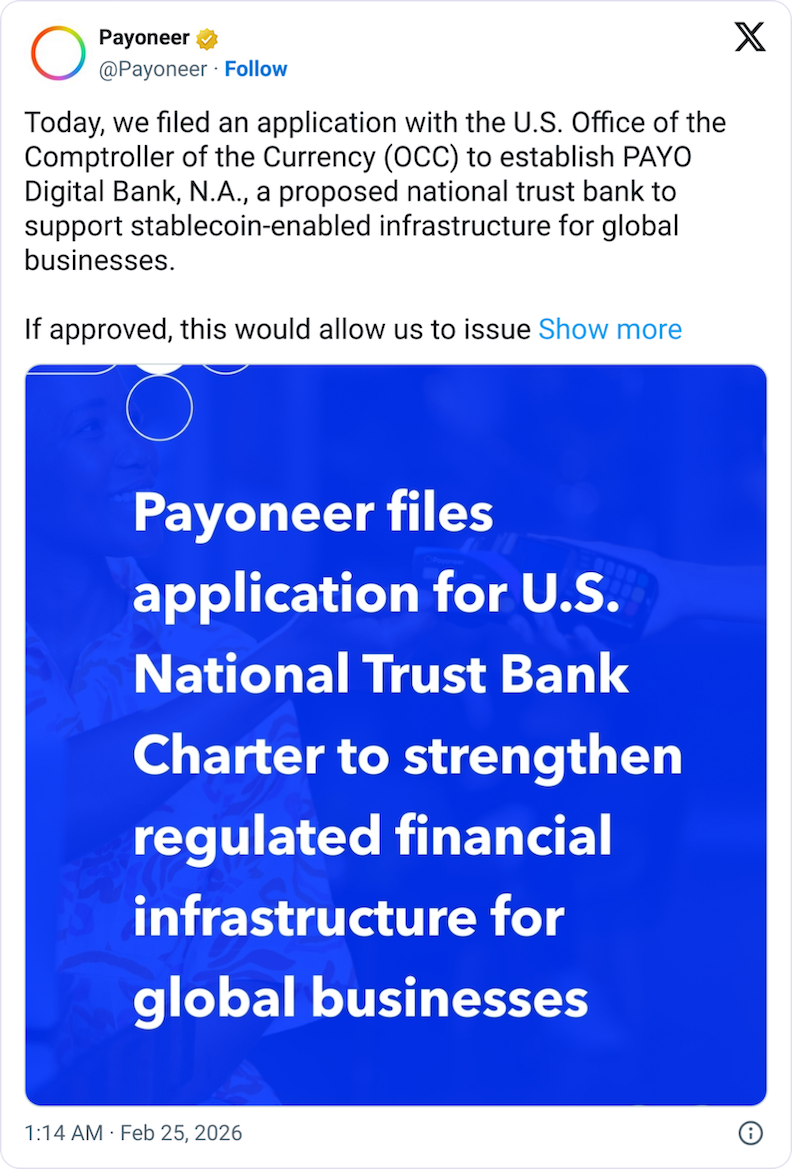
Global financial services firm Payoneer is the latest in a growing number of companies that have filed for a national trust banking charter in the US, which could enable it to issue a stablecoin and provide various crypto services.
Payoneer said on Tuesday it filed with the Office of the Comptroller of the Currency to form PAYO Digital Bank, a week after it partnered with stablecoin infrastructure firm Bridge to add stablecoin capabilities to its platform that is mainly focused on cross-border transactions.
Payoneer said that it is seeking to issue a GENIUS Act-compliant stablecoin, PAYO-USD, to serve as the holding currency in Payoneer wallets, in addition to allowing customers to pay and receive stablecoins.
OCC approval would also enable Payoneer to manage PAYO-USD reserves, offer custodial services and enable customers to convert between the stablecoins into their local currency.
“We believe stablecoins will play a meaningful role in the future of global trade,” said Payoneer CEO John Caplan.

The OCC gave conditional approval to Crypto.com for a charter on Monday, adding to the banking charters won by crypto companies Circle, Ripple, Fidelity Digital Assets, BitGo and Paxos in December.
Related: Better, Framework Ventures reach $500M stablecoin mortgage financing deal
The Trump family’s World Liberty Financial also applied for one in January to expand the use of its USD1 (USD1) stablecoin, but is still awaiting a decision.
Crypto trading platform Laser Platform also submitted an application in January, while Coinbase has been awaiting a decision on its application since October.
Stablecoins ideal for business cross-border transfers: Payoneer
Payoneer said OCC approval would allow it to offer its nearly two million customers, which are mostly small and medium-sized businesses, a regulated stablecoin solution to simplify cross-border trade.
“This offering will help advance the use of the USD in global trade, reduce barriers for American companies competing internationally, and expand the dollar’s presence across non-dollar payment corridors,” it said.
In December, Comptroller of the Currency Jonathan Gould said that new entrants to the federal banking sector was “good for consumers, the banking industry and the economy [as] they provide access to new products, services and sources of credit to consumers, and ensure a dynamic, competitive and diverse banking system.”
Magazine: Did a Hong Kong fund kill Bitcoin? Bithumb’s ‘phantom’ BTC: Asia Express
Bitcoin price is attempting a recovery near $65,000 as the Coinbase Premium turns positive despite recent exchange-traded fund outflows.
Summary
- Bitcoin price prediction leans towards trend reversal as the Coinbase Premium flips positive.
- The metric indicates strong U.S. demand returning after recent ETF outflows.
- Price must reclaim key resistance to confirm a stronger recovery.
Bitcoin was trading at $65,907 at press time, up 3.4% in the last 24 hours. The move follows a drop to $62,900 within the past week, where buyers stepped in.
Even with the bounce, Bitcoin (BTC) is still down 24% over the past month and about 50% below its October 2025 all-time high of $126,050.
Trading activity increased during the recovery. Spot volume reached $46 billion, up 22% day over day. In derivatives markets, CoinGlass data shows futures volume up 6.2% to $74.8 billion, while open interest slipped 0.1% to $43.9 billion.
This suggests some traders are closing positions rather than adding aggressive leverage.
Coinbase premium turns positive
On Feb. 25, the Coinbase Premium Index turned positive for the first time in 40 days, hitting 0.0525%, according to CoinGlass.
The index measures the price difference between Coinbase and global exchanges. A positive reading means Bitcoin trades slightly higher on Coinbase, which often reflects stronger U.S. demand.
This shift comes at a time when U.S. spot Bitcoin ETFs have recorded heavy outflows, with roughly $3.8 billion exiting recently. That contrast is important. While ETFs have seen capital leave, the premium suggests some U.S. buyers are stepping back in through exchange flows.
In past cycles, sustained positive premiums have aligned with accumulation phases and relief rallies. However, a single flip does not confirm a trend change. Traders will watch if the premium widens and holds over several sessions.
Bitcoin price prediction: Is the trend reversing?
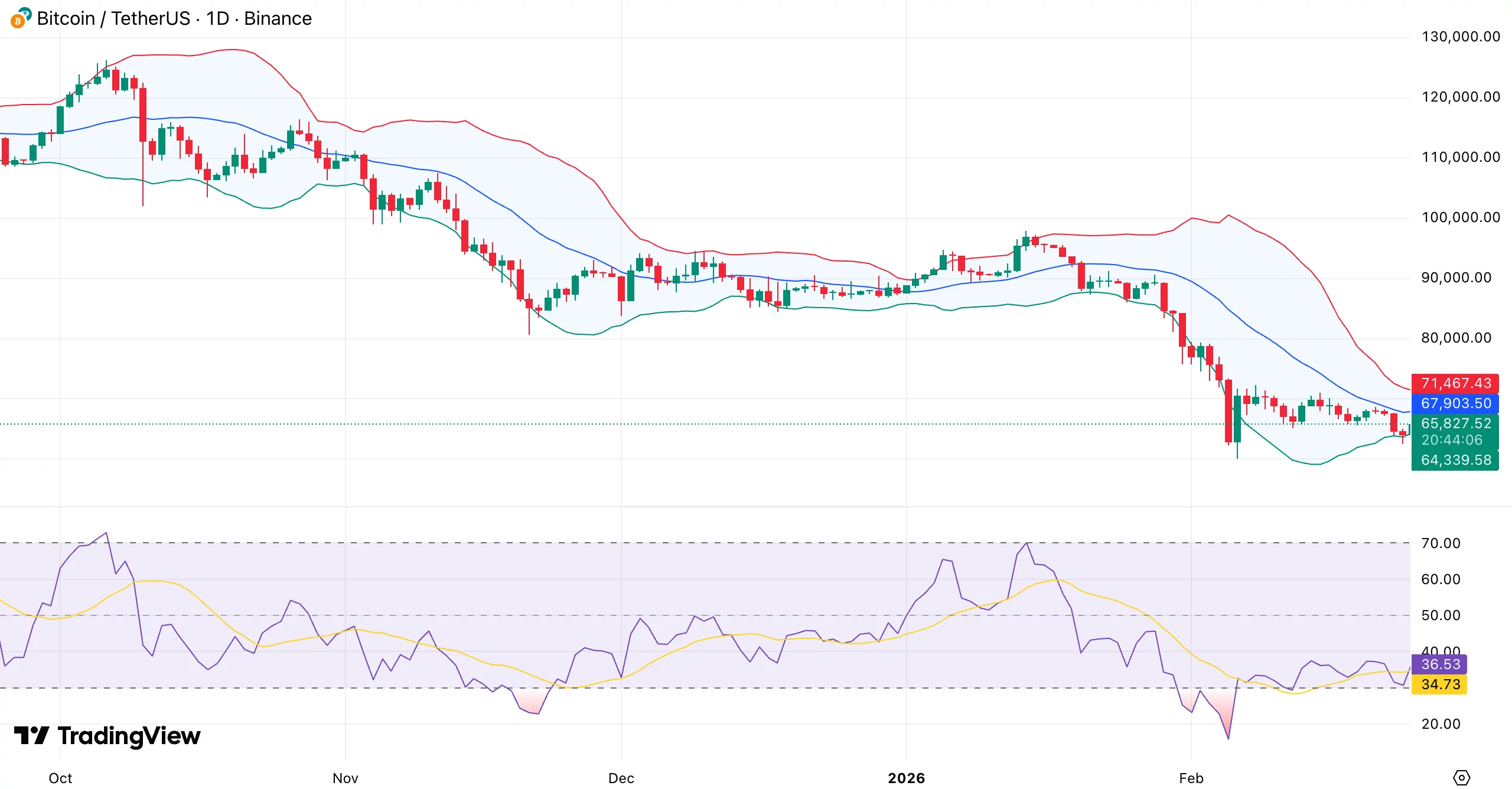
Bitcoin is attempting to stabilize after a sharp corrective phase. On the daily chart, price is still trading below its short-term trend pivot near the mid-Bollinger band around the high -$67,000 area.
That zone now acts as the line that separates a relief bounce from a stronger recovery attempt.
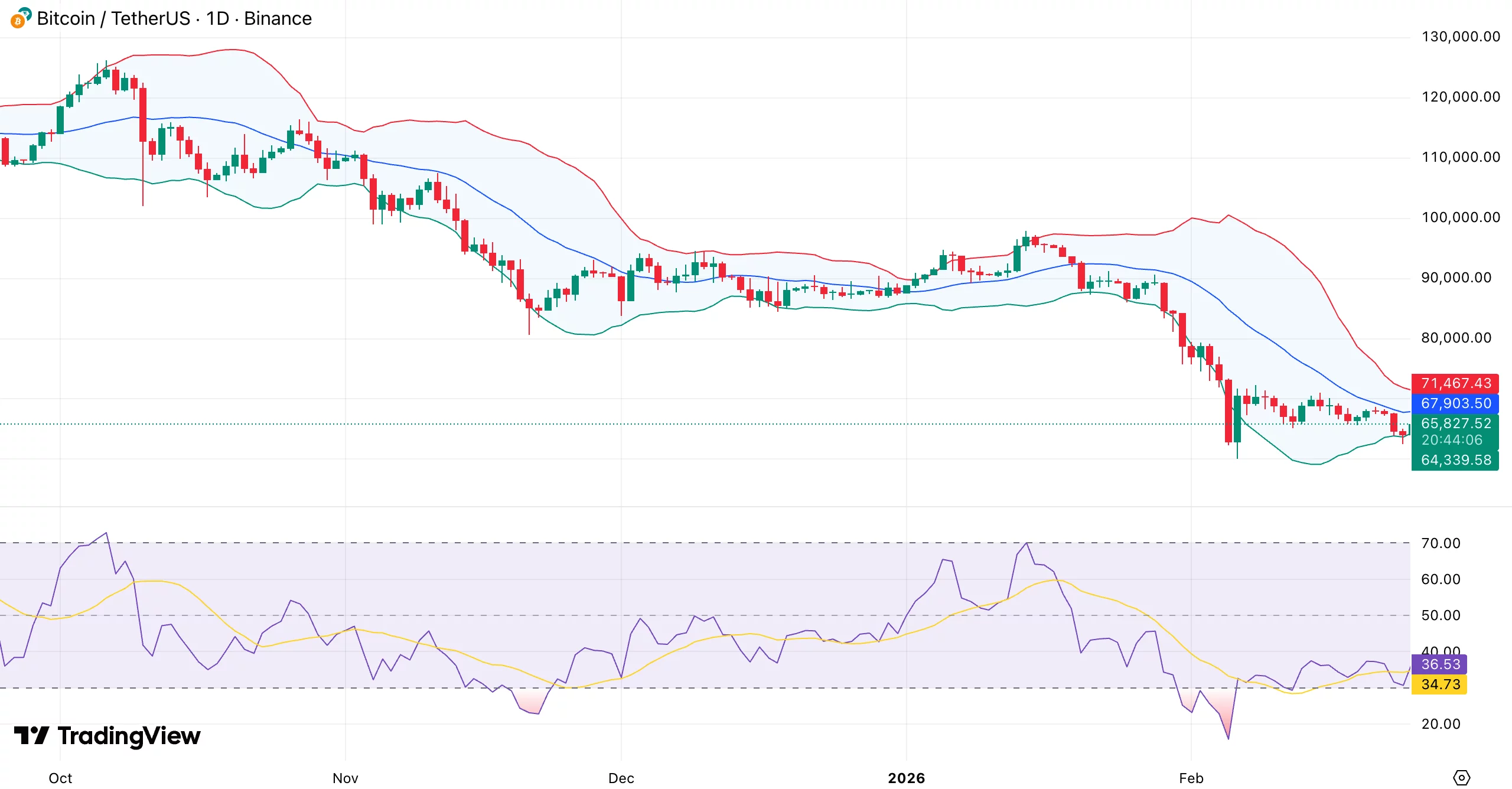
Momentum indicators show improvement from oversold conditions, with the relative strength index climbing from sub-30 levels earlier in February. Bulls have not yet completely taken back control, though, as the RSI is still below the midpoint.
The recovery might reach the low -$70,000 area if the Coinbase Premium holds positive and Bitcoin breaks through the mid-band resistance with growing spot volume. A move into that zone would shift short-term structure and increase confidence that the trend has reversed.
On the other hand, failure to reclaim resistance would keep the price vulnerable to another pullback toward the mid -$64,000 area. A break below that support would raise the risk of a deeper move toward $60,000.

TLDR
- Binance has relaunched tokenized stocks trading through a partnership with Ondo Finance on Binance Alpha.
- The platform lists 10 tokenized U.S. stocks, ETFs, and commodity-linked products.
- Users in the United States cannot access the new tokenized stock offerings.
- Binance previously halted a similar service in 2021 after regulatory scrutiny in Europe.
- Ondo Finance has recorded over $550 million in locked value and $11 billion in cumulative trading volume since September 2025.
Binance has relaunched tokenized stocks trading through a new partnership with Ondo Finance. The exchange will list 10 tokenized U.S. stocks, ETFs, and commodity-linked products on Binance Alpha. The move marks Binance’s return to this market nearly five years after halting a similar service.
Binance and Ondo Finance Launch Tokenized Equities on Alpha
Binance has partnered with Ondo Finance to introduce tokenized versions of major U.S. equities on Binance Alpha. The platform operates within Binance Wallet and targets early-stage digital asset offerings. Users can trade blockchain-based versions of Apple, Google, Tesla, and Nvidia shares.
The lineup also includes the Invesco QQQ ETF, which tracks the Nasdaq index. Binance confirmed that users in the United States cannot access these tokenized stocks. Jeff Li, Binance’s vice president of product, said, “Our users now have even more convenient ways to explore and trade tokenized stocks.”
Binance Alpha allows access to projects before they reach the centralized spot marketplace. The company positions the platform as a gateway for higher-risk digital assets. Through this structure, Binance expands product access while keeping trading within its wallet ecosystem.
Ondo Finance issues the tokenized equities listed on the platform. The company focuses on bridging traditional financial assets with blockchain networks. Binance integrates these tokens directly into its wallet infrastructure.
Binance previously launched tokenized stocks in April 2021, starting with Tesla shares. The exchange later added Coinbase, Strategy, Microsoft, and Apple to the offering. However, regulators in the United Kingdom and Germany raised compliance concerns.
The U.K.’s Financial Conduct Authority and Germany’s BaFin reviewed the product structure. Following regulatory scrutiny, Binance discontinued the service within months. The company has now resumed tokenized equities through its collaboration with Ondo Finance.
Last month, Binance stated that it was considering a renewed push into tokenized equities. The latest listings on Binance Alpha confirm that plan. The rollout follows growing activity in blockchain-based stock trading platforms.
Tokenized Stocks Market Expands Across Exchanges
Tokenized stocks have grown across crypto exchanges and traditional brokerages. The sector’s total value approaches $1 billion, according to recent market data. Ondo Finance reports more than $550 million in locked value.
The company also recorded $11 billion in cumulative trading volume since September 2025. Other exchanges, including Kraken, Bybit, and Gemini, have introduced similar products. Robinhood has also launched tokenized equity trading services.
Traditional exchanges have also outlined plans involving stock tokens. Nasdaq and the New York Stock Exchange have presented proposals tied to blockchain-based trading models. These developments align with Binance’s renewed entry into tokenized equities through Ondo Finance.
The biggest Bitcoin ATM operator in the US has begun phasing in a new requirement for users to provide identification for every transaction at its crypto ATMs amid increasing pressure from regulators and lawmakers for operators to curb illicit activity.
Bitcoin Depot said on Tuesday that it began the rollout earlier in February across the company’s US network ATMs, with the goal of helping to detect suspicious activity in real time and eliminate misuse by bad actors, such as account sharing, identity theft, and account takeover.
“Continuous verification allows us to detect suspicious activity based on customers, locations, or transaction amount before a transaction is approved,” Bitcoin Depot CEO Scott Buchanan said in a statement.
Bitcoin Depot implemented ID requirements in October, but only for all new users to its service. Buchanan said that “by requiring identity verification at every transaction, we are taking an additional step to strengthen security, protect customers, and maintain the integrity of our services.”
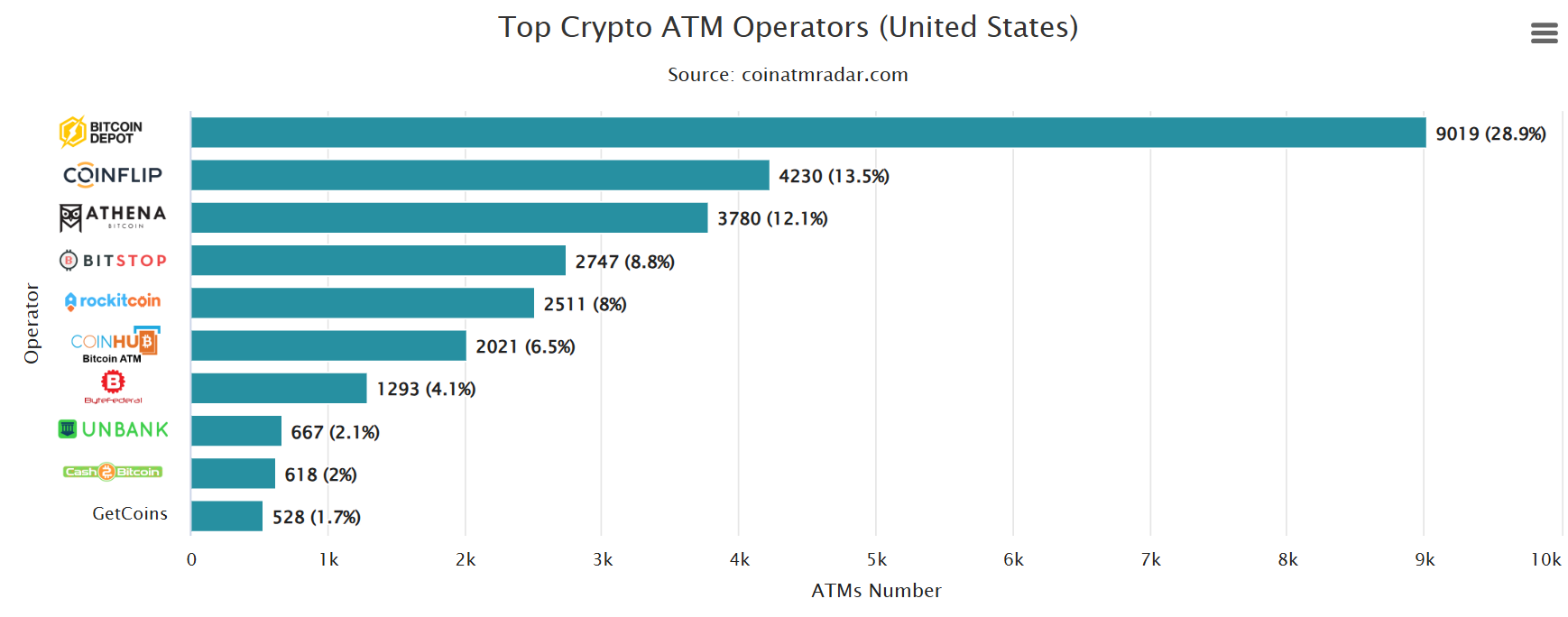
The US is the largest hub for Bitcoin (BTC) ATMs, with Coin ATM Radar listing 31,360 machines, accounting for 78% of the worldwide total. Bitcoin Depot is the market leader in the country with 9,019 kiosks.

Bitcoin Depot faces state-level lawsuits
Scammers have long used crypto ATMs as a way to receive funds from unwitting victims, as the kiosks are widespread and their transactions are irreversible, leading regulators and lawmakers to crack down on crypto ATM operators.
The advocacy organisation, the American Association of Retired Persons, reported in February that 17 US states have passed laws requiring crypto ATM operators to implement protections, including daily transaction limits, fraud warning signs, and licensing requirements.
Related: Crypto ATM limits and bans sweep across US: Here’s why
Bitcoin Depot has caught the ire of state regulators, as Massachusetts Attorney General Andrea Campbell sued Bitcoin Depot earlier this month, alleging the company has not implemented sufficient safeguards to prevent scams. Campbell is seeking a court order to bar Bitcoin Depot from processing large transactions without additional user protections.
In January, Maine Attorney General Aaron Frey reached a $1.9 million settlement with Bitcoin Depot to reimburse individuals who lost money to scams while using the company’s ATMs.
Last year, Iowa Attorney General Brenna Bird launched a lawsuit against both Bitcoin Depot and its rival Coinflip, alleging the operators failed to implement adequate protections to prevent scams.
Magazine: 6 massive challenges Bitcoin faces on the road to quantum security


Mastercard is hiring a Director of Crypto Flows to lead stablecoin-linked card issuance, scale DeFi payment flows, and rewrite network rules for Web3 transactions.
The job posting, first surfaced by crypto journalist Frank Chaparro on Feb. 24, signals a structural push beyond the pilot-stage experiments the payments giant has run so far.
The Timing That Writes Itself
Days earlier, Citrini Research published “The 2028 Global Intelligence Crisis,” a doomsday scenario that rapidly went viral on Substack. The report maps a chain reaction in which AI agents progressively dismantle fee-based intermediaries — and payment networks sit squarely in the blast radius. Citrini specifically names Mastercard’s Q1 2027 earnings as a potential inflection point, the moment when agentic commerce begins routing around card interchange via stablecoins.
The logic is straightforward. When AI agents transact on behalf of consumers, a 2-3% card interchange fee becomes an irrational cost. Stablecoin rails settle the same transaction for near zero. In that world, Mastercard doesn’t lose to a competitor. It loses to a protocol.
The gap Mastercard needs to close
The vulnerability is not hypothetical. Stablecoins transferred $18.4 trillion in value in 2024, surpassing both Visa ($15.7 trillion) and Mastercard ($9.8 trillion) in raw volume, according to Artemis Analytics. The comparison is imperfect — much of that is trading, not payments — but the directional signal is clear.
Mastercard’s own CEO, Michael Miebach, told analysts in January that the company is “leaning in” to stablecoins and agentic commerce, calling the latter a trend in which “the train is leaving the station.” Yet he framed stablecoins as “another currency we can support within our network.”
That framing is precisely what Citrini challenges. The doomsday thesis is not that stablecoins replace card payments at today’s checkout counter. It is that a new category of commerce — machine-to-machine, micropayment-dense, 24/7 — will emerge entirely outside the card network’s design envelope.
Building rails or getting routed around
The new role suggests Mastercard is beginning to internalize this risk. Mastercard has laid the groundwork: onboarding multiple stablecoins onto its network in June 2025, expanding Circle’s USDC settlement across the Middle East and Africa, and reportedly pursuing a $2 billion acquisition of crypto infrastructure startup zerohash.
But the gap with Visa persists. Visa’s on-chain stablecoin settlement reached an annual run rate of $3.5 billion by late 2025. Crypto-native issuers like Rain and Reap built their card programs primarily on Visa rails, with Rain scaling to over $3 billion annualized after securing direct Visa membership. Industry analysis suggests Visa’s early crypto-native alignment translated into share, while Mastercard’s exchange-focused approach generated less volume.
Coincidence or confirmation
Regardless of whether Mastercard’s hiring push was triggered by Citrini’s report, the more important reading is that the diagnosis is converging. A research outfit writing from 2028 and a payments giant hiring in 2026 point at the same fault line. Card networks that cannot accommodate stablecoin-native commerce will be bypassed, not disrupted.
The canary, as Citrini wrote, is still alive. The question is whether Mastercard is building a bridge to close the gap—or just hiring someone to watch it widen.
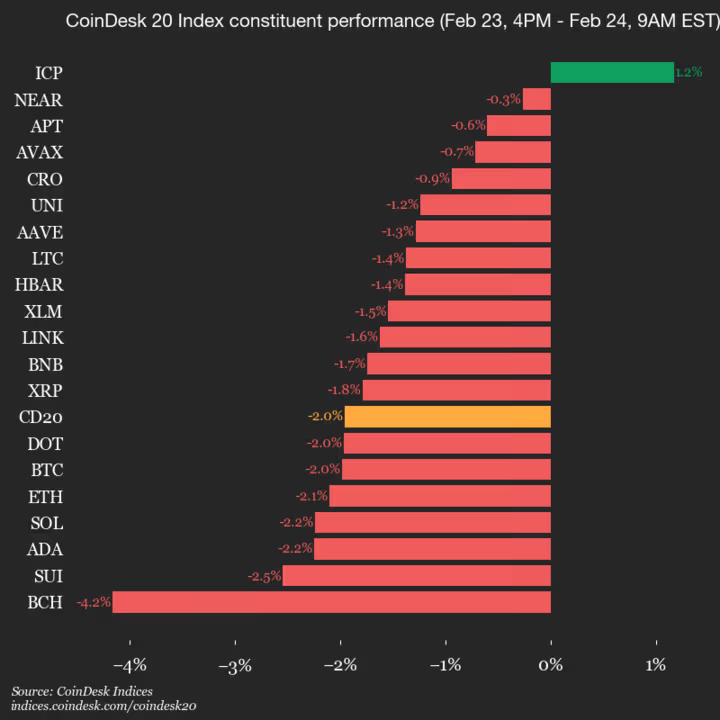
CoinDesk Indices presents its daily market update, highlighting the performance of leaders and laggards in the CoinDesk 20 Index.
The CoinDesk 20 is currently trading at 1816.14, down 2.0% (-36.33) since 4 p.m. ET on Monday.
One of the 20 assets is trading higher.

Leaders: ICP (+1.2%) and NEAR (-0.3%).
Laggards: BCH (-4.2%) and SUI (-2.5%).
The CoinDesk 20 is a broad-based index traded on multiple platforms in several regions globally.


The Ethereum Foundation has begun staking a portion of its treasury holdings, marking a significant shift in how the organization manages its ETH reserves.
Summary
- The Ethereum Foundation has begun staking its treasury, starting with a 2,016 ETH deposit and planning to stake approximately 70,000 ETH in total.
- Staking rewards will be directed back to the foundation’s treasury to help fund core operations, including protocol R&D, ecosystem grants and community development.
- The validator setup uses open-source tools from Attestant, including Dirk and Vouch, with a focus on distributed signing, minority clients and multi-jurisdiction infrastructure.
Ethereum Foundation puts treasury to work with 70K ETH staking plan
In a post on X, the foundation said it has made an initial deposit of 2,016 Ethereum (ETH) and plans to stake approximately 70,000 ETH in total, with staking rewards directed back into its treasury. The move follows a Treasury Policy announced last year and is designed to both support network security and help fund the foundation’s core operations.
The staking setup is being implemented using open-source tools developed by Attestant, including Dirk and Vouch.
Dirk functions as a distributed signer, allowing validators to be operated across multiple jurisdictions and reducing the risk of a single point of failure.
Vouch enables the use of multiple consensus and execution client pairings, helping mitigate client diversity risks, a key concern for Ethereum’s decentralization model. The foundation said its validator setup incorporates minority clients and a mix of hosted infrastructure and self-managed hardware spread across several regions.
The announcement comes at a notable moment for Ethereum. Recently co-founder Vitalik Buterin sold roughly $7 million worth of ETH amid a broader price pullback, sparking discussion about treasury management and market signals.
At the same time, the foundation has been expanding ecosystem support through new grant initiatives, including updates to its Ecosystem Support Program aimed at funding protocol research, community development and public goods projects.
By staking a portion of its holdings, the foundation is effectively putting dormant ETH to work, generating yield while reinforcing validator participation. The move aligns the treasury more closely with Ethereum’s proof-of-stake design and provides an additional funding stream for long-term development efforts without relying solely on asset sales.
Payment processing firm Stripe is reportedly considering an acquisition of all or parts of its rival PayPal Holdings.
Stripe is in early talks and has expressed preliminary interest in PayPal or parts of its business, though no deal is guaranteed, Bloomberg reported on Tuesday, citing people familiar with the matter.
It comes as Stripe, which enables enterprises to accept payments, make payouts, and automate financial processes, said on Tuesday that it was valued at $159 billion in a tender offer to shareholders and employees, a 74% jump from a year ago.
The move comes as PayPal has been reportedly struggling to compete with the likes of Google Pay and Apple Pay, which are embedded in consumer smartphones.
Stripe president John Collison told Bloomberg that “PayPal has had, obviously, a tough time over the past few years, and the landscape has changed quite a bit with Apple Pay and Google Pay and everything like that.”
“I can’t talk about any, you know, M&A [mergers and acquisitions] hypotheticals, but they’ve definitely had a tough time,” he added.
PayPal stock gains on the day
PayPal is also in leadership transition, with new CEO Enrique Lores set to take over on March 1 following the ouster of Alex Chriss, amid missed earnings estimates and slowing payment volumes.
Related: PayPal draws takeover interest following 46% stock slide: Report
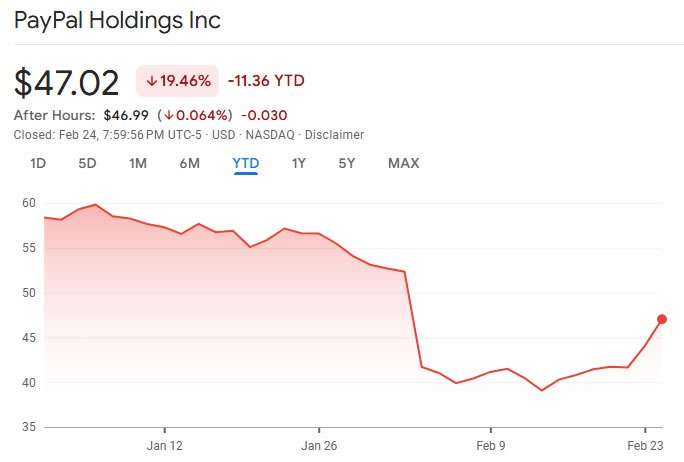
PayPal stock (PYPL) gained 6.74% on Tuesday to end the day trading at $47.02, according to Google Finance. However, shares in the payments platform have declined almost 20% since the beginning of this year and are down 85% from their 2021 all-time high of just over $300.

PayPal, Stripe have serious stablecoin ambitions
PayPal began offering crypto trading in the US in 2020 and launched its own stablecoin PYUSD in 2023. The dollar-pegged asset has gained traction in recent months with its market capitalization topping $4 billion for the first time on Feb. 14.
Stripe has also been dabbling in crypto with its stablecoin platform Bridge, which received conditional approval to operate as a federally chartered national trust bank under the US Office of the Comptroller of the Currency (OCC) on Feb. 17.
Stripe first offered stablecoin-based accounts globally in May 2025. A merger could see the new entity become a serious player in the stablecoin market.
Magazine: Bitdeer sells all Bitcoin, Metaplanet rejects misconduct claims: Asia Express


Bitcoin fell below 200-week EMA, over 52% off peak, risking death-cross capitulation.
Summary
- BTC closed last week under the 200-week EMA, a key confluence zone tied to post-halving re-accumulation range highs, after three weeks of elevated sell volume and weak demand.
- Analysts warn BTC may retest the underside of the 200-week EMA as new resistance, echoing 2018 and 2022 structures that triggered a second bearish acceleration wave.
- BTC has dropped over 52% from its October top and approaches a 3-day 50/200 SMA death cross by late February, historically followed by an additional 45%-52% drawdown.
Bitcoin (BTC) closed the week below a critical support level, falling beneath that threshold for the first time since early February and reaching a two-week low, according to market data. Analysts have warned that the cryptocurrency could face additional downward pressure.
Analyst Rekt Capital stated that Bitcoin closed last week below the 200-week Exponential Moving Average (EMA), which sits at the center of a major confluence zone. The 200-week EMA aligns with the Post-Halving Re-accumulation Range highs, while the Post-Halving Re-accumulation Range lows define the broader structure of Bitcoin’s current range, according to the analyst.
Over the past three weeks, the cryptocurrency attempted to develop a demand region around this area, which was previously a major supply area, Rekt Capital noted. The analyst stated that this level has not historically been a structurally reliable support, noting that it previously acted as a 10-month resistance.
“In the current structure, we have seen three consecutive weeks of elevated sell-side volume in this region, with limited meaningful buy-side response,” the analyst stated in a post. The imbalance led to a weekly close below the 200-week EMA, losing it as support in this timeframe, according to the analysis.
Rekt Capital stated that there is a strong probability that Bitcoin will press back toward the underside of that EMA to attempt turning it into new resistance. If the underside retest holds, the structure would shift from defending the support to confirming the resistance at this level, the analyst said. The analyst added that if that level begins to act as resistance, downside continuation will become increasingly probable.
The analyst also noted that Bitcoin’s recent performance aligns closely with its price action in prior cycles. In 2018 and 2022, a weekly close below the 200-week EMA acted as a structural trigger to the second wave of bearish acceleration, according to the analysis. “Bitcoin would attempt to reclaim the level, turn it into resistance, and then dissipate lower. That pattern is now attempting to replicate itself,” Rekt Capital stated.
Analyst Ali Martinez pointed to the cryptocurrency’s historical performance on the three-day chart, stating that this has been one of Bitcoin’s key timeframes from a macro perspective. Martinez said market observers must watch the upcoming interaction of the 50-day and 200-day Simple Moving Averages (SMAs), as the crossover between these two indicators on the three-day timeframe has historically preceded the final leg down of the bear market.
Bitcoin dropped approximately 50% to 72% from its cycle tops in past cycles before death crosses took place in subsequent years, according to historical data. Following those SMA crossovers, the cryptocurrency experienced another 45% to 52% decline, Martinez noted. Bitcoin has fallen more than 52% from its October peak and is approaching a potential death cross on the three-day chart by the end of February, according to the analyst.
“If history repeats — even partially — this could signal the beginning of the final leg down of this cycle,” Martinez stated. The analyst predicted that another substantial correction from current levels could follow, placing the cryptocurrency’s target near lower support levels. “If the cross confirms, it becomes a level to take very seriously,” Martinez said.

Cross-Chain Governance Attacks – Smart Liquidity Research
Congressman holding sign aimed at Donald Trump ejected from State of the Union address

Flats boss Eddie Kamil loses battle over consumer warnings


-

 Video5 days ago
XRP News: XRP Just Entered a New Phase (Almost Nobody Noticed)
-

 Fashion4 days ago
Weekend Open Thread: Boden – Corporette.com
-

 Politics3 days ago
Baftas 2026: Awards Nominations, Presenters And Performers
-

 Entertainment7 days ago
Kunal Nayyar’s Secret Acts Of Kindness Sparks Online Discussion
-

 Sports1 day ago
Women’s college basketball rankings: Iowa reenters top 10, Auriemma makes history
-

 Politics1 day ago
Nick Reiner Enters Plea In Deaths Of Parents Rob And Michele
-

 Tech7 days ago
Retro Rover: LT6502 Laptop Packs 8-Bit Power On The Go
-
 Sports6 days ago
Clearing the boundary, crossing into history: J&K end 67-year wait, enter maiden Ranji Trophy final | Cricket News
-

 Business3 days ago
Mattel’s American Girl brand turns 40, dolls enter a new era
-

 Crypto World21 hours ago
XRP price enters “dead zone” as Binance leverage hits lows
-

 Business2 days ago
Law enforcement kills armed man seeking to enter Trump’s Mar-a-Lago resort, officials say
-

 Entertainment6 days ago
Dolores Catania Blasts Rob Rausch For Turning On ‘Housewives’ On ‘Traitors’
-

 Business7 days ago
Tesla avoids California suspension after ending ‘autopilot’ marketing
-

 Tech2 days ago
Anthropic-Backed Group Enters NY-12 AI PAC Fight
-
 NewsBeat2 days ago
‘Hourly’ method from gastroenterologist ‘helps reduce air travel bloating’
-

 NewsBeat2 days ago
Armed man killed after entering secure perimeter of Mar-a-Lago, Secret Service says
-

 Politics3 days ago
Maine has a long track record of electing moderates. Enter Graham Platner.
-

 Crypto World6 days ago
WLFI Crypto Surges Toward $0.12 as Whale Buys $2.75M Before Trump-Linked Forum
-

 Tech10 hours ago
Unsurprisingly, Apple's board gets what it wants in 2026 shareholder meeting
-
 NewsBeat6 hours ago
Police latest as search for missing woman enters day nine