Ether has not reclaimed the $2,500 level since late January, and traders are awaiting catalysts to spark a fresh run. The latest signals from institutions point to a shift in appetite: some of the industry’s biggest players are reallocating from BTC-centric exposure toward Ethereum-focused ETFs. Harvard’s endowment disclosed an $87 million stake in BlackRock’s iShares Ethereum Trust during Q4 2025, while trimming holdings in the iShares Bitcoin Trust. Separately, the market for real-world assets tokenized on Ethereum surpassed $20 billion in aggregate value, reflecting a growing blend of traditional finance with blockchain rails. With the bear market bottom noted around $1,744 on February 6, analysts are watching for decisive momentum that could sustain a rebound.
Key takeaways
Institutional sentiment is shifting toward Ether as elite funds reallocate capital from Bitcoin to Ether ETFs.
BlackRock’s Staked Ethereum ETF features a 0.25% expense ratio and an 18% retention of staking rewards as service fees to intermediaries, balancing incentives in the staking flow.
Real-world asset tokenization on Ethereum has surpassed $20 billion in aggregate value, with broad participation from BlackRock, JPMorgan Chase, Fidelity and Franklin Templeton.
Harvard’s SEC filings show an $87 million addition to BlackRock’s iShares Ethereum Trust during Q4 2025, alongside a reduction in its iShares Bitcoin Trust.
Dragonfly Capital’s $650 million funding round signals sustained appetite for tokenized stocks and private credit offerings on-chain, reinforcing the momentum toward RWAs and custody infrastructure.
Tickers mentioned: (omitted as per guidance to avoid introducing tickers not clearly provided in the source)
Sentiment: Neutral
Price impact: Positive. The combination of renewed institutional interest and expanding RWA activity on Ethereum could support a constructive price bias for ETH over the medium term.
Trading idea (Not Financial Advice): Hold. The emerging mix of ETF activity and RWA infrastructure suggests potential for a delay-driven rebound, pending clearer price confirmations.
Advertisement
Market context: The ETH narrative sits at the intersection of regulated access to staking, continued ETF experimentation, and a broadening roster of on-chain real-world asset use cases. While spot flows have been modest in the near term, the participation of major asset managers in ETH-focused vehicles points to growing demand for regulated exposure and secure custody solutions within the crypto ecosystem. The sector remains sensitive to overall risk appetite, macro cues, and regulatory developments that could influence institutional allocations to crypto assets.
Why it matters
The trajectory for Ether as a mainstream financial instrument hinges on the alignment between traditional finance’s risk controls and the evolving capabilities of on-chain infrastructure. The ongoing expansion of RWAs on Ethereum demonstrates that large-scale capital is looking beyond pure speculative bets toward assets that can be tokenized, securitized, and traded within regulated frameworks. A 0.25% expense ratio on a Staked Ethereum ETF, paired with an 18% retention of staking rewards as fees, signals an industry attempt to balance competitive pricing with sustainable staking incentives. The underlying staking ecosystem—where custodians like Coinbase play a key role in facilitating services—highlights a path for institutions to access ETH staking without shouldering daily operational risk directly.
Moreover, the $20+ billion RWA market on Ethereum reflects a concerted effort to bring real assets onto the blockchain, blending gold, Treasuries and bonds with programmable settlement and liquidity access. The involvement of BlackRock, JPMorgan Chase, Fidelity and Franklin Templeton underscores how the line between traditional custody and digital asset infrastructure is blurring. In parallel, venture funding from players like Dragonfly Capital reinforces confidence in the long-run viability of tokenized stocks and private credit offerings, suggesting a maturation phase for the sector that could underpin sustained demand for ETH as a settlement and collateral layer.
Price catalysts remain tied to the broader risk environment. While a near-term move to $2,500 is discussed in market chatter, the path will likely depend on regulatory clarity, ETF inflows, and the pace at which RWAs scale from pilot projects to widely adopted products. The bear market bottom observed in early February may prove to be a reference point if new catalysts emerge, but investors will want to see consistent demand signals, improved liquidity, and clear governance for staking yield structures before committing meaningful capital.
Advertisement
What to watch next
Regulatory milestones for ETH-focused ETFs and any SEC updates on product approvals or adjustments.
Upcoming quarterly ETF flow data to gauge whether institutional inflows into Ether-based products accelerate.
New RWAs issuances and partnerships on Ethereum, including any large-scale tokenizations of traditional assets.
Price action around the $2,000–$2,500 zone and whether macro risk sentiment supports a durable breakout for ETH.
Sources & verification
Harvard’s 2025 Q4 Form 13F filings showing an $87 million stake in BlackRock’s iShares Ethereum Trust and adjustments to its iShares Bitcoin Trust.
MarketBeat data detailing changes in notable iShares Ethereum Trust holdings.
DefiLlama data on the RWAs aggregate on Ethereum exceeding $20 billion in value.
Dragonfly Capital’s $650 million fundraise focused on tokenized RWAs and related on-chain infrastructure.
Institutional bets build as ETH ETFs mature and RWAs expand
Ether (CRYPTO: ETH) has begun to demonstrate a degree of resilience that could be the prelude to a broader regime shift in active institutional exposure. The most meaningful signal to date is the combination of major asset managers embracing Ethereum-based products and the rapid expansion of real-world asset tokenization that sits atop the Ethereum chain. The Harvard disclosures, which show an $87 million addition to BlackRock’s iShares Ethereum Trust in Q4 2025, and a concurrent trimming of iShares Bitcoin Trust holdings, exemplify a nuanced preference for ETH-driven exposure over BTC-focused routes. This bifurcation in appetite suggests institutions are seeking regulated, scalable access to staking and on-chain liquidity, rather than relying solely on the volatility of the broader crypto market.
BlackRock’s Staked Ethereum ETF adds another dimension to the narrative. With a 0.25% expense ratio and an 18% retention of staking rewards as service fees, the vehicle aims to strike a pragmatic balance between cost efficiency and the revenue necessary to compensate the intermediaries that enable staking. The arrangement underscores a broader trend in the industry: in order to scale, staking products must align the incentives of custodians, exchanges, and fund managers with the long-term interests of investors seeking yield-bearing crypto exposure. Coinbase’s involvement as a staking service intermediary is cited as a notable practical factor in ensuring smooth on-ramp and on-chain execution for such portfolios.
Beyond the ETF mechanics, the size and scope of RWAs on Ethereum point to a maturation of the ecosystem. The aggregate RWAs on Ethereum now surpass $20 billion, a milestone that includes tokenized gold and a growing slice of US Treasuries, bonds, and money market funds. The involvement of major financial institutions—BlackRock, JPMorgan Chase, Fidelity, and Franklin Templeton—signals a coordinated push to bring more traditional assets under a tokenized, on-chain framework. When measured alongside other blockchain ecosystems, Ethereum’s RWAs stand out as a bridge between regulated finance and decentralized technologies, reinforcing the case for ETH as a robust platform for both settlement and collateral.
The venture funding environment is also shifting in this space. Dragonfly Capital’s recent $650 million round, aimed at real-world assets and tokenized financial instruments, illustrates persistent appetite from crypto-focused investors to back asset-backed models that operate in concert with established market infrastructure. In practice, this means more pilot programs, more credible custodial arrangements, and more sophisticated deals that link asset origination with tokenized issuance and on-chain trading. The result could be a multi-year trajectory in which RWAs contribute to sustained demand for ETH, even as the broader crypto market experiences sideways or choppy price action.
From a price perspective, the catalysts discussed—ETF inflows, deeper RWA adoption, and regulatory clarity—could provide the conditions for a rebound toward the $2,500 level noted in market discussions. The bear cycle that bottomed near $1,744 on February 6 has left a price floor that investors are watching closely, with the possibility of a renewed risk-on environment driving ETH higher as institutional confidence grows. While no single event guarantees a sustained rally, the confluence of regulated access, staking economics, and tangible on-chain assets tied to ETH strengthens the case for a constructive, though cautious, upside path in the medium term. The landscape suggests that the next phase of ETH’s price narrative will be driven less by frothy retail speculation and more by disciplined, asset-backed finance and regulated market access. Harvard’s stake in BlackRock’s ETH Trust and the evolving real-world asset framework remain central reference points as this story develops. For additional context on RWAs’ market dynamics, see Tokenized RWAs climb despite market rout, and for coverage of Dragonfly Capital’s funding round, visit Dragonfly’s $650M fund. The price-angle discussion around a potential move to $2,500 is also explored in ETH chart patterns and rally scenarios as noted in market analysis. Investors should monitor price action, ETF flow data, and regulatory developments to gauge how these structural shifts translate into tangible market movements.
Advertisement
Risk & affiliate notice: Crypto assets are volatile and capital is at risk. This article may contain affiliate links. Read full disclosure
Jeff Park voluntarily resigned as Chief Investment Officer of ProCap Financial (BRR), effective April 3, 2026, according to an SEC filing.
The departure ends an eight-month stint at the Bitcoin treasury company founded by Anthony Pompliano. ProCap has not named a successor.
What the SEC Filing Reveals
The 8-K filing states Park’s exit was voluntary and not tied to any disagreement with ProCap’s board over operations, policies, or practices. Park also resigned from all subsidiary positions.
Resigned as CIO of ProCap today. Day 1 of whatever’s next. More soon.
His separation agreement, dated April 3, includes salary continuation through May 8, 2026, and continued vesting of restricted stock units through August 2026.
ProCap will also cover up to six months of group health insurance.
However, one detail stands out. The company waived Park’s non-compete covenant entirely.
He remains bound by confidentiality, non-solicitation, and non-disparagement clauses.
Advertisement
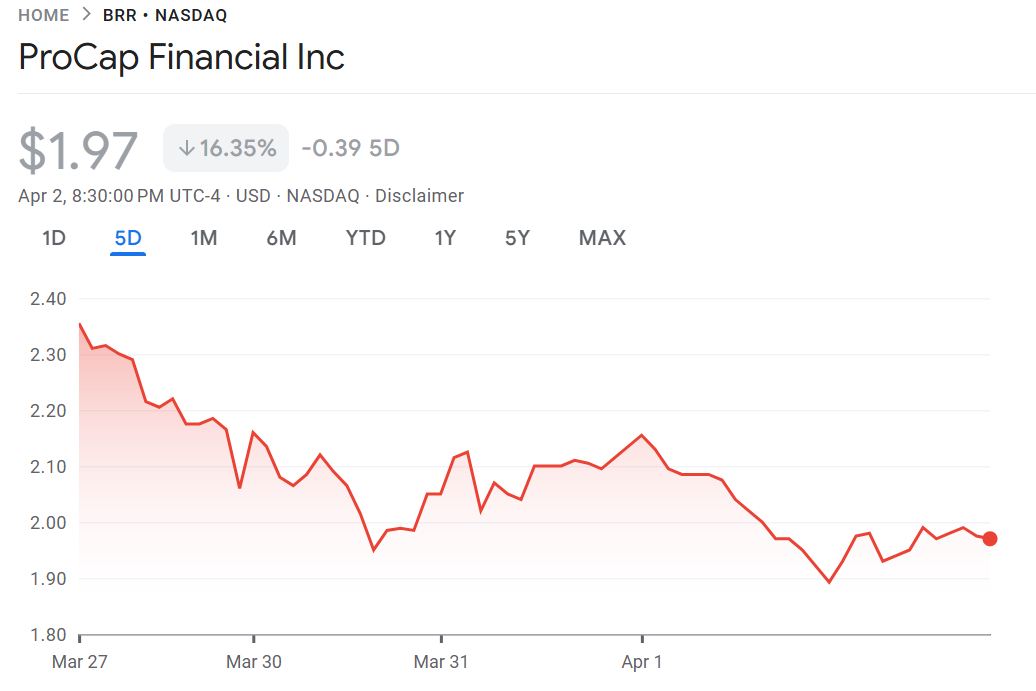
ProCap Financial BRR stock chart or BTC holdings graphic, Source: Google Finance
Park’s Role at ProCap
Park joined ProCap in mid-2025 after serving as Head of Alpha Strategies at Bitwise Asset Management. Pompliano recruited him to lead investment strategy and portfolio construction for the Bitcoin-focused firm.
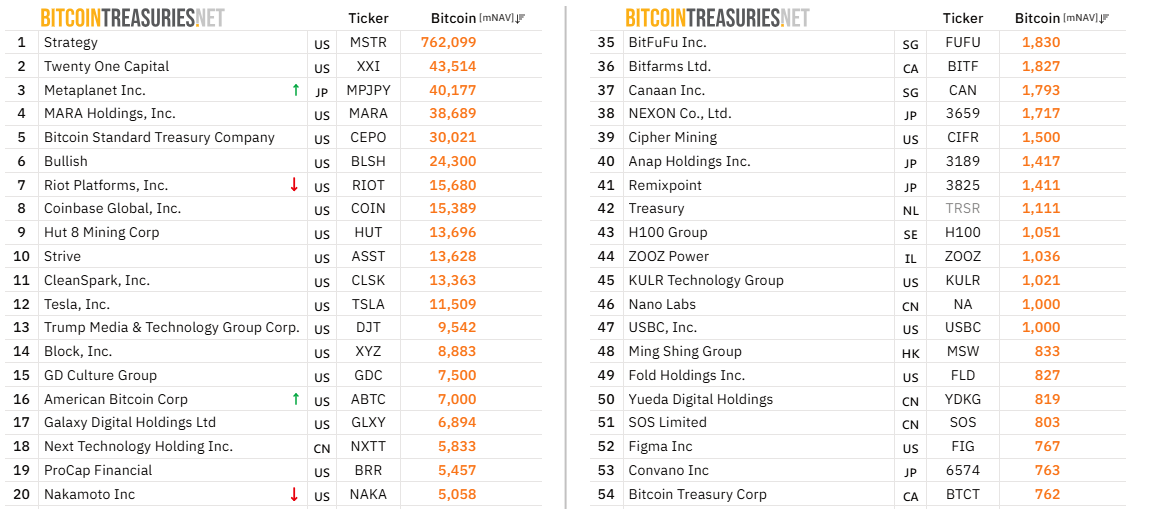
During his tenure, ProCap accumulated roughly 5,457 BTC and executed share buybacks to narrow a persistent discount to net asset value. The firm ranks 19th among public companies holding Bitcoin.
Public Companies Holding BTC. Source: Bitcoin Treasuries
Park also purchased BRR shares personally in December 2025.
He became a vocal advocate for what he called “Radical Portfolio Theory,” arguing that heavy Bitcoin allocations should replace traditional 60/40 portfolio models.
That framework shaped much of ProCap’s public-facing investment thesis.
What Comes Next
ProCap raised over $750 million through its SPAC merger and continues to pursue Bitcoin accumulation alongside financial services for retail investors.
Advertisement
Today I am announcing a $1 BILLION merger to create ProCap Financial, a bitcoin-native financial services. The company will be a publicly traded entity on Nasdaq at the conclusion of the proposed business combination between my private company ProCap BTC, LLC and Columbus Circle…
President Donald Trump submitted a $1.5 trillion defense spending request for fiscal year 2027 on Friday — the largest military budget proposal in U.S. history, a roughly 40% increase over current funding levels, arriving in the fifth week of the U.S.-led war against Iran.
Summary
Trump’s FY2027 budget seeks $1.5 trillion in defense spending, the proposed largest year-over-year increase in the post-WWII era, according to nonpartisan fiscal analysts
The plan pairs the defense surge with $73 billion in domestic cuts targeting health research, education, renewable energy, and community development programs
Non-defense discretionary spending would be cut by 10%; the proposal requires congressional approval and is expected to face significant pushback
According to Breaking Defense, the $1.5 trillion total is structured in two parts: a $1.15 trillion base budget — the first time the base Pentagon budget has crossed $1 trillion — and $350 billion to be passed through budget reconciliation.
The base budget requests approximately $260 billion for procurement and $220 billion for research, development, testing, and evaluation. The Golden Dome missile defense shield would receive $17.5 billion through reconciliation. The Air Force’s R&D account is slated to rise from $57 billion to $74.2 billion, funding programs including the F-47 stealth fighter scheduled for first flight in 2028. Shipbuilding capital reaches $65.8 billion for 34 vessels.
Advertisement
Budget Director Russell Vought said the plan “builds on the president’s vision by continuing to constrain non-defense spending and reform the federal government.”
Political Backdrop
NPR reports the request arrives as U.S. forces remain engaged in active combat with Iran, burning through Pentagon reserves at an estimated $1.2 billion per week. A separate emergency war supplemental is expected before Congress in late April or May. The Committee for a Responsible Federal Budget estimated the proposal would add $6.9 trillion to the national debt over 10 years, once interest costs are included. Federal Reserve Chair Jerome Powell warned separately that the debt trajectory “will not end well if we don’t do something fairly soon.”
Democratic Senator Patty Murray said she refuses “to provide a blank check to the Pentagon,” adding the department’s challenge is efficient spending, not funding volume. Republicans control both chambers but need to pass the reconciliation vehicle this year — with midterm elections approaching in November.
Advertisement
Market Implications
A budget of this scale, built on deficit spending during active military engagement, adds materially to inflation risk across global markets. As escalating military costs and oil supply disruption from the Iran conflict compress monetary policy options, investors in all asset classes — including digital assets — are recalibrating. The DeFiance CEO warned months ago that Middle East escalation would hit supply chains and financial markets in ways that would ripple broadly. Meanwhile, surveys show that 72% of financial institutions now classify digital assets as essential — a baseline that makes crypto markets increasingly sensitive to the macro signals this budget transmits.
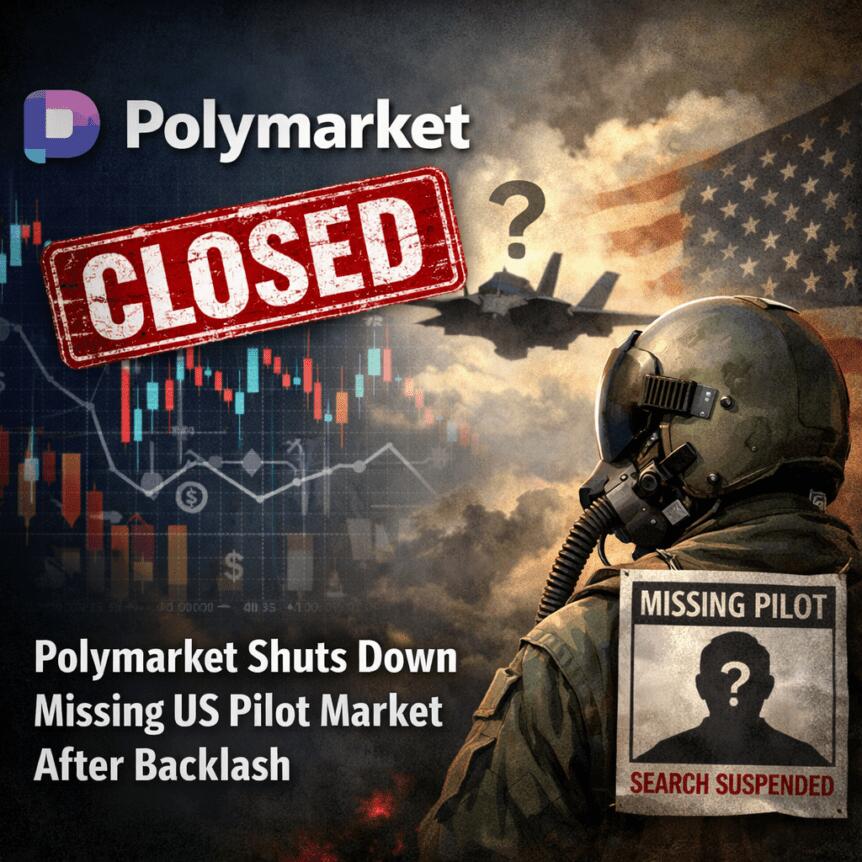
Polymarket removed a market tied to a missing US service member after public criticism and political backlash.
Summary
Polymarket removed a market tied to a missing US service member after public backlash mounted.
The platform said the listing failed integrity standards and should not have gone live there.
Lawmakers and users raised fresh questions about prediction markets, ethics, safeguards, and insider-trading risks.
The platform said the listing failed to meet its integrity standards, adding new pressure on how prediction markets handle sensitive real-world events.
The controversy began after a market appeared asking whether US authorities would confirm the rescue of a pilot reportedly shot down over Iran. Most traders had bet that the person would not be rescued until Saturday, turning the listing into a wider public issue.
Advertisement
Polymarket later said it removed the market immediately. The company said the listing should not have gone live and added that it is now reviewing how the market passed its internal checks. The platform did not explain which specific rule had been broken.
US Representative Seth Moulton criticized the listing and said it should never have been available for trading. In a post on X, he called the market “disgusting” and said people were placing bets on the fate of a potentially injured service member.
“They could be your neighbor, a friend, a family member. And people are betting on whether or not they’ll be saved,” Moulton added.
The criticism drew more attention to the case and placed Polymarket under fresh public scrutiny over how it reviews markets before launch.
Advertisement
Although Polymarket said the market failed its integrity standards, the company did not say which rule applied. That lack of detail led some users and observers to question how the platform defines prohibited markets.
Business Insider correspondent Jack Newsham said he reviewed the platform’s market integrity page and terms of service but could not identify the relevant restriction. He wrote, “I’m looking at the “Market Integrity” page, and I checked the TOS, and I don’t see which prohibition is relevant here.”
Wider pressure on prediction markets
The latest dispute comes as Polymarket faces more attention over its growth and market activity. Reports recently said the platform’s daily fees climbed sharply after a broader fee model took effect across areas such as finance, politics, and technology.
At the same time, concerns about insider trading on prediction markets have continued to grow. Last month, reports said a group of traders made about $1 million by correctly betting on the timing of US strikes on Iran.
Advertisement
That activity led at least 42 Democratic lawmakers to urge the Commodity Futures Trading Commission and the Office of Government Ethics to warn federal employees against using non-public information to trade on prediction markets.
Defense Secretary Pete Hegseth forced Army Chief of Staff General Randy George into immediate retirement on Thursday — the latest in a pattern of senior military dismissals tied to a deepening conflict between Hegseth and uniformed leaders over diversity-linked promotion decisions.
Summary
Hegseth fired Gen. Randy George — the Army’s top uniformed officer — effective immediately on April 3, along with two other generals
The removal followed clashes over Hegseth’s decision to block promotions for four Army officers from a list of 29 candidates, two of them Black and two women
Gen. Christopher LaNeve, Hegseth’s former military aide, was named acting Army Chief of Staff
Pentagon spokesperson Sean Parnell confirmed George’s departure in a statement on X: “General Randy A. George will be retiring from his position as the 41st Chief of Staff of the Army effective immediately. The Department of War is grateful for General George’s decades of service to our nation. We wish him well in his retirement.”
No official reason was given. ABC News confirmed a senior Defense Department official told CBS News: “We are grateful for his service, but it was time for a leadership change in the Army.” Sources told CBS News that Hegseth wants someone in the role who will implement his and President Trump’s vision for the Army. Two other generals were also removed Thursday: General David Hodne, commander of the Army’s Transformation and Training Command, and Major General William Green Jr., the Army’s chief of chaplains.
Advertisement
What Drove It
The New York Times reported that George requested a meeting with Hegseth to discuss blocked promotions — and Hegseth refused to meet. The four officers removed from a promotion list of 29 candidates included two Black officers and two women. Nine U.S. officials familiar with the process told NBC News that Hegseth has blocked or delayed promotions for more than a dozen Black and female senior officers across all four military branches.
“If there are no open allegations or investigations, what was the reason they were removed from the list? They have all deployed and done their jobs, and all are combat-tested,” one official said.
George, a career infantry officer commissioned from West Point in 1988, served combat tours spanning Desert Storm, Iraq, and Afghanistan. Nominated to the Chief of Staff role by President Biden and confirmed in 2023, his term was expected to run through September 2027. He is the latest in a series of Joint Chiefs members removed by Hegseth, following the earlier dismissals of Joint Chiefs Chairman Gen. C.Q. Brown and Chief of Naval Operations Adm. Lisa Franchetti.
Advertisement
Pattern and Response
Democratic Senator Chris Murphy attributed the firings to the Iran conflict: “It’s likely that experienced generals are telling Hegseth his Iran war plans are unworkable, disastrous, and deadly.” The Joint Chiefs paid George a tribute: “Since 1988, General George and his family have consistently answered the nation’s call with honor and dedication.”
Military instability of this kind, during active combat, compounds the geopolitical uncertainty already affecting global markets. Analysts tracking Middle East escalation have consistently flagged its downstream effects on supply chains and financial systems. For context, Ripple’s survey data showed that 72% of financial institutions now view digital assets as essential infrastructure — a measure of how deeply integrated digital markets have become with the macro environment that geopolitical decisions like this one directly shape.
Polymarket has pulled a market tied to the fate of a missing U.S. service member after a wave of backlash, saying the listing violated its integrity standards. The decision comes amid heightened scrutiny of prediction markets that touch on real-world human outcomes and potential military actions.
The controversy centered on a prediction asking whether U.S. authorities would confirm the rescue of a pilot reportedly shot down over Iran, a topic that drew rapid and emotional reaction from users. Signals from the market suggested a majority—more than 60% of bettors—did not expect a rescue by the upcoming Saturday, highlighting how quickly sentiment can polarize around volatile, real-time events.
U.S. Representative Seth Moulton condemned the market as “disgusting,” expressing concerns about people speculating on the fate of a potentially injured service member. “They could be your neighbor, a friend, a family member. And people are betting on whether or not they’ll be saved,” he wrote, underscoring the human dimension behind the bets.
Polymarket stated that it removed the market immediately, adding that it should not have been listed and that the company is reviewing how the listing passed internal safeguards. The platform did not offer further detail about which specific rule or policy was violated.
Advertisement
Key takeaways
Polymarket deleted a market linked to the fate of a missing U.S. service member after backlash, signaling a potential tightening of internal safeguards for sensitive events.
Officials and commentators are calling for clearer governance of prediction markets that touch on human safety and military outcomes, amid questions about which rules apply to borderline cases.
Historical tensions around insider trading concerns persist in prediction markets, with recent reporting suggesting substantial profits from timing bets on geopolitical events and renewed calls from lawmakers for regulator guidance.
Polymarket’s monetization strategy, including a recent fee overhaul, has intensified scrutiny around the platform’s business model and its alignment with user interests and integrity standards.
The episode underscores the ongoing friction between innovative risk markets and ethical, regulatory, and operational safeguards—an area likely to attract regulatory attention in the near term.
Polymarket’s misstep and the boundaries of prediction markets
From the outset, the market’s subject—whether authorities would confirm the rescue of a potentially endangered service member—presses into delicate territory. Prediction markets have long drawn scrutiny when they intersect with real-world crises, where outcomes can directly affect real lives. Polymarket’s decision to remove the market suggests a recalibration of what content it deems appropriate for its platform, even as the broader market remains interested in forecasting events that straddle news cycles and human risk.
Users quickly noted the lack of clarity around policy enforcement. As coverage of the incident circulated, questions arose about which specific rule in Polymarket’s “integrity standards” had been breached. Critics argued that without transparent guidance on how safeguards are applied, users are left to guess at the boundaries between legitimate forecasting and ethically fraught betting lines. This kind of ambiguity can erate legitimate concerns about governance and user trust—issues that affect not only participants but potential partners and investors evaluating the long-term viability of decentralized or crypto-native prediction platforms.
Polymarket’s action follows a broader context of scrutiny in the sector. The platform has recently expanded its price feeds and product lines, moving into equities and commodities in collaboration with data providers, a move that coincided with a notable uptick in activity and monetization. In March, the company implemented a revamped fee structure, which Cointelegraph noted propelled daily fees well above prior levels and brought revenue into a higher profile. While monetization is essential for sustainable operation, it can also intensify incentives to broaden markets and attract trading volume, complicating the governance calculus when sensitive topics are on the table.
Insider trading concerns persist in prediction markets
Beyond governance questions, prediction markets remain under the lens for potential insider trading issues. Last month, reporting highlighted a group of traders who reportedly profited by accurately timing bets on U.S. strikes in the Middle East. The betting activity centered on the timing of events that could only be known with public or near-public information, and investigators flagged the pattern as suggestive of informational advantages being exploited through blockchain wallets created specifically to target those events. The episode underscored the tension between fast-moving information markets and safeguards against unfair advantages.
In response to those concerns, lawmakers entered the conversation. At least 42 Democratic lawmakers pressed the U.S. Commodity Futures Trading Commission (CFTC) and the Office of Government Ethics to warn federal employees against using non-public information to trade on prediction markets. The appeal reflects bipartisan interest in establishing guardrails that protect both market integrity and the broader public interest, particularly when markets touch on national security or military actions.
Advertisement
Taken together, these developments illustrate a pivot point for the sector. On the one hand, prediction markets offer a compelling lens on how information and sentiment drive consensus around uncertain events. On the other hand, the same dynamics that make these markets attractive—liquidity, rapid pricing, and the potential for swift monetization—also invite ethical and regulatory scrutiny when real-world stakes are high.
What readers should watch next
The Polymarket episode is likely to reverberate through the ecosystem as platforms reassess which markets to enable and how to articulate rules with greater precision. Investors and participants should monitor whether Polymarket, or comparable platforms, publish more granular guidance on integrity standards and incident-response processes. Regulators may also weigh in with clarifications on permissible subjects, disclosure practices, and anti-insider trading measures for decentralized or crypto-enabled markets.
As markets evolve, expect ongoing debates about balancing openness and innovation with accountability. For traders and builders, the takeaway is clear: clarity and safeguards are becoming as important as the odds themselves, and the next wave of policy and product decisions will likely shape how widely these markets are adopted in mainstream financial ecosystems.
Readers should stay tuned to see how Polymarket and peers adjust their governance models, whether new guardrails emerge from regulatory discussions, and how participants adapt their strategies in response to these evolving standards.
Advertisement
Risk & affiliate notice: Crypto assets are volatile and capital is at risk. This article may contain affiliate links. Read full disclosure
Binance ETH reserve fell to 3.3M ETH, breaking below both the February and August 2024 historical lows.
Bitcoin reserves on Binance declined from 670,000 BTC in early February to 636,000 BTC by early April 2025.
USDT reserves on Binance grew from $35 billion on March 12 to $38 billion by April 2, reflecting rising dry powder.
USDC balances climbed from $4.6 billion in February to $6.6 billion by April 2, adding to total stablecoin buying power.
Binance ETH reserve has dropped to its lowest level in over a year, falling below key historical lows. At the same time, stablecoin balances on the exchange have been rising steadily.
On-chain data from CryptoQuant shows that these two opposing trends are reshaping the exchange’s liquidity structure.
The shift points to easing sell-side pressure alongside growing buying power among traders holding dollar-denominated assets.
ETH and BTC Reserves Record Notable Declines on Binance
Binance’s Ethereum reserve has fallen to 3.3 million ETH, according to CryptoQuant analyst Amr Taha. This level sits below the February 2024 low of 3.53 million ETH and the August 29, 2024 low of 3.49 million ETH. Breaking below both historical support levels marks a clear downward trend in ETH holdings on the exchange.
Binance ETH Reserve Drops Below February 2024 Low While USDT and USDC Reserves Climb
“If this trend continues, it could create a more supportive setup for price expansion.” – By Amr Taha pic.twitter.com/aFbrLcdObH
Bitcoin reserves on Binance have also moved lower over recent weeks. The BTC balance declined from approximately 670,000 BTC in early February to 636,000 BTC by early April. That drop reflects a similar pattern of reduced crypto asset supply sitting on the exchange.
When fewer coins rest on an exchange, available sell-side supply tends to shrink. This shift often reduces the immediate pressure that sellers can place on spot prices during periods of market activity.
Rising Stablecoin Reserves Point to Growing Buying Power
As crypto reserves declined, stablecoin balances on Binance moved in the opposite direction. USDT reserves grew from $35 billion on March 12 to $38 billion by April 2. USDC reserves also climbed from $4.6 billion in February to $6.6 billion over the same period.
Advertisement
Taha noted in his analysis: “If this trend continues, it could create a more supportive setup for price expansion.” The combined growth in USDT and USDC balances reflects an accumulation of dry powder sitting ready on the exchange.
Stablecoin reserves rising while crypto reserves fall is a well-known market structure among experienced traders. It suggests that capital has rotated out of volatile assets and into dollar-pegged holdings, without leaving the exchange entirely.
Whether buyers begin deploying those stablecoin balances into spot markets remains the key variable to watch in the coming weeks.
X is preparing to automatically lock Twitter accounts that mention crypto for the first time, and the ripple effect on memecoin communities built entirely on social momentum could be severe.
X Head of Product Nikita Bier confirmed the mechanism directly: “We are in the process of implementing auto-locking + verification if a user posts about cryptocurrency for the first time in the history of their account.”
Yeah we’re aware. We are in the process of implementing auto-locking + verification if a user posts about cryptocurrency for the first time in the history of their account. This should kill 99% of the incentive, especially since Google isn’t doing shit to stop the phishing…
The trigger is first-time crypto posting, not repeat offenders. Bier’s rationale targets the 99% of phishing incentives tied to hijacked accounts promoting fraudulent tokens and fake giveaways. The move follows a wave of fake copyright violation emails stripping users of login credentials and 2FA codes.
For memecoins that depend on viral first-post discovery, new wallets, new converts, and new degens, this is a direct hit to the top of the funnel.
Advertisement
The broader market context adds pressure. X’s bot crisis, driven by AI-powered scam accounts exploiting recommendation algorithms with deepfake-heavy promotions, has already eroded trust in platform-native crypto signals.
Crypto Twitter Lock Mechanism Could Be A Good Cure For The Space
X’s verification layer filters scam noise and actually improves signal quality for legitimate crypto Twitter projects, driving renewed institutional interest and bringing back trust back to the industry. But the market might see whether the auto-lock policy reduces spam effectively or simply chills organic growth.
Advertisement
However, policy friction could also reduce crypto posting from new users by a material margin, cutting viral discovery loops that memecoins depend on.
X is about to auto-lock your account the moment you post about crypto – if it's your first time. Head of Product Nikita Bier just announced it. Hackers break into accounts and immediately start shilling random tokens. X is now looking to freeze those accounts before the damage… pic.twitter.com/IWV7ZuB4fw
Bitcoin Hyper Targets Early Infrastructure Upside as Memecoins Face Platform Risk
When social-layer memecoins face existential platform risk, capital has historically rotated toward projects with utility that doesn’t depend on viral posting cycles. That rotation is already showing up in presale momentum, and it’s worth watching where that money is going.
Bitcoin Hyper ($HYPER) is positioning directly in that gap. The project claims the title of the first-ever Bitcoin Layer 2 with Solana Virtual Machine (SVM) integration, delivering a faster performance than Solana through extremely low-latency processing, a Decentralized Canonical Bridge for BTC transfers, and high-speed smart contract execution.
Bitcoin has core limitations of slow transactions, high fees, and near-zero programmability, and Hyper is here to fix them. Hard numbers back the early traction, $32 million raised at a current price of $0.013678, with staking at a high 36% APY for early participants. Presale capital has been flowing toward infrastructure plays as memecoin sentiment cools.
Two U.S. military aircraft were shot down in separate incidents during combat operations over Iran on April 3 — an F-15E Strike Eagle and an A-10 Thunderbolt II — with a search-and-rescue operation still ongoing for one missing crew member as Operation Epic Fury approaches its sixth week.
Summary
Iran shot down a U.S. F-15E Strike Eagle on April 3; one of the two crew members was rescued, the other remains unaccounted for
An A-10 Thunderbolt II dispatched during the rescue effort was also struck by Iranian fire; the pilot ejected and was subsequently recovered
The incidents directly contradict recent U.S. government claims of complete air dominance over Iran, complicating the administration’s public messaging on the war’s progress
U.S. officials confirmed to CBS News that the F-15E Strike Eagle — a two-seat aircraft flown by a pilot and a weapons systems officer — was shot down by Iranian forces. One crew member was rescued by U.S. forces following a combat search-and-rescue mission. The second crew member, a weapons systems officer, remains missing. Images verified by CNN showed low-flying rescue aircraft conducting operations over Khuzestan Province in central Iran.
A rescue helicopter that extracted the surviving pilot was hit by small arms fire during the operation, wounding crew members on board before landing safely. An A-10 Warthog dispatched as part of the search effort was then struck by Iranian fire, forcing its pilot to eject over the Persian Gulf before recovery.
Advertisement
Iran’s state media posted claims of downing the aircraft and announced a reward for the capture of any “enemy pilot or pilots.” Iran’s Parliament Speaker Mohammad Bagher Ghalibaf mocked the U.S. search effort publicly on X.
A Direct Contradiction
The downing conflicts with statements from President Trump, who said in a prime-time address two days earlier: “They have no anti-aircraft equipment. Their radar is 100% annihilated. We are unstoppable as a military force.” Defense Secretary Pete Hegseth and other officials have repeatedly asserted U.S. air dominance over Iran.
According to Axios, three F-15Es had previously been lost to friendly fire during the conflict. The war has now claimed 13 American lives and wounded 365 service members. Israel separately suspended airstrikes in areas relevant to the ongoing U.S. rescue effort, according to an Israeli official speaking anonymously to the Associated Press.
Advertisement
Economic Pressure
Iran’s response has escalated alongside the aircraft losses. Tehran has imposed what amounts to a toll system on the Strait of Hormuz, a waterway through which approximately 20% of globally traded oil transits. Missile and drone attacks struck oil, gas, and desalination facilities across the Persian Gulf on Friday. The Federal Reserve Bank of Chicago’s Austan Goolsbee told CBS News that the Iran war risks fueling inflation in a way that could prevent the Fed from cutting rates in 2026.
As analysts warned months ago, Middle East escalation carries supply chain and inflationary consequences that reverberate across all risk assets. Institutional capital flows have already shifted in response to the conflict’s progression, with large asset managers repositioning across both traditional and digital markets as geopolitical uncertainty deepens.
Leap Wallet will shut down its products by May 28, ending a crypto wallet project that began in the Terra ecosystem and later expanded to Cosmos and other chains.
Summary
Leap Wallet will shut down its apps, web platform, exchange tool, and validator service by May 28.
Users can still access assets through another wallet using their recovery phrase or private key.
Leap began in Terra and expanded into Cosmos after the 2022 collapse changed its path.
The closure affects its browser extension, mobile apps, web app, exchange tool, and validator service.
Leap said on Friday that it plans to sunset its software suite by May 28. The shutdown covers its browser extension, iOS and Android apps, Leap WebApp, Swapfast exchange platform, and Leap Cosmos Hub Validator.
Advertisement
The team said the decision came after building across multiple networks since 2022. In a post on X, it said, “We started Leap in 2022 to redefine what wallet experiences in crypto mean.” It added that the project later grew across “100+ chains.”
Leap also said the move was difficult for the team. It stated, “This decision was not made lightly,” while adding that it still believes in the long-term future of crypto and the interchain ecosystem.
Leap said noncustodial users will still be able to access their assets after the shutdown. The team explained that users can restore the same wallet address through another wallet by using a recovery phrase or private key.
Advertisement
The FAQ said there is no need to move assets to a new address. It explained, “There is no need to withdraw or send your assets to a new address,” because importing the recovery phrase or private key will restore access to the same address.
The team also issued a separate notice for Cosmos users who delegated ATOM to Leap’s validator. It asked them to redelegate to another validator if they want to keep earning staking rewards.
Project began in Terra ecosystem
Leap launched in late 2021 with a $50,000 grant from Terraform Labs, the now-defunct firm behind TerraUSD. In early 2022, the project raised a $3.2 million seed round co-led by CoinFund and Pantera Capital.
At the start, Leap positioned itself as a wallet focused on Terra, with tools for staking LUNA, trading, and connecting with applications such as Anchor and Mirror. It aimed to offer a wallet experience similar to what MetaMask built for Ethereum and Phantom built for Solana.
Advertisement
After the collapse of Terra in 2022, Leap shifted its focus and expanded into the wider Cosmos ecosystem. That move allowed the project to continue as a multi-chain wallet after its original market changed.
The shutdown now closes that chapter for the wallet. While the apps and related services will go offline, users will still retain control of their assets through standard wallet recovery tools supported by other providers.
Leap Wallet will sunset all products, including extensions and mobile apps, on May 28, 2026, across iOS and Android.
Users can migrate safely using their recovery phrase, as Leap is non-custodial and assets remain on the blockchain at all times.
ATOM delegators staking with Leap’s Cosmos Hub validator must redelegate early due to network unbonding period delays.
After the May 28 deadline, all installed Leap apps will stop functioning, though fund recovery via recovery phrase remains fully possible.
Leap Wallet has officially announced that it will discontinue all its products on May 28, 2026. The crypto wallet provider has been active since 2022, serving users across more than 100 blockchain networks.
The shutdown covers extensions, mobile apps, and several associated services. Users are advised to begin migrating their assets to other supported wallets ahead of the deadline.
All core wallet functions will remain available until that date to allow a smooth transition.
Products Scheduled for Discontinuation After the May Deadline
The shutdown affects a broad range of products tied to the Leap ecosystem. These include Leap Wallet browser extensions and mobile versions on iOS and Android.
Compass Wallet, the Leap WebApp, and the Swapfast service are also on the list. Leap Cosmos Hub Validator and Leap Cosmos Snaps will be discontinued as well.
Advertisement
The team behind Leap shared the news through an official tweet. They noted the wallet was launched to change what crypto wallet experiences could offer users.
Since launch, it expanded to support over 100 chains across multiple ecosystems. The post also reflected the care and responsibility the team felt toward its user base.
In the announcement tweet, the team wrote that the decision to shut down was not made lightly. They added that they continue to believe in the long-term future of the crypto space.
Leap Wallet: Sunset Notice
After careful consideration, we’ve made the decision to sunset Leap Wallet and its associated products.
Advertisement
The products will be sunset on 28th May, 2026, and all users should complete their migration before then.
We started Leap in 2022 to redefine what…
— Leap Wallet | Sunset on 28th May (@leap_wallet) April 2, 2026
They also extended appreciation to partners and users who supported the product over the years. The message was direct, measured, and absent of any bitterness or blame.
Advertisement
Until May 28, 2026, all listed products will retain their existing core functionality. Users can still view balances, send tokens, and manage their staking positions.
Exporting recovery phrases and private keys will also remain available throughout this period. No core feature will be removed before the official sunset date arrives.
What Users Must Do Before the Shutdown Date
Users holding assets in Leap Wallet are encouraged to move to another wallet provider. The team recommended Keplr, MetaMask, Phantom, and Rabby as compatible alternatives.
Since Leap is a non-custodial wallet, assets are held on the blockchain and not within the app. This means migration does not require any complex transfer of funds between addresses.
Advertisement
Any user with a recovery phrase can import it directly into another supported wallet. That process will restore all addresses and balances automatically across compatible chains.
No manual transfers are necessary for this to work correctly. Starting early reduces the risk of delays or missed steps before the deadline.
Those who delegated ATOM to Leap’s Cosmos Hub validator must also take a separate action. They need to redelegate to another validator to keep earning staking rewards.
Network unbonding periods can stretch over several days, so acting promptly matters. A detailed migration guide with full instructions is available at leapwallet.io.
Advertisement
After May 28, 2026, all Leap products will stop functioning, including already-installed apps. Users who miss the deadline can still recover their funds using their recovery phrase.
Importing it into any compatible wallet will restore full access to holdings. Migration support remains available at support@leapwallet.io until the shutdown date.




















 NewsBeat2 days ago
 Business1 day ago
 Fashion16 hours ago
 Crypto World3 days ago
 Tech5 days ago

 Tech5 days ago
 Tech4 days ago
 Sports4 days ago
 Business2 days ago
 Fashion6 days ago
 Tech6 days ago
 Tech4 days ago
 Fashion5 days ago
 Politics5 days ago
 Crypto World4 days ago
 Tech5 days ago
 Tech4 days ago
You must be logged in to post a comment Login