

Crypto World
Ethereum Analysts Flag Potential ‘Selling Wave’ as ETH Struggles at $1.7K

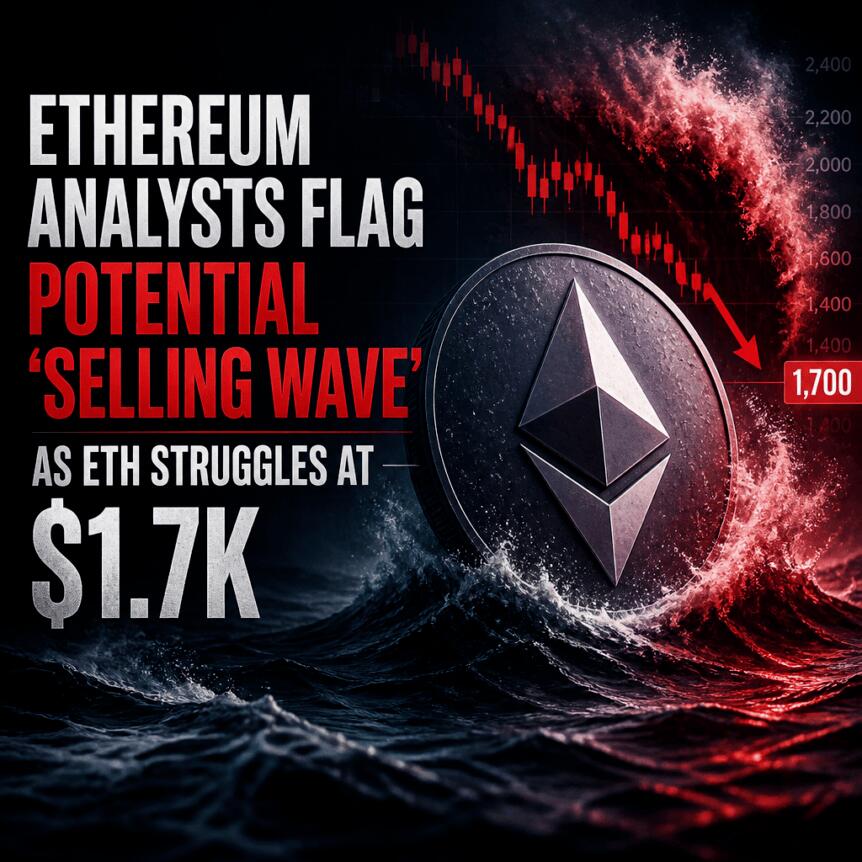
Ether’s near-term outlook is deteriorating as spot flow and derivatives positioning both point to weaker participation. Over the past several days, Binance saw net inflows of about 57,700 ETH, while Ether futures open interest has dropped to $10.3 billion—down from roughly $15 billion a month earlier—marking the lowest level across exchanges since April 2025, according to CryptoQuant.
Analysts say the mix of rising exchange supply, fewer new depositors, and cooling leverage is consistent with a market that may be running out of fresh buying pressure. Several traders are now watching key weekly demand areas around $1,700 and $1,400, with the potential for renewed downside if Ether fails to hold.
Key takeaways
- Binance net inflows of ~57,700 ETH suggest more Ether is moving onto the most liquid venues, increasing the risk of sell-side pressure if price rallies.
- Ether futures open interest fell ~31% to $10.3B—its lowest aggregate level since April 2025, reflecting cooling speculative activity.
- Estimated leverage ratio declined to 0.83 from an early-June peak, signaling reduced trader conviction and less leverage-driven volatility.
- Weekly price levels in focus: the market is hovering near $1,700 and $1,400, with lower liquidity targets below there.
Why Binance inflows matter for short-term selling risk
CryptoQuant analyst Pelin Ay highlighted that Binance received roughly 57,700 ETH on a net basis over the past few days. In crypto market structure, large and sustained exchange inflows can act as a warning sign for near-term sell pressure—especially when the influx is concentrated on a venue with deep liquidity like Binance.
Ay also tied the pattern to a lack of offsetting demand. The number of new ETH depositors is currently around 320 addresses, which is described as materially below levels seen during earlier demand surges. When deposit growth is weaker, the spot market’s ability to absorb incoming supply without repricing can fade—leaving price action more dependent on existing holders.
There is also a supply-side counterweight to consider. Ay noted that daily ETH issuance sits near 2,791 ETH, a relatively modest figure that has been typical since Ethereum’s EIP-1559 upgrade in 2021. Still, even with comparatively lower issuance, elevated exchange inflows can be enough to tilt order books if buyers don’t step in.
In Ay’s view, the near-term risk is that a brief relief rally into resistance could encourage further distribution from exchange balances, turning “stability” into renewed pressure.
Derivatives activity cools as open interest hits a multi-month low
Beyond spot flows, the derivatives tape has weakened. Ether futures open interest fell to $10.3 billion on Thursday, down from about $15 billion a month ago—roughly a 31% decline. CryptoQuant characterizes this as the lowest aggregate open interest across exchanges since April 2025.
Open interest is often used as a proxy for participation and the balance of hedging versus new speculative bets. A drop of this scale typically points to fewer market participants taking fresh positions, which can translate into less willingness to press trades during a rebound attempt.
Leveraged positioning has also eased. The estimated leverage ratio (ELR) fell to 0.83 from an all-time high of 1.10 on June 2. CryptoQuant also notes that this move represents the largest leverage unwind since October 2025, when the metric slid from 0.72 to 0.56.
Lower leverage can reduce short-term volatility and speculative pressure, but it usually comes with a trade-off: it often reflects weaker conviction. In other words, the market may be less prone to sharp liquidations, yet less capable of sustaining a strong uptrend on its own momentum.
Weekly demand zones under scrutiny: $1,700 and $1,400
On the chart, Ether’s weekly trend has continued to struggle. The weekly outlook referenced in the analysis shows ETH down about 30% over the past 42 days, trading near demand zones around $1,700 and $1,400.
The April 2025 low at $1,384 is cited as the nearest external liquidity target if weakness continues. Below that, the analysis points to a broader demand area dating back to January 2023, spanning roughly $1,289 to $1,071.
Trader Ardi previously argued on X that there are early technical “bottoming” signals forming for altcoins, including ETH. In the same framing, Ardi noted that Ether touched the lower band of a long-term acceptance range that had previously aligned with macro lows—suggesting the market may be approaching a decision point rather than continuing an uninterrupted slide.
Part of that argument is based on momentum indicators. The weekly RSI is near 31, while a daily RSI reading of 11 during the recent sell-off is described as the lowest recorded level. In practical terms, these readings are often interpreted as improving the odds of stabilization—though they do not guarantee a reversal.
Ardi also emphasized that ETH/BTC remains an important metric to watch because the pair continues to trend lower. For now, the key trading range remains where liquidity and position-taking are concentrated: roughly $1,400 to $1,700.
What investors and traders should monitor next
If exchange inflows keep outpacing new depositors while futures open interest remains depressed, Ether could struggle to convert any bounce into a sustained trend—especially if leverage continues to unwind. The immediate question for markets is whether ETH can hold the weekly demand bands near $1,700 and $1,400, or whether the combination of supply returning to exchanges and reduced derivatives activity will push price toward the next liquidity pockets below.

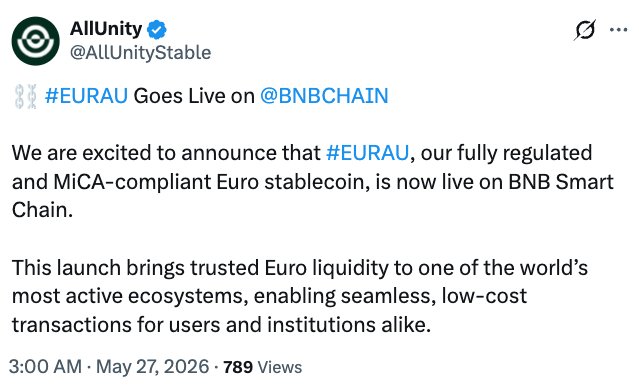
Digital asset company AllUnity is launching SEKAU, a Swedish krona-backed stablecoin issued under the European Union’s Markets in Crypto-Assets Regulation (MiCA).
The new token operates as an e-money token under MiCA, according to a statement shared with Cointelegraph on Friday. It is backed by segregated Swedish krona reserves and targets institutional settlement and cross-border payments.
The launch follows AllUnity’s Swiss franc stablecoin rollout, extending its multi-currency stablecoin strategy under the EU’s MiCA framework.
Banking Circle among SEKAU partners
The launch of SEKAU is supported by a growing ecosystem of partners.
Banking Circle, a regulated business-to-business bank and financial infrastructure company based in Luxembourg, will hold and manage the reserves backing the token, while Swedish Marginalen Bank supports the rollout as a banking partner.
Trust Anchor Group, a local digital asset infrastructure and technology company, provides infrastructure integration for broader ecosystem access to the stablecoin.
Swedish krona stablecoin launches on multiple networks
SEKAU debuts across five blockchain networks, including Ethereum, Solana, Base, Tempo and Polygon.
AllUnity said the multi-chain rollout is designed to improve access, interoperability and liquidity across major blockchain ecosystems. The company added that it plans to expand SEKAU to additional blockchain networks later in 2026.
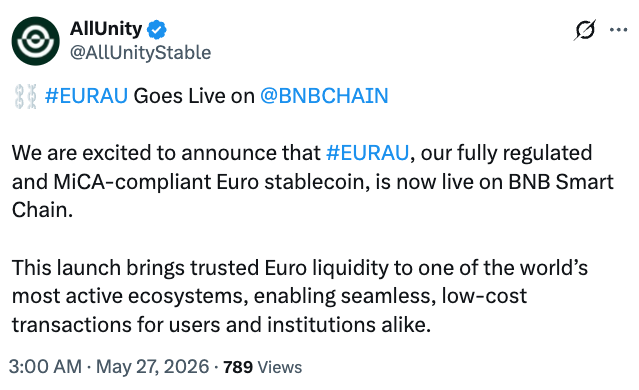
By contrast, AllUnity’s Swiss franc stablecoin CHFAU initially launched exclusively on Ethereum in February before expanding to Tempo. The company also operates EURAU, a euro-backed stablecoin launched in 2025.
Source: AllUnity
Since launch, EURAU has reached a market capitalization of $1.4 million and ranks as the 16th largest euro stablecoin among 23 tracked tokens, according to CoinGecko. The euro stablecoin market totals about $883 million in combined value at the time of writing.
AllUnity stressed that SEKAU is the first fully reserved Swedish krona-denominated stablecoin aligned with MiCA, issued as a regulated EMT backed 1:1 by SEK reserves.
“SEK exposure has previously existed mainly through early-stage concepts, which are not confirmed as a MiCA-authorized, fully regulated EMT,” a spokesperson for AllUnity told Cointelegraph.
Related: Tether winds down gold-backed derivative stablecoin aUSDT
The representative also mentioned that Swedish banking and fintech pilots have explored tokenized deposit money and settlement systems, but these remain “closed, experimental infrastructures” rather than publicly redeemable stablecoins.
AllUnity said the most relevant initiative is Sweden’s e-krona project by the Riksbank, a central bank digital currency exploring tokenized payments infrastructure, but it is fundamentally different from a stablecoin. Riksbank communicated earlier this year that there were no stablecoins in Swedish kronor.
Magazine: Crypto wanted to overthrow banks, now it’s becoming them in stablecoin fight
TLDR
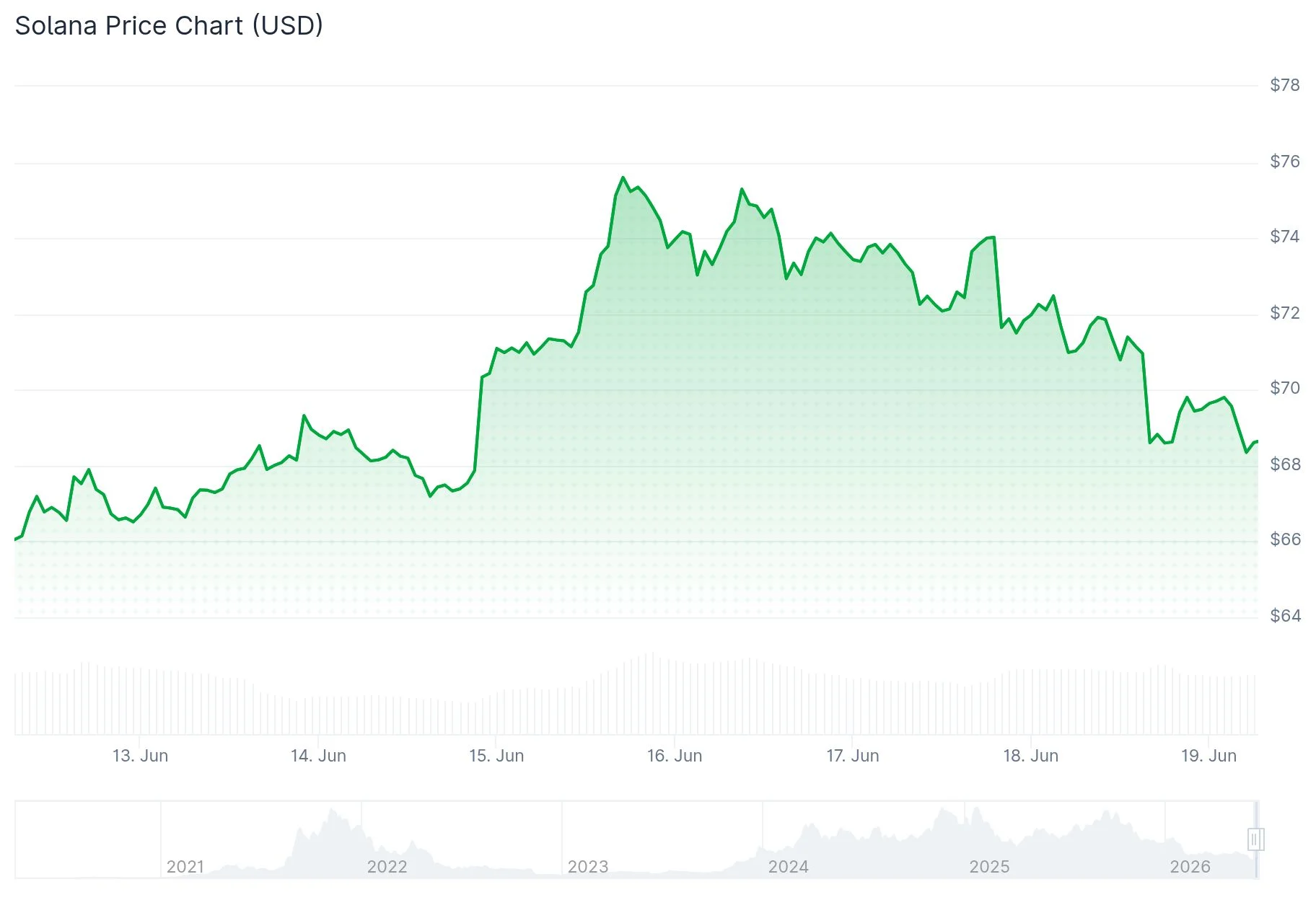
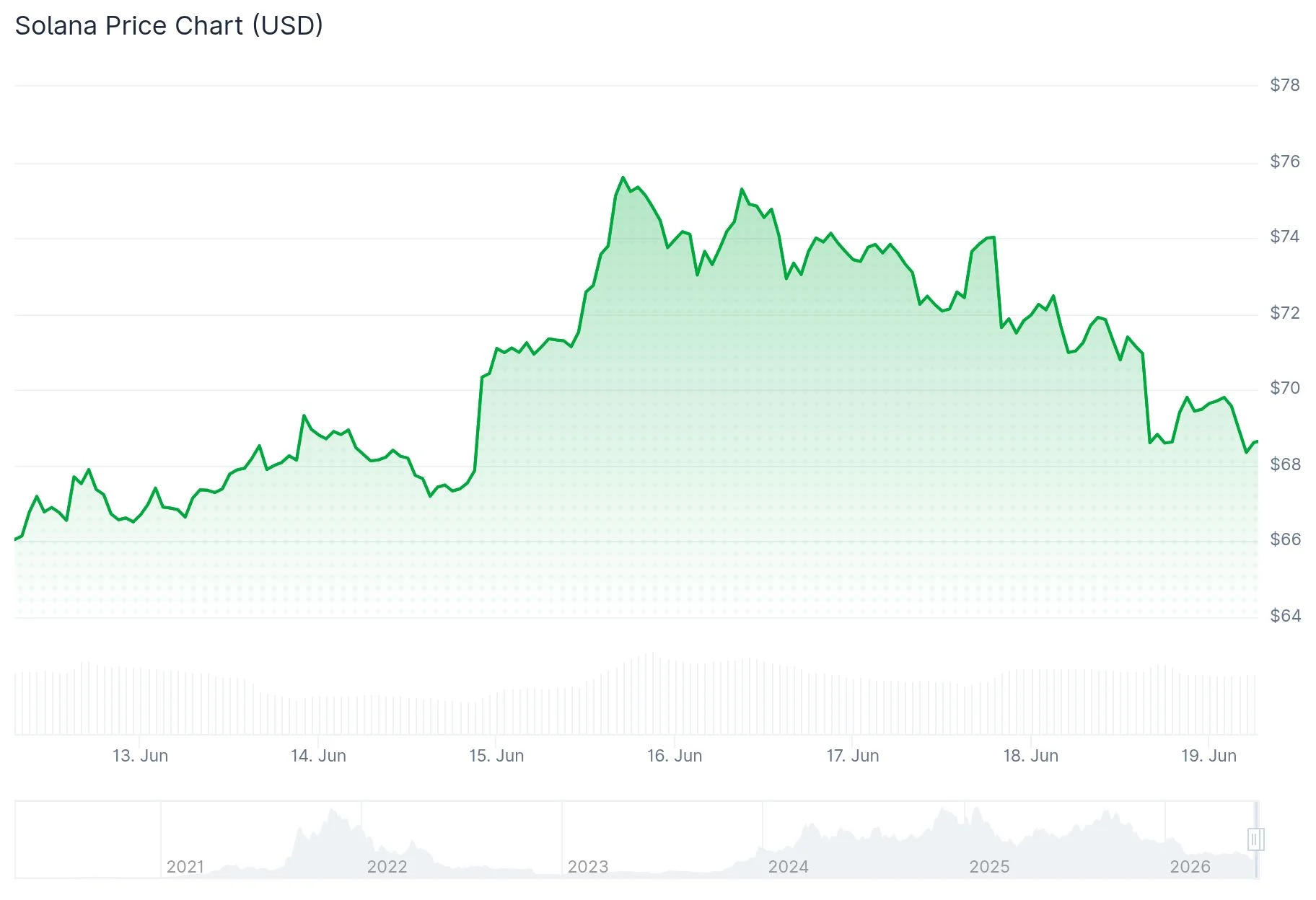
- SOL breached the $70 level on Friday, declining more than 6% from its June 15 peak at $75.60
- Morgan Stanley submitted an updated S-1 filing to the SEC for a Solana ETF product (MSOL)
- Weekly capital flows into SOL ETFs reached $7.11 million even as prices retreated
- Solana has emerged as the leading blockchain for tokenized Real-World Assets by holder count, surpassing 285,000 holders
- Critical support zone established at $70; breach could trigger decline toward June lows around $62
Solana experienced a sharp reversal from its recent $75.60 high, falling to an intraday bottom of $70.70 on June 18 before finding temporary support around $71. This downturn came after a strong 20%+ recovery from early June’s $62 floor.
The downward pressure intensified following the Federal Reserve’s decision to maintain interest rates within the 3.50%–3.75% range, coupled with cautionary language about persistent inflation threats. Fed officials signaled potential additional policy tightening through 2026, prompting investors to retreat from high-volatility assets such as SOL.
Bitcoin simultaneously retreated toward the $64,000 mark in response to the Fed’s stance. Many major altcoins experienced more pronounced declines compared to Bitcoin during this period.
Crypto analyst Ash Crypto observed that SOL’s monthly chart indicators show the most oversold conditions in its history. He further noted that Solana achieved a new milestone for tokenized stock trading volume in a single day, processing over $140 million in spot transactions—97% of the total crypto market share, outperforming all competing blockchains combined.
Despite the bearish price action, institutional appetite for Solana exposure has remained robust. SOL-based ETF products attracted $2.99 million in a single day on Thursday, contributing to a weekly total of $7.11 million in net inflows.
ETF Filing and Institutional Moves
Morgan Stanley submitted a revised S-1 registration statement to the SEC on Thursday for its Solana-focused exchange-traded fund, which will trade under the ticker MSOL. This filing represents the latest in a series of institutional developments surrounding SOL in recent weeks.
Eight consecutive months of positive net flows into SOL ETF products demonstrate persistent institutional conviction. Continued capital inflows throughout the coming week could potentially shift the monthly balance from marginally negative to positive territory.
RWA Adoption on Solana
On the retail adoption front, Solana has claimed the top position among blockchains by Real-World Asset holder count. The network now hosts over 285,000 holders of tokenized RWAs, with the tokenized SpaceX IPO serving as a significant catalyst.
Despite these positive on-chain developments, derivatives market data paints a more cautious picture. SOL futures Open Interest contracted to $4.85 billion on Friday, down from $5.18 billion just two days earlier on Wednesday.
Long position liquidations over the past 24 hours totaled $13.66 million, dramatically outpacing the $1.80 million in short liquidations, indicating clear bearish control of the market.
Market analyst BATMAN observed that Solana had been “rejected by its previous support level, now as resistance,” and that the stochastic oscillator had climbed to the same overbought zone that preceded the previous significant peak.
CoinGlass liquidation heatmap analysis reveals concentrated leveraged positions clustered between $74 and $76. Another significant liquidity pool exists in the $65–$66 range.
The critical near-term support level holds at $70. A confirmed daily close beneath this threshold could accelerate movement toward the June low near $62, with Fibonacci extension levels suggesting potential downside toward $60.
For bullish momentum to reassert itself, SOL needs a definitive daily close above the descending trendline, with overhead resistance barriers positioned at $74.80 and $79.30.



Kalshi has exceeded a $2 billion annualized revenue run rate as the prediction market operator has begun early discussions with investment banks about a potential initial public offering, according to a report from The Information.
Summary
- Kalshi has reportedly begun early IPO discussions with investment banks after surpassing a $2 billion annualized revenue run rate.
- The prediction market platform recorded $16.81 billion in May trading volume and recently secured a $1 billion funding round at a $22 billion valuation.
The Information, citing people familiar with the matter, reported that Kalshi has held informal talks regarding an IPO while continuing to post rapid business growth. The revenue figure represents a sharp increase from the $1 billion annualized run rate previously reported by The Wall Street Journal in March.
A spokesperson for Kalshi declined to comment on the IPO discussions when contacted by The Block.
Fresh interest in a public listing comes weeks after the company secured $1 billion in Series F funding at a $22 billion valuation. The round was led by Coatue and included participation from Sequoia Capital, Andreessen Horowitz, IVP, Paradigm, Morgan Stanley, and ARK Invest.
Trading activity has continued to climb alongside that growth. Data from DeFiLlama showed Kalshi recorded $16.81 billion in trading volume during May, up from $14.81 billion in April. Competing platform Polymarket generated $7.08 billion in volume last month, compared with $9.01 billion a month earlier.
Regulatory pressure intensifies as business expands
Rising volumes and investor interest have coincided with mounting scrutiny from lawmakers, gaming groups, state regulators, and federal authorities over how prediction markets should be regulated in the United States.
Earlier this week, several U.S. gaming industry organizations urged the Senate to include language in pending crypto market structure legislation that would explicitly prevent sports and casino-style prediction markets from operating under federal derivatives rules, according to a Semafor report.
Among the groups backing the effort were the American Gaming Association, the Indian Gaming Association, and the Association of Gaming Equipment Manufacturers. In a letter cited by Semafor, the organizations argued that prediction market operators have effectively expanded sports betting nationwide while bypassing state and tribal gaming frameworks.
Their push arrives as lawmakers continue reviewing the CLARITY Act, a major crypto market structure proposal that has already advanced through the Senate Banking Committee.
Political opposition has also been accompanied by legal challenges at the state level. Kentucky became the latest state this week to sue Kalshi, Polymarket, and affiliated entities, alleging they operated illegal and unlicensed sports betting platforms within the state. Similar actions have emerged across multiple jurisdictions, including Ohio, Nevada, New Jersey, Maryland, Montana, Illinois, New York, Connecticut, Arizona, Wisconsin, New Mexico, and others.
Federal and state regulators remain at odds
Court battles surrounding prediction markets increasingly center on a jurisdictional dispute between state gaming authorities and the Commodity Futures Trading Commission.
Just days earlier, the CFTC filed suit against New Mexico after state officials moved against Kalshi over allegations that it offered unlicensed sports betting products. In its complaint, the regulator argued that event contracts listed on federally regulated exchanges fall under its exclusive authority through the Commodity Exchange Act and cannot be subjected to state gaming enforcement.
CFTC Chair Michael Selig said at the time that New Mexico was attempting to override established law and judicial precedent governing federally regulated exchanges.
At the same time, critics of prediction markets have challenged whether sports-related event contracts belong under derivatives regulation at all. Former CFTC Chair Gary Gensler told the Sixth Circuit Court of Appeals earlier this month that sports prediction contracts do not function like traditional swaps because they are not used to hedge commercial or economic risks.
Federal regulators, however, have continued defending their oversight role while also developing a framework that would review event contracts individually rather than imposing category-wide restrictions. According to a Wall Street Journal report published this month, the agency is considering standards that would subject certain contracts to closer review while allowing others to remain listed.

Key Takeaways
- Alex Mashinsky has been issued a lifetime prohibition from all CFTC-regulated trading activities
- This enforcement action represents the CFTC’s inaugural case against a cryptocurrency lending platform
- The Celsius founder is currently incarcerated, serving 12 years for fraud charges connected to the 2022 platform failure
- Regulatory bans now include the CFTC and FTC, while SEC litigation remains unresolved
- A motion to overturn his criminal conviction was submitted in May, citing legal representation failures and prosecutorial issues
The founder of the defunct cryptocurrency lending platform Celsius, Alex Mashinsky, has received a permanent prohibition from participating in any trading activities regulated by the U.S. Commodity Futures Trading Commission.
On Thursday, a federal court within the Southern District of New York granted approval for the consent decree. This ruling permanently prevents Mashinsky from obtaining CFTC registration or engaging in any commodities, futures, or derivatives trading activities.
According to the CFTC, this resolution marks the conclusion of the agency’s inaugural enforcement proceeding against a digital asset lending operation. The regulatory body initially launched this action in 2023.
This settlement includes no additional monetary penalties. Mashinsky is presently fulfilling a 12-year prison term imposed in May 2025, after entering a guilty plea to charges of securities fraud and commodities fraud.
Additionally, he received orders to pay $50,000 in fines and forfeit $48 million as components of his criminal proceedings.
Allegations Against the Celsius Platform
The CFTC asserted that Mashinsky, along with Celsius, orchestrated a fraudulent operation that deceived hundreds of thousands of users regarding the platform’s security, profitability, and adherence to regulatory standards.
Regulators claimed the platform collected approximately $20 billion in customer deposits and deployed these funds in high-risk ventures to fulfill the returns promised to its user base.
The Celsius platform failed in 2022 amid a widespread cryptocurrency market decline. According to the CFTC, the company continued assuring customers of fund security even while experiencing substantial financial losses.
Celsius joined several prominent cryptocurrency enterprises that collapsed during the same timeframe, amplifying the devastating impact on the broader industry.
Multiple Regulatory Prohibitions Accumulate
This CFTC prohibition represents just one of several industry bans imposed on Mashinsky.
In April, he reached a settlement agreement with the Federal Trade Commission. This agreement permanently prohibits him from involvement with any product or service facilitating asset deposits, exchanges, investments, or withdrawals.
The SEC maintains an ongoing legal action against Mashinsky, initiated in July 2023. The charges include conducting an unregistered securities offering, misrepresenting Celsius operations, and engaging in price manipulation of the Celsius token.
Toward the end of May, the SEC informed a federal court that settlement discussions with Mashinsky had commenced. No agreement has been finalized. The court extended the negotiation period by an additional 60 days for both parties.
Concurrently, Mashinsky submitted a motion on May 26 seeking to overturn his 12-year criminal sentence. His claims include inadequate legal representation, evidence contamination through official misconduct, and allegations that FTX co-founder Sam Bankman-Fried orchestrated the manipulation of Celsius token prices.
Prosecutors have been directed by the court to file their response to this motion by mid-August.
The CFTC settlement represents among the final significant regulatory proceedings against Mashinsky to conclude, leaving only the SEC litigation outstanding.
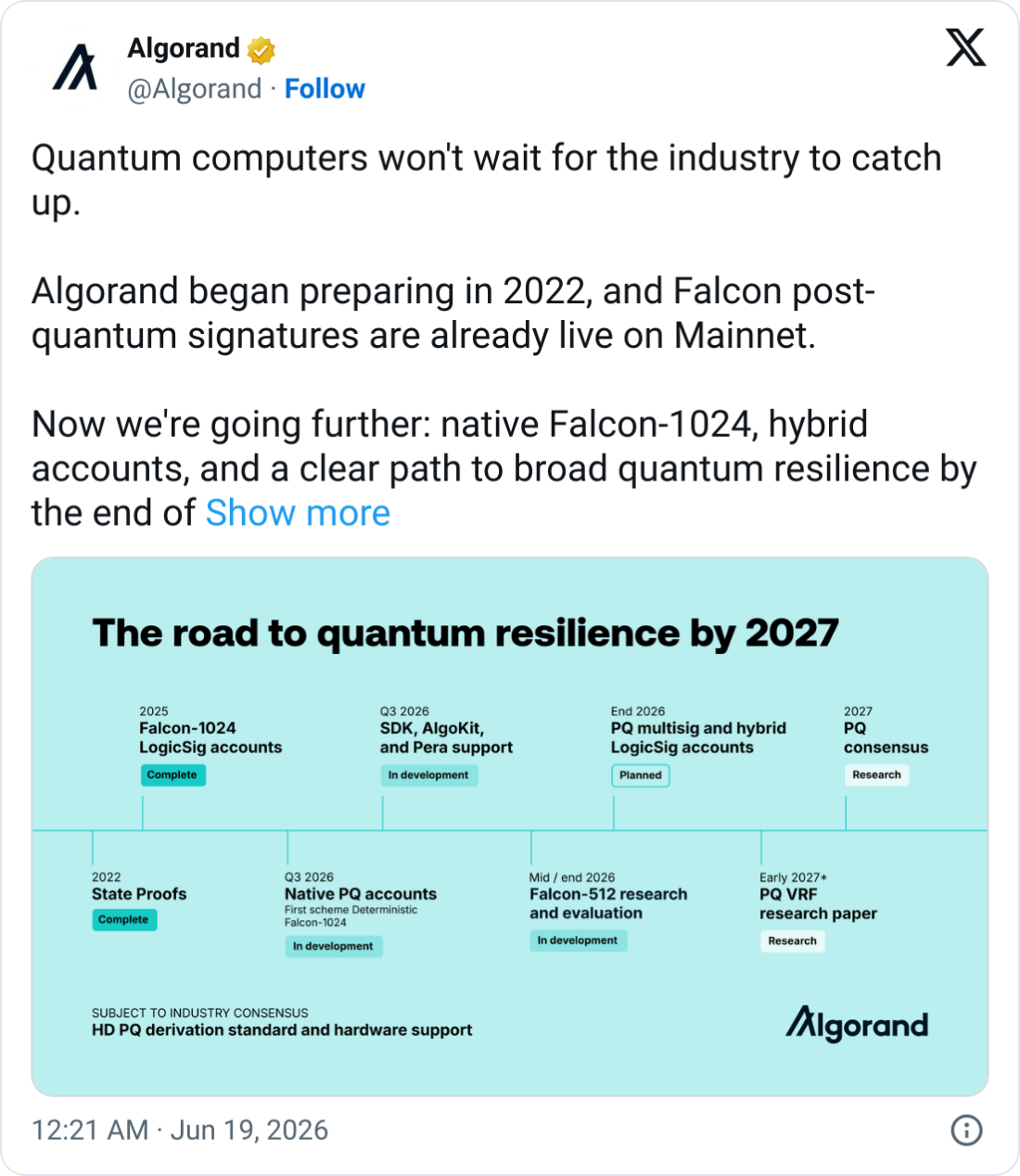
Algorand Foundation has released a post-quantum security roadmap that aims to make the layer-1 blockchain broadly quantum resilient by the end of 2027.
Summary
- Algorand plans native post-quantum accounts, multisignatures, and consensus upgrades before its network’s end-2027 target date.
- Google research has increased pressure on blockchains to prepare for future attacks against exposed keys.
- Bitcoin, France, and major security bodies are already planning quantum-safe transitions.
The plan covers user accounts, wallets, developer tools, staking, and the consensus system that helps secure the network.
The foundation said the first milestones will begin in Q3 2026. Native post-quantum accounts are expected to reach users and developers through Pera Wallet and updated software kits. Later steps include post-quantum multisignatures and the foundation’s own treasury migration to post-quantum accounts.
Falcon accounts build on earlier work
Algorand began preparing for quantum risks in 2022 by adding State Proofs signed with Falcon, a lattice-based signature scheme. The foundation says Falcon offers smaller signatures than some other post-quantum options, which can help blockchain systems where data size matters.
The new roadmap expands that work with native Falcon-1024 accounts. Algorand also plans to support hybrid accounts, where users can secure an account with both classic and post-quantum keys. The foundation says this approach can reduce risk while newer cryptography matures.
Algorand said Falcon accounts will work with its standard wallet experience, including familiar mnemonic backup flows. The foundation also said it is open to working with hardware wallet makers and other industry groups on wider account standards.
Quantum risk is moving into policy
The roadmap comes as governments and security agencies move quantum-safe systems into formal planning. France’s cybersecurity agency ANSSI plans to stop certifying products that lack quantum-resistant encryption from 2027. The U.S. National Security Agency has also set a 2027 start date for new national security systems that use approved quantum-resistant algorithms.
Google researchers have added more pressure to the debate. In March, Google said future quantum computers may break the elliptic-curve cryptography used by many blockchains with fewer resources than earlier estimates suggested. Algorand’s Bruno Martins said, “Governments, standards bodies, and security experts around the world are already preparing” for that risk.
Crypto networks prepare early
As previously reported by crypto.news, Glassnode warned that 1.92 million BTC, or 9.6% of supply, sits in outputs that are structurally exposed to a future quantum breakthrough. The firm said the risk is not active today, but exchanges and custodians should improve address practices and plan migration paths.
Crypto.news also reported that France’s 2027 certification rule adds pressure on crypto networks, wallets, and security vendors. Bitcoin, Ethereum, Solana, Algorand, and Aptos are now part of a wider debate on how blockchains should move to post-quantum security.
Algorand’s plan does not claim that a working attack exists. It treats quantum computing as a long-term security issue that needs early work because live blockchains can take years to change.
Chris Peikert, Algorand Foundation’s chief scientific officer, said migrating a live protocol takes years and that the chance of a quantum attack on older cryptography grows as the end of the decade approaches. He said the roadmap brings post-quantum cryptography to every layer of a live network, including consensus.
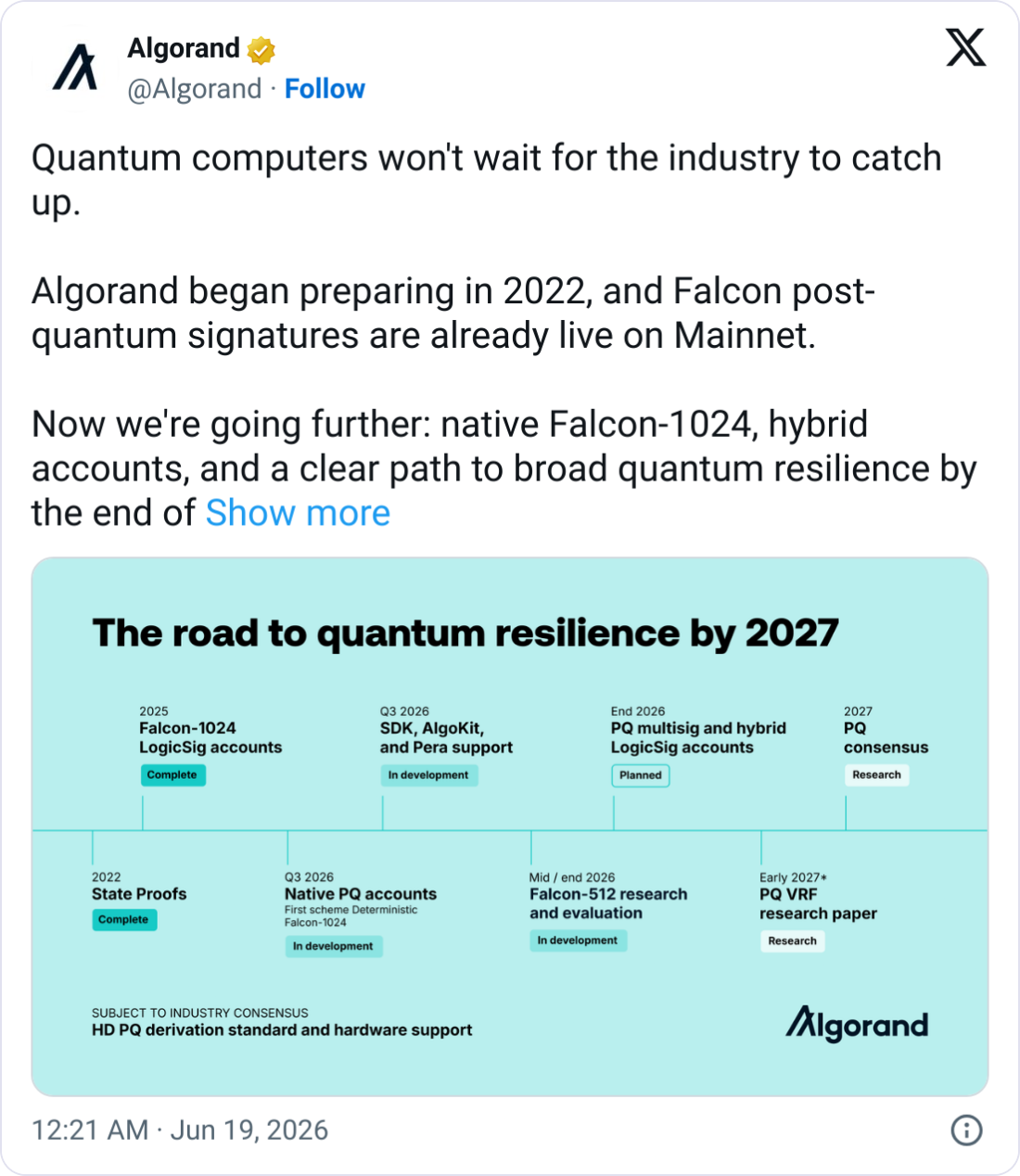
The layer-1 blockchain Algorand has released its plan to tackle the potential threat of quantum computing, with a roadmap to update the network’s infrastructure by the end of 2027.
Algorand Foundation technology chief Bruno Martins said Thursday that the updates will aim to give the network broad quantum resilience, a threat it has been researching and preparing for several years.
“Governments, standards bodies, and security experts around the world are already preparing for a future where quantum computers may break many of the cryptographic systems that protect today’s digital infrastructure,” Martins said.
Algorand is the latest crypto project to plan for quantum computing as users share increasing concerns that the technology could soon break the encryption underpinning the ecosystem, putting billions of dollars worth of value at risk of exploitation.
Quantum computers, a technology set to be vastly more powerful than today’s supercomputers, are only in their early stages, but Google researchers said in a paper in March that they may need fewer resources than previously estimated to break the cryptography protecting blockchains.
That paper also noted that Algorand was likely the most quantum-ready blockchain, while Ethereum and Solana are also actively exploring solutions to be prepared for quantum computers.
Algorand’s Martins said the roadmap includes new accounts based on its signature scheme, Falcon, designed with quantum-resistant cryptography.
Source: Algorand
He added that the blockchain will also update its consensus mechanism from its current cryptography, which is not quantum-resistant. It will also update how accounts participating in consensus operate and is researching options, including a “hybrid mix” of classic and quantum-resistant signatures.
Related: Nearly 10% of Bitcoin supply is ‘structurally unsafe’ from quantum breakthrough: Glassnode
Quantum threats to cryptography are a growing concern among governments and businesses, with many companies putting plans in place before quantum computers are powerful enough to break encryption, which could happen as soon as 2030.
France’s cybersecurity agency ANSSI said on Tuesday that it will stop certifying security products that lack quantum-resistant encryption to encourage businesses to create only quantum-safe products by 2030.
The US National Security Agency has also required all new national security systems to use its quantum-resistant algorithms starting Jan. 1, 2027, while nonquantum-resistant systems must be phased out by the end of 2030.
Google has set a deadline for 2029 to be ready for the event due to rapid progress in quantum computing hardware and error correction.
Last month, Tezos launched a prototype blockchain for payments designed to resist quantum computing attacks, and stablecoin issuer Circle released a roadmap in April for its Arc blockchain to become quantum-ready.
California Institute of Technology researchers have also theorized that a functional quantum computer may require far fewer resources than previously believed, and one could be deployed before 2030.
Magazine: Nobody knows if quantum-secure cryptography will even work
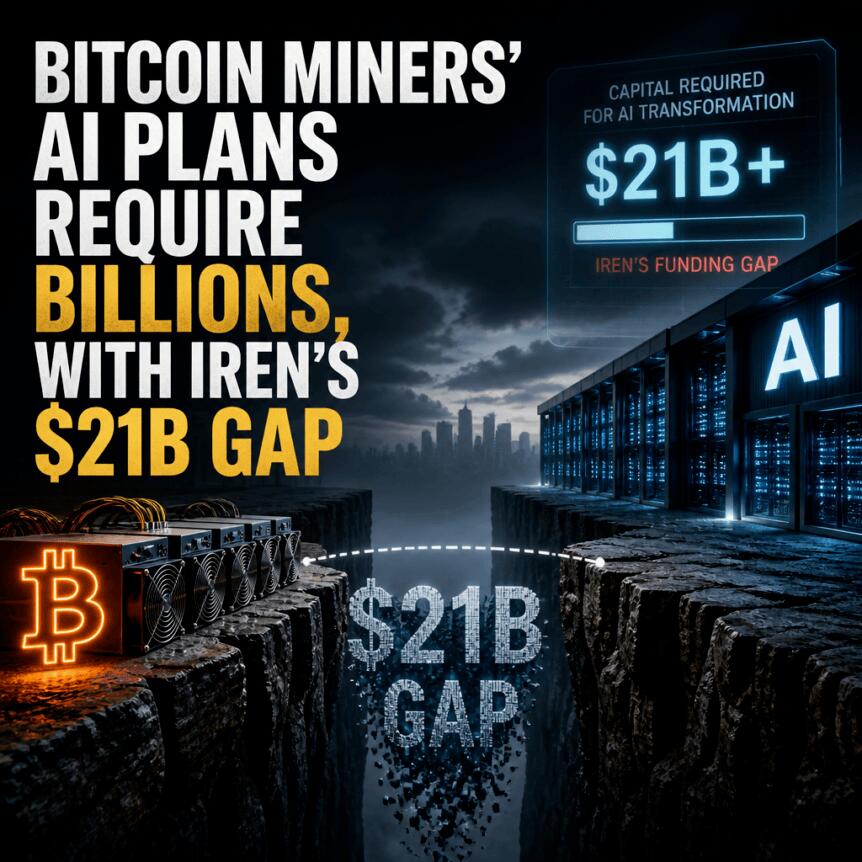
Bitcoin miners are being recast as potential “AI infrastructure” plays, but turning that story into funded, operational capacity may demand a scale of investment that many public operators currently do not have. A framework highlighted in Blocksbridge Consulting’s Miner Weekly newsletter estimates that miners could require roughly $50 billion in near-term capital to build AI- and high-performance computing (HPC) data center facilities from their existing power assets.
The idea is gaining traction as mining difficulty and hashprice pressures intensify. In parallel, Miner Weekly points to a major June shift in the mining network—difficulty fell sharply after an estimated 100 exahashes per second (EH/s) of computing power went offline—raising fresh questions about how much of miners’ future energy allocation will remain tied to producing Bitcoin.
Key takeaways
- Miner Weekly argues that financing needs for AI/HPC-grade data centers are materially higher than for traditional Bitcoin mining operations, potentially pushing total near-term capital demand for miners toward ~$50 billion.
- Estimated AI data center funding gaps vary by miner, with IREN facing the largest gap at about $21.1 billion, followed by Riot Platforms ($7.2 billion) and HIVE Digital ($4.6 billion).
- The network saw a historically large difficulty drop—down 10.09% to 124.93 trillion on June 14—after an estimated 100 EH/s went offline.
- Miner Weekly suggests the AI pivot could alter future hashrate growth patterns, as miners redirect some energy capacity from Bitcoin production toward data center services.
- Underlying mining economics have been stressed since the 2024 halving, with CoinShares and other analysts describing hashprice falling to levels where a meaningful share of miners may run unprofitably.
Why “AI miner” narratives imply very real capex
Miner Weekly’s central point is that power is only the starting point. Converting energy access into AI-ready data center capacity requires upgrading infrastructure standards—especially around reliability and performance. According to Miner Weekly, a Bitcoin mine can often function with “relatively simple buildings,” modular setups, and ASIC fleets that can tolerate fast curtailment. AI and HPC facilities, by contrast, require higher uptime commitments and greater system redundancy, including more demanding cooling, electrical backup, networking capacity, and ongoing customer support.
That shift in requirements matters because it changes how investors should interpret “miner-to-AI” announcements. If miners truly aim to monetize their power assets by hosting or operating AI/HPC infrastructure, the bottleneck is no longer only securing power; it becomes securing the long-term financing needed for complex data center buildouts.
Miner Weekly’s framework relies on VanEck data to argue that the move could require billions per large public miner and adds up to a much larger aggregate figure across the sector.
Difficulty drop highlights how fragile mining economics can be
Even as the AI narrative spreads, the near-term mechanics of mining are still dominated by network conditions. Miner Weekly points to one of the largest percentage declines in Bitcoin mining difficulty on record: difficulty fell 10.09% to 124.93 trillion on June 14 after an estimated 100 EH/s of computing power went offline.
Miner Weekly attributes the decline to a combination of weaker mining economics and seasonal power curtailments. But the bigger implication the newsletter draws is about future behavior. If miners increasingly view data centers as a path to different revenue streams, the way hashrate grows—or contracts—may begin to reflect that reallocation of energy capacity.
In other words, a “difficulty down” moment is not just a snapshot of the mining cycle. It can also be a stress test for the industry’s broader strategy: whether miners can fund the pivot while competing in a market where profitability is sensitive to network difficulty and hashprice.
The funding gaps public miners would face
Miner Weekly highlights estimated AI data center funding gaps among public Bitcoin miners pursuing AI infrastructure. In its framework, IREN tops the list, needing an estimated $21.1 billion to complete its AI data center plans. Riot Platforms is shown with a $7.2 billion gap, and HIVE Digital with $4.6 billion.
These are not minor shortfalls. They also help explain why the AI pivot is still best understood as a longer-duration capital project rather than a quick re-rating. If miners must meet higher uptime and redundancy requirements, they need sustained investment—often through structured finance, project funding, or new equity/debt—before the AI story can translate into operating cash flows.
The funding discussion also aligns with earlier market commentary. Cointelegraph previously noted that Bernstein flagged IREN as the public miner most likely to move away from Bitcoin mining toward an AI cloud business, projecting a $3.7 billion annualized revenue run rate once AI operations are fully built out. The gap estimates in Miner Weekly underscore the practical challenge embedded in those forward-looking projections: building those operations requires substantial capital at the outset.
Pressures on mining since the halving—and what “hashprice” signals
Beyond network-level changes, Miner Weekly frames the AI pivot as increasingly appealing because traditional mining economics have been under pressure since Bitcoin’s 2024 halving. The core issue is that hashprice—the daily revenue earned per unit of computing power—has fallen sharply from highs seen around Bitcoin’s all-time peak in October.
Earlier coverage summarized in the article described how the environment worsened through 2024. In a December report, TheEnergyMag characterized Q4 as the “harshest margin environment of all time” for public miners, citing hashprice dropping to roughly $35 per PH/s. In the first quarter, CoinShares data in prior reporting indicated hashprice falling further to around $28 per PH/s, a level at which, the coverage notes, up to 20% of miners may be operating at a loss—particularly those with older hardware or higher electricity costs.
This is where the AI pivot’s investor relevance becomes sharper. When mining margins compress, balance sheets become more sensitive to financing costs and to the ability to withstand volatility in hashprice. By emphasizing that AI/HPC infrastructure demands higher reliability standards, Miner Weekly effectively argues that miners shouldn’t treat AI as a simple extension of their existing operations. It’s a transition that could reshape capital allocation—and potentially influence which operators can sustain both sides of the story.
At the same time, the broader AI buildout is continuing. The article references Cointelegraph coverage that Nvidia is reportedly planning a $20 billion bond offering to help fund AI-related investments, reinforcing the backdrop of sustained demand for compute infrastructure.
For investors and operators, the next signal to watch is whether public miners can close the estimated AI data center funding gaps without undermining their core mining operations during periods of difficulty volatility and depressed hashprice. The strategic pivot may still be plausible, but the timing—and the ability to finance higher-grade AI infrastructure—will likely determine how quickly the narrative turns into measurable results.
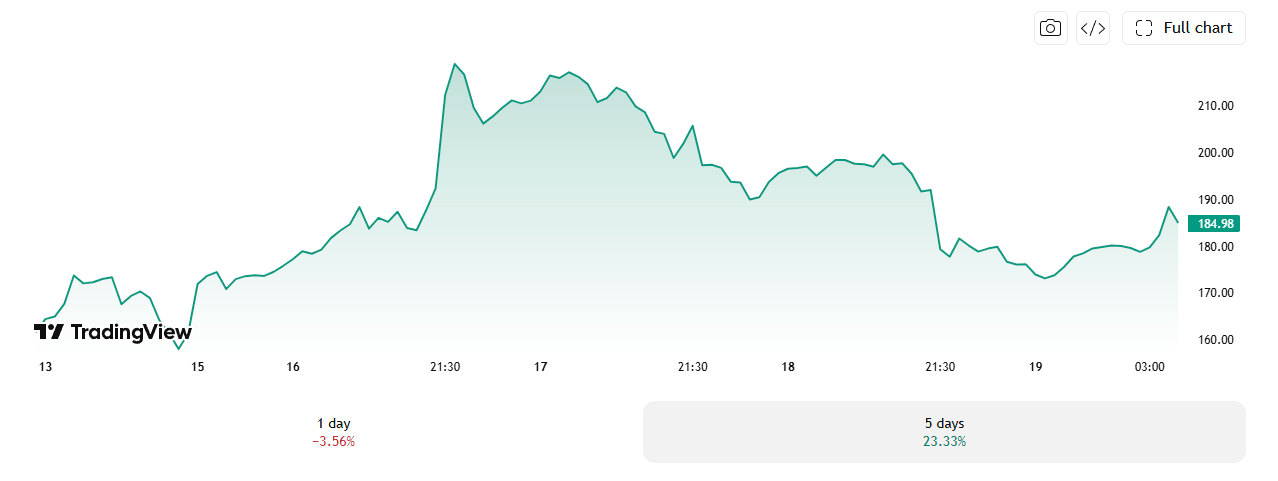
SpaceX (SPCX) shares have dropped 18% from their post-IPO peak, and the average investor who bought in the open market is now nearly breaking even, raising the question of whether the historic debut has already peaked.
Shares closed Thursday at $184.98, down 3.6% on the day. According to CNBC, the stock’s five-day volume-weighted average price sat at $181.71, a closely watched measure of where the typical post-debut buyer is positioned. That slim margin above cost basis marks a sharp reversal from Tuesday’s intraday high above $225.
From $3 Trillion to Seventh Place
The two-day slide has erased roughly $620 billion in market value, pulling SpaceX’s valuation from nearly $3 trillion down to $2.37 trillion. The company, which briefly ranked fourth globally ahead of Amazon and Microsoft, has since slipped as low as seventh place, competing closely with TSMC.

The trigger was SpaceX’s June 16 announcement that it would acquire Anysphere, the company behind AI coding tool Cursor, for $60 billion in an all-stock deal. The transaction carries roughly 3.4% dilution of SpaceX’s $1.77 trillion IPO valuation.
Morningstar responded by trimming its fair value estimate to $62 from $63, noting the deal adds share dilution on top of a stock it had already flagged as significantly overvalued. The firm’s best-case scenario puts fair value at $169, below where the stock is currently trading.
Retail Frenzy Cools Fast
The speed of the reversal underscores how sentiment-driven the initial rally was. Vanda Research data showed retail investors poured $369.8 million into SPCX over its first three sessions, more than four times the amount flowing into Nvidia over the same period. That pace slowed sharply by Thursday, June 18, with net retail buying cooling to $9.1 million by midafternoon.
Retail investors who received IPO allocations at $135 through platforms like Robinhood, Fidelity, and SoFi still hold gains, though many received only a fraction of the shares they requested. Those who chased the stock higher in the open market are now sitting on paper losses. As BeInCrypto reported ahead of the drop, smart money in the perpetuals market had already positioned for a correction.
Not everyone is bearish. Oppenheimer analyst Timothy Horan raised his price target to $250 following the Cursor deal, arguing the acquisition gives SpaceX access to AI talent, training data, and an established developer user base.
However, with a lockup expiry looming in late July that could double the tradeable float, and a potential $20 billion bond sale tied to xAI financing, the supply-side pressure on SPCX is only set to grow.
Whether this is a healthy correction or the start of a longer post-IPO unwind may hinge on SpaceX’s first earnings report as a public company, due in late July.
The post SpaceX Sheds $620 Billion in Two Days: Is the Post-IPO Slide Just Starting? appeared first on BeInCrypto.

Key Takeaways
- STRC finished Thursday at $88.59, reaching an intraday bottom of $82.50 — representing the most extended period below $100 par since its July 2025 launch
- Volume exploded to 10.7 million shares, significantly exceeding the typical 3.4–3.5 million daily range
- Analyst Jeff Dorman from Arca suggests Strategy could be forced to liquidate $3B–$4B in Bitcoin holdings to bring STRC back to par
- TD Cowen upheld its Buy rating on MSTR with a $400 target, even as MSTR shares dropped 4% to $112.53
- The company has suspended STRC’s ATM offering while shares remain under par value
Strategy’s preferred equity STRC ended Thursday’s trading at $88.59, representing back-to-back closes beneath $90 and the most prolonged period trading under its $100 par value since its initial offering in July 2025.
Intraday action saw STRC plunge to $82.50 before staging a modest comeback. The security was structured to maintain par value through a flexible dividend mechanism — presently yielding 12.9% with monthly recalibrations.
Share volume exploded to roughly 10.7 million on Thursday, dwarfing the standard daily turnover of approximately 3.4 to 3.5 million. This marked one of the most active trading sessions since the preferred stock’s inception.
With STRC languishing below par, Strategy has temporarily halted the security’s ATM offering. Under normal circumstances when STRC exceeds $100, Strategy issues additional shares to acquire Bitcoin.
The company’s common equity also experienced turbulence, declining 4% to settle at $112.53.
Potential Remedies for STRC’s Par Value Problem
Jeff Dorman, Arca’s Chief Investment Officer, outlined the available pathways on X, characterizing it as the “MSTR pickle continues.”
Dorman’s primary projection — assigned a 70% likelihood — envisions Strategy gradually offloading modest quantities of MSTR shares monthly at dilutive prices. He contends this approach provides STRC investors “a glimmer of hope” while preserving most Bitcoin reserves, though he cautions MSTR equity “would get hammered.”
His secondary forecast, weighted at 25% probability, involves more aggressive intervention: liquidating $3 billion to $4 billion in Bitcoin holdings. Dorman suggests this would “buy a ton of time” and benefit STRC holders, despite creating short-term headwinds for Bitcoin prices.
The final alternative — what Dorman labels the “nuclear” option at 5% probability — would see Strategy suspending dividend payments on its preferred securities. This could leave preferred shareholders recovering just 30 to 40 cents per dollar and potentially exclude Strategy from capital markets indefinitely. However, it would eliminate what Dorman calculates as approximately $1.7 billion in annual cash obligations.
TD Cowen Maintains Optimistic Stance
Despite mounting concerns, TD Cowen reaffirmed its Buy recommendation on MSTR Thursday, preserving its $400 price objective while expressing confidence in Strategy’s preferred stock portfolio, including STRC.
The investment bank characterized Strategy as evolving beyond merely functioning as a leveraged Bitcoin vehicle toward establishing what it describes as a “Bitcoin capital markets platform.”
TD Cowen analysts referenced three investor briefings with CFO Andrew Kang, observing that Strategy may emphasize reserve reconstruction and preferred stock stabilization over fresh Bitcoin acquisitions during challenging market environments.
Critic Peter Schiff escalated warnings on social platforms, suggesting potential litigation against Michael Saylor’s Strategy regarding STRC’s persistent deterioration.
Dorman additionally scrutinized MSTR’s broader valuation metrics, calculating the firm possesses approximately $35.2 billion in unencumbered Bitcoin assets against a $40.4 billion equity capitalization — positioning MSTR at 1.15x modified NAV. He argues the shares “should trade at a discount to NAV now” and face continued downside pressure absent a swift Bitcoin recovery.


The CFTC and SEC have asked the public to comment on how U.S. rules define swaps, security-based swaps, and related derivatives products.
Summary
- The agencies want feedback on swaps, security-based swaps, mixed swaps, and emerging derivatives products rules.
- CME says Kalshi’s crypto perpetual futures should be treated as swaps under Dodd-Frank law.
- The public comment request could shape crypto perps, prediction markets, and future jurisdiction lines nationwide.
The joint request focuses on Title VII of the Dodd-Frank Act, the law that split parts of the swaps market between the two agencies.
The request seeks input on swap exclusions, mixed swaps, jurisdictional questions, alternative compliance, and new products. The agencies said comments will remain open for 60 days after publication in the Federal Register.
The agencies said market structures and trading practices have changed since the original rules took shape. They asked whether current definitions still match the way derivatives products now trade.
The review also gives both agencies a common record as they weigh products that may touch both commodities and securities laws. It could also shape future staff guidance for market participants and courts.
CFTC Chair Michael Selig said the request could address “longstanding ambiguities” in Dodd-Frank. SEC Chair Paul Atkins said clarification is “long overdue,” including for event-based products.
CME lawsuit raises pressure
The public comment request came as CME Group sued the CFTC over the agency’s treatment of crypto perpetual futures. CME argues that Kalshi’s perpetual futures should fall under swaps rules, not ordinary futures rules.
As previously reported by crypto.news, CME accused the CFTC of bypassing congressional requirements when approving Kalshi’s crypto perpetual contracts. The exchange said the agency created a path for new competitors without using the swap framework set by Dodd-Frank.
CME Chief Executive Terrence Duffy had already said the company planned to sue after the CFTC cleared platforms such as Kalshi and Coinbase to offer regulated crypto perpetual futures. CME says the products compete for retail derivatives customers.
Perpetual futures test old categories
Perpetual futures are derivatives contracts without expiry dates. Traders can hold positions without rolling into a new contract, which makes them common on offshore crypto exchanges.
The CFTC allowed Kalshi’s Bitcoin perpetual futures to remain listed under existing futures rules, subject to compliance with the Commodity Exchange Act and CFTC regulations. Crypto.news earlier reported that Kalshi later expanded into other crypto-linked perpetual products.
The dispute now turns on legal definitions. If regulators treat crypto perps as swaps, platforms may face different rules for clearing, reporting, execution, and oversight. If regulators treat them as futures, venues can list them through the futures exchange process.
Prediction markets add another layer
The CFTC and SEC also asked for views on event contracts and other new products. That part of the request matters because prediction markets have grown quickly and now face questions over federal and state oversight.
Crypto.news has reported several CFTC fights involving Kalshi and state gaming regulators. The CFTC has argued that federally regulated event contracts fall under its authority, while states have claimed some sports-linked products look like gambling.
The SEC has also shown interest. Crypto.news earlier reported that Atkins told lawmakers some event contracts may fall under securities law, depending on how they are written.
The new comment process does not settle the CME case or the prediction market disputes. It gives exchanges, crypto firms, legal experts, and the public a chance to tell regulators where the current definitions need clearer lines.

Major train disruption LIVE as Bolton and Wigan lines blocked in serious incident

(VIDEO) Toy Story 5 Nears Franchise Box Office Record With Massive Thursday Night Preview Haul

AllUnity Launches Swedish Krona Stablecoin SEKAU


-

 Business5 days ago
No Jackpot Winner as $257 Million Prize Rolls Over to $269 Million Monday Draw
-

 Fashion7 days ago
Weekend Open Thread: Tuckernuck – Corporette.com
-
Crypto World4 days ago
Zimbabwe Requires Crypto Businesses to Register Annually Under New FIU Regulations
-

 Crypto World6 days ago
Bitget enters Argentina’s regulated crypto market through PSAV registration
-

 Tech6 days ago
NanoClaw integrates JFrog registries to secure AI agent downloads
-

 Tech7 days ago
This Week In Security: Microsoft On Microsoft, Register Your Domains, Linux On ARM, And FreeBSD Joins The File Cache Club
-

 NewsBeat6 days ago
FBI searches office of Ohio voter registration group
-
 Entertainment5 days ago
Matt Damon’s Viral Sci-Fi Thriller Has Taken Over HBO Max
-

 Business5 days ago
Anthropic staff to meet White House officials next week, Axios reports
-

 Tech5 days ago
As AI companies race to go public, who else is along for the ride?
-
 Crypto World5 days ago
Bitcoin could crash to $48,000, if this historical pattern is triggered
-

 Politics4 days ago
“Israel’s” ban on ICRC visits ruled illegal, but Knesset moves to stop them permanently
-
 NewsBeat5 days ago
Warning of disruption as Cardiff Crossrail works to start
-

 News Videos5 days ago
Financial Accounting | Last Day Revision Strategy and Booster | CMA Inter – June 2026
-
 NewsBeat4 days ago
Tributes to former deputy head teacher at Cambridge school among death and funeral notices
-
 Crypto World5 days ago
Market Preview: SpaceX (SPCX) IPO Record, Federal Reserve Meeting, and Iran Nuclear Agreement
-
 NewsBeat5 days ago
what doctors are seeing in ebike crashes
-

 Entertainment5 days ago
Deion Sanders Shares Powerful Post After Viral Advice To Deiondra
-
 Entertainment5 days ago
Kate Middleton Glare Goes Viral After Kids Booed At Royal Event
-

 Business5 days ago
Invesco Quality Income Fund Q1 2026 Commentary
You must be logged in to post a comment Login