Crypto World
Ethereum (ETH) Price Struggles Below $2,200 Amid Macro Headwinds and ETF Outflows

Key Takeaways
- Ethereum declined 6% following a brief rally to $2,200, pressured by US equity market weakness and geopolitical tensions
- Options market skew reached 7%, indicating institutional traders are positioning for potential downside
- US spot Ethereum ETFs experienced combined net outflows totaling $91 million on March 5
- The validator entry queue expanded to 3.4 million ETH, while exit queue contracted to only 58,944 ETH
- Ethereum commands 65% of aggregate blockchain TVL across layer-1 and layer-2 networks, with $55.4B on mainnet
Ethereum is currently exchanging hands near $2,080 following its inability to sustain momentum beyond the $2,200 threshold this week. The pullback occurred amid deteriorating global market conditions, influenced by escalating Middle East tensions and a US judicial decision mandating government repayment exceeding $130 billion in tariff refunds to domestic enterprises.
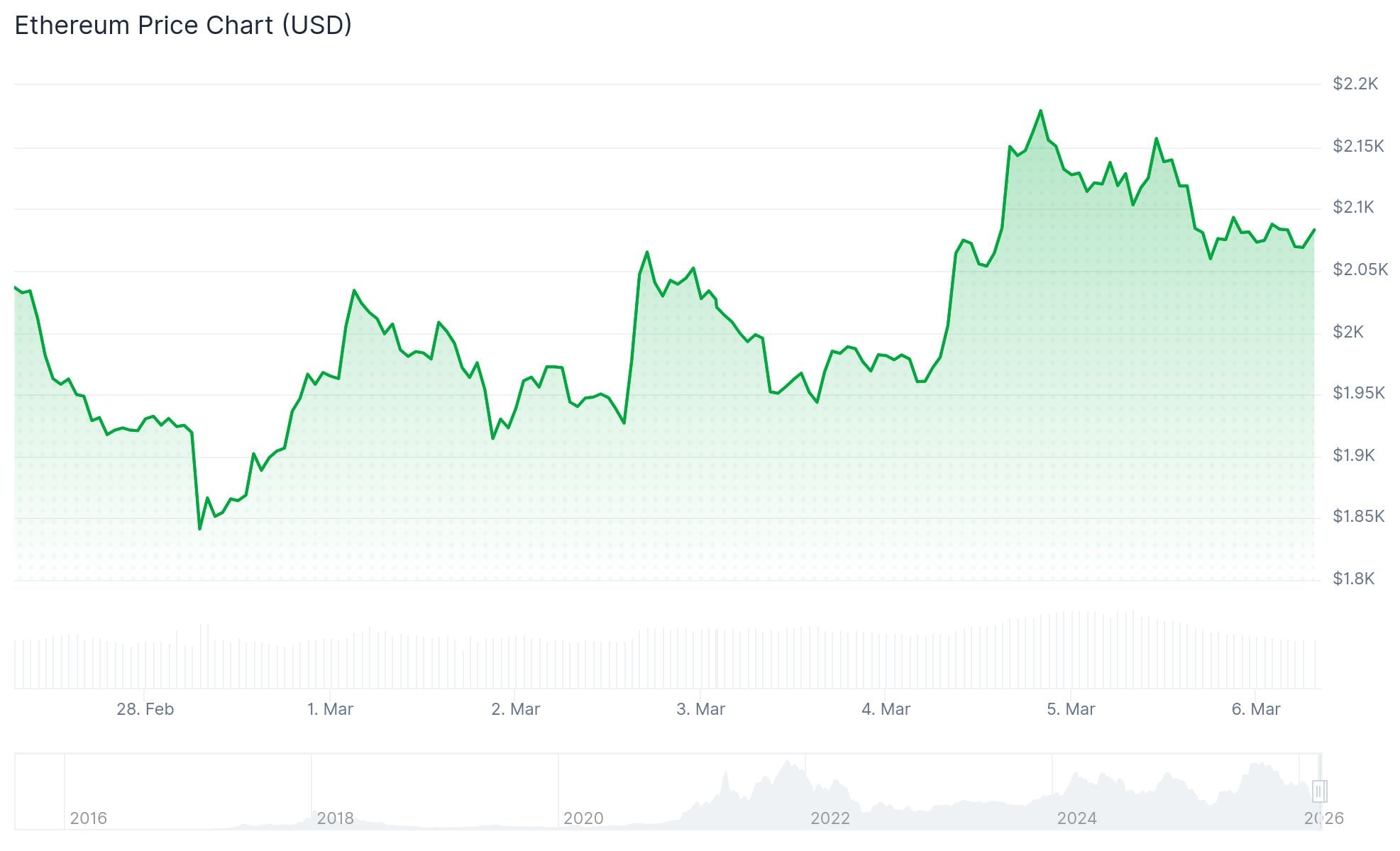

The second-largest cryptocurrency had mounted an impressive 22% recovery from its February nadir of $1,800, but upward momentum dissipated rapidly. Wednesday’s temporary breach of $2,200 was swiftly followed by a 6% retracement, echoing broader risk-asset selloffs across US markets.
Futures market indicators paint a cautious picture. The 30-day annualized premium for ETH futures contracts remains significantly below the 5% neutral benchmark, suggesting limited appetite for leveraged bullish positions among derivatives traders.
The put-call skew for ETH options expanded to 7% on Thursday. Historical patterns indicate that readings exceeding 6% generally reflect heightened demand for downside protection among sophisticated market participants.
Liquidation data from CoinGlass reveals that ETH traders absorbed $58 million in forced position closures over a 24-hour period, with long positions accounting for $35.7 million of that total.
Institutional Flows and Staking Dynamics
The price deterioration coincided with unfavorable institutional flow data. March 5 witnessed US spot Ethereum ETF products recording aggregate net redemptions of $91 million, signaling a temporary retreat in institutional demand.
This outflow represented a sharp reversal from the more constructive inflows observed during earlier trading sessions in the week, underscoring how rapidly institutional sentiment responds to changing market dynamics.
Meanwhile, network staking metrics present a contrasting narrative. The validator activation queue has ballooned to approximately 3.4 million ETH, while the corresponding exit queue has diminished to merely 58,944 ETH. Prospective validators now face wait times approaching 57 days.
These figures indicate that substantial holders are preferring to stake their ETH for yield generation rather than liquidating positions during market turbulence.
Onchain Metrics and Ecosystem Dominance
Decentralized exchange activity on Ethereum has cooled considerably. Weekly DEX trading volumes contracted to $12.6 billion from $20.2 billion recorded one month prior. Decentralized application revenues similarly declined to $14.1 million over the trailing seven days, representing a 47% month-over-month decrease.
Solana experienced comparable trends, with DEX volumes contracting by 50% across the identical 30-day measurement period.
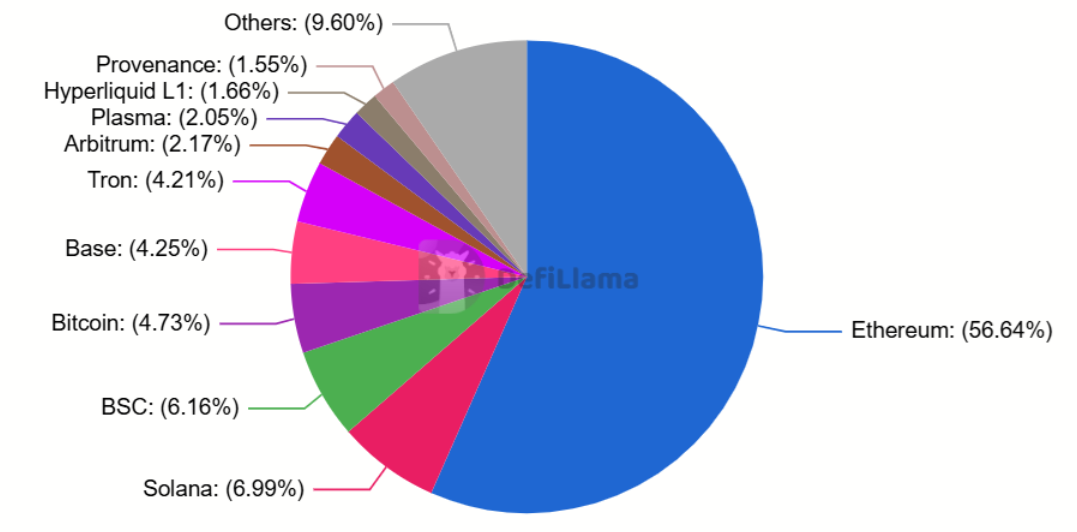

Notwithstanding reduced network activity metrics, Ethereum maintains its commanding position in value locked across the blockchain ecosystem. When accounting for layer-2 scaling solutions, the Ethereum infrastructure captures approximately 65% of total blockchain TVL. The mainnet alone secures $55.4 billion, substantially exceeding Solana’s $6.8 billion.
Technical analysis identifies immediate resistance at the $2,108 level on daily timeframes. A decisive close above this threshold could facilitate a move toward $2,388. Conversely, should support at $1,741 fail to hold, subsequent downside targets emerge at $1,524 and $1,404.
Analysts have identified $1,826 as the lower boundary of the current range structure, representing the next technical attractor should selling pressure intensify in the near term.

