
Crypto World
Ethereum Foundation deepens DeFi treasury push with fresh Morpho deployment



Ethereum Foundation deploys 3,400 more ETH into Morpho vaults, cementing its shift toward active, on-chain DeFi treasury management instead of selling ETH to fund operations.
Summary
- The Foundation allocated 3,400 ETH (about $7.6M) to Morpho Vaults, including 1,000 ETH to Vaults V2, as part of an expanding DeFi treasury program.
- Since early 2025, it has funneled tens of thousands of ETH plus stablecoins into Morpho, Compound and Spark to earn yield while backing Ethereum-aligned, open-source protocols.
- The latest move signals confidence in Ethereum’s DeFi stack even as ETH trades near $2,239, with Morpho’s TVL near $5.8B and growing RWA exposure.
The Ethereum (ETH) Foundation announced Wednesday via its official X account that it has deployed an additional 3,400 ETH to Morpho Vaults, with 1,000 ETH directed specifically into Morpho Vaults V2. At current prices, the deployment represents approximately $7.6 million — but its significance extends well beyond the dollar figure. It marks the latest installment in an accelerating institutional pivot by the world’s most prominent blockchain foundation toward active, yield-bearing DeFi treasury management.
The move is not without precedent. In October 2025, the Foundation had already deployed 2,400 ETH and approximately $6 million in stablecoins into Morpho yield vaults, citing the protocol’s “commitment to Free/Libre Open Source Software principles” and its release of both Morpho Vault V2 and Morpho Blue V1 under open GPL 2.0 licenses. That deployment was itself part of a broader strategic overhaul initiated earlier in 2025, when the Foundation committed an initial tranche of up to 50,000 ETH to various decentralized finance platforms — including Compound and Spark (the lending arm of the Sky/MakerDAO ecosystem) — in a deliberate shift away from the previous practice of periodically selling ETH to fund operations.
The rationale is both financial and philosophical. According to data from Arkham Intelligence, the Ethereum Foundation holds total assets exceeding $820 million, of which approximately $735 million is denominated in ETH. Rather than leave that capital idle or convert it to fiat, the Foundation has positioned Morpho as a core pillar of a responsible liquidity management approach — using DeFi tooling to generate yield while simultaneously reinforcing the open-source infrastructure it has long championed.
Morpho itself has grown substantially into this role. The protocol scaled from 67,000 users to over 1.4 million users across 2025, with deposits rising from $5 billion to $13 billion and active loans reaching $4.5 billion by year-end. Total real-world asset (RWA) deposits on the platform grew from near zero at the start of 2025 to $400 million by the end of Q3. Morpho Vaults V2, which launched in November 2025, introduced an expanded curator model designed to give asset managers and institutions greater flexibility in structuring on-chain lending strategies.
Wednesday’s allocation to Vaults V2 is particularly notable. The newer architecture enables more sophisticated curation, compliance integration, and programmable liquidity conditions — features that align with the Foundation’s need to manage a large, institutionally sensitive treasury. With Morpho’s total value locked reported around $5.8 billion as of early March 2026, the protocol sits among the most battle-tested lending infrastructures in DeFi.
The deployment also carries a signalling dimension. As Ethereum faces ongoing questions about its competitive positioning against faster, cheaper chains, the Foundation deploying material ETH into its own ecosystem’s DeFi stack is a statement of confidence — one that comes at a moment of broader market stress, with ETH trading around $2,239, down 3.49% on the day. The message, whether intentional or not, is clear: the foundation is not just building Ethereum, it is putting its own balance sheet to work within it.

Crypto World
Flow Traders debuts 24/7 OTC liquidity service for tokenized stocks, gold and money market funds


Flow Traders, one of the world’s top market makers in exchange-traded products, said Tuesday it is bringing its decades of TradFi expertise to tokenized assets with the launch of 24/7 over-the-counter (OTC) liquidity.
The move arms institutional clients with a new tool, allowing them to manage risk and keep capital flowing via blockchain versions of popular traditional assets when traditional exchanges are dark on weekends and after hours.
The new offering, delivered through Flow Traders’ Digital Asset OTC platform, provides proprietary, two-way pricing for tokenized money-market funds, equities and commodities, including Franklin Templeton’s BENJI and tether gold (XAUT), according to the press release shared with CoinDesk.
It means that the OTC platform will now constantly quote prices, ready to buy or sell the tokenized assets outside regular traditional market hours. The service is available immediately to permissioned counterparties, with institutions able to access liquidity via direct FIX connectivity and other standard trading interfaces.
“At Flow Traders, we have operated at the intersection of traditional and digital markets for many years, and we are pleased to launch 24/7 OTC liquidity for regulated tokenized equities and commodities for permissioned counterparties through our digital asset OTC platform,” Thomas Spitz, CEO of Flow Traders, said.
The OTC liquidity aims to address a nagging problem for institutions: The inability to adjust positions during weekends or overnight sessions. This has become brutally clear in recent weeks, as Iran-Israel tensions flared over the weekends, leaving traditional trading desks empty while crypto markets churned.
The demand mainly comes from institutions that want the ability to manage exposure outside traditional market hours,” Marc Jansen, co-chief trading officer at Flow Traders, told CoinDesk.
He explained that the OTC liquidity service will help large traders manage their risk better beyond market hours through tokenized equities and commodities, which are already gaining popularity on venues such as Binance, OKX, and Hyperliquid.
“All weekend long, with these markets getting pretty close to the traditional market open price as a result of that weekend price discovery. OTC liquidity helps support that activity, particularly for larger trades where public venue liquidity is still developing,” he said.
According to the firm, tokenization is growing fast and the tokenized gold and silver market alone is nearing $6 billion in value, up roughly fourfold since the end of 2024.
“Liquidity providers such as Flow Traders play a critical role in ensuring that tokenized assets like XAUT can trade efficiently across venues and reach a broader set of market participants,“ said Paolo Ardoino, CEO of Tether.
The asset tokenization market is reportedly worth $3 trillion as of this year and is growing at a CAGR of 44.25% and could reach over $18 trillion by 2031, according to some estimates.
This booming market, however, demands more than just enthusiasm; it requires battle-tested expertise, and this is where Flow Traders appears to have an edge, thanks to their 20 years of experience in market-making and liquidity provisioning for global exchange-traded products.
They operate across asset classes, including ETPs, digital assets, fixed income, FX, and commodities, and ranked among the top three global market makers by ETP trading volume in 2025.
“For us, with extensive experience in the ETF markets, it’s a more familiar problem. We’ve always priced and managed risk in products when parts of the primary market are closed. That already requires using models rather than relying purely on underlying market prices and we’ve built those pricing models over time in our ETF business, and they can be extended to tokenized markets,” Jansen said.
“Our role is to provide liquidity wherever the market develops,” he added.
The new OTC service will expand coverage and evolve, with asset availability guided by institutional counterparty demand, ongoing regulatory developments, and the integration of supported trading venues.
Product offerings will therefore vary by jurisdiction and depend on client eligibility, with different members of the Flow Traders group providing access based on their respective regulatory statuses.
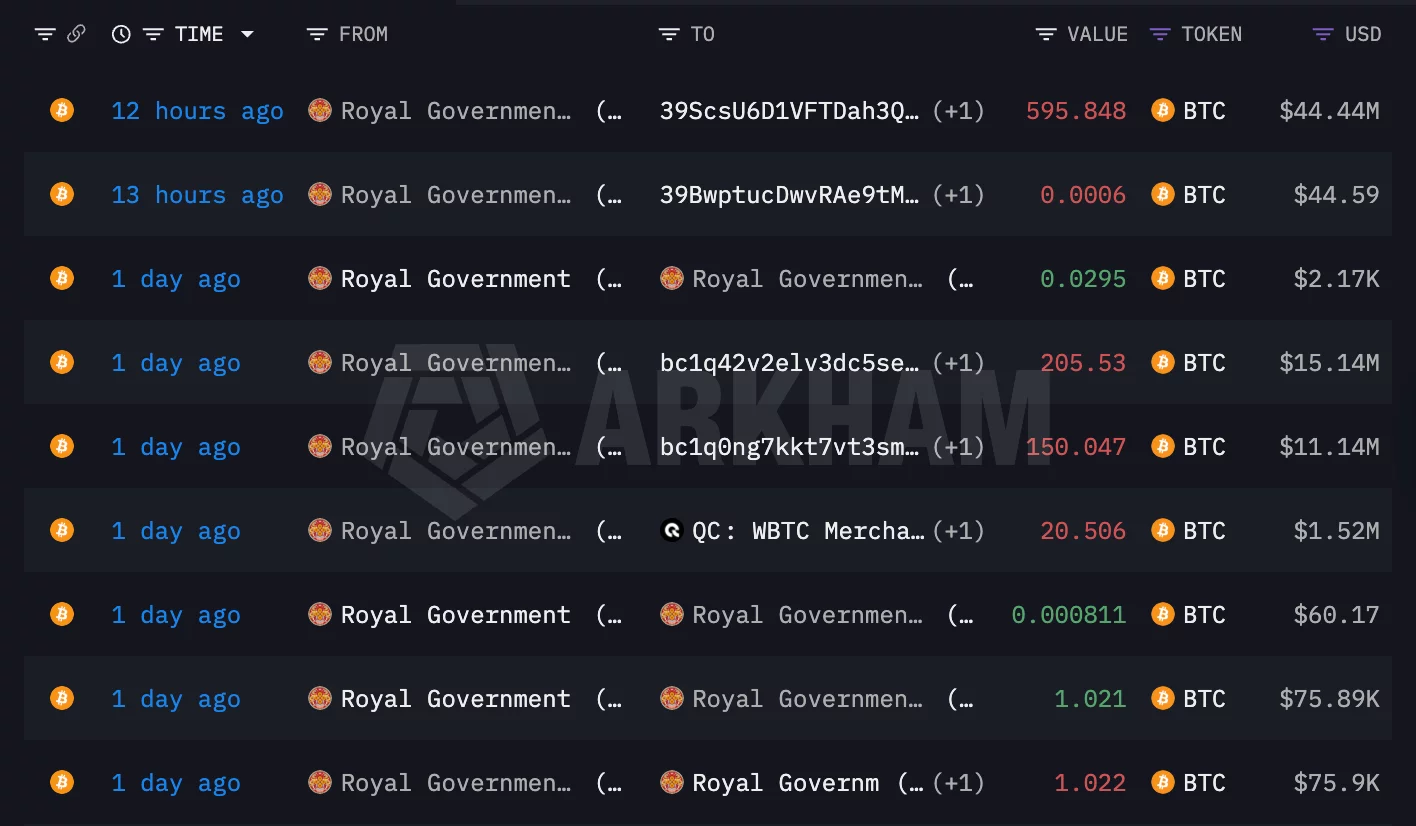
Bhutan has transferred roughly $72.3 million in Bitcoin over the past 24 hours, continuing a steady pattern of trimming its sovereign holdings.
Summary
- Bhutan transferred roughly $72.3 million in Bitcoin over 24 hours, with Druk Holding and Investments moving more than 973 BTC across multiple transactions.
- Holdings have declined to over 4,400 BTC from a peak of 13,295 BTC in October 2024, as the country continues periodic sales from its sovereign reserve.
According to Arkham Intelligence data, Druk Holding and Investments, which manages the country’s crypto mining and treasury operations, has moved more than 973 BTC. The latest transfers come as Bhutan has continued to offload portions of its Bitcoin reserves in measured intervals.
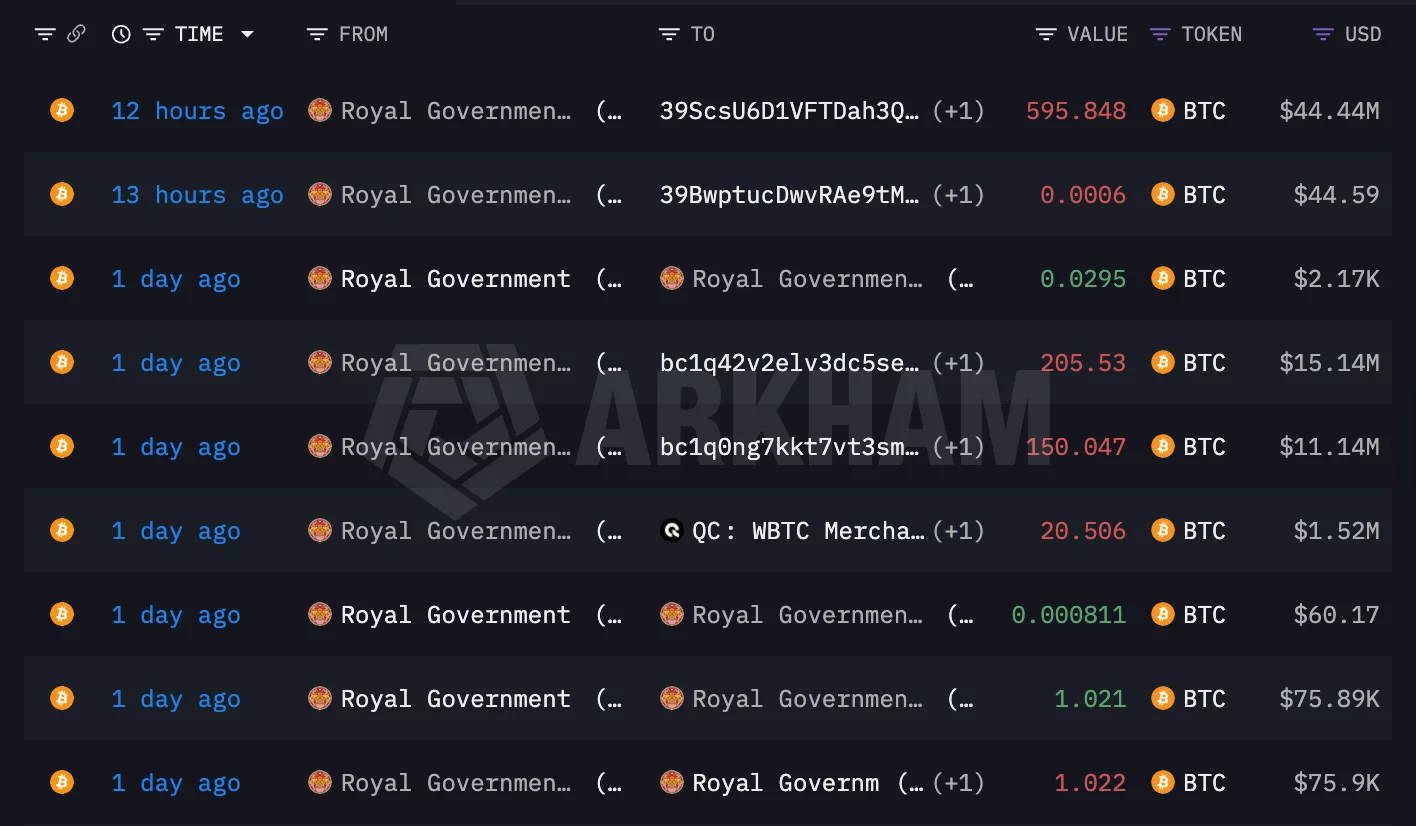
DHI’s last major transfer was flagged on March 10, when it moved more than 175 BTC worth around $11.8 million.
Arkham noted that the country periodically sells Bitcoin in clips of $5 million to $10 million, but current transfers appear larger in scale compared to the activity seen around September 2025.
After the current transfers, Bhutan now holds more than 4,400 BTC, valued at over $322 million based on current market prices.
At its peak, Bhutan held 13,295 BTC in October 2024 and has since gradually reduced its holdings through a series of on-chain transfers.
Bhutan’s Bitcoin play
Bhutan has outlined a Bitcoin Development Pledge aimed at supporting the Kingdom of Bhutan’s long-term economic development through its mining operations and strategic reserves. Meanwhile, it has also committed to deploying part of its Bitcoin holdings toward the development of the Gelephu Mindfulness City.
Further, Arkham added that Bhutan-linked wallets have not recorded inflows greater than $100 million over the past year. Many in the crypto community are now speculating that the country may have scaled back or ceased its mining operations.
However, there’s been no confirmation of any halt in mining activity.
Early reports suggest the country has been using renewable energy sources, particularly hydroelectric power, to sustain its Bitcoin mining operations.
The latest transfers come as the Bitcoin price has dropped over 4.5% in the last 24 hours, falling below the $71,000 mark as investors reacted to hotter-than-expected inflation concerns in the US.
Large-scale selling from sovereign entities like Bhutan could further exacerbate downward pressure on the asset, especially as the market remains sensitive to signs of reduced institutional conviction and potential sell-side liquidity from major holders.
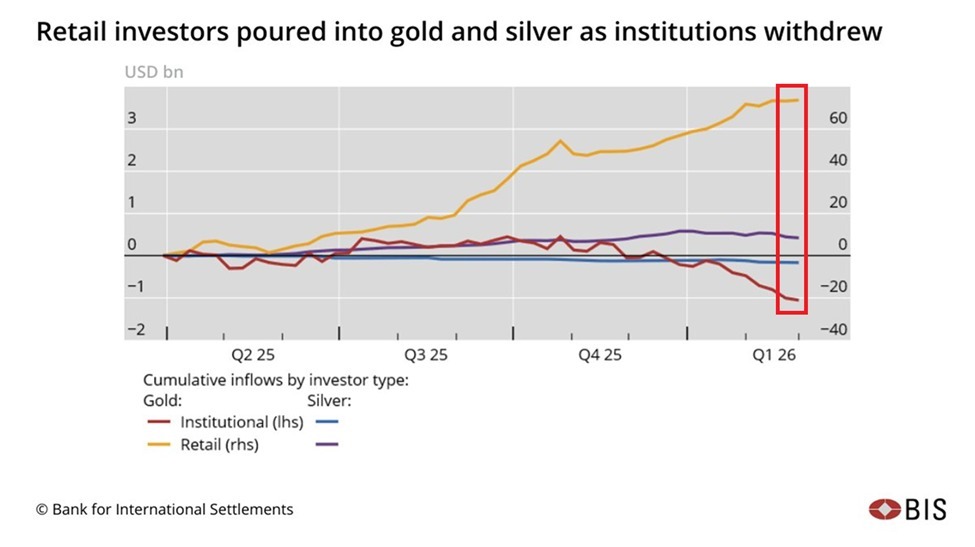
Retail gold purchases have tripled over the last six months, while Wall Street selling has accelerated over the past four months, according to data from the Bank for International Settlements (BIS).
“Retail-driven exuberance,” increasingly channeled through exchange-traded funds (ETFs), “set the stage for outsize moves,” continuing the precious metal rally from 2025, reported the BIS in a quarterly review released on Monday.
Since Q2 2025, retail investors have bought around $70 billion in gold ETFs, and these purchases have more than tripled over the last six months, observed the Kobeissi Letter, citing BIS data on Thursday.
“Retail investors are all-in on precious metals,” it noted.
Gold has surged 60% over the past year, and some crypto proponents have speculated it has come at the expense of Bitcoin, which some argue competes with gold as a store-of-value asset.
BIS data shows cumulative retail inflows effectively tripled from around $20 billion to roughly $60 billion over the six months from late Q3 2025 to the end of Q1 2026.
However, institutional selling started around mid-November and accelerated after the precious metals market began to correct in January, according to the data.

Leveraged liquidations amplified commodity drops
Bitcoin (BTC) is not the only asset susceptible to high volatility from overleveraged positions.
Prices of precious metals such as gold and silver reversed abruptly in late January and February 2026, while the “daily rebalancing of leveraged ETFs and margin‑triggered liquidations amplified the swings,” particularly in silver, BIS reported.
Smaller speculative derivatives traders, or “non-reportables,” had built up heavily leveraged long positions in silver heading into the crash, it added.
Gold prices are currently down 9% from their late January all-time high, while silver has slumped much harder, dropping 34% over the same period, according to GoldPrice.
Related: Bitcoin vs gold: ETF flows point to early capital rotation signs
The abrupt price drop and the spike in precious metal volatility “point to the role of retail flows, and amplification of price moves due to forced sales by leveraged ETFs, trend-following investors such as commodity trading advisers, and margin dynamics,” BIS stated.
Dollar strengthens as commodities and crypto weakens
The bank concluded that gold and silver declines coincided with changing expectations around US monetary policy and the performance of the US dollar, which has gained 4.7% since late January, according to the DXY dollar index.
“The precious metals crash seemingly coincided with shifts in expectations about the US dollar and the path of monetary policy, but it was hard to square with broader changes in fundamentals.”
Meanwhile, crypto markets have fallen around 43% from their October total capitalization peak as retail sentiment and interest in digital assets have dried up and remain at bear market levels.

Magazine: Metaplanet’s Japan Bitcoin bet, Bithumb ordered suspension: Asia Express
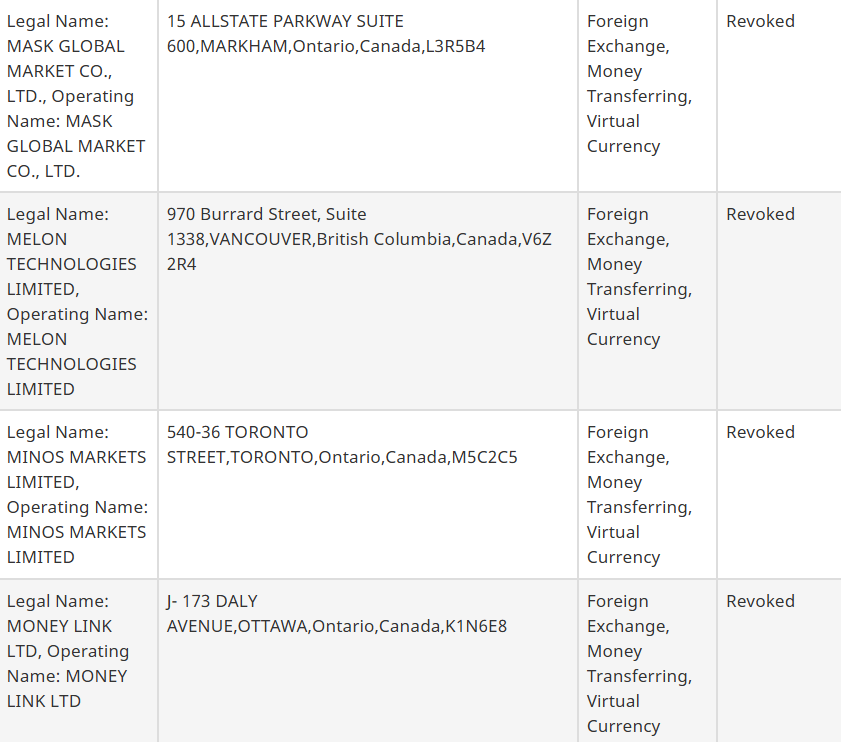
Canada’s financial intelligence unit has revoked the registrations of 50 money services businesses (MSBs) so far this year, with 47 related to crypto, and the minister of finance says it will continue cracking down.
Canada’s Financial Transactions and Reports Analysis Centre (FINTRAC) said on Monday that it took its most recent action, revoking 23 MSB registrations.
Minister of Finance François-Philippe Champagne said in a statement on Tuesday that it’s part of the government’s latest effort to combat money laundering, with FINTRAC also “strengthening enforcement and increasing transparency on compliance actions.”
He added that the 23 cancellations represented “a significantly increased pace of action, and our government will maintain this momentum.”
“Our government will continue to monitor and pursue new measures to address risks posed by virtual currency businesses, such as cryptocurrency MSBs and crypto ATMs, which can be used to facilitate money laundering and fraud,” Champagne said.

Traditional financial systems, such as wire transfers, have long been used for money laundering and other forms of fraud due to their scale and widespread adoption.
Related: US, UK, Canada launch joint operation to disrupt crypto fraud
The Financial Action Task Force estimates that 2 to 5% of global GDP is laundered through traditional financial systems, whereas Chainalysis estimates that less than 1% of crypto transactions are linked to illicit activity.
Two crypto platforms fined near the end of last year
FINTRAC has been stepping up its enforcement actions against crypto firms, issuing a $126 million fine against crypto platform Cryptomus in October for a range of alleged violations, including failing to report suspicious transactions on 1,068 separate occasions in July 2024 and failing to develop and apply written compliance policies.
Crypto exchange KuCoin also received a $14 million penalty a month earlier for violations, including allegedly failing to register as a foreign money services business with FINTRAC and failing to report large crypto transactions with the required information.
Magazine: Big Questions: Can Bitcoin save you from the dreaded Cantillon Effect?


Visa’s crypto division has launched a tool to allow artificial intelligence agents to make payments, the same day the Stripe-backed blockchain Tempo launched alongside a protocol for AI agents.
“Excited to share Visa CLI, the first experimental product from Visa Crypto Labs,” Cuy Sheffield, the head of Visa Crypto Labs, posted to X on Wednesday.
A website for Visa CLI, meaning a command line interface where users type what action a program must take, says the tool will give an AI agent “the ability to securely pay for what you need as you code.”
The tool also said it allows for “programmatic card payments without the pain of API keys.” API keys can include sensitive information that AI agents can leak, causing security risks.
It’s the latest standard seeking to allow AI agents to make payments online as hype around AI and stablecoins grows.
Coinbase launched its x402 standard to facilitate agentic stablecoin payments in May, which was most recently integrated by Sam Altman’s World in a developer toolkit for AI agents released on Tuesday.
Stripe-backed Tempo blockchain goes live
Meanwhile, the Tempo blockchain, backed by payments company Stripe, launched on mainnet on Wednesday, releasing a payments protocol for AI agents.
Tempo posted to X that its blockchain was “purpose-built for payments” and focused on servicing high-throughput stablecoin transactions, currently one of the most popular ways AI agents are used.
“Agents can already write code, coordinate services, retrieve data, and execute complex workflows across the internet. But as these systems become more capable, they increasingly need to transact,” Tempo said.
Agent payments will soon overtake human payments on the internet. The Machine Payments Protocol (@mpp) is a new open standard co-authored by @stripe and @tempo.
It’s designed to be extensible and payment-method agnostic, already supporting stablecoins, cards, and more. pic.twitter.com/dEjfGN2tp9
— Tempo (@tempo) March 18, 2026
The project also launched the Machine Payments Protocol, an open standard that it developed with Stripe, which it described as giving “a standard way for agents and services to coordinate payments programmatically.”
Related: SlowMist introduces Web3 security stack for autonomous AI agents
Tempo said the protocol “is designed to be rail-agnostic and extensible,” noting that Visa had extended support for the protocol on its card payments network while Stripe is supporting “cards, wallets, and other payment methods.”
The crypto fintech Lightspark had also extended support for the protocol over the Lightning Network for Bitcoin (BTC) payments.
AI Eye: IronClaw rivals OpenClaw, Olas launches bots for Polymarket


Nasdaq has received approval from the U.S. Securities and Exchange Commission to proceed with its tokenized equities pilot.
Summary
- Nasdaq received SEC approval to launch a pilot allowing select participants to trade and settle equities in tokenized form alongside traditional shares.
- The pilot is limited to securities within the Russell 1000 and major index linked ETFs, with tokenized shares carrying the same rights and pricing as standard equities.
According to the SEC’s approval filing, Nasdaq can now move ahead with “eligible participants” choosing to trade securities in either traditional or tokenized form on the same platform.
Tokenization involves representing real-world assets as digital tokens on blockchain infrastructure, allowing for more efficient settlement and extended market functionality.
Per previous coverage, Nasdaq first filed its proposal in September to enable trading of high-volume stocks in either a traditional format or as tokenized versions within the same exchange environment.
At the time, CEO Tal Cohen said the model can shorten settlement cycles and improve processes such as proxy voting, while maintaining investor protections.
The SEC has limited the pilot to securities in the Russell 1000 Index, which tracks the largest publicly traded companies in the U.S., along with exchange-traded funds tracking the S&P 500 and Nasdaq 100 indices.
According to the filing, there were concerns around market surveillance and potential pricing discrepancies during the review process. The commission said these were addressed through amendments that clarified safeguards.
Nasdaq has also partnered with crypto exchange Kraken, along with tokenization platform Backed, to build infrastructure that would allow public companies to create and issue tokenized shares.
Wednesday’s approval follows growing demand for tokenized assets from both crypto firms and traditional financial institutions seeking to modernize market infrastructure.
The SEC has also authorized the DTCC to pilot tokenization initiatives, while the New York Stock Exchange’s parent company Intercontinental Exchange has backed a project with OKX to launch tokenized stocks.
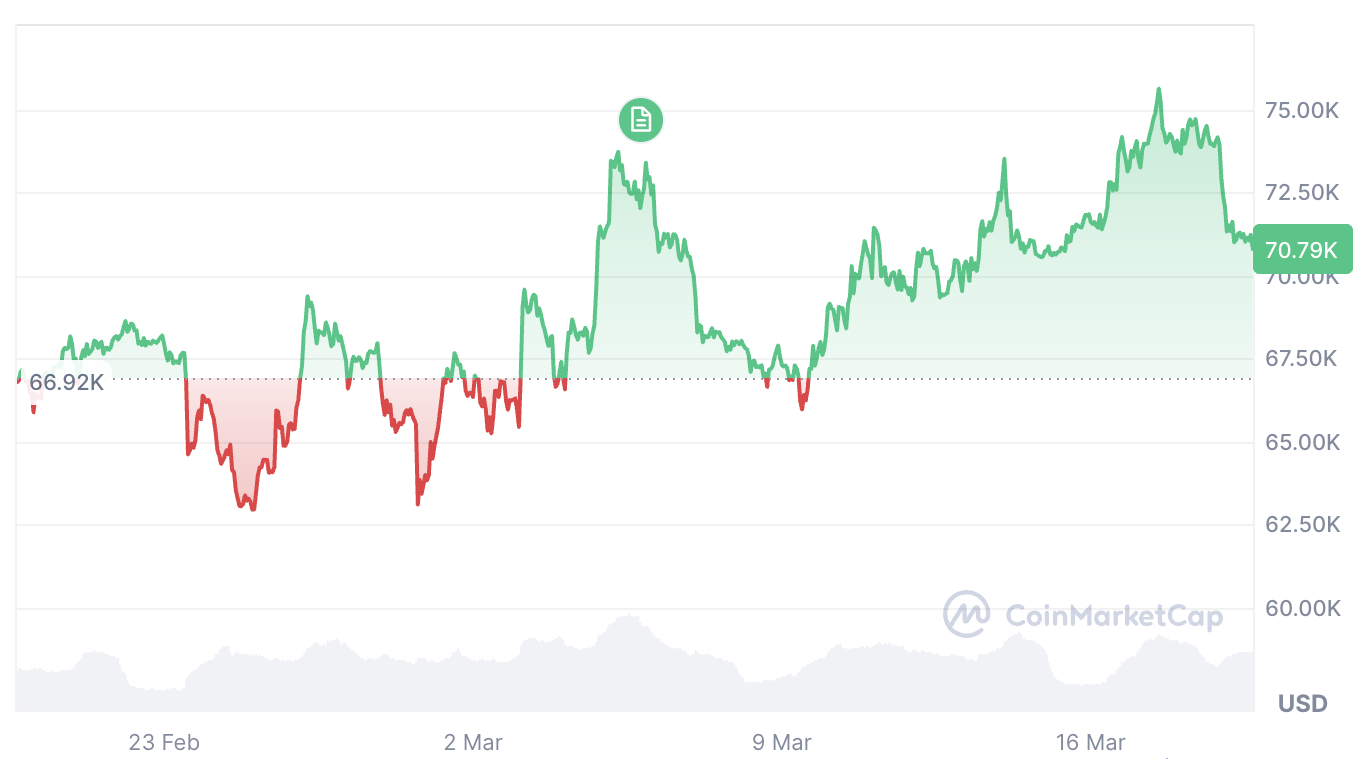
Crypto traders have become hopeful for a market rally after the US Federal Reserve held interest rates steady on Wednesday, according to crypto sentiment platform Santiment.
However, analysts are split on whether a near-term market surge is a reliable signal for traders.
“For now, traders are expecting a bullish relief rally in spite of no changes being made,” Santiment said in an X post on Wednesday, pointing to an increase in bullish sentiment among crypto market participants on social media who are linking the Fed’s steady rates to a potential crypto rally.
The social media discussion score surged from roughly 9 to 71 in the hours after the Fed’s “expected outcome” on Wednesday to hold rates steady at 3.5-3.75%.
Fed policy is a strong catalyst for Bitcoiners
“This is likely due to the fact that the bearish price action related to the lack of cuts already occurred yesterday,” Santiment said.

Fed policy has historically been a major catalyst for optimism among crypto market participants, with traders eyeing rate cuts in 2025 as a signal for a possible bull year for Bitcoin.
However, a pause in rates can increase expectations that cuts could come next.
Several analysts said they are expecting a crypto rally, but they are divided on how long it could last.
“Bull trap” may be on the horizon
Bitcoin (BTC) onchain analyst Willy Woo recently warned that a potential “bull trap” may be forming, a false signal that Bitcoin is entering an uptrend before reversing lower.
Bitcoin has fallen 4.35% over the past 24 hours, trading at $70,790 at the time of publication, according to CoinMarketCap.
Meanwhile, crypto analyst Matthew Hyland said that Bitcoin and the broader crypto market will “see a significant rally” once the stock market finds its low and rebounds. The S&P 500 has fallen 3.73% over the past 30 days, according to Google Finance.
Echoing a similar sentiment, crypto trader Moustache said in an X post on Monday, “What you’ll see in the coming months is a massive rally.”
Related: ‘Rich Dad, Poor Dad’ author says ‘pin is near’ on TradFi ‘bubble burst:’ Predicts $750K Bitcoin
Other indicators suggest that crypto investors are still taking a cautious approach to the market.
The Crypto Fear & Greed Index, which measures overall crypto market sentiment, fell back into “Extreme Fear” territory on Wednesday, after briefly moving up into “Fear” the day prior.
Magazine: Big Questions: Can Bitcoin save you from the dreaded Cantillon Effect?
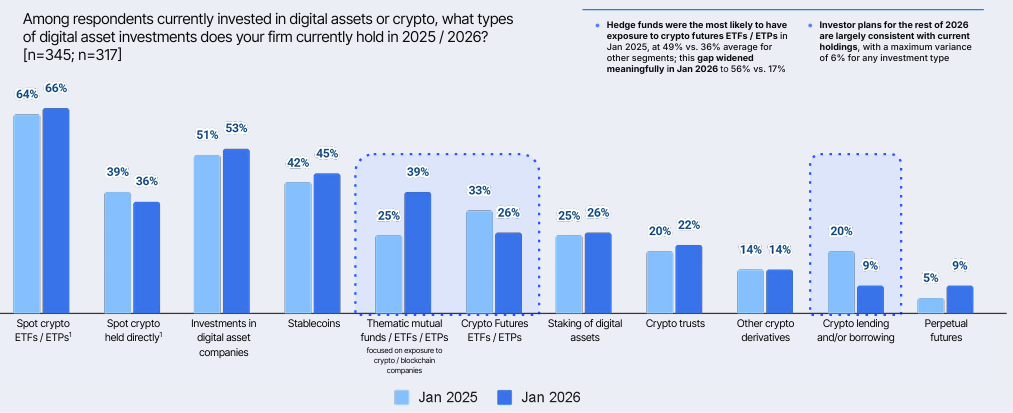
The crypto market sell-off since October hasn’t deterred institutional investors, with a new survey showing most plan to increase exposure to digital assets in the coming year.
According to a January survey of 351 institutional investors conducted by Coinbase and EY-Parthenon, 73% of respondents said they plan to increase their allocations of digital assets in 2026, while 74% expect crypto prices to rise over the next 12 months.
Two-thirds of respondents said exchange-traded products (ETPs) and other regulated vehicles have become their preferred way to gain exposure, reflecting growing familiarity with these instruments and a broader shift toward regulated access points. Regulation was also cited as a key factor attracting institutional participation.
On the regulatory front, more than three-quarters of respondents cited market structure as the most important area requiring clarity — a concern that comes as US lawmakers continue to debate legislation defining how digital assets are classified and regulated across agencies.
Market volatility, however, is reshaping how institutions approach crypto. Nearly half (49%) of respondents said recent turbulence has led them to place greater emphasis on risk management, liquidity and position sizing, rather than reducing exposure.

Related: Crypto’s 2026 investment playbook: Bitcoin, stablecoin infrastructure, tokenized assets
Stablecoins, tokenization gain traction
One of the key takeaways from the survey is growing institutional interest in emerging blockchain use cases such as stablecoins and tokenized real-world assets (RWAs).
According to the findings, 85% of respondents use or plan to use stablecoins for payments and treasury operations, with settlement and internal cash management cited as primary use cases.
Part of that momentum is being driven by US regulatory developments, with 83% of respondents saying the passage of the GENIUS Act will increase financial institutions’ willingness to engage with stablecoins. More than two-thirds (69%) said the law will drive broader adoption of stablecoin-based transactions.

Meanwhile, interest in tokenized assets continues to grow, with 63% of investors expressing interest in gaining exposure and 61% expecting tokenization to have a significant impact on market structure in the coming years.
Related: SEC’s ‘Crypto Mom’ calls for simpler disclosure rules, flags tokenization debate
XRP digital asset treasury Evernorth has submitted a key filing with the SEC, putting it a step closer to its goal of going public on the Nasdaq stock exchange.
The Ripple Labs-backed firm announced plans to go public in October as part of a merger with special purpose acquisition company (SPAC) Armada Acquisition Corp. II (Armada II).
In a statement on Wednesday, Evernorth announced that it had filed a Form S-4 registration statement with the US Securities and Exchange Commission (SEC), marking the final major regulatory hurdle before launching via a SPAC.
Evernorth eyes ticker XRPN
If the SEC approves the filing, Evernorth said it will still need final approval from Armada II shareholders for the merger, after which it can move forward with listing on the Nasdaq under the ticker XRPN.
Evernorth stated in October that it expects the merger to generate $1 billion in gross proceeds, which will be primarily used to build an XRP treasury, with a smaller portion of the funds being allocated to operating and deal expenses.
XRP treasury faces market turbulence
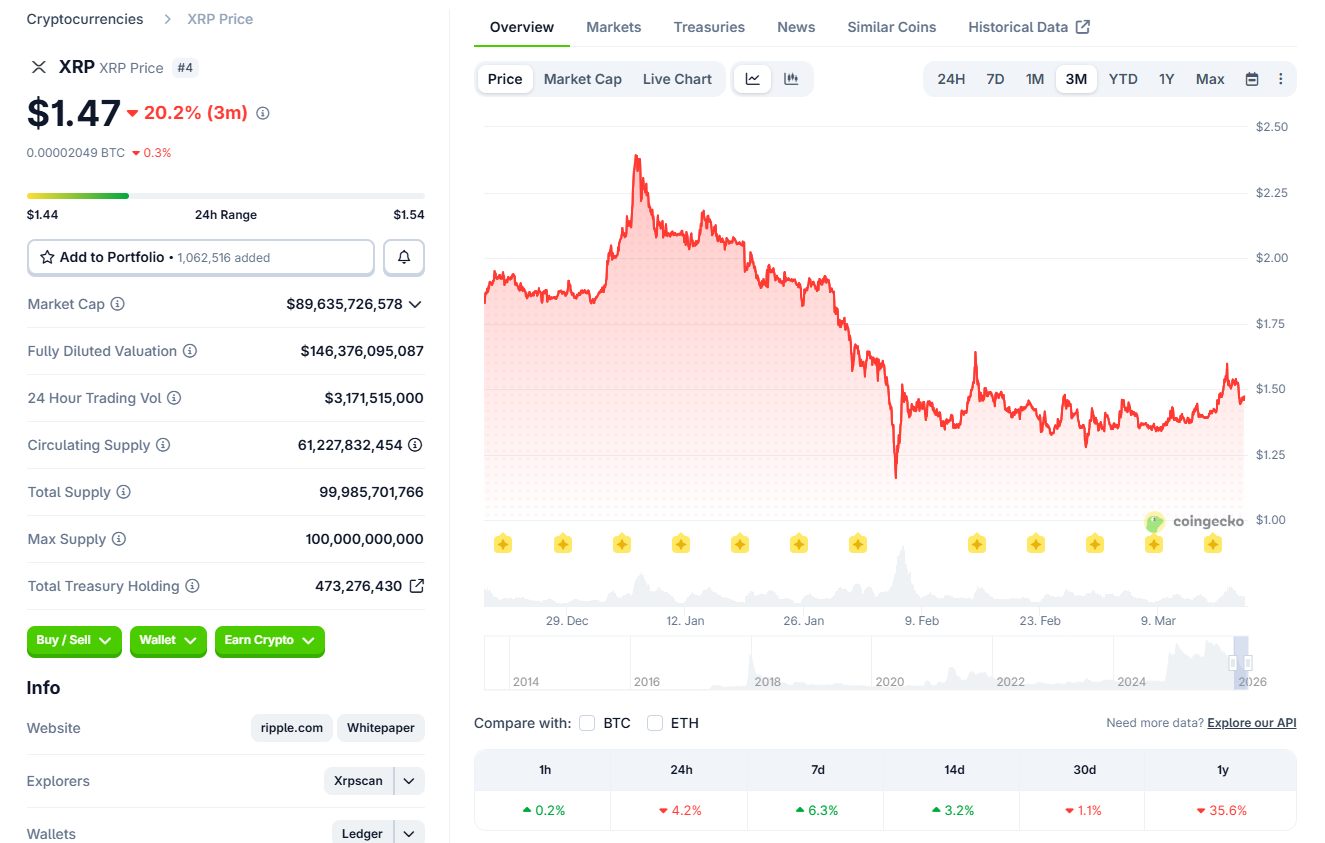
Evernorth has already begun building its XRP (XRP) treasury, with CoinGecko data showing the firm’s total treasury value is at $692.24 million, made up of 473.27 million XRP, which it made in two tranches between Oct. 20 and Nov. 4.
With an average cost per XRP at $2.54, the value of its holdings has fallen 19.1% over the past three months amid a broader crypto market downturn. At the time of writing, XRP is currently priced at $1.47.

Related: Ripple to buy back $750M in shares through April: Report
SEC provides clarity for crypto and XRP
Evernorth’s treasury plans come as XRP was among a number of tokens declared as a digital commodity in guidance published by the SEC on Tuesday.
In a notice on Tuesday, the SEC declared that generally only tokenized securities remain “subject to the securities laws.”
Other tokens used in its digital commodities example included Aptos (APT), Avalanche (AVAX), Bitcoin (BTC), Dogecoin (DOGE) and Ethereum (ETH).
“We always knew XRP wasn’t a security – and now the @SECGov has made clear what it is: a digital commodity. Grateful to the Crypto Task Force for working to deliver the clarity that markets, investors, and innovators have long deserved,” said Ripple’s chief legal officer, Stuart Alderoty via X on Tuesday.

Magazine: Big Questions: Can Bitcoin save you from the dreaded Cantillon Effect?

Polymarket, the blockchain-driven prediction markets platform, is acquiring Brahma, a crypto startup that builds DeFi infrastructure. The move is framed as a step to consolidate Polymarket’s stack and broaden its product suite as the two firms align on a path toward deeper on-chain and off-chain liquidity.
Brahma announced the transition on Wednesday, saying its team will dedicate its efforts to evolving Polymarket’s stack and product offerings. The company, founded in 2021, has reported processing over $1 billion in volume and asserts that its technology could help Polymarket streamline wallet creation, deposits, and token redemptions for users.
According to the announcement, the acquisition could unlock more liquidity for niche, low-volume markets on Polymarket and help the platform scale complex products for sophisticated users. Polymarket’s founder and CEO, Shayne Coplan, told Fortune that building reliable infrastructure across blockchain networks and traditional financial rails remains hard and there are no shortcuts. Financial terms of the deal were not disclosed at press time.
Key takeaways
- Polymarket is acquiring Brahma to enhance its infrastructure and product stack, with Brahma winding down its own products as the transition unfolds.
- Brahma’s core offerings—Strategy Vaults for automated DeFi strategies, Brahma Accounts (smart accounts for DeFi users), and Swype.fun (a Visa card linked to DeFi positions)—will be phased out over the next 30 days.
- The deal aims to bring more liquidity to Polymarket’s markets, particularly in smaller, harder-to-liquidate segments where users may benefit from smoother wallet creation and redemption flows.
- Polymarket has pursued aggressive expansion despite broader crypto-market softness, including partnerships and acquisitions announced in recent months.
Strategic implications of the Brahma integration
The Brahma transaction signals Polymarket’s intent to deepen technical capacity behind its prediction markets. Brahma’s experience in designing and operating scalable, user-ready DeFi infrastructure could help Polymarket reduce friction for users—potentially lowering barriers to entry and increasing throughput on low-visibility markets where liquidity is typically thin.
While the two firms have not disclosed the purchase price, the alignment comes as Polymarket has sought to diversify its toolkit beyond core prediction markets. The integration underscores a broader industry push to merge on-chain finance primitives with markets that hinge on real-world events and outcomes.
What changes for Brahma’s products and users
As part of the transition, Brahma’s three main products will be wound down over the next month: Strategy Vaults, which automate DeFi positioning; Brahma Accounts, the platform’s smart-account solution for DeFi users; and Swype.fun, a card-linked interface intended to realize DeFi positions for real-world spending. For existing users of these services, the wind-down process will be navigated in the coming weeks as the Polymarket integration proceeds.
Brahma’s team noted that its solutions were designed to meet sophisticated users’ demands, including automated strategies and streamlined access to DeFi features. The move to fold these capabilities into Polymarket could embed more robust infrastructure into the platform and potentially broaden its appeal to professional market participants and developers building on top of prediction markets.
Polymarket’s broader expansion playbook
The Brahma deal is part of a broader acceleration of Polymarket’s growth trajectory. In March, the company announced a partnership with Palantir Technologies and TWG AI to build an AI-powered sports integrity platform, signaling continued investment in data-focused, technologist-led initiatives. Earlier, Polymarket acquired Dome, a Y Combinator-backed provider of developer tools for prediction markets, and Lunch, a boutique firm focused on assembling and recruiting technical teams for startups.
Despite a tougher macro environment for crypto, Polymarket has faced regulatory scrutiny in several jurisdictions given its business model around unregulated betting on real-world events. Notably, recent coverage has highlighted how prediction markets have encountered resistance in places like Argentina, alongside ongoing debates in the United States about market design and regulation.
Polymarket’s ongoing expansion, including the Brahma acquisition, indicates a strategy focused on building a more capable infrastructure backbone and scaling its ecosystem through partnerships and targeted acquisitions. Investors and users will want to watch how the Brahma integration unfolds, how liquidity dynamics evolve on niche markets, and how regulatory developments shape the platform’s ability to deploy new features at scale.
As the integration progresses, readers should monitor whether Polymarket can successfully merge Brahma’s engineering capabilities with its existing stack, and what that means for the speed and reliability of user experiences, especially in lower-liquidity markets where liquidity depth and transaction costs can be decisive.

LSU star Flau’jae Johnson gears up for final NCAA tournament run

Viwoods AiPaper e-reader review: a damn fine digital notebook

Bolton Council condemns use of quad bikes in Longsight Park


-
 Crypto World5 days ago
HYPE Token Enters Net Deflation as HyperCore Buybacks Outpace Staking Rewards
-

 Tech3 days ago
Your Legally Registered ‘Motorcycle’ Might Not Count Under Proposed US Law
-

 Fashion6 days ago
Weekend Open Thread: Addict Lip Glow
-
 Tech2 days ago
Are Split Spacebars the Next Big Gaming Keyboard Trend?
-
Sports5 days ago
Why Duke and Michigan Are Dead Even Entering Selection Sunday
-

 Business3 days ago
Search for Savannah Guthrie’s Mother Enters Seventh Week with No Arrests
-

 Business5 days ago
US Airports Launch Donation Drives for Unpaid TSA Workers as Partial Government Shutdown Enters Fifth Week
-
Crypto World5 days ago
Coinbase and Bybit in Investment Talks: Could Bybit Finally Enter the US Crypto Market?
-

 Business3 days ago
Australian shares drop as Iran war enters third week
-

 Business5 days ago
Country star Brantley Gilbert enters growing non-alcoholic beer market
-

 Crypto World3 days ago
Crypto Lender BlockFills Enters Chapter 11 with Up to $500M in Liabilities
-

 Sports5 days ago
College Basketball Best Bets: Conference Tournament Semifinal Picks
-

 Politics21 hours ago
The House | The new register to protect children from their abusers shows Parliament at its best
-
 Business6 days ago
Trump demands Powell cut rates as Iran conflict raises energy prices
-

 Fashion3 days ago
25 Celebrities with Curly Hair That Are Naturally Beautiful
-

 News Videos14 hours ago
RBA board divided on rate cut, unusually buoyant share market | Finance Report | ABC NEWS
-

 Crypto World6 days ago
Senate Votes to Include CBDC Ban in Bipartisan Housing Bill
-

 NewsBeat6 days ago
Deane Road crash near Bolton colleges and university
-

 News Videos6 days ago
Tom Lee: The 100x Opportunity EVEN Bigger Than Bitcoin (New Ethereum Prediction 2026)
-

 Crypto World14 hours ago
Canada’s FINTRAC revokes registrations of 23 crypto MSBs in AML crackdown


You must be logged in to post a comment Login