

Crypto World
Ethereum Foundation's Kohaku Initiative Launches SDK for Wallet-Level Privacy Integration


The Ethereum Foundation's Kohaku Initiative announced the release of its SDK for integrating privacy protocols into Ethereum wallets without intermediaries. The team achieved a major milestone with v0.0.1-alpha.21 of the kohaku-eth/railgun integration, which now features operational 4337 mempool… Read the full story at The Defiant

Crypto World
PremiumBlock Launches Non-Custodial Risk Hub for User-Created Prediction Markets, Perps and Web3 Poker
[PRESS RELEASE – Stockholm, Sweden, June 19th, 2026]
PremiumBlock brings leveraged prediction markets, liquid 24/7 FX perpetuals, and Web3 poker together in one wallet-native platform via premiumblock.org
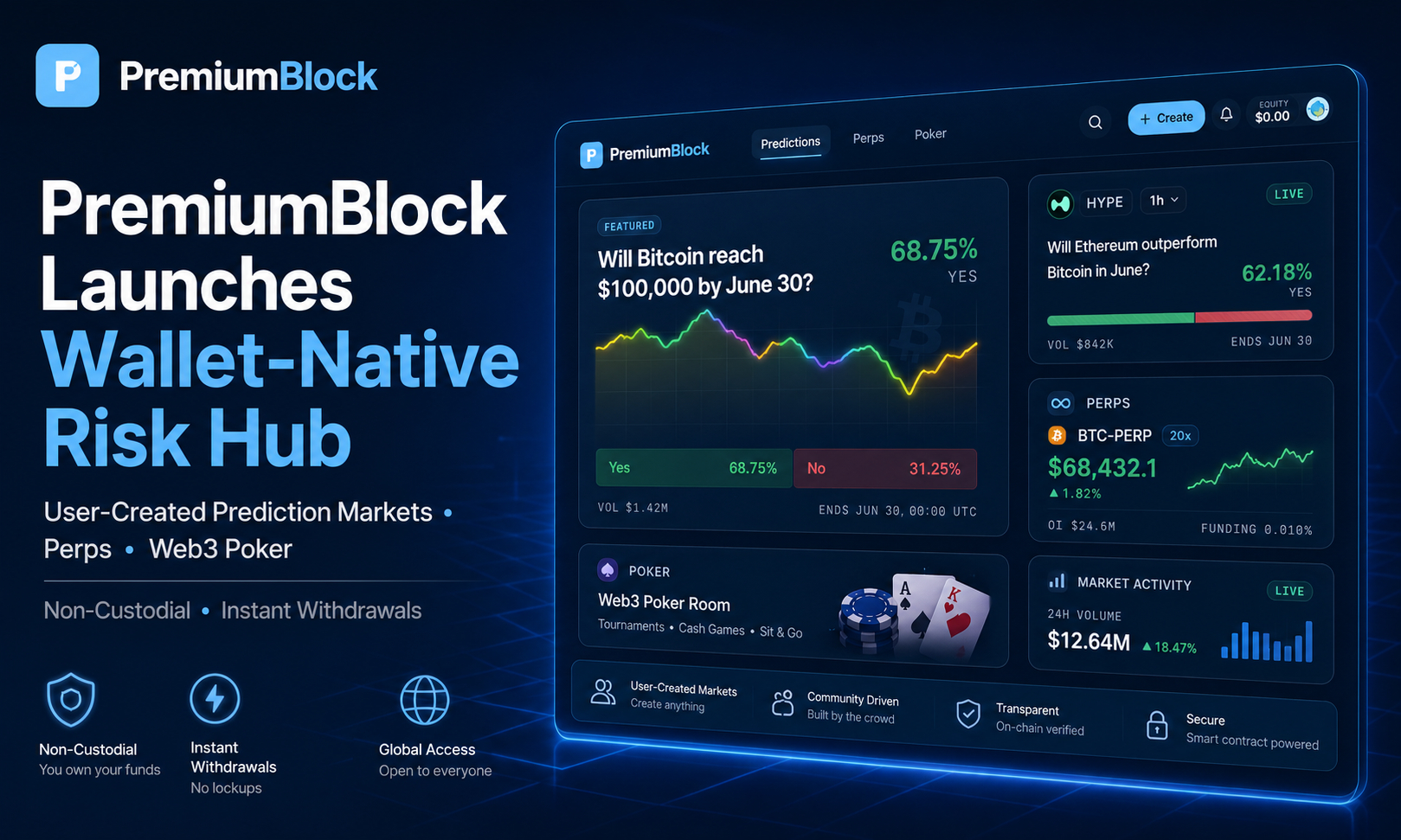
PremiumBlock today announced the launch of its non-custodial risk hub for decentralized prediction markets, perpetual futures and Web3 poker, giving crypto users one wallet-native destination to create markets, trade outcomes, access perps and participate in on-chain poker without relying on a centralized custodian.
PremiumBlock is built around a simple idea: the next generation of crypto speculation will not be limited to order books or one-directional prediction markets. Users want to price real-world events, express conviction with leverage, trade crypto volatility, and control their bankroll from the same wallet. PremiumBlock brings those use cases together in a single interface designed for speed, maximal liquidity and instant withdrawals.
The platform’s prediction market layer allows users to create and participate in markets around crypto, sports, politics, culture, macro events and world news. Unlike platforms where market creation is tightly curated, PremiumBlock is designed for user-created markets, giving communities the ability to surface the questions they believe deserve liquidity.
PremiumBlock also supports leveraged prediction-market positions, with up to 2.5x leverage available on selected markets. The feature gives experienced users a way to express stronger conviction on event outcomes while operating inside a defined collateral framework. As with any leveraged product, participants should understand volatility, liquidation risk, and market-resolution rules before entering a position.
Alongside prediction markets, PremiumBlock offers crypto perpetual futures for traders who want long or short exposure without traditional expiry dates. The perps layer brings a familiar derivatives format into the same wallet-native environment as the platform’s event markets, reducing the need for users to move capital between separate prediction-market, exchange and gaming applications.
PremiumBlock’s Web3 poker product adds a third pillar to the platform’s risk ecosystem. Built for crypto-native users who value bankroll control, the poker experience is designed around fast deposits, instant withdrawals and non-custodial fund management. The goal is to offer a transparent alternative to legacy poker rooms where withdrawal delays, account controls and operator custody can create unnecessary friction.
“PremiumBlock was built for users who want direct market access without waiting on approvals, custodians or withdrawal queues,” said Baqir Hussain at PremiumBlock. “Prediction markets, perps and poker all revolve around information, timing and risk. Bringing them together in one non-custodial environment gives users a more flexible way to participate in the markets they understand.”
PremiumBlock enters the market as prediction platforms continue to move further into mainstream crypto conversation. Polymarket helped popularize event markets for crypto-native users, while Kalshi brought regulated event contracts into broader public discussion. PremiumBlock expands the category with a model focused on user-created leveraged markets, perpetual futures and wallet-based bankroll control.
The platform is available now for users seeking a crypto-native environment where event markets, leverage, perps and poker can exist side by side. PremiumBlock does not provide investment advice. Users are responsible for understanding applicable laws, smart contract risk, market volatility and the rules of any market or game before participating.
About PremiumBlock
PremiumBlock is a non-custodial risk hub for decentralized prediction markets, perpetual futures and Web3 poker. The platform combines user-created event markets, up to 2.5x leverage, crypto perps and instant withdrawals in a wallet-native experience designed for crypto users who want direct control over funds.
The post PremiumBlock Launches Non-Custodial Risk Hub for User-Created Prediction Markets, Perps and Web3 Poker appeared first on CryptoPotato.


G7 leaders have renewed calls for joint action against North Korea’s cryptocurrency thefts and cybercrimes.
Summary
- G7 leaders linked North Korea crypto theft and cybercrime to wider nuclear and missile concerns.
- Chainalysis estimated DPRK hackers stole $2.02 billion in crypto in 2025 alone through attacks globally.
- The G7 statement urged joint action but did not name new sanctions or enforcement tools.
The warning came in a geopolitical statement issued after the G7 summit in Evian-les-Bains, France.
The leaders said they were deeply concerned about North Korea’s nuclear and ballistic missile programs. In the same statement, they said member nations needed to “jointly address North Korea’s cryptocurrency thefts and cybercrimes.”
The statement did not name new sanctions, exchange rules, or crypto mixer controls. It also did not set out a timeline for fresh enforcement action against wallets, platforms, or intermediaries linked to stolen funds.
Stolen crypto remains a funding concern
The G7 warning follows years of reports that North Korea-linked hackers use stolen crypto to raise money under heavy sanctions. Western governments and blockchain analytics firms have long tied the activity to Pyongyang’s wider weapons program.
According to Chainalysis, North Korean hackers stole at least $2.02 billion in crypto in 2025. The firm said that pushed the all-time total linked to DPRK actors to at least $6.75 billion.
CrowdStrike also said DPRK-linked actors drove a 51% yearly rise in digital asset theft in 2025. Its 2026 financial services report said North Korea-linked groups used AI-generated identities, fake recruiters, and cloud access campaigns against crypto and financial firms.
Rising attack scale
As previously reported by crypto.news, North Korea-linked Lazarus attacks drained $577 million from Drift Protocol and KelpDAO in April 2026. Those two attacks accounted for most crypto theft reported that month.
Crypto.news also reported that April became the worst month for crypto hacks in 2026, with more than $606 million stolen across 12 incidents in the first 18 days. The Drift and KelpDAO attacks made up nearly all of that loss.
Those cases showed that attackers are moving beyond simple smart contract bugs. The methods included social engineering, compromised devices, bridge weaknesses, and signer manipulation.
North Korea rejects the claims
North Korea has denied U.S. and allied claims over cybercrime. In May, a Foreign Ministry spokesperson called the accusations “absurd slander” and said Washington was spreading false information for political reasons.
The denial has not stopped governments and security firms from naming DPRK-linked groups as major crypto threats. CrowdStrike said North Korean actors use deception at scale, including fake identities and recruiter personas.
The latest G7 statement keeps the issue on the diplomatic agenda, but it leaves open how member states plan to act. It does not say whether governments will tighten exchange screening, pursue new sanctions, or target laundering networks more aggressively.
Goldman Sachs has cut its year-end gold forecast by $500 an ounce, lowering its target to $4,900 from $5,400.
Summary
- Goldman cut its year-end gold target to $4,900 as expected Fed rate cuts faded further.
- Gold remains above current levels in Goldman’s outlook, but near-term risks now look weaker overall.
- Higher rates can pressure Bitcoin and gold by keeping cash and bonds more attractive longer.
According to Bloomberg, the bank still expects gold to rise from current levels, but it now sees a smaller move than before.
The revision comes as Goldman no longer expects the Federal Reserve to cut rates in 2026. Market reports said the bank now expects the next rate cuts to arrive in 2027, after earlier forecasts pointed to easing sooner.
Goldman commodity analysts Lina Thomas and Daan Struyven said their view remains “structurally constructive but tactically cautious.” They also pointed to near-term downside risk and medium-term upside risk.
Fed pause weighs on gold
The Federal Reserve held rates steady at 3.50% to 3.75% on June 17. The central bank said inflation remains above its 2% target and pointed to price pressure linked partly to energy.
That matters for gold because bullion does not pay yield. When interest rates stay higher, bonds and cash can look more attractive than holding gold. A stronger dollar can also make gold less attractive for buyers using other currencies.
Reuters reported that gold headed for a third weekly loss on June 19 as the dollar firmed and hawkish Fed signals weighed on prices. Spot gold fell to its lowest level since June 11 during the session.
Bitcoin faces the same liquidity test
A delayed rate-cut cycle can also weigh on Bitcoin and other cryptocurrencies. Lower rates often support digital assets by improving liquidity and reducing the cost of capital.
As previously reported by crypto.news, Bitcoin fell toward $63,000 after stronger U.S. jobless claims data reinforced the Fed’s hawkish outlook. Traders reduced exposure after the Fed kept rates unchanged and left the door open to tighter policy.
Crypto.news also reported that Bitcoin slipped toward $65,000 ahead of the Fed decision as traders cut risk. Falling oil prices offered some relief, but they did not fully offset concern over rates and inflation.
Traders watch inflation and rate odds
Goldman’s lower gold target does not mean the bank has turned fully bearish on bullion. The $4,900 forecast still points to a price above current levels, but the path now looks more dependent on inflation cooling and Fed policy shifting.
The market is also watching whether geopolitical risk can keep demand for safe-haven assets alive. The war in Iran has added uncertainty, but rate expectations and dollar strength have recently carried more weight in daily trading.
For Bitcoin, the same pressure remains visible. Crypto.news earlier reported that rising bond yields hit crypto-linked equities and pushed Bitcoin lower as rate-hike odds climbed.
Gold and Bitcoin are different assets, but both can react to the same liquidity backdrop. If rate cuts stay delayed, traders may keep favoring cash, short-term bonds, and the dollar. If inflation cools and the Fed turns softer, both markets may find a better base.
Crypto World
Microsoft identifies malware ‘worm’ that hijacks crypto wallets, spreads through USB drives


The wallet-stealing component monitors Windows’ clipboard, the hidden temporary memory used for copy-and-paste operations, roughly every 500 milliseconds. When a user copies a crypto wallet seed phrase or a private key for a Bitcoin or Ethereum wallet, the malware captures that data and sends it to the attacker’s server over the Tor network, an open-source overlay that provides anonymous communication. It also takes five screenshots, ten seconds apart, and sends those along too.
The risk doesn’t end there.
If a user copies a recipient address to send funds, the worm silently replaces it with an attacker-controlled address before the user pastes, so the transfer goes to the attacker without any visible cue.
Lastly, the worm propagates when a clean USB drive is plugged into the computer. It scans the clean USB drive for ordinary files, Word docs, Excel sheets and PDFs, replaces them with new shortcut files using the same names and infects the drive. Then the cycle continues.
Microsoft recommends disabling AutoRun for removable media, blocking .lnk file execution on USB drives via group policy and restricting script hosts such as wscript.exe and cscript.exe. Microsoft Defender customers can also run hunting queries to check for related activity, including connections to a local Tor proxy on port 9050.
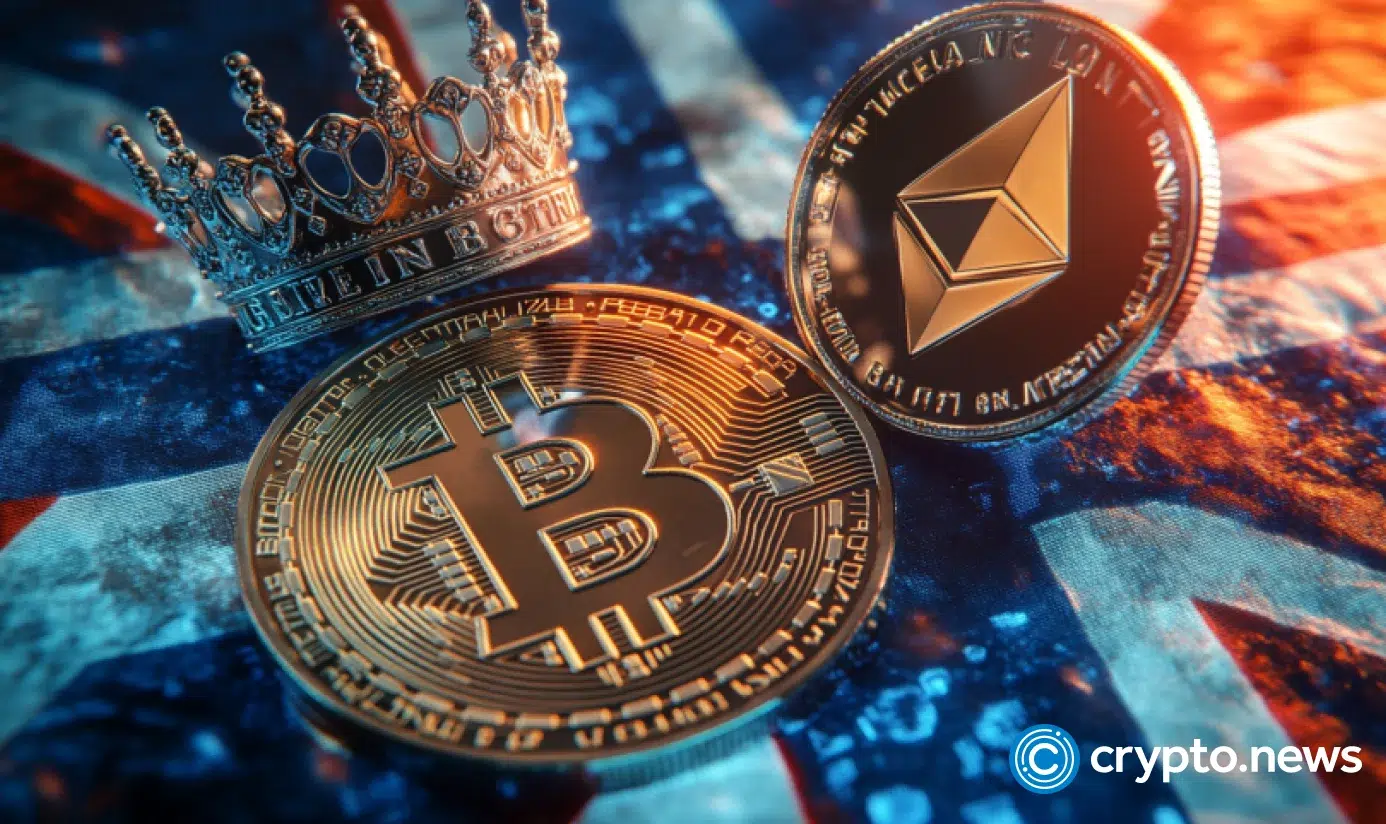
UK merchants have ranked cryptocurrency payments among emerging customer demands, even as security and payment simplicity remain their top priorities, according to a new whitepaper released by payment technology provider DECTA.
Summary
- A DECTA survey found 11.8% of UK merchants believe customers want cryptocurrency payment options, with demand rising to 20.7% among the largest SMEs.
- More than half of surveyed UK SMEs already sell worldwide, placing greater focus on payment methods that support international commerce.
- Security remained the top payment priority for merchants, while interest in BNPL, open banking, and cryptocurrency continued to gain ground.
A new DECTA whitepaper shared with crypto.news, based on a survey of 500 UK SME decision-makers conducted by research firm Censuswide between March 13 and March 20, 2026, found that 11.8% of merchants believe their customers want the option to pay with cryptocurrency, while the figure rises to 20.7% among businesses with annual turnover between £50 million and £99.99 million.
The report placed crypto behind payment security, simplicity, speed, multiple payment options, refunds, guest checkout, Buy Now Pay Later, and open banking when merchants were asked about customer payment priorities. Payment security topped the list at 48.6%, followed by simplicity at 42.2% and speed at 37.2%. Cryptocurrency ranked eighth at 11.8%.
Scott Dawson, chief executive officer of DECTA and chairman of the Payments Innovation Forum, said alternative payment methods continue to gain traction among merchants. DECTA said BNPL emerged as a top customer priority for nearly 20% of respondents, while open banking and cryptocurrency attracted greater interest among larger businesses.
Crypto interest grows among larger businesses
According to the report, cryptocurrency remains a minority payment preference overall but carries greater weight among high-turnover merchants. The company stated that payment providers that ignore crypto risk being viewed less favorably by some of their largest merchant customers.
The survey also found that 53.8% of UK SMEs already sell products and services worldwide. At the same time, 20.2% of merchants involved in global trade said their international payments experience has deteriorated. DECTA said cross-border payment capabilities have become increasingly important as more SMEs expand beyond domestic markets.
Merchants identified slow access to funds as their most common business challenge, with 19.4% citing it as a problem. Another 16% pointed to fraud and security concerns, while 14.2% cited a lack of transparency around payment processing fees.
Meanwhile, more than half of surveyed merchants, 51.8%, said they would prioritize security over both lower fees and access to the latest payment technology. Among micro-businesses with one to nine employees, that figure climbed to 62.1%.
UK cracks down on crypto
The findings arrive as UK regulators continue to scrutinize the crypto sector. Earlier this month, the Financial Conduct Authority warned football clubs about sponsorship arrangements involving unauthorised crypto firms, arguing that such partnerships could expose supporters to financial risks and products that fall outside UK regulatory protections.
The FCA has also continued work on its broader crypto framework ahead of the UK’s planned licensing regime. Under the regulator’s current timetable, crypto firms will be able to apply for authorization from September 30, 2026, while the full cryptoasset regime is scheduled to take effect on October 25, 2027.
Separately, UK authorities sanctioned Huobi Global S.A., linked to HTX, in May as part of a Russia-focused enforcement action targeting entities allegedly connected to the A7 network. The move followed earlier FCA legal proceedings against HTX over alleged unlawful crypto promotions aimed at UK consumers.
Despite that regulatory activity, DECTA’s survey suggests a segment of UK merchants continues to view cryptocurrency payments as a relevant customer option, particularly among larger businesses with international operations.
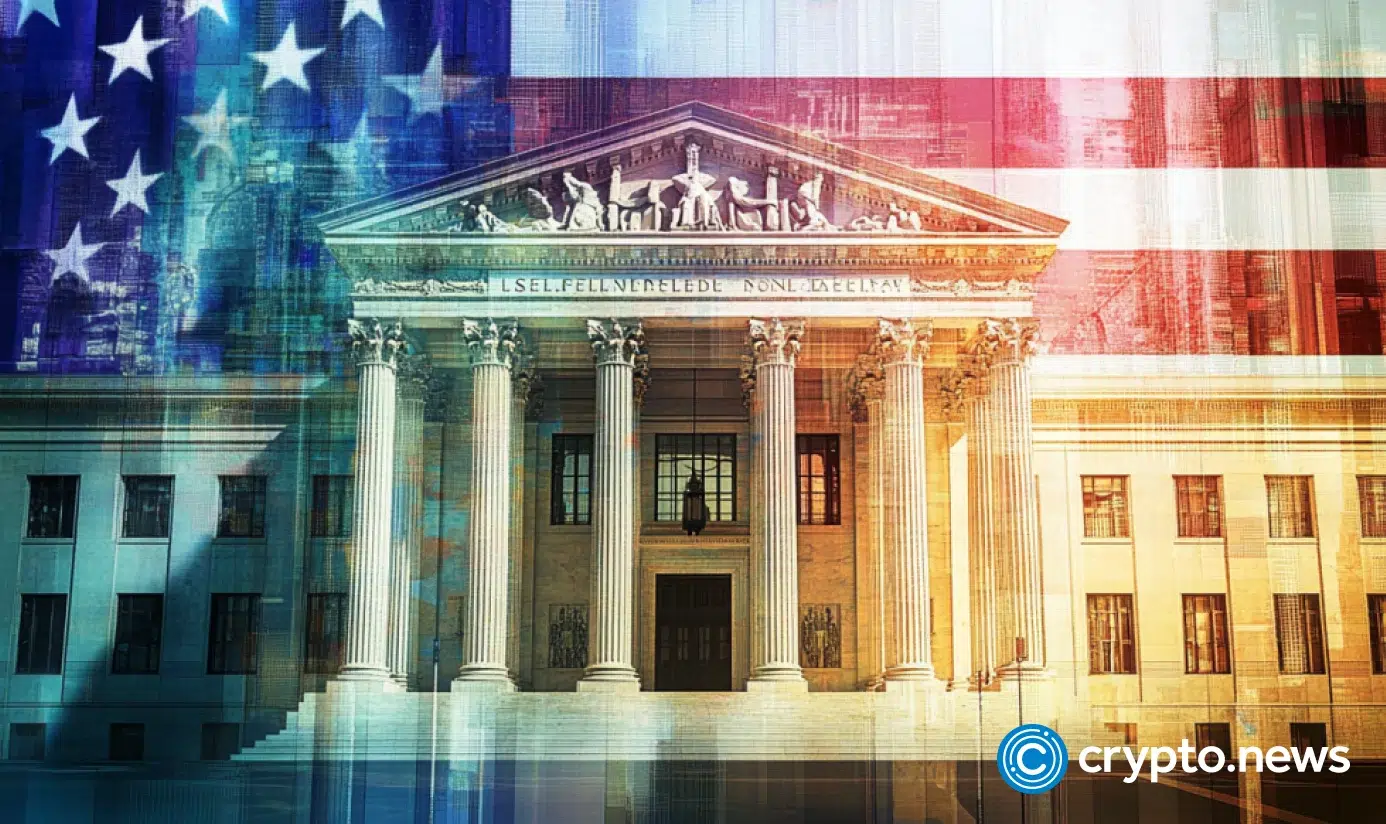
The new Fed chair held rates steady in his debut, then quietly inverted the entire outlook. The dot plot that projected cuts in March now projects hikes. For a crypto market that spent all year waiting on cheaper money, the ground just shifted.
Summary
- Warsh held rates steady, but the dot plot changed the entire market outlook.
- Crypto fell because the expected path of rates moved higher, not because current rates changed.
- A hawkish Fed raises the bar for every crypto bull case.
- Inflation is now the key number for crypto investors to watch.
On June 17, 2026, Kevin Warsh chaired his first meeting of the Federal Reserve and left interest rates exactly where they were, at 3.50% to 3.75%, the fourth consecutive hold and an outcome markets had fully expected. That decision changed nothing.
What Warsh did to the projections changed everything. Its updated dot plot, the chart showing where officials expect rates to go, flipped from projecting cuts to projecting hikes, and the forward guidance that markets had leaned on for a year was stripped out entirely.
Most major cryptocurrencies fell between 1% and 3% on the news, with Bitcoin sliding toward $64,000. The reason was not the rate decision, which was priced in, but the realization that the cheap-money future crypto had been pricing for the second half of 2026 had just evaporated.
For most of this year, a large part of the crypto bull case rested on a single assumption: that the Fed would cut rates in 2026, easing financial conditions, increasing liquidity, and lifting risk assets including crypto. That assumption is now in serious doubt, and the man who put it in doubt is, ironically, the crypto-friendly chair the industry welcomed.
This piece works through what Warsh actually did at his first meeting, why the dot-plot reversal matters more than the rate hold, why a hawkish Fed is a headwind for crypto, the inflation backdrop forcing the Fed’s hand, and what changes for a market that has to rebuild its thesis without the rate cuts it was counting on.
The rate-cut trade is dead, and understanding why is essential to understanding where crypto goes from here.
What Warsh actually did
The meeting held rates steady, so the story is entirely in the projections and the language, and both pointed firmly in one direction.
The Federal Open Market Committee voted twelve to zero to keep the federal funds rate at 3.50% to 3.75%, a decision so widely expected that on its own it would have passed without much market reaction. The market-moving content sat in the Summary of Economic Projections, the quarterly document that includes the dot plot.
In March, before Warsh took over, that dot plot showed zero officials projecting a rate hike for 2026 and the committee as a whole forecasting a cut. At this meeting, the picture inverted: nine of eighteen officials now project at least one rate hike in 2026, and six of those project two hikes, while only one official still pencils in a cut.
The median projection for the end-of-2026 rate rose to 3.8% from 3.4% in March. In the space of one quarter, the Fed went from expecting to cut to expecting, on balance, to hold or hike, which is a sharp and consequential reversal.
Its language shifted just as hard. The policy statement dropped its easing bias, removing the references to future rate adjustments that had signaled cuts were coming, and became shorter and blunter, declaring that the committee “will deliver price stability.”
Warsh explicitly abandoned the practice of telegraphing future moves, the forward guidance that markets had relied on under the previous chair. He signaled a Fed that would be data-dependent and unwilling to promise the easing that traders wanted.
He also announced a broad review of the central bank’s work, naming five task forces covering inflation, communications, economic data, productivity, and the labor market, a sign that he intends to reshape how the Fed operates, not merely to chair its meetings. The combination, a hawkish dot plot, stripped-out guidance, and a price-stability-first message, told markets that this Fed is focused on inflation and is not preparing to cut.
Why the dot-plot reversal matters more than the hold
The rate hold was a non-event because it was expected; the projection reversal was the event because it rewrote what markets expect next, and expectations are what move asset prices.
Markets do not price the current interest rate so much as the expected path of future rates, because asset values reflect what investors believe will happen, not only what is true today. For a year, the crypto market and the broader risk-asset complex had priced in a path of falling rates in 2026, an easing cycle that would loosen financial conditions and support higher valuations.
The dot-plot reversal demolished that priced-in path in a single afternoon, replacing an expected easing with an expected hold-to-tightening. When the expected path of rates shifts upward, the assets that were priced for falling rates have to reprice downward to reflect the new reality.
That repricing is what the 1% to 3% crypto decline represented. It was not a reaction to a rate that did not change, but an adjustment to a future that did.
Removing forward guidance compounds the effect by injecting uncertainty. Under the prior regime, markets received signals about where rates were heading, which let them price the future with some confidence.
Warsh’s refusal to telegraph moves means markets must now navigate without that guidance, pricing a wider range of outcomes and demanding more compensation for the uncertainty. That tends to pressure risk assets that depend on confident expectations of easier conditions.
A Fed that will not promise cuts, that projects hikes, and that anchors everything to delivering price stability is a Fed that has taken the rate-cut assumption off the table. Every asset that was leaning on that assumption, crypto prominently among them, has to find its footing without it.
The hold kept rates still; the projections moved the market, because the market trades the future the projections describe.
Why a hawkish Fed is a headwind for crypto
The connection between Fed policy and crypto prices is direct and well-known, and a hawkish turn works against crypto through several reinforcing channels.
The clearest channel runs through liquidity and risk appetite. When the Fed holds or raises rates, it keeps money relatively expensive and scarce, which reduces the flow of capital into speculative, risk-sensitive assets, and crypto sits at the far end of the risk spectrum.
Higher rates make safe assets like Treasury bills more attractive by paying a solid yield for no risk. That raises the bar for holding a volatile, yield-less asset like Bitcoin, since the opportunity cost of choosing crypto over a safe 4% return goes up.
Crypto has shown a persistent correlation with risk assets during periods of monetary tightening, and the precedent is recent and painful. When the Fed hiked aggressively in 2022 and 2023, crypto fell hard alongside equities, and the same dynamic can reassert itself when policy tightens or simply refuses to loosen.
A hawkish Fed drains the cheap liquidity that fuels crypto rallies. It is one of the macro forces pressuring crypto, and it now sits at the center of the market’s 2026 problem.
A second channel runs through the dollar and real yields. A more hawkish Fed tends to strengthen the dollar, and a stronger dollar is generally a headwind for crypto, which is priced in dollars and competes with the dollar as a store of value.
Rising real yields, interest rates adjusted for inflation, make holding non-yielding assets like Bitcoin and gold less attractive by raising the return available elsewhere. That is part of why both have struggled in this environment.
A third channel is sentiment and the narrative. The crypto market had built a meaningful part of its 2026 optimism on the expectation of rate cuts, and removing that expectation removes a pillar of the bullish story, leaving the market to lean on other catalysts.
None of this means crypto cannot rise in a hawkish environment, since asset-specific catalysts can override the macro. But it means the macro tide is now running against crypto instead of with it, and swimming against a tide is harder than swimming with one.
The inflation backdrop forcing the Fed’s hand
Warsh’s hawkishness is not arbitrary; it is a response to an inflation problem that has worsened, and understanding the backdrop explains why the rate-cut trade was always vulnerable.
This meeting unfolded against the worst inflation reading in three years. Consumer prices rose 4.2% in May from a year earlier, the largest annual increase since April 2023, driven substantially by higher energy costs tied to the conflict in the Middle East that began earlier in the year.
Inflation running well above the Fed’s 2% target, and rising instead of falling, leaves the Fed little room to cut even if it wanted to. Cutting rates into rising inflation risks letting that inflation accelerate, the cardinal error a central bank focused on price stability must avoid.
The Fed’s statement explicitly tied the inflation backdrop to supply shocks including energy, and Warsh’s price-stability-first framing is the natural response of a central bank confronting inflation that has not been tamed. The hawkish turn is the Fed reacting to the data in front of it.
This is why the rate-cut trade was built on a shaky foundation from the start. The market wanted cuts, and priced them, but the inflation data never supported them, and a Fed serious about its 2% mandate was always going to struggle to deliver easing while prices climbed at 4.2%.
The irony of the Middle East situation is sharp here. The same geopolitical conflict that briefly lifted crypto on risk-on relief when a peace deal approached is also the source of the energy-driven inflation that is keeping the Fed hawkish.
That is the geopolitical side of the same backdrop. The story cuts both ways, offering a sentiment tailwind while feeding the inflation that produces a monetary headwind.
It is also the oil-inflation-Fed chain in action: energy prices feed inflation, inflation shapes Fed policy, and Fed policy shapes the crypto liquidity environment.
Warsh inherited an inflation problem, and his first meeting signaled that he intends to treat it as the priority. That means the easy money the crypto market wanted is not coming while inflation runs this hot.
The data killed the rate-cut trade; Warsh merely confirmed the death.
What changes for crypto
With the rate-cut assumption gone, several things change for how the crypto market should be understood and how its thesis has to be rebuilt.
One change is that the macro tailwind many were counting on for the second half of 2026 is now a headwind, or at best a neutral. That means the crypto bull case can no longer lean on easing financial conditions and has to rest on other foundations.
Asset-specific catalysts become more important precisely because the macro is no longer doing the work. Adoption, institutional flows, regulatory clarity, and project-level developments now have to carry more of the burden of driving prices, since they cannot count on a rising liquidity tide to lift everything.
That is how a softer Fed shaped the XRP case: without easier money, even strong asset-specific theses need a clearer mechanism and real inflows to matter.
Regulatory catalysts still matter, especially when they change who can buy, hold, or finance digital assets. That is why letters to federal banking regulators on digital-asset risk weights still sit inside the broader crypto thesis, even as the Fed turns hawkish on rates.
This raises the bar for any bullish thesis, which now has to identify a specific reason an asset will rise despite a hawkish Fed, instead of assuming the macro will provide the lift. The market that spent 2026 waiting for the Fed has to start finding reasons that do not depend on it.
Another change is in how to read the data going forward. The single most important number for crypto is now the inflation print, because the path of rates, and therefore the macro environment for crypto, depends on whether inflation continues climbing or begins to ease.
If the 4.2% figure keeps rising, the probability of actual rate hikes increases, and the headwind for crypto intensifies. If inflation cools, the Fed could soften and the rate-cut hope could revive.
Crypto investors who were watching for dovish signals from the Fed should now be watching the inflation data that drives the Fed, because that data is upstream of everything.
A third change is psychological: the market has to absorb that the crypto-friendly chair it welcomed is, on monetary policy, a hawk, and that personal comfort with Bitcoin does not translate into the easy money that lifts its price. Warsh can like crypto and still run a policy that pressures it, and the market is learning that distinction the hard way.
That distinction matters even as Congress advances crypto-related limits on the Fed, including a CBDC pause in a major housing bill. A crypto-friendly policy environment can exist alongside a hostile liquidity environment.
What it means for investors
For anyone navigating crypto in this environment, the Warsh pivot reframes the landscape, and a few principles follow from it.
Realistically, crypto now faces a less supportive macro backdrop than the market assumed for most of 2026. The expected rate cuts have been replaced by an expected hold-to-tightening, and that is a genuine headwind that has to be weighed against whatever asset-specific catalysts an investor is following.
It does not mean crypto cannot rise, because strong enough catalysts can overcome a hawkish macro. A major adoption event, a regulatory breakthrough, a powerful project development, or sustained institutional flows can still move individual assets even in tight environments.
But it means the broad, rising-tide bull case that depended on easing is off the table for now. An investor should be skeptical of any thesis that quietly assumes the Fed will ride to the rescue with cuts, because the Fed has just signaled it will not.
The macro wind is in crypto’s face, and a position should be sized with that in mind. That is the broader question this raises: whether crypto can keep advancing when the liquidity story no longer does the lifting.
Discipline means separating the macro from the micro and watching the inflation data as the key variable. An investor can still find compelling asset-specific opportunities in a hawkish environment, but should hold them understanding that they are fighting the macro instead of riding it, and should adjust expectations and risk accordingly.
Watching the inflation prints, the dollar, and real yields gives a clearer read on the crypto environment now than watching for Fed dovishness that is not coming. Those are the forces actually driving the policy.
None of this is investment advice; it is a frame for a market whose central macro assumption just changed, and which has to be understood in light of that change rather than in the comfortable terms it used for most of the year.
The easy money is not coming
Kevin Warsh’s first meeting as Fed chair will be remembered not for the rate hold, which surprised no one, but for the projection reversal that killed the rate-cut trade.
The dot plot that showed cuts in March now shows hikes, the forward guidance is gone, the message is price stability above all, and a crypto market that spent the year pricing in easier money has had to reprice for a Fed that is not going to provide it.
The 1% to 3% decline on the news was the market beginning to absorb a future without the cuts it was counting on, and that absorption is not finished.
The deeper lesson: the macro foundation of the 2026 crypto bull case has shifted, and the market has to rebuild its thesis on something other than Fed easing. The rate cuts that were supposed to lift crypto in the second half of the year are not coming while inflation runs at 4.2%, and the crypto-friendly chair the industry welcomed has turned out to be, on the policy that matters most for prices, a hawk.
What carries crypto from here will have to be asset-specific: adoption, flows, regulatory clarity, and real catalysts. The macro is no longer offering a free lift and may be pushing the other way.
The rate-cut trade is dead, the inflation print is now the number that matters most, and the comfortable assumption that cheap money would return in 2026 just ran out of road. Crypto can still rise, but it will have to earn it without the Fed’s help, and that is the change that matters.
Frequently asked questions
What did Kevin Warsh do at his first Fed meeting?
At his June 17, 2026 debut, Warsh held the federal funds rate steady at 3.50% to 3.75% on a 12-0 vote, an expected decision. The market-moving change lived in the projections: the dot plot flipped from projecting rate cuts in March to projecting hikes. Nine of eighteen officials now see at least one 2026 hike and six see two, while the median end-2026 rate rose to 3.8% from 3.4%. The statement also dropped its easing bias and emphasized delivering price stability.
Why did crypto fall after the Fed held rates steady?
Because markets price the expected path of future rates, not just the current rate. For a year, crypto had priced in rate cuts in 2026. The hawkish dot-plot reversal replaced that expected easing with an expected hold-to-tightening, forcing assets that were priced for falling rates to reprice downward. Most major cryptocurrencies fell 1% to 3%, with Bitcoin sliding toward $64,000, reacting not to the unchanged rate but to the changed outlook.
Why is a hawkish Fed bad for crypto?
A hawkish Fed keeps money expensive and scarce, reducing the flow of capital into speculative assets like crypto. Higher rates make safe assets like Treasury bills more attractive, raising the opportunity cost of holding yield-less crypto. A hawkish stance also tends to strengthen the dollar and raise real yields, both headwinds for Bitcoin. Crypto has shown persistent correlation with risk assets during tightening, falling alongside equities when the Fed hiked in 2022 and 2023.
Why is the Fed turning hawkish now?
Inflation has worsened. Consumer prices rose 4.2% in May from a year earlier, the largest annual increase since April 2023, driven substantially by higher energy costs tied to the Middle East conflict. With inflation well above the Fed’s 2% target and rising, the Fed has little room to cut without risking accelerating inflation. Warsh’s price-stability-first stance is a response to this data, which is why the rate-cut trade was built on a shaky foundation.
Does this mean crypto cannot go up in 2026?
No, but it means the macro is now a headwind rather than a tailwind. Crypto can still rise on strong asset-specific catalysts, adoption, institutional flows, regulatory clarity, or major project developments, which can override a hawkish macro. But the broad, rising-tide bull case that depended on rate cuts is off the table for now. Any bullish thesis has to identify a specific reason an asset will rise despite the Fed, not assume easing will lift everything.
What should crypto investors watch now?
The inflation print is now the most important number, because the path of rates depends on whether inflation keeps climbing or eases. If inflation rises, rate hikes become more likely and the crypto headwind intensifies; if it cools, the Fed could soften. Investors should also watch the dollar and real yields, which drive the crypto environment. Watching the inflation data that drives the Fed gives a clearer read than waiting for Fed dovishness that the June meeting signaled is not coming.
As of June 19, 2026. Monetary policy and markets change quickly; verify current data before relying on this analysis. This article is information, not investment advice.
The broader market weakness, perhaps prompted by the latest FOMC meeting or fears about Strategy having to sell more BTC to fund dividend payments, has not spared Ripple’s cross-border token.
The asset is down by well over 4% in the past day and a whopping 18% on a monthly scale. It was rejected at $1.30 earlier this week and now fights to stay above $1.10. However, there are some warning signs about a more profound breakdown.
Warning Shots
Ripple whales have been a crucial part of the broader project investment ecosystem, as recent reports indicate they control nearly 70% of the entire supply. Additional data from CryptoQuant doubled down on their bullishness, as the analysts noted that they had refused to sell despite XRP’s price drop.
However, Ali Martinez shared a more concerning statistic earlier today. Citing data from Santiment, he said XRP whales have distributed (likely sold) more than 30 million tokens in the past five days alone, as their total holdings have declined toward 3.78B.
Similar moves by the largest cohort of investors not only increase the immediate selling pressure, but their example could also be followed by smaller market participants, who tend to mimic their actions.
The second major warning sign comes from the declining network usage. More data from the same two sources suggested that the XRP network activity has plummeted by nearly 50% in the past two weeks. Active addresses have fallen from around 50,000 to 25,000. The graph below illustrates this substantial decline, as there were days with even fewer than 25,000 active wallets.
$XRP network activity has dropped by nearly 50% in the past two weeks, as active addresses declined from 50,000 to around 25,000. https://t.co/aFHyt1Wdo1 pic.twitter.com/9pHudnAUpf
— Ali Charts (@alicharts) June 18, 2026
The Silver Lining
The only positive constant for Ripple’s native token remains the institutional appetite for the exchange-traded funds tracking its performance. Even during weeks where the BTC and ETH ETFs recorded massive net outflows, the spot XRP counterparts kept defying the bearish trend, staying in the green.
The past four trading days were no exception. SoSoValue data shows that the net inflows stood at $2.82 million on Monday, $5.30 million on Tuesday, and $2.55 million on Thursday, with Wednesday seeing no reportable action. The total cumulative net inflows have risen slightly again, to a fresh all-time high of $1.45 billion.
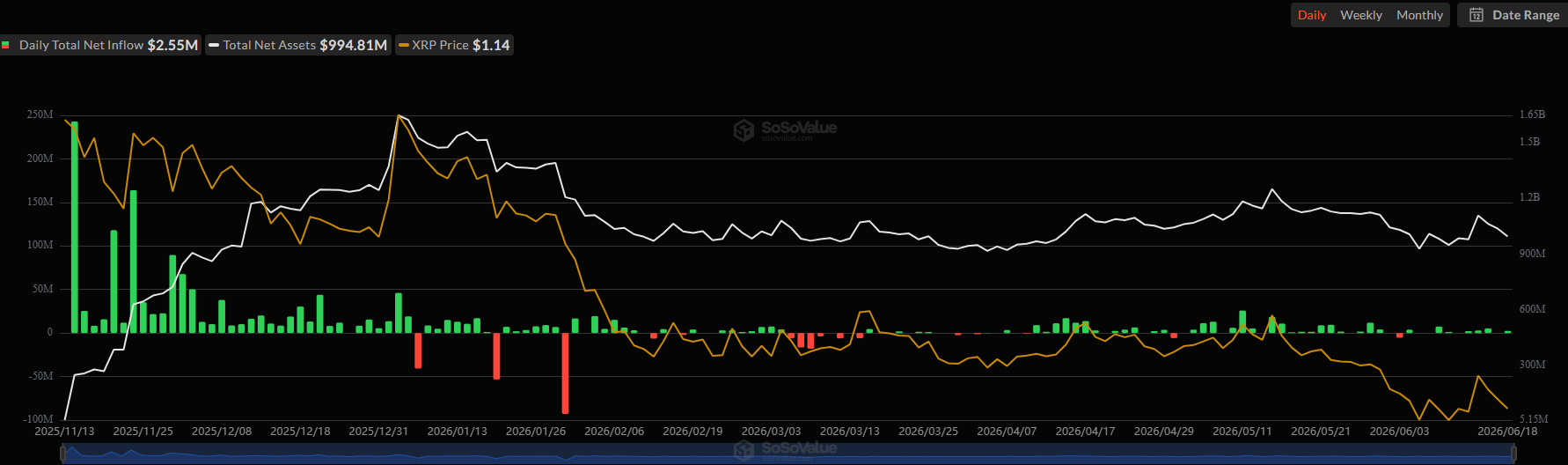
The post 2 Major Red Flags for Ripple’s Price as XRP Dumps 4.5% Daily: Details appeared first on CryptoPotato.


The Algorand Foundation will harden its blockchain against quantum attacks by the end of 2027, moving before the National Security Agency’s deadline.
The roadmap targets every layer of the network. It spans user wallets, developer tools, and the consensus mechanisms.
A Timeline Built Around Q-Day
Algorand frames the work against Q-Day, the point at which quantum computers could break the cryptography securing most blockchains today. The 2027 target arrives before the National Institute of Standards and Technology phases out legacy RSA key sizes. It also lands three years ahead of the NSA’s deadline for national security systems.
According to the roadmap, native post-quantum accounts will arrive with the Q3 2026 protocol release. Users will create them inside the Pera wallet, and all software development kits will support the new format.
Stakers will also be able to stake from the quantum-resistant accounts. Moreover, with the Q3 2026 upgrade, Algorand will support multiple signature types at once.
Follow us on X to get the latest news as it happens
The effort builds on work that began in 2022, when Algorand deployed State Proofs signed with the Falcon scheme. Post-quantum multi-signatures and a treasury migration are scheduled for later this year.
“Post-quantum security cannot be retrofitted after Q-Day. Every institution tokenizing or staking, every developer building, and every user transacting on Algorand needs to know their assets will remain secure should the quantum threat materialize. This roadmap gives them that assurance, starting with concrete deployments in 2026,” Bruno Martins, Chief Technology Officer, Algorand Foundation, said.
Chris Peikert, the Foundation’s Chief Scientific Officer, said upgrading a live protocol takes years as attack odds rise toward the end of the decade. The coming releases will test whether Algorand holds to its schedule.
Rival chains are moving on parallel tracks. TRON plans a quantum-resistant testnet in Q2 2026 and a mainnet rollout in Q3. Solana has said its migration is fully researched and ready to deploy once the threat lands. Ethereum developers, meanwhile, expect Layer 1 upgrades by 2029.
Subscribe to our YouTube channel to watch leaders and journalists provide expert insights
The post Algorand Targets Broad Quantum Resilience by End of 2027 With New Roadmap appeared first on BeInCrypto.
Goldman Sachs lowered its year-end gold forecast by $500 an ounce, citing expectations that the US Federal Reserve won’t cut interest rates this year.
The revised target places gold at $4,900, down from earlier estimates of $5,400. It comes on the assumption that the next Fed cuts could be pushed to March 2027 and December 2027.
“Our gold price views remain structurally constructive but tactically cautious, with near-term downside risk and medium-term upside risk,” Goldman Sachs commodity analysts Lina Thomas and Daan Struyven said, according to Bloomberg.
A delay in US interest rate cuts could also weigh on cryptocurrencies, as lower interest rates tend to be favorable for digital assets such as Bitcoin. The war in Iran has also taken its toll on the assets.
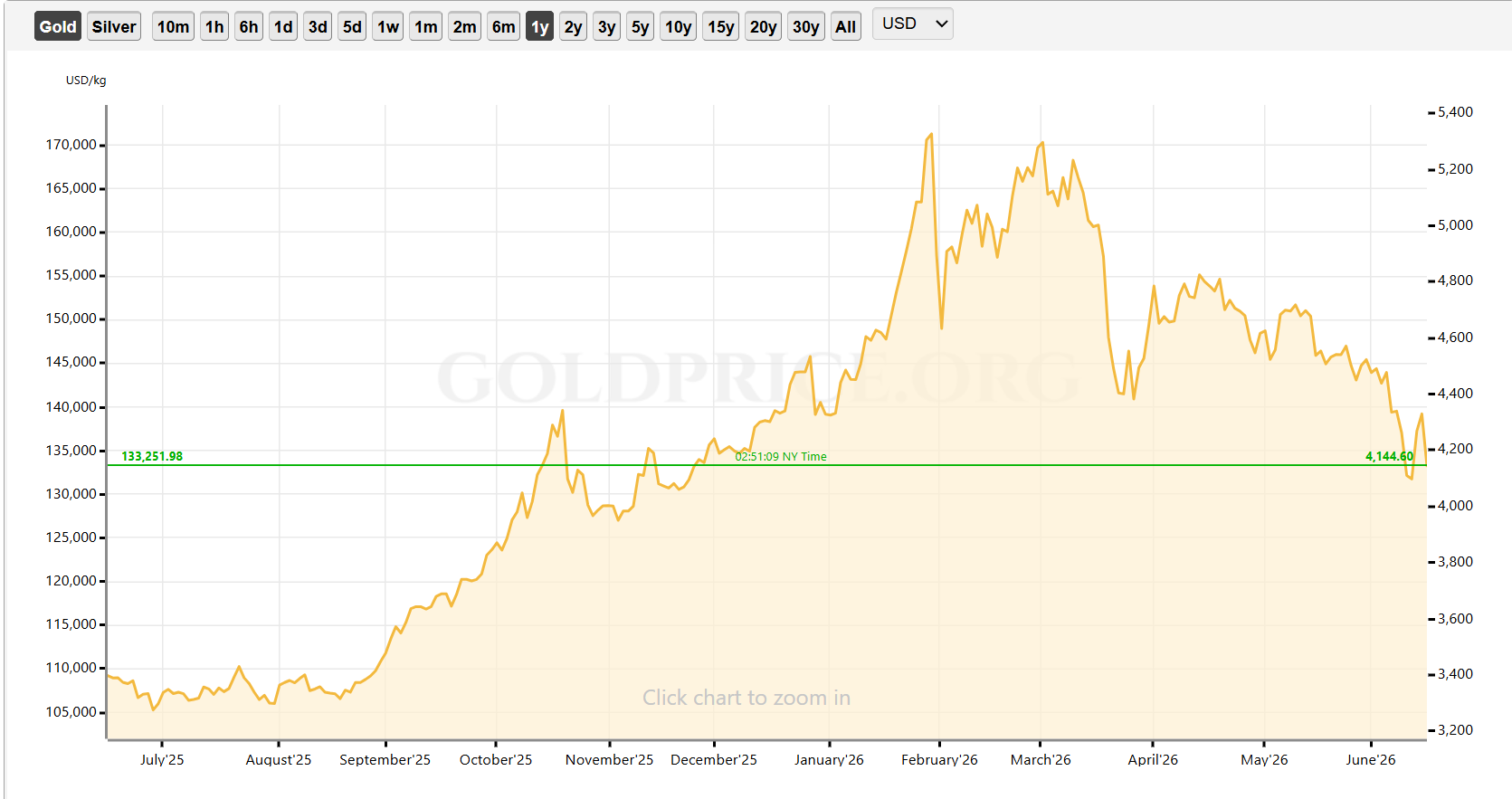
Bitcoin has fallen 28.3% since January, and gold has declined more than 22% since its January all-time high of $5,327 per ounce. Gold is now just $135 away from dipping below $4,000, a level not seen since November, according to GoldPrice.
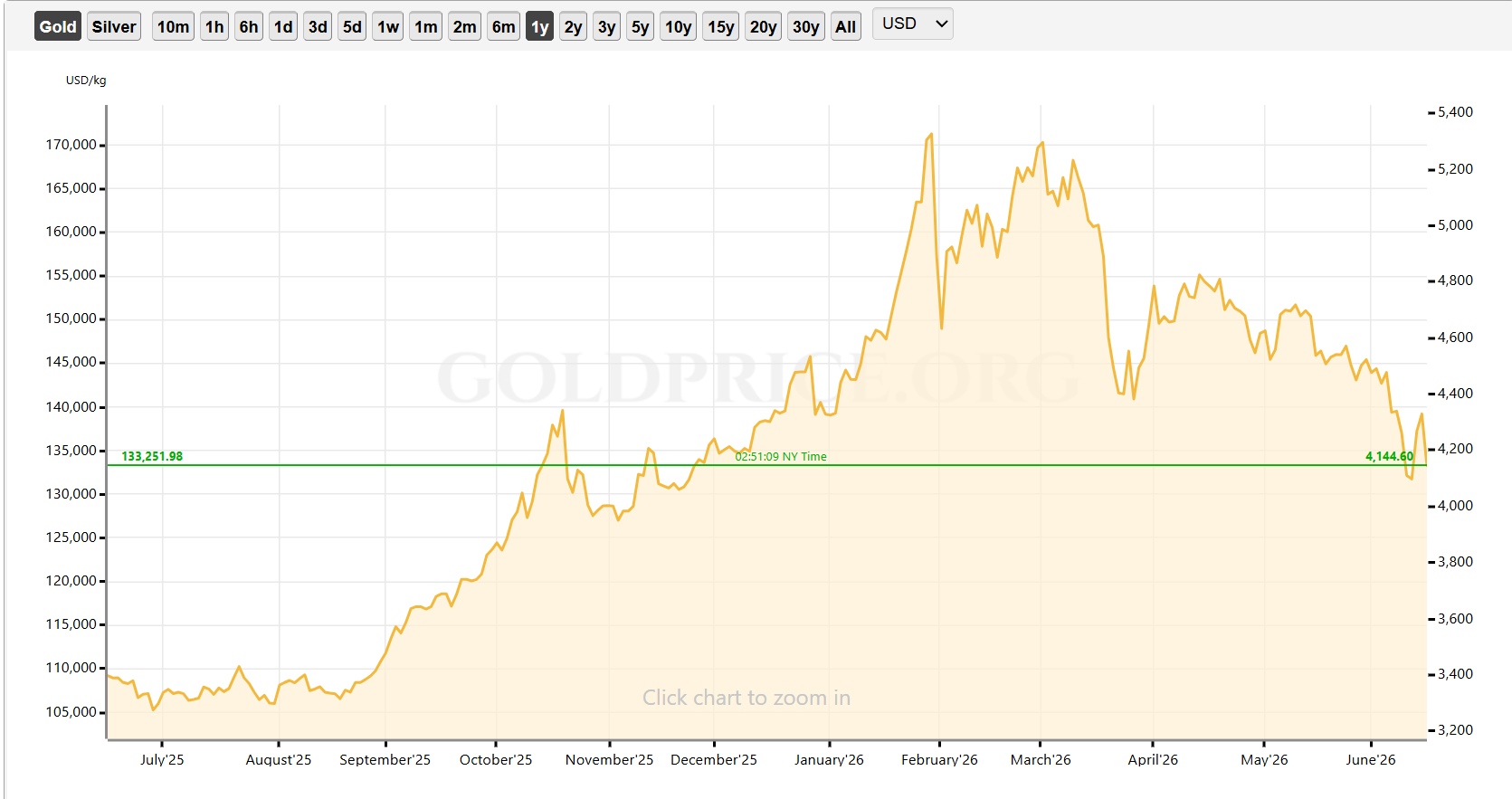
Gold price one-year chart. Source: GoldPrice
Related: Bitcoin’s deeply discounted versus AI-stocks, but hawkish Fed risk lingers: Bitwise
Last week, analysts cautioned that Bitcoin and gold may face further headwinds this year following a 4.2% annual increase in the US Consumer Price Index in May, coupled with the conflict in the Middle East.
Since gold pays no yield, rising rates could mean that holding gold becomes more expensive relative to bonds or cash, and the market may be repricing the entire “easy money” thesis that drove gold to record highs earlier this year.
“Only when inflation drops, rate cuts become viable, and liquidity improves alongside lower capital costs, will the overall risk appetite truly reverse,” HashKey Group senior researcher Tim Sun told Cointelegraph.
CME’s FedWatch tool shows a high chance of rates staying the same or rising in the remaining months of 2026, compared with the current target rate of 3.5% to 3.75%.
Magazine: The end of anon? AI could unmask crypto’s hidden identities


Bitcoin and Ethereum faced a $2.13 billion options expiry on June 19 as both assets traded below their max pain levels.
Summary
- Bitcoin options worth $1.9 billion expired with max pain at $65,000, above spot prices Friday.
- Ether options worth $230 million expired near $1,725 max pain as ETH traded lower.
- GreeksLive said $60,000 remains a critical Bitcoin strike as quarterly expiry nears next week.
The expiry covered 31,000 BTC options with a put-call ratio of 0.78 and a notional value of $1.9 billion.
Ether also had 138,000 options expire, with a put-call ratio of 1.03 and a notional value of $230 million. ETH’s max pain level stood at $1,725, while BTC’s max pain level stood at $65,000.
Bitcoin traded near $62,500 during the session, below the level where many options would expire with the least value to buyers. Ethereum traded near $1,690, also below its max pain area.
Bitcoin momentum fades near key support
Bitcoin briefly rebounded toward $67,000 earlier this week, but the move lost strength. Sellers pushed the asset below $63,000 before expiry, keeping attention on the $60,000 to $63,000 range.
As previously reported by crypto.news, last week’s options expiry also placed the $60,000 to $62,000 Bitcoin area in focus. GreeksLive had said downside exposure was concentrated in that region.
The same level remains important this week. GreeksLive said the $60,000 strike acts as a “critical threshold.” The firm added that a “sustained breach” below that level could turn dealer hedging into a force that supports a faster move lower.
ETF flows and Strategy concerns weigh on sentiment
The market has also struggled to absorb pressure from institutional selling. Strategy, formerly MicroStrategy, has drawn attention after a small Bitcoin sale earlier this month shook confidence among some traders.
Crypto.news earlier reported that analysts pushed back against claims that Strategy alone caused Bitcoin’s drop. ETF outflows and whale selling were seen as larger forces behind the decline.
Still, the Strategy debate has added pressure to a market already dealing with weaker liquidity and falling prices. Traders have become more cautious as Bitcoin trades closer to downside strikes than upside call levels.
ETF demand has also cooled during the recent pullback. That matters because spot Bitcoin ETFs have been one of the main sources of institutional demand since their launch.
Traders watch quarterly settlement
This week’s expiry was smaller than last week’s, but next week brings the quarterly settlement. About 15% of options positions are set to expire, making June 26 a key date for derivatives traders.
Open interest remains large near the $80,000 strike, while bearish exposure still sits near $60,000. That split shows a market caught between longer-term upside bets and short-term downside protection.
Laevitas said a “week of grinding calm” had weakened the front end of Bitcoin volatility. That suggests traders have not priced in a large near-term move, even as quarterly expiry approaches.
Skew remains negative, showing that traders still pay more attention to downside protection. If Bitcoin holds above $60,000, volatility could remain contained. A break below that level may bring faster hedging flows and another test of lower support.
For Ethereum, the $1,700 area remains the near-term line to watch. ETH traded below its $1,725 max pain level, and a failure to reclaim that area could keep pressure on the $1,650 to $1,600 range.
The options expiry did not change the wider market trend by itself. It did, however, show that traders remain cautious while BTC and ETH trade below their pain points before a larger quarterly settlement.
Disclosure: This article does not represent investment advice. The content and materials featured on this page are for educational purposes only.

The Superyacht Influencer and Questions Over Mother City Capital
PremiumBlock Launches Non-Custodial Risk Hub for User-Created Prediction Markets, Perps and Web3 Poker

Ryanair accused of changing reason for flight delay to avoid compensation


-

 Business5 days ago
No Jackpot Winner as $257 Million Prize Rolls Over to $269 Million Monday Draw
-

 Fashion7 days ago
Weekend Open Thread: Tuckernuck – Corporette.com
-
 Crypto World4 days ago
Zimbabwe Requires Crypto Businesses to Register Annually Under New FIU Regulations
-

 Crypto World6 days ago
Bitget enters Argentina’s regulated crypto market through PSAV registration
-

 Tech6 days ago
NanoClaw integrates JFrog registries to secure AI agent downloads
-

 Tech7 days ago
This Week In Security: Microsoft On Microsoft, Register Your Domains, Linux On ARM, And FreeBSD Joins The File Cache Club
-

 NewsBeat7 days ago
FBI searches office of Ohio voter registration group
-
 Entertainment5 days ago
Matt Damon’s Viral Sci-Fi Thriller Has Taken Over HBO Max
-

 Business5 days ago
Anthropic staff to meet White House officials next week, Axios reports
-

 Tech5 days ago
As AI companies race to go public, who else is along for the ride?
-
 Crypto World5 days ago
Bitcoin could crash to $48,000, if this historical pattern is triggered
-

 Politics5 days ago
“Israel’s” ban on ICRC visits ruled illegal, but Knesset moves to stop them permanently
-
 NewsBeat5 days ago
Warning of disruption as Cardiff Crossrail works to start
-

 News Videos5 days ago
Financial Accounting | Last Day Revision Strategy and Booster | CMA Inter – June 2026
-
 NewsBeat5 days ago
Tributes to former deputy head teacher at Cambridge school among death and funeral notices
-
 Crypto World5 days ago
Market Preview: SpaceX (SPCX) IPO Record, Federal Reserve Meeting, and Iran Nuclear Agreement
-
 NewsBeat5 days ago
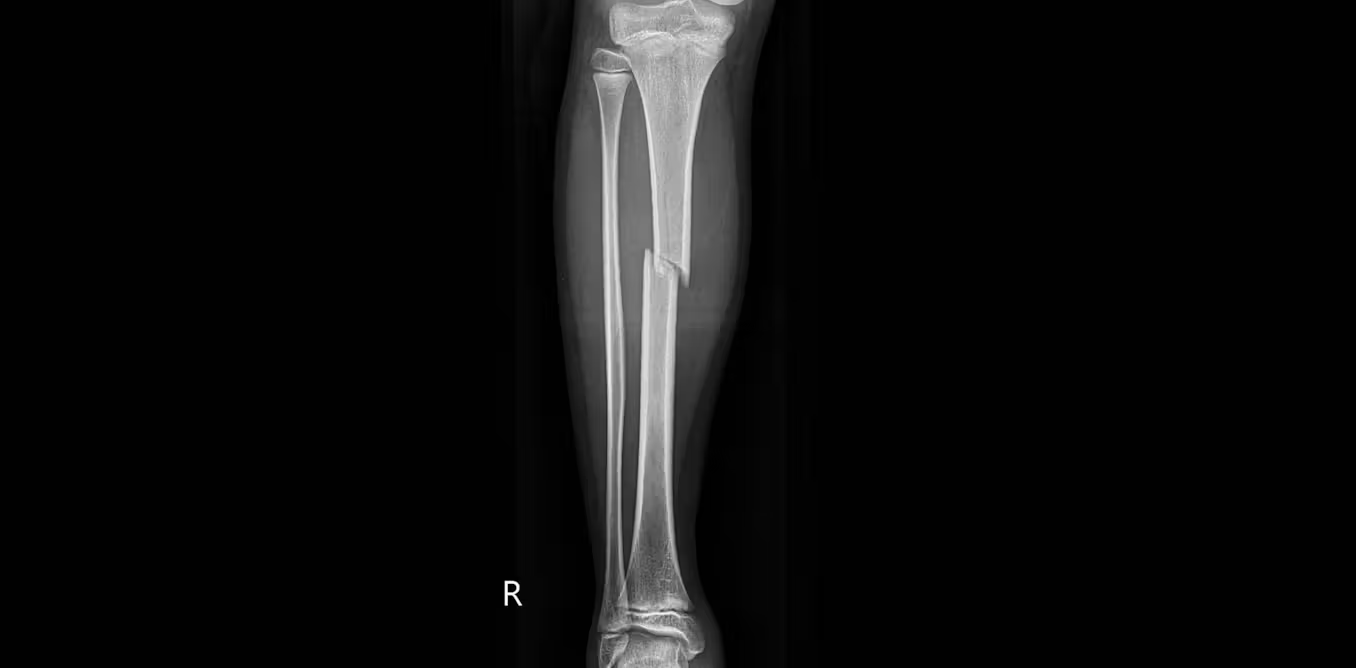
what doctors are seeing in ebike crashes
-

 Entertainment5 days ago
Deion Sanders Shares Powerful Post After Viral Advice To Deiondra
-
 Entertainment5 days ago
Kate Middleton Glare Goes Viral After Kids Booed At Royal Event
-

 Business5 days ago
Invesco Quality Income Fund Q1 2026 Commentary
You must be logged in to post a comment Login