

Crypto World
Ethereum Price Hits Critical 5Y Volume Support Zone: Is a Multi-Month Reversal Setting Up?

TLDR:
- Ethereum is testing a major five-year high-volume node between $1,850 and $2,000 on the monthly chart.
- The latest monthly candle prints a long lower wick, signaling active defense by larger market participants.
- ETH structure remains heavy with lower highs from $4,000, keeping resistance firm between $2,700 and $3,600.
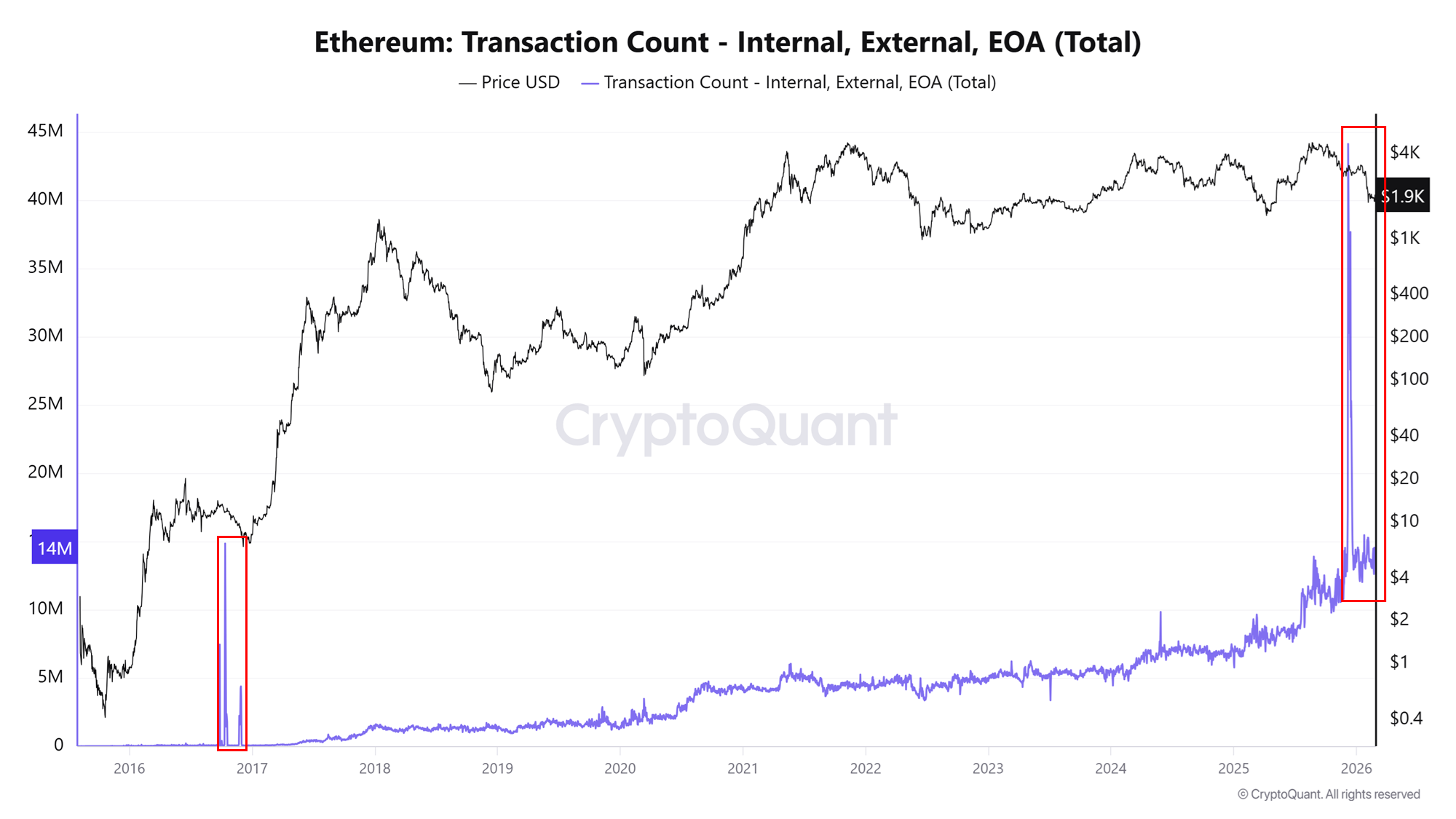
- On-chain transaction data mirrors the 2017 cycle pattern, which preceded a sustained one-year bull market run.
Ethereum is at a critical inflection point after tapping a major five-year volume node on the monthly chart. The asset was trading at $1,901.69 as of writing, down 2.09% in the last 24 hours.
The seven-day decline stands at 4.33%, with trading volume at $20.23 billion. Market participants are closely watching this zone. The monthly reaction here is expected to define the next multi-month directional move for ETH.
Ethereum Price Taps Key Demand Zone With Long Lower Wick on Monthly Chart
Ethereum at a critical inflection point means price is now testing the $1,850–$2,000 high-volume node on the monthly timeframe.
This zone has drawn heavy market participation over the past five years. Large positions were historically built here, giving it structural demand characteristics rather than acting as a random support level.
Analyst Bitcoinsensus noted that the latest monthly candle prints a long lower wick within this region. That pattern reflects aggressive buying activity below the support area. It suggests that larger participants are actively absorbing sell pressure and defending the zone.
However, a wick alone reflects reaction, not a confirmed reversal. The broader structure still carries weight from above, showing a pattern of lower highs from the $4,000+ region. ETH continues to trade beneath prior range resistance between $2,700 and $3,600.
Until momentum shifts and price reclaims the mid-range area, downside risk cannot be ruled out. A confirmed hold above $1,850 on a monthly close would support a move toward $2,700. From there, an expansion toward $3,300–$3,600 becomes the next area of interest.
On-Chain Transaction Data Draws Parallel to Ethereum’s 2017 Market Cycle
On-chain analyst CW8900 observed that Ethereum transaction activity is mirroring patterns seen during the 2017 cycle.
That period saw an explosive rise in ETH transactions, followed by a sharp decline. The correction eventually gave way to a roughly one-year bull market run.
The current setup shows a similar sequence. After a surge in transaction activity, ETH has experienced a notable price pullback. This parallel is drawing attention from analysts who monitor long-term cycle behavior on-chain.
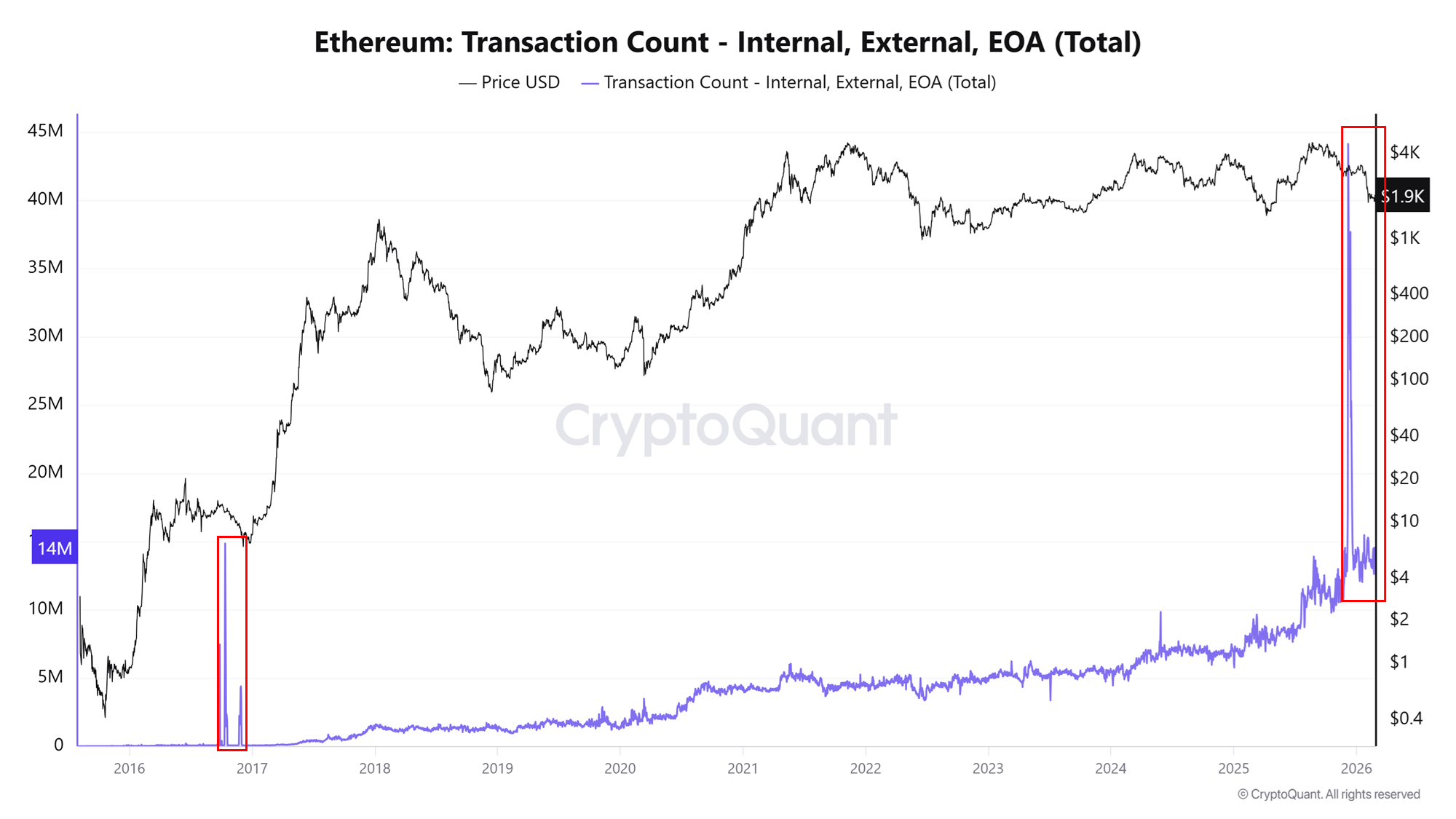
Source: Cryptoquant
If history follows a similar path, the next phase could bring renewed bullish momentum for Ethereum. That said, historical patterns serve only as reference points.
Market structure and macro conditions today differ from those in 2017 in meaningful ways.
For now, Ethereum remains at a macro decision point. Acceptance below $1,850 on a monthly close would open the path toward the $1,500 level relatively quickly.
The price action over the coming weeks will be essential in confirming which direction the market commits to from this key zone.



The CEO of AI company Anthropic, Dario Amodei, has responded to the United States Department of Defense and the White House, ordering military defense contractors that do business with the Department of Defense to stop using Anthropic’s products.
Anthropic objected to the use of its AI models for mass domestic surveillance and fully autonomous weapons that can fire without any human input, Amodei told CBS on Saturday.
He added that Anthropic was fine with all of the US government’s proposed use cases for its AI models, except for surveillance and fully autonomous weapons platforms. He said:
“These are things that are fundamental to Americans: the right, not to be spied on by the government, the right for our military officers to make decisions about war, themselves, and not turn it over completely to a machine.”

The decision by the Defense Department to label Anthropic as a “supply chain risk,” meaning that military contractors cannot use Anthropic’s products on defense contracting work, is “unprecedented” and “punitive,” he added.
Amodei later clarified that he is not against the development of fully automated weapons if foreign militaries begin using them in the future, but that AI is not yet reliable enough to function autonomously in a military setting.
The law has not caught up to the rapidly developing AI sector, Amodei said, calling on the United States Congress to pass “guardrails” to prevent the use of AI in domestic mass surveillance programs.
Related: Anthropic says it’s been targeted in massive distillation attacks
OpenAI wins a defense contract after US officials label Anthropic a supply chain risk
On Friday, US “Secretary of War” Pete Hegseth announced that Anthropic is a “Supply-Chain Risk to National Security.”
“Effective immediately, no contractor, supplier, or partner that does business with the United States military may conduct any commercial activity with Anthropic,” he said.
Hours later, rival AI company OpenAI accepted a contract with the US Defense Department to deploy its AI models across military networks.

The announcement of the deal from OpenAI CEO Sam Altman drew online backlash from critics, who cited AI being used for mass domestic surveillance and undermining individual privacy as a red line.
Magazine: ‘Slaughterbot’ drones in Ukraine, MechaHitler becomes sexy waifu: AI Eye
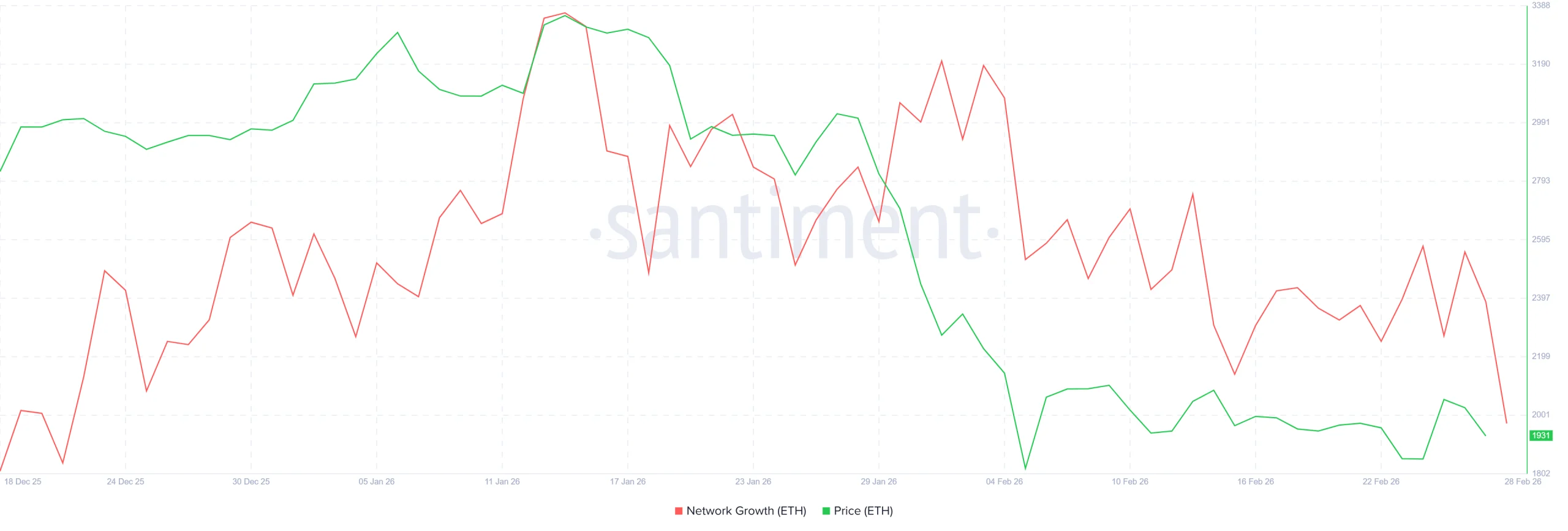
Ethereum price continues to trade in a sideways structure that reflects a gradual decline rather than stability. ETH has struggled to generate sustained upside momentum. The exit of new participants has weighed on sentiment, even as some long-term metrics show early signs of improvement.
This divergence creates a mixed outlook for Ethereum. While network growth has weakened, improving holder retention offers a counterbalance.
Ethereum New Holders Dip
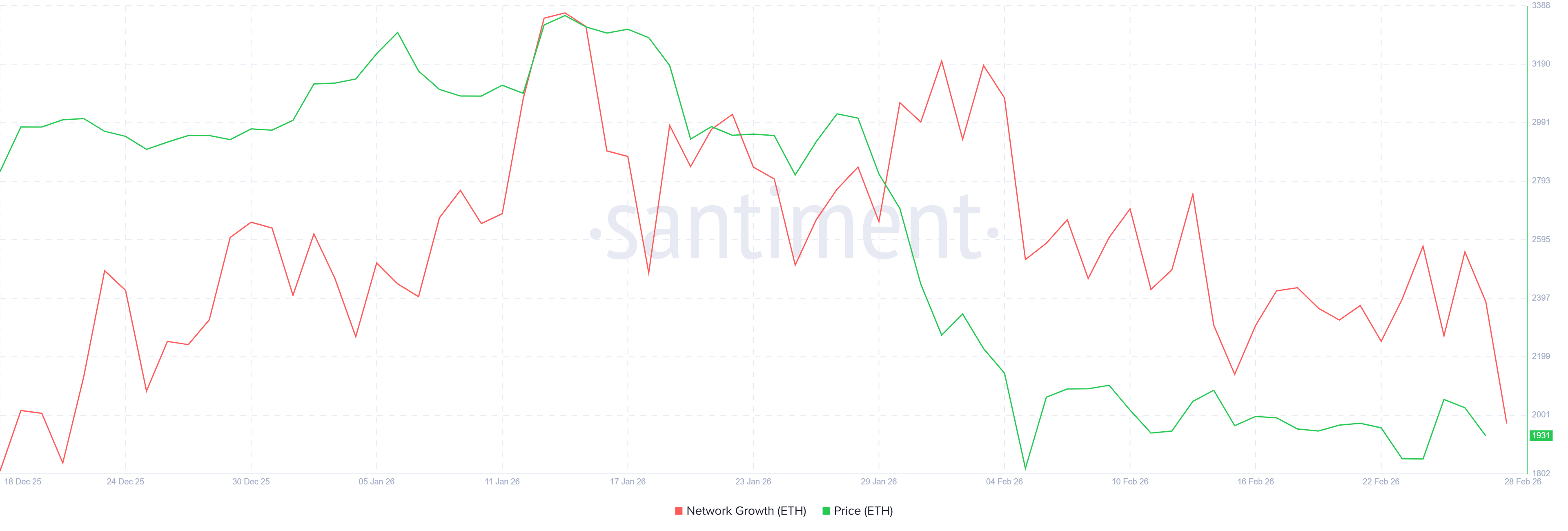
Ethereum has seen a sharp decline in new addresses over the past several days. Daily new addresses fell nearly 36% within 48 hours, dropping from 298,000 to 191,000. This contraction pushed Ethereum’s Network Growth metric to a two-month low.
The slowdown has persisted since the beginning of the month. Fewer new participants reduce organic demand. Weak onboarding also signals hesitation among retail investors. This trend has added pressure to ETH price performance and contributed to cautious market sentiment.
Want more token insights like this? Sign up for Editor Harsh Notariya’s Daily Crypto Newsletter here.
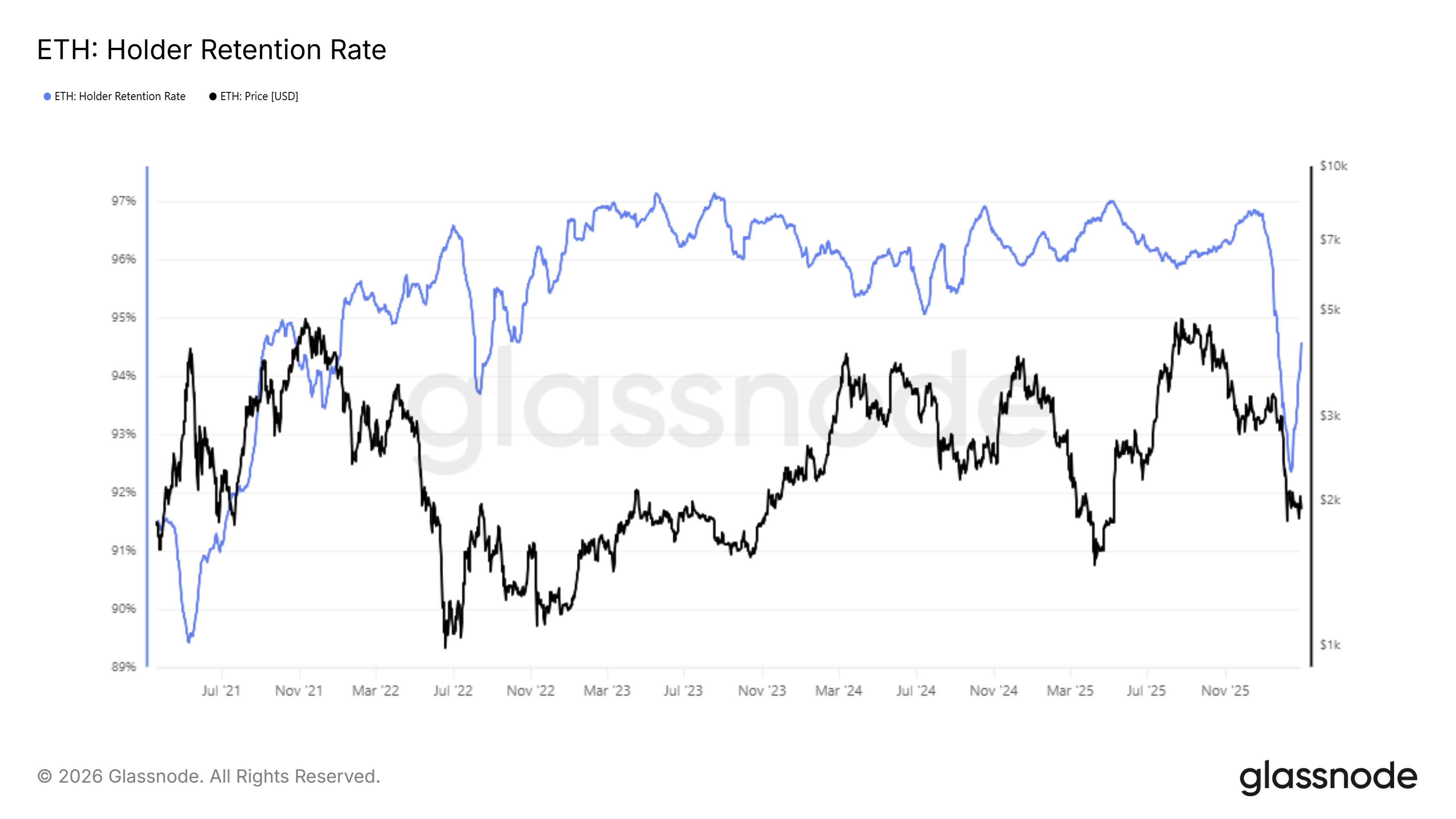
The Ethereum Holder Retention Rate provides deeper context that even though new holders are declining, the ones that are staying are staying for good. This metric tracks the percentage of addresses maintaining a balance across consecutive 30-day periods. It measures whether holders continue to retain ETH rather than exit positions.
The retention rate recently fell to 92.4%, marking a 4.5-year low and the weakest reading since September 2021. This decline confirmed wavering conviction among newer holders.
However, the metric has begun to improve modestly, suggesting renewed stability among participants. Rising retention can strengthen structural support if sustained.
ETH Price Shows Potential To Bounce Back
Ethereum is trading at $1,904 at the time of writing, holding above the $1,816 support level. While price action appears flat, a descending resistance line indicates a slow downtrend. Without stronger demand, ETH remains vulnerable to continued weakness.
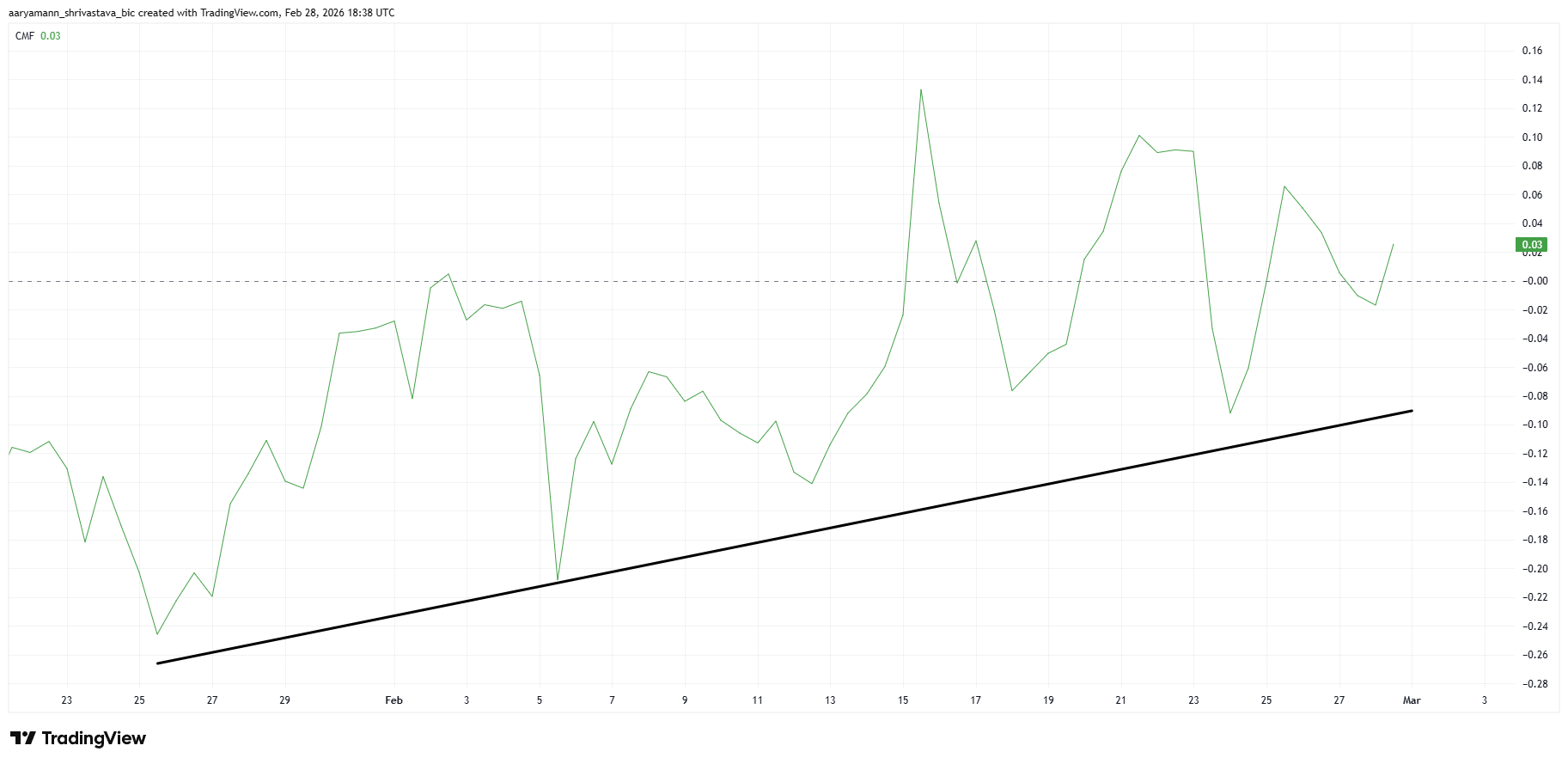
The Chaikin Money Flow indicator offers cautious optimism. CMF has shifted into positive territory after a gradual uptrend. This movement signals improving capital inflows. Transitioning from outflows to inflows is essential for any sustained Ethereum price recovery.
If inflows continue and support holds, Ethereum could rebound from $1,816 and attempt a move toward $2,165. A breakout above this resistance would invalidate the current downtrend line. Such a shift would likely restore investor confidence and reinforce bullish momentum.
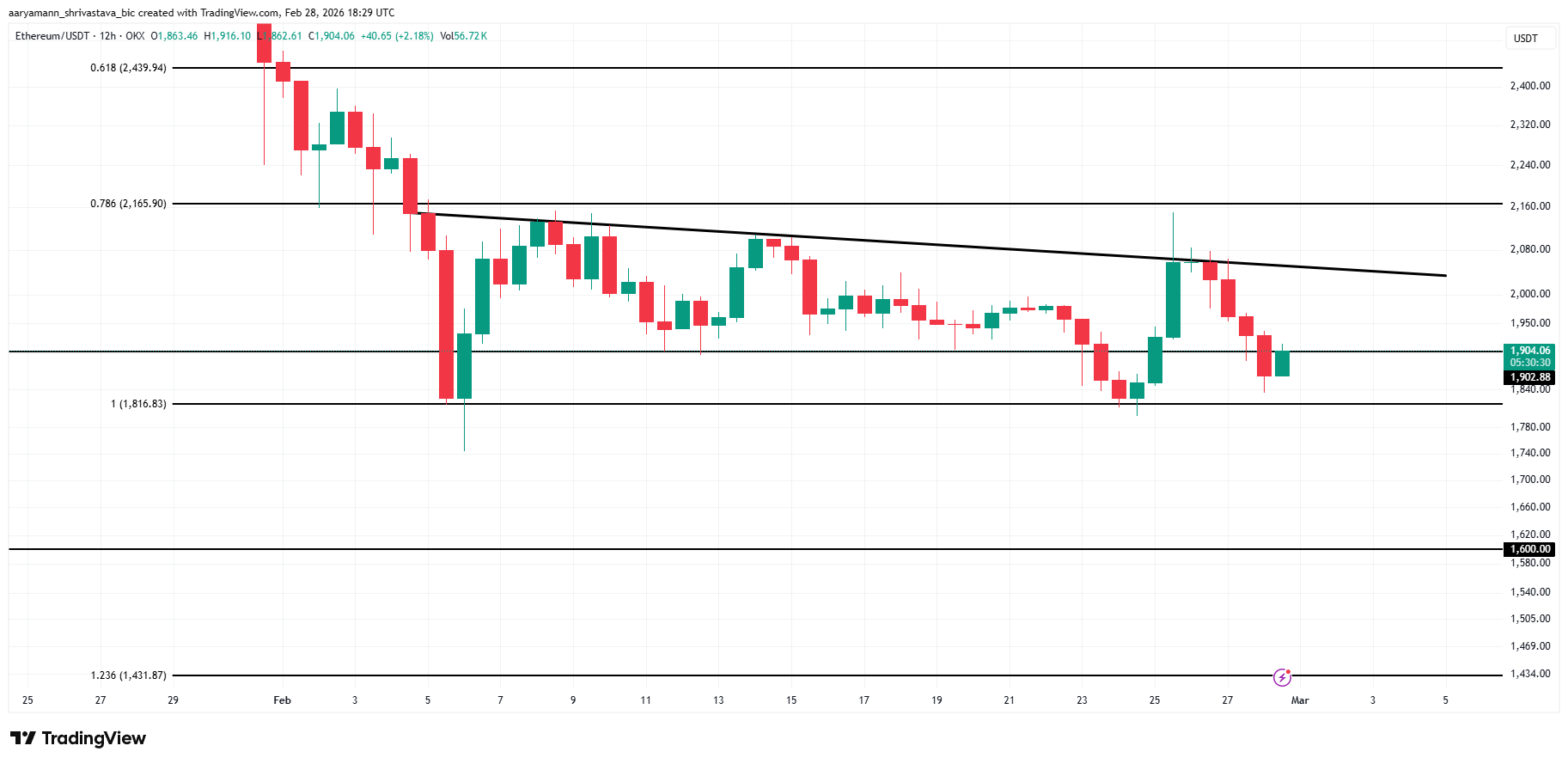
However, failure to maintain positive capital flow would undermine this outlook. A breakdown below $1,816 would invalidate the recovery thesis. In that scenario, Ethereum price could slide toward $1,600, increasing downside risk and reinforcing bearish control across the broader crypto market.
The post Ethereum Holder Retention Rebounds From a 4-Year Low appeared first on BeInCrypto.
Key takeaways:
-
Institutional adoption of the Ethereum network accelerates despite Ether disappointing price action. Ethereum and its layer-2s hold 65% of TVL market share.
-
Vitalik Buterin is shifting focus toward base layer scalability and ZK-EVM to ensure long-term onchain efficiency and security.
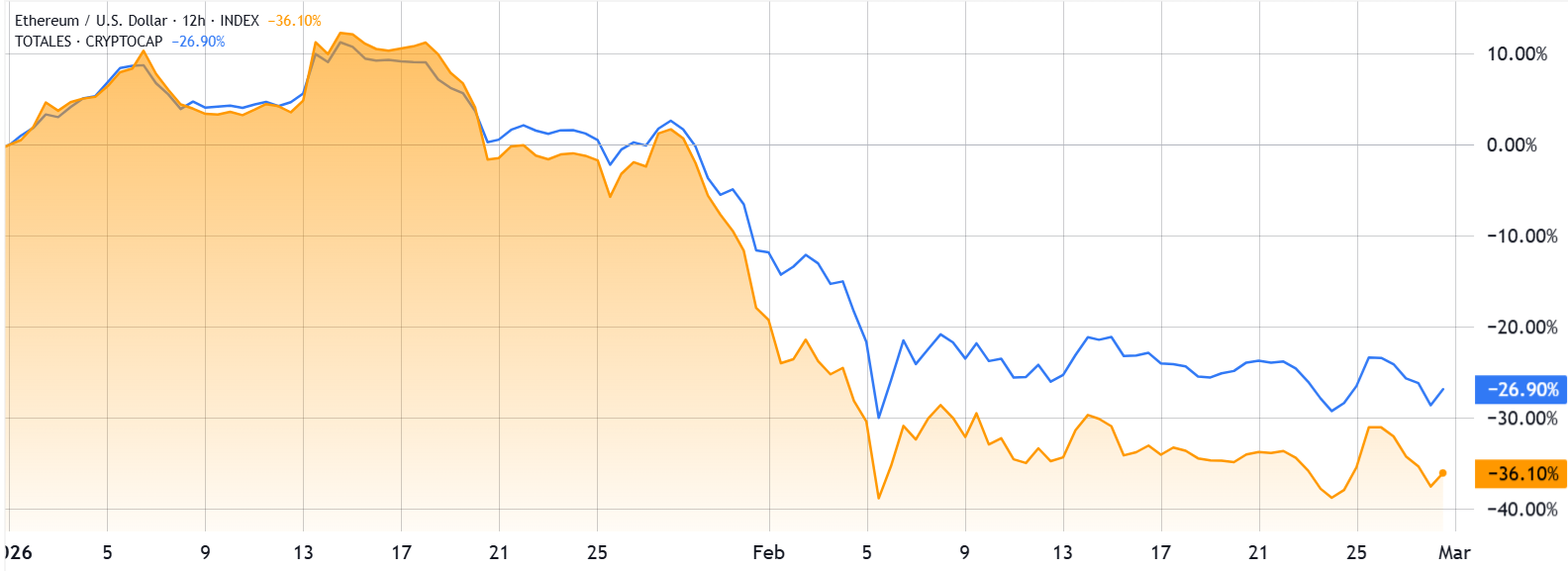
Ether (ETH) has declined 36% in 2026, sparking frustration as the $3,000 level feels increasingly out of reach. Despite a retreat toward $1,900, Ethereum fundamentals appear resilient. Development continues at a rapid pace, specifically targeting base layer scalability, privacy, and quantum resistance.
Critics claiming Ether is poorly positioned may be surprised if the market sentiment shifts back toward cryptocurrencies.

Ether has underperformed the broader crypto market by 9% during the first two months of 2026, challenging the theory that external factors are the sole drivers of this correction. Decentralized exchange (DEX) volumes on the Ethereum network fell 55% over the past six months, while competitor Solana saw a more modest 21% decline during that same timeframe.

Ethereum DEX volumes dropped to $56.5 billion in February 2026, down significantly from a peak of $128.5 billion in August 2025. During the same period, monthly Solana volumes reached $95.5 billion, down from $120.6 billion in August. This contraction in activity has weighed on network fees and decentralized application (DApp) revenue, effectively reducing the immediate incentives for holding Ether.
Institutions choose Ethereum over other blockchains
The narrow focus on volume ignores the fact that Ethereum maintains a 57% market share in total value locked (TVL), totaling $52.4 billion. When including layer-2 solutions such as Base, Arbitrum, Polygon, and Optimism, Ethereum’s dominance rises to 65%. For comparison, Solana’s TVL sits at $6.4 billion, while BNB Chain holds an aggregate $5.5 billion locked in smart contracts.
Major institutions, including JP Morgan Asset Management, Citi, Deutsche Bank, and BlackRock, have recently launched onchain projects using Ethereum. From tokenized funds to dedicated layer-2 rollups and bank-issued stablecoins, Ethereum remains the primary venue for decentralized finance (DeFi) innovation, commanding a 68% market share in Real World Assets (RWA).

Ethereum’s strategic decision to prioritize layer-2 scalability via rollups has been partially labeled a failure, as competing chains like Tron and Solana currently lead in network fees. Regardless of how critics judge the decision to subsidize rollup costs, no “Ethereum killer” has managed to match its monetary value. Even the highly successful Hyperliquid maintains a relatively modest $1.5 billion in TVL.

Vitalik Buterin, Ethereum’s co-founder and lead architect, recently expressed intentions to reduce dependence on rollups by targeting base layer scalability. According to Buterin, the proposed changes include parallel block verification, aligning gas costs with actual execution time, and the implementation of a zero-knowledge Ethereum Virtual Machine (ZK-EVM).
These updates will be implemented gradually. Buterin recommends that a minority of the network participate initially before moving toward mandatory block confirmation systems that rely on ZK-EVM. Additionally, Ethereum maintains a clear roadmap to navigate the quantum computing era, which includes consensus-layer signatures based on privacy-focused proof systems.
Related: Why institutions still prefer Ethereum despite faster blockchains
Buterin has admitted that quantum-resistant signatures are significantly larger and more difficult to verify, noting that lattice-based solutions are currently inefficient. Consequently, the proposed solution involves fixing protocol-layer recursive signature and proof aggregation while developing vectorized math precompiles to reduce gas costs. While the Ethereum network is not yet perfect, a viable path for scalability exists.
Before dismissing ETH as a failure, it is necessary to analyze what has made the network successful relative to competing DApp-focused blockchains. Decentralization and trust require years, if not decades, to establish. ETH maintains a significant first-mover advantage and appears well-positioned to capture a future surge in demand for institutional-grade onchain activity.
This article does not contain investment advice or recommendations. Every investment and trading move involves risk, and readers should conduct their own research when making a decision. While we strive to provide accurate and timely information, Cointelegraph does not guarantee the accuracy, completeness, or reliability of any information in this article. This article may contain forward-looking statements that are subject to risks and uncertainties. Cointelegraph will not be liable for any loss or damage arising from your reliance on this information.


Bitcoin fell to $63,062 before recovering to $66,201 following reports of large explosions in Tehran as the United States and Israel launched strikes across Iran.
Summary
- Bitcoin dropped to $63K on Iran strike news before rebounding above $66K.
- Crypto market lost $128B in panic selling as missiles hit Middle East.
- UAE intercepted missiles safely as BTC and ETH recovered from lows.
Ethereum (ETH) dropped to $1,837 before rebounding to $1,940. As per the data at the time of the attack, the crypto market erased approximately $128 billion in value in the immediate aftermath.
Iran launched retaliatory missiles at multiple locations including Israel, Qatar, the United Arab Emirates, and Bahrain.
They also threatened further strikes against U.S.-linked bases in Iraq.
The UAE Ministry of Defence successfully intercepted Iranian missiles without damage or injuries, though fragments fell across Abu Dhabi.
Bitcoin and Ethereum recover from intraday lows
Bitcoin (BTC) traded in a 24-hour range of $63,062 to $66,108 before settling at $66,201. The asset gained 1.12% over one hour and 1.28% over 24 hours. The intraday low of $63,062 is a 4.6% drop from the 24-hour high.
Ethereum’s 24-hour range spanned $1,837 to $1,946, with the current price at $1,940. The asset posted gains of 1.42% over one hour.
Both assets demonstrated quick recovery from initial panic selling as markets assessed the scope of the military action.
Bitcoin reclaimed the $66,000 level while Ethereum held above $1,900 after testing support below $1,850.
Regional missile exchanges cause risk-off sentiment
The strikes began Saturday with explosions reported in Tehran. U.S. President Donald Trump urged Iranians to overthrow the government once the military campaign concludes.
Hours after the initial strikes, Iran launched missiles targeting Israel, Qatar, UAE, and Bahrain.
The UAE Ministry of Defence intercepted the new wave of Iranian missiles launched toward the country.
Fragments of intercepted missiles fell across several parts of Abu Dhabi including Saadiyat Island, Khalifa City, Bani Yas, Mohammed bin Zayed City, and Al Falah. No injuries were reported.
The ministry affirmed readiness to deal with any threats and stated it is taking all necessary measures to counter anything aiming to undermine the country’s security and stability.
TLDR:
- Bitcoin dropped to $63K within minutes of the Iran War breaking out, triggering over $515M in crypto liquidations.
- Gold surged past $5,200 as the Iran War intensified, with Bank of America forecasting a $6,000 per ounce target.
- The Strait of Hormuz carries 20% of global oil daily, and tankers are already halting movement amid the Iran War.
- Recession probability jumped from 25–30% to 40–50% as the Iran War threatens sustained disruption to global oil supply.
The Iran War has triggered an immediate financial shockwave across every major asset class. Open military conflict between the U.S., Israel, and Iran erupted on February 28, following explosions across Tehran, southern Lebanon, and near U.S. military bases.
President Trump declared “major combat operations” under Operation Epic Fury. Iran responded with missile strikes on Israeli and U.S. Gulf bases.
Investors across every market are now reassessing their positions as the situation continues to evolve hour by hour.
Stock Markets Face a Historic Test as War Escalates
The Iran War arrived at an already fragile moment for equities. The S&P 500 had turned negative for 2026 before the first strike even landed.
Bank of America held the most bearish S&P 500 outlook heading into the conflict, with a year-end target of just 7,100.
Historical data, however, offers a counterpoint worth noting. CFA Institute data shows U.S. large-cap stocks returned 11.9% annualized during wartime versus 10.0% during peacetime periods.
Across six major conflicts, the pattern has remained consistent — markets sell off before the war begins, then recover shortly after it starts.
The critical difference this time is oil. None of those previous wars directly threatened a supply corridor handling 20% of global crude.
If the Strait of Hormuz faces prolonged disruption, the historical “buy the war” playbook may not hold. Recession probability has already shifted from roughly 25–30% to an estimated 40–50%.
Bitcoin and Gold Split as Investors Seek Safety
Bitcoin dropped to approximately $63,000 within minutes of the Iran War breaking out, falling 3.8% almost immediately.
Over $515 million in crypto liquidations followed, erasing roughly $128 billion from total market capitalization. Ethereum fell 5.5%, with $149 million in ETH futures liquidations recorded by CoinGlass.
Gold, by contrast, surged past $5,200 and settled near $5,296 in the same window. Silver climbed 7.85% alongside it.
Gold had already gained 13.31% in January alone, reflecting a months-long trend driven by central bank buying and growing de-dollarization momentum.
The divergence between the two assets tells a clear short-term story. Bitcoin is trading like a risk-on asset, absorbing panic selling during weekend hours when no other liquid market is open.
Gold is functioning as the traditional safe haven. Bank of America expects gold to reach $6,000 per ounce over the next 12 months, and every current macro condition supports that trajectory.
Oil Prices and Economic Fallout Determine What Comes Next
The Iran War’s economic consequences hinge almost entirely on what happens at the Strait of Hormuz. Roughly 20 million barrels of oil pass through it daily, covering Qatar’s LNG, UAE crude, and most of Kuwait and Iraq’s exports.
Tanker traffic has already slowed, with Japanese shipping firm Nippon Yusen directing its full fleet away from the strait.
Brent crude closed the prior Friday at $72.48, while WTI jumped to $75.33, up 12% in a single session. Lombard Odier estimates a temporary spike to $100 per barrel is plausible under current conditions.
A sustained 20–30% oil price increase could depress global growth by 0.5–1.0% and push headline inflation higher by a similar margin.
The chain reaction from there runs through the entire economy. Higher oil raises costs across transportation, manufacturing, and consumer goods. Spending contracts, confidence falls, and growth slows.
The Federal Reserve, already stuck with rates at 3.5%–3.75% and inflation near 3%, has little room to respond. If Brent remains below $90, markets may stabilize. Above $100 sustained, the road through 2026 becomes considerably rougher.


Bitcoin’s future in an artificial intelligence-driven world may depend less on code and more on central banks.
In a new note, Greg Cipolaro, global head of research at financial services and infrastructure firm NYDIG, argued that artificial intelligence will affect bitcoin mainly through macroeconomic channels and its impact on the labor market.
The key variables are growth, employment, real interest rates and liquidity. Bitcoin, he writes, sits downstream of those forces.
If automation cuts jobs and wages, consumer demand could weaken and, in a severe case, falling incomes would strain debt payments and pressure asset prices.
Those fears appear to be well-grounded. Just this week, Jack Dorsey’s fintech firm Block unveiled its shrinking back toward its pre-pandemic size, cutting staff by about 40%. Dorsey cited AI-enabled efficiency for the job cuts, something that was theorized in Citrini’s research on the AI-doom that spooked the market this week.
In such a scenario, policymakers might respond with lower rates or fiscal spending to stabilize the economy. That wave of liquidity could support bitcoin, which has often tracked shifts in global money supply.
A different outcome would look less friendly for the cryptocurrency. If AI boosts productivity and economic growth without major job losses, real yields could rise, and central banks might keep policy tight.
Higher real rates have historically weighed on bitcoin by raising the opportunity cost of holding it and making risk assets less attractive.
Shift in demand
Anxiety around AI echoes past moments of upheaval in Human society.
The steam engine displaced manual labor in factories and on farms. Electrification then rewired entire industries. Later, computers and the internet automated clerical work and reshaped retail, media and finance.
Each wave triggered fears of permanent job loss. In the early 1900s, factory mechanization sparked labor unrest as machines replaced skilled craftsmen. In the 1980s and 1990s, personal computers cut typist pools and back-office staff. More recently, e-commerce helped hollow out brick-and-mortar retail roles.
Yet aggregate demand did not collapse. Productivity rose. New industries absorbed displaced workers, even if the transition proved uneven and painful. Nowadays, we have industries that were unthinkable before the dawn of the internet. Think cloud computing.
Cipolaro argued AI may follow a similar pattern. As a general-purpose technology, it requires firms to redesign workflows and invest in complementary tools. Over time, that process tends to expand productive capacity rather than shrink it.
“The implication is not that disruption will be painless, but that the equilibrium response to new technology has historically been integration, not obsolescence,” Cipolaro wrote. “Society’s response to AI will likely follow the same pattern.”
For bitcoin, that distinction matters. If AI ultimately lifts long-term growth, the structural backdrop could differ from the short-term shocks that often drive liquidity injections.
Meanwhile, adoption may also rise thanks to agentic payments, which would essentially see software pay other pieces of software without human involvement. One of Bitcoin’s earliest visions centered on machine-to-machine payments, and AI may be the necessary tool to make them a reality.
Still, incentives aren’t currently there for a widespread rollout. Credit cards bundle rewards and short-term credit, features that stablecoins do not yet match, Cipolaro noted.
Ultimately, while the rise of AI brings new challenges, what matters is the human response to the disruption it brings. If AI triggers a deflationary shock and forces the money printer to turn back on, or if it fuels a productivity boom that raises real yields, bitcoin will reflect that.


A tip to Homeland Security unraveled a multi-wallet laundering scheme, which ultimately resulted in a $61 million Tether confiscation.
US federal agents have seized more than $61 million worth of USDT. Investigators traced the seized funds to cryptocurrency addresses allegedly linked to the laundering of criminal proceeds obtained through “pig butchering” schemes.
According to the official press release, the funds were connected to scams in which victims were recruited and manipulated into transferring money under false pretenses.
Romance, Fake Profits, and $61M in USDT
Court filings state that criminal actors targeted victims by establishing trust and often posed as romantic partners. After gaining victims’ confidence, the scammers claimed to have specialized knowledge or techniques that could generate massive profits through cryptocurrency trading.
Victims were directed to fraudulent cryptocurrency trading platforms that closely resembled legitimate platforms in name and appearance. These fake platforms displayed fabricated investment portfolios and showed unusually high returns in order to encourage victims to invest increasing amounts of money.
When victims attempted to withdraw their funds, they were unable to do so and were frequently told they needed to pay additional “taxes” or “fees” to release their assets. According to authorities, these tactics were used to extract more money from victims.
Once funds were transferred to cryptocurrency wallets controlled by the scammers, the money was rapidly moved through multiple wallets to conceal its source, ownership, and control. In this case, Homeland Security Investigations (HSI) agents and analysts in Raleigh received a complaint through the HSI Tip Line and traced the victim’s funds through several cryptocurrency wallets involved in the alleged fraud and money laundering scheme.
Authorities also revealed that some of those wallets still held significant amounts of victims’ funds, making them subject to seizure and forfeiture.
You may also like:
Crackdowns
Tether has been involved in several financial crime investigations in coordination with international law enforcement agencies. The stablecoin issuer has assisted efforts to track, freeze, and support the seizure of illicit funds. On July 22, 2025, the US Department of Justice announced a civil forfeiture action against Buy Cash Money and Money Transfer Company that involved freezing and reissuing $1.6 million in USDT allegedly tied to Gaza-based terror financing.
In June 2025, Brazilian authorities recognized Tether’s assistance in blocking approximately $6.2 million, connected to a cross-border money-laundering scheme conducted through Klever Wallet. Also in June 2025, the Department of Justice and OKX enabled a civil forfeiture complaint seeking to seize roughly $225 million in USDT allegedly linked to pig butchering investment scams. In March 2025, the United States Secret Service froze $23 million in funds associated with transactions on the Russian-sanctioned exchange Garantex.
Binance Free $600 (CryptoPotato Exclusive): Use this link to register a new account and receive $600 exclusive welcome offer on Binance (full details).
LIMITED OFFER for CryptoPotato readers at Bybit: Use this link to register and open a $500 FREE position on any coin!
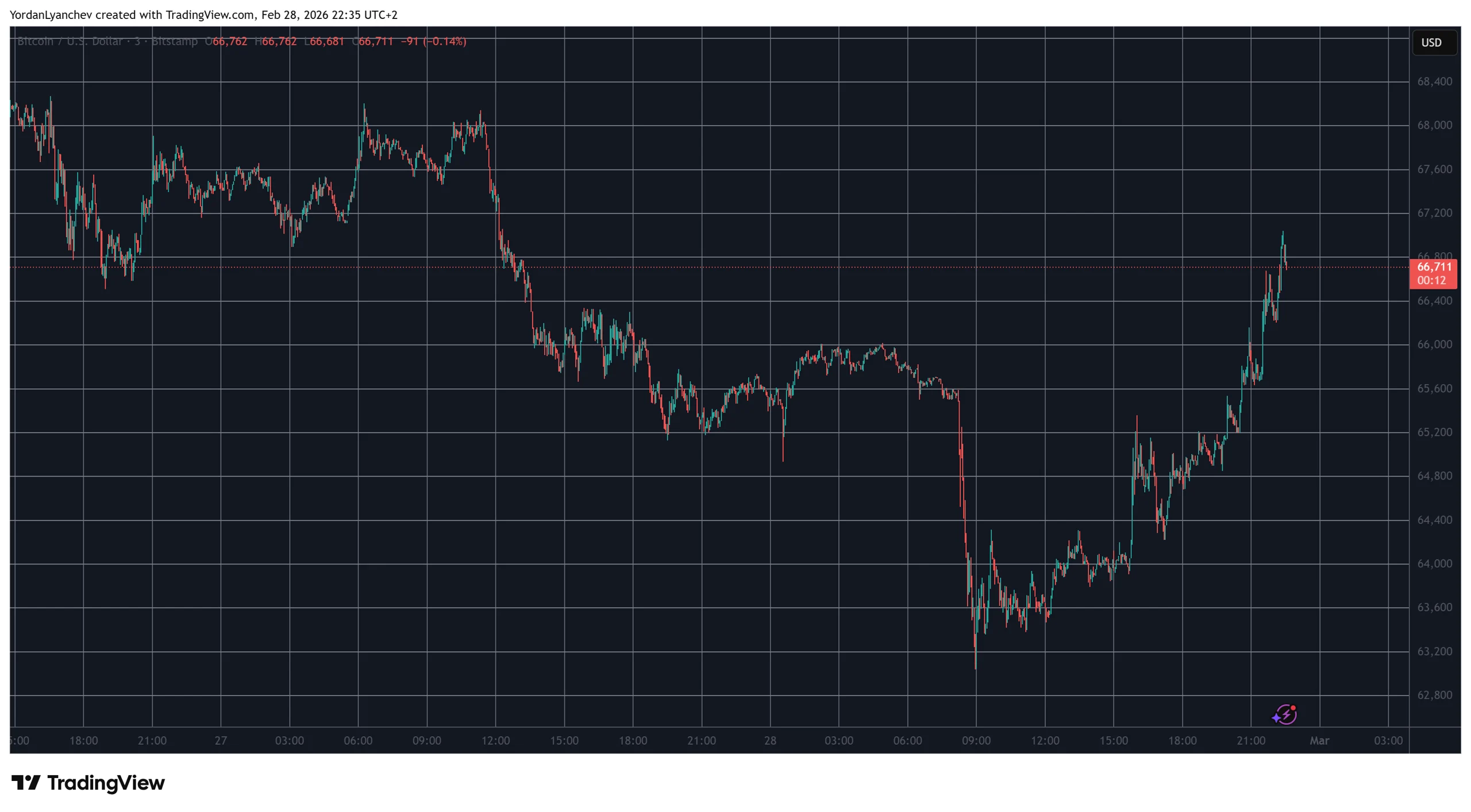
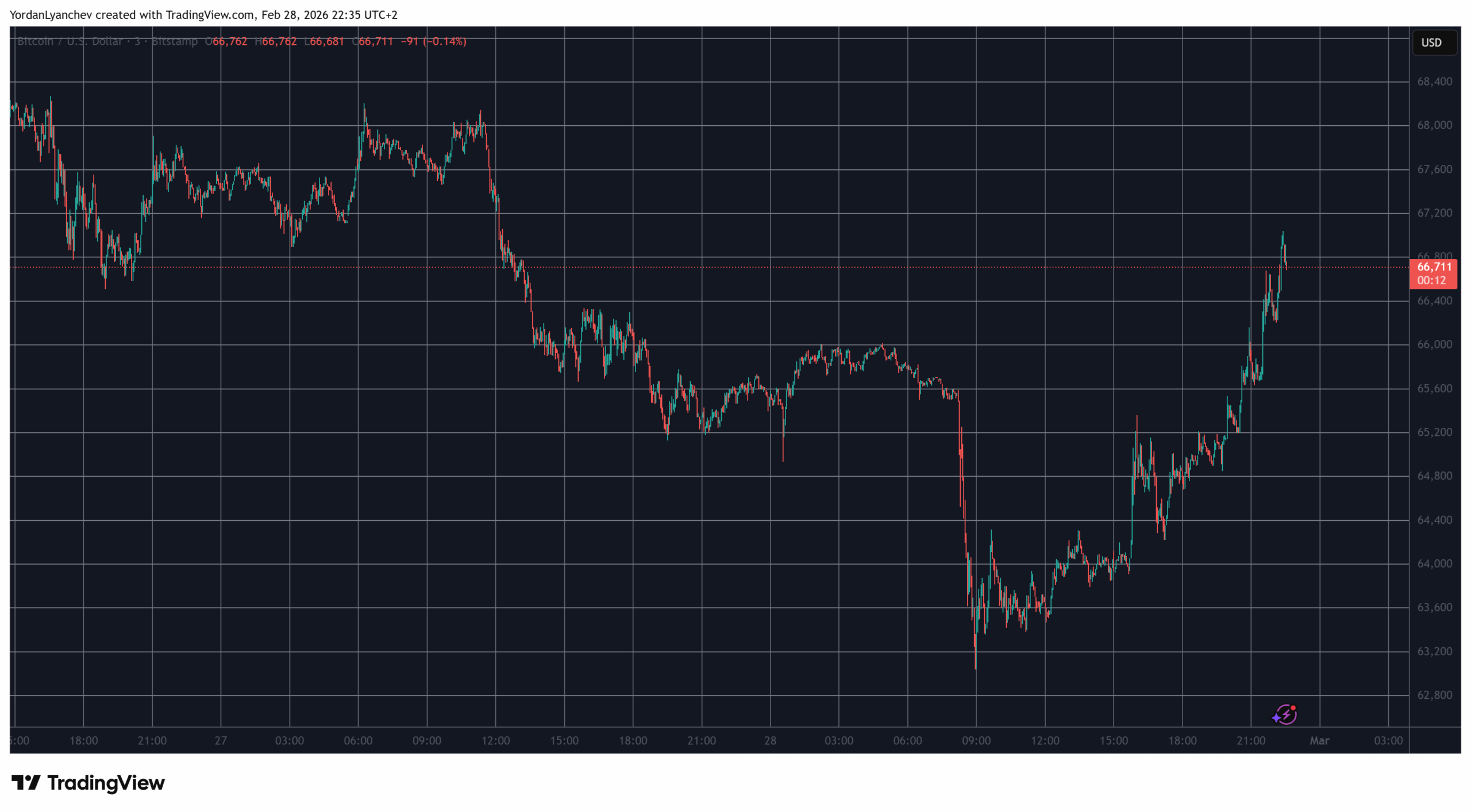
BTC has completely turned the tables around during this highly volatile day.
The intense volatility in the cryptocurrency markets continues as bitcoin just shot up to $67,000 after plunging to $63,000 this morning.
The most likely reason for all the Saturday fluctuations is the quickly escalating situation in the Middle East, and the latest reports hinting at a regime change in Iran.
It all started this morning when Israel and the USA carried out several attacks against Iran. The Middle East country retaliated against several nations in the region, including the UAE, Bahrain, Qatar, and Saudi Arabia.
In the following hours, more reports began to unravel, and the latest big development on the matter indicated that Iran’s supreme leader had been killed. So far, though, the information is coming only from Israeli sources and there’s no official confirmation.
US President Donald Trump also addressed the situation recently, warning that he could end it all in a matter of days and warned of further military actions if Iran doesn’t scale back on its nuclear development.
BREAKING: President Trump is floating several “off ramps” for Iran just hours after the strikes launched by Israel and the US, per Axios.
Trump says:
1. He can end the situation in “two or three days”
2. This would involve threatening Iran with further military action if they… https://t.co/xQf5c7nmjb
— The Kobeissi Letter (@KobeissiLetter) February 28, 2026
Since the cryptocurrency market is the only financial industry operating during the weekend, it endured significant volatility as the events unfolded. After the initial strikes, bitcoin plunged from $66,000 to $63,000 within minutes, and the altcoins followed suit.
You may also like:
However, it rebounded in the following hours and even jumped to $67,000 minutes ago after the reports about Khamenei’s death.
Binance Free $600 (CryptoPotato Exclusive): Use this link to register a new account and receive $600 exclusive welcome offer on Binance (full details).
LIMITED OFFER for CryptoPotato readers at Bybit: Use this link to register and open a $500 FREE position on any coin!
Crypto World
KAI Exchange Celebrates Satoshi Nakamoto’s Birthday on March 1 With 10,000 Traders Worldwide

[PRESS RELEASE – Dubai, United Arab Emirates, February 28th, 2026]
KAI Exchange, the world’s leading AI-native cryptocurrency trading platform, says it has received a mysterious message from Satoshi Nakamoto: “April 5th is not Satoshi Nakamoto’s birthday (that belongs to Changpeng Zhao); Satoshi’s real birthday is March 1st.”
Upon receiving this confidential message, KAI Exchange immediately decided to host the “Satoshi Nakamoto Birthday Bash” on March 1, inviting users to join in and become part of a historic moment.
Event Manifesto:
“March 1, 2026, marks the birthday of our beloved Satoshi Nakamoto. Seize this historic opportunity to create an unprecedented myth in Bitcoin history—the legend of 49 Chain Web4.
All future realities will follow the historical traces left on March 1, 2026! Pay tribute to the visionary spirit of Bitcoin founder Satoshi Nakamoto.”
During the event, KAI officially released a striking market forecast: the BTC/USAD trading pair on its platform is expected to challenge an all-time high of 4,927,000 on the day of the event, positioning itself as a market focal point.
The KAI operations team stated that this birthday celebration is not only a tribute to the spirit of Bitcoin but also an innovative exploration of the integration between artificial intelligence and the cryptocurrency market. Through AI-driven market predictions, community engagement, and festive reward mechanisms, KAI aims to deliver a trading experience that combines cutting-edge technology, active participation, and market insight for users worldwide.
As a centralized virtual asset exchange powered by AI at its core, KAI deeply integrates artificial intelligence across all aspects of its operations—from token selection and market trend identification to strategy execution and customer support—providing users with a fast, secure, and intelligent trading experience. Looking ahead, KAI will continue to explore the potential of integrating AI with finance, working hand in hand with users to build a new Web4.0 financial world driven by intelligence.
About USAD:
USAD, as KAI’s native stablecoin, operates on the TOK chain and is a dollar-pegged stablecoin backed by reserve assets. USAD provides rapid settlement and open access capabilities for the KAI platform, serving as a crucial financial cornerstone for the efficient operation of the platform’s ecosystem. USAD: Stable, Transparent, Born for Web 4.0.
For more information on how to participate and event details, please visit KAI’s official website at Kai.com.
Binance Free $600 (CryptoPotato Exclusive): Use this link to register a new account and receive $600 exclusive welcome offer on Binance (full details).
LIMITED OFFER for CryptoPotato readers at Bybit: Use this link to register and open a $500 FREE position on any coin!
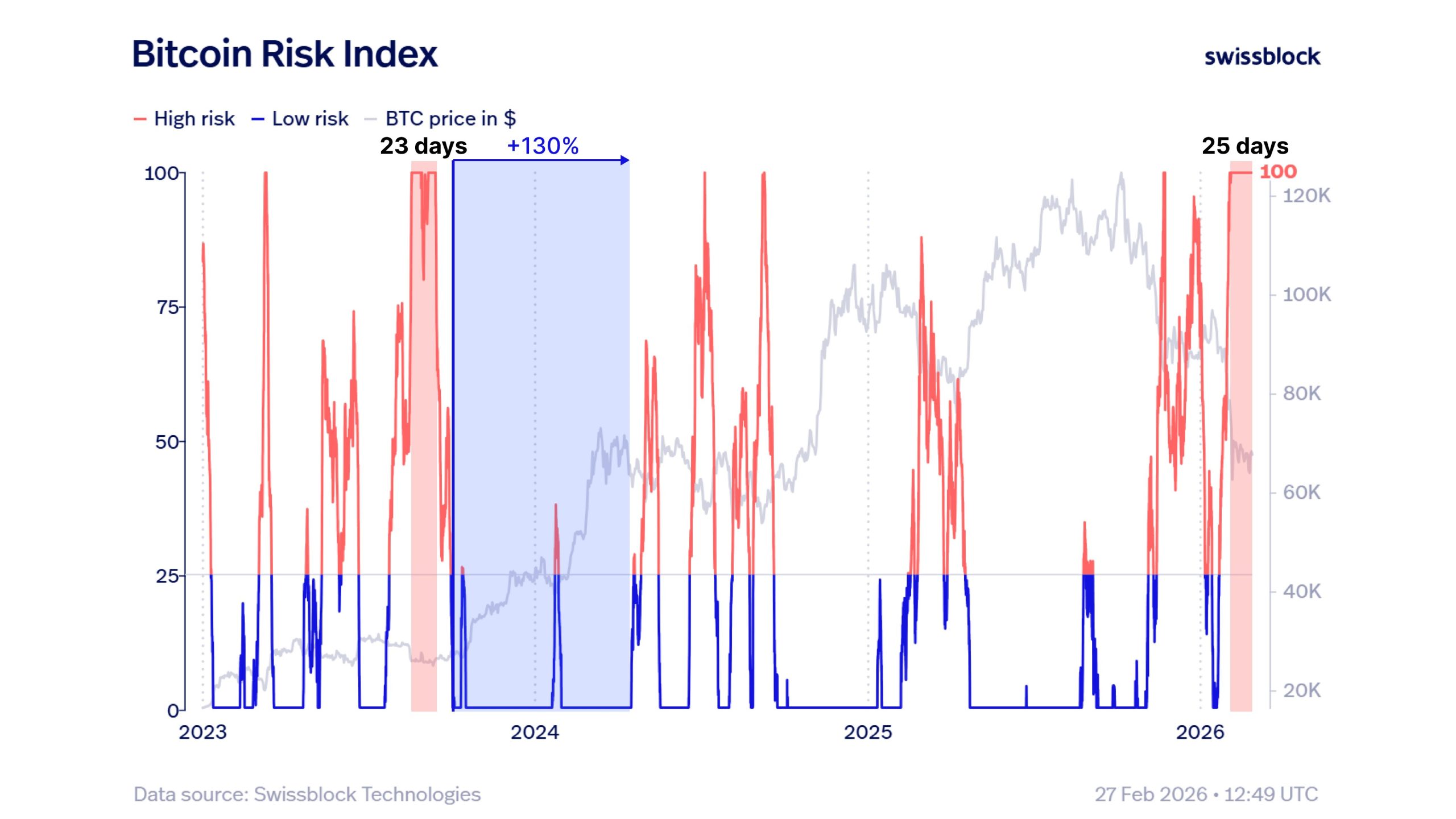
A Bitcoin (BTC) bottom signal that appeared in 2023, ahead of a 130% rally in 2024, has flashed again this week, raising the possibility that the price is nearing another bullish inflection point.
At the same time, the broader data of liquidity, exchange-traded fund (ETF) flows, and macroeconomic data changes the environment from two years ago, suggesting that the path forward may not mirror the previous cycle’s.
BTC bottom trigger appears without strong follow-through
Data aggregator Swissblock noted that Bitcoin has now logged 25 consecutive days in its “extreme high risk” zone, the longest stretch on record and above the 23-day peak seen in 2023. Historically, an extended stay in this zone has aligned with late-stage drawdowns or a bottom signal.

MN Capital founder Michaël van de Poppe also pointed to the BTC versus supply in the profit/loss chart, which shows the price interacting with levels that previously marked bottoming phases. In 2023, the shift from high risk to low risk coincided with the start of a powerful bullish expansion.

Trader positioning is not in sync with an uptrend. RugaResearch noted that 30-day apparent demand continues to flip between positive and negative. While the selling pressure has faded, sustained buying demand has not maintained its dominance.
Related: Bitcoin to $30K? Analysts debate when and at what price BTC will bottom
Deeper Bitcoin drawdowns take time
Macroeconomic newsletter Ecoinometrics highlighted that a BTC decline of this magnitude rarely resolves quickly. Excluding the 2020 COVID rally, which was supported by aggressive monetary policy intervention, the recoveries from 50% drawdowns developed over an extended period.

The ETF flow data reinforces the cautious tone. Since August, cumulative inflows into gold ETFs have surpassed spot Bitcoin ETF flows on a 90-day rolling basis. Over the same period, Bitcoin funds have posted negative flows on a 90-day average rolling basis, currently sitting at –$2.06 billion.
The inflation trends added further context. Ecoinometrics noted that the headline Personal Consumption Expenditures (PCE) sits near 2.9% year-on-year, with core near 3.0% and core services above 3.4%. The Federal Reserve targets PCE, and the recent trend has not shown a clear downward shift. Without easing expectations, the liquidity expansion looks limited.
The price levels frame the debate. CMCC Crest Managing Partner Willy Woo said that any short-term relief rally to $70,000 to $80,000 is likely to be met with another round of selling pressure, since “the broader regime is heavily bearish with both spot and futures liquidity deteriorating”.

Woo said that the $45,000 level aligns with the prior bear market. Below that, $30,000 and $16,000 mark the historical support, which is tied to longer-term trend preservation.
Related: Crypto taxes updated, BTC stuck below $70K: Month in charts
This article does not contain investment advice or recommendations. Every investment and trading move involves risk, and readers should conduct their own research when making a decision. While we strive to provide accurate and timely information, Cointelegraph does not guarantee the accuracy, completeness, or reliability of any information in this article. This article may contain forward-looking statements that are subject to risks and uncertainties. Cointelegraph will not be liable for any loss or damage arising from your reliance on this information.

Anthropic CEO Slams Pentagon Decision As ‘Unprecedented’

Brit Awards 2026: What Did Jack Whitehall Actually Say During His Censored Political Joke?
Twente vs Feyenoord Prediction and Betting Tips


-

 Politics7 days ago
Baftas 2026: Awards Nominations, Presenters And Performers
-

 Sports5 days ago
Women’s college basketball rankings: Iowa reenters top 10, Auriemma makes history
-

 Fashion1 day ago
Weekend Open Thread: Iris Top
-

 Business4 days ago
True Citrus debuts functional drink mix collection
-

 Politics5 days ago
Nick Reiner Enters Plea In Deaths Of Parents Rob And Michele
-

 Politics2 days ago
ITV enters Gaza with IDF amid ongoing genocide
-

 Crypto World5 days ago
XRP price enters “dead zone” as Binance leverage hits lows
-
Sports17 hours ago
The Vikings Need a Duck
-

 Business6 days ago
Mattel’s American Girl brand turns 40, dolls enter a new era
-

 Tech4 days ago
Unsurprisingly, Apple's board gets what it wants in 2026 shareholder meeting
-
 NewsBeat5 hours ago
Dubai flights cancelled as Brit told airspace closed ’10 minutes after boarding’
-

 Business6 days ago
Law enforcement kills armed man seeking to enter Trump’s Mar-a-Lago resort, officials say
-
 NewsBeat9 hours ago
The empty pub on busy Cambridge road that has been boarded up for years
-
 NewsBeat3 days ago
Manchester Central Mosque issues statement as it imposes new measures ‘with immediate effect’ after armed men enter
-

 NewsBeat3 days ago
Cuba says its forces have killed four on US-registered speedboat | World News
-
 NewsBeat5 days ago
‘Hourly’ method from gastroenterologist ‘helps reduce air travel bloating’
-

 Tech6 days ago
Anthropic-Backed Group Enters NY-12 AI PAC Fight
-

 NewsBeat6 days ago
Armed man killed after entering secure perimeter of Mar-a-Lago, Secret Service says
-

 Politics6 days ago
Maine has a long track record of electing moderates. Enter Graham Platner.
-
 NewsBeat4 days ago
Police latest as search for missing woman enters day nine