
Crypto World
Ethereum Price Prediction: Exchange Supply Lowest Since 2016


Ethereum price is holding just above $2,100, dropping by 2% in 24 hours, and the supply picture underneath that price action and prediction is becoming harder to ignore. Exchange reserves have collapsed to their lowest level since 2016, staking absorption is accelerating, and analysts are split between a $7,500 end-year target and a weekly chart pattern that could cut ETH in half.
Right now, we wait because the next 72 hours around the $2,160–$2,180 neckline may determine which scenario plays out first.
Is the ETH supply crunch accelerating? — Declan Barrett
Data shows tightening liquid supply via net outflows, rising staking, and falling exchange reserves.
This contraction could signal a major shift.
Options flow anticipated.
Strategy: Scale in.  pic.twitter.com/QFUpjcKBc6
 (@declan_bar_styl) March 26, 2026
Data confirms ETH exchange supply has hit multi-year lows, with Binance-specific balances hovering near 3.3 million ETH, levels last seen in December 2020. Approximately 38.1 million ETH sits locked in staking, 33.1% of the circulating supply, a record, with the validator entry queue holding 2,876,752 ETH against an exit queue of just 40,504 ETH.
Whether that structural argument translates into near-term price strength depends entirely on whether ETH can hold and reclaim a critical technical zone that bulls have been defending since earlier this month.
Discover: The best crypto to diversify your portfolio with
Ethereum Price Prediction: Will ETH USD Reclaim $2,400 Before the Weekly Head-and-Shoulders Takes Over?
ETH is down by more than 40% of its all-time high, but a confirmed break above the $2,400 zone opens a measured move toward $2,600, with Changelly projecting $2,401 as the March peak and $2,241 by March 28.
The Fear & Greed Index sits at 32 fear, with only a little of technical indicators flashing bullish, the kind of sentiment reading that historically precedes either capitulation or a sharp short-squeeze reversal.
The RSI reads neutral at 49-53 suggests trend strength is building but not yet committed. Key supports stack at $2,050, then $1,830 and $1,790. Lose $1,790 and the weekly head-and-shoulders pattern, which targets $1,320, becomes the dominant technical narrative. Bears will maintain control until a convincing $3,000 reclaim materializes, per multiple analysts tracking the setup.

Standard Chartered’s $7,500 end-2026 call remains the bull case, but that view requires Federal Reserve rate cuts, ETF inflow recovery, and sustained Layer 2 TVL growth to all line up simultaneously.
Discover: The best pre-launch token sales
LiquidChain Targets Early-Mover Upside as Ethereum Tests Key Levels
ETH’s structural supply squeeze tells a compelling long-term story, but right now, the near-term upside is capped by heavy resistance and a macro environment still priced for fear. Traders who want asymmetric exposure to the same liquidity fragmentation problem that’s been pressuring Ethereum’s growth narrative are looking one layer deeper.
A new layer emerges. Only a few see it first. — LiquidChain (@getliquidchain) March 24, 2026
The future is LiquidChain  ⟁https://t.co/vqvBcdSj94 pic.twitter.com/R7ZeZ0NPGl
LiquidChain ($LIQUID) is a Layer 3 infrastructure project positioning itself as the cross-chain liquidity layer, fusing Bitcoin, Ethereum, and Solana liquidity into a single execution environment. The architecture centers on four components: a Unified Liquidity Layer, Single-Step Execution, Verifiable Settlement, and a Deploy-Once Architecture that lets developers access all three ecosystems without redeploying contracts.
The presale is currently priced at $0.014 with more than $600K raised to date, and a huge 1700% APY in staking rewards. Research LiquidChain here before the current round closes.
This article is not financial advice. Cryptocurrency investments are volatile. Always do your own research before committing capital.
The post Ethereum Price Prediction: Exchange Supply Lowest Since 2016 appeared first on Cryptonews.

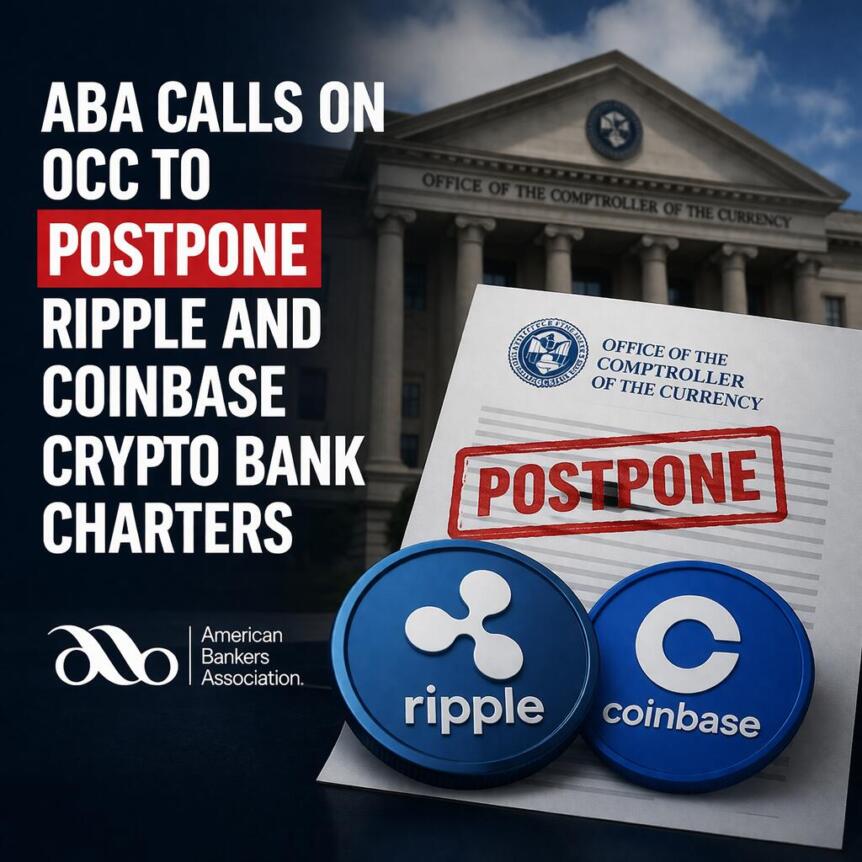
Fear of Regulatory Loopholes
The industry association argued that regulators ought to hold off until Congress finishes crypto banking legislation. It claimed that granting charters without complete regulations could pose a threat to the financial system. In addition, the group urged the OCC not to use conventional timelines on crypto companies. The ABA also expressed concern about the application of the GENIUS Act in the charter process. It observed that a number of agencies are yet to achieve rulemaking pursuant to the law. The group also indicated that implementing it in parts would complicate regulation of crypto firms.
Ripple is also one of the important applicants that will be impacted by the request. The banking group also criticised the OCC, as the firm was conditionally approved by the OCC earlier. Thus, full approval can now be delayed.Other companies seeking approval include BitGo, Paxos and Laser Digital of Nomura. There are also new entrants in the process who face increased scrutiny. This trend presents increasing interest towards regulated banking status.
Lawmakers too, such as Elizabeth Warren, have entered the debate. Previously, she demanded a stop on the same applications associated with crypto companies. Additionally, the topic has now been incorporated into broader debates about financial oversight.The ABA highlighted the necessity of more powerful oversight mechanisms prior to approvals. It raised issues of the risk of insolvency and how the regulators could act. Therefore, the group demanded a slow and cautious stance.
Industry Practice Claims
The association also cited questions around the way crypto companies make returns. It claimed that there are companies that can evade the restrictions by using related platforms. It also noted that more explicit rules are needed to resolve such practices. The petition is also indicative of increased tensions between traditional banks and crypto companies that seek to gain regulatory acceptance. It also underscores the persistent ambiguity with lawmakers still working on regulations regarding crypto bank activities.


- Katana (KAT) gains momentum from Upbit and Bithumb listings with KRW pairs.
- Katana Perps launch adds derivatives and deeper market utility.
- Traders should watch the support at $0.014 and the immediate resistance at $0.016.
Katana (KAT), the native token of the Katana Network, has seen an extraordinary 53% price surge today, largely fueled by major cryptocurrency exchange listings.

Upbit and Bithumb, two of South Korea’s largest cryptocurrency exchanges, have added KAT, opening up direct KRW trading pairs for the token.
These listings have given Katana greater visibility in a market known for active retail participation.
South Korean investors often respond quickly to new token listings, and the addition of KRW trading pairs makes it easy for traders to engage with KAT.
This kind of exposure can amplify buying pressure and lead to sharp price moves, especially when combined with already strong market momentum.
The recent surge has also coincided with extremely high trading volumes.
KAT’s daily turnover has been several times its earlier average, signalling strong interest from traders and speculators.
Sustained volume is crucial for maintaining momentum. If volume remains high, KAT is likely to continue testing local highs.
Conversely, a sudden drop in trading activity could lead to sharp pullbacks.
Adding to the bullish narrative, Katana recently acquired IDEX to launch a native perpetual futures platform called Katana Perps.
By integrating derivatives trading directly into the ecosystem, Katana can capture more trading activity within its own network.
This move also brings professional liquidity providers and market makers into the token’s orbit, creating a more stable and deeper market.
Technical outlook
Overall, KAT is in a high-momentum phase driven by both exchange listings and real product development.
From a technical analysis perspective, KAT is currently hovering near its recent local high, and the immediate support level to watch is $0.014.
Holding above this level would suggest that bullish momentum remains intact and could pave the way for a retest of the local high around $0.016.
But if this support fails, traders should anticipate a move toward the next key support near $0.012.
Volume remains a crucial indicator in this environment.
Sustained daily volume above $100 million would confirm strong trader interest and reduce the likelihood of a sudden correction.
On the other hand, if volume drops below $50 million, it could signal that momentum is fading and that a pullback may be imminent.
The combination of exchange listings, high trading volumes, and a new derivatives platform provides KAT with both momentum and structural growth potential.
However, traders should be aware that these factors create opportunities but also increase the risk of sharp swings if interest wanes.
Bitcoin Slips as Geopolitical Signals Shift
- Bitcoin drops 1% as Trump signals faster end to US-Iran conflict timeline
- BTC trades near $70,700 while volatility rises amid geopolitical shifts
- Oil prices climb, offsetting crypto gains as tensions remain unresolved
- Iran rejects ceasefire terms, adding pressure to global financial markets
- Crypto derivatives show weakening momentum ahead of major options expiry
Bitcoin declined 1% during early Thursday trading, reflecting uncertainty from evolving geopolitical developments. The asset traded at $70,712, showing limited momentum within a narrow daily range. Meanwhile, traders reacted to reports of a potential shift in US foreign policy direction.
The US administration signaled an intention to shorten the ongoing conflict with Iran. This stance introduced mixed expectations across financial markets and increased short-term volatility. As a result, Bitcoin failed to sustain earlier gains despite recent bullish projections.
At the same time, trading volumes remained subdued, indicating weaker participation in the current market phase. Market activity reflected hesitation, especially as external risks continued to dominate sentiment. Consequently, Bitcoin moved sideways with a slight downward bias.
Oil Prices Rise as Conflict Dynamics Evolve
Oil prices moved higher as geopolitical tensions continued to influence supply expectations. The upward movement erased some gains previously seen in risk assets like cryptocurrencies. This shift highlighted the inverse reaction between commodities and digital assets.
Reports indicated that the US aimed to conclude the conflict within a defined timeframe. However, Iran rejected proposed ceasefire conditions and introduced its own demands. These developments prolonged uncertainty and supported oil price strength.
Additionally, the proposed conditions included sanctions removal and expanded regional control measures. Such demands complicated negotiations and extended the timeline for resolution. Therefore, energy markets maintained upward pressure amid unresolved tensions.
Derivatives Market Signals Weakening Momentum
Bitcoin derivatives data showed declining open interest over recent hours, signaling reduced market conviction. This drop aligned with broader uncertainty across financial markets. As a result, traders adjusted positions ahead of key expiry events.
Options data indicated that over $16 billion in Bitcoin and Ethereum contracts approach expiration. This large volume created expectations of heightened volatility in the near term. Consequently, short-term price movements remained sensitive to external triggers.
Meanwhile, projections from institutional analysts suggested a potential long-term upside for Bitcoin. However, current market behavior reflected caution due to geopolitical risks. Therefore, near-term sentiment remained mixed despite optimistic forecasts.
🚨 BITCOIN HAS JUST DROPPED BELOW $70,000
INSTITUTIONS HAVE STARTED SELLING, AND MOMENTUM IS FADING.
IF BITCOIN LOSES THE $69,000-$70,000 RANGE, THE DOWNTREND WILL SHARPLY ACCELERATE. 📉 pic.twitter.com/lWrwFCt3tC
— That Martini Guy ₿ (@MartiniGuyYT) March 26, 2026
Background and Broader Context
The US administration aimed to balance foreign policy priorities with domestic agendas. Reports indicated a focus on upcoming elections and legislative initiatives. This shift influenced decisions related to the conflict timeline.
At the same time, global markets responded quickly to any signals of escalation or de-escalation. Digital assets, commodities, and equities showed increased correlation during this period. As a result, geopolitical developments continued to shape market direction.
Overall, the situation remained fluid, with negotiations still uncertain and conditions unresolved. Market participants reacted to each update, causing frequent price adjustments. Consequently, volatility persisted across both traditional and digital asset classes.
Bitcoin (BTC) faces a new macro test as markets increasingly bet on the US entering recession in 2026.
Key points:
-
Bitcoin could face a new challenge in the form of its first recession after the COVID-19 crash.
-
US recession odds surge as BlackRock CEO Larry Fink warns over oil prices.
-
Bitcoin’s high correlation with “extremely oversold” stocks continues.
Moody’s puts 12-month recession odds near 50%
Data highlighted this week by Axel Adler Jr., a contributor to onchain analytics platform CryptoQuant, shows recession odds nearing 50%.
Bitcoin’s next bull run could come courtesy of a US economic downturn, and market participants see the latter as more and more likely this year.
“Moody’s Analytics raised the probability of a U.S. recession over the next 12 months to 48.6%, while Goldman Sachs increased its estimate to 30%,” Adler noted on X.
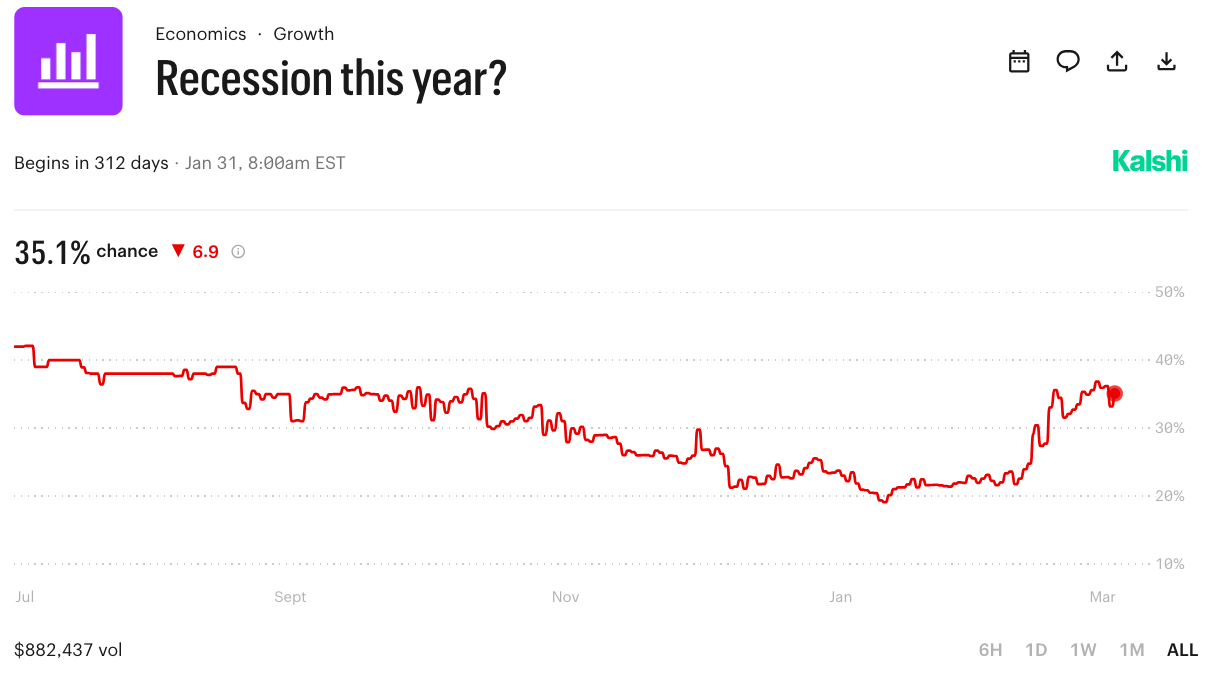
Prediction traders agree, with US recession odds reaching 36% on Kalshi — the highest reading since September 2025.

The US-Iran war and its impact on global oil prices lie at the heart of the surge. Recent claims by both sides about dialogue to end hostilities and fully reopen the Strait of Hormuz have caused confusion throughout risk-asset markets.
“That’s keeping upside pressure on oil prices, which is recently crossing a key threshold historically associated with recession,” trading resource Mosaic Asset Company commented in the latest edition of its regular newsletter, “The Market Mosaic.”
Mosaic said that oil jumping 50% above its long-term trend, a phenomenon now playing out, “has been seen before or during nearly every recession over the past 50 years.”
“Oil prices are directly correlated to headline inflation, where a $10 increase per barrel can push inflation higher by 0.20% or more,” it added.

Major players echo those concerns, including Larry Fink, CEO of the world’s largest asset manager, BlackRock.
“We’ll have a global recession,” he told the BBC this week about the consequences of Iran staying a “threat” to the global economy, even if the war itself ended.
Bitcoin stays tied to “extremely oversold” stocks
Bitcoin has had little experience of recession in its lifespan of less than 20 years.
Related: Gold slides as traders eye sub-$50K BTC: Five things to know in Bitcoin this week
In 2020, a US recession from February to April preceded a period of major BTC price upside after BTC/USD initially joined risk assets in a global crash in March.

As Cointelegraph reported, Bitcoin’s correlation to US stocks has become stronger this year, potentially increasing the potential for a relief bounce.
“While the uncertainty over inflation and the outlook for monetary are broadly weighing across the market, conditions are very favorable to see at least a short-term rally unfold,” Mosaic commented.
“Various measures of investor sentiment and positioning are pointing to excessive bearishness in the market while breadth metrics are extending to extremely oversold levels.”

This article does not contain investment advice or recommendations. Every investment and trading move involves risk, and readers should conduct their own research when making a decision. While we strive to provide accurate and timely information, Cointelegraph does not guarantee the accuracy, completeness, or reliability of any information in this article. This article may contain forward-looking statements that are subject to risks and uncertainties. Cointelegraph will not be liable for any loss or damage arising from your reliance on this information.
Crypto World
Altcoins lead losses as bitcoin slips and derivatives signal bearish turn: Crypto Markets Today


The crypto market is reeling from an overnight selloff, with bitcoin trading lower at $69,400 having lost 2.6% since midnight UTC and ether (ETH) heading back toward $2,000 after tumbling by 4.1%.
The declines come alongside a sharp drop in U.S. equities and precious metals. Nasdaq 100 futures are down by around 1% while gold has lost 1.8%.
Oil, meanwhile, spiked back above $100 per barrel as supposed peace talks between the U.S. and Iran stalled.
The altcoin market was the worst hit, with the CoinDesk Computing Select Index (CPUS) and the CoinDesk DeFi Select Index (DFX) tumbling by 4.3% and 3.9%, respectively, during the Asia session.
Zooming out, bitcoin and the broader crypto market are still locked in a price range that has persisted since early February despite multiple attempts to break out to the upside.
Derivatives positioning
- Deadlock in the Iran-U.S. negotiations seems to have triggered renewed risk aversion, leading to capital outflows from crypto derivatives. The cumulative crypto futures open interest (OI) has declined by 3.5% to $108.30 billion.
- OI in PAXG fell nearly 11% in 24 hours, with the gold price falling 1.8% to $4,423 an ounce. DOGE, ZEC and TAO are other major OI losers.
- Some traders may have shorted BTC futures on major exchanges as prices dropped below $70,000 during European hours. That’s evident from the slight uptick in OI in major dollar- and USDT-denominated exchanges to 232K BTC from 229K BTC.
- ETH, BNB, XPR, SOL, TRX and DOGE are seeing negative fund rates, a sign of increased bias for bearish, short positions.
- Meanwhile, CC, TRX and BCH stand out with positive cumulative volume deltas pointing to positive positioning while other majors including BTC see seller dominance.
- In the options market, some traders are chasing downside protection in ether by purchasing risk reversals, a position that involves selling calls to fund put option buys, TDX Strategies said in a market note.
- On Deribit, BTC and ETH puts remain more expensive than calls across all tenors. At the front end, ether puts are pricier than BTC’s, a sign traders are bracing for a bigger downside in ether in the short-term.
Token talk
- The crypto market is red across the board on Thursday, but some tokens fared worse than others; AI-focused FET is down by 7.7% while ETHFI and RENDER have given back much of the past week’s gains, dropping by 6.3% and 5.9%, respectively.
- The “Altcoin Season” index is still at 48/100, suggesting a bullish recovery could be on the cards if the market can find support and consolidate.
- Around half a dozen tokens out of the top 100 remain in the black over the past 24 hours, these include ethena (ENA), up 2.2%, and layer-1 network tokens XDC, NIGHT and TRX, all between 1% and 2% higher.
- Overall, worryingly low liquidity that has failed to recover since the tail end of 2025, coupled with the fickle nature of crypto retail traders, could create the perfect storm across the altcoin market, producing an exaggerated downturn.
Crypto World
Pepeto Price Prediction Targets 200x as Pepe Coin Made Millionaires With Zero Products While TAO and APT Struggle
Pepe coin turned early buyers into millionaires. A trader who put $250 into Pepe at the 2023 launch walked away with $1.8 million when the token hit $11 billion on nothing but meme energy and a 420 trillion token supply. Another wallet turned $27 into $2.3 million with zero products behind it.
The pepeto price prediction starts with those numbers because the same cofounder is now behind Pepeto, and this time there is a working exchange, a SolidProof audit, and more than $8 million raised with the Binance listing approaching.
Pepeto Price Prediction Gets Context as Trump Iran Threats Drop BTC to $68K and Altcoins Bleed
President Trump threatened to destroy Iran’s power plants if the Strait of Hormuz stayed closed, Bitcoin dropped to $68,000, and most altcoins fell harder, according to CoinDesk.
Trump has since postponed the strike and BTC recovered above $70,000, but the Fear and Greed Index hit 8, according to CoinMarketCap.
The Pepeto forecast does not depend on the market recovering because the returns come from the listing, not from sentiment calming down.
Crypto Picks for 2026: Where the Pepeto Price Prediction Meets Pepe Coin History and Real Exchange Utility
Pepeto
Pepe coin reached a market cap of $11 billion with the same 420 trillion supply and zero products. Matching that price from the current presale entry is over 150x, and Pepeto has a full exchange that Pepe never had. That is the floor of the Pepeto outlook, not the ceiling, because more utility logically reaches more than what zero utility reached.
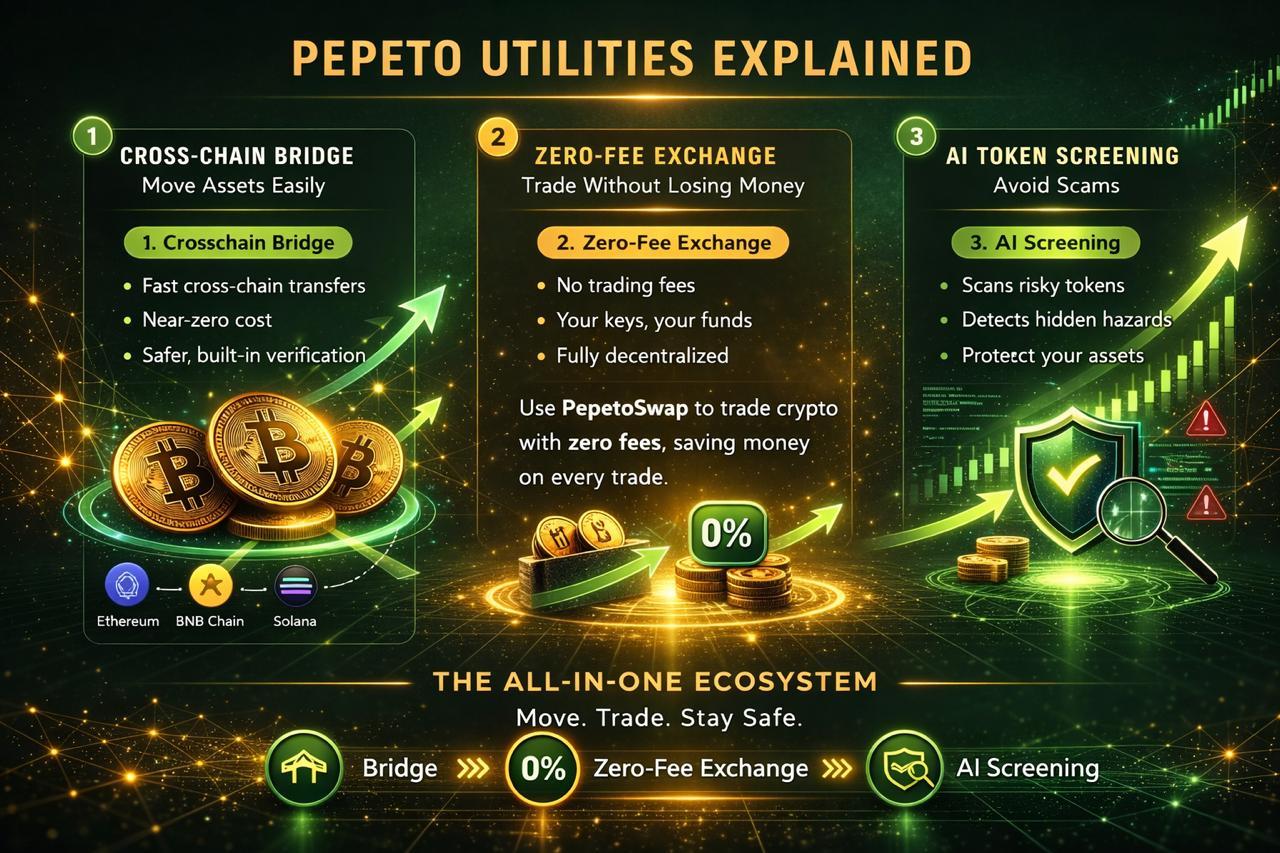
Pepeto was built for retail investors who came to crypto because they do not want to wait for a stock portfolio to double over years. The risk scorer checks every contract for hidden drains and honeypot functions before your money goes near them, and explains what it found so you enter positions with real information instead of trust.
PepetoSwap runs zero fee trades so your capital keeps full value, and the cross chain bridge moves tokens at zero cost. A former Binance expert is on the dev team, the SolidProof audit cleared every contract, and 194% APY staking compounds in wallets that entered early while the stages fill faster each week.
Pepeto is at $0.000000186 with analysts projecting 200x from the current entry once the Binance listing opens public trading. The Pepeto forecast is built on math that anyone can check: same supply as Pepe, same cofounder, but this time there is an exchange making the price floor real instead of relying on hype alone.
With the listing days away and the gap between presale pricing and what the exchange is actually worth closing fast, waiting any longer risks missing the most favorable entry the Pepeto outlook will ever offer.
TAO
Bittensor trades near $332 as of March 24 after climbing 66% from March lows as Grayscale opened a private TAO trust, according to CoinMarketCap.
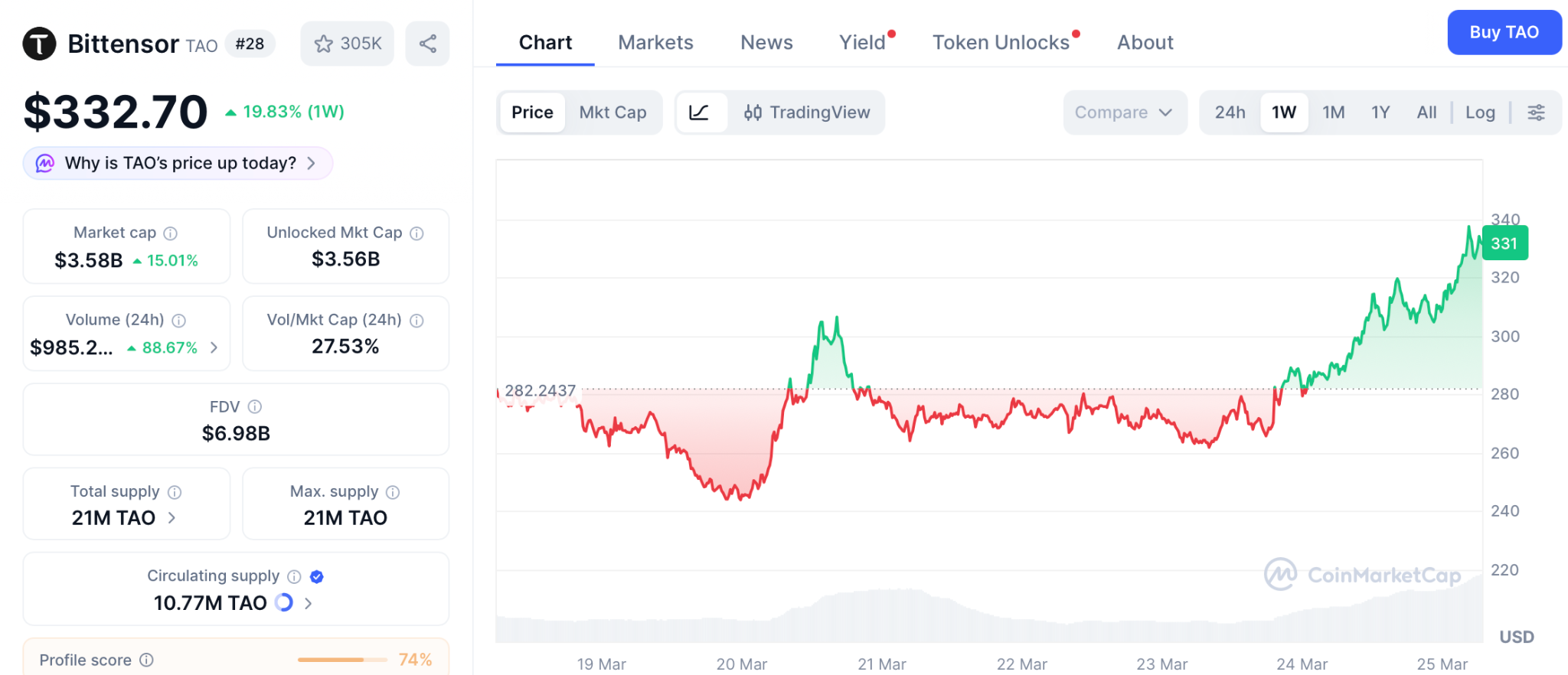
The $302 to $340 zone has rejected the price multiple times. Break $350 and $400 opens, fail and $240 comes first. Strong AI narrative, but the Pepeto forecast offers more room from one listing at a fraction of the price.
APT
Aptos trades near $1.08 as of March 24 after climbing 12% on a 180% volume jump, according to CoinMarketCap. Transaction throughput and active addresses trend lower despite the price rise, questioning whether the rally lasts.
Break $1.08 and $1.25 opens, reject here and $0.95 comes first. A speculative bounce, not the return that changes how your portfolio looks the way the Pepeto forecast delivers from one listing.
Pepeto Price Prediction Confirms That the Returns That Reshape Portfolios Never Come From Large Cap Recovery
The Pepeto outlook is not built on hope. It is built on the fact that Pepe reached $11 billion with nothing and the same cofounder built Pepeto with a full exchange this time. TAO is testing $300 and APT bounced 12%, but the biggest catalysts for both are priced in.
The returns that reshape a portfolio never come from large cap recovery, they come from being early in what the market discovers after the listing. Meme energy from the Pepe cofounder plus exchange utility plus a Binance listing at the same time is the rarest setup crypto produces.
Being one stage earlier is the difference that lasts a lifetime, and the pepeto price prediction needs only the listing. The Pepeto official website is where that entry is still open.
Pepe made millionaires with zero products. The pepeto price prediction has more behind it. Visit Pepeto before the listing closes the entry.
Click To Visit Pepeto Website To Enter The Presale

FAQ:
What is the pepeto price prediction analysts are projecting as the listing approaches?
Analysts project 200x from the current entry based on matching Pepe coin’s market cap with more utility behind it. The Pepeto official website is where entries are secured before listing day.
What does the pepeto price prediction look like compared to TAO and APT?
The pepeto price prediction offers more room because the token sits at presale pricing while TAO and APT already priced in their biggest catalysts.
What drives the pepeto price prediction beyond the presale?
The same cofounder who built Pepe to $11 billion is behind a working exchange with verified contracts, zero fee trading, and the Binance listing days away.
Disclaimer: This is a Press Release provided by a third party who is responsible for the content. Please conduct your own research before taking any action based on the content.

Crypto World
Porsche SE (PSHG) Reports 9% Profit Decline as Volkswagen Struggles Weigh on 2025 Results

Key Highlights
- Porsche SE’s adjusted after-tax earnings totaled €2.9 billion in 2025, representing a ~9% decline versus the previous year
- Performance suffered due to operational challenges and elevated expenses at both Volkswagen and Porsche AG
- Net debt decreased modestly to €5.1 billion compared to €5.2 billion previously
- Portfolio investments delivered €193 million in earnings, with significant contributions from Quantum Systems and Celestial AI
- Management committed €100 million to a newly established European defence technology investment vehicle
Shares of Porsche SE declined 2.7% during morning trading Thursday, trailing behind broader equity benchmarks.
Porsche Automobil Holding SE, PAH3.DE
The Stuttgart-based holding company posted adjusted after-tax profit of €2.9 billion for the full 2025 fiscal year, marking approximately a 9% contraction compared to the year-ago period. The disappointing performance stems primarily from operational difficulties throughout the Volkswagen Group, where Porsche SE maintains a 31.9% equity stake along with 53.3% of voting control.
Volkswagen continues to navigate significant headwinds including tariff pressures, intensifying competitive threats from Chinese automotive manufacturers, and substantial capital requirements associated with its electric vehicle transformation strategy. Making matters worse, Porsche AG—the premium sports car manufacturer in which Porsche SE holds a 12.5% interest—paused its electric vehicle expansion program in September, triggering additional financial burdens.
The holding company’s net debt position improved marginally, declining to €5.1 billion from €5.2 billion year-over-year—representing only incremental progress against a substantial debt burden.
Venture Portfolio Delivers Positive Contribution
Amid the challenges in core automotive holdings, Porsche SE found some relief from its venture investment portfolio. These smaller strategic investments generated €193 million in profit contributions, led by a €114 million gain from drone manufacturer Quantum Systems and a €47 million contribution from AI chip developer Celestial AI.
The aggregate carrying value of the portfolio investments has roughly doubled to approximately €535 million since the close of fiscal 2024—a metric management emphasized in its results presentation.
Chairman Hans Dieter Poetsch characterized the investment portfolio as “a key strategic asset” for the organization.
Strategic Pivot Toward Defence Technology
Reflecting broader shifts in German industrial strategy, Porsche SE disclosed a €100 million capital commitment to a new defence-focused investment fund managed by DTCP.
The vehicle will deploy capital into European technology companies developing solutions across cybersecurity, artificial intelligence, and related defence applications. Institutional interest in defence and security sectors has accelerated substantially as geopolitical tensions stemming from conflicts in Ukraine and the Middle East have elevated the strategic importance of these industries.
Poetsch reaffirmed the company’s long-term commitment to Volkswagen, highlighting €1 billion in cost reductions executed across the group during the past year.
“We expect the management of both Volkswagen AG and Porsche AG to view the challenging situation as an opportunity to implement the strategic adjustments,” Poetsch stated.
Looking to fiscal 2026, Porsche SE provided guidance calling for adjusted group profit after tax in the range of €1.5 billion to €3.5 billion—an unusually broad forecast range that underscores the considerable uncertainty surrounding its primary automotive investments. Net debt is anticipated to finish between €4.7 billion and €5.2 billion.
The substantial variance in forward guidance clearly illustrates management’s limited visibility into near-term operating conditions.
Porsche SE stock traded down 2.99% at publication time.

TLDR:
- The Solana Foundation reports 15 million on-chain agent payments already processed on its network
- Stablecoins are emerging as the default payment rail for AI agents buying computational resources.
- Vibhu Norby says 95 to 99% of future crypto transactions will originate directly from AI agents.
- Solana developers are building machine-readable skill files and AI-first platforms for agents.
Solana is positioning itself as core infrastructure for an emerging “agentic” internet. The Solana Foundation reports the network has already processed 15 million on-chain agent payments.
Stablecoins are emerging as the default payment rail for AI-driven compute and services. Vibhu Norby, the foundation’s chief product officer, shared these updates at the Digital Asset Summit in New York on March 25, 2026. This shift, he said, could change how the internet is monetized at its core.
Solana Emerges as the Default Payment Layer for AI Agents
The Solana Foundation is making a strong case for the network’s role in machine-to-machine commerce. Norby confirmed the network has already “processed 15 million payments onchain from agents,” pointing to real and measurable activity.
He added that “the programmatic aspect of crypto payments is what is making it interesting for agents.” Stablecoins, he noted, are “going to be the default thing that agents use to pay for any computational resource.”
Traditional payment systems are not built to handle sub-cent, pay-per-use transactions at scale. Norby pointed to this gap directly, stating that agentic payments support low-cost, high-frequency activity that “traditional rails cannot handle.”
Solana’s performance-focused design addresses this need efficiently. This gives the network a clear edge as AI-driven commerce continues to grow across industries.
Norby described AI agents as logical and performance-driven systems that prioritize results over loyalty. “Agents are cold, calculated machines… they don’t subscribe to crypto religiosity,” he told panelists at the summit.
He went further, noting that “if you ask an agent what’s the best way to pay for something with crypto, most of the time, Solana is showing up at the top.” This positions Solana not by preference, but by performance.
The 15 million on-chain agent payments already processed reflect steady, measurable real-world activity on the network. This figure confirms that machine-to-machine commerce is gaining ground on Solana.
As AI systems scale globally, transaction volumes from agents are expected to increase substantially over time.
Agentic Payments Signal a Broader Shift in Internet Monetization
Beyond payments, the Solana Foundation is watching a wider platform transformation take shape across the tech sector.
Norby stated that “AI is not really a vertical. It’s a platform shift… affecting everything across every industry, including crypto.”
He argued that “agentic payments are probably going to change the entire way that the internet is monetized.” This framing sets the stage for entirely new internet business models built around autonomous agents.
Developers on Solana are already building tools designed directly for AI systems to use. Norby noted that “what agents like is APIs and documentation and skills,” pointing to machine-readable skill files and AI-first developer platforms.
The aim is to make Solana more accessible for agents through clean, structured tooling. This active development effort reflects a deliberate shift in how the ecosystem is being built.
Advances in AI are also removing long-standing technical barriers for developers working across ecosystems. Machines and developers can now build cross-platform tools more easily than before.
This opens room for more AI-native applications and cross-chain solutions to take hold on Solana. The result is a more open and developer-friendly network overall.
Looking ahead, Norby expects AI agents to become the standard interface through which people interact with crypto.
He projected that “the default way people will interact with crypto is going to be through their agent… 95 to 99% of all transactions… will be coming from LLMs.” Agentic payments, in his assessment, are set to transform the entire way the internet operates financially.


- Ondo price hovered around $0.26 on Thursday.
- A partnership with Franklin Templeton brings $1.7 trillion AUM ETFs on-chain.
- The real-world assets market continues to attract institutional adoption.
The Ondo token traded higher after Ondo Finance announced a key partnership with Franklin Templeton, the global asset manager overseeing $1.7 trillion in assets under management (AUM).
According to the Ondo Finance team, this collaboration is about tokenizing Franklin Templeton’s ETFs to bolster adoption via on-chain access.
The move comes as traditional investment products get increased attention through real-world assets (RWA).
Franklin Templeton’s tokenized ETFs now live on Ondo Global Markets, including the Growth ETF, Income Equity focus ETF and High Yield Corporate ETF.
This launch sees Ondo, a leading RWA protocol, continue to expand its ecosystem. It’s attracting institutional interest amid rising demand for tokenized securities.
“Franklin is partnering with Ondo to have all their ETFs be tokenized so people on-chain can enjoy the awesomeness of cheap beta,” Bloomberg senior ETF analyst Eric Balchunas noted via X.
“Like I’ve been saying, tokenization isn’t a threat to ETFs, on the contrary, it’s a distribution mechanism.”
Ondo, Chainlink and Avalanche are some of the coins riding high on the tokenized assets narrative.
Adoption trends across the globe, with major banks and other top financial institutions keen on a piece of the cake, mean notable long-term gains for ONDO among others.
“Financial assets are becoming software. And as more assets move into the digital wallet-based ecosystem, there’s endless potential for their on-chain utility,” Franklin Templeton’s Robert Crossley said at a tokenization summit in London.
Ondo price analysis
Ondo (ONDO) price reacted bullishly to the announcement, climbing to highs of $0.273.
Despite the optimism around tokenization and real-world assets, RWA ecosystem tokens mirror the broader market in terms of recent performance.
Ondo has traded lower since hitting resistance around $2.00 in late 2024.
The downtrend accelerated below $1.00 in September 2025, with Ondo hitting multi-year lows as cryptocurrencies fell in February this year.
From a technical perspective, key support holds at $0.24 (recent swing low) and $0.21. The latter provides a solid reload zone amid broader market volatility.
Meanwhile, resistance looms at $0.28, with a breakout potentially targeting $0.50.
If Bitcoin maintains stability above $70,000, the next leg up could see ONDO test the $1 mark. Hurdles above this psychological level would be around $1.20 and $1.50.
However, macroeconomic risks like US Federal Reserve rate decisions could combine with geopolitical shocks to cap gains.
BTC is eyeing the $75,000 mark, but an escalation in the Iran war could plunge prices to lows of $50,000.

Cardano just dropped to $0.257, down 5%, as one of the worst performers today, even after a landmark regulatory ruling just hit the tape that is pushing its price prediction to bullish. The SEC and CFTC officially classified ADA as a “digital commodity” earlier this week, stripping away the securities ambiguity that has shadowed the asset for years.
The joint SEC/CFTC designation covers 16 cryptocurrencies in total, meaning Cardano shares the regulatory tailwind with a crowded field of competitors. Still, the ruling carries specific implications for ADA: staking services that previously operated in a legal grey zone are now on firmer ground, and airdrop distributions across the Cardano ecosystem are no longer treated as securities offerings under most standard conditions.
— Our Crypto Talk (@ourcryptotalk) March 17, 2026
 The SEC and CFTC Just Named
16 Crypto Assets as "Digital Commodities”
• Aptos (APT)
• Avalanche (AVAX)
• Bitcoin (BTC)
• Bitcoin Cash (BCH)
• Cardano (ADA)
• Chainlink (LINK)
• Dogecoin (DOGE)
• Ethereum (ETH)
• Hedera (HBAR)
• Litecoin (LTC)
• Polkadot (DOT)
•… pic.twitter.com/GFiJmlQOJr
Discover: The best pre-launch token sales
Cardano Price Prediction: Can ADA Price Recover to $0.30 Soon?
Institutional capital that sat on the sidelines over compliance concerns now has fewer excuses. Meanwhile, network-level catalysts are stacking, the van Rossum hard fork is slated for April, the Midnight privacy sidechain mainnet approaches, and whale wallets accumulated $161M in ADA over the past 48 hours while TVL crossed $1.1B.
The macro backdrop remains a headwind. US CPI data and a March Fed meeting have kept risk appetite compressed across the broader crypto market, and ADA’s chart still sits in a defined downtrend below key moving averages. The regulatory win is real, but price action doesn’t always care about fundamentals on a short timeframe.
ADA is consolidating in a tight band between $0.24 and $0.3, with neutral daily RSI at 47, neither oversold enough to trigger aggressive dip-buying nor strong enough to signal momentum.

Motley Fool analyst Dominic Basulto has floated a $1.00 ADA target for 2026, a 250% return from here, contingent on spot ETF approvals and sustained institutional inflows. That’s a compelling long-term thesis. Short-term, the chart needs to clear $0.30 to confirm any trend reversal is actually underway.
Discover: The best crypto to diversify your portfolio with
LiquidChain Targets Early-Mover Upside as Cardano Tests Key Resistance
ADA’s regulatory clarity is a step forward, but a commodity classification at a $0.27 price point still leaves investors waiting for a catalyst chain to actually fire. For traders unwilling to sit through months of SMA compression, early-stage infrastructure plays offer a different risk-reward geometry altogether.
LiquidChain ($LIQUID) is a Layer 3 infrastructure project positioning itself as the cross-chain liquidity layer, fusing Bitcoin, Ethereum, and Solana liquidity into a single execution environment. The core proposition: developers deploy once and access all three ecosystems simultaneously via a Unified Liquidity Layer, Single-Step Execution, and Verifiable Settlement architecture.
Things are heating up.
The Order grows.— LiquidChain (@getliquidchain) March 26, 2026

The presale is live at $0.014 per $LIQUID, with more than $600K raised to date. The deploy-once architecture addresses one of DeFi’s most persistent friction points, fragmented liquidity across siloed chains, which gives the project a use case that extends well beyond the current market cycle.
Research LiquidChain’s presale here.
This article is for informational purposes only and does not constitute financial advice. Crypto assets are highly volatile. Always conduct your own research before investing.
The post Cardano Price Prediction: Time to Buy ADA Right Now? appeared first on Cryptonews.

ABA calls on OCC to postpone Ripple and Coinbase crypto bank charters

The House | The UK is cutting aid as progress on child mortality stalls. This is not the moment to retreat

Salah to leave Liverpool at the end of the season after ‘illustrious’ nine-year stretch


-
 Crypto World5 days ago
NIO (NIO) Stock Plunges 6.5% as Shelf Registration Sparks Dilution Worries
-

 Fashion6 days ago
Weekend Open Thread: Adidas – Corporette.com
-
 NewsBeat1 day ago
Manchester United reach agreement with Casemiro over contract clause amid transfer speculation
-

 Politics6 days ago
Jenni Murray, Long-Serving Woman’s Hour Presenter, Dies Aged 75
-

 Crypto World5 days ago
Best Crypto to Buy Now: Strategy Just Spent $1.57 Billion on Bitcoin During Fear While Early Investors Quietly Enter Pepeto for 150x Potential
-

 Crypto World5 days ago
Bitcoin Price News: Bhutan Sells $72 Million in BTC Under Fiscal Pressure, but the Smart Money Entering Pepeto Sees What the Market Does Not
-

 Tech6 days ago
inKONBINI Lets You Spend Summer Days Behind the Register
-

 News Videos9 hours ago
Parliament publishes latest register of MPs’ financial interests
-

 Sports3 days ago
Remo Stars and Kano Pillars Strengthen Survival Hopes in NPFL
-

 Politics7 days ago
Gender equality discussions at UN face pushbacks and US resistance
-

 Business4 days ago
No Winner in March 21 Drawing as Prize Rolls to $133 Million for Next
-

 Sports3 days ago
Gary Kirsten Accuses Pakistan Cricket Board Of ‘Interference’, Mohsin Naqvi Responds
-

 Tech4 days ago
Give Your Phone a Huge (and Free) Upgrade by Switching to Another Keyboard
-

 Sports6 days ago
2026 Kentucky Derby horses, odds, futures, preview, date: Expert who nailed 12 Derby-Oaks Doubles enters picks
-

 Tech4 days ago
AI enters the chat: New Seattle dating app relies on tech to facilitate meaningful human connections
-

 Politics7 days ago
Scotland’s rejection of assisted dying is a victory for humanity
-

 Business7 days ago
DLocal: Entering 2026 At Escape Velocity
-
Business5 days ago
Columbia Sportswear enters $500 million credit agreement with JPMorgan Chase
-

 NewsBeat7 days ago
Missile lands next to presenter during live report
-

 Tech4 days ago
Today’s NYT Connections Hints, Answers for March 22 #1015
You must be logged in to post a comment Login