
Crypto World
EUR/USD Chart Analysis: Pair Trades Near Yearly Lows

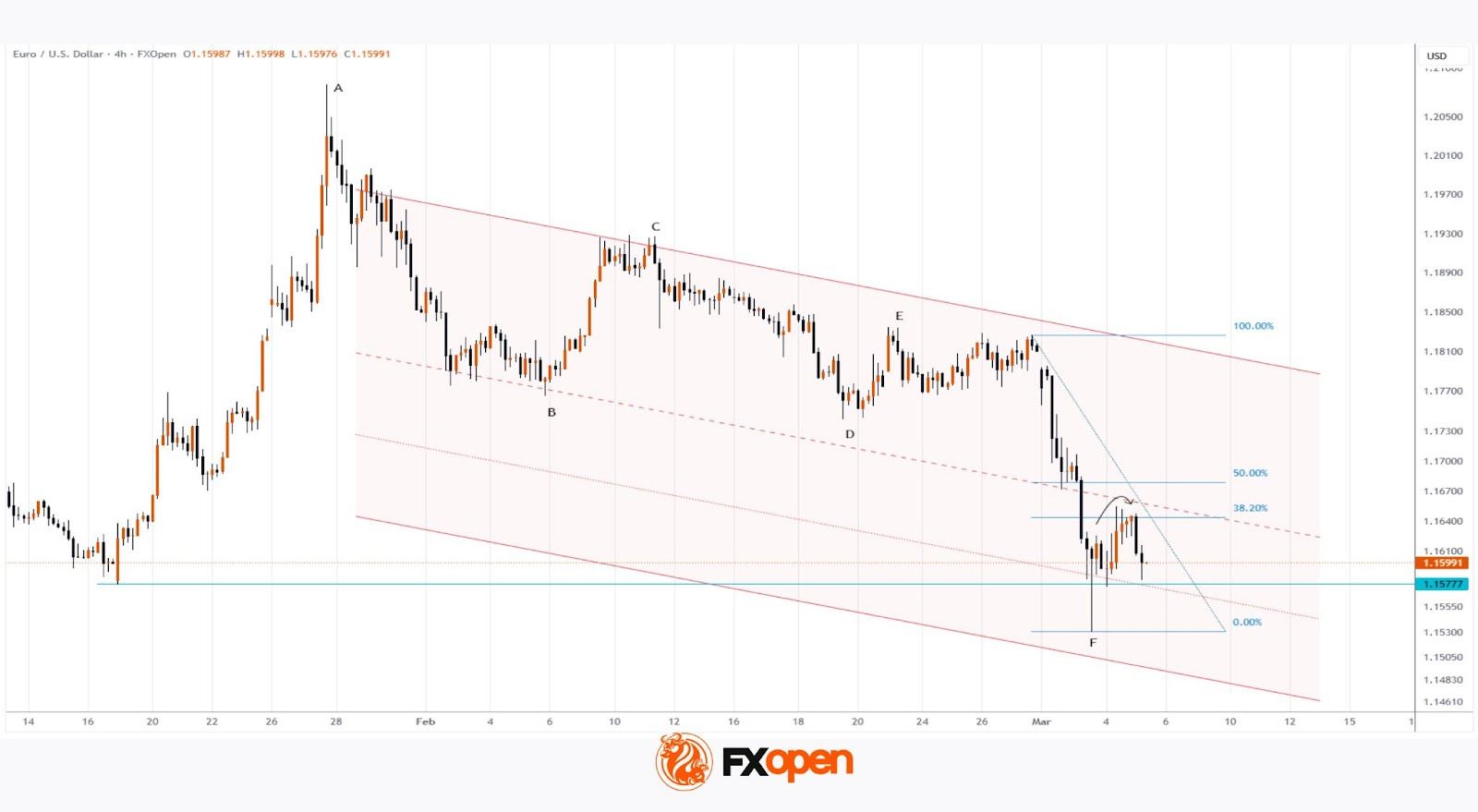
On 3 March, the EUR/USD pair fell below the January low (around 1.15777), establishing the lowest level of the year. As of today, 5 March, the chart shows signs of a continuation of bearish momentum.
On one hand, demand for the USD as a “safe-haven currency” remains elevated amid the ongoing military conflict in the Middle East.
On the other hand, the euro is under pressure because:
→ rising energy prices put the European Union at a disadvantage;
→ traders may be cautious ahead of today’s ECB news (Lagarde’s speech is scheduled for 20:00 GMT+3).
Technical Analysis of the EUR/USD Chart
On 19 February, we:
→ noted that bears held a certain advantage during February;
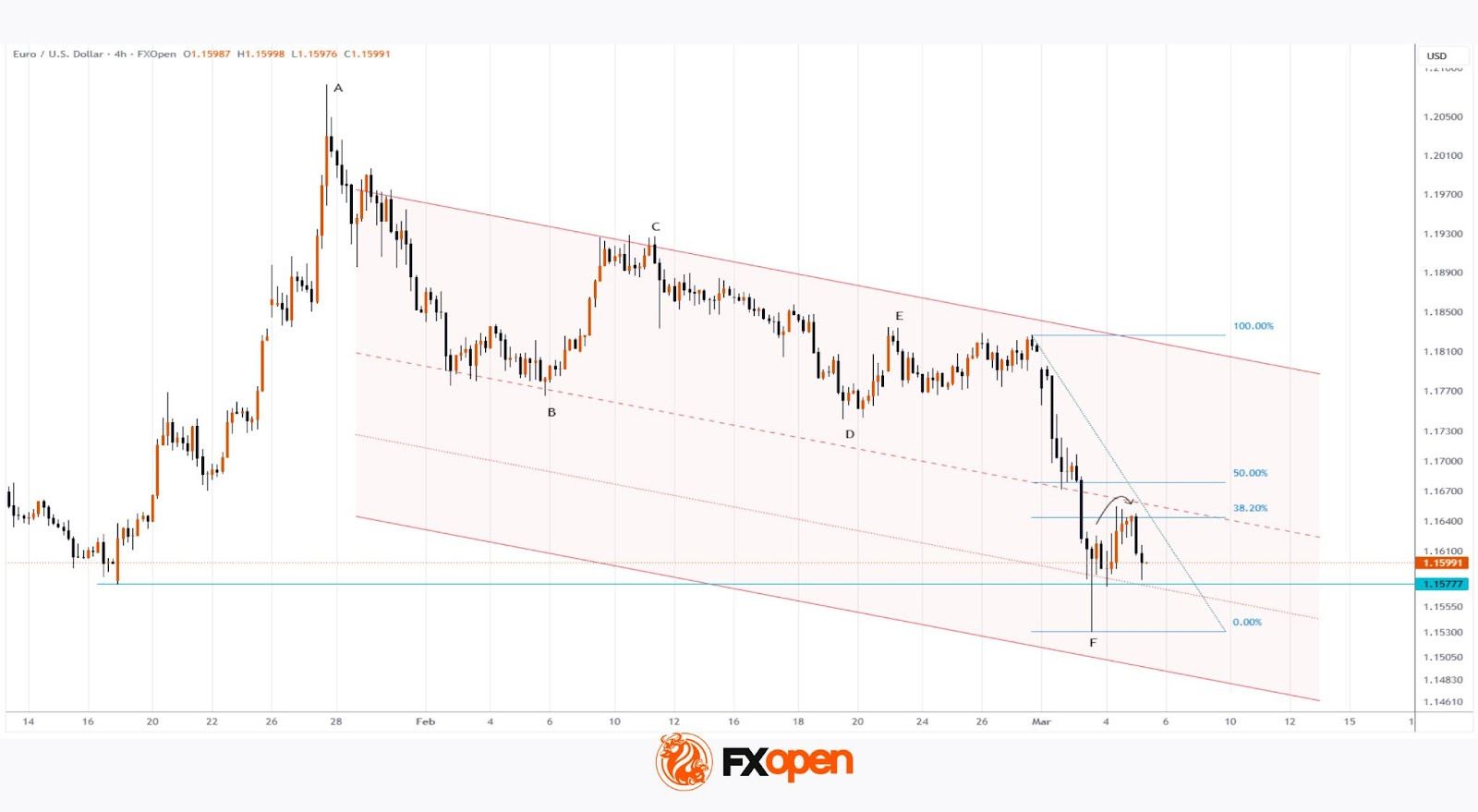
→ highlighted lower highs and lower lows at points A-B-C;
→ suggested a potential bearish scenario.
Since then, the downward movement has developed into a sequence A-B-C-D-E-F. Analysing the key patterns on the EUR/USD chart now allows us to construct a descending channel.
In this context, yesterday’s bearish reversal (indicated by the arrow) is noteworthy, as it occurred:
→ in the 0.382–0.5 Fibonacci zone, indicating a weak recovery;
→ below the channel median, which acted as resistance.
Considering the above, it is reasonable to state that bears remain in control. Forex traders should not rule out further declines in EUR/USD towards a new yearly low (and a test of the lower boundary of the channel).
However, the long lower shadow at point F suggests aggressive demand around the psychological level of 1.15000, and market sensitivity to Middle East news could rapidly change sentiment.
Trade over 50 forex markets 24 hours a day with FXOpen. Take advantage of low commissions, deep liquidity, and spreads from 0.0 pips (additional fees may apply). Open your FXOpen account now or learn more about trading forex with FXOpen.
This article represents the opinion of the Companies operating under the FXOpen brand only. It is not to be construed as an offer, solicitation, or recommendation with respect to products and services provided by the Companies operating under the FXOpen brand, nor is it to be considered financial advice.

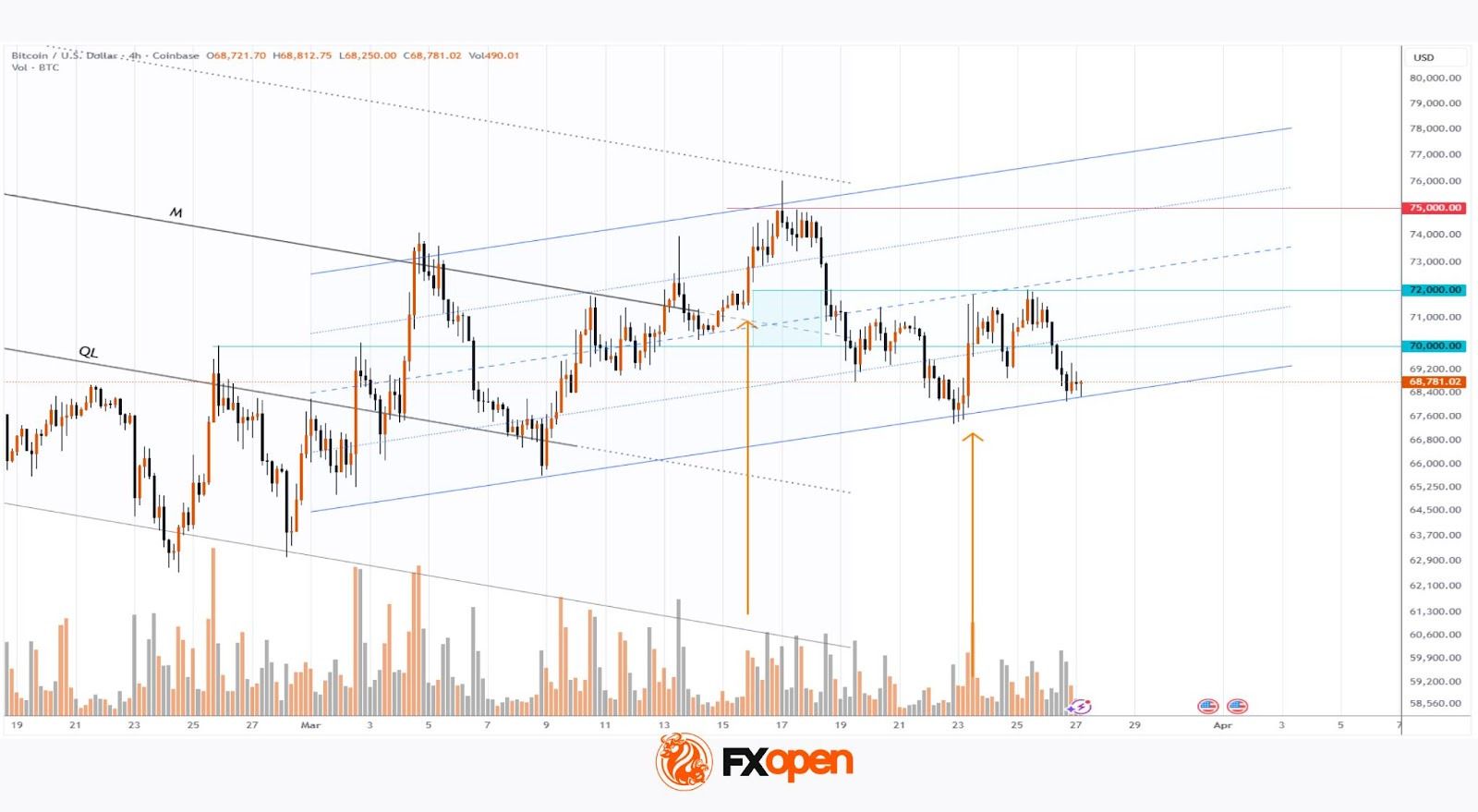
Today, BTC/USD is trading slightly below the psychological $70k level. Assessing its price action since the panic on 5 February, it is reasonable to suggest that the market is showing signs of range-bound behaviour: sellers tend to emerge near $75k, while buyers become active around $65k.
This balance between supply and demand, where neither side has been able to take control for several weeks, may feel either tiring or calming; however, the price chart suggests there are reasons for concern.
Technical Analysis of BTC/USD
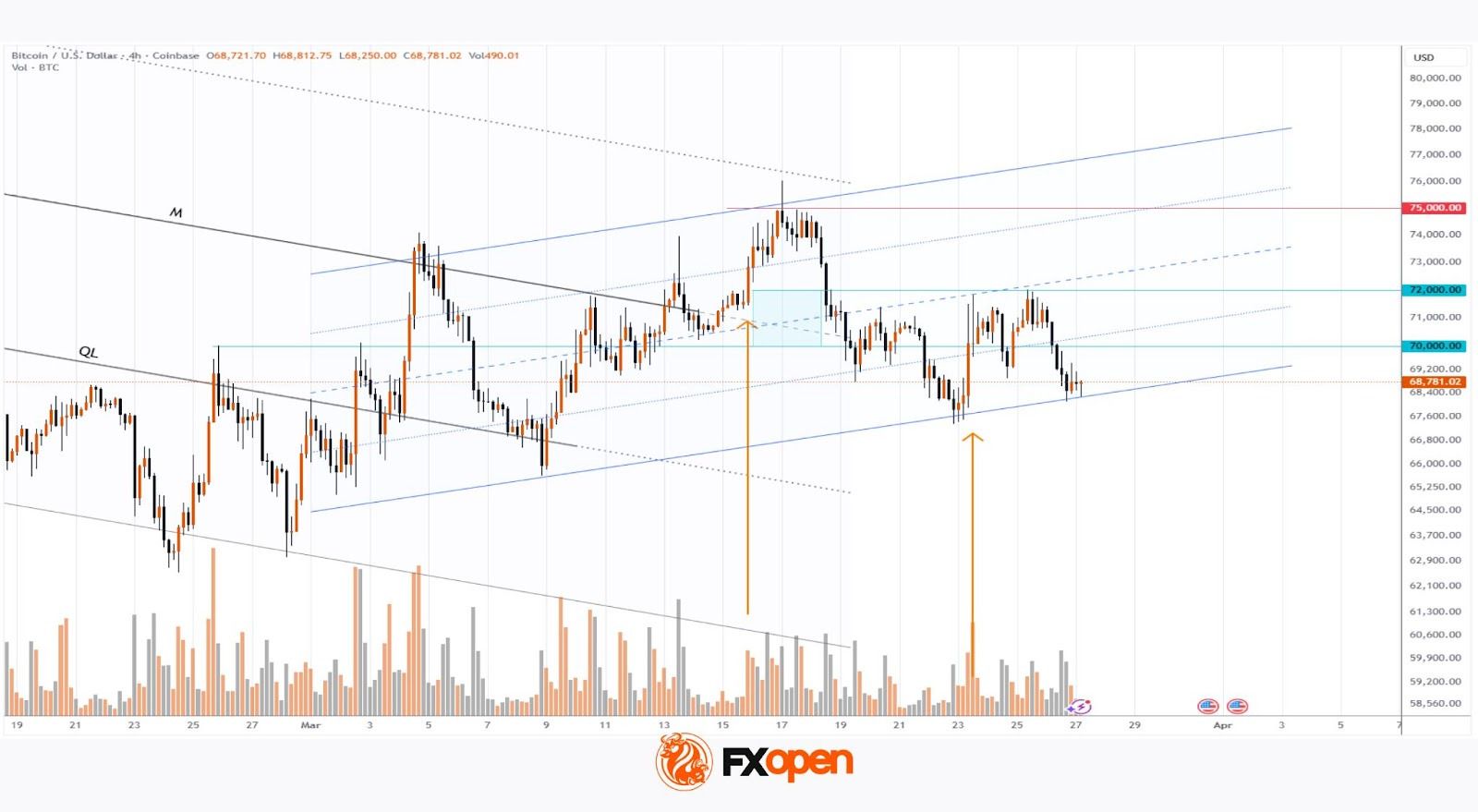
On 18 March, analysing Bitcoin’s price action within a broad descending channel, we:
→ noted signs of buying pressure, which led to the formation of an intermediate ascending channel (shown in blue);
→ suggested that buyers were pushing sellers out of the $70–72k zone, which could act as support.
However, the price soon reversed lower from the psychological $75k level, and the highlighted zone failed to provide support. Bulls retreated and showed an inability to defend the gains marked by the first arrow.
A similar lack of strength was observed later:
→ As indicated by the second arrow, on Monday, 23 March, Bitcoin surged sharply following statements by Donald Trump regarding negotiations with Iran.
→ However, the previously mentioned $72k level acted as resistance, and yesterday’s decline once again reflects a retreat by buyers.
As a result, there are grounds to conclude that bulls are struggling to sustain momentum, increasing the risk of a bearish breakout below the lower boundary of the blue channel. This level is particularly important because:
→ the blue channel may be interpreted as a bearish flag pattern;
→ a breakdown of this pattern could pave the way for a continuation of the prevailing downtrend, which has been in place since autumn 2025.
FXOpen offers the world’s most popular cryptocurrency CFDs*, including Bitcoin and Ethereum. Floating spreads, 1:2 leverage — at your service (additional fees may apply). Open your trading account now or learn more about crypto CFD trading with FXOpen.
*Important: At FXOpen UK, Cryptocurrency trading via CFDs is only available to our Professional clients. They are not available for trading by Retail clients. To find out more information about how this may affect you, please get in touch with our team.
This article represents the opinion of the Companies operating under the FXOpen brand only. It is not to be construed as an offer, solicitation, or recommendation with respect to products and services provided by the Companies operating under the FXOpen brand, nor is it to be considered financial advice.

Bitcoin holders with large balances continued to accumulate BTC, adding a notable 61,568 coins over the past month as geopolitical tensions and macro uncertainty persisted around the globe. Data from Santiment shows the surge came alongside a broader shift in on-chain activity: whales and sharks (addresses holding between 10 and 10,000 BTC) increased their holdings by about 0.45%, while wallets with less than 0.01 BTC expanded by roughly 0.42%, equating to an extra 213 BTC in the smaller cohort over the same period.
Bitcoin exchange outflows noted through March, a sign that holders appear more inclined to accumulate than to cash out, even as markets grapple with risk-off dynamics tied to geopolitical headlines and macro uncertainty. In a recent X post, Santiment framed the data as a potential indicator of a forthcoming move, suggesting that whale accumulation during a consolidation phase often precedes a breakout.
Key takeaways
- Large Bitcoin holders added 61,568 BTC over the last 30 days, signaling sustained accumulation among the top address tier.
- Whales and sharks (10–10,000 BTC) rose their holdings by about 0.45%, while ultra-small wallets (<0.01 BTC) grew by roughly 0.42% (about 213 BTC) during the same period.
- On-chain data suggests ongoing Bitcoin exchange outflows through March, reinforcing the view that holders are more inclined to accumulate than to sell.
- Analysts see whale accumulation during consolidation as a potential precursor to a breakout, though retail activity may drift with fear-driven dynamics.
- Market sentiment remains in extreme fear, with the Crypto Fear & Greed Index hovering around single-digit scores, highlighting a cautious to risk-off atmosphere.
Whales loading up as macro risk persists
Cointelegraph. “Small wallets chase momentum during uptrends, reflecting a fear of missing the next leg up.”
“Whales tend to buy in waves, so accumulation could continue if the range holds and macro conditions stay supportive. On the other hand, if retail FOMO overheats, we could see a pause or slight sell-off before the next accumulation phase.”
Those observations echo a broader market narrative: large-volume players appear to be positioning for a breakout, while retail participants exhibit mixed signals—drawn by upward price moves yet restrained by broader risk concerns. The age-old tension between accumulation and distribution within the crypto market remains a central theme for traders watching key support and resistance levels.
Fear, greed, and market timing amid geopolitical pressures
Market structure, timing, and what comes next
Looking ahead, investors should watch for a decisive move beyond the current range combined with continued on-chain signals. While the latest data hint at possible upside, the path remains contingent on macro stability and how geopolitical tensions resolve or intensify in the coming weeks.

Key Takeaways
- On March 25, a federal judge in California granted class certification in an investor lawsuit against Nvidia and its CEO Jensen Huang
- Plaintiffs allege the company concealed more than $1 billion in graphics card sales to cryptocurrency miners, misrepresenting them as gaming revenue between 2017 and 2018
- In 2022, Nvidia settled with the SEC for $5.5 million over inadequate disclosure of crypto mining’s influence on gaming segment sales
- The certified class includes all NVDA shareholders who purchased shares from August 10, 2017 through November 15, 2018
- A case management hearing is scheduled for April 21 through Zoom; shares traded at $174.03, declining 2.5%
Nvidia (NVDA) was trading at $174.03, down 2.50% at the time of writing.
Shares declined following a California federal court decision that brought the extended cryptocurrency revenue litigation significantly closer to reaching trial.
The Foundation of the Legal Challenge
The central accusation is clear-cut: Nvidia communicated to shareholders that its gaming graphics card revenue was expanding because of increased purchases from video game enthusiasts. However, this narrative omitted critical information.
Throughout the 2017 cryptocurrency surge, Ethereum mining operations were purchasing GeForce graphics cards in massive quantities. This demand was silently responsible for a substantial portion of what Nvidia classified as “gaming” revenue.
Quarterly sales surged by 52% followed by 25% year-over-year during these timeframes. The plaintiffs contend that shareholders were completely unaware of how much revenue depended on cryptocurrency activity.
When Bitcoin collapsed in 2018 and mining operations became economically unviable, demand for GPUs plummeted. Gaming segment revenue declined sharply, and the cryptocurrency-fueled basis of the prior growth became unmistakable after the fact.
Nvidia’s own fourth quarter FY2019 earnings discussion compounded the issue. Company executives explicitly attributed the revenue decline to the cryptocurrency mining collapse — a statement that directly conflicted with how they had characterized the earlier expansion.
SEC Enforcement Action Preceded This Lawsuit
The Securities and Exchange Commission acted before this civil case gained momentum. In May 2022, Nvidia agreed to a $5.5 million settlement after regulators determined the company had inadequately disclosed how cryptocurrency mining materially affected gaming GPU sales during the second and third quarters of fiscal 2018.
The commission’s enforcement division stated that Nvidia’s disclosure shortcomings prevented investors from accessing information essential for proper business evaluation.
Nvidia resolved that enforcement action without admitting guilt — a framework that allowed the company to maintain its legal position while essentially confirming the underlying factual claims.
The current civil litigation continues from where the SEC action concluded. The question is no longer whether disclosure failures occurred, but rather who bears financial responsibility.
Plaintiffs further contend that Nvidia personnel were actively monitoring cryptocurrency market movements and linking them to GPU sales performance in real time during those reporting periods. This evidence, they assert, demonstrates that executive-level statements regarding gaming demand were deliberately misleading — not merely incomplete.
On March 25, Judge Haywood Gilliam approved certification for the investor class — encompassing all individuals who purchased NVDA shares between August 10, 2017 and November 15, 2018. This decision is procedural in nature and doesn’t establish whether Nvidia’s disclosures constituted fraud.
A case management conference has been set for April 21 through a publicly accessible Zoom webinar.
Nvidia responded: “Investors who purchased NVIDIA in the 2017-2018 timeframe have done incredibly well, as our corporate strategy unfolded as we consistently predicted. We will address the complaint in court.”


Startale Group has closed a $63 million Series A backed by SBI Group and Sony Innovation Fund, positioning the Web3 infrastructure company at the center of Japan’s institutional push into tokenized securities and stablecoin rails.
A Japanese mega-bank and a global entertainment conglomerate writing nine-figure checks into a single Web3 infrastructure stack is not a coincidence. It is a capital concentration signal.
- Round Size: Startale closed a $63 million Series A in two tranches — a $13 million first close from Sony Innovation Fund and a $50 million second close from SBI Group.
- Lead Investors: SBI Group, one of Japan’s largest financial conglomerates with access to over 80 million customers, anchored the round alongside Sony, with whom Startale co-developed Ethereum Layer 2 Soneium.
- Strategic Context: Capital goes directly toward scaling Strium (a Layer 1 for tokenized securities), expanding JPYSC and USDSC stablecoins, and building a consumer SuperApp — a full-stack institutional and retail Web3 infrastructure play.
Discover: The best crypto presales gaining institutional momentum right now
The Deal: SBI’s $50 Million Bet on Onchain Finance
SBI Group’s $50 million second close is the dominant force in this round. SBI is not a passive financial sponsor, it is a strategic co-builder.
LATEST: — CoinMarketCap (@CoinMarketCap) March 26, 2026
 Startale has closed a $63 million Series A backed by SBI Group and Sony Innovation Fund to scale its blockchain, stablecoin and consumer app operations in Japan. pic.twitter.com/cvq2OOI0SV
The two companies have already shipped Strium, a Layer 1 blockchain built specifically for tokenized securities and real-world asset trading, and JPYSC, described as the first trust bank-backed Japanese yen stablecoin.
SBI Chairman Yoshitaka Kitao said Startale “possesses extensive expertise in the field of on-chain integration and offers capabilities that complement those of the SBI Group,” framing the investment as vertical integration in digital finance rather than a passive bet. Startale also unveiled USDSC, a dollar-pegged stablecoin designed to enable fiat-to-crypto integration, onchain dividends, and yield distribution for both retail and institutional users.
Sony’s $13 million first close, announced previously, originated from the companies’ existing collaboration on Soneium — Sony’s Ethereum Layer 2 — developed through Sony Block Solutions Labs. Fresh capital will also fund an upgrade of the Startale App into a SuperApp running on Soneium, integrating tokenized assets, stablecoins, payments, Mini Apps, and social features into a single consumer interface.
CEO Sota Watanabe said the round “reflects the strong conviction our partners have in the vision we are building,” adding that the SBI collaboration will “accelerate the adoption of tokenized stocks, centered on Japanese equities and JPY stablecoin, this year.”
Discover: The best crypto to diversify your portfolio with
The Signal: Institutional Capital Finds Its Layer
This is not a DeFi protocol raise. This is infrastructure.
The capital is targeting the settlement layer — the part of the crypto stack that processes tokenized equities, stablecoin transfers, and RWA trades at institutional scale.
That is precisely where institutional demand is concentrating across global crypto markets right now. SBI’s distribution network of over 80 million customers gives Strium and JPYSC a deployment path that most Web3 infrastructure projects cannot access in a decade of organic growth.
The Sony angle is equally deliberate. Soneium gives Startale a live Ethereum Layer 2 with a global entertainment brand attached, a consumer distribution wedge for a product suite that would otherwise struggle to cross the mainstream threshold. The SuperApp model collapses the distance between a retail user and onchain asset management. That matters for adoption velocity.
Regulatory tailwinds are real. Japan has moved faster than most jurisdictions on stablecoin legislation, and the broader regulatory framework supporting institutional crypto participation is maturing across major markets. Startale is building into that window.
Discover: The best crypto presales gaining institutional momentum right now
The post Startale Group Raises $63 Million Series A Backed by SBI and Sony appeared first on Cryptonews.


Strategy’s “Stretch” preferred shares are drawing strong interest from retail investors as the company keeps using the product to fund Bitcoin purchases.
Summary
- Retail investors hold majority of Strategy Stretch shares seeking lower volatility Bitcoin exposure with steady yields
- Strategy raised over 1 billion dollars through Stretch shares to fund recent Bitcoin purchases
- Stretch shares offer 11.5 percent dividend while redirecting part of Bitcoin returns to investors
New comments from Strategy executives show that individual investors now make up most of the holders of STRC, a dividend-paying security that the company markets as a lower-volatility way to gain Bitcoin-linked exposure.
Strategy CEO Phong Le said about 80% of the owners of the company’s “Stretch” perpetual preferred shares are retail investors. He said retail buyers prefer “low-volatility, high-yield digital credit” as they look for steadier exposure tied to Bitcoin.
The figures show that demand for Bitcoin-linked products remains active even during a weaker period for the asset and for Strategy’s stock. Michael Saylor and other company executives have increased promotion of STRC as a product for investors who want Bitcoin exposure without taking on the same level of price swings seen in common shares or the token itself.
Strategy relied heavily on STRC sales in March to raise funds for more Bitcoin purchases. Bloomberg reported that about $1.2 billion from at-the-market sales of the preferred shares helped finance one of the company’s recent Bitcoin buys, though the firm later returned to common stock sales for its latest purchase.
Speaking at the 2026 Digital Asset Summit in New York, Saylor said selling a new credit instrument to retail investors is usually difficult. He later told CNBC that the goal is to create “an onramp for people who believe Bitcoin is going to be around for the long term, but they can’t handle the volatility in the near term.”
In addition, Saylor said Stretch removes the first 10% to 11% of Bitcoin’s yearly return and directs it to credit investors. He said the structure is “way overcollateralized” and argued that equity holders could still benefit if Bitcoin rises at a faster pace over time.
The security pays a variable dividend that adjusts monthly in an effort to keep the share price near $100. The dividend stood at 11.5% in March, while the product is structured as a perpetual preferred share with no maturity date.
Strategy expands its funding plans
Strategy has signaled that preferred stock will remain a core part of its Bitcoin funding model. In filings and company materials, the firm has described a broader capital strategy built around different securities that offer varying types of Bitcoin exposure to investors.
The company also disclosed plans to expand its fundraising capacity. According to the report cited in the source material, Strategy plans to raise up to $21 billion through stock sales and another $21 billion through Stretch-related at-the-market programs, showing that the company is preparing to keep using these instruments as it adds to its Bitcoin holdings.

Torg Grabber, a newly identified infostealer malware, targets 728 crypto wallet extensions across 850 browser add-ons, and it is already in active deployment.
The malware exfiltrates seed phrases, private keys, and session tokens through encrypted channels before most endpoint tools register a detection event. Self-custody users running browser-based wallets are the primary exposure surface.
Gen Digital researchers documented the threat after tracing a loader chain through domain reputation data, ultimately compiling 334 samples across a three-month development window. This is not a proof-of-concept. It is a live Malware-as-a-Service operation with identified operators.
- Threat Scope: Torg Grabber scans 850 browser extensions, 728 of them crypto wallet targets, across 25 Chromium and 8 Firefox browser variants.
- Attack Method: Dropper masquerades as a legitimate Chrome update (GAPI_Update.exe, 60 MB), deploys payload via a fake 420-second Windows Security Update progress bar, then exfiltrates data using ChaCha20 encryption with HMAC-SHA256 authentication through Cloudflare infrastructure.
- Who Is at Risk: Browser-extension wallet users — MetaMask, Phantom, and comparable hot wallets — face direct credential theft; hardware wallet users face indirect risk only if seed phrases are stored digitally.
Discover: The best crypto presales gaining institutional momentum right now
The Mechanism: How Torg Grabber Malware Executes the Attack On Crypto Wallets
The infection chain opens with a dropper disguised as GAPI_Update.exe — a 60 MB InnoSetup package distributed from Dropbox infrastructure. It extracts three benign DLLs into %LOCALAPPDATA%\Connector\ to establish a clean-looking footprint, then launches a fake Windows Security Update progress bar running for exactly 420 seconds, complete with animated ASCII art compiled via csc.exe. The delay is deliberate: it creates a plausible installation window while the payload deploys.
The final executable drops under randomized names — v4jkqh.exe, hkjpy08.exe, ln3dkgz.exe — into C:\Windows\ across documented samples. One captured 13 MB instance spawned dllhost.exe and attempted to disable Event Tracing for Windows before behavioral detection terminated it mid-execution.
Post-deployment, Torg Grabber targets 25 Chromium browsers, 8 Firefox variants, Discord, Steam, Telegram, VPN clients, FTP clients, email clients, and password managers in addition to crypto wallets. Data is archived to an in-memory ZIP or streamed in chunks. Exfiltration routes through Cloudflare endpoints using per-request HMAC-SHA256 X-Auth-Token headers and ChaCha20 encryption — a production-grade architecture, not improvised tooling.
CRYPTO THEFT MALWARE: New “Torg Grabber” infostealer targets 728 cryptocurrency wallets.
The malware is designed to harvest wallet data and enable theft of digital assets.
Crypto wallets remain a primary target for financially motivated attackers.— CyberAlertsHQ (@CyberAlertsHQ) March 25, 2026
Gen Digital’s analysis identified over 40 operator tags embedded in binaries: nicknames, date-encoded batch IDs, and Telegram user IDs linking eight operators to the Russian cybercrime ecosystem. The MaaS model means individual operators can deploy custom shellcode post-registration, expanding the attack surface beyond the base configuration. As Gen Digital researchers described it, Torg Grabber evolved from Telegram dead drops to “a production-grade REST API that worked like a Swiss watch dipped in poison.”
Discover: The best crypto to diversify your portfolio with
The Self-Custody Signal: What 728 Wallets Actually Means
728 is not an arbitrary number. It represents a deliberate configuration sweep, every major browser-based wallet with measurable installation volume. MetaMask alone has over 30 million monthly active users. The extension-targeting logic means Torg Grabber does not need to find a specific victim; it harvests whatever wallet credentials are present on any infected machine.

The broader risk bifurcates cleanly. Self-custody users storing seed phrases in browser storage, text files, or password managers face complete wallet compromise on a single infection. Exchange-held assets are not directly exposed to this specific attack vector, the malware targets local credential stores, not exchange APIs at scale. But session token theft from browser storage can expose connected exchange accounts if login sessions are active.
If Torg Grabber’s MaaS operator base expands, and Gen Digital’s monitoring of its REST API infrastructure suggests active iteration, the wallet targeting list will grow. The 728 figure is a current snapshot, not a ceiling. Comparable infostealers like Vidar and RedLine normalized this model years ago; Torg Grabber is executing the same playbook with more structured infrastructure.
Discover: The best crypto presales gaining institutional momentum right now
The post New ‘Torg Grabber’ Malware Targets 728 Crypto Wallets appeared first on Cryptonews.


ARK Invest is adding Kalshi’s prediction market data to its research process as more institutions test whether these markets can help measure expectations in real time.
Summary
- ARK Invest adopts Kalshi data to track real time expectations and guide research decisions
- Prediction markets expand beyond trading as institutions explore signals for risk management and forecasting
- Federal Reserve and academia study prediction markets as tools for real time economic expectations analysis
Meanwhile, the move places prediction market signals alongside ARK’s existing work on market trends, policy events, and company milestones, showing how the data is being used for research and portfolio planning beyond direct trading.
According to the announcement, ARK will use Kalshi data to track real-time expectations and support its market-based research. The firm also plans to study signals tied to trading activity, regulatory approvals, and technology progress as part of that process.
Kalshi said ARK will also use the data in risk management and hedging. Cathie Wood said, “Bringing prediction markets into institutional workflows is a natural next step for innovation in financial research,” while ARK Research Director Nick Grous said these markets offer “some of the purest expressions of risk around key economic and company-specific outcomes.”
In an X post, Wood said on X that ARK has also been working with Kalshi on markets tied to topics the firm follows, including macroeconomic releases and scientific milestones. Kalshi CEO Tarek Mansour said some of those markets are already live, including contracts linked to non-farm payrolls, deficit-to-GDP ratios, and business key performance indicators.
The partnership adds to a wider push to use prediction market data as a decision tool. Kalshi has grown into one of the main regulated platforms in the sector, and firms are testing whether market-based probability signals can complement surveys, analyst models, and event-driven research.
Fed and academic research track the same trend
A Federal Reserve paper published last month said Kalshi’s macro markets can provide a “high-frequency, continuously updated, distributionally rich benchmark” for researchers and policymakers. The paper compared Kalshi data with surveys and market-based forecasts and argued that prediction markets can offer a real-time view of changing expectations.
Academic work has also examined how prediction markets react to political shocks. A recent paper using Polymarket’s 2024 presidential election data studied trading around the Biden-Trump debate, the assassination attempt on Trump, and Biden’s withdrawal from the race, showing how traders adjusted positions as events unfolded.
Crypto World
MARA Sells 15,133 Bitcoin for $1 Billion Debt Repurchase, Retains 15,627 BTC in Reserve

TLDR:
- MARA sold 15,133 BTC at ~$65,348 each, generating roughly $989M to fund its debt repurchase plan.
- The company captured $88.1M in savings by repurchasing convertible notes at a 9% discount to par.
- MARA reduced its total convertible debt by 30%, bringing the balance down to roughly $2.3 billion.
- After the BTC sale, MARA still holds 15,627 Bitcoin as long-term strategic reserves on its books.
MARA Holdings, Inc. sold 15,133 bitcoins to complete a $1 billion repurchase of its convertible senior notes. The Miami-based company executed the sales between March 4 and March 25, 2026.
Total proceeds reached approximately $1.1 billion, with the remainder reserved for general corporate purposes. The company, listed on NASDAQ under the symbol MARA, is the largest Bitcoin mining firm in the United States.
Following the deal, MARA retains approximately 15,627 bitcoins as long-term core reserves.
MARA Captures $88 Million Discount on Convertible Note Repurchase
The repurchase targets 0.00% convertible senior notes due in 2030 and 2031. MARA agreed to buy back $367.5 million in 2030 notes for roughly $322.9 million.
It also repurchased $633.4 million in 2031 notes for approximately $589.9 million. Closings are set for March 30 and 31, 2026, respectively.
The transactions capture roughly $88.1 million in cash savings before costs. This equals about a 9% discount to the notes’ par value.
Overall, MARA’s outstanding convertible debt will decrease by approximately 30%. The deal also cuts potential shareholder dilution from note conversion features.
After closing, $632.5 million of the 2030 Notes and $291.6 million of the 2031 Notes remain. MARA’s total convertible debt stood at around $3.3 billion before the deal. That balance is expected to fall to roughly $2.3 billion. Other outstanding note series remain unchanged.
CEO Fred Thiel addressed the decision in a statement. “By retiring over $1 billion of face value debt at a discount, we captured $88 million in value,” Thiel stated.
He added the move reduces shareholder dilution and deleverages the balance sheet. J. Wood Capital Advisors and Paul, Weiss served as financial and legal advisors.
MARA Moves Beyond Bitcoin Mining Into Digital Energy and AI
The 15,133 bitcoins sold averaged approximately $65,348 per coin, generating roughly $989 million. Those funds were directed primarily toward financing the note repurchases.
Remaining proceeds will support general corporate purposes. MARA completed the sales without raising new equity or taking on additional debt.
MARA stated that it is now expanding beyond pure-play bitcoin mining. Digital energy and AI/HPC infrastructure are named as primary growth targets.
This reflects a capital allocation strategy aimed at long-term diversification. New revenue streams from these areas could reduce the company’s dependence on mining income.
Using bitcoin holdings to fund debt reduction allowed MARA to act on its own terms. The company still holds approximately 15,627 bitcoins as a strategic reserve.
That position gives MARA room to respond to future market opportunities. Retaining a strong reserve remains part of the company’s long-term plan.
Thiel said the transaction’s position at MARA, as well as it builds into new infrastructure areas. He noted the deal strengthens financial standing and expands strategic options.
Remaining convertible obligations total roughly $2.3 billion after the repurchases. MARA continues to manage its capital structure with efficiency and long-term growth in mind.


Institutional demand for bitcoin appears to be cooling after a strong start to the month.
On Thursday, investors withdrew a combined $171.12 million from the 11 U.S.-listed spot bitcoin exchange-traded funds, marking the largest single-day outflow in just over three weeks, according to data from SoSoValue. BlackRock’s IBIT saw $41.92 million in outflows, while funds such as FBTC, GBTC, BITB and ARKB each recorded withdrawals in the $20 million to $30 million range.
The recent pullback follows a period of robust inflows, with these funds attracting more than $2 billion between late February and mid-month. Since then, momentum has slowed, with just $95.8 million in inflows last week and net outflows of $70.71 million so far this week.
The moderation in flows may point to a pause in institutional accumulation, with investors adopting a more measured approach to these ETFs. Launched in January 2024, the funds allow market participants to take exposure to bitcoin without requiring direct ownership.
The slowdown in demand raises questions about how long bitcoin can maintain resilience near $70,000 amid broader macroeconomic shocks.
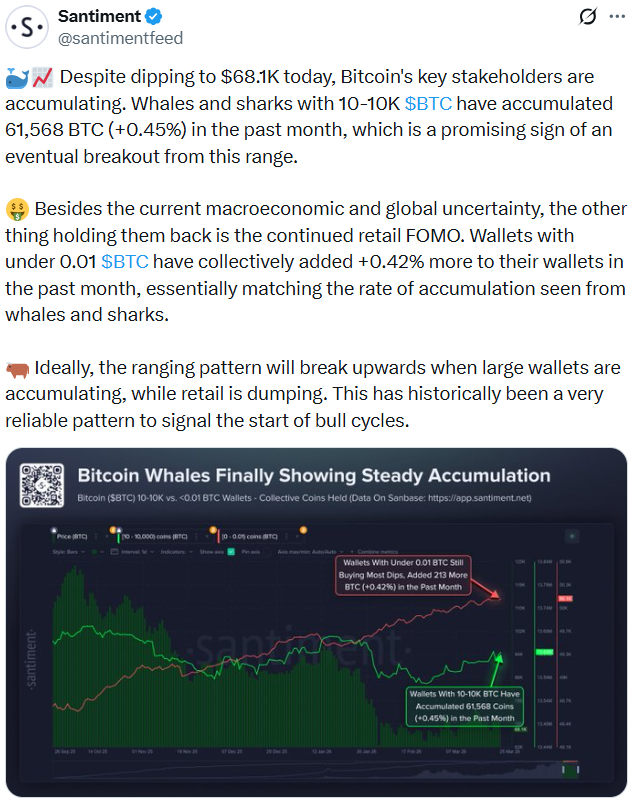
Large Bitcoin holders accumulated 61,568 more Bitcoin over the past month against the backdrop of escalating conflict in the Middle East and macroeconomic uncertainty.
Whales and sharks, defined as those holding between 10 and 10,000 Bitcoin (BTC), have increased their holdings by 0.45%, while wallets with under 0.01 Bitcoin have added 0.42%, or 213 BTC, over the past month, Santiment said in an X post Thursday.
The figures support recent data showing that Bitcoin exchange outflows have persisted throughout March, indicating that Bitcoin holders are accumulating rather than looking to sell.
Santiment analysts added that whale accumulation could be a “promising sign” of an eventual breakout from the range.
“Ideally, the ranging pattern will break upwards when large wallets are accumulating, while retail is dumping. This has historically been a very reliable pattern to signal the start of bull cycles,” the analysts said.

Tensions in the Middle East escalated in February after the US and Israel launched strikes against Iran. Iran retaliated against several neighboring countries, and the conflict has continued since.
Some whales wait for breakout; small holders driven by FOMO
Some Bitcoin whales are taking a different approach.
On March 19, two Bitcoin whales moved tens of millions of dollars to exchanges as Bitcoin fell and energy prices jumped after attacks on Gulf oil and gas infrastructure deepened during the Iran conflict.
Dominick John, an analyst at Zeus Research, told Cointelegraph that the whales who have been accumulating in the background are likely preparing for the next breakout.
“Whales are scooping up BTC because they’re positioning ahead of a potential breakout, quietly stacking during consolidation periods. Small wallets are chasing the momentum, driven by FOMO during uptrends and the fear of missing the next leg up,” he said.
Related: Binance says US midterms could boost Bitcoin and stocks
“Whales tend to buy in waves, so accumulation could continue if the range holds and macro conditions stay supportive. On the other hand, if retail FOMO overheats, we could see a pause or slight sell-off before the next accumulation phase,” John added.
Fear and greed index in “extreme fear”
Meanwhile, investor sentiment remains deeply uncertain. The Crypto Fear & Greed Index returned a score of 13 on Friday, firmly in “extreme fear” territory.

Thursday’s score was 10, and both the prior week and the month of February averaged “extreme fear” ratings as well, according to the index.
Magazine: Banks want to run Vietnam’s crypto exchanges, Boyaa’s $70M BTC plan: Asia Express

Under-fives should not watch screens for more than an hour a day, Keir Starmer tells parents

China plus One: The Race for Indispensability in a Fragmented World

BTC/USD Analysis: Bitcoin Tests Key Support


-
 Crypto World6 days ago
NIO (NIO) Stock Plunges 6.5% as Shelf Registration Sparks Dilution Worries
-
 NewsBeat2 days ago
Manchester United reach agreement with Casemiro over contract clause amid transfer speculation
-

 Fashion7 days ago
Weekend Open Thread: Adidas – Corporette.com
-

 Politics7 days ago
Jenni Murray, Long-Serving Woman’s Hour Presenter, Dies Aged 75
-

 Crypto World5 days ago
Best Crypto to Buy Now: Strategy Just Spent $1.57 Billion on Bitcoin During Fear While Early Investors Quietly Enter Pepeto for 150x Potential
-

 Crypto World5 days ago
Bitcoin Price News: Bhutan Sells $72 Million in BTC Under Fiscal Pressure, but the Smart Money Entering Pepeto Sees What the Market Does Not
-

 News Videos1 day ago
Parliament publishes latest register of MPs’ financial interests
-

 Sports4 days ago
Remo Stars and Kano Pillars Strengthen Survival Hopes in NPFL
-

 Sports4 days ago
Gary Kirsten Accuses Pakistan Cricket Board Of ‘Interference’, Mohsin Naqvi Responds
-

 Tech4 days ago
Give Your Phone a Huge (and Free) Upgrade by Switching to Another Keyboard
-

 Business5 days ago
No Winner in March 21 Drawing as Prize Rolls to $133 Million for Next
-

 Sports7 days ago
2026 Kentucky Derby horses, odds, futures, preview, date: Expert who nailed 12 Derby-Oaks Doubles enters picks
-

 Tech4 days ago
AI enters the chat: New Seattle dating app relies on tech to facilitate meaningful human connections
-
Business6 days ago
Columbia Sportswear enters $500 million credit agreement with JPMorgan Chase
-

 News Videos4 days ago
Ch 9 Financial Management Part 1 | Detailed One Shot | Class 12 Business Studies Boards 2026
-

 Tech5 days ago
Today’s NYT Connections Hints, Answers for March 22 #1015
-

 Business12 hours ago
Instagram, YouTube Found Responsible for Teen’s Mental Health Struggle in Historic Ruling
-
 Crypto World7 days ago
Small-cap Russell 2000 enters correction territory
-

 Business5 days ago
Will Duke Basketball Win It All? Duke Basketball Enters Second Round as Third Favorite to Claim NCAA Title
-

 Sports4 days ago
2026 Kentucky Derby horses, odds, futures, preview, date: Expert who hit 12 Derby-Oaks Doubles enters picks
You must be logged in to post a comment Login