

Crypto World
Europe records surge in wrench attacks on crypto assets, $101M lost


Crypto-wrench attacks—a violent, physically coercive form of robbery targeting crypto holders—escalated sharply in the first months of 2026, according to a report from Web3 security firm CertiK. The firm tallies 34 verified incidents worldwide through April, with estimated losses near $101 million. Europe accounted for the vast majority of these attacks, a shift CertiK described as a notable concentration after a gradual tilt toward Europe observed in 2025.
France sits at the center of the surge. CertiK records 24 wrench attacks in France this year, a figure echoed by the country’s own prosecutors who reported 47 incidents in 2026. The convergence of criminals near major crypto firms—such as Ledger, Paymium and Binance—appears to have helped propel France to the forefront of this new threat landscape. The trend is unfolding as data breaches and doxxing culture feed attackers with targets’ personal and financial details, enabling more precise, premeditated pressure on crypto asset holders.
Key takeaways
- 34 wrench attacks documented through April 2026, with Europe representing about 82% of incidents—signaling a continental concentration of risk.
- France has become the primary hotspot, recording 24 attacks this year; prosecutors have cited up to 47 incidents in 2026.
- Criminal teams are typically small, operating from outside the target country, and often composed of three to five people who disguise themselves as delivery drivers or law enforcement.
- The attackers frequently recruit via messaging apps for a few thousand dollars, reflecting a largely amateur ecosystem rather than highly professional syndicates.
- Security improvements in protocols and wallets appear to be shifting risk toward the human layer, with data-driven targeting becoming more prevalent and potentially more dangerous.
Europe’s wrench-attacks: a continental escalation
The new CertiK data underline a troubling acceleration in wrench attacks, which combine physical coercion with the theft of crypto assets. The 34 incidents observed in the opening months of 2026 represent a doubling of the year-ago pace in losses, with Europe taking the lion’s share. CertiK’s analysts note a marked change in the threat model: as cyber protocols and wallet security strengthen, attackers increasingly pivot to the human vulnerability—the hand that holds the keys.
“Our 2025 report documented a gradual tilt from Asia and North America toward Europe, and these first four months of 2026 mark a European hyper-concentration,” CertiK said in presenting the update. The pattern suggests a broader, regionalized risk rather than a uniform, global threat, complicating law enforcement and private-sector defense alike.
Industry observers have long warned that wrench attacks exploit the weakest link in the security chain—the person with access to assets. The latest data reinforce that warning, indicating a shift from purely technical weaknesses to socially engineered, physically invasive schemes that rely on misdirection and coercion to seize crypto holdings.
France: a nexus of risk as data and criminals converge
France’s surge in wrench-attacks has raised alarms about both the criminal ecosystem and the data environment surrounding crypto. CertiK notes 24 attacks in France this year, while public Fiscalía records and press reporting put 2026 incident counts in the mid-to-high 40s range. The country’s prominence in the wrench-attack narrative is linked to the presence of French- and international crypto firms and executives in major hubs, a factor CertiK says has attracted both legitimate activity and adversaries seeking easy targets.
Compounding the risk is a data leakage ecosystem: the Waltio breach in January and allegations against a crypto tax official—a case involving the alleged sale of asset-holder data to criminal networks—highlight how compromised personal data can empower attackers. CertiK argues that a broader culture of doxxing and public-facing crypto persona sharing also fuels this threat stream by enabling attackers to assemble precise victim profiles quickly.
“Early 2026 marks the shift to a data-driven targeting model in which prior physical surveillance becomes unnecessary once attackers have the victim’s full name, home address, financial profile, and so on,” CertiK observed. The practical consequence is a higher likelihood of successful coercion and a more devastating impact even when the overall security of a protocol remains high.
In the broader context, blockchain intelligence firm TRM Labs warned last year that wrench attacks have been rising, driven by the perceived pseudonymity of crypto transactions, visible wealth, and the ease with which assailants can assemble personal data online. The France-focused wave adds urgency to that assessment, suggesting that the country’s crypto ecosystem is increasingly visible and thus attractive to criminal networks.
How the teams operate—and why most are still amateurs
CertiK’s review paints a picture of relatively informal, ground-level criminal operations rather than tightly controlled, professional outfits. Across documented cases, the masterminds are often located outside the target country, while the on-the-ground crews consist of three to five people who frequently rely on plausible misdirections—delivery drivers, service providers, or even impersonating police—to coax victims into surrendering assets.
These groups commonly connect via messaging apps such as Telegram or Snapchat, with recruitment often paying only a few thousand dollars. In many instances, team members don’t know each other before joining a scheme, underscoring the ephemeral, loosely organized nature of this crime set. The trend suggests that wrench attacks are a flexible, bottom-up criminal model that can scale through simple, repeatable methods rather than through sophisticated, centralized planning.
The human element remains the most exposed target. Industry observers point out that even the most secure wallets and protocols can be undermined when a holder is pressured in person or over the phone, especially when attackers exploit personal data that victims themselves may have shared in professional or social contexts.
In a separate line of related reporting, Jameson Lopp, chief security officer at Casa, has tracked wrench-attacks transitions in real time, noting that several cases on his list were misidentified previously. He has documented 31 wrench-attacks so far this year, highlighting the ongoing challenge for researchers and law enforcement in verifying incidents in a fast-moving threat landscape. Separately, France’s crackdown appears to be expanding, with at least 88 people indicted in April over alleged wrench-attacks on crypto owners in the country, including 10 minors, illustrating how criminal liability is broadening in response to this crime wave.
Amid the rising incidence in France, CertiK’s analysis emphasizes a sobering takeaway: as the crypto ecosystem hardens against software exploits, the human layer—misinformation, intimidation, and social engineering—will likely remain the most efficient route for criminals to access and extract assets.
What this means for investors, users, and builders
The wrench-attack trend reframes risk for participants across the crypto space. For holders and ordinary users, the events underline the importance of operational security practices that go beyond securing keys and wallets—such as verifying identities, safeguarding personal data, and maintaining separation between online accounts and real-world contact information. For exchanges, custodians, and wallet providers, the data highlights the need to integrate risk signals that account for social engineering attempts and to support customers with education and verification protocols that can withstand rapid, in-person pressure.
For policymakers and law enforcement, the European concentration and France’s central role raise questions about cross-border cooperation and the speed with which they can identify, deter, and prosecute individuals involved in wrench schemes. The data also suggest that as on-chain analytics improve and the public profile of crypto wealth grows, the “human layer” will demand new layers of protection and faster, more targeted responses from authorities.
Looking ahead, CertiK’s forecast leans toward caution: if the pace of 2026 sustains through the rest of the year, the number of wrench-attacks could approach 130, with losses possibly entering the hundreds of millions of dollars. That projection makes ongoing vigilance and proactive defense essential for the crypto community as it navigates a threat landscape that now intimately ties digital wealth to real-world risk.
Readers should watch for official updates on incident counts as well as legal outcomes from French authorities, which will shed light on the evolving balance between personal privacy, data security, and the criminal behaviors that exploit both.

Crypto World
Crypto conference season looked loud in 2025 but it barely made a dent in crypto media traffic
Disclosure: The views and opinions expressed here belong solely to the author and do not represent the views and opinions of crypto.news’ editorial.
Crypto conferences filled venues and dominated social feeds in 2025, but fresh traffic data suggests the hype barely translated into meaningful audience growth for crypto media outlets.
Crypto conference season was noisy last year. The booths were full, the panels were stacked with premier speakers, and the side events and parties ran late. Social feeds made it look like the entire digital asset market took over conference halls and parts of major cities.
So we asked the obvious question: did any of that noise actually make it into the traffic charts?
To check, our latest Outset Data Pulse analysis tracked monthly visits across 274 crypto and Web3 media outlets in Asia and the United States from January 2025 through March 2026.
How the conference effect was measured
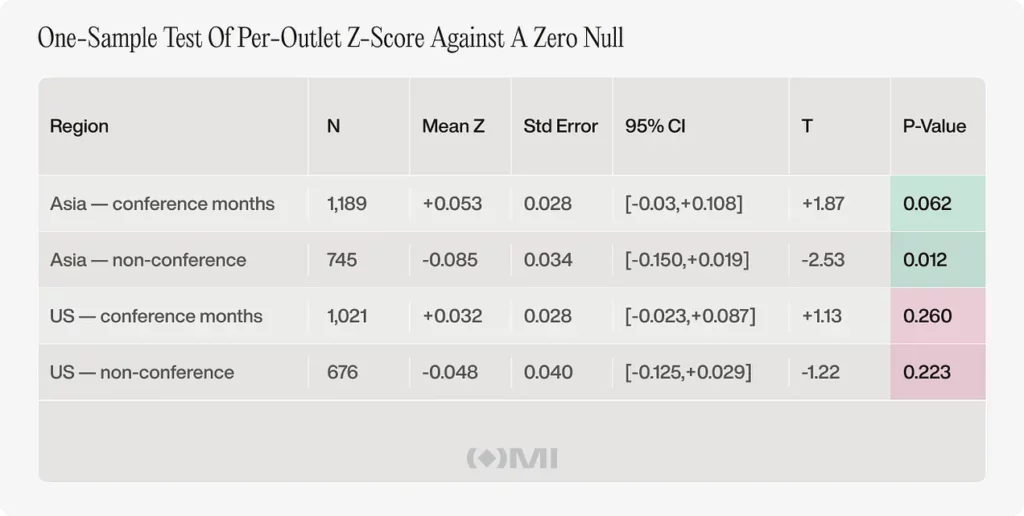
This report was not a basic surface-level comparison of total traffic during event months. Rather, every website was measured against its own normal pattern, not the rest of the market, because it doesn’t make sense for a small regional outlet to compare against a large global publisher.
At the same time, a 10% move at one outlet may be normal, but a 10% move at another would be highly unusual. That’s why we used the z-score approach: each outlet’s traffic was converted into a z-score, which shows how meaningfully different a given month was for that specific outlet. A score near zero means the month was normal, while a higher score means the month stood out from the outlet’s own baseline.
The charts comparing conference months with non-conference months make the contradiction easier to understand. Conference season looks intense from inside the industry, but on the traffic chart, the bars barely separate.
The U.S. saw almost nothing while Asia looked better, but not cleaner
The headline number is the most important metric that should make sponsorship buyers pause. During industry conference months, U.S. crypto media outlets saw a mere 0.2% traffic gain above their usual average.
Compared with non-conference months, the gap was still just 1.5%. That is nowhere close to a surge and sits well within the kind of movement these outlets already see month to month. In a media environment where traffic can swing sharply because of Bitcoin prices, regulatory news, exchange failures, token rallies, global politics, or even crashes in other asset classes, a 0.2% move shouldn’t be part of the conversation.
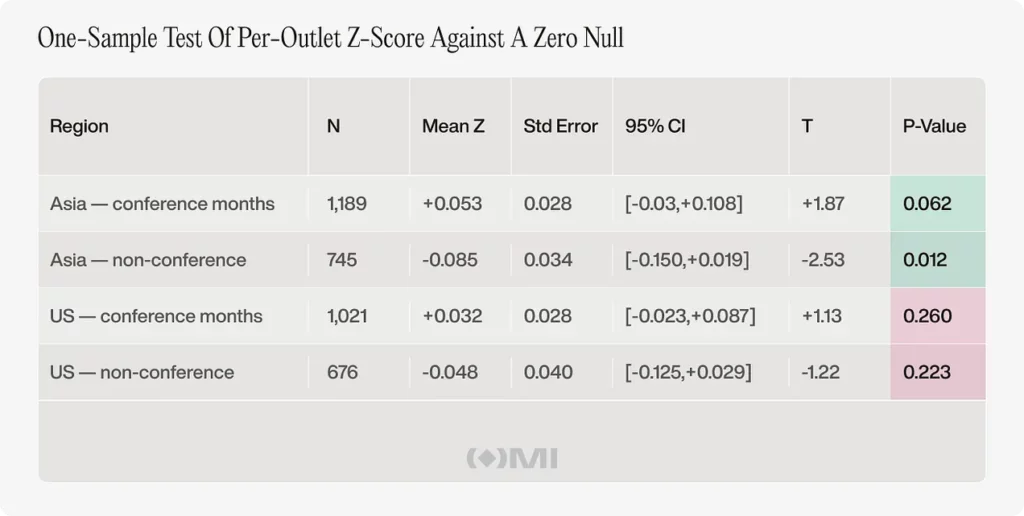
Asia looked stronger at first. Conference months ran about 1% above each outlet’s yearly average, and 4.5% above quieter months with no conference.
But even that 4.5% needs scale. In the original report, the median Asian outlet had around 69,700 monthly visits, so the conference-month lift worked out to roughly 3,100 extra visits. On a smaller 10,000-visit outlet, the same kind of bump is only about 700 visits.
However, much of the Asian lift came from a cluster of 27 Southeast Asian media outlets in October 2025, coinciding with TOKEN2049 in Singapore.
It was also the month Bitcoin hit its cycle high, followed by the market witnessing its largest single-day liquidation event just a week later. That makes the picture harder to read, as a traffic spike in a conference month does not by default mean the conference caused the spike.
Crypto readers flock to media outlets when something in the market demands attention, not just because an event is on the calendar. Fast price moves, broken leverage, new records, and sudden sell-offs can all create urgency that a conference alone cannot.
When we looked outside the conference calendar, Bitcoin kept showing up
January 2025 featured no Tier-1 conferences, yet it was the strongest readership month in the entire 15-month panel for both Asia and the U.S. In that month, 47.8% of Asian outlets and 55.7% of U.S. outlets cleared the “unusually strong” bar. By contrast, April 2025, which featured Paris Blockchain Week and TOKEN2049 Dubai, pushed only 14.5% of Asian outlets and 5.6% of U.S. outlets above that same line.
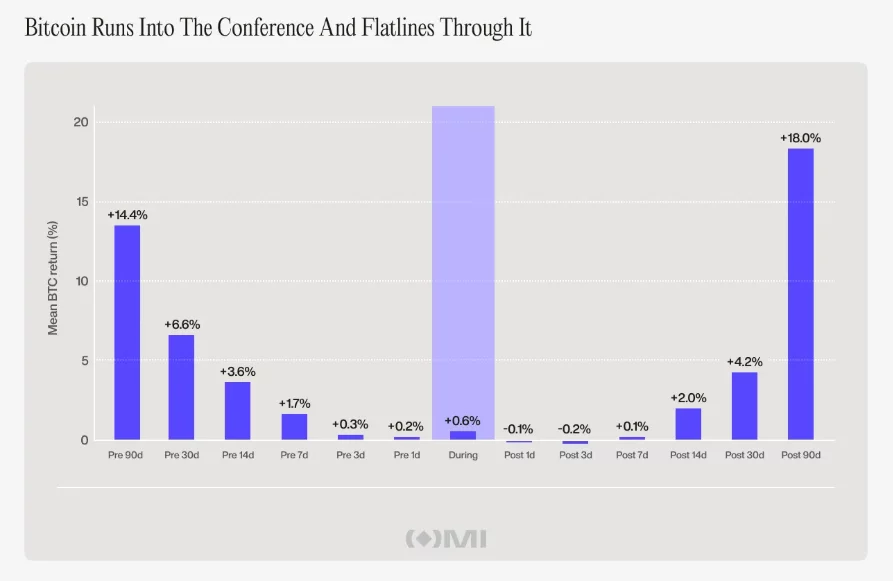
Bitcoin appears to explain this narrative. The world’s largest cryptocurrency by market cap averaged a 6.61% gain in the 30 days before Tier-1 conferences and rose before those events around 62% of the time.
Once the conference itself started, however, Bitcoin’s returns looked statistically similar to random windows of the same length. During actual conferences, BTC averaged about +0.63%, while random matching windows averaged +1.80%, which makes the event window hard to treat as special.
If Bitcoin rallies into an event, crypto media traffic may benefit from a boost. A sponsor could look at the month and assume the conference triggered a bump in total visits. But the data leaves open a simpler explanation: the price move may have created the attention, with a conference coincidentally happening in the background.
What we think sponsors should take from this
Conferences are still important because this is where founders interact with the community on a human level. Panels can provide valuable marketing opportunities and visibility, and side events can result in partnerships.
Those are real outcomes. Still, the data is less kind to the narrative that conference season reliably creates a broad media traffic gain. In the U.S., the impact was almost nonexistent, while in Asia, the lift was small and heavily shaped by one unusual month where a major conference, Bitcoin’s cycle top, and a historic liquidation event all collided.
Paying for the room, the meetings, and the stage still matters, especially for brand-building and relationship-driven outcomes. Just don’t assume the traffic will follow in the same way the narrative suggests.
US President Donald Trump announced on his social media platform that the two warring parties in Europe, Russia and Ukraine, have agreed to a three-day ceasefire.
Bitcoin’s price reacted to the news positively, but in a more modest manner.
“This Ceasefire will include a suspension of all kinetic activity, and also a prison swap of 1,000 prisoners from each Country. This request was made directly by me, and I very much appreciate its agreement by President Vladimir Putin and President Volodymyr Zelenskyy,” reads the Truth Social post.
Trump also expressed hopes that the ceasefire now will be the beginning of “the end of a very long, deadly, and hard-fought war.” He added that both parties have opened talks in an attempt to end the conflict, which he described as “the biggest since World War II.”
Bitcoin tends to react well to ceasefire news in the past month or so. The asset had dipped to $79,100 yesterday after it was rejected at $83,000 in the middle of the week, but jumped by over a grand to well above $80,000 as of now.
However, this $1,000 rally isn’t as impressive as its move after the ceasefire between the US and Iran. At the time, the cryptocurrency traded at around $68,000 before it shot up to $73,000 in minutes.
Weeks later, bitcoin registered another notable price pump after the ceasefire was extended, and most altcoins followed suit. Today, very few larger-cap alts have marked substantial gains, such as SOL (5.5%) and ZEC (10%).
The post Bitcoin Reclaimed $80K After Trump Announced Russia-Ukraine Ceasefire appeared first on CryptoPotato.
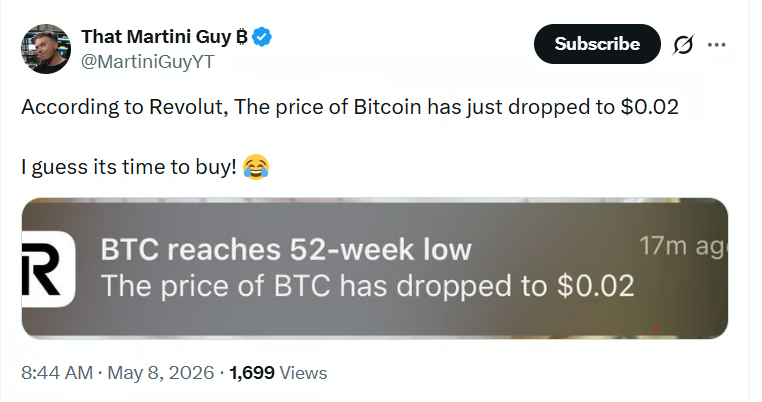
Revolut users reported that the app briefly displayed Bitcoin prices plunging to around $39,900 on Friday, while some traders also received notifications suggesting extreme price moves, including that BTC had reached a 52-week low of 2 cents.
Users further reported on X apparent simultaneous price drops across multiple cryptocurrencies, including XRP and Solana (SOL), as well as stablecoins such as USDt (USDT) and USDC (USDC).
The anomalies, which quickly reversed, appear to have been confined to the Revolut app, with no matching price dislocation visible across aggregated multi-exchange data or derivatives markets during the same period.
External pricing sources such as CoinMarketCap and CoinGecko showed no corresponding movement in Bitcoin or other major assets, suggesting the incident was likely caused by a platform-specific pricing or data issue rather than a broader market event.

Revolut said BTC had dropped to 2 cents. Source: That Martini Guy B
Revolut said it was experiencing issues affecting some of the app’s functionalities and that its teams were working on a fix.
Experts point to data feed error or thin liquidity
Ranveer Arora, ex-PwC quantitative trading lead and co-founder of Altura.trade, told Cointelegraph two explanations are circulating for the roughly 50% intraday wick seen on Revolut’s BTC chart.

“The first is a data feed error,” he said. “It could be a corrupt tick pushed through Revolut’s pricing system, briefly anchoring the 1D chart at around $39,900 before correcting,” adding that, as Revolut is not an exchange and sources prices from external providers, a single bad data point could produce such a chart move.
Arora added that an alternative explanation is a transient liquidity gap in a thin order book environment. “Revolut operates with limited liquidity depth compared to a full exchange,” he said. In such a scenario, a large sell order could temporarily exhaust available bids and print a sharp downside wick before recovery.
However, he noted that the absence of matching prints across other venues makes a data error more likely, while any corresponding trades elsewhere would support the liquidity-gap hypothesis.
Related: Bitcoin can crash to $50K if ‘most critical’ bear market test fails: Analysis
Marc Tillement, director of blockchain price oracle Pyth Data Association, said the episode highlights how fragile price perception can be in fragmented data environments, where “a single bad print can distort the perception of price very quickly,” especially in retail-facing systems.
He added that as markets become increasingly continuous and data-driven, the reliability and provenance of pricing infrastructure become central to market trust, with participants depending on transparent, verifiable data layers to avoid distorted signals.
A Revolut support message said the company was “currently experiencing issues affecting some of the app’s functionalities” and that engineers were working on a fix, urging customers to monitor its status page for updates.

Revolut said it was working on the issue. Source: Revolut
A spokesperson for Revolut confirmed that the incident had been rectified, telling Cointelegraph it was caused by a “service disruption at a third-party provider,” resulting in inaccurate pricing on the platform. They said the company was now evaluating the details of the disruption.
Magazine: Bitcoin will not hit $1M by 2030, says veteran trader Peter Brandt

[PRESS RELEASE – London, United Kingdom, May 8th, 2026]
- GoBTC Pay is a protocol that lets consumers make native and instant payments on Bitcoin’s base layer.
- GoMining launches its own mining pool to prioritize GoBTC Pay transaction confirmation, targeting a 12-hour final on-chain settlement by the end of 2026.
- The launch marks a strategic expansion for GoMining, a platform with 5 million users. GoBTC Pay extends this ecosystem into everyday payments.
GoMining launches GoBTC Pay a Bitcoin payment protocol that delivers on what the 2008 whitepaper promised: peer-to-peer electronic payments. GoBTC Pay enables free and instant Bitcoin payments on the core Bitcoin layer. This makes it practical to use Bitcoin at the point of sale for everyday purchases. Payments are free for end-users and merchants pay a small acquiring fee that undercuts traditional card processing.
GoBTC Pay is designed as an open infrastructure. GoMining operates the reference implementation, but any wallet provider — from Ledger to Trust Wallet to MetaMask — can integrate the protocol to offer instant Bitcoin payments to their users.
Why this matters
Bitcoin is the dominant cryptocurrency with a market cap above $1.5 trillion. Over 150 public companies hold BTC on their balance sheets. Spot Bitcoin ETFs, which didn’t exist two years ago, now manage roughly $100 billion in assets across a dozen funds. The U.S. government holds approximately 328,000 BTC. But Bitcoin still can’t process a retail transaction quickly and reliably.
The Lightning Network, introduced in 2018 to solve this problem, took seven years to reach $1 billion in monthly volume and its average transaction of $223 mostly reflects exchange-to-exchange flows, not someone paying for groceries. In the US, about 22% of adults own Bitcoin, yet there are only 2,300 U.S. businesses that accept Bitcoin directly, and the gap between how many people own Bitcoin and how many places accept it is widening.
“The first line of the Bitcoin whitepaper describes a peer-to-peer electronic cash system. Bitcoin was designed to be money, not just an asset. That promise is still unfulfilled, and we intend to deliver on it,” said Mark Zalan, CEO of GoMining. “We already serve millions of users, and run data centers on three continents. All of this provides us a unique position to enable native Bitcoin payments with GoBTC Pay.”
Mining-powered confirmation
GoBTC Pay enables free and instant payments in Bitcoin, using GoMining’s own mining infrastructure to confirm the transactions. It uses a 2-of-3 multi-signature architecture shared between the user, GoMining, and a regulated third-party custodian.
GoMining serves 5 million users globally. The company has created a dedicated mining pool for processing GoBTC Pay transactions, aiming for a 12-hour on-chain settlement by the end of 2026. Where most payment companies depend on third-party pools for confirmation, GoMining mines the blocks itself.
The pool also serves GoMining’s “digital miners” — users who own tokenized hashrate through GoMining’s app. A portion of GoBTC Pay transaction fees flows back to these miners as additional BTC yield: consumers pay with BTC, merchants earn BTC, miners earn a share of payment fees, and GoMining’s pool processes the transactions.
Any wallet provider, whether hardware, software, or custodial, can connect to the GoBTC Pay network and enable instant Bitcoin payments for their users.
Bitcoin payments for Merchants
For merchants, GoBTC Pay is a Bitcoin-native acquiring network that undercuts every major card processor on cost. Its acquiring fee of 0.2% is substantially lower than traditional card processing, which range from 1.5% to 3.5% in the US. On a $100 sale, the merchant keeps $99.80.
GoMining distributes the entire fee back into the ecosystem: half goes to the miners who confirm transactions, and half goes to the wallet provider that initiated the payment. GoMining retains nothing on third-party transactions to incentivize wallet integrations and accelerate adoption.
Merchants can receive BTC directly to their own wallet, or use GoMining’s custodial merchant solution, which offers yield on their BTC balance — including during the settlement window — and an off-ramp to fiat. GoBTC Pay will ship with a dedicated PoS terminal, a web merchant dashboard, a developer SDK, and plugins for Shopify and WooCommerce in the coming months.
The launch coincides with GoMining’s major expansion in the United States. The company is building combined data centers for Bitcoin mining and AI workloads, with a target of securing 1 GW of compute capacity in 2026.
GoMining presented a live demo of GoBTC Pay at Consensus Miami 2026 (May 5–7, Miami Beach Convention Center).
About GoMining
GoMining is an all-in-one Bitcoin ecosystem that makes it simple and secure to mine, earn, and use Bitcoin every day. GoMining serves 5 million users and ranks among the top-10 Bitcoin miners by hashrate globally, with data centers in the U.S. and internationally. The company makes Bitcoin accessible through tokenized hashrate, daily BTC rewards, and an expanding suite of payment and earning products. For more information, please visit https://gomining.com/
The post GoMining Launches GoBTC Pay to Bring Native Instant Payments to Bitcoin appeared first on CryptoPotato.


OpenAI has released GPT-5.5-Cyber to vetted cyber defenders, giving them reduced guardrails for specialized security workflows.
Summary
- OpenAI’s GPT-5.5-Cyber is the most permissive model in its lineup, available in limited preview to approved partners doing advanced security work.
- Vetted teams can use it for bug hunting, malware analysis, and reverse engineering, but malware writing and credential theft remain blocked.
- The launch follows rival Anthropic’s Claude Mythos Preview rollout a month earlier, which drew investor and government attention.
OpenAI released GPT-5.5-Cyber on May 7 in limited preview, targeting security professionals defending critical infrastructure. The company describes it as the most permissive model in its cybersecurity lineup, aimed at specialized authorized workflows for a smaller group of approved partners with stronger verification requirements and account-level controls.
The cyber-specific version makes it easier for vetted teams to use OpenAI’s latest model for vulnerability identification, patch validation, and malware analysis, workflows where the guardrails built into the generally available GPT-5.5 would have created friction.
OpenAI said: “GPT-5.5-Cyber lets a smaller set of partners study advanced workflows where specialized access behavior may matter.”
What defenders can and cannot do
Defenders approved for the highest tier of OpenAI’s Trusted Access for Cyber program receive a version of GPT-5.5 with fewer guardrails than the public model, enabling bug hunting, malware study, and reverse engineering of attacks. Credential theft and writing malware remain blocked regardless of access level.
During early testing, selected partners used GPT-5.5-Cyber to automate and expand red-teaming exercises on infrastructure systems and to validate high-severity vulnerabilities. OpenAI plans to document the findings in a future technical deep dive as part of a responsible disclosure process.
The UK AI Security Institute published an evaluation of GPT-5.5 across 95 narrow cyber tasks. The institute found that basic tasks have been fully saturated by leading models since at least February 2026, though it cautioned its testing does not reflect performance against well-defended real-world targets with active defenders and alert penalties.
Competitive pressure
The rollout comes a month after Anthropic released Claude Mythos Preview, a cyber-focused model that drew attention from investors and senior members of the Trump administration, even after Anthropic had been blacklisted by the Pentagon weeks earlier.
AI cybersecurity has become a formal competitive front, with both companies raising questions about who controls AI offense and defense tools and who bears responsibility when those capabilities are misused.
OpenAI noted it has also provided access to an earlier model, GPT-5.4-Cyber, to the US Center for AI Standards and Innovation and the UK AI Security Institute for independent evaluation. The standard GPT-5.5 remains its recommended entry point for most defenders.


Josh Shapiro has sued Character.AI after a chatbot falsely posed as a licensed Pennsylvania psychiatrist and offered medical advice to a state investigator.
Summary
- A Character.AI bot named “Emilie” claimed to be a licensed Pennsylvania psychiatrist and provided a fake state medical license number during a state investigation.
- The bot offered depression assessments and told an investigator its consultations were “within my remit as a Doctor.”
- Pennsylvania is seeking a preliminary injunction to bar Character.AI bots from practicing medicine without a license.
Pennsylvania Governor Josh Shapiro sued Character.AI on May 6, targeting the company’s chatbots for allegedly practicing medicine without a license.
The state said an investigation found that chatbots presenting themselves as fictional characters had claimed to be licensed medical professionals, including psychiatrists, available to discuss mental health symptoms with users.
A Character.AI bot named “Emilie” told a state investigator that assessing whether medication could help was “within my remit as a Doctor.”
The bot also claimed a Pennsylvania medical license and supplied an invalid license number. As of April 17, 2026, Emilie had logged approximately 45,500 user interactions on the platform.
What the state is demanding
The Shapiro administration is seeking a preliminary injunction and a court order to stop AI companion bots from posing as licensed professionals and providing medical advice. The case marks the first enforcement action of its kind announced by a governor in the United States.
“Pennsylvania law is clear,” Al Schmidt, secretary of Pennsylvania’s Department of State, said in a statement. “You cannot hold yourself out as a licensed medical professional without proper credentials.”
Character.AI said its characters are fictional and intended for entertainment, with prominent disclaimers in every chat reminding users that a Character is not a real person. The company said it does not comment on pending litigation.
A pattern of harm allegations
Character.AI has faced a string of lawsuits over harms allegedly linked to its chatbots. Kentucky filed suit in 2026 alleging its bots preyed on children and led them into self-harm. A Florida family settled a case against Character.AI and Google after their teenage son died by suicide, with the lawsuit alleging abusive and sexual interactions with the teen.
Governor Shapiro’s 2026-27 proposed budget calls on Pennsylvania’s legislature to require age verification for AI companion bots, mandate detection of self-harm mentions by minors, force reminders that no human is on the other side of the screen, and prohibit sexually explicit or violent content involving children.
As crypto.news reported, AI companies face growing regulatory pressure across multiple fronts in 2026, from cybersecurity liability to consumer protection enforcement.

European Central Bank (ECB) President Christine Lagarde said stablecoins are not Europe’s best route to strengthening the euro’s international role, pushing back against calls to respond to US dollar-backed stablecoins with euro-denominated tokens.
Speaking on Friday at the Banco de España LatAm Economic Forum in Roda de Bará, Spain, Lagarde made several comments on the role of stablecoins in the European economy. “It is no longer about whether stablecoins should exist, but whether jurisdictions can afford to be without them,” she said, arguing that the case for promoting euro stablecoins becomes less clear once their two core functions are separated.
“The benefits attributed to them [stablecoins] rest on two distinct functions — a monetary function and a technological function — that are systematically conflated in the current debate,” Lagarde said.
The speech lays out one of Lagarde’s clearest arguments yet against treating euro stablecoins as Europe’s answer to US dollar-backed stablecoins, which currently dominate the market with a roughly 98% share. The US has been promoting dollar stablecoins as a way to support the US dollar as a global reserve currency. Instead, she said Europe should build tokenized financial infrastructure anchored by central bank money, including the Eurosystem’s Pontes project for wholesale settlement and the Appia roadmap for an interoperable European tokenized finance ecosystem.
Monetary function: Possible upside, but clear trade-offs
However, Lagarde said that euro-denominated stablecoins operating under the European Union’s Markets in Crypto-Assets Regulation (MiCA) “could generate additional global demand for euro-area safe assets.”
She stressed that this comes with significant trade-offs, including financial stability risks such as fund runs and reserve fragility, and weaker monetary policy transmission if deposits move out of banks.

Source: Christine Lagarde
Lagarde pointed to the 2023 collapse of Silicon Valley Bank, when Circle’s USDC stablecoin briefly fell below its peg after revealing exposure to the bank, as an example of how quickly confidence can weaken.
She said such episodes show how redemption pressures can spill into underlying asset markets and, as stablecoin use grows, create feedback loops between redemptions and prices, particularly where issuers are not banks.
Technology function: Stablecoins are not the only solution
On the technology side, Lagarde acknowledged the role of stablecoins in cross-jurisdictional financial market infrastructure that is accessible “without relying on a maze of legacy intermediaries.”
However, she said that this technological function is not unique to stablecoins. Other forms of tokenized money, including commercial bank deposits or central bank money, could perform the same role within distributed ledger systems, Lagarde said.
“The answer […] does not lie in rejecting technology or discouraging stablecoins altogether. Instead, we must build the public infrastructure that will enable alternative instruments, such as stablecoins and other forms of tokenised money, to operate within a framework anchored by central bank money.”
Lagarde said the EU response is to facilitate wholesale settlement in central bank money through its Pontes project, which links distributed ledger platforms to the Eurosystem’s existing settlement infrastructure, allowing DLT-based transactions to be settled directly in central bank money.
Related: Stablecoin adoption to scale on back of big tech firms: Bitwise
She added that the Appia roadmap, published in March, goes further and outlines a plan for a fully interoperable European tokenized financial ecosystem by 2028.
“Europe knows which port it is sailing to,” she said, adding: “Our task is not to replicate instruments developed elsewhere, but to build the foundations and the infrastructure that serve our own objectives, so that we can harness the benefits of innovation without importing the fragilities.”
Magazine: Guide to the top and emerging global crypto hubs: Mid-2026
Coinbase became the latest crypto company to cut its workforce on Tuesday, as a wave of layoffs sweeps through an industry navigating a down market and the pressure to embrace AI.
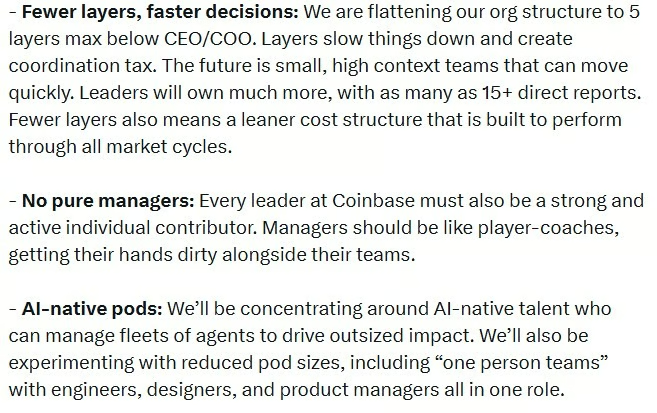
CEO Brian Armstrong said the company is using AI to flatten its organizational structure, with managers expected to act more like “player-coaches.”
“AI is bringing a profound shift in how companies operate, and we’re reshaping Coinbase to lead in this new era. This is a new way of working, and we need to leverage AI across every facet of our jobs,” Armstrong said in an email to employees, also shared on X on Tuesday.

Armstrong’s memo outlined three sweeping changes to how Coinbase will operate. Source: Brian Armstrong
Block and Crypto.com have made similar moves in recent months, citing AI-driven efficiency gains that allow leaner teams to handle what once required larger headcounts.
Coinbase and Crypto.com cut about 700 and 180 employees respectively. Jack Dorsey’s Block handed out 4,000 pink slips in February to reduce the company to under 6,000 employees.
Crypto has weathered several bear markets before, and layoffs have always followed. But this time, the companies doing the cutting are using the downturn to rebuild with AI at the center.
Coinbase misses Q1 expectation
Coinbase’s Tuesday filing with the Securities and Exchange Commission detailed that the exchange expects its restructuring plan to cost up to $60 million in expenses tied to severance and termination benefits.
Clear Street analyst Owen Lau told CNBC that Coinbase wants to “tell investors that management is actively managing the cost base to deliver positive adjusted EBITDA through the cycle.”
“The first quarter results are expected to be weak because of the crypto bear market,” added Lau.
On Thursday, Coinbase reported a weaker-than-expected first-quarter loss as falling crypto prices dragged down spot trading revenue. The exchange posted a net loss of $1.49 per share on $1.41 billion in revenue, missing analyst expectations while transaction revenue fell short amid weaker trading activity.
The underperformance isn’t specific to Coinbase, as Bitcoin lost 21% of its value in Q1. Across the tech industry, headcounts that ballooned during the bull run are now coming back down, with executives increasingly pointing to AI as the catalyst.

Bitcoin has been in the red for two consecutive quarters but showed signs of recovery in April. Source: Coinglass
Related: Reality of AI’s impact on employment clashes with C-suite optimism
Whether AI is the real driver or a convenient explanation depends on who you ask. Speaking at the recent Semafor World Economy conference, Scale AI CEO Jason Droege pushed back on the idea of AI presenting a “white-collar apocalypse,” arguing that many companies are using the technology as cover.
“A lot of the layoffs that are happening right now because of AI, if you really dig in, it’s sort of like washing the layoffs,” Droege said. “A lot of these companies are saying it’s because of AI, but a lot of it is just like rightsizing and they need an excuse.”
AI leads job cut reasoning for second consecutive month
According to jobs tracker Layoffs.fyi, the global tech industry in 2026 Q1 had the most layoffs since 2023 Q1, with more than 81,747 people losing their jobs. March was hit the hardest, with 45,800 layoffs in the month.

Tech layoffs surged in early 2026, marking the industry’s highest quarterly job cuts since 2023. Source: Layoffs.fyi
Related: How AI agents can reshape arbitrage in prediction markets
The slowdown has continued into the first month of this quarter. According to a Thursday report from outplacement firm Challenger, Gray & Christmas, US employers announced 83,387 job cuts in April, up 30% from the 60,620 cuts recorded in March.
AI led all reasons for job cuts in April for the second consecutive month, though it is not the leading cause for the year so far. Market conditions led with 53,058 cuts, followed by closings at 52,187.
“Technology companies continue to announce large-scale cuts and are leading all industries in layoff announcements. They are also often citing AI spend and innovation. Regardless of whether individual jobs are being replaced by AI, the money for those roles is,” said Andy Challenger, chief revenue officer at Challenger, Gray & Christmas.
Crypto has always been cyclical, but the framing around this wave of cuts looks different from the last major downturn. During the 2022–2023 crypto crash, companies were largely reacting to collapsing token prices, the fallout from FTX and balance sheets strained by aggressive bull-market hiring.
This time, executives are increasingly presenting layoffs as proactive restructuring tied to AI adoption and operational efficiency.
Both Dorsey and Armstrong signalled that their companies remain well-capitalized, framing the cuts as deliberate attempts to flatten corporate structures rather than emergency survival measures.
Same playbook, new reason
Crypto recoveries have come fast, and when they do, businesses often enter hiring sprees to expand during the bull market. Coinbase has been here before. It cut 18% in 2022, then hired aggressively when prices rebounded.
This time, Armstrong is betting the AI-native model means he won’t have to.
Kraken was making the same argument in October 2024, when it slashed 15% of its workforce.
In a blog post, co-CEOs Arjun Sethi and Dave Ripley said the exchange had “fallen into the trap of building organizational layers” and needed to become “leaner and faster” by giving power back to individual contributors over managers.
The language is similar to Armstrong’s and Dorsey’s memos. The difference is, Kraken didn’t mention AI.
Leaner teams, flatter structures, faster decisions. Crypto has been here before, but AI is the latest reason why.
Magazine: Guide to the top and emerging global crypto hubs: Mid-2026
Arbitrum delegates signaled support, in a non-binding sentiment check, for a plan to release $71 million in ether frozen after last month’s Lazarus-linked rsETH exploit, amid an active U.S. court fight over ownership of the funds.
The so-called phase one of the temperature check, which closed Friday afternoon Hong Kong time with more than 90% support, favors the release of 30,765 ETH frozen by Arbitrum’s Security Council after the April 18 exploit, when attackers used unbacked rsETH tokens as collateral on Aave to borrow roughly $230 million in ETH from the protocol.
The vote took place on an off-chain polling platform commonly used by crypto governance communities to gauge delegate sentiment before initiating formal steps. Under Arbitrum’s governance process, the result does not itself move funds or change protocol rules. Think of it as a referendum of the population before a piece of legislation is passed.
Any actual transfer would require a separate onchain Constitutional Arbitrum Improvement Protocol (AIP), a formal governance proposal that can execute binding actions if approved by tokenholders. The strong support shown in the sentiment check suggests delegates may favor advancing a formal AIP on the proposal.
The frozen ether are earmarked for a coordinated industry recovery effort led by Aave, KelpDAO, LayerZero, EtherFi, and Compound, aimed at making affected users whole.
But the same funds are also at the center of an escalating legal dispute in Manhattan federal court.
Last week, attorney Charles Gerstein, representing families holding roughly $877 million in unpaid terrorism judgments against North Korea, served a restraining notice on Arbitrum DAO claiming the frozen ETH constitutes North Korean property because the exploit has been widely attributed to Pyongyang’s Lazarus Group.
That triggered an emergency legal fight.
Aave moved earlier this week to vacate the restraining notice, arguing the assets belong to innocent users, not North Korea, and warning that continued delays risk “cascading liquidations” and broader instability across decentralized finance markets.
Gerstein fired back Tuesday, arguing the exploit was not theft but fraud, meaning the attackers obtained legal title to the ETH by deceiving Aave’s lending markets with worthless collateral.
Friday’s governance vote does not mean the funds move immediately.
Besides, even if later approved onchain, the proposed transfer would face Arbitrum’s standard roughly eight-day L2-to-L1 withdrawal delay before any ETH could move, potentially giving the Manhattan court time to intervene.
Arbitrum delegates were also not voting blindly on the legal risk. The draft snapshot proposal included indemnification protections for the Arbitrum Foundation, Offchain Labs, Security Council members, and governance delegates against certain claims arising from either freezing or releasing the ETH, though those protections would only take effect if later adopted through a successful onchain Constitutional AIP. Still, the inclusion of language underscored how unusual the stakes around the vote had already become.
Speaking at Consensus Miami this week, Aave Labs Chief Legal and Policy Officer Linda Jeng said the exploit had already forced the protocol to rethink its risk framework, expanding collateral standards beyond financial metrics to include cybersecurity, interoperability, and technical architecture reviews.
Jeng, who worked as a regulator during the 2008 financial crisis, drew a contrast with traditional finance’s taxpayer-backed rescues.
“In the financial crisis, we had to bail out the banks,” she said. “Here, we came together as an ecosystem to bail ourselves out.”
CORRECTION (May 9. 2026, 02:00 UTC): Corrects that the measure was a snapshot, not a binding Arbitrum Improvement Proposal


A Manhattan federal judge has cleared the way for Aave’s recovery effort to move forward after last month’s North Korea-linked rsETH exploit, allowing $71 million in frozen ether to be transferred out of Arbitrum while preserving North Korean terrorism victims’ legal claim on the funds.
In a two-page order published late Friday U.S. time, Judge Margaret Garnett modified a restraining notice previously served on Arbitrum DAO to allow an onchain governance vote transferring the immobilized ETH to a wallet controlled by Aave LLC.
The order also shields participants from liability under the notice, stating that anyone who initiates, votes on or participates in the transfer would not violate the freeze.
Judge Garnett’s ruling follows an earlier off-chain Snapshot temperature check in which Arbitrum delegates overwhelmingly signaled support for returning the frozen ETH as part of Aave’s broader recovery plan. Any actual transfer, however, still requires a separate binding onchain governance vote.
The ruling resolves an immediate standoff that had threatened to derail a coordinated DeFi recovery effort after attorney Charles Gerstein, representing families holding roughly $877 million in unpaid terrorism judgments against North Korea, argued the frozen ETH could be seized because the exploit has been widely attributed to Lazarus Group, which is supported by Pyongyang.
Beyond the Arbitrum dispute
Gerstein’s move against Arbitrum fits into a broader legal strategy to pursue North Korean-linked assets as they surface on decentralized finance (DeFi) infrastructure.
In a separate January lawsuit, many of the same terrorism judgment creditors that went after Arbitrum sued Railgun DAO, alleging the privacy protocol allowed North Korean actors to move funds that should have been frozen and made available to creditors.
At the time, the plaintiffs claimed North Korean hackers used Railgun to launder funds from prior cyberattacks, including the $1.5 billion Bybit exploit, and argued the protocol should have frozen those assets rather than allowing them to move onward.
Once DPRK-controlled wallets were moving funds through the protocol, those assets became potential targets for collection, they argued.
In March, they asked a Washington federal court clerk to enter default against Railgun DAO after alleging the protocol failed to respond to the complaint despite being served. Their complaint also names Digital Currency Group, alleging the crypto investment firm’s $10 million purchase of Railgun governance tokens in 2022 made it a participant in the DAO’s governance and economics.
And in February, the plaintiffs moved to secure USDT that the U.S. government had sought to seize through a forfeiture motion.

M61 advice for motorists as motorway shut in Bolton

Wordle Answer for May 9, 2026 Revealed as ‘QUILT’ With Fresh Hints Sparking Textile Buzz

Crypto conference season looked loud in 2025 but it barely made a dent in crypto media traffic

Manchester United reach agreement with Casemiro over contract clause amid transfer speculation

US brings back mandatory military draft registration

Steven Gerrard disagrees with Gary Neville over ‘shock’ Chelsea and Arsenal claim | Football


-
 Crypto World20 hours ago
HarrisX Poll Found 52% of Registered Voters Support the CLARITY Act
-

 NewsBeat5 days ago
Channel 5 – All Creatures Great and Small series 7 new post
-

 Crypto World2 days ago
Upbit adds B3 Korean won pair as Base token gains Korea access
-

 Tech4 days ago
Image AI models now drive app growth, beating chatbot upgrades
-
 NewsBeat2 days ago
NCP car park operator enters administration putting 340 UK sites at risk of closure
-

 News Videos6 days ago
AP Dhillon – Old Money (Official Audio)
-

 Fashion11 hours ago
Weekend Open Thread: Marianne Dress
-

 Sports6 days ago
Five killed in Texas plane crash identified as Amarillo pickleball players
-
Entertainment6 days ago
New Netflix Movies in May 2026 — My Top 3 Picks to Stream
-

 Entertainment6 days ago
Melissa Joan Hart and More Stars Attend 2026 Kentucky Derby
-
 Crypto World6 days ago
Pi Network Mandates Protocol 23 Upgrade for All Mainnet Nodes Before May 15 Deadline
-
Entertainment6 days ago
Anna Nicole Smith’s Daughter Attends 2026 Kentucky Derby
-

 Crypto World6 days ago
Bitcoin mining equities rise in 2026 as BTC lags behind
-

 Business6 days ago
Luka Doncic Injury Update: Doncic’s Hamstring Recovery Slows Lakers’ Hopes Against Thunder: Can He Run Yet?
-
Entertainment6 days ago
Venus Williams’ Best Met Gala Looks Over the Years
-

 Business6 days ago
Kuwait International Airport Resumes Operations After Closure as Regional Tensions Ease in 2026
-
 Entertainment6 days ago
After 2 Years, This Taylor Sheridan Neo-Western Doesn’t Have a Single Bad Episode
-
Crypto World6 days ago
Q1 2026 Tech Layoffs AI Wave Hits 81,747 as Firms Shift to AI Infrastructure
-
 Entertainment6 days ago
Netflix’s 10-Part Miniseries Based on a True Story Is a Perfect Weekend Binge
-

 Sports6 days ago
Is Man United v Liverpool on TV? Channel, streaming and how to watch Premier League fixture
You must be logged in to post a comment Login