
Crypto World
Europe’s Premier FX, Crypto & Fintech Event


Limassol, Cyprus – Mark your calendars for WIKIEXPO CYPRUS 2026, taking place on November 6, 2026 at the prestigious Parklane, a Luxury Collection Resort & Spa. As one of Europe’s most influential gatherings for the foreign exchange and fintech services industry, the event is set to welcome over 5,000 professionals, 50+ distinguished speakers, and 50+ exhibitors from more than 30 countries.
This year’s expo places a strategic focus on the core pillars that drive today’s financial markets, with dedicated tracks on:
- Foreign Exchange & Liquidity Solutions – Institutional FX, prime brokerage, liquidity aggregation, and risk management
- Regulatory & Compliance Frameworks – Navigating MiCA, CySEC regulations, AML/KYC, and cross‑border licensing
- Next‑Generation Payments – Cross‑border remittance, digital wallets, instant settlement, and merchant services
- Platform Building & Brokerage Technology – Trading platforms (MT4/5, cTrader, proprietary), white‑label solutions, CRM, and infrastructure providers
- Fintech Service Providers – B2B technology vendors, data analytics, AI‑driven trading tools, and compliance automation
- Crypto & DeFi – On‑chain liquidity, tokenized assets, smart contract‑based settlement, and the convergence of crypto with traditional FX
- AI in Finance – AI‑powered trading algorithms, predictive analytics, fraud detection, and regulatory technology (RegTech)
Set in the heart of Cyprus – a global hub for forex brokers, payment processors, and regulatory technology firms – this expo offers an unrivalled platform for service providers, brokers, IBs, liquidity providers, payment gateways, and platform vendors to connect, showcase innovations, and forge cross-border partnerships. Backed by CySEC’s stringent oversight and EU-wide passporting privileges, this jurisdiction empowers firms to scale operations across the European Economic Area, all while staying ahead of the crypto and AI waves reshaping the industry.
Attendees will gain actionable insights through keynote addresses, panel debates, fireside chats, and dedicated networking sessions, all designed to address the real‑world challenges and opportunities facing the FX, fintech, and digital asset ecosystem.
“Cyprus has long been recognized as a gateway between Europe, Asia, and Africa, with a robust regulatory environment and a thriving community of financial technology providers,” said Loki So, COO of WikiEXPO. “Our Cyprus edition is uniquely tailored to the FX, liquidity, payments, and platform‑building sectors – but we also recognize that crypto and AI are no longer optional. We aim to bring together the entire value chain of service providers – from traditional brokers to cutting‑edge DeFi protocols and AI‑driven analytics firms – under one roof to drive responsible innovation and sustainable growth in this dynamic region.”
How to Participate:
The Only Official Free Registration Link:
https://www.wikiexpo.com/Cyprus/2026/en/?c=7iil3INU
Sponsorship & Exhibiting Opportunities:
Secure a prime booth or exclusive sponsorship package – ideal for liquidity providers, trading platform vendors, payment solution companies, regulatory tech firms, Web3 infrastructure projects, and AI fintech startups.
Contact Name: Loki So
Email Address: loki@wikiexpo.com
Telegram: https://t.me/Loki_wikiexpo_coo
LinkedIn ID: https://www.linkedin.com/in/loki-so-33826318a/
About WikiEXPO
WikiEXPO is a global hub for financial innovation, uniting visionaries and leaders in fintech, forex, and crypto industries. With a worldwide community of over two million followers, our iconic summits are held in global capitals including Dubai, Hong Kong, Cyprus, Bangkok, Singapore, Sydney, South Africa, and beyond. From cutting‑edge startups to industry giants, we connect the brightest minds. After six years of rapid development, WikiEXPO has become one of the world’s largest and most influential event platforms in the forex, fintech, and digital asset space.
Past Speakers at WikiEXPO (selected):
- Dominic Williams – Founder & Chief Scientist, DFINITY Foundation
- Evan Auyang Chi‑chun – Group President, Animoca Brands
- Justin Sun – Founder, TRON; Member, HTX Global Advisory Board
- Reeve Collins – Co‑Founder, Tether
- Cynthia Wu – Founding Partner and CCO, BIT
- Livio Weng – CEO & Executive Director, Bitfire
- Kevin Lee – CCO, Gate
- Mario Nawfal – CEO, IBC Group
- Yiannos Ashiotis – Board Chairman – Revolut Digital Assets Europe
- John Riggins – Partner, BTC Inc
- Loretta Joseph – Policy Consultant, The Commonwealth; Chairman, ADFSAC
- Vít Jedlička, President, Free Republic of Liberland
- Bugra Celik – Director, Digital Assets | Global Private Banking & Wealth, HSBC
- Hassan Ahmed – Country Director, Coinbase Singapore
We look forward to welcoming you to Limassol this November – where the FX, fintech, and crypto communities converge to shape the future of finance!

Crypto World
After the CLARITY Act fails, XRP price falls and faces selling pressure, investors fight back successfully to earn $10,000 a day

Disclosure: This content is provided by a third party. Neither crypto.news nor the author of this article endorses any product mentioned on this page. Users should conduct their own research before taking any action related to the company.
As the CLARITY Act was rejected with 49 votes in favor and 50 votes against, the bill was not advanced. With substantial outflows from spot ETFs, XRP is facing selling pressure and its price continues to decline.
Investors have reduced their investment in higher-risk assets, causing an overall decline. Against the backdrop of a sluggish cryptocurrency market, more and more XRP investors are beginning to explore cloud mining to earn passive income of up to $10,000 per day.

As U.S. Treasury yields rise, investors have reduced their investment in higher-risk assets, leading to an overall decline. The yield on 10-year U.S. Treasury bonds once exceeded 5%, significantly “increasing the opportunity cost of holding non-yielding assets, including most of the cryptocurrency market.”
At the same time, oil prices exceeding $100 per barrel, geopolitical tensions, and expectations of tighter monetary policy have all intensified pressure on risk assets. “Market volatility may remain elevated,” Masabuni pointed out, as the market faces multiple challenges from monetary policy, regulation, and geopolitical risks.
Ryan Kirkley, Co-Founder and CEO of the Global Settlement Network, also pointed out that the Senate’s failure to advance the CLARITY Act immediately put pressure on the cryptocurrency market, with crypto-related stocks such as Coinbase (Nasdaq: $COIN) and Circle (NYSE: $CRCL) facing pressure.
“The reaction from investors precisely demonstrates how much they value regulatory certainty,” Kirkley told Crypto.news, adding that institutional capital needs to know “who regulates what, how assets are classified, what intermediaries can do, and the scope of responsibilities of the U.S. Securities and Exchange Commission (SEC) and the Commodity Futures Trading Commission (CFTC). When the answers to these questions remain unresolved, capital must price this uncertainty into the market.”
A new choice for XRP investors: UE Crypto’s path to growing returns
Given this trend, more and more XRP investors are turning their attention to UE Crypto, exploring more stable and sustainable income models through cloud mining and income aggregation mechanisms.
Compared with more volatile futures trading or ETF investments, UE Crypto provides a more straightforward and convenient way to participate in digital assets, helping users improve the efficiency of their digital assets while participating in the development of the XRP ecosystem. For users with a certain amount of capital, this model may offer greater potential for daily returns.
Unlike highly volatile leveraged trading or strategies that rely solely on price appreciation, the Crypto cloud mining platform provides a more convenient way to participate in digital assets. Users do not need to deploy mining machines or maintain hardware; they only need to select a computing-power contract to participate in mining services. This allows them to focus on the long-term prospects of XRP while maximizing the returns of their digital assets.
About UE Crypto
UE Crypto is headquartered in the United Kingdom and operates under European regulatory frameworks such as MiCA and MiFID II, continuously improving its transparency, operational standards, and user protection mechanisms.
The platform adopts a multi-layer security architecture, including:
- Annual financial and security compliance audits conducted by PricewaterhouseCoopers (PwC);
- Digital asset custody insurance provided by Lloyd’s of London;
- Enterprise-level cybersecurity protection from Cloudflare and McAfee® security systems;
- Bank-level data encryption technology and professional security infrastructure, providing multiple layers of protection for user assets and accounts.
UE Crypto supports a variety of mainstream digital assets, including XRP, BTC, ETH, USDT, USDC, DOGE, LTC, and SOL, providing users with a more flexible and convenient digital asset service experience.
How to Join UE Crypto
With just three steps, you can easily start earning daily returns:
1. Register an account
2. Choose a mining package
According to your personal budget and needs, choose a suitable cloud mining contract and start mining with one click.
3. Start earning
After the contract is activated, the system will automatically allocate computing power, and returns will be automatically settled every 24 hours. Users can withdraw their returns at any time or continue participating according to their needs, achieving long-term compound growth of their assets.
Popular UE Crypto contracts:
BTC (Super Computing System Contract)
Investment Amount: $1,000
Contract Duration: 10 days
Daily Return: $13.10
Total Return at Contract Expiration: $1,000 + $131
LTC (Algorithm-Driven System Contract)
Investment Amount: $5,000
Contract Duration: 25 days
Daily Return: $72
Total Return at Contract Expiration: $5,000 + $1,800
BTC (Quantitative Intelligent System Contract)
Investment Amount: $10,000
Contract Duration: 35 days
Daily Return: $158
Total Return at Contract Expiration: $10,000 + $5,530
For more details about the contract plans, please visit the official UE Crypto website.
Conclusion
UE Crypto was founded in 2015 and is headquartered in London, United Kingdom. It is a globally leading innovative cloud computing platform. We deeply integrate cutting-edge hardware, intelligent core algorithms, and powerful cloud infrastructure to provide global users with high-performance, cost-effective crypto asset solutions. As a pioneer in the fields of cloud computing technology and digital asset services, UE Crypto brings together a team of top experts and adheres to the core values of “green, intelligent, open, and sustainable.” UE Crypto is committed to leading the global blockchain energy revolution. Through innovative cloud computing architecture and decentralized finance (DeFi) technology, we are fully committed to promoting the development of an efficient and low-carbon computing ecosystem. We are reshaping the future of an open and shared digital economy while continuously creating long-term value for global users.
UE Crypto’s cloud mining services provide users with a low-risk alternative for long-term engagement with the digital asset ecosystem, helping investors move away from short-term market noise, focus on the long-term value of their assets, and establish a more resilient and sustainable form of passive income.
For more information, please visit the official UE Crypto website and download the application.
Disclosure: This content is provided by a third party. Neither crypto.news nor the author of this article endorses any product mentioned on this page. Users should conduct their own research before taking any action related to the company.
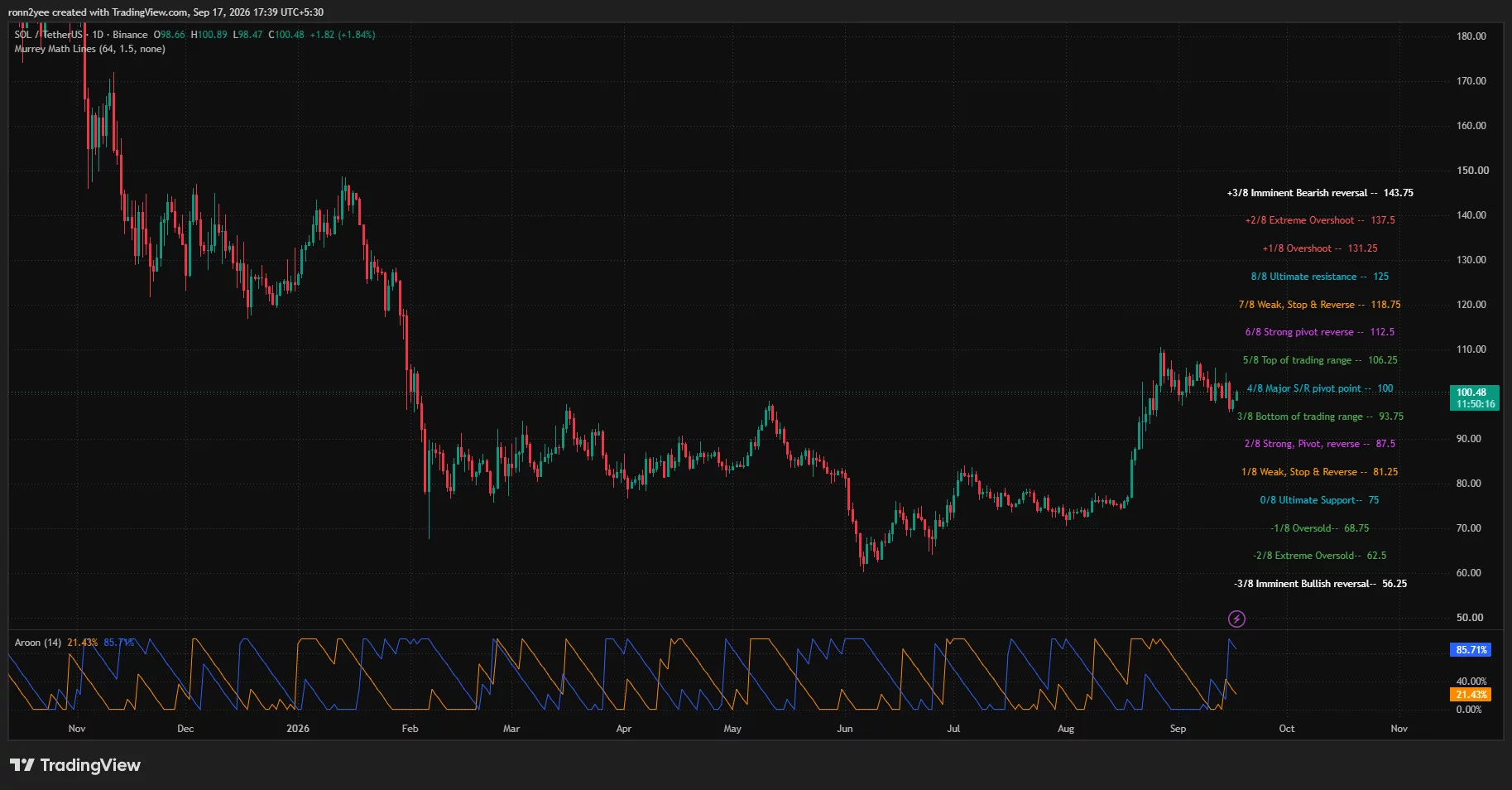
Solana price rose back above $100 after buyers defended the $95–$96 support zone, but technical resistance and concentrated liquidation levels near $102 could determine whether the rebound develops into a wider recovery.
Summary
- Solana price rebounded from $96.23 and traded near $100.50 on Thursday.
- Aroon Up reached 85.71%, showing that short-term bullish momentum had returned.
- The 4-hour Supertrend remained bearish, with resistance positioned near $102.80.
- Liquidation clusters between $101 and $102 could increase volatility during another recovery attempt.
Solana price rebounds from $96 support
Solana (SOL) price traded near $100.50 after recovering from a 24-hour low of $96.23, according to the daily chart. The rebound followed a sharp sell-off linked to the US Senate’s failed procedural vote on the CLARITY Act and the Federal Reserve’s 25-basis-point rate increase.
The daily chart shows that SOL briefly moved below $100 before buyers entered around the $95–$96 area. The recovery carried the price back to the Murrey Math major support and resistance pivot at $100.
Holding that pivot would improve the short-term structure following the decline from the late-August peak near $110. However, the asset has not yet cleared the lower highs formed during September, leaving its broader recovery incomplete.
Crypto analyst Ella identified $95–$96 as the level Solana needed to defend. She said SOL fell to $96.13 around the Fed decision before bouncing to $98.72 and outperforming Bitcoin and Ethereum during the initial recovery.
“Get back above it and yesterday’s damage starts to look repairable,” Ella wrote, referring to the $100 level.
The analyst warned that another loss of $96 could cause the rebound to fade quickly. SOL’s recovery above $100 therefore needs confirmation through sustained closes rather than a brief intraday move.
Momentum improves, but Supertrend remains bearish
The daily Aroon indicator favors buyers after the rebound. Aroon Up stood at 85.71%, compared with an Aroon Down reading of 21.43%. The gap suggests that a recent high carries more weight than the latest low within the indicator’s 14-day lookback period.
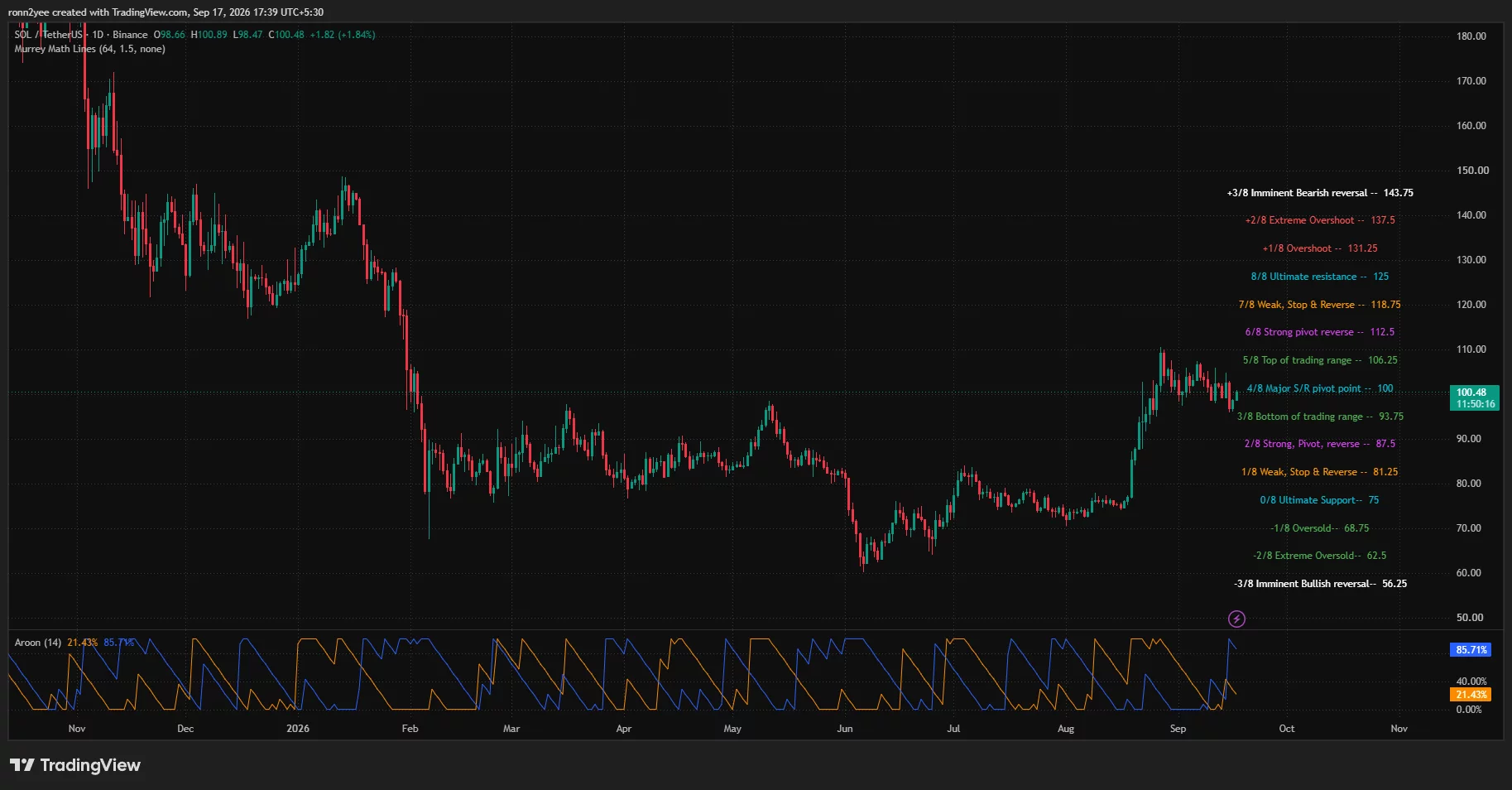
SOL must continue holding $100 for that momentum signal to remain constructive. The next daily resistance appears at $106.25, marked as the top of the current Murrey Math trading range.
A daily close above $106.25 would strengthen the case for a return toward $110 and the next major pivot at $112.50. Higher resistance sits at $118.75 and $125, although SOL would first need to break its September sequence of lower highs.
The 4-hour chart remains less supportive. SOL traded below the Supertrend level of approximately $102.80, keeping the indicator’s short-term signal bearish. Price must reclaim that level before buyers can argue that the latest correction has ended.
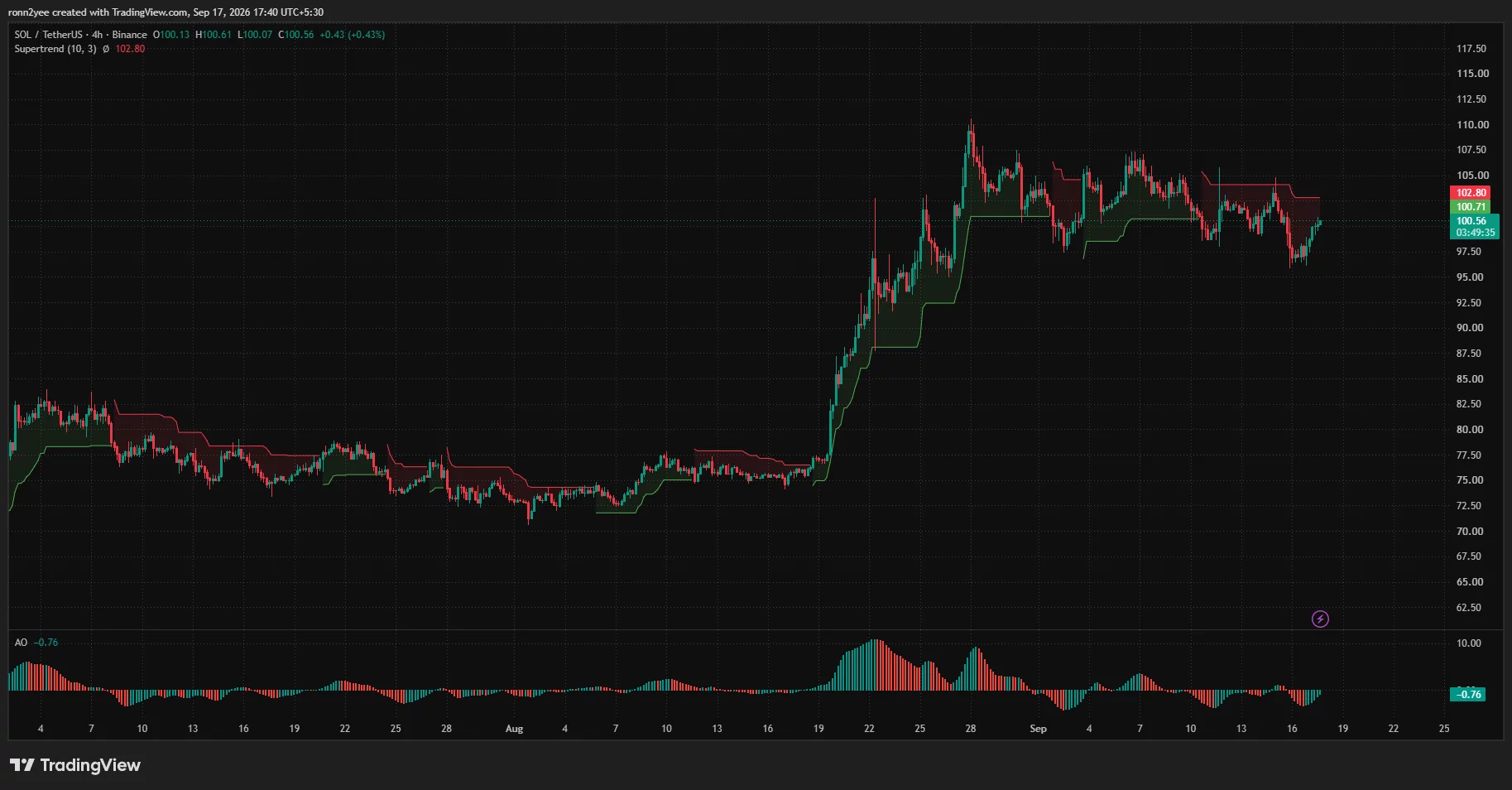
The Awesome Oscillator also remained slightly below zero at about -0.76. Its negative bars were contracting, however, suggesting that bearish momentum was losing strength as SOL recovered from $96.
A move above the zero line would confirm improving 4-hour momentum. Failure to do so could leave the latest advance vulnerable to another rejection between $101 and $103.
SOL liquidation map puts $102 in focus
The three-day CoinGlass liquidation heatmap shows a dense concentration of leveraged positions immediately above the current price. The brightest nearby bands sit around $101.30 and $101.80–$102, making that zone a potential target during an upward move.
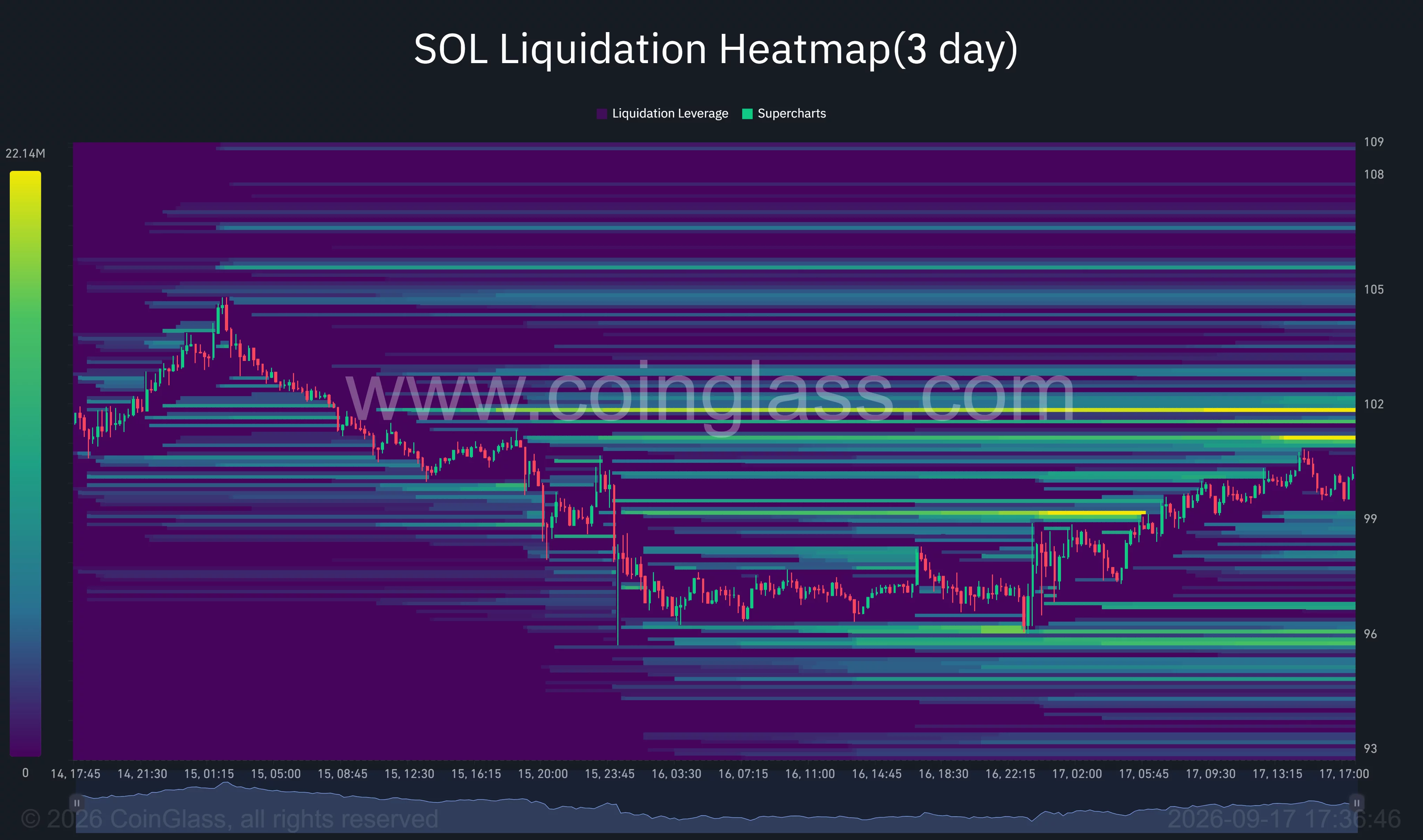
A push into those levels could liquidate short positions and help SOL test the 4-hour Supertrend resistance at $102.80. Additional liquidity appears around $105 and $105.70, close to the upper end of the $101–$106 resistance region visible on the price charts.
Liquidity also remains below the market. The clearest downside concentrations appear near $99, $96, and $95.50. Losing $99 could therefore pull the price back toward the defended $95–$96 zone as leveraged long positions come under pressure.
The heatmap does not establish price direction on its own. It instead identifies areas where forced position closures could add speed to an existing move. With sizable liquidity on both sides, a break from the $96–$103 range may produce a sharper move than the recent consolidation suggests.
Solana bulls face resistance between $102 and $106
The immediate bullish case depends on SOL holding the $100 pivot and breaking $102.80. Clearing the 4-hour Supertrend could open a move toward $105 and the daily resistance at $106.25.
Rand Group said Solana continued to defend horizontal support while pressing against a local downtrend. Its shared chart showed the asset compressing beneath descending resistance after recovering from its midyear lows, a structure the firm described as a possible breakout setup.
DeFi Development Corp.’s reported $300 million financing facility for SOL treasury purchases could provide a separate source of demand. However, its potential market impact will depend on the pace and execution of any purchases under the facility.
The bearish case would strengthen if SOL loses $99 and closes below $96. A breakdown beneath that support would invalidate the latest rebound and expose the Murrey Math level at $93.75. Further selling could bring the $87.50 pivot into view, while the wider chart places major support at $75.
For US investors, the next move may remain sensitive to changes in Treasury yields and expectations for another Fed rate increase. The CLARITY Act setback also leaves regulatory uncertainty in place for smart-contract platforms and other altcoins.
SOL has absorbed the initial policy and rate shocks without breaking its main support, but buyers still need a sustained move above $102.80—and ultimately $106.25—to confirm that control has shifted back in their favor.
Disclosure: This article does not represent investment advice. The content and materials featured on this page are for educational purposes only.

Zcash crypto trades at $1,330, up 15% over the past 24 hours, cementing its status as the session’s standout privacy asset. That kind of move doesn’t happen in a vacuum. There’s a specific regulatory trigger behind it, and a specific bull case that follows, one that carries implications well beyond ZEC itself.
The catalyst traces back to the stalled CLARITY Act, whose failure to advance has left US crypto market structure rules in limbo, pushing traders toward assets that don’t depend on regulatory clarity to function, namely, privacy coins.
Paradigm co-founder Matt Huang added fuel to the move, disclosing his firm’s ZEC position in an X post describing Zcash as “a private complement to Bitcoin.” Bitcoin itself held above $76,000 as the Fed signaled limited further tightening, giving the market room to breathe.
Zcash holders recently backed proposals for faster transactions alongside bitcoin-style halving schedules, a governance signal that’s arguably as important as the price action itself. The question now is whether this rally has legs or whether it’s a regulatory-headline spike destined to fade, and what that means for where capital rotates next.
Earn $50 and Enter $300K Prize Draw on EdgeX
Can Zcash Crypto Price Hit $1,500 This Week?
ZEC’s move above $1,300 marks a clean breakout from the $1,000 level that had capped prices for weeks, a threshold flagged as Zcash’s highest mark in nearly a decade. Volume has scaled with price, a sign this isn’t a thin-liquidity spike. The $1,300 zone now functions as near-term support; a hold there keeps the breakout structure intact.

- The bull case: a retest and break of the $1,390 intraday high opens a path toward $1,500, particularly if privacy-narrative momentum persists alongside continued regulatory gridlock.
- Base case: consolidation between $1,300 and $1,400 as traders digest the move before the next leg.
- Bear case: a slide back under $1,000 would invalidate the breakout entirely and signal the rally was headline-driven rather than structural.
Watching the $1,300 line matters more than watching the headlines at this point.
Trade Zcash on Bybit and Get a Chance to Win Our $1,000 USDT Airdrop
LiquidChain Targets Early Mover Upside as Zcash Tests Key Levels
A 15% single-day move validates conviction for anyone already holding ZEC. But at a market cap north of $22 billion, doubling from here requires a very different scale of capital inflow than doubling a sub-$1 million presale does.
That math is why traders chasing this kind of move often start looking one step earlier in the risk curve.
LiquidChain is positioning itself as a Layer 3 infrastructure play that fuses Bitcoin, Ethereum, and Solana liquidity into a single execution environment. It’s a “deploy-once” architecture meant to let developers build against all three ecosystems without fragmenting liquidity.
The quill knows what comes after L2. — LiquidChain (@getliquidchain) September 17, 2026
 https://t.co/vqvBcdSQYC pic.twitter.com/BSumZRCBFg
The presale token sits at $0.014956, with total raised at $967K and closing in on the $1 million mark. Standout features include a Unified Liquidity Layer and Verifiable Settlement.
Research LiquidChain before the presale window closes.
Discover: The Best Token Presales
The post Zcash Crypto Surges 15% as CLARITY Act Fails, Privacy Concerns Drive Demand appeared first on Cryptonews.

S&P Global has agreed to acquire OpenZeppelin, the blockchain security firm known for its open-source smart contract tooling and professional security reviews. The move is designed to strengthen S&P Global’s digital asset capabilities—particularly around risk assessment and onchain technology analysis—at a time when financial institutions are increasingly looking to tokenized markets.
The acquisition was announced on Thursday in a press release by S&P Global. Financial terms were not disclosed, and the transaction remains subject to customary closing conditions.
Key takeaways
- S&P Global’s planned purchase of OpenZeppelin targets expanded onchain smart contract and technology risk assessment capabilities.
- OpenZeppelin’s open-source contracts library is expected to remain free and publicly maintained on GitHub after the deal.
- The transaction is structured so OpenZeppelin will operate as a separate S&P Global business unit.
- Deal completion depends on closing conditions; investors should watch for regulatory and transaction approvals.
Why S&P Global wants OpenZeppelin
In its announcement, S&P Global framed the acquisition as a complement to its existing efforts in risk assessment and ecosystem development for the digital asset market. The company said the goal is to bring “trusted data, benchmarks and transparent risk assessment” to markets as activity moves onchain.
Yann Le Pallec, S&P Global’s ratings president, said the acquisition will help expand the firm’s smart contract and onchain technology risk assessment capabilities. For S&P Global, this is a strategic fit: ratings and risk frameworks typically rely on standardized methodologies, while OpenZeppelin’s offerings center on security evaluation for smart contracts and related blockchain systems.
That matters for investors and market participants because, in tokenized environments, security failures can quickly translate into financial losses. As more traditional finance workflows connect to smart contract infrastructure, the demand for repeatable, auditable security assessments is likely to grow.
What OpenZeppelin brings to the table
OpenZeppelin, founded in 2015, develops open-source smart contract software and conducts security assessments for both blockchain projects and financial institutions, according to the deal announcement. The company also highlighted its track record: its smart contracts have supported more than $37 trillion in value transferred, and it has completed over 900 security engagements.
Those numbers point to scale and adoption, but they also underscore a key differentiator in this space—OpenZeppelin is not only a services provider; it also maintains widely used reusable contract components. That dual model (public tooling plus professional security work) is often valuable to enterprises because it can reduce the friction between building securely and validating security expectations.
How the acquisition is structured
OpenZeppelin said its contracts library and other open-source applications will remain free and publicly maintained on GitHub. The announcement also states that the platform will be operated as a separate S&P Global business unit, with Demian Brener continuing as CEO and reporting to Le Pallec.
Operational independence can be important for maintaining trust in security tooling, especially where developers and institutions rely on consistent standards over time. By stating that its open-source artifacts will remain publicly maintained, OpenZeppelin also aimed to reassure builders that the acquisition is not intended to lock critical components behind proprietary access.
Part of a broader push into tokenized markets
This agreement comes shortly after S&P Global pursued additional exposure to crypto market infrastructure. Earlier this week, S&P Global led a strategic investment in Kaiko, the Paris-based crypto market data provider, extending Kaiko’s Series B funding to $110 million as it expands data infrastructure for tokenized financial markets—coverage of that round was reported by Cointelegraph in a separate piece.
Read together, the S&P Global–OpenZeppelin deal and the Kaiko investment suggest a broader strategy: pairing market data and benchmarks with stronger onchain security and risk assessment. For institutional participants trying to operationalize tokenized assets, this combination can be critical—data helps monitor markets, while security assessment helps address the risks embedded in smart contract systems.
Still, the timeline for any tangible impact will depend on deal closing. Until the acquisition completes, readers should treat the operational outcomes—such as integration plans and any changes to service delivery—as uncertain.
With S&P Global and OpenZeppelin now linked under a pending transaction, the next thing to watch is whether closing conditions are met promptly and how the new business unit evolves—especially in how it applies OpenZeppelin’s security expertise to S&P Global’s benchmarks and risk frameworks across tokenized markets.


Attackers claiming responsibility for Revolut’s data breach say they want $3 million in Monero from the banking firm, or they’ll sell the stolen customer data to other criminals.
That’s according to the Financial Times, which reports that the group, going by the name “iamnotavillain,” is making its demands for the first time.
Its ransom website was launched this week, but negotiations haven’t yet begun with Revolut.
Reuters also reports that Revolut has had no contact with, or received any demands from, the attackers.
Read more: Trezor’s summer of hacks continues with Brevo email breach
Previous reports from Coin Bureau claimed the attackers had demanded 10,000 BTC, a figure that would be worth over $760 million today. It’s unclear whether it’s a different group behind today’s demand.
Coin Bureau never revealed the usernames behind the apparent 10,000-BTC demand.
Revolut was tricked with an Italian gov email
The attackers were reportedly able to breach Revolut after obtaining access to an Italian government email.
Using this email, they posed as law enforcement and bypassed the bank’s security checks in order to retrieve data from various customer accounts.
Reuters says a source familiar with the attack told it that around 680 customers were affected, and that the attack didn’t impact Revout’s core infrastructure, databases, or customer accounts.
Earlier this month, crypto hardware wallet firm Trezor revealed that 80,000 of its users were exposed in a mailing breach.
Password manager LastPass also suffered a customer data leak in June, and researchers have claimed that India’s state-run Bank of Baroda suffered a customer data leak last July.
Got a tip? Send us an email securely via Protos Leaks. For more informed news and investigations, follow us on X, Bluesky, and Google News, or subscribe to our YouTube channel.

It’s not big news, but Cardano generated 3.3 million ADA in transaction fees against 493.7 million ADA in staking rewards across the 73 five-day epochs ending Sept. 1, 2026. Fees covered about 0.668% of rewards, leaving the reward pool roughly 149.6 times larger than fee revenue.
That gap widened as usage thinned out. Average daily transactions fell 72.46%, from 90,294 in 2022 to 24,869 between January and August 2026, turning the fee-versus-reward math into Cardano’s most pressing structural question heading into its next scaling upgrade.
If we counted transactions from Cardano’s first block and grouped the comparison into 73 five-day epochs running Sept. 1, 2025, through Sept. 1, 2026. The official epoch 654 snapshot recorded 108,500 transactions and 33,855 ADA in fees over five days, against 9.998 million ADA in distributed rewards.
Cardano’s reserves stood at 6,126,859,027 ADA in epoch 655, equal to 13.62% of the 45 billion ADA maximum supply.
Earn $50 and Enter $300K Prize Draw on EdgeX
Why Reserve Emissions Still Do the Heavy Lifting?

Under Cardano’s monetary policy, transaction fees and 0.3% of the remaining reserve flow into a virtual pot every epoch. The treasury takes 20% of that pot, and the rest is available for staking rewards, subject to pool performance.
The reserve is engineered to decay, with documentation citing a half-life of roughly four to five years and no fixed exhaustion date. As emissions shrink, nominal reward payouts can fall too, which mechanically narrows the fee-coverage gap without a single extra transaction being processed.
Current minimum fees combine a fixed component with a size-based charge, and protocol governance can still adjust those parameters, but closing the gap on a durable basis still depends on real fee-generating activity rather than a shrinking denominator alone.
Trade ADA on Bybit and Get a Chance to Win Our $1,000 USDT Airdrop
Cardano News: Leios Solves Capacity, Not Demand
Cardano reported a sixfold increase in Leios performance in an August public testnet update using synthetic traffic. It is a capacity result, not evidence that mainnet users will generate enough activity to multiply fee revenue anywhere near 150-fold. Linear Leios is designed for throughput above the simplified 43.1 TPS scenario, giving the network a plausible technical path to process far more volume than it does today.
Ouroboros Leios is steadily progressing towards mainnet. — Cardanians (CRDN) (@Cardanians_io) September 16, 2026

This week, the team demonstrated ~1,000 TPS in a test environment.
The mainnet-ready version is expected to be ready in November.
If all goes well, we could see Leios live on Cardano mainnet this year. 
BULLISH. pic.twitter.com/FXOV8E9cmn
That gap between raw throughput and paying demand is not unique to Cardano. Solana’s Transaction v1 upgrade tripled data capacity on a chain that already runs higher fee volumes meaningfully, underscoring that added capacity only converts into network income when applications and users show up to spend it.
Until applications and users generate enough paid transactions to meaningfully close the 149.6-fold gap, Cardano’s staking yields remain a function of reserve depletion rather than organic network income, a distinction that matters for anyone pricing ADA on protocol fundamentals rather than nominal APY.
Discover: The Best Token Presales
The post Cardano News: Rewards Still Depend on Reserve Emissions appeared first on Cryptonews.

Barcelona, 17 September 2026. The Vault, the institutional digital asset custody platform regulated in Switzerland and the EU, has launched its own multi-party computation (MPC) library, the cryptography that allows separate parties to hold shares of a signing key so that a complete private key never exists on any device or server. The launch follows an independent security audit by blockchain security firm Halborn, which issued its final report earlier this week confirming that all findings raised have been remediated and verified.
Artem Stopnevich, chief executive of The Vault, presented it at the European Blockchain Convention in Barcelona, describing it as the first sovereign cryptographic library for institutional custody in Europe, following the completion of an independent audit by Halborn.
The library enforces The Vault’s co-signing model, under which no single party, including The Vault itself, can authorize a transfer on its own. Most custody providers license this component from an external vendor, a decision that ties them to the vendor’s release cycle for security fixes, to the curves and protocols it supports, and to the level of disclosure it permits during due diligence.
The Vault builds it in-house, which is what the company means by sovereign cryptography: the code, the signing protocol, and the release schedule sit with the platform, so fixes ship on The Vault’s own timetable, auditors see the whole codebase, and the protocol can move forward as standards evolve.

“For an institution, custody is a risk decision that has to be signed off internally, and it comes down to a single question: who is able to move an asset, and under what controls,” said Artem Stopnevich, Chief Executive Officer of The Vault, speaking on the sidelines of the European Blockchain Convention in Barcelona, where he joined a panel on the custody of tokenised funds. “We are the only EU-regulated custody provider running institutional MPC cryptography of its own making, and we took the view that we would not put it in front of clients until somebody outside this company had taken it apart at the protocol level, which is what Halborn has now done.”
The library implements distributed key generation, resharing, refresh and recovery, and threshold ECDSA and EdDSA signing, together with commitment, oblivious transfer and zero-knowledge proof primitives, and the transport that carries protocol messages between signers. It is written in Rust, a systems language whose compiler enforces memory safety without a garbage collector, and the same implementation runs on The Vault’s servers and inside the mobile signer on iOS and Android, so the audit covers a single codebase.
“The properties we need at the signing layer are the ones the compiler can enforce for us: no use-after-free, no data races across the concurrent rounds of a protocol, and explicit control over how key material is held in memory and erased once it is no longer needed,” said Yurii Derbasov, Chief Technology Officer at The Vault. “The language does not make a protocol correct, which is why the design itself needed an external review of this depth.”
Halborn’s engagement covered 91 files across the cryptographic core, its test suite and the iOS and Android signer applications. Findings raised during the review were addressed in the codebase as the engagement progressed, and Halborn verified each remediation against the commit that implemented it, confirming the final items in August 2026.
“It was a pleasure to work together with The Vault on securing their MPC custody. Security was clearly a priority for their team, and all findings raised during the engagement were remediated and verified. For institutional custody, proprietary cryptography gives providers direct control over security fixes and protocol updates, and allows auditors to examine the complete implementation rather than stopping at a vendor boundary. That matters when clients are performing technical due diligence on who can move their assets.” said Gabi Urrutia, SVP Security & Field CISO at Halborn.
In the co-signing model, the client holds a key share on their own device, and the mobile signer is the application through which that share is held and used. It is available as an add-on to The Vault’s SaaS custody product.
Looking ahead, The Vault intends to publish the Rust library as open source, so that the cryptography can be examined by anyone, and its cryptography team is working on two new protocols.
The first is a threshold variant of ML-DSA, the post-quantum signature scheme that NIST standardized under FIPS 204 for a single signer; threshold signatures have no NIST-standardised form today, and candidate constructions, classical and post-quantum alike, are going through competitive selection under the NIST First Call for Multi-Party Threshold Schemes, which opened in January 2026. The second is a new threshold post-quantum password-authenticated key exchange, or PAKE.
The full report is available to institutional clients on request (media@thevault.inc).
About The Vault
The Vault is a Swiss and EU-regulated institutional infrastructure platform for digital assets, serving corporate treasuries, financial institutions, family offices, and payment providers. It covers the full lifecycle, from secure custody and treasury operations to back-office management and wallet infrastructure, and is built on proprietary threshold MPC cryptography developed by an in-house research team. It is available in SaaS and On-Premise, with a bespoke modular architecture that can be customized to each company’s needs and frameworks.
The post The Vault Launches Its own MPC Library for Institutional Custody appeared first on BeInCrypto.
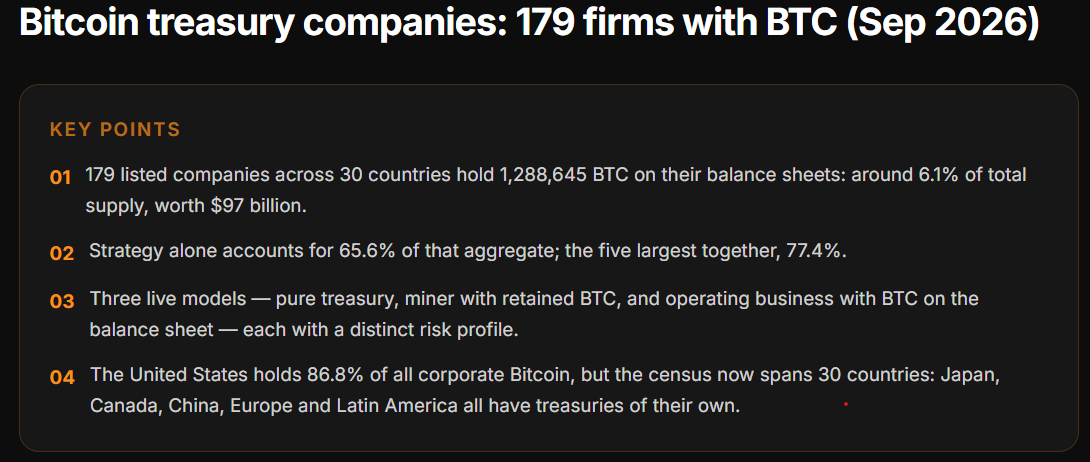
There are now 179 listed companies holding Bitcoin on their balance sheets, all following variations of the same simple formula:
Raise capital on traditional markets, buy Bitcoin and attempt to increase the amount of BTC that backs each share faster than the company dilutes shareholders.
According to Mark Palmer, managing director and senior equity research analyst at StoneX, that’s how treasury companies attempt to “beat” Bitcoin’s returns.
Making that equation work is a lot easier when the price of Bitcoin is going up and investors are happy to fund the next spree of purchases. Unfortunately, the mechanics work in both directions.
When the premium evaporates, investor enthusiasm wanes. Financing gets harder, debt and yield obligations remain, and the same structure that outperformed the asset magnifies the losses on the way down. No surprise that the 50 largest Bitcoin treasury companies bled $83 billion in market value since July 2025.
Metaplanet’s recent shareholder backlash shows the sort of questions that arise when treasury companies dilute their shareholders too much.
Treasury companies are more likely to need to raise money in bear markets, but this creates a potential problem. Palmer says:
“Issuing shares at a premium to net asset value and buying Bitcoin with the proceeds increases the Bitcoin backing every existing share. The same issuance at a discount destroys value.”
So are the outsize returns on offer during the bull market, worth it for the downside risks during the bear?
The math works, until the capital markets stop cooperating
For all the complexity around Bitcoin treasury companies, the basic test for potential investors is relatively simple. Do shareholders end up with more Bitcoin backing each share over time?
Palmer says investors should look past the headline number of Bitcoin a company holds and focus instead on “Bitcoin per fully diluted share, net of debt and preferred stock claims.”
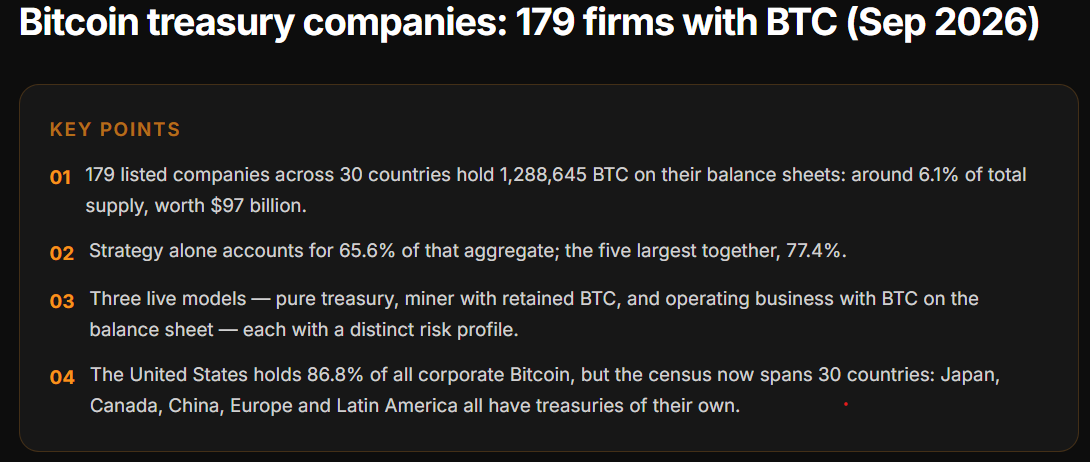
179 Bitcoin treasury companies as of September 2026. Source: SatsIntel
Issuing new shares is not necessarily a problem. What matters, is whether the new capital generates enough additional value and profit that the benefits to existing shareholders outweigh the dilution.
Related: Metaplanet moves 4,800 BTC worth $377M to Coinbase Prime
If the company issues shares for more than the value of the Bitcoin that backs them, and uses that money to buy more Bitcoin, shareholders can end up with more Bitcoin per share. If it raises money below that value, they can end up with less.
That dynamic was very favorable for Strategy during the last Bitcoin bull market, McCarthy says, because Bitcoin was increasing fast. “They were able to take on new debt. They were able to issue new debt because of that.”
The first blow is half the battle
Choosing the right digital asset treasury is a key decision. With a couple of hundred now on offer, longer established companies have the advantage, explains McCarthy:
“It’s a first-mover advantage, right? Like if you’re Michael Saylor or you’re Bitmine and you’ve got this sort of larger-than-life character at the top, it’s a bit different.”
Strategy’s executive chairman Michael Saylor has become part of the machinery of the trade itself, and McCarthy says he can keep the story moving even when Bitcoin’s price isn’t. Ethereum treasury company Bitmine has a similarly prominent figure in Tom Lee.
Bitcoin and other cryptocurrencies rise and fall on narratives, so having a storyteller out front helps keep investors interested — especially when the underlying asset is in freefall. But McCarthy warns:
“I don’t think there’s enough room for a hundred Michael Saylors; there’s not enough people like that around.”
Related: Strategy raises $334M through stock sales but buys no Bitcoin
McCarthy says many of the companies that followed Strategy were essentially just buying Bitcoin and hoping the stock price would follow. They “didn’t have an exit plan” for when the dynamics reversed, he says, and he expects the shakeout to be even more brutal still:
“I think it’s going to flush out like 95% of it.”
The corporate wrapper comes with baggage
There are also simpler ways to get exposure to Bitcoin by just buying it directly on an exchange, or via a spot Bitcoin exchange-traded fund (ETF).
Spot ETFs let TradFi investors buy Bitcoin through a conventional brokerage account, without having to consider a DAT’s company’s management, financing structure, or governance risks.
Creative financial engineering can be difficult for retail investors to understand, says Palmer:
“The biggest risk that investors face in buying Bitcoin treasury company stocks is forgetting that common shareholders’ claim is a residual one, as convertible debt and perpetual preferred stock sit ahead of them in terms of priority.”
Those instruments, he adds, “carry cash obligations that Bitcoin itself doesn’t generate.”
So, can treasury companies beat Bitcoin?
Matt Cole, chief executive of Strive, one of the largest Bitcoin treasury companies, says investors should just look at the scoreboard:
“Strategy has dramatically outperformed Bitcoin since adopting its strategy. Metaplanet has also outperformed Bitcoin since inception and Strive has outperformed Bitcoin both since announcing our strategy in May 2025 and year-to-date in 2026.”
He adds that, “Strive has not sold a single Bitcoin, and during a Bitcoin bear market we have increased our holdings approximately fourfold while outperforming Bitcoin.”
David Bailey, chief executive of Nakamoto, makes a similar case for Metaplanet, saying it was “the best performing equity in the world for nearly two years” and is “up 1,300% from genesis.”
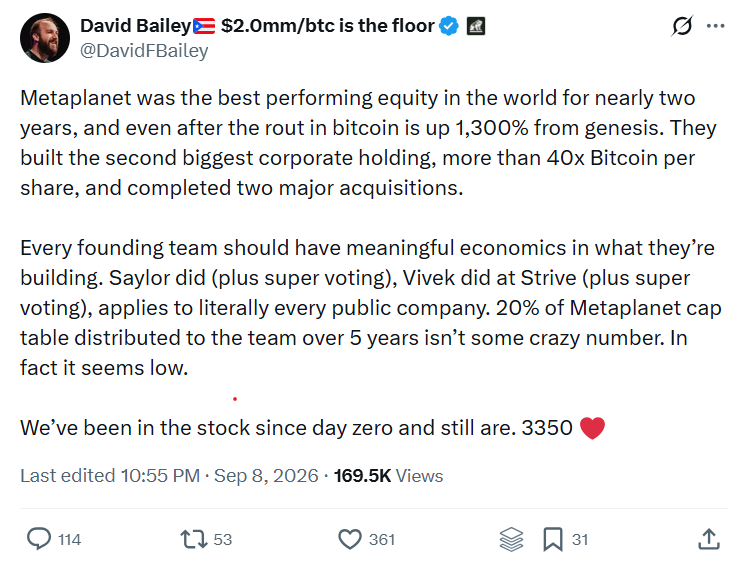
David Bailey says Metaplanet best performing equity for 2 years. Source: David Bailey.
Despite the returns to date, debt maturity and yield obligations may still cause problems down the line. And some companies without the same access to capital, investor following or balance sheet firepower have found out how quickly the trade can work against them. The two most notable examples are Bailey’s own Nakamoto Inc, whose stock fell 99% from its 2025 peak and the UK company Satsuma Technology, which saw a similar decline.
McCarthy’s own view is telling. When asked how he would deploy $100,000 for Bitcoin exposure, he says he would “mostly buy an ETF” and might put a smaller amount into Strategy “for the vol.”
At the end of the day, buying Bitcoin is a bet on Bitcoin. Buying a treasury company is a bet on Bitcoin plus an additional bet on the people, financing structure, balance sheet and corporate governance wrapped around it.
Magazine: Strategy became a symbol of the dot-com crash: Could history repeat?
Cointelegraph publishes long-form journalism, analysis and narrative reporting produced by Cointelegraph’s in-house editorial team with subject-matter expertise. All articles are edited and reviewed by Cointelegraph editors in line with our editorial standards. Some articles contain affiliate links, from which Cointelegraph may earn a commission. These relationships do not influence which products we review or our editorial conclusions. Content published in here does not constitute financial, legal or investment advice. Readers should conduct their own research and consult qualified professionals where appropriate. Cointelegraph maintains full editorial independence.


S&P Global (SPGI) said Thursday it has agreed to buy OpenZeppelin, a smart-contract security firm whose open-source code library is used across much of the stablecoin and tokenized-fund market. S&P said contracts built with the library have moved more than $37 trillion over time. Terms of the deal were not disclosed.
The deal gives S&P Global access to a part of onchain finance that conventional ratings do not cover: the code that issues, moves and manages stablecoins, tokenized funds and DeFi products. A project can have sound reserves or a strong credit profile but still fail because of a flaw in its smart contracts. S&P is betting banks and asset managers will need common ways to assess that technology risk before they use onchain products at scale.
The $37 trillion figure is a measure of value transferred through contracts using OpenZeppelin’s library over time, not assets the company manages or holds.
“The transaction complements S&P Global’s risk assessment and ecosystem development capabilities in digital asset markets, enhancing its ability to create the next generation of onchain security assessments, benchmarks, and deliver essential intelligence as capital markets transition onchain,” the firm said.
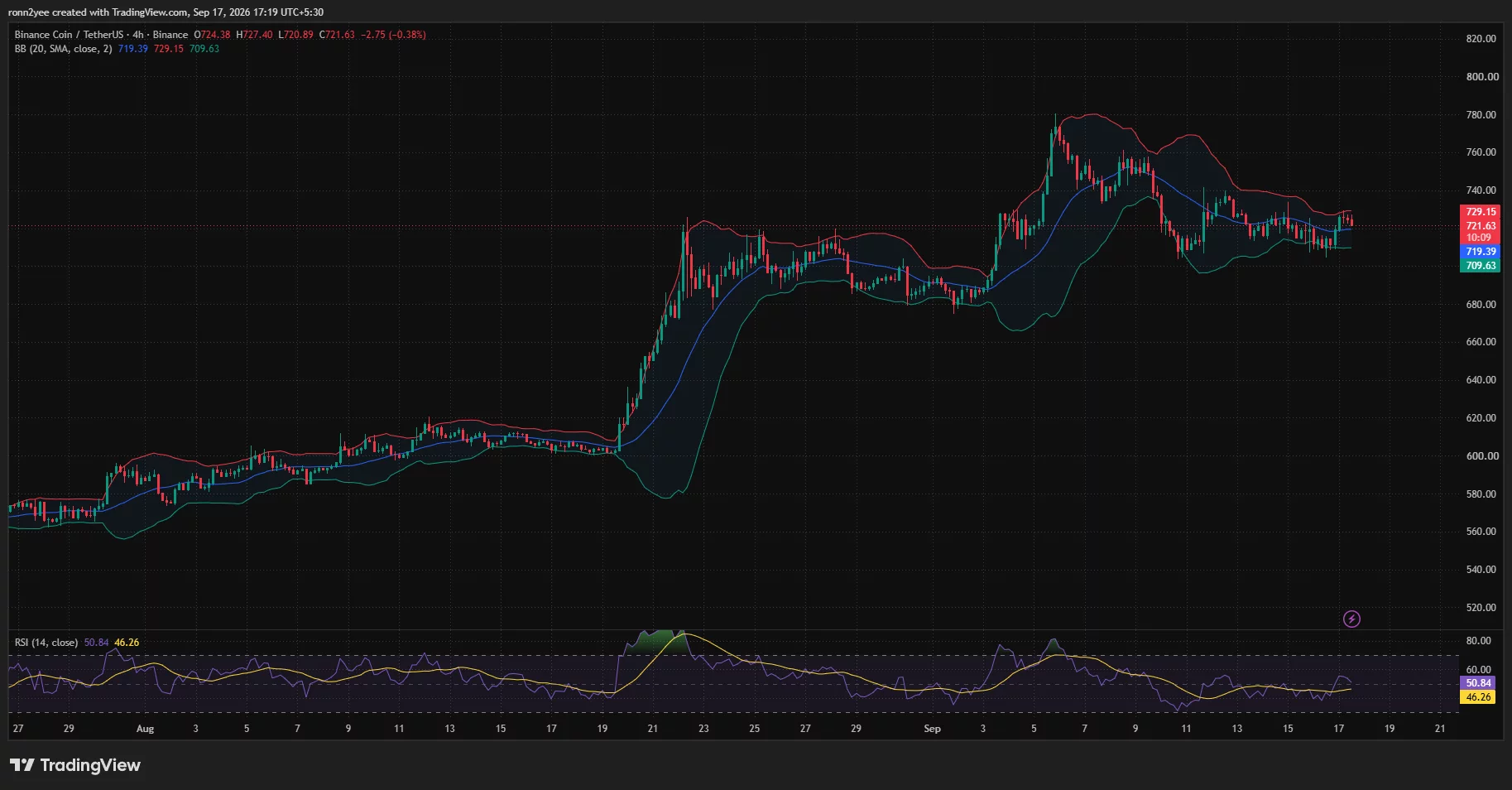
BNB price traded near $721 on Sep. 17 after buyers defended the $709–$710 area, but weakening daily momentum and dense liquidity above $739 leave the token without a clear breakout signal.
Summary
- BNB price recovered from a daily low near $709 but remained below resistance at $729.
- The 4-hour RSI returned to 50.84, showing balanced momentum after the rebound.
- Daily MACD recorded a bearish crossover, while the histogram fell to -5.04.
- Liquidation clusters near $710 and $740 could shape BNB’s next major move.
BNB price consolidates above $710
BNB (BNB) price was trading at approximately $721 at the time of writing, down 0.63% during the daily session. The token opened near $725.92, reached $729.22, and fell as low as $720.89 on the daily candle.
The wider chart shows that BNB remains in a consolidation phase following its early-September rally. The token climbed from below $700 to nearly $780 before sellers pushed it back toward the $710 region.
Price has since formed a tighter range between roughly $710 and $730. Repeated defenses of the lower boundary show that buyers remain active around $700–$710, but the lack of a sustained move above $730 suggests demand has not yet regained full control.
BNB’s broader structure still includes higher lows from the July bottom near $550. However, the decline from the September high has interrupted the previous bullish momentum and left the token searching for a new short-term direction.
The pullback came against a weaker risk backdrop following the failed procedural vote on the US CLARITY Act and the Federal Reserve’s 25-basis-point rate increase. Higher US interest rates can reduce demand for risk assets by lifting returns on cash and government debt.
4-hour indicators point to a neutral setup
The 4-hour Bollinger Bands show BNB trading just above the middle band at $719.39. The upper band stands at $729.15, while the lower band sits at $709.63.
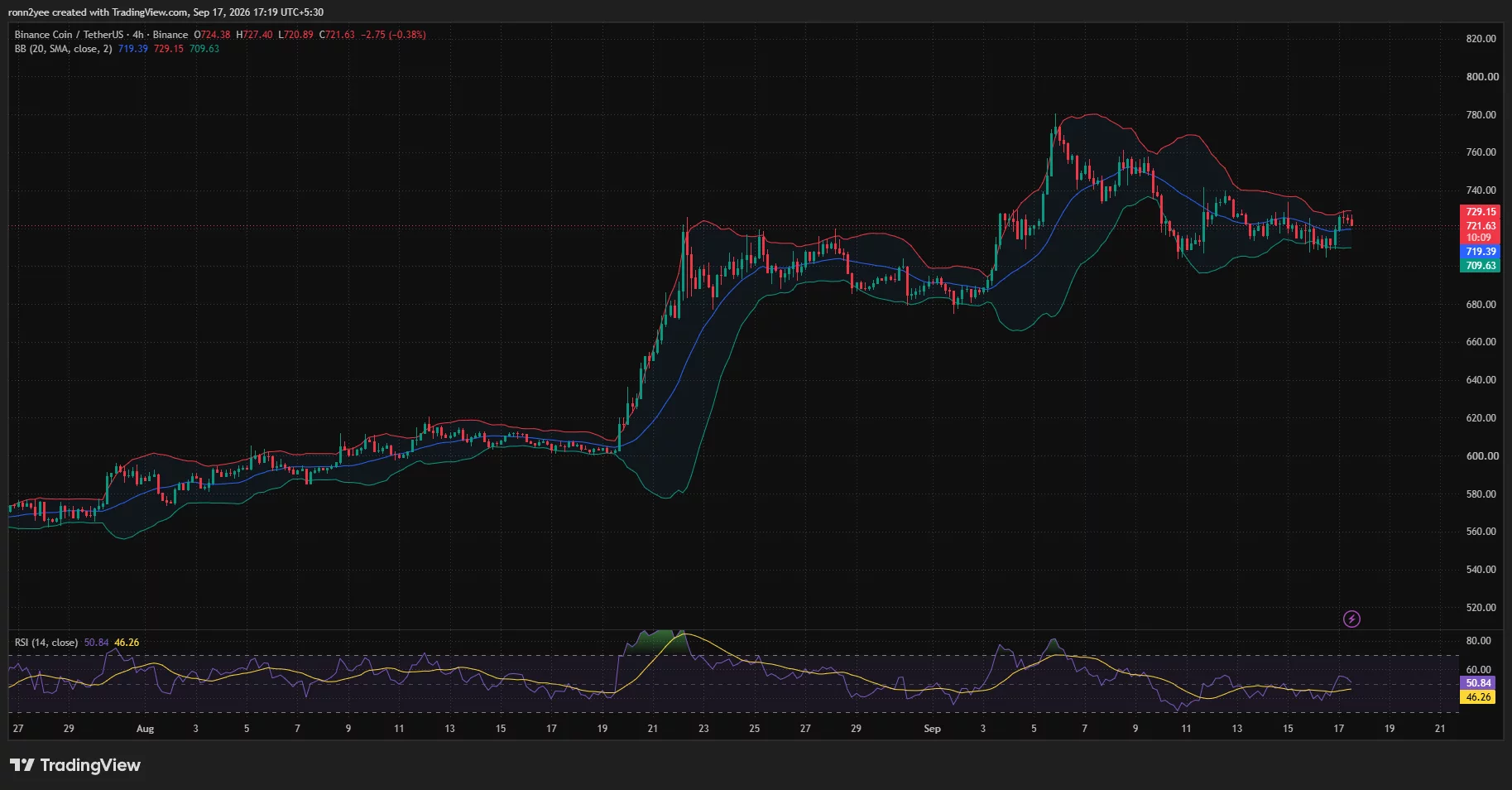
Price near the middle band reflects consolidation rather than a strong directional trend. The narrowing distance between the bands also points to falling volatility after the sharp swings seen earlier in September.
A 4-hour close above $729.15 would push BNB beyond the upper Bollinger Band and could signal renewed upside momentum. Buyers would then need to clear the $737–$740 area to establish a stronger breakout.
The lower band reinforces $709–$710 as immediate support. A decisive close beneath it would show that the current range has broken down and could expose the psychological $700 level.
BNB’s 4-hour relative strength index stood at 50.84, above its moving average of 46.26. The reading places momentum near the center of its range, with neither buyers nor sellers holding a major advantage.
The RSI’s recovery above 50 offers a modest positive signal, but it has not reached the 60–70 area normally associated with stronger bullish momentum. Price therefore needs confirmation from a resistance breakout before the indicator can support a wider recovery scenario.
Daily MACD warns of fading bullish momentum
BNB’s daily chart presents a weaker momentum picture. The moving average convergence divergence line stood at 15.14, below the signal line at 20.18, while the histogram had fallen to -5.04.
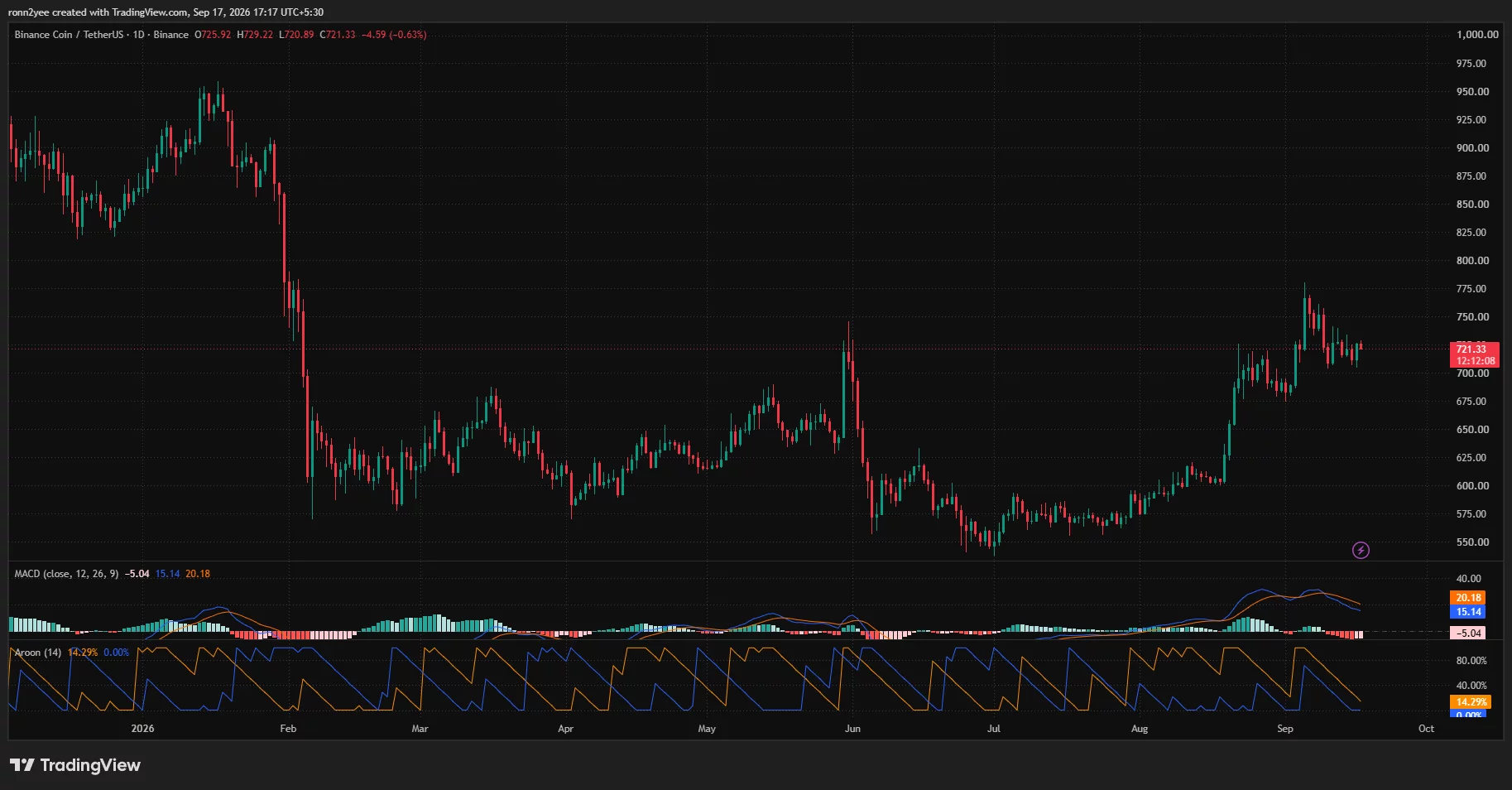
The bearish crossover shows that momentum from the late-August rally is fading. The MACD remains above the zero line, meaning the broader recovery has not fully reversed, but the negative histogram signals increasing short-term selling pressure.
Aroon readings also show limited directional strength. The indicator’s two lines had fallen to 14.29% and 0%, suggesting that neither a fresh high nor a fresh low has recently established a dominant trend.
Low Aroon readings often appear during consolidation. In BNB’s case, they support the range-bound structure visible since the price retreated from nearly $780.
For a bullish reversal, the MACD line would need to flatten and move back above the signal line. A stronger Aroon Up reading would provide further confirmation if BNB begins setting fresh short-term highs.
Liquidation heatmap places $740 in focus
The 24-hour liquidation heatmap shows concentrated leverage on both sides of BNB’s current price. The nearest lower liquidity cluster appears around $709–$712, close to the 4-hour lower Bollinger Band.
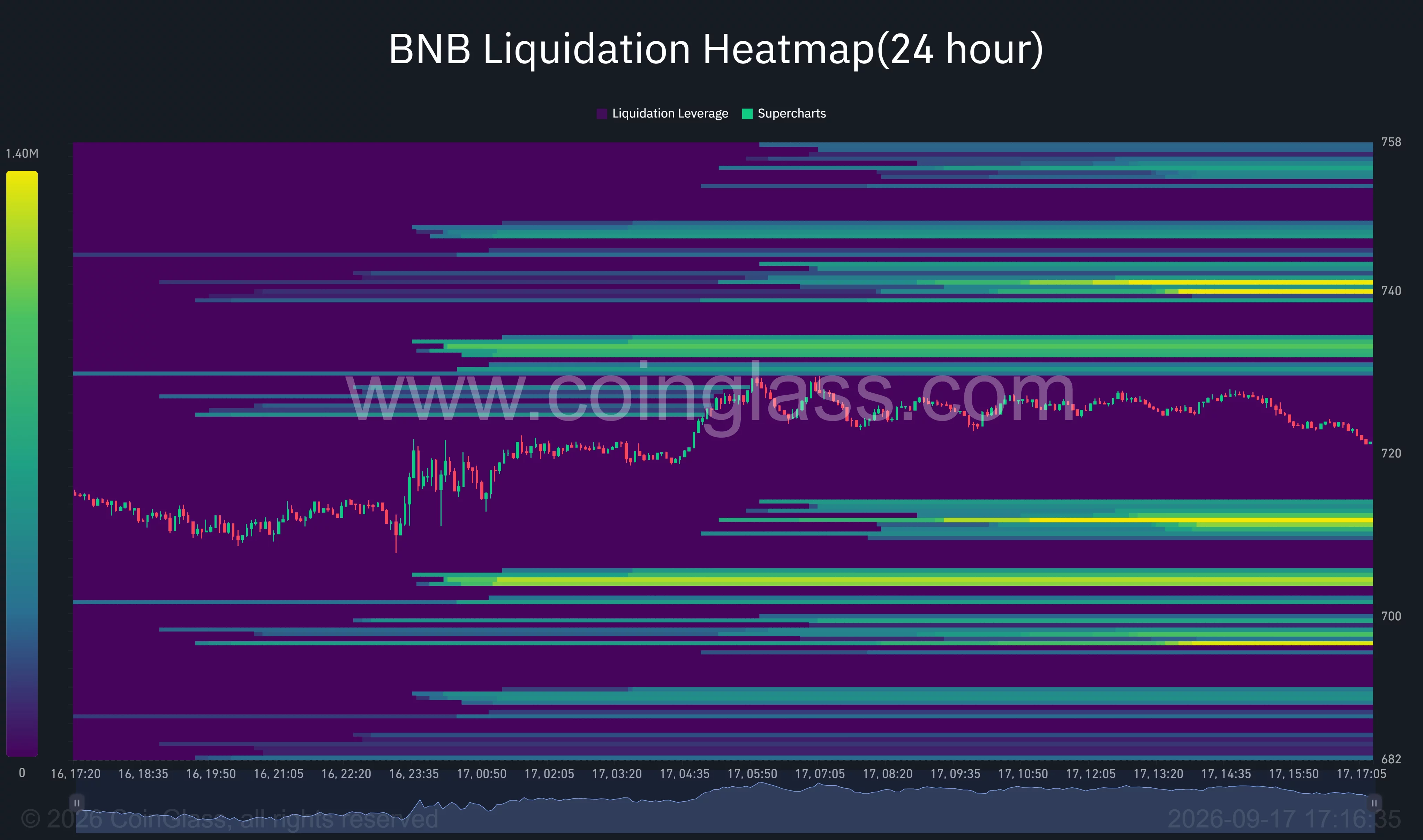
Larger pockets are also visible near $703–$705 and $695–$698. If BNB loses $709, leveraged long positions around those levels could increase downside volatility and pull the price toward $700.
Above the market, liquidity is concentrated around $727–$730, followed by a brighter and denser cluster near $739–$741. The latter area matches the resistance zone identified by the price charts.
A move through $730 could therefore draw BNB toward $740 as short positions are closed. However, the large concentration at that level may also create resistance if spot demand does not support the derivatives-driven move.
Additional liquidity appears near $747–$755, giving bulls a secondary target if BNB establishes support above $740.
BNB faces breakout test between $710 and $740
BNB’s short-term outlook depends on which side of the current range gives way first. Holding $709–$710 would preserve the consolidation and allow another attempt at $729.
A 4-hour close above $729, followed by a sustained move through $740, would strengthen the bullish case. The next targets would sit near $750 and the September peak around $775–$780.
The bearish case would gain weight if BNB closes below $709. Such a move would break the lower Bollinger Band and could trigger liquidations toward $703, $700, and $695. A loss of $695 would weaken the broader recovery structure and place the late-August breakout area near $680 back in view.
For US investors, the Federal Reserve’s rate path and any further action on crypto market-structure legislation remain potential sources of volatility. Technically, however, $710 support and $740 resistance provide the clearest boundaries for BNB’s next directional move.
Disclosure: This article does not represent investment advice. The content and materials featured on this page are for educational purposes only.

After the CLARITY Act fails, XRP price falls and faces selling pressure, investors fight back successfully to earn $10,000 a day

Jurgen Klopp Calls Up 44 Players In Huge First Germany Squad

FCC ISM Rules May Shatter Lora Mesh Communities

Weekend Open Thread – Corporette.com

Memory prices are slowing because buyers ran out of money

Micron Stock Climbs Above $1,031 as AI Memory Crunch and a $50 Billion Outlook Fuel the Rally

Jio financial share | Jio financial share latest news | jio financial share anelysis, jiofin

Dj Maphorisa, DJ Tunez, Wizkid, Mavo – MONEY CONSTANT (Official Audio)

WATCH LIVE: Senate Democrats block cryptocurrency bill, demanding more limits on Trump’s investments
-
 Fashion6 days ago
Weekend Open Thread – Corporette.com
-

 Tech4 days ago
The Latest Weird Thing to Play Doom Is the Mapped-Out Brain of a Fruit Fly
-

 Business6 days ago
10 Most-Streamed Songs On Spotify In 2026 So Far, Led By Ella Langley’s Dominant Run On The Charts This Year
-

 Crypto World6 days ago
XAG/USD: Silver’s Short-Term Rally Meets Its Moment of Truth
-

 Tech7 days ago
Battery life is the only iPhone 18 Pro and iPhone Duo upgrade I care about. Apple didn’t disappoint
-

 Crypto World7 days ago
OKX launches 10x OpenAI, Anthropic X-Perps in Europe
-

 Crypto World6 days ago
Diesel Tops $6 a Gallon for the First Time as 28 States Set Records
-

 Crypto World3 days ago
Kraken Lets xStocks Holders Earn Yield Through DeFi
-

 Business7 days ago
Western Digital Slips 2.7% as AI Storage Rally Cools After Record Cash and Guidance
-

 News Videos6 days ago
Facing Financial Fears
-

 Crypto World3 days ago
Elon Musk Drops a Bombshell: Grok 5 Could Be the AGI Breakthrough
-

 Business4 days ago
Rivals Sam Altman and Elon Musk Rally Behind Dario Amodei’s Call for a Slowdown in AI Development
-
Crypto World7 days ago
Ethereum Price Analysis: Consolidation at $2.5K Tests Momentum as On-Chain Activity Surges
-

 Crypto World5 days ago
Can AI Build a Startup in 72 Hours? Elon Musk's Team Will Livestream the Test
-

 Entertainment6 days ago
News Specials, Movies, Shows, More
-

 Crypto World15 hours ago
US Charges Robinhood Engineers Over Crypto Listing Trades
-
 NewsBeat3 days ago
‘Sick conspiracy’: Trump says only guardrails AI needs is ‘a strong and smart (High IQ!) president’ in all-caps rant
-

 Crypto World6 days ago
Bitcoin ETFs Pull $167M as 2026’s Best Inflow Run Slows
-

 Crypto World7 days ago
US CPI forecast at 3.4% as tariff risks build
-
 Entertainment6 days ago
New Horror Movie Officially Earns a Rare Stephen King Recommendation
You must be logged in to post a comment Login