
Crypto World
FBI Issues Urgent Warning as Russian Hackers Target Signal Users and Compromise Thousands of American Accounts


TLDR:
- Russian intelligence-linked hackers have compromised thousands of Signal accounts through targeted phishing campaigns globally.
- High-value targets include current and former U.S. government officials, military personnel, journalists, and political figures.
- Signal’s encryption remains unbroken — Russian hackers bypass it by stealing user credentials through social engineering.
- The FBI urges Americans to never share PINs or 2FA codes and to report suspicious activity to IC3.gov immediately.
The FBI has issued a stark warning about Russian hackers actively targeting Americans who use Signal and other commercial messaging apps.
Working alongside the Cybersecurity and Infrastructure Security Agency, the bureau confirmed that thousands of individual accounts have already been compromised.
The campaign focuses on high-value targets, including current and former U.S. government officials, military personnel, political figures, and journalists. Authorities stress that Signal’s encryption is not at fault — end users are the primary vulnerability.
FBI Confirms Russian Hackers Are Actively Compromising Signal Accounts Across the Globe
Russian hackers linked to the country’s intelligence services have been running a coordinated phishing campaign against Signal users.
The operation involves sending messages disguised as official CMA support communications to unsuspecting targets. Once a user interacts with the message, the attacker gains full access to their account.
FBI Director Kash Patel publicly confirmed the threat, warning Americans through an official statement on X.
After gaining access, Russian hackers can read private messages and browse full contact lists. They can also send messages while posing as the account owner. This creates a chain of trust-based attacks that are difficult for recipients to detect.
The phishing messages are carefully tailored to each target, making them appear legitimate and urgent. Victims are typically asked to click a link, provide a verification code, or submit an account PIN. Any of these actions immediately hands control of the account to the attacker.
Authorities noted that the campaign continues to evolve. Russian hackers may expand their methods to include malware designed to infect victim devices directly. This development moves the threat beyond social engineering into more technically advanced territory.
Signal’s end-to-end encryption remains fully operational and has not been breached. However, the FBI warned that phishing renders encryption irrelevant when attackers access accounts directly. No level of encryption can protect a user who unknowingly hands over their credentials.
What Americans Can Do Right Now to Protect Their Signal Accounts
The FBI and CISA released joint guidance to help Americans defend against the ongoing Russian hacker campaign.
The first step is straightforward: stop all interaction the moment a message feels suspicious. Users should never share PINs or two-factor authentication codes for actions they did not personally initiate.
Any unsolicited message requesting account information should be treated as a potential phishing attempt. Even messages appearing to come from known contacts warrant caution if they contain unusual requests.
When uncertain, users should contact the sender through a completely separate channel before responding.
Group chats also need to be monitored carefully for unauthorized participants. Users should scan participant lists regularly for duplicate or unfamiliar accounts.
Any anomaly should be verified through secure communication outside of the app before further messages are shared.
The FBI reminded Americans that legitimate Signal support never sends verification links through direct messages.
Real support teams communicate exclusively through official email channels and never request codes or PINs inside the app. Any message claiming otherwise is almost certainly a phishing attempt by Russian hackers.
Americans who suspect they have been targeted should report the activity to the Internet Crime Complaint Center at IC3.gov or contact their nearest FBI field office.
Organizational IT and security teams should also be notified immediately. Fast reporting strengthens the FBI’s ability to track the campaign and protect additional accounts from being compromised.



A 66-year-old Hong Kong retiree lost 6.6 million Hong Kong dollars (roughly $840,000) in a string of three related crypto investment scams after repeatedly trusting self-proclaimed “virtual currency experts” who reached out via WhatsApp, according to Hong Kong police’s CyberDefender unit.
In a March 20 Facebook post, police said the victim was first approached in September 2025 by a scammer who cold messaged, claiming to be a “virtual currency investment expert” and promising steady gains if the victim followed his advice. The retiree then transferred $180,000 and deposited crypto into a wallet the scammer controlled, only to watch him disappear, prompting the filing of a police report.
The case shows how fraudsters can recycle the same victim through successive schemes that start with “guaranteed profit” pitches and escalate into offers to recover funds that have already been stolen.
“Life has no take two; but scams can have take three,” the CyberDefender team wrote, warning that genuine professionals do not rely on random outreach and that phrases such as “guaranteed returns” and “inside information” are classic red flags.
Related: How US investigators traced $61M in crypto tied to romance scams across wallets

Triple “crypto expert” scam drains retiree’s savings
The retiree then transferred $180,000 and deposited crypto into a wallet the scammer controlled, only to watch him disappear, prompting the victim to file a police report.
Unwilling to accept the loss, the victim later searched online for another “crypto expert” who claimed he could help recover the missing funds, but then demanded $75,000 as a security deposit. After the victim paid, that expert also vanished.
In January, a third supposed specialist messaged the retiree on WhatsApp offering to reclaim both prior losses if the victim bought $585,000 in crypto and sent it to a specified address. Once the victim complied, that scammer disappeared as well, bringing the total losses over roughly six months to approximately $840,000.
Incident falls amid rising Web3 fraud
The case lands against a broader backdrop of mounting crypto-related crime. Web3 platforms saw about $3.95 billion in losses in 2025, with state-linked hackers and weak key security driving much of the damage, according to security firm Hacken.
Authorities worldwide have also flagged new waves of phishing and investment fraud, from the FBI’s recent warning over fake FBI tokens on Tron to India’s GainBitcoin probe and US efforts to forfeit $3.4 million in Tether tied to a multi-state investment scam.
Magazine: Influencers shilling memecoin scams face severe legal consequences

Bitcoin’s mining difficulty shifted lower once more, declining by about 7.7% in the latest retarget to 133.79 trillion at block 941,472, according to CoinWarz data. The move follows a mid-March dip that pulled the metric from roughly 148 trillion to the current level, marking the sharpest drop since February. A lower difficulty means less computational work is required to mine a given block, effectively boosting revenue per unit of hash power for operators that keep running.
The adjustment came on the heels of slower-than-target block production over the previous 2,016 blocks. CloverPool’s explorer data show average block times near 12 minutes 36 seconds—well above Bitcoin’s 10-minute target—prompting the protocol to recalibrate downward to maintain steady issuance.
February’s landscape also featured a notable disruption: weather-related outages in the United States temporarily knocked several large mining facilities offline, triggering a sharp drop in difficulty. As power conditions normalized and hashrate returned, the metric rebounded by roughly 15% in subsequent weeks, underscoring the sensitivity of the network to regional outages and the geographic concentration of mining capacity.
Bitcoin’s difficulty metric measures how hard it is to find a valid hash for the next block. It auto-adjusts to keep block production close to one every 10 minutes; rising hashpower pushes difficulty higher to prevent blocks from being mined too quickly, while a retreat in hashrate lowers the target to preserve issuance cadence.
Related: Cango reports $285M Q4 loss as Bitcoin mining costs surge in 2025
The market consensus around the near-term difficulty path remains conditional on how quickly the next 10-minute cadence can resume as hashrate shifts with weather, power prices and utilization of mining hardware across regions. The next difficulty adjustment is currently projected for April 3, subject to block-by-block changes.
Key takeaways
- March 20 adjustment: Bitcoin mining difficulty fell about 7.7% to 133.79 trillion at block 941,472, marking the steepest drop since February and reflecting a softer recent hash rate.
- Block-time pressure: Average block times around 12 minutes 36 seconds, well above the 10-minute target, catalyzed the downward recalibration to keep issuance stable.
- Weather-driven volatility: February’s drop followed US weather disruptions that temporarily sidelined major facilities, with a roughly 15% rebound as power conditions normalized.
- Strategic shifts among miners: In response to tighter margins and power costs, several operators are moving toward AI and high-performance computing workloads to diversify revenue streams beyond pure BTC mining.
Miner strategy shifts in a power-cost environment
The latest difficulty reset arrives at a moment when a subset of publicly listed miners is broadening its focus beyond traditional Bitcoin mining. Industry observers note that AI workloads and HPC infrastructure offer a potential counterbalance to volatile crypto earnings, leveraging existing data-center footprints and power networks to monetize idle capacity without relying exclusively on block rewards.
Among the players cited in market discourse, Core Scientific, Marathon Digital Holdings (MARA), Hut 8, and Cipher Mining have steered capacity toward AI-oriented deployments or high-performance computing. The trend aligns with a broader re-evaluation of capital expenditure and capacity utilization as power prices squeeze margins and competition for electricity intensifies between compute-intensive sectors.
Additionally, Bitdeer has moved to shrink its treasury exposure. The company disclosed it liquidated 943 BTC from reserves in February and, in its latest weekly update on March 21, confirmed that its BTC holdings remained at zero. Such treasury management moves highlight a broader investor question: how miners balance balance sheets against cyclical earnings and shifting demand for computing power.
Proponents of the AI pivot argue that the overlap between data-center capacity and AI workloads offers a path to steadier returns in environments where BTC mining margins can swing with electricity costs and network difficulty. Critics contend that AI demand may also be volatile and energy-intensive, potentially creating its own cycle of capacity constraints and price pressures.
Industry commentary has also touched on resilience questions for Bitcoin itself. Some observers have framed AI as the newest competing demand for electricity, even as proponents stress the enduring value of Bitcoin’s decentralized security model. The debate underscores a broader strategic tension facing miners: diversify beyond a single revenue line or double down on core hash-power economics during periods of elevated energy costs.
Looking ahead, investors and operators will watch how the next rounds of capacity expansion, power pricing, and regulatory developments influence both the profitability of existing mines and the viability of AI-centric data-center deployments. The ongoing swing in hashrate and difficulty will continue to interact with these strategic choices, shaping the industry’s trajectory through the rest of the year.
As the network navigates these crosscurrents, the immediate question for market participants is what the April 3 adjustment will reveal about the balance of supply and demand in the global mining ecosystem. For readers tracking risk and opportunity, the evolving demand backdrop for AI workloads, the pace of capacity reallocation, and potential regulatory developments in key mining hubs remain critical to watch in the near term.
Readers should stay tuned for the forthcoming data on next-block production and power-market dynamics, which will cast further light on whether miners can sustain growth amid rising energy costs and a shifting compute landscape.


The crypto market saw several important developments today, including a warning from Hong Kong authorities about cryptocurrency scams, a new filing from Grayscale for a crypto-based ETF, and progress on the CLARITY Act in the U.S. Here’s a quick overview of the major events.
Summary
- Hong Kong senior lost HK$6.6M in three crypto scams involving fake experts.
- Grayscale files for HYPE ETF, offering exposure to Hyperliquid’s token.
- US lawmakers near agreement to regulate stablecoin yield to protect banks.
Hong Kong police warn after senior man falls victim to scams
Hong Kong’s Police Cyber Crime Bureau issued a warning today after a 66-year-old retired man lost HK$6.6 million to three separate cryptocurrency scams. According to reports, the elderly victim was first contacted in September 2025 by a fraudster claiming to be a cryptocurrency expert. The scammer convinced the victim to invest, promising guaranteed profits. The man transferred HK$1.4 million to the fraudster, only to realize later that he had been tricked.
Undeterred, the victim sought help from another fraudster posing as an expert to recover his losses. However, after paying a deposit of 600,000 yuan, the second fraudster also disappeared. In January of this year, the victim was once again approached by a scammer claiming to recover the previous losses. This time, the fraudster instructed the victim to purchase cryptocurrency worth 4.6 million yuan, which the victim did. Once again, the scammer vanished, leaving the man without his entire life savings.
Grayscale files for HYPE ETF linked to Hyperliquid token
In other news, Grayscale filed with the U.S. Securities and Exchange Commission to launch an exchange-traded fund (ETF) tied to Hyperliquid’s native token, HYPE. The proposed Grayscale HYPE ETF, if approved, would allow investors to gain exposure to the token’s price movement without holding the token directly.
Hyperliquid is a blockchain platform focused on decentralized perpetual futures trading. The proposed ETF would initially track the price of HYPE, with the potential for staking to be added later. Grayscale’s move adds to a growing list of firms exploring investment products tied to newer digital assets like HYPE, as interest in crypto ETFs continues to expand beyond Bitcoin and Ethereum.
U.S. lawmakers work on stablecoin yield agreement
Meanwhile, in the United States, progress on the CLARITY Act is moving forward. Reports suggest that lawmakers are close to a tentative agreement on stablecoin yield, a key issue that has slowed the progress of the cryptocurrency market structure bill earlier this year.
The proposed agreement would address concerns over stablecoin yield and its potential impact on bank deposits. If passed, the legislation could regulate how stablecoin issuers offer yield to their holders. The deal aims to protect innovation while limiting the risk of deposit flight from the banking system. It could be a significant step forward in regulating digital assets and stabilizing the U.S. crypto market.
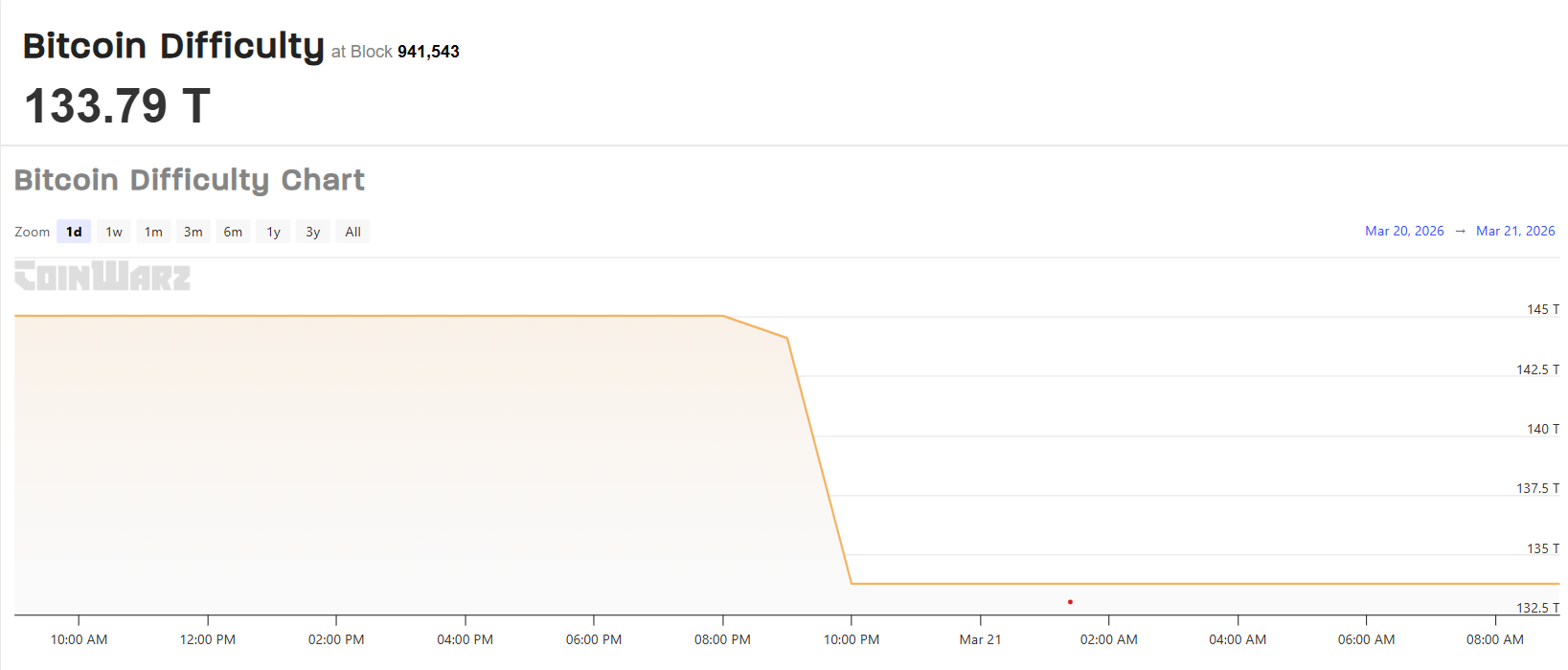
Bitcoin’s mining difficulty fell by around 7.7% at the latest adjustment on March 20 to 133.79 trillion at block 941,472, the sharpest drop since February, according to CoinWarz data.
The latest move takes difficulty down from around 145 trillion in mid-March and roughly 148 trillion at the start of the year. A lower difficulty means it takes less computational work to earn the same block reward, slightly improving revenue per unit of hashrate for firms that stay online.
The adjustment followed slower-than-target block production over the prior 2,016 blocks. CloverPool data showed average block times at about 12 minutes 36 seconds, well above Bitcoin’s 10-minute target, forcing the network to recalibrate lower.
In February, difficulty dropped sharply after weather-related disruptions in the United States temporarily knocked large American mining facilities offline, and it later rebounded by about 15% as hashrate returned to the network once power conditions normalized.
Bitcoin (BTC) difficulty measures how hard it is for miners to find a valid hash for the next block and is automatically adjusted to keep issuance steady at one block every 10 minutes.
When more computing power, or hashrate, joins the network, difficulty rises to prevent blocks from being mined too quickly, while a decline in hashrate triggers a lower difficulty, making it easier for remaining miners to earn rewards.

Related: Cango reports $285M Q4 loss as Bitcoin mining costs surge in 2025
The next difficulty adjustment is currently estimated for April 3, though that projection changes with each new block.
Miners pivot to AI as power costs bite
The difficulty reset also comes as several listed miners push further into AI and high-performance computing infrastructure in search of steadier returns on power and data-center capacity.
Last week, crypto trader Ran Neuner argued AI had become Bitcoin mining’s biggest competitor as both industries compete for electricity, even going as far as to say that “AI has killed Bitcoin forever.”
Bitcoin miners such as Core Scientific, MARA Holdings, Hut 8 and Cipher Mining have begun reallocating capacity or pivoting toward AI workloads, while some operators have reduced hashrate or shut down less efficient rigs as profitability tightens.
On Feb 21, Bitdeer liquidated 943 BTC from reserves and sold newly mined coins, cutting corporate holdings to zero. In its latest weekly update on March 21, it confirmed that its BTC holdings remained at zero.
Big questions: Would Bitcoin survive a 10-year power outage?


Former FTX CEO Sam Bankman-Fried, who is currently serving a 25-year sentence for fraud, has renewed public praise of U.S. President Donald Trump, adding to speculation that he hopes to secure a pardon.
In a recent post on X, written through a proxy using prison-approved communications, Bankman-Fried backed Trump’s decision to launch strikes against Iran. He framed the move as necessary to counter nuclear risk and claimed the operation had sharply reduced Iran’s military capacity.
The comments mark his latest in a string of statements supportive of the U.S. president. In earlier posts, he pointed to lower gas prices under Trump than in the Biden era and in other countries. He also credited Trump with “saving” the SEC by replacing former chair Gary Gensler with Paul Atkins, arguing the shift eased pressure on crypto firms and reduced inter-agency conflict.
The tone has drawn attention, given Bankman-Fried’s legal position. Presidential pardons have historically extended to financial crimes, and Trump has shown a willingness to grant clemency in high-profile cases. Ross Ulbricht, who operated a digital black market platform called Silk Road, was sentenced to life in prison without the possibility of parole in 2015 before Trump freed him shortly after being sworn in in 2025. For Bankman-Fried, whose conviction stemmed from one of the largest financial collapses in crypto history, public alignment with the president may serve a clear purpose.
His outreach comes as the remnants of his former empire continue to unwind. Earlier this week, the FTX Recovery Trust said it will distribute about $2.2 billion to creditors as part of an ongoing Chapter 11 process, pushing recovery rates close to full repayment for many claim classes.
Still, the damage from FTX’s collapse runs deep. Millions of customers lost access to funds in 2022, and the event shook trust in crypto markets. Prices fell, firms failed, and regulators stepped in with tighter scrutiny. The case remains a reference point for risk in the industry.
Bankman-Fried’s praise of Trump’s Iran policy lands as that decision faces growing criticism, with some warning the conflict could strain public finances and disrupt global oil supply, as well as concerns about inflation and higher costs for households and businesses.
For now, Bankman-Fried remains behind bars, communicating through intermediaries while his former company repays creditors. His lawyers filed a motion for a new trial in February, which the government opposed. His public messaging, however, suggests he is trying to shape an outcome beyond the courtroom.


The Hong Kong Police Cyber Crime Bureau has issued a warning after a 66-year-old retired man fell victim to three separate cryptocurrency scams.
Summary
- A Hong Kong senior loses HK$6.6M in three separate cryptocurrency scams.
- Police warn against transferring money or crypto to strangers to avoid fraud.
- Fraudsters impersonating experts tricked the victim into losing all his savings.
In total, the elderly victim lost HK$6.6 million after being misled by fraudsters posing as cryptocurrency experts, according to local reports.
In September 2025, the victim received a WhatsApp message from a fraudster claiming to be a cryptocurrency investment expert. The scammer promised guaranteed profits and offered to teach the victim how to invest in cryptocurrencies.
Trusting the individual, the elderly man handed over HK$1.4 million. After the cryptocurrency was deposited into the fraudster’s account, the scammer vanished. Realizing he had been deceived, the victim reported the incident to the police.
Not willing to give up, the victim went online to seek help from another “cryptocurrency expert” to recover his losses. The new fraudster reassured the victim that recovery was possible, but demanded 600,000 yuan as a deposit. Once the victim transferred the money, the so-called expert disappeared as well, and the victim realized he had been scammed a second time.
In January of this year, the victim was contacted by another fraudster claiming to be able to recover his previous losses. This time, the fraudster insisted that the victim purchase 4.6 million yuan worth of cryptocurrency and deposit it into a designated account. As with the previous scams, the fraudster disappeared after the victim complied. At this point, the elderly man had lost his entire life savings to scammers.
Police Warning and Advice
The police are urging citizens to be cautious and avoid transferring money or cryptocurrency to strangers. They emphasize that no one can guarantee to recover losses, and any offer that promises guaranteed returns or insider information is likely a scam. If someone offers to help recover funds after a previous scam, it is likely part of a serial fraud scheme.
Additionally, the FBI has issued a warning about fake tokens on the Tron blockchain impersonating the agency. Scammers are using these fake tokens to trick users into providing personal information under the false pretense that their wallets are under investigation.

Key takeaways
On-chain activity and the ETH exposure narrative
ETF flows, price backdrop, and what they signal
Bitmine’s conviction, DeMark signals, and the long arc of ETH

RLUSD Supply Adjustments and Treasury Activity
Ripple executed the latest burn through its treasury wallet, permanently removing nine million RLUSD tokens from circulation. Consequently, the move reduced the available supply and followed earlier large-scale burns during the same month. The action forms part of routine supply management tied to redemptions and liquidity balancing.
Earlier in March, Ripple eliminated twenty-five million RLUSD on the Ethereum blockchain through a similar treasury operation. Moreover, the firm conducted another ten million token burn on the XRP Ledger before this latest adjustment. These consecutive reductions indicate active oversight of the circulating supply across multiple blockchain networks.
🔥🔥🔥🔥🔥🔥 9,000,000 #RLUSD burned at RLUSD Treasury.https://t.co/3K4NW7GKCE
— Ripple Stablecoin Tracker (@RL_Tracker) March 20, 2026
Stablecoin issuers typically burn tokens when users redeem assets or when reserves require rebalancing. Therefore, Ripple maintains a one-to-one backing model by aligning supply with underlying reserves. This approach supports transparency and ensures compliance with audit expectations tied to regulated stablecoins.
RLUSD Market Growth and Slowing Momentum
RLUSD has recorded steady adoption since its launch in December 2024, supported by rising transaction volumes and integrations. Currently, the stablecoin holds a market capitalization of nearly 1.5 billion dollars with notable daily trading activity. However, continued burns have slowed the pace of net supply expansion despite earlier rapid growth.
Market participants had anticipated a quicker move toward the two billion supply level based on early adoption trends. Additionally, integrations with major financial institutions contributed to expectations of accelerated issuance and broader usage. Yet, the recent sequence of burns has offset minting activity and tempered that trajectory.
Despite slower growth, RLUSD maintains consistent demand across payment channels and institutional use cases. Moreover, transaction data shows ongoing utility rather than speculative accumulation driving activity. This pattern reflects stable adoption dynamics even as total supply growth stabilizes.
XRP Ledger Role and Institutional Context
The XRP Ledger continues to support RLUSD issuance and settlement alongside Ethereum-based operations. Consequently, Ripple uses multiple networks to distribute supply and manage cross-chain liquidity efficiently. This structure allows flexibility while maintaining consistent reserve backing across platforms.
Institutional integrations have played a key role in RLUSD adoption, especially within cross-border payment systems. Furthermore, partnerships with financial entities have increased transaction throughput and strengthened real-world usage. These developments contribute to steady demand, even as treasury burns adjust the circulating supply.
Ripple’s approach shows controlled supply management rather than unchecked expansion of its stablecoin ecosystem. Therefore, the firm balances minting and burning to reflect actual usage patterns and reserve requirements. This method supports long-term stability and aligns RLUSD growth with measurable demand conditions.

The crypto market recovered today as Bitcoin climbed back above $71,000 after recent losses. The broader market cap rose to $2.42 trillion, supported by derivatives activity. However, macro pressure and weak sentiment continue to shape short-term direction.
Key Highlights
- Bitcoin rebounds to $71K after major options expiry boosts momentum
- Ethereum struggles near $2.1K despite short-term institutional support
- XRP holds firm as retail demand offsets weaker institutional flows
- Crypto market cap climbs to $2.42T amid volatile macro backdrop
- Analysts warn of short-term rallies but highlight ongoing downside risks
⚡️ Bitcoin back above $71K.
Ethereum reclaims $2K — strength returning across the market.Momentum is building again. 🚀$BTC $ETH pic.twitter.com/vhMtAGvElD
— Nehal (@nehalzzzz1) March 20, 2026
Bitcoin Holds Above $71K as Options Expiry Drives Momentum
Bitcoin price trades near $71,000 after rebounding from post-FOMC lows earlier this week. The recovery follows the expiry of $1.7 billion in BTC options. This expiry event aligned with a max pain level near $70,000, supporting upward movement.
Moreover, implied volatility has increased, which signals rising short-term bullish sentiment. At the same time, traders reduced demand for downside protection, which reflects improved confidence. However, positioning remains tactical as the next quarterly expiry approaches.
Meanwhile, macro conditions continue to influence price action, as delayed rate cuts weigh on sentiment. ETF outflows have also added pressure in recent sessions. Still, strong support from institutional and derivatives traders has helped stabilize Bitcoin.
Ethereum Struggles Near $2,100 Despite Institutional Activity
Ethereum price trades around $2,150 after holding a key support zone near $2,100. The asset rebounded slightly after options worth nearly $380 million expired. However, the put-to-call ratio near 1.02 indicates balanced sentiment.
At the same time, implied volatility continues to rise, which suggests expectations of near-term price swings. Institutional accumulation has supported Ethereum, yet momentum remains weak compared to Bitcoin. This reflects ongoing uncertainty in broader market conditions.
In addition, macro risks and lower institutional demand continue to limit upside potential. Analysts expect Ethereum could retest levels below $2,100 if pressure builds again. Therefore, the current rebound appears fragile despite temporary support.
XRP Maintains Strength as Retail Demand Supports Price
XRP price holds near $1.40 as steady retail demand supports its recent performance. The asset shows resilience despite weaker institutional participation. Expanding utility also contributes to its relative stability in the current market cycle.
Furthermore, analysts expect XRP could rise toward $1.50 in the short term. This outlook depends on continued demand and stable market conditions. However, broader uncertainty could still limit sustained upward movement.
At the same time, market dynamics continue to shift as traders adjust positions. Altcoins, including XRP, may benefit from declining Bitcoin dominance. Yet, analysts warn that sudden reversals could trigger repeated stop-outs for short-term traders.
Macro Trends and Oil Markets Shape Crypto Sentiment
Global macro developments continue to influence crypto market direction. Oil prices have declined after signals of increased supply and reduced geopolitical escalation. This has improved risk sentiment across financial markets.
Additionally, policy discussions around Iranian oil sanctions have contributed to price declines. However, supply risks remain, as disruptions could push oil prices significantly higher. This uncertainty continues to affect broader market stability.
As a result, crypto assets remain sensitive to external economic signals. While the current rebound reflects short-term relief, underlying risks persist. Therefore, market participants continue to adjust strategies based on evolving conditions.


The cryptocurrency market has experienced a slowdown in the past 24 hours, with Bitcoin’s price showing little movement. As of now, Bitcoin (BTC) trades within a narrow range, oscillating between $69,500 and $70,600.
Summary
- Bitcoin stabilizes around $70K after volatility, with a minor correction from earlier highs.
- Altcoins show minimal price changes, with most trading within a narrow range.
- Market uncertainty persists amid rising geopolitical tensions, with Bitcoin driving altcoin performance.
Meanwhile, this is after a week of high volatility and substantial liquidations in the derivatives market. The altcoin market also reflects a similar lack of significant price action, suggesting a calm period before potential price shifts.
Bitcoin’s price has been relatively stable around $70,000 following a week of intense volatility. At the time of writing, Bitcoin is closer to $71,000, but the market volume has slowed down as expected for the weekend. Earlier in the week, BTC surged past $76,000 but has since corrected by nearly 10%.
This price drop is partly attributed to ongoing geopolitical tensions, particularly the conflict between the US, Israel, and Iran. Rising oil prices and inflation fears have added to the uncertainty, leading to a broader market correction. The risk-on markets, including crypto, have experienced a downturn, and the future direction of Bitcoin’s price may depend heavily on the resolution of these global issues.
Altcoin market shows minimal movement
The altcoin market has shown minimal price changes over the past 24 hours. Most cryptocurrencies have remained within a narrow range, with price fluctuations generally between -1% and +1%.
Some altcoins, such as WLFI, have shown modest gains of over 4%, but these are exceptions and do not suggest sustained upward momentum. The broader market remains cautious, with little to suggest that a breakout in altcoins is imminent. In the current market conditions, the altcoins’ performance is largely influenced by Bitcoin’s price movements.
Disclosure: This article does not represent investment advice. The content and materials featured on this page are for educational purposes only.

Liverpool lose Hugo Ekitike to early injury after James Milner challenge

Central Bank Policy On Hold As Markets Weigh Energy Risks

Hong Kong Retiree Loses $840K in Triple Crypto Scam


-

 Tech6 days ago
Your Legally Registered ‘Motorcycle’ Might Not Count Under Proposed US Law
-

 Politics19 hours ago
Jenni Murray, Long-Serving Woman’s Hour Presenter, Dies Aged 75
-
 Tech4 days ago
Are Split Spacebars the Next Big Gaming Keyboard Trend?
-

 Fashion20 hours ago
Weekend Open Thread: Adidas – Corporette.com
-
Sports7 days ago
Why Duke and Michigan Are Dead Even Entering Selection Sunday
-

 Business6 days ago
Search for Savannah Guthrie’s Mother Enters Seventh Week with No Arrests
-
Crypto World7 days ago
Coinbase and Bybit in Investment Talks: Could Bybit Finally Enter the US Crypto Market?
-

 News Videos3 days ago
RBA board divided on rate cut, unusually buoyant share market | Finance Report | ABC NEWS
-
 Crypto World14 hours ago
NIO (NIO) Stock Plunges 6.5% as Shelf Registration Sparks Dilution Worries
-

 Business5 days ago
Australian shares drop as Iran war enters third week
-

 Crypto World5 days ago
Crypto Lender BlockFills Enters Chapter 11 with Up to $500M in Liabilities
-

 Politics3 days ago
The House | The new register to protect children from their abusers shows Parliament at its best
-

 Fashion5 days ago
25 Celebrities with Curly Hair That Are Naturally Beautiful
-

 Tech1 day ago
inKONBINI Lets You Spend Summer Days Behind the Register
-

 Crypto World3 days ago
Canada’s FINTRAC revokes registrations of 23 crypto MSBs in AML crackdown
-
 Politics4 days ago
Real-time pollution monitoring calls after boy nearly dies
-

 Crypto World7 days ago
Crypto Losses Drop 87% in February, But Hackers Are Now Targeting People, Not Code
-
 NewsBeat3 days ago
Residents in North Lanarkshire reminded to register to vote in Scottish Parliament Election
-

 Business5 days ago
Meta planning major layoffs as AI spending and automation reshape workforce
-

 News Videos3 days ago
PARLIAMENT OF MALAWI – PAC MEETING WITH REGISTRAR OF FINANCIAL ON AMARYLLIS HOTEL – INQUIRY LIVE


You must be logged in to post a comment Login