
Crypto World
FDIC, Federal Reserve, and OCC Move to Modernize Regulatory Capital Rules for All US Banks


TLDR:
- Three federal agencies jointly propose modernizing capital rules for banks of all sizes across the U.S.
- Largest banks would use one calculation set instead of two to meet risk-based capital requirements.
- Smaller banks may see moderate capital requirement reductions tied to traditional lending activities.
- All public comments on the three capital framework proposals must be submitted by June 18, 2026.
Regulatory capital framework proposals have been issued by three federal banking agencies for public comment. The Federal Deposit Insurance Corporation, the Federal Reserve Board, and the Office of the Comptroller of the Currency jointly released three proposals.
These aim to modernize capital requirements across banks of all sizes. The goal is to better align regulatory capital with risk. Capital levels are expected to modestly decrease but remain well above pre-financial crisis standards.
Largest Banks Face Enhanced Risk-Sensitivity Rules
The first proposal primarily targets the largest, most internationally active banks in the country. It would require these institutions to use one set of calculations instead of two.
This streamlines how banks determine compliance with risk-based capital requirements. The framework would also improve calibration across credit, market, and operational risks.
Under the proposal, market risk rules would apply only to banks with significant trading activity. All other banks would retain the option to voluntarily adopt this approach.
This change aims to reduce burden while improving consistency across banking institutions. Risk sensitivity across the regulatory capital framework would be enhanced as a result.
In a joint release, the FDIC, Federal Reserve, and OCC confirmed that the proposals are designed to benefit institutions of every size.
As stated in their joint release, the agencies are seeking to “modernize the regulatory capital framework for banks of all sizes.”
The statement reflects a broad effort to bring the framework in line with current market conditions. Public comment is being actively encouraged ahead of the June 18, 2026 deadline.
The agencies noted that a decade of experience revealed room for improvement in the current framework. Certain elements could be updated without reducing the safety and soundness of the system.
After the 2008 global financial crisis, regulators substantially increased loss-absorbing capital requirements. Stress testing requirements for large banks were also introduced during that period.
Smaller Banks and Systemic Risk Measurements Under Review
The second proposal applies broadly to all but the largest banking institutions in the system. It would better align capital requirements for traditional lending activities with actual risk.
Modifications to mortgage servicing capital requirements are also part of this proposal. These changes would extend to banks operating under the community bank leverage ratio framework.
Additionally, certain large banks would be required to reflect unrealized gains and losses on securities. This would directly affect their reported regulatory capital levels, subject to a transition period.
The adjustment aims to provide a more accurate picture of a bank’s financial position. Disincentives connected to mortgage origination would also be reduced under this framework.
The agencies further clarified the expected outcome of the combined proposals in their joint statement. They noted that the measures “would modestly reduce capital for large banks and moderately reduce requirements for smaller banks.”
This reflects the more traditional lending activities that community and regional banks typically carry. The reduction is calibrated to align requirements more closely with actual lending risk profiles.
The third proposal, issued solely by the Federal Reserve Board, addresses how systemic risk is measured. It would refine the additional capital requirement for the largest and most complex institutions.
The method for calculating systemic risk buffers would be updated accordingly. Altogether, capital levels across the system would still remain substantially higher than pre-crisis levels.


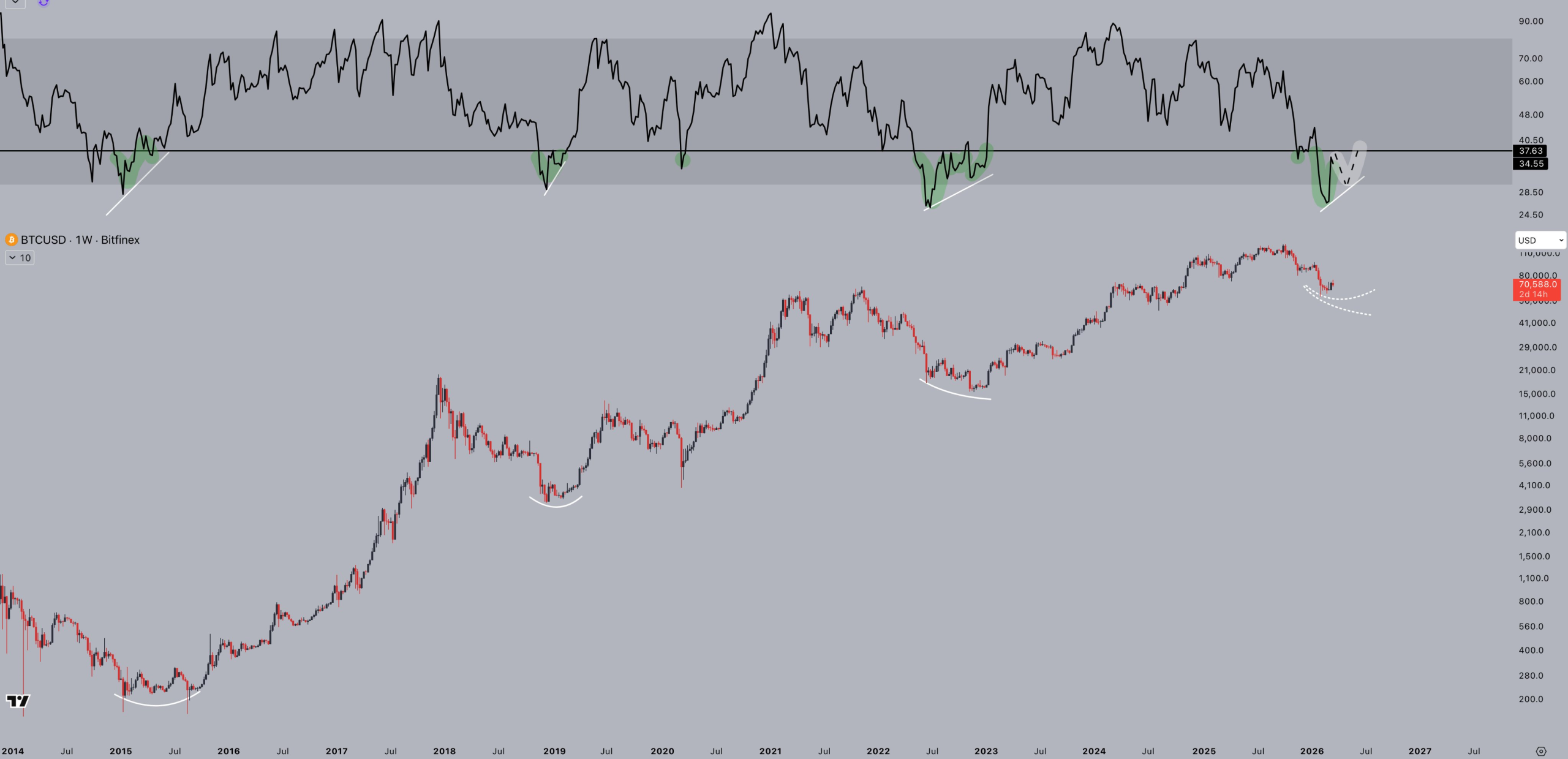
Bitcoin RSI signals approached a key moment as analysis said that a higher low was needed next to allow bullish BTC price continuation.
Bitcoin (BTC) is hinting at its next long-term bottom as a key leading indicator preps a higher low.
Key points:
-
Bitcoin RSI is approaching a critical long-term position for the fate of the bear market.
-
RSI needs a weekly bullish divergence to repeat its early-2023 rebound.
-
A trader says he is “not in a rush” to reenter the market with the comedown from all-time highs just a few months old.
Bitcoin RSI: All eyes on higher low
New analysis covering relative strength index (RSI) data on BTC/USD concludes it could soon be “time to pay attention.”
Bitcoin bear-market bottoms often follow the start of a bullish divergence with RSI on weekly time frames.
For trader Jelle, current market behavior is following historical trends, and Bitcoin’s next inflection point may be around the corner.
“When $BTC’s weekly RSI makes a higher low again, it’s time to pay attention,” he wrote on X.
A classic bullish divergence locks in when RSI makes a higher low while price makes lower lows. Jelle, however, says that price has room to maneuver and still preserve the emerging recovery.
“Doesn’t matter if BTC makes a higher low, equal low, or lower low,” he continued.
“When RSI starts moving higher again, the bottom is very close – or already in.”

BTC price bear flag still in play
RSI last flipped bullish at the end of Bitcoin’s 2022 bear market, and its signals preceded a period of upside that continued for over a year.
Related: Bitcoin tests old 2021 top as gold falls to six-week lows under $4.7K
At the time, talk also focused on reclaiming the 200-week exponential moving average (EMA) as support, something that occurred in March 2023.
As Cointelegraph reported, the 200-week EMA was only lost again last month, with analysis calling the trend line “unreliable.”

Jelle, meanwhile, is among those speculating that previous cycles demand a much longer bear market than the few months that have elapsed so far.
“Previous bear markets all lasted around a year. $BTC topped just 23 weeks ago, and looks like this,” he told X followers.
“I’m not in a rush to buy back in.”

A separate chart drew attention to a possible bear flag formation under development — a sign of weakness that could result in a fresh support failure in a manner similar to January.
This article does not contain investment advice or recommendations. Every investment and trading move involves risk, and readers should conduct their own research when making a decision. While we strive to provide accurate and timely information, Cointelegraph does not guarantee the accuracy, completeness, or reliability of any information in this article. This article may contain forward-looking statements that are subject to risks and uncertainties. Cointelegraph will not be liable for any loss or damage arising from your reliance on this information.
Crypto World
Dell (DELL) Stock Climbs 3% While Super Micro (SMCI) Crashes 25% Following Export Violation Charges

Key Points
- US authorities charged Super Micro co-founder Wally Liaw and two associates with allegedly orchestrating the diversion of approximately $2.5 billion in Nvidia-based servers to China in breach of export regulations.
- Following revelations of alleged involvement, Super Micro suspended two staff members and terminated a contractor’s agreement.
- Super Micro (SMCI) shares tumbled more than 25% during Friday’s premarket session.
- Dell (DELL) shares advanced approximately 3% in premarket activity as Super Micro’s main competitor.
- Industry analysts at Bloomberg Intelligence cautioned that reputational harm could trigger extended customer attrition for Super Micro.
Shares of Dell Technologies (DELL) advanced approximately 3% during Friday’s premarket session following a dramatic collapse in Super Micro Computer (SMCI) stock, which plummeted over 25% after federal prosecutors charged a company co-founder with violations of export regulations related to Nvidia technology.
Federal prosecutors on Thursday made public criminal charges against Yih-Shyan “Wally” Liaw — who serves as Super Micro’s senior vice president for business development and holds positions as co-founder and board member — alleging he orchestrated the unlawful transfer of billions of dollars in artificial intelligence servers to Chinese entities.
Prosecutors allege that Liaw, along with two accomplices, arranged sales of export-restricted Nvidia-equipped servers through an Asian intermediary, with full knowledge that the hardware would ultimately reach China in contravention of federal export restrictions.
The additional defendants named in the case include Ruei-Tsang “Steven” Chang, who managed sales operations at Super Micro’s Taiwan facility, and Ting-Wei “Willy” Sun, an independent contractor whom federal prosecutors characterized as a facilitator who allegedly coordinated elements of the operation.
Throughout 2024 and into 2025, the Asian intermediary entity acquired roughly $2.5 billion in server equipment, which was subsequently repackaged and transported to destinations in China, according to Justice Department filings.
Super Micro acknowledged the charges and announced it has placed both employees on administrative suspension while terminating its relationship with the contractor upon discovering the allegations.
Notably, Super Micro itself was not designated as a defendant in the criminal proceedings.
Super Micro Issues Official Statement
In a Thursday evening statement, Super Micro declared that “the conduct by these individuals alleged in the indictment is a contravention of the Company’s policies and compliance controls.”
The technology firm emphasized its operation of a “robust compliance program” and reaffirmed its dedication to full adherence to American export and re-export regulations. The company further noted its ongoing cooperation with federal investigators.
This represents another chapter in Super Micro’s recent regulatory challenges. The company experienced significant stock volatility in August 2024 when a short-selling firm questioned its financial reporting practices, coupled with the firm’s postponement of its mandatory annual 10-K disclosure.
An independent review commissioned by the board subsequently cleared the company of fraud or wrongdoing, and the outstanding filing was completed in February 2025 — allowing Super Micro to avoid potential removal from Nasdaq listing.
Dell Positioned to Capture Market Share
As Super Micro’s primary rival in the artificial intelligence server sector, Dell emerged as the clear market winner in Friday’s trading activity.
Woo Jin Ho, an analyst with Bloomberg Intelligence, observed that “given the reputation damage, risks for share losses to Dell are heightened long term” — suggesting Super Micro may experience significant customer migration.
Ho further commented that the criminal indictment underscores what he perceives as insufficient advancement by Super Micro in strengthening its internal financial oversight mechanisms.
Super Micro’s stock declined more than 25% in premarket activity and extended losses beyond 27% following the opening bell Friday. Meanwhile, Dell registered gains of approximately 2–3% during the corresponding period.


Ripple said a new 2026 survey shows digital assets are moving closer to the center of financial services strategy.
- Ripple found stablecoins lead demand as finance firms seek faster treasury tools and working capital efficiency.
- Banks and asset managers ranked custody and secure storage among top tokenization infrastructure priorities.
- Most respondents said security certifications and trusted providers matter most when choosing digital asset partners.
Meanwhile, the company polled more than 1,000 finance leaders across banks, asset managers, fintechs, and corporates, with 72% saying firms must offer digital asset solutions to stay competitive.
Ripple said stablecoins ranked as the top digital asset use case in the survey. About 74% of respondents said stablecoins can boost cash-flow efficiency and unlock trapped working capital, showing that many firms now view them as tools for treasury and liquidity management, not only payments.
The report linked that demand to wider market growth. Ripple noted that the stablecoin market cap moved above $300 billion in early March, as adoption expanded across payments, trading, and business settlement.
The survey also showed rising interest in tokenization. Among banks and asset managers looking at tokenization partners, 89% said custody and secure storage were a main priority. Banks ranked token lifecycle management at 82%, while asset managers placed primary distribution at 80%.
Ripple said the results show that many firms are now focused on the systems needed to support digital assets. “The key takeaway here is that finance leaders want more from the crypto companies offering these solutions,” the company wrote, adding that institutions want a provider that can support current and future needs.
Additionally, security ranked as the top factor in partner selection. Ripple said 97% of respondents viewed certifications such as ISO and SOC II as important or very important. Post-integration technical support followed at 88%, while industry experience and financial strength also ranked highly.
The survey also found that many firms prefer one provider for several digital asset services. Ripple said 71% of corporates favor a one-stop-shop model, while slightly more than half of fintechs and financial institutions do the same.
Ripple expands as adoption grows
The findings match broader adoption trends, where firms are moving from early testing to live digital asset plans. Ripple said,
“Most finance leaders aren’t debating digital assets anymore. They’re figuring out how to build with them and who to build with.”
As previously reported by Crypto News, that shift also comes as Ripple expands in Latin America. The company recently said it plans to apply for a VASP license in Brazil, adding to its push in payments and tokenization in the region.
Disclosure: This article does not represent investment advice. The content and materials featured on this page are for educational purposes only.

Key Takeaways
- Spotify (SPOT) dropped 6.62% Thursday following a significant technical malfunction that caused Premium subscribers to experience advertisements and had their accounts appear as free-tier memberships.
- The technical failure sparked worries about customer retention and system dependability.
- Institutional shareholder Alecta Tjanstepension Omsesidigt reduced its SPOT holdings, contributing to downward momentum.
- Evercore ISI lowered its SPOT price target from $700 down to $650, while maintaining an Outperform designation.
- SPOT shares have declined 11.02% since the beginning of the year, with InvestingPro analysis indicating the stock trades above its Fair Value estimate.
Shares of Spotify tumbled 6.62% Thursday, weighed down by a perfect storm of platform malfunction, reduced Wall Street expectations, and institutional investor exits.
Trouble emerged when Premium-tier subscribers experienced an unexpected technical failure that began displaying advertisements and downgraded their account status to resemble free memberships. For a streaming giant whose revenue engine runs on premium subscriptions, such a malfunction represents far more than a minor inconvenience.
The technical mishap eroded investor confidence in the platform’s stability during a critical period, with the company’s quarterly financial report on the horizon. Even subtle indications that premium customers might reassess their membership decisions capture immediate market attention.
Selling momentum accelerated throughout Thursday’s trading session. News surfaced that institutional stakeholder Alecta Tjanstepension Omsesidigt had reduced its SPOT stake. Additional shareholders appeared to secure profits, amplifying the day’s losses.
Evercore ISI Reduces Price Expectations
Evercore ISI adjusted its price objective for SPOT downward this week, revising it from $700 to $650. Despite the reduction, the firm maintained its Outperform designation and simultaneously increased its financial forecasts for the streaming company.
The adjustment stems from recalibrated assumptions regarding currency strength and taxation rates rather than diminished faith in Spotify’s core operations. Evercore ISI currently anticipates gross margins reaching 35.4% by 2028, surpassing the consensus Wall Street estimate of 34.9%.
According to the firm, market participants continue to undervalue Spotify’s Two-Sided Marketplace — the suite of promotional and advertising tools offered to musicians and record companies for platform visibility.
Other Wall Street firms have similarly recalibrated their forecasts. Cantor Fitzgerald maintains a $525 target with a Neutral stance. Guggenheim positions at $600 with a Buy recommendation. Jefferies and Benchmark both carry Buy ratings at $650 and $760 respectively.
This broad range in analyst perspectives highlights the ongoing discussion surrounding how to properly assess Spotify’s expansion potential against its current valuation.
Valuation Questions Persist
InvestingPro analysis indicates the stock currently trades above its Fair Value calculation, despite Thursday’s selloff. SPOT has surrendered 11.02% of its value since January began.
Five Wall Street analysts have recently upgraded their earnings projections, and the streaming giant carries a PEG ratio of 0.47, indicating the market may be underestimating anticipated growth rates.
Spotify’s gross profit margin stands at 32% across the trailing twelve months. Management has prioritized margin expansion, and analyst models suggest upward potential.
Fourth-quarter operating income exceeded previous projections by 8%, or 1% when excluding social charges, based on Cantor Fitzgerald’s analysis of the financial results.
Regarding artificial intelligence developments, Jefferies observed that Google’s introduction of the Lyria 3 music generation capability within the Gemini application warrants monitoring, though the firm retained its Buy rating, implying confidence that Spotify can navigate the competitive threat.
Shares concluded Thursday’s session with a market capitalization of $106.4 billion, accompanied by typical daily trading volume around 2.86 million shares.

Key Takeaways
- ASML’s American depositary shares have declined 7% over the last 30 days amid a broader retreat from AI-linked semiconductor equities.
- TD Cowen’s Krish Sankar maintains a Buy recommendation with a €1,500 price objective (approximately $1,735).
- The company’s valuation multiple relative to semiconductor equipment competitors has contracted from 120% to roughly 20% since Q4 2022.
- Next-generation logic processors and DRAM memory chips are projected to demand increased EUV lithography layers.
- Nvidia CEO Jensen Huang recently projected $1 trillion in cumulative AI chip orders extending through 2027, reinforcing ASML’s growth trajectory.
ASML shares have retreated from their recent peak levels, creating what TD Cowen analyst Krish Sankar characterizes as a “very attractive” entry point for investors. His optimistic stance centers on compressed valuation metrics and robust long-term expansion potential linked to surging AI semiconductor demand.
The company’s U.S.-traded shares have fallen 7% during the past month. This decline occurred as market participants shifted capital away from AI-adjacent chip stocks, despite ASML posting record-breaking orders for its advanced lithography equipment.
ASML occupies a strategic position within the semiconductor manufacturing ecosystem. The Dutch firm maintains an effective monopoly on extreme ultraviolet (EUV) lithography technology, which remains essential for producing cutting-edge microchips. No competing vendor currently offers comparable systems.
Since late 2022, ASML’s valuation premium compared to semiconductor equipment manufacturers such as Applied Materials, Lam Research, and KLA Corp has narrowed dramatically from 120% to approximately 20%. Sankar attributes this compression to current chip production techniques that utilize fewer EUV processing steps.
However, Sankar contends this dynamic is poised to shift. Upcoming generations of both logic semiconductors and memory technology — particularly DRAM — will require additional EUV layers during fabrication. He emphasizes that the memory sector implications remain “underappreciated” among investors.
High-NA EUV Technology: Emerging Growth Catalyst
ASML’s latest High-NA EUV equipment remains in the initial stages of commercial deployment. The company reported revenue from only two High-NA units during Q4 2025, contrasted with 94 conventional lithography systems delivered during that same quarter.
TSMC has demonstrated reluctance in publicly embracing High-NA EUV adoption. The foundry giant has indicated it can maximize existing equipment capabilities. Nevertheless, Sankar expects enhanced system reliability will ultimately drive broader customer adoption.
TD Cowen’s financial models project 60 lithography system shipments in 2026, expanding to 68 units in 2027 as High-NA equipment volumes double and legacy platforms transition to upgraded variants.
Sankar rates ASML’s Amsterdam-traded shares as Buy with a €1,500 price objective, calculated at 48 times his 2027 earnings per share projection. ASML’s European-listed equity closed Thursday at €1,165. The U.S.-listed American depositary shares traded down 1.4% at $1,347.40 during premarket hours.
AI Capital Expenditure Underpins Long-Range Demand
The fundamental demand environment for ASML remains robust. Nvidia CEO Jensen Huang, presenting at GTC 2026 on March 16, elevated his AI chip order projection to at least $1 trillion through 2027. Broadcom CEO Hock Tan has independently forecasted $100 billion in AI semiconductor revenue for fiscal year 2027.
Amazon, Microsoft, Google, and Meta are anticipated to deploy nearly $600 billion in combined capital expenditures throughout 2026, with substantial portions allocated to AI infrastructure investments.
ASML also generates predictable recurring revenue. Maintenance and service contracts for its deployed equipment base represented approximately 25% of total 2025 revenue.
ASML currently commands a forward price-to-earnings ratio of 39.8, exceeding its 10-year median of 35.8. The company’s market capitalization stands at approximately $527 billion.
Key Takeaways
- DarkSword compromises iOS versions 18.4 through 18.7, exfiltrating cryptocurrency assets and sensitive information.
- Ghostblade spyware focuses on popular exchanges like Coinbase, Binance, Kraken, and wallets such as Ledger and MetaMask.
- Infection occurs through malicious websites requiring zero user interaction to compromise devices.
- Malware payloads automatically erase themselves after successfully extracting victim data.
- iOS 26.3 update addresses vulnerabilities; Lockdown Mode provides additional defense against DarkSword.
Cybersecurity researchers have uncovered DarkSword, a sophisticated exploit chain compromising Apple devices running iOS versions 18.4 to 18.7. This attack framework utilizes six previously unknown zero-day security flaws to deploy surveillance malware on targeted iPhones. Active campaigns have been detected across Saudi Arabia, Ukraine, Malaysia, and Turkey, indicating widespread deployment.
The DarkSword framework installs data-stealing malware capable of harvesting authentication credentials, communication records, and geolocation data. Cryptocurrency applications and digital wallets represent primary targets for this malicious campaign. Victims become infected simply by visiting weaponized web pages, requiring no clicks or downloads.
Security analysts have documented three distinct malware variants delivered via DarkSword: Ghostblade, Ghostknife, and Ghostsaber. These payloads rapidly extract targeted information before automatically removing themselves from infected systems. Evidence suggests both commercial surveillance companies and government-sponsored hacking groups are utilizing DarkSword in their operations.
Ghostblade Malware Hunts Cryptocurrency Applications
The Ghostblade payload distributed through DarkSword systematically scans compromised iOS devices for cryptocurrency exchange apps. Its target list encompasses leading trading platforms: Coinbase, Binance, Kraken, Kucoin, OKX, and MEXC. Additionally, it searches for prominent wallet software including Ledger, Trezor, MetaMask, Exodus, Uniswap, Phantom, and Gnosis Safe.
Beyond digital currency theft, Ghostblade harvests text messages, iMessages, phone logs, and contact lists from infected devices. The spyware extracts Wi-Fi passwords, Safari browser cookies, web history, and GPS coordinates. It further accesses Apple Health records, photo libraries, and conversations from messaging platforms like Telegram and WhatsApp.
Ghostblade executes a hit-and-run strategy, removing temporary artifacts and self-destructing after completing data exfiltration. This rapid execution minimizes forensic evidence left on compromised devices. The deployment of Ghostblade through DarkSword demonstrates escalating threats facing cryptocurrency holders.
Worldwide Campaign Distribution and Technical Operation
DarkSword deployment has been documented through weaponized websites and hijacked government web portals. Saudi Arabian victims were lured through a counterfeit Snapchat-themed page hosting the DarkSword exploit. The attack framework generates hidden iframes and retrieves remote code execution modules to inject malware payloads.
Various remote code execution exploits within DarkSword target distinct iOS versions, exploiting memory handling flaws and pointer authentication bypass weaknesses. The loader mechanism occasionally struggles with device version identification, suggesting accelerated development timelines. Nevertheless, DarkSword successfully delivers terminal payloads including Ghostknife and Ghostsaber across affected devices.
Security teams disclosed these vulnerabilities to Apple during late 2025, with remediation patches released in iOS 26.3. Domains associated with DarkSword distribution have been incorporated into browser Safe Browsing databases. iPhone owners should immediately install iOS updates or activate Lockdown Mode to defend against DarkSword exploitation.
DarkSword represents a critical security challenge for iOS cryptocurrency users worldwide. The exploit’s swift proliferation among diverse threat actors demonstrates heightened risks to digital financial holdings. Its comprehensive targeting of exchanges, wallets, and personal information emphasizes the urgency of applying available security patches.


Oil volatility triggered by the Iran conflict is pushing traders onto decentralized exchanges (DEXs) like Hyperliquid, where markets never close, Wall Street investment bank JPMorgan said in a Wednesday report.
The bank flagged a surge in activity from non-crypto investors using perpetual futures, derivatives with no expiry, to gain round-the-clock oil exposure. Unlike traditional venues, these contracts trade 24/7 and use funding rates to track spot prices.
“In particular, oil trading exploded on the Hyperliquid exchange early this month when the Iran war erupted as CME traders were unable to react when Iranian infrastructure strikes broke over the weekend,” wrote analysts led by Nikolaos Panigirtzoglou.
Market volatility spiked following the outbreak of war in the Middle East, with oil prices leading sharp moves as traders reacted to supply risks and geopolitical uncertainty. The initial shock was amplified by thin liquidity outside traditional trading hours, driving wider price swings and pushing investors toward venues offering continuous, 24/7 market access.
A decentralized exchange (DEX) is a peer-to-peer marketplace where users trade crypto directly without intermediaries. Unlike centralized exchanges, DEXs are non-custodial, meaning users retain control over their private keys and funds.
Rather than relying on a central operator, DEXs use smart contracts to automatically execute trades and settle them onchain. These trustless systems are a fast-growing part of the crypto market and are driving new types of financial products.
With CME markets shut over the weekend, traders turned to Hyperliquid’s CL-USDC perpetual, which stayed open for price discovery. The contract, margined in USDC with up to 20x leverage, hit $1.7 billion in peak daily volume and is now the platform’s third-most traded product, the bank said. Open interest has climbed to about $300 million.
More broadly, the analysts said demand for 24/7 access to traditional assets is accelerating interest in DEXs. Platforms like Hyperliquid use onchain order books rather than automated market makers, offering tighter spreads and more precise execution closer to traditional markets.
Features such as sub-second finality and portfolio margining are further attracting institutional traders by enabling faster execution and more capital-efficient strategies.
As a result, DEXs are taking share from mid-tier centralized exchanges in crypto derivatives, driven by speed, liquidity, self-custody and continuous market access, according to the analysts.
The trend is likely to expand beyond commodities as DEXs capitalize on a key gap in traditional finance: markets that don’t close, the report added.
Hyperliquid’s HYPE token is up roughly 25% year-to-date, outperforming much of the broader crypto market.
Read more: Iranian crypto outflows jump 700% minutes after U.S.-Israeli airstrikes, Elliptic says


Coinbase (COIN) said it began offering perpetual stock futures to eligible non-U.S. retail and institutional traders, extending its derivatives product line into U.S. equities.
The contracts let traders take leveraged positions on a group of large-cap U.S. stocks, colloquially known as the Magnificent 7: Apple, Microsoft, Alphabet, Amazon, Nvidia, Meta and Tesla. Perpetual futures tied to the SPY and QQQ exchange-traded funds, which track the S&P 500 and Nasdaq 100 indices, are also available in some jurisdictions, the exchange said in a Friday blog post.
Unlike standard futures contracts, perpetual futures have no expiry date. Coinbase’s contracts are cash-settled in USDC, a dollar-pegged stablecoin issued by Circle Internet (CRCL).
Coinbase said traders can use up to 10-times leverage on single-stock contracts and up to 20-times on ETF products. Demand for round-the-clock equity exposure, it added, has been growing rapidly, and most of the offerings have been concentrated on decentralized platforms.
The largest such decentralized platform is Hyperliquid, which earlier this week introduced S&P 500 perpetual futures contracts. The platform has become a hotbed for contracts tied to traditional financial instruments, including oil-linked contracts that are trading round-the-clock as war erupts in the Middle East.
Coinbase also said the product uses the same risk engine that supports its crypto derivatives markets, with cross-margining across perpetual futures and spot positions.
The move comes as the exchange expands the range of assets available on its platform as part of a bid to become the “Everything Exchange.”

Coinbase has expanded its stock perpetual futures offering to eligible non-U.S. traders, delivering leveraged, cash-settled exposure to major U.S. equities and indices on its non-U.S. trading rails. The rollout, disclosed in a Friday blog post, underscores Coinbase’s ongoing effort to provide a unified platform where crypto, stocks, and event-based contracts can be accessed in a single account.
The product is not available to U.S. residents at this time, with Coinbase indicating it is working to extend the offering to additional regions in the future. Access is currently limited to retail users on Coinbase Advanced and to institutions on Coinbase International Exchange, featuring perpetual contracts tied to notable stocks such as Apple and Nvidia.
Key takeaways
- Stock perpetual futures deliver leveraged, cash-settled exposure to major U.S. equities (including Apple and Nvidia) via Coinbase Advanced for retail clients and Coinbase International Exchange for institutions, aimed at crypto-style trading familiarity.
- The launch aligns with Coinbase’s broader 2026 roadmap, which centers on a multi-asset, “everything exchange” built around stablecoins, its Base layer-2 network, and a brokerage model spanning crypto and traditional assets.
- Europe already saw a related move earlier in March, when Coinbase rolled out perpetual futures for Coinbase Advanced users across 26 MiFID-regulated countries, signaling a broader international push beyond the U.S. footprint.
- In the wider market, several platforms offer tokenized or perpetual equity exposure to non-U.S. traders, including Binance and Kraken, highlighting an active, competitive space for synthetic stock products and on-chain real-world assets.
Non-U.S. expansion shapes Coinbase’s multi-asset strategy
Coinbase framed stock perpetual futures as a core element of its non-U.S. trading expansion, presenting a format familiar to crypto traders while delivering exposure to traditional equities. The company notes that the product is not yet available to U.S. persons, but it plans to broaden coverage to additional regions over time. By offering leveraged, cash-settled exposure on both its retail-focused Coinbase Advanced platform and its institutional Coinbase International Exchange, Coinbase aims to provide a seamless cross-asset experience without requiring users to toggle between separate apps or brokers.
Coinbase’s move dovetails with its stated ambition to evolve into an “everything exchange.” In January, CEO Brian Armstrong highlighted a priority to grow global access to crypto, equities, prediction markets, and commodities within a single ecosystem, emphasizing a strategy that places stablecoins, the Base network, and multi-asset brokerage at the heart of its 2026 outlook.
European rollout complements a broader regulatory push
Europe’s earlier March iteration of the stock perpetual futures program rolled out under Coinbase’s MiFID-compliant entity, covering 26 countries. The European effort demonstrates how Coinbase is threading regulatory compliance with product expansion, enabling non-U.S. users to trade synthetic stock products in a framework designed to align with regional oversight.
The Europe-focused expansion also mirrors a broader trajectory in which crypto-native platforms seek to bridge traditional capital markets with digital trading mechanics. As part of its multi-asset ambition, Coinbase is positioning itself to offer a spectrum of instruments—from tokens and tokens-to-equities to event-driven contracts—that can operate alongside cash equities, futures, and options in a single interface.
Rivals, regulation, and the evolving landscape for equity perps
The stock perpetual sector remains fragmented but increasingly crowded. Coinbase is entering a field where other non-U.S. platforms have ventured into equity exposure, including Binance’s equity perpetual contracts and Kraken’s tokenized-equity perpetual futures for global traders. A cluster of offshore platforms also list single-stock and index perpetuals with varying degrees of regulatory oversight. In March, the tokenization of stocks reached a notable milestone, surpassing $1 billion in on-chain value, underscoring the rapid growth of real-world assets tied to blockchain networks and the demand for cross-market access among traders.
As regulators weigh appropriate guardrails for synthetic equities and tokenized assets, Coinbase’s Europe launch under a MiFID framework and its ongoing U.S. non-availability stance for this product reflect a cautious approach: expand functionality where oversight exists, while continuing to navigate the evolving rules that govern cross-border crypto and traditional markets.
Strategic significance for Coinbase’s broader platform
Stock perpetual futures reinforce Coinbase’s vision of a single, multi-asset marketplace. By integrating stock-like exposure with the familiar crypto trading flow, the company signals a path toward deeper liquidity and more versatile product design—an attractive proposition for traders seeking diversified exposure without managing multiple counterparties or platforms. The European rollout, paired with the ongoing push in non-U.S. regions, suggests Coinbase views global expansion as a critical lever for user acquisition and retention across its ecosystem.
What remains uncertain is the pace and geography of the U.S. configuration for stock perpetuals, and how upcoming regulatory developments might shape access, risk controls, and product scope. Investors and users should watch for further regional expansions, updates on leverage and settlement specifics, and any changes to eligibility criteria as Coinbase continues to push toward a broader, all-in-one trading experience.
Readers should keep an eye on the next steps in Coinbase’s international roadmap and any official communications detailing new regions, asset coverage, and pruning of regulatory friction, which could redefine how traditional equities are accessed within crypto-native trading environments.
Source references: Coinbase’s official blog post on stock perpetual futures and related corporate statements; prior European MiFID rollout announcements; ongoing market reports on tokenized stocks and cross-asset platforms.


The World Gold Council has proposed plans to develop a platform that will change how the metal operates in digital financial systems.
Summary
- World Gold Council has proposed a “Gold as a Service” platform aimed at standardizing and scaling tokenized gold products across digital financial systems.
- The model seeks to link physical gold custody with digital issuance frameworks while streamlining processes such as compliance, reconciliation, and redemption.
In a white paper released on March 18, the World Gold Council outlined plans for a proposed “Gold as a Service” platform that would “support the issuance and operation of scalable, interoperable digital gold products.”
The platform would link the physical custody of gold with digital systems used to issue and manage tokenized gold products. It would standardize essential market processes such as custody coordination, reconciliation, compliance, and redemption to “reduce operational complexity, improve access, and enable greater consistency across digital gold products,” the World Gold Council said.
Among some of the key features, the new service would include standardizing tokenized gold issuance and management, improving digital gold’s fungibility, embedding audits and assurance, enabling interoperability with existing financial rails, and improving liquidity in lending and borrowing markets.
According to CEO David Tait, gold must evolve to maintain its role in the global financial system.
“Shared infrastructure can help gold become more accessible, more easily traded and fully integrated into modern financial systems, ensuring it remains as relevant tomorrow as it has been for millennia,” he added.
It must be noted that similar products already exist, such as Tether Gold or Pax Gold, which have built their own custody, compliance, and redemption frameworks. However, the Council’s position in the space could offer its platform an edge among institutional participants.
As previously reported by crypto.news, in September last year, Tait said the group was working on a framework that would allow participants to “pass gold digitally around the gold ecosystem, as collateral, for the first time.”
He said gold is often seen as a static unyielding asset, and by digitalizing it, the metal could be used for margins and collateral, generating profit for investors through a structure referred to as “pooled gold interest” or PGI.
A pilot for the initiative was planned for the first quarter of 2026.

Amazon is giving smartphones a second try, and you can probably guess what it’s all about

Brits endure ‘Baltic’ weather in Tenerife and ‘hurricane’ storms in Lanzarote

Rs 1 lakh crore wiped off! Bajaj Finance shares tumble 18% in March so far amid raging Iran-US war

Smart energy pays enters the US market, targeting scalable financial infrastructure

Why Israel is blocking foreign journalists from entering

Bitcoin: We’re Entering The Most Dangerous Phase

Crypto Trading LIVE: BTC Live Trading Bitcoin Analysis | 19 MAR #crypto #bitcoin #btc

AO VIVO: CAMINHONEIROS ADIAM GREVE; ANP COBRA PETROBRAS POR MAIS OFERTA – 20/03/2026 | CNN MONEY

Bitcoin: Der Crash kommt schneller als du denkst!
-
Crypto World6 days ago
HYPE Token Enters Net Deflation as HyperCore Buybacks Outpace Staking Rewards
-

 Tech5 days ago
Your Legally Registered ‘Motorcycle’ Might Not Count Under Proposed US Law
-

 Fashion7 days ago
Weekend Open Thread: Addict Lip Glow
-
 Tech3 days ago
Are Split Spacebars the Next Big Gaming Keyboard Trend?
-
Sports6 days ago
Why Duke and Michigan Are Dead Even Entering Selection Sunday
-

 Business5 days ago
Search for Savannah Guthrie’s Mother Enters Seventh Week with No Arrests
-

 Business6 days ago
US Airports Launch Donation Drives for Unpaid TSA Workers as Partial Government Shutdown Enters Fifth Week
-
Crypto World6 days ago
Coinbase and Bybit in Investment Talks: Could Bybit Finally Enter the US Crypto Market?
-

 Business4 days ago
Australian shares drop as Iran war enters third week
-

 Business6 days ago
Country star Brantley Gilbert enters growing non-alcoholic beer market
-

 Crypto World4 days ago
Crypto Lender BlockFills Enters Chapter 11 with Up to $500M in Liabilities
-

 Sports7 days ago
College Basketball Best Bets: Conference Tournament Semifinal Picks
-

 Politics2 days ago
The House | The new register to protect children from their abusers shows Parliament at its best
-

 News Videos2 days ago
RBA board divided on rate cut, unusually buoyant share market | Finance Report | ABC NEWS
-

 Fashion4 days ago
25 Celebrities with Curly Hair That Are Naturally Beautiful
-

 Tech9 hours ago
inKONBINI Lets You Spend Summer Days Behind the Register
-

 Crypto World2 days ago
Canada’s FINTRAC revokes registrations of 23 crypto MSBs in AML crackdown
-
 Politics3 days ago
Real-time pollution monitoring calls after boy nearly dies
-

 Crypto World6 days ago
Crypto Losses Drop 87% in February, But Hackers Are Now Targeting People, Not Code
-
 NewsBeat2 days ago
Residents in North Lanarkshire reminded to register to vote in Scottish Parliament Election


You must be logged in to post a comment Login