

Crypto World
Fed Faces Sticky Inflation as January PCE Exceeds Target Ahead of Policy Meeting


Key Takeaways
- Year-over-year core PCE inflation registered 3.1% in January, exceeding the Federal Reserve’s 2% objective
- On a monthly basis, core PCE increased 0.4%, matching analyst forecasts
- Overall PCE recorded 2.8% annual growth, marginally lower than the anticipated 2.9%
- Financial markets broadly anticipate the Federal Reserve will maintain interest rates between 3.5%–3.75% during the upcoming policy meeting
- These figures predate the Iran military engagement, which has elevated crude oil costs and introduces uncertainty to future inflation trends
On March 13, 2026, the Bureau of Economic Analysis published its personal consumption expenditures (PCE) report for January. This metric serves as the Federal Reserve’s primary gauge for measuring inflationary pressures.
The core PCE measure, which excludes volatile food and energy components, climbed 3.1% on an annual basis in January. This figure aligned with expert predictions but represented an acceleration from December’s 3.0% reading. Monthly core PCE advanced 0.4%, consistent with projections.
The overall PCE measurement — encompassing all consumer goods and services — expanded 2.8% annually. This result fell marginally short of the 2.9% consensus estimate and represented a deceleration from the previous month’s velocity.
On a month-to-month basis, overall PCE increased 0.3%, in line with market expectations.
The Federal Reserve maintains an inflation target of 2%. With core PCE currently positioned at 3.1%, consumer prices continue running significantly above the central bank’s desired threshold.
Markets are pricing in that the Fed will maintain its current rate range of 3.5% to 3.75% during next week’s policy deliberations. Given the stubborn inflation readings, interest rate reductions appear unlikely in the near term.
The PCE measure has been registering higher readings compared to the Labor Department’s Consumer Price Index. This divergence primarily stems from varying methodologies for weighing housing and healthcare expenditures. PCE assigns reduced importance to shelter expenses, which have been moderating, while giving greater emphasis to medical costs, which have been climbing.
February’s CPI registered 2.4% year-over-year — a considerably more subdued figure.
What These Numbers Miss
The January data captures economic circumstances from over a month in the past. It fails to incorporate consequences from the Iran military conflict, which commenced following U.S. and Israeli aerial operations in late February.
Oil prices have surged substantially since hostilities began. Elevated crude costs typically translate to higher inflation in subsequent months.
The economic landscape faces additional complexity from broad-based tariff implementations and substantial corporate capital allocation toward artificial intelligence initiatives. Both factors are already influencing economic conditions but remain challenging to measure accurately in real time.
Paul Ashworth, Chief North America Economist at Capital Economics, observed that America’s status as a net petroleum exporter may cushion the impact of rising oil valuations. He acknowledged that while increased energy expenses could initially diminish consumer purchasing capacity, any corresponding investment gains would require time to materialize throughout the economy.
Personal consumption expenditures rose 0.4% in January compared to the previous month, surpassing forecasts. Personal income expansion, conversely, experienced modest deceleration.
Looking Forward
Fourth-quarter 2025 GDP expansion underwent substantial downward revision to merely 0.7%.
Ashworth anticipates economic recovery during the first quarter of 2026, attributable in part to diminishing headwinds from a government shutdown that occurred in late 2025.
The Federal Reserve’s upcoming interest rate determination will follow a two-day policy meeting next week. Current market indicators suggest rates will remain unchanged.



Crypto exchange Bybit has introduced a new artificial intelligence feature that allows automated trading through external AI assistants. The tool enables users to connect AI systems and execute trades using simple natural language commands. The launch reflects a broader push among crypto platforms to integrate AI into digital asset trading services.
Bybit Launches AI Trading Skill For Automated Trading
Bybit has launched an AI Trading Skill that allows external AI assistants to perform trading actions on its platform. The feature enables users to access market data, place trades, and manage assets through natural language prompts. As a result, traders can interact with the exchange without relying on a traditional trading interface.
The system connects with several AI assistants that interpret instructions and convert them into trading commands. Users can issue requests to check prices, open positions, or review portfolio balances through conversational prompts. Consequently, the feature simplifies trading operations and reduces the time required to execute market actions.
The exchange designed the AI Trading Skill to operate without complex installation processes. Users only need to connect supported AI assistants through secure API authentication. Therefore, traders can quickly activate the system and begin using AI-driven commands across their accounts.
AI Agents Execute Trades Through Extensive API Access
The AI Trading Skill operates through a network of 253 API endpoints that enable wide access to trading functions. These endpoints allow AI assistants to retrieve market data and execute various trading instructions instantly. As a result, AI systems can process commands and respond to market conditions more efficiently.
Users can chain several commands together and follow up with additional requests within a single conversation. The system also supports advanced operations such as margin lending and price differential trading strategies. Consequently, traders can manage multiple tasks without navigating separate trading dashboards.
Bybit also integrated real-time market intelligence through WebSocket data streams that deliver continuous market updates. These streams help AI assistants analyze live market conditions and respond to price movements quickly. Therefore, automated trading decisions can occur faster than manual execution.
The exchange described the feature as its most comprehensive AI integration across trading and digital asset management. Earlier tools provided analysis and strategy support, but required manual action from traders. However, the new framework allows AI agents to move from analysis to direct execution.
Safeguards Aim To Protect Users During AI-Driven Trading
Bybit added several safeguards to ensure that automated trading operates securely within its ecosystem. The exchange requires new users to perform test trades in a testnet environment before accessing live markets. This step allows traders to experiment with AI commands while avoiding financial risk.
All live trades require manual confirmation from the user before the order reaches the market. This control mechanism ensures that traders maintain final authority over every transaction. Consequently, AI assistance does not remove human oversight during trading activity.
The system also protects account data through secure API authentication that manages communication between AI assistants and the exchange. Users do not need to expose sensitive credentials when connecting to the feature. Therefore, the infrastructure reduces security risks while supporting automated trading commands.
Crypto exchanges have steadily expanded artificial intelligence tools to improve trading efficiency and platform accessibility. Other major exchanges have released AI tools that assist with market monitoring, strategy generation, and automated execution. As AI adoption grows, exchanges continue to test new ways to combine automation with digital asset trading services.
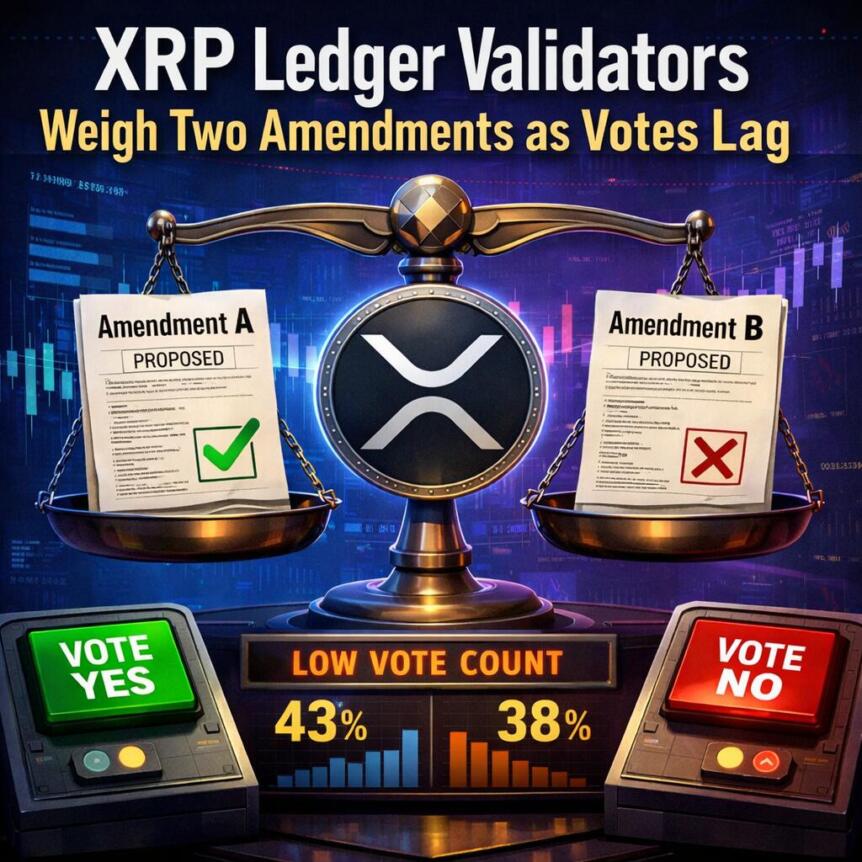
The XRP Ledger is reviewing two proposed amendments that could expand lending functions and strengthen vault infrastructure. Validators have begun voting, yet early participation remains limited. Current results suggest the proposals still face significant hurdles before reaching activation requirements.
Data from XRPScan shows that validators have submitted only a small portion of the required votes. The network requires a strong consensus before any protocol change becomes active. Consequently, both amendments remain far from the necessary approval threshold.
The proposed changes target deeper financial functionality across the XRP ecosystem. Developers designed them to enhance lending capabilities and asset management tools. However, the current voting pace indicates that activation may take longer than expected.
SingleAssetVault Amendment
Validators are currently assessing the v3.1.0 SingleAssetVault amendment across the network. The proposal introduces vault mechanisms designed for single asset management within decentralized environments. As a result, developers expect stronger custody options for on-chain financial applications.
So far, only eight validators have recorded votes supporting the proposal. This number remains well below the required activation threshold. Therefore, the amendment currently shows limited progress toward implementation.
The XRP Ledger requires at least 28 validator approvals to activate protocol changes. This requirement represents roughly 80 percent of the network’s validator set. Without that support, the activation process automatically resets after the voting period ends.
Lending Protocol Amendment
Validators are also reviewing the v3.1.0 Lending Protocol amendment during the same voting cycle. This proposal introduces infrastructure for native lending services within the XRP Ledger ecosystem. Consequently, developers aim to expand decentralized finance capabilities directly on the network.
The amendment has gathered only six validator votes so far. That participation rate equals about 17% of the total validator pool. Therefore, the proposal remains far below the required approval threshold.
If voting participation does not accelerate, the activation timer will expire. When that happens, the amendment returns to a pending state. Validators may then reconsider the proposal during a future voting round.
Amendment Oversight and Security Context
Protocol amendments carry major consequences because they directly modify core blockchain functionality. Developers, therefore, apply strict governance rules before enabling any change. The XRP Ledger uses extended validator voting periods to confirm broad consensus.
A recent example demonstrated why careful review remains essential. Security researchers discovered a vulnerability in the proposed Batch amendment, known as XLS-56. That issue appeared during its voting phase and never reached activation.
The flaw could have allowed attackers to withdraw funds from user wallets. Notably, the exploit did not require access to private keys. Early detection prevented potential damage and reinforced the network’s review process.
Such events highlight the importance of gradual amendment adoption. Validators must carefully examine technical risks before approving protocol upgrades. Consequently, the slow progress of current proposals reflects the network’s cautious governance approach.


Why Arthur Hayes is bullish: In an interview with CoinDesk’s Jennifer Sanasie on MArkets Outlook, Hayes said Hyperliquid has separated itself from competing perpetual futures exchanges with real usage rather than incentive-driven volume.
- Hayes told Sanasie he sold his firm’s HYPE position around $50–$55 ahead of expected token unlock pressure but turned bullish again after the team chose not to sell most of its monthly token allocations.
- He said Hyperliquid still generates close to a $1 billion annualized revenue run rate based on 30-day fee data.
- The platform’s HIP-3 permissionless listing system has expanded trading beyond crypto into assets like oil or equity indices.
What’s driving activity: Hayes said traders are increasingly using Hyperliquid to access markets unavailable through traditional platforms.
- Retail traders can trade assets like oil or Nasdaq proxies 24/7 on-chain using stablecoins and crypto wallets.
- Hayes said leverage of 10x–20x is often available compared with the 2x–3x many retail investors receive on traditional brokerage platforms.
- Weekend geopolitical events, such as sudden conflict announcements, have pushed traders to use Hyperliquid while traditional markets are closed.
Why Hyperliquid stands out: Hayes argued Hyperliquid’s liquidity and trading metrics show more genuine market activity than rival decentralized exchanges.
- Many competing platforms rely on wash trading or token incentive programs to inflate activity, Hayes said.
- He evaluates exchanges using the ratio of trading volume to open interest, which he said helps identify genuine trading demand.
- Hayes said Hyperliquid has the lowest ratio among major perpetual DEXs, indicating more “real” trading.
- The platform also offers the lowest slippage for large bitcoin perpetual trades ranging from $100,000 to $10 million, he said.
What could derail the thesis: Hayes said rising hype and stronger competition could signal a potential exit point.
- He said he would reconsider his position if HYPE’s price-to-earnings ratio rises sharply and market sentiment becomes overwhelmingly bullish.
- Another risk is whether competitors offering lower fees can erode Hyperliquid’s roughly 70% share of perpetual DEX revenue.
- Hayes said maintaining strong revenue and continued restraint in team token selling are key to sustaining the bull case.
Beyond HYPE: Hayes also highlighted privacy-focused crypto projects as a developing narrative.
- He said Zcash could benefit from growing concerns about blockchain surveillance and AI-powered transaction analysis.
- Hayes cited Zcash’s cryptographic upgrades and privacy model as reasons he favors it over alternatives like Monero.
Bitcoin outlook: Hayes maintained his aggressive forecast for Bitcoin.
- He reiterated that Bitcoin could reach $250,000 by the end of the year despite missing earlier targets.


The document articulates and reaffirms the purpose and “promise of Ethereum,” as well as the EF’s role in the ecosystem.
The Ethereum Foundation released the EF Mandate today, a foundational document it says functions as part constitution, part manifesto. The 38-page document, published by the EF’s board today, March 13, as a PDF and on-chain, aims to articulate the “promise of Etheruem,” as well as the EF’s role in the ecosystem.
Per the Mandate, the EF defines its role not as Ethereum’s owner or ruler, but as a steward with one core mission: ensuring Ethereum becomes and stays a decentralized, resilient tool for user self-sovereignty.
The Mandate also reaffirms the definition of Ethereum as humanity’s “World Computer” as the ecosystem’s first “promise” — what the EF says represents a “common computational substrate that anyone can interact with trustlessly, permissionlessly, and persistently.” Ethereum’s second promise, per the EF Mandate, is to enable self-sovereign coordination at scale, without coercion or capture.
Per the document, the EF’s mandate consists of two main principles: ensuring Ethereum stay decentralized and resilient, specifically as a tool for self-sovereignty; secondly, “scaling the guaranteed availability of self-sovereignty to users ready to
exercise it directly.”
The document states that a core aim of the EF within the first of its mandates is to ensure that Ethereum remain “CROPS” — censorship resistant, open source, private, and secure. This collection of properties, the EF says, is the non-negotiable baseline for all EF decisions for Ethereum, at both the protocol and application layers, per the Mandate.
“May the Foundation fall on its own sword if it fails to uphold its solemn promise to Ethereum,” an illustrated part of the EF Mandate reads.
Buterin Responds
Ethereum’s co-founder, Vitalik Buterin, posted a detailed breakdown of the Mandate on X today, describing Ethereum’s as “a sanctuary technology” built to “preserve technological self-sovereignty” and “ensure that no single person, organization or ideology’s victory in cyberspace can be total.”
Buterin outlined the EF’s role as well, including developing “the zero option” at the Ethereum application layer — UX that “goes hard” on security, privacy, and respecting user agency — while leaving broader adoption-first efforts to outside players. “Such work has its natural home outside the EF,” he wrote.
The Mandate also formally enshrines passing the “walkaway test” as the EF’s norttart for Ethereum. Buterin first introduced the concept on Jan. 12, as The Defiant reported at the time.
The walkaway test refers to making sure Ethereum is robust and resilient enough to function and evolve even if the EF and the protocol’s core developers “disappeared tomorrow.” The Foundation frames its own diminishing relevance as the truest measure of success, arguing that despite what may sound like a contradiction, “we believe, and history shows us time and again, that the only way to grow a garden into something truly infinite is to choose subtraction,” referring to the eventual “subtraction” of the EF itself as steward of Ethereum.
“For we are building nothing less than the machinery of freedom — not just for today, but for the next thousand years,” the Mandate states in its closing section.
The release comes amid significant internal change at the EF, following leadership restructuring last summer, and more recently, executive departures.
“We are doubling down on Ethereum,” Buterin wrote in his X post today, “and are excited about its next chapter.”
This article was written with the assistance of AI workflows. All our stories are curated, edited and fact-checked by a human.


Robinhood’s February data show crypto notional volumes up 9% to $25b while equity, options and event contracts shrink, proving speculative energy has rotated back into coins.
Summary
- Crypto notional trading hit $25.0b in February, up 9% month‑on‑month and 74% year‑on‑year, with $9.4b on the app and $15.6b routed through Bitstamp.
- Equity notional volume fell to $194.4b, down 14% from January, while options contracts slipped 10% to 180.3m, underscoring cooling risk appetite outside coins.
- Event contracts plunged 29% versus January, signalling that speculative flow is rotating away from Robinhood’s prediction markets and back into volatile crypto names.
Robinhood’s February numbers are clear: crypto is where the life is, everything else is fading.
Robinhood crypto volume jumps in February
Robinhood reported February crypto notional trading volumes of $25.0 billion, up 9% month‑on‑month and 74% year‑on‑year. Of that, $9.4 billion ran through the Robinhood app itself, with the remaining volume routed via Bitstamp, which Robinhood acquired in 2025 and now uses as its institutional and deep‑liquidity back‑end. This follows January’s $22.9 billion in crypto volume, meaning Robinhood has printed back‑to‑back months of sequential growth in digital‑asset activity to start 2026.
The crypto growth comes as Bitcoin trades near all‑time highs and volatility returns across majors and meme‑adjacent tokens, pulling in both retail flow on the app and larger tickets via Bitstamp. For Robinhood, that mix is ideal: more notional, fatter spreads and higher engagement in a product line that was supposed to be dead post‑2021 but is now the only one actually inflecting up.
Equities, options and event contracts slump
Everything outside crypto is going the other way. Equity notional trading volume in February came in at $194.4 billion, down 14% from January, even though that still marks a 36% increase versus a year earlier. Options contracts traded fell to 180.3 million, a 10% month‑on‑month decline and only a 9% gain year‑on‑year, with average daily option volume at 9.5 million contracts, down 5% versus January.
The sharpest hit is in Robinhood’s event contracts — its prediction‑market‑style product. February saw just 2.4 billion event contracts traded, a 29% drop from January’s level, giving back a chunk of the growth the firm had touted as part of its post‑meme diversification story. That tells you where speculative energy has rotated: away from binary macro bets and back into leveraged plays on BTC and friends.
What this rotation really means
From a market‑structure perspective, Robinhood is simply reflecting the broader tape: crypto volatility plus upside trends are attracting flows at the margin, while single‑stock and options trading cools off after a heavy run. For crypto markets, more retail flow through Robinhood and Bitstamp means more noise, more forced buying and selling around headlines, and fatter tails on both sides when the Fed or macro shocks hit.


Dividend-paying companies are rapidly closing the earnings growth gap with technology stocks and contributing more earnings momentum to the S&P 500. After a significant increase over the past year on this key earnings metric, the trend suggests that dividend stocks may present an even stronger case to investors seeking income and safety in a volatile market.
The earnings momentum broadening out beyond the tech sector comes at a time when investors are seeking ways to limit risk amid the second military conflict in the Middle East in under a year and a shock to the oil markets that is unprecedented.
In Q1 2025, the S&P 500 Dividend Aristocrats Index posted earnings growth of negative 5.5%. By Q4 of last year, that earnings growth rate had rebounded to positive 9%. At the same time, the Nasdaq 100 Index saw earnings growth decline from over 35% in Q2 2025 to under 15% in Q4.
Simeon Hyman, global investment strategist at ProShares, said during this week’s CNBC’s “ETF Edge” podcast that the rotation that began away from the Mag 7 tech stocks well before the war merits a deeper look from investors at a time of market uncertainty.
“We think one of best ways to take advantage of it is through quality stocks, companies growing their dividends for 25 consecutive years at minimum and that have been out of favor,” he said.
While the reversal began before the outbreak of war, Hyman said high quality, lower volatility stocks may be “kind of good to have during a conflict.”
“It’s not only the price [of the stocks] turning around but the fundamentals turning around,” he said. “Go back four quarters and all the earnings growth was coming from the tech sector and Nasdaq 100. Those dividends growers year-over-year, earnings were shrinking a little bit. But now the gap has closed and may shortly go the other way. We’re almost now to parity,” he said, referring to Bloomberg data cited by ProShares in a recent blog post on the topic.
ProShares S&P 500 Dividend Aristocrats ETF (NOBL) is one of the many exchange-traded funds that offers exposure to large-cap U.S. stocks that pay healthy dividends. Its top three holdings are Chevron, Exxon Mobil and Target.

Performance of S&P 500 Dividend Aristocrats Index over the past year.
ETF experts agree that the outlook for dividend stocks has improved across the market.
“Growth characteristics of companies in the financial sector, the health care sector, the industrial sector … those are where you often find dividend growth. They continue to experience more and more growth,” Todd Rosenbluth, head of research at VettaFi, told CNBC.
A long history of dividend increases reflects consistent cash flow and disciplined management, however, it has not traditionally matched the rapid profit expansion seen in the technology sector. But strong operating performance and improving margins have helped boost profits for many dividend-payers from other sectors. And as earning rise, these companies continue to increase dividends while strengthening their balance sheets. At the same time, expectations for technology stocks remain extremely high after several years of strong gains, and as tech firms are spending huge sums on AI buildouts which is stressing their balance sheets and cash flow. Dividend-paying companies outside of tech often trade at more moderate valuations, and as their earnings growth improves, investors may increasingly view them as offering both stability and expansion.
Of course, if the U.S.-Iran war — and factors such as oil prices persistently above $100 and a Strait of Hormuz closure that is prolonged — pushes up prices across a supply-depleted economy and sends the global economy into a recession, there is no sure thing for stock investors. Dividend stocks and the ProShares NOBL ETF have been caught up in the recent stock market negative sentiment, down 5% in the past month but still up close to 8% over the past year.
Hyman said in his view this is “certainly not a time to capitulate, but maybe a time to tweak around the edges,” and focus more on quality stories. “We love our dividend growers,” he said.
He noted that after the two prior Gulf wars which were prolonged conflicts, stocks were higher in the six to 12-month periods after initial pullbacks, and up by as much as 25-30%. “The history is pretty darn clear … markets do rebound,” he said.
The history is also clear, Hyman said, on dividend stock outperformance having “some durability to it.” And right now, these stocks are pulling even more weight in the market. “In addition to the durable outperformance opportunity from the dividend growers, the other thing that is very important is that it has kept overall S&P 500 fundamentals stable” Hyman said. “They are now filling the gap,” he said, as mega cap tech earnings growth slides, “and that suggests a little bit of a soft landing,” he added.
Sign up for our weekly newsletter that goes beyond the livestream, offering a closer look at the trends and figures shaping the ETF market.
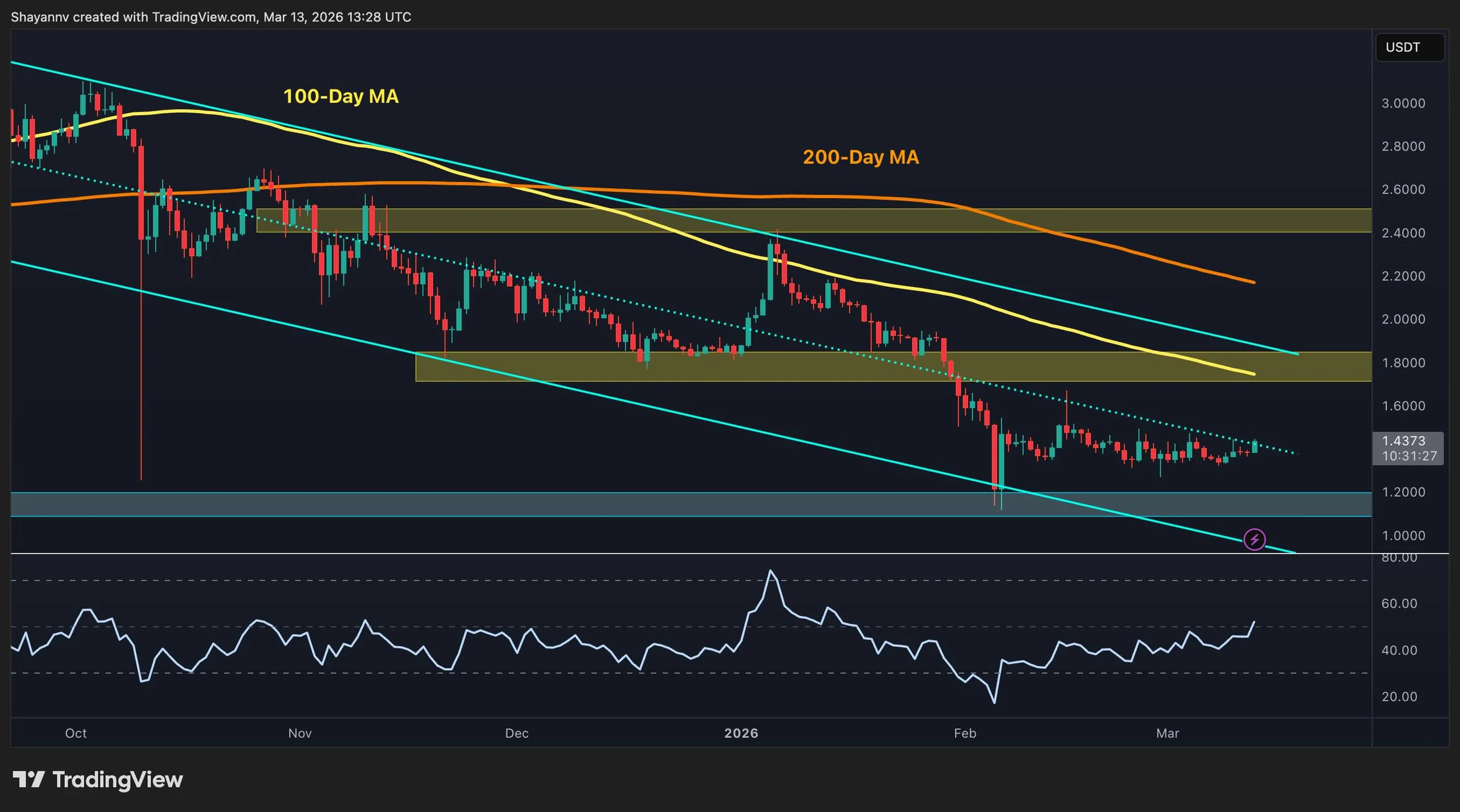
XRP remains in a fragile position, with both the USDT and BTC pairs still trading within broader bearish structures. Although the price is attempting to stabilize near key support zones, buyers have yet to reclaim the major moving averages or break the descending trendlines that continue to define the downtrend.
Ripple Price Analysis: The USDT Pair
On the XRP/USDT chart, the asset is still moving inside a falling channel and remains below both the 100-day and 200-day moving averages, which keeps the broader outlook tilted to the downside. XRP is now trading around $1.43, holding above the $1.10 to $1.20 support zone, while the first meaningful resistance sits at the $1.80 mark.
If buyers manage to push above that area, the next major hurdle comes in around $2.40 to $2.50. For now, though, the structure remains weak, and the recent RSI recovery only points to mild momentum improvement rather than a confirmed trend reversal.
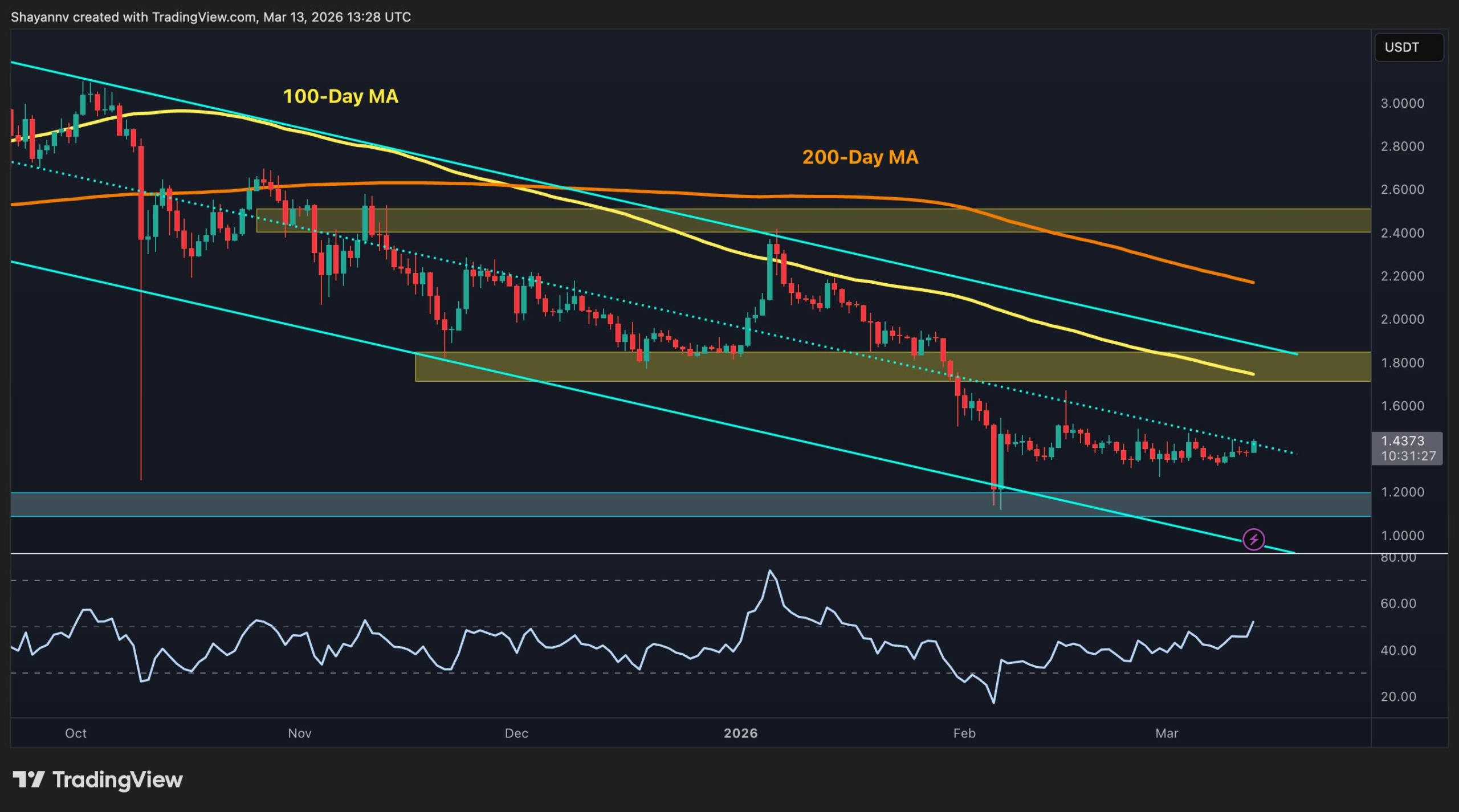
The BTC Pair
Against Bitcoin, XRP continues to underperform and again, remains pinned below both the 100-day and 200-day moving averages. The pair is trading near 1,968 sats and is once again testing the key 1,950 to 2,000 sats support area, which has acted as an important floor in recent months.
As long as that support holds, a short-term bounce remains possible, but any recovery still needs to clear the 2,500 sats resistance zone to shift momentum more decisively. If the current support breaks, the next downside target would likely be the 1,500 sats region, while a stronger reclaim of overhead resistance could open the way toward the key 2,700 sats resistance level.

Binance Free $600 (CryptoPotato Exclusive): Use this link to register a new account and receive $600 exclusive welcome offer on Binance (full details).
LIMITED OFFER for CryptoPotato readers at Bybit: Use this link to register and open a $500 FREE position on any coin!
Disclaimer: Information found on CryptoPotato is those of writers quoted. It does not represent the opinions of CryptoPotato on whether to buy, sell, or hold any investments. You are advised to conduct your own research before making any investment decisions. Use provided information at your own risk. See Disclaimer for more information.


Circle’s (CRCL) USDC has overtaken Tether’s USDT in transaction volumes for the first time since 2019, prompting Japanese investment bank Mizuho to raise its price target for the stablecoin issuer to $120 from $100, while reiterating its neutral rating on the stock.
The shares rose 1% in early trading to $115.40 and are up roughly 95% from their February lows.
Analysts Dan Dolev and Alexander Jenkins increased their Circle estimates, citing “USDC activity trends and use cases like Polymarket or agentic commerce expectations.”
Stablecoins, digital tokens backed by reserves such as fiat currency or gold, serve as key payment and settlement rails in the crypto economy, particularly for trading and cross-border transfers. The sector is dominated by Tether’s USDT with a $143 billion market cap, followed by Circle’s USDC at $78 billion.
According to their Friday report, USDC has recorded about $2.2 trillion in adjusted transaction volume so far in 2026, compared with $1.3 trillion for USDT. That gives USDC roughly 64% share of adjusted volumes, a sharp reversal from 2019–2025 when Tether consistently led, and USDC averaged about a 30% share.
The analysts said the shift matters because the long-term winner among stablecoins will likely be determined by real economic usage rather than market capitalization alone. Standard Chartered expects the stablecoin market cap to reach $2 trillion by the end of 2028.
Reflecting stronger USDC activity and expanding use cases, the Mizuho analysts raised several long-term Circle forecasts. They now expect “meaningful wallets” to reach 11.7 million by 2027, up from a prior estimate of 10 million, helping lift projected USDC market capitalization to $139 billion from $123 billion.
Circle has outperformed other crypto-linked equities recently.
William Blair analysts said in a Thursday note that while recent gains could easily be linked to rising oil prices and a potentially more hawkish Federal Reserve, other factors are likely driving the move.
They pointed instead to the resilience of USDC’s market capitalization despite the broader crypto downturn, along with increasing investor recognition of Circle’s economic model and its leadership in stablecoin infrastructure.
Other analysts pointed to a positioning-driven short squeeze rather than fundamentals as the driver of the recent move higher in the shares.
While the company delivered strong growth in USDC supply, the stock’s outsized reaction post earnings was driven more by crowded short bets heading into the print than by strong financials, according to Markus Thielen, founder of 10x Research.
Read more: Circle’s outperformance highlights USDC’s staying power, says bullish Wall Street analyst


The Ethereum Foundation (EF) released a sweeping new document outlining its philosophy, priorities and long-term role in stewarding the world’s second-largest blockchain network.
The 38-page “EF Mandate,” published Friday, frames the blockchain, whose ether (ETH) token is beaten only by bitcoin in market capitalization, as a technology designed to protect individual freedom in an increasingly centralized digital world and lays out the principles the nonprofit says must guide its development.
The document comes at a time of transition for the organization, following recent shifts in Ethereum’s technical roadmap and the resignation earlier this year of one of the foundation’s co-executive directors.
“The Ethereum Foundation is the original steward of the Ethereum project,” the document says. “The Foundation is not the parent, owner, or ruler of Ethereum. We are not ‘the system’ itself.”
At the center of the mandate is the concept of self-sovereignty, which the foundation describes as Ethereum’s core purpose.
“The first aim is to ensure Ethereum becomes and stays a decentralized and resilient tool for self-sovereignty,” the manifesto states. “Our first fundamental principle is that a user has the final say over their identities, assets, actions, and agents.”
To preserve that goal, the foundation says four properties must remain central to Ethereum’s development: censorship resistance, open source and free (as in freedom), privacy, and security, collectively known as CROPS.
“We hold that these properties – CROPS – must remain, as an indivisible whole, the sine qua non of all Ethereum’s development priorities, which cannot be displaced,” the mandate says.
The foundation also said it will measure its own long-term success by how unnecessary it becomes. For the time being, it will focus on work that no other ecosystem participants are likely to undertake, including long-term protocol research, public-goods security work and coordination across development teams.
Once the broader ecosystem can take over those functions, it plans to step back.
“Our goal is to reduce the Foundation’s relative influence over time,” the team wrote. “Subtraction is rather a process of ensuring Ethereum’s maturity: a trajectory of growth with decentralization, robust enough to outgrow and outlast us.”
More broadly, the document situates the blockchain within an ecosystem of open technologies that support free and decentralized systems. The EF describes Ethereum as part of an “infinite garden,” an expanding network of builders, communities and institutions working to keep digital infrastructure open and resilient.
“The World Computer is decentralized infrastructure for permissionless compute, communication, and association,” the mandate states.
The manifesto concludes by reiterating the foundation’s long-term goal: protecting Ethereum’s promise as an open system that enables individuals and communities to coordinate without relying on centralized authorities.
“Our work is not about capturing markets, corporates, or states, nor about helping them extract or capture,” the document says. “We are here to uncapture the individual, and to entrench their freedoms of association.”
Read more: Ethereum Foundation leadership shake-up: Tomasz Stańczak out as co-executive director
Crypto exchange KuCoin has launched equity-linked perpetual derivatives tied to stocks, including Tesla and Strategy, allowing traders to speculate on their price movements through USDt-settled contracts that trade around the clock.
According to Friday’s announcement, the first listings include TSLAUSDT and MSTRUSDT perpetual contracts, which track price movements in the underlying equities but do not grant ownership of the shares. Instead, the products are synthetic derivatives settled in stablecoins.
The contracts have no expiration date and can be traded continuously. Positions can be opened with as little as 1 USDt (USDT), lowering the entry threshold for traders seeking exposure to equity-linked price movements through a crypto trading platform.
According to KuCoin, the product uses a pricing framework designed to track underlying equity benchmarks while accounting for differences between traditional stock market hours and the continuous trading environment of crypto derivatives markets.
Access to the contracts may be restricted in some jurisdictions depending on local regulations, the company said.
Founded in 2017, KuCoin says its platform serves more than 40 million users across more than 200 countries and lists over 1,000 digital tokens for trading. The exchange ranks eighth by spot trading volume, according to CoinMarketCap data.
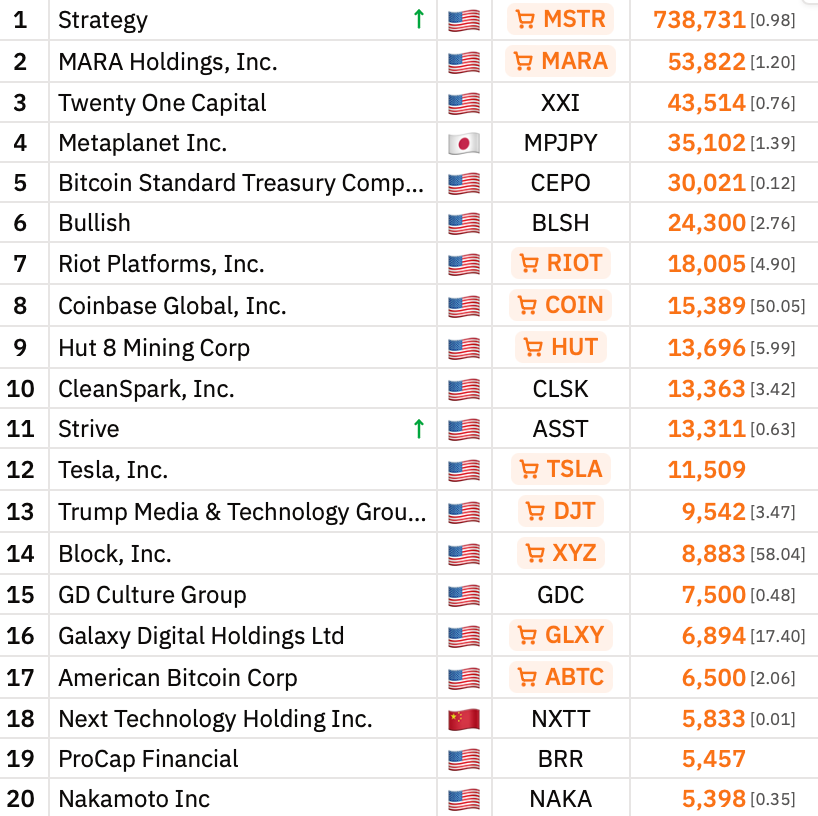
MicroStrategy, which rebranded to Strategy in February 2025, is currently the largest corporate Bitcoin holder, with 738,731 BTC on its balance sheet. Tesla ranks as the 12th-largest public holder, with 11,509 BTC.

Related: SEC’s ‘Crypto Mom’ calls for simpler disclosure rules, flags tokenization debate
Fintechs and exchanges move to tokenize stocks
The market for tokenized equities has surged since the beginning of 2025. Tokenized stocks now have a total market value of about $1.03 billion, according to RWA.xyz data, up from around $291 million on Jan. 1, 2025.
Growth in the sector is being driven by fintech companies, crypto exchanges, and traditional brokerages alike.
In October, Robinhood expanded its tokenization initiative on the Arbitrum blockchain, adding 80 new stock tokens and bringing the total number of tokenized assets on the platform to nearly 500.

In June, more than 60 tokenized stocks became available on Kraken and Bybit following the launch of Backed Finance’s xStocks product. Last month, Kraken launched tokenized equity perpetual futures on its regulated derivatives platform, allowing eligible non-US clients to trade 24/7 leveraged exposure to major US stock indexes, gold and companies including Tesla, Nvidia, and Apple.
Traditional exchanges are also exploring the concept. In January, the New York Stock Exchange announced it is developing a platform for trading tokenized stocks and exchange-traded funds with 24/7 trading and instant settlement, subject to regulatory approval.
In September, Nasdaq filed with the US Securities and Exchange Commission seeking approval to list tokenized stocks. It has since partnered with Payward, Kraken’s parent company, and its subsidiary, Backed Finance, to develop an equities tokenization gateway. The platform is expected to begin offering services to issuers in the first half of 2027.
Magazine: All 21 million Bitcoin is at risk from quantum computers
New Kids on the Block's Joey McIntyre celebrates 2 years of sobriety: 'Can you believe it?'

XRP WATCH! Clarity ACT Crypto Market Structure LIVE!

Why the next escalation in the Iran conflict could be between the US and Turkey


-

 News Videos4 days ago
10th Algebra | Financial Planning | Question Bank Solution | Board Exam 2026
-
 Tech2 days ago
A 1,300-Pound NASA Spacecraft To Re-Enter Earth’s Atmosphere
-

 Fashion7 days ago
Weekend Open Thread: Ann Taylor
-

 Crypto World4 days ago
Paradigm, a16z, Winklevoss Capital, Balaji Srinivasan among investors in ZODL
-

 Tech3 days ago
ChatGPT will now generate interactive visuals to help you with math and science concepts
-

 Business3 days ago
ExxonMobil seeks to move corporate registration from New Jersey to Texas
-

 Sports6 days ago
Three share 2-shot lead entering final round in Hong Kong
-

 Sports6 days ago
Braveheart Lakshya downs Lai in epic battle to enter All England Open final | Other Sports News
-

 NewsBeat2 days ago
Residents reaction as Shildon murder probe enters second day
-

 Entertainment7 days ago
Hailey Bieber Poses For Sexy Selfies In New Luscious Lip Thirst Traps
-

 Business2 days ago
Search Enters Sixth Week With New Leads in Tucson Abduction Case
-

 Business5 days ago
Search for Nancy Guthrie Enters 37th Day as FBI Probes Wi-Fi Jammer Theory
-
 NewsBeat4 days ago
Pagazzi Lighting enters administration as 70 jobs lost and 11 stores close across Scotland
-

 Tech4 days ago
Despite challenges, Ireland sixth in EU for board gender diversity
-

 Business4 days ago
Search Enters 39th Day with FBI Tip Line Developments and No Major Breakthroughs
-

 NewsBeat2 days ago
I Entered The Manosphere. Nothing Could Prepare Me For What I Found.
-

 Business7 days ago
Iran war enters second week as Trump demands ’unconditional surrender’
-

 Sports4 days ago
Skateboarding World Championships: Britain’s Sky Brown wins park gold
-

 Crypto World3 days ago
Will Chainlink price reclaim $10 amid volatility squeeze?
-

 Sports5 days ago
Tomorrow’s Top 25 Today: Florida jumps to No. 4; Louisville, Wisconsin enter projected rankings