Crypto World
Fed Rate Cut Delayed as Strong Jobs Data Tests Bitcoin

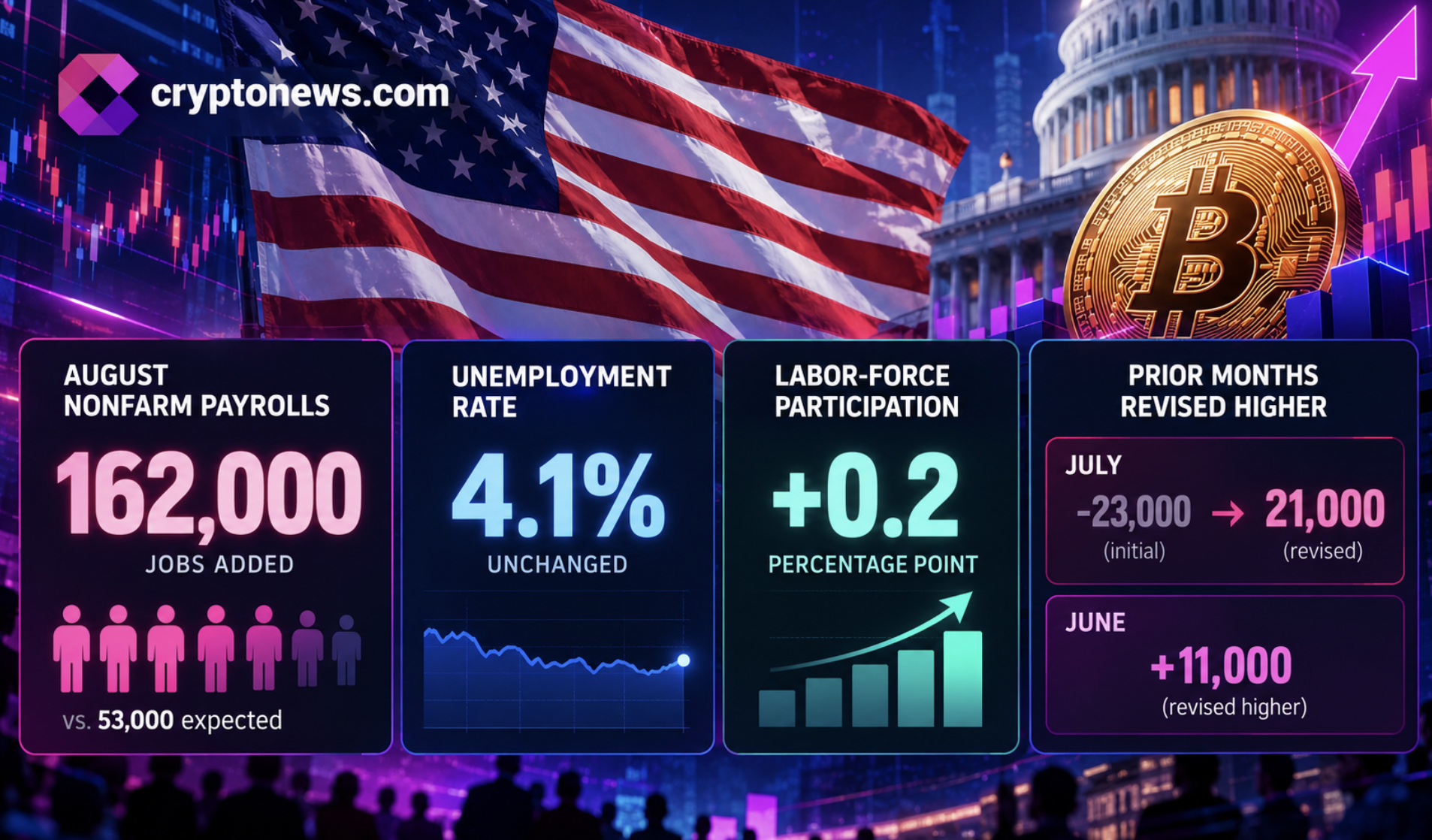
Citigroup pushed its forecast for the Fed first interest rate cut to June 2027 after US employers added 162,000 jobs in August, more than triple the 53,000 economists had penciled in. The revision extends the timeline for lower borrowing costs by nine months.
Now, it opens a question Bitcoin traders have been circling all year: how much longer can a resilient labor market keep real yields, the dollar, and interest rates elevated before it actually breaks risk-asset demand?
The August payrolls report did more than beat expectations on the headline number. The unemployment rate held at 4.1%, labor-force participation rose 0.2 percentage point, and prior months were revised sharply higher: July payrolls flipped from a reported loss of 23,000 to a gain of 21,000, while June was revised up by 11,000.

Citi economists Andrew Hollenhorst and Veronica Clark concluded that employment conditions looked stable enough for the Federal Reserve to shift its attention squarely to inflation.
Citi had previously been one of the more dovish desks on Wall Street, calling for cuts in October and December 2026 and January 2027. That call is gone. The bank now projects reductions in June, September, and December 2027, and the market reaction was immediate: rate futures pushed the probability of a September Fed hike from 52% to 61% the day the jobs data landed, a repricing that rattled Bitcoin within hours.
Discover: The Best Token Presales
What Does the Higher-for-Longer Policy Mean for Bitcoin?
The Fed followed through. On September 16, the Fed raised the benchmark rate by 25 basis points to a 3.75%-4% target range, the first hike since July 2023, despite traders wanting a cut. Sixteen of 18 officials projected at least one more increase before year-end, and inflation has now sat above the Fed’s 2% target for more than five years, according to the Fed’s own framing of the data.
The mechanical case against Bitcoin here is straightforward: Treasury yields and a stronger dollar compete with risk assets for capital, and Bitcoin generates no yield simply by being held, so every basis point of delay in cuts raises the opportunity cost of parking capital in it instead of government debt.
This is the textbook crypto liquidity headwind, and it showed up in price. But the textbook case stopped predicting price action the moment the hike actually landed.


Bitcoin briefly dropped toward $75,000 immediately after the September 16 decision, then reversed and climbed past $86,000 as ETF demand returned, yields eased and short sellers were squeezed out of bearish positions, a pattern consistent with BTC’s prior recoveries when yields soften. That rebound can’t be pinned on a single cause, and it doesn’t prove Bitcoin has decoupled from monetary policy. It does prove that a rate hike alone isn’t a mechanical sell signal once other flows are running in the opposite direction.
Earn $50 and Enter $300K Prize Draw on EdgeX
Bitcoin Levels, Flows, and Citi Fed Rate Cut Expectation
The price path around these events is the clearest evidence of how sensitive BTC remains to macro surprises. Bitcoin fell below $80,000 right after the August jobs release, reversing from an intraday high near $81,370, and was later quoted near $79,600, down about 1.5% on the day.
Ahead of the September Fed meeting, as hike odds moved above 92%, BTC fell below $76,000 before the post-decision dip toward $75,000 and the subsequent climb to a brief touch of $87,000, per the latest price action review.
Flow data backs up the recovery narrative. US spot Bitcoin ETFs logged $433 million in net inflows on September 18 after a stretch of heavy withdrawals earlier that week, suggesting institutional demand re-engaged once the hike was priced in rather than feared.
For us, the actionable variables are the same ones that moved Bitcoin twice in the past month: real yields, Treasury yields, dollar strength, spot ETF flows, and the next round of inflation and payroll prints.
If labor data stays firm and inflation proves sticky, a higher-for-longer stance keeps yields elevated and tightens the liquidity backdrop for crypto. If yields ease and ETF demand persists, Bitcoin can keep absorbing hawkish surprises well before Citi’s June 2027 cut ever arrives.
Trade Crypto on Bybit and Get a Chance to Win Our $1,000 USDT Airdrop
The post Fed Rate Cut Delayed as Strong Jobs Data Tests Bitcoin appeared first on Cryptonews.
You must be logged in to post a comment Login