

Crypto World
Florida executive charged with wire fraud, money laundering in $328M crypto scam



Federal authorities have arrested Christopher Alexander Delgado, the founder and CEO of Goliath Ventures, on federal charges tied to an alleged $328 million Ponzi crypto scam, the U.S. Department of Justice announced.
Summary
- Goliath Ventures CEO Christopher Delgado was arrested on federal wire fraud and money laundering charges tied to a $328 million Ponzi scheme.
- Prosecutors say investors were promised monthly crypto returns, but funds were diverted to pay earlier investors and support Delgado’s luxury lifestyle.
- If convicted, Delgado faces up to 30 years in prison; authorities are reaching out to victims under the Crime Victims’ Rights Act.
Goliath Ventures CEO arrested in $328M crypto scam
Delgado, 34, of Apopka, Florida, was taken into custody on a criminal complaint filed in the United States District Court for the Middle District of Florida, where he is charged with wire fraud and money laundering.
If convicted on all counts, he could face up to 30 years in federal prison.
Prosecutors allege Delgado’s scheme ran from January 2023 through January 2026, during which he solicited investors to put money into purported cryptocurrency “liquidity pools” that promised steady monthly returns. In reality, federal officials say only about $1 million of the funds was actually invested in legitimate crypto assets.
The bulk of the more than $300 million collected from victims was used to pay earlier investors and finance Delgado’s lavish lifestyle, including luxury travel, company-sponsored events, and purchases of multi-million-dollar homes in central Florida.
According to court filings, victims were drawn in through personal referrals, slick marketing materials, and high-end networking events aimed at projecting legitimacy. At the scheme’s unraveling, investors seeking withdrawals were met with delays, inconsistent explanations, and restricted access to account information.
Federal law enforcement agencies including IRS Criminal Investigation and Homeland Security Investigations spearheaded the probe. Victims are being notified of their rights under the Crime Victims’ Rights Act, and authorities have invited potentially unidentified victims to come forward.
The arrest marks one of the largest alleged crypto-related fraud cases in recent years and underscores ongoing regulatory and criminal scrutiny of digital asset investment schemes.

TLDR
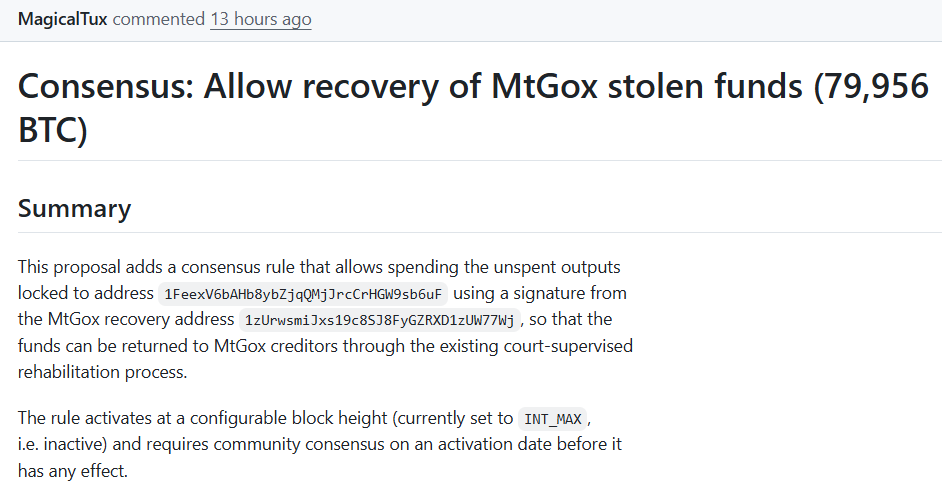
- Mark Karpelès, who previously led Mt. Gox, has floated a Bitcoin hard fork idea aimed at retrieving approximately 80,000 BTC taken during a 2011 security breach, currently valued above $5.2 billion.
- His plan would enable these funds to transfer without accessing the lost private key, through implementing a specialized consensus mechanism for one specific wallet.
- The draft was posted to GitHub as an exploratory discussion rather than an official Bitcoin Improvement Proposal.
- Detractors believe this creates a risky precedent that could undermine Bitcoin’s foundational immutability principle.
- These stolen coins exist separately from the approximately 200,000 BTC currently undergoing distribution to Mt. Gox claimants, with that process scheduled through October 2026.
Mark Karpelès, who formerly ran the defunct Mt. Gox Bitcoin exchange, has unveiled a draft plan advocating for a Bitcoin hard fork. His objective centers on retrieving approximately 79,956 BTC taken during a security breach over 15 years ago.
These digital assets remain locked in one specific wallet, representing more than $5.2 billion based on current market valuations. The funds have remained untouched since their theft in June 2011.
Bitcoin’s existing protocol requires the original private key to authorize any transaction. That critical key was never retrieved.
Karpelès uploaded his proposal to GitHub last Friday. His suggestion involves creating a novel consensus mechanism enabling fund movement to a designated recovery wallet without needing the missing key.
This rule would exclusively target that particular wallet address. Network-wide adoption would trigger activation at a predetermined future block height.
Karpelès showed transparency regarding the proposal’s nature. “I want to be upfront: this is a hard fork,” he stated.
He positioned this submission as a solution to an ongoing impasse. Nobuaki Kobayashi, serving as the Mt. Gox trustee, has refused to pursue blockchain-based recovery without guaranteed community support for such a protocol modification.
Why Critics Are Pushing Back
The suggestion has triggered substantial opposition, primarily focused on Bitcoin’s unchangeable nature. Bitcoin operates on the principle that confirmed transactions cannot be reversed or altered.
Numerous community members contend that modifying ownership protocols for a single address, regardless of theft circumstances, establishes dangerous precedent. Bitcointalk forum participants cautioned this might encourage comparable requests following future security incidents.
The proposal recognizes this concern directly. It notes: “If it can be done once, the argument goes, it can be done again.”
Governance concerns also emerge. Bitcoin lacks established procedures for determining which past thefts warrant protocol rule modifications.
Successful hard fork implementation requires widespread approval from miners, node operators, and trading platforms. Throughout Bitcoin‘s history, achieving consensus on divisive modifications has proven exceptionally challenging.
How This Fits Into Broader Mt. Gox Repayments
The 80,000 BTC held in the compromised wallet exist independently from funds presently distributed to creditors. Current repayments originate from a distinct reserve of roughly 200,000 BTC retrieved following the platform’s 2014 shutdown.
Creditor distributions commenced during mid-2024, with the completion deadline now pushed to October 2026. The stolen coins remain completely beyond trustee jurisdiction.
Mt. Gox declared bankruptcy in Tokyo on February 28, 2014, following the loss of approximately 750,000 customer bitcoins. During its operational prime, the platform processed 70% of worldwide Bitcoin transactions.
Certain creditors have expressed approval for this initiative. One individual identifying as a creditor mentioned receiving roughly 15% of their Bitcoin through bankruptcy proceedings and would endorse a legal mandate to recover the remaining stolen assets.
The proposal currently exists as a preliminary discussion draft without official endorsement or implementation schedule.

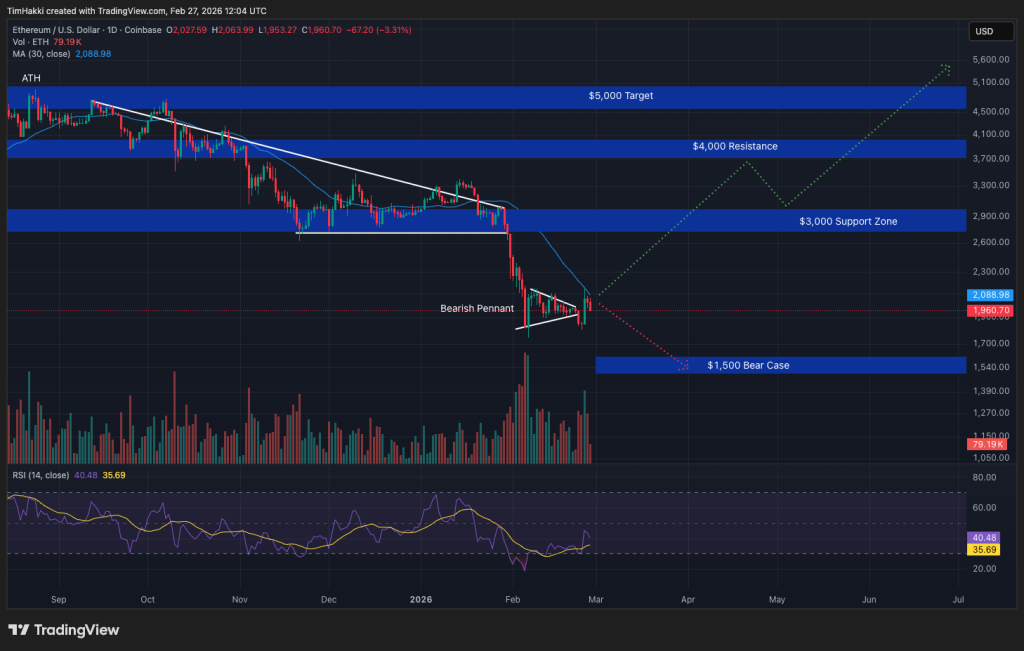
Ethereum (ETH) price action is stalling near $2,000, but the on-chain reality of its stablecoin advantage tells a radically different story.
The network now commands over 53%, or $159 billion, of the $300 billion stablecoin market, cementing its status as the settlement layer for Institutional Crypto.
So, while the ETH price chart usually looks flat nowadays, the infrastructure moat is arguably deeper than ever.
Key Takeaways
- The Stat: Ethereum holds $153.41 billion in Stablecoins, controlling nearly 60% of the global supply.
- The Argument: Jeff Housenbold views ETH as vertical infrastructure for fintech, distinct from day-to-day asset pricing.
- The Tension: Price lags infrastructure utility, creating a disconnect between value settled and token valuation.
The $159B Stablecoin Moat: Why Institutions Stick with Ethereum
Jeff Housenbold is betting on infrastructure. The President and CEO of Beast Industries (the company behind the viral MrBeast brand) recently termed Ethereum the “backbone” of the stablecoin industry in an interview with CNBC.
That assessment aligns with hard data. As of today, Ethereum hosts $159 billion of the market’s total $300 billion stablecoin supply.
This dominance persists because, arguably, institutional crypto use cases value settlement finality over speed.
While Beast Industries expands its fintech footprint following the acquisition of Step, a financial literacy app with 1.45 million users, the focus remains on where the deepest liquidity lives.
Housenbold’s firm, which also oversees a $200 million investment from Bitmine, isn’t chasing pump-and-dump mechanics. They are looking at the rails moving $10.3 trillion in monthly transfer volume.
That volume matters. While price continues trading sideways, Wall Street institutions are eyeing Ethereum. The 2024 GENIUS Act provided regulatory clarity for stablecoin issuers, but it was Ethereum’s existent liquidity that captured the institutional share.
The sheer market share of USDT ($183 billion) and USDC ($75 billion) on the network creates a self-reinforcing loop. Institutions mint where the liquidity is deepest. That lock-in effect is why the supply on Ethereum’s headstart on the stablecoin sector will be a tough challenge for rivals like Ripple to navigate.
Discover: The best crypto to diversify your portfolio with
Solana and Base: The Retail Volume Shift
While Ethereum holds the collateral, retail users are transacting elsewhere. That is the clear signal from recent Stablecoins flow data.
Solana’s stablecoin supply surged 40% in late 2025, outpacing Ethereum’s percentage growth, according to BitWise research analyst Danny Nelson. Traders chasing speed and low fees have migrated, driving Solana to 2.3 million daily active users compared to Ethereum’s 709,000.
Base, Coinbase’s Ethereum Layer 2, processed $5.3 trillion in January 2026 Circle (USDC) transfers despite holding a fraction of the supply found on mainnet.
This points to a high velocity of money on Layer 2, i.e., tokens moving fast in small amounts, versus the stagnant, high-value collateral sitting on Ethereum.
Stablecoin transfer volume across EVM, Solana, and Tron reached $10.3T in Jan ’26.
While Ethereum holds the supply, velocity is moving to L2s and Solana.
— CryptoNews Analyst (@CryptoNews) February 12, 2026
Circle is a primary beneficiary of this multi-chain expansion. The issuer recently saw revenue surges as USDC proliferates across high-speed chains.
However, for Ethereum, the loss of retail transaction dominance hasn’t eroded its reserve status. It has simply specialized: Ethereum is the savings account; Solana and Base are the checking accounts.
Beyond the Stablecoin Advantage, Is $2,000 the Floor for Ethereum?
Ethereum is trading at $1,960. The price has compressed into a tight range, lagging behind the broader market rally. The $2,000 level is now the critical psychological and technical pivot that will help ETH consolidate its current ground and go up to the next leg.
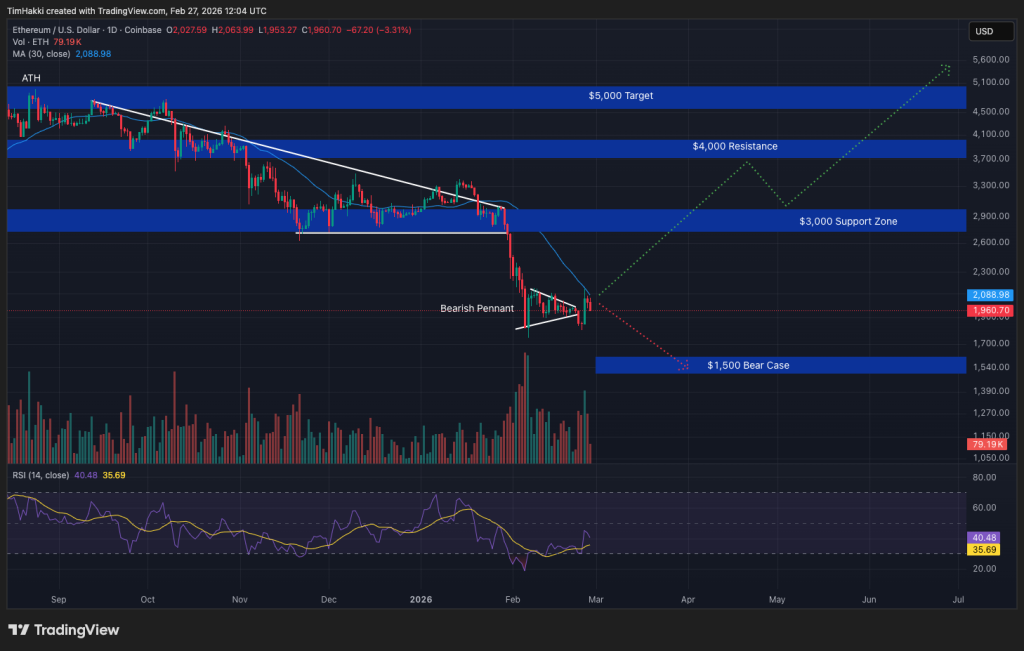
Losing this support level could put Ethereum in freefall, which may not break until $1,500, effectively invalidating all gains since the post-FTX 2021/2022 crash.
Supply dynamics favored a move higher. 31% of the total ETH supply is now staked, removing over 10 million coins from circulation since 2024.
That supply shock is latent energy. Standard Chartered sees this leading to $7,500 by year-end, but the market needs a catalyst to ignite it.
For now, momentum indicators are neutral. The RSI is sitting at 41, indicating indecision. The market is waiting for institutional capital to deploy the stablecoin dry powder sitting on Ethereum’s network. Until that capital rotates from stablecoins into risk assets, ETH remains in a consolidation phase.
Discover: The best new crypto to buy now
The post Ethereum $159B Stablecoin Dominance: Why Infrastructure Beats Price appeared first on Cryptonews.

TLDR
- Nebius Group (NBIS) plummeted 13.1% Friday, hitting an intraday low of $88.40 and settling at $91.19
- Fourth-quarter earnings showed a loss of $0.69 per share versus the anticipated -$0.42; sales reached $227.7M against a $246M projection
- Capital spending for the quarter totaled approximately $2.06B, sparking investor worries about liquidity
- Sector-wide weakness intensified as CoreWeave’s (CRWV) lackluster results triggered a broader neocloud retreat
- Wall Street analysts continue favoring the stock with a “Moderate Buy” consensus and $143.22 mean target
Nebius Group (NBIS) experienced significant turbulence Friday, surrendering 13.1% to finish at $91.19 after touching $88.40 earlier in the trading session. The previous session had seen shares close at $104.88.
Volume metrics painted a picture of heightened investor activity. Approximately 22.8 million shares traded hands — representing a 68% surge compared to the typical daily volume of 13.6 million.
The sharp decline followed NBIS’s February 12th fourth-quarter earnings release that fell short of analyst projections across key metrics.
The neocloud provider reported a per-share loss of $0.69, substantially wider than the Street’s forecast of a $0.42 deficit — representing a $0.27 shortfall. Top-line performance also underwhelmed, with revenue reaching $227.7 million versus the $246 million consensus.
While the earnings disappointment initially triggered selling, the investment spending figures ultimately amplified concerns.
The company disclosed capital expenditures totaling roughly $2.06 billion during Q4. Management’s outlook for sustained multi-billion dollar annual investments has prompted investor scrutiny regarding financing strategies and short-term liquidity management.
Sector Pressure From CoreWeave
The NBIS decline wasn’t an isolated incident. Competing neocloud provider CoreWeave (NASDAQ: CRWV) plunged up to 21.9% the same session following its own earnings disappointment.
Both enterprises compete in an identical market segment — acquiring GPU infrastructure and leasing AI computing resources to hyperscalers and emerging artificial intelligence companies. Market sentiment tends to correlate between these players.
This dynamic has emerged as a recurring theme. These equities attract intense scrutiny, remain opaque to mainstream investors, and demonstrate acute sensitivity to adverse developments within the AI infrastructure ecosystem.
NBIS exhibits a beta coefficient of 3.90, underscoring its pronounced volatility relative to broader market movements.
Analyst Views Still Mostly Positive
Notwithstanding Friday’s retreat, Street sentiment remains constructive. Among 11 analysts tracking the name, two rate it Strong Buy, seven assign Buy ratings, one maintains Hold, and one recommends Sell.
The consensus price objective stands at $143.22 — substantially above Friday’s closing level. Morgan Stanley launched coverage in January with an Equal Weight stance and $126 target. Freedom Capital elevated its recommendation to Strong Buy this month.
Skepticism exists in certain quarters. Both Wall Street Zen and Weiss Ratings have recently downgraded shares to Sell.
CICC Research initiated coverage last November with an Outperform recommendation and $143 price objective.
Technical indicators show the 50-day moving average at $95.00, while the 200-day moving average rests at $95.95. The company’s market capitalization approximates $22.96 billion.
Street forecasts project 2026 revenue at $3.35 billion, implying year-over-year expansion of 531%.
Strategic cloud collaborations with Meta and Microsoft underpin analyst confidence in the long-term revenue trajectory.
For the ongoing fiscal period, consensus estimates anticipate a $1.10 per-share loss.
Institutional ownership accounts for 21.90% of outstanding shares, with multiple funds gradually increasing their allocations in recent reporting periods.
Crypto World
ARK Invest’s Latest Moves: CoreWeave and Kratos Purchases Highlight February 27 Trading

Quick Summary
- ARK Invest acquired approximately $19.4M in CoreWeave stock following a 19% decline after the company’s Q4 earnings report
- The fund’s most significant transaction was a $23.2M acquisition of Kratos Defense & Security Solutions shares
- Teradyne holdings were reduced by $12.9M, extending ARK’s pattern of trimming this position
- ARK decreased its Rocket Lab stake despite the company exceeding earnings forecasts, with shares declining roughly 5%
- Additional moves included divesting Roku holdings and establishing a position in Generate Biomedicines
On Friday, February 27, Cathie Wood’s ARK Invest executed multiple strategic portfolio adjustments. The trading activity encompassed fresh investments and position reductions spanning technology, defense, and biotechnology sectors.
Kratos Defense & Security Solutions emerged as the day’s most substantial acquisition. ARK accumulated 252,169 shares valued at $23.2 million. The company specializes in unmanned aerial systems and autonomous defense technologies, aligning with ARK’s investment thesis centered on robotics and automation.
The second-largest acquisition involved CoreWeave, a provider of AI-focused cloud infrastructure. ARK secured 198,980 shares totaling approximately $19.4 million, distributed between its ARKK and ARKW exchange-traded funds.
CoreWeave, Inc. Class A Common Stock, CRWV
ARK’s CoreWeave purchase occurred during a session where the stock declined 19%. The downturn followed fourth-quarter earnings that demonstrated robust revenue growth but revealed expanding losses and capital expenditures that exceeded market expectations.
By purchasing shares during the selloff, ARK appears to interpret the market reaction as temporary volatility rather than fundamental business deterioration. CoreWeave operates in the AI computing infrastructure space, which has experienced substantial demand expansion.
CoreWeave maintains a Moderate Buy rating among Wall Street analysts. With eleven Buy ratings and eight Hold ratings, the consensus price target of $114.18 suggests potential upside of approximately 43.5% from current trading levels.
ARK Scales Back Teradyne and Rocket Lab Holdings
Regarding portfolio reductions, ARK divested 38,773 Teradyne shares valued at $12.9 million across several ETFs. Teradyne manufactures semiconductor testing systems and industrial automation equipment. This transaction continues ARK’s recent pattern of decreasing its Teradyne exposure.
ARK also liquidated 46,921 shares of Rocket Lab valued at approximately $3.4 million. The space technology company had recently announced quarterly performance that surpassed both earnings and revenue projections, yet shares declined roughly 5% on Friday.
Rocket Lab disclosed robust launch operations and an expanding order backlog. Nevertheless, the inaugural launch of its larger Neutron rocket was delayed until late 2026, potentially contributing to investor disappointment.
Additional Portfolio Adjustments in Biotech and Technology
ARK disposed of 46,389 shares of Roku valued at $4.3 million from its ARKK fund. The rationale for this divestment was not publicly disclosed.
Within the biotechnology sector, ARK acquired 459,525 shares of Generate Biomedicines valued at $7.4 million via its ARKG fund. Simultaneously, the fund sold 39,423 shares of Ionis Pharmaceuticals for $3.2 million.
ARK liquidated 10,590 Deere & Co shares for $6.6 million and reduced its Guardant Health position by 27,334 shares valued at $2.7 million.
Minor transactions included a reduction of 205,211 PagerDuty shares for $1.5 million and an acquisition of 14,097 Brera Holdings shares valued at approximately $15,600.
The CoreWeave and Kratos acquisitions represented ARK’s two most significant individual transactions on February 27, with combined value exceeding $42 million.


Mark Karpelès, the former chief executive of the defunct Mt. Gox exchange, is urging the Bitcoin community to consider a network hard fork designed to retrieve nearly 80,000 Bitcoin linked to the platform’s historic hack.
Key Takeaways:
- Mark Karpelès proposed a Bitcoin hard fork to recover 79,956 BTC worth about $5.2B from the Mt. Gox hack.
- The plan would allow the coins to move without the original private key and potentially repay creditors.
- The proposal has triggered strong opposition over fears it would weaken Bitcoin’s immutability.
In a proposal published Friday on GitHub, Karpelès outlined a change to Bitcoin’s consensus rules that would allow 79,956 BTC, currently held in a single wallet, to be transferred to a designated recovery address without access to the original private key.
At current prices, the holdings are worth more than $5.2 billion.
Dormant Mt. Gox Bitcoin Unmoved for 15 Years
“These coins have not moved in over 15 years,” Karpelès wrote, describing the funds as among the most widely monitored unspent transaction outputs in Bitcoin’s history.
He acknowledged the magnitude of the suggestion, stating plainly that the change would require a hard fork.
Such an update would make a transaction previously rejected by the network valid and would require node operators to upgrade their software before a specified activation block.
Karpelès said the idea is not an attempt to sidestep Bitcoin’s development process but rather to trigger discussion around a long-standing impasse.
According to him, bankruptcy trustee Nobuaki Kobayashi has declined to pursue on-chain recovery because there is no certainty the community would support it.
“That creates a deadlock,” Karpelès wrote. “The trustee won’t act without confidence, and the community can’t evaluate the idea without a concrete proposal.”
If the coins were recovered, the existing bankruptcy framework could distribute them to creditors already receiving repayments from the estate.
The suggestion has sparked sharp backlash across Bitcoin forums. Critics argue that altering consensus rules to reclaim stolen funds would undermine Bitcoin’s defining characteristic: irreversible transactions.
“Every time a hack happens, someone will want another special rule,” one Bitcointalk member wrote, warning it would erode trust in the system.
Another user argued Bitcoin should remain independent from legal or government determinations in any jurisdiction.
Karpelès Says Mt. Gox Recovery Case Is Unique as Creditors Back Proposal
Karpelès countered that the case is unique because both law enforcement and much of the community agree the wallet contains stolen Mt. Gox funds.
Some individuals claiming creditor status expressed support, saying any recovery could restore losses from the 2014 collapse.
Mt. Gox once processed roughly 70% of global Bitcoin trading between 2010 and 2014.
The exchange unraveled after a massive theft went undetected for years, ultimately losing about 750,000 customer Bitcoin and forcing a bankruptcy filing in Tokyo.
More than a decade later, the incident remains one of the largest failures in crypto history.
In May last year, Vivek Ramaswamy’s Strive said it plans to acquire 75,000 Bitcoin, valued slightly over $8 billion, from claims related to the defunct Mt. Gox exchange bankruptcy.
Strive noted that the strategy is intended to purchase Bitcoin at a discount price.
The post Former Mt. Gox CEO Proposes Hardfork to Recover $5.2B in BTC appeared first on Cryptonews.
Crypto World
Solana Price Analysis: SOL Slides 5% Amid Middle East Tensions – Critical Support Zones Ahead
TLDR
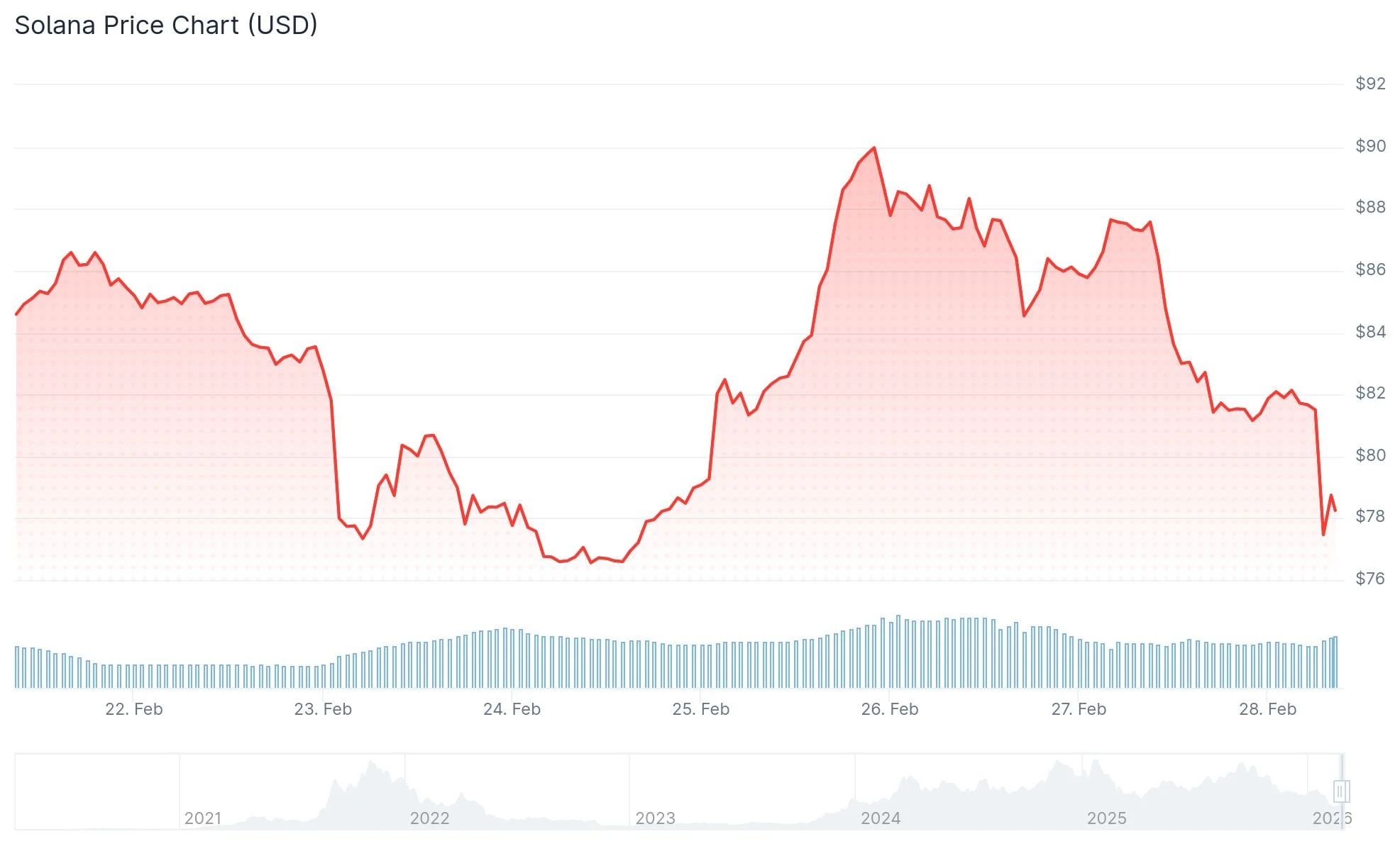
- SOL has declined 72% from its record high of $295 and is currently valued at approximately $78
- The token’s spot ETF products have experienced only $11.3M in total outflows, significantly less than Bitcoin and Ethereum ETFs that recorded four straight months of withdrawals
- Solana dominated decentralized exchange activity with $108 billion in 30-day volume, surpassing Ethereum’s $63.7 billion
- Technical analysts highlight critical support zones at $50, $22, and $10 derived from Parallel Channel formations
- Military strikes involving Israel and Iran sparked widespread cryptocurrency liquidations, driving Bitcoin near $60,000 and weighing heavily on alternative tokens including SOL
The Solana network’s native token SOL is presently valued at $78, representing a 72% decline from its peak valuation of $295. This downturn coincides with a comprehensive cryptocurrency market correction intensified by escalating geopolitical instability on February 28, 2026.
Saturday morning witnessed Israeli forces conducting military operations against Iranian targets. Intelligence from AP sources confirms American involvement in the coordinated assault. Bitcoin experienced a sharp 5% correction within minutes, approaching the $60,000 threshold, with the resulting market panic cascading into alternative cryptocurrencies like SOL.
While price action reflects bearish sentiment, Solana’s fundamental network metrics demonstrate continued robustness. The blockchain recorded $108 billion in decentralized exchange volume throughout the previous 30-day period, outpacing Ethereum’s $63.7 billion and Base’s $31.48 billion by significant margins.
During the past 24-hour cycle, Solana applications produced $3.1 million in protocol revenue compared to Ethereum’s $2.95 million. The network maintained 2.17 million active wallet addresses, substantially exceeding Ethereum’s 682,236 active participants.
Solana’s real-world asset tokenization ecosystem has achieved a new milestone valuation of $1.71 billion, marking a 45% increase over the past month.
SOL ETF Flows Hold Steady
Exchange-traded fund products for SOL debuted in late October 2025, attracting more than $100 million in average daily net inflows throughout their initial five-week period. Weekly capital inflows have subsequently moderated to the $20–$25 million range as token valuations contracted.
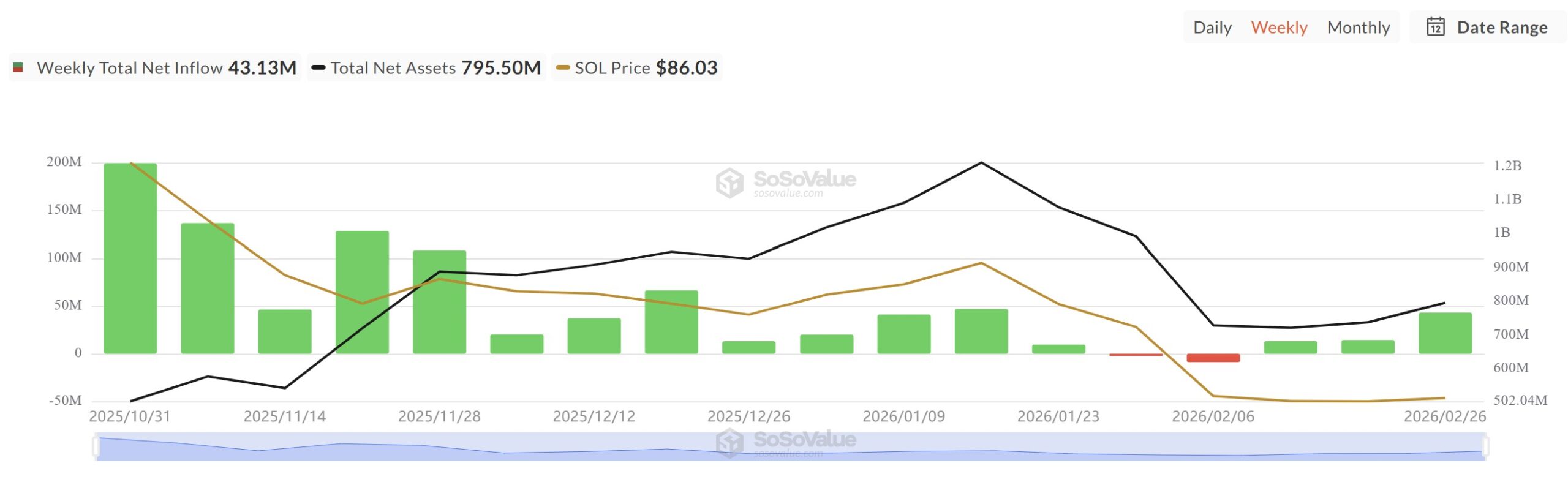
Total accumulated outflows throughout the four-month price correction measure merely $11.3 million across a two-week span. Comparatively, Bitcoin and Ethereum ETF products documented four consecutive months of net negative flows during this identical timeframe.
Solana is presently trading substantially beneath the $188 valuation observed during its ETF product introduction.
Key Support Levels to Watch
Market analyst Ali Martinez has identified a Parallel Channel formation developing on SOL’s weekly timeframe chart. This technical pattern suggests potential support zones positioned at $50.22, $22.47, and $9.98.
Analyst Crypto Scient has pinpointed two supplementary areas of interest. The initial zone corresponds to the 0.75 Fibonacci retracement level spanning $60 to $70. The secondary area represents a weekly demand fair value gap situated between $22 and $29.
UTXO analytics from Glassnode indicate that over 6% of circulating SOL supply last transacted within the current valuation range. The subsequent significant supply concentration, exceeding 3%, exists between $20 and $30.
SOL continues trading beneath the weekly resistance threshold of $120. The $51 to $80 range on weekly charts has undergone testing and corresponds with the retracement zone under analyst scrutiny.
As of February 28, 2026, SOL maintained a $78 valuation as cryptocurrency markets absorbed developments from the Israel-Iran military engagement.
Key Takeaways
- Federal authorities ordered a complete halt to Anthropic’s AI technology across all government agencies, citing national security supply-chain concerns.
- Within hours of Anthropic’s dismissal, OpenAI secured a Pentagon agreement to integrate its AI systems into classified military infrastructure.
- The $200 million Pentagon arrangement with Anthropic fell apart when the company declined to permit its technology for autonomous weaponry or widespread domestic monitoring.
- While OpenAI claims its agreement contains identical usage limitations that Anthropic demanded, skeptics wonder if the company will maintain those boundaries.
- Anthropic plans legal action against the supply-chain risk classification, arguing the decision lacks legal foundation.
On Friday, the United States government severed its partnership with Anthropic and classified the AI firm as a supply-chain security threat. Shortly afterward, competing company OpenAI revealed a fresh agreement to integrate its artificial intelligence technology into the Pentagon’s secure networks.
President Donald Trump mandated that all federal departments cease operations with Anthropic’s technology effective immediately. Organizations currently utilizing the company’s Claude AI systems have six months to complete their migration to alternative solutions.
Defense Secretary Pete Hegseth declared via X that Anthropic represents a “Supply-Chain Risk to National Security.” This classification typically applies to entities from hostile nations such as China.
The decision carries implications beyond government contracts. Organizations partnering with the Pentagon may face requirements to demonstrate they’ve eliminated Claude from their operations entirely. Major corporations including Nvidia, Amazon, and Google count themselves among Anthropic’s investors and collaborators.
Anthropic had achieved a milestone as the initial AI laboratory to integrate its models within the Pentagon’s secure computing environment. The July agreement carried a potential value reaching $200 million.
Negotiations collapsed when Anthropic declined to ensure its artificial intelligence would remain accessible for all legally permissible military applications. The company established firm boundaries against autonomous weaponry and large-scale domestic monitoring programs.
Pentagon officials indicated Anthropic should rely on military adherence to existing legal frameworks. Anthropic CEO Dario Amodei stated Thursday that his organization “cannot in good conscience” accept such terms.
OpenAI Secures Pentagon Partnership
OpenAI CEO Sam Altman revealed the Pentagon arrangement late Friday through X. He indicated the contract incorporates identical restrictions regarding mass surveillance and autonomous weapons systems that Anthropic had sought.
Altman further stated OpenAI requested the administration extend comparable contract conditions to all artificial intelligence providers. Elon Musk’s xAI had previously received military authorization for deployment in classified environments.
OpenAI President Greg Brockman and his spouse contributed $25 million to a Trump-aligned political action committee during the previous year. They continue financial support for Trump’s artificial intelligence initiatives in forthcoming electoral contests.
Anthropic Prepares Legal Response
Anthropic expressed being “deeply saddened” by the classification and intends to pursue judicial remedies. The organization characterized the determination as “legally unsound” and warned it establishes a troubling precedent for American technology companies engaging in government negotiations.
The General Services Administration announced Anthropic’s removal from its catalog of approved products available to government entities.
Certain observers expressed criticism toward OpenAI’s actions. Democratic figure Christopher Hale announced on X his cancellation of ChatGPT membership in favor of switching to Claude Pro Max.
Anthropic emerged in 2021 when researchers departed OpenAI due to apprehensions about diminishing safety priorities. Both organizations have secured funding in the tens of billions recently and are evaluating potential public stock offerings.
The controversy also referenced a particular event. Following Claude’s deployment during a Venezuela operation in January, an Anthropic staff member contacted a Palantir associate seeking clarification on the technology’s application. Pentagon leadership interpreted this communication as inappropriate interference.
Anthropic maintained the conversation represented standard technical coordination between collaborative partners.
Crypto World
BTC Plunges Below $64K as US-Israel Military Action Against Iran Triggers Crypto Selloff
TLDR
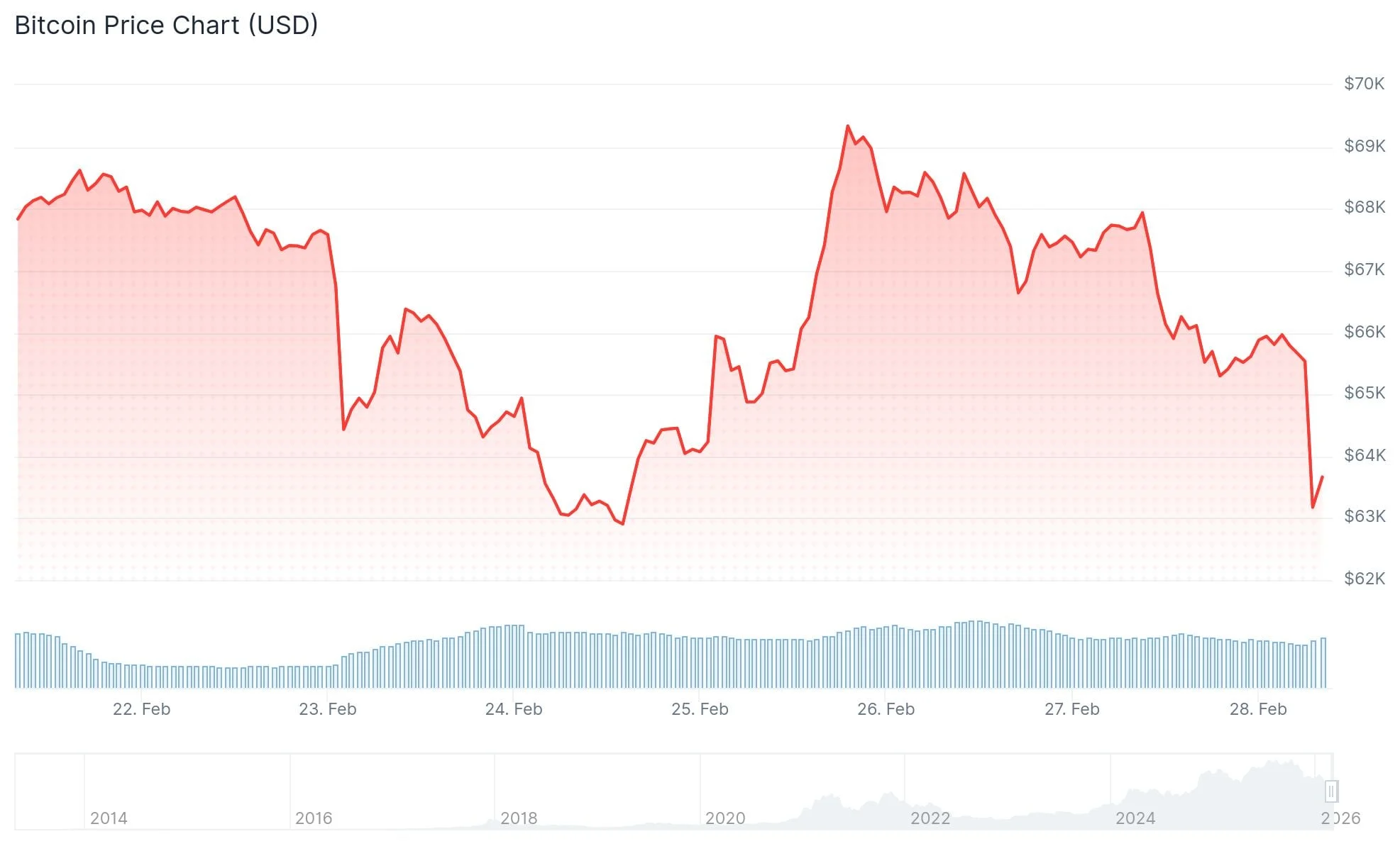
- BTC plummeted almost 5% toward $63,000 following coordinated US-Israeli military operations against Iranian targets
- The cryptocurrency reached its weakest level since the February 5 market crash when BTC momentarily fell under $60,000
- Israel’s Defense Minister Israel Katz announced a nationwide state of emergency throughout the country
- BTC’s continuous trading schedule positions it as an immediate outlet for risk aversion when traditional markets remain closed
- Market participants dumped bitcoin as it represented one of the only major liquid assets accessible during weekend hours
The world’s leading cryptocurrency experienced a dramatic decline on Saturday, February 28, 2026, plunging toward $63,000 following military strikes executed by the United States and Israel against Iran.
The digital asset shed nearly 5% of its value within mere minutes, representing a significant blow to the cryptocurrency market.
The selloff pushed bitcoin to levels not witnessed since February 5, when the digital currency momentarily traded beneath the $60,000 threshold.
Israeli Defense Minister Israel Katz announced a comprehensive state of emergency covering the entire nation immediately following the commencement of the military operations.
According to The Wall Street Journal, a U.S. official verified American involvement in the coordinated attacks.
Reuters reported that Israeli officials characterized the military action as a “preemptive strike,” citing statements from the nation’s defense leadership.
Why Bitcoin Sold Off First
Unlike traditional equity and bond markets that close for weekends, Bitcoin operates continuously without interruption, 24 hours daily, seven days weekly.
This constant availability positions it as among the few substantial, liquid assets accessible for traders to offload during heightened risk periods outside conventional market operating hours.
This behavior represents a recurring phenomenon. BTC frequently experiences rapid selloffs during geopolitical crises, often rebounding once conventional markets resume trading.
“Bitcoin just dropped off a cliff,” one market observer shared on X, further predicting that “Monday will be a bloodbath in the market.”
Geopolitical Context
The military operations arrive after several weeks of escalating U.S. military presence and unsuccessful nuclear discussions with Iranian leadership.
Market analysts had previously been examining potential implications of Iranian conflict for bitcoin, precious metals, and equity markets.
The military action heightens the possibility of expanded regional warfare in one of the globe’s most economically critical regions.
In recent months, bitcoin’s price movement has diverged from gold, challenging its narrative as a safe-haven or “digital gold” investment vehicle.
As of Saturday morning hours, bitcoin was changing hands near $63,000, with additional market volatility anticipated when conventional financial markets resume operations Monday.
Crypto World
Altcoins Bleed Out After Trump Confirms Attacks Against Iran, BTC Down to $63K: Weekend Watch
KCS, STABLE, and PIPPIN are today’s top losers after the latest attacks.
Bitcoin’s price moves took another turn for the worse in the past few hours after Israel attacked Iran, and then US President Trump confirmed his country was also involved.
Numerous altcoins have bled out heavily, while Binance Coin has taken advantage and surpassed XRP in terms of market cap.
BTC Dumps Again
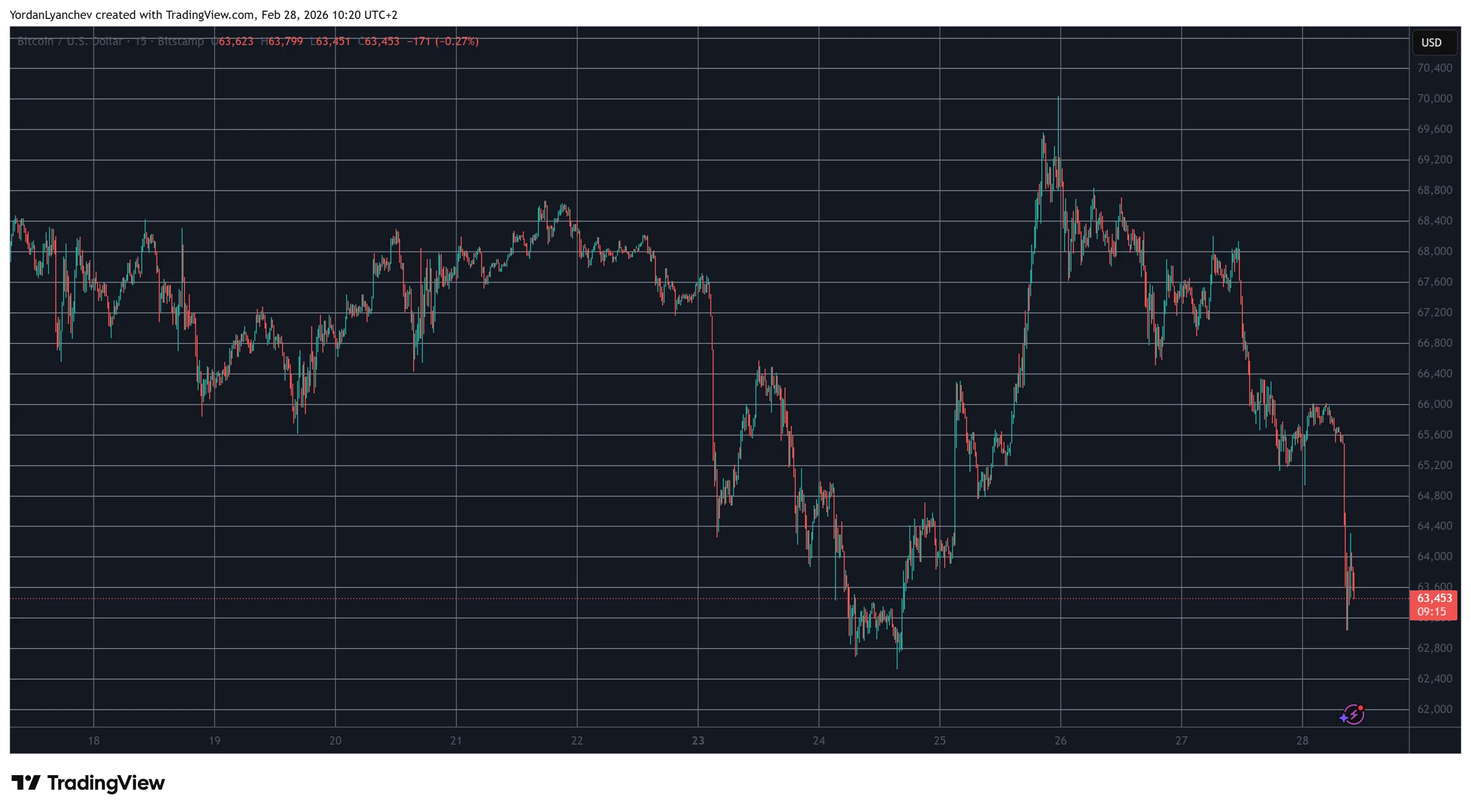
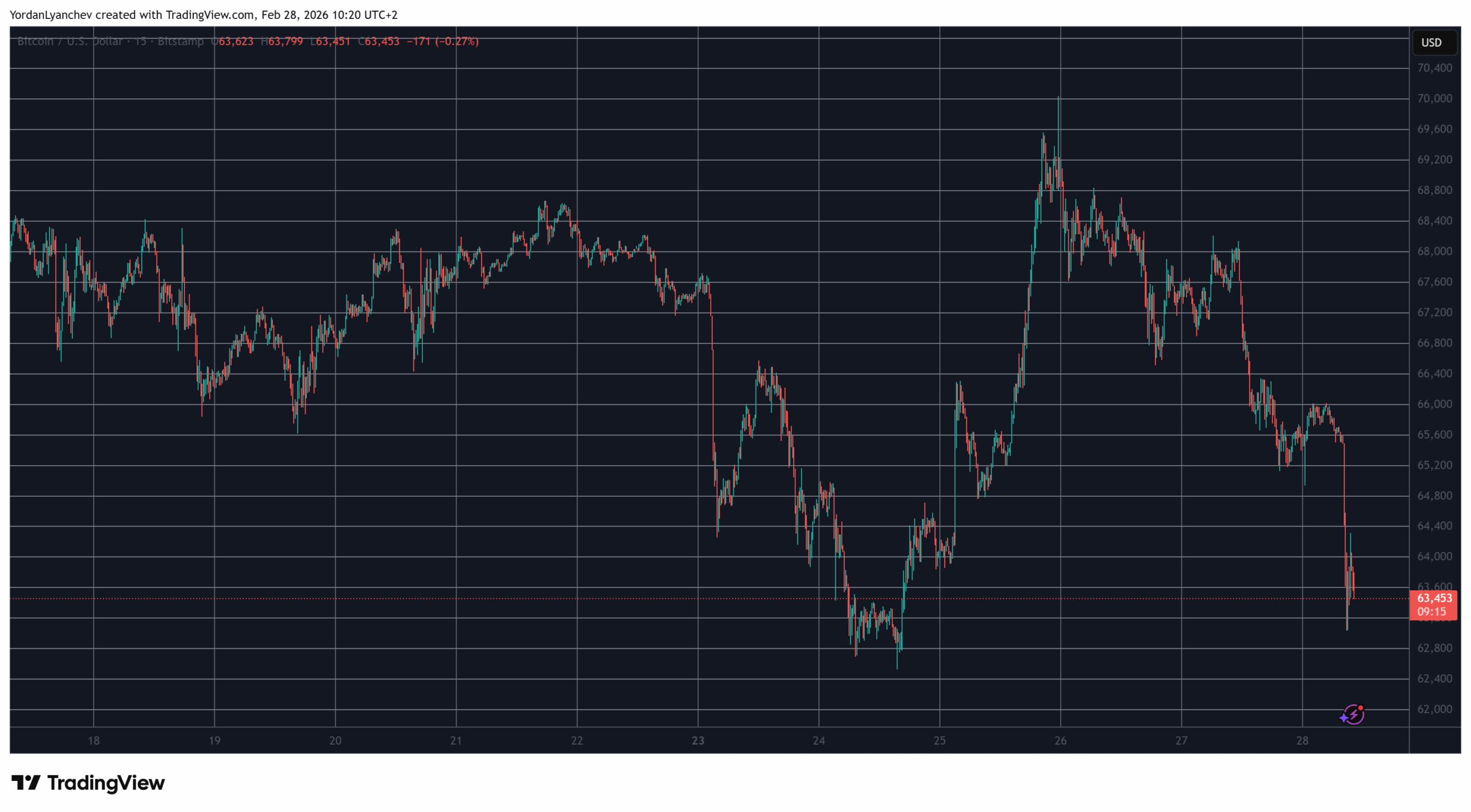
It was already a highly volatile trading week for the primary cryptocurrency as the bears seemed to be in full control by Tuesday. At the time, they pushed the asset south to a multi-week low of $62,500. However, bitcoin rebounded almost immediately and skyrocketed by several grand to $70,000 on Wednesday.
Many analysts speculated whether this was a typical dead-cat bounce, which turned out to be the case. At first, BTC slipped to around $68,000, where it spent most of Thursday and Friday. However, the situation worsened once again on Saturday morning when Israel launched a “preemptive” attack against Iran and issued a state of emergency.
In minutes, BTC plunged to under $62,800 before it recovered some ground to $63,400 as of press time. US President Donald Trump confirmed that the US was also involved in the attacks, and more volatility is expected later today as the situation unravels.
As of now, bitcoin’s market cap has slid to $1.275 trillion on CG, while its dominance over the alts is below 56%.
Alts Bleed
The graph below will show the painful reality in the altcoin space, in which almost all assets are deep in the red. ETH has plunged by $200 in the past few days to $1,850. XRP was surpassed by BNB after a 9% drop, while SOL has slumped by double digits to under $80.
ADA, HYPE, BCH, DOGE, CC, LINK, and XLM have plummeted hard as well. Declines of up to 20% are evident from KCS, PIPPIN, and STABLE, while stablecoins linked to gold are in the green.
The total crypto market cap has erased over $100 billion in the past day or so and is deep below $2.3 trillion on CG.

Binance Free $600 (CryptoPotato Exclusive): Use this link to register a new account and receive $600 exclusive welcome offer on Binance (full details).
LIMITED OFFER for CryptoPotato readers at Bybit: Use this link to register and open a $500 FREE position on any coin!
Disclaimer: Information found on CryptoPotato is those of writers quoted. It does not represent the opinions of CryptoPotato on whether to buy, sell, or hold any investments. You are advised to conduct your own research before making any investment decisions. Use provided information at your own risk. See Disclaimer for more information.
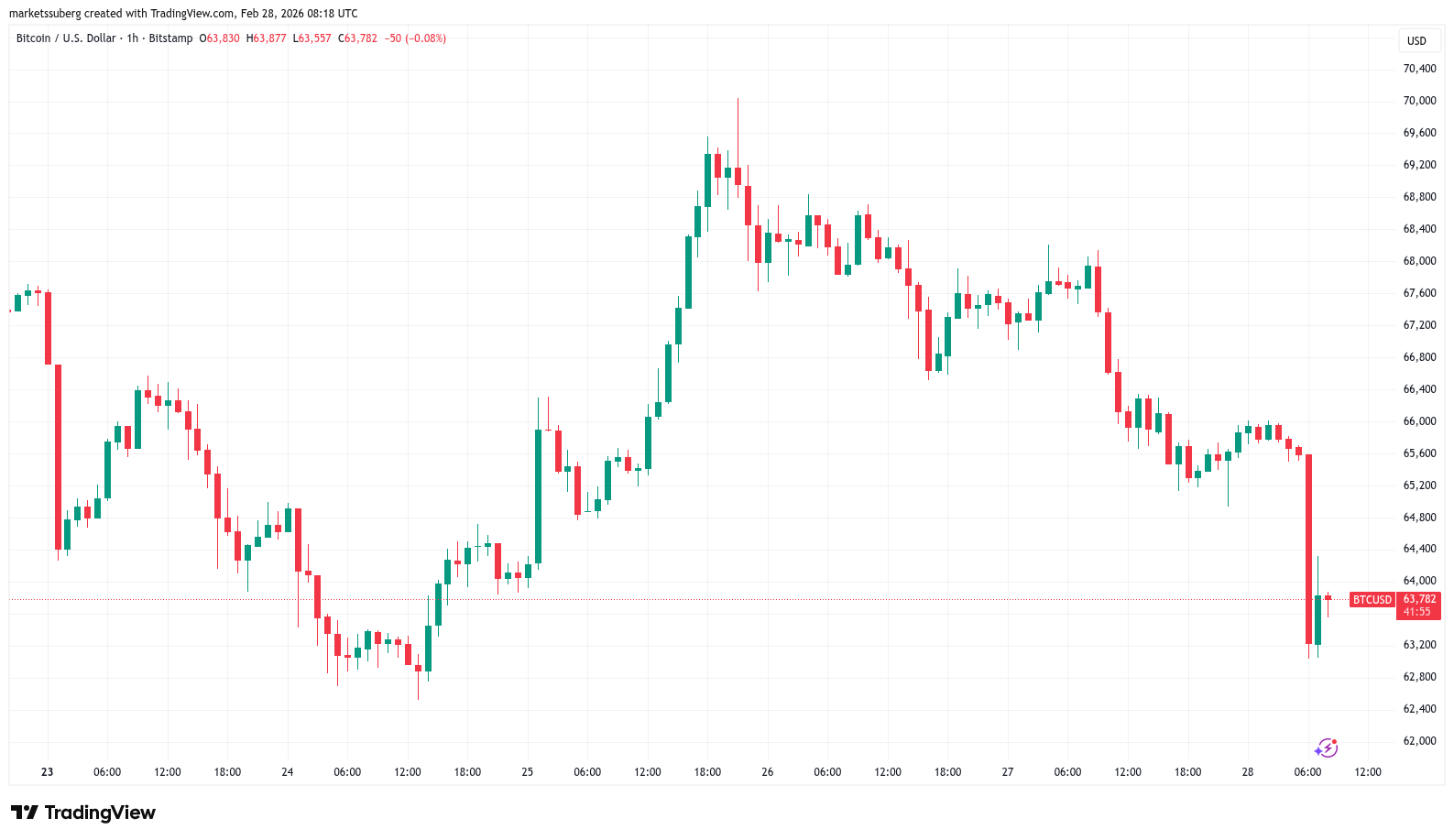
Bitcoin faced geopolitical instability alone as a weekend move on Iran saw traditional markets closed, with key support still holding.
Bitcoin (BTC) daily losses neared 4% on Saturday as the US and Israel announced a military operation in Iran.
Key points:
-
Bitcoin targets $63,000 as US President Donald Trump confirms a major bombing campaign inside Iran.
-
Trump highlights nuclear infrastructure as a key target of the joint raids with Israel.
-
Crypto markets react alone with TradFi trading suspended until futures return.
Trump tells Iranians: “Take over your government”
Data from TradingView showed BTC price action testing $63,000 as crypto markets reacted to the weekend’s events.

In a video address, US President Donald Trump said that the goal of the move was to target Iran’s nuclear infrastructure, but finished by calling on Iranians to take control of the incumbent government.
“When we are finished, take over your government; it will be yours to take,” he said.
“This will be, probably, your only chance for generations. For many years, you have asked for America’s help, but you never got it.”
With US stock market futures yet to open, crypto was alone in deciding on how to react to fresh geopolitical instability.
Data from CoinGlass showed liquidations passing $250 million in the four hours to the time of writing.

“The US and Israel now appear to be at war with Iran for the second time in 8 months,” trading resource The Kobeissi Letter wrote in a response on X.
Kobeissi referenced a previous Iran offensive in 2025 — an event that sparked an immediate, volatile reaction across crypto and risk assets.
Bitcoin reacts to familiar cues
With core support levels still holding for BTC/USD, the fresh escalation comes at a key time for traders as the final hours tick down to the February monthly close.
Related: Price predictions 2/27: BTC, ETH, XRP, BNB, SOL, DOGE, BCH, ADA, HYPE, LINK
As Cointelegraph reported, the pair is now down roughly as much as in February 2025, and due to seal its fifth consecutive month of losses — something not encountered in seven years.
Hot US inflation data added another headwind for Bitcoin bulls on Friday, after they tried and failed to reclaim key support levels closer to $70,000.
This article does not contain investment advice or recommendations. Every investment and trading move involves risk, and readers should conduct their own research when making a decision. While we strive to provide accurate and timely information, Cointelegraph does not guarantee the accuracy, completeness, or reliability of any information in this article. This article may contain forward-looking statements that are subject to risks and uncertainties. Cointelegraph will not be liable for any loss or damage arising from your reliance on this information.

Abby Champion Sexy Snapshots To Celebrate Her 29th Birthday

Man United’s Harry Maguire ‘concern’ as Michael Carrick stance clear after £15.6m decision

Omloop Het Nieuwsblad Free Streams: How to watch the first cobbled classic of 2026


-

 Politics6 days ago
Baftas 2026: Awards Nominations, Presenters And Performers
-

 Sports5 days ago
Women’s college basketball rankings: Iowa reenters top 10, Auriemma makes history
-

 Fashion15 hours ago
Weekend Open Thread: Iris Top
-

 Politics5 days ago
Nick Reiner Enters Plea In Deaths Of Parents Rob And Michele
-

 Business4 days ago
True Citrus debuts functional drink mix collection
-

 Politics1 day ago
ITV enters Gaza with IDF amid ongoing genocide
-

 Crypto World4 days ago
XRP price enters “dead zone” as Binance leverage hits lows
-
Sports5 hours ago
The Vikings Need a Duck
-

 Business6 days ago
Mattel’s American Girl brand turns 40, dolls enter a new era
-

 Tech4 days ago
Unsurprisingly, Apple's board gets what it wants in 2026 shareholder meeting
-

 Business6 days ago
Law enforcement kills armed man seeking to enter Trump’s Mar-a-Lago resort, officials say
-
 NewsBeat2 days ago
Manchester Central Mosque issues statement as it imposes new measures ‘with immediate effect’ after armed men enter
-

 NewsBeat2 days ago
Cuba says its forces have killed four on US-registered speedboat | World News
-
 NewsBeat5 days ago
‘Hourly’ method from gastroenterologist ‘helps reduce air travel bloating’
-

 Tech6 days ago
Anthropic-Backed Group Enters NY-12 AI PAC Fight
-

 NewsBeat6 days ago
Armed man killed after entering secure perimeter of Mar-a-Lago, Secret Service says
-

 Politics6 days ago
Maine has a long track record of electing moderates. Enter Graham Platner.
-

 Business2 days ago
Discord Pushes Implementation of Global Age Checks to Second Half of 2026
-
 NewsBeat3 days ago
Police latest as search for missing woman enters day nine
-

 Business2 days ago
Only 4% of women globally reside in countries that offer almost complete legal equality