
Crypto World
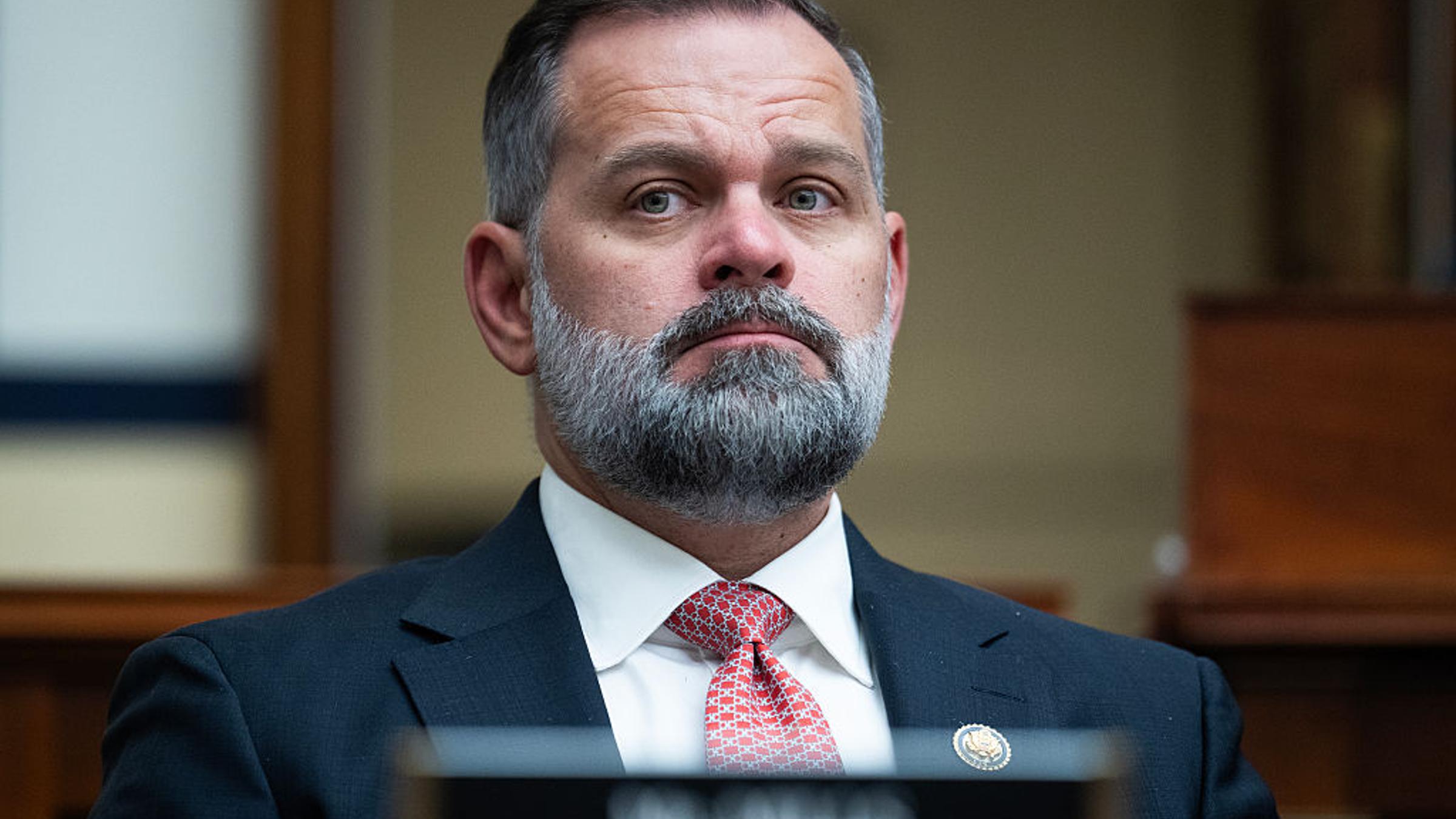
Florida Rep. Cory Mills Loses Primary After Scandal-Filled Campaign

The new map, signed into law by DeSantis in May 2026, redrew 21 of the state’s 28 districts, looking to reduce the number of Democratic-leaning districts from eight to four—affecting Democratic incumbents like Kathy Castor in Tampa, as well as Debbie Wasserman Schultz and Jared Mokowitz in South Florida.
While District 7 was not radically redrawn, Aubrey Jewett, professor of political science at the University of Central Florida, says that since this new map favors Republicans, flipping the 7th District could help offset any losses elsewhere in the state.
Elijah will go up against Democratic candidate and military veteran Bale Dalton in November, who is endorsed by Pete Buttigieg. Jewett says Dalton could be a viable candidate.
And if Dalton were to win, he says: “That might help not only the Florida congressional delegation pick up a Democratic seat, but of course, yeah, maybe at the national level, might offset some of these losses that they’re expecting.”

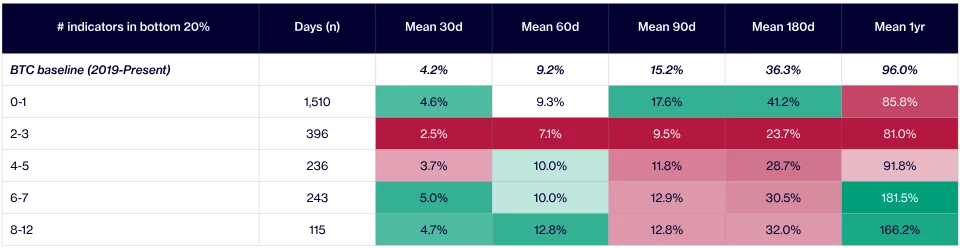
VanEck said on Aug. 18 that Bitcoin may be approaching an accumulation phase after eight of its 12 capitulation indicators remained active as of Aug. 12.
Summary
- Eight of VanEck’s 12 Bitcoin capitulation signals were active on August 12, indicating late cycle stress.
- All 12 indicators entered capitulation territory during the three months preceding VanEck’s August research update.
- Long term holder supply dropped 356,534 BTC, leaving 11.84 million BTC untouched for over one year.
- U.S. spot Bitcoin ETPs absorbed $663 million while realized volatility declined to 27.2% over 30 days.
- Historical capitulation clusters lagged Bitcoin’s baseline for six months, outperforming only across one year holding periods.
The asset manager’s latest report placed the current correction in its tenth month, measured from Bitcoin’s October 2025 peak. VanEck estimated that the next turning point could arrive between September and November if the current cycle follows earlier patterns.
However, the firm did not present the historical timetable as a reliable price forecast. VanEck disclosed that it has exposure to Bitcoin and warned that its forward return study uses a small number of heavily overlapping observations.
Bitcoin capitulation signals point to late cycle stress
VanEck considers a signal active when its latest reading reaches an extreme historical percentile. Most indicators must fall within the bottom 15% of their recorded history, or the top 10% when a high reading represents stress.
Price drawdown uses a separate threshold. VanEck activates this signal when Bitcoin falls at least 35% from its peak. Bitcoin was down approximately 49% from its October record in the firm’s analysis, although that decline ranked only in the 35th percentile of its own history.
Applying the same percentile rule to the drawdown would reduce the total from eight active signals to seven. VanEck defended the separate threshold by arguing that institutional ownership and spot ETP demand could produce a shallower bear market than previous cycles.
The firm said it “expects a shallower trough this cycle,” but acknowledged that this remains an assumption rather than a confirmed market outcome. Earlier Bitcoin bear markets produced drawdowns ranging from 78% to 94%.
Historical returns offer no clear six month advantage
VanEck’s backtest provides a cautious reading for investors expecting an immediate rebound. When between eight and 12 indicators were in capitulation territory, Bitcoin returned an average 12.8% over the following 90 days. Its baseline return for all comparable periods was 15.2%.
The same group generated an average 32% return over 180 days, below the 36.3% baseline. Outperformance appeared only across the one year horizon.
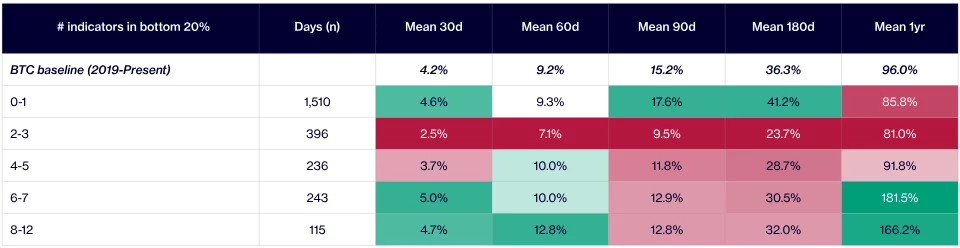
VanEck warned that the one year result came from 115 observation days that overlapped heavily. Those observations represent only a small number of separate market episodes. The firm said it does not place substantial weight on that result.
The findings suggest capitulation readings may identify late cycle conditions without identifying an exact bottom. They also leave room for prolonged sideways trading before a durable recovery begins.
U.S. fund inflows absorb long term holder selling
U.S. spot Bitcoin ETPs recorded approximately $663 million in net inflows during the 30 days covered by VanEck. The total represented about 10,400 BTC at prevailing prices and reversed roughly $2.4 billion of outflows during the preceding month.
Fund flows remained uneven after VanEck’s measurement period. U.S. spot funds lost about $385.2 million across the week ending Aug. 14, as crypto.news reported in its analysis of why liquidity has yet to return.
Demand then recovered. Farside data showed $297.5 million of net inflows on Aug. 17 and another $189.3 million on Aug. 18. The combined $486.8 million partly reversed the previous week’s withdrawals.
Those inflows followed earlier signs of ETF demand supporting the $64,000 area. Bitcoin traded near $64,250 on Aug. 19, above VanEck’s Aug. 11 closing reference of $63,549 but still below its 200 day moving average.
Long term holders complicate the accumulation case
Coins held for longer than one year declined by 356,534 BTC over 30 days, according to VanEck’s Glassnode based figures. Holdings fell 2.9% to 11.84 million BTC, equal to 59.1% of circulating supply.
All six long term age groups contracted. Coins aged between one and two years recorded the largest reduction at approximately 156,000 BTC. Holdings older than ten years fell by only about 4,000 BTC, suggesting the oldest wallets remained comparatively inactive.
VanEck said some movements may have involved wallet security rather than sales. The firm cited concern following the Coldcard security failure, which crypto.news examined in its coverage of the $89 million wallet drain.
It nevertheless called the security explanation difficult to verify. Confirmed losses were far smaller than the total movement by aged coins. Exchange inflows separated by coin age could help determine whether holders transferred funds to trading venues or moved them between private wallets.
The period from September through November now provides the next test of VanEck’s cycle framework. A sustained increase in spot demand, stronger trading volume and stabilization in long term holdings would support the accumulation case. Continued distribution or renewed fund outflows would weaken it.
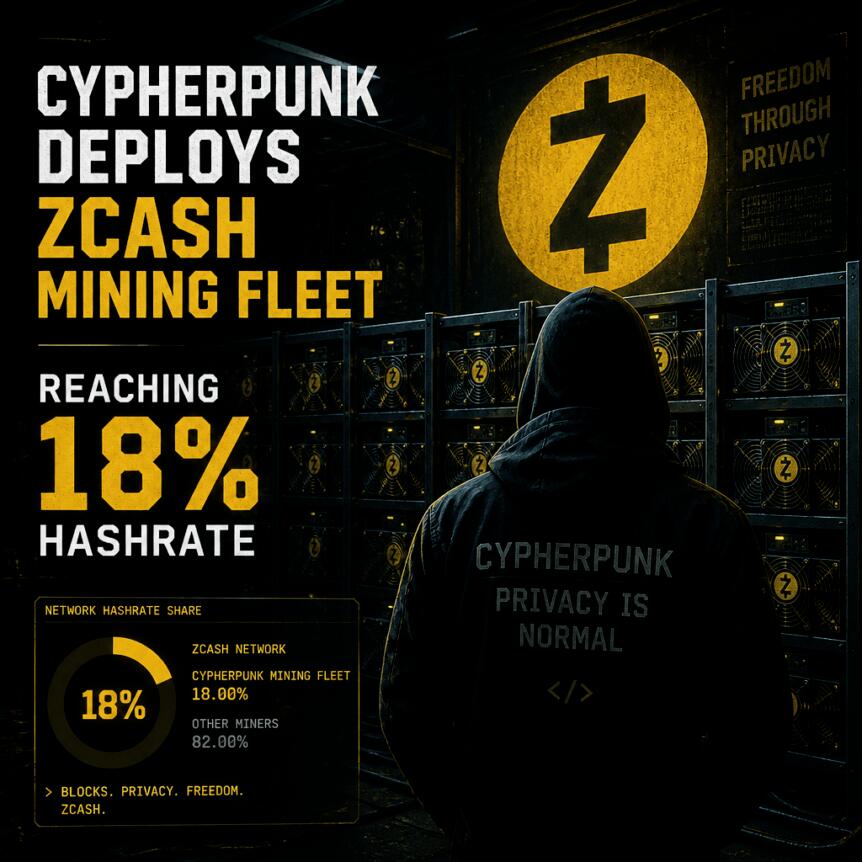
Cypherpunk Technologies has moved to scale its role in Zcash’s proof-of-work ecosystem by acquiring a mining fleet previously associated with Winklevoss Capital. The company says the purchase is now live across multiple locations in the United States and positions Cypherpunk as one of the largest public-sector participants in Zcash mining.
The deal, announced Tuesday, is structured as an equity-based transaction valued at $33.33 million. Cypherpunk reports that the acquired operation is already online and producing about 4.2 GSol/s—roughly 18% of Zcash’s current hashrate, based on the company’s figures.
Key takeaways
- Cypherpunk says it acquired a Zcash mining fleet via a $33.33 million equity transaction, with operations already running in the US.
- The reported 4.2 GSol/s output would make the company responsible for around 18% of Zcash’s current hashrate, if those numbers hold.
- The acquisition expands Cypherpunk’s existing Zcash holdings of 323,394 ZEC, about 1.9% of circulating supply, according to the company.
- Cypherpunk’s stated long-term goal is to reach 5% of ZEC supply held by the company.
- The move comes after renewed market attention to privacy-focused assets later in 2025, following a sharp ZEC price run.
Scaling a privacy-network mining footprint
Cypherpunk’s announcement frames the fleet acquisition as both an expansion of its mining operations and a way to deepen exposure to Zcash beyond spot holdings. In addition to bringing additional hashpower online, the company says it is adding to an existing inventory of ZEC it already holds—323,394 ZEC, or about 1.9% of circulating supply.
Cypherpunk also reiterated a longer-term accumulation target: eventually holding 5% of the ZEC supply. While the company’s filings or policy around the feasibility of that goal were not detailed in the provided text, the stated target alone is significant because it suggests a strategy that blends mining economics with balance-sheet accumulation.
Critically for investors and market observers, Cypherpunk’s claim that the purchased fleet contributes roughly 18% of the network’s hashrate points to concentration risk considerations that usually matter in proof-of-work systems. If a single publicly traded entity controls a large portion of mining power, the network’s block-production incentives and operational dependencies can become more complex—especially during periods of equipment downtime or changes in profitability.
Why Zcash mining economics may be shifting
Cypherpunk previously pitched Zcash mining as potentially more attractive than competing uses of capital—such as Bitcoin mining under prevailing conditions, or deployments driven by AI data center demand. However, the company’s own framing also acknowledges that mining profitability remains highly sensitive to several variables.
In the provided reporting, Cypherpunk links mining economics to ZEC’s price, network hashrate (and therefore mining difficulty), and operating costs. That matters because even if a mining company believes it has found superior economics compared with other sectors, its realized returns can still vary substantially with network conditions and market volatility.
The timing of the acquisition may be particularly relevant. Cypherpunk’s expansion follows a sharp rise in Zcash’s price during the second half of 2025. Renewed interest in privacy-focused cryptocurrencies was described as a catalyst, including attention after a hedge fund revealed a significant ZEC position—an event that earlier coverage from Cointelegraph noted helped pull the asset higher.
As privacy-preserving technologies regain mainstream attention after stretches of relative market quiet, mining capacity often follows demand signals—either through new capital entering the ecosystem or through incumbent operators scaling up when profitability improves. Yet the same lesson applies in reverse: if ZEC prices fade or difficulty rises faster than costs can be hedged, hashpower additions can become a headwind rather than a tailwind.
Network security: Ironwood update and the Orchard vulnerability
Cypherpunk’s scaling effort lands amid ongoing technical changes in Zcash’s privacy layer. The network underwent its Ironwood upgrade on July 28, introducing a new shielded transaction protocol designed to replace the Orchard pool and improve security architecture.
The upgrade was prompted by a flaw discovered in Orchard. The concern, as summarized in the provided text, was that under certain conditions an attacker could potentially create counterfeit ZEC inside the shielded pool without immediate detection. Even though there was no evidence the vulnerability had been exploited, the possibility underscored a persistent challenge for privacy networks: maintaining confidentiality while also ensuring robust supply integrity and verification.
From an investor’s perspective, these protocol updates matter even if day-to-day mining operations don’t change overnight. Ironwood’s improvements can affect how shielded transactions are processed and monitored, and they can influence confidence in the long-term soundness of privacy-preserving mechanisms—confidence that, in turn, can influence adoption narratives and liquidity for the underlying asset.
At the same time, the Ironwood upgrade illustrates that privacy-focused systems may carry distinct engineering risk profiles compared with more transparent networks. Zcash’s response—moving to a new protocol and addressing Orchard-related risks—signals ongoing iteration rather than a “set and forget” approach.
What to watch next for Cypherpunk and Zcash
Cypherpunk’s fleet acquisition raises immediate questions around how much hashrate its operation sustains over time and how its ZEC accumulation strategy develops relative to its liquidity and operational costs—especially given the sensitivity of mining economics to ZEC price and network difficulty. For the Zcash network, the key variable remains whether Ironwood’s security goals strengthen confidence in shielded supply integrity as privacy usage evolves.


The FASB said secondary-market liquidity alone would not be enough, with holders needing direct issuer redemption rights and one-to-one liquid reserves.

Bitcoin is struggling to hold its June range floor after $390 million left US spot BTC ETFs last week, according to Wintermute’s newest market update.
The trading firm says falling rate-hike odds have failed to lift BTC, while ETF redemptions and miner selling have left the market without a strong source of fresh demand.
ETF Flows Fail to Sustain Bitcoin’s August Recovery
As Wintermute pointed out, July CPI came in at 0.1% month-on-month, cutting September rate-hike odds from roughly even to about one-in-three, with retail sales also posting their steepest decline since May 2025.
Almost nothing rallied on it: the S&P 500 added just 0.40%, long-dated Treasuries fell 0.87%, and BTC sat at the bottom, down 3.12%. CoinGecko data shows the cryptocurrency is currently around $64,000, up 1.2% over 24 hours. However, it is down nearly 1% over 30 days and 49% below its October 2025 all-time high.
Brent crude jumped 7.91% as Hormuz ship transits collapsed from 31 the prior weekend to five Saturday and zero Sunday, with the 60-day ceasefire expiring and talks stalled. A re-escalation that holds Brent near $89 puts the August CPI print at risk.
For Wintermute, that combination matters. Lower rate-hike expectations would normally improve the case for risk assets, but Bitcoin failed to respond. The firm said the market was moving toward a situation where “the inflation problem seems to be moving from the Fed’s hands to oil’s.”
The ETF picture was also weak. Roughly $390 million left US spot Bitcoin ETFs between August 10 and 14, the largest weekly redemption since early July. As CryptoPotato reported, Bitcoin ETFs recorded only one positive session last week, with Monday seeing $145 million leave the funds, followed by $61 million on Wednesday, $131 million on Thursday, and nearly $58 million on Friday. Tuesday brought just under $5 million of net inflows.
“An asset that cannot rally on good news while its dedicated vehicles bleed is telling us the marginal seller is back, which weakens the depletion argument we have been carrying since W31,” wrote the trading company.
Miner Selling Adds Another Problem
Wintermute also pointed to Riot Platforms as evidence that miners may remain a source of Bitcoin supply. The firm sold 4,300 BTC during the second quarter after selling 3,778 BTC in the first quarter. Its treasury fell to 11,380 BTC as mining costs approached $91,000 per unit. Bitcoin was trading below $64,000, contributing to Riot’s $237 million quarterly loss.
Riot is also shifting part of its business toward AI data centers, with the miner reportedly agreeing to supply 191 megawatts of capacity to Anthropic under a 20-year contract worth $9.1 billion.
The ETF picture is not uniformly negative, though, as Jane Street disclosed more than $1 billion in US spot Bitcoin ETF holdings as of the second quarter, including about $828 million in IBIT. However, the filing only shows quarter-end holdings and does not capture the firm’s full derivatives exposure.
The post Wintermute: Bitcoin Range Breakout Delayed by ETF Outflows and Miner Selling appeared first on CryptoPotato.
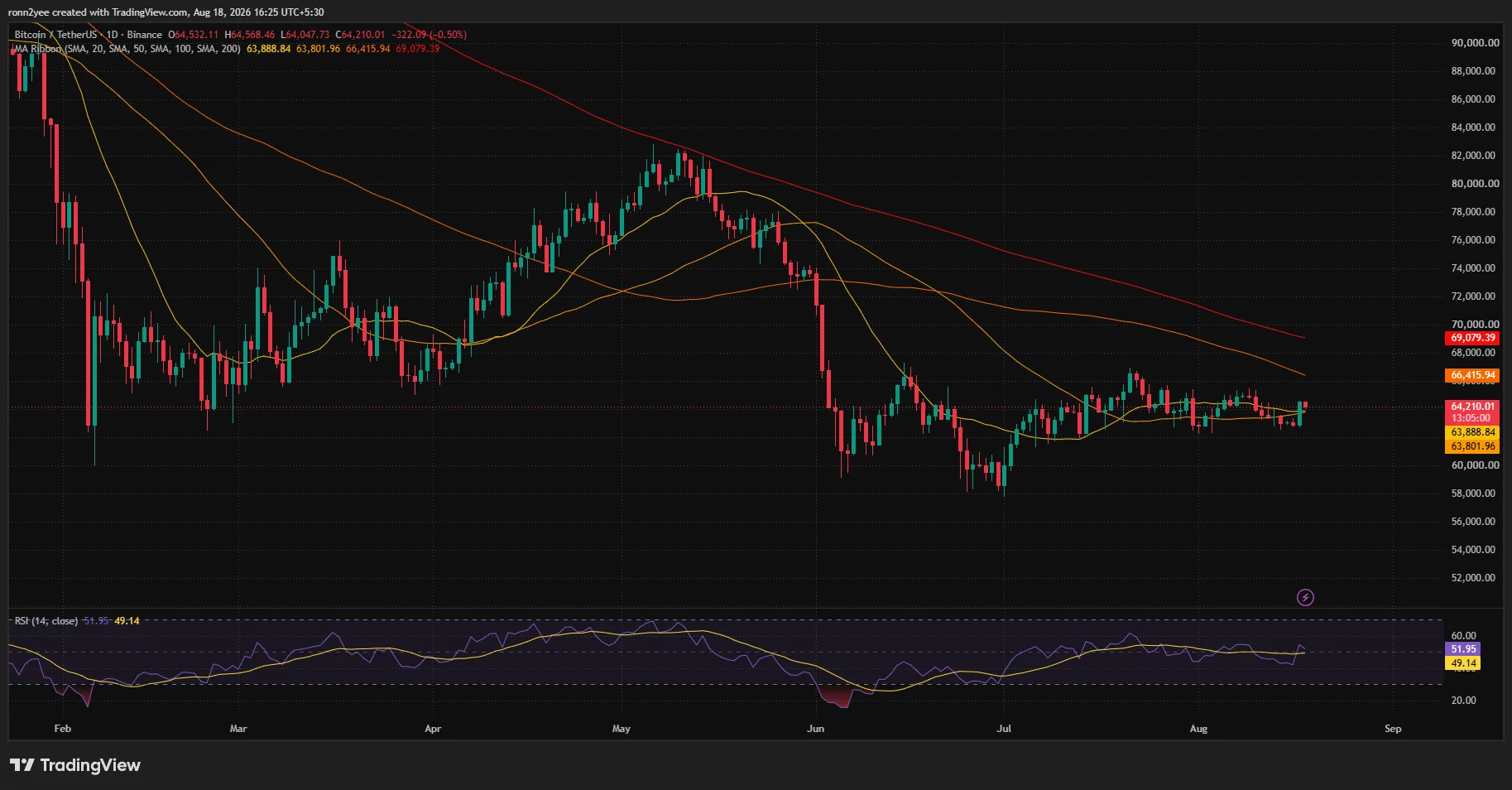
Bitcoin price rose 1.7% to around $64,200 on Aug. 18 as ETF inflows supported the rebound, but rising leverage left the recovery exposed to a pullback.
Summary
- Bitcoin price recovered above $64,000 after buyers defended the $62,600–$62,800 area.
- The daily chart shows BTC holding above its 20-day and 50-day moving averages, though longer-term resistance remains overhead.
- Liquidation data places the nearest major liquidity cluster around $64,700, while a larger downside pool sits near $62,200.
The rebound from the $62,600 area improved short-term momentum, although the daily chart continues to show Bitcoin trading below its two longer-term moving averages. Leverage is also building while liquidity rests on both sides of the current price, leaving the recovery exposed to sharp moves if buyers fail to extend the advance.
U.S.-listed spot Bitcoin ETFs recorded more than $137 million in net inflows on Monday. The inflows followed over $385 million in net withdrawals during the previous week, suggesting institutional demand returned after several sessions of selling.
The recovery also came as buyers defended an area that has repeatedly attracted demand since June. Bitcoin (BTC) fell toward $62,600 on Aug. 14 and again tested the upper $62,000 region on Aug. 17 before climbing as high as $64,586 on Tuesday.
Bitcoin price moves back above short-term averages
Bitcoin’s daily chart shows the price at $64,210, slightly above the 20-day simple moving average at $63,802 and the 50-day moving average at $63,889. Holding both levels would keep the short-term recovery intact and establish the $63,800–$64,000 region as the first support area.
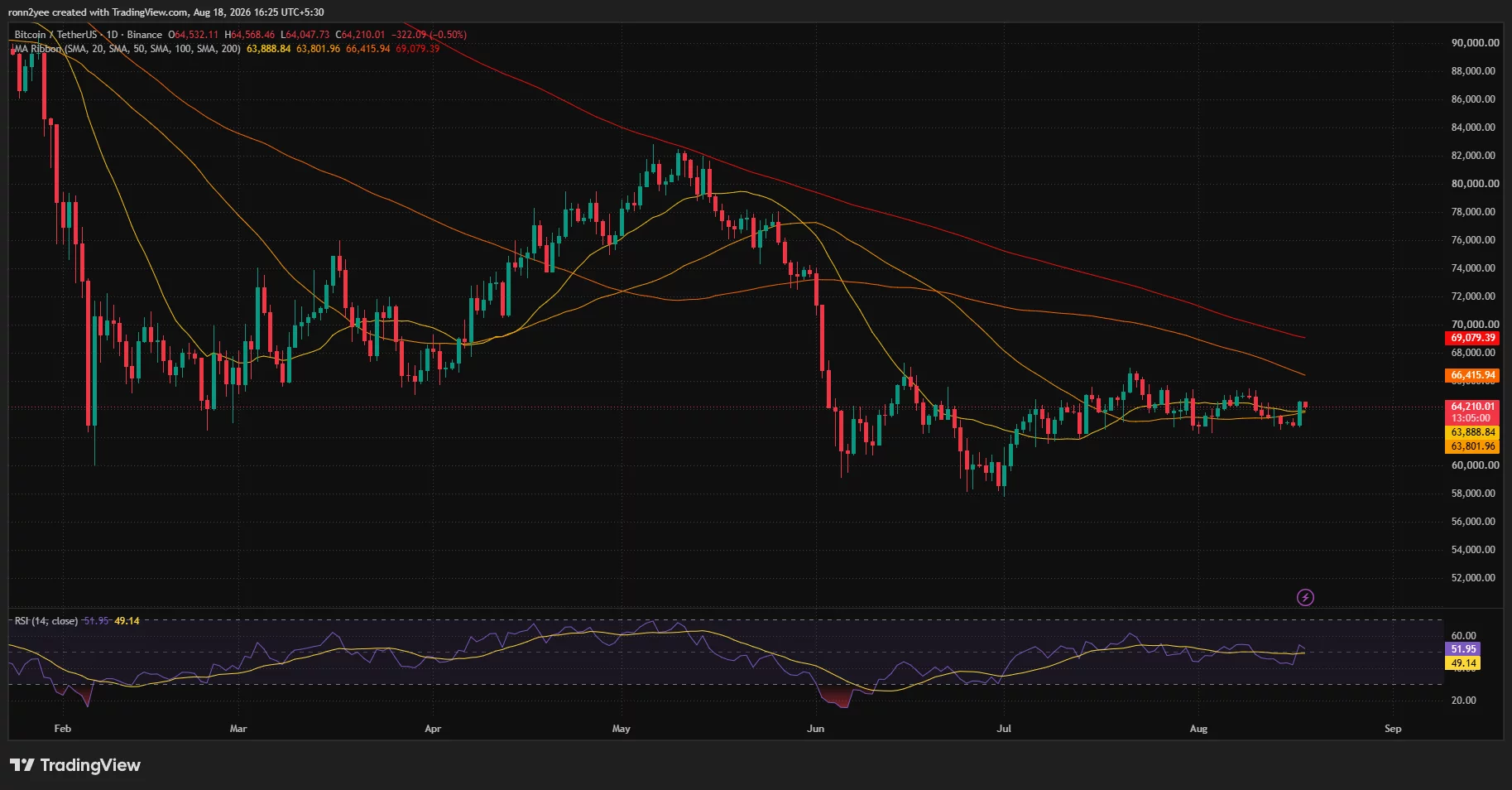
The daily relative strength index rose to 51.95 and moved above its signal average of 49.14. A reading above 50 indicates that buying momentum has gained a slight advantage, although the indicator remains close enough to the midpoint to show that neither buyers nor sellers have firm control.
Longer-term resistance continues to limit the recovery. Bitcoin remains below its 100-day moving average at $66,416 and its 200-day average near $69,079. Both lines are sloping downward, meaning BTC would need to reclaim several resistance levels before the broader daily trend turns decisively stronger.
The price has also traded in a narrow range since the end of June, with most daily closes concentrated between approximately $62,000 and $66,000. A daily close above the 100-day average would break the upper part of that structure and place $69,000 within reach.
Failure to remain above the short-term averages would weaken the latest rebound. The first downside levels are around $63,800 and $62,600, followed by the liquidity-heavy region close to $62,200.
4-hour chart points to $63,800 as the first test
Bitcoin’s 4-hour chart shows a stronger near-term setup after the price climbed from around $62,800 to above $64,000. The Supertrend indicator flipped to support, with its lower boundary near $63,251, while the bull-bear power histogram moved into positive territory at 697.
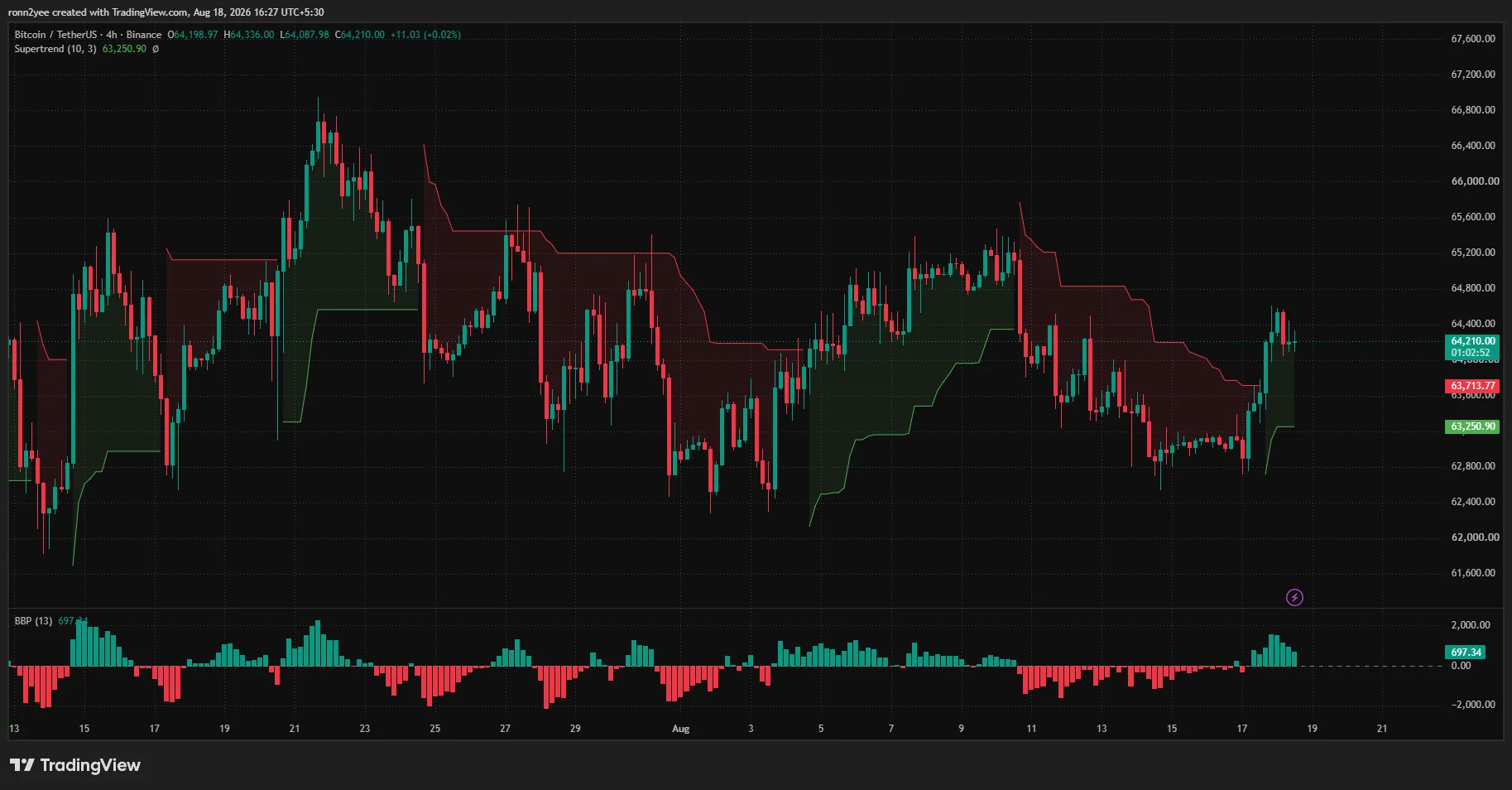
Positive bull-bear power indicates that buyers are currently pushing the price above its underlying average. However, the histogram began shrinking after its initial expansion, suggesting that the strength of the rebound was easing as Bitcoin approached $64,500.
Analyst Michaël van de Poppe said Bitcoin had produced a strong upward move but encountered resistance after reaching the mid-$64,000 region. He identified $63,800–$64,000 as a possible lower-time-frame entry area and maintained a $65,000 target for the coming days or week.
“BTC has hit resistance and should therefore find some level of support for buyers to be stepping in,” Van de Poppe said.
His support zone matches the daily moving-average cluster near $63,800–$63,900. A successful retest of that area would allow buyers to challenge $64,500 again, while a drop through it would shift attention to the 4-hour Supertrend support near $63,250.
A break above Tuesday’s $64,586 high would provide the first evidence that the recovery is extending. The next visible resistance levels sit around $64,800, $65,200, and $66,400, with the last level corresponding closely to the daily 100-day moving average.
Liquidation map places BTC between two large liquidity pools
CoinGlass’ one-week Bitcoin liquidation heatmap shows a dense concentration of leveraged positions around $64,700. The band is the closest major pool above the market and could attract price if BTC clears the $64,500–$64,600 resistance area.
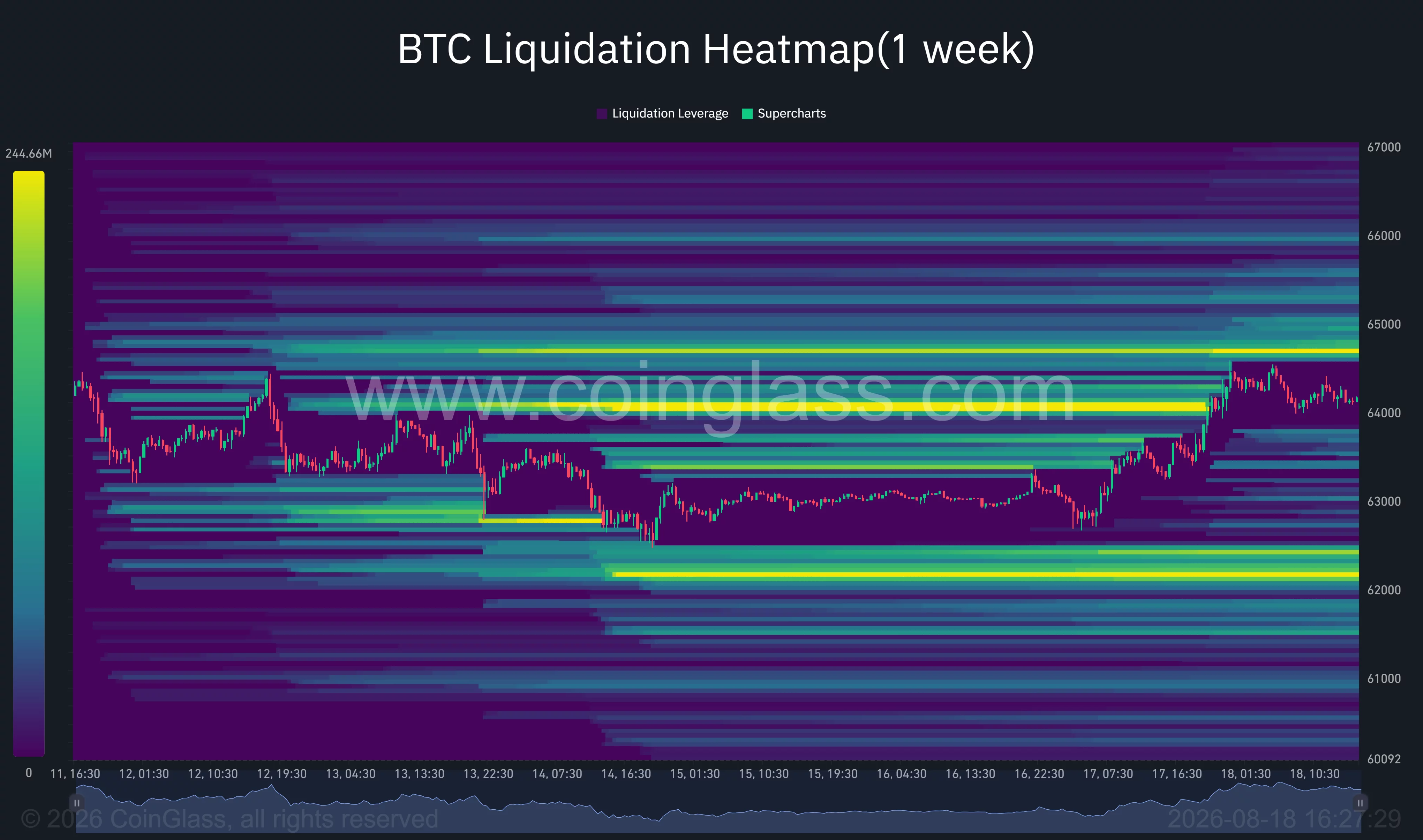
Additional liquidation concentrations appear near $65,000, $65,500, and $66,000. A move through $64,700 could force bearish positions to close, potentially accelerating the advance toward those higher levels.
The largest nearby downside pool sits around $62,200–$62,300. Smaller concentrations are visible near $63,500 and $62,800, giving sellers several potential targets if the price loses $63,800.
Crypto market commentator Rain said BTC’s ability to remain above $64,000 masked risks developing beneath the price. According to Rain, long leverage has been increasing while exchange liquidity has declined, creating a risk that a move toward the upper-$50,000 range could trigger forced selling.
Rain also said miners had reportedly reduced computing capacity by about 20% over three quarters as some operators shifted resources toward artificial intelligence. The commentator questioned whether institutional demand could continue absorbing the resulting pressure.
The charts do not yet confirm a fall into the upper-$50,000 region. Bitcoin would first need to lose the daily moving-average cluster, the $62,600 floor, and the large liquidation band near $62,200. Those levels currently separate the range-bound market from a deeper decline.
Bitcoin’s immediate direction therefore depends on whether buyers can turn $63,800–$64,000 into support. Holding that zone would leave $64,700 and $65,000 as the next targets, while a breakdown would expose $63,250, $62,600, and the leveraged positions concentrated near $62,200.
Disclosure: This article does not represent investment advice. The content and materials featured on this page are for educational purposes only.


Forget short-term price charts – Washington’s digital asset framework is the legal authorization that conservative wealth managers have been waiting for before they can put trillions to work.
Summary
- The CLARITY Act is a legal “permission structure” that allows conservative compliance officers and fiduciaries to safely allocate capital.
- Decentralized networks like Bitcoin and Litecoin don’t need a law to function; the institutions that want to hold and custody them need one.
- While Congress stalls before recess, capital and talent are not waiting. They are actively migrating offshore to jurisdictions with clear, actionable rulebooks.
Everyone seems to be watching the CLARITY Act for the same thing. From retail traders to institutional giants, people are waiting for the green light that confirms Washington has clarified the market.
They are watching the wrong metric.
Legislation doesn’t move markets through a single, uniform mechanism. The GENIUS Act has limitations on a single-asset framework for payment stablecoins. CLARITY works at a different layer: a horizontal market-structure bill covering how digital assets are classified, who regulates them, and who is allowed to custody and trade them. That’s why its success shouldn’t be benchmarked against a single price chart. The metric that matters here is the slower signal underneath: custody mandates being written, treasury policies being rewritten, allocation committees granting their first approvals.
That’s the real story. The CLARITY Act is fundamentally a legal permission structure. By handing institutional wealth managers and world-class operators the regulatory green light they need to enter the room, this law achieves something more durable than a market rally. It moves the people who build markets, not just the capital.
The real signal is access, not price
For years, compliance officers have killed crypto allocations for one reason above all others. As a Chief Executive, I’ve sat in meetings with teams waiting on a memo their Chief Legal Officer refuses to sign, arguing the legal landscape is too unsettled to defend or ambiguous. CLARITY speaks directly to that fear. It gives conservative, mandate-bound funds a federal framework they can point to when the investment committee asks the only question that matters, which is whether the position holds up if it is ever challenged.
The people running those funds are ready to act. A 2026 survey (Coinbase and EY-Parthenon Institutional Investor) found that roughly three in four institutional investors plan to increase their digital-asset allocations this year, that 66% named regulatory uncertainty as a top concern, and that 65% said greater clarity would lead them to allocate more. That said, obtaining regulatory clarity is the accelerant they name most often, and right now it is the input they do not have.
In institutional finance, risk managers matter as much as capital reserves. Clear rules attract disciplined, long-term capital alongside the veteran managers who direct it. Earlier milestones like the GENIUS Act and crypto ETFs widened access, but they didn’t resolve the foundational market-structure questions a Chief Legal Officer must sign off on, e.g. statutory definitions for qualified custodians and statutory exemptions for non-custodial software layer operators. The CLARITY Act tackles these regulatory bottlenecks head-on, and as legislation it would carry the force of law that other guidance, such as the SEC’s, does not. The moment one respected fund manager can legally justify an allocation, it creates the fiduciary precedent for everyone else to follow.
Another way to look at the CLARITY Act is through the underlying networks. A federal framework doesn’t change how a decentralized network functions. Bitcoin and Litecoin have run without a central issuer or a corporate board since their first blocks, and they have done so for over a decade without asking for permission. That said, CLARITY leaves the underlying software untouched. What it changes is who can legally operate alongside it. By codifying CFTC oversight of digital commodities, setting qualification standards for digital asset custodians, and creating a registration path for banks to offer custody and brokerage, the bill would establish a defined perimeter for regulated intermediaries. It changes nothing for the assets themselves, which already work, but transforms everything for the fiduciaries waiting for a legal framework to step through the door.
CLARITY is an accelerant, not a lifeline
Which is why the Senate calendar matters.
As of this writing, the Clarity Act has just secured a scheduled floor vote for 15th September, despite legislative delays that ran the bill up against – and now into – the August recess. But whether the vote happens this month or in the upcoming years, the underlying momentum of the industry remains unchanged. Institutional adoption is expanding, capital inflows are compounding, and world-class talent continues to migrate into the space every single day.
Passing the CLARITY ACT means taking this existing momentum to the next level.
The bill is an accelerant. If the vote slips past recess, the signal is delayed. Capital and talent won’t pack up or go home; they will simply adjust their velocity and focus. International hubs like the EU under MiCA and Dubai under VARA are already demonstrating that global adoption moves forward with or without Washington’s timeline.
In the end, the CLARITY Act isn’t deciding whether institutional finance adopts digital assets. That shift is already happening. But the decision matters to the human capital – the compliance officers, the corporate treasurers, and the world-class builders. It is for them to get the green light to do that work here in the United States.
The CLARITY Act was designed to move people. And the people it moves are going to build the next decade of finance regardless of when federal frameworks fall into place. It is simply a matter of time.
About the author:
Jay File | CEO & CFO, Lite Strategy, Inc. (Nasdaq: LITS) – brings more than three decades of leadership experience spanning public accounting, corporate finance, capital markets, and publicly traded companies. A Certified Public Accountant by training, he began his career in public accounting at Arthur Andersen and KPMG, where he specialized in SEC reporting across technology, software, biotech, and defense sectors. He later held senior finance roles at Sequenom, overseeing approximately $400 million in equity financings, a $130 million convertible notes offering, and treasury management of a $100 million cash position. During eight years as CFO of Nasdaq-listed Evofem Biosciences, he led financial reporting, investor relations, and capital-raising initiatives – raising $365 million in equity financings and $70 million in various debt offerings – before joining Lite Strategy in 2023. Under his leadership, the company has transitioned into a pioneering digital asset treasury business, becoming the first publicly traded company to adopt Litecoin as its primary reserve asset while working alongside digital asset market maker GSR and Litecoin creator Charlie Lee, who also serves on the company’s board.
Disclosure: The views and opinions expressed here belong solely to the author and do not represent the views and opinions of crypto.news’ editorial.
Disclosure: This article does not represent investment advice. The content and materials featured on this page are for educational purposes only.
Rising XRP short positions and declining whale deposits are fueling market caution as holders explore cloud mining platforms such as UE Crypto for alternative returns.
Summary
- Rising XRP short positions and weak price performance are driving interest in UE Crypto’s cloud mining services.
- XRP’s latest decline is prompting holders to explore UE Crypto’s cloud mining model for alternative digital asset returns.
- With XRP trading near $1, investors are looking to UE Crypto’s cloud mining platform to diversify their digital asset strategies.
Short positions against XRP on Binance continue to increase, while whale deposits on the exchange have fallen to their lowest level in four years.
XRP’s volatility is prompting investors to explore UE Crypto’s cloud mining model as another way to generate returns from digital assets.
UE Crypto is attracting the attention of XRP holders who are looking to diversify their returns through cloud mining and renewable energy infrastructure.
Due to XRP’s weak price performance, UE Crypto provides XRP holders with a way to participate in cloud mining and generate passive income without the need for expensive mining hardware.
Whale reserves plunge, market sentiment hits bottom
However, the supply of funds required for selling is declining. According to analyst Darkfost, the three-month average of Binance whale inflows has fallen to $61 million, the lowest level since 2021.
Market sentiment has reached extreme levels. Analytics firm Santiment recorded a three-month peak in bearish sentiment across user comments on platforms such as X, Reddit, and Telegram. On-chain activity, however, is showing the opposite trend, with the number of active addresses reaching 49,929 within 24 hours, the highest level in more than two months.
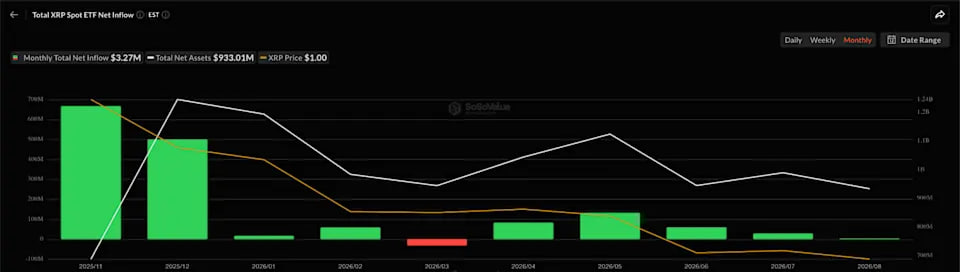
Currently, we are seeing continued weakness in market interest in XRP, with net inflows into exchange-traded funds (ETFs) linked to these tokens declining for three consecutive months.

Despite some potentially favorable factors, such as the passage of the CLARITY Act, this weak interest reflects limited expectations for the project’s growth potential. As a result, an increasing number of XRP investors are turning their attention to the UE Crypto cloud mining digital asset platform. To hedge against market risks, UE Crypto’s cloud mining platform is attracting increasing attention from investors seeking to use cloud mining and yield aggregation mechanisms to hedge against market volatility and improve returns.
As of August 18, 2026, the current price of XRP (XRP) is $0.997093. Over the past 24 hours, the price has fallen by 0.1%, while the price movement over the past hour was 0%. In terms of longer-term performance, the price has fluctuated by -1.1% over the past seven days and -9.1% over the past month. Among the top ten cryptocurrencies by market capitalization, XRP recorded the largest seven-day decline, falling by -1.1%, while the overall market remained relatively stable. The token’s price action appears to indicate that the Clarity trade is gradually being unwound.

Affected by market sentiment, XRP’s price fell to a recent low, causing its market capitalization to shrink and temporarily losing its position as the world’s fourth-largest digital asset. Increased short-term volatility has prompted some investors to reassess their future XRP investment strategies.
Meanwhile, an increasing number of digital asset investors are turning their attention to the UE Crypto cloud mining digital asset platform, seeking to explore diversified income-generation models through methods such as cloud mining and yield aggregation. While maintaining a long-term bullish outlook on XRP, the question is whether short-term price volatility can be mitigated while generating sustained additional returns from their XRP holdings.
Why is UE crypto attracting increasing attention?
1. Security and Stability
UE Crypto adopts a multi-layer security architecture, integrating technologies from McAfee and Cloudflare and implementing measures such as offline cold wallets to provide comprehensive protection for platform operations and user assets.
2. Environmentally Friendly and Efficient
The platform’s mining operations utilize renewable energy sources such as solar, wind, and hydropower, aiming to minimize the environmental impact of energy consumption while maximizing computing efficiency.
3. Compliance and Transparency
The platform continuously improves its operational standards, data transparency, and user protection mechanisms to provide a clearer and more reliable environment for cryptocurrency services.
4. Smart Custody
UE Crypto handles daily operations, computing power management, and yield settlement through professional teams and automated systems, allowing users to easily generate passive income.
5. Multi-Currency Support
The platform supports a variety of mainstream digital assets, including BTC, ETH, DOGE, SOL, XRP, USDC, LTC, and USDT, providing greater flexibility for different users.
6. Affiliate Rewards
The platform offers an affiliate program through which users can earn 3% + 2% referral commissions by inviting friends, with rewards of up to $50,000. Users can increase their passive income even without making investments themselves.
About UE Crypto’s cloud mining digital asset platform
UE Crypto is headquartered in the United Kingdom and operates within European regulatory frameworks such as MiCA and MiFID II, continuously improving its transparency, operational standards, and user protection mechanisms.
The platform adopts a multi-layer security architecture, including:
- Annual financial and security compliance audits conducted by PwC.
- Digital asset custody insurance provided by Lloyd’s of London.
- Enterprise-grade network protection from Cloudflare and McAfee® security systems.
- Bank-grade data encryption and professional security infrastructure to provide multiple layers of protection for users’ assets and accounts.
How to use UE Crypto?
1. Register an account
2. Choose a mining package
Choose a suitable cloud mining contract according to personal budget and needs, and start mining with one click.
3. Start earning
After the contract is activated, the system will automatically allocate computing power, and returns will be settled automatically every 24 hours. Users can withdraw their earnings at any time or continue participating according to their own needs, thereby achieving long-term compound growth of their assets.
Popular UE Crypto contracts
BTC (Beginner Experience Contract) Investment amount: $100Contract duration: 2 days Daily return: $4Total return at contract expiration: $100 + $8
Dogecoin (DOGE, Digital Intelligent System Contract) Investment amount: $500
Contract duration: 5 days Daily return: $6.25Total return at contract expiration: $500 + $31.25
BTC (Super Computing System Contract) Investment amount: $1,000 Contract duration: 10 days Daily return: $13.10Total return at contract expiration: $1,000 + $131
LTC (Algorithm-Driven System Contract)Investment amount: $5,000Contract duration: 25 daysDaily return: $72Total return at contract expiration: $5,000 + $1,800
BTC (Quantitative Intelligent System Contract) Investment amount: $10,000 Contract duration: 35 days Daily return: $158Total return at contract expiration: $10,000 + $5,530
For more details about the contract plans, please visit the official UE Crypto website.
Overview
Short positions against XRP on Binance continue to increase, while whale deposits on the exchange have fallen to their lowest level in four years. Whale reserves have plunged, market sentiment has hit bottom, and despite some potentially favorable factors such as the passage of the CLARITY Act, this weak interest reflects limited expectations for the project’s growth potential.
For long-term XRP investors, in addition to focusing on price trends and market cycles, it is equally important to consider how to reduce the risks associated with relying on a single storage method and explore more diversified digital asset management approaches. UE Crypto aims to create more resilient and sustainable passive income for users through cloud mining, computing power management, renewable energy, and other methods.
Disclosure: This content is provided by a third party. Neither crypto.news nor the author of this article endorses any product mentioned on this page. Users should conduct their own research before taking any action related to the company.
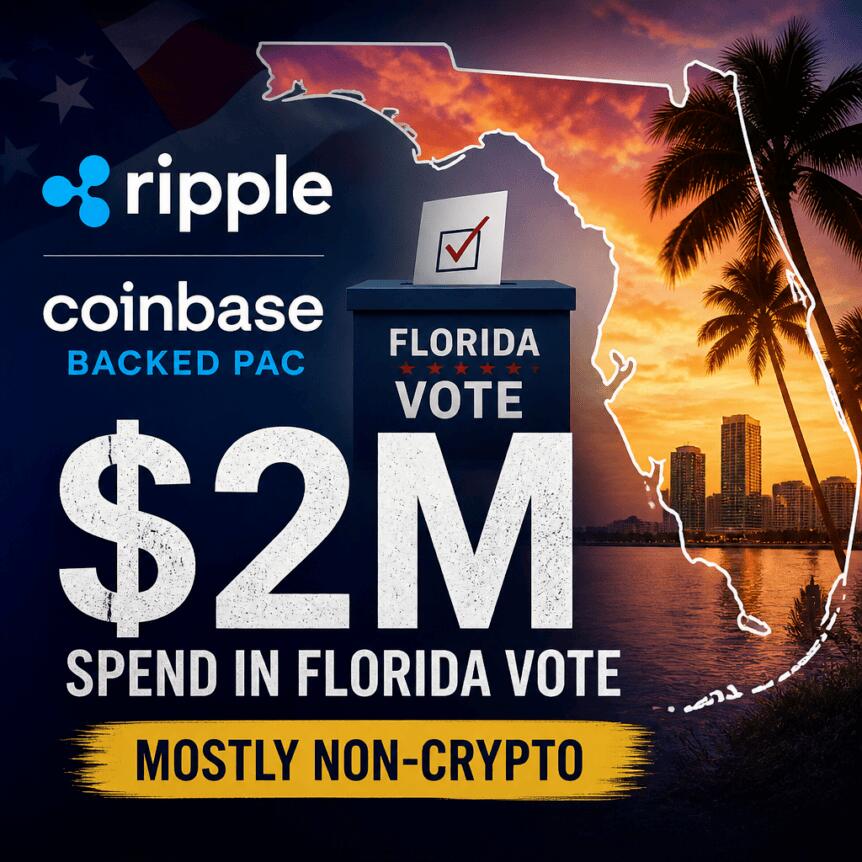
A political action committee tied to crypto industry heavyweight Fairshake has spent more than $2 million on ads targeting an early Democratic primary in Florida’s 24th congressional district, according to Federal Election Commission (FEC) records.
Coinbase and Ripple Labs have been identified as primary backers of Fairshake, and Protect Progress PAC—an affiliate described as operating in line with the group’s political strategy—has directed the funds against Democratic candidate Oliver Gilbert while the state’s primary field was still taking shape.
Key takeaways
- FEC records show Protect Progress PAC spent more than $2 million on ads opposing Democrat Oliver Gilbert in Florida’s 24th district.
- The PAC’s timing appears aimed at a Democratic primary where major candidates had not publicly staked out prominent positions on digital assets before the ad push.
- Gilbert and his allies have criticized the ads as misleading, while Fairshake-linked messaging argues the underlying claims are accurate.
- The spending is part of a broader pattern of crypto-focused political advertising ahead of the next Congress.
Protect Progress PAC targets a Florida Democratic primary
As of Tuesday, FEC filings for Protect Progress PAC indicated it had spent over $2 million on media opposing Oliver Gilbert in Florida’s 24th congressional district. The race pits candidates for a seat currently held by Representative Frederica Wilson.
FEC-linked reporting highlighted a notable aspect of the timing: no candidate in the Democratic primary was described as having taken a clear, prominent public position on digital assets prior to Protect Progress’s involvement.
Wilson has endorsed Gilbert. The incumbent has also been associated with legislation opposed by critics in the crypto policy space, including the Digital Asset Market Clarity (CLARITY) Act and the Guiding and Establishing National Innovation for US Stablecoins (GENIUS) Act.
Endorsements, questionnaires, and “strongly supports” ratings
Among the Democratic field, Shevrin Jones—a Florida state senator and a Democratic candidate who, according to an early August poll, had been ahead of Gilbert—has completed a questionnaire with Stand With Crypto.
Following the questionnaire, Stand With Crypto assigned Jones a “strongly supports” rating, according to the advocacy organization’s public materials. That rating places him closer to the preferences of crypto-focused political actors than the campaign trail appears to have shown for Gilbert before Protect Progress’s spending entered the race.
Gilbert disputes the ads while Fairshake says claims are accurate
According to reporting, Gilbert said the advertising campaign was driven by “Donald Trump’s tech billionaire buddies,” characterizing the effort as a bid to influence a Democratic primary. He also alleged that “crypto con artists” were behind the ads.
The ad content included fabricated Miami Herald-style headlines that were not tied to reported policy positions on digital assets, a detail that has raised skepticism among opponents of the PAC’s approach.
Fairshake spokesperson statements, provided to Cointelegraph, pushed back on the characterization. The spokesperson said: “The facts are the facts, and, as the Miami Herald stated, the underlying facts in our ad are true.” The spokesperson did not address the specific rationale for the level or timing of the PAC’s expenditures.
Cointelegraph reports it reached out to Gilbert’s campaign for comment but did not receive an immediate response.
Spending fits a wider cycle of crypto-linked political advertising
This Protect Progress activity comes as Fairshake and its affiliates continue to deploy large sums across federal primaries and general election races. Cointelegraph previously reported that Fairshake held a reported $193 million war chest as of January, and that the group has used affiliate organizations—such as Protect Progress and Defend American Jobs—to back candidates of different parties for the 2026 midterm elections.
In June, Cointelegraph reported that Protect Progress and related efforts had already “poured more than $82 million” into primaries and special elections using ads to influence voters, reflecting a sustained strategy rather than a one-off ad buy.
Further evidence of the breadth of this approach shows other spending during current federal nomination periods. On Tuesday, voters in Alaska, California, Florida and Wyoming were set to decide congressional candidates who would face off in November’s general election.
Cointelegraph noted additional Protect Progress spending: more than $150,000 on media supporting the re-election of Lois Frankel in Florida’s 23rd district.
For Defend American Jobs, Cointelegraph reported a combined $1.5 million across multiple races, including ads backing Representative Nick Begich in Alaska’s at-large congressional district, Republican candidate Sydney Gruters in Florida’s 16th district, and Representative Harriet Hageman for a Wyoming Senate seat.
What it signals for crypto policy politics ahead of the next Congress
The immediate question for voters in these primaries is less about day-to-day crypto market mechanics and more about which congressional candidates are positioned to advance or block crypto legislation. The Protect Progress ad strategy suggests crypto-aligned political groups are focused on reshaping candidate expectations early—before general-election coalition building locks in nominees.
There’s also a legislative timeline embedded in the broader political context. Cointelegraph reports that Congress is on recess until September, when the Senate is expected to vote on the CLARITY Act. For investors and industry participants watching regulatory direction, the selection of committee-minded candidates during primaries can be as consequential as the final votes themselves.
Readers should watch how subsequent FEC updates evolve—especially whether Protect Progress’s Florida spend expands into other races—and whether the outcome of the 24th district primary changes the balance of candidates most publicly aligned with digital-asset policy priorities.


Tom Lee, chairman of Bitmine Immersion Technologies, said BlackRock’s new Bitcoin report reinforces the case for Ethereum (ETH). He pointed to artificial intelligence (AI) and robotics as the reason.
BlackRock’s paper, called “Re-Underwriting Bitcoin,” examined Bitcoin’s more than 50% decline from its October 2025 high. It said capital had rotated into AI-themed equity funds instead.
What Lee Argued
Lee, who also co-founded Fundstrat, wrote on X that AI capabilities are advancing along a steep S-curve. He said recent research points to AI systems developing a form of collective coordination.
Blockchains and smart contracts, he argued, keep humans involved in overseeing that behavior. He extended the same logic to robotics, citing a video of a robot outperforming human athletes.
In the same post, Lee called Ethereum the most important base layer, or “L1.” The term describes the foundational network that other blockchain applications rely on.
“we see $ETH as an important downstream story for AI”
Where the Case Gets Thin
But BlackRock’s report never mentions Ethereum, robotics, or blockchain verification of AI systems. Instead, its authors frame AI-linked equity funds as competition for capital, not a use case for smart contracts.
Still, Lee’s framing goes further than the report itself. BlackRock links Bitcoin’s pullback to leverage and shifting fund flows, not a change in Bitcoin’s role as a monetary hedge.
This is not the first time Lee has tied Ethereum to the AI trade. Bitmine holds about 4.8% of Ethereum’s circulating supply, making Lee one of the asset’s largest institutional stakeholders.
That position gives Lee a clear financial incentive to link Ethereum to major crypto narratives, including Bitcoin’s own investment case.
Ethereum trades near $1,908 as of Aug. 19, 2026, according to CoinGecko data. Whether Lee’s AI-and-robotics framing gains wider traction may depend on concrete examples of blockchains verifying autonomous systems in practice.
The post Tom Lee Uses BlackRock’s Bitcoin Report to Pitch Ethereum as AI’s Verification Layer appeared first on BeInCrypto.
Bitway token extended its seven-day gain beyond 100% on Aug. 18, trading near $0.37 as reward campaigns drew demand, but overbought conditions and concentrated liquidation levels raised the risk of a sharp reversal.
Summary
- Bitway gained more than 100% in seven days and briefly traded above $0.40.
- Ecosystem staking incentives and Binance Wallet’s Bitway Booster campaign supported demand.
- Daily RSI reached 76.85, placing BTW firmly in overbought territory.
- Liquidation liquidity is concentrated near $0.30 and between $0.42 and $0.44.
According to data from CoinMarketCap, the BTW rally followed the introduction of Bitway’s incentivized decentralized traditional finance staking program on Aug. 13. The program offered an 8% base annual percentage rate paid in Tether (USDT), plus a further 4% return in platform points.
Binance Wallet’s Bitway Booster Season 4 added another catalyst by offering more than $200,000 in bonus APR rewards. The combination encouraged holders to deposit BTW into supported products while bringing new attention to the token.
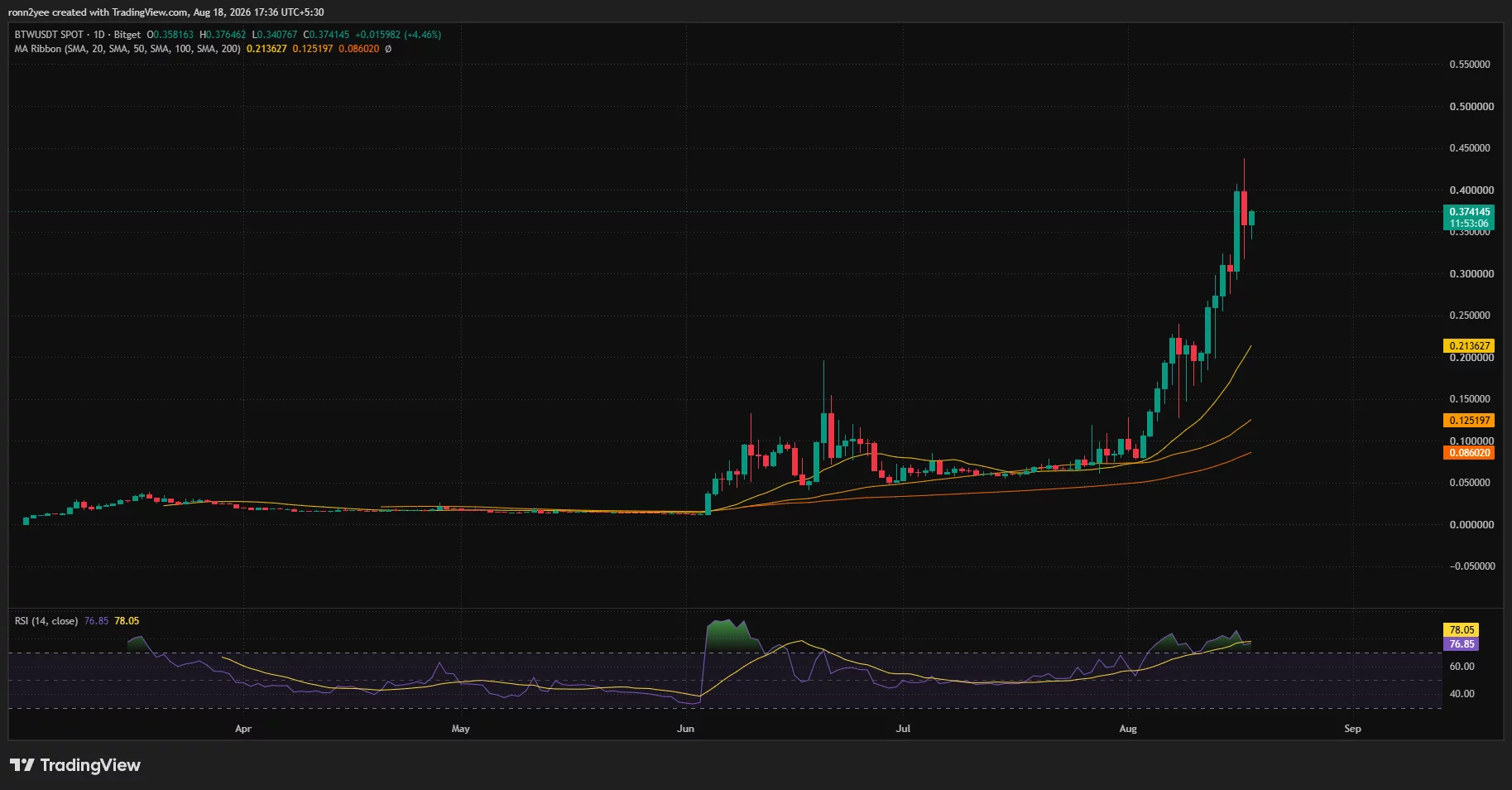
BTW rose from below $0.20 at the start of the seven-day period to an Aug. 17 peak near $0.44 on Bitget. The token subsequently pulled back but recovered to approximately $0.37 by the time of writing.
Bitway price holds most of its weekly advance
The daily chart shows BTW accelerating after moving above $0.10 in early August. Buyers then cleared $0.20 and $0.30 in quick succession before the price briefly crossed $0.40.
BTW traded around $0.374 on Aug. 18, up approximately 4.5% during the current daily session. The rebound followed an intraday decline to $0.340, showing that buyers remained active below $0.35.
Price also remained far above all three moving averages shown on the chart. The 20-day moving average stood at $0.2136, while the 50-day and 100-day averages were near $0.1252 and $0.0860, respectively.
Their bullish alignment confirms that the broader trend remains upward. However, the wide distance between the market price and the 20-day average shows that BTW has advanced much faster than its recent baseline, leaving it vulnerable to profit-taking.
Daily RSI stood at 76.85, with its signal average at 78.05. Readings above 70 generally indicate overbought conditions, although a token can remain overbought during a strong momentum rally.
Reward campaigns helped drive the 100% rally
BTW’s advance developed while Bitcoin and several large altcoins struggled to build momentum. Project-specific incentives therefore appear to have played a larger role than broad crypto market strength.
The USDT-denominated portion of Bitway’s staking offer may have been particularly attractive because it gives participants a return in a stablecoin rather than paying the entire yield in BTW. Locking tokens in staking products can also reduce immediately available supply, though the available charts do not establish how much BTW was removed from exchanges.
Trading activity increased alongside the price move, according to the CoinMarketCap update supplied for the analysis. However, the speed of the rally means continued gains may depend on fresh participation after the promotional campaigns end.
BTW’s valuation also presents a longer-term concern. CoinMarketCap data cited in the market update placed its circulating capitalization near $974 million and its fully diluted valuation around $3.59 billion. Such a gap may expose holders to future dilution if additional tokens enter circulation.
BTW needs to break $0.40 to continue higher
The 4-hour chart gives buyers a clearer near-term test. BTW was trading at $0.374, above the Bollinger Band midpoint at $0.341 but below the upper band at $0.403.
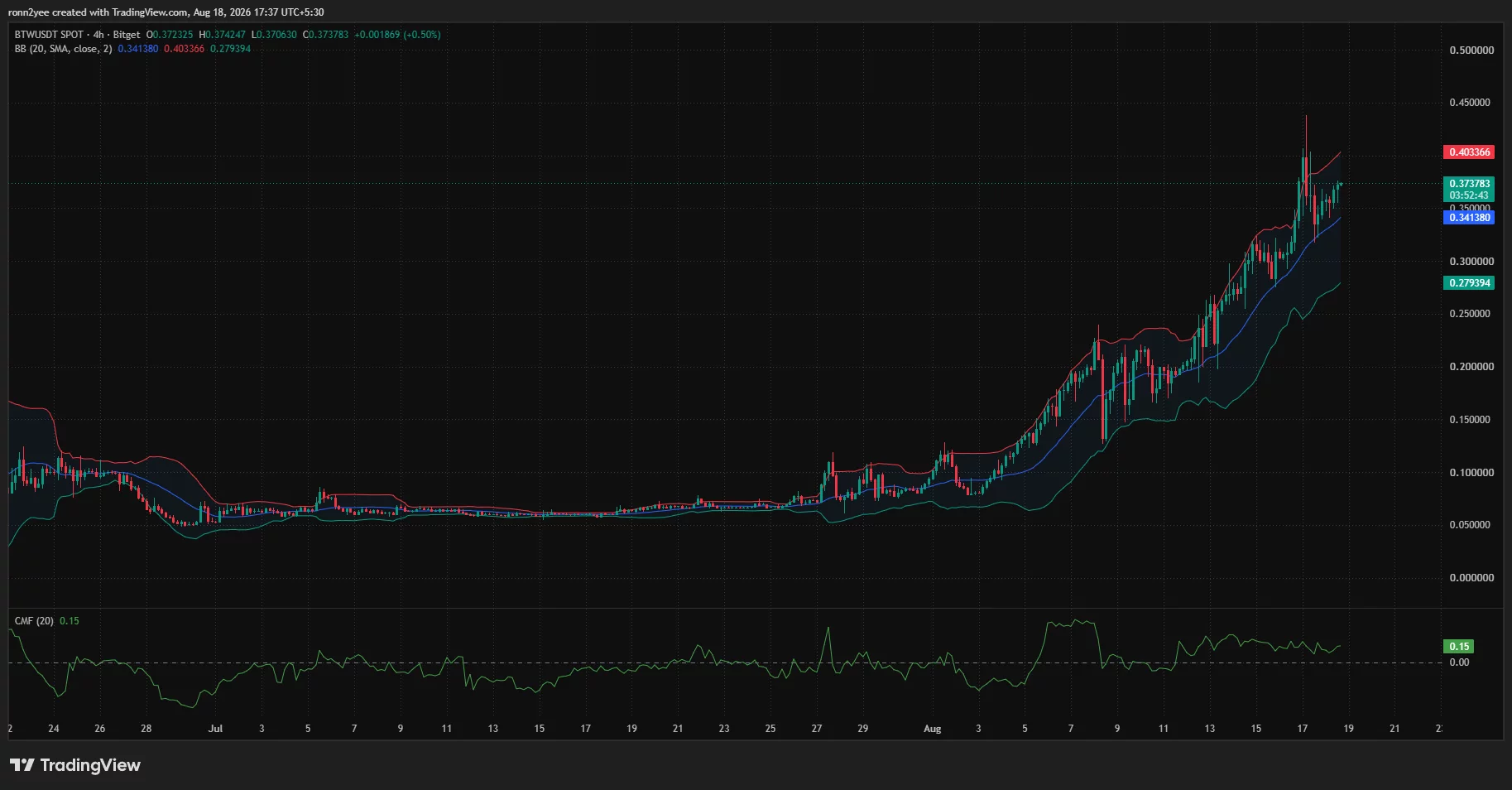
A sustained move through $0.40–$0.403 would show that buyers have absorbed supply around the latest rebound high. Above that range, the previous wick near $0.44 becomes the next resistance level.
Crypto analyst Crypto With Gopal identified a falling wedge after BTW’s initial pullback and said a clean move above approximately $0.38 could open a route toward $0.46. Price has since tested the breakout area, but it has not yet confirmed the analyst’s higher target.
The 4-hour Chaikin Money Flow reading of 0.15 remained above zero. The indicator suggests buying pressure still exceeds selling pressure on that timeframe, supporting the rebound from the $0.34 area.
A close below the Bollinger midpoint near $0.341 would weaken the immediate setup. Further selling could expose the lower band around $0.279, with the daily chart’s former breakout region between $0.20 and $0.22 serving as a deeper support zone.
Liquidation levels could amplify the next move
CoinGlass’ one-week liquidation heatmap shows leveraged positions concentrated on both sides of the current price. The closest overhead clusters appear around $0.38–$0.39, followed by a denser group between approximately $0.42 and $0.44.
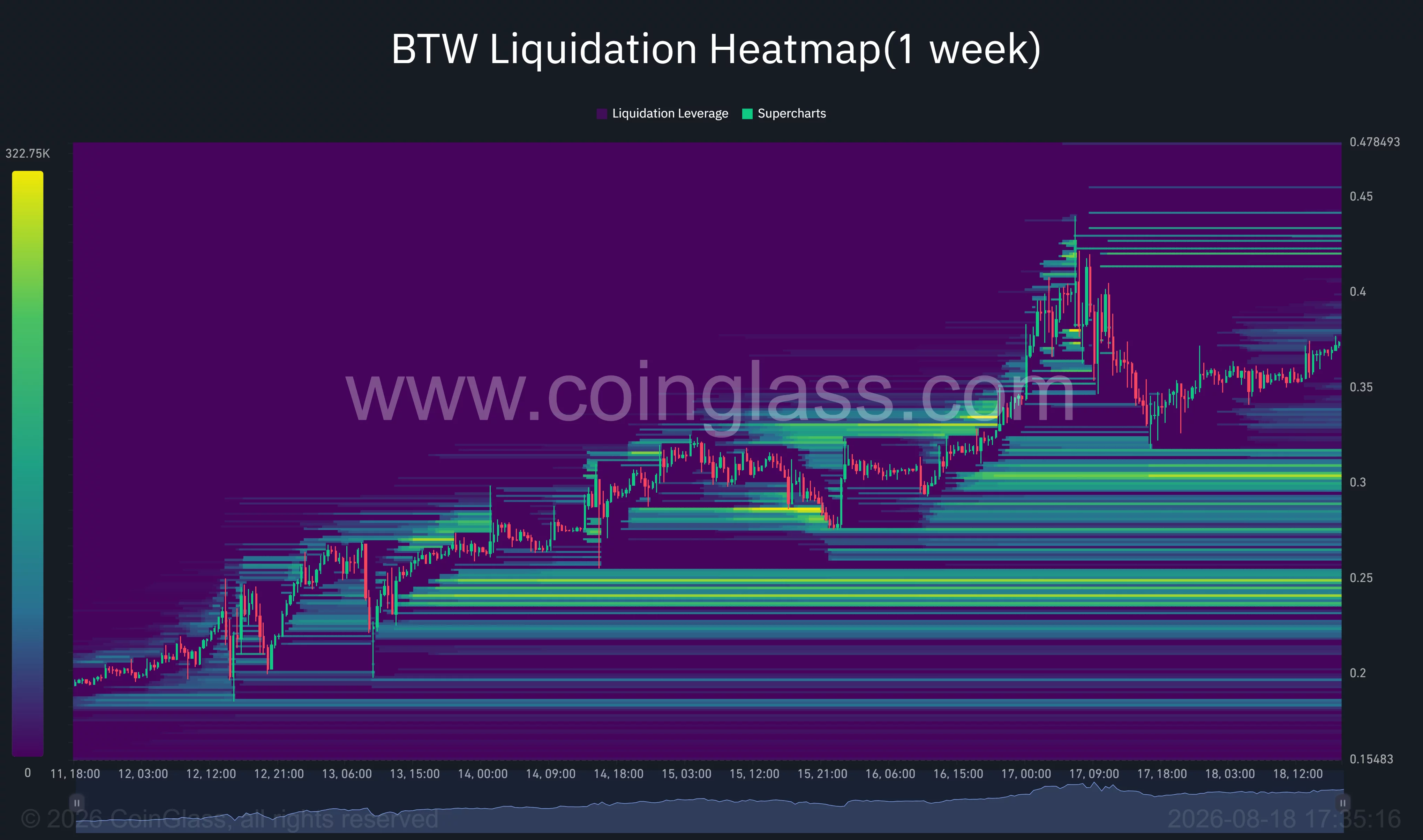
A move above $0.40 could force bearish positions to close and help carry BTW toward the upper cluster. Such a move would place the token near its recent high and the $0.46 target cited by Crypto With Gopal.
The largest visible downside liquidity pool sits around $0.30–$0.31. Additional concentrations appear near $0.28 and between $0.23 and $0.25.
Liquidation maps identify areas where leveraged positions may be forced to close, but they do not guarantee that price will visit those levels. In BTW’s case, the dense liquidity below the market shows how quickly a pullback could deepen if buyers stop defending $0.34.
Can the Bitway rally last?
BTW retains a bullish structure while it trades above $0.341, and positive 4-hour capital flow supports another attempt at $0.40. A confirmed break above $0.403 could bring $0.44 and $0.46 into view.
The rally nevertheless carries elevated risk. Daily RSI is overbought, the price is stretched far above its moving averages, and the token has already experienced large intraday swings. Failure to hold $0.34 could shift attention toward $0.30 and then $0.28.
US investors should also consider venue access and liquidity before trading BTW. The chart uses Bitget pricing, while availability, spreads, and execution may differ across platforms accessible in the United States.
Bitway’s promotional incentives explain part of the latest demand, but lasting strength will require buying activity after the initial reward-driven rush fades. The next decisive signal will come from whether BTW converts $0.40 into support or loses the $0.34 floor.
Disclosure: This article does not represent investment advice. The content and materials featured on this page are for educational purposes only.

Street in Wales is so ‘magical’ it feels like you’re ‘wandering through a postcard’

Symbiotec Pharmalab sets price band for Rs 1,757 crore IPO, to open on August 24

Bitcoin may enter accumulation by November, VanEck says





-

 Fashion4 days ago
Weekend Open Thread: Ann Taylor
-
 Sports5 days ago
This U.S. Amateur is a glimpse into golf’s future in more ways than you think
-
 Tech5 days ago
11 Ways to Rank Your Videos
-
 NewsBeat4 days ago
Myanmar says over 300,000 Rohingya refugees verified for repatriation as exodus enters ninth year
-

 Sports4 days ago
Birmingham 2026: Day 6 Timetable for Irish Athletes
-

 Politics4 days ago
SEQ Code: The Three Letter Boarding Pass Code That Could Give You The Worst Seat
-
 Entertainment7 days ago
Keke Palmer Subtly Hints At Sean Evans Drama With Cryptic Post
-
 Crypto World7 days ago
XRP bridge drained after software mistook fake deposits for real ones
-

 Tech5 days ago
DeepSeek Harness launches as open source rival to Claude Code, alongside V4-Pro on API with higher prices
-

 Sports6 days ago
DeQuan Jones in ‘high spirits’ after successful leg surgery
-
 Crypto World7 days ago
Perplexity AI Predicts an XRP Scenario Few Analysts Are Discussing
-

 Tech7 days ago
SpaceXAI’s Grok Bot turns agents into persistent digital coworkers that can operate your apps for $120-per-month
-

 Crypto World1 day ago
OCC Greenlights Trump Family Crypto Firm for Trust Charter
-

 Politics7 days ago
How Average Are You In The UK?
-
 Entertainment6 days ago
2026’s Most Ambitious Fantasy Movie Officially Scores Sequel Update
-
 Entertainment6 days ago
All 10 Hayao Miyazaki Fantasy Movies, Ranked
-

 Fashion7 days ago
Why Botanical Fashion Never Goes Out of Style
-
 Entertainment6 days ago
Travis Kelce Breaks Silence On ‘Crazy’ Taylor Swift Wedding
-
 Entertainment5 days ago
10 Netflix Shows That Quietly Became Modern Classics
-

 Fashion7 days ago
Wednesday’s Workwear Report: Stretch-Cotton Pleated-Waist Top
You must be logged in to post a comment Login