

Crypto World
FLR price outlook as Flare and Xaman launch one-click DeFi access for XRP holders



- The one-click DeFi access could unlock idle XRP liquidity for Flare’s ecosystem.
- The FLR token price remains weak amid low liquidity and cautious market sentiment.
- The immediate support level for Flare (FLR) sits near $0.00963, with downside risk if this support breaks.
Flare (FLR) cryptocurrency price is pulling back after a recovery attempt that pushed it to a high of $0.009826 on February 28, following the news of Flare rolling out one-click DeFi access for XRP token holders through a partnership with Xaman.
This comes as FLR cryptocurrency trades near multi-month lows, raising an important question about whether fundamentals can eventually support a shift in price momentum.
The one-click DeFi lowers the barrier for XRP holders
For years, XRP holders have largely remained on the sidelines of decentralised finance due to technical complexity and limited native options.
Flare’s latest integration aims to change that by simplifying how the XRP cryptocurrency can be used in DeFi without forcing users to navigate bridges, complex smart contracts, or unfamiliar wallets.
The one-click approach allows users to interact with DeFi protocols while maintaining self-custody, which has been a persistent concern for more conservative market participants.
By abstracting away the complicated steps, Flare positions itself as a gateway for idle XRP liquidity to enter yield-generating activities.
This matters because XRP represents one of the largest pools of dormant capital in crypto, yet only a small fraction of it is currently productive.
If even a modest percentage of that capital moves on-chain, it could significantly boost activity across Flare’s DeFi stack.
The timing is also notable, as demand for yield products has been rising while speculative trading has slowed.
That shift suggests users are becoming more selective, favouring utility and predictable returns over short-term price bets.
Market conditions keep FLR under pressure
Despite the positive narrative, Flare’s native token, FLR, has struggled to reflect this progress in its price.
The broader crypto market has recently leaned risk-off, with total market capitalisation slipping and Bitcoin posting mild losses.
In this environment, FLR has underperformed slightly, declining more sharply than the market average over the past 24 hours.
Liquidity remains thin, as reflected by a sharp drop in daily trading volume, which makes the token more sensitive to modest sell pressure.
Low liquidity often exaggerates price moves, especially when there is no strong catalyst to attract fresh buyers.
While social sentiment around XRP-related developments has turned more optimistic, that enthusiasm has not yet translated into sustained buying activity.
Over the past month, FLR has remained down meaningfully, reinforcing the idea that traders are still cautious.
This disconnect between improving fundamentals and weak price action highlights a familiar crypto pattern where adoption narratives take time to show up on charts.
Flare price forecast
FLR is currently trading in a tight technical range that reflects uncertainty rather than panic.
Price action is sitting between key Fibonacci retracement levels that have capped momentum in both directions.
The first level traders are watching is the area around $0.00904, which has acted as short-term support.
A clean break below this zone could expose the previous swing low near $0.0085.
If that lower level fails to hold, downside pressure may accelerate due to thin liquidity.
This makes volume confirmation critical for any move lower or higher.
On the upside, FLR needs a decisive push above the $0.00968 region to shift near-term momentum.
Such a move would signal that buyers are finally stepping in with conviction.
From a technical standpoint, momentum indicators, including the Relative Strength Index (RSI), currently sit near neutral, suggesting the market is coiled rather than trending.

This leaves FLR vulnerable to broader market moves until a clear catalyst emerges.
The key question is whether growing DeFi participation from XRP holders can translate into measurable demand for FLR.
If on-chain activity and volume rise together, price could stabilise and attempt a recovery.
Until then, the outlook remains neutral to slightly bearish, with traders focused on support resilience rather than breakout targets.

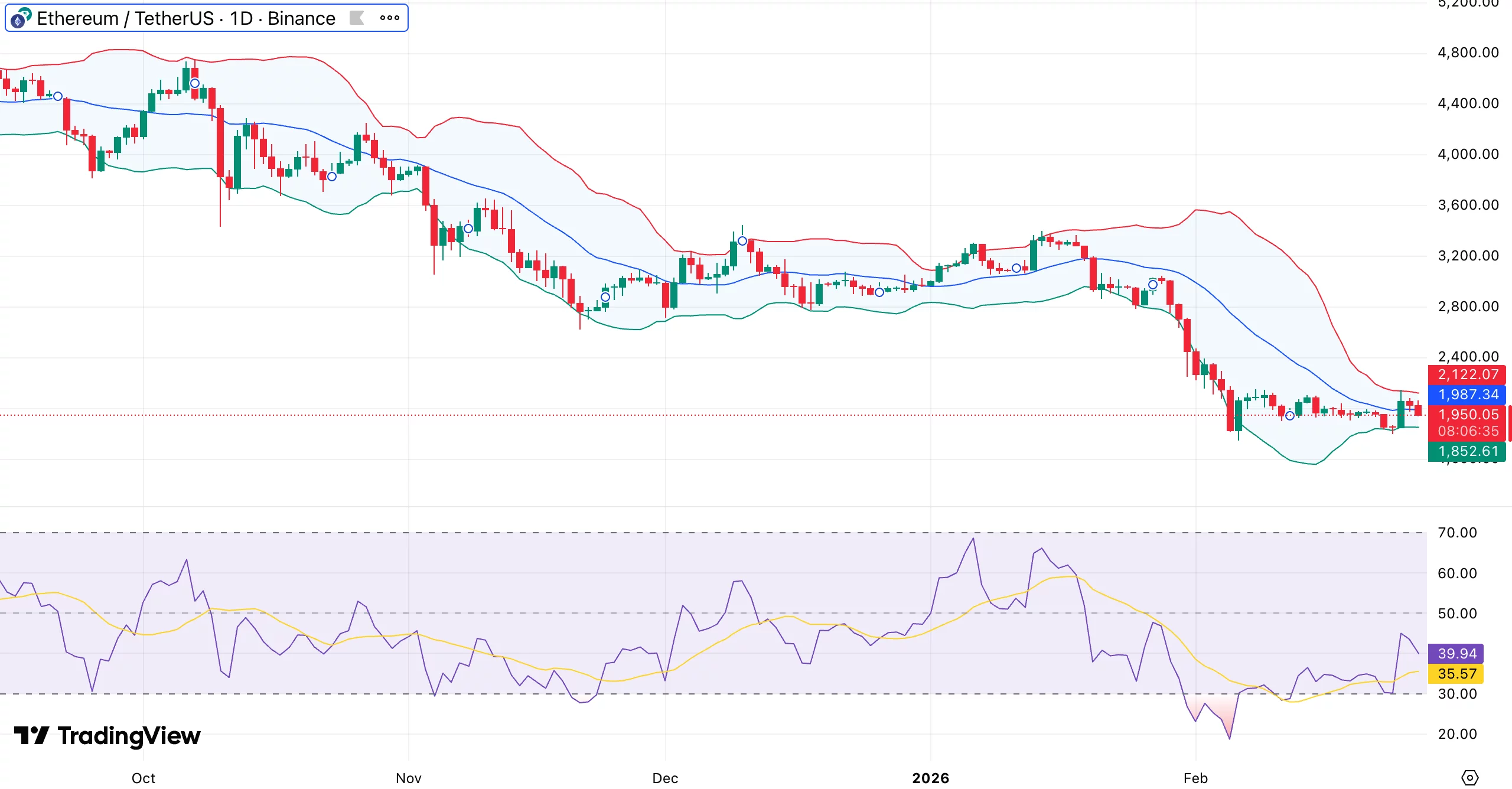
Ethereum price trades near $1,950 as the Binance buy/sell ratio hints at a potential shift in derivatives positioning.
Summary
- Ethereum price sits near the lower end of its weekly range after a sharp monthly decline.
- Binance Taker Buy/Sell Ratio has climbed toward neutral after weeks of sell-side pressure.
- A move above $2,200 is needed to challenge the current downtrend structure.
Ethereum (ETH) trades at $1,947 at press time, down 4% in the past 24 hours. Price is sitting near the bottom of its seven-day range of $1,815.54 to $2,099.16. Over the last month, ETH has fallen 35%, and it is still roughly 60% below its August all-time high of $4,946.
Daily trading volume came in at $22.5 billion, down 25% from the previous session. Participation has thinned as the market drifts sideways near recent lows, with traders appearing cautious rather than aggressive.
Binance taker buy/sell ratio shows early improvement
A Feb. 27 report from CryptoQuant contributor Darkfost focused on Ethereum’s Taker Buy/Sell Ratio on Binance. This metric tracks whether aggressive futures orders are dominated by buyers or sellers.
When the ratio pushes above 1, market buys outweigh market sells. When it stays below 1, sellers are pressing harder.
During Ethereum’s push toward prior highs, the ratio stayed under that equilibrium level. The monthly reading slipped to 0.95, while the weekly average dropped further to 0.92. At the same time, price began to roll over. Persistent futures selling added weight to the move lower.
With derivatives volume hovering around $65 billion, futures flows carry significant influence over price discovery. Heavy sell-side pressure in that market often feeds into spot weakness.
Over the past two weeks, the picture has started to shift. The weekly ratio has hovered near 1.0, and there have been several daily spikes above 1.12, reflecting bursts of aggressive buying. The monthly figure has edged up to around 0.99.
ETH has not staged a decisive rebound yet, but the imbalance seen earlier is less extreme. If the ratio can hold above 1 for a sustained stretch, it would show that buyers are taking control of short-term futures positioning. That kind of shift can lay the groundwork for price stabilization.
Ethereum price technical analysis
On the chart, the trend still favors the downside. Ethereum has printed a series of lower highs and lower lows since breaking down from the $3,000–$3,200 area.
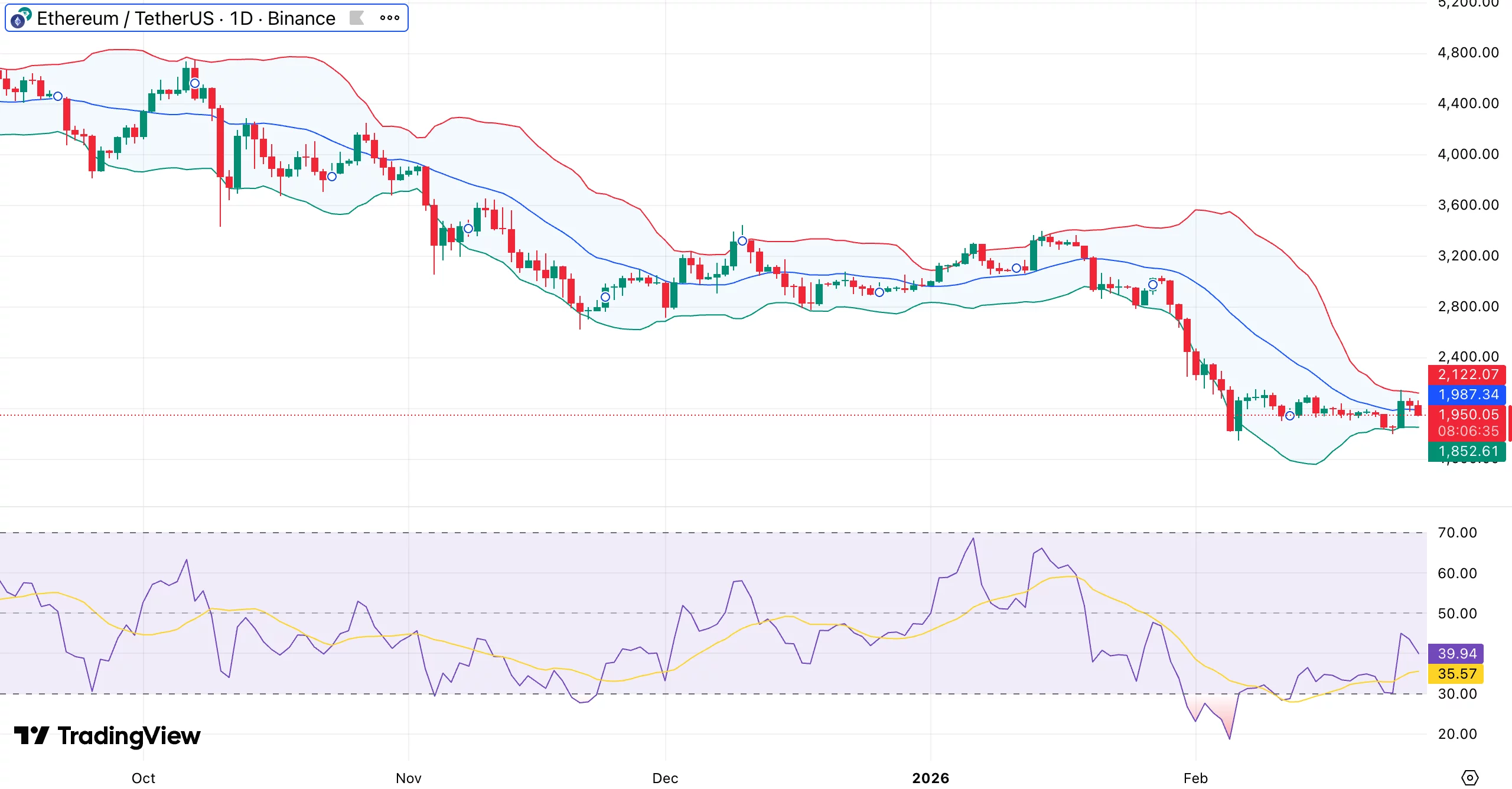
Price is now compressing between roughly $1,950 and $2,000. A higher high has not formed, and until ETH climbs through the $2,200–$2,300 region, the larger structure tilts bearish.
Bollinger Bands widened sharply during the drop as price pierced the lower band near $1,850. That expansion reflected a spike in volatility.
The bands have begun to narrow, pointing to a cooling phase. ETH trades below the middle band, currently around $1,980–$2,000, which is acting as near-term resistance.
The relative strength index fell into the 25–30 zone during the selloff, deep in oversold territory. It has recovered to around 40. Momentum has improved slightly, yet buyers have not regained full control. A push above 50 would strengthen the case for a more durable bounce.
Support lies between $1,850 and $1,880. If that floor gives way, the next area to watch sits near $1,700–$1,750. On the upside, $2,000 is the first barrier, followed by stronger resistance between $2,120 and $2,200.


Ethereum co-founder Vitalik Buterin has published a new blog post on X outlining his latest vision for scaling the blockchain, arguing the network can boost capacity in the near term while laying the groundwork for a longer-term shift to advanced cryptography and data-heavy “blobs” that would change how Ethereum is validated.
The post reflects Buterin’s renewed focus on scaling Ethereum’s base layer, after several years in which much of the ecosystem’s scaling strategy centered on layer-2 rollups. The plan comes on the heels of the Ethereum Foundation publishing a ‘strawmap’ aimed at making the network more efficient in the long term.
In the short term, Buterin says Ethereum can safely increase throughput by making blocks easier and faster to check. Upcoming upgrades will allow the computers that run Ethereum to review different parts of a block simultaneously, rather than processing everything step by step. At the same time, changes to how blocks are built will let the network use more of each 12-second processing window, rather than finishing early out of caution (known as ePBS, and will be implemented in the upcoming Glamsterdam upgrade).
The result: Ethereum should be able to fit more transactions into each block without increasing the risk of errors or instability.
Another major piece of the plan involves rethinking how transaction fees — known as “gas” — are calculated. Buterin argues that not all activity on Ethereum puts the same strain on the network. There’s a big difference between using computing power temporarily and permanently adding new data that every Ethereum computer, or node, must store forever.
Right now, those costs are largely bundled together. But creating new permanent data — such as deploying a new contract — increases the blockchain’s long-term size, making it more expensive to run a node over time. That, in turn, risks pushing out smaller operators. Buterin’s proposal would make long-term storage more expensive while allowing more room for everyday transaction processing. In effect, Ethereum could handle more activity without dramatically increasing how fast the blockchain grows.
The goal, he argues, is to avoid a future in which Ethereum processes more transactions but becomes so data-intensive that only large, well-funded players can afford to participate.
Longer term, Buterin sees Ethereum leaning more heavily on zero-knowledge proofs (a private verification method) and expanded data capacity through so-called blobs. Originally introduced to help layer-2 networks post transaction data more cheaply, blobs could eventually carry Ethereum’s own transaction data — a shift that would allow validators to confirm activity without re-running every transaction themselves.
Read more: Ethereum’s ‘Glamsterdam’ upgrade aims to fix MEV fairness

Key Takeaways
- Shares of Sunrun plummeted 28% to $14.74 following the release of conservative 2026 guidance
- Fourth quarter earnings delivered 38 cents per share, significantly surpassing analyst expectations of 3 cents; revenue jumped 124% to reach $1.16 billion
- Company forecasts 2026 cash generation between $250M and $450M, representing a potential decrease from 2025’s $377M
- Investment firm Jefferies cut its rating on RUN to Hold from Buy while maintaining a $22 price target
- Management’s silence on potential dividends or share repurchases left investors disappointed
The solar company delivered impressive fourth quarter results, posting earnings of 38 cents per share—substantially exceeding the analyst consensus of just 3 cents. Revenue reached $1.16 billion, representing a remarkable 124% increase compared to the previous year. Much of this revenue surge stemmed from a strategic decision to sell newly created lease agreements to external parties—marking a fresh approach for the organization.
However, it was the forward-looking guidance that spooked market participants.
Management provided 2026 cash generation estimates ranging from $250 million to $450 million. The midpoint of this forecast—$350 million—falls short of the $377 million achieved in 2025. This apparent regression caught Wall Street’s attention immediately.
Shares declined 28% to close at $14.74 on Friday. The drop is particularly painful considering the stock had rallied 182% over the preceding twelve months and gained 11% year-to-date before the earnings announcement.
Investment bank Jefferies revised its stance, downgrading the stock from Buy to Hold while keeping its $22 price objective intact. Research analyst Julien Dumoulin-Smith characterized the company’s approach as adopting a “defensive posture” heading into fiscal 2026.
Analyst Highlights Conservative Stance
Dumoulin-Smith observed a notable contrast: while competing residential solar firms have expressed increasing optimism about market recovery, Sunrun’s management painted a more sobering picture during its earnings conference call—emphasizing extended market weakness and heightened focus on balance sheet discipline.
The company also revealed plans to reduce its affiliate partner network by approximately 40%. Jefferies interprets this restructuring as an indicator that total installations and new customer acquisitions will decelerate.
Market participants had anticipated announcements regarding dividends or stock buyback programs, particularly given the robust cash generation in 2025 and meaningful progress toward the company’s 2x leverage ratio objective. Management declined to commit to either option. Executives clarified that returning capital to shareholders remains under consideration, but current priorities center on safe-harbor investments and reducing outstanding debt.
Jefferies identified challenging conditions in tax equity markets and quality issues among Sunrun’s partner ecosystem as further obstacles ahead.
The firm maintained its constructive long-term view on Sunrun but anticipates limited share price appreciation through 2026 until capital market conditions normalize.
Contrarian Voice Emerges
Not all analysts share this pessimistic outlook. Clear Street analyst Tim Moore reaffirmed his Buy recommendation and increased his price objective to $24 from $23.
Moore expressed confidence despite anticipated volume reductions, highlighting Sunrun’s strategic pivot toward channels with superior profit margins. He believes the monetization strategy for newly created subscription agreements will drive improved profitability even if installation volumes decline.
Jefferies also acknowledged that third-party originators such as Sunrun stand to benefit from approximately 25% growth this year following the conclusion of the 25D tax credit—though this potential upside hasn’t yet materialized in official guidance.
Sunrun’s measured outlook contrasts sharply with industry peers like Enphase Energy, which has aggressively pursued prepaid lease and loan products as the sector undergoes transformation.
The stock concluded Friday’s trading session at $14.74, down 28% for the day.

Key takeaways
-
The EU’s new crypto tax rules do not introduce new taxes but expand tax transparency by ensuring that crypto transactions are reported and shared across member states.
-
Reporting obligations fall primarily on crypto-asset service providers, requiring them to collect user identity information, tax residency details and transaction data in a standardized format.
-
Information reported by platforms will be automatically exchanged among EU tax authorities, reducing cross-border reporting gaps for crypto users.
-
The framework aligns with the Organisation for Economic Co-operation and Development’s global crypto reporting standard, increasing compatibility with non-EU jurisdictions.
The European Union is set to significantly enhance its monitoring of cryptocurrency transactions for tax purposes. Starting Jan. 1, 2026, updated reporting obligations require crypto platforms operating in the EU or serving EU users to provide detailed information on users and their transactions to tax authorities. This change aligns digital assets more closely with the transparency requirements long established in conventional finance.
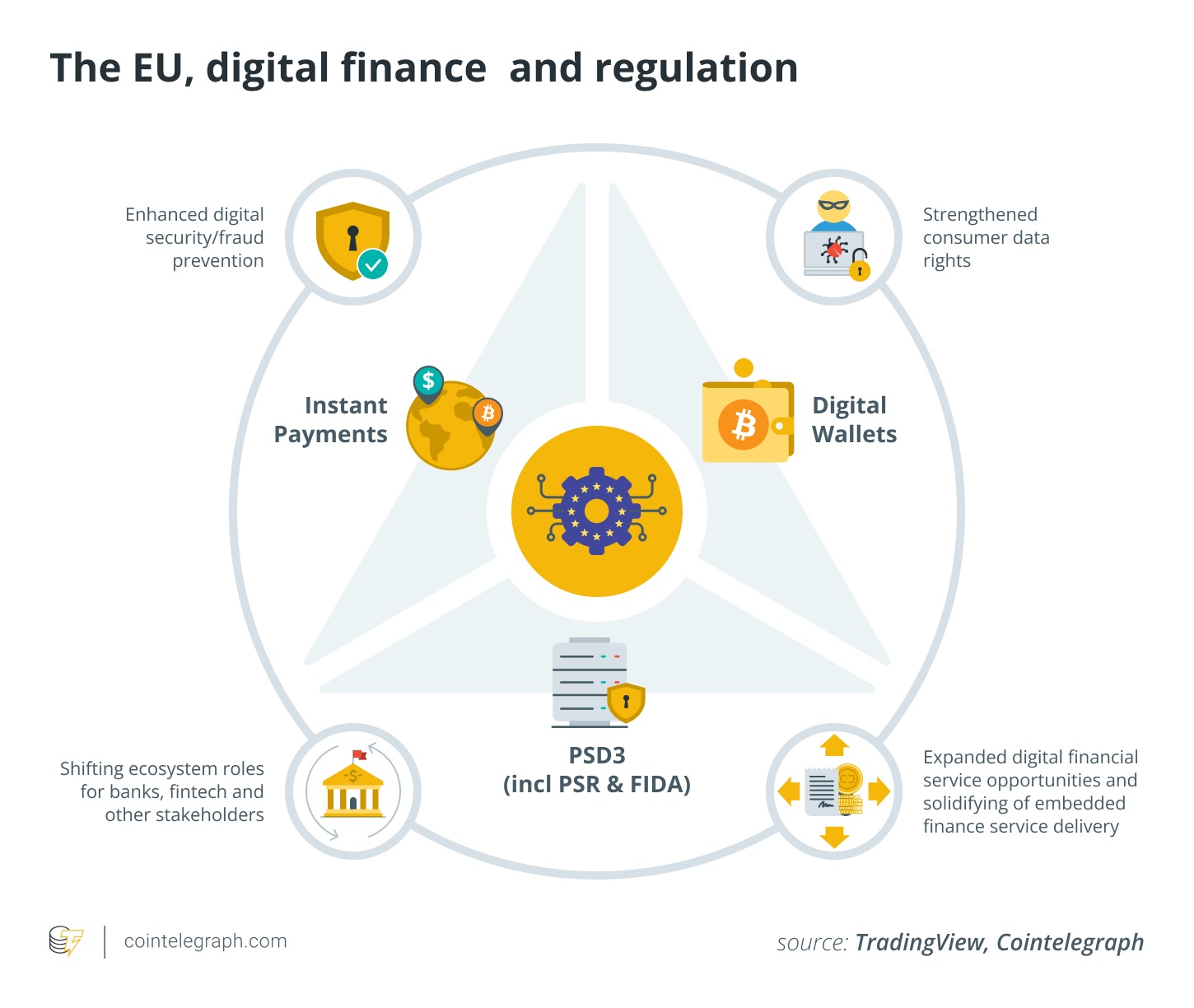
The key legislation driving this shift is Council Directive (EU) 2023/2226, commonly known as DAC8. It expands the EU’s existing framework for the automatic exchange of tax information to include crypto assets. Paired with the Markets in Crypto-Assets (MiCA) regulation, DAC8 represents a major step in regulating the crypto sector. It focuses specifically on taxation rather than solely on market conduct or licensing.
This article explains how the new EU crypto tax reporting system will work, outlines the obligations for platforms and examines the implications for individual users as the rules take effect.
Why DAC8 is being introduced: Closing the gap from banks to blockchains
For more than a decade, EU countries have used the Directive on Administrative Cooperation (DAC) to automatically share tax-related financial data across borders. Previous iterations covered bank accounts, investment income and certain digital platforms, but crypto transactions were largely exempt from routine reporting.
As cryptocurrency adoption grew in Europe, this exemption created clear loopholes for potential tax evasion. EU authorities viewed it as inconsistent to exempt crypto solely because of its technological basis.
DAC8 aims to close this gap by formally incorporating crypto assets into the tax transparency system, ensuring that transaction data is gathered, reported and exchanged in a manner similar to traditional financial information. The European Commission has emphasized that crypto deserves no special exemption from tax enforcement.

Alignment with the OECD’s Crypto-Asset Reporting Framework (CARF)
The EU built DAC8 around the CARF, which was launched in 2023. The CARF sets a global benchmark for crypto transaction reporting by specifying:
-
Which crypto assets qualify for reporting
-
Which entities must report
-
The specific user and transaction details required.
By adopting the CARF model, the EU promotes consistency with international standards, making it easier to share data with non-EU countries that implement similar rules.
Did you know? Before crypto-specific rules, several EU tax authorities relied on blockchain analytics firms instead of formal reporting to estimate crypto activity, often producing significantly different figures for the same market.
Scope of DAC8: Covered assets and platforms
The focus of DAC8 is on crypto-asset service providers (CASPs) operating in the EU. These include centralized exchanges, brokers, custodial wallets and similar intermediaries. The rules cover a broad range of assets, including most cryptocurrencies, stablecoins, tokenized assets and certain non-fungible tokens that function more like investment vehicles than pure collectibles. The emphasis is on transferability and investment use rather than on specific labels.
The obligations extend beyond EU-based platforms. Non-EU providers serving EU users may also need to comply, highlighting the directive’s extraterritorial impact.
Timeline and implementation of DAC8
Adopted in October 2023, DAC8 required transposition into national law by Dec. 31, 2025, with application starting on Jan. 1, 2026. As of early 2026, some member states have faced delays or infringement notices for incomplete transposition, though the EU expects full enforcement.
Key dates include:
-
Platforms began collecting relevant data on Jan. 1, 2026.
-
The first reports, covering 2026 activity, will be submitted to national tax authorities in 2027, typically within nine months of year-end.
-
Tax authorities then automatically exchange the data annually with other EU countries.
The commission has signaled that it expects timely and full implementation. Several countries have received formal notices for delays in transposing the rules, underlining that enforcement will not be optional.
Did you know? Early drafts of EU crypto tax proposals debated whether self-custody wallets could ever be subject to reporting, highlighting how difficult it is to regulate decentralized ownership.
Reporting requirements for platforms in DAC8
Under DAC8, CASPs are required to perform enhanced due diligence and submit detailed information to their local tax authority. This includes user details such as full name, address, tax residency and tax identification number (TIN), if available.
Transaction data includes:
-
Types of crypto transactions, such as sales, exchanges and transfers
-
Gross proceeds from disposals
-
Dates and values of transactions.
After collection, this information is automatically shared among EU tax authorities. A user’s country of residence receives the relevant data even if the platform is located in a different country.
For platforms, DAC8 makes crypto tax reporting a structured, recurring compliance obligation. It more closely resembles financial reporting than ad hoc disclosures.
Impact of DAC8 on crypto users
One of the most significant changes for crypto users is increased tax reporting transparency under DAC8. National tax authorities can now view transactions conducted on reporting platforms.
This may result in:
-
Requests for more detailed tax residency or identification information during account setup or updates
-
Greater ability for authorities to match crypto activity against declared income on tax returns
-
Easier detection of inconsistencies between reported data and tax filings.
DAC8 does not introduce new taxes or standardize rates across the EU. Member states retain authority over crypto taxation policies, as the directive focuses solely on information exchange. While DAC8 automates data exchange between authorities, users are still required to report their crypto activity through their respective national tax returns.

Compliance challenges for platforms under DAC8
Implementing DAC8 requires significant upgrades, including accurate transaction tracking, tax residency verification and secure data storage. Smaller or less-resourced providers may struggle to meet these obligations alongside MiCA and Anti-Money Laundering requirements.
Non-compliance carries the risk of penalties, including fines for late, incomplete or missing reports. Some platforms have indicated that regulatory compliance costs may influence where they choose to operate.
Users may also face confusion in understanding DAC8 in the context of MiCA. DAC8 addresses tax transparency behind the scenes, while MiCA covers licensing, investor safeguards and market conduct.
The two are complementary: DAC8 ensures tax data flows once services are active, while MiCA defines permissible operations. Together, they create a comprehensive oversight framework for the crypto economy.
Certain aspects remain unclear under DAC8, such as how decentralized finance (DeFi) fits in when no central intermediary exists to report to. Privacy advocates have raised concerns about extensive data collection and sharing, though EU officials note that the General Data Protection Regulation (GDPR) and other data protection laws continue to apply. It remains to be seen how these safeguards will operate in practice.
Did you know? Similar crypto tax reporting models are being explored in Asia-Pacific and Latin America, suggesting that EU-style transparency could become a global norm rather than a regional exception.
DAC8 in the broader context
DAC8 forms part of a global trend as crypto integrates into mainstream finance. Governments worldwide are increasingly treating it as part of the mainstream financial system rather than as a parallel economy viewed with suspicion.
By adopting OECD-aligned standards and enabling cross-border exchanges, the EU underscores that crypto will face the same transparency demands as traditional assets. For users and platforms in Europe, the period of limited formal tax oversight is effectively ending.
Cointelegraph maintains full editorial independence. The selection, commissioning and publication of Features and Magazine content are not influenced by advertisers, partners or commercial relationships.

The market may be entering a new phase: The shaking out of the most crowded “non-traditional” strategies.
ETF Action founding partner Mike Akins contends not everything getting stuffed into exchange-traded funds, including private assets, makes sense and they need to be questioned a little bit.
“The ETF wrapper is just more efficient for a lot of things. Not everything,” Akins told CNBC’s “ETF Edge” this week, adding that “I always say I’m an ETF first type of guy, but I’m not an ETF only.”
According to Akins, it’s more about what’s going in the world than the ETF structure. He finds investors are more interested in exposure to real asset themes such as infrastructure and industrial reshoring right now than artificial intelligence.
“The ability to get [an] ETF to market has become very mainstream. It’s super easy if you have the right provider or partner,” said Akins. “So, I think the investor is going to drive that next theme based on the market.”
He expects that should propel ETF product innovation — for better or for worse.
“There is always that little bit of performance chasing that goes on, and sometimes by the time the themes get to market, the trade is played out,” said Akins. “But there’s no reason to think within the ETF space that we’re going to run out of innovation.”
‘The onus is on you’
He lists the macroeconomic landscape, leaders and laggard changes as catalysts for adaption in the industry. Akins contends new themed funds could turn into tactical tools that put more responsibility on investors.
“If you’re investing in these strategies that are niche… your success goes from relying on the manager to your ability to use the product at the right time,” he said. “The onus is on you to decide whether it’s a good time to invest in.”
That dynamic is setting up a shakeout, especially in the hottest corners of options-based product design. Looking ahead to the rest of the year, Akins expects a consolidation of the non-traditional ETF strategies.
He pointed to a wave of recent so-called copycat launches — with issuers rushing out similar products, including different covered call and buffer strategies.
“We’re going to start seeing a consolidation to those strategies that have performed the best and that have gained market share, ” he said. “So, I think there’s going to be a consolidation shift. I think they’ll continue to grow and get adoption from investors. But I think that we’re going to start seeing some serious winners and losers within that.”
His reason: Everybody launched something, and you can’t have that many strategies tracking the same spot.
At the same time, ETF innovation may be shifting from what funds own to how they’re run. Tidal Financial Group’s Aga Kuplinska sees AI increasingly moving beyond simple “AI themed” portfolios, finding its way into the investment process.
Tidal is already seeing early signs of that transition in the marketplace, Kuplinska told CNBC in the same interview.
“We have seen already on our platform, launches or filings of products that are AI-enhanced or AI-managed,” the firm’s senior vice president of product development said, calling it an area where “we are only scratching the surface.”


MoonPay and M0 have introduced PYUSDx, a platform aimed at simplifying the creation and management of application-specific stablecoins backed by Paypal’s PYUSD.
MoonPay and M0 have officially launched PYUSDx, a platform designed to simplify the creation and management of application-specific stablecoins.
PYUSDx leverages PYUSD, the stablecoin developed by PayPal and issued by Paxos Trust Company. The token recently surpassed $4 billion in market capitalization.
PYUSDx promises several key features, including branded stablecoins backed by PYUSD, fast time-to-market, cross-chain compatibility, and transparent reserve reporting. The platform combines M0’s universal stablecoin capabilities with MoonPay’s distribution infrastructure.
“The next phase of stablecoin adoption is happening at the application layer,” said May Zabaneh, SVP & GM of Crypto at PayPal. “Developers want to build differentiated experiences, but they shouldn’t have to rebuild trusted monetary infrastructure from scratch.”
Luca Prosperi, CEO of M0, emphasized the platform’s role in fostering innovation. “Developers of crypto applications have been early adopters of custom stablecoin-backed technology, but they still don’t have a trusted platform they can use to quickly bootstrap solutions,” Prosperi stated. “PYUSDx will allow developers to iterate much more quickly within an interoperable solution and with built-in liquidity.”
The first developer to utilize PYUSDx is USD.ai, which is building an application-specific stablecoin for AI infrastructure.
This article was generated with the assistance of AI workflows.


A senior Axiom staffer allegedly accessed sensitive user data, shared private wallet screenshots, and coordinated targeted trading strategies.
ZachXBT has alleged that an employee at Axiom Exchange abused internal access to sensitive user data.
In a series of posts, the prominent crypto investigator identified the employee as Broox Bauer and claimed he used internal tools at Axiom to look up private wallet information and track user activity for trading purposes beginning in early 2025.
Internal Tools Exploited
Axiom was founded in 2024 by Mist and Cal and later participated in Y Combinator’s Winter 2025 batch. ZachXBT said the platform quickly became one of the most profitable companies in the crypto sector, and generated more than $390 million in revenue to date. He stated that he was retained to independently investigate allegations of misconduct at the firm after receiving reports.
According to the investigator, Broox served as a senior business development employee at Axiom based in New York. In recorded clips from a private group call, Broox allegedly said he could track any Axiom user through referral codes, wallet addresses, or user IDs, and claimed he could “find out anything to do with that person.”
In the same recording, Broox allegedly described initially researching 10 to 20 wallets and gradually increasing that number to avoid drawing suspicion. ZachXBT said Broox also set rules for how others could request user lookups and stated he would send a full list of wallets.
The investigator further claimed that in April 2025, Broox shared a screenshot from an internal Axiom dashboard displaying private wallets belonging to a trader identified as “Jerry.” In August 2025, Broox allegedly shared another image showing registration details and connected wallets for a trader named “Monix.” That same month, he reportedly discussed looking up Axiom users who had traded the meme coin AURA.
According to ZachXBT, members of the group created a Google Sheet compiling wallet addresses for multiple key opinion leader (KOL) targets. The sheet allegedly mapped wallet data obtained through Axiom’s internal dashboard by Broox. Multiple KOLs named in the document or shown in leaked screenshots were contacted and independently confirmed that the wallet information attributed to them was accurate, the on-chain sleuth added.
You may also like:
One of the targeted traders was identified as Marcell, described as a KOL known for purchasing large portions of meme coin token supplies from private wallets before promoting them to followers. ZachXBT said such traders were considered prime targets because private wallet addresses are rarely public and address reuse is less common, which increases the value of privileged information.
ZachXBT stated that Broox’s main wallet was identified through private chat messages and that related addresses were mapped. However, he said that due to the high volume of meme coin trades, it was difficult to isolate specific high-confidence examples of insider trading without access to Axiom’s internal logs to review trade timing. Funds from related addresses were said to have flowed primarily to several centralized exchange deposit addresses.
The investigator also alleged that Broox discussed plans during a February 2026 recorded call to help a recently hired Axiom moderator, identified as Gowno (Seb), quickly profit $200,000 by abusing access to internal tools. ZachXBT claimed that Broox shared screenshots of exchange balances in private chats to show that the activity had already generated returns.
ZachXBT added that because Broox is based in New York City, the matter could potentially fall within the jurisdiction of the Southern District of New York.
On-Chain Crime Investigations
From linking “Lick” to wallets tied to over $90 million in suspected thefts and US government seizure-related funds, to uncovering a $5-10 billion “Black U” laundering market on Tron allegedly connected to the Lazarus Group, ZachXBT has built a reputation for tracing major crypto crime networks.
He detailed how stolen assets from hacks on platforms like Bybit were funneled through illicit channels, and separately exposed a Canadian scammer accused of stealing over $2 million via Coinbase support impersonation schemes.
Binance Free $600 (CryptoPotato Exclusive): Use this link to register a new account and receive $600 exclusive welcome offer on Binance (full details).
LIMITED OFFER for CryptoPotato readers at Bybit: Use this link to register and open a $500 FREE position on any coin!


PayPal and MoonPay have introduced a new platform that allows developers to create custom stablecoins backed by PayPal’s PYUSD.
Summary
- PYUSDx lets developers issue app-specific stablecoins backed by PYUSD.
- The platform reduces launch time from months to days.
- USD.ai is the first project building on the framework.
In a joint Feb. 27 press release, the companies announced the launch of PYUSDx, a framework developed with M0 to support application-specific stablecoins using PayPal USD as the underlying reserve asset.
PYUSDx is designed to help developers launch branded stablecoins without building complex infrastructure from scratch. The platform allows apps to issue tokens backed by PYUSD, while relying on MoonPay’s distribution and onboarding systems and M0’s token platform.
Building application-level stablecoins
According to the announcement, the number of stablecoins with supplies above $10 million rose by 89% in 2025. The companies said this growth has increased demand for faster and cheaper ways to launch custom digital currencies.
Ivan Soto-Wright, chief executive of MoonPay, said developers need dependable tools to manage stablecoins at the application layer. He added that PYUSDx reduces technical and operational hurdles and shortens the time needed to bring products to market.
Under the structure, the base PYUSD token is issued by Paxos Trust Company, while PYUSDx tokens are issued through MoonPay Digital Assets Limited. The companies stressed that PYUSDx tokens are separate from PayPal’s native stablecoin and are not supported within PayPal or Venmo wallets.
The platform offers cross-chain compatibility, on-chain reserve reporting, and flexible economic models. Additionally, it facilitates quick deployment, allowing developers to go from testing to launch in a matter of days as opposed to months.
USD.ai has been named as the first developer to use PYUSDx, building an application-focused stablecoin for artificial intelligence infrastructure.
Expanding PayPal’s stablecoin ecosystem
Since its debut in 2023, PayPal has worked to increase the use of PYUSD, and this launch builds on those efforts. Users started earning 3.7% a year on PYUSD balances in April 2025. Stellar and Arbitrum were added to the stablecoin later that year, increasing speed and reducing transaction costs.
May Zabaneh, head of crypto at PayPal, said developers want to create unique financial products without rebuilding core monetary systems. She described PYUSDx as a way to anchor new projects in a regulated and trusted structure.
Luca Prosperi, chief executive of M0, said the platform allows developers to iterate faster while benefiting from built-in liquidity and interoperability.
The companies also noted that regulatory treatment of PYUSDx tokens will vary by region and remains the responsibility of individual issuers. PYUSDx tokens cannot be used for payments or transfers within PayPal or Venmo.

TLDR
- Warner Bros Discovery’s board has labeled Paramount Skydance’s $111bn proposal as “superior” compared to Netflix’s competing offer
- Netflix has withdrawn from the bidding, stating the $31 per share valuation makes the acquisition “no longer financially attractive”
- The Paramount proposal encompasses WBD’s complete portfolio, including HBO, CNN, and iconic franchises like Harry Potter and Batman
- Significant regulatory scrutiny lies ahead, with California’s Attorney General and federal/European authorities still reviewing the transaction
- Employees at both CBS News and WBD have expressed serious concerns regarding potential layoffs and editorial direction under Ellison leadership
Paramount Skydance has overcome a significant obstacle in its pursuit of Warner Bros Discovery following Netflix’s decision to exit the competition, propelling Paramount shares 6% higher in extended trading.
On Thursday, Netflix announced it would decline to counter Paramount’s $31-per-share proposal after WBD’s board designated it as the “superior” bid. Netflix’s co-CEOs Ted Sarandos and Greg Peters explained that the elevated price point rendered the transaction “no longer financially attractive.”
This decision concludes several months of competitive bidding that commenced when Paramount initially contacted WBD in September.
Paramount Skydance Corporation Class B Common Stock, PSKY
The $111bn Paramount proposal encompasses WBD’s entire operations — including HBO, CNN, and valuable intellectual property like Harry Potter and Batman franchises. By contrast, Netflix’s initial $83bn December agreement covered exclusively WBD’s studio operations and streaming platforms.
The Ellison family, which merged Skydance with Paramount in the previous year, stands to acquire oversight of CBS News, 60 Minutes, and CNN through this proposed consolidation.
David Zaslav, WBD’s CEO, praised the transaction, stating it “will create tremendous value for our shareholders.”
Netflix shares surged 8.5% in after-market trading, with investors seemingly pleased the streaming giant avoided a transaction carrying substantial antitrust exposure.
Regulatory Road Ahead
The transaction remains far from finalized. Approval from the US Department of Justice and European regulatory bodies is still required.
California’s Attorney General Rob Bonta confirmed his office maintains an active investigation and plans to conduct a “vigorous” review. “Paramount/Warner Bros is not a done deal,” he stated via social media.
Paramount enhanced its proposal by increasing the per-share price by $1 from its December offer, introduced a $0.25-per-share quarterly payment should the deal extend beyond September, and included a $7bn breakup fee if regulatory authorities reject it.
Additionally, Paramount committed to assuming the $2.8bn termination payment WBD would owe Netflix upon exiting their original agreement.
Staff Concerns
Personnel at CBS News and WBD have responded to the announcement with considerable apprehension. Workers anticipate that combining two major news operations will result in workforce reductions as duplicate positions are consolidated.
Several staff members have voiced unease about Bari Weiss, who was named CBS News editor-in-chief last October, potentially assuming expanded responsibilities. Weiss lacks previous television news background, and her leadership has received mixed reviews.
A CBS News producer cautioned the consolidation would be “a disaster for the people who work at both companies.”
Seth Stern from the Freedom of the Press Foundation issued sharp criticism, cautioning that Ellison would favor corporate priorities above journalistic independence.
Political considerations have also emerged as factors. Trump, who maintains ties to Larry Ellison, has commented publicly on the bidding process on multiple occasions. David Ellison was present at Trump’s State of the Union address Tuesday as Senator Lindsey Graham’s guest.
WBD has scheduled an employee town hall meeting for Friday morning. In a Thursday memorandum, CNN leader Mark Thompson encouraged staff to avoid premature conclusions.
Paramount shares gained 6% in after-hours trading when the news broke.
- Hedera dropped to $0.10 as Bitcoin fell to lows of $65,680.
- Ethereum (ETH) has shed 5.3% to under $1,950; XRP, Solana, and BNB also dipped.
- HBAR price could retreat to support at $0.088.
Hedera’s HBAR token is under pressure as leading cryptocurrencies Bitcoin and Ethereum trim recent gains.
The altcoin has dropped to $0.10 as bears show dominance amid broader market caution, with BTC giving up gains to under $66,000.
Several of the top 10 coins are down too, losing 3-5% of their respective prices in the past 24 hours as of writing.
Downside risks for BTC, ETH, and Solana, among other cryptocurrencies, could accelerate declines for HBAR.
Hedera dips as Bitcoin sheds gains
As noted, Hedera is struggling to hold gains near $0.10 as Bitcoin faces renewed selling pressure.
The benchmark digital asset is trading around $66,230 after testing lows of $65,680 and being down more than 3% in early US trading hours.
Bears showed up as negative sentiment threatens to entrench once again despite a decent uptick in spot ETF outflows over the week.
Bitcoin reversed its gains as US stock futures flipped lower, with investor concerns over AI and its impact reemerged.
A lot of the risk asset jitters on the day came as Jack Dorsey’s Block announced it was slashing its workforce by 4,000.
Tech stocks fell this week despite Nvidia’s earnings beat, and the cascade has seen BTC fail to cement gains near $70.
Analysts say Bitcoin could yet fall to support at $60k or lower before rebounding higher in coming months.
With BTC posting downward movement, Ethereum (ETH) shed 5.3% to under $1,950, while XRP (XRP), Solana (SOL), and BNB also registered losses. The HBAR cryptocurrency is currently -3% in the 24-hour timeframe.
The HBAR cryptocurrency is currently -3% in the 24-hour timeframe.
HBAR price analysis
Losses across the market come as caution returns. ETF holders and treasuries have snapped up Bitcoin at low prices, but shorts are not done yet.
However, while HBAR’s price is down on the day, the trading volume of $137 million in the last 24 hours is also down by more than 5%.
Bulls may fail to stem the slide as price tests the $0.10 support, but decreased volume points to a potential seller exhaustion.
Other technical indicators outline this mixed short-term outlook, with RSI around 51 suggesting potential upside momentum before HBAR hits overbought conditions.

The token is also showing consolidation near the upper Bollinger Band, with short-term moving averages converging at that level as a pivot.
A break above the upper band, which is also at the resistance line of a descending channel, could see Hedera reclaim $0.12. The 200-day EMA offers the first major hurdle around $0.14.
However, the MACD indicator shows a potential bearish flip as the histogram shrinks near zero.
While volume hints at possible exhaustion in selling, a bearish cross could heighten chances of a dip below $0.10, with support at $0.088 and $0.079.

Ethereum price tests $1,950 as ratio hints pivot

Valdo Calocane, the BAFTAs and the poison of wokeness
The Vikings’ Fill-In GM Said the Magic Word


-

 Politics5 days ago
Baftas 2026: Awards Nominations, Presenters And Performers
-

 Fashion7 days ago
Weekend Open Thread: Boden – Corporette.com
-

 Sports4 days ago
Women’s college basketball rankings: Iowa reenters top 10, Auriemma makes history
-

 Politics4 days ago
Nick Reiner Enters Plea In Deaths Of Parents Rob And Michele
-

 Business3 days ago
True Citrus debuts functional drink mix collection
-

 Politics16 hours ago
ITV enters Gaza with IDF amid ongoing genocide
-

 Crypto World3 days ago
XRP price enters “dead zone” as Binance leverage hits lows
-

 Business5 days ago
Mattel’s American Girl brand turns 40, dolls enter a new era
-

 Business5 days ago
Law enforcement kills armed man seeking to enter Trump’s Mar-a-Lago resort, officials say
-
 NewsBeat2 days ago
Manchester Central Mosque issues statement as it imposes new measures ‘with immediate effect’ after armed men enter
-

 NewsBeat2 days ago
Cuba says its forces have killed four on US-registered speedboat | World News
-

 Tech3 days ago
Unsurprisingly, Apple's board gets what it wants in 2026 shareholder meeting
-
 NewsBeat4 days ago
‘Hourly’ method from gastroenterologist ‘helps reduce air travel bloating’
-

 Tech5 days ago
Anthropic-Backed Group Enters NY-12 AI PAC Fight
-

 NewsBeat5 days ago
Armed man killed after entering secure perimeter of Mar-a-Lago, Secret Service says
-

 Politics5 days ago
Maine has a long track record of electing moderates. Enter Graham Platner.
-

 Business2 days ago
Discord Pushes Implementation of Global Age Checks to Second Half of 2026
-
 NewsBeat3 days ago
Police latest as search for missing woman enters day nine
-
 Sports4 days ago
2026 NFL mock draft: WRs fly off the board in first round entering combine week
-

 Crypto World3 days ago
Entering new markets without increasing payment costs