

Crypto World
Former legal executives from crypto exchange OKX unveil DeFi connectivity, risk-rating service



Three former executives who held high-profile legal, policy and product roles at crypto exchange OKX have unveiled an easy access decentralized finance connectivity platform called Shredpay, which is aimed at both retail customers and institutions in the U.S.
The Shredpay founding team is made up of CEO Mauricio Beugelmans, the former chief legal officer at OKX; president Melissa Muehlfeld, former OKX global general counsel; and CTO Peter Chang, the ex-VP of product at OKX.
Decentralized finance (DeFi) remains a tricky proposition for the uninitiated. The current market offerings are segmented and include no transparent risk information, making mainstream adoption difficult, according to a press release issued by Shredpay.
Beugelmans and co’s solution is to provide an uncomplicated, easily accessible onchain finance platform with clear risk ratings for DeFi protocols that help new users, the firm said.
The so-called ShredPay DeFi Ratings Index, evaluates protocols across smart contract security, liquidity depth, operational transparency, compliance, governance structure, and historical performance, providing users with standardized risk assessment comparable to traditional credit ratings.
“DeFi seems opaque, but it’s not about the technology – it’s about information asymmetry,” said Beugelmans. “Users often can’t easily distinguish between battle-tested protocols and exit scams.”
Shredpay CTO Chang said crypto natives may already know how to assess protocol risk; they read audits, track TVL, monitor governance. “We’re packaging that institutional-grade due diligence into a format that works for mainstream users. It expands the addressable market for every protocol we rate,” he said.



The Deputy Governor of the Bank of England said that the institution remains open to reviewing the proposed rules for pound-denominated stablecoins.
The Deputy Governor of the Bank of England, Sarah Breeden, has reportedly said she has been disappointed by the lack of constructive engagement on the bank’s proposed rules to regulate stablecoins pegged to the British pound.
She said that the institution has been “genuinely open” to changing its proposals.
Recall that the proposed regulatory regimen planned to ensure that sterling-denominated stablecoins remain safe and redeemable at face value. The rules also required issuers to be thoroughly supervised by the Bank of England if they were to be designated as systemic by the Treasury, and they must 100% back their coins with high-quality assets.
Some of the key rules include:
- Systemic issuers must hold at least 40% of the reserves as deposits at the Bank of England
- up to 60% in short-term UK government debt
- Coins have to be redeemable at par
- Issuers must maintain very resilient business models
- Stablecoins used predominently for trading have to remain regulated by the country’s FCA.
Binance Free $600 (CryptoPotato Exclusive): Use this link to register a new account and receive $600 exclusive welcome offer on Binance (full details).
LIMITED OFFER for CryptoPotato readers at Bybit: Use this link to register and open a $500 FREE position on any coin!
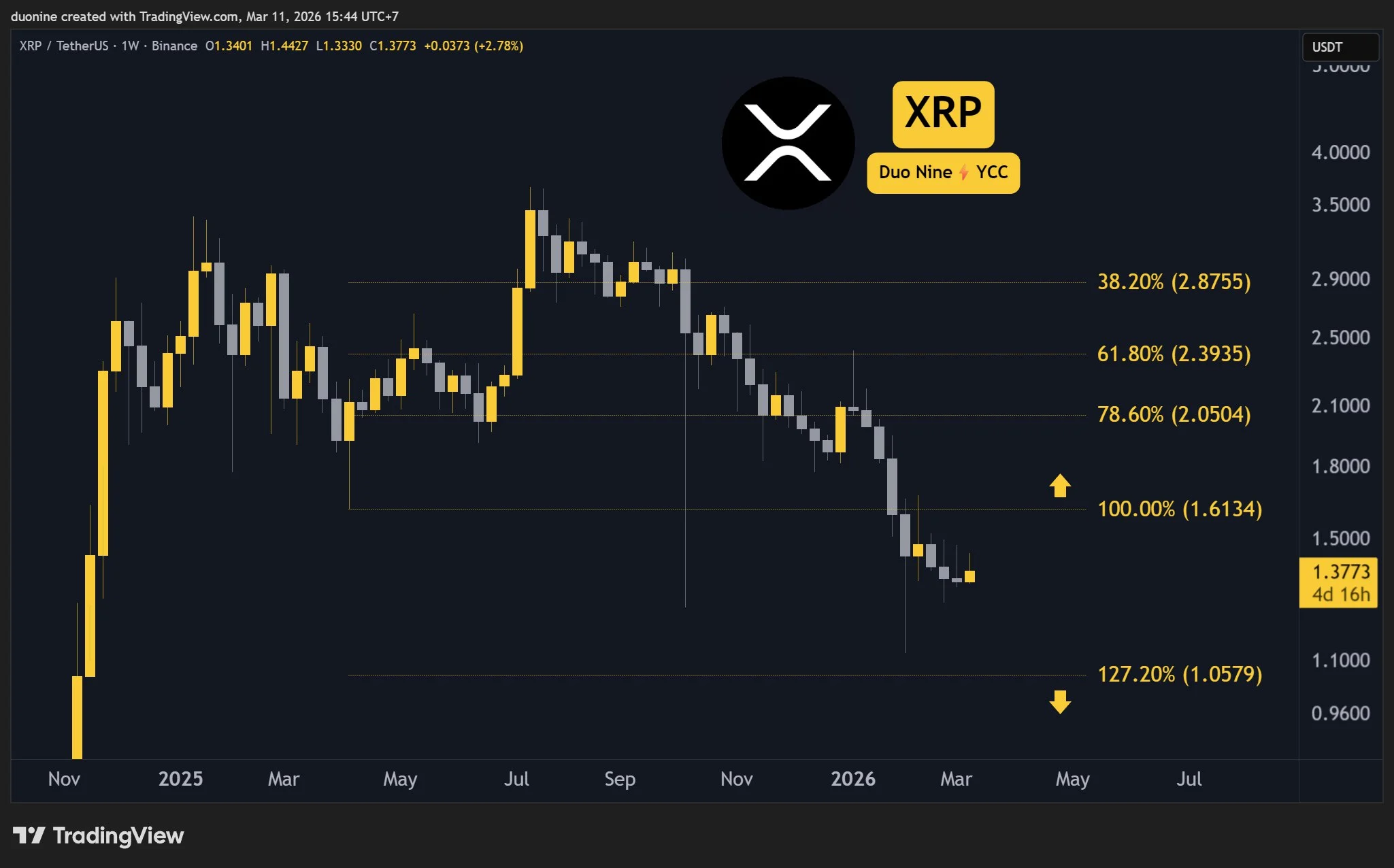
XRP appears to be consolidating before its next major move.
Ripple (XRP) Price Predictions: Analysis
Key support levels: $1
Key resistance levels: $1.4
XRP is Consolidating Around $1.4
Over the past few weeks, XPR has been moving flat around $1.4, currently acting as key resistance. This price consolidation around this level can be interpreted as bullish since sellers were unable to secure a lower low.
This price action is encouraging buyers to return, and the current weekly candle is green. If it closes the week like this, then the resistance will likely break and turn into a key support.
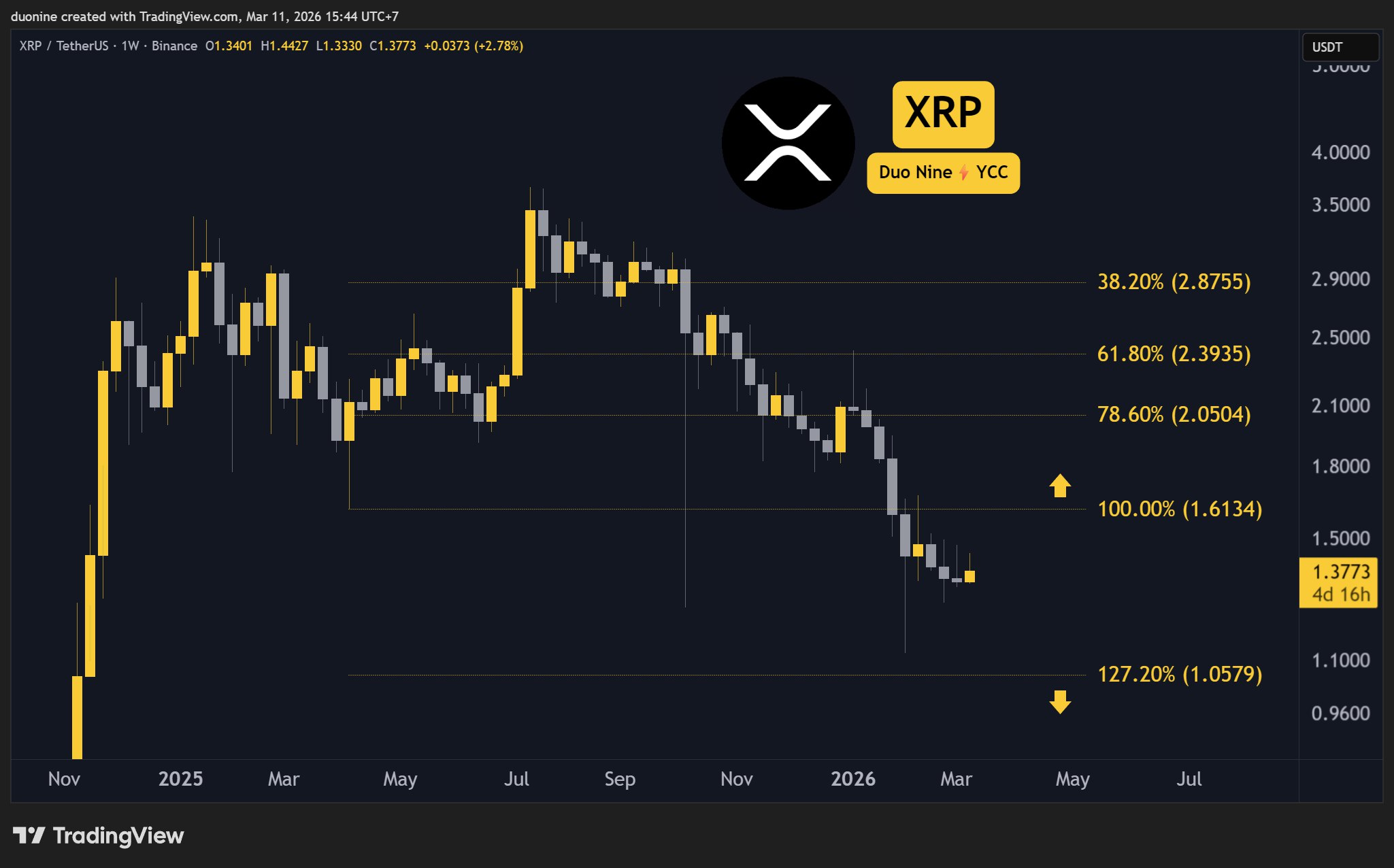
Downtrend Over?
With sellers unable to push the price lower, XRP has been moving sideways. This is a key signal that the market structure may be about to change. This makes a reversal possible in the future.
While buyers still appear shy here, they are slowly gaining momentum. This will likely be amplified as soon as the $1.4 resistance falls. Should they fail, then XRP has solid support at $1.2 and $1.

MACD Bullish Cross
The 3-day MACD crossed bullish, which is a major signal that momentum is turning bullish. If this is sustained in the coming week, then higher price levels appear inevitable.
A clean break above $1.4 will also open the way for XRP to test the $1.6 and $1.8 resistance levels next. Bears will be in serious trouble at that point because it opens the way for this cryptocurrency to retest $2.

Binance Free $600 (CryptoPotato Exclusive): Use this link to register a new account and receive $600 exclusive welcome offer on Binance (full details).
LIMITED OFFER for CryptoPotato readers at Bybit: Use this link to register and open a $500 FREE position on any coin!
Disclaimer: Information found on CryptoPotato is those of writers quoted. It does not represent the opinions of CryptoPotato on whether to buy, sell, or hold any investments. You are advised to conduct your own research before making any investment decisions. Use provided information at your own risk. See Disclaimer for more information.


Changpeng Zhao ranked above Bill Gates on the 2026 Forbes billionaires list, but he says the figures are wrong.
Forbes’ newly announced 2026 Billionaires list shows that Binance founder Changpeng Zhao (CZ) is now richer than tech mogul Bill Gates.
CZ came in 17th place in the magazine’s annual ranking of the richest people in the world, while Gates is placed not far from him at 19th.
CZ Outranks Gates in Forbes Billionaire List
Released annually, the Forbes Billionaires List provides a real-time snapshot of the wealth of the most prolific entrepreneurs, investors, heirs, and celebrities worldwide. According to Forbes’s website, as of March 11, 2026, the former Binance executive has a net worth of $111.1B, while Gates’ is listed as $105.7B.
The data also suggests that CZ’s wealth has been growing steadily over the past three years, thanks to his Binance-linked crypto holdings. But, on the other hand, the tech billionaire’s riches have remained relatively stable and are tied to his Microsoft shares and philanthropic commitments.
Zhao has since responded to the piece, outlining on social media that the information shared is inaccurate.
“Didn’t read the Forbes article, but if you just look at the little chart 👇, you know it’s wrong.”
In his X post, CZ questioned how the publication calculated the figures, pointing out that crypto prices had already fallen by more than 50% in 2026, yet his reported net worth had increased.
Zhao also believes that Forbes’ calculations are “way off.” He gave another example by comparing ByteDance’s $150 billion valuation to its former CEO’s $69 billion net worth. The Forbes official website notes that the 2026 ranking was based on calculations of stock prices and exchange rates as of March 1.
You may also like:
The publication also explained that it looks at the different assets a billionaire is believed to control to come up with a gauge of their wealth, including stakes in public companies, private businesses, real estate, art collections, and other investments.
Forbes Breaks Down Its Wealth Estimates
In Zhao’s case, most of his assumed wealth is believed to originate from his ownership stake in Binance. Forbes’ data shows that he still owns roughly 90% of the exchange. This represents a huge share of his fortune if the company’s valuation is taken into account.
On top of that, he is also believed to hold a large amount of BNB tokens linked to the Binance ecosystem. CZ has shared in the past that his crypto portfolio contains about 98.5% in BNB and only 1.3% in BTC. Despite this, the exact amounts remain undisclosed.
Gates’ wealth, on the other hand, was calculated very differently. The outlet said that most of his fortune has historically been tied to his stake in Microsoft. Forbes, however, revealed that his ownership in the firm has dropped to less than 1% after years of donations and asset diversification.
The tech mogul has given more than $59 billion to the trust that funds the Gates Foundation over the past couple of years. According to Forbes, this has reduced his overall net worth, and as a result, his placement on their list has also dropped.
Binance Free $600 (CryptoPotato Exclusive): Use this link to register a new account and receive $600 exclusive welcome offer on Binance (full details).
LIMITED OFFER for CryptoPotato readers at Bybit: Use this link to register and open a $500 FREE position on any coin!

TLDR:
- Tokenized real-world assets grew 66% in 2026, rising from $14B to $23.6B in total on-chain market value.
- Tokenized funds lead the sector with $10.5B as treasury bills and bonds transition onto blockchain rails.
- Tokenized commodities reached $6.5B, with gold-backed assets driving global investor participation.
- Tokenized equities climbed near $4B as blockchain enables fractional ownership and continuous trading.
Tokenized real-world assets recorded strong growth in 2026 as blockchain infrastructure expanded across financial markets.
The sector’s on-chain market value rose from about $14 billion in January to roughly $23.6 billion, reflecting increased institutional participation and broader asset tokenization.
Institutional Funds Accelerate Tokenized Real-World Assets Growth
Tokenized real-world assets are expanding rapidly as traditional financial products move onto blockchain networks. Market data shows the sector increased by about 66% during 2026.
Tokenized funds represent the largest portion of this growth. The category currently holds roughly $10.5 billion in total on-chain value.
These funds include tokenized treasury bills, bonds, and money market instruments previously managed through conventional financial infrastructure. Their presence shows that institutional-grade assets are entering blockchain-based markets.
Investors are increasingly exploring these products due to faster settlement and transparent transaction records. Blockchain ledgers provide continuous verification of ownership and asset movements.
Traditional markets often rely on multi-day settlement processes and fixed trading schedules. Tokenized funds remove many of these constraints by enabling faster transfers and easier distribution.
Institutional participation also strengthens market credibility and attracts additional investors. Financial institutions continue testing tokenization strategies to expand digital asset offerings.
Market participants often discuss this transition across digital finance platforms. Infrastructure improvements are also supporting the rise of tokenized funds.
Custody solutions, regulatory frameworks, and token issuance platforms have developed significantly. As these systems mature, tokenized real-world assets continue to integrate familiar financial instruments with blockchain infrastructure.
Commodities and Equities Expand Blockchain Market Access
Tokenized real-world assets also include commodities and equities that continue gaining traction. These asset classes broaden the tokenization ecosystem across financial markets.
Tokenized commodities currently represent about $6.5 billion of the sector. Gold-backed tokens account for a large portion of this value.
Gold remains widely recognized as a store of value across global markets. Tokenization allows investors to access exposure through blockchain-based digital tokens.
This structure enables fractional ownership of commodities that were historically difficult for smaller investors to access. Investors can hold smaller units of value linked to physical reserves.
Blockchain transfers also allow near-instant movement of commodity tokens between participants. These transactions occur without many traditional intermediaries.
Tokenized equities represent another growing segment, currently valued at nearly $4 billion. Companies can issue blockchain-based shares representing fractional ownership.
Unlike traditional stock exchanges, tokenized equities can trade continuously. Blockchain markets operate around the clock rather than within fixed trading hours.
Startups and small enterprises are also exploring tokenized fundraising models. These structures allow companies to issue tokenized equity or debt instruments.
Investors can participate through digital platforms that facilitate compliant token issuance and trading. Platforms such as InvestaX provide infrastructure for these processes.
Through tokenization, businesses gain access to broader investor pools while improving liquidity opportunities. Tokenized real-world assets, therefore, continue expanding across both institutional and emerging market participants.



While the bank has yet to confirm its plans, the move could mark a first step toward launching its own USD stablecoin.
Wells Fargo has quietly filed a trademark application with the U.S. Patent and Trademark Office for the ticker “WFUSD,” per a filing dated March 10.
The trademark covers cryptocurrency exchange services, blockchain-based payment verification, crypto hardware wallets, and software for accessing NFTs on-chain, among a slew of other goods and services.
While Wells Fargo has yet to publicly confirm its plans for the trademark, the ticker closely mirrors established naming conventions for stablecoins tickers, strongly suggesting the $1.9 trillion-asset bank is laying the groundwork for its own dollar-pegged digital currency.
The WFUSD filing arrives in the wake of broader Wall Street stablecoin ambitions. As The Defiant reported, last May, companies co-owned by Wells Fargo, JPMorgan Chase, Bank of America, Citigroup, and other large banks — including Zelle operator Early Warning Services and real-time payment network The Clearing House — were considering launching a joint stablecoin, reportedly “intended to fend off escalating competition from the cryptocurrency industry.”
As far back as 2022, Wells Fargo was also part of a group of big U.S. banks exploring integrating blockchain tech for connecting deposits, as The Defiant reported at the time.
Since then, Citigroup CEO Jane Fraser publicly confirmed the bank is evaluating its own proprietary token, telling analysts on a Q2 2025 earnings call that “we are looking at the issuance of a Citi stablecoin,” per The Defiant.
The pressure to act is only mounting. In December, U.S. neobank SoFi unveiled SoFiUSD, making SoFi the first U.S. national bank to release an “open access” stablecoin on a public blockchain — Ethereum — backed 1:1 by cash reserves held in its Federal bank account.
SoFi has since inked a partnership with Mastercard to use SoFiUSD across its global payments network.
Whether WFUSD represents Wells Fargo going it alone or hedging its bets ahead of the consortium effort remains unclear.
The stablecoin sector grew by over $100 billion in 2025 alone. Acording to data from DefiLlama, total stablecoin circulating supply currently stands at $314.7 billion. As The Defiant reported, that figure was near $310 billion as of just mid-December 2025 — up more than 50% from roughly $205 billion at the start of the year.
This article was generated with the assistance of AI workflows.

SlowMist has unveiled a five-layer security framework intended to help crypto firms navigate the mounting risks tied to AI and Web3 agents performing on-chain actions. In a midweek blog post, the cybersecurity company described a holistic approach that blends governance controls, an AI development security solution (ADSS), and a set of execution-layer tools to create a closed-loop process: checks before execution, constraints during execution, and a structured review after actions complete. By design, the system seeks to defend against prompts injection, supply-chain poisoning, and data leaks, while preserving the efficiency and speed that autonomous agents can deliver for trading, wallet interactions, and other on-chain workflows.
Key takeaways
- The framework fuses governance via ADSS with execution-layer tools—OpenClaw, MistEye Skill, MistTrack Skill, and MistAgent—to create a phased workflow that anticipates risk at every stage of decision and action.
- It targets core attack vectors such as prompt injection, supply-chain poisoning, data leaks, and asset loss arising from unauthorized AI actions or agent exploits.
- ADSS establishes auditable security standards, including AI agent permission constraints, real-time threat checks for external interactions, and stronger on-chain risk detection.
- SlowMist positions the framework against a backdrop of rising autonomous trading tools in crypto, citing no-code AI agents from several platforms and cross-chain execution on Base and Solana.
- Officials say the aim is to convert scattered security actions into a repeatable, executable, auditable, and sustainable process that can scale with AI-driven automation.
Market context: The push to formalize security for autonomous agents aligns with a broader market shift toward programmatic trading and automated on-chain interactions. As liquidity and risk sentiment shift in response to macro developments and regulatory signals, firms seek standardized, auditable controls that can reduce operational risk without throttling AI-driven efficiency. The emergence of no-code AI trading interfaces and cross-chain execution capabilities adds urgency to governance frameworks that can scale across Layer-1 and Layer-2 ecosystems.
Why it matters
For users and investors, the SlowMist framework offers a blueprint for safeguarding assets as AI agents increasingly operate across wallets and decentralized protocols. The five-layer approach, anchored by ADSS, promises a transparent trail of permission settings, risk checks, and post-action reviews that can be audited by internal security teams or external auditors. This could improve trust in automated workflows, especially in volatile market conditions where rapid execution is both a strength and a risk.
For builders and protocol teams, the framework underscores the need for integrated security into product design rather than relying on ad hoc safeguards. By codifying a closed-loop model—checks before execution, constraints during execution, and post-action review—developers can embed risk controls into AI agents without sacrificing performance. In practice, this means developers might implement standardized permission schemas, real-time external interaction checks, and on-chain anomaly detection as core components of any AI-enabled automation feature.
In a broader sense, the initiative reflects how the crypto and AI sectors are intertwining governance with execution. As autonomous agents become more capable, there is a parallel demand for auditable standards that can reassure users, exchanges, and regulators. The industry conversation around AI-enabled automation has grown alongside headlines about the growing value and potential of AI technologies, including coverage on OpenAI’s market trajectory and speculation about a trillion-dollar IPO, which highlights the high stakes involved in AI-enabled innovation. For context, related coverage has explored the business value and regulatory considerations of AI-driven platforms (see related coverage linking to ongoing discussions about AI-driven economic potential).
What to watch next
- Adoption of the five-layer framework by crypto firms implementing AI agents and autonomous trading tools.
- Public audits, case studies, or user reports detailing how ADSS and the accompanying tools performed in practice.
- Updates to the execution-layer tools (OpenClaw, MistEye Skill, MistTrack Skill, MistAgent) and any interoperability efforts with major networks like Base and Solana.
- Regulatory guidance or standards developments that address governance and security for autonomous on-chain actions.
Sources & verification
- SlowMist’s blog post: Comprehensive security solution for AI and Web3 agents — https://slowmist.medium.com/comprehensive-security-solution-for-ai-and-web3-agents-9d56ce85f619
- AI agents article: AI agents crypto wallets safe risks — https://cointelegraph.com/news/ai-agents-crypto-wallets-safe-risks
- Nansen autonomous trading tools on Base and Solana — https://cointelegraph.com/news/nansen-autonomous-ai-crypto-trading-base-solana
- OpenAI trillion-dollar IPO discussion — https://cointelegraph.com/news/openai-ipo-1t-valuation-late-2026-report
Five-layer security framework for AI and Web3 actions
SlowMist’s auditable approach centers on a structured, end-to-end cycle designed to tame risk without throttling AI-driven advantage. At the core is the ADSS governance solution, a control plane that sits alongside a set of execution tools collectively described as the digital fortress. The governance layer is not merely a policy document; it is an operational framework that imposes permission constraints on AI agents, enabling administrators to specify who can do what, when, and under which conditions. Real-time threat checks monitor external interactions as actions unfold, and the system’s on-chain risk detection capabilities provide visibility into anomalous patterns that might indicate unauthorized behavior or compromised inputs.
In tandem with ADSS, SlowMist deploys a quartet of execution-layer components—OpenClaw, MistEye Skill, MistTrack Skill, and MistAgent. While the article detailing the framework does not exhaustively enumerate every function, the naming suggests a clear division of labor: OpenClaw potentially handles permissioned access and command execution paths, MistEye Skill may observe and interpret agent activity, MistTrack Skill could monitor execution traces for anomalies, and MistAgent might be the autonomous control layer that interfaces with on-chain actions. The overall architecture is intended to be a closed-loop system: a checks-before-execution phase curtails potentially unsafe instructions, constraints during execution limit the range of permissible actions, and a post-action review captures data for audits and future improvements.
The security fortress aims to counter a spectrum of risks that increasingly concern operators of autonomous systems. Prompt injection stands as a primary worry; AI agents can be steered to perform unintended actions if adversarial inputs are crafted to manipulate prompts. Supply-chain poisoning also looms large, where trusted software components or data feeds could be subverted to introduce backdoors or misleading behavior. Data leaks risk exposure of sensitive keys, strategies, or user data, while unauthorized operations threaten asset safety and compliance. SlowMist emphasizes that the framework is designed to mitigate these threats while preserving the speed and efficiency that automated agents deliver for trading and other on-chain tasks.
Industry context matters here. Crypto firms have been testing autonomous tools for trading and execution, with examples of no-code AI trading agents expanding access to individual traders and institutions alike. The referenced no-code solutions, including those from Nansen and other platforms, illustrate a trend toward user-friendly automation that can operate across networks such as Base and Solana. While these advancements lower barriers to entry, they also elevate the importance of robust governance and risk controls. The ADSS-driven approach provides a vocabulary and a blueprint for organizations aiming to deploy AI-powered automation with auditable safety nets, rather than relying on bespoke, one-off safeguards. In parallel discussions about the broader AI ecosystem, ongoing analyses of market potential and regulatory considerations continue to shape how autonomous tools are developed and deployed.

Ripple Labs is pursuing a strategic move to buy back private shares, aiming to provide liquidity for investors and employees while signaling confidence in the company’s long-term value. A Bloomberg report on March 11, 2026, indicated Ripple plans to tender up to $750 million of its private stock, a program that would value the company at about $50 billion. The tender is expected to run through April, aligning a significant repurchase with a financial picture that has not always reflected the company’s ambitions. The plan sits against a backdrop of a volatile crypto market and a company that has been expanding beyond its core payments rails into broader financial services and technology initiatives. Despite a higher valuation from the buyback, Ripple’s publicly traded token price has faced pressure, illustrating the gap between private market activity and public market sentiment.
Key takeaways
- Ripple plans a private share buyback of up to $750 million, pegged to a $50 billion valuation, according to Bloomberg.
- The tender offer is expected to run through April, providing liquidity options for existing shareholders and employees.
- The $50 billion valuation represents a roughly 25% uplift from the valuation implied by its November 2025 fundraising round.
- Ripple has moved to expand beyond crypto with a $1.2 billion acquisition push that includes non-bank prime broker Hidden Road and treasury management system provider GTreasury, signaling a strategic pivot toward broader fintech services.
- Regulatory development remains on Ripple’s radar, including ongoing discussions around a U.S. national trust bank charter, while the company pursues an Australian financial license through a local payments acquisition.
- Market indicators show XRP has declined sharply in recent months, while RLUSD has surpassed $1 billion in market capitalization since its December 2024 launch, and private-market prices for Ripple’s stock have slipped.
Tickers mentioned: $XRP, $RLUSD
Sentiment: Neutral
Price impact: Positive. The buyback, by signaling confidence and offering liquidity at a higher implied valuation, could bolster sentiment among private holders despite the near-term price softness in XRP.
Market context: The move comes in a climate where crypto markets are juggling liquidity constraints, regulatory scrutiny, and ongoing debates about tokenized finance offerings. Regulatory progress, such as national-charter discussions, intersects with corporate strategies aimed at expanding cash flows and diversification beyond a single business line. At the same time, public market dynamics for XRP differ from private market activity for Ripple, underscoring a nuanced landscape for investors and employees holding private shares.
Why it matters
The proposed $750 million share repurchase frames Ripple as a company intent on unlocking liquidity for a dispersed base of investors and employees, a common path for privately held tech and fintech firms seeking to optimize capital structure ahead of broader strategic moves. The buyback values Ripple at about $50 billion, a level that implies strong confidence among insiders and external backers about the firm’s growth potential, even as XRP experiences a sustained price drawdown in public markets. The contrast between private valuation signals and public-market price action highlights how market participants weigh corporate strategy differently from token-based trading dynamics.
Beyond the buyback, Ripple’s foray into broader financial services reflects a deliberate pivot from a crypto payments network toward a more diversified financial technology platform. The company disclosed an $1.2 billion acquisition that encompassed Hidden Road, a non-bank prime broker, and GTreasury, a treasury management system provider. Taken together, the deal signals a push into institutional infrastructure—areas that could broaden Ripple’s revenue streams and reduce reliance on pure crypto volatility. The expansion aligns with the company’s stated intent, in earlier public communications, to explore regulated fintech avenues, including a potential Australian financial license through the acquisition of a local payments firm. These steps suggest a strategy aimed at building a multi-faceted fintech portfolio that can weather fluctuations in crypto market cycles.
On the regulatory front, the U.S. move toward formal national trust bank charters—where Ripple and other crypto firms appear to be advancing—adds a layer of legitimacy that could unlock uses for its stablecoin operations and related services. Ripple’s application to not be a stablecoin issuer for RLUSD, as outlined in OCC communications, indicates a careful negotiation of regulated capabilities. The regulatory environment remains a critical variable for investors assessing Ripple’s long-term viability and for institutions evaluating the risk and reward of engaging with a company pursuing both fintech licenses and crypto-enabled products.
Market data from Ripple’s public footprint show a diversified picture. On the private market side, Forge Global has recorded a more than 9% decline in Ripple’s private share price as of midweek, illustrating that private investors remain wary of near-term price catalysts even as the company pursues strategic expansion. In the public-facing metrics, Ripple reported that it processed more than $100 billion in transactions, with RLUSD surpassing a $1 billion market capitalization since its December 2024 launch, underscoring the platform’s growing footprint in on-chain settlement and stablecoin-enabled programs. XRP, the native token, has fallen more than 53% over the past six months, reflecting the broader risk-off sentiment in crypto markets and the particular volatility of project and token narratives within the space.
The evolving narrative around Ripple—combining liquidity events, strategic acquisitions, and regulated expansion—is shaping how market participants assess the company’s near- and medium-term trajectory. The buyback could serve as a signal to investors that the board views current private valuations as representational of potential upside, while the expansion into institutional infrastructure markets may offer a buffer against crypto-cycle volatility. Yet the path remains contingent on regulatory developments, execution of the acquisitions, and the broader macro backdrop for risk assets within the crypto and fintech spaces.
What to watch next
- Completion of the $750 million tender and any updates on the final valuation implied by the buyback.
- Progress on the Australian financial-license pursuit through the local payments firm acquisition and any regulatory milestones.
- Updates on Hidden Road and GTreasury integration, and how the new assets contribute to Ripple’s revenue mix and risk profile.
- Crypto-market conditions and XRP price movement, particularly as Ripple’s private-market activities unfold alongside public trading activity.
Sources & verification
- Bloomberg report detailing Ripple’s planned $750 million share buyback at a $50 billion valuation and the tender timeline through April.
- Ripple’s statements and public disclosures related to not pursuing an IPO and to regulatory charters, including OCC communications from December.
- Acquisitions of Hidden Road and GTreasury and related financial details reported for the company’s expansion beyond crypto.
- Ripple’s public posts noting transaction volumes, RLUSD market capitalization, and XRP price movements, including X (formerly Twitter) activity.
- Forge Global data reflecting changes in Ripple’s private share price as of midweek.
Ripple’s buyback and growth push reshape its valuation narrative
Ripple’s decision to advance a private share repurchase underscores a broader strategic arc that combines liquidity options for private holders with a deliberate expansion into regulated, non-crypto financial services. The tender, set to unfold through April, arrives alongside a valuation implication of $50 billion, a level that would mark a meaningful uplift from the private-market assessments that followed the November 2025 funding round. The juxtaposition of a rising private valuation against a softer public token price highlights a nuanced dynamic: the market is pricing Ripple’s future cash flows and regulatory prospects differently than its current crypto-market performance would suggest.
The acquisition strategy central to this narrative—covering Hidden Road and GTreasury in a single $1.2 billion move—signals a pivot toward infrastructure and treasury management capabilities that could broaden Ripple’s appeal to institutions and developers seeking integrated fintech services. By embedding itself in areas such as prime brokerage and cash management, Ripple could diversify revenue streams and reduce exposure to episodic swings in the crypto market. This shift mirrors a broader industry trend where crypto firms leverage regulated, utility-focused offerings to stabilize growth trajectories and unlock new monetization channels beyond pure token value appreciation.
Regulatory progress remains a key variable in how this story unfolds. The December determination by the Office of the Comptroller of the Currency to conditionally approve national trust bank charters for several crypto companies marks a meaningful, if conservative, step toward formalizing a path for regulated digital finance. Ripple has specifically stated that its RLUSD-related charter would not position it as a stablecoin issuer, suggesting a hedged approach to tokenized settlement that prioritizes compliance and governance. In parallel, the company’s plan to pursue an Australian financial-license pathway via a local payments acquisition indicates Europe- and Asia-anchored expansion ambitions, potentially creating a bridge between U.S. regulatory developments and international growth opportunities.
Market observers will monitor how the private buyback interacts with ongoing public-market dynamics. The 9% dip in private Ripple shares on Forge Global, alongside XRP’s 53% six-month decline, highlights the split between private investor sentiment and public token performance. Yet the RLUSD program, already surpassing a $1 billion market cap, demonstrates tangible traction in the stablecoin space, hinting at a real-use case that could complement Ripple’s broader platform ambitions. As the tender progresses and regulatory steps materialize, the company’s trajectory could hinge on how effectively it can translate an expanded product slate into sustainable, compliant revenue streams that resonate with institutional and retail participants alike.


Anchorage Digital has taken a strategic stake in Immunefi and its IMU token, tying a U.S.-chartered crypto bank directly into on-chain bug bounty infrastructure for DeFi security.
Summary
- Anchorage Digital invested in Immunefi and purchased IMU, tightening links between a U.S.-chartered crypto bank and one of crypto’s largest bug bounty platforms.
- The deal signals institutions now treat on-chain security as core infrastructure, with Immunefi’s bug bounties positioned as a way to cut exploit tail risk across DeFi and L1s.
- Anchorage can route banks and asset managers toward standardized bounty programs and security SLAs, while Immunefi gains a regulated partner to legitimize IMU’s role in its Security OS.
Anchorage Digital, the first federally chartered crypto bank in the United States, has made a strategic investment in security infrastructure provider Immunefi and purchased its native IMU token, tightening the link between regulated financial institutions and on-chain bug bounty markets. The move underscores how institutional players are increasingly treating protocol security as critical infrastructure rather than an afterthought, especially as capital flows back into higher-risk DeFi and L1 ecosystems.
Immunefi operates one of crypto’s largest bug bounty platforms, linking white-hat hackers with protocols that pay out rewards for disclosed vulnerabilities instead of suffering live exploits. By taking both an equity-style strategic position and exposure to IMU, Anchorage is effectively underwriting the thesis that better-aligned incentives between security researchers and protocols can reduce tail-risk events that destabilize markets and damage institutional confidence. For clients that custody assets with Anchorage, the signal is clear: security infrastructure is becoming part of the investable stack, not just a cost center.
The timing matters. After multiple cycles of bridge hacks, governance takeovers, and oracle failures, institutional allocators have become acutely sensitive to smart contract risk, often demanding audit trails, bug bounty coverage, and clear incident response procedures before deploying size into a protocol. Anchorage’s backing gives Immunefi a regulated, U.S.-chartered partner that can open doors with banks, asset managers, and corporates who require robust counterparties before touching on-chain security workflows. In practice, this could translate into larger, more structured bounty programs and standardized security SLAs around major DeFi and infrastructure projects.
For Immunefi, Anchorage’s involvement also helps legitimize IMU as part of a broader security ecosystem rather than a speculative side token. If the relationship deepens, one plausible path is tighter integration between Anchorage’s custody stack and Immunefi’s bounty coordination layer, allowing institutional clients to pre-commit budgets to security programs or ring-fence funds for rapid response payouts when vulnerabilities surface. Such tooling would mirror traditional cyber insurance and incident-response retainers, but enforced and settled on-chain.
At the ecosystem level, the deal signals a slow but decisive shift: instead of merely insuring against crypto risk from the outside, regulated entities are now buying into the core primitives that reduce that risk at the protocol level. Whether that bet pays off will show up directly in exploit frequency, recovery rates, and the willingness of large, regulated pools of capital to treat DeFi rails as investable infrastructure rather than a speculative side-show.


Travis Hill, chair of the US Federal Deposit Insurance Corporation (FDIC), confirmed that, in his opinion, a law passed in July would not give the agency the authority to guarantee stablecoin deposits.
In remarks prepared for the American Bankers Association (ABA) Washington Summit on Wednesday, Hill said that under rules for the stablecoin payments bill, the GENIUS Act, the FDIC would not allow the government to guarantee deposits once the law was fully implemented. Similarly, stablecoin issuers would be prohibited from representing that the digital assets were FDIC insured, and a proposed plan would stop “pass-through insurance” by third parties.
“If a payment stablecoin arrangement qualified for pass-through insurance, this would mean that if a bank holding the issuer’s reserves in a deposit account failed, the FDIC would insure the deposit account based on the interests of the stablecoin holders, rather than insuring the account as a corporate deposit account eligible for only $250,000 of insurance,” said Hill.
The GENIUS Act, passed by Congress and signed into law by US President Donald Trump in July, established a US regulatory framework for payment stablecoins. The law will be fully implemented 18 months after it was signed or 120 days after related regulations are finalized in agencies like the FDIC and Treasury Department.
Related: Crypto turnaround at Fed as Kraken scores account and Trump nominee goes to Senate
While the FDIC may not be insuring stablecoin holders’ deposits, issuers will be expected to fully back the dollar-pegged coins.
Stablecoin yield debate continues in market structure bill
Hill’s remarks did not include a discussion of the digital asset market structure bill under consideration in the US Senate, where lawmakers and crypto and banking industry representatives have been clashing over how to handle stablecoin yield, tokenized equities, and ethics.
The ABA said in late January that one of several priorities it has this year is to “stop payment stablecoins from becoming deposit substitutes that slash community bank lending by prohibiting paying interest, yield or rewards regardless of the platform.”
The White House has hosted three meetings with industry leaders so far this year to discuss how to move forward on the bill, but it was unclear as of Wednesday if or when it would advance.
Magazine: All 21 million Bitcoin is at risk from quantum computers

Key takeaways:
-
Professional traders remain cautious, pricing low odds for a Bitcoin breakout to $78,000 despite recent ETF inflows.
-
US and Israel-Iran war and soft US labor data offset momentum in Bitcoin ETFs.
Bitcoin options: 17% chance of breaking $78,000
Bitcoin (BTC) reclaimed the $70,000 mark again on Wednesday. However, repeated failed attempts to break above $74,000 over the last five weeks have fueled skepticism. The ongoing US and Israel-Iran war, coupled with disappointing US labor numbers, has only added to the cautious outlook.
Traders are now evaluating whether recent inflows into Bitcoin exchange-traded funds (ETFs) signal an imminent bullish breakout.

While US-listed Bitcoin ETFs saw $414 million in net inflows between Monday and Tuesday, this was insufficient to offset the $576 million in net outflows recorded the previous Thursday and Friday.
Data from the derivatives market suggests that professional traders are skeptical of a significant rally before the end of the month.

Bitcoin call options on Deribit for March 27, which target a $78,000 strike price, traded at $704 on Wednesday. This pricing indicates that whales and market makers see less than a 17% chance of Bitcoin gaining roughly 12% from its current levels.
This cautious outlook is also visible in the futures market, where demand for leveraged long positions remains stagnant.

The annualized premium (basis rate) for monthly Bitcoin futures has stayed below the 4% neutral threshold. Notably, this metric failed to shift even after a 16% four-day rally that peaked with a retest of $74,000 on March 4.
Current onchain and derivatives data point toward indifference rather than an expectation of a sharp crash.
Economic outlook offsets institutional BTC inflows
Professional traders appear wary of sustained BTC price momentum, largely due to a worsening global economy.
Seema Shah, chief global strategist at Principal Asset Management, said that investors are far more focused on how the conflict feeds into inflation, according to Yahoo Finance.
Raymond James strategist Tavis McCourt wrote on Monday that the $25 oil price gain essentially offsets the fiscal benefit from the One Big Beautiful Bill Act, according to CNBC.
McCourt added that after the Gulf War in 1990 and the Russian invasion of Ukraine in 2022, it took about six months for oil prices to get back to where they were before.
The 92,000 job positions cut in the US during February, announced on Friday, vastly disappointed analysts, as consensus anticipated a 55,000 increase. Sentiment further deteriorated on Monday after JPMorgan reportedly reduced the value of private credit loans made to software firms, according to Financial Times.

Regardless of the economic outlook, yield products revolving around Strategy (MSTR US) shares are becoming increasingly supportive for Bitcoin’s price. The company announced a record high daily average price and trading volume, offering opportunities to issue at-the-market share offerings and use the proceeds to buy additional spot Bitcoin positions.
Related: Price predictions 3/11: BTC, ETH, BNB, XRP, SOL, DOGE, ADA, BCH, HYPE, XMR
X user “gumsays” said that Strategy Variable Rate Perpetual (STRC US) adoption would lead to Strategy buying billions worth of Bitcoin per week.
The analysis added that a potential series of ETF inflows could result in sustained institutional demand. Therefore, traders will likely have to wait until after March for Bitcoin to break $78,000.
This article does not contain investment advice or recommendations. Every investment and trading move involves risk, and readers should conduct their own research when making a decision. While we strive to provide accurate and timely information, Cointelegraph does not guarantee the accuracy, completeness, or reliability of any information in this article. This article may contain forward-looking statements that are subject to risks and uncertainties. Cointelegraph will not be liable for any loss or damage arising from your reliance on this information.
Form 4 Aeon Biopharma Inc For: 11 March

PSG stun Chelsea as Jorgensen blunder sparks Champions League thriller

TikTok to Let Apple Music Users Stream Full Songs Without Ever Leaving the App


-
Business5 days ago
Form 8K Entergy Mississippi LLC For: 6 March
-

 Tech7 days ago
Bitwarden adds support for passkey login on Windows 11
-

 News Videos3 days ago
10th Algebra | Financial Planning | Question Bank Solution | Board Exam 2026
-

 Fashion5 days ago
Weekend Open Thread: Ann Taylor
-

 Crypto World2 days ago
Paradigm, a16z, Winklevoss Capital, Balaji Srinivasan among investors in ZODL
-
 Tech17 hours ago
A 1,300-Pound NASA Spacecraft To Re-Enter Earth’s Atmosphere
-
 Sports6 days ago
499 runs and 34 sixes later, India beat England to enter T20 World Cup final | Cricket News
-

 Politics6 days ago
Top Mamdani aide takes progressive project to the UK
-

 Business1 day ago
ExxonMobil seeks to move corporate registration from New Jersey to Texas
-

 Sports4 days ago
Three share 2-shot lead entering final round in Hong Kong
-

 Sports4 days ago
Braveheart Lakshya downs Lai in epic battle to enter All England Open final | Other Sports News
-

 NewsBeat6 hours ago
Residents reaction as Shildon murder probe enters second day
-

 NewsBeat6 days ago
Piccadilly Circus just unveiled ‘London’s newest tourist attraction’ and it only costs 80p to enter
-

 Entertainment5 days ago
Hailey Bieber Poses For Sexy Selfies In New Luscious Lip Thirst Traps
-

 Business3 days ago
Search for Nancy Guthrie Enters 37th Day as FBI Probes Wi-Fi Jammer Theory
-

 Business17 hours ago
Search Enters Sixth Week With New Leads in Tucson Abduction Case
-
 NewsBeat2 days ago
Pagazzi Lighting enters administration as 70 jobs lost and 11 stores close across Scotland
-

 Tech2 days ago
Despite challenges, Ireland sixth in EU for board gender diversity
-
Entertainment7 days ago
Harry Styles Has ‘Struggled’ to Discuss Liam Payne’s Death
-

 Tech7 days ago
ACIP To Discuss COVID ‘Vaccine Injuries’ Next Month, Despite That Not Being In Its Purview