

Crypto World
Franklin Templeton, Binance Roll Out Off-Exchange Collateral

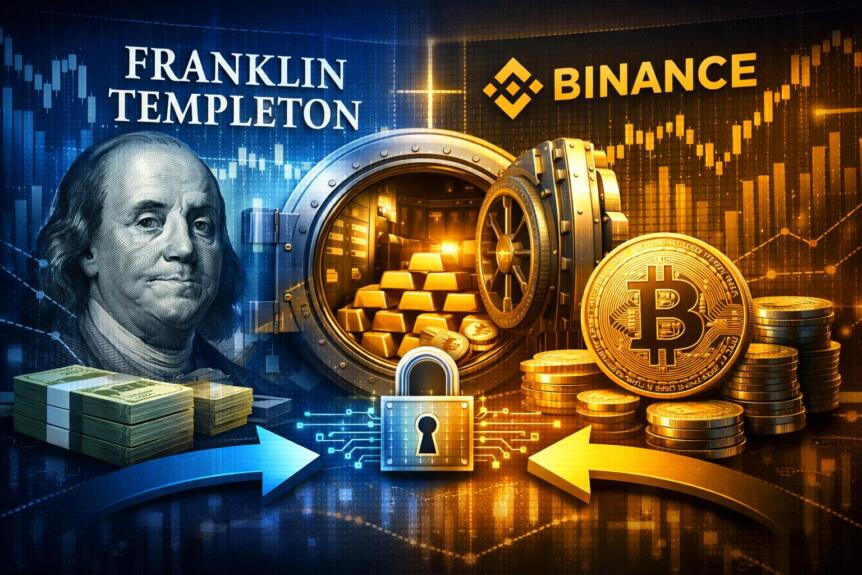
Editor’s note: In this era of digital finance, institutional collaboration between traditional asset managers and crypto exchanges is reshaping markets. The collaboration between Franklin Templeton and Binance demonstrates a practical path to bridge regulated money market products with 24/7 digital markets, using tokenized assets as collateral while preserving custody and risk controls. This editorial snapshot previews how off-exchange collateral programs can improve capital efficiency for institutions without moving assets onto exchanges.
Key points
- Off-exchange collateral using Benji tokenized money market fund shares now live on Binance.
- Custody by Ceffu minimizes counterparty risk for institutions.
- Enables yield-bearing assets to be used for trading without on-exchange parking.
- Expands Franklin Templeton and Binance’s networks of off-exchange program partners.
Why this matters
This collaboration signals growing institutional adoption of tokenized real-world assets, improving capital efficiency and risk controls in crypto markets. By tokenizing money market funds and maintaining custody off-exchange, institutions can participate in 24/7 trading with regulated protections, potentially broadening the set of assets available for collateral and fueling more stable liquidity in digital markets.
What to watch next
- Broader rollout to additional institutional clients.
- Addition of more tokenized Benji funds.
- Deeper custody and settlement integrations with Ceffu.
- Ongoing collaboration expansion across networks since the 2025 announcement.
Disclosure: The content below is a press release provided by the company/PR representative. It is published for informational purposes.
Franklin Templeton and Binance Advance Strategic Collaboration with Institutional Off-Exchange Collateral Program
Institutions can now use Benji-issued tokenized money market funds as off-exchange collateral to trade on Binance using Ceffu’s custody layer.
SAN MATEO, CA, and ABU DHABI, UAE, February 19, 2026 — Franklin Templeton, a global investment leader, and Binance, the world’s leading cryptocurrency exchange by trading volume and users, today announced a new institutional off-exchange collateral program, making digital markets more secure and capital-efficient. Now live, eligible clients can use tokenized money market fund shares issued through Franklin Templeton’s Benji Technology Platform as off-exchange collateral when trading on Binance.
The program alleviates a long-standing pain point for institutional traders by allowing them to use traditional regulated, yield-bearing money market fund assets in digital markets without parking those assets on an exchange. Instead, the value of Benji-issued fund shares is mirrored within Binance’s trading environment, while the tokenized assets themselves remain securely held off-exchange in regulated custody. This reduces counterparty risk, letting institutional participants earn yield and support their trading activity without hedging on custody, liquidity, or regulatory protections.
“Since partnering in 2025, our work with Binance has focused on making digital finance actually work for institutions,” said Roger Bayston, Head of Digital Assets at Franklin Templeton. “Our off-exchange collateral program is just that: letting clients easily put their assets to work in regulated custody while safely earning yield in new ways. That’s the future Benji was designed for, and working with partners like Binance allows us to deliver it at scale.”
“Partnering with Franklin Templeton to offer tokenized real-world assets for off-exchange collateral settlement is a natural next step in our mission to bring digital assets and traditional finance closer together,” said Catherine Chen, Head of VIP & Institutional at Binance. “Innovating ways to use traditional financial instruments on-chain opens up new opportunities for investors and shows just how blockchain technology can make markets more efficient.”
Assets participating in the program remain held off-exchange in a regulated custody environment, with tokenized money market fund shares pledged as collateral for trading on Binance. Custody and settlement infrastructure is supported by Ceffu, Binance’s institutional crypto-native custody partner.
“Institutions increasingly require trading models that prioritize risk management without sacrificing capital efficiency,” said Ian Loh, CEO of Ceffu. “This program demonstrates how off-exchange collateral can support institutional participation in digital markets while maintaining strong custody and control.”
Launching the institutional off-exchange collateral program expands on both Franklin Templeton’s and Binance’s growing networks of off-exchange program partners and represents another effort since announcing Franklin Templeton and Binance’s strategic collaboration in September 2025.
By using Benji to bridge tokenized money market funds, Franklin Templeton is taking trusted investment products and making them work in modern markets—allowing institutions to trade, manage risk, and move capital more efficiently as digital finance becomes an everyday part of the financial system.
Offering more tokenized real-world assets on Binance meets the increasing institutional demand for stable, yield-bearing collateral that can settle 24/7. This gives investors greater choice and enhances their trading experience on the world’s largest regulated digital asset exchange.
Franklin Templeton is a pioneer in digital asset investing and blockchain innovation, combining tokenomics research, data science, and technical expertise to deliver cutting-edge solutions since 2018. Learn more at http://franklintempleton.com/investments/asset-class/digital-assets.
About Binance
Binance is a leading global blockchain ecosystem behind the world’s largest cryptocurrency exchange by trading volume and registered users. Binance is trusted by more than 300 million people in 100+ countries for its industry-leading security, transparency, trading engine speed, protections for investors, and unmatched portfolio of digital asset products and offerings from trading and finance to education, research, social good, payments, institutional services, and Web3 features. Binance is devoted to building an inclusive crypto ecosystem to increase the freedom of money and financial access for people around the world with crypto as the fundamental means.
For more information, visit https://www.binance.com.
About Ceffu
Ceffu is a compliant, institutional-grade custody platform offering custody and liquidity solutions that are ISO 27001 & 27701 certified and SOC2 Type 2 attested. Our multi-party computation (MPC) technology, combined with a customizable multi-approval scheme, provides bespoke solutions allowing institutional clients to safely store and manage their virtual assets.
For the purposes of this program, custody services for Benji-issued tokenized money market fund shares are provided by Ceffu Custody FZE, a virtual asset custodian licensed and supervised in Dubai.
About Franklin Templeton
Franklin Templeton is a trusted investment partner, delivering tailored solutions that align with clients’ strategic goals. With deep portfolio management expertise across public and private markets, we combine investment excellence with cutting-edge technology. Since our founding in 1947, we have empowered clients through strategic partnerships, forward-looking insights, and continuous innovations – providing the tools and resources to navigate change and capture opportunity.
With more than $1.7 trillion in assets under management as of January 31, 2026, Franklin Templeton operates globally in more than 35 countries.
To learn more, visit franklintempleton.com and follow us on LinkedIn.
Franklin Resources, Inc. [NYSE: BEN]
All investments, including money funds, involve risk, including loss of principal. There are risks associated with the issuance, redemption, transfer, custody, and record keeping of shares maintained and recorded primarily on a blockchain. For example, shares that are issued using blockchain technology would be subject to risks, including the following: blockchain is a rapidly-evolving regulatory landscape, which might result in security, privacy or other regulatory concerns that could require changes to the way transactions in the shares are recorded.
This is a general announcement. Products and services referred to here may not be available in your region. Terms and conditions apply.
Copyright © 2026. Franklin Templeton. All rights reserved.


Breaking RBC reports suggest that Russia is manoeuvring to block foreign crypto exchange websites like Binance and OKX starting September 1 unless they comply with strict domestic regulations.
The strategic move funnels crypto customers to locally licensed and state monitored exchanges, securing control over cross-border on-chain capital flows while tightening the grip on retail speculation.
Key Takeaways
- The Move: Foreign crypto exchanges face a potential blockade by September 1 under new “experimental” legal frameworks.
- The Goal: Authorities want to centralize cross-border crypto payments to evade sanctions while monitoring domestic capital flight.
- The Impact: Traders using offshore platforms may be forced onto planned state-backed exchanges in Moscow and St. Petersburg.
Why Is This Happening Now?
Why limit access now? It comes down to control. Following the laws signed by President Putin in August 2024, crypto is no longer viewed merely as a speculative asset but as a critical tool for bypassing SWIFT bans. However, the Kremlin demands oversight.
Data from Chainalysis indicates Russia has pivoted toward “legislated sanctions evasion.” By forcing activity onto domestic platforms, authorities can monitor flows that were previously opaque.
Russia is setting up two Cryptocurrency exchanges—one for international trade, one for Russian — alongside its own stablecoin. Wave "bye" to another aspect of sanctions. pic.twitter.com/QnKyxGogNp
— James Porrazzo (@JamesPorrazzo) August 23, 2024
This broadly mirrors concerns across the continent in Brussels, where leaders like Christine Lagarde warn of regulatory gaps in digital finance. Moscow wants those gaps closed.
The government is essentially bifurcating the market. One lane is for state-sanctioned entities like exporters using crypto for international settlement.
The other lane (retail) is being subjected to extreme friction to prevent capital flight.
Discover: The best meme coins on Solana
How Will the Ban Work?
The proposed mechanism targets foreign platforms offering unlicensed access. While major players like Coinbase, which Cathie Wood recently doubled down on, rely on global accessibility, Russian user bases are substantial.
Under the new regime, only exchanges operating within specific “experimental legal regimes” (EPR) might survive.
Reports suggest plans for state-backed exchanges in St. Petersburg and Moscow are accelerating.
These venues would facilitate cross-border trade for approved exporters while retail traders get squeezed out of foreign venues. Compliance is the bottleneck.
As noted in Crystal Intelligence’s regulatory roadmap, strict KYC and capital requirements have been on the table for Russian regulators since 2022. Now, they are becoming entry barriers.
Finance Minister Anton Siluanov has previously admitted that Moscow finding a regulatory solution is complex but vital.
Yet, the urgency to mitigate sanctions is overriding technical hesitations. This aligns with global trends where developer liability and platform compliance are central to legislative debates.
If foreign entities do not register locally, a move many will refuse due to Western sanctions, they face a hard block.
What Happens Next for Traders?
If the crackdown goes live in September, expect a liquidity fracture. Russian retail volume, estimated over a hundred billion annually, will likely flood into underground P2P networks or the few sanctioned domestic entities like Garantex.
As industry lobbying groups work to define clearer frameworks globally, Russia’s isolating move offers a stark counter-narrative: nationalization over decentralization.
In that light, the ruble pairing spreads may reveal the first signs of this shift.
The post Russia May Block Foreign Crypto Exchanges Under New Domestic Regulations appeared first on Cryptonews.
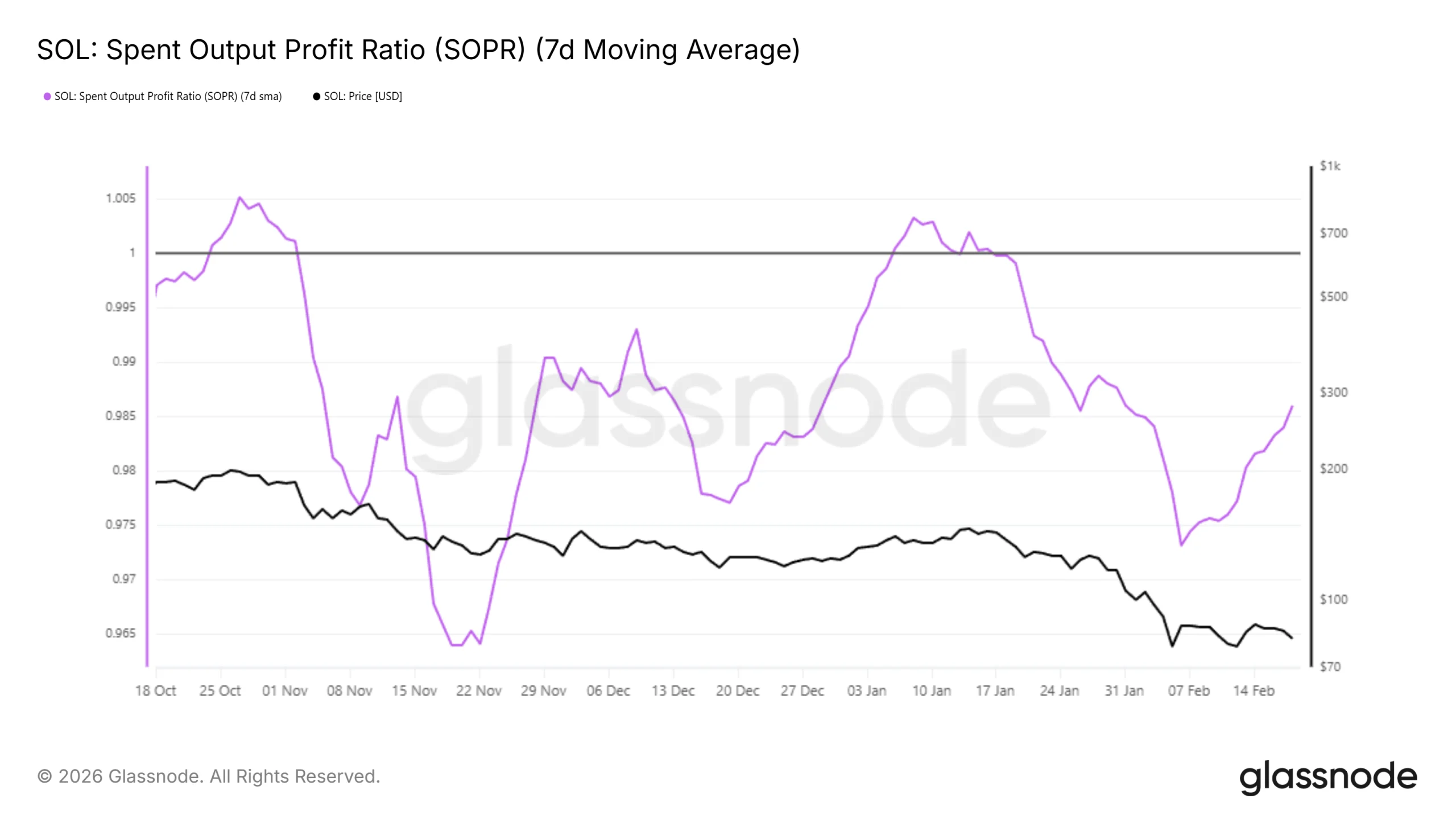
Solana has remained range-bound after nearly two weeks of consolidation below $90. The lack of direction reflects persistent uncertainty across the crypto market.
On-chain indicators hint at a gradual recovery. However, losses endured by investors continue to shape sentiment. While technical signals show improvement, the broader structure suggests that risks remain present.
Solana Metrics’ Mixed Signals
The Spent Output Profit Ratio, or SOPR, has recently ticked higher from the negative zone. A reading below 1 indicates that investors are selling at a loss. The recent uptick signals that realized losses are beginning to dissipate.
Historically, a move above 1 during extended bearish periods marks the first wave of profit-taking. Such transitions often lead to renewed volatility. When profitability briefly returns, some Solana investors sell to exit positions, triggering short-term pullbacks.
Want more token insights like this? Sign up for Editor Harsh Notariya’s Daily Crypto Newsletter here.
This pattern has appeared twice in the past three months. Each instance was followed by renewed selling pressure. If SOPR climbs above 1 again, a similar reaction could unfold. That dynamic may limit immediate recovery despite improving on-chain sentiment.
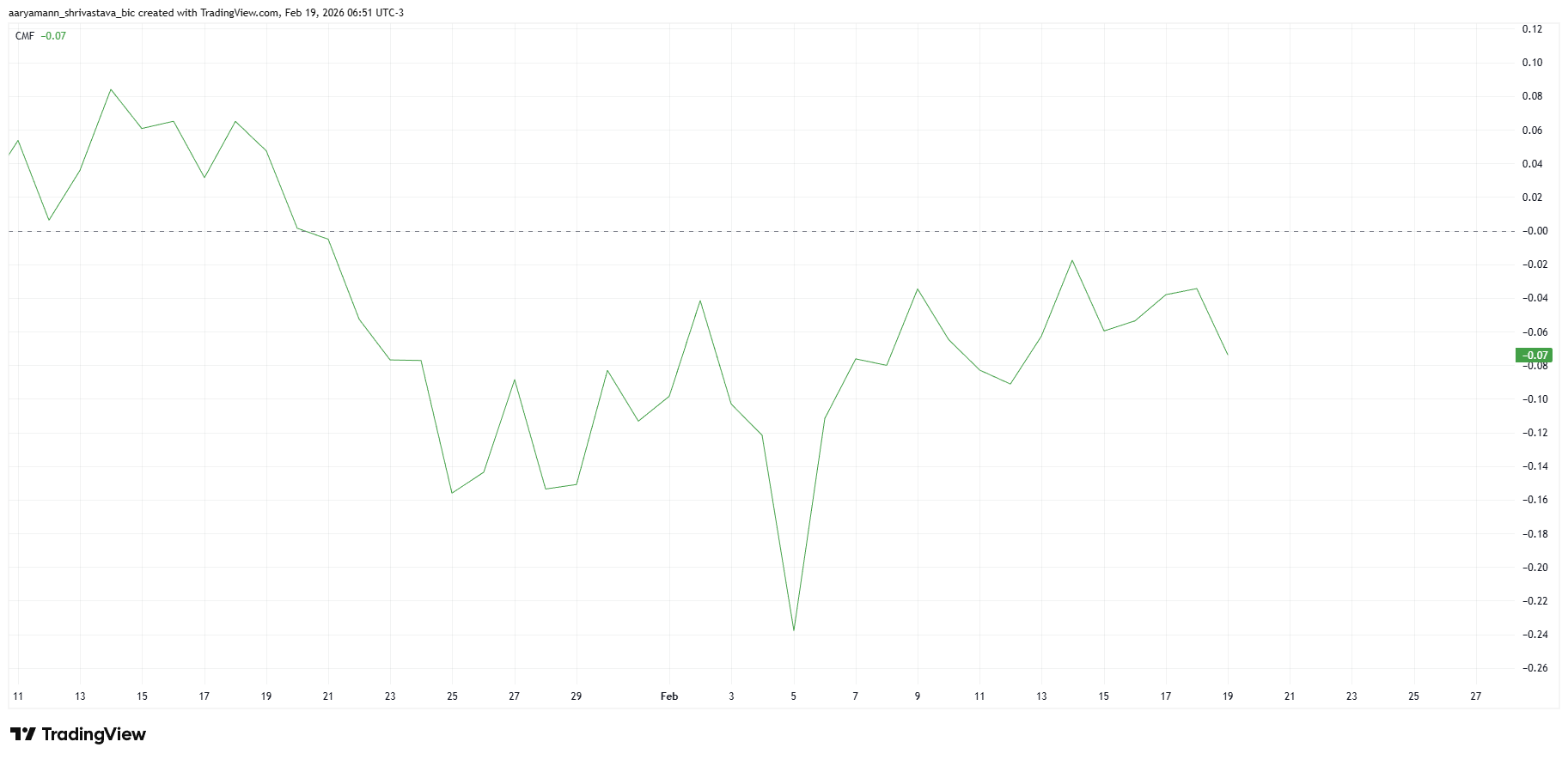
Technical indicators offer mixed signals. The Chaikin Money Flow is rising but remains in negative territory. This incline suggests that outflows are declining, yet capital has not returned decisively.
A move above the zero line would confirm sustained inflows. Until that shift occurs, Solana remains vulnerable to further weakness. Gradual improvement does not guarantee reversal, especially in an environment of cautious investor positioning.
Institutions Like Solana
Institutional flows provide a contrasting signal. For the week ending February 13, Solana recorded $31 million in inflows. Among major tokens, only XRP saw comparable institutional support.
These inflows reflect continued interest from large wallets. Despite broader bearish conditions, institutions appear to view Solana as strategically valuable. Such support can cushion downside moves during periods of market stress.
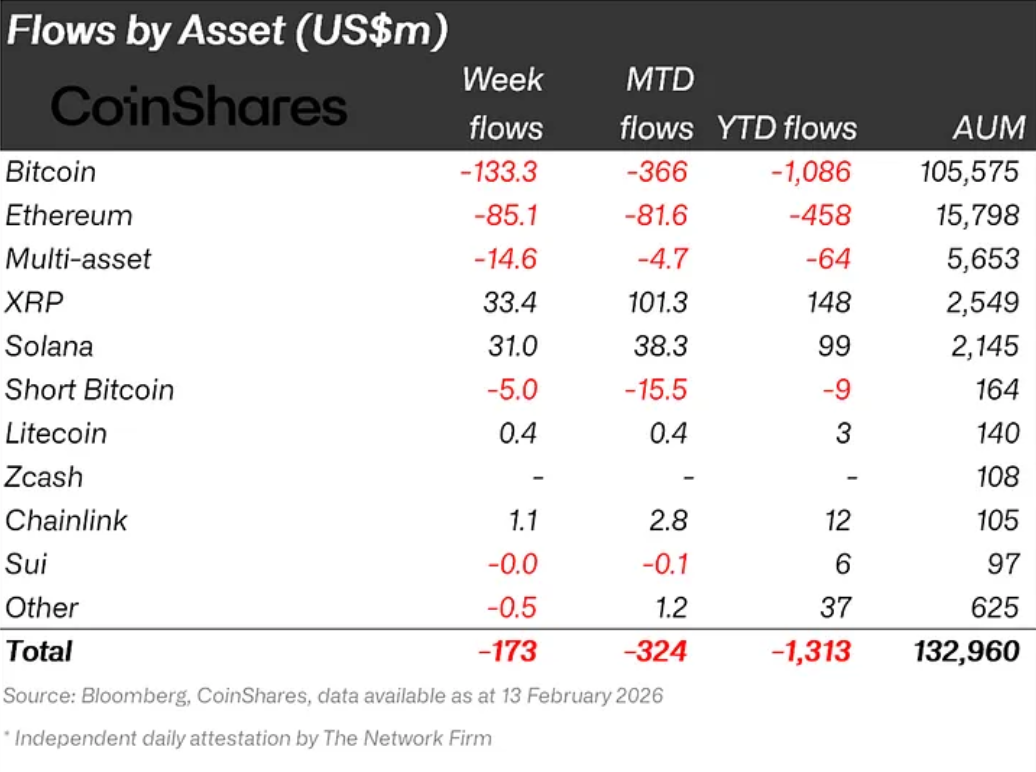
Institutional accumulation has likely prevented deeper declines. Strong backing from larger players reinforces confidence in the network’s long-term prospects. This underlying demand remains a stabilizing factor even as retail sentiment fluctuates.
SOL Price Continues Moving Sideways
Solana price is trading at $81 at the time of writing. The token remains range-bound between $78 support and $87 resistance. This consolidation has persisted for over two weeks, signaling indecision among market participants.
Without clear recovery catalysts, sideways movement may continue. If bearish pressure intensifies, SOL could slip below $78. A breakdown may expose the next support near $73, extending short-term downside risk.
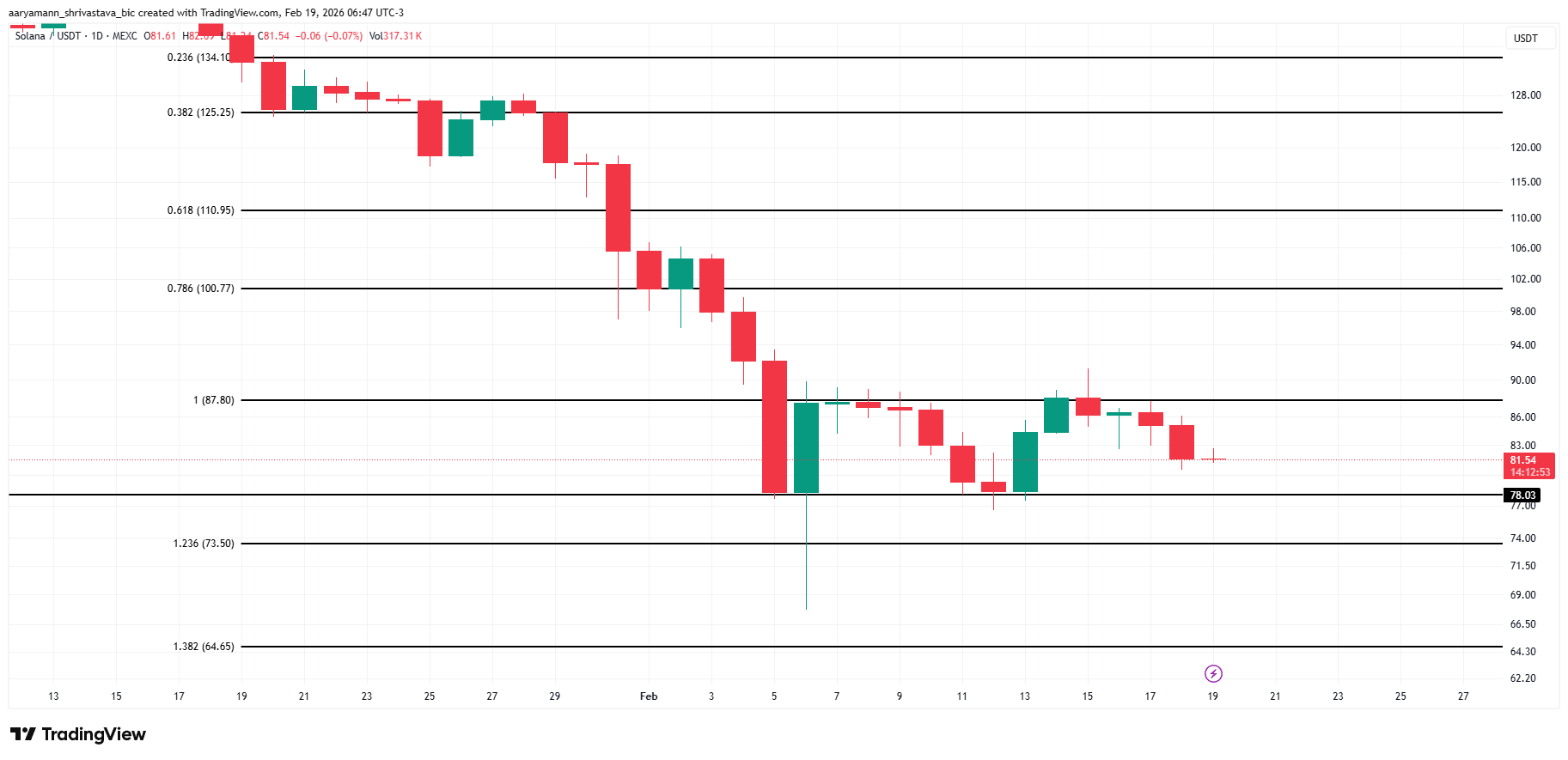
Conversely, a bounce from $78 could shift momentum. A decisive move above $87 would signal breakout potential. Sustained buying pressure could then push Solana toward $100. If SOL clears that psychological barrier, price may advance toward $110, invalidating the prevailing bearish outlook.
Crypto World
Exclusive: Eric Trump Calls Maldives Hotel First of Many Real Estate Tokenization Projects


The new project highlights World Liberty Financial’s broader push to bring traditional assets on-chain.
World Liberty Financial’s plan to tokenize loan revenue interests tied to the Trump International Hotel & Resort in the Maldives is just the start of a larger plan, World Liberty Financial co-founder Eric Trump said in an exclusive interview with The Defiant.
The project, announced Wednesday, Feb. 18, is being developed with real estate firm DarGlobal and Securitize, a platform known for tokenizing real-world assets (RWAs), including funds like BlackRock’s BUIDL.
Trump told Camila Russo, founder of The Defiant, that tokenization will change real estate finance by making deals simpler and allowing more people to invest who couldn’t before.
“Do we have more plans for this? Yes, certainly, World Liberty has plans to be in the tokenization space of many different asset types, and they’re sprinting toward that,” Trump said. “I believe [DarGlobal CEO Ziad El Chaar] and I will do many more projects, tokenize many more projects, and I think history will look back and say, you know, these were the guys that popped the cork of the champagne bottle.”
The first token sale is designed to give accredited investors a fixed return, a share of income from loans tied to the resort, and the potential for profits upon any future sale. The tokens are expected to be issued on public blockchains and could later be used as collateral on World Liberty Financial’s platform, according to a press release viewed by The Defiant.
“We believe that scalable on-chain real estate products issued with compliance, governance, and market structure in mind will be globally sought after. That’s exactly what this partnership with WLFI is designed to deliver,” said Carlos Domingo, co-founder and CEO of Securitize.
The deal highlights a broader trend in crypto of more institutions and firms focusing on tokenization – one of the fastest-growing sectors in the space. As of Thursday, Feb. 19, the distributed asset value of tokenized RWAs has climbed to $24.8 billion, up 11% in the past month, while the number of holders rose more than 30% in the same time frame, according to RWAxyz.
“Everything’s gonna be tokenized,” Trump emphasized. “Commodities are gonna be tokenized, Hollywood can be tokenized, artists are gonna be tokenized, brands, I mean, you can tokenize just about anything.”
The Maldives resort is a flagship hospitality development scheduled to open in 2030. It is expected to include 100 beach and overwater villas, according to the press release.
World Liberty Financial’s native token WLFI is currently trading at around $0.12, down 3.8% over the past 24 hours, according to CoinGecko. The move follows Wednesday’s rally of 30%, which occurred just ahead of the World Liberty Financial forum held at President Donald Trump’s Mar-a-Lago resort.
Meanwhile, World Liberty Financial’s USD1 stablecoin recently surpassed $5.1 billion in circulation, up from roughly $3 billion just weeks ago. It’s now the fifth-largest stablecoin by market capitalization, according to DeFiLlama.
Both etherfi and Optimism described the transition as a long-term partnership.
Decentralized neobank and crypto card issuer etherfi is leaving Scroll for Optimism, taking with it millions of dollars in total value locked and monthly fees generated on Scroll, data shows.
In an X post on Wednesday, Feb. 18, etherfi said it plans to move its Cash accounts and card program from Scroll to Optimism’s OP Mainnet, migrating more than 70,000 active cards, roughly 300,000 user accounts, and nearly $160 million in TVL in the coming months.
With etherfi, Scroll’s own TVL is only around $188 million as of today, Feb. 19, per data from DefiLlama.

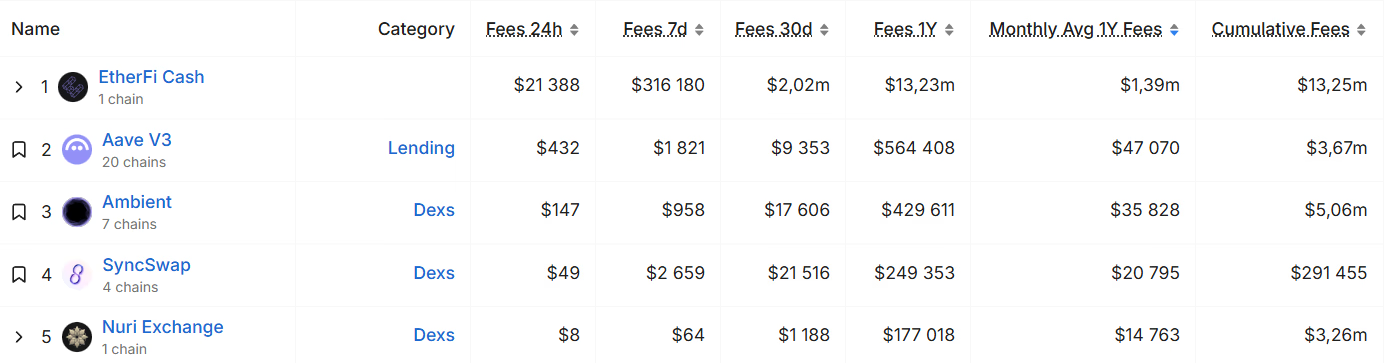
The decision marks a clear break from Scroll, an Ethereum ZK rollup, where etherfi was the dominant consumer-facing app. According to data from DefiLlama, as of today, EtherFi Cash, the company’s crypto card and digital account product, accounted for roughly $13.2 million in annualized fees, and over $23,000 in the past 24 hours.

For comparison, Aave V3, the second-largest protocol on Scroll by annual fees, boasts only around $564,000 over the past year, meaning EtherFi Cash produced nearly 23 times more in fees.

Since launching its Cash product in September 2024, the company says it has processed more than $265 million in card spend, positioning the service as one of the largest non-custodial crypto card programs currently in operation, the firm noted in its X post announcing the migration.
‘Long-Term Partnership’
Per its post, etherfi is framing the transition as a “long-term partnership,” pointing to deeper liquidity, broader DeFi integrations and native stablecoin support on Optimism.
In commentary for The Defiant, etherfi co-founder Rok Kopp explained that Optimism “has been one of the pioneers of the L2 space and Ethereum scaling solutions more broadly, and the Superchain has powered many of the most widely used blockchain products in the world.”
Kopp added:
“We are excited to build on battle tested, cost efficient infrastructure we know we can scale effectively on. Working with the OP Labs team has been our pleasure, and we believe our collaboration can help propel the DeFi neobanking space to new heights”
Optimism, for its part, also described the migration in a Feb. 18 blog post as a “long-term OP Enterprise partnership” aimed at scaling on-chain payments.
With its leading fee-generating dApp departing, Scroll now faces losing a big chunk of its revenue.
The Defiant reached out to etherfi and Scroll for comments on the move, but hasn’t heard back by press time.
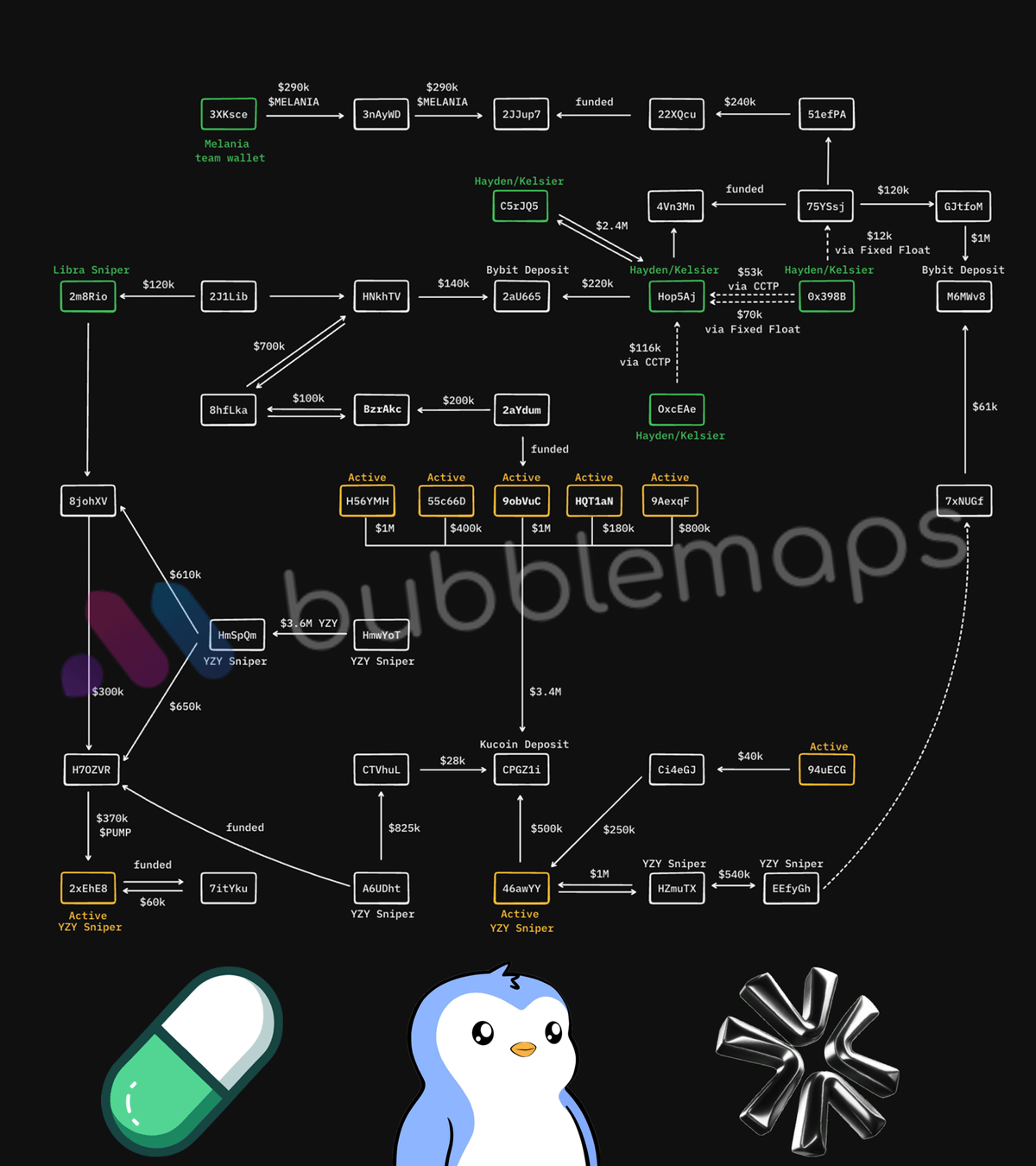
Blockchain analytics firm Bubblemaps has linked controversial meme coin insider Hayden Davis to one of the largest private allocations of Pump.fun’s PUMP token.
The firm found that a wallet attributed to Davis invested $50 million USDC in the private sale and received 12.5 billion PUMP tokens at launch. Those tokens were worth about $73 million at the time.
How a Top Insider Cashed Out Millions From Pump.fun
However, the wallet quickly moved roughly 80% of the tokens to centralized exchanges within days of the launch.
The remaining tokens were gradually sold over time. Bubblemaps estimates Davis made about $15 million in profit from the trade.
This discovery reveals that Davis was not just a trader in the Pump.fun ecosystem but one of its largest early institutional investors.
His allocation made him the second-largest private buyer of the PUMP token. Private sale investors typically receive discounted prices, giving them an advantage over public buyers.
As a result, Davis likely secured profits early, while retail investors faced volatility later. The PUMP token initially surged after its July 2025 ICO but has since fallen about 75% from its peak. This pattern reflects the broader meme coin cycle, where insiders often exit early.
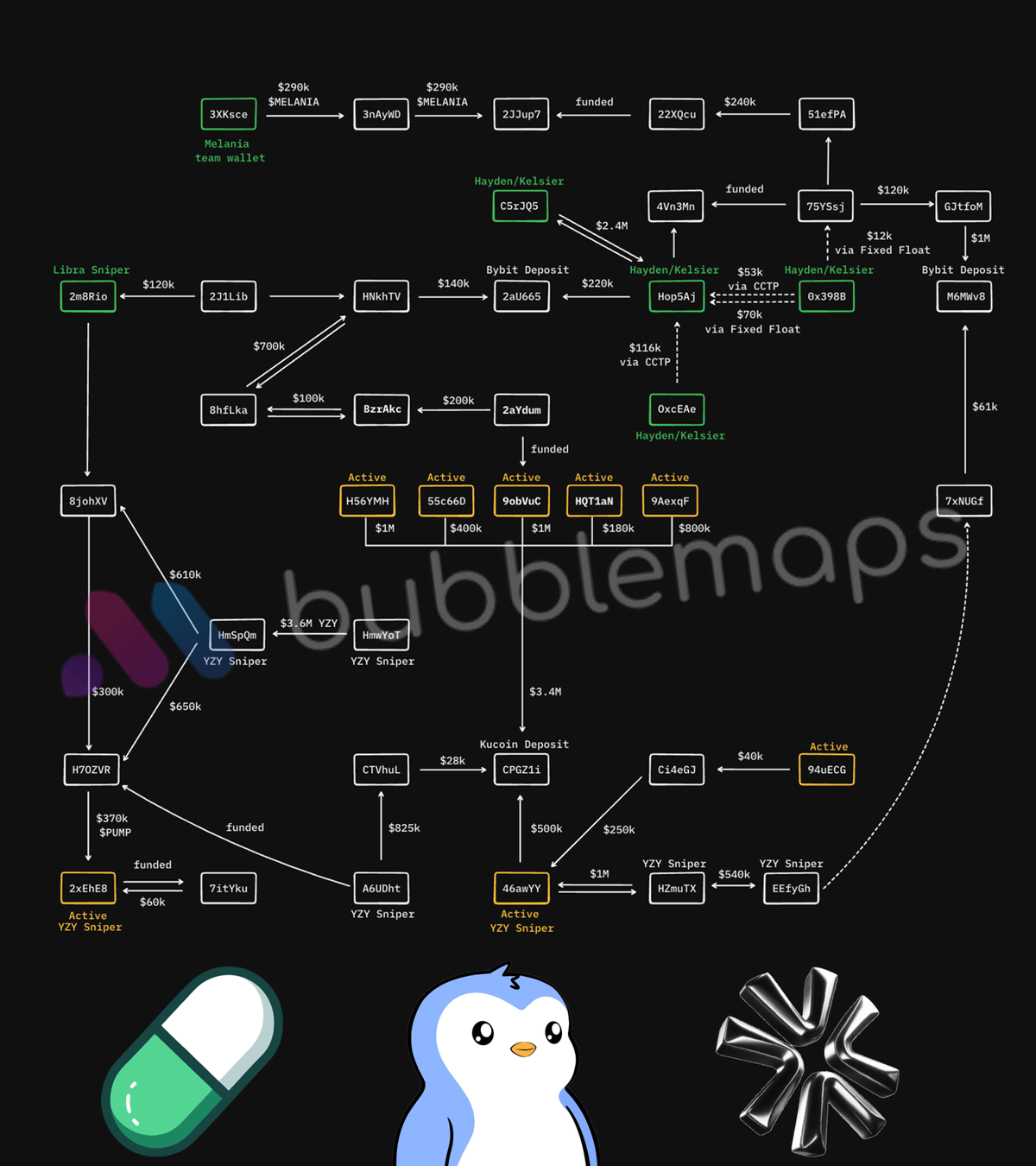
Meanwhile, Davis already has a controversial reputation in the crypto industry. He serves as CEO of Kelsier Ventures, a crypto firm tied to multiple meme coin launches and scandals.
He became widely known for his role in the LIBRA token, which surged above $4 billion in market value after promotion by Argentine President Javier Milei but collapsed within hours.
Authorities later froze wallets and assets linked to Davis during fraud investigations. Argentine prosecutors even sought an Interpol Red Notice, citing concerns that he could flee.
Furthermore, Davis admitted he helped launch several celebrity-linked tokens, including MELANIA and others connected to political branding.
Blockchain investigators have linked his wallets to repeated patterns of early insider allocations and rapid sell-offs after launch hype.
Now, the Bubblemaps findings suggest Davis also operated as a major insider investor in Pump.fun itself. This expands his role from meme coin creator to launchpad-level whale.
Ultimately, the case highlights ongoing concerns about insider access and profit extraction in crypto token launches.
Regulators and investors continue to scrutinize how private allocations shape market outcomes long after the initial hype fades.


The latest ETHDenver conference, which got underway earlier this week, has been depicted as a post-apocalyptic wasteland of crumbling booths and discarded conference swag in a new painting by renowned NFT artist Beeple.
Ethereum has declined 29% over the past 12 months, costing investors over $90 billion in market capitalization.
In an effort to convey the sheer scale of the collapse, Beeple, who’s one of the highest-earning NFT creators in history, has created a nightmarish scene that imagines a decrepit venue stacked with trash, pigeons, stray dogs, and destitute attendees.
Tattered signs hang from the ceiling and trash boxes are filled with worthless merchandise from prior campaigns like DeFi Summer, NFTs, and memecoins.
The image immediately resonated on Crypto Twitter and spurred users to post their own wasteland jokes. One likened ETHDenver to Skid Row, a famous homeless area of downtown Los Angeles.
Read more: Beeple NFT tops almost every ‘Old World Masters’ ever auctioned
ETHDenver stats crater
Attendance at the flagship Ethereum conference, which once rivaled the largest Bitcoin conference from 2023-2024, has collapsed this year. Indeed, ticket sales have dipped below 10,000 from a previous 25,000 high.
The number of side events planned a month in advance, such as mixers, afterparties, and workshops, also fell 85% from last year’s 668.
“I have to say that this was the internal monologue of most of the attendees at ETHDenver,” agreed one attendee.
“The show was about 1/10th the size of last year’s. Probably a lot more reminiscent of ETHDenver 2019 and not what we would have expected for ETHDenver 2026.”
“Hilarious Trump even said no ETHDenver and threw a crypto event at Mar a Lago,” noted another observer.
The Trump family’s crypto forum in Palm Beach, Florida and a White House stablecoin meeting directly conflicted with the dates of ETHDenver 2026.
Others disagreed entirely. Indeed, Jesse Pollack posted a stream of positive updates, as did other Ethereum permabulls like David Hoffman.
Several users posted photos and videos from the conference floor under Beeple’s art to contest his characterization.
Ethereum founder Vitalik Buterin ignored the social drama entirely, quietly posting technical updates. The Ethereum Foundation posted its 2026 roadmap to minimal media attention.
Got a tip? Send us an email securely via Protos Leaks. For more informed news, follow us on X, Bluesky, and Google News, or subscribe to our YouTube channel.
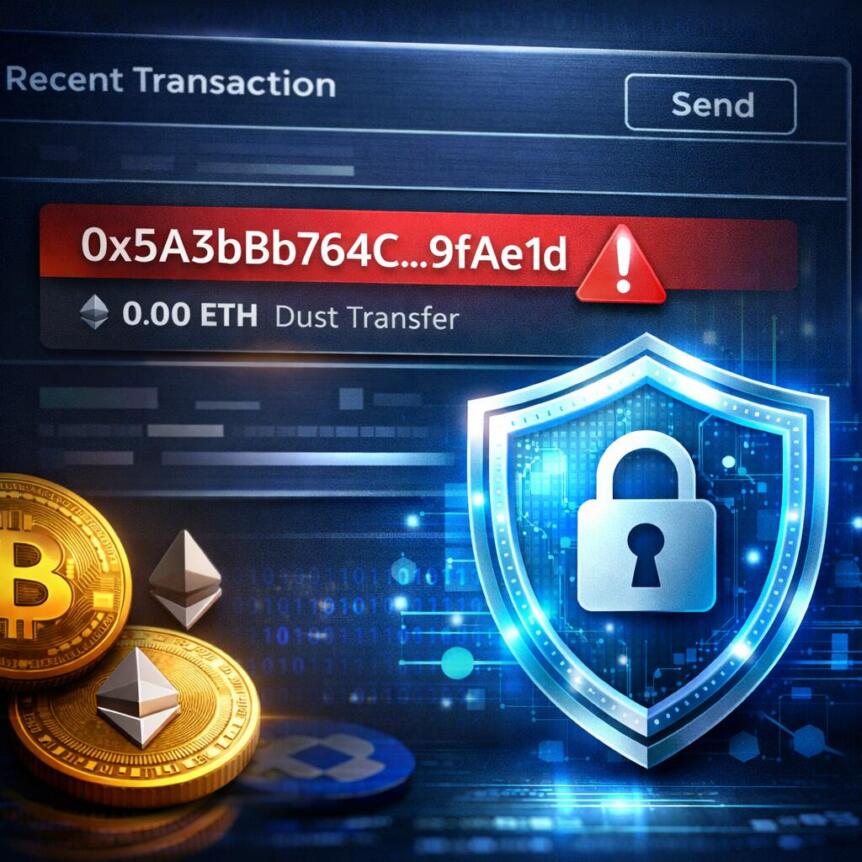
Address poisoning is reshaping risk in crypto wallets by shifting focus from private keys to how users interact with interfaces. Rather than breaking encryption, attackers exploit human habits and design flaws to misdirect funds. In 2025, a victim lost about $50 million in Tether’s USDt after copying a poisoned address. In February 2026, a phishing campaign tied to Phantom Chat drained roughly 3.5 Wrapped Bitcoin (wBTC) worth more than $264,000. These episodes underscore how small UI cues—copy buttons, visible transaction histories, and dust transfers—can seduce users into repeating trusted patterns and handing over assets they believe they are sending to legitimate contacts.
Key takeaways
- Address poisoning operates on user behavior and UI cues, not on private key theft or code flaws.
- Two high-profile losses illustrate the scale: a $50 million hit in 2025 and a February 2026 incident involving about 3.5 Wrapped Bitcoin ($WBTC) worth over $264,000.
- Copy buttons, visible transaction histories, and unfiltered dust transfers can make poisoned addresses look legitimate within wallet UIs.
- Because blockchains are permissionless, attackers can send tokens to any address, and many wallets display all incoming activity, including spam, which can seed trust in fake entries.
- Mitigations hinge on better UX and guardrails: explicit address verification, dust-filtering, proactive warnings, and recipient-address checks during sending flows.
Tickers mentioned: $USDT, $WBTC
Sentiment: Neutral
Market context: The cases underscore ongoing UX-driven security challenges in a market where on-chain activity is highly transparent and attackers increasingly target everyday user workflows. As stablecoins and tokenized assets gain prominence, wallet design and on-chain visibility will be central to risk management, alongside traditional education and phishing countermeasures.
Why it matters
The essence of address poisoning lies in the reproducible, human-centered mistakes that occur when users manage crypto transfers. Private keys remain secure in these scenarios; the vulnerability emerges when recipients or senders rely on partial address fragments or familiar transaction patterns. The attack chain typically unfolds with attackers locating valuable wallets, crafting near-identical recipient addresses, and initiating a tiny or zero-value transfer to insert their spoofed address into the victim’s recent-history view. The attacker then waits for the user to copy the address from that history and accidentally paste it into a new transfer, thereby sending funds to the wrong destination. The absence of a cryptographic breach highlights a fundamental truth: the security model of public blockchains hinges on user judgment as much as cryptography.
UX design decisions amplify the risk. Many wallets provide one-click copy buttons adjacent to recent transactions, a convenience that can backfire when spam or dusting entries appear in the same list. Investigators have long noted that victims often “trust” their own transaction history, presuming it signals legitimacy. In cases like the 2025 loss of USDt and the 2026 wBTC incident, the cost of this cognitive shortcut becomes starkly clear. The broader lesson is that user interfaces—the way addresses are displayed, verified, and confirmed—play a pivotal role in security outcomes, sometimes more so than key management alone.
Industry voices have urged wallets to adopt stronger safeguards. Tech leaders, including Changpeng “CZ” Zhao, have publicly called for enhanced protections to curb address poisoning, signaling a potential shift in wallet governance toward more rigorous recipient verification and anti-poisoning features. The tension is real: developers must balance smooth UX with robust safety checks, ensuring users can transact efficiently without becoming victims of lookalike addresses or suspicious dust transfers. In the meantime, the onus remains on users to verify destinations beyond quick-glance cues and to adopt disciplined sending practices.
At the core, the risk is not about breaking cryptography but about breaking user habits in high-friction moments—entering long addresses, approving approvals, and acting on incomplete information. The public and permissionless nature of blockchains makes every address accessible, and the legibility of transactions often lags behind the complexity of strings that represent keys and addresses. The result is a security rhythm in which attackers rely on social and UX dynamics, not on bypassing cryptographic barriers.
What address poisoning really involves
Address poisoning scams hinge on manipulating a victim’s transaction history to misdirect funds, rather than compromising keys or exploiting software vulnerabilities. The typical playbook unfolds as follows:
- Attackers first identify high-value wallets using publicly visible on-chain data.
- They generate a lookalike address that closely resembles a recipient the victim uses regularly, matching several leading and trailing characters to maximize recognizability at a glance.
- They initiate a small or zero-value transfer from the fake address to seed legitimacy and appear in the recipient’s recent activity.
- The attacker then relies on the victim copying the address from the recent transfers list when preparing a legitimate payment to someone else.
- The final step is when the victim pastes the attacker’s address and authorizes the transfer, unwittingly sending funds to the malicious destination.
The victim’s wallet and private keys remain untouched—the crypto-cryptographic layer is intact. The scam thrives on human error, habitual behavior, and trust built from familiar patterns. In some instances, the exploit is reinforced by dusting operations, where tiny transfers flood a user’s activity feed, nudging them toward interacting with suspicious entries without suspicion.
Did you know? Address poisoning scams have gained visibility in parallel with the expansion of Ethereum layer-2 networks, where reduced fees enable mass small transfers that populate users’ histories with fodder for identity-based deception.
How attackers craft deceptive addresses
Crypto addresses are long hexadecimal strings, often 42 characters on Ethereum-compatible chains. Wallets typically truncate the display to a short fragment, such as “0x85c…4b7,” which attackers exploit by constructing lookalikes with identical prefixes and suffixes while altering the middle portion. A legitimate example might read 0x742d35Cc6634C0532925a3b844Bc454e4438f44e, while an almost identical poisoned variant could appear as 0x742d35Cc6634C0532925a3b844Bc454e4438f4Ae. The strategy hinges on human visual heuristics: people rarely verify the entire string and often rely on the start and end characters to judge authenticity.
Some attackers even use vanity-address generation tools to produce thousands of near-identical strings. The social engineering angle is reinforced by dusting, where small funds accompany the malicious address to create a sense of legitimacy in a user’s transaction history. In practice, this is less about AI or cryptography and more about UX trust and careful scrutiny during each sending action.
Security researchers emphasize a key distinction: the breach lies in behavior and interface design, not in the encryption or signing process. Private keys are still the powerhouse that authorizes transactions, but they cannot verify whether the destination address is correct. The result is a paradox: the strongest security on the planet (cryptography) is undermined not by a technical flaw but by a failure to verify addresses thoroughly at the moment of sending.
Practical ways to stay safer
Because address poisoning exploits human tendencies rather than technical vulnerabilities, small but deliberate changes in how you interact with crypto wallets can markedly reduce risk. Here are practical steps for users and developers alike.
For users
- Build and maintain a verified address book or whitelist for frequent recipients, then reference it instead of retyping or copying from history.
- Always verify the full address before sending. If possible, use a character-by-character comparison or an address-checking tool.
- Avoid copying addresses from recent transaction history. If you need to, double-check the source in the list, or re-enter addresses from trusted bookmarks.
- Be wary of unsolicited small transfers that appear in your history; treat them as potential poisoning attempts and isolate them from normal activity.
For wallet developers
Design choices can dramatically reduce risk by making it harder for poisoned addresses to slip through in everyday flows. Suggested safeguards include:
- Filtering or dimming or automatically isolating very low-value (dust) transactions from typical recipient lists.
- Implementing recipient-address similarity checks that flag near-identical addresses during sending.
- Providing pre-signing simulations and risk warnings when the destination looks suspicious or matches a poisoned-pattern entry.
- Integrating on-chain checks or shared blacklists to identify and block known poisoned addresses before a user confirms a transfer.
Sources & verification
- Phantom Chat address poisoning and related bitcoin phishing details: https://cointelegraph.com/news/phantom-chat-address-poisoning-bitcoin-phishing
- General phishing attack overview in crypto: https://cointelegraph.com/learn/articles/what-is-a-phishing-attack-in-crypto-and-how-to-prevent-it
- Tether price index reference: https://cointelegraph.com/tether-price-index
- Critical observations from ZachXBT on poisoning cases: https://x.com/zachxbt/status/2021022756460966139
- Industry commentary on wallet safeguards and address poisoning: https://www.binance.com/en/square/post/34142027296314


Blockfills, the crypto lender backed by trading giant Susquehanna, has incurred losses of around $75 million during the recent market downturn, according to two people with knowledge of the matter.
Blockfills is now looking for a buyer, one of the people said, who spoke on condition of anonymity because the matter is private.
Asked about the losses, Blockfills declined to comment.
Chicago-based Blockfills suspended deposits and withdrawals last week. The firm’s management said in a press release on Feb. 11 that it was working with investors and clients to achieve a swift resolution and restore liquidity to the platform.
“Clients have been able to continue trading with BlockFills for the purpose of opening and closing positions in spot and derivatives trading and select other circumstances,” the firm said.
The company said it transacted over $60 billion in trading volumes in 2025, a 28% increase from 2024 and is one of the most active institutional lending and borrowing desks in the crypto industry. The liquidity provider services around 2,000 institutional clients, including hedge funds, asset managers and mining companies.
Bear market woes
Blockfill’s sudden halting of withdrawals recalls memories of 2022’s crypto winter, when a cascade of firms such as Celsius, BlockFi and Genesis halted customer withdrawals as markets unraveled.
The crypto market has struggled to regain momentum in early 2026, with flagship assets trading well below recent peaks amid cautious investor sentiment. Bitcoin has languished under $70,000 following a sharp selloff from late-2025 highs, while ether (ETH) sits below $2,000 amid broader weakness across digital assets.
Broader market indicators, including slumping crypto-focused funds and declines in related equities, underscore lingering volatility and risk aversion, even as periodic rallies and profit-taking drive short-term price swings
Blockfills closed a $37 million Series A round in January 2022, led by institutional investors including Susquehanna Private Equity Investments, CME Ventures, Simplex Ventures, C6E and Nexo Inc. The raise marked the company’s second multimillion-dollar funding round since its 2018 founding, bringing total capital raised to $44 million.
Read more: Institutional crypto platform BlockFills said to halt withdrawals, restrict trading
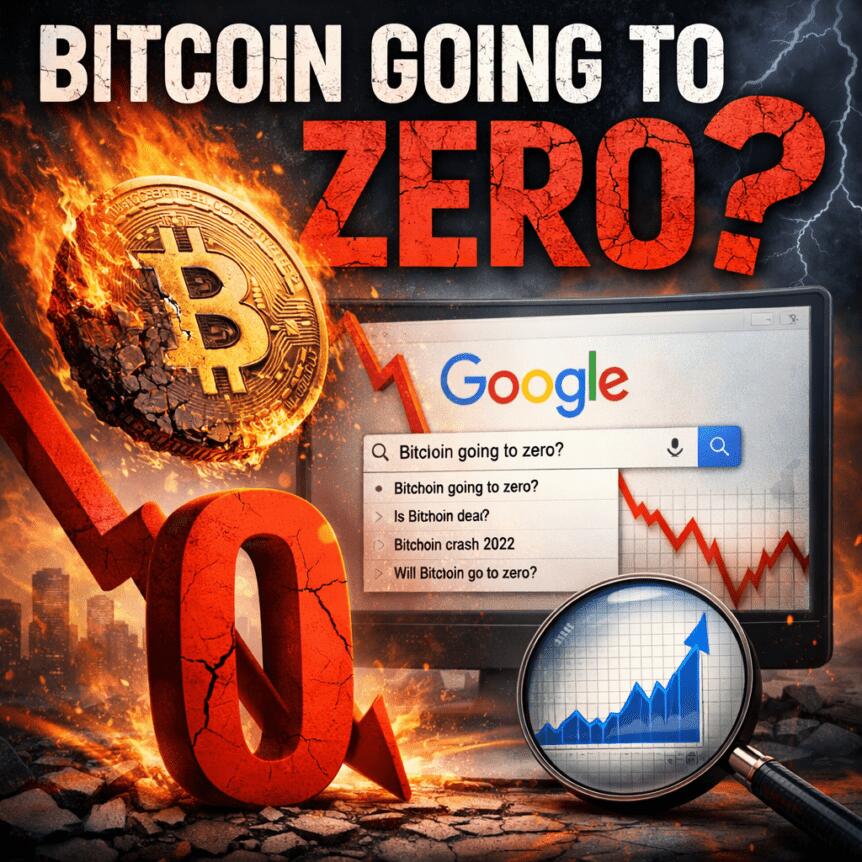
As fear and macro uncertainty weigh on markets, researchers report a spike in Google searches for “Bitcoin going to zero,” marking the highest level since the FTX era panic in late 2022. Bitcoin has retreated from its Oct. 6, 2025 all-time high near $126,000 to roughly $66,500 at the time of writing, according to data tracked by Coingecko. The retreat comes as the Bitcoin Fear and Greed Index plunged into extreme fear, a mood reminiscent of past crises, while macro indicators register heightened anxiety that could influence risk appetite across asset classes. In this environment, institutional participants have continued to accumulate BTC even as retail chatter centers on worst-case scenarios, complicating the narrative around downside risk.
Key takeaways
- Google Trends shows searches for “Bitcoin going to zero” reach levels last seen during the November 2022 FTX crisis, signaling amplified fear rather than a narrowing probability of success.
- Bitcoin’s price dropped from its Oct. 6, 2025 all-time high near $126,000 to about $66,500, marking roughly a 50% retracement from the peak.
- The Bitcoin Fear and Greed Index sank into extreme fear, with readings around 9, echoing the Terra collapse and the FTX fallout era.
- Macro uncertainty, as captured by global indices like the World Uncertainty Index (WUIGLOBALSMPAVG), sits near record levels, suggesting a cautious backdrop for risk assets.
- Even as headlines skew bearish, institutional buyers — including sovereign wealth funds and large corporates — are quietly increasing BTC exposures, often via ETFs and treasury strategies.
Tickers mentioned: $BTC
Sentiment: Neutral
Price impact: Negative. The asset traded down from its peak, signaling a retreat rather than a renewed uptrend.
Trading idea (Not Financial Advice): Hold. In a setting where macro headwinds and sentiment fluctuate, patience may be prudent given ongoing institutional demand and mixed narrative signals.
Market context: The current mix of macro uncertainty, risk-off sentiment, and evolving ETF flows continues to shape crypto liquidity and price action.
Why it matters
The contradiction at the heart of the current moment is stark: sentiment data — the Google Trends spike for catastrophic outcomes — points to heightened fear, while on the ground, large buyers appear to be amassing BTC. A crypto intelligence study analyzing 650+ crypto media sources found that the fear cycle in 2022 was driven largely by internally cascading failures in centralized lenders and a high-profile exchange crisis, whereas today’s fear is framed more by macro concerns and is amplified by a single bearish voice. The result is a narrative split between public perception and professional activity, a dynamic that can create abrupt shifts in risk appetite.
Bloomberg’s Mike McGlone has emerged as a dominant figure in the current bearish framing, repeatedly warning that Bitcoin could go to zero or near-zero. His stance has been described as a relentless, media-saturated forecast that crypto outlets have repeatedly echoed. The effect is a tightened feedback loop: more coverage feeds more searches, which in turn can influence retail behavior even as professional buyers continue to accumulate. The tension between fear-driven narratives and evidence of continued institutional interest is a key feature of the present market environment.
Nikolic notes that this time around the fear narrative benefits from macro dread, rather than the idiosyncratic shock seen in 2022. “This is not a single event; it’s a composite of price volatility, macro doom, and a prominent bearish voice all converging in a single window,” he said. The discussion around Bitcoin’s prospects is increasingly nuanced: while some voices warn of existential risk, others emphasize resilience and long-term demand, underscoring a market that can remain volatile even as core holders accumulate.
On the price front, Bitcoin’s swing from its October peak to the mid-$60,000s signals a significant retracement rather than a capitulation phase. The price action occurs in a broader risk-off backcloth, where macro indicators such as the World Uncertainty Index show elevated references to global risk and policy uncertainty. While fear in search trends runs hot, official data from on-chain analytics and ETF activity suggest a more complex dynamic than a straight-line decline. The tension between fear-based narratives and steady accumulation by institutions is likely to dominate the near-term discourse as traders weigh tactical entries against longer-horizon exposure.
The narrative around quantum risk has also hung over the market in fits and starts. While the topic has persisted as a backdrop since late 2025, searches for “Bitcoin quantum” surged earlier in the year but have since moderated. In Nikolic’s framing, quantum risk is an amplifier rather than a primary driver of price; it tends to intensify existing bearish sentiment when price action is weak, but it is not by itself a sufficient trigger for a sustained move lower. In this sense, the current spike in “Bitcoin going to zero” queries appears to be a confluence of price backdrop, macro anxiety, and the echo chamber effect of bearish voices in financial media.
Amid the fear narrative, there are tangible signs of demand on the other side of the ledger. Reports tracing ETF flows and corporate treasury strategies show ongoing BTC accumulation by both sovereign wealth funds and major corporations, even as retail chatter fixates on doom scenarios. This dichotomy reinforces the view that the crypto market remains a battleground of narratives, with price action often lagging behind shifts in sentiment and on-chain behavior. The interplay between media cycles, macro risk indicators, and institutional positioning will likely set the tone for the next phase of this cycle.
The broader macro backdrop remains a critical factor. The fear spike around “Bitcoin going to zero” is nested within a climate of record-level uncertainty, underscored by research indicating that spikes in global uncertainty can precede weaker growth and delayed investment. As the market absorbs both the fear-driven headlines and the evidence of ongoing demand, participants should remain attentive to policy signals, ETF development, and any fresh macro data that could recalibrate risk appetite. The rise and fall of emotion in crypto markets continues to be closely tied to global economic cues and the narratives built around them.
For readers seeking anchor points, several sources referenced in this narrative offer context: Google Trends provides the search data illustrating consumer fear; CoinGecko tracks Bitcoin’s price trajectory from its peak to the current level; and macro indicators such as the World Uncertainty Index contextualize the mood against a backdrop of global risk. The discourse around Bitcoin’s future is evolving, and while fear remains a potent force in the short term, it coexists with a persistent undercurrent of institutional support that could help stabilize the market over the longer horizon.
What to watch next
- Price action around the current mid-$60k range and any decisive move toward or away from the $70k level that could alter near-term momentum.
- Updates to the World Uncertainty Index and other macro indicators that might influence risk sentiment and capital allocation in crypto.
- ETF and institutional flow data, including potential shifts in sovereign wealth fund positioning and corporate treasury strategies.
- Regulatory developments or macro-policy signals that could sway the risk environment for digital assets.
Sources & verification
- Google Trends: the query “Bitcoin going to zero” worldwide over the last five years.
- CoinGecko data for Bitcoin price movements, including the Oct. 6, 2025 high and current levels around 66,500.
- Bitcoin Fear and Greed Index and related social discussions.
- World Uncertainty Index (WUIGLOBALSMPAVG) as a macro-risk gauge.
- IMF research on uncertainty spikes and growth implications (Bloom.pdf).
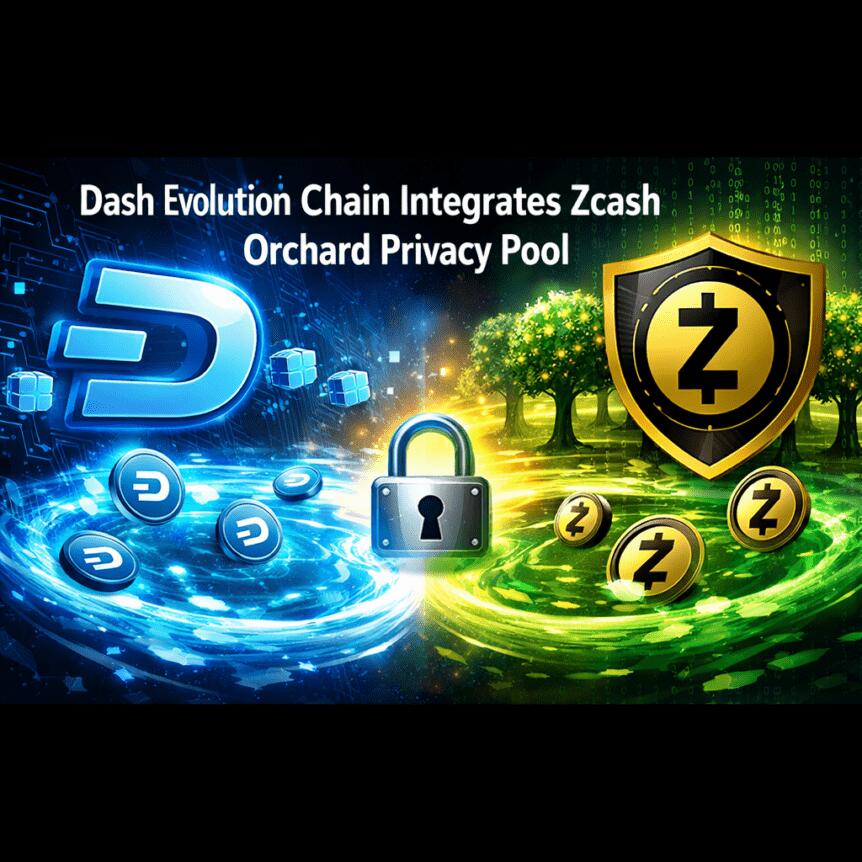
Dash, a layer-1 blockchain protocol with privacy-preserving features, announced on Thursday the integration of Zcash’s “Orchard” shielded pool into the Dash Evolution chain, a secondary layer on the L1 network that supports smart contract functionality. The rollout will proceed after cybersecurity audits are completed and is expected to launch in March, according to the project’s announcement. In the initial phase, Evolution will facilitate basic transfers of Zcash (ZEC) from one party to another, with subsequent upgrades planned to bring Orchard’s privacy features to tokenized real-world assets (RWAs) on the platform. The news adds a new privacy-centric rails dimension to Evolution and signals a broader push to blend shielded transactions with smart-contract enabled networks.
Key takeaways
- Dash (DASH) will integrate Zcash (ZEC)’s Orchard shielded pool into the Evolution layer, enabling private transfers on a smart-contract-capable L1.
- The launch is slated for March, pending cybersecurity audits, with initial support limited to basic ZEC transfers before privacy features for tokenized RWAs are rolled out.
- Privacy-focused tokens and on-chain privacy tooling gained renewed momentum in 2025–2026, as practitioners argue privacy is essential for practical crypto payments and for protecting sensitive business information.
- Dubai’s DFSA moved to ban privacy tokens like ZEC and XMR in January 2026, highlighting tensions between regulatory regimes and privacy tech development.
- Dash’s price action has reflected renewed interest in privacy narratives, with January 2026 seeing a surge of more than 125% and a local high near $96 on Binance before pulling back.
Tickers mentioned: $DASH, $ZEC, $XMR, $BTC
Market context: The integration arrives as the crypto market weighs the balance between privacy protections and regulatory compliance. Privacy-preserving tools are increasingly viewed as necessary for large-scale institutional use cases and for safeguarding payrolls, supplier payments, and partner disclosures from exposure, even as policy makers scrutinize anonymity features for potential misuse.
Why it matters
The Dash–Zcash collaboration underscores a broader industry push to weave shielded, privacy-forward capabilities into programmable networks. By incorporating Zcash’s Orchard shielded pool into Evolution’s smart-contract framework, Dash aims to deliver private on-chain transactions alongside the ability to deploy decentralized applications and tokenized assets. That combination could address one of the long-standing friction points in crypto payments: the need to protect transaction data while still enabling verifiable, auditable activity on a public chain. The approach also raises questions about how privacy protections interact with anti-money-laundering (AML) and know-your-customer (KYC) requirements, particularly as institutions contemplate using private rails for payroll, vendor payments, and cross-border settlements.
From a technical perspective, the Orchard integration pivots on a layered model: the base Dash network remains the settlement layer, while Evolution acts as a second layer capable of complex logic and asset tokenization. The plan to enable ZEC transfers first, followed by privacy enhancements for RWAs, suggests a measured rollout designed to test privacy-preserving mechanics in a controlled environment. For users and developers, this could open doors to more private asset issuance and private, auditable cash flows, while still leveraging the existing interoperability of Dash with other blockchains and services.
Regulatory debates frame the pace and scope of such privacy tools. Dubai’s DFSA ban on privacy tokens illustrates a regulatory hard line: while individuals may continue to hold privacy tokens, exchanges operating under its jurisdiction cannot offer them to new customers. The policy reflects a broader tension between enabling private financial activity and maintaining a measurable, compliant financial system. Advocates, including privacy researchers and industry practitioners, argue that real-world privacy needs to be addressed through a blend of regulation, culture, and code — not by siloing privacy features entirely. Critics contend that on-chain privacy can complicate enforcement and compliance, fueling a broader debate about how best to balance privacy and lawfulness in crypto ecosystems.
Amid these discussions, the narrative around privacy remains dynamic. The discourse includes prominent voices who argue that privacy is a fundamental requirement for practical adoption, especially in the context of enterprise use cases, where sensitive data such as compensation and strategic partnerships could be exposed if not shielded. Critics, meanwhile, push back on the idea that anonymity should be absolute on public networks, warning of misuse and illicit activity. The ongoing exchange of viewpoints—ranging from industry leaders to academics—continues to shape how privacy features are implemented and regulated across networks and jurisdictions.
Historical threads also color the conversation. The broader privacy discourse includes debates about anonymity, traceability, and the potential for forensic analysis to identify ownership of privacy tokens, even when on-chain data is shielded. These discussions inform the way privacy technologies are designed, tested, and deployed, as researchers seek to strike a balance between protecting user privacy and enabling legitimate oversight where needed. In parallel, researchers and practitioners increasingly emphasize that true financial privacy requires more than mere cryptographic obfuscation; it demands thoughtful regulation and governance, aligned with technical safeguards and practical use cases.
In a related vein, the debate around privacy in payments remains a central theme. Industry observers note that the lack of privacy may hinder crypto payments adoption, a concern echoed by industry leaders who argue that privacy-preserving tools are essential to shield sensitive details in business-to-business and enterprise transactions. The integration of Orchard into Evolution can be seen as part of a broader movement to embed privacy options into mainstream blockchains, rather than to keep them confined to niche use cases.
What to watch next
- March 2026: Audits complete and the initial ZEC transfers on Evolution become publicly available.
- Rollout of Orchard’s privacy features for tokenized RWAs, including governance and upgrade milestones for Evolution.
- Regulatory developments in other jurisdictions regarding privacy tokens and on-chain privacy tooling.
- Market reaction to the integration, including any shifts in Dash liquidity and trading activity on major exchanges.
Sources & verification
- Official announcements from Dash and Zcash regarding the Orchard integration and Evolution roadmap.
- Regulatory actions and statements from Dubai’s Financial Services Authority (DFSA) on privacy tokens, including ZEC and XMR.
- Historical price data for Dash (DASH) around January 2026 and associated market commentary on privacy narratives.
- Industry commentary on the role of privacy coins and the debate surrounding privacy versus regulatory compliance.
Key figures and next steps
Dash, positioned at the intersection of privacy and programmable money, is advancing a multi-phase plan to bring Orchard’s shielded capabilities to Evolution. The initial focus on basic ZEC transfers on Evolution lays the groundwork for more sophisticated privacy features tied to RWAs, potentially enabling confidential settlement and private asset issuance. If the March timeline holds post-audits, developers and users could begin testing privacy-first workflows within a familiar Dash ecosystem, while regulators and market participants watch how such integrations comport with compliance regimes around the world. The path forward will likely involve ongoing audits, governance voting on feature upgrades, and a careful articulation of privacy controls within a broader regulatory framework.
Why it matters — concluding thoughts
Privacy continues to be a critical axis for the crypto market’s maturation. The Dash–Zcash integration exemplifies how teams are attempting to reconcile the demand for private, verifiable transactions with the realities of regulatory scrutiny. For builders, it signals a roadmap for embedding privacy-by-design into smart-contract-capable networks, potentially broadening the range of use cases from payment rails to regulated asset tokenization. For users, the development could translate into more flexible privacy options without sacrificing access to a broad ecosystem of DeFi, wallets, and cross-chain services. As the regulatory landscape evolves, the ability to demonstrate privacy safeguards that align with compliance frameworks will be a decisive factor in determining how widely such technologies gain traction. In the near term, investors will be watching not just the march launch, but how the privacy feature set evolves and how this blend of shielded transactions with programmable rails resonates with real-world adoption.
What to watch next
- Audits concluding and March rollout of ZEC transfers on Evolution.
- Public validation of Orchard privacy features for tokenized RWAs on Dash.
- Regulatory updates in other jurisdictions regarding on-chain privacy tools.

Fixing A Destroyed XBox 360 Development Kit

The Forbidden Corner jobs up for grabs right now – how to apply

Leader in Mac Virtualization (Run Windows on Mac)


-

 Video3 days ago
Bitcoin: We’re Entering The Most Dangerous Phase
-

 Tech5 days ago
Luxman Enters Its Second Century with the D-100 SACD Player and L-100 Integrated Amplifier
-

 Crypto World2 days ago
Can XRP Price Successfully Register a 33% Breakout Past $2?
-

 Sports3 days ago
GB's semi-final hopes hang by thread after loss to Switzerland
-

 Video6 days ago
The Final Warning: XRP Is Entering The Chaos Zone
-
 Tech3 days ago
The Music Industry Enters Its Less-Is-More Era
-

 Business2 days ago
Infosys Limited (INFY) Discusses Tech Transitions and the Unique Aspects of the AI Era Transcript
-

 Entertainment1 day ago
Kunal Nayyar’s Secret Acts Of Kindness Sparks Online Discussion
-

 Video2 days ago
Financial Statement Analysis | Complete Chapter Revision in 10 Minutes | Class 12 Board exam 2026
-

 Tech1 day ago
Retro Rover: LT6502 Laptop Packs 8-Bit Power On The Go
-

 Crypto World6 days ago
Bhutan’s Bitcoin sales enter third straight week with $6.7M BTC offload
-
 Sports15 hours ago
Clearing the boundary, crossing into history: J&K end 67-year wait, enter maiden Ranji Trophy final | Cricket News
-

 Entertainment21 hours ago
Dolores Catania Blasts Rob Rausch For Turning On ‘Housewives’ On ‘Traitors’
-

 Crypto World6 days ago
Kalshi enters $9B sports insurance market with new brokerage deal
-

 Business1 day ago
Tesla avoids California suspension after ending ‘autopilot’ marketing
-
 NewsBeat4 days ago
The strange Cambridgeshire cemetery that forbade church rectors from entering
-

 Crypto World1 day ago
WLFI Crypto Surges Toward $0.12 as Whale Buys $2.75M Before Trump-Linked Forum
-
 NewsBeat4 days ago
Man dies after entering floodwater during police pursuit
-

 NewsBeat5 days ago
UK construction company enters administration, records show
-
 Crypto World6 days ago
BlackRock Enters DeFi Via UniSwap, Bitcoin Stages Modest Recovery