
Crypto World
Gemini Q4 Revenue Lifts Shares Despite Weaker Crypto Markets

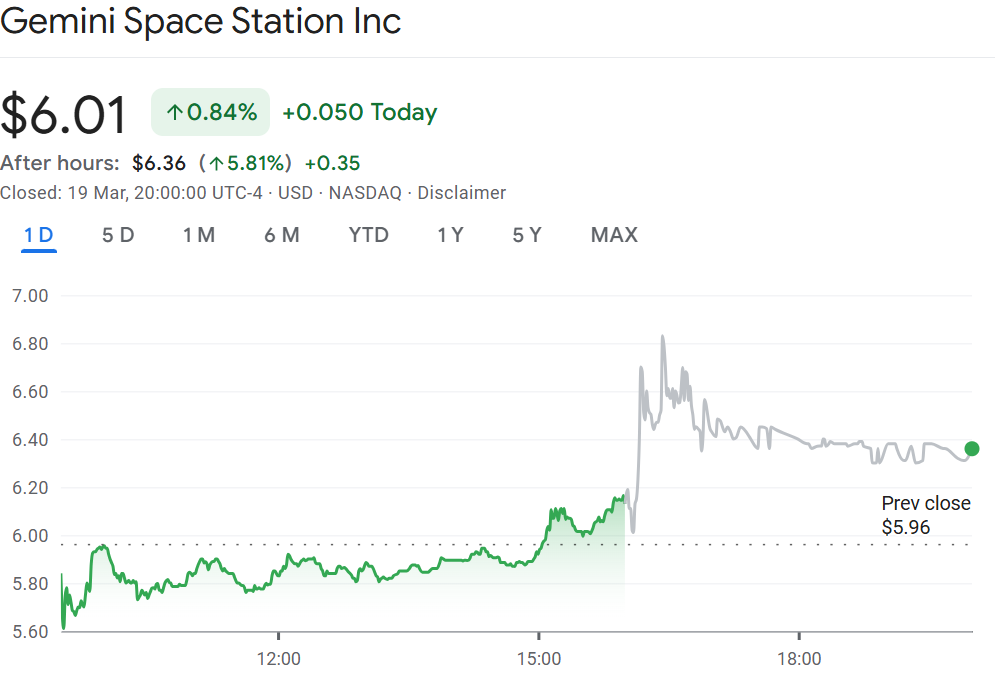
Shares in crypto exchange Gemini surged after hours as stronger-than-expected fourth-quarter results showed revenue growth driven by credit card adoption and a reworked fee structure.
Gemini reported on Thursday that its Q4 revenues rose 39% from the year-ago quarter to $60.3 million, reportedly beating analyst expectations of $51.7 million.
It reported a net loss of $140.8 million for Q4, deepening from its $27 million loss from a year ago. Gemini posted a total 2025 loss of $585 million, ahead of its total 2024 losses of $156.6 million.
Gemini co-founders Cameron and Tyler Winklevoss said in a shareholder letter that Q4 was the company’s highest quarterly revenue in three years, even with trading volumes declining, the revenue gain was reflective of “deliberate fee structure work through the back half of the year.”
Shares in Gemini (GEMI) initially jumped 14% after hours on Thursday to a high of $6.83, but settled at $6.36 for a gain of 5.8% after ending the trading day flat at around $6.

The results are Gemini’s second after going public in September and came amid a broad crypto market decline in late 2025, which saw Bitcoin (BTC) rapidly decline from its all-time peak above $126,000 in October.
Gemini lays off 30% of staff so far this year
In February, Gemini said it was withdrawing from the UK, the EU and Australia, citing challenging market conditions. The company also planned to lay off 25% of its workforce, in part due to artificial intelligence.
In their letter, Cameron and Tyler Winklevoss said Gemini had reduced its workforce by “roughly 30% since the start of 2026,” citing an increased use of AI.
“Today, AI is used in more than 40% of our production code changes and we expect that number to climb to close to 100% in the not-too-distant future,” they said. “Not using AI at Gemini will soon be the equivalent of showing up to work with a typewriter instead of a laptop.”
The Winklevoss brothers said the company’s plan this year was to “focus and double down on America,” adding they were encouraged by the pro-crypto stance of US market regulators.
Prediction markets and credit card key 2026 priorities
Gemini launched its in-house prediction market, Gemini Predictions, across all 50 US states in December, shortly after it obtained a license from the Commodity Futures Trading Commission.
Related: Gemini bets on ‘super app’ as stock sinks to record low on Q3 results
The company said it would refine and expand its prediction market offering and also scale its credit card and exchange.
The Winklevoss brothers said Gemini would “shift into becoming a markets company with Gemini Predictions” and use that infrastructure for its perpetual futures contracts once they’re approved in the US.
Magazine: Are DeFi devs liable for the illegal activity of others on their platforms?

Crypto World
FDIC, Federal Reserve, and OCC Move to Modernize Regulatory Capital Rules for All US Banks

TLDR:
- Three federal agencies jointly propose modernizing capital rules for banks of all sizes across the U.S.
- Largest banks would use one calculation set instead of two to meet risk-based capital requirements.
- Smaller banks may see moderate capital requirement reductions tied to traditional lending activities.
- All public comments on the three capital framework proposals must be submitted by June 18, 2026.
Regulatory capital framework proposals have been issued by three federal banking agencies for public comment. The Federal Deposit Insurance Corporation, the Federal Reserve Board, and the Office of the Comptroller of the Currency jointly released three proposals.
These aim to modernize capital requirements across banks of all sizes. The goal is to better align regulatory capital with risk. Capital levels are expected to modestly decrease but remain well above pre-financial crisis standards.
Largest Banks Face Enhanced Risk-Sensitivity Rules
The first proposal primarily targets the largest, most internationally active banks in the country. It would require these institutions to use one set of calculations instead of two.
This streamlines how banks determine compliance with risk-based capital requirements. The framework would also improve calibration across credit, market, and operational risks.
Under the proposal, market risk rules would apply only to banks with significant trading activity. All other banks would retain the option to voluntarily adopt this approach.
This change aims to reduce burden while improving consistency across banking institutions. Risk sensitivity across the regulatory capital framework would be enhanced as a result.
In a joint release, the FDIC, Federal Reserve, and OCC confirmed that the proposals are designed to benefit institutions of every size.
As stated in their joint release, the agencies are seeking to “modernize the regulatory capital framework for banks of all sizes.”
The statement reflects a broad effort to bring the framework in line with current market conditions. Public comment is being actively encouraged ahead of the June 18, 2026 deadline.
The agencies noted that a decade of experience revealed room for improvement in the current framework. Certain elements could be updated without reducing the safety and soundness of the system.
After the 2008 global financial crisis, regulators substantially increased loss-absorbing capital requirements. Stress testing requirements for large banks were also introduced during that period.
Smaller Banks and Systemic Risk Measurements Under Review
The second proposal applies broadly to all but the largest banking institutions in the system. It would better align capital requirements for traditional lending activities with actual risk.
Modifications to mortgage servicing capital requirements are also part of this proposal. These changes would extend to banks operating under the community bank leverage ratio framework.
Additionally, certain large banks would be required to reflect unrealized gains and losses on securities. This would directly affect their reported regulatory capital levels, subject to a transition period.
The adjustment aims to provide a more accurate picture of a bank’s financial position. Disincentives connected to mortgage origination would also be reduced under this framework.
The agencies further clarified the expected outcome of the combined proposals in their joint statement. They noted that the measures “would modestly reduce capital for large banks and moderately reduce requirements for smaller banks.”
This reflects the more traditional lending activities that community and regional banks typically carry. The reduction is calibrated to align requirements more closely with actual lending risk profiles.
The third proposal, issued solely by the Federal Reserve Board, addresses how systemic risk is measured. It would refine the additional capital requirement for the largest and most complex institutions.
The method for calculating systemic risk buffers would be updated accordingly. Altogether, capital levels across the system would still remain substantially higher than pre-crisis levels.

Digital assets are no longer a fringe experiment in finance, they’re fast becoming a core part of how banks, asset managers, fintechs and corporates plan to move money, store value and manage risk.
That’s the key takeaway from fintech firm Ripple’s survey of more than 1,000 global finance leaders, which reveals how the industry sees digital assets as urgent, and no longer optional.
Seven in 10 respondents said finance leaders must offer some kind of digital asset solution to stay competitive, underscoring a broad sense that the “digital asset revolution” is already underway.
Stablecoins, those digital tokens with values pegged to fiat currencies, such as the U.S. dollar, emerged as the most compelling use case: 74% of leaders said stablecoins can improve cash‑flow efficiency and unlock working capital, highlighting their growing appeal as treasury tools and not just payment rails.
Fintechs are leading the charge in adopting digital assets, with more of them already using digital assets in treasury and payments than banks or corporates. About 31% use stablecoins to collect payments for customers, and 29% accept stablecoins directly. Many also rely on digital asset custodians and infrastructure providers for custody, while 47% of fintechs want to build their own solutions.
More banks and asset managers want to tokenize assets and they need partners to do it. Of those looking, 89% focus on safe storage and custody first. Meanwhile, banks care a lot about token management (82%), with asset managers focusing more on distribution (80%).
Nearly all respondents – 97% – flagged security and certifications like ISO and SOC 2 as critical, with operational support and industry‑specific experience also weighing heavily.
The bottom line: digital assets are becoming a strategic necessity, and the infrastructure decisions made today are expected to shape competitive edge tomorrow.
Crypto World
Nevada Takes Aim at Kalshi: What This Means for Crypto Prediction Platform Legal Battles
Key Takeaways
- Kalshi’s emergency motion to halt Nevada enforcement action was rejected by the Ninth Circuit Appeals Court
- The platform faces a likely temporary restraining order that would suspend Nevada operations for a minimum of 14 days
- Nevada regulators issued a cease-and-desist order in March, claiming Kalshi operates unlicensed sports wagering
- The platform maintains its products are federally regulated by the CFTC, not subject to state gambling laws
- Multiple states including Connecticut, New York, and New Jersey are pursuing parallel enforcement actions against Kalshi and competing platforms
The Ninth Circuit Appeals Court has rejected Kalshi’s urgent petition to prevent Nevada from pursuing enforcement action against the platform’s sports-event trading products. This decision opens the door for state authorities to move forward with regulatory measures.
https://twitter.com/coinbureau/status/2024026094609768527?s=20
Back in March, Nevada’s Gaming Control Board delivered a cease-and-desist notice to Kalshi. State regulators contend that the platform’s sports-event trading products constitute illegal sports wagering operations without proper licensing.
According to gaming attorney Daniel Wallach, a temporary restraining order appears virtually certain at this point. Because Nevada statute prohibits appealing a TRO, Kalshi would be forced to suspend state operations for no less than 14 days.
https://twitter.com/WALLACHLEGAL/status/2034674972522680587?s=20
“Since a TRO is not appealable under Nevada law, Kalshi would be required to exit the state in the interim,” Wallach explained.
In its court filings, Kalshi has contended that the Commodity Futures Trading Commission holds exclusive regulatory authority over its products. The company asserted that preventing these contracts from operating would inflict “imminent harm” on its business operations.
With the emergency appeal denied, the matter heads back to federal district court as Nevada prepares its enforcement measures.
Platform Highlights Risk of Contradictory Judicial Decisions
Through a March 13 legal filing, Kalshi emphasized that permitting Nevada’s action to proceed alongside ongoing federal proceedings could result in conflicting judicial outcomes.
The company warned that both forums might arrive at “exactly the opposite conclusion” regarding whether federal commodities regulations preempt state gaming statutes. Kalshi characterized this scenario as potentially generating “jurisdictional chaos.”
At the heart of the dispute lies a fundamental question: whether federal authorities or state gaming regulators hold ultimate jurisdiction.
Multi-State Campaign Targets Prediction Trading Platforms
Nevada’s regulatory offensive is part of a broader pattern. Connecticut, New York, New Jersey, and additional jurisdictions have launched similar challenges against sports-event trading contracts on prediction market platforms.
Kalshi isn’t the sole platform under scrutiny. Crypto.com, Polymarket, and Coinbase are similarly entangled in legal confrontations with various state authorities over comparable offerings.
The prediction markets sector has experienced explosive expansion. Weekly transaction volumes across platforms such as Kalshi and Polymarket routinely exceed $2 billion, per Dune Analytics data.
This rapid growth has attracted regulatory attention from officials concerned about potential insider trading violations and market manipulation schemes.
Throughout these legal confrontations, Kalshi has consistently argued that state regulators lack jurisdiction to restrict event contracts already supervised by federal authorities.
The critical next phase involves a preliminary injunction hearing, which will decide whether Kalshi can maintain Nevada operations during the extended litigation process.
Crypto World
UK shuts down crypto exchange Zedxion after sanctions probe ties platform to Iranian networks


Britain’s company register has moved to dissolve cryptocurrency exchange Zedxion, accused of processing funds for Iran’s Islamic Revolutionary Guard Corps.
Summary
- Britain’s Companies House has moved to dissolve Zedxion after findings linked the exchange to IRGC-connected transactions and misleading incorporation details.
- TRM Labs estimates show Zedxion and Zedcex processed around $1 billion in funds tied to the IRGC, with exposure rising to 87% of volume in 2024.
According to a notice published on its website, Britain’s company register, Companies House said Zedxion has been shut down due to “information or a statement in an application for incorporation that is misleading, false or deceptive.”
An earlier investigation conducted by the Organized Crime and Corruption Reporting Project found that Zedxion’s listed director, Elizabeth Newman, was likely a fictitious identity.
Further, the company reportedly used stock images to represent Newman in promotional material.
Analysis conducted by TRM Labs found that Zedxion and its sister platform Zedcex processed roughly $1 billion in funds with connections to the IRGC, accounting for about 56% of the platforms’ total transaction volume. Subsequently, that share rose to 87% in 2024, when IRGC-linked flows reached approximately $619.1 million.
Incorporated in May 2021, Zedxion Exchange Ltd listed an individual named “Babak Morteza” as both director and person with significant control. Meanwhile, records show that the identifying details associated with that name match those of Babak Zanjani, an Iranian businessman previously accused of sanctions evasion.
Data further shows that “Babak Morteza” ceased to be listed in August 2022, after which Newman was appointed as director.
The latest action follows sanctions imposed by the U.S. Treasury’s Office of Foreign Assets Control, which designated Zedxion and a related entity, Zedcex, for helping Iran evade sanctions and for links to sanctioned financier Babak Zanjani.
Zanjani has also been sanctioned by the U.S. and European Union in 2013 for laundering billions in oil revenue on behalf of Iranian state entities, including the IRGC. He was later convicted in 2016 for embezzlement and sentenced to death, though the sentence was commuted in 2024 after he repaid funds.
Separately, U.S. regulators are probing Binance over alleged sanctions violations tied to more than $1 billion in transactions that may have moved through the platform.
Binance has denied the allegations, stating that it does not directly transact with sanctioned entities and has taken action to shut down accounts linked to suspicious activity.
Crypto World
Iran’s IRGC Turns Strait of Hormuz Into a $2 Million Toll Road for Global Tanker Traffic
TLDR:
- Iran’s IRGC charges up to $2M per tanker transit, accepting cash, crypto, or barter as payment.
- Between March 1–15, roughly 89–90 vessels cleared the strait under some form of IRGC approval.
- Total transit costs now exceed what moving an entire fleet through Hormuz cost six months ago.
- Sanctioning paying operators risks halting the only active oil supply channel through the strait.
The Strait of Hormuz has become a commercial toll point following reports of Iran’s IRGC charging tanker operators up to $2 million per passage.
The Financial Times confirmed the arrangement, with the IRGC verifying clearances over VHF radio. Between March 1 and March 15, roughly 89 to 90 vessels transited under some form of IRGC clearance, according to Lloyd’s List Intelligence.
Payments are made in cash, cryptocurrency, or through barter, and the commercial precedent is now firmly established.
How the IRGC Toll Mechanism Operates at the Strait of Hormuz
The process begins when a tanker operator contacts intermediaries linked to the IRGC. Negotiations follow, and a fee of up to $2 million per voyage is agreed. Payment is accepted in cash, cryptocurrency, or through barter. The vessel then receives clearance to proceed.
The IRGC hails the tanker on VHF radio to verify its AIS transponder data. After confirmation, the ship is granted passage through the strait.
Not all 89 to 90 vessels paid the toll between March 1 and March 15. Iranian and allied ships, along with some Indian tankers, received passage through separate government-to-government arrangements.
Analyst Shanaka Anslem Perera shared key details on X about the toll arrangement. He described how intermediaries negotiate with the IRGC and confirmed that payments are made in cash or crypto.
At least one operator paid the toll explicitly, his post confirmed. That single transaction set a benchmark the broader market now faces.
The $2 million toll adds to soaring war-risk insurance costs. A VLCC worth $120 million pays between $3.6 million and $6 million in war-risk premiums per voyage.
Charter rates have also quadrupled, reaching up to $800,000 per day. Moving one crude cargo now costs more than an entire fleet transit did six months ago.
Cost Flows to Consumers as the Strait of Hormuz Becomes Self-Financing
Every dollar added at the strait eventually reaches end consumers. The toll raises prices for crude, LNG, urea, and pharmaceuticals.
The $2 million is not a cost confined to the shipping industry. Billions of people downstream absorb it through higher commodity prices.
The IRGC appears to have created a self-sustaining revenue loop through the closure. The blockade generated scarcity, and that scarcity pushed operators to pay for passage.
Those payments reportedly fund the same provincial commands that enforced the initial closure. The mechanism sustains itself without any external financing.
The United States is likely to frame these toll payments as state-sponsored terrorism financing. Expected responses include sanctions on paying operators and expanded designations on intermediaries.
A naval escort pledge involving six allied nations is also set to accelerate. However, enforcement carries a direct contradiction in practice.
Sanctioning every paying operator removes the only vessels currently moving oil through the strait. The toll, though extortion, remains the only active supply channel in the region.
Iran has reopened the Strait of Hormuz selectively, on its own terms and at its own price. The boundary between a military operation and a protection racket has effectively collapsed.


The crypto market held close to the $2.5 trillion market cap with no signs of movement as traders reassess their positions amid the current market environment.
Summary
- Crypto market held near $2.5 trillion with muted price action as Bitcoin stalled above $70,000 and major altcoins posted modest declines.
- Investor sentiment weakened amid Middle East tensions, rising oil prices, and hawkish Fed signals following stronger-than-expected U.S. inflation data.
- Lack of fresh liquidity, ETF caution, and a record $5.7 trillion options expiry contributed to sideways trading and $393 million in liquidations.
Bitcoin (BTC), the so-called digital gold asset, has stalled shortly after reclaiming the $70,000 mark following its 8% drop since hitting its Wednesday high. Ethereum (ETH) fell 2.2% to under $2,200, while other major crypto assets such as XRP (XRP), BNB (BNB), and Solana (SOL) were each down 1% on Friday.
The broader market slowdown comes as multiple pressures converge on investor sentiment.
First, the escalation of the ongoing war in the Middle East continues to deteriorate investor appetite for risk assets. Notably, investors are rotating capital back to traditional safe-haven assets such as Gold and other precious metals to hedge against the rising inflation caused by a surge in oil prices, which reached record highs recently.
Gold price rose over 2% today, back above $4,700 per ounce, while Silver rose nearly 4% to hit the $73 mark.
Second, recent inflation data suggest that the odds of the Federal Reserve cutting interest rates this year seem off the table. The U.S. PPI data came in much hotter than expected at 0.7% month over month, and was followed by a hawkish statement by Jerome Powell, who reiterated that the Federal Reserve would continue to remain data dependent and warned that if inflation progress stalls, rate cuts will not occur.
Risk assets, including cryptocurrencies, have historically retreated or traded sideways when the Fed takes a cautious stance towards rate cuts.
Third, several key Asian tech stocks, such as Japan’s Nikkei 225 and China’s Shanghai Composite, have fallen after opening on Friday. It followed a similar trend to the U.S. tech stocks that showed over the past day.
Cryptocurrencies, including Bitcoin, have often mirrored the movements of high-growth technology indices during periods of global market uncertainty.
Fourth, Wall Street will be facing a massive $5.7 trillion options expiry today, the largest March “triple-witching” event on record, which is expected to drive significant market volatility across markets. Cryptocurrencies often trade sideways during such massive settlement windows as traders brace for spillover volatility.
Data from CoinGlass show that the crypto market experienced $393 million in liquidations across leveraged markets in the past 24 hours, with the majority from traders with long positions, suggesting trades could be unwinding rapidly as they await more clarity from the macroeconomic landscape.
Fifth, the total market cap of stablecoins has shown no net movement over the past 24 hours, standing at $312 billion. A relatively calmer stablecoin market means there is a lack of fresh liquidity entering the ecosystem to spark a meaningful recovery in prices.
Disclosure: This article does not represent investment advice. The content and materials featured on this page are for educational purposes only.
Key Takeaways
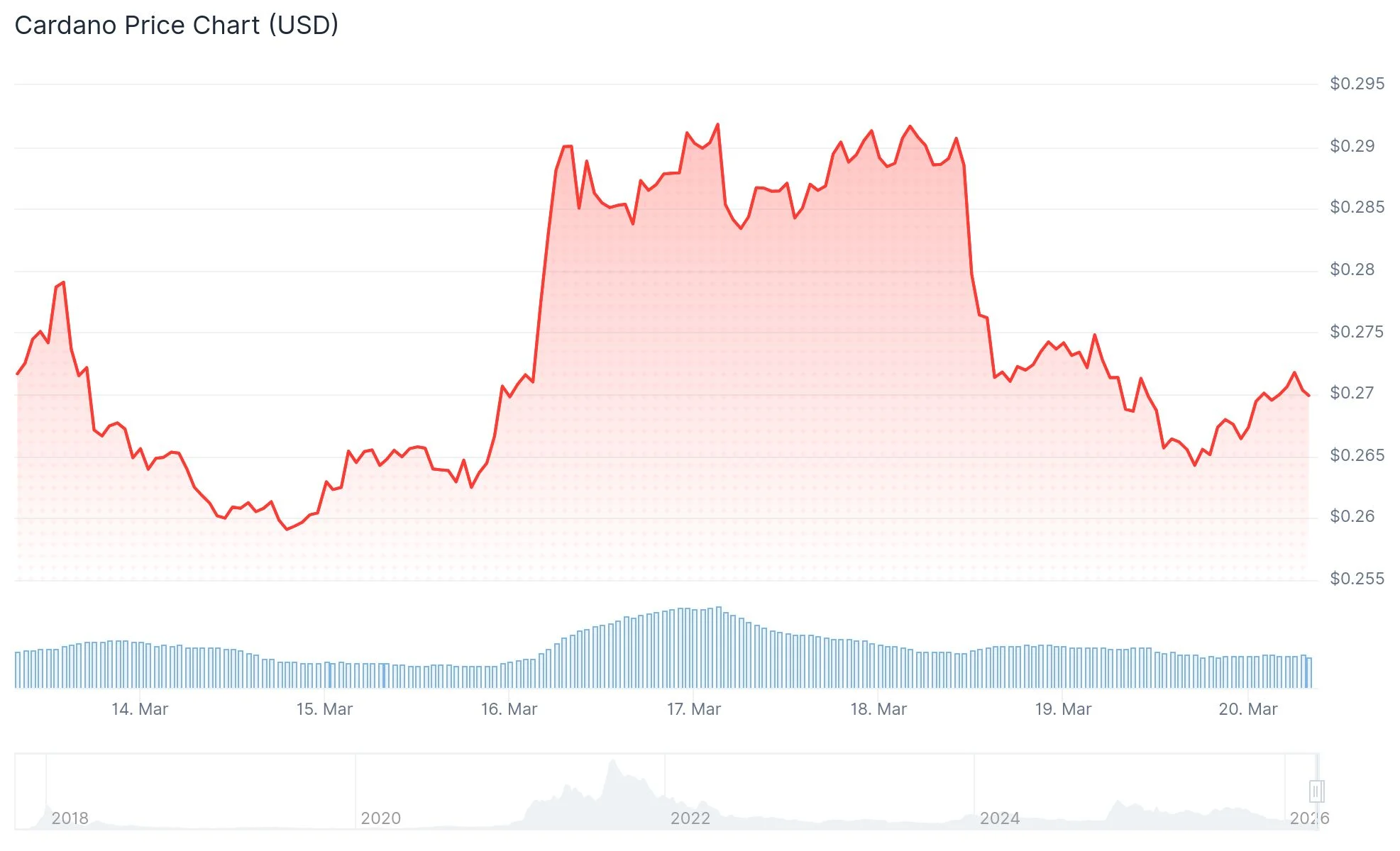
- Cardano’s price declined 1.86% over 24 hours, currently trading around $0.267 within the $0.26–$0.27 support zone
- Joint regulatory guidance from the SEC and CFTC provides clarity on crypto asset classification, including commodities and securities
- The Protocol 11 (van Rossem) hard fork approaches as Node 10.7.0 prerelease readies for deployment
- Bearish momentum persists; bulls must break above $0.28 resistance to challenge $0.29–$0.30 levels
- Technical analyst @alicharts identified a TD Sequential buy signal on weekly timeframes, projecting potential moves to $0.32 and $0.37
Cardano (ADA) currently hovers around $0.267, reflecting a 1.86% decline in the last 24-hour period. The digital asset maintains position within a consolidation range spanning $0.26 to $0.27.
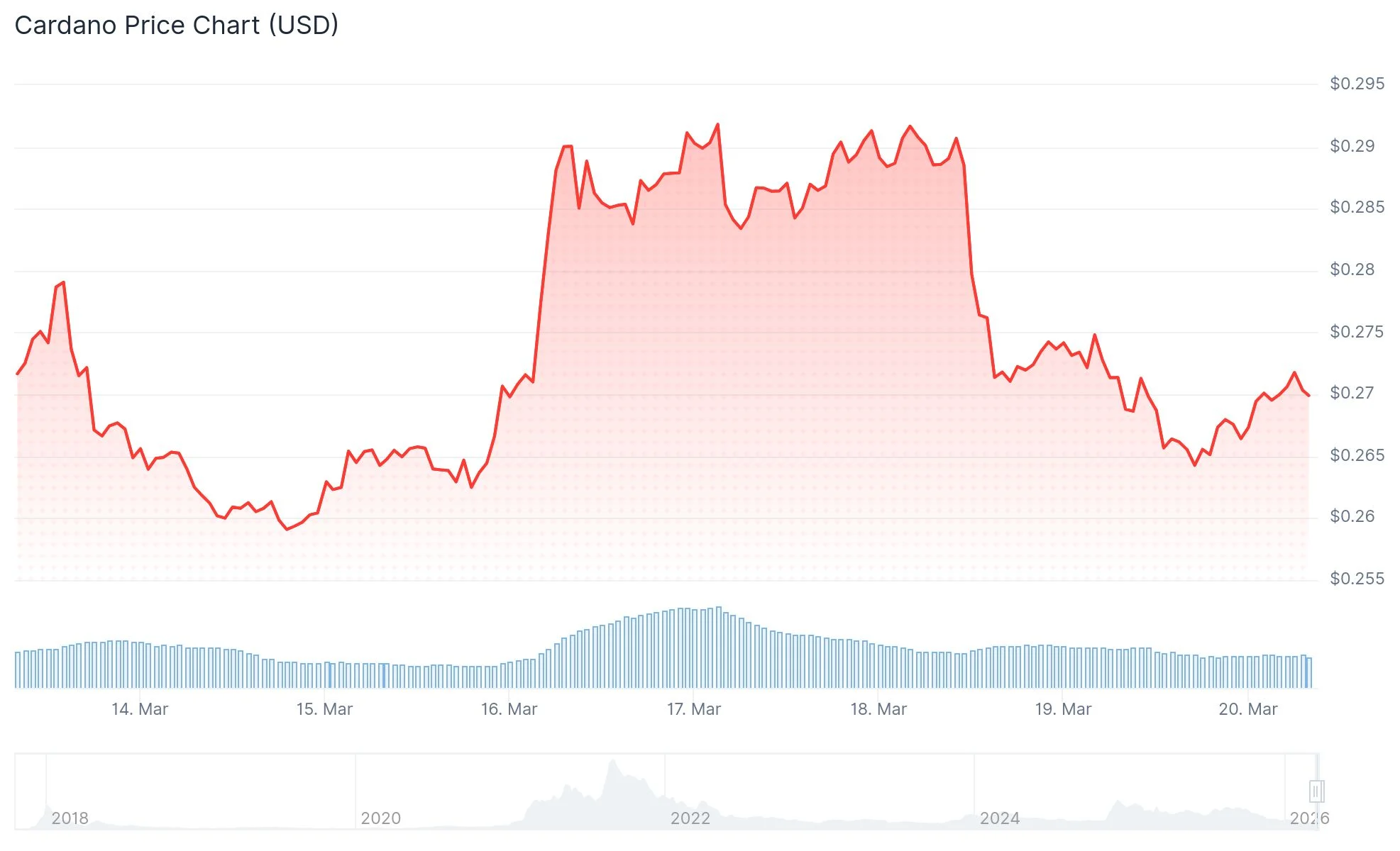
The wider cryptocurrency landscape experienced similar downward pressure throughout this timeframe. The aggregate global crypto market capitalization decreased 1.26%, settling at $2.41 trillion.
Escalating geopolitical tensions across Middle Eastern regions contributed to surging crude oil valuations. These developments reignited inflationary fears and prompted widespread selling across risk-oriented assets, including digital currencies.
Bitcoin maintained its position above the $70,000 threshold despite modest daily losses. Ethereum preserved support above $2,100 while XRP remained anchored above $1.40.
Examining the four-hour timeframe reveals that ADA bears reasserted dominance following an unsuccessful attempt to breach recent peak levels. The MACD histogram displays red bars positioned beneath the signal line, while the RSI indicator rests below the 50 midpoint, suggesting near-term bearish pressure.
For bullish traders to regain momentum, ADA must successfully recapture the $0.28 resistance level. A decisive move beyond this threshold could unlock pathways toward $0.29, followed by $0.30.
Market analyst Ali Charts shared observations on X, highlighting that Cardano has formed a TD Sequential “black 9” buy signal across weekly charts. The analyst indicated this technical pattern “typically anticipates 1–4 weeks of upward expansion,” establishing price objectives at $0.32 and $0.37, contingent upon ADA maintaining $0.23 support on weekly closing prices.
https://twitter.com/alicharts/status/2034859227110351302?s=20
Regulatory Agencies Issue Unified Crypto Framework
The United States Securities and Exchange Commission, alongside the Commodity Futures Trading Commission, published collaborative guidance addressing crypto asset categorization. The regulatory bodies delineated distinct classifications encompassing digital commodities, collectibles, stablecoins, and digital securities.
The framework further clarifies circumstances under which tokens qualify as investment contracts and conditions enabling that designation to expire. The CFTC acknowledged that certain non-security tokens may meet commodity classification criteria. Market observers suggest enhanced regulatory transparency could influence ADA’s investor sentiment and future exchange-traded fund conversations.
Network Upgrade Advances Toward Mainnet Deployment
Cardano progresses toward its subsequent network enhancement. The intra-era hard fork implementing Protocol 11, designated as van Rossem, anticipates activation within the forthcoming days.
https://twitter.com/IntersectMBO/status/2034598520892571701?s=20
The upgrade necessitates two sequential node releases. Node 10.6.2 deployed in February. Node 10.7.0 represents the concluding requirement before the hard fork can execute.
Intersect, a membership-driven organization within the Cardano ecosystem, verified that the Node 10.7.0 prerelease is anticipated imminently.
Protocol 11 introduces additional Plutus built-in functions through multiple Cardano Improvement Proposals. These enhancements incorporate an array type (CIP-138), refined MaryEraValue processing (CIP-153), modular exponentiation capabilities (CIP-109), and multi-scalar multiplication supporting advanced cryptographic operations (CIP-133).
The upgrade preserves existing transaction architecture without disrupting deployed smart contracts. Hardware wallet functionality remains unaffected. SanchoNet currently operates these capabilities in testing environments.
Mainnet activation will proceed following successful testnet fork completion.
Quick Overview
- A tokenized version of the Coinbase Bitcoin Yield Fund has been introduced on the Base blockchain through a collaboration between Coinbase Asset Management and Apex Group.
- The investment vehicle aims to deliver 4% to 8% yearly returns denominated in Bitcoin through options strategies and lending activities.
- Apex Group functions as the blockchain-based transfer agent, managing compliance protocols and ownership documentation.
- The fund utilizes the ERC-3643 token framework, which integrates investor verification requirements directly within each digital token.
- Access is presently limited to institutional and accredited investors outside the United States, with domestic availability expected in the future.
Coinbase Asset Management (CBAM) has partnered with financial services provider Apex Group to introduce a tokenized share class of its Bitcoin Yield Fund, deploying it on Base, the Ethereum Layer-2 network developed by Coinbase.
https://twitter.com/BSCNews/status/2034729035117600807?s=20
Apex Group, which manages approximately $3.5 trillion in assets under administration, takes on the role of on-chain transfer agent. This responsibility includes maintaining digital ownership records, implementing regulatory compliance protocols, and recording all transactions natively on the Base blockchain infrastructure.
The investment strategy seeks to generate between 4% and 8% in annual Bitcoin-denominated returns. The fund achieves this through various mechanisms, including the sale of covered call options on Bitcoin holdings and engagement in strategic lending programs.
Coinbase initially introduced the international version of this yield fund in April 2025, followed by a domestic offering in October 2025. The blockchain-native tokenized share class has now been activated exclusively for investors based outside the United States.
Brett Tejpaul, who leads Coinbase Institutional, noted that numerous institutional market participants maintain significant Bitcoin and Ether allocations as foundational portfolio holdings. This yield-generating product provides these investors with an opportunity to earn incremental returns during periods when they’re holding assets for price appreciation.
Understanding the Compliance Framework
The tokenized offering leverages the ERC-3643 permissioned token protocol. This technical standard incorporates investor verification and eligibility validation mechanisms directly within the token’s code structure.
Wallets that haven’t completed the required onboarding and verification procedures will find transfer transactions automatically rejected by the smart contract. This approach eliminates the need for manual compliance oversight by encoding regulatory requirements into the token architecture itself.
Anthony Bassili, president of Coinbase Asset Management, explained that the infrastructure validates “identity and eligibility at the token level.” Currently, only qualified institutional and accredited investors located outside U.S. jurisdiction can participate in the offering.
Coinbase has indicated intentions to release a tokenized iteration of its domestic fund, though no timeline has been publicly disclosed.
Apex’s Broader Blockchain Strategy
Apex completed its acquisition of Tokeny in the previous year. Prior to the transaction, Tokeny had enabled the tokenization of assets exceeding $32 billion in total value.
The company has publicly committed to tokenizing $100 billion worth of investment funds through its T-REX Ledger platform by June 2027. This infrastructure is engineered to facilitate ownership management and regulatory compliance across multiple blockchain networks.
This product launch positions Coinbase among an expanding group of prominent asset management firms deploying tokenized investment vehicles. Industry leaders including BlackRock, Fidelity, and Franklin Templeton have all rolled out comparable blockchain-based offerings in recent years.
Projections for the tokenized asset sector show considerable variation. McKinsey’s analysis forecasts the market reaching $2 trillion by 2030, while collaborative research from BCG and Ripple suggests the industry could grow to $18.9 trillion by 2033.
According to Apex, the tokenized share class is “set up to interact with compatible platforms, wallets, and infrastructure without compromising compliance.”
The blockchain-based share class of the fund became operational on Base as of March 19, 2025.
Key Highlights
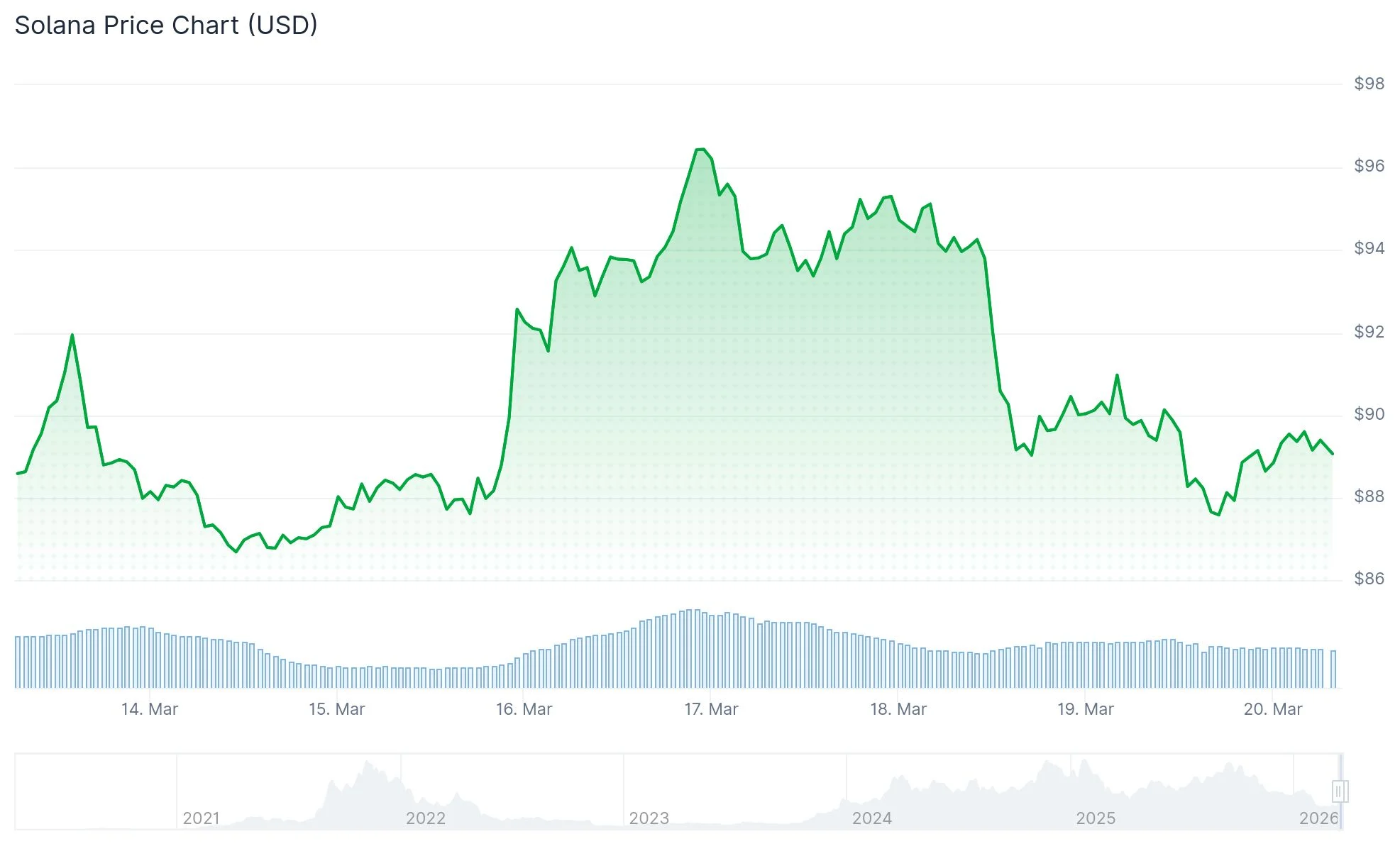
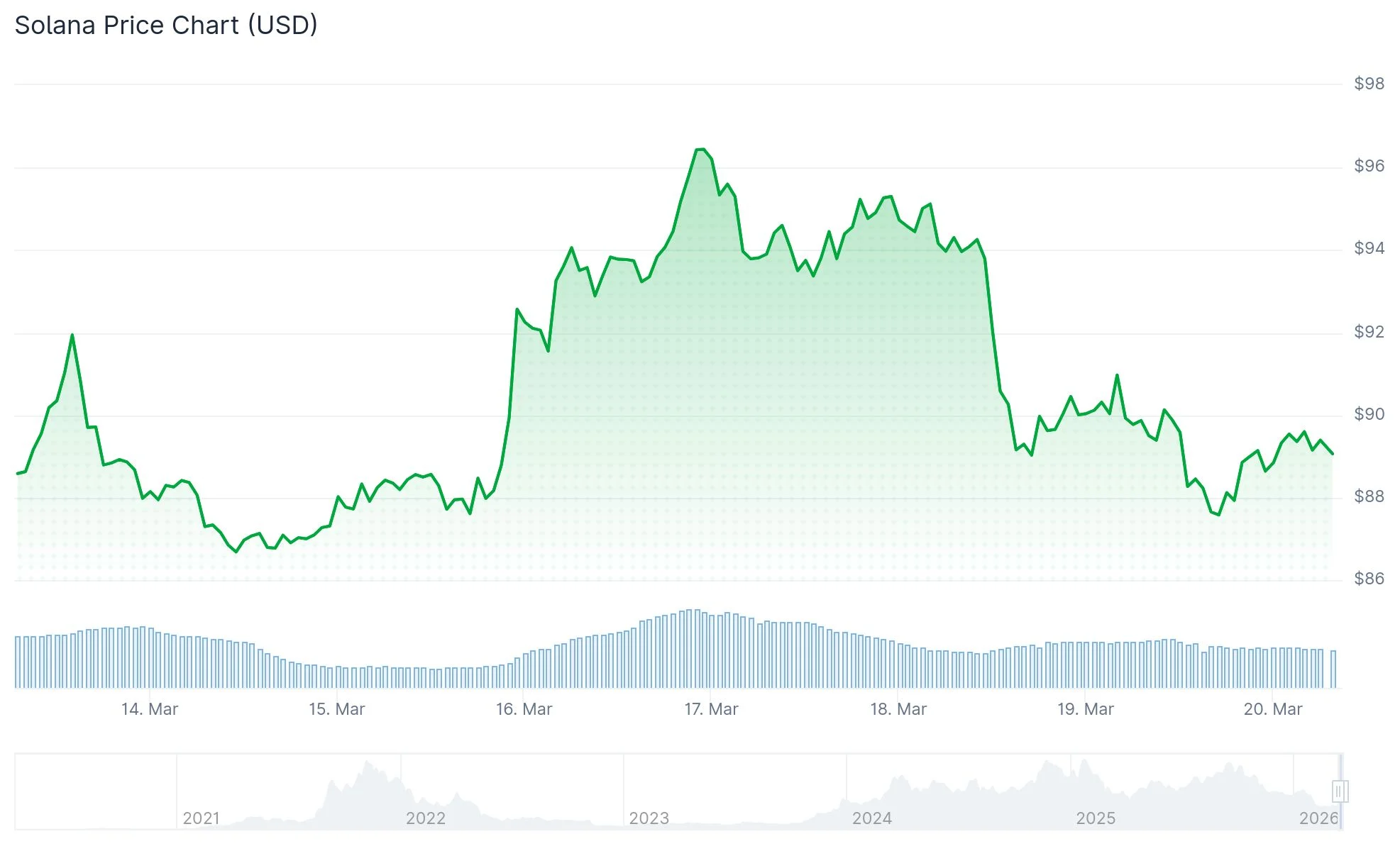
- Solana’s SOL token plummeted 11% over a three-day period, declining from $97.70 to $87 and triggering $25 million in liquidations.
- Perpetual futures funding rates for SOL have reached 0%, indicating minimal bullish interest in leveraged trading.
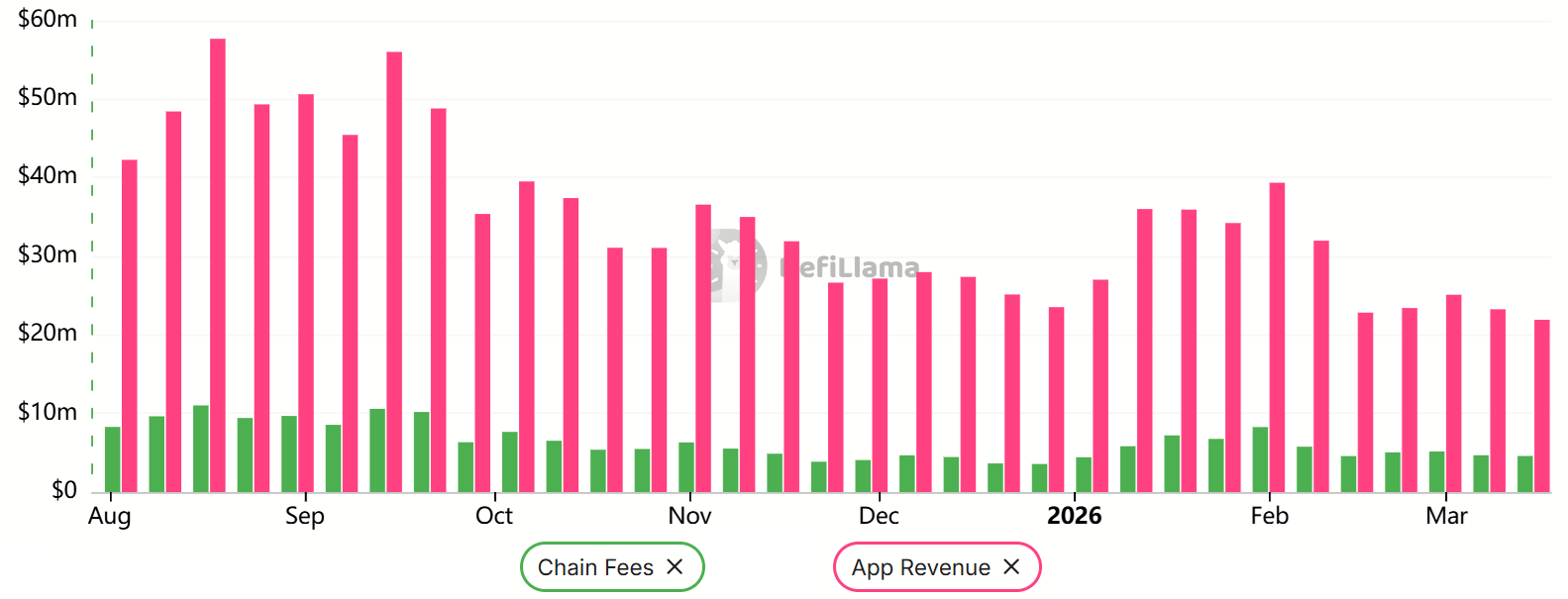
- DApp revenue on the Solana network plunged to $22 million, marking an 18-month low from $36 million recorded eight weeks earlier.
- Specialized derivative platforms like Hyperliquid now dominate with over 80% of perpetual futures trading volume.
- Corporate SOL holders including Forward Industries and DeFi Development Corp. are experiencing losses on their treasury positions.
The Solana ecosystem has encountered significant headwinds this week. Following a peak of $97.70 earlier this week, the SOL token experienced an 11% correction over 72 hours, bottoming out at $87. This sharp decline resulted in $25 million worth of long position liquidations, dampening market sentiment among traders.
The futures market signals are equally concerning. Funding rates for SOL perpetual futures contracts have collapsed to approximately 0%, indicating a complete absence of bullish appetite for leveraged long positions. Typically, these rates maintain levels around 9% when market participants exhibit optimistic positioning. For the past 30 days, bearish traders have dominated the derivatives landscape.
The options market reflects similar pessimism. Deribit’s 30-day delta skew metric surged to 12% this Thursday, suggesting that put options—which generate profits from declining prices—command higher premiums than call options. This premium structure reveals that sophisticated market participants and institutional traders are positioning defensively against additional downside, despite SOL already trading 70% beneath its record high.
Network Revenue Decline Compounds Market Weakness
The revenue generated by Solana’s decentralized applications has contracted to an 18-month nadir of $22 million. This represents a significant decline from the $36 million recorded merely two months prior. While this deterioration isn’t exclusive to Solana—BNB Chain witnessed a 52% revenue contraction during the same timeframe—it underscores widespread weakness in blockchain network activity.
Solana maintains its position as the leading blockchain for decentralized exchange activity, powered by platforms such as Pump, Raydium, and Orca. However, the derivatives trading landscape tells a different narrative. Purpose-built derivative chains—including Hyperliquid, Edgex, Zklighter, and Aster—have captured more than 80% of the perpetual contract trading market.
The introduction of an officially sanctioned S&P 500 Index perpetual futures product on Hyperliquid, created by Trade[XYZ], has further diverted liquidity and trader attention from Solana-based protocols. The tokenized equities sector is now approaching $1.1 billion in aggregate assets.
Technical Analysis Shows Bearish Pattern Formation
From a technical perspective, market analysts have identified a bearish fractal developing on Solana’s price chart. Analyst Elja highlighted that the current price action bears striking resemblance to a January 2026 pattern where SOL rallied into resistance zones before experiencing a sharp reversal. Both instances feature similar characteristics: upward movement into resistance following a decline, followed by rapid momentum loss.
https://twitter.com/Eljaboom/status/2034310769488416909?s=20
With a market capitalization of $51 billion, SOL trades at a 42% discount relative to BNB’s $88 billion valuation. Nevertheless, Solana demonstrates superior fundamentals in certain metrics—generating $20.8 million in 30-day network fees compared to BNB Chain’s $9.1 million, while maintaining a total value locked (TVL) of $6.9 billion versus BNB Chain’s $5.7 billion.
Corporate entities such as Forward Industries and DeFi Development Corp., which incorporated SOL into their balance sheet strategies, are presently facing unrealized losses on these holdings.
Crypto World
Geopolitical Tensions and Energy Markets Drive Bitcoin to $70,800 as Traditional Markets Struggle
Key Highlights
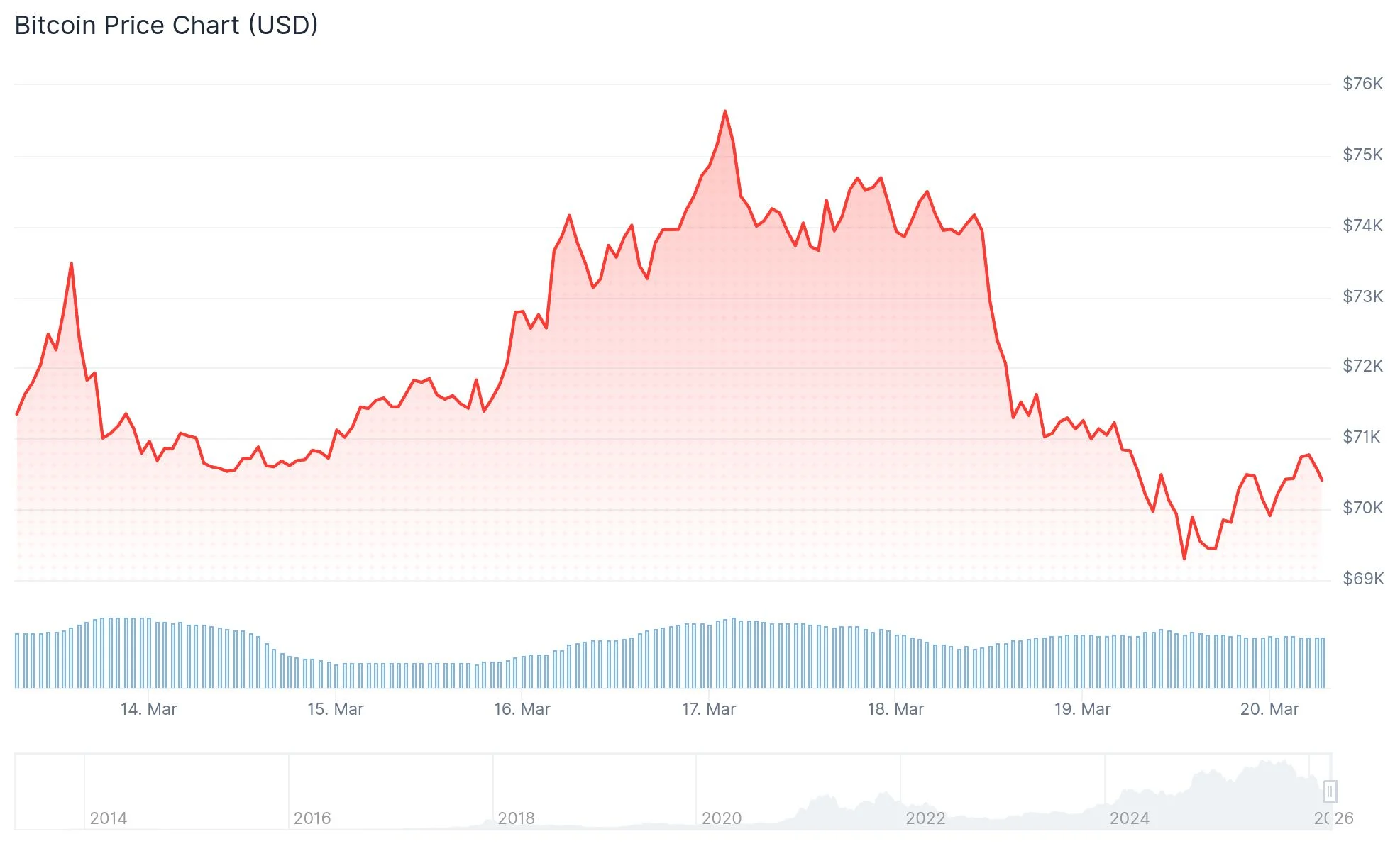
- Bitcoin surged above $70,800, registering gains exceeding 1% following announcements from six leading economies aimed at securing energy supply routes and stabilizing global markets.
- Crude oil retreated nearly 2%, with WTI sliding to $93.80 following a coordinated statement from Britain, France, Germany, Italy, the Netherlands, and Japan.
- Alternative cryptocurrencies including Ether, XRP, and Solana posted modest increases under 1%, underperforming Bitcoin’s rally.
- The S&P 500 crossed beneath its 200-day moving average for the first occasion since May of the previous year, indicating potential bearish momentum.
- Federal Reserve officials have indicated interest rates will likely remain unchanged, with market participants not anticipating cuts despite one potential reduction still being discussed.
Bitcoin spearheaded a widespread cryptocurrency market rebound on Friday as declining oil prices provided relief for risk-sensitive assets. The leading digital currency advanced to $70,800, posting daily gains exceeding 1%, following an overnight decline that saw prices touch $68,900.
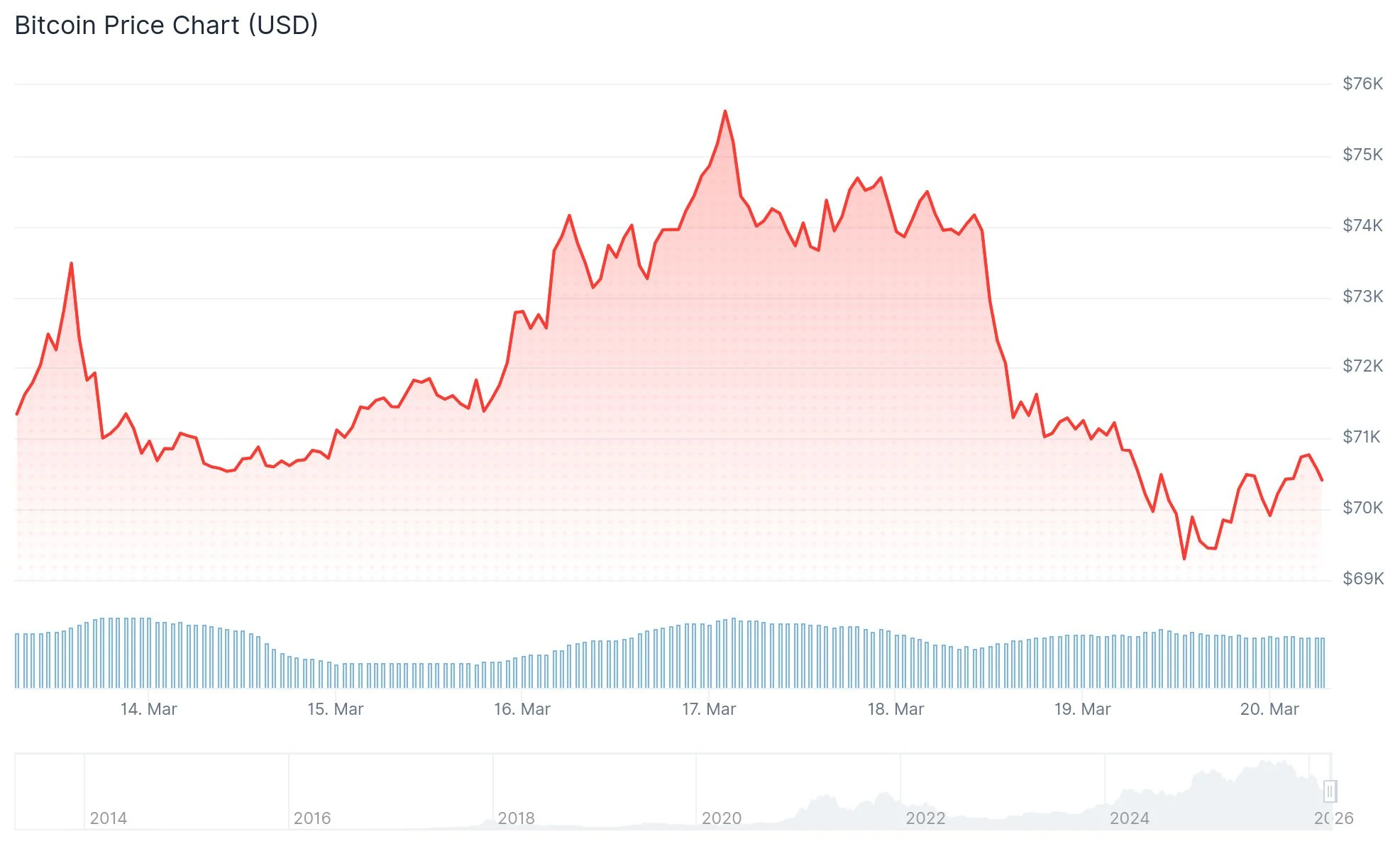
The cryptocurrency’s upward movement coincided with a coordinated announcement from six leading industrialized nations — the United Kingdom, France, Germany, Italy, the Netherlands, and Japan — who collectively denounced Iran’s recent military actions and committed to guaranteeing secure transit through the strategically vital Strait of Hormuz. The declaration was distributed through UK Prime Minister Keir Starmer’s official channels.
West Texas Intermediate crude oil declined approximately 2% to reach $93.80 in the wake of the announcement. Brent crude experienced comparable reductions. Additionally, U.S. Treasury Secretary Scott Bessent indicated on Thursday that the administration might consider removing sanctions on Iranian oil tankers and potentially utilize the nation’s Strategic Petroleum Reserve.
Other digital assets experienced more moderate movements. Ether, XRP, and Solana each posted gains below 1%, underperforming Bitcoin’s recovery.
Neverthstanding the rebound, market volatility persists. The Middle Eastern conflict continues to unfold, and WTI crude maintains trading levels significantly elevated compared to pre-conflict prices, hovering near crucial support around $92. Market analysts from Mott Capital Management noted that oil maintains an upward bias as long as it sustains that support threshold.
Equity Markets Face Continued Headwinds
Traditional stock markets continued experiencing pressure as the week drew to a close. U.S. futures contracts showed modest improvement Friday morning, with Dow futures advancing 0.2% and S&P 500 futures climbing 0.1%. However, the overarching trend remains decidedly negative.
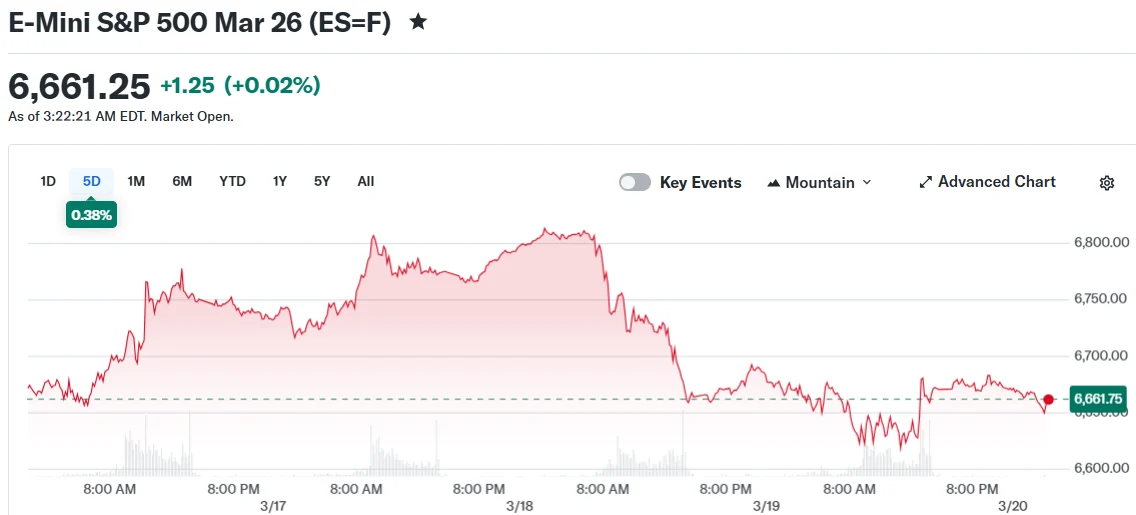
Primary U.S. equity indexes are positioned for their fourth consecutive week of declines. The Dow has fallen approximately 1.2% over the week, while the S&P 500 has retreated about 0.4% and the Nasdaq has declined roughly 0.1%. Both the Dow and Nasdaq are currently trading approximately 8% beneath their recent all-time peaks.
During Thursday’s session, the S&P 500 finished trading beneath its 200-day simple moving average for the initial time since May of last year. This technical development is closely monitored by market participants as an indicator of changing market dynamics.
https://twitter.com/TrendSpider/status/2034691377775145236?s=20
Market sentiment received a modest boost following comments from Israeli Prime Minister Benjamin Netanyahu, who stated Israel was contributing to U.S.-led efforts through intelligence cooperation and additional support directed at reopening the Strait of Hormuz. He also implied the regional conflict might conclude earlier than widespread expectations suggest.
Central Bank Policy Maintains Market Uncertainty
The Federal Reserve this week communicated increasing ambiguity regarding both economic expansion and inflationary pressures. Fed Chair Jerome Powell’s recent statements have led market participants to anticipate stable interest rates in the near term, despite policymakers acknowledging that one rate reduction could materialize before year’s end.
This positioning has left both cryptocurrency and conventional financial markets vulnerable to energy price fluctuations, with minimal cushion from anticipated monetary policy easing.
Regarding corporate developments, the quarterly earnings reporting period has largely concluded. GameStop and Carnival are scheduled to announce their financial results in the coming week.

China Is Helping Drive Cuba’s Solar Boom

Nasa camera accidentally captures moment comet breaks up in real time | News Tech

Zillow Stock Rises After Compass Drops Lawsuit on Home Marketing


-
Crypto World6 days ago
HYPE Token Enters Net Deflation as HyperCore Buybacks Outpace Staking Rewards
-

 Tech5 days ago
Your Legally Registered ‘Motorcycle’ Might Not Count Under Proposed US Law
-

 Fashion7 days ago
Weekend Open Thread: Addict Lip Glow
-
 Tech3 days ago
Are Split Spacebars the Next Big Gaming Keyboard Trend?
-
Sports6 days ago
Why Duke and Michigan Are Dead Even Entering Selection Sunday
-

 Business5 days ago
Search for Savannah Guthrie’s Mother Enters Seventh Week with No Arrests
-

 Business6 days ago
US Airports Launch Donation Drives for Unpaid TSA Workers as Partial Government Shutdown Enters Fifth Week
-
Crypto World6 days ago
Coinbase and Bybit in Investment Talks: Could Bybit Finally Enter the US Crypto Market?
-

 Business4 days ago
Australian shares drop as Iran war enters third week
-

 Business6 days ago
Country star Brantley Gilbert enters growing non-alcoholic beer market
-

 Crypto World4 days ago
Crypto Lender BlockFills Enters Chapter 11 with Up to $500M in Liabilities
-

 Sports7 days ago
College Basketball Best Bets: Conference Tournament Semifinal Picks
-

 Politics2 days ago
The House | The new register to protect children from their abusers shows Parliament at its best
-

 News Videos2 days ago
RBA board divided on rate cut, unusually buoyant share market | Finance Report | ABC NEWS
-

 Fashion4 days ago
25 Celebrities with Curly Hair That Are Naturally Beautiful
-

 Tech4 hours ago
inKONBINI Lets You Spend Summer Days Behind the Register
-

 Crypto World2 days ago
Canada’s FINTRAC revokes registrations of 23 crypto MSBs in AML crackdown
-
 Politics3 days ago
Real-time pollution monitoring calls after boy nearly dies
-

 Crypto World6 days ago
Crypto Losses Drop 87% in February, But Hackers Are Now Targeting People, Not Code
-
 NewsBeat1 day ago
Residents in North Lanarkshire reminded to register to vote in Scottish Parliament Election


You must be logged in to post a comment Login