
Crypto World
Gemini stock gains 6% after-hours on Q4 earnings

Gemini pushed through a better-than-expected fourth quarter even as the broader crypto market remained under pressure. The exchange reported revenue of $60.3 million for Q4, up 39% from a year earlier and ahead of consensus estimates of about $51.7 million. However, the company also posted a net loss of $140.8 million for the quarter, widening from a $27 million loss in the same period a year ago. For the full year, Gemini’s loss totaled $585 million in 2025, compared with $156.6 million in 2024. The results come after the platform went public in September and amid a late-2025 crypto drawdown that saw Bitcoin slide from its peak above $126,000 in October.
Shares of Gemini initially moved higher in after-hours trading, climbing as much as 14% to a high of $6.83 before settling around $6.36, for a gain of roughly 6% on the session. The day’s action mirrored the market’s mixed reception to a growth-focused quarter that delivered a revenue win but did not escape the ongoing profitability challenge for many crypto incumbents.
Key takeaways
- Gemini’s Q4 revenue of $60.3 million rose 39% year over year and beat estimates of about $51.7 million, signaling business momentum even as trading volumes cooled.
- The quarter produced a net loss of $140.8 million, deepening from a $27 million loss a year earlier; the company’s 2025 loss reached $585 million, higher than 2024’s $156.6 million.
- Management cited deliberate fee-structure optimization and other efficiency measures as drivers of revenue growth, even with a softer trading environment.
- Gemini is accelerating a strategic shift toward a markets-focused organization, highlighted by the launch of Gemini Predictions across all 50 states and a plan to leverage that infrastructure for perpetual futures once approved in the U.S.
Strategic ambitions sharpen as cost discipline takes center stage
In a February update, Gemini said it was trimming its workforce by roughly 30% since the start of 2026, citing challenging market conditions. The leadership framing this downsizing as part of a broader pivot toward a more AI-driven, efficiency-first operating model. Co-founders Cameron and Tyler Winklevoss highlighted a rapid integration of artificial intelligence into the development process, noting that AI is now used in more than 40% of production code changes and is expected to rise significantly in the near term. “Not using AI at Gemini will soon be the equivalent of showing up to work with a typewriter instead of a laptop,” they wrote in a shareholder letter.
The Winklevoss duo signaled a clear pivot toward a U.S.-centric growth strategy, underscoring optimism about a pro-crypto regulatory environment in the United States. They stressed that 2026 would be about focusing and expanding in America, aligning with a broader investor interest in platforms that can scale within clearer regulatory boundaries.
From trading floors to markets infrastructure: Predictions and futures ambitions
Gemini has been building out its markets-oriented toolkit, most notably with Gemini Predictions. The platform rolled out its in-house prediction market across all 50 states in December, shortly after obtaining a license from the Commodity Futures Trading Commission. The company described its longer-term plan as turning Gemini into a “markets company” anchored by predictions, with the potential to extend that framework to perpetual futures contracts once U.S. approval is secured.
The December launch followed a prior line of coverage noting Gemini’s broader ambition to expand beyond traditional exchange functions into more complex financial primitives. As part of the 2026 roadmap, the company intends to refine and grow Predictions while simultaneously scaling its credit card program and exchange services, tapping into a more diversified revenue mix that could help weather ongoing volatility in crypto trading volumes. In evaluating the strategic path, investors will also be watching how regulatory feedback in the U.S. shapes the pace of approvals for new product categories, including perpetual futures.
These plans come against the backdrop of a February update that confirmed Gemini’s withdrawal from the U.K., the EU and Australia, a move the company attributed to tougher market conditions. The leadership’s stated aim is to “focus and double down on America,” a stance that aligns with the firm’s renewed investment in U.S.-based market infrastructure and its growing bets on a more favorable regulatory climate for crypto innovation.
The company’s quarterly results reflect a broader pattern among newer, publicly traded crypto platforms: revenue growth can outpace trading volumes due to fee-structure optimization, product diversification and active expansion into non-trading monetization streams. Gemini’s fourth-quarter performance—driven by its credit card program and pricing strategy—offers a data point suggesting that meaningful upside can still emerge even amid a subdued price cycle. The question for investors now is whether the path to profitability can be accelerated through AI-enabled efficiency gains and a clearer, U.S.-centered growth engine, supported by product bets in prediction markets and, potentially, regulated futures.
According to the company’s investor materials, the Q4 results marked the highest quarterly revenue in three years, reflecting the impact of the revised fee structure through the back half of 2025 and a push into more monetizable products. The combination of revenue resilience and continued investment in AI-driven scale positions Gemini as a case study in how crypto platforms seek to balance growth with cost discipline during a protracted market downturn.
For investors and builders watching the sector, the key takeaway is that 2026 could hinge on how quickly Gemini translates its market infrastructure into sustainable profitability, the pace at which U.S. regulators greenlight broader product suites, and how effectively the firm scales non-trading revenue streams, like predictions markets and card programs, in a regulated environment.
Readers should keep an eye on next-quarter earnings and regulatory developments that could determine the speed at which Gemini completes its shift toward a broader markets-facing business model while continuing to nurture its consumer-facing products.


Key Takeaways
- Evercore ISI maintains Outperform rating on Amazon (AMZN) with $285 price target intact
- AWS revenue forecasted to reach $163B in 2026 (27% year-over-year increase) and $214B in 2027 (31% expansion)
- Evercore designates Amazon as its top large-cap investment recommendation for 2026, noting stock trades at 3-year P/E trough
- Firm increases total revenue and operating income projections by 2–3%, positioning estimates 4–5% above consensus
- Capital expenditures anticipated to approach ~$250B by 2027, potentially resulting in ~$10B annual free cash flow deficits
Evercore ISI’s Mark Mahaney reaffirmed his Outperform stance on Amazon.com (AMZN) this Wednesday, maintaining his $285 price objective. With shares currently hovering around $208.76, this target represents approximately 37% potential upside.
Mahaney designated Amazon as his “#1 large-cap long idea for 2026,” pointing to attractive valuation levels, robust cloud computing expansion, and emerging business ventures as primary catalysts supporting his bullish outlook.
This recommendation follows Evercore’s updated assessment of Amazon Web Services, the e-commerce giant’s cloud computing arm. The firm now anticipates AWS will generate $163 billion in revenue during 2026, representing a 27% year-over-year increase, before accelerating to $214 billion in 2027 with 31% growth.
Regarding profitability metrics, Evercore forecasts AWS operating margins will reach 34% in 2026, with a modest contraction to 32% in 2027. These figures underscore the ongoing operational efficiency of the cloud platform.
Evercore has also upgraded its comprehensive Amazon financial projections. The firm’s revenue and operating income estimates increased by 2–3%, positioning them 4–5% higher than prevailing Street consensus forecasts. This represents a notable divergence from mainstream analyst expectations.
Investment Case and Valuation Opportunity
A cornerstone of Mahaney’s investment thesis centers on Amazon’s current valuation discount—particularly relative to its own historical trading multiples. Shares are trading near a three-year low on a price-to-earnings basis, with the current P/E ratio at 29.11 and a PEG ratio of 0.98. This PEG metric suggests the market may be undervaluing the company’s anticipated growth trajectory.
Evercore highlighted emerging company programs, such as Project Leo and Perishable Checkout, as potential value catalysts that could deliver more substantial contributions throughout 2026.
BofA Securities maintains a Buy recommendation on the shares with a $275 target, following Amazon’s recent introduction of 1-hour and 3-hour delivery services across numerous U.S. metropolitan areas.
Capital Spending Represents Key Risk Factor
The primary concern centers on Amazon’s aggressive investment strategy. Evercore anticipates capital expenditures will escalate to approximately $250 billion by 2027, representing a significant financial commitment. The firm projects roughly $10 billion in free cash flow losses for both 2026 and 2027 stemming from this investment cycle.
Capex intensity—calculated as capital expenditures relative to total revenue—is expected to reach its peak in 2026, though Evercore acknowledged this elevated spending could persist through 2027. This investment surge will meaningfully constrain near-term cash generation capacity.
Neverthstanding these headwinds, Mahaney contends this risk factor is already reflected in current share prices, with the overall risk-reward profile remaining attractive.
On the corporate finance front, Amazon recently secured $36.9 billion through a multi-tranche debt issuance, while also completing a €14.47 billion euro-denominated bond offering. Separately, Jeff Bezos is reportedly pursuing $100 billion in capital for a new investment vehicle focused on manufacturing enterprises and AI-powered automation technologies.
According to the latest analyst consensus data, 40 of 43 analysts covering AMZN maintain Buy ratings, with the average price target established at $280.00 per share.

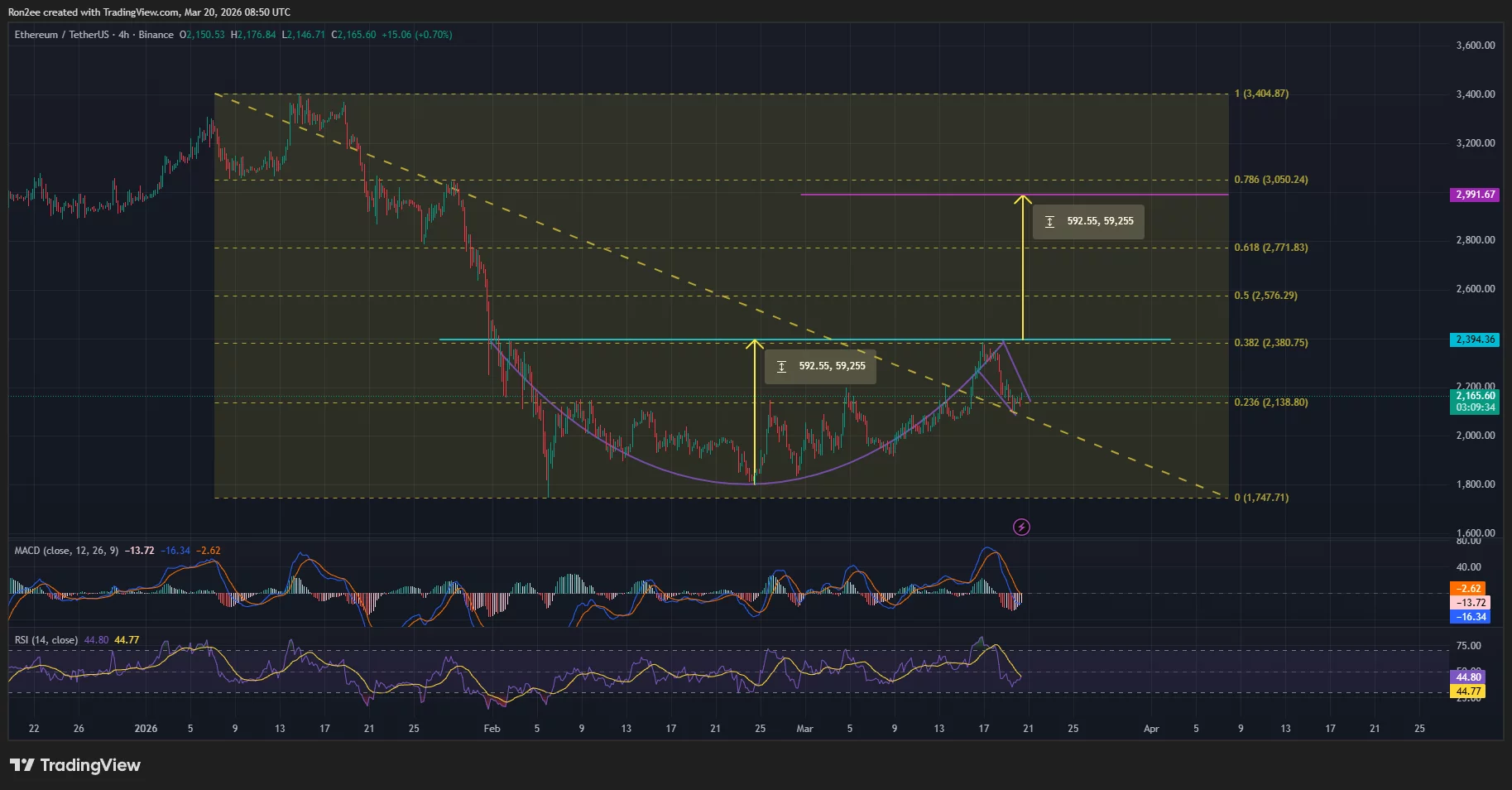
Ethereum price has fallen by over 35% since the beginning of this year. However, a bullish pattern forming on charts now suggests a potential bounce back to earlier levels if confirmed.
Summary
- Ethereum remains down over 35% year to date, trading near $2,172 amid macro pressure from geopolitical tensions, inflation risks, and a hawkish Fed outlook.
- A cup and handle pattern has formed on the daily chart, with a breakout above $2,400 potentially opening the path toward $3,000.
- Institutional sentiment shows early recovery signs with $302.8 million in ETF inflows this month, though momentum indicators still reflect weak bullish strength.
According to data from crypto.news, Ethereum (ETH) price was trading at $2,172 at press time, down 8% from its weekly high and 35.7% from its year-to-date high of $3,379.
Ethereum price fell in tandem with Bitcoin (BTC) and the wider crypto market as the macro environment for risk-on assets continued to deteriorate across the globe.
Some of the headwinds that have weighed investor sentiment down include U.S. tariff threats against the EU and Canada, the successive escalation of war between the U.S. and Iran in the Middle East, and a hawkish stance from the Federal Reserve on interest rate cuts for this year.
Investors have also been rotating to traditional safe-haven assets such as Gold and other precious metals as they seek protection against geopolitical instability and inflationary pressures.
Outflows from spot Ethereum ETFs over the past two months also left the market vulnerable to sudden price swings. These institutional vehicles have, however, shown a resurgence this month, drawing in $302.8 million in total net inflows so far, a sign that institutions are betting on a recovery at these discounted levels.
On the daily chart, Ethereum price has been forming a large cup and handle pattern since early February this year. The pattern is formed with a rounded bottom representing a period of stabilization and a slight downward handle indicating a final shakeout of weak hands.
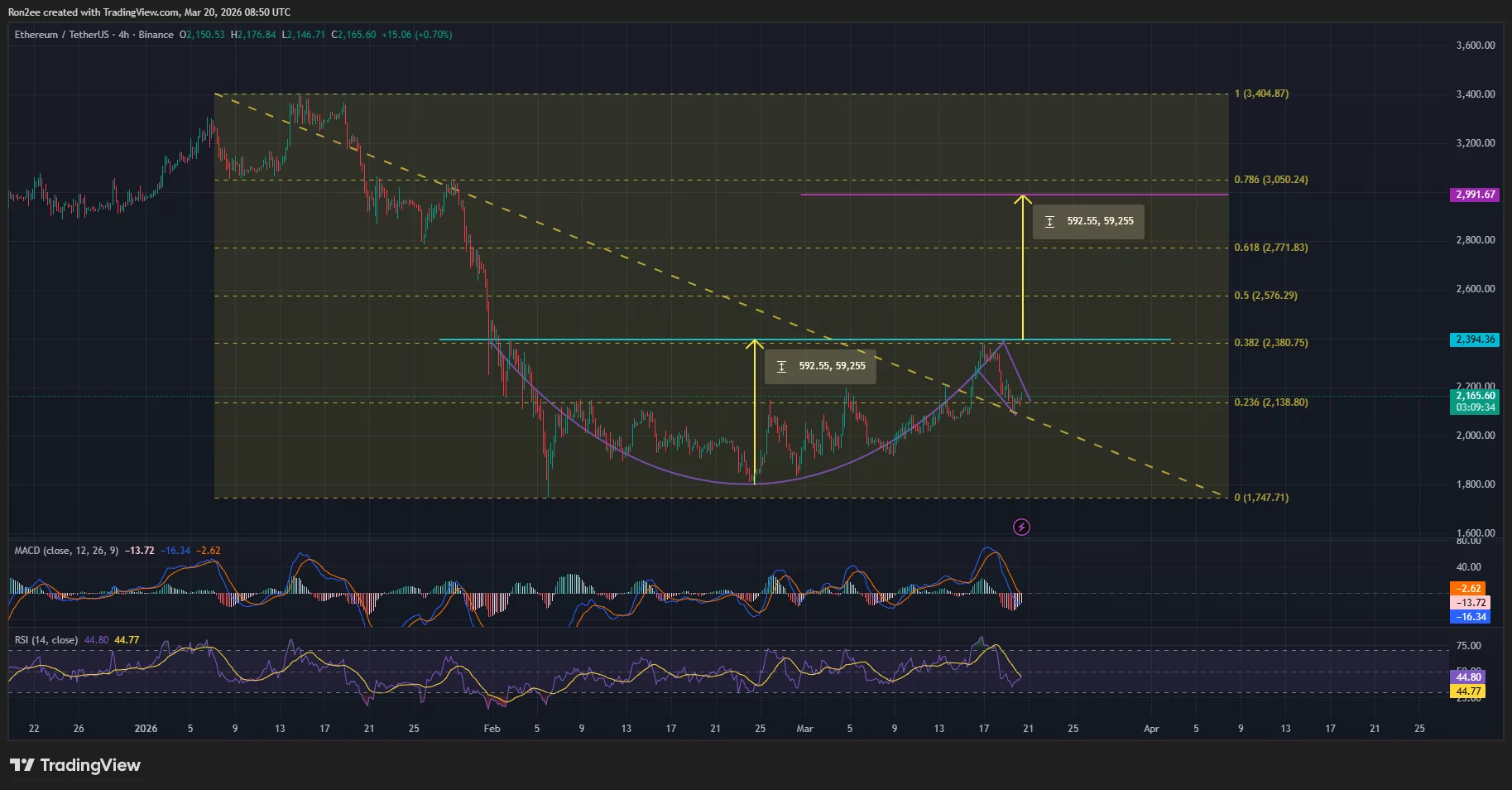
The neckline of the pattern lies at the $2,400 psychological resistance level. A decisive breakout here could push Ethereum up all the way to $3,000, a level calculated by adding the height of the cup formed to the point at which the pattern would be confirmed.
Momentum indicators seem to suggest that bears were still dominating the market at press time. The MACD lines were pointed downwards while the Relative Strength Index was at 40.85, slightly under the neutral thresholds but beginning to flatten as selling pressure exhausts.
For now, the key resistance to watch is the $2,400 psychological barrier, which it failed to break during the market-wide bounce on Tuesday. On the lower side, $2,000 remains a critical support zone that must hold to prevent a slide back toward the yearly lows.
Disclosure: This article does not represent investment advice. The content and materials featured on this page are for educational purposes only.

Key Highlights
- Amazon Web Services will receive 1 million GPUs from Nvidia by the conclusion of 2027.
- Deliveries commence in 2025 and continue through the end of 2027.
- The agreement encompasses networking equipment, Groq inference processors, and upcoming Blackwell and Rubin architectures.
- AWS plans to deploy seven different Nvidia chip varieties for AI inference operations.
- NVDA and AMZN shares both climbed in extended trading after the announcement.
The Amazon Web Services agreement represents one of Nvidia’s most substantial single-client semiconductor contracts disclosed to date. A closer examination reveals increasingly compelling details about the partnership.
In a statement to Reuters, Nvidia Vice President Ian Buck disclosed that GPU deliveries totaling 1 million units will commence in 2025 and extend through 2027. This timeframe aligns precisely with CEO Jensen Huang’s forecast of a $1 trillion addressable market for Nvidia’s Blackwell and Rubin processor families during the identical period.
The partnership extends considerably beyond simple GPU quantities. AWS is acquiring a comprehensive portfolio of Nvidia infrastructure, including Spectrum-X networking components and ConnectX equipment. This development is particularly significant given AWS’s historical reliance on proprietary networking solutions. The integration of Nvidia’s networking technologies into AWS data centers represents a substantial strategic pivot.
Amazon Web Services Embraces Comprehensive Nvidia Inference Strategy
AI inference — the computational process enabling AI platforms to produce outputs and execute tasks — forms the foundation of this partnership’s technical framework. AWS intends to leverage seven distinct Nvidia chips for managing inference operations.
Buck articulated the complexity clearly: “Inference is hard. It’s wickedly hard. To be the best at inference, it is not a one chip pony. We actually use all seven chips.”
The Groq processors, unveiled by Nvidia earlier this week following a $17 billion licensing arrangement with an AI semiconductor startup, constitute part of that inference ecosystem. These chips function in tandem with six additional Nvidia processors to provide what the company characterizes as industry-leading inference capabilities.
AWS will also receive Nvidia’s Blackwell processors and is anticipated to integrate the forthcoming Rubin platform upon its release. Neither Nvidia nor Amazon has revealed the monetary terms of this arrangement.
Both companies’ shares experienced modest gains during after-hours trading Thursday following the disclosure. NVDA declined approximately 1% during regular trading hours, while AMZN dropped about 0.5%.
AWS Continues Developing Proprietary Chip Solutions
Amazon maintains its own AI semiconductor development efforts, including the Trainium2 processor. Nevertheless, the company continues partnering with Nvidia for the most resource-intensive computing requirements. These dual strategies appear complementary rather than contradictory.
This agreement underscores ongoing substantial capital allocation toward AI infrastructure among leading cloud service providers. AWS is not abandoning its custom silicon initiatives — instead, it’s augmenting them with Nvidia hardware for specialized high-performance scenarios.
The Nvidia-AWS partnership was initially announced earlier this week without precise timeline details. Buck’s Thursday remarks to Reuters provided unprecedented clarity: deliveries beginning in 2025, extending through late 2027, encompassing a diverse array of Nvidia offerings spanning compute, networking, and inference capabilities.
Crypto World
Forward Industries (FWDI) Executes $27M Stock Buyback with Galaxy Digital Crypto-Backed Loan

Key Highlights
- Forward Industries executes a repurchase of 6.16 million shares for approximately $27.4 million, cutting outstanding shares by around 7%.
- A $40 million credit facility from Galaxy Digital at 3.4% annual interest finances the transaction, secured by the company’s staked Solana tokens.
- The company maintains 7.01 million SOL valued at approximately $616 million, positioning it as the largest corporate Solana holder.
- FWDI shares have declined roughly 87% since their September 2025 high; Solana has dropped over 60% from Forward’s initial accumulation levels.
- The firm anticipates core operational expenses will decrease approximately 45% from fiscal Q1 through Q3.
Forward Industries has completed a $27.4 million share repurchase leveraging a crypto-backed credit line. Galaxy Digital LLC provided the $40 million financing at a 3.4% interest rate, enabling the buyback without liquidating digital assets.
Forward Industries, Inc., FWDI
The transaction involved acquiring 6,164,324 shares from an institutional investor through a privately negotiated deal. Following this repurchase, Forward’s outstanding share count declines to approximately 77 million shares—representing a 7% reduction in the float.
The company’s treasury contains 7,013,536 SOL tokens with a current market value around $616 million. This staked Solana position, which generates approximately 6.2% in annual staking yields, serves as collateral for the Galaxy Digital loan.
This financial engineering creates a positive spread: Forward borrows at 3.4% while its collateral earns 6.2% in staking income. The arrangement allows the company to unlock liquidity without triggering a taxable sale of its cryptocurrency reserves.
This buyback falls under a $1 billion share repurchase authorization Forward established in November 2025. Management cited balance sheet strength and strategic flexibility when announcing the program.
Market conditions provide important context. FWDI shares have plummeted approximately 87% from September 2025 highs and show a year-to-date decline of roughly 25%.
Solana has experienced similar volatility. The token has fallen about 30% in 2025 and currently trades near $88—more than 60% below the ~$240 price point when Forward initiated its accumulation strategy.
Forward launched its aggressive Solana acquisition campaign in September 2025, purchasing heavily while the token traded near peak valuations. This timing has generated approximately $972 million in unrealized losses across the company’s digital asset portfolio.
At least 18 publicly traded companies have implemented comparable Solana treasury approaches. These firms collectively carried over $1.5 billion in unrealized losses as of February, with Forward representing the majority of that figure.
Increasing SOL Per Share Concentration
Forward positions the buyback as a mechanism to enhance its SOL-per-share ratio. Reducing the denominator means each outstanding share claims a larger portion of the company’s Solana reserves.
This per-share metric has become the company’s primary value proposition to shareholders—particularly as the stock trades dramatically below previous peaks.
Among corporate Solana holders, the next-largest position belongs to Solana Company with roughly 2.3 million SOL. Forward’s 7+ million token position dwarfs all known competitors in the corporate treasury space.
Operational Efficiency Improvements
Beyond the buyback, Forward announced projected reductions in operating overhead. The company expects core selling, general, and administrative expenses to contract by approximately 45% between fiscal Q1 and Q3.
This cost reduction stems from decreased professional service fees, legal expenses, and third-party vendor commitments. The Galaxy Digital credit facility carries a maturity date less than five months out.
This short timeline creates a potential inflection point. Without meaningful Solana price recovery, refinancing or repaying the loan could present challenges. Forward has not disclosed contingency plans for debt service if market conditions remain unfavorable at maturity.

Key Highlights
- Bluesky closes $100M Series B round to accelerate decentralized platform development.
- User base expands dramatically from 13M to 43M worldwide in recent months.
- AT Protocol ecosystem now supports more than 1,000 weekly active applications.
- Executive restructuring: Jay Graber becomes Chief Innovation Officer, Toni Schneider takes interim CEO role.
- Platform infrastructure now manages billions of public social records across decentralized network.
The decentralized social media platform Bluesky has revealed a $100 million Series B funding round that was completed in April 2025. This substantial investment aims to fuel the company’s ambitious expansion plans and strengthen its open-source social networking infrastructure. The announcement comes as Bluesky experiences remarkable user adoption and prepares for its next growth chapter under revised leadership.
$100M Investment Round Powers Decentralized Platform Vision
Bluesky successfully completed its $100 million Series B financing in April 2025, with Bain Capital Crypto serving as the lead investor. The funding round attracted participation from multiple prominent investment firms including Alumni Ventures, Anthos Capital, Bloomberg Beta, Knight Foundation, and True Ventures.
Throughout the past year, the company has strategically allocated these funds to expand its team and enhance its technical infrastructure. This capital injection enabled Bluesky to reinforce its systems to handle accelerating worldwide user demand. Additionally, the investment fuels ongoing development of the platform’s decentralized network foundation.
Bluesky maintains its commitment to offering a viable decentralized alternative to conventional social media platforms. The ecosystem encompasses developers, third-party applications, and users all collaborating on common infrastructure. This architectural approach enables growth and innovation without depending on centralized governance structures.
Explosive User Adoption and Developer Ecosystem Momentum
Following its previous funding announcement in October 2024, Bluesky has witnessed extraordinary user acquisition. The platform’s worldwide user count surged from 13 million to surpass 43 million users in a matter of months. This rapid expansion demonstrates increasing market appetite for decentralized social networks and open identity frameworks.
Simultaneously, Bluesky’s comprehensive “Atmosphere” ecosystem has grown substantially across various operational layers. The network currently powers more than 1,000 applications built on its protocol that remain active on a weekly basis. Software development kit downloads have climbed beyond 400,000 per month, indicating robust developer community participation.
The platform’s network infrastructure now maintains approximately 20 billion public records distributed across its decentralized architecture. These records encompass user-generated posts, social interactions, and relationship connections. As a result, Bluesky has established a substantial and dynamic data foundation supporting its distributed network model.
Executive Transition Supports Innovation and Operational Focus
Bluesky has recently enacted significant leadership restructuring to align with its evolving strategic priorities. Company founder Jay Graber has moved into the position of Chief Innovation Officer to concentrate on protocol architecture and technical innovation. This organizational shift enables Bluesky to emphasize advancement of its fundamental infrastructure technology.
Toni Schneider has stepped into the interim Chief Executive Officer position and will manage daily operations while the organization conducts a search for a permanent CEO. This leadership realignment coordinates executive responsibilities with the company’s ambitious growth trajectory and product roadmap.
Bluesky began as an initiative launched by Jack Dorsey in 2019 while he led Twitter. The company achieved independence in 2021 and completed its full separation from Twitter in 2022. Since establishing autonomy, Bluesky has concentrated its efforts on developing an open, interoperable social networking framework.
Crypto World
Hyperliquid (HYPE) Surges as JPMorgan Highlights Oil Trading Shift and S&P 500 Perpetuals Launch
Key Highlights
- A March 18 JPMorgan analysis highlighted Hyperliquid as an emerging platform for crude oil futures activity among professional traders
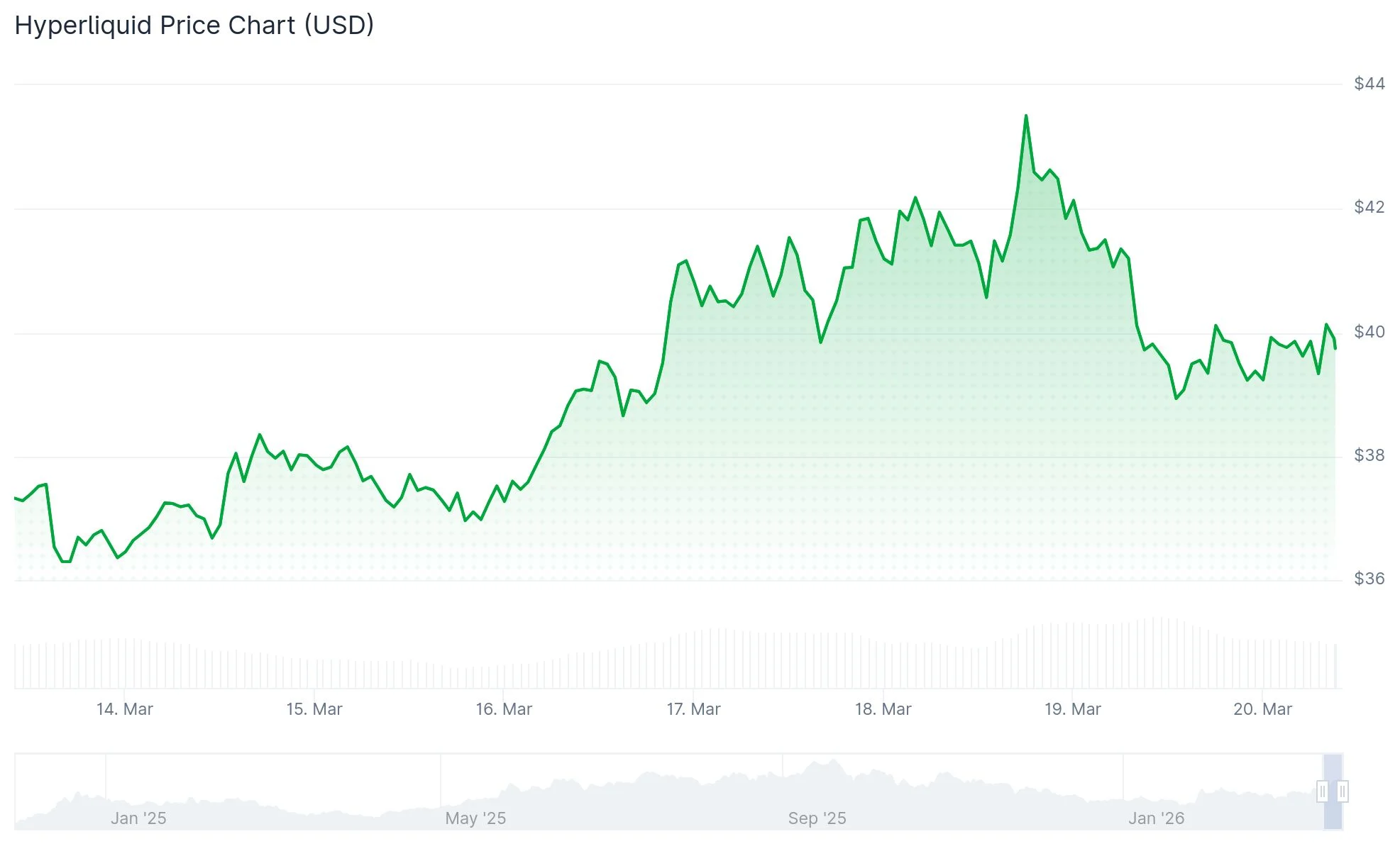
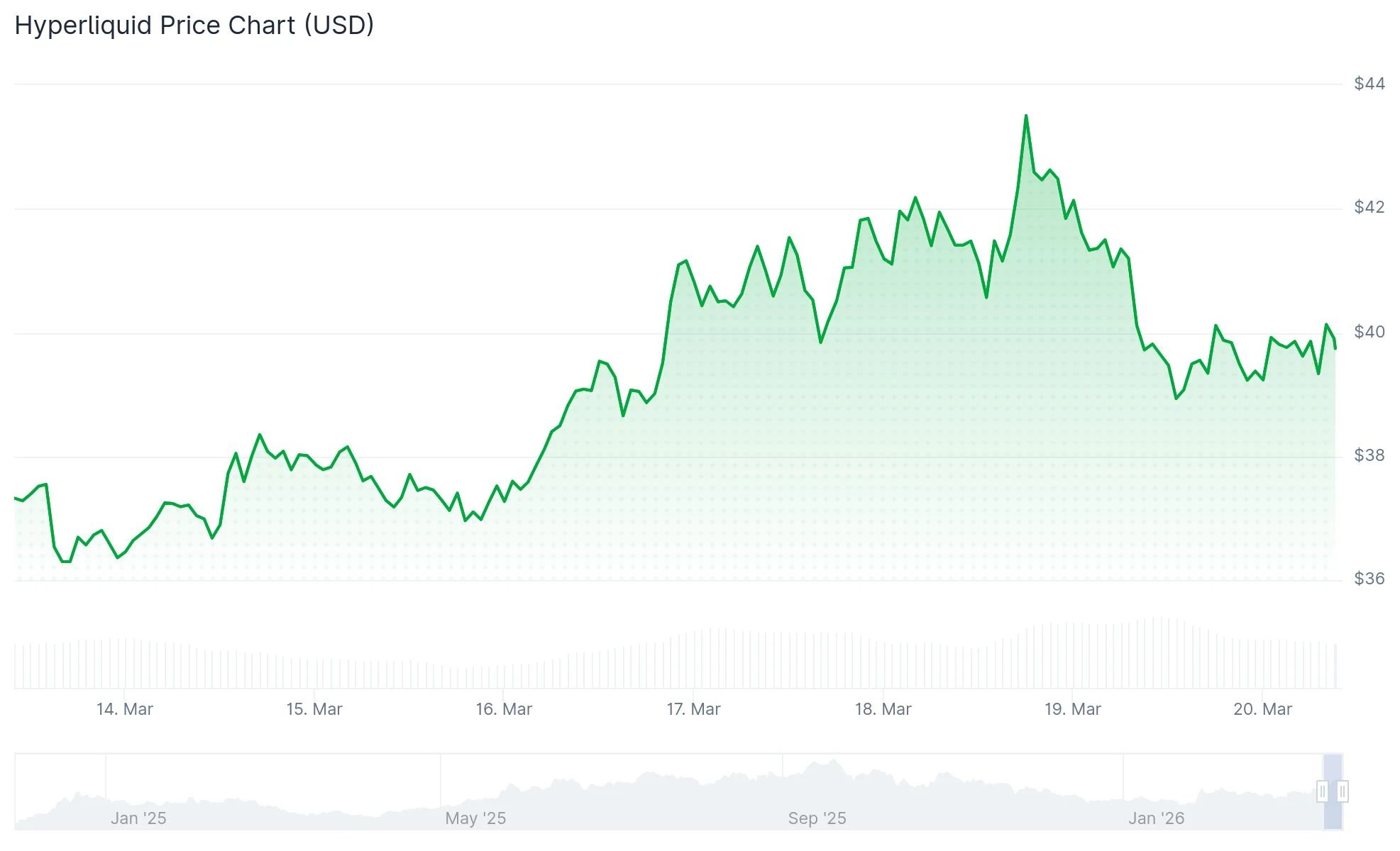
- The HYPE token advanced approximately 3.5% to reach $42.50 after Trade[XYZ] introduced S&P 500 perpetual futures contracts
- Trade[XYZ] secured official licensing from S&P Dow Jones Indices to offer blockchain-based derivatives using the flagship index on Hyperliquid
- After establishing a low point at $22, HYPE has developed a pattern of ascending peaks and troughs since mid-January
- Critical resistance levels are positioned between $42–$44; a successful breach could propel prices toward $50 and subsequently $59.80
The HYPE token experienced an approximately 3.5% appreciation this week, reaching $42.50, fueled by dual developments — institutional recognition from JPMorgan regarding decentralized crude oil futures activity and the introduction of the first officially authorized S&P 500 perpetual contract on the network.
In their March 18 analysis, JPMorgan researchers identified Hyperliquid as an accelerating destination for professional crude oil futures participants. The assessment revealed that market participants from conventional trading environments are leveraging oil-pegged perpetual instruments on the decentralized exchange to execute trades beyond traditional market operating hours.
Traditional venues like the Chicago Mercantile Exchange maintain limited operating windows, closing overnight and throughout weekends. Global geopolitical developments, however, operate continuously. When recent weekend tensions escalated involving Iran, perpetual oil contracts on Hyperliquid experienced dramatic volume spikes while conventional exchanges remained offline.
The JPMorgan assessment further observed that decentralized platforms are progressively capturing market share from mid-tier centralized trading venues, propelled by enhanced user interfaces, strengthened liquidity pools, and increasing institutional acceptance of blockchain-based settlement mechanisms.
Official S&P 500 Perpetual Contracts Debut on Hyperliquid Infrastructure
S&P Dow Jones Indices entered a licensing arrangement with Trade[XYZ], a protocol specializing in tokenized real-world asset derivatives operating on Hyperliquid’s blockchain infrastructure. This collaboration produced what’s characterized as the first formally authorized perpetual futures instrument tracking the S&P 500 within decentralized finance.
Eligible participants located outside United States jurisdiction can establish leveraged long or short exposures to the benchmark index continuously, without contract expiration constraints. The instrument incorporates S&P DJI’s institutional-quality, live index data streams — distinguishing it from earlier unofficial S&P 500 proxies circulating in DeFi markets.
The S&P 500 benchmark supports more than $1 trillion in aggregate daily transaction volume across conventional financial products. Introducing an officially sanctioned blockchain version enables continuous market access aligned with cryptocurrency trading schedules rather than equity market operating hours.
Chart Analysis: Critical Price Zones in Focus
HYPE established a significant floor at $22 after completing a downward trend spanning November through mid-January. Subsequently, the asset has executed a V-shaped reversal characterized by progressively higher peaks and elevated support levels.
On March 16, price action penetrated upward from a rising wedge formation visible on daily timeframes. The 20-period exponential moving average is advancing above the 50-period EMA, while the Relative Strength Index approaches 70. The MACD indicator displays a bullish intersection accompanied by expanding positive histogram bars.
Market technician Mizer observed that failure to maintain support above the $42–$44 corridor could trigger retracement toward $40–$38, potentially extending to $36–$32. He additionally highlighted that HYPE’s price movements have exhibited strong correlation patterns with Bitcoin’s trajectory.
Immediate overhead resistance occupies the $42 to $44 range. A convincing breakout above this zone establishes preliminary upside objectives at $50, followed by $59.80, based on technical projections referenced in market analysis.

Key Takeaways
- Gemini (GEMI) shares climbed as high as 14% in after-hours trading following better-than-anticipated Q4 results
- Fourth-quarter revenue jumped 39% compared to the previous year, reaching $60.3 million—the strongest quarterly performance in three years
- The company’s net loss expanded to $140.8 million during Q4, compared to $27 million in the year-ago period; annual 2025 losses totalled $585 million
- Approximately 30% of Gemini’s staff has been eliminated since early 2026, with AI automation replacing numerous coding functions
- The exchange is withdrawing operations from the UK, EU, and Australia to concentrate resources on the American market
Gemini (GEMI) delivered fourth-quarter revenue totalling $60.3 million, representing a 39% increase from the comparable period last year and exceeding Wall Street’s consensus forecast of approximately $51.7 million. Shares initially jumped 14% in extended trading before moderating to roughly a 6% gain.
These quarterly figures marked the crypto exchange’s second earnings report since its September Nasdaq debut. Since reaching its post-IPO peak, the stock has plummeted approximately 82%.
While revenue exceeded expectations, the company’s loss situation deteriorated significantly. The Q4 net loss reached $140.8 million, translating to $1.22 per share, versus $27 million during the identical quarter one year prior. For the complete 2025 fiscal year, losses amounted to $585 million, a sharp increase from $156.6 million recorded in 2024.
Gemini Space Station, Inc. Class A Common Stock, GEMI
Founders Cameron and Tyler Winklevoss credited the revenue expansion to a restructured fee system implemented during the latter portion of 2025, combined with increased uptake of Gemini’s credit card offering. This growth materialized despite declining trading volumes—typically an unfavorable indicator for exchange platforms.
The Winklevoss twins characterized Q4 as delivering the company’s strongest revenue quarter across the past three years, representing a positive headline figure. However, the expanding losses highlight the substantial gap between the company’s expenditures and income generation.
Staff Reductions and Artificial Intelligence
Gemini disclosed that approximately 30% of its workforce has been eliminated since the beginning of 2026. The organization had previously announced in February that 25% of personnel would be laid off, with artificial intelligence adoption serving as a partial driver.
In their communication to shareholders, the twin founders revealed that AI now generates over 40% of Gemini’s production code modifications, with expectations for that percentage to approach 100%. “Failing to utilize AI at Gemini will soon be comparable to arriving at the office with a typewriter rather than a laptop,” they stated.
Three senior leadership positions—Chief Operating Officer, Chief Financial Officer, and Chief Legal Officer—have also seen departures within recent months.
This unfolds against a challenging cryptocurrency market environment. Bitcoin experienced a sharp decline from its record peak above $126,000 in October 2025, creating headwinds for cryptocurrency-related equities.
Gemini revealed in February its decision to cease operations in the UK, EU, and Australia, attributing the move to challenging market dynamics. The organization stated its intention to “concentrate and intensify efforts on America,” highlighting what it perceives as a more accommodating regulatory landscape in the US under present market oversight.
Forecasting Platform and Payment Card
Gemini introduced its proprietary prediction market platform, Gemini Predictions, throughout all 50 US states during December 2025, following approval from the Commodity Futures Trading Commission.
The Winklevoss founders indicated the company intends to enhance and broaden that offering throughout 2026. They additionally signaled intentions to leverage identical infrastructure for perpetual futures trading, subject to US regulatory clearance.
The payment card product and primary exchange operations remain central strategic focuses alongside the predictions platform for the upcoming year.
Citigroup analyst Peter Christiansen has previously noted that Gemini requires distinct competitive advantages to challenge larger competitors such as Coinbase. “In the absence of genuine differentiation and unique value propositions that competitors lack, we believe it will remain challenging for them to close the gap,” he commented.
GEMI concluded Thursday’s standard trading session essentially unchanged at approximately $6.00.

Introduction
Decentralized Finance (DeFi) has rapidly evolved into a complex ecosystem of protocols, assets, and users distributed across multiple blockchains. While much of the attention in DeFi is directed toward yield generation, token incentives, and emerging applications, a critical yet often overlooked component underpins the entire system: liquidity routing.
Liquidity routing plays a fundamental role in ensuring that trades are executed efficiently, with minimal cost and optimal pricing. Despite its importance, it remains underdiscussed compared to more visible aspects of DeFi. This article explores liquidity routing in depth, examining its mechanics, significance, risks, and future trajectory.
What Is Liquidity Routing?
Liquidity routing refers to the process of determining the most efficient path for executing a trade across one or more liquidity sources. In decentralized exchanges (DEXs), liquidity is not centralized in a single order book but distributed across various pools and platforms.
When a user initiates a token swap, the system must identify how to execute that trade in a way that minimizes slippage, reduces fees, and maximizes output. Rather than relying on a single liquidity pool, modern DeFi protocols utilize routing algorithms to:
-
Search across multiple liquidity pools
-
Evaluate price differences between platforms
-
Split trades into smaller portions when necessary
-
Execute transactions across different venues simultaneously
The result is a more efficient and cost-effective trading experience for users.
The Evolution from Simple Swaps to Smart Order Routing
In the early stages of DeFi, automated market makers (AMMs) such as Uniswap operated with relatively simple mechanisms. Trades were executed within a single liquidity pool, often leading to significant price impact for large transactions.
As the ecosystem expanded and liquidity became increasingly fragmented, more sophisticated systems emerged. This led to the development of Smart Order Routing (SOR).
Smart Order Routing enhances traditional routing by:
-
Dynamically splitting trades across multiple pools
-
Optimizing execution based on both price and transaction costs
-
Adapting to real-time market conditions
-
Utilizing aggregators to access a broader range of liquidity sources
SOR has become a standard feature in many DeFi aggregators, significantly improving execution quality compared to earlier models.
Why Liquidity Routing Is Essential
1. Improved Price Efficiency
Liquidity routing ensures that trades are executed at the best available price by leveraging multiple liquidity sources. Without routing, large trades would significantly impact the price within a single pool, leading to unfavorable outcomes for traders.
2. Reduced Slippage
Slippage occurs when the execution price of a trade differs from the expected price due to insufficient liquidity. By distributing trades across multiple pools, routing minimizes this effect and stabilizes transaction outcomes.
3. Enhanced Market Connectivity
The DeFi ecosystem is increasingly fragmented, with liquidity spread across various blockchains, Layer 2 solutions, and decentralized exchanges. Liquidity routing acts as a unifying mechanism, connecting these disparate sources into a more cohesive market structure.
4. Competitive Execution Advantage
For active traders and institutions, execution quality is a critical factor. Even marginal improvements in pricing—on the order of fractions of a percent—can significantly impact long-term profitability. Liquidity routing enables these incremental gains by optimizing trade paths.
Risks and Challenges
Despite its advantages, liquidity routing introduces several complexities and risks that must be considered.
1. Maximal Extractable Value (MEV)
Complex routing paths can expose transactions to MEV strategies such as front-running and sandwich attacks. These exploitative practices can reduce the effectiveness of routing and negatively impact user outcomes.
2. Dependency on Aggregators
Many routing solutions rely on aggregators to source liquidity. If these platforms experience outages, vulnerabilities, or exploits, users may face degraded execution quality or, in extreme cases, financial losses.
3. Gas Cost Trade-offs
While splitting trades across multiple pools can improve pricing, it may also increase transaction costs due to higher gas usage. In some cases, the additional cost can offset the benefits of improved execution.
4. Cross-Chain Complexity
As routing expands across multiple blockchains, additional risks arise, including bridge vulnerabilities, latency issues, and increased operational complexity.
The Future of Liquidity Routing
Liquidity routing is expected to play an increasingly central role in the evolution of DeFi. Several emerging trends highlight its growing importance:
Cross-Chain Routing
Future routing systems will enable seamless asset swaps across different blockchains, abstracting away the complexity of bridges and interoperability from the end user.
Intent-Based Trading
A shift toward intent-based systems is underway, where users specify desired outcomes (e.g., “obtain the best possible price for this asset”), and protocols compete to fulfill those intents through optimized routing strategies.
AI-Driven Optimization
Artificial intelligence and machine learning may further enhance routing efficiency by analyzing real-time market data, predicting liquidity conditions, and dynamically adjusting execution strategies.
Conclusion
Liquidity routing is a foundational yet underappreciated component of the DeFi ecosystem. Optimizing how trades are executed across fragmented liquidity sources, it ensures efficient pricing, reduces slippage, and enhances the overall user experience.
As DeFi continues to scale and diversify, the importance of robust and intelligent routing mechanisms will only increase. While it may not receive the same attention as more visible innovations, liquidity routing remains a critical driver of performance and efficiency in decentralized markets.
Understanding this infrastructure provides deeper insight into how DeFi truly operates—and where its next major advancements are likely to emerge.
REQUEST AN ARTICLE
Key Highlights
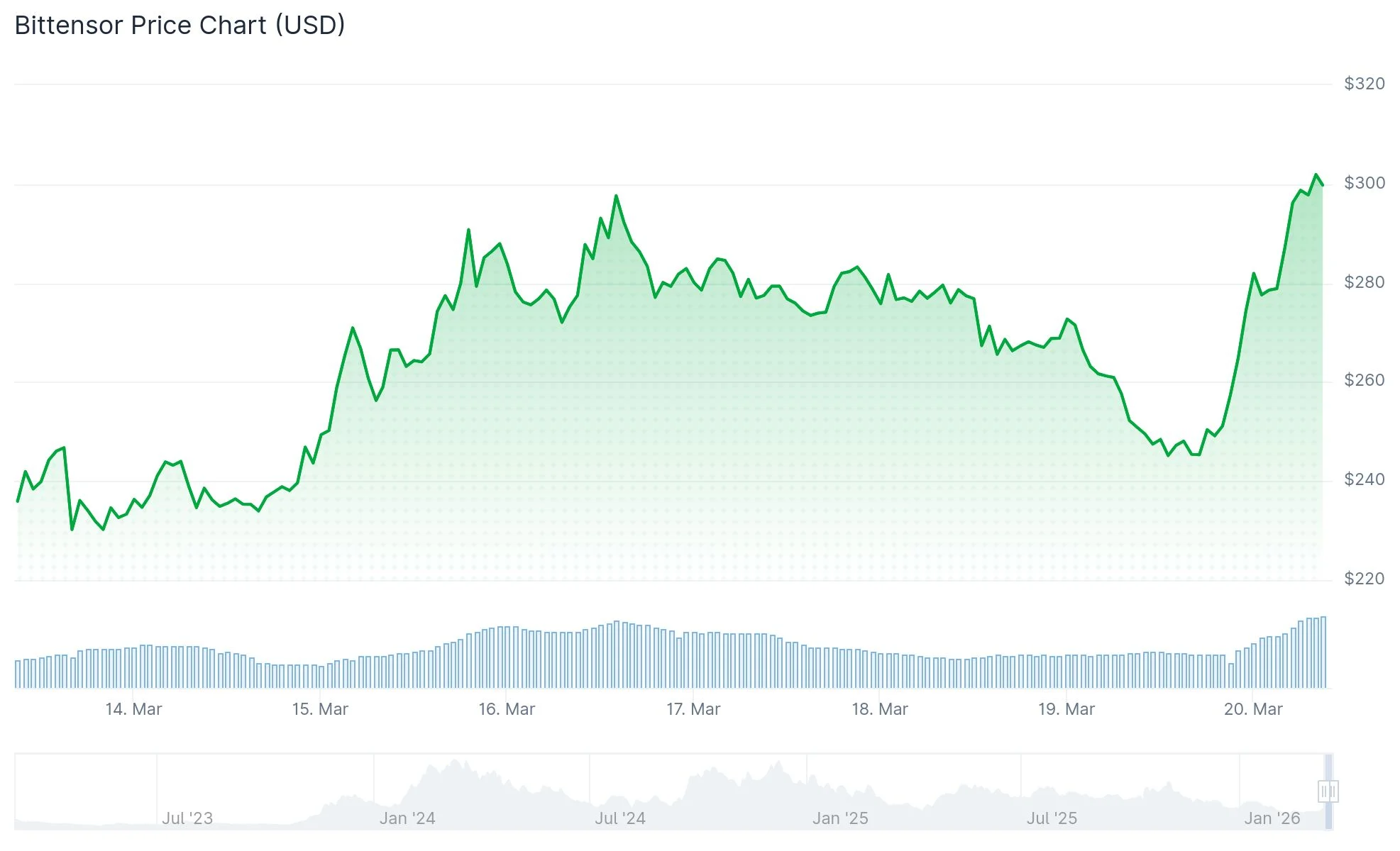
- TAO token has climbed more than 15% this week, with prices hovering between $289 and $298
- Jensen Huang, CEO of NVIDIA, and investor Chamath Palihapitiya endorsed Bittensor’s distributed AI training approach during the All-In Podcast
- Covenant-72B, a 72-billion-parameter language model, represents the largest decentralized pre-training initiative ever documented
- Daily trading volume surged to $677 million while open interest climbed to $361 million, marking multi-month peaks
- Grayscale’s move to transform the Bittensor Trust into a spot ETF signals rising institutional appetite
Bittensor (TAO) has seen its price climb to the $289–$298 range this week, registering gains exceeding 15% across a seven-day period. The upward momentum followed significant commentary on the All-In Podcast, where NVIDIA’s CEO Jensen Huang alongside venture investor Chamath Palihapitiya acknowledged a breakthrough achievement in distributed artificial intelligence.
During the podcast, Palihapitiya outlined how a substantial language model was successfully trained using dispersed hardware contributed by independent operators worldwide. “They successfully trained a 4 billion parameter LLaMA model in a completely distributed fashion, with numerous contributors offering spare computing power,” he explained, characterizing it as “an extraordinary technical achievement.”
The actual model referenced has been identified as Covenant-72B, rather than the 4 billion parameter version mentioned in the discussion. The Opentensor Foundation verified that Covenant-72B is a 72-billion-parameter language model pre-trained using contributions from over 70 global participants utilizing conventional internet-connected hardware. The model posted a 67.1 MMLU benchmark score and its methodology is detailed in a March 2026 arXiv publication. This represents the most extensive decentralized LLM pre-training effort ever recorded.
Jensen Huang offered support for the wider vision of distributed AI development. “These two approaches aren’t mutually exclusive; they’re complementary,” Huang stated. “That’s absolutely certain.” He positioned proprietary and open-source frameworks as partners rather than rivals.
TAO appreciated roughly 5% within hours of the podcast airing, accompanied by trading volume that nearly doubled overnight.
Market Activity and Derivatives Interest Spike
Blockchain analytics from Santiment indicate Bittensor’s daily trading volume peaked at $677.06 million on Sunday — the strongest showing since November 7. By Friday, volume maintained elevated levels at $521.92 million.
%20%5B08-1773982048268-1773982048269.57.15%2C%2020%20Mar%2C%202026%5D.png&w=1536&q=95)
Futures open interest monitored by CoinGlass advanced to $361.15 million on Monday, climbing from $131.94 million recorded on March 4. Friday’s reading stood at $331.95 million, also near recent highs.
Growing Institutional Participation
Grayscale has submitted regulatory filings to restructure the Bittensor Trust into a spot exchange-traded fund. The trust currently trades at a premium valuation, which market observers interpret as evidence of strengthening institutional demand.
Bittensor has simultaneously activated Covenant-72B to stimulate utilization of its distributed computing infrastructure, while ongoing modular subnet development continues attracting both individual and institutional participants.
From a technical perspective, TAO trades above its 50-day, 100-day, and 200-day exponential moving averages. The Relative Strength Index registers 77, indicating overbought conditions. Immediate resistance appears near $305.30, with subsequent targets at $341.10 upon clearing that threshold.
$TAO ready to attempt another breakout of the right-angled broadening descending wedge at ~$302.
Chart put in a local higher-low and rebounded to the top boundary on strong volume. Now needs to look for a close above resistance to start pushing to $360-370 overhead.
5-month… https://t.co/G38JCfMA7B pic.twitter.com/jMCiY4BgIa
— Ardi (@ArdiNSC) March 20, 2026
Technical analyst Ardi identified a right-angled broadening descending wedge formation developing since October, with breakout confirmation requiring a daily close exceeding $302. Under that scenario, projected targets extend to the $360–$370 zone.
TAO has advanced 37% during the past week and 55.66% over the previous month, though it remains 61.13% beneath its all-time peak of $767.68 established in April 2024.

The U.S. Justice Department has unsealed an indictment charging Yih-Shyan “Wally” Liaw, the co-founder of Super Micro Computer, Inc., along with sales executives Ruei-Tsang “Steven” Chang and Ting-Wei “Willy” Sun, in what prosecutors describe as a multi-billion-dollar scheme to route advanced artificial intelligence server hardware to China. Super Micro itself was not charged, and the company says it is cooperating with investigators and distancing itself from the alleged actions.
According to the Justice Department, the defendants conspired to sell billions of dollars’ worth of servers containing sensitive, controlled GPUs to buyers in China, in violation of U.S. export-control laws. The alleged scheme, spanning 2024 and 2025, involved concealing the true nature of the clientele and the shipments, with prosecutors asserting that roughly $2.5 billion in servers were moved to a Chinese company, including about $510 million in sales during April and May 2025 alone.
Federal investigators described a range of concealment techniques, including fabricating documents, staging counterfeit equipment to pass audits, and using a pass-through intermediary to mask the true end customer. The FBI’s New York Field Office linked the scheme to the defendants’ efforts to obscure the sale of high-performance server hardware used in data centers and other critical operations.
“These defendants allegedly fabricated documents, staged bogus equipment to pass audit inventories, and used a pass-through company to conceal their misconduct and true clientele list,” said James Barnacle, Jr., FBI assistant director in charge of the New York Field Office. The defendants will face proceedings in the Northern District of California, with Liaw and Sun already in custody and Chang listed as a fugitive outside the United States.
Key takeaways
- The Justice Department indicted Yih-Shyan Liaw, Ruei-Tsang Chang, and Ting-Wei Sun for alleged export-control violations tied to selling servers with advanced GPUs to China; Super Micro is not charged.
- The alleged scheme spanned 2024–2025, involving about $2.5 billion in server sales, including $510 million in April–May 2025.
- Liaw and Sun have been arrested and are to appear in U.S. court, while Chang remains a fugitive.
- Super Micro publicly distanced itself from the actions, stating they contravene the company’s policies and controls and stressing ongoing cooperation with investigators.
- Trading after the announcement showed immediate market reaction, with Super Micro’s stock falling in after-hours trading by about 13% to around $26.71.
Allegations, scope and the case timeline
At the center of the indictment is a concerted effort to export cutting-edge server technology to China in ways that circumvent U.S. export controls. Prosecutors describe a pattern of misrepresentation and mislabeling designed to obscure the true buyers and destinations of the servers, which included high-end GPUs subject to regulatory restrictions. The government says the defendants blended legitimate sales with false documentation and a network of intermediaries to mask the ultimate customer, enabling billions of dollars in transactions that should have faced heightened scrutiny.
The scope of the alleged activity, as laid out by the DOJ, covers deals executed over a period that extended into 2025, with particular emphasis on shipments and the corresponding audit trails used to validate those shipments. The department’s filing highlights the alleged use of fake inventories and other deceptive practices to facilitate the export of controlled hardware.
Corporate response and investor lens on Super Micro
In a statement shared with Cointelegraph, Super Micro said the defendants’ actions would be treated as a violation of its internal policies and compliance controls. The company asserted that it has not been named as a defendant in the indictment and emphasized its commitment to cooperating with authorities as the case proceeds.
From an investor perspective, the development raises questions about governance, supply-chain compliance, and the risk profile of suppliers involved in high-performance data-center hardware. Super Micro’s public response signals an attempt to isolate the enterprise from the criminal allegations while acknowledging the seriousness of the DOJ’s findings. The firm’s stock reaction underscores the market’s sensitivity to regulatory actions, particularly when a supplier in the high-stakes AI infrastructure space faces potential enforcement risk.
Regulatory backdrop and broader implications for the sector
The charges come amid heightened scrutiny of export controls related to advanced semiconductors, GPUs, and other high-performance components that enable AI workloads. Authorities have increasingly scrutinized how hardware can be channeled to jurisdictions where policy constraints are tight, prompting suppliers to strengthen due-diligence, due-process, and auditing across their distribution networks. The case may serve as a testbed for enforcement approaches and risk management practices among tech manufacturers with global supply chains.
For buyers and partners, the episode underscores the importance of transparent procurement, rigorous compliance testing, and robust record-keeping. It also highlights the reputational and financial exposure companies face when allegations of illicit export practices surface, even if the company itself is not charged.
What comes next for the case and the market
The DOJ’s indictment sets the stage for judicial proceedings in the Northern District of California. Liaw and Sun have been detained and are scheduled for court appearances, while Chang remains at large. As the legal process unfolds, observers will watch for additional charges, potential settlements, and further disclosures about the supply chain arrangements involved in the alleged scheme.
In the near term, investors and industry stakeholders will assess how the case could influence export-control enforcement, supplier risk assessments, and collaboration agreements with major tech players that rely on advanced AI-capable hardware. Market participants will also be watching whether the charges prompt broader due-diligence changes among data-center buyers and integrators who source cutting-edge GPUs and servers.
According to the Justice Department, the investigation reflects the government’s continued vigilance over sensitive technologies and the channels through which they reach restricted markets. As authorities press forward, the industry will need to navigate tighter compliance requirements and the potential for further enforcement actions tied to similar cross-border technology transfers.
Readers should stay tuned for court developments and any additional detail about Chang’s status, as well as updates on how Super Micro and its partners adjust governance practices in response to this high-profile case.
Evercore Names Amazon (AMZN) Stock Its #1 Large-Cap Pick for 2026

The House Article | “No one had as many friends”: Lord Mann pays tribute to Phil Woolas
The Vikings’ Front Office Has Completed a Major Goal


-
Crypto World6 days ago
HYPE Token Enters Net Deflation as HyperCore Buybacks Outpace Staking Rewards
-

 Tech5 days ago
Your Legally Registered ‘Motorcycle’ Might Not Count Under Proposed US Law
-

 Fashion7 days ago
Weekend Open Thread: Addict Lip Glow
-
 Tech3 days ago
Are Split Spacebars the Next Big Gaming Keyboard Trend?
-
Sports6 days ago
Why Duke and Michigan Are Dead Even Entering Selection Sunday
-

 Business5 days ago
Search for Savannah Guthrie’s Mother Enters Seventh Week with No Arrests
-

 Business6 days ago
US Airports Launch Donation Drives for Unpaid TSA Workers as Partial Government Shutdown Enters Fifth Week
-
Crypto World6 days ago
Coinbase and Bybit in Investment Talks: Could Bybit Finally Enter the US Crypto Market?
-

 Business4 days ago
Australian shares drop as Iran war enters third week
-

 Business6 days ago
Country star Brantley Gilbert enters growing non-alcoholic beer market
-

 Crypto World4 days ago
Crypto Lender BlockFills Enters Chapter 11 with Up to $500M in Liabilities
-

 Sports7 days ago
College Basketball Best Bets: Conference Tournament Semifinal Picks
-

 Politics2 days ago
The House | The new register to protect children from their abusers shows Parliament at its best
-

 News Videos2 days ago
RBA board divided on rate cut, unusually buoyant share market | Finance Report | ABC NEWS
-

 Fashion4 days ago
25 Celebrities with Curly Hair That Are Naturally Beautiful
-

 Tech5 hours ago
inKONBINI Lets You Spend Summer Days Behind the Register
-

 Crypto World2 days ago
Canada’s FINTRAC revokes registrations of 23 crypto MSBs in AML crackdown
-
 Politics3 days ago
Real-time pollution monitoring calls after boy nearly dies
-

 Crypto World6 days ago
Crypto Losses Drop 87% in February, But Hackers Are Now Targeting People, Not Code
-
 NewsBeat2 days ago
Residents in North Lanarkshire reminded to register to vote in Scottish Parliament Election


You must be logged in to post a comment Login