
Crypto World
Germany's AfD's Election Surge Puts Its Pro-Bitcoin Agenda Back in Focus



Germany’s far-right Alternative for Germany (AfD) won 43.8% of the vote in Sunday’s Saxony-Anhalt state election, its strongest regional result. The win revives questions about what a bigger AfD footprint would mean for Bitcoin (BTC) policy in Europe’s largest economy.
The party fell short of an outright majority in the 83-seat parliament, leaving coalition talks ahead. Nationally, the AfD leads opinion polls, keeping its pro-Bitcoin platform in view.
AfD’s Bitcoin Platform
The AfD has positioned itself as Germany’s most crypto-friendly major party. Its national platform calls for “extensive deregulation” of Bitcoin, wallets, and trading. The party argues regulators have been overly cautious, according to Reuters reporting on its platform documents.
In October 2025 AfD filed a Bundestag motion stating the government had failed to recognize Bitcoin strategically as an asset that could be held in currency reserves during monetary instability, and described it as a potential reserve asset.
The party also opposes a digital euro, the European Central Bank’s proposed digital currency. It wants cash enshrined as a constitutional right, per the same reporting.
Beyond deregulation, AfD lawmakers have pushed for lighter Bitcoin treatment under the European Union’s Markets in Crypto-Assets (MiCA) framework. MiCA is the bloc’s licensing regime for crypto firms.
The lawmakers argue it was built for centrally issued tokens, not decentralized ones like Bitcoin. That view comes from Germany’s Bitcoin Bundesverband, an industry group that tracks the country’s crypto legislation.
Germany’s Finance Committee already rejected a push from the Greens to end a related tax break. That one-year Bitcoin holding exemption is the same rule the AfD wants to keep.
The fight over MiCA’s reach extends beyond Germany. Poland has failed three times to pass its own compliant framework.
Can AfD Lead Germany?
Even with Sunday’s result, AfD’s crypto agenda faces the same wall as its broader platform. Mainstream German parties still refuse to govern with the far-right nationally. That leaves the party’s Bitcoin proposals a talking point rather than law for now.
“It’s a signal for the whole of Germany, a self-confident signal.”
— Ulrich Siegmund, AfD’s lead candidate said in Saxony-Anhalt after the win.
Siegmund has said he would rather see a new election than lead a minority government. That leaves Saxony-Anhalt’s coalition talks unresolved for now.
The post Germany's AfD's Election Surge Puts Its Pro-Bitcoin Agenda Back in Focus appeared first on BeInCrypto.

Bitcoin’s price was rejected at $80,000 once again yesterday morning, and the subsequent correction has taken it south by over two grand.
Some of the larger-cap alts, such as HYPE, ZEC, XMR, and LINK, have posted substantial daily losses, while BNB has reclaimed the $750 level.
BTC Down to $78K
The primary cryptocurrency spent the previous weekend trading sideways between $77,000 and $79,000 after that Friday’s rejection at $81,500. It tried to break out on Monday, but it was halted and driven south first to $77,200 and then to $76,400 as the week progressed.
The bulls finally stepped up on Thursday. At first, they helped BTC halt the freefall. Then came the major leg up. In a matter of hours, bitcoin skyrocketed by several grand and surged to a new three-month high of almost $82,500.
However, the same rejection scenario repeated and worsened after the stronger-than-expected US jobs report on Friday. BTC first dipped to $81,300 before the bears drove it south to under $78,800 after the report went live. Nevertheless, it rebounded over the weekend and jumped past $80,400 on Monday morning.
The bears reemerged once again, driving the cryptocurrency south by over $2,000 in the following days. BTC dipped to $78,200 earlier today, and now sits inches above that level. Its market cap has dipped to $1.570 trillion, while its dominance over the altcoins is down to 58.8% on CMC.

XRP Below $1.40
Ethereum is below $2,500 once again after failing at that level on Sunday and Monday. XRP has also slipped below a key support level, currently struggling at $1.39. In contrast, SOL has remained above $100 even after a 1.7% daily decline. BNB has reclaimed $750 after a minor increase.
More profound losses come from the likes of ZEC, XMR, LINK, and HYPE. All of those were on a roll lately and have given up a minor portion of their gains. TAO is down by 6% daily, while DOT has spiked by more than 8%.
PONS has finally retreated after its mind-blowing rally, down by over 10% daily. On the other hand, AERO and PIEVERSE are up by 16% and 14%, respectively.
The cumulative market cap of all crypto assets has declined by around 1% to $2.670 trillion on CMC.

The post XRP Dips Below Crucial Support, BTC Slides Toward $78K: Market Watch appeared first on CryptoPotato.


Australia’s financial crime regulator has struck 45 remittance and virtual asset service provider (VASP) registrations from its registers. The cancellations, suspensions, and refused renewals span the past year.
The Australian Transaction Reports and Analysis Centre (AUSTRAC) has referred individuals behind some of those businesses to law enforcement.
Why Australia Pulled 45 Crypto Firms Off Its Registers
AUSTRAC listed several grounds for the actions. Some businesses were dormant or inactive, and some were insolvent. Others had gone long stretches without providing any designated service at all.
A lack of operational capacity also prevented some from starting or continuing to trade. Some held the wrong registration or failed to notify AUSTRAC of material changes to their operations.
The remainder posed a significant risk of money laundering or terrorism financing.
“The rapid movement of money across borders can create some of the highest ML/TF risks,” CEO Brendan Thomas said. “Financial crime operates across borders, and we work closely with our domestic and international partners to strengthen the financial system not just in Australia, but globally.”
Follow us on X to get the latest news as it happens
GetCoins Cancellation Sits Inside a Wider Payments Sweep
AUSTRAC named BA Digital Ventures Pty Ltd, which traded as GetCoins, in the announcement. The regulator worked with the National Anti-Scam Centre (NASC) after receiving customer complaints.
It then requested information on the company’s operations to assess whether GetCoins could manage its money-laundering exposure. Organized cryptocurrency investment scams allegedly exploited the VASP, according to AUSTRAC.
Meanwhile, the sweep lands alongside other recent action in payments and crypto. The regulator opened an investigation into Western Union on September 1 and suspended Cryptolink in August, taking 96 crypto ATMs offline.
“Our message to industry is clear: understand and manage your risks and meet your reporting obligations, or you may not be able to continue operating,” Thomas added.
Thomas tied the tighter oversight to the agency’s annual risk update. He added that AUSTRAC will keep removing businesses that pose a significant money laundering or terrorism financing risk.
Subscribe to our YouTube channel to watch leaders and journalists provide expert insights
The post Australia Has Kicked 45 Crypto and Money Transfer Firms Off Its Registers appeared first on BeInCrypto.


Fractal Bitcoin has completed its first halving at block 2,100,000, cutting the network’s block reward to 6.25 FB as the FIP-102 upgrade takes effect and sets aside an equivalent 6.25 FB emission budget for future distribution on the Bitcoin mainnet.
Summary
- Fractal Bitcoin completed its first halving at block 2,100,000, with nodes and indexing services operating normally after activation.
- FIP-102 reduced the Fractal side block reward to 6.25 FB and allocated an equivalent 6.25 FB emission budget for Bitcoin mainnet distribution.
- FB’s total supply will not increase under the new structure, while Fractal’s three existing mining mechanisms retain their 1:1:1 distribution ratio.
- FIP-103 will define how FB is distributed on Bitcoin mainnet, with a full rollout targeted for the first quarter of 2027.
Fractal Bitcoin said in a Sept. 8 post on X that the halving had been completed successfully, with network nodes and indexing services operating normally during the first 10 minutes after activation.
The milestone activated FIP-102, a consensus upgrade that changes how future FB emissions are distributed while preparing the token for distribution on Bitcoin. The proposal does not raise FB’s total supply or create a separate supply for tokens distributed through Bitcoin.
Under FIP-102, Fractal’s first scheduled halving reduced the block reward from 25 FB to 12.5 FB. The proposal simultaneously brought forward the network’s second halving, cutting the reward available on Fractal again to 6.25 FB.
The remaining 6.25 FB per Fractal block equivalent has been allocated to a Bitcoin mainnet distribution budget. That allocation will not immediately be distributed at its full rate, with the project planning a progressive rollout after the upgrade.
Fractal Bitcoin halving activates FIP-102
FIP-102 keeps Fractal’s existing reward structure between Merged Mining, Permissionless Mining and Index Mining. Blocks on the Fractal side will continue to be assigned to the three mechanisms at a 1:1:1 ratio, meaning one block in each three-block cycle goes to each category.
Before the halving, Fractal emitted 25 FB per block. Each of the three mechanisms therefore received an average allocation of roughly 8.33 FB per block when measured across the three-block cycle.
Following FIP-102, each eligible Fractal block now carries a 6.25 FB reward. Averaged across the block sequence, Merged Mining, Permissionless Mining and Index Mining each account for approximately 2.0833 FB per Fractal block.
The second 6.25 FB allocation will eventually be distributed to users through eligible activity on Bitcoin mainnet. FIP-102 establishes the emission budget, while the specific activities, technical architecture and distribution rules are being left to the upcoming FIP-103 proposal.
Fractal said it will continue monitoring the network following the halving and asked users experiencing service-related problems to contact the team.
The reward reduction follows the same basic supply mechanism used by Bitcoin, where scheduled halvings periodically reduce new issuance. Bitcoin itself currently pays miners 3.125 BTC per block following its April 2024 halving, with its next reward reduction expected around 2028. As crypto.news previously explained, Bitcoin’s block subsidy falls by 50% every 210,000 blocks, slowing the rate at which new BTC enters circulation.
FB distribution is moving to Bitcoin mainnet
The Bitcoin allocation under FIP-102 is designed to let users obtain FB through eligible interactions directly on Bitcoin rather than limiting new distribution to activity on Fractal.
A 1:1 conversion mechanism between FB on Fractal and FB on Bitcoin mainnet is planned under the same framework. Converting a token between the two environments will not generate an extra unit of FB, according to the proposal, keeping both versions within one unified supply.
The project plans to introduce Bitcoin-mainnet distribution progressively over roughly three months. Research and implementation work will continue for three to six months, with testing scheduled to begin in the fourth quarter of 2026 and a full rollout targeted for the first quarter of 2027.
FIP-103 will provide the remaining technical details, including eligible interactions, distribution mechanisms, rollout requirements and the process for converting FB between Fractal and Bitcoin.
The mainnet distribution plan expands on Fractal’s existing relationship with Bitcoin miners. In April 2025, Fractal added Foundry to its merged-mining network, giving the protocol access to computing power equivalent to 93% of Bitcoin’s hashrate at the time. Fractal and Bitcoin both use SHA-256, allowing miners to secure the two networks through merged mining without dedicating separate computing power to each chain.
Fractal uses its Cadence Mining model to prevent merged miners from receiving the entire block reward. The model divided rewards between Bitcoin merged miners and permissionless participants before Index Mining was incorporated into the current three-way allocation.
Fractal has expanded its Bitcoin mining links
Binance Pool began supporting Fractal Bitcoin merged mining in November 2024, allowing Bitcoin miners using the service to receive FB rewards in external wallets. Binance said at the time that support for FB mining did not mean the exchange planned to list the token.
Fractal’s mainnet had launched in September 2024 using Bitcoin Core code and the same SHA-256 hashing algorithm as Bitcoin. Its genesis block carried the same newspaper headline embedded by Satoshi Nakamoto in Bitcoin’s genesis block.
The network has since been used as infrastructure for Bitcoin-focused applications. UniSat, for example, built its Hexa trading engine on Fractal Bitcoin. UniSat said the infrastructure offered additional block space and 30-second confirmation times while supporting trading of Bitcoin-based assets.
FIP-102 changes the emission schedule supporting that network without increasing the approved FB supply. At full rollout, the combined target emission budget will remain equivalent to 12.5 FB per Fractal block, split evenly between 6.25 FB in Fractal-side block rewards and a 6.25 FB equivalent budget for Bitcoin-mainnet distribution.
Future reward milestones will follow the revised schedule. The next Fractal block-reward halving is set for block 4,200,000, after which the target allocations for both the Fractal and Bitcoin distribution paths are expected to decline proportionally unless a later Fractal Improvement Proposal changes the mechanism.
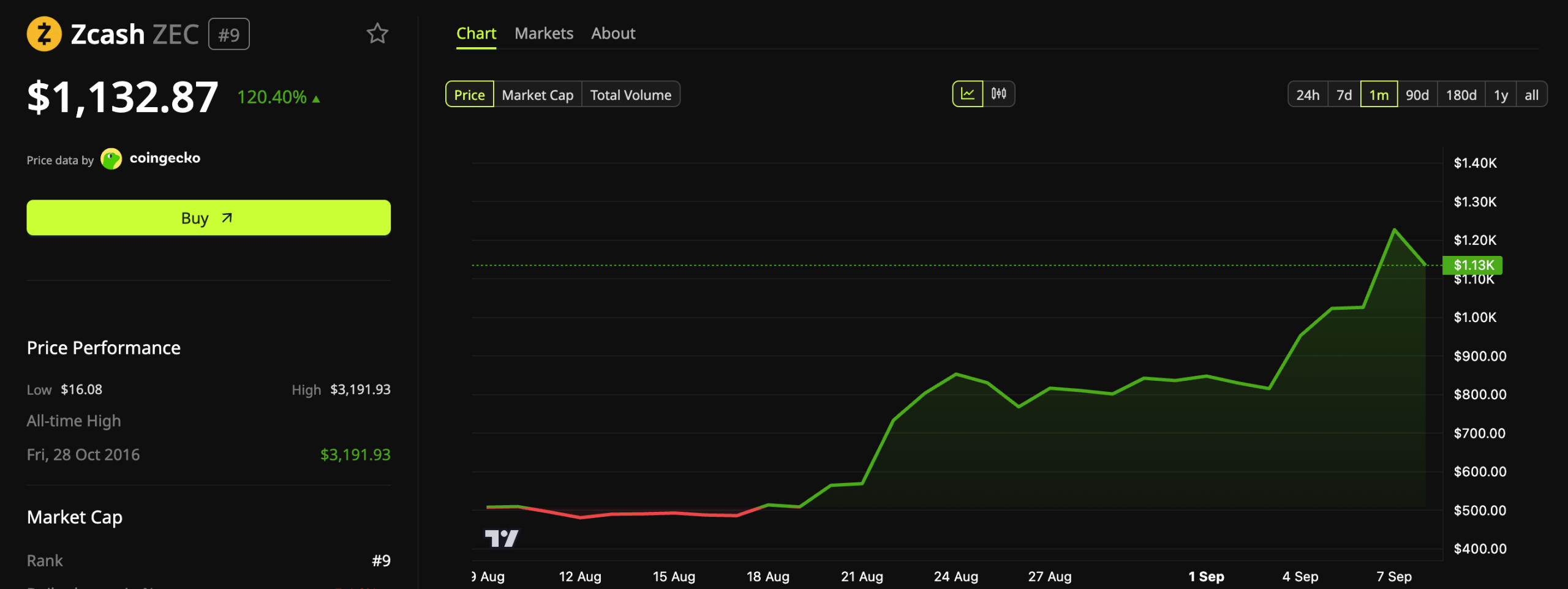
Zcash’s (ZEC) triple-digit rally has put pressure on short sellers, who now watch their positions sink deeper into the red.
ZEC has gained 120% in the past month alone and trades near $1,124. It crossed $1,000 last week for the first time in nearly a decade.

Follow us on X to get the latest news as it happens
ZEC Shorts Sink Further as Zcash Leads the Only Winning Sector
The rally has proved costly for traders positioned against ZEC. Hyperliquid data shows trader Garrett Jin, wallet 0x92ea…50e9, short 39,760 ZEC worth $44.86 million from an average entry of $576.30.
“Garrett Jin just closed his entire 1,332 BTC ($105.4M) long for a $2.7M profit and is now fully focused on shorting ZEC,” Lookonchain posted.

That trade is down $21.94 million and liquidates at $2,540.47. A second wallet, 0xdd53…2b13, is short 27,557 ZEC from $644 and is sitting on a paper loss of $13.33 million.
A third, 0x362a…1d9f, is down $4.12 million on 15,785 ZEC. Together, the three sit on roughly $39 million in unrealized losses.
None of them has folded yet. Funding has softened the blow, with Jin collecting $554,850 since opening the trade, because positive funding rates mean long positions pay short ones.
These bears are not just fighting one token, however. They are short, the only sector still above its level when Bitcoin (BTC) peaked in October.
Privacy Is the Only Sector Still Above the October High
Bitcoin sits 36% below its October 2025 peak, and the median top-200 asset trades 58% lower. Privacy coins are the exception, up 213% over that stretch, Glassnode found.
The sector was worth $7.1 billion a year ago. It is worth $33.6 billion today. ZEC drove most of that expansion.
Glassnode puts it at 62% of the sector by market cap and up 2,496% in 12 months. Strip ZEC out, however, and the remaining privacy basket is still up 85%.
Institutional money has followed. Grayscale listed the first US spot Zcash exchange-traded fund (ETF) on NYSE Arca on August 25, and the fund has since gathered $463 million.
Still, the concentration cuts both ways. ZEC futures open interest sits at $2.56 billion, per CoinGlass, so the same leverage punishing the bears could turn on the longs if the privacy bid fades.
Subscribe to our YouTube channel to watch leaders and journalists provide expert insights
The post Zcash Crossed $1,000 for the First Time in Nearly a Decade. 3 Whales Wish It Hadn't appeared first on BeInCrypto.
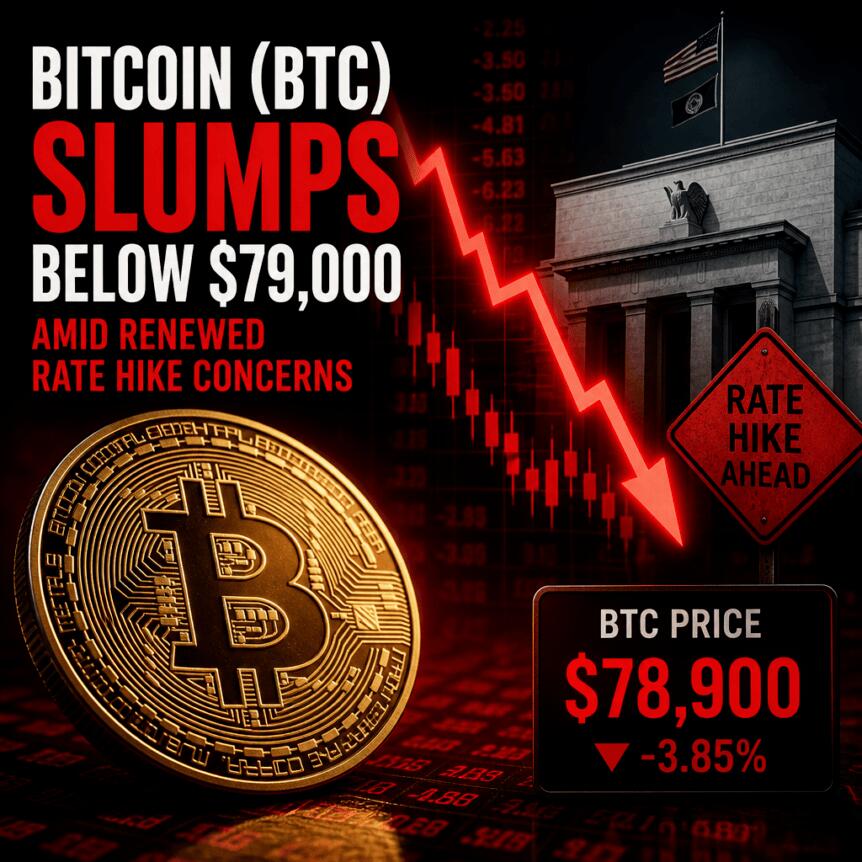
Bitcoin (BTC) slipped below $79,000 early on Tuesday after the odds of a Federal Reserve rate hike rose to around 60% following Friday’s jobs data. Some analysts believe the flagship cryptocurrency will remain under $82,000 until the Fed decides on interest rates.
BTC fell 1.55% on Monday and closed at $79,091. It slipped further during the ongoing session and is down nearly 1% at $78,364.
Bitcoin (BTC) Decline Continues
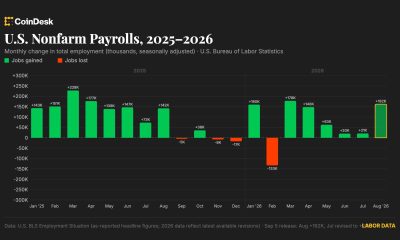
BTC’s latest rally took the price past $82,000 on Friday, reaching an intraday high of $82,282 before losing momentum thanks to substantial selling pressure above $82,000. However, price action wavered following Friday’s jobs report. The report revealed the US added 162,000 jobs in August against the expected 55,000, while the unemployment rate remained unchanged at 4.1%. CME’s FedWatch tool increased the likelihood of a 25 bps interest rate hike to 60% following the report.
The US Dollar and Treasury yields also rose following the report, pressuring BTC and other rate-sensitive assets. LMAX Group Market Strategist Joel Kruger believes BTC and the broader cryptocurrency market were displaying considerable resistance, stating in comments to The Block,
“The crypto market continues to display exceptional resilience despite having been presented with plenty of reasons to correct. Bitcoin is holding near $80,000 following an aggressive August rally that pushed momentum into overbought territory.”
Kruger also highlighted that crypto had faced substantial headwinds, including US-Iran tensions, rising oil prices, and higher Treasury yields.
“What stands out is that crypto has absorbed these headwinds without suffering meaningful technical damage.”
Bitcoin (BTC) Could Remain Muted Until Fed Decision
Bitfinex analysts believe BTC is consolidating with an upside bias, not a confirmed breakout. For the moment, sustained ETF demand is absorbing the pressure from the Treasury yield increase and possible interest rate hike. BTC’s latest decline comes after another attempt to reclaim $80,000, as selling pressure pushed the price lower following Friday’s move to $82,282.
Meanwhile, analysts at CoinEx believe BTC will remain pinned under $82,000 until the Federal Reserve decides on interest rates. Jeff Ko, the chief analyst at CoinEx, stated,
“I expect compression into a tight range, capped around $82,000 with support at $78,000–$79,000.”
Ko added that if BTC loses the lower end of its support range, it could slip towards $77,000, a level also flagged by Bitfinex analysts. BTC must decisively clear $80,000 before it can retest the $82,000 resistance. However, this could be difficult. The recent August rally took BTC past $79,000. Technical indicators such as the daily Relative Strength Index (RSI) have reached overbought territory, while waning momentum and upper-level resistance increase the likelihood of a pullback.
Upcoming CPI And PPI Decisions Could Dictate Bitcoin Price Action
The biggest test for Bitcoin ahead of the Federal Open Market Committee (FOMC) meeting is the interest rate decision. The odds of a 25 basis point hike have increased following Friday’s employment figures, which strengthened the argument for tighter policy. Manufacturing also expanded, with the Purchasing Managers’ Index reaching 54.6. However, elevated input costs suggest inflationary risk remains elevated. The Producer Price Index (PPI) is expected on September 10, followed by the Consumer Price Index (CPI) data on September 11. The Federal Reserve will announce its decision on interest rates on September 16. Ko stated,
“A hot print that pushes yields and the dollar sharply higher would be the cleanest test of Bitcoin’s resilience.”
Spot Bitcoin ETFs Help BTC Remain Near $80,000
Meanwhile, spot Bitcoin ETFs extended the weekly inflow streak, recording $986.9 million in net inflows for the week ending September 4. The latest figures have taken the three-week inflows to $3.8 billion. Sustained ETF inflows have helped the flagship cryptocurrency remain near $80,000 despite rising Treasury yields, a stronger dollar, and expectations of an interest rate hike.
However, Ko cautioned that the inflows do not confirm an accumulation phase.
“The $986.9 million of inflows brought the three-week total to roughly $3.8 billion, which is clearly constructive. But I would still like to see another few weeks of sustained net inflows, particularly if Bitcoin turns boring and trades sideways, before calling this a genuine accumulation phase.”
Disclaimer: This article is provided for informational purposes only. It is not offered or intended to be used as legal, tax, investment, financial, or other advice.


Binance founder Changpeng “CZ” Zhao said on Sept. 7 that initial public offerings “will move on chain,” as regulated exchanges and blockchain companies expand infrastructure for tokenized securities.
Summary
- CZ predicted IPOs will move on-chain but provided no timeline, structure or named issuer publicly.
- Tokenized stocks hold approximately $2.9 billion on-chain, according to current data published by RWA.xyz today.
- France’s ST Group raised €2.07 million through a fully tokenized IPO completed during April 2026.
- SEC staff says tokenizing securities does not alter registration, disclosure or investor-protection requirements under law.
- Nasdaq and NYSE rules permit eligible tokenized securities to trade alongside conventional versions under pilots.
Zhao offered no timeline, proposed structure or potential issuer in his brief statement. His comment was therefore a prediction rather than an announcement involving Binance or a confirmed offering.
Parts of the infrastructure needed to conduct an on-chain IPO are already operating. France completed a fully tokenized public offering in April, while Nasdaq and the New York Stock Exchange have established rules for trading eligible securities in tokenized form.
Market data also show growing demand for blockchain-based equities. Tokenized stocks currently represent about $2.9 billion in distributed value, according to the RWA.xyz dashboard. That figure was roughly 14% higher over the preceding month when Zhao made his statement.
On-chain IPOs have moved beyond the proposal stage
French aerospace and defense supplier ST Group completed a tokenized IPO through Paris-based Lightning Stock Exchange, or Lise, in April. The company raised €2.07 million by selling 113,525 shares at €18.25 each.
The transaction operated under the European Union’s Distributed Ledger Technology Pilot Regime. Legal adviser Clifford Chance described the offering as the world’s first fully tokenized IPO in its transaction record.
Unlike many tokenized-stock products, ST Group issued its equity through a blockchain-based market from the initial offering stage. Investors received regulated shares rather than tokens providing only synthetic price exposure.
Crypto.news previously reported that Lise planned to list ST Group through Europe’s first fully on-chain IPO. Completion of the transaction demonstrated that a company can conduct a primary offering through distributed-ledger infrastructure within an established securities regime.
Cantor Fitzgerald and Securitize are also developing regulated infrastructure for blockchain-based capital raising. The companies plan to support IPOs and follow-on offerings while retaining conventional underwriting, compliance and investor-protection processes.
Their partnership, as covered in July, seeks to bring public offerings onto regulated blockchain infrastructure. Neither company has identified the first external issuer that will use the system.
U.S. exchanges are adding tokenized trading rails
The U.S. market is moving through existing exchanges and clearing institutions. The SEC approved Nasdaq’s tokenized-securities pilot on March 18.
The approved order allows eligible participants to trade tokenized versions of selected Russell 1000 securities and major index-linked exchange-traded products.
Tokenized and conventional versions use the same Nasdaq order book. They carry the same ticker, CUSIP, price and shareholder rights. Participants can instruct the Depository Trust Company to settle eligible trades in tokenized form.
Nasdaq’s approved pilot keeps tokenized shares inside the national market system, rather than moving trading to an unrelated crypto venue.
The NYSE filed a similar rule change on April 9. Its SEC filing established a framework for eligible tokenized securities to trade alongside conventional shares under the DTC pilot.
These programs do not amount to native on-chain IPOs. They apply blockchain-based settlement to eligible securities already trading within existing market structures.
DTC conducted live production transactions involving about 40 firms on July 15. The company said those tests moved its tokenization service from development into production activity. A broader service launch is expected in October 2026, according to DTCC’s official update.
Tokenized shares do not always provide ownership
The term “tokenized stock” covers several structures with different legal rights. An issuer can place its official shareholder register on a blockchain, or a third party can issue a token backed by shares held with a custodian.
Another model provides synthetic exposure without transferring ownership in the underlying company. Holders of synthetic products may lack voting rights, dividends or claims against the referenced issuer.
The SEC explained these distinctions in a January statement. Staff divided tokenized securities into issuer-sponsored and third-party-sponsored structures, with the latter including custodial entitlements and synthetic instruments.
The agency said moving ownership records onto a blockchain does not alter the application of federal securities laws. Offers and sales must still be registered unless an exemption applies.
The statement was issued by SEC staff and is not a Commission rule. It carries no independent legal force, but it explains how three agency divisions currently view tokenized securities.
Investor rights remain a central issue. Transfer agents have urged regulators to favor issuer-backed structures, warning that third-party tokens may introduce bankruptcy exposure or provide weaker ownership rights. Crypto.news reported that industry groups asked the SEC to restrict third-party tokenized stocks over those concerns.
On-chain IPO growth still faces practical limits
Blockchain settlement could support fractional shares, programmable compliance and longer trading hours. It may also reduce reconciliation work by allowing participants to use a shared ownership record.
However, tokenization does not automatically eliminate underwriters, auditors, lawyers, transfer agents or regulated intermediaries. Those parties perform functions that extend beyond recording transactions.
Round-the-clock trading also requires continuous liquidity, market surveillance and cash settlement. A token may remain transferable when its underlying market is closed, but limited liquidity can create wider price differences and volatile order books.
Traditional exchanges are testing ways to address that problem. The London Stock Exchange and Kraken parent Payward plan to explore tokenized UK public equities. LSE 24 could support trading in xStocks during 2027, subject to regulatory approval.
In related coverage, the London Stock Exchange proposed bringing major UK-listed shares into the xStocks framework. The project remains under development and does not constitute a confirmed on-chain IPO.
The next measurable milestones are DTCC’s planned October launch, further SEC decisions and the first issuer using the Cantor-Securitize offering system. A large company choosing native blockchain issuance would provide stronger evidence for Zhao’s forecast.


Bitcoin, gold and technology stocks fall as the yen rallies, while oil prices and government bond yields climb globally.
Capital inflows into spot Bitcoin ETFs reached $986.9 million in the week ending 5 September 2026. Over the past three weeks, cumulative inflows have totalled $3.8 billion, marking the strongest three-week performance for these funds in 2026. Over the same period, spot Ethereum ETFs attracted $218.4 million, down from $824.4 million the previous week, representing a roughly 74% decline in inflows.
Against this backdrop, Ethereum continues to prepare for the Gl Amsterdam upgrade, which is expected to launch on the mainnet in Q4 2026, although an exact date has yet to be confirmed. The upgrade is aimed at further scaling the network and improving the efficiency of transaction and data processing. These factors provide the fundamental backdrop for ETH following its strong rally in the second half of August.
Technical Analysis of ETH/USD
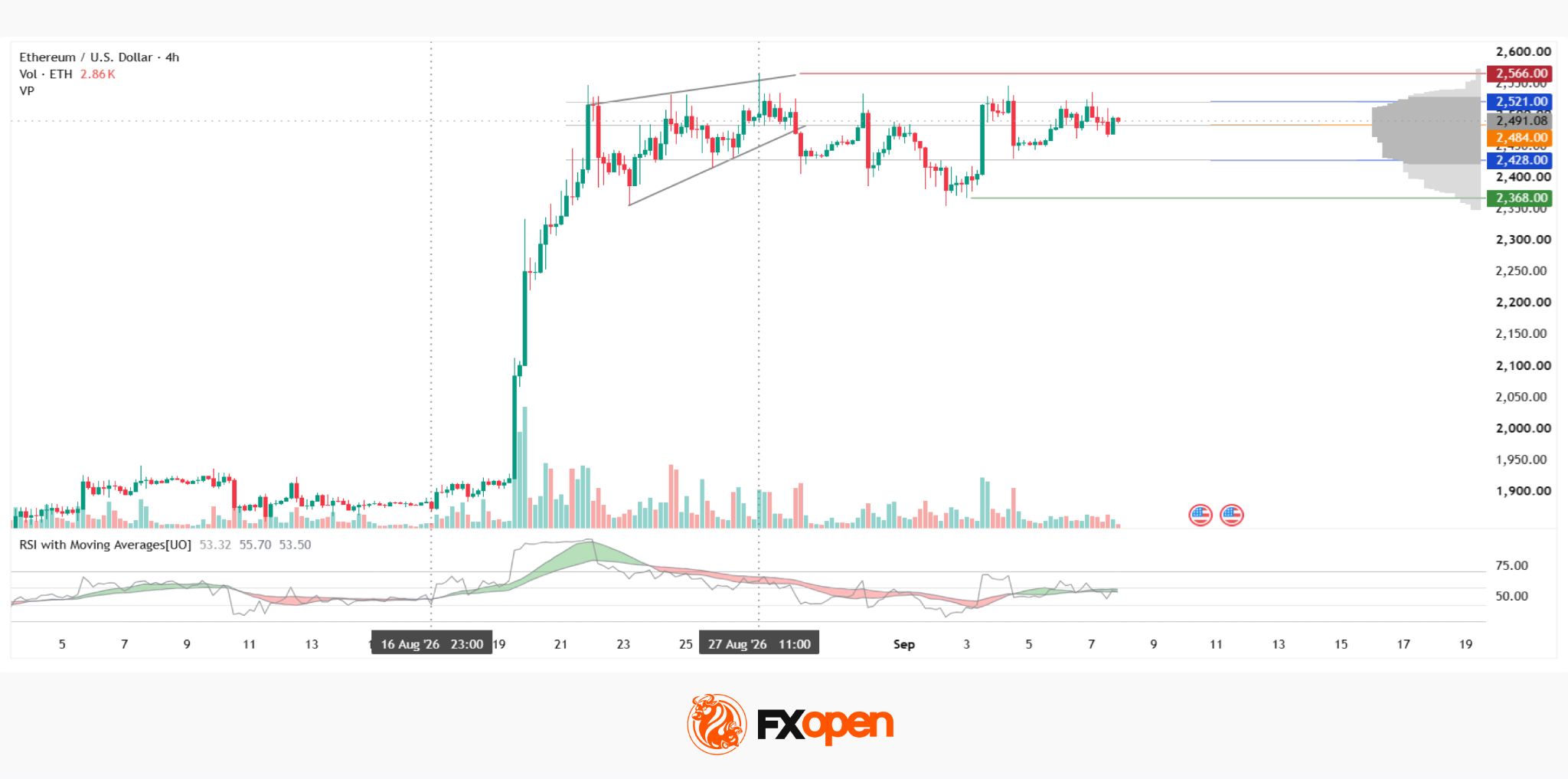
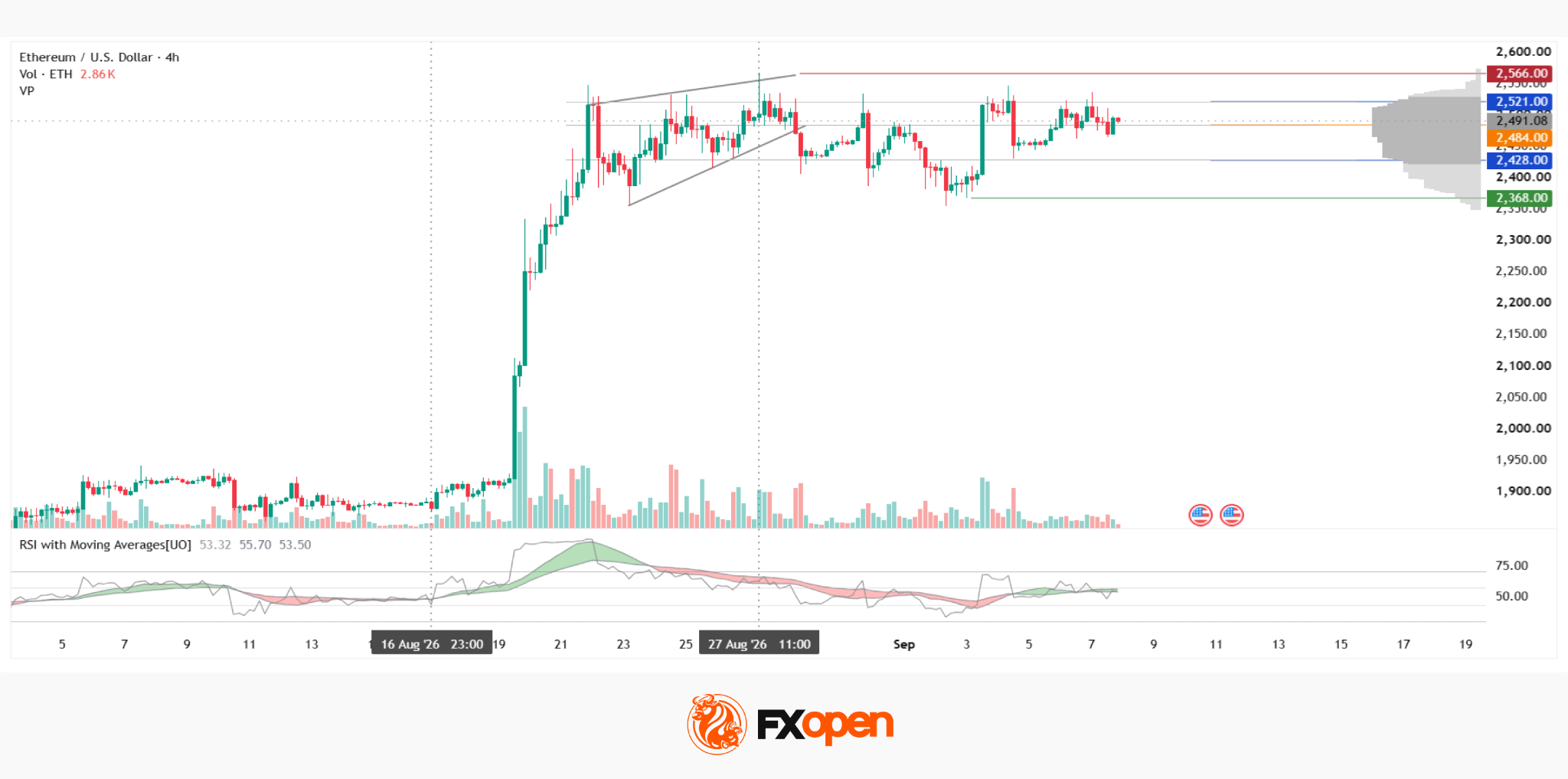
The four-hour ETH/USD chart shows a pronounced uptrend that began with a sharp impulse on volume significantly above the average levels seen in previous weeks. An ascending wedge formed near the top of this move, with price fluctuations gradually narrowing to create a classic pattern. At the end of August, the price attempted to break out of the wedge to the downside, but the breakout failed to develop, with the market returning to the boundaries of the developing market profile.
Trading within the current boundaries has continued for a relatively long period, which could indicate that energy is building ahead of the next significant move. The price is currently moving between the Point of Control (POC) at $2,484 and the upper boundary of the profile at $2,521.
Above the current market profile, near the top of the trend, there is a red resistance area around $2,566. Below it lies a green support area at $2,368, which would only become accessible if the price first breaks through the lower boundary of the profile at $2,428.
The RSI + MAs indicator is showing readings of 53, 55 and 53. The oscillator and both moving averages are holding below the upper boundary of the neutral zone and are attempting to move higher, while the moving-average lines are green.
Key Takeaways
The prolonged consolidation following the failed downside wedge breakout has yet to determine the pair’s next direction, while the RSI + MAs readings add to the potential recovery scenario. The flow of capital into spot Ethereum ETFs remains an additional point of reference for Ethereum.
FXOpen offers the world’s most popular cryptocurrency CFDs*, including Bitcoin and Ethereum. Floating spreads, 1:2 leverage — at your service (additional fees may apply). Open your trading account now or learn more about crypto CFD trading with FXOpen.
*Important: At FXOpen UK, Cryptocurrency trading via CFDs is only available to our Professional clients. They are not available for trading by Retail clients. To find out more information about how this may affect you, please get in touch with our team.
This article represents the opinion of the Companies operating under the FXOpen brand only. It is not to be construed as an offer, solicitation, or recommendation with respect to products and services provided by the Companies operating under the FXOpen brand, nor is it to be considered financial advice.


Cronos’s post-mortem put the Tectonic exploit’s affected borrowing at $120.4 million, with 7.6% transferred off-network before validators intervened.

A man holds a laptop computer as cyber code is projected on him in this illustration picture taken on May 13, 2017.
Kacper Pempel | Reuters
Security audits weren’t enough to keep many cryptocurrency platforms safe from money-losing hacks, crypto market data site CoinGecko said in a report dated Aug. 27.
Between January 2025 and July 2026, cryptocurrency platforms have lost more than $3.63 billion due to a variety of cyberattacks and stolen passkeys, the report said.
Around 88% of the stolen funds and about 60% of the affected platforms had “completed independent security audits,” the report said. It noted most of the attacks targeted areas that checks do not typically cover.
Bybit was most affected, the report said, citing the $1.4 billion February 2025 heist that Elliptic attributed to North Korea. Second-most affected was KelpDao, with $292 million lost, followed by Drift Protocol, with $285 million lost, the report said.
Bybit, KelpDao and Drift Protocol didn’t immediately respond to a CNBC request for comment.

‘It’s been wall-to-wall aggravation’: F1 supremo Bernie Ecclestone, 95, speaks out after being stopped for illegally carrying shotgun on his jet ‘to go clay-pigeon shooting’

The real driving force behind development isn’t money, it’s trust
XRP Dips Below Crucial Support, BTC Slides Toward $78K: Market Watch

Weekend Open Thread – Corporette.com

Weekend Open Thread: Brooks Brothers

London Mayor Sadiq Khan handed a peerage by Keir Starmer alongside 15 other Labour figures… just days before the PM leaves No10

Ripple XRP Is Going To $32 A Coin This Is Going To Shock The Daylights Out Of You

Jangan pernah Menyerah sampai Kalian Berhasil! #timothyronald #motivasikaya #cryptocurrency

You’re 48% Better Than The Average Financial Planner
-

 Fashion4 days ago
Weekend Open Thread: Beyond Yoga
-
 Crypto World4 days ago
Bitcoin price stalls near $82K as key resistance holds
-

 Politics4 days ago
Best Gaming Laptops, CPUs, TVs, And Keyboards To Upgrade Your Set Up For GTA VI
-

 Tech4 days ago
The Birds Outside, Drawn For You Automatically
-

 Crypto World4 days ago
IMF Says El Salvador’s Post-Review Bitcoin Purchases Used No Public Funds
-
 Crypto World4 days ago
U.S. added stronger than expected 162,000 jobs in August as labor market bounced back
-

 Sports4 days ago
Alexandre Pato consortium’s Northampton Town investment approved
-

 Sports4 days ago
Commanders’ Chig Okonkwo is a top breakout fantasy football candidate
-

 Sports4 days ago
Golden Eaglets Drawn in Group B for 2026 WAFU B U17 Championship
-
 Crypto World4 days ago
XRP price breaks falling channel as bulls target $1.53
-

 Politics4 days ago
A new European chapter for Gibraltar
-

 Politics4 days ago
How To Avoid Winter Colds: 4 Everyday Habits That Spread Germs, Says Pharmacist
-

 Politics4 days ago
The House | Bin the lectures, bring gossip and be ready to banter: how the new PM should prepare for his Trump encounter
-

 Crypto World4 days ago
From warning to listing: UK’s largest retail investment platform opens access to crypto ETNs
-

 Crypto World4 days ago
FinCEN flags $12.7B tied to Southeast Asia crypto investment scams
-

 Tech4 days ago
A Worthy Android Ereader, With Some Tradeoffs
-

 Crypto World4 days ago
Trezor Data Breach Impacts 67,000 More US Customers
-

 Tech4 days ago
How To Edit Claude’s Memory
-

 Politics4 days ago
33 Cosy Autumn Home Decor Ideas: Blankets, Pumpkin Decorations, And Candles
-

 Tech4 days ago
beyerdynamic AVENTHO Y Debuts at IFA 2026 and Makes Wireless Headphones Less Disposable
You must be logged in to post a comment Login