
Crypto World
Gold Price Analysis: Singapore To Tap Gold Ecosystem


Gold price might just get a big push from Singapore, and the analysis for the metal is getting bullish. Singapore is making a calculated push to become the Asia-Pacific’s dominant gold trading hub, and the institutional machinery backing that move is significant.
The Monetary Authority of Singapore announced on March 27, 2026, that it would build out a full gold ecosystem, covering physical vaulting, capital market products, OTC clearing, and central bank storage services. Gold price has held elevated as institutional demand accelerates.
Singapore is planning to expand its gold storage capacity, positioning itself as a key custodian of bullion for foreign central banks. — Gold Telegraph
It’s also developing “gold-related capital market products to promote price discovery and build liquidity”
Big news…
 (@GoldTelegraph_) March 27, 2026
MAS Deputy Chairman Chee Hong Tat confirmed the initiative alongside the Singapore Bullion Market Association, framing it explicitly as a new pillar for Singapore’s wealth management sector.
“What we’re doing is to create an ecosystem that enables gold trading activities based out of Singapore,” Chee said, describing the effort as “planting trees in an ecosystem.”
The working group, formed in January 2026, includes heavyweights DBS, JPMorgan, UBS, UOB, ICBC Standard Bank, SGX, and the World Gold Council. The LionGlobal Singapore Physical Gold ETF debuted on SGX just one day prior, on March 26, offering fractional exposure in both SGD and USD through vault operators Brink’s, Loomis, and Malca-Amit.
The convergence of sovereign-level institutional infrastructure and a brand-new ETF launch positions Singapore’s gold market at an inflection point, one that increasingly intersects with blockchain-based settlement and tokenized real-world asset infrastructure.
Discover: The best pre-launch token sales
Gold Price Analysis: Can Singapore’s Gold Push Sustain Bullion’s Institutional Bid?
Gold’s macro setup remains structurally bullish. Central bank accumulation, persistent dollar uncertainty, and now Singapore’s formal vaulting ambitions for foreign sovereign entities are layering new demand floors beneath spot prices.
The MAS initiative targets four pillars: physical infrastructure for storage and transport, gold-related capital market products for price discovery, a clearing and settlement system for large bars (12.4kg, the London standard) and kilobars (1kg, the Asian standard), and vaulting services for foreign central banks potentially held within MAS’s own vault.
That last point deserves attention. Sovereign vaulting demand doesn’t fluctuate with retail sentiment, it anchors long-term institutional positioning. Industry analysts note Singapore is now positioning directly alongside Dubai, Shanghai, and Hong Kong as a primary Asian bullion hub. Job creation across vaulting, trading, and analysis is expected as the ecosystem matures through 2026.
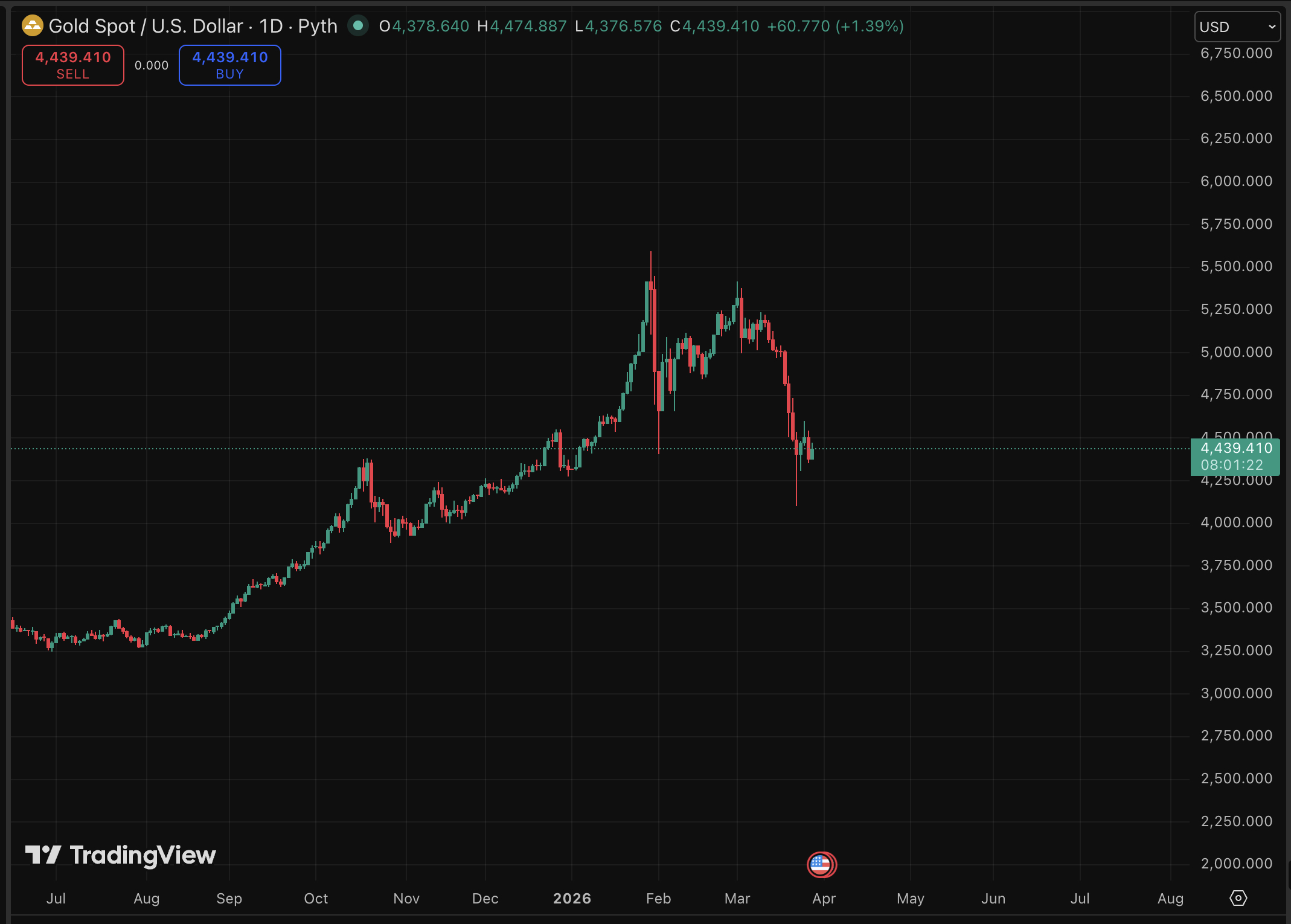
Gold price is falling right now, but Singapore might push it higher than the previous highs.
Discover: The best crypto to diversify your portfolio with
LiquidChain Targets Early Mover Upside as Gold’s Digital Infrastructure Layer Heats Up
Singapore’s gold push isn’t happening in isolation. The settlement infrastructure, clearing systems, and capital market products Chee described all point toward the same destination: programmable, verifiable asset settlement on-chain.
Institutional blockchain infrastructure is already moving in this direction, and tokenized real-world asset protocols are scaling fast. Spot gold, at current elevated prices, offers limited asymmetric upside for late-stage entries; the structural gains increasingly accrue at the infrastructure layer underneath it.
That’s the thesis behind LiquidChain ($LIQUID), an L3 infrastructure project currently in presale at $0.01435, with over $600K raised to date. LiquidChain fuses Bitcoin, Ethereum, and Solana liquidity into a single execution environment. Its Unified Liquidity Layer enables Single-Step Execution across all three ecosystems without bridging friction. Developers deploy once and access all.
A new layer emerges. Only a few see it first. — LiquidChain (@getliquidchain) March 24, 2026
The future is LiquidChain  ⟁https://t.co/vqvBcdSj94 pic.twitter.com/R7ZeZ0NPGl
Verifiable Settlement in Liquid Chain bakes auditability directly into the execution layer. As cross-chain interoperability becomes the backbone of institutional DeFi, early-stage L3 infrastructure plays carry the kind of asymmetric upside that spot gold simply can’t match at this market cap.
Research LiquidChain’s presale terms here.
This article is for informational purposes only and does not constitute financial advice. Crypto assets are highly volatile. Always conduct your own research before investing.
The post Gold Price Analysis: Singapore To Tap Gold Ecosystem appeared first on Cryptonews.


Key Takeaways
- Both BRK.A and BRK.B shares have declined for eight consecutive trading days — the most extended losing period since late 2018
- Class A shares are down 4.7% while Class B has fallen 4.9% from their March 17 closing highs
- Fourth quarter 2025 operating profits declined approximately 30% compared to the previous year, totaling $10.2 billion; insurance underwriting profits plunged 54%
- CEO Greg Abel reinitiated share repurchases on March 4 and acquired $15.3 million of company stock personally
- The conglomerate acquired approximately 2.5% of Tokio Marine Holdings for $1.8 billion, with shares jumping 24% following the announcement
Berkshire Hathaway is experiencing an eight-session consecutive decline — marking the most prolonged downward streak since December 2018. Since closing positively on March 17, Class A shares have retreated 4.7% while Class B shares have dropped 4.9%.
Berkshire Hathaway Inc., BRK-B
Broader market turbulence has compounded the pressure. The S&P 500 has declined 5.2% during the identical timeframe and sits approximately 7% lower year-to-date, amid its own five-week consecutive downturn. Escalating energy costs and geopolitical tensions stemming from the Iran situation continue to dampen investor confidence.
The timing presents challenges for Berkshire. Greg Abel formally assumed the CEO position at the beginning of 2026, while Warren Buffett transitioned to the chairman role. Shares have tumbled more than 13% since Buffett’s announcement last year regarding his planned departure from the chief executive position.
The company’s financial performance added to investor concerns. Fourth quarter 2025 operating profits totaled $10.2 billion, representing approximately a 30% year-over-year decline. Full-year operating earnings reached $44.5 billion, down 6% compared to 2024.
Insurance underwriting operations proved particularly challenging, plummeting 54% year-over-year during Q4 to $1.56 billion. While this comparison faced a particularly robust prior-year baseline, the results nonetheless rattled market participants when disclosed on February 28.
BNSF, Berkshire’s railroad subsidiary, continues grappling with margin compression due to elevated diesel expenses. The conglomerate’s consumer-focused and manufacturing operations also face headwinds from increased energy costs that are squeezing consumer spending power.
Abel Takes Action
Notwithstanding the negative price momentum, Abel has acted decisively to communicate his capital deployment philosophy. Berkshire restarted its share repurchase program on March 4 — marking the first buyback activity since May 2024. Abel informed CNBC that the company repurchases shares when they trade beneath intrinsic value, signaling his belief that current prices represent value.
He additionally revealed a personal investment of $15.3 million in Berkshire shares and pledged to invest his complete after-tax compensation in company stock annually throughout his tenure as chief executive.
Berkshire concluded 2025 holding $373.3 billion in cash, cash equivalents, and Treasury bills, slightly down from the third quarter record of $381.6 billion but still representing among the largest corporate cash reserves worldwide.
Tokio Marine Investment
In a notable transaction announced this week, Berkshire’s National Indemnity insurance subsidiary invested $1.8 billion to acquire just under 2.5% of Tokio Marine Holdings — Japan’s most established insurance enterprise.
Tokio Marine shares rocketed more than 24% after Monday’s disclosure. The position now carries a market value approaching $2.3 billion.
Berkshire retains the flexibility to expand its ownership to just below 10% via open-market transactions. Any holdings exceeding that threshold necessitate board authorization.
The transaction was directed by Ajit Jain and reportedly included Buffett in a consultative role. Tokio Marine issued fresh shares to facilitate the acquisition and intends to execute equivalent buybacks to maintain share count neutrality.
Both organizations will work together on reinsurance opportunities and jointly evaluate strategic investment prospects. Tokio Marine characterized the arrangement as a “long-term strategic relationship.”
Berkshire’s current portfolio of five Japanese trading companies — Itochu, Marubeni, Mitsubishi, Mitsui, and Sumitomo — have appreciated between 42% and 124% during the past 52 weeks, with aggregate market capitalization exceeding $44 billion.
Mitsubishi reached a record closing price on Friday.


GameStop didn’t sell its Bitcoin stash; it pledged it to Coinbase for a covered-call strategy. By capping its upside at a $105,000 strike price, GameStop evolved its treasury from passive holding into active yield generation.
But while corporate giants squeeze fixed-income premiums from established assets, retail investors are hunting for explosive price discovery. DeepSnitch AI (DSNT) delivers exactly that.
With $2.6 million raised and five live AI agents already giving traders an institutional-grade intelligence edge, DSNT captures the asymmetric upside that legacy treasuries trade away.
GameStop pledged its Bitcoin as collateral
GameStop’s recent 10-K filing reveals it didn’t sell its massive Bitcoin stash; instead, it pledged 4,709 BTC to Coinbase for a covered-call strategy.
By capping its upside at the $105,000 to $110,000 strike range, GameStop evolved its treasury from passive holding into active yield generation, even while recording a $59.7 million unrealized loss.
Because Coinbase can now rehypothecate the collateral, GameStop replaced the BTC on its balance sheet with a digital asset receivable. This move signals a broader market shift: corporate treasuries and institutional giants like BlackRock are increasingly using structured options to squeeze fixed-income yield from Bitcoin.
However, this institutional yield playbook is designed for entities holding hundreds of millions in capital. Everyday retail investors do not need capped options premiums; they need asymmetric price discovery and a fundamentally better entry point.
Top 3 best crypto presales in 2026
DeepSnitch AI
GameStop recently revealed it is generating yield on its massive Bitcoin holdings through covered-call premiums with a $105,000 strike. While this marks a major evolution in corporate treasury strategy, it requires holding thousands of Bitcoin and utilizing complex institutional infrastructure.
Retail investors don’t need fixed-income options on established assets; they need asymmetric early-stage opportunities. That is exactly what DeepSnitch AI (DSNT) offers.
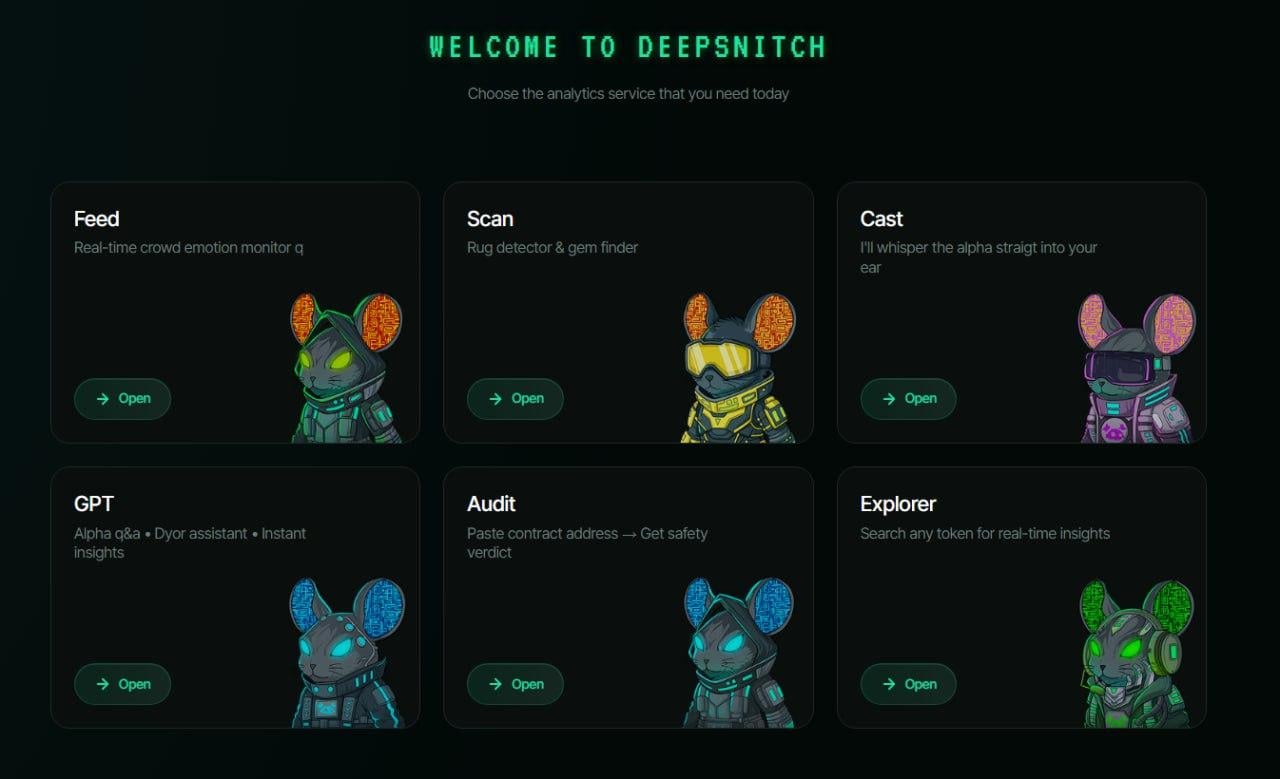
With its March 31st launch rapidly approaching, DSNT has raised over $2.6 million by doing what most presales fail to do: launching a fully operational product first. Its five live AI agents empower retail traders with institutional-grade intelligence, handling real-time sentiment tracking, scam detection, and hidden gem discovery.
Community projections are pointing toward 100x to 300x returns, the explosive upside that covered-call strategies simply cannot offer. This growth story is built on genuine daily utility, driving organic adoption and long-term token value rather than a temporary launch spike.
At $0.04669, the DeepSnitch AI ground-floor entry point is definitively closing in just three days. Once the Uniswap listing goes live, open-market price discovery takes over entirely.
Ionix Chain
Ionix Chain embeds AI directly into its Layer 1 protocol, offering a decentralized GPU marketplace and $0.0005 transaction fees. Having raised $6.65 million in Stage 18, its ambition is undeniable.
However, the risks match the scale. Building production-ready AI infrastructure takes significantly longer than roadmaps suggest, and Ionix’s undisclosed team severely hinders the enterprise adoption it targets. As GameStop’s transparent Bitcoin strategy proves, institutional credibility requires verifiable accountability.
DeepSnitch AI (DSNT) operates from a structurally different position. By shipping a live, working intelligence product with a fully disclosed team before opening its presale, DSNT delivers immediate utility.
Gassed Token
Gassed Token relies on a Solana-based, click-to-earn mechanic to drive community engagement.
While Solana’s low fees suit this gamified loop, the ceiling remains strictly capped. Beneath the meme, there is no underlying product, recurring revenue, or utility to absorb selling pressure once the novelty fades.
Furthermore, unconfirmed audits and an undisclosed team strip away crucial accountability. As GameStop’s transparent Bitcoin yield strategy proves, serious capital demands verifiable structure.
DeepSnitch AI (DSNT) operates in an entirely different category. Offering a live intelligence platform, active daily users, dual audits, and a confirmed March 31st listing, DSNT delivers genuine utility over fleeting attention.
Closing thoughts
GameStop recently pledged its Bitcoin to Coinbase to run covered calls, squeezing options yield from a $105,000 strike. While corporate crypto strategy grows increasingly sophisticated, retail investors need asymmetric entry points.
The market is actively filtering out weak setups. Ionix Chain’s undisclosed team creates a massive credibility gap for enterprise adoption, and Gassed Token’s click-to-earn model lacks both an underlying utility floor and published audits. DeepSnitch AI (DSNT) answers these exact concerns.
Having shipped five live AI agents before raising a single dollar, DSNT has secured $2.6 million from active users. At $0.04669, early backers are already seeing 210% gains, fueling 100x to 300x community projections that are grounded in genuine daily utility.
While GameStop caps its upside for yield, DSNT is heading for pure price discovery. The March 31st presale deadline is exactly three days away, and the Uniswap listing follows immediately. The entry point that exists today will not exist next week.
Visit the official DeepSnitch AI website, join Telegram, and follow on X for more updates.
FAQs
Which best crypto presales are still open as GameStop’s Bitcoin strategy evolves from holding to yield generation?
DeepSnitch AI leads: $2.6M raised, 210% gains, five live AI agents, and a confirmed March 31st Uniswap launch with 100x to 300x projections. GameStop’s covered-call strategy peaks at structured options premiums on a $105,000 strike.
What upcoming crypto presales offer retail investors bigger returns than corporate covered-call Bitcoin strategies?
DeepSnitch AI: daily utility across sentiment tracking, rug detection, hidden gem discovery, and instant DYOR tools that any retail investor can access with a wallet, no Bitcoin collateral required. DSNT’s 100x to 300x case requires getting in before March 31st.
How does DeepSnitch AI stand apart from Ionix Chain and Gassed Token right now?
DeepSnitch AI has a shipped product, a disclosed team, $2.6M raised from real users, and a confirmed listing time. Ionix Chain has team transparency gaps that enterprise adoption will eventually require answers to. Gassed Token has no utility floor and no published audits.
Disclaimer: This is a Press Release provided by a third party who is responsible for the content. Please conduct your own research before taking any action based on the content.
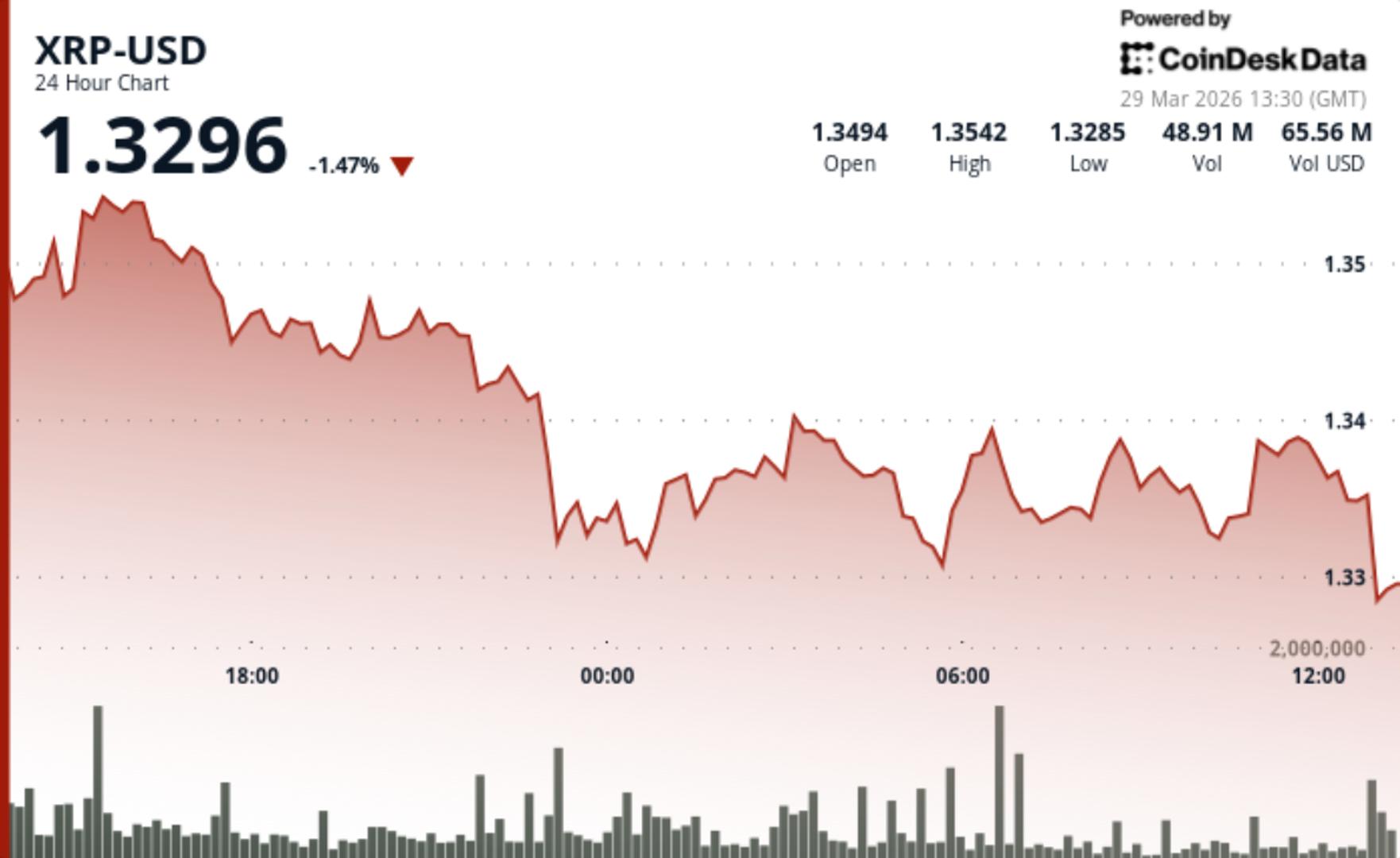
Funding spikes and liquidations point to positioning build-up, with direction hinging on whether buyers can defend support.
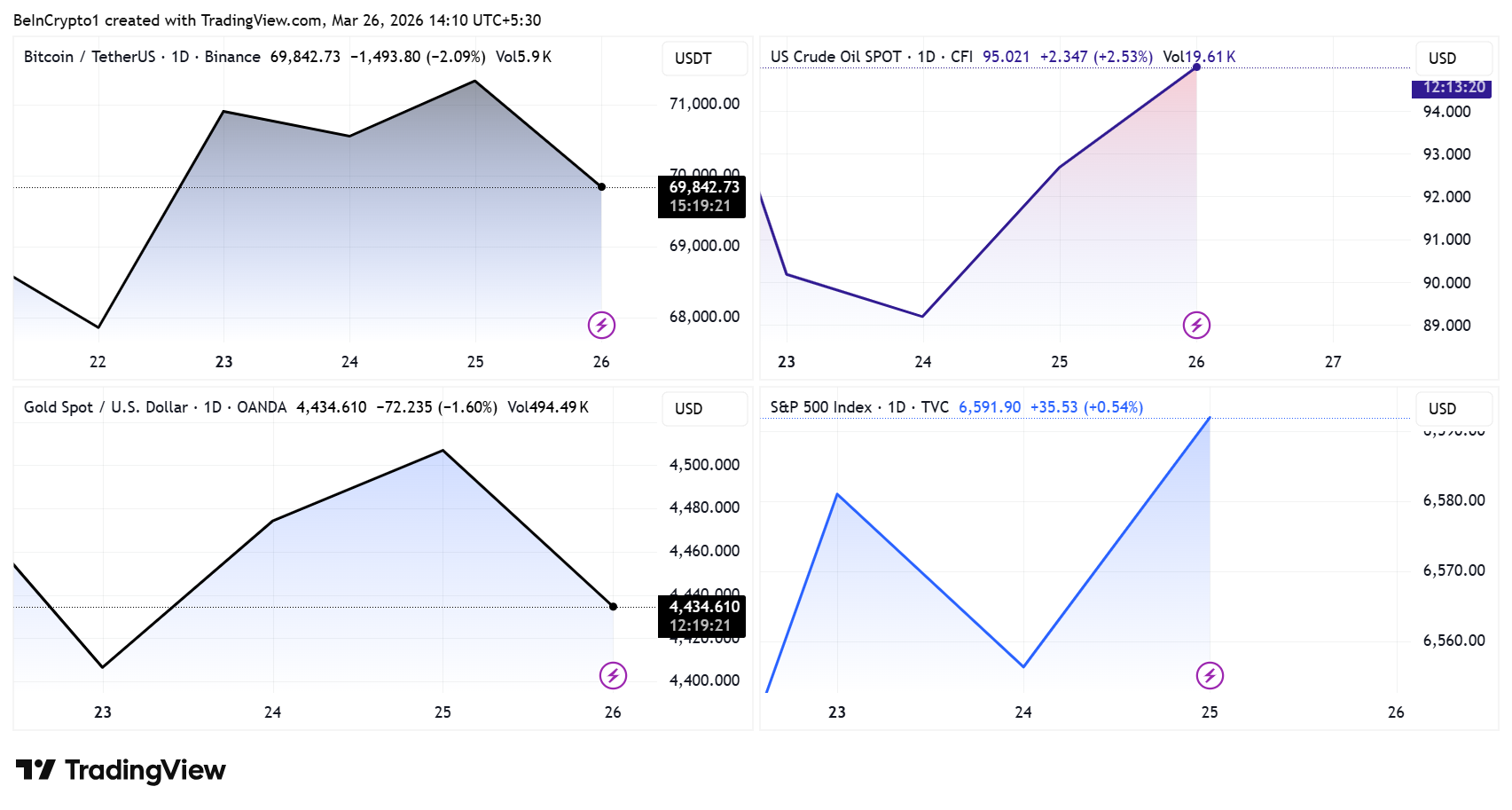
On Monday, March 23, President Trump announced a 5-Day pause on strikes against Iranian energy infrastructure. The decision added $1.7 trillion to US stocks, crashed oil prices by 15%, and sent Bitcoin above $70,000. That pause is now extended until April 6.
But Tehran called these claims ‘fake news’, and Israel already violated Trump’s pause. Almost all of these financial gains vanished within a week.
So, did Donald Trump actually have productive talks with Iran, or was it just a ploy to benefit financial markets and have big players cash out?
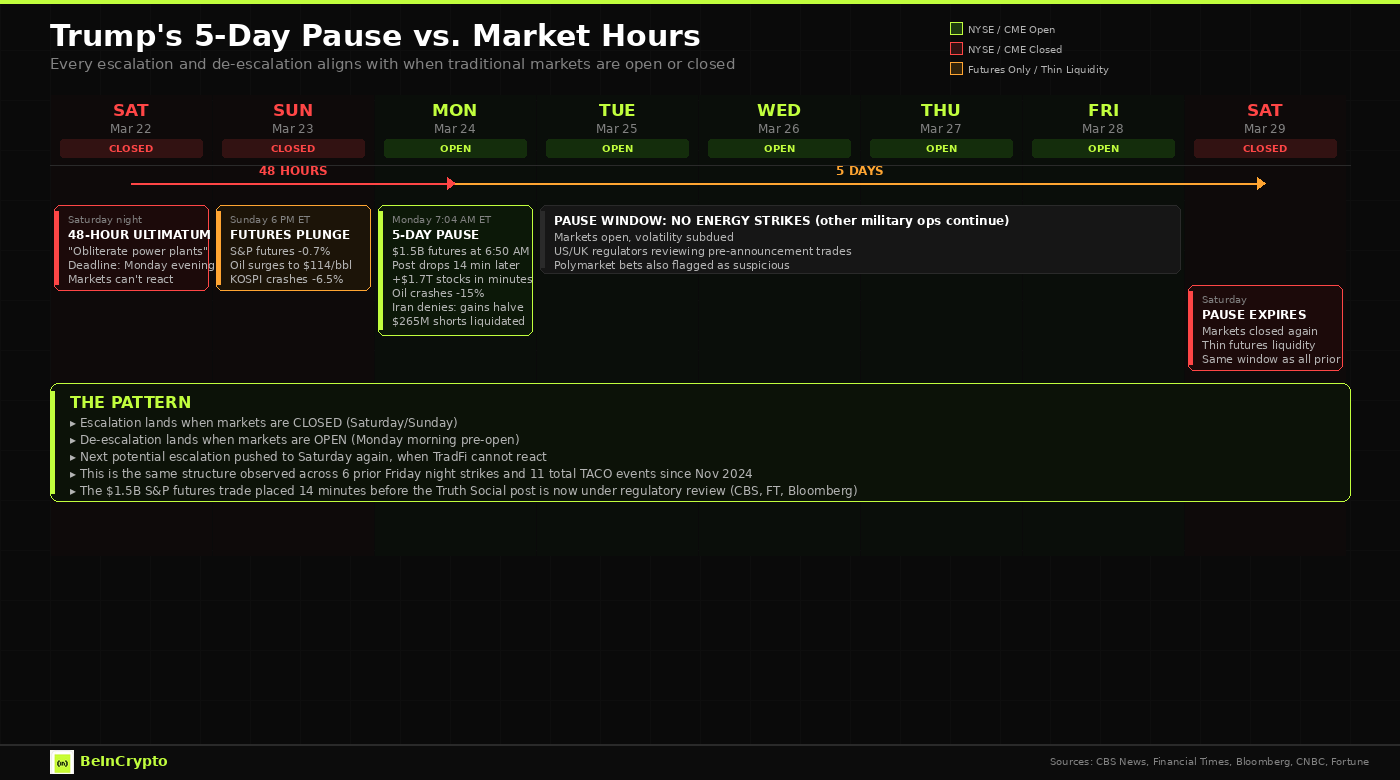
How Trump’s Pause Lines Up With Market Hours
The sequence starts Saturday, March 22. Trump posted a 48-hour ultimatum on Truth Social demanding Iran reopen the Strait of Hormuz or face strikes on its power plants.
That deadline was set to expire Monday evening, with traditional markets fully open and exposed.
Instead of following through, Trump posted at 7 a.m. ET Monday, claiming “very good and productive conversations” with Tehran. He announced a 5-day postponement of all energy infrastructure strikes.
The 5-day window expired Saturday, March 28. Not a random day.
- Equity markets are closed
- Futures liquidity is thin
- Institutional desks are offline.
If escalation resumes, it lands in the same low-liquidity window that has preceded every major Trump-era market shock since mid-2025.
Someone Traded Before the Post
Markets moved before the announcement went live. Between 6:49 and 6:50 a.m. ET, roughly 6,200 Brent and WTI futures contracts changed hands with a notional value of $580 million.
The average for that same minute over the prior five trading days was approximately 700 contracts, according to Bloomberg data reported by the Financial Times.
At the same time, $1.5 billion in S&P 500 futures were purchased. That single order pushed the index 0.3% higher instantly. Fourteen minutes later, Trump’s post dropped. By 7:10 a.m. ET, the S&P 500 had gained roughly $2 trillion in value.
U.S. and UK regulators are reportedly reviewing the data. No charges have been filed.
“The massive spike in volume of trades right before that post is certainly enough to raise eyebrows, and I think to launch an investigation into what was behind that,” wrote CBS News, citing Stephen Piepgrass, a partner who specializes in futures trading at the law firm Troutman Pepper Locke.
Iran Says It Never Happened
Tehran’s response left no ambiguity. Parliament Speaker Mohammad Bagher Ghalibaf called it “fake news” intended to manipulate financial and oil markets.
The Foreign Ministry described it as psychological warfare aimed at lowering energy prices and buying time for more strikes. Officials acknowledged receiving messages through intermediaries but insisted no direct negotiations occurred.
The denial triggered an immediate reversal. Oil rebounded. Stocks gave back roughly half their gains. BTC pulled back after briefly reclaiming $70,000, leaving $265 million in crypto shorts liquidated within 15 minutes.
This Has Happened 11 Times Since November 2024
Monday was not the first time. BeInCrypto has tracked 11 market-moving Trump announcements since November 2024, each following what traders now call the TACO pattern, a cycle of action, crash, reversal, and recovery.
- Liberation Day tariffs were announced on April 2, 2025, at 4:30 p.m. ET, after markets closed. Trump posted “BE COOL! THIS IS A GREAT TIME TO BUY!!” the next morning, minutes after opening. A 90-day pause followed, producing a 9.5% rally in the S&P 500.
- On October 10, 2025, a 100% tariff threat on China dropped on a Friday, 20 minutes after close. BTC fell 18.4%. Crypto liquidations hit $19.1 billion in 24 hours.
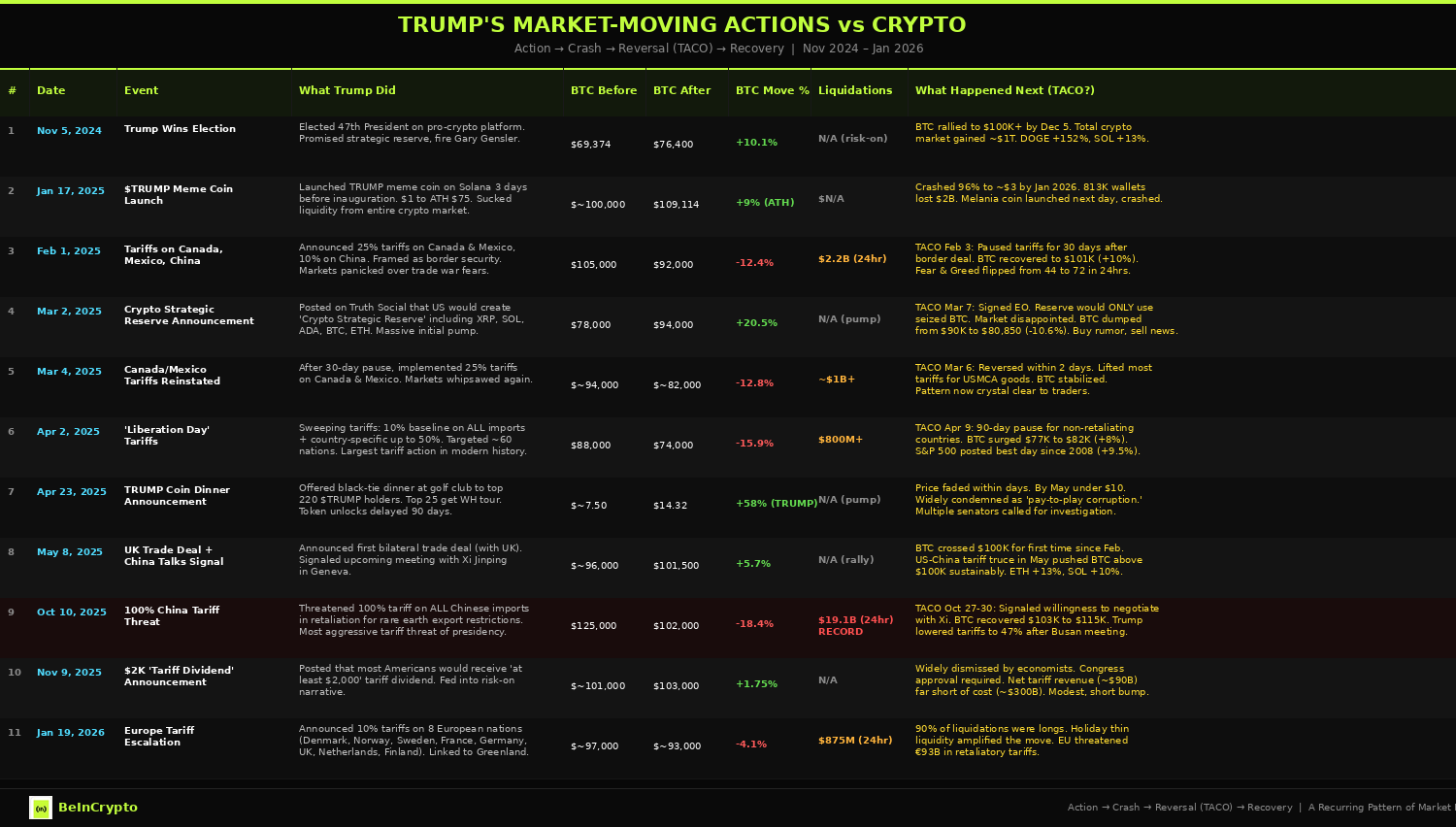
Six confirmed Friday night strikes between June 2025 and February 2026 followed the same logic. BeInCrypto identified this as a repeatable 60-hour sequence across those events.
The Iran pause is the evolution. Instead of a Friday shock and a Monday walk-back, Monday itself became the vehicle. Ultimatum on Saturday. Relief on Monday. Next escalation window on Saturday again.
What the Experts See
Oxford-based political scientist Richard Heydarian warned on the BeInCrypto podcast that the economic damage from the conflict could run into trillions while Trump’s tactical moves remain impossible to anticipate.
“Trump is strategically predictable, but tactically impossible to predict. We know what his endgame is. American hegemony, beyond question. But how to achieve that in such a complex world? No one knows,” Richard Heydarian told BeInCrypto.
Stanford economist Mordecai Kurz, also speaking on the BeInCrypto podcast, placed the dynamics within a structural problem of concentrated private power that leaves ordinary people exposed.
“There are so many concentrations of private power in America that this cannot continue… young people have a chance only if technology is made to serve people and policy serves people,” Kurz explained.
The 5-day clock expires Saturday. If the pattern holds, the next headline lands when markets are closed, and liquidity is at its weakest.
Across 11 documented events and 16 months, the pattern has not broken once.
The post How Trump’s Iran Pause Fits Into His Market-Timed Playbook appeared first on BeInCrypto.
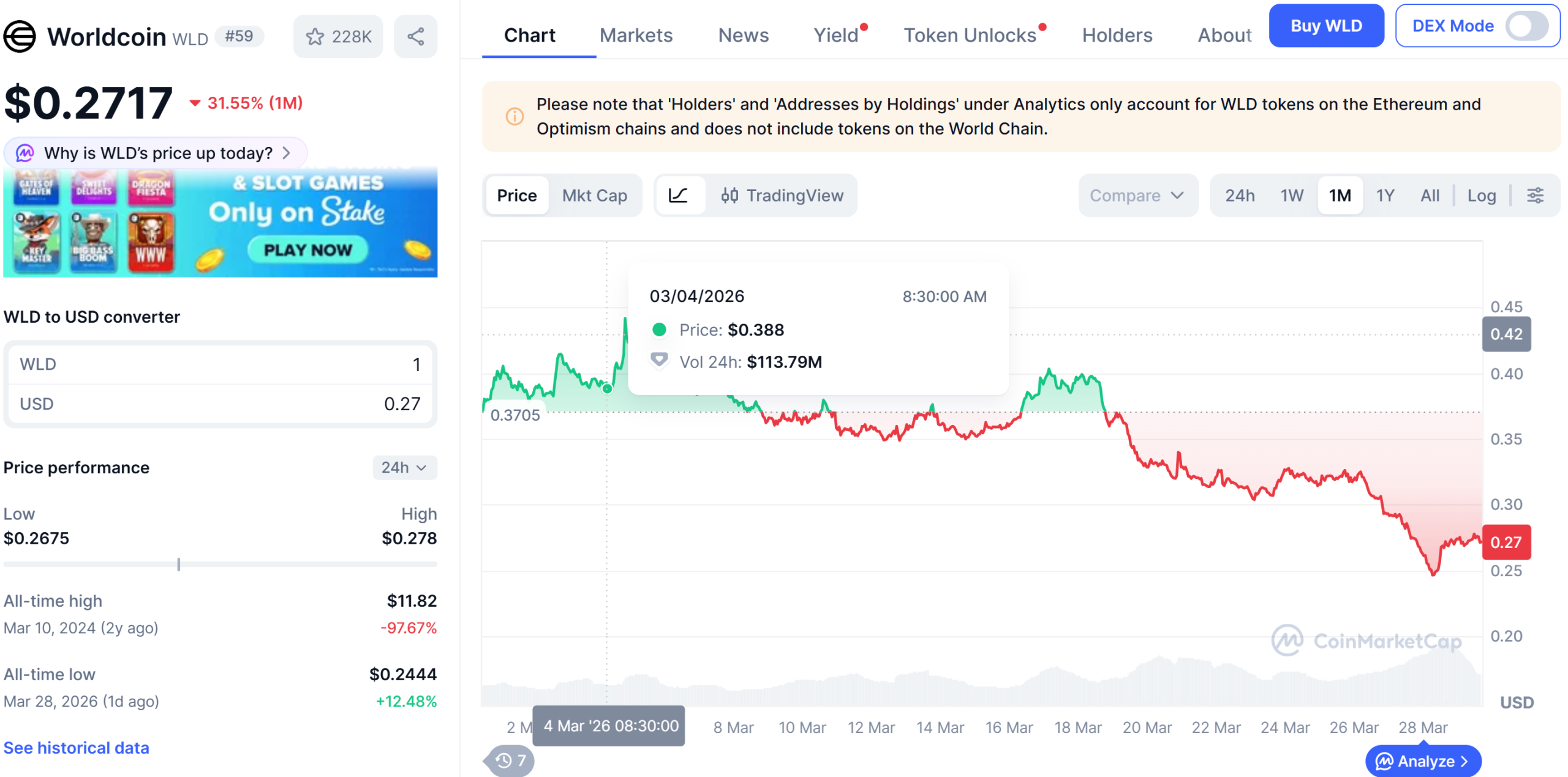
Sam Altman’s World Foundation has raised $65 million through an over-the-counter (OTC) sale of its WLD token, which has hit new record lows.
In a Saturday post on X, the foundation said its token issuance arm, World Assets, completed the sale to four counterparties over the past week, with the first tranche settling on March 20. The transactions were priced at an average of roughly $0.27 per token, suggesting that around 239 million Worldcoin (WLD) changed hands.
“This sale funds the project’s core operations and activities, R&D, orb manufacturing, ecosystem development, and more,” World Foundation wrote on X.
Of the total, $25 million worth of tokens are subject to a six-month lockup, while the remainder were immediately liquid.
Related: World launches AgentKit with Coinbase integration to enable human-verified AI agents
WLD hits new low
Following the announcement, WLD briefly fell to an all-time low of around $0.24 before recovering to $0.27, leaving it down about 97% from its March 2024 peak near $11.82. The token is currently trading at $0.2725, up by 0.28% over the past day, according to data by CoinMarketCap.

Additional supply pressure may be on the horizon. A major community token unlock is scheduled for July 23, covering roughly 52.5% of the token’s 10 billion total supply, according to DefiLlama.
Meanwhile, the new sale also comes at a steep discount to prior rounds. In May last year, World raised $135 million at approximately $1.13 per token from backers including Andreessen Horowitz and Bain Capital Crypto.
Related: Tools for Humanity expands World app toward super-app model
Thailand raids World-linked iris scanning site
In October last year, authorities in Thailand raided an iris-scanning site linked to World. The country’s Securities and Exchange Commission, working with the Cyber Crime Investigation Bureau, said the service may have violated digital asset laws by operating without a license, leading to arrests and an ongoing investigation.
The move added to a growing list of regulatory challenges for World. Since launching in 2023, the project has faced probes and pushback in several countries, including Indonesia, Germany, Kenya and Brazil, with concerns ranging from licensing issues to the handling of sensitive biometric data.
Magazine: Bitcoin may take 7 years to upgrade to post-quantum — BIP-360 co-author
Crypto World
Solana Price Prediction: Grok AI Targets $290 as Pepeto Targets 100x While BNB and LINK Hold
When Goldman Sachs speaks, markets pay attention. The $3.6 trillion asset manager published research indicating the downturn may be running out of steam, and the solana price prediction from Grok AI at $210 to $290 confirms the recovery.
Pepeto is in that window right now with more than $8 million raised, a live exchange already running, and analysts projecting 100x as the Binance listing approaches. Pepeto at presale is positioned to capture the kind of return SOL at $39 billion will not deliver.
Grok AI forecasts Solana trading between $210 and $290 by December 2026, supported by Goldman Sachs’ $108 million SOL ETF stake and Mastercard and Western Union partnerships according to MEXC.
Combined with the Alpenglow upgrade bringing 150ms finality, the forecast carries the highest raw percentage growth potential among large caps. According to Yahoo Finance, AI models project SOL up to $800 in a bull scenario, a 500% ceiling, but that level still requires $39 billion in market cap growth.
The presale entries with verified utility capture the returns that large cap forecasts structurally will not produce.
Where Goldman Research Points and Where the Real Entry Lives
Pepeto: The Exchange That Could Multiply Wealth as the Solana Price Prediction Confirms the Cycle
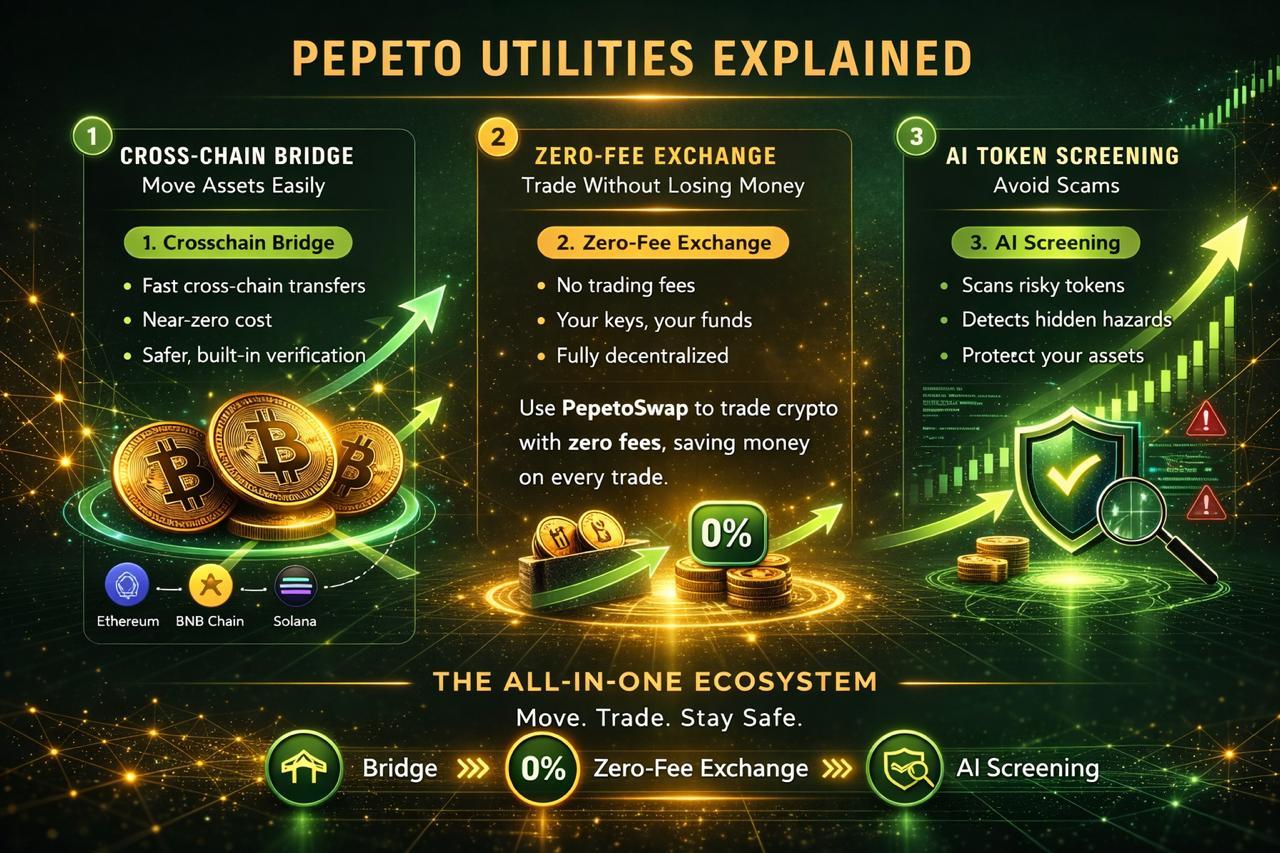
Most presale projects ask investors to bet on a promise. Pepeto is asking investors to back an exchange that is already running. The trading tools are live right now, accessible to any trader in the world, with no setup process or learning curve required. That simplicity is the product’s most powerful quality, and this is why Pepeto leads the presale market.
Zero cost execution on PepetoSwap means your full investment stays working, the multi chain delivery system moves tokens without deducting a cent, and the project auditor rejects anything that fails its safety scan, all verified by SolidProof. The mind behind the original Pepe coin, which climbed to $11 billion on meme power with zero products backing it, engineered this exchange alongside a Binance infrastructure veteran.
A tool that solves a real, recurring problem creates durable demand long after the initial excitement fades, At the current entry of $0.000000186, analysts project 100x as the Binance listing opens, and 191% APY staking compounds your position while the listing approaches.
The solana price prediction at $290 is a 3.5x over 9 months, and each new exchange listing introduces a fresh pool of buyers who pay market price instead of presale price, and this is the kind of entry that will not come back.
Binance Coin (BNB)
BNB trades at $612 per CoinMarketCap, holding steady as the broader market corrects.
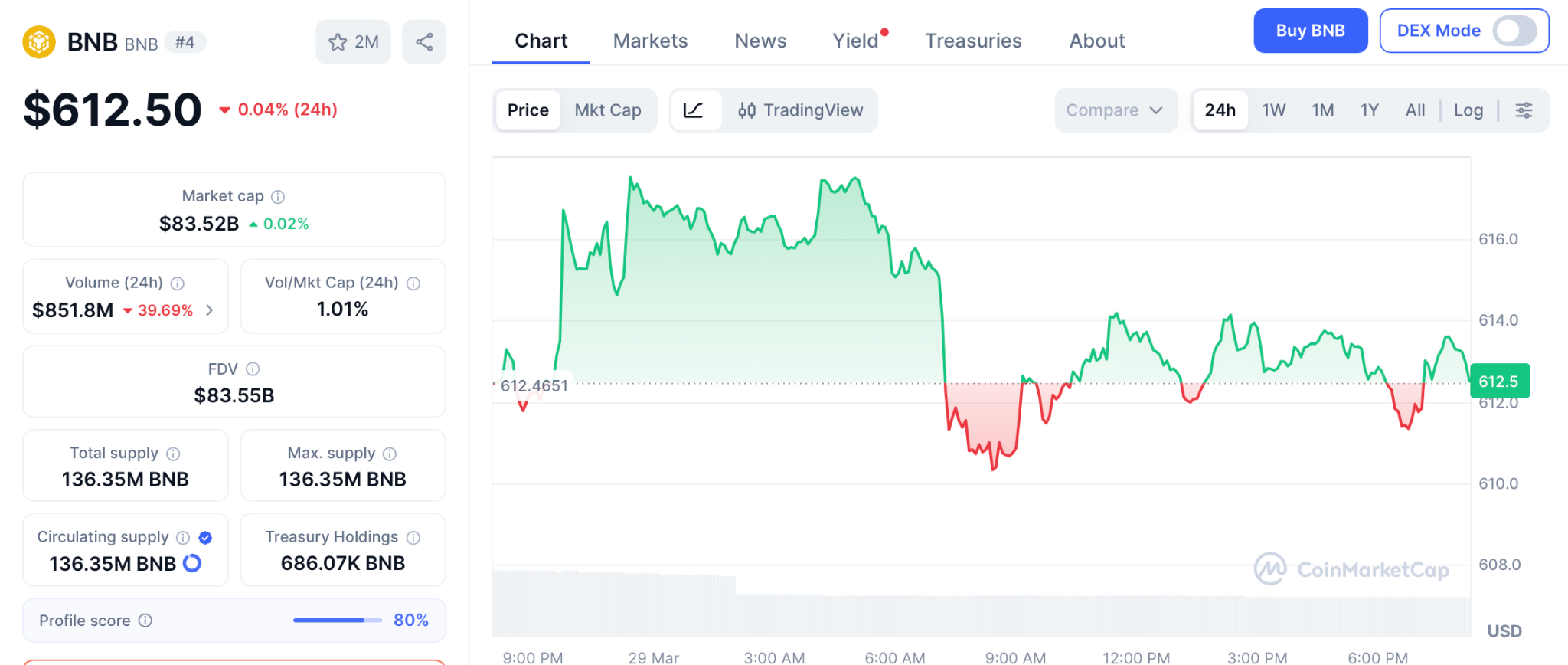
At $83 billion market cap, a recovery to $700 delivers 14% over months, a strong ecosystem anchor, while Pepeto at presale targets the 100x that BNB at this cap is past delivering.
Chainlink (LINK)
LINK trades at $8.49 per CoinDesk, pressured below major moving averages as the oracle sector corrects as the broader market corrects.
The CCIP protocol positions LINK for tokenized asset growth as NYSE explores blockchain integration.
A recovery to $12 delivers 38% over months, while presale entries are where the life changing returns are built and Pepeto offers the math that LINK at $5 billion will not replicate.
The Solana Price Prediction Confirms the Cycle and the Presale Window Is the Entire Opportunity
The picture is clear, because when Goldman Sachs signals a bottom and large wallets move into a presale at this pace it is a signal that the smartest capital already knows where the next repricing is coming from.
Six months from now you are living one of two versions of this moment. In one version you entered while $8 million in presale proved conviction was real and 191% APY compounded daily until the listing changed everything. In the other you saw this and let it pass.
SOL targets $290 while Pepeto targets 100x. Visit the Pepeto official website and enter the presale now, because six months from now this entry is either your proudest decision or someone else’s best investment of the year.
Click To Visit Pepeto Website To Enter The Presale

FAQs
What did Goldman Sachs say about the solana price prediction and crypto in March 2026?
Goldman Sachs signaled the crypto bottom is forming, and the solana price prediction from Grok at $210 to $290 confirms the bull case that Pepeto’s Binance listing is positioned to capture with 100x projected.
What is the solana price prediction for 2026?
Grok AI forecasts SOL between $210 and $290 by December, a 3.5x from current levels, but Pepeto at presale targets 100x that the solana price prediction at $39 billion cap will not deliver, and the Pepeto official website is where the entry is still open.
Why is Pepeto the strongest entry alongside the solana price prediction?
Pepeto has a live exchange with SolidProof audit and Binance listing approaching that targets 100x, while SOL at $290 represents patience returns and Pepeto represents the life changing math.
Disclaimer: This is a Press Release provided by a third party who is responsible for the content. Please conduct your own research before taking any action based on the content.
Crypto World
Cardano Price Prediction: ChatGPT Projects ADA to $1 as Pepeto Targets 100x While ETH and SOL Correct
Governor Newsom just signed an executive order banning state officials from profiting on prediction markets, drawing a hard line against insider trading.
The cardano price prediction just received a boost from ChatGPT projecting ADA to $1 as an “undervalued comeback” play. But the real story is that Pepeto’s verified exchange is pulling in capital faster than any presale this cycle.
As the Binance listing approaches, securing a position in the Pepeto presale is the smartest move a trader can make. More than $8 million raised and analysts projecting 100x confirm this is the strongest entry of the cycle.
ChatGPT predicted that ADA could reach $1 by year end, calling Cardano an “undervalued comeback” with brand recognition, exchange liquidity, and a large holder base ready to re-engage according to ICOBench.
At current levels around $0.249, a move to $1 represents a 4x that ChatGPT described as “a relatively modest market cap expansion compared to previous cycles.” According to Yahoo Finance, AI models project ETH between $3,000 and $18,000 and SOL up to $800 in bull scenarios.
The cardano price prediction confirms the cycle is building, and the presale entries at verified exchanges are where the returns that reshape lives actually live.
Where the AI Forecasts Point and Where the Real Returns Build
Pepeto: The Exchange Where 100x Is Projected as the Cardano Price Prediction Confirms the Bull Setup
The $1 target confirms the comeback is building, but the information gap where insiders know what outside investors do not is still one of the most persistent problems in crypto, and it shows up in prediction market betting, token unlocks, and liquidity structures designed to benefit early insiders. Pepeto was built specifically to close that gap at the trading level.
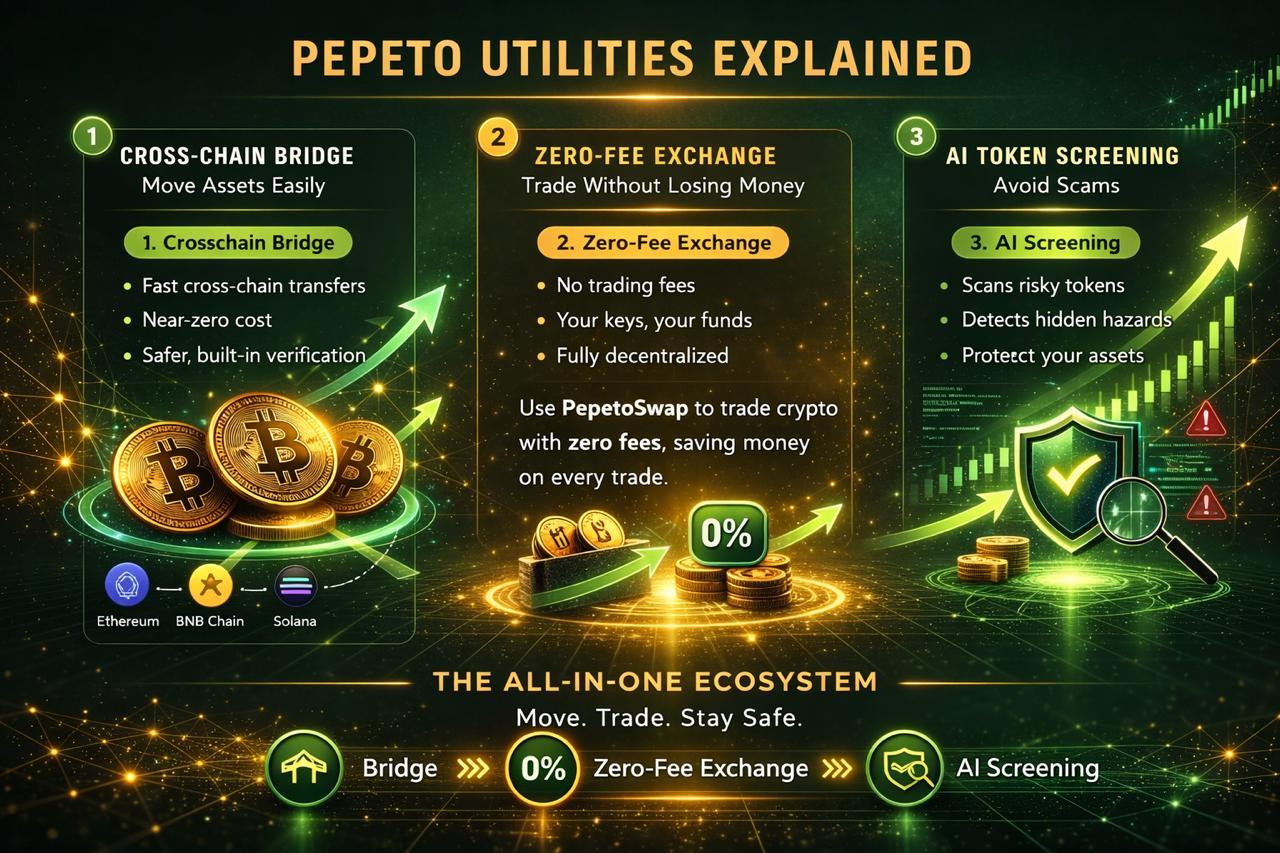
When you evaluate a new token, the contract contains information most investors never see. Pepeto’s exchange reads all of that and confirms safety in plain terms before you commit a single dollar.
The zero fee execution on PepetoSwap means committed capital stays fully working, the multi chain delivery moves tokens without deducting a cent, and the project auditor rejects anything that fails its safety scan, all verified by SolidProof. The same founder whose first meme coin reached $11 billion on zero infrastructure engineered this exchange with a senior operator from Binance’s listing division.
At $0.000000186, analysts project 100x as the Binance listing opens, and 191% APY staking compounds your position while the window narrows. That $1 target is a 4x over 9 months, respectable for a $9 billion cap, but the presale entry at Pepeto is where the 100x math lives and the listing is approaching fast.
Ethereum (ETH)
ETH trades at $2,001 per CoinMarketCap, holding the psychological $2,000 level as the Glamsterdam hard fork approaches.
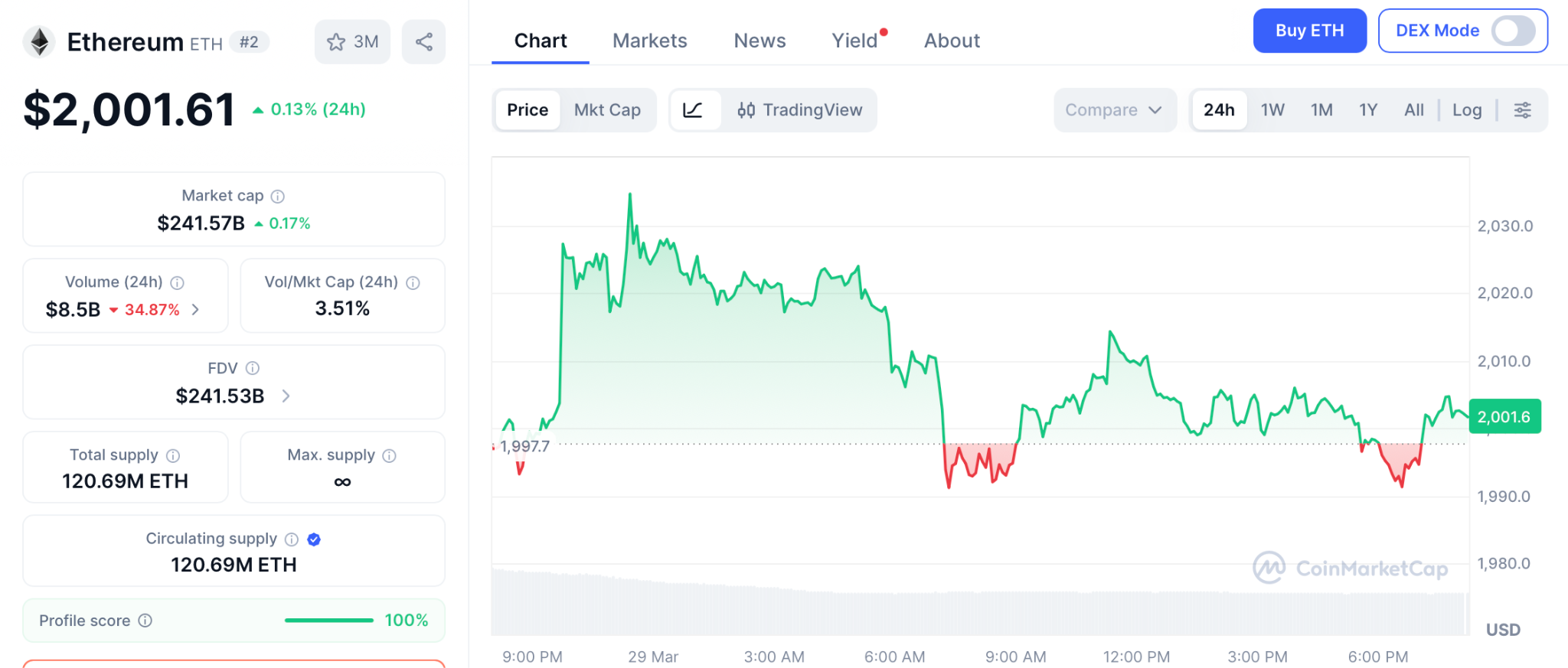
Standard Chartered targets $7,500 by year end, a 3.7x that rewards patience, while Pepeto at presale targets the returns that ETH at $240 billion will not replicate from here.
Solana (SOL)
SOL trades at $82.45 per CoinDesk, consolidating within the $80 to $85 range as Goldman Sachs holds a $108 million SOL ETF stake.
Grok AI targets $210 to $290 by December, a 3x from current levels, strong infrastructure value, while presale entries are where the cycle defining 100x returns are built and Pepeto offers that exact math before the Binance listing opens.
The Cardano Price Prediction Confirms the Comeback and the Wallets Inside Pepeto Are Already Positioned
The whale wallets building Pepeto positions right now at six zeros are the same wallets that will be selling to latecomers at 50x the price after listing day, and the only decision left is whether you buy from the presale today or buy from those whales six months from now at a price that makes this moment feel like a dream.
ADA at $0.01 turned $1,000 into $310,000 for the wallets that acted early. Visit the Pepeto official website and enter before this stage closes.
Click To Visit Pepeto Website To Enter The Presale

FAQs
Why is the cardano price prediction relevant to presale entries?
The cardano price prediction at $1 confirms the bull cycle building, and Pepeto’s verified exchange with 100x projected from the Binance listing is where the returns that ADA’s $9 billion cap is past delivering actually live.
How does the cardano price prediction compare to Pepeto’s potential?
ADA targets $1 for a 4x over 9 months per ChatGPT, while Pepeto targets 100x from presale as the Binance listing opens, and the Pepeto official website is where the entry is still available.
Is the cardano price prediction only for patient holders?
The cardano price prediction rewards patience with 4x over 12 months, but Pepeto at presale with the Pepe builder and a Binance listing offers the returns that reshape a financial life from one position.
Disclaimer: This is a Press Release provided by a third party who is responsible for the content. Please conduct your own research before taking any action based on the content.

BNP Paribas is expanding its digital asset footprint, rolling out six new crypto-linked exchange-traded notes (ETNs). The products offer indirect exposure to the price movements of digital assets such as Bitcoin and Ethereum.
For Europe’s largest bank by assets, the launch represents a significant escalation in its strategy to bridge traditional finance with the crypto ecosystem.
What Investors Need to Know About BNP’s New ETNs
However, European compliance realities heavily gate the rollout. The Markets in Financial Instruments Directive (MiFID II) mandates the bank to enforce strict investor protection protocols.
The ETNs will be made available across its broader customer base, including private banking, entrepreneurial, and digital-first “Hello bank” clients.
“These ETNs are regulated products that offer exposure to the performance of crypto-assets through an indirect investment, without the need for direct purchase or holding of Bitcoin or Ether. These securities are issued by recognized asset managers, selected by BNP Paribas for their solidity and risk management systems,” the bank stated.
However, access is decidedly not an unstructured free-for-all. Retail clients will face rigorous appropriateness tests to verify their understanding of high-risk, highly volatile markets before gaining access to execution.
Crucially for investors, the product’s structure demands careful risk assessment.
Physically backed crypto exchange-traded funds (ETFs) hold the underlying Bitcoin or Ethereum in specialized cold storage custody. In contrast, these ETNs are structured as unsecured debt securities issued by the bank.
While they offer seamless synthetic exposure to the price movements of single cryptocurrencies or broader digital asset baskets, buyers are fundamentally taking on BNP Paribas’ credit risk.
The new retail push comes just a month after BNP successfully launched a tokenized share class of a French-domiciled money market fund on the public Ethereum blockchain. This launch signals that the bank’s digital asset ambitions now extend well beyond institutional plumbing.
BNP’s calculated launch coincides with a distinct regulatory thaw around the globe for crypto-related products.
The UK Financial Conduct Authority’s pivotal October 2025 reversal highlights this shift. Last year, the regulator allowed crypto ETNs to return to British retail trading screens after a multi-year ban.
Ultimately, this shows that traditional financial institutions are distinct investment vehicles for safely capturing retail demand for Web3 volatility.
The post BNP Paribas Rolls Out 6 Crypto ETNs Under Strict Retail Access Rules appeared first on BeInCrypto.


Bittensor’s TAO has rallied 90% so far this month, and the tokens in its ecosystem are running up even harder.
The network’s subnet token category reached a combined market cap of $1.47 billion on Monday, with $118 million in 24-hour trading volume, according to CoinGecko data.
The surge follows TAO’s own run from $180 to above $332 in March, but the subnet tokens are where the real action is. Templar, the token for Subnet 3, gained 444% in 30 days. OMEGA Labs rose 440%. Level 114 added 280%. BitQuant gained 230%. Even the larger subnet tokens posted significant returns, with Chutes up 54% and Targon gaining 166%.
Bittensor is a decentralized network that creates marketplaces for artificial intelligence. Instead of one company building and controlling AI models, Bittensor incentivizes a global network of participants to contribute computing power, data, and machine learning models in exchange for TAO, the network’s native token.
The network is divided into specialized sub-networks called subnets, each focused on a different AI task, from training language models to running compute infrastructure to cybersecurity analysis. There are currently 128 active subnets, each with its own token whose value is tied directly to the amount of TAO staked into it.
Several catalysts contributed to these moves of the Bittensor’s ecosystem tokens.
Subnet 3 produced Covenant-72B, a large language model trained permissionlessly across Bittensor’s decentralized network by over 70 contributors using commodity internet hardware.
The model was trained on 1.1 trillion tokens and achieved a 67.1 MMLU score, confirmed in a March 2026 arXiv paper. That puts it in competitive range with Meta’s Llama 2 70B, a model built by one of the most well-resourced AI labs in the world. (MMLU, or Massive Multitask Language Understanding, is a standardized test for AI models that scores them across 57 academic subjects.)
Subnet 3, called Templar, is Bittensor’s decentralized AI training network. Miners contribute GPU compute power and compete to produce useful training gradients for large language models, while validators evaluate the quality of their contributions and distribute TAO rewards accordingly.
Think of it as a way to train AI models the same way bitcoin mines blocks, with distributed participants around the world contributing hardware and getting paid for useful work.
Elsewhere, Nvidia CEO Jensen Huang and investor Chamath Palihapitiya endorsed Bittensor’s approach on the All-In Podcast on March 20, framing decentralized AI training as complementary to proprietary models. Coming from the CEO whose blog post earlier this month briefly helped reverse a tech stock selloff, the endorsement carried weight beyond the usual crypto echo chamber.
How subnet tokens work
The subnet token mechanics explain why the gains are so outsized relative to TAO itself.
Since Bittensor launched dynamic TAO in February 2025, each subnet operates its own automated market maker with a native token whose valuation is determined by the TAO staked into that subnet’s reserves. When TAO appreciates, every subnet’s reserve becomes more valuable, inflating token prices and attracting more stakers. The relationship is reflexive and amplifies moves in both directions.
With TAO at roughly $3 billion in market cap and individual subnet tokens ranging from $1 million to $137 million, the subnet tokens function as leveraged bets on the parent protocol.
The network plans to expand from 128 to 256 active subnets later this year, which would bring a new wave of token launches.
A potential regulatory decision on converting the Grayscale TAO Trust into a spot ETF could provide institutional access by late 2026. And Digital Currency Group subsidiary Yuma is already contributing to 14 different subnets, suggesting the smart money is treating this as infrastructure rather than speculation.
Whether the subnet rally sustains depends on whether Bittensor keeps producing competitive AI models or whether Covenant-72B was a one-off that got lucky timing with a Huang endorsement.

Bitcoin-focused digital asset treasuries (DATs) have slowed down their BTC purchases, with Strategy as the sole buyer making large purchases. Strategy has been commanding most of the purchases over the last 30 days, while other firms hold off. This shows a collapse in broad corporate demand for Bitcoin as volatility continues to spike.
Retail focus, on the other hand, is shifting towards DeepSnitch AI (DSNT). This AI market intelligence platform has truly earned its spot as the best crypto to buy now due to its utility, fueled by five smart AI agents.
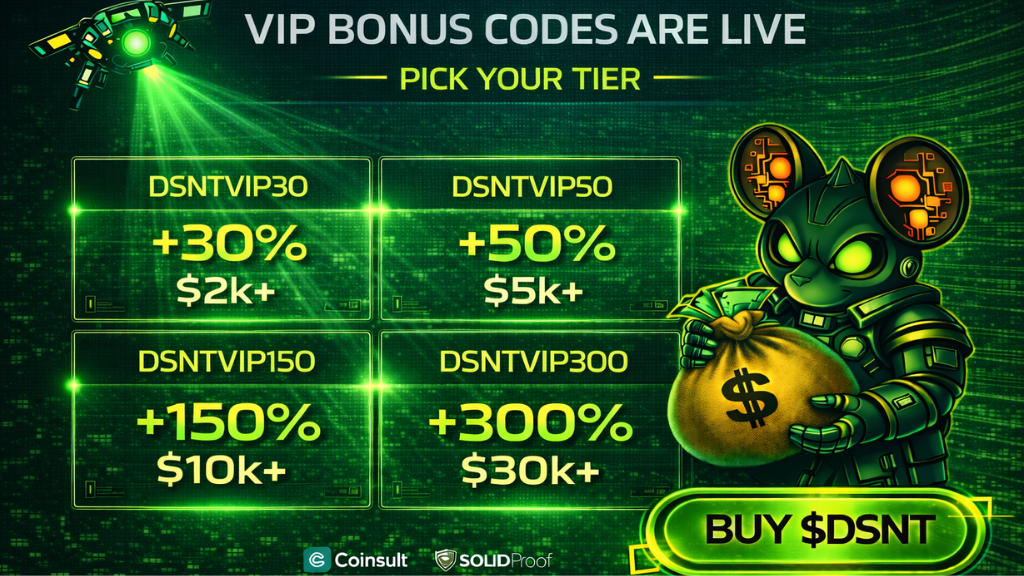
At the moment, DeepSnitch AI has raised more than $2.609 million, with the token only going for $0.04699. The amount raised in just a short span shows many buyers are now rushing to buy DSNT before the token launches.
Strategy could be the only major corporate BTC buyer left standing
Strategy is the only DAT buying Bitcoin aggressively right now, highlighting concerns swirling around Bitcoin’s corporate demand. According to a recent report, Strategy purchased 45,000 BTC, while all other corporate firms bought around 1,000.
This highlights radical market structure change with the increasing corporate trend now virtually relying on the services of one company. The change stems from the recent crash across Bitcoin, which traded at $65,848 after losing over 50% of its value in six months, falling from an all-time high of $126,200.
2 days before launch: DeepSnitch AI buyers are running out of time to accumulate DSNT
1. DeepSnitch AI: Here’s why no one wants to miss out on this AI crypto as March 31 TGE knocks at the door
Crypto trading requires access to accurate market intelligence. But access to such information is often limited to elite investors, such as institutional investors, and costs a fortune.
However, DeepSnitch AI gives you access to such information without breaking the bank. At just $0.04699, you can purchase DSNT to gain access to profit-ready trading signals.
The DeepSnitch AI platform scans social and on-chain data, combining it to turn it into actionable intelligence. This explains why the platform is gaining widespread attention despite being just in presale.
The well-designed interface is also a marvel for investors who see DeepSnitch AI as the next big thing in crypto market analytics.
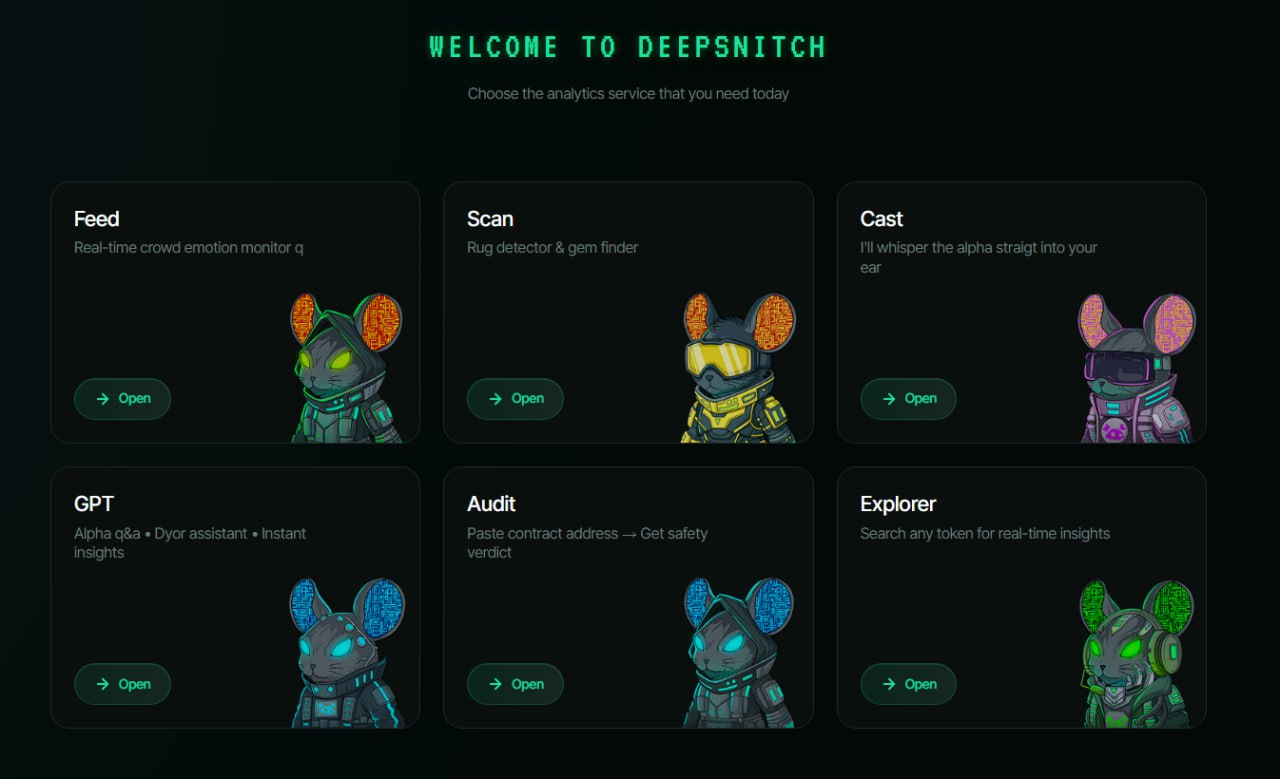
With more than $2.609 million now raised, DeepSnitch AI is accelerating fast towards launch. The token is set to start trading on Uniswap after the March 31 TGE, which is already confirmed. This leaves a short window for investors to buy DSNT before it launches.
2. Shiba Inu burn rate plunges as price drops
According to data from Coingecko, Shiba Inu (SHIB) traded at $0.000005758 on March 27, after a 1.8% dip on the day. The recent drop adds to Shiba Inu’s bearish momentum following increased volatility across the crypto market.
Additionally, the Shiba Inu’s burn rate has dipped by 95.93% according to data from Shibburn. This indicates that activity around this meme coin is dropping. SHIB token burns reduce circulating supply to boost prices, but now investors seem to have abandoned the model as the price plunges.
3. MemeCore defies crypto market crash as price remains steady
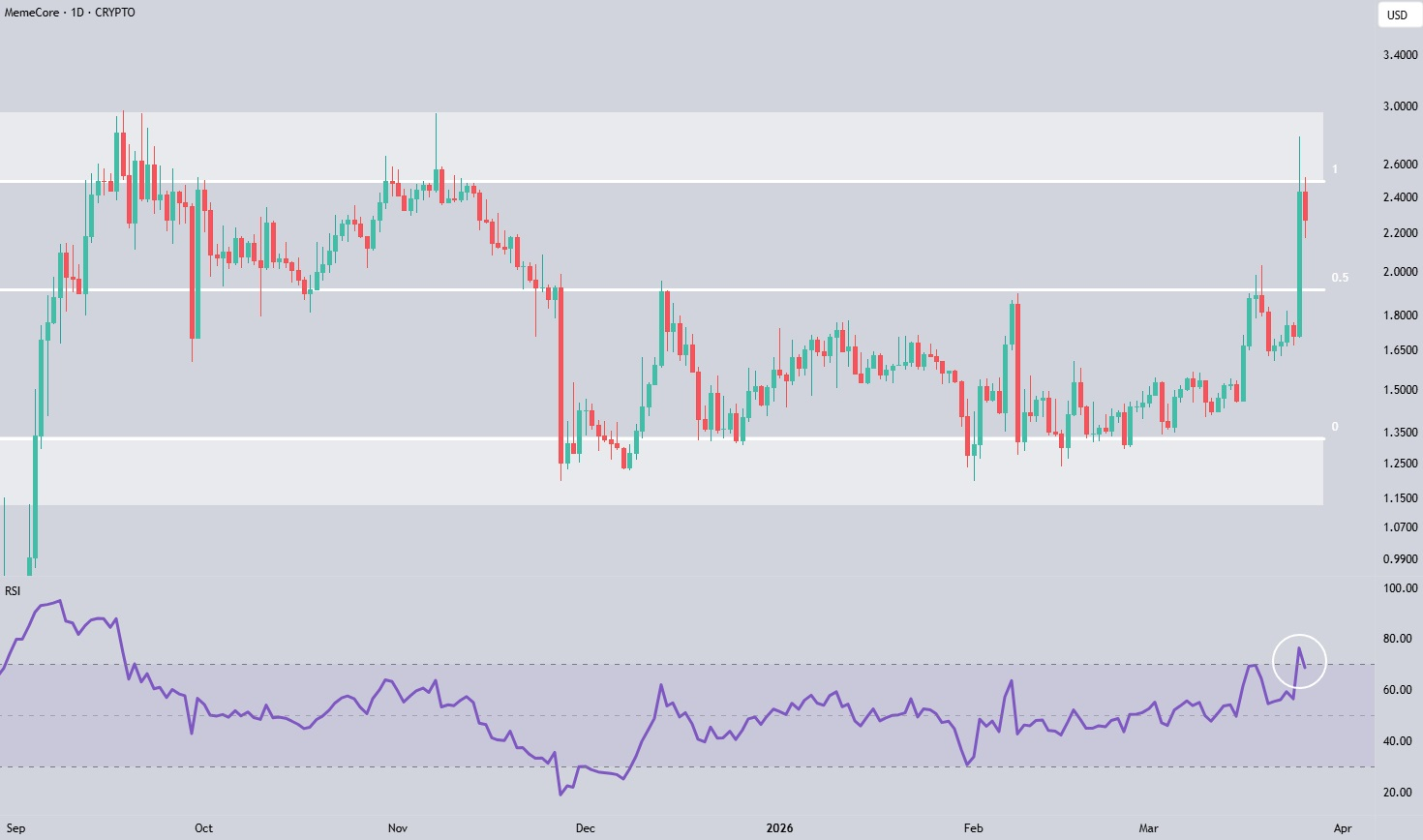
MemeCore (M) defied the latest crypto market slump as the crypto posted gains on a generally red day for crypto. As of the time of writing, MemeCore traded at $2.20 after a 4.4% surge.
The recent rally adds to MemeCore’s bullish run as the crypto recorded nearly 30% gains over the past week. However, momentum could slow down as the RSI on the daily chart shows that this crypto is overbought.
The bottom line
DeepSnitch AI has now entered the last days before launch. With only 2 days to go, early buyers are running out of time to buy DSNT before the presale window ends.
DSNT is now priced at $0.04669, giving buyers a cheap entry point into a crypto seen to be the next 100x moonshot. The more than 51 million DSNT staked so far also indicate strong investor participation in DeepSnitch AI staking.
Visit the official website for more information, and join X and Telegram for community updates.
FAQs
1. What is the AI crypto that will explode?
Considering its utility, solid performance, and expected after-launch adoption, DeepSnitch AI seems to be the AI crypto set to explode in 2026. Many buyers are now targeting a 100x rally for this crypto.
2. When will DSNT launch?
DeepSnitch AI (DSNT) is set to hold a TGE on March 31, after which trading will begin on Uniswap before CEX and DEX listings follow through.
3. Which AI is the most accurate for trading?
DeepSnitch AI uses five AI agents to convert raw on-chain data into actionable market intelligence. As a result, the platform provides accurate and real-time crypto market insights vital for making trading moves similar to whales and insiders.
Disclaimer: This is a Press Release provided by a third party who is responsible for the content. Please conduct your own research before taking any action based on the content.

As many as 70 Brits detained in UAE over Iran war images under ‘draconian’ laws | World News

Pakistan hosts regional powers for Iran talks with focus on Hormuz proposals
Berkshire Hathaway (BRK.A) Faces Eight-Day Slide Under Greg Abel’s Leadership


-
 NewsBeat4 days ago
Manchester United reach agreement with Casemiro over contract clause amid transfer speculation
-

 News Videos4 days ago
Parliament publishes latest register of MPs’ financial interests
-

 Sports6 days ago
Remo Stars and Kano Pillars Strengthen Survival Hopes in NPFL
-

 Sports6 days ago
Gary Kirsten Accuses Pakistan Cricket Board Of ‘Interference’, Mohsin Naqvi Responds
-

 Business7 days ago
No Winner in March 21 Drawing as Prize Rolls to $133 Million for Next
-

 Tech7 days ago
Give Your Phone a Huge (and Free) Upgrade by Switching to Another Keyboard
-

 Tech7 days ago
AI enters the chat: New Seattle dating app relies on tech to facilitate meaningful human connections
-

 Business3 days ago
Instagram, YouTube Found Responsible for Teen’s Mental Health Struggle in Historic Ruling
-

 News Videos6 days ago
Ch 9 Financial Management Part 1 | Detailed One Shot | Class 12 Business Studies Boards 2026
-

 NewsBeat2 days ago
The Story hosts event on Durham’s historic registers
-
 NewsBeat4 days ago
Tesco is selling new Cadbury Dairy Milk bar and people can’t wait to try it
-

 Sports6 days ago
2026 Kentucky Derby horses, odds, futures, preview, date: Expert who hit 12 Derby-Oaks Doubles enters picks
-

 Tech6 days ago
Samsung will soon let you control smart home devices from your car’s dashboard
-
 Entertainment16 hours ago
Lana Del Rey Celebrates Her Husband’s 51st Birthday In New Post
-
 Entertainment6 days ago
Cynthia Bailey Dishes on ‘RHOA’ Season 17, Discusses Kandi
-
 NewsBeat6 days ago
Colombian military plane with 110 soldiers onboard crashes following takeoff
-

 Fashion5 days ago
Does It Matter What You Wear When You’re Laid Off and Looking?
-

 Business5 days ago
More women enter wealth management, but few in advisory roles: study
-

 Sports4 days ago
Fantasy Baseball Week 1 Preview: Top sleeper hitters for both five- and 12-day period led by Munetaka Murakami
-

 Politics6 days ago
How Media Platforms Balance Performance and Accessibility in Image Delivery
You must be logged in to post a comment Login