

Crypto World
Google’s Gemini AI Predicts the Price of XRP, Solana and Cardano by The End of 2026

Global headlines may be rattling investors, but when fed with a carefully calibrated prompt, Gemini AI unlocks surprising medium-and long-term outlook for XRP, Solana, and Cardano.
According to Gemini AI, the next ten months will bring a lot of new capital into crypto thanks to a combination of technical indicators, news developments and a maturing regulatory environment.
So, here’s why Gemini just might be right.
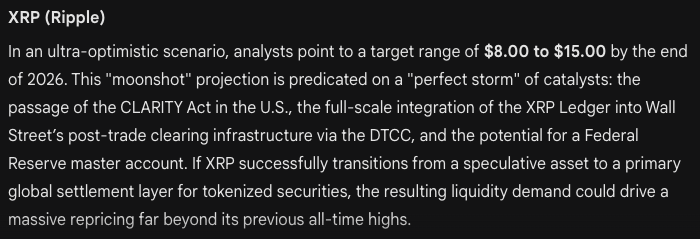
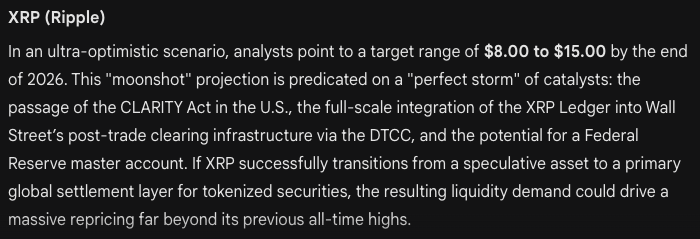
XRP (XRP): Gemini AI Sees 10x Potential Within 10 Months
In a recent statement, Ripple emphasized that XRP ($XRP) remains central to its strategy of turning the XRP Ledger (XRPL) into a global, enterprise-level payments infrastructure.
The company designed XRPL for fast low-cost transaction settlement, while giving it an early lead in two of crypto’s biggest use cases: stablecoins and tokenized real-world assets.
XRP is currently trading near $1.42, and Gemini’s projections indicate the asset could climb toward $15 before the end of the year, representing a more-than-tenfold increase.
Technical indicators also point toward improving momentum. XRP’s recent support and resistane lines form a bullish flag that often foreshadows a breakout.
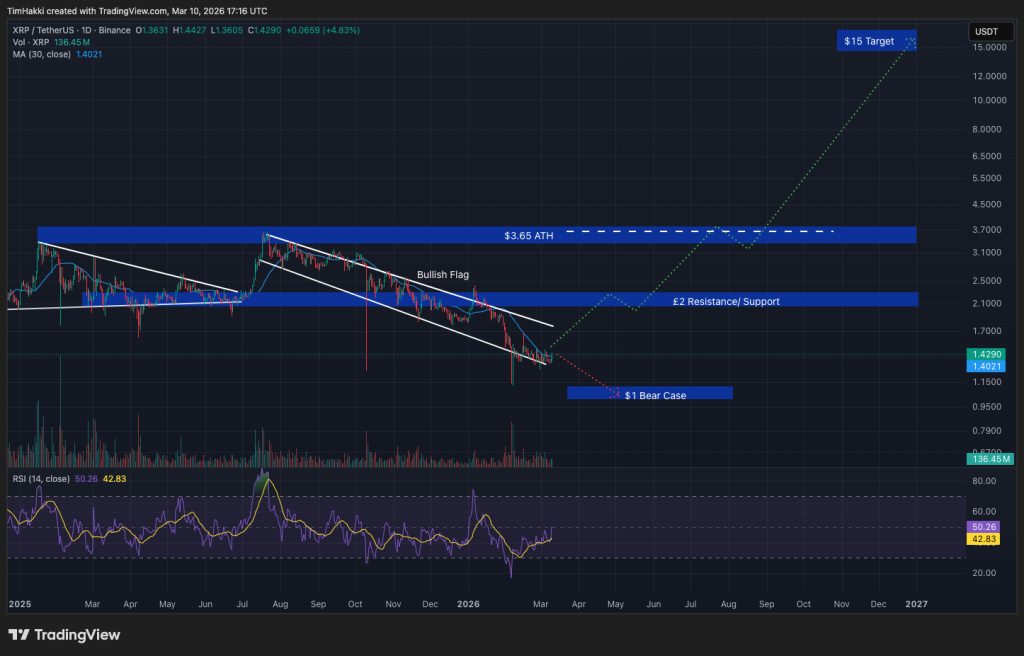
Several price drivers to watch include sustained institutional investment via the recently launched US XRP ETFs, Ripple’s growing list of international partnerships, and the possibility of the CLARITY Act passing Congress this year.
Solana (SOL): Could Solana Double Its Previous Record in 2026?
Solana ($SOL) currently hosts $6.7 billion in total value locked and capitalizes $50 billion.
Institutional adoption accelerated after asset managers Bitwise and Grayscale launched Solana spot ETFs in the US.
SOL experienced a steep downturn toward the end of 2025 and spent much of this February trading below $100.
Gemini’s most optimistic scenario sees Solana surging from $88 to as high as $600 by Christmas, a gain of 7x that would double SOL’s January 2025 ATH of $293.
Supporting the long-term thesis, major financial institutions including Franklin Templeton and BlackRock have begun deploying tokenized financial products on Solana, highlighting its early advantage in a potentially ubiquitous future crypto use case.
Cardano (ADA): Gemini AI Suggests Potential Gains of Up to 1,000%
Developed by Ethereum co-founder Charles Hoskinson, Cardano ($ADA) takes a a research-driven approach to development that prioritizes academic rigor, security, scalability, and sustainability.
With a market capitalization exceeding $10 billion and more than $140 million in TVL, Cardano’s ecosystem continues growing in step with its rivals.
Gemini’s forecast suggests ADA could rise by 826%, from roughly $0.27 today to around $2.50 by Christmas. Such a move would allow the token just below its record of $3.09 reached in 2021.
Like with all altcoins targeting institutional capital, comprehensive cryptocurrency legislation in the United States would massively expand ADA’s price prospects. Clear regulatory could also enable leading altcoins to move more independently from Bitcoin’s price cycles.
Maxi Doge: Early-Stage Meme Coin Aims for Major Breakout
If a bull run or altseason arrives, the momentum could drive the price of meme coins sky high, as they notoriously exaggerate the price movements of the wider market
One new meme coin tipped to explode tis Maxi Doge ($MAXI). The token has already raised $4.7 million through its ongoing presale as traders bet it could unseat stalwarts like BONK or Floki.
Maxi Doge is Dogecoin’s loud, proud hard-pumping, risk-loving distant cousin, recapturing the viral degen comic culture that ignited the 2021 meme coin boom.
The is an ERC-20 asset on Ethereum’s proof-of-stake network, giving it a smaller environmental footprint than Dogecoin’s proof-of-work architecture.
Presale investors can currently stake MAXI tokens for rewards reaching as high as 67% APY, although yields gradually decrease as more tokens enter the staking pool.
The token is $0.0002808 during the current round, with nominal price increases scheduled at each new funding round.
Interested investors can visit the official website and connect a supported wallet such as Best Wallet.
Purchases can also be completed using a bank card.
Visit the Official Website Here
The post Google’s Gemini AI Predicts the Price of XRP, Solana and Cardano by The End of 2026 appeared first on Cryptonews.


Ethereum’s network activity has surged to all-time highs across multiple metrics, but the growth has failed to lift ether’s price or boost fee generation at the base layer.
A weekly report from analytics firm CryptoQuant published March 10 found that daily active addresses on Ethereum approached 2 million in February 2026, exceeding peaks seen during the 2021 bull market. Active addresses are unique blockchain wallet addresses that have sent or received a transaction within a specific timeframe, like the past 24 hours
Smart contract calls, or codes on blockchain telling it to do something specific, topped 40 million per day, and token transfers driven by internal contract interactions also set records. The findings point to broad adoption across DeFi, stablecoins and automated protocol activity, even as investment demand for ether has weakened.
Record network user activity typically bodes well for the market value of the blockchain’ native token. But that’s not the case with Ethereum.
It’s native token ether is down roughly 30% over the last six months, and the one-year change in Ethereum’s realized capitalization has turned negative, indicating net capital outflows from the market.
Exchange flow data from CryptoQuant shows ether moving to trading venues at a faster rate relative to bitcoin, a pattern consistent with elevated selling pressure.
Focus on capital flows
CryptoQuant argued that capital flows, rather than network activity, now explain ETH price dynamics more effectively.
In prior cycles, particularly 2018 and 2021, rising on-chain activity coincided with price rallies. That relationship has weakened. The firm’s scatter analysis showed recent observations clustering at high activity levels but relatively low prices, suggesting incremental usage growth now has less explanatory power for ether’s valuation.
The fee picture reinforces the disconnect. Data from DefiLlama shows Ethereum generated roughly $10.3 million in transaction fees over the past 30 days, placing it third behind Tron at nearly $25 million and Solana at about $20 million.

On a revenue basis, the gap widens further. Ethereum ranked fifth in 30-day protocol revenue at $1.22 million, trailing Tron as well as Polygon, Base and Solana. Base, an Ethereum layer-2 network built by Coinbase, generated roughly three times Ethereum’s protocol revenue over the same period.

The disparity reflects the growing role of Ethereum’s layer-2 ecosystem. Networks such as Base and Polygon process large volumes of transactions while paying relatively small settlement costs back to the base chain, distributing economic activity across the broader Ethereum ecosystem rather than concentrating it on the base layer.
Stablecoins remain a bright spot for adoption. Ethereum hosts approximately $162 billion in stablecoin supply, roughly 52% of the global market, according to DefiLlama. Yet that activity has not translated into proportional value capture for ether itself.
Ethereum may be busier than ever, but the blockchain’s native asset is capturing less of the value created on top of it.

Michael Saylor’s Strategy, the world’s largest public holder of Bitcoin, sold a record amount of its perpetual preferred equity, Stretch (STRC), after amending its sales rules on Monday.
Strategy is estimated to have bought 1,420 Bitcoin (BTC) in a single day after selling roughly 2.4 million STRC shares through its at-the-market (ATM) program, according to data from STRC.live. The amount marks the largest estimated daily issuance of STRC and BTC purchases, surpassing the previous record of 1,069 BTC, according to a Monday X post from STRC.live.
Strategy announced a major rule change to its at-the-market (ATM) share sales program on Monday, allowing a second agent to sell the securities before the US market opens and after it closes, easing a prior restriction limiting such sales to one agent per trading day.

STRC is one of the major pillars of Strategy’s Bitcoin buying
STRC is Strategy’s variable-rate perpetual preferred stock, launched in July 2025 as one of several securities the company uses to help fund its Bitcoin treasury strategy, alongside other ATM programs such as Stride (STRD), Strife (STRF), Strike (STRK) and common stock (MSTR). Strategy says the stock pays monthly variable cash dividends, with the annualized rate for March set at 11.5%.

Some market observers said the updated sales structure could make it easier for Strategy to issue stock more efficiently during premarket and after-hours trading, potentially accelerating future capital raises tied to Bitcoin purchases.
“A lot more capital will be raised, and a lot more Bitcoin will be purchased,” market observer Ragnar said.

According to STRC.live, last week’s estimate suggested STRC proceeds would fund a weekly purchase of approximately 4,300 BTC ($303 million). However, the actual purchase exceeded expectations, as Strategy reported selling around $378 million in STRC in its filing with the SEC on Monday.
Related: Oil tumbles, crypto gains as Trump sends mixed signals over Iran war

The company reported a massive $1.3 billion BTC purchase, marking one of its largest Bitcoin acquisitions on record. Common stock MSTR accounted for the largest proceeds in reported sales, generating nearly $900 million in proceeds.
The results for STRC underscore ongoing rapid acceleration in investor interest, despite the Bitcoin price trading below Strategy’s reported average cost basis of $75,862.
Magazine: The debate over Bitcoin’s four-year cycle is over: Benjamin Cowen
Exchange-related activity involving XRP has declined significantly in recent months. What does it mean for Ripple’s price?
Alongside Bitcoin, major altcoins posted minor recovery as optimism surrounding a potential ceasefire in the Iran conflict supported risk assets. XRP, for one, climbed by 4% on Tuesday.
The appreciation, however, comes at a time when fewer XRP users are interacting with exchanges.
Market Interest Cools
On-chain analytics shared by CryptoQuant shows that the number of deposit and withdrawal transactions across major trading platforms has fallen to the lowest level recorded since the indicator was first introduced. The decline in activity has emerged following a steep drop in XRP’s price, which has fallen more than 60% from its highs established last summer. According to the analysis, the price correction appears to have been accompanied by a considerable reduction in user engagement with cryptocurrency exchanges.
The observation is based on the Multi Exchanges Daily Depositing/Withdrawing Transactions Delta. This metric is designed to track the net number of XRP transfer transactions occurring across 15 leading crypto exchanges. Unlike traditional flow metrics that measure the total volume of assets moving between wallets and exchanges, this indicator focuses specifically on transaction counts.
As a result, it provides insight into the number of users actively sending or withdrawing XRP, rather than simply measuring the quantity of tokens transferred.
In terms of market interpretation, rising values in the metric generally indicate that a larger number of users are depositing XRP onto exchanges compared with those withdrawing it. Such behavior can suggest potential selling pressure, since traders often move assets to exchanges in preparation for selling.
On the other hand, declining values typically imply that more participants are withdrawing XRP to private wallets, a trend often associated with accumulation or longer-term holding strategies.
You may also like:
Historical data reveals that the last major spike in exchange deposits occurred in January 2025 when the crypto asset’s price approached $3. That surge was followed by strong withdrawal activity between May and June 2025, which reflected accumulation after the sell-off.
Payments Ecosystem
The development comes as Ripple recently detailed several milestones tied to its payments ecosystem. In a post on X, the company said that Ripple Payments has processed more than $100 billion in total transaction volume and currently operates across over 60 markets worldwide.
The system is connected to 51 real-time payment rails, according to the update. Ripple also noted that RLUSD reached a $1 billion market capitalization in less than a year after launch. The company said the platform integrates fiat currencies and stablecoins while operating under more than 75 regulatory licenses across multiple jurisdictions.
Binance Free $600 (CryptoPotato Exclusive): Use this link to register a new account and receive $600 exclusive welcome offer on Binance (full details).
LIMITED OFFER for CryptoPotato readers at Bybit: Use this link to register and open a $500 FREE position on any coin!
Dogecoin price rose for two consecutive days this week as Bitcoin and most altcoins stabilized.
Summary
- Dogecoin price has formed a double-bottom pattern on the daily chart.
- Demand for DOGE ETFs has waned this month.
- The volume and futures open interest have continued rising.
Dogecoin (DOGE) token was trading at $0.09 today, March 10, up slightly from this month’s low of $0.087. This rebound is happening even as demand for the three spot DOGE ETFs wanes completely.
Data shows that Grayscale’s GDOG, 21Shares’s TDOG, and Bitwise’s BWOW have accumulated over $7.45 million in inflows. Their net assets have moved to $8.97 million, a tiny amount for one of the biggest coins in the crypto industry.
Most notably, these funds have added just $779k in assets this month. They have not had any inflows in the last five consecutive days. In contrast, spot Solana ETFs have had $955 million in inflows since their inception and $21 million this month.
On the positive side, data shows that the volume in the spot and futures markets is improving. CoinGlass numbers show that its volume on Tuesday jumped to over $2.6 billion, the third consecutive day of gains. It has soared from $1.4 billion on Sunday.
Dogecoin’s futures open interest has also stabilized above the $1.2 billion range. Also, the weighted funding rate turned green, a sign that traders in the futures market expect it to rebound.
Dogecoin price technical analysis
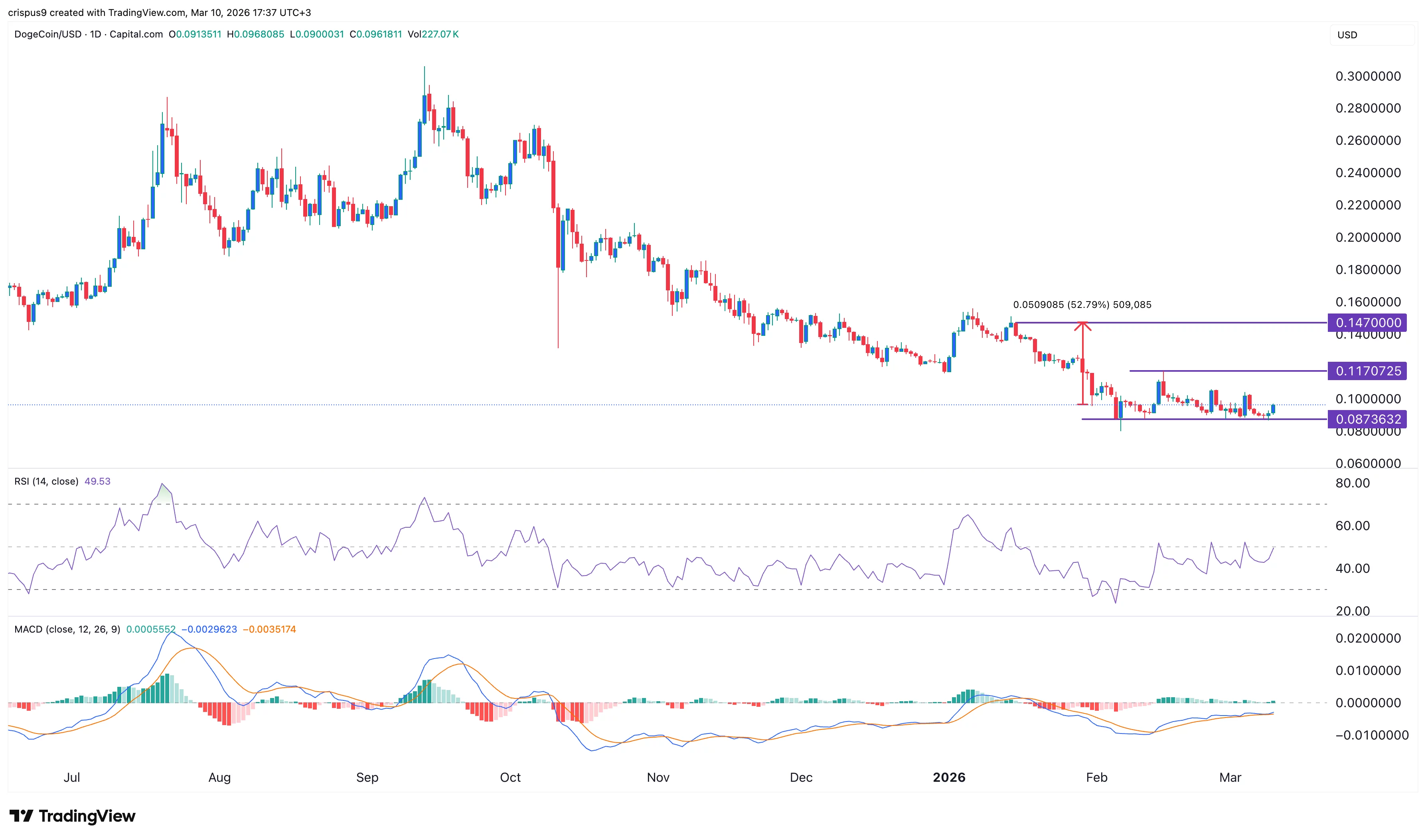
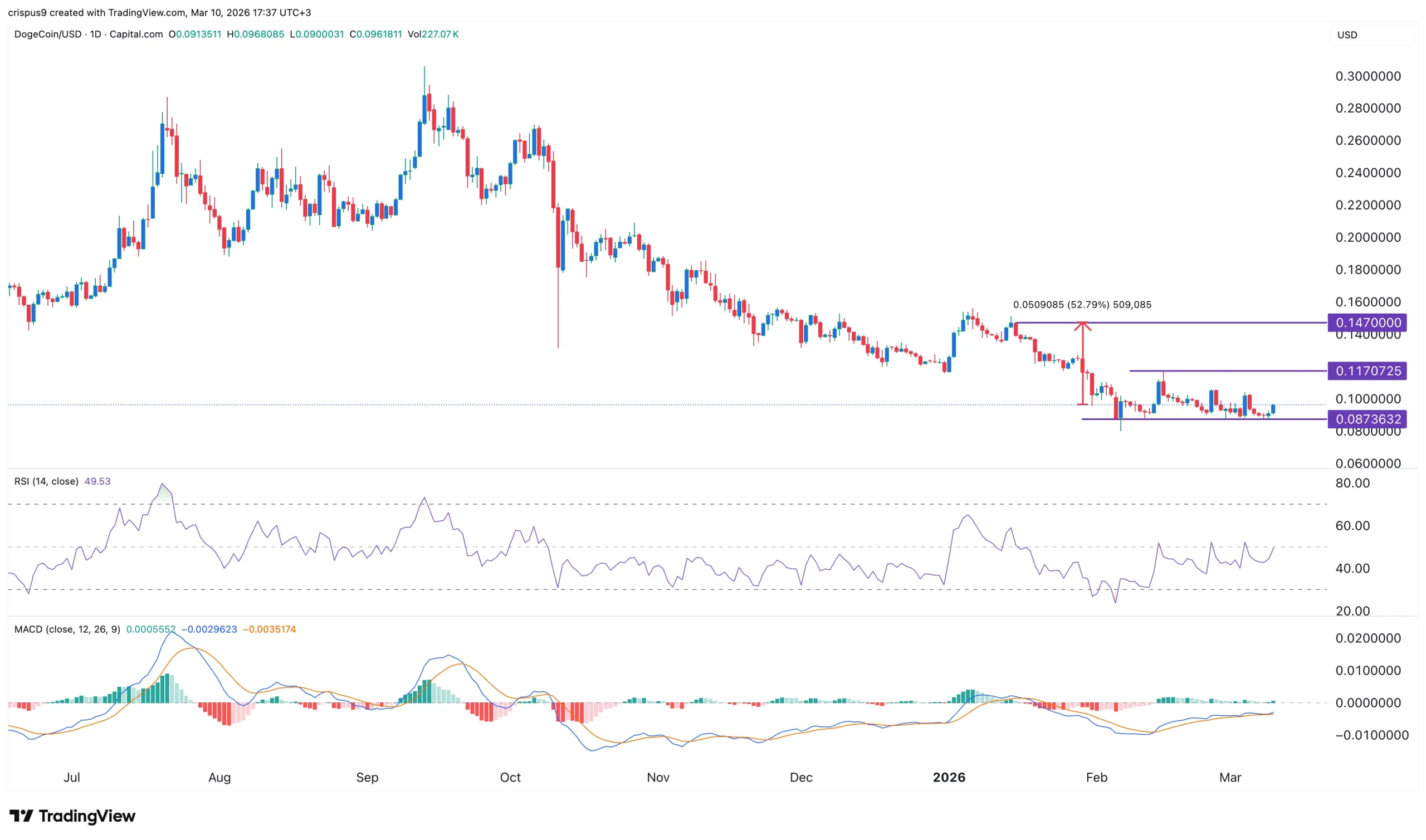
The daily chart is showing that the DOGE price has bottomed. It formed a double-bottom-like pattern at $0.0877, its lowest level in February and March. Its neckline was at $0.1170, its highest swing on February 15 this year.
A double-bottom pattern signals that bears are afraid of placing trades below that price. The price target is established by estimating the height by subtracting the double-bottom from the neckline. In this case, the height is $0.030. One then adds this figure to the neckline, giving it a target of $0.1470.
Other indicators are pointing to a rebound. For example, the Relative Strength Index has jumped to the neutral point of 50, while the MACD indicator is nearing the zero line.
Therefore, the token will likely bounce back, with the initial target being the neckline at $0.1170. A move above that level will point to further gains to the double-bottom target at $0.1470, which is about 50% above the current level.


Google’s Gemini AI is being embedded across the U.S. military, cementing AI‑defense as structural policy and tying Bitcoin closer to big‑tech, liquidity‑driven macro trades.
Summary
- Google’s Gemini agents will automate workflows for roughly 3 million Pentagon staff via the new GenAI.mil platform.
- The contract marks Google’s return to military AI under tighter guardrails, alongside parallel Pentagon deals with OpenAI, Anthropic and xAI.
- Bitcoin and Ethereum are trading as high‑beta expressions of the same AI‑defense‑tech liquidity complex, not as isolated “crypto” stories.
According to a new report in Bloomberg, Google is about to wire its AI directly into the day‑to‑day machinery of the U.S. military, and markets need to treat that as structural, not cosmetic. Alphabet’s Google will roll out Gemini‑based “AI agents” across the Pentagon’s roughly three million civilian and military staff, automating routine work on unclassified systems in what Defense Secretary Pete Hegseth calls the start of an “AI‑driven culture change” on the digital battlefield.
These agents are not chatbots bolted onto email; they are task executors. Bloomberg reports that Gemini agents “can undertake work independently on behalf of a user who sets them tasks,” with Emil Michael, the Pentagon’s Under Secretary of Defense for Research and Engineering, saying deployment will begin on non‑classified networks before expanding across classification levels. In a separate blog post, Google vice‑president Jim Kelly said the system will let “civilian and military personnel at the Department of Defense build AI agents using natural language,” embedding them into workflows spanning logistics, document processing, and data triage. The new platform, branded GenAI.mil, is the front end of a $200 million contract Google Cloud won last year to deliver AI capabilities to the Department of Defense; rival firms OpenAI, Elon Musk’s xAI and Anthropic have secured similar deals.
The partnership rests on two pillars: scale and doctrine. Scale is explicit – three million potential users, military and civilian, with Hegseth arguing “the future of warfare in America is upon us, and it is driven by AI,” as software helps the military “swiftly analyze video footage and imagery.” Doctrine is softer but more consequential: by standing up GenAI.mil as a system‑of‑record, the Pentagon is signalling that AI is no longer an experiment but a baseline assumption for planning, targeting, procurement and administration. That comes after years of controversy. In 2018, thousands of Google employees protested its work on Project Maven, a Pentagon program using AI to analyze drone footage, forcing the company to let the contract lapse; the new deal shows management is now willing to re‑enter defense under tighter guardrails and clearer messaging.
For crypto markets, the partnership matters as a macro and market‑structure signal, not because blockchains sit inside the deal. Bitcoin trades near $70,400 over the past 24 hours, up about 3.5%, while Ethereum changes hands around $2,059 with a roughly 2.9% daily gain, moving in tandem with large‑cap tech as investors lean back into long‑duration, AI‑linked growth stories. As defense, AI and big‑tech spending consolidate into a single policy‑backed complex, BTC increasingly trades as a high‑beta expression of the same liquidity and discount‑rate expectations, rather than a separate “crypto” narrative.

US Commodity Futures Trading Commission (CFTC) Chair Michael Selig has voiced support for prediction markets paired with blockchain technology, claiming they could become powerful tools for discovering truth.
Speaking at the FIA Global Cleared Markets Conference in Boca Raton, Florida, on Monday, Selig argued that prediction markets, also known as event contracts, can provide valuable signals about future events when participants put money behind their views, describing well-functioning markets as “truth machines.”
“When participants express views on future events — and back those views with capital — they create accountability, transparency and information,” Selig said. He added that highly liquid prediction markets often produce signals that the public increasingly sees as more reliable than traditional opinion polls.
“The reality is that prediction market platforms are now viewed by the public as more accurate than political polls,” Selig claimed, pointing to the 2024 US presidential election as an example where market pricing captured the scale of the outcome.
Related: Kalshi sued over Khamenei prediction market ‘death carveout’
US states take legal action against prediction markets
Selig’s backing of prediction markets comes as several US states have taken legal or regulatory action against these platforms, arguing that their event-based contracts resemble unlicensed gambling.
Last week, two US federal court rulings allowed Nevada regulators to continue pursuing legal action against prediction market platforms Polymarket and Kalshi. In February, the state sued Kalshi after the prediction market company lost its court challenge to stop the state’s regulator from taking action over its sports prediction markets.

Massachusetts has also taken action, filing a lawsuit against Kalshi over sports prediction contracts offered to residents. Meanwhile, Connecticut regulators issued cease-and-desist letters to Kalshi and Robinhood, ordering them to stop offering certain event contracts tied to sports outcomes.
The CFTC chair said the agency plans to provide clearer rules for how event contracts can be listed and traded under the regulator’s framework. He said staff have been directed to draft guidance outlining how these markets should operate while remaining compliant with existing derivatives laws.
Related: Kalshi, Polymarket eye $20B valuations in potential fundraising: WSJ
CFTC chair plans clearer crypto asset classification
Selig also said the CFTC plans to pursue a clearer classification framework for crypto assets and provide guidance on how rules apply to developers of non-custodial software such as digital wallets and decentralized finance applications.
He maintained that the agency should focus on clear rulemaking instead of ambiguity and enforcement-first policy, claiming that “America is now the crypto capital of the world.”
Magazine: Bitcoin may take 7 years to upgrade to post-quantum — BIP-360 co-author


BNB price is rallying as BNB Chain quietly becomes the main retail rail for dollar stablecoins, turning BNB into an equity‑like bet on parallel money in crisis economies.
Summary
- BNB Chain now processes about 40% of global stablecoin transfers, with 82% under $1,000, making it look more like a retail payments rail than a trading venue.
- Data from crisis economies shows stablecoins acting as parallel dollars for workers and merchants, with Latin American stablecoin flows jumping to roughly $27 billion by 2024.
- BNB increasingly trades like equity in this infrastructure, tied to fee throughput and rising regulatory and geopolitical risk around dollar stablecoins.
BNB Chain (BNB) price is quietly gaining steam as it becomes the core retail plumbing of the dollarized crypto economy. Data cited by Forbes shows that BNB Chain now handles about 40% of global stablecoin transactions by number, with 82% of transfers under $1,000 and 99% below $10,000 – a profile that looks less like a trading venue and more like a payments network for workers, merchants and remittance flows in stressed economies.
Stablecoins as parallel money on BNB
In a recent Forbes analysis on crisis economies, researcher Boaz Sobrado writes that stablecoins have “subtly emerged as alternative currencies in many developing nations,” with over 99.9% of transactions denominated in dollars and often used where “local currencies fail to provide a dependable store of value.” On BNB Chain specifically, he notes that “82% of transfers are under $1,000, and 99% are below $10,000,” adding that transactions “typically cost around $0.05” – cheaper than a bus ride to the nearest bank branch in many markets. The same piece highlights that Latin American stablecoin transactions surged ninefold from 2021 to 2024 to roughly $27 billion, underscoring how quickly these rails are becoming part of everyday economic life.
That microstructure matters at the macro level. Separate Forbes and Bloomberg data put total stablecoin transaction volume at about $33 trillion in 2025, up more than 70% year‑on‑year and now rivaling or surpassing the combined throughput of Visa and Mastercard. Crucially, volumes more than doubled while overall stablecoin supply grew less than 50%, a dynamic described as a “transition from speculation to utility” as the same stock of digital dollars turns over faster in real‑world payments.
Market structure and BNB’s role
For BNB, the token that secures and pays for activity on BNB Chain, this is turning into a structural story about fee flows and political risk, not just DeFi yields. The Forbes report quotes BNB Chain growth lead Nina describing their user base as dominated by “micro and retail” – “normies” – and notes that two‑thirds of merchant payments originate from exchange accounts, with more than half of emerging‑market users first touching crypto through Binance or OKX. That concentration effectively gives a small cluster of platforms and one chain disproportionate influence over how digitized dollars move through vulnerable economies.
At press time, BNB trades around $645 over the past 24 hours, up roughly 3%, while Bitcoin sits near $70,400, gaining about 3.5%, and Ethereum changes hands close to $2,060 with a near‑3% daily rise, all denominated in $ and reflecting a broader bid into long‑duration, liquidity‑sensitive risk assets. As stablecoins harden into parallel currencies and BNB Chain emerges as a dominant retail rail, BNB increasingly becomes an equity‑like bet on that infrastructure – exposed not only to fee throughput and user growth, but also to the regulatory and geopolitical scrutiny that inevitably follows control over how digital dollars circulate.


The Jito Foundation has acquired SolanaFloor, a data and journalism platform covering the Solana ecosystem, and plans to relaunch the site after it shut down earlier this year following a security breach at its parent organization.
The platform went offline in February after its parent company, Step Finance, wound down operations following a treasury wallet breach. Before shutting down, SolanaFloor provided ecosystem news, research and onchain analytics tracking projects and market activity across the Solana network.
Under the deal, SolanaFloor will resume operations under the Jito Foundation and continue publishing coverage of developments across the Solana ecosystem, according to a company press release shared with Cointelegraph.
Awais Afzal, editor at SolanaFloor, said the platform’s existing editorial team has been absorbed as part of the acquisition and will remain in place following the relaunch. He told Cointelegraph that SolanaFloor’s day-to-day editorial operations will be conducted independently from the Jito Foundation.
Jito Foundation is a Solana ecosystem organization that supports development around the Jito protocol, which focuses on liquid staking and block-building infrastructure. The foundation coordinates grants, partnerships and other initiatives intended to support activity across the Solana network.
Additional details about SolanaFloor’s editorial structure, team and commercial offerings are expected to be shared following the relaunch. Jito Foundation did not disclose the financial terms of the deal.
Related: Solana ETFs still hold ‘impressive numbers’ even as token dives 57%
Step Finance hack forced shutdown of multiple Solana projects
Step Finance announced in February that it would shut down operations after a treasury wallet breach in late January drained roughly $40 million in Solana (SOL).
The Solana DeFi aggregator said the closure would also extend to several affiliated platforms, including SolanaFloor and the lending and yield protocol Remora Markets.
Step Finance reported the breach on Jan. 31 and said it had brought in cybersecurity firms to investigate the incident. Blockchain security company CertiK later reported that more than 261,854 Solana (SOL) tokens were unstaked and transferred during the attack.
Security breaches remain a challenge across the crypto industry. A December report from blockchain analytics company Chainalysis estimated that hackers stole about $3.4 billion in cryptocurrency in 2025.
Large attacks accounted for a significant share of those losses. Chainalysis said just three incidents in 2025 were responsible for around 69% of the total funds stolen during the year, including a $1.4 billion breach of the crypto exchange Bybit.
According to the report, North Korean hacking groups were behind $2.02 billion in stolen cryptocurrency during the year, frequently using tactics such as placing covert IT workers inside crypto projects.
Magazine: ‘If you want to be great, make enemies’: Solana economist Max Resnick

Republicans in the US Congress want to ban any possibility of a central bank digital currency (CBDC). To do so, they’re threatening progress on a bipartisan housing bill.
A group of Republican members of the US House of Representatives wrote a letter dated March 6, expressing the “dire need to prohibit a Central Bank Digital Currency from ever happening in the United States.”
The letter cited familiar arguments claiming a CBDC would threaten financial privacy and grant the US Federal Reserve unprecedented financial surveillance powers.
Critics question why Republicans are so eager to ban a CBDC, particularly as other global economic centers like the European Union and China develop their own digital forms of money. Still, the Republicans are ready to pull support from a bipartisan housing bill to get their way.
Republicans hang CBDC ban on 21st Century ROAD to Housing Act
Twenty-eight Republican representatives signed a letter to House Speaker Mike Johnson. In it, they noted that the 21st Century ROAD to Housing Act, a bill making its way through the Senate Banking Committee, contained a provision that would ban CBDCs.
But the lawmakers said it wasn’t strong enough. The ban would sunset in 2030, they noted, adding that the new language does not prohibit the Fed from studying a CBDC, which a bill introduced last year by Minnesota Rep. Tom Emmer sought to block.
The representatives demanded that both provisions be removed in the Senate before the bill reaches the House, claiming that a “prohibition on a Central Bank Digital Currency must be permanent.” If not, they threatened the success of the housing bill:
Otherwise, we will do everything to ensure that the 21st Century ROAD to Housing Act is dead-on arrival.”
Republican Representative Anna Paulina Luna said, “This will probably get nasty so I am telling everyone now. We would appreciate your air support on this.”
This move puts a still-niche and relatively unknown monetary question onto a bill that would at least nominally address concerns over housing affordability in the US.
According to a June 2025 survey from fintech firm Aevi, 61% of Americans haven’t even heard of a CBDC. The number is even higher among older respondents, with over 70% of 55- to 64-year-olds having never heard of one.

Meanwhile, housing costs in the US are getting higher. Data from the Fed and the S&P/Case-Shiller Home Price Index collated by LongtermTrends shows that a typical single-family home currently costs 7.14 times the median annual household income.
This is the highest home price-to-median household income ratio on record going back to the late 1940s, higher than at the height of the 2006 housing bubble.

Part of this is due to a supply squeeze. Homebuilding crashed after the 2008 financial crisis. This has continued to decline during the second Trump administration.
Related: US Bitcoin reserve still has no plan to stack sats
The new, bipartisan 21st Century ROAD to Housing Act contains several proposals to make building new housing easier and therefore cheaper. This includes expedited environmental reviews and increased Federal Housing Administration family loan limits.
“The package includes the vast majority of the Senate’s unanimously supported ROAD to Housing Act, incorporates bipartisan housing ideas from the House, and takes a good first step to rein in corporate landlords that are squeezing families out of homeownership,” Senator Elizabeth Warren said in a statement.
The presidential administration has already signaled its support of the bill, including a ban on CBDCs.
Holding up a housing affordability bill over a CBDC, something voters know very little about, may not play well, especially as President Donald Trump and Congress slip in the polls and the economy remains a central concern.
Related: Crypto turnaround at Fed as Kraken scores account and Trump nominee goes to Senate
Does the US need a CBDC to ensure the dollar stays on top?
Republicans claim to be concerned about the privacy implications of a CBDC, and they aren’t alone. Regarding the digital euro, the European Central Bank’s planned CBDC, Luxembourg-based economist Elisabeth Krecké said that it’s unclear how the tradeoff between privacy and functionality could be managed.
“The digital euro drafters simply assert that Europe’s legal framework offers the ‘strongest privacy protections in the world,’” she said. “The real question is: What happens to the data in the end? Who will have access to it and, ultimately, who will control it?”
Democrats are far less skeptical of a CBDC than their Republican colleagues. Particularly as, according to Krecké, over 90% of the world’s central banks are investigating the technology.
In a criticism of Emmer’s early efforts to ban a CBDC, Congresswoman Maxine Waters said in a statement, ”When Republicans raise concerns about CBDCs they are talking about retail CBDCs, but because they are so averse to knowledge and studying things, they have no idea that their bill blocks research into other forms of digitizing the dollar that could truly cut costs for people.”
She added that with a functional and operating digital currency, China could provide an attractive alternative to the dollar as the global reserve currency.
Congress is still hammering out the details of the CLARITY Act, the long-awaited crypto framework bill, and now the future of a CBDC is being balanced with more affordable housing ahead of a midterm election.
Magazine: The debate over Bitcoin’s four-year cycle is over: Benjamin Cowen


Mantle’s Aave-powered lending market smashed $1b in under three weeks, pushing DeFi TVL to record highs even as MNT trails flows in a classic TVL–price disconnect.
Summary
- Mantle’s Aave lending and borrowing market crossed $1 billion in total market size just 19 days after launch, while Mantle DeFi TVL hit a record above $755 million, up 66% in a week.
- Aave V3 on Mantle rapidly captured around 40% of network TVL, led by USDT and wrapped ETH deposits and backed by a six‑month incentive program funded from Mantle’s $4b+ community treasury.
- Despite surging TVL and volumes, MNT underperformed while AAVE rallied, with analysts flagging a TVL–price disconnect as traders still treat MNT as high‑beta risk in a choppy BTC and ETH market.
Mantle’s (MNT) Aave (AAVE) integration has turned a niche Ethereum (ETH) layer‑2 into one of the fastest‑growing DeFi distribution layers in the market, with numbers big enough that macro desks can no longer ignore them. In just 19 days since launch, the Mantle x Aave lending and borrowing market has surpassed $1 billion in total market size, while Mantle’s broader DeFi TVL has climbed to an all‑time high above $755 million, a 66% jump in a single week.
According to a March 2 press release, the $1 billion threshold was breached “following a record‑breaking launch of $800 million on Friday,” and a weekend that saw “over $200 million in organic inflows,” despite what the team describes as “volatile” broader conditions. That move capped a month‑long ramp‑up. AInvest and other outlets note that Mantle’s DeFi TVL more than doubled from roughly $333 million at the end of 2025 to around $445–543 million by late February, driven primarily by Aave V3’s launch on February 11 and a six‑month incentive program tied to Mantle’s $4‑plus billion community‑owned treasury. Aave’s deployment quickly concentrated liquidity: within days it accounted for around 40% of Mantle’s TVL, with supplied assets led by USDT and wrapped ETH.
Mantle pitches itself as a “premier distribution layer and gateway for institutions and TradFi to connect with on‑chain liquidity and access real‑world assets,” anchored by the MNT token and integrated with partners such as Ethena’s USDe, Ondo’s USDY and other yield‑bearing dollar products. The protocol emphasizes “legacy‑level safety with decentralized efficiency,” leaning heavily on Aave’s status as the largest on‑chain lending network with about 60% market share and more than $50 billion in net deposits, according to the same release. In plain terms, Mantle is trying to industrialize DeFi credit distribution: it deploys treasury capital to seed liquidity, uses Aave as the risk‑managed front end, and then routes both institutional and retail flow into that stack.
For token traders, the picture is more nuanced. As Bankless Times and others have pointed out, Mantle’s TVL and volumes have surged even as MNT’s price has lagged, at one point falling around 4–7% during a week when Aave’s token gained double digits. Analysts frame that as a classic “TVL–price disconnect”: real capital is flowing into the network in search of yield, but secondary‑market buyers are still treating MNT as a high‑beta risk asset in a choppy macro tape. In a market where Bitcoin trades near $70,400 over the last 24 hours, up about 3.5%, and Ethereum around $2,060 with roughly a 2.8% daily rise, Mantle’s story is less about headline price and more about whether this TVL is sticky enough to justify its emerging role as a DeFi credit hub.

Channel 5 Ellis fans ‘disappointed’ by Northern Ireland-set drama season 2 comeback

Immunome: Upcoming NDA, Valuation, And Investment Case (NASDAQ:IMNM)
Ethereum’s on fire with record activity, but ether price and blockchain fees lag

Smart energy pays enters the US market, targeting scalable financial infrastructure

Why Israel is blocking foreign journalists from entering

Bitcoin: We’re Entering The Most Dangerous Phase

Sanjana Ganesan: Sports Anchor’s Career and Financial Overview #viral #shorts #motivation#trending

You Won’t Believe How Much MONEY This Arcade Game Makes! #vendingmachine #arcade #money

XRP: This Is Going TO BLOW YOUR MIND!
-
Business5 days ago
Form 8K Entergy Mississippi LLC For: 6 March
-

 Tech6 days ago
Bitwarden adds support for passkey login on Windows 11
-

 News Videos2 days ago
10th Algebra | Financial Planning | Question Bank Solution | Board Exam 2026
-

 Fashion4 days ago
Weekend Open Thread: Ann Taylor
-

 Crypto World2 days ago
Paradigm, a16z, Winklevoss Capital, Balaji Srinivasan among investors in ZODL
-
 Sports5 days ago
499 runs and 34 sixes later, India beat England to enter T20 World Cup final | Cricket News
-

 Sports3 days ago
Three share 2-shot lead entering final round in Hong Kong
-

 Sports3 days ago
Braveheart Lakshya downs Lai in epic battle to enter All England Open final | Other Sports News
-

 Politics5 days ago
Top Mamdani aide takes progressive project to the UK
-

 Business13 hours ago
ExxonMobil seeks to move corporate registration from New Jersey to Texas
-

 NewsBeat5 days ago
Piccadilly Circus just unveiled ‘London’s newest tourist attraction’ and it only costs 80p to enter
-

 Entertainment4 days ago
Hailey Bieber Poses For Sexy Selfies In New Luscious Lip Thirst Traps
-

 Business2 days ago
Search for Nancy Guthrie Enters 37th Day as FBI Probes Wi-Fi Jammer Theory
-
 NewsBeat1 day ago
Pagazzi Lighting enters administration as 70 jobs lost and 11 stores close across Scotland
-

 Tech2 days ago
Despite challenges, Ireland sixth in EU for board gender diversity
-

 Crypto World6 days ago
New Crypto Mutuum Finance (MUTM) Reports V1 Protocol Progress as Roadmap Enters Phase 3
-
Entertainment6 days ago
Harry Styles Has ‘Struggled’ to Discuss Liam Payne’s Death
-

 Tech6 days ago
ACIP To Discuss COVID ‘Vaccine Injuries’ Next Month, Despite That Not Being In Its Purview
-

 Business1 day ago
Search Enters 39th Day with FBI Tip Line Developments and No Major Breakthroughs
-
 NewsBeat6 days ago
Good Morning Britain fans delighted as Welsh presenter returns to host ITV show