

Crypto World
Grayscale’s GSUI Sui Staking ETF Begins Trading on NYSE Arca

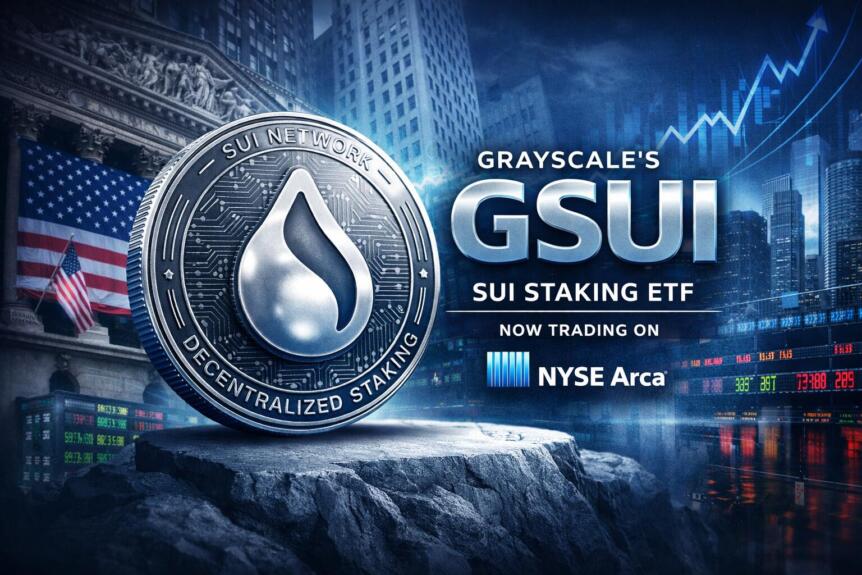
Key insights:
- GSUI ETF approved via SEC 8-A filing, begins NYSE Arca trading on February 18 with staking-based yield exposure.
- Fund charges 0.35% fee but waives it for 3 months or until $1B AUM threshold is reached.
- SUI rose by 7% after the announcement; derivatives data shows mixed sentiment despite growing institutional interest.
Grayscale Investments’ Sui Staking ETF will start trading on NYSE Arca on February 18 under the ticker GSUI after the 8-A filing became automatically effective with the U.S. Securities and Exchange Commission (SEC).
Grayscale’s 8-A Filing for Sui Staking ETF. Source: U.S. SEC
The listing gives investors regulated exposure to the SUI token and staking rewards without directly holding crypto assets, marking a significant expansion of exchange-traded products tied to alternative Layer-1 blockchains.
GSUI ETF Framework, Fees, and Key Institutional Participants
The management fee on the fund is 0.35%. Grayscale Investments Sponsors LLC has foregone the entire fee for up to 3 months or until assets under management reach $1 billion. The ETF aims to generate yield by staking SUI tokens deposited in the trust.
The key market participants include Jane Street Capital and Virtu Americas, which act as authorized participants, while JSCT, Virtu Financial Singapore, Galaxy Digital Trading Cayman, and Flowdesk will provide liquidity. Additionally, the Bank of New York Mellon serves as transfer agent and administrator, while Coinbase functions as the prime broker, and Coinbase Custody Trust Company holds the assets.
The product was previously available on OTCQX in 2025. Moving to NYSE Arca broadens access for traditional investors who want blockchain exposure without managing wallets or private keys.
SUI Market Reaction and Price Movement
SUI rose about 7% after news of the ETF surfaced, but later traded at $0.968, down 0.88% on the day. The 24-hour range stood between $0.954 and $0.987, while trading volume fell roughly 22% amid wider crypto-market uncertainty ahead of macroeconomic data, including the Federal Reserve’s FOMC minutes.
Derivatives data showed mixed sentiment. Total SUI futures open interest rose about 1% to $509 million, though short-term positions fluctuated across exchanges. In a post on X, analyst Ali suggested a potential 15% rally toward $1.16 based on a technical breakout pattern.
$SUI is breaking out of an Adam & Eve pattern, opening the door to a 15% rally toward $1.16. pic.twitter.com/2qtjppCzxw
— Ali Charts (@alicharts) February 14, 2026
GSUI Launch Signals Expansion of Staking-Based Crypto ETFs
GSUI ETF enables investors to receive staking rewards in a regulated environment, blending conventional finance with blockchain yield systems. The launch also increases institutional visibility for the Sui network, a Layer-1 blockchain designed to support high-throughput Web3 apps.
Grayscale entering into staking-based exchange-traded products is an indication of a wider trend in diversified crypto ETFs that are no longer limited to Bitcoin and Ethereum. With more adoption, analysts believe that there will be better liquidity and involvement in smaller ecosystems of digital assets.
What happens next?
GSUI will begin trading on NYSE Arca, with market participants watching early inflows and their impact on SUI liquidity and price dynamics. This indicates an expanding competition in the wider crypto ETF market.

Crypto market sentiment has fallen into “Extreme Fear” territory as asset prices continue to decline amid mounting macroeconomic and geopolitical pressures.
While some investors view such periods as potential opportunities to buy the dip, one analyst suggests that extreme caution may not necessarily translate into optimal entry points.
“Bitcoin Going to Zero” Searches Reach All-Time High Amid Extreme Market Fear
According to the latest data, the Crypto Fear & Greed Index, a widely used sentiment indicator that measures market mood on a 0–100 scale, stands at 9 today. This marks a slight recovery from 8 yesterday and an extreme low of 5 last week.
Despite the modest uptick, the latest reading suggests the market remains firmly in “Extreme Fear” territory.
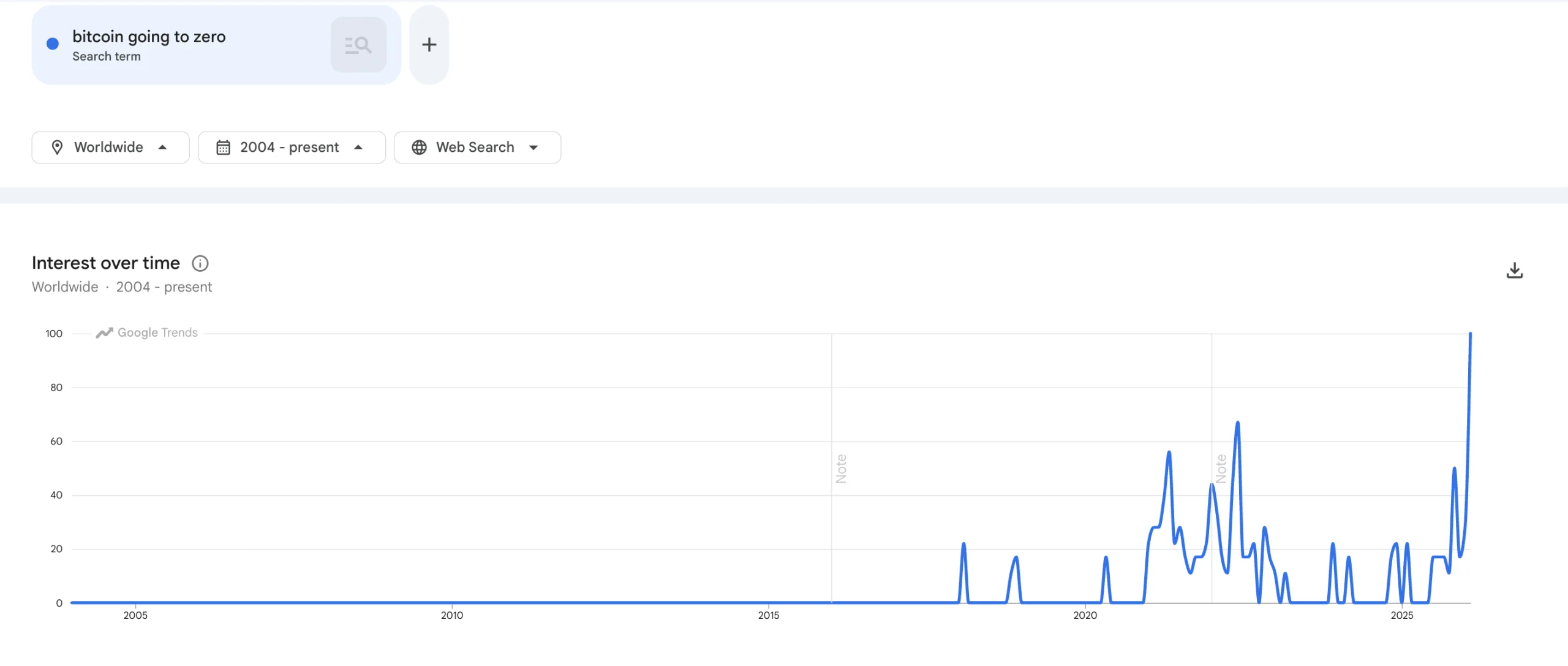
Meanwhile, investor anxiety is also reflected in search behavior. Google Trends data shows that searches for “Bitcoin going to zero” have reached their highest level on record, surpassing previous market downturns.
The search interest score hit 100, indicating peak retail curiosity and heightened concern among participants.
However, several market analysts argue that periods of extreme pessimism often represent buying opportunities.
Previously, Santiment noted that spikes in negative sentiment often occur when prices decline fast. According to the analytics firm, widespread predictions of collapse and narratives centered around terms like “down,” “selling,” or “going to $0” are often interpreted as signs of retail capitulation, when shaken confidence pushes weaker hands out of the market.
“And once you see the predictions of doom for cryptocurrency, it’s generally the best time to officially buy the dip,” Santiment stated.
Bitcoin’s Best Returns Came During Extreme Greed, Not Fear, Data Shows
Nonetheless, Nic Puckrin, investment analyst and co-founder of Coin Bureau, questioned the traditional narrative to buy Bitcoin during extreme fear.
“Buying BTC in ‘Extreme Fear’ is NOT the best call,” he said.
Puckrin argued that the data complicates the widely held belief that extreme fear automatically signals an attractive entry point. His analysis shows that when the Fear & Greed Index drops below 25, the average 90-day forward return has historically been just 2.4%.
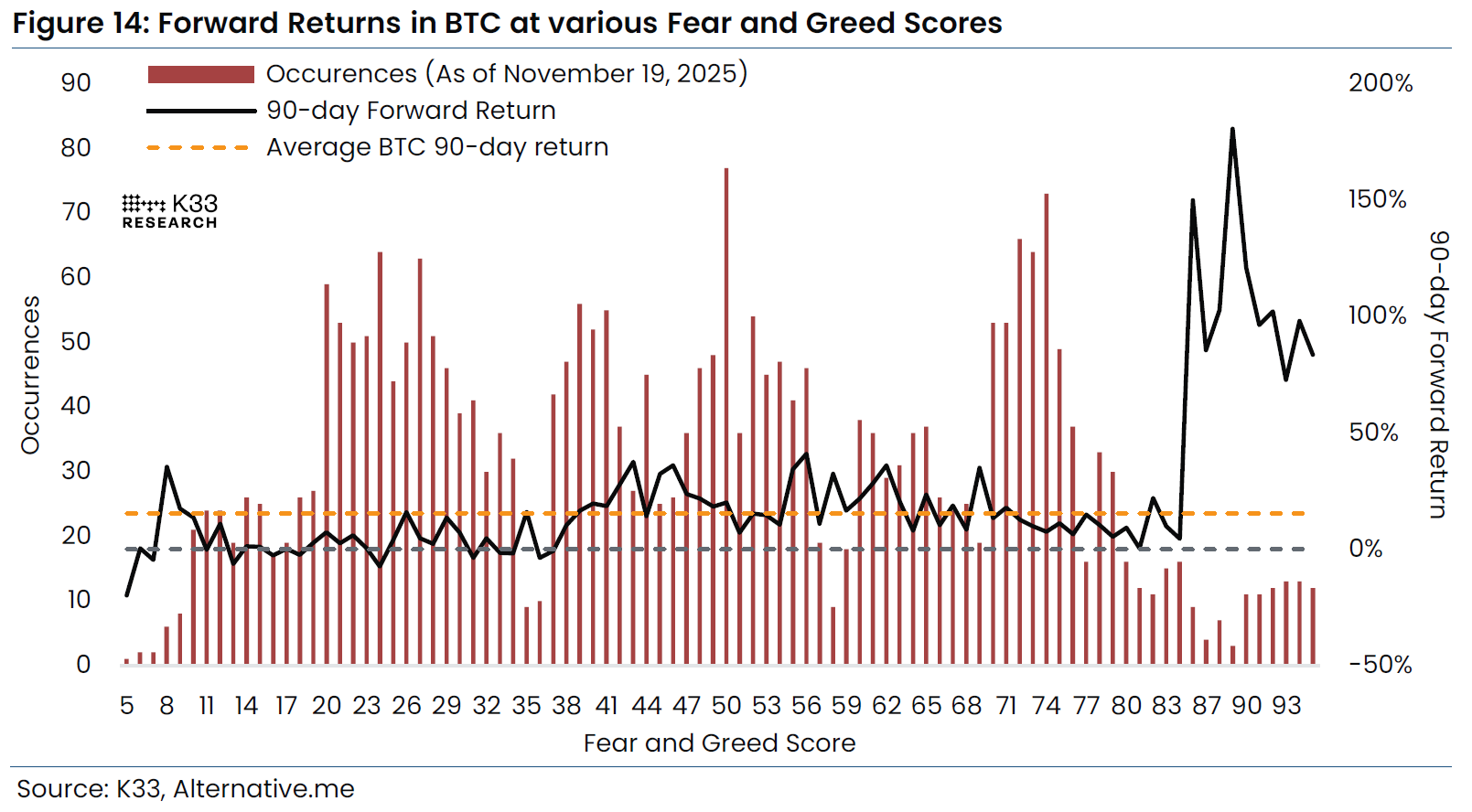
By comparison, buying in periods categorized as “Extreme Greed” has delivered substantially stronger performance, with average 90-day returns reaching as high as 95%. The findings suggest that momentum and sustained bullish conditions, rather than peak pessimism, have historically aligned with stronger forward returns.
“The F&G index is nothing but a backward-looking momentum indicator. It’s less relevant for predicting returns,” he added.
However, several analysts quickly questioned his choice of timeframe. Critics argue that a 90-day window is too narrow. One market watcher noted that while returns may appear modest three months after an extreme fear reading, the longer-term picture tells a different story.
“You can see that 12 months after extreme fear- Bitcoin has averaged over 300% gains historically. The F&G index isn’t a 90-day signal. It’s a 12-month accumulation alert. You’re not supposed to feel rich immediately after buying extreme fear,” a user replied.
Ultimately, whether this moment represents opportunity or risk may depend less on sentiment itself and more on an investor’s time horizon and strategy.
The post Is Extreme Fear a Buy Signal? New Data Questions the Conventional Wisdom appeared first on BeInCrypto.
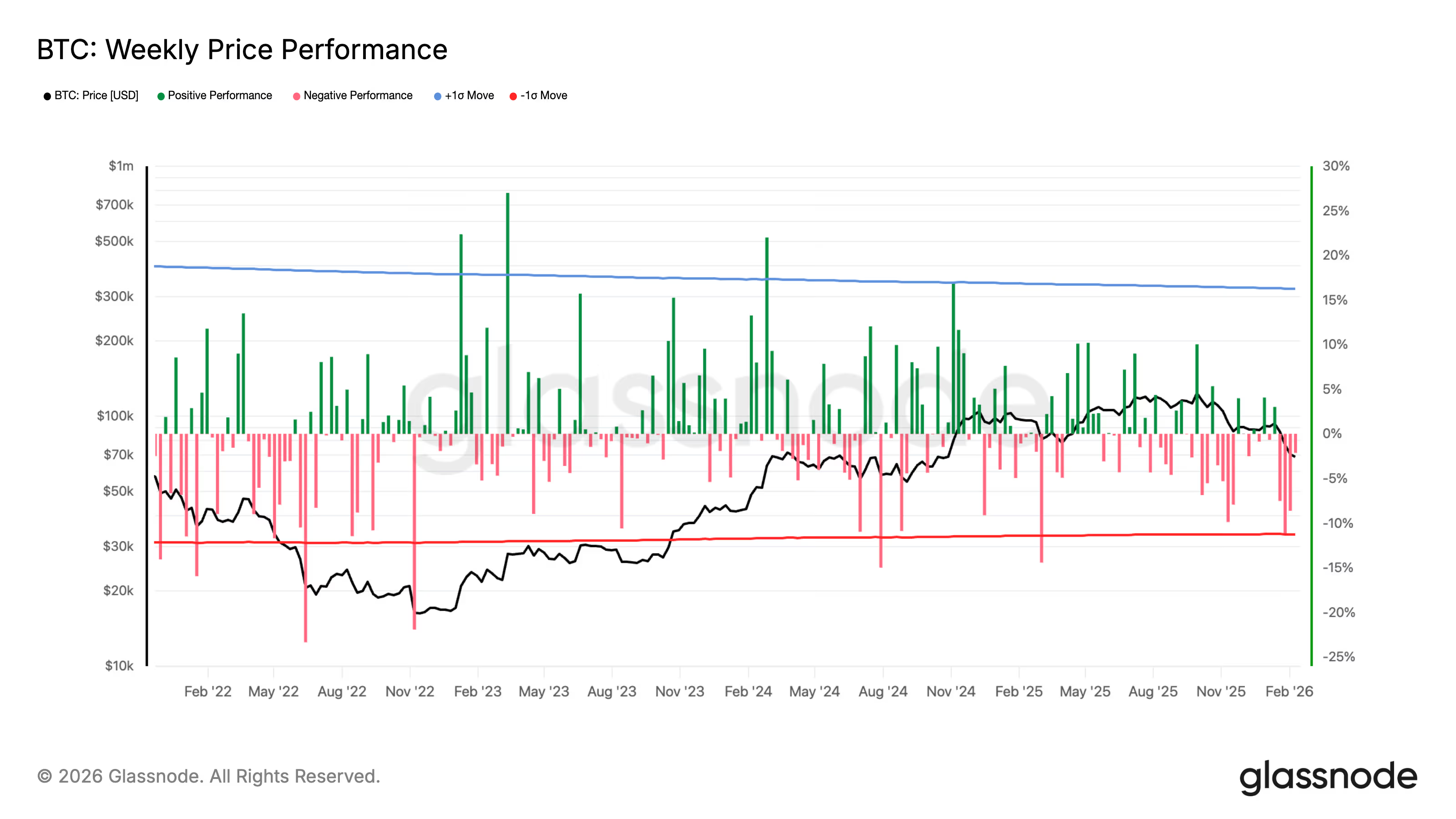
Bitcoin is on course to print its fifth consecutive weekly loss, which would mark the first such streak since March to May 2022, when bitcoin went down for nine consecutive weeks.

As of Thursday Asia time, the largest cryptocurrency by market cap is already down roughly 3% on the week, below $67,000, according to CoinDesk market data, and leaving it vulnerable to another weekly red close.
Macro pressures are adding to the technical weakness. According to the Wall Street Journal, the U.S. has amassed its largest concentration of air power in the Middle East since the 2003 Iraq invasion. While Washington is reportedly prepared to launch strikes on Iran, President Donald Trump has not made a final decision, with Polymarket bettors giving a 27% chance of strikes occurring by the end of the month.
The geopolitical uncertainty has lifted the dollar index to 97.7, its highest level since Feb. 6, while WTI crude oil has climbed to $65 from Wednesday’s $62 low. A stronger dollar and rising oil prices typically weigh on risk assets, creating additional headwinds for bitcoin, reinforcing a negative weekly close.
Bitcoin has declined by more than 50% from its October all-time high near $126,500 to levels as low as $60,000.
On a monthly basis, bitcoin has recorded five straight declines since October, the second-longest losing streak on record, surpassed only by the six-month slide from 2018 to 2019.
Against gold, bitcoin is down seven consecutive months relative to the precious metal, its longest stretch of underperformance in that pairing.


World Liberty Financial has unveiled plans to roll out an institutional-grade real-world asset product, starting with a tokenized investment linked to Trump International Hotel & Resort, Maldives.
Summary
- WLFI is partnering with Securitize and DarGlobal to tokenize loan revenue from a major Maldives resort.
- The offering targets accredited investors and will operate under strict regulatory and transfer rules.
- The project reflects WLFI’s ongoing strategy to link DeFi, traditional assets, and institutional finance.
The goal of the project, which is being developed in partnership with Securitize and DarGlobal PLC, is to tokenize loan revenue interests tied to the upscale resort.
According to WLFI’s Feb. 18 statement, the offering is designed for accredited and eligible investors, providing access to fixed yield and revenue streams within a regulated framework.
How the tokenized product is structured
The initial offering will provide investors with fixed returns and access to loan-related income generated by the resort. Revenue from interest payments will be distributed through the token structure, allowing holders to gain exposure to the asset’s performance without direct property ownership.
The company noted that the product will operate within a regulated securities framework under Regulation D and Regulation S. Tokens will not be registered for public sale in the United States and may only be offered through approved exemptions.
Eric Trump, co-founder of WLFI, said the initiative aims to bring tokenized real estate to decentralized finance in a compliant way. He described the Maldives project as a flagship example of how high-end property can move on-chain.
“We built World Liberty Financial to open up decentralized finance to the world. With today’s announcement, we are now extending that access to tokenized real estate.”
— Eric Trump, co-founder of World Liberty Financial.
Securitize chief executive officer Carlos Domingo said scalable and compliant real estate tokens could see strong global demand, while DarGlobal CEO Ziad El Chaar called the partnership a step toward improving liquidity in private real estate markets.
The announcement clarified that The Trump Organization is not directly involved in issuing or promoting the tokens, and that branding is used under a licensing agreement.
World Liberty Financial (WLFI) also noted that the tokens may later be supported on multiple public blockchains and could be used as collateral through its WLFI Markets platform, where permitted by law.
Broader expansion strategy
The real estate launch follows a series of recent efforts by WLFI to position itself in institutional digital finance. On the same day as the announcement, the company hosted the World Liberty Forum at Mar-a-Lago, bringing together executives from firms including Goldman Sachs, Nasdaq, and Franklin Templeton.
The private event focused on digital assets, stablecoins, artificial intelligence, and monetary policy, according to people familiar with the gathering.
WLFI also announced a separate partnership with Apex Group to pilot its USD1 stablecoin for settlements in tokenized fund operations. The agreement will help integrate blockchain-based payments into traditional fund administration.


In a letter sent on February 18 activist investor Starboard Value LP called on Riot Platforms to urgently execute its transition from bitcoin mining to a premier artificial intelligence and high-performance computing (AI/HPC) data center provider.
Summary
- Starboard Value released a high-stakes letter urging Riot Platforms to capitalize on a massive $21 billion opportunity in artificial intelligence.
- The recent AMD deal is seen only as a “proof of concept”; the activist demands larger, investment-grade tenants to bridge the valuation gap with peers.
- The shareholder warned that if Riot cannot execute quickly, its rare power assets make it a prime acquisition target for tech giants.
Starboard: Riot Platforms sitting on a multi-billion dollar AI payday
“We believe Riot is on its way to a transformation from a bitcoin miner to a best-in-class AI/HPC
data center company,” Starboard said in the letter.
While praising recent governance improvements, Starboard warned that “time is of the essence” as the company continues to underperform its peers.
Starboard highlighted Riot Platform’s “massive” opportunity, centered on its 1.7GW of available power across two flagship sites in Corsicana and Rockdale, Texas. As the AI industry faces severe power constraints and multi-year grid interconnection delays, Starboard contends that Riot’s already-powered sites are among the most attractive in the nation.
The investor pointed to Riot’s January 2026 deal with Advanced Micro Devices (AMD) as a “positive signal” and proof of concept. Under the agreement, AMD committed to 25MW which is expected to generate $311 million in revenue over a 10-year term with an 80% EBITDA margin.
Starboard’s analysis suggests Riot is also significantly undervalued. If Riot successfully monetizes its remaining 1.4GW of capacity in line with recent industry transactions, it could generate over $1.6 billion in annual EBITDA. Using valuation multiples of 12.5x to 20x, Starboard estimates the AI/HPC business alone could contribute between $9 billion and $21 billion in equity value, implying a share price of $23 to $53.
Despite these prospects, Starboard Managing Member Peter Feld noted that Riot’s stock has materially lagged behind peers who signed larger AI deals earlier. The letter urged Riot to focus on “highest-quality” investment-grade tenants and warned that if management cannot execute quickly, the company should consider itself a candidate for consolidation due to the scarcity of its power assets.
“Riot is now positioned to focus on executing its AI/HPC strategy,” Feld wrote, “but it must execute with excellence and urgency”.
Crypto World
Ether.fi Migrates Cash Product to OP Mainnet in Long-Term Optimism Enterprise Partnership

TLDR:
- Ether.fi Cash processes 28,000 daily spend transactions averaging $2 million in volume, doubling every two months.
- The migration covers 70,000 active cards, 300,000 accounts, and millions in user TVL moving to OP Mainnet.
- OP Stack processed 3.6 billion transactions in H2 2025, accounting for 13% of all global crypto transactions.
- ether.fi users will access OP token rewards, 3%+ cashback, travel perks, and free metal cards post-migration.
Ether.fi is migrating its flagship Cash product to Optimism’s OP Mainnet. The move covers roughly 70,000 active cards and 300,000 accounts.
Millions in user TVL will also transfer to the new network. The migration is part of a long-term OP Enterprise partnership.
Together, the teams aim to accelerate on-chain global payments. This positions OP Mainnet as a leading destination for payment activity in the broader crypto ecosystem.
Ether.fi Cash Brings Scale and Speed to OP Mainnet
Ether.fi Cash is a non-custodial digital banking product combining a credit card with a savings account. It runs DeFi protocols under the hood to generate yield for users.
The product allows movement between fiat and crypto while offering cashback and global spending. Users manage their assets without giving up custody.
Since launching last year, the product has grown quickly. Each day, the app processes 2,000 internal swaps and 28,000 spend transactions.
Daily spend volume averages around $2 million. These numbers have roughly doubled every two months since launch.
The migration to OP Mainnet will expand liquidity access for users making swaps. They will also gain access to more assets for deposits and withdrawals.
Gas fees and network costs for card transactions will be covered by ether.fi. More cashback rewards are also planned as part of the move.
For end users, the transition is designed to be seamless. Optimism has managed major ecosystem migrations before and has a structured process in place. Users should not experience disruption during the switch to the new network.
What the OP Enterprise Partnership Means for Ether.fi
As an OP Enterprise customer, Ether.fi gains access to several infrastructure benefits. These include established liquidity, a dedicated account manager, and priority access to new features. The same codebase works across all OP Stack chains, which reduces development overhead.
The OP Stack processed 3.6 billion transactions in the second half of 2025. That represented 13 percent of all crypto transactions during that period. OP Mainnet serves as a hub for DeFi activity and a launchpad for consumer apps.
As part of the integration, ether.fi users will receive access to OP token rewards. Ongoing reward programs include 3% or more cashback, in-app campaigns, travel discounts, and free metal cards. Membership tiers and lounge access are also part of the package.
ether.fi sees blockchain infrastructure as a way to expand globally at a lower cost than traditional fintech. Operating non-custodially allows the platform to scale without the overhead traditional banks carry.
The partnership with Optimism supports that model with enterprise-grade tools and network depth.
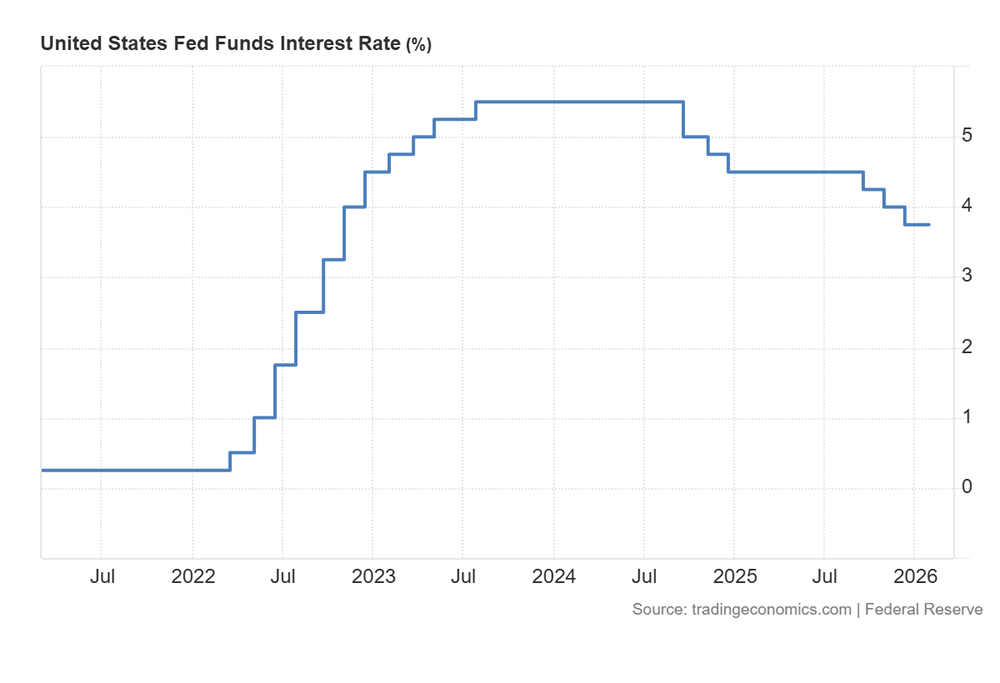
United States Federal Reserve policymakers discussed the possibility of interest rate increases last month, according to newly released comments from a January meeting.
The minutes of the Federal Open Market Committee meeting from late January were released on Wednesday, revealing that some policymakers were mulling a rate hike due to stubbornly high inflation.
Several participants indicated that they would support “the possibility that upward adjustments to the target range for the federal funds rate could be appropriate if inflation remains at above-target levels,” the minutes stated.
Central bank policymakers voted to keep interest rates unchanged at 3.5% to 3.75% at their January meeting after cutting rates three times at the end of 2025, from 4.5% to current levels.
If enacted, it would be the first rate hike since July 2023. However, CME futures markets indicate a 94% probability that rates will remain unchanged at the Fed’s next meeting on March 18.
The Federal Reserve has two primary mandates for its policy on rates: inflation and the labor market.

High inflation concerns persist
The minutes also revealed that there is a significant “hawkish” contingent that is not yet ready to commit to further cuts.
Some participants commented that it would likely be appropriate to “hold the policy rate steady for some time” to give them more time to assess economic data.
However, a number of these participants judged that “additional policy easing may not be warranted until there was a clear indication that the progress of disinflation was firmly back on track.”
Related: Why Bitcoin has recently reacted more to liquidity conditions than to rate cuts
Most participants cautioned that progress toward the 2% inflation objective “might be slower and more uneven than generally expected,” judging that there was a meaningful risk of it remaining above the target.
If inflation were to decline in line with expectations, rate reductions “would likely be appropriate,” the minutes stated.
US inflation as measured by the Consumer Price Index (CPI) is currently 2.4%, having increased 0.2% in January, according to the Bureau of Labor Statistics.

Rate hikes are typically bad for crypto prices
Higher rates are generally bearish for high-risk assets such as crypto, as safer assets like Treasury bonds or cash offer better returns with no risk.
Higher rates also make borrowing more expensive, which reduces speculative activity, leverage, and venture capital investments.
Crypto market sentiment, which is already at rock bottom, could also be further hit by a hawkish Federal Reserve.
Magazine: Chinese New Year boosts interest, TradFi buying crypto exchanges: Asia Express
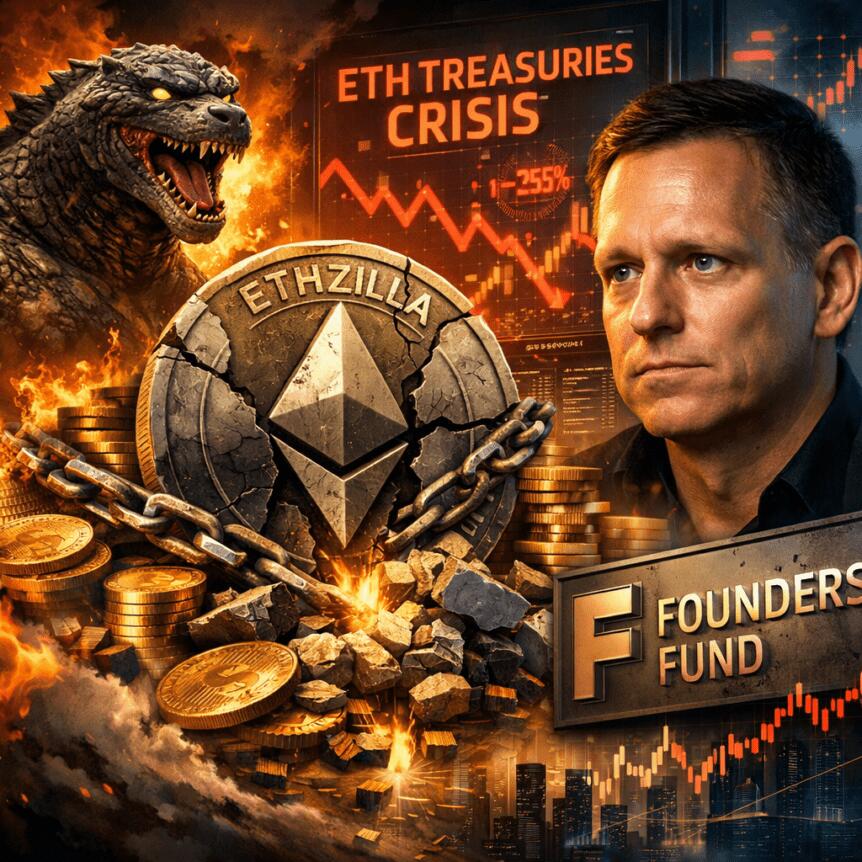
The exit by billionaire tech investor Peter Thiel’s Founders Fund from ETHZilla marks a notable pivot in how crypto treasuries are managed and disclosed. A Tuesday filing with the U.S. Securities and Exchange Commission shows affiliates of Thiel no longer hold any stake in the Ether-focused treasury company, signaling a retreat from a venture that once intersected biotech finance with a crypto strategy. The move comes after an Aug. 4, 2025 filing disclosed a 7.5% stake in 180 Life Sciences Corp., comprising 11,592,241 shares valued at roughly $40 million when shares traded near $3.50. In crypto markets, the timing of this exit underscores growing scrutiny of Ether‑heavy treasury models as investors reassess risk, liquidity, and regulatory clarity.
ETHZilla’s lineage traces back to a biotech outfit rebranding around a dedicated Ether treasury program. The rebirth into ETHZilla followed a July 2025 fundraising drive that raised about $425 million to launch an Ether treasury strategy and reposition the company under the new name. That period underscored the appetite among certain investors for backing Ether-centric balance sheets, even as Ether‑heavy strategies faced volatile price swings and evolving risk controls. The narrative around ETHZilla intensified as the firm subsequently pursued additional liquidity through convertible debt, expanding its Ether holdings in a bid to deploy capital across decentralized finance (DeFi) and tokenized assets.
The sequence of events in late 2025 paints a fuller picture of how these strategies evolved. In September, ETHZilla tapped investors for roughly $350 million via convertible bonds, enabling further expansion of its Ether holdings. At one point, the firm held more than 100,000 Ether, positioning its balance sheet as a significant, if high‑volatility, exposure to the largest smart contract platform’s native asset. The strategy sought to diversify across DeFi protocols and tokenized assets, but the market environment subsequently prompted reallocation and liquidity management moves as macro and crypto-specific tides shifted.
By December, ETHZilla began liquidating a portion of its Ether holdings to meet debt obligations. Specifically, 24,291 Ether were redeemed for about $74.5 million, executed at an average price near $3,068.69 per Ether, leaving roughly 69,800 ETH on the balance sheet. The liquidation underscores how even large treasury positions can be trimmed in response to funding needs or risk controls, particularly when market liquidity and asset correlations complicate balance sheet management. The exit by Founders Fund, paired with ETHZilla’s own liquidity actions, reinforces a broader move among Ether-based treasury actors to reassess capital allocation, leverage, and the durability of non‑Bitcoin crypto treasury playbooks.
Thiel’s withdrawal from ETHZilla is framed by broader tensions in crypto treasury models that favored Ether over Bitcoin (CRYPTO: BTC) in earlier disclosures. While some managers pursued diversified holdings across multiple assets, a number of high‑profile Ether accumulators have taken different paths. BitMine Immersion Technologies, the largest listed Ethereum holder, expanded its Ether stake by purchasing 40,613 ETH on Feb. 9, driving total holdings beyond 4.3 million ETH and pushing the value of its portfolio into the tens of billions of dollars at prevailing prices. In contrast, Trend Research moved to unwind a substantial position, selling 651,757 ETH for about $1.34 billion and locking in roughly $747 million of realized losses. The varying approaches illustrate a market segment wrestling with how to balance liquidity, yield, and risk in a rapidly evolving crypto landscape.
ETHZilla itself did not stay static after the initial pivot. The firm launched ETHZilla Aerospace, a subsidiary intended to provide tokenized exposure to leased jet engines, as part of a broader diversification effort beyond plain Ether holdings. The pivot to tokenized real‑world assets (RWA) and crypto yield initiatives reflects the broader industry push to build revenue streams that can complement or hedge against crypto market cycles. Yet Thiel’s exit amplifies the narrative that Ether‑centric treasury structures—once viewed as a strategic differentiator—face renewed scrutiny from investors seeking clearer governance, transparency, and diversification in an environment defined by price volatility and shifting liquidity regimes.
The evolving story of ETHZilla and its contemporaries sits within a wider context of institutional attention to crypto treasuries. While Ether remains a focal point for many on-chain treasury strategies, observers are weighing whether the sector has adequate risk controls, valuation discipline, and regulatory clarity to sustain large, illiquid holdings. The SEC filings—along with company disclosures and market actions—will be watched closely for any further changes in ownership, debt facilities, or new collateral arrangements that could influence Ether’s standing in corporate balance sheets and in broader market sentiment.
Key takeaways
- Founders Fund affiliate holdings of ETHZilla were reduced to zero shares via a Schedule 13G amendment filed with the SEC, signaling an exit from the vehicle that once included a 7.5% stake in 180 Life Sciences Corp.
- 180 Life Sciences rebranded to ETHZilla after a July 2025 fundraising round that raised about $425 million to back a dedicated Ether treasury strategy.
- ETHZilla pursued additional capital through a September 2025 convertible debt round, enabling expansion of its Ether holdings and deployment across DeFi and tokenized assets, at one point exceeding 100,000 ETH.
- December 2025 saw a liquidation of 24,291 ETH for roughly $74.5 million to repay debt, leaving about 69,800 ETH on the balance sheet.
- Thiel’s exit underscores ongoing strain on Ether‑centric treasury models as the market consolidates and investors reassess risk, liquidity, and governance around crypto treasuries.
- Ethically and strategically, ETHZilla diversified into tokenized jet‑engine exposure through ETHZilla Aerospace, signaling a broader push to blend real‑world assets with crypto yields.
Tickers mentioned: $BTC, $ETH
Market context: The move reflects broader liquidity and risk considerations shaping crypto treasuries as investors weigh yield against volatility and regulatory risk. Transparency via 13G filings intersects with a sector still building governance norms around crypto treasury management.
Why it matters
For investors and developers in the crypto space, the Thiel/ETHZilla episode highlights the fragility and adaptability of Ether‑heavy treasury models. The sequence—from a high‑profile rebrand and a large capital raise to a substantial liquidation and a major investor exit—reveals how treasuries anchored to Ether can be exposed to rapid swings in token prices, funding needs, and balance sheet constraints. The development underscores the importance of governance clarity, valuation discipline, and diversified asset mixes for corporate treasury strategies that ride on volatile digital assets.
From a market perspective, the episode amplifies the ongoing debate over whether Ether is a suitable long‑term treasury anchor for publicly traded or VC‑backed entities. While some firms have pursued aggressive Ether accumulation to maximize yield opportunities in DeFi and tokenized assets, others are retreating or retooling their strategies in response to liquidity spikes, drawdown risks, and the potential for regulatory changes that could affect custody, reporting, and capital adequacy.
For builders and operators of treasury platforms, the ETHZilla case reinforces the value of transparent public disclosures and flexible architectures that can accommodate both Ether holdings and structured debt, while offering pathways to tokenize real‑world assets and monetize yield streams. It also cautions that even well‑capitalized Ether portfolios must be prepared to realign in a market where price sensitivities and funding requirements can abruptly alter risk profiles.
What to watch next
- Follow any additional SEC disclosures or updates to ETHZilla’s corporate filings that could reveal new ownership structures or debt instruments.
- Monitor developments around ETHZilla Aerospace and any further tokenized real‑world asset projects that could broaden the firm’s revenue mix.
- Track the pace of Ether liquidity movements from large holders like BitMine and Trend Research to gauge how the sector is balancing yield, risk, and capital preservation.
- Observe broader regulatory signals related to crypto treasuries, custody standards, and reporting requirements that could influence future treasury strategies.
Sources & verification
- SEC filing: Schedule 13G for Founders Fund and ETHZilla holdings — primary_doc.xml — https://www.sec.gov/Archives/edgar/data/1690080/000199596426000003/xslSCHEDULE_13G_X01/primary_doc.xml
- SEC filing: Schedule 13G reporting a 7.5% stake in 180 Life Sciences Corp. (Aug. 4, 2025) — primary_doc.xml — https://www.sec.gov/Archives/edgar/data/1690080/000141588925021455/xslSCHEDULE_13G_X01/primary_doc.xml
- 180 Life Sciences rebrands to ETHZilla — Cointelegraph article — https://cointelegraph.com/news/down-99-biotech-firm-180-life-sciences-pivots-crypto-eth
- ETHZilla raises $350M via convertible bonds — Cointelegraph article — https://cointelegraph.com/news/ethzilla-raises-350m-expand-ether-holdings-defi-yield
- Bitmine staked Ether holdings and broader ETH treasury data — Cointelegraph article — https://cointelegraph.com/news/bitmine-staked-ether-holdings-annual-staking-revenue
- Trend Research reduces ETH holdings — Cointelegraph article — https://cointelegraph.com/news/trend-research-reduces-eth-holdings-325k-187k-eth-binance
- ETHZilla liquidates Ether and restructures debt — Cointelegraph article — https://cointelegraph.com/news/ethzilla-liquidates-ether-redeem-convertible-debt
- ETHZilla tokenized jet engines RWA — Cointelegraph article — https://cointelegraph.com/news/ethzilla-tokenized-jet-engines-rwa-ethereum-liquidity-io

Key Insights
- CFTC asserts federal control over prediction markets, countering state gambling claims.
- Prediction markets offer economic hedging and information aggregation value to society.
- Clear federal rules spur U.S. crypto innovation and limit fragmented state enforcement.
CFTC Files Amicus Brief to Protect Prediction Markets
The U.S. Commodity Futures Trading Commission has filed an amicus curiae (“friend of the court”) brief to defend its authority over prediction markets such as Polymarket and Kalshi, amid a rising wave of state enforcement actions. In an X post, CFTC Chair Mike Selig highlighted that prediction markets are under federal jurisdiction, not state oversight, and serve legitimate economic purposes.
I have some big news to announce… pic.twitter.com/3OBNTaOnIL
— Mike Selig (@ChairmanSelig) February 17, 2026
Federal Authority vs. State Crackdowns
Selig noted that prediction markets have been regulated by the CFTC for over 20 years and serve a real purpose in the U.S. economy. Despite the crackdowns, the United States remains a global leader in financial markets as it approaches its 250th anniversary.
These platforms are derivatives markets, where a user can hedge commercial risks and offer valuable insights to society. States such as Massachusetts claim that sport-themed contracts transform these platforms into unlawful gambling activities, prompting Polymarket to file a federal jurisdiction suit.
Prediction Markets Drive Risk Management and Market Insights
Prediction markets help increase economic efficiency by pooling information and providing risk-management facilities. Selig added that such markets serve as a significant countercheck to media narratives as well, offering society more data-driven information. The CFTC’s involvement ensures legal clarity and can influence court decisions that may shape the future of U.S. markets.
Federal Oversight: Key to Crypto Innovation and Clarity
Exchanges such as Coinbase and Crypto.com, which offer prediction-style products, are under scrutiny by state regulators. Under the CLARITY Act, the proposed legislation would explicitly separate regulatory jurisdiction, with the CFTC regulating crypto-asset commodities and the Securities and Exchange Commission regulating digital securities. CLARITY Act
Industry leaders: Tyler Winklevoss described the filing as “huge,” and Senator Bernie Moreno emphasized the need for a clear regulatory picture when it comes to innovation in the United States.
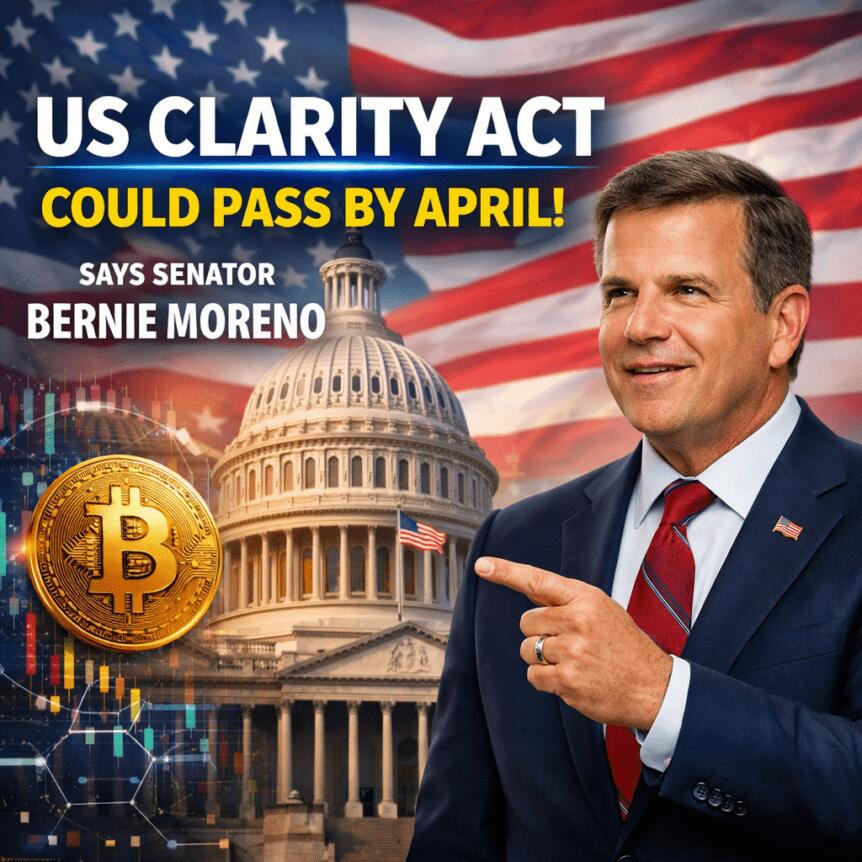
The US CLARITY Act, a long-awaited framework intended to clarify how the United States will regulate the burgeoning crypto sector, could be on track for a congressional pass in the coming weeks, according to crypto-friendly policymakers. Senator Bernie Moreno suggested a potential April milestone as he spoke to CNBC in Florida, where he was touring President Donald Trump’s Mar-a-Lago resort. The remarks came as Coinbase CEO Brian Armstrong joined Moreno for a discussion that touched on market structure and the regulatory path forward at a gathering organized by the World Liberty Financial crypto forum.
Armstrong described the current climate as offering a “path forward” that might yield a balanced outcome for the industry, traditional banks, and American consumers. He noted that earlier iterations of the draft included provisions that would ban interest-bearing stablecoins and would place the U.S. Securities and Exchange Commission in a central regulatory role over crypto markets. Those elements proved problematic for the exchange and had contributed to a pause in its public backing for the bill. At the same time, members of the crypto community have emphasized the need for a predictable regulatory framework that can spur investment and innovation while protecting consumers and the broader financial system.
Moreno, who co-authored or championed the legislation’s bipartisan path, signaled that the sticking point on stablecoins—particularly the idea of rewarding users with yield—has shifted toward a more workable compromise. In his view, the debate over stablecoin rewards “shouldn’t be part of this equation,” and he indicated that lawmakers were looking to refine the language so it could pass with broad support. The discussion has not been simple, given the various interests involved, from traditional banking to fintech platforms and consumer advocates. But with executives from the crypto industry at the table alongside bankers and lawmakers, the atmosphere has become more conducive to finding a compromise that can be signed into law.
From the trading floor to the Capitol, the conversation has also been about market structure and consumer protections. Armstrong invoked a vision of a “win-win-win” scenario where the bill would advance the interests of the crypto industry, safeguard banks, and benefit American consumers by consolidating a coherent national framework. The idea is to harmonize the fast-moving crypto markets with existing financial regulations, reducing uncertainty for businesses and investors alike. The discussions have taken place against a backdrop of broader regulatory activity, including ongoing policy reviews at the White House and within Congress, and amid an intensifying push from both parties to deliver tangible crypto reforms.
The regulatory conversation has not occurred in a vacuum. Polymarket, a prediction market for crypto policy, offered a glimpse into market sentiment by showing the odds of the CLARITY Act passing in 2026 swing between 90% and roughly 72% around the time of the interview. The volatility in these odds underscores the uncertainty that still surrounds the drafting process and the political dynamics at play in a year marked by competing priorities for lawmakers. While Moreno suggested a constructive path forward, he also acknowledged that the timetable is influenced by technical details that still require resolution, particularly around stablecoins and the precise allocation of regulatory authority among federal agencies.
Key takeaways
- The CLARITY Act is gaining momentum in Congress, with a potential passage window cited as “April” by Senator Bernie Moreno in a CNBC interview conducted at Mar-a-Lago.
- Coinbase previously withdrew support over provisions that would ban interest-bearing stablecoins and centralize crypto regulation under the SEC, complicating the bill’s path; the White House reportedly viewed the move as a unilateral action.
- Armstrong and Moreno signaled a renewed effort to achieve a balanced compromise that would advance crypto market structure while addressing concerns from the banking sector.
- Market-facing sentiment on the bill has fluctuated, with Polymarket showing odds of passage in 2026 ranging from 90% to 72% around the talks.
- The discussions emphasize restoring clarity for market participants, investors, and consumers, potentially shaping the United States’ stance on crypto policy for years to come.
Sentiment: Bullish
Market context: The rhetoric around the CLARITY Act reflects a broader push for regulatory clarity in a volatile asset class, as lawmakers seek a stable framework to accommodate innovation while safeguarding financial stability and consumer protections in a rapidly evolving market.
Why it matters
The CLARITY Act represents more than a regulatory tweak; it signals a concerted attempt to establish a nationwide standard for crypto assets, a move that could significantly influence how exchanges, wallet providers, and fintech firms operate in the United States. By aiming to clarify which activities trigger regulatory oversight and which agencies oversee them, the bill seeks to reduce the current fragmentation that has left many market participants navigating a patchwork of state and federal rules. If enacted, the act could provide a predictable environment for investment, product development, and institutional participation, potentially attracting capital that has been cautious due to regulatory ambiguity.
However, the path to passage remains contingent on reconciling divergent priorities. The debate over stablecoins—whether to treat certain yields as permissible rewards or to prohibit certain yield-bearing mechanisms—highlights the trade-offs lawmakers face between fostering innovation and protecting financial stability. The White House’s reaction to Coinbase’s withdrawal illustrates the delicate political optics involved in crypto legislation, with officials wary of any moves that could cast the administration as unfavorably aligned with industry players or skeptical of robust consumer protections. As talks continue, stakeholders on all sides are watching for a clearer set of draft language that can win broad bipartisan support and withstand evolving regulatory scrutiny.
For investors and users, the potential passage of the CLARITY Act could usher in a period of relative regulatory certainty, enabling more precise risk assessment and potentially more defined product offerings. The balance being sought is delicate: too lenient a regime could invite operational risk, while overly restrictive provisions might stifle innovation and push activity offshore or into less regulated ecosystems. The ongoing discussions at the WLF crypto forum, coupled with public comments from industry leaders, show a sector eager for governance that protects consumers without quashing growth.
What to watch next
- Upcoming committee hearings or markup sessions in Congress that could reveal the final language of the CLARITY Act.
- Any revisions to stablecoin treatment within the bill, particularly around yield-bearing arrangements and consumer protections.
- White House statements or official remarks that signal shifting positions or tailored guidance on crypto regulation.
- Respective statements or filings from Coinbase and other major players to gauge industry alignment with the revised draft.
- Follow-up coverage on the World Liberty Financial crypto forum and any subsequent policy pledges or compromises announced by lawmakers.
Sources & verification
- CNBC interview at Mar-a-Lago featuring Senator Bernie Moreno and Coinbase CEO Brian Armstrong.
- World Liberty Financial crypto forum discussions on market structure and regulatory pathways.
- Coinbase withdrawal of support for the CLARITY Act and White House reaction documenting the administration’s stance.
- Polymarket odds page tracking the CLARITY Act’s passage probability in 2026.
- David Sacks statements cited by Cointelegraph regarding confidence in the bill’s trajectory.
US CLARITY Act gains momentum as lawmakers edge toward April passage
The ongoing dialogue around the CLARITY Act underscores a broader shift in how the United States intends to regulate crypto markets. As policymakers seek a cohesive and comprehensive framework, industry leaders are pushing for a balance that preserves innovation while ensuring consumer protection and financial stability. The discussions at the Mar-a-Lago event and the WLF crypto forum point to a willingness to negotiate, even if core points—from stablecoin policy to the SEC’s regulatory role—remain contested. If April proves to be a viable milestone, as Moreno suggested, lawmakers may be positioned to deliver a bill that could redefine the U.S. market structure for years to come. The unfolding narrative will likely influence investor sentiment, the trajectory of exchange policies, and the pace at which traditional financial institutions engage with crypto products in a regulated environment.
As the sector awaits more precise legislative language, participants will be closely watching for any signals that the political calculus has shifted enough to secure bipartisan support. The balance of risk and opportunity in the year ahead will hinge on how effectively the bill reconciles the industry’s demand for clarity with the banking sector’s emphasis on safety and soundness. The next few weeks could prove pivotal for a piece of legislation that many view as a potential turning point for mainstream crypto adoption in the United States.
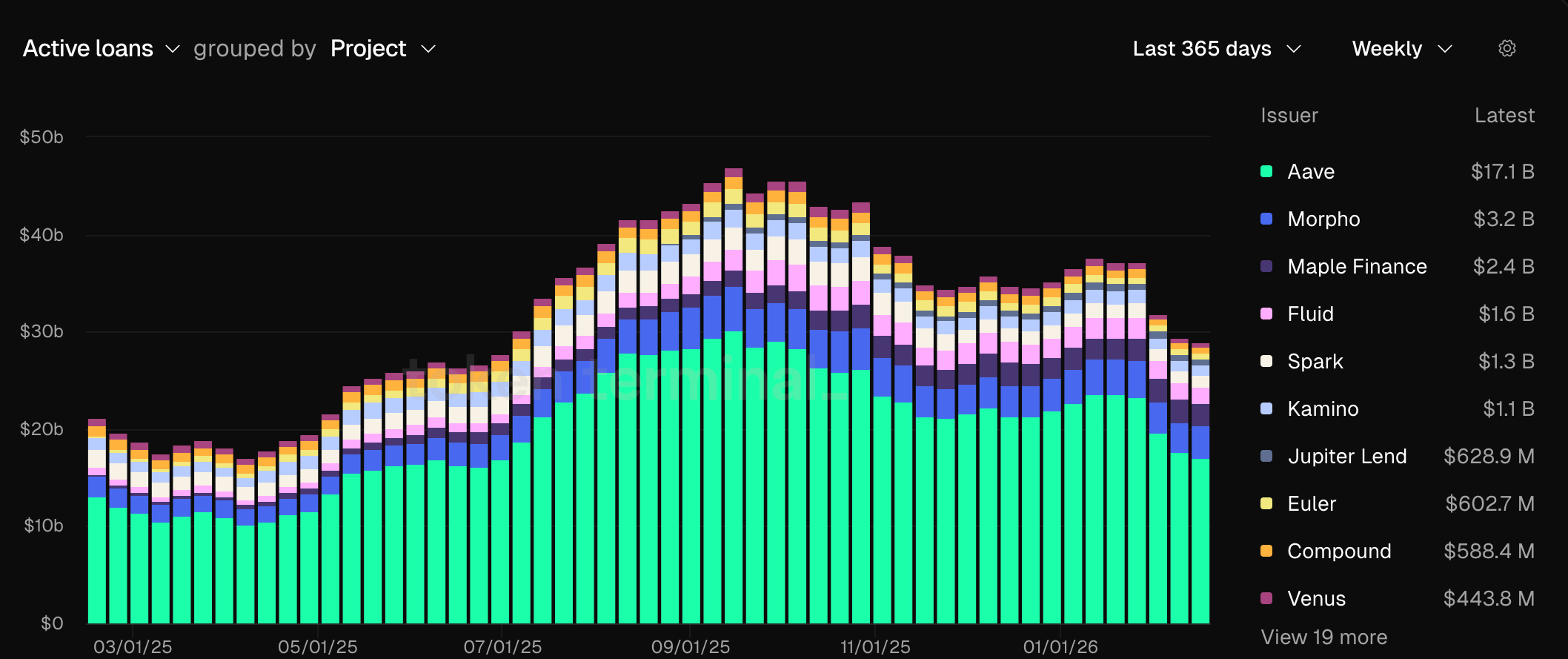
Digital asset lending company Ledn has completed the first-ever transaction of its kind in the asset-backed debt market, selling $188 million in securitized bonds backed by Bitcoin (BTC).
This development emerges as the lending market confronts a volatile environment. Active loans have fallen to around $30 billion, and liquidation risks are rising with persistent price declines.
Sponsored
Sponsored
Coinbase and Ledn Double Down on Crypto Lending
Bloomberg, citing sources familiar with the matter, reported that the deal consists of two bonds. One portion, rated investment-grade, was priced at a spread of 335 basis points above the benchmark rate.
According to a report from S&P Global Ratings, the bonds are secured by a pledge of 4,078.87 Bitcoin. The fair market value stands at approximately $356.9 million.
The loans carry a weighted average interest rate of 11.8%. Jefferies Financial Group Inc. served as the lead manager, structuring agent, and initial purchaser.
“Ledn’s liquidation engine is an algorithmic trading program that sources prices on multiple exchanges and/or is available through multiple trading partners. Ledn has successfully liquidated BTC collateral to repay 7,493 loans in its seven-year history, with an average LTV at liquidation of 80.32%, a maximum LTV at liquidation of 84.66%, and has never experienced a loss. On a WA basis, liquidation upon an LTV EOD has taken under 10 seconds, with minimal “price slippage” in execution,” the report reads.
Beyond Ledn, Coinbase is expanding its footprint in crypto-backed lending. In a recent update, the exchange said users can borrow up to $100,000 in USDC, the stablecoin issued by Circle, by pledging XRP (XRP), Cardano (ADA), Dogecoin (DOGE), or Litecoin (LTC) as collateral through the decentralized finance protocol Morpho.
The offering is available across the US, with the exception of New York, according to the company.
Sponsored
Sponsored
Crypto Lending Shrinks 36% as Active Loans Fall
This comes at a pivotal moment for the crypto lending sector, which has contracted sharply amid broader market weakness. Data from TokenTerminal showed that as of February 2026, total active loans across lending protocols stand at roughly $30 billion, down 36% from the September peak of $46.96 billion.
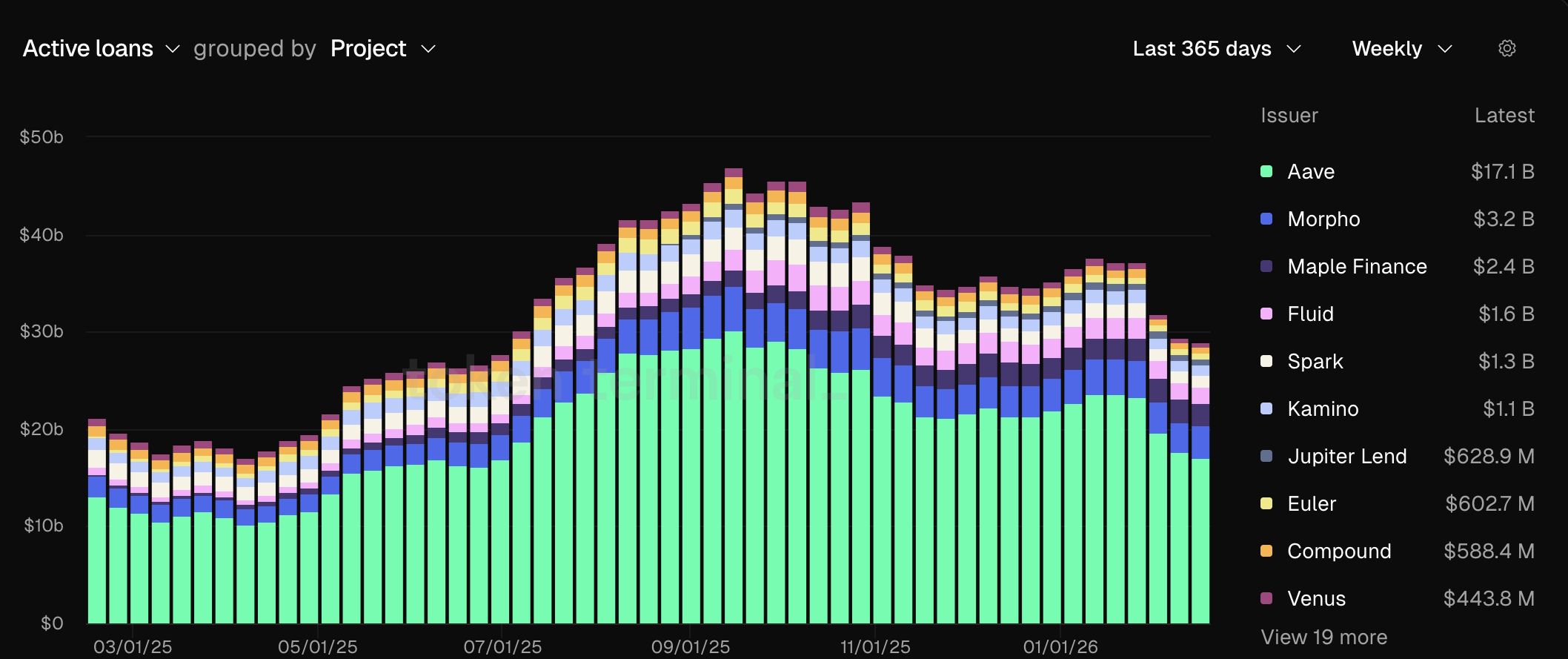
The decline coincides with a sustained downtrend in the crypto market since October, which likely amplified the contraction. Falling asset prices reduce the dollar value of posted collateral, tightening borrowing capacity and contributing to liquidations or voluntary deleveraging.
This compresses outstanding loan balances while mechanically lowering total value locked when measured in USD terms. Increased volatility further pressures leveraged positions, reinforcing the decline in active loans.
“Quick loan refresher during volatile markets: As BTC price drops, LTV rises, Higher LTV = higher liquidation risk, Adding collateral or repaying part of the loan lowers LTV, Tools exist to help, but understanding the mechanics always comes first,” Ledn posted.
At the same time, total value locked across lending protocols fell from more than $89.7 billion in October to roughly $52 billion, according to DefiLlama. This represented a decline of around 42%.
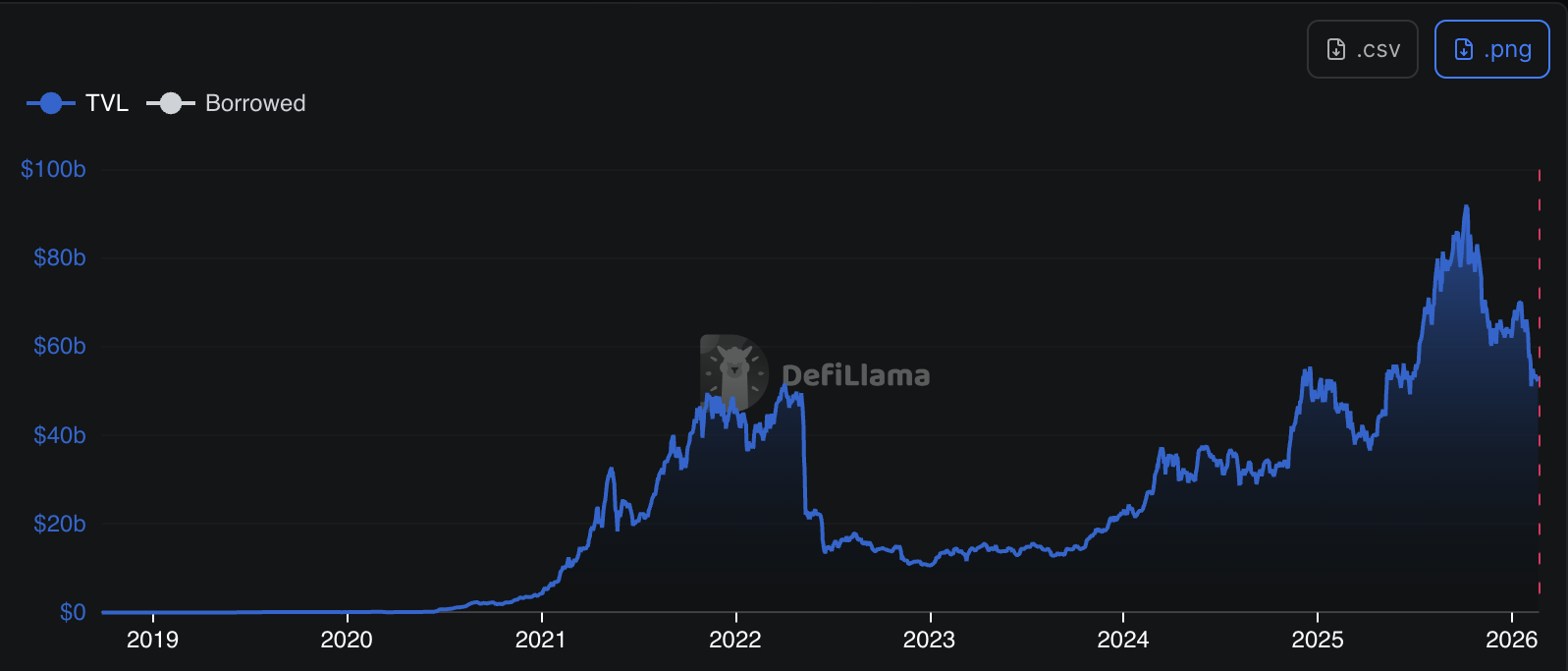
The decline reflects both asset price depreciation and capital outflows, as weaker market conditions reduced risk appetite, suppressed new borrowing demand, and prompted users to deleverage or rotate into lower-risk assets.

Matthew Jeffery: Law, order, and doubt – Why the Lucy Letby case should give Conservatives pause

Ranji Trophy: Jammu and Kashmir dare to dream under pressure – A big leap long in the making | Cricket News

Diamond Age-Inspired Pocket Watch Has ESP32 Inside


-

 Video3 days ago
Bitcoin: We’re Entering The Most Dangerous Phase
-

 Tech4 days ago
Luxman Enters Its Second Century with the D-100 SACD Player and L-100 Integrated Amplifier
-

 Crypto World2 days ago
Can XRP Price Successfully Register a 33% Breakout Past $2?
-

 Sports2 days ago
GB's semi-final hopes hang by thread after loss to Switzerland
-

 Video6 days ago
The Final Warning: XRP Is Entering The Chaos Zone
-
 Tech2 days ago
The Music Industry Enters Its Less-Is-More Era
-

 Business1 day ago
Infosys Limited (INFY) Discusses Tech Transitions and the Unique Aspects of the AI Era Transcript
-

 Entertainment17 hours ago
Kunal Nayyar’s Secret Acts Of Kindness Sparks Online Discussion
-

 Video2 days ago
Financial Statement Analysis | Complete Chapter Revision in 10 Minutes | Class 12 Board exam 2026
-

 Crypto World5 days ago
Bhutan’s Bitcoin sales enter third straight week with $6.7M BTC offload
-

 Tech21 hours ago
Retro Rover: LT6502 Laptop Packs 8-Bit Power On The Go
-
 Sports2 hours ago
Clearing the boundary, crossing into history: J&K end 67-year wait, enter maiden Ranji Trophy final | Cricket News
-

 Entertainment8 hours ago
Dolores Catania Blasts Rob Rausch For Turning On ‘Housewives’ On ‘Traitors’
-
 NewsBeat4 days ago
The strange Cambridgeshire cemetery that forbade church rectors from entering
-

 Business7 days ago
Barbeques Galore Enters Voluntary Administration
-

 Business23 hours ago
Tesla avoids California suspension after ending ‘autopilot’ marketing
-

 Crypto World6 days ago
Kalshi enters $9B sports insurance market with new brokerage deal
-

 Crypto World11 hours ago
WLFI Crypto Surges Toward $0.12 as Whale Buys $2.75M Before Trump-Linked Forum
-
 Crypto World7 days ago
Ethereum Price Struggles Below $2,000 Despite Entering Buy Zone
-
 NewsBeat4 days ago
Man dies after entering floodwater during police pursuit