
Crypto World
H100 targets 3,501 BTC in new Norway stock deal



H100 Group has signed a letter of intent to buy Norwegian Bitcoin companies Moonshot AS and Never Say Die AS through an all-share deal.
Summary
- H100 plans an all-stock deal to acquire Moonshot and Never Say Die in Norway.
- The proposed acquisition could raise H100’s Bitcoin holdings to about 3,501 BTC total.
- If completed, H100 would become Europe’s second-largest listed Bitcoin treasury company by holdings.
If completed, the transaction would expand H100’s Bitcoin treasury and move the Sweden-listed company closer to the top tier of Europe’s public Bitcoin holders.
According to a press release, H100 said the proposed transaction would be carried out as a share-for-share acquisition. Under the plan, H100 would issue new shares to acquire all shares in Moonshot AS and Never Say Die AS, with no cash payment included in the structure.
The company said this setup is designed to keep the sellers exposed to Bitcoin through shares in a listed company. H100 added that the final terms will be set in definitive agreements, while the deal remains subject to due diligence, corporate approvals, and stock exchange requirements.
Bitcoin holdings could rise to about 3,501 BTC
Bitcointreasuries data shows H100 currently holds 1,051 BTC. The company said the two target firms hold about 2,450 BTC combined, which would bring the total to about 3,501 BTC if the acquisition closes.
That total would place H100 just behind Germany’s Bitcoin Group among Europe’s listed Bitcoin treasury companies. Bitcointreasuries ranks H100 44th among public Bitcoin treasury companies worldwide at present, and the added holdings would move it well above its current standing.
H100 chairman Sander Andersen said,
“Scale, credibility and access to capital markets are increasingly important in the Bitcoin space, and this transaction would strengthen H100 in these areas.”
That statement appeared in public reporting on the planned acquisition and outlined the company’s stated reason for the move.
The company has also completed the acquisition of Switzerland-based Future Holdings AG, showing that it is still building its Bitcoin treasury platform through deals. H100 said the new transaction would not change its listing structure or its role as the listed parent company.
AGM timing and share performance remain in focus
H100 expects to sign a definitive agreement by April 22. The company has said closing would come after its annual general meeting, but its current financial calendar lists the AGM on May 21, 2026.
The proposed deal comes while H100 shares remain under pressure and Bitcoin treasury companies continue to face a weaker market environment.


Two leading prediction-market platforms have rolled out tighter guardrails on Monday to curb insider trading and suspected market manipulation in event-based contracts, as lawmakers in Washington step up scrutiny of a sector that blends finance, law and politics.
Kalshi and Polymarket argued that their updates are designed to prevent the exploitation of confidential information and to reduce the risk that markets skew the outcomes of real-world events. The moves come amid a broader policy push in the United States to regulate or restrict prediction markets that resemble gambling or sports betting.
Key takeaways
- Kalshi and Polymarket introduced new guardrails to combat insider trading and manipulation in event contracts.
- Kalshi will preemptively bar political candidates from trading on their campaigns and exclude individuals connected to college and professional sports from relevant markets.
- Polymarket expanded prohibitions to forbid trades based on stolen confidential information or those who can influence market outcomes.
- A bipartisan bill, the Prediction Markets Are Gambling Act, would bar CFTC-registered platforms from listing event contracts that resemble sports bets or casino-style games.
- The policy debate highlights tensions over jurisdiction, licensing and the boundaries between financial markets and entertainment-oriented betting.
Guardrails tighten as Congresseye rules intensify
Kalshi said it would preemptively ban political candidates from trading on their own campaigns, along with individuals known to be involved in college and professional sports—such as athletes, staff, and referees. The exchange described the move as part of a long-running effort to align with evolving regulatory guidance and proposed legislation addressing insider trading and market manipulation in prediction markets.
In a separate but related move, Polymarket unveiled broader prohibitions intended to close loopholes that could enable insiders to benefit from confidential information or influence the outcome of a contract. The company said its updated rules aim to make the market more resistant to manipulation and to protect the integrity of events traded on its platform.
The changes come on the heels of intense public debate about whether some well-timed bets on political or geopolitical events reflect legitimate market activity or exploit privileged information. In recent coverage, observers noted bets placed around high-profile events such as U.S. and Israeli actions in Iran and a U.S.-led operation related to Venezuela’s Nicolás Maduro, with some traders appearing to use multiple accounts to mask activity. The Guardian reported that the Iran-strike bets were made by users who could be perceived as having inside information, underscoring the ongoing concerns about insider knowledge shaping market outcomes.
Kalshi described its policy evolution as a proactive response to the regulatory environment and to proposed congressional action. The company, which is a member of the Coalition for Prediction Markets, argued that these guardrails are part of preparing for potential legal guidance and legislative developments that address insider trading and market manipulation in prediction markets.
Policy spotlight: bipartisan efforts and legal tensions
On Monday, Democratic Senator Adam Schiff and Republican Senator John Curtis introduced a bipartisan bill, the Prediction Markets Are Gambling Act, that would bar Commodity Futures Trading Commission-registered entities from listing event contracts that resemble sports betting or casino-style games. In their view, sports prediction contracts are effectively sports bets—an assertion Schiff has repeated to emphasize the public-law implications of these instruments when they resemble gambling more than information-driven markets.
The proposed legislation would withdraw a key allowance for platforms like Kalshi and Polymarket by limiting what contracts they may offer in the United States. Schiff’s office framed the issue as one of regulatory clarity and consumer protection, while Curtis stressed maintaining state authority over broader gaming and betting activities.
Kalshi’s chief executive, Tarek Mansour, reacted to the bill by framing the move within a broader “casino lobby” effort. He argued that the legislation is not about protecting consumers but about preserving entrenched monopolies, a line he shared publicly on social media. His comments underscore how industry actors view the political dynamic surrounding prediction markets and their place in the U.S. financial-regulatory landscape.
Legal tension has already surrounded prediction-market operators in several states, which have asserted that sports-event contracts constitute gambling that requires a state license. Platforms such as Kalshi, Polymarket andCoinbase have contended that their offerings are not illegal betting and, regardless, fall under the exclusive jurisdiction of the Commodity Futures Trading Commission rather than state authorities.
The policy debate is not theoretical for traders and developers who rely on prediction markets for hedging and information discovery. As reported by Cointelegraph, the U.S. Senate has been weighing bills aimed at curtailing or redefining the reach of these markets, alongside state-level actions that challenge the legality of specific contracts. The ongoing legal and regulatory discourse creates an environment of uncertainty, even as platforms push for clearer rules that would allow compliant operation in the United States.
For context, Cointelegraph’s reporting has highlighted instances where traders leveraged event-driven markets to capitalize on geopolitical developments, reinforcing concerns about information asymmetry and the potential for manipulation. The new guardrails by Kalshi and Polymarket are thus part of a broader effort to reconcile the commercial appeal of prediction markets with legitimate safeguards against abuse.
What to watch next in the evolving landscape
As lawmakers advance their proposals and courts consider disputes over jurisdiction and licensing, the trajectory of prediction markets in the United States remains uncertain. If the proposed act passes, CFTC-approved platforms could face tighter restrictions or even a narrowed set of permissible contracts, potentially dampening growth but improving trust and regulatory compliance.
For users, traders and builders, the key questions are how the guardrails translate into practical trading limits, whether state or federal rules will ultimately prevail, and how enforcement will unfold in a landscape that often intersects with political sentiment and sports governance.
The next chapter will likely hinge on legislative momentum in Congress and any legal clarifications from federal or state authorities. Watch for updates on whether the bipartisan bill gains traction, how the industry responds with further rule adjustments, and whether there are new developments in the ongoing legal actions against these platforms. The balance between innovation and integrity in prediction markets remains delicate, and investors should monitor both regulatory signals and platform-level safeguards as the market evolves.
Sources: Kalshi newsroom announcements on guardrails; Polymarket rule updates; U.S. Senate press releases announcing the proposed act; coverage of insider-trading concerns around event contracts; The Guardian reporting on Iran-strike bets; ongoing state-level legal actions against prediction-market operators.

Balancer Labs, the team behind the decentralized finance protocol Balancer, is shutting down after mounting financial pressure and a $116 million hack in November, with executives proposing continuation of the protocol under a leaner, more cost-effective structure.
“After careful consideration, I have decided to wind down Balancer Labs. This is not a decision I take lightly,” one of Balancer Protocol’s founders, Fernando Martinelli, said on Monday, adding that Balancer Labs has become a “liability rather than an asset to the protocol,” as it has been operating without revenue.
Balancer Labs CEO Marcus Hardt added that it was spending too much to attract liquidity relative to the revenue the protocol is making, a strategy that came at the cost of diluting Balancer (BAL) token holders.

Balancer was one of the more notable DeFi protocols during the 2020–2021 bull market, reaching a peak of $3.3 billion in total value locked (TVL) in November 2021.
However, that figure fell to $800 million by October 2025, with the hack leading to another $500 million TVL drop over the next two weeks. Balancer’s TVL has since fallen to $158 million, showing how challenging it is for DeFi protocols to recover from large-scale hacks.
Martinelli said the November exploit “created real and ongoing legal exposure” and that maintaining a corporate entity that carries the liability of past security incidents wasn’t sustainable.
Balancer Labs executives outline restructuring plan
Moving forward, Hardt and Martinelli are pushing for Balancer’s future to be managed by the Balancer Foundation and the protocol’s decentralized autonomous organization.
Martinelli advocated for Balancer to adopt a more “lean continuation path,” which involves cutting BAL emissions to zero, restructuring fees to enable Balancer’s DAO to capture more revenue, reducing the team as much as possible and targeting lower operating costs.
“Balancer still has real value to build from here. If we can make this transition work, we have a real chance to build a stronger and more sustainable protocol on the other side of it,” Hardt said.
Balancer DAO members have been asked to vote on two proposals reflecting possible changes in Balancer’s operational restructuring and BAL’s tokenomics.
Related: OP_NET launches Bitcoin DeFi push without bridges or wrapped BTC
Despite the tokenomics issues, Martinelli noted that Balancer is “still generating real revenue” at over $1 million across the past three months:
“That’s not nothing — that’s a functioning protocol buried under a broken tokenomics model and an overweight cost structure,” he said.
“The problem isn’t that Balancer doesn’t work. The problem is that the economics around Balancer aren’t working. Those are fixable.”
Magazine: Are DeFi devs liable for the illegal activity of others on their platforms?
Two NYSE-linked exchanges have put new crypto ETF options rules into effect after filings cleared the SEC process.
Summary
- NYSE Arca and NYSE American removed position limits on options tied to 11 crypto ETFs.
- The SEC waived the usual waiting period, allowing the new crypto options rules to take effect immediately.
- The rule change gives institutions more flexibility and allows crypto ETF options to trade as FLEX contracts.
NYSE Arca and NYSE American removed the 25,000-contract position and exercise limit for options tied to 11 spot Bitcoin and Ether exchange-traded funds, giving those products broader trading terms.
NYSE Arca filed its proposed rule change on March 10, 2026, to revise rules for options on certain crypto-linked ETFs. The filing covered products that had been trading under a 25,000-contract cap since their launch phases.
NYSE American filed a similar proposal on the same date. Its filing also removed the fixed 25,000-contract limit and updated the exchange’s rules so those options can follow the broader position-limit structure already used for other eligible products.
SEC waiver made the changes effective at once
Both filings became effective under Rule 19b-4(f)(6). In each case, the SEC said the standard 30-day operative delay could be waived because the changes aligned crypto ETF options rules with those used by other exchanges and did not create new regulatory issues.
The Federal Register notices state that the Commission designated both proposals to be operative upon filing. In the notices, the SEC wrote that waiving the delay was consistent with investor protection and the public interest, making the new rules active without waiting another month.
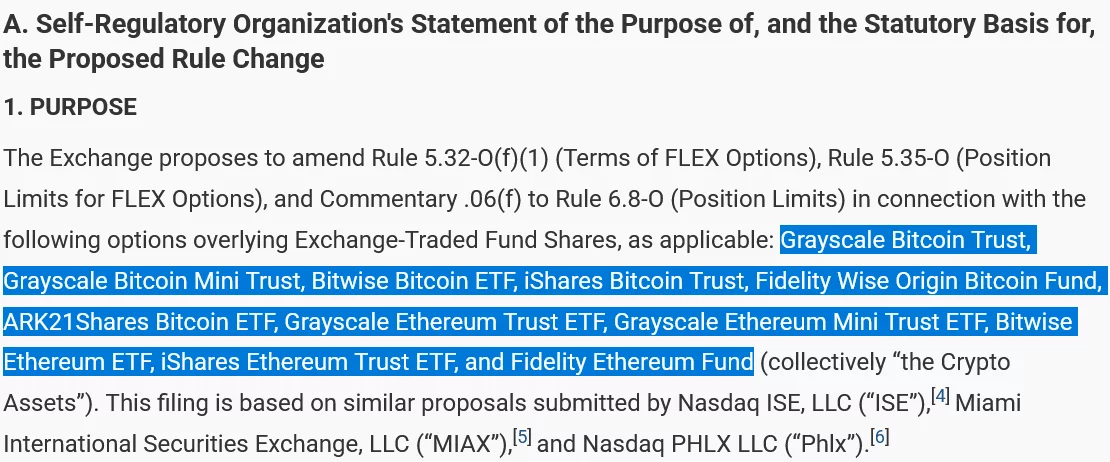
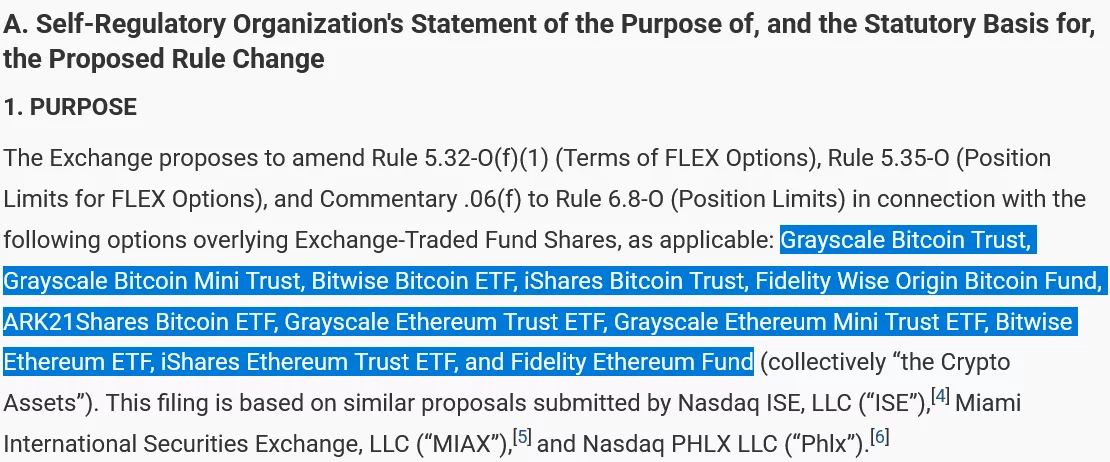
Furthermore, the rule changes affect 11 crypto ETF options. The list includes BlackRock’s iShares Bitcoin Trust, Fidelity Wise Origin Bitcoin Fund, ARK 21Shares Bitcoin ETF, Grayscale Bitcoin Trust, Grayscale Bitcoin Mini Trust, Bitwise Bitcoin ETF, Grayscale Ethereum Trust ETF, Grayscale Ethereum Mini Trust ETF, Bitwise Ethereum ETF, iShares Ethereum Trust ETF, and Fidelity Ethereum Fund.
Earlier filings had already removed some limits for a smaller group of Bitcoin ETF options, including GBTC, the Grayscale Bitcoin Mini Trust, Bitwise Bitcoin ETF, and IBIT. The new March 2026 changes extend similar treatment across the full set of listed crypto ETF options covered by these exchange rules.
FLEX options and larger positions now get more room
The updates also allow these crypto ETF options to trade as FLEX options under the revised rules. FLEX contracts let market participants customize terms such as strike prices, expiration dates, and exercise styles instead of using only standard listed terms.
NYSE American’s filing says the exchange wants these crypto asset options treated like other options for position, exercise, and FLEX trading purposes. A separate Nasdaq ISE proposal still seeks to raise the position limit for IBIT options to 1 million contracts, and that proposal remains under SEC review.


Crypto prices opened lower in Asia on Monday as fresh pressure from oil markets and geopolitical tension weighed on risk assets.
Summary
- Crypto prices dropped in Asia as war fears and oil market stress pressured investor sentiment again.
- Traders are watching PMI, jobless claims, and sentiment data for clues on rates inflation.
- Bitcoin and Ether weakened as rising energy costs and macro risks weighed on markets.
Meanwhile, investors are also watching a packed U.S. data calendar this week, with new reports on business activity, jobless claims, consumer sentiment, and inflation expectations due between March 23 and March 27.
Crypto markets faced renewed selling after conflict in the Middle East kept traders focused on energy supply risks. Reuters reported that U.S. stock futures fell as investors reacted to President Donald Trump’s 48-hour demand for Iran to reopen the Strait of Hormuz, while Iran warned of retaliation if attacks hit its infrastructure.
Oil prices stayed elevated as the new week began. Brent crude at about $113.20 a barrel, while U.S. West Texas Intermediate traded near $101.32. Higher oil prices have lifted concern about inflation and have pushed markets to reassess the path for interest rates.
Investors shift focus to economic data
The week’s economic calendar may shape trading across crypto and traditional markets. A Wall Street Journal report cited Deutsche Bank economists as saying,
“This is significant because it’s one of the first economic indicators we’ll get that cover the period since the conflict began,” referring to the March PMI data.
Thursday’s initial jobless claims report will offer another reading on labor market conditions. At the same time, markets are tracking whether inflation pressure from fuel costs could change expectations for Federal Reserve policy. Investors have sharply reduced hopes for rate cuts this year and are now pricing in a higher chance of a rate increase later in 2026.
Bitcoin and Ether trade lower in Asia
Bitcoin remained under pressure in Monday trading. Live market data showed Bitcoin (BTC) at around $68,400, while Ethereum (ETH) traded at $2,000. Both assets were down from recent highs as traders pulled back from risk during a weak start to the week.
Broader crypto market sentiment also softened as investors moved more carefully across global markets. Rising yields, weaker equities, and higher energy costs have added pressure across risk assets, including digital tokens.
Higher oil prices may feed through to household spending if the rally continues. CBS News quoted Oxford Economics chief global economist Ryan Sweet, who said,
“To kind of put it into context, every penny increase in gasoline prices reduces consumer spending by one and a half billion dollars over the course of a year.”


Bitcoin rose sharply on March 23 after U.S. President Donald Trump said Washington had held constructive talks with Iran and would pause planned military strikes for five days.
Summary
- Bitcoin rebounded from below $68,500 and briefly touched $71,500 after Trump announced a strike delay.
- Trump said US-Iran talks were productive and paused planned military action for five days.
- The rally liquidated nearly $270 million in short positions and pushed daily crypto liquidations higher.
The move lifted market sentiment after several sessions of pressure linked to Middle East tensions. The rebound also triggered a wave of short liquidations across the crypto market.
Bitcoin had fallen below $68,500 earlier in the session as traders reacted to geopolitical uncertainty and broader risk-off sentiment. The asset then reversed course within hours and climbed by about $3,000, reaching $71,500 before giving up part of the gain.
At the time of reporting, Bitcoin traded near $71,000. The move marked its first return to the $71,500 area since last Thursday and showed how quickly sentiment shifted after Trump’s latest comments on the Iran situation.
Trump said the United States and Iran had held “very good and productive conversations” over the previous two days. He also said he had instructed the “Department of War” to delay military action against Iranian power plants and energy infrastructure for five days while talks continue.
The statement pointed to a possible easing in tensions after weeks of conflict. It also came about 36 hours after Trump warned he would “obliterate” Iran if the Strait of Hormuz was not reopened safely, making the change in tone a key factor in the market reaction.
Short traders face heavy losses
Bitcoin’s fast recovery caught bearish traders off guard. Data from CoinGlass showed that nearly $270 million in short positions were liquidated within the past hour as prices moved higher.
Total liquidations across the crypto market reached about $780 million by press time. More than 200,000 traders were liquidated over the same period, showing the scale of the sudden reversal and the pressure on leveraged positions.


Strategy added more bitcoin during the latest market pullback, extending a buying pattern that has continued through recent volatility and rising geopolitical tension.
Summary
- Strategy bought 1,031 BTC at $74,326, raising its total bitcoin holdings to 762,099 BTC.
- The latest purchase was smaller than last week’s 22,337 BTC acquisition worth $1.57 billion.
- Bitcoin fell below $70,000, leaving Strategy under pressure on its latest purchase during market volatility.
Meanwhile, the company disclosed that it bought 1,031 BTC for $76.6 million, bringing its total holdings to 762,099 BTC. The latest purchase came as bitcoin traded above $74,000 early last week before falling below $70,000 after the second Federal Open Market Committee meeting of the year.
Michael Saylor’s latest update showed that Strategy completed the purchase at an average price of $74,326 per bitcoin. Based on that entry level, the transaction likely took place during the first few business days of the previous week.
The new purchase lifted Strategy’s total bitcoin holdings to 762,099 BTC. The company has now spent about $57.69 billion building its bitcoin position, keeping its status as the largest corporate holder of the asset.
The latest acquisition was much smaller than the one Strategy announced a week earlier. In that earlier update, Saylor said the company had spent $1.57 billion to acquire 22,337 BTC.
Even so, the new purchase showed that Strategy has kept its regular buying approach in place. The company continues to announce bitcoin buys on Mondays, even as markets remain sensitive to macro and geopolitical developments.
Bitcoin price swings shape market backdrop
Bitcoin traded above $74,000 by Wednesday morning last week before reversing lower. The decline deepened around and after the year’s second FOMC meeting, adding pressure to the broader crypto market.
By press time, bitcoin had fallen below $70,000 after a brief rebound to $71,500. That move followed Trump’s latest “statement” on the war in Iran, which briefly pushed prices higher before the rally faded.
Strategy’s bitcoin stack remains under pressure as the asset trades below the company’s latest average purchase price. The market correction has left the firm sitting on unrealized losses based on current spot levels.


Disclosure: This article does not represent investment advice. The content and materials featured on this page are for educational purposes only.
Cloud mining evolves in 2026 as users prioritize transparency, flexibility, and real returns over raw computing power.
Summary
- HashBitcoin simplifies mining with daily payouts and no hardware setup required.
- HashBitcoin uses renewable-powered mining farms in North America and Europe for stable, transparent returns.
- Cloud mining grows as a mainstream tool in 2026, with HashBitcoin targeting beginners and passive income seekers.
Once upon a time, mining was a playground for tech geeks and big investors. In 2026, cloud mining has quietly become a popular financial tool for the masses — no expensive equipment, no technical barriers, just a phone or computer, and anyone can earn Bitcoin (BTC), Dogecoin (DOGE), and other digital assets every day.
As mining difficulty rises and global electricity prices fluctuate, user demands have fundamentally changed: computing power is no longer the only pursuit. Transparent earnings, flexible contracts, and real returns are now the core competition points for cloud mining platforms.
This article will help someone understand the latest industry trends and reveal seven cloud mining platforms worth attention, helping them start their journey to passive income with digital assets.
Quick comparison: Which cloud mining platform is right?
| Platform | Supported Coins | Entry Threshold | Daily Payout | Unique Features |
| HashBitcoin | BTC, DOGE | $200 | Yes | High returns, ultra-simple, ideal for beginners |
| BitFuFu | BTC | $500+ | Yes | Enterprise-level mining, for professional investors |
| NiceHash | BTC | Flexible | Yes | Hashpower trading, strategy lovers’ paradise |
| ECOS | BTC | $150+ | Yes | Long-term contracts, conservative and stable |
| StormGain Alt | BTC | Free/Paid | Limited | “Zero-risk” experience, entry-level for casual users |
| Binance Pool | BTC, DOGE | Flexible | Yes | Seamless exchange integration, for ecosystem users |
| Kryptex | BTC | Very Low | Variable | Desktop mining, for hardware enthusiasts |
1. HashBitcoin — Let every day “mine gold” automatically
HashBitcoin has completely simplified the cloud mining process: users just choose a contract, with no hardware installation required, and earnings are automatically credited daily.
The platform is based on real mining farms in North America and Europe, powered by renewable energy for both stability and eco-friendliness. Real-time dashboards make earnings crystal clear, and contract returns are fully transparent.
Popular contracts overview
| Mining Plan | Investment | Contract Term | Daily Rewards | Total Return (Principal + Profit) |
| Newbie Mining Plan | $200 | 1 Day | $7 | $200 + $7 |
| Avalon A15 Pro Mining Rig | $1,200 | 2 Days | $43.2 | $1,200 + $86.4 |
| BitDeer SealMiner A2 | $3,600 | 3 Days | $136.8 | $3,600 + $410.4 |
| Avalon Nano 3S Miner | $8,000 | 2 Days | $344 | $8,000 + $688 |
| Antminer S23 Hyd | $16,800 | 3 Days | $924 | $16,800 + $2,772 |
| Whatsminer M63S (390T) | $33,000 | 2 Days | $2,145 | $33,000 + $4,290 |
| Antminer E9 Pro | $58,000 | 1 Day | $5,104 | $58,000 + $5,104 |
Innovative features:
- Instant mining after purchase, earnings credited immediately
- $15 bonus for new users, lowering the entry barrier
- Clear contract terms and returns
- Eco-friendly mining farms for extra trust
HashBitcoin is perfect for those looking to quickly experience cloud mining, pursue short-term returns, or stabilize their assets in a volatile market.
2. BitFuFu — Enterprise mining for professionals
Backed by large-scale mining farms, BitFuFu delivers strong hashpower and transparent data, ideal for investors familiar with mining economics. While the entry cost is higher, returns are stable, and risks are controlled, making it the top choice for institutions and high-net-worth users.
3. NiceHash — Hashpower trading for strategy enthusiasts
NiceHash isn’t a traditional cloud mining platform but a “hashpower marketplace.” Users can buy and sell hashpower, switch algorithms, and create personalized strategies. It offers high flexibility but isn’t beginner-friendly, best suited for those who love DIY and chasing optimal returns.
4. ECOS — Stable long-term contracts
ECOS focuses on long-term mining contracts, is regulated, and operates in Armenia’s Free Economic Zone. With mobile app support and predictable earnings, it’s suitable for conservative investors. While returns are lower, risks are better managed.
5. StormGain alternatives — Zero-risk experience for easy entry
Some platforms offer free mining experiences, allowing users to earn small amounts of digital assets without investment. Although earnings are limited, it’s a good way for newcomers to try and learn the cloud mining process — a “zero-risk” entry point.
6. Binance Pool — Mining expansion for exchange users
Binance Pool integrates seamlessly with the Binance ecosystem, supporting BTC and DOGE. It’s ideal for active Binance users, with reliable infrastructure, though it requires some management effort and is best for those looking to diversify their asset allocation.
7. Kryptex — desktop mining for hardware enthusiasts
Kryptex runs on users’ local computers, automatically converting earnings to Bitcoin. With a user-friendly interface, it’s great for beginners with good hardware, though it’s not a true cloud solution and returns depend on their own equipment.
2026 trends: Mining is no longer a hardcore game
This year, four major trends have emerged in cloud mining:
1. Short-term contracts are popular: Fast capital turnover, users prefer quick settlements.
2. Daily payouts are standard: Earnings are credited daily, and weekly settlements are fading out.
3. Energy transparency matters: Green mining farms earn more trust, and eco-friendliness is a bonus.
4. Ultra-simple user experience: The easier the registration, the higher the user retention.
HashBitcoin aligns perfectly with these trends and has become a rising star in the industry.
Conclusion: Cloud mining makes passive income easy
In 2026, cloud mining has evolved from a “tech game” to a mainstream financial tool. With ultra-simple operation, stable returns, and real mining farms, HashBitcoin is the leading choice for beginners and passive income seekers. Whether someone is new to digital assets or looking to grow wealth, cloud mining is worth a try — let every day automatically “mine gold” and start the new digital wealth life with ease!
Disclosure: This content is provided by a third party. Neither crypto.news nor the author of this article endorses any product mentioned on this page. Users should conduct their own research before taking any action related to the company.
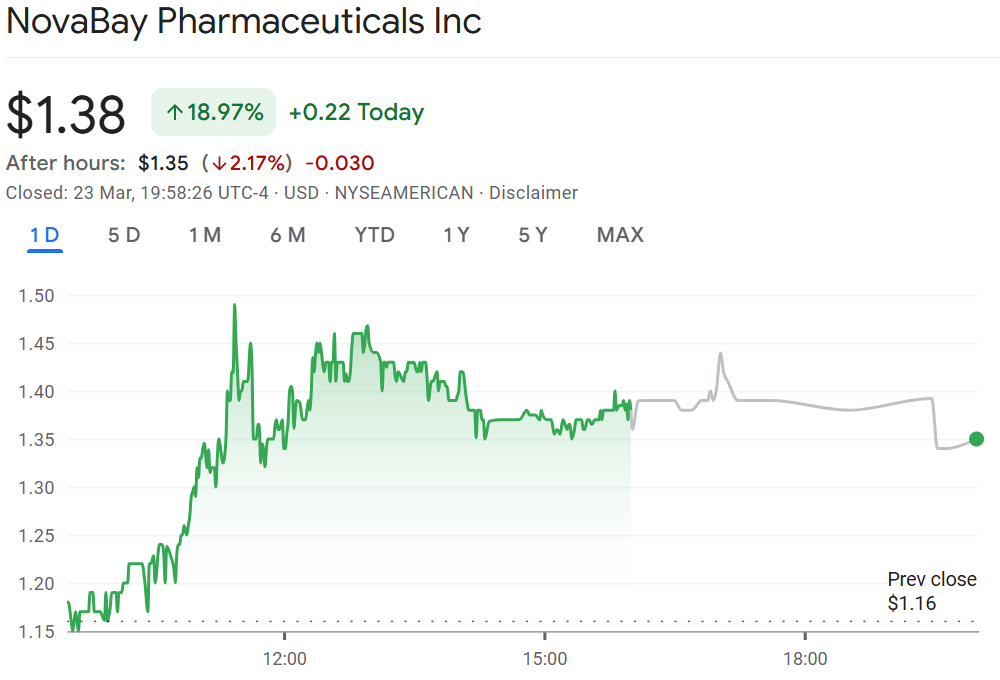
Shares in NovaBay Pharmaceuticals jumped nearly 19% after the company announced it would change its name to Stablecoin Development Corporation as part of its strategic crypto pivot.
NovaBay Pharmaceuticals CEO Michael Kazley said in a statement on Monday that the company’s plan going forward is to access cash flows within the growing stablecoin economy.
“The name change to Stablecoin Development Corporation reflects our conviction that stablecoins represent the most compelling structural opportunity in digital finance,” he said.
It adds to a wave of companies over the last year that have pivoted to a crypto strategy to improve their fortunes. However, with crypto markets down since October, there are warnings of potential consolidation ahead.
The company’s stock ticker will change from NBY to SDEV, effective April 3. It has also disclosed that it holds two billion Sky (SKY) tokens as of March 16, representing more than 8% of the total supply.
Shares of NovaBay Pharmaceuticals (NBY) spiked 19% to trade at $1.38 in the trading session following the announcement.

SKY holdings are already over two billion
NovaBay Pharmaceuticals began life in 2000 as a California-based biopharmaceutical company focused on eye care products.
The company disclosed in a January SEC filing that it was changing tactics to operate under an “on-chain holding company framework focused on long-duration participation in protocol-level digital asset ecosystems.”
As part of the pivot, NovaBay Pharmaceuticals entered into a $134 million private placement backed by Tether Investments, an affiliate of the stablecoin issuer, to buy and hold assets within the SKY protocol ecosystem.
NovaBay Pharmaceuticals has since acquired more than two billion SKY tokens and has generated cumulative staking rewards of 26.6 million SKY tokens. SKY is trading at $0.073 as of Tuesday, according to CoinGecko.
Under its new framework, the company said it can “hold protocol-aligned digital assets for extended periods in order to participate in protocol-level economic activity.”
Related: Stablecoin inflows rebound to $1.7B as Washington battles over yield rules
Efforts are also underway to continue buying additional SKY tokens on the open market, according to the announcement.
Company is interested in yield-bearing stablecoins
At this stage, the SKY token is the only digital asset approved under the company’s operating and risk management framework.
However, NovaBay Pharmaceuticals flagged “stablecoins as an increasingly important component of global digital financial infrastructure” and said it has a particular interest in yield-bearing stablecoins.
“These instruments represent a compelling evolution in digital finance, functioning as productive financial assets that unlock new primitives for savings, treasury management, and capital formation.”
Magazine: Banks want to run Vietnam’s crypto exchanges, Boyaa’s $70M BTC plan: Asia Express

Two major prediction market platforms, Kalshi and Polymarket, on Monday announced new trading guardrails to address insider trading amid mounting concerns of market manipulation on recent event contracts.
It comes the same day that US lawmakers introduced a bipartisan bill to ban event contracts that resemble a “sports bet” or “casino-style game.”
Kalshi on Monday said it would preemptively ban political candidates from trading on their own campaigns and those known to be involved in college and professional sports, such as athletes, personnel, and referees.
Kalshi’s ban followed just hours after rival Polymarket revealed comparatively broader prohibitions to ban users who trade using stolen confidential information, illegal tips or those who can influence the outcome of a market.
The platforms have faced mounting criticism over insider trading after Polymarket users profited from well-timed bets before US and Israeli strikes on Iran and a US military operation to capture Venezuelan President Nicolás Maduro.
Ben Yorke, a former Cointelegraph research analyst, told The Guardian on Monday that the Iran strike bets were “someone with some degree of inside info,” as the bets were made at market price, and multiple accounts were used in an apparent attempt to obfuscate their identity.
Kalshi said its ban has “been in the works for months” and was made to proactively address regulatory guidance and legislation introduced in Congress involving insider trading and market manipulation on prediction markets.

Bipartisan bill would ban sports event contracts
Kalshi and Polymarket’s bans come after Democratic Senator Adam Schiff and Republican Senator John Curtis introduced a bill on Monday to ban certain event contracts “that are indistinguishable from gambling.”
The so-called Prediction Markets Are Gambling Act would ban Commodity Futures Trading Commission-registered entities, which would include Kalshi and Polymarket US, from listing event contracts that resemble “a sports bet or a casino-style game.”
“Sports prediction contracts are sports bets — just with a different name,” Schiff said. “These contracts have been offered in all fifty states in clear violation of state and federal law.”
Curtis said that the legislation “clarifies regulatory jurisdiction, ensuring that states can maintain their authority over sports betting and casino gaming.”
Related: US Senate bill targets prediction markets on war and assassinations
Tarek Mansour, the CEO of Kalshi, which is a member of the Coalition for Prediction Markets lobby group, posted to X that the bill was the “casino lobby hard at work.”
“This bill isn’t about protecting consumers; it’s about protecting monopolies,” he added.
Prediction market platforms, including Kalshi, Polymarket and Coinbase, are embroiled in legal action across multiple states, which have asserted that sports event contracts are gambling that requires a state license to offer.
The platforms have argued that their contracts are not illegal betting and are, regardless, subject to the exclusive jurisdiction of the CFTC, not state authorities.
Magazine: When privacy and AML laws conflict — Crypto projects’ impossible choice
Bitcoin (BTC) price is struggling to maintain footing above $68,000 today, down 1% as the prediction of selling pressure mounts following a rigid rejection at the $76,000 ceiling a week ago. The market leader is currently navigating a perilous consolidation phase analysts call a “No-Trade Zone,” where conflicting signals between derivatives data and spot buying are creating high volatility.
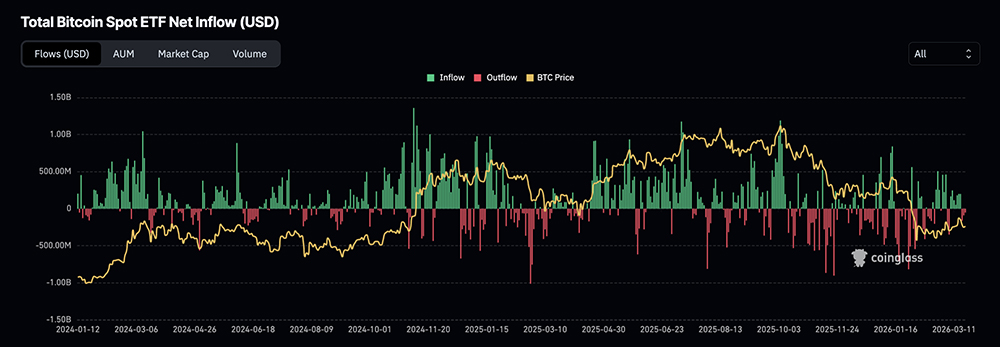
The rejection at higher levels coincides with a distinct shift in institutional sentiment, evidenced by ETF flows showing signs of reversal amid broader geopolitical uncertainty.
On-chain data from Santiment reveals that large wallet holders, specifically those with significant BTC balances, trimmed positions on the 22nd, dropping collective holdings from 1.15 million to 1.14 million BTC. This distribution suggests that without a decisive catalyst, the path of least resistance remains sideways to down.

Can BTC Hold the $65,000 Support Level Amid Bear Flag Fears?
Bitcoin price technical structure on the 1-day chart presents a precarious setup for bullish prediction. Trading just above $68,000, BTC is oscillating within a narrowing range defined by fading buyer strength.
The immediate concern is the massive volume node between the $70,700 and $63,500 area, where approximately 1.72 million BTC have been transacted. This range acts as a critical battleground; a loss of the lower bound could trigger a cascading liquidation event.
Technically, the formation of a bear flag following the recent 39% flagpole decline raises the risk of a deeper capitulation. If sellers force a daily close below the $63,700 trigger level, Fibonacci extension targets suggest downside exposure toward $57,000 and potentially $52,700.

Conversely, momentum indicators like the RSI are flattening, hinting at a potential hidden divergence that typically precedes a reversal, but confirmation is absent. (Where are the bulls waiting? Likely at the 200-day SMA near $93k or lower trendline support.
For the bullish case to regain validity, price action must decisively reclaim the $71,000 mid-range resistance. Until then, the divergence between stabilizing smaller wallets (1k-10k BTC) and profit-taking mega-whales paints a picture of a market in conflict, often resulting in extended consolidation before the next major impulse.
Discover: The Best New Crypto
Bitcoin Price Prediction Is Down, But Investors Rotate to Infrastructure as Hyper Targets SVM Scalability
While spot Bitcoin struggles with overhead resistance, smart money creates a noticeable trend of capital rotation into high-beta infrastructure plays. Investors often hedge against mainnet chop by allocating to Layer 2 protocols that promise to solve Bitcoin’s velocity constraints. Leading this surge is Bitcoin Hyper ($HYPER), the first-ever Bitcoin Layer 2 to integrate the Solana Virtual Machine (SVM).
The project has defied the broader market pullback, amassing an impressive $32 Million in its ongoing presale. Bitcoin Hyper aims to deliver sub-second finality and high-speed smart contracts directly to the Bitcoin ecosystem, effectively bridging the gap between Bitcoin’s security and Solana’s speed. Current data prices $HYPER at $0.0136 with 36% APY on staking rewards.
This massive fundraising milestone indicates that investors are rotating toward infrastructure capable of unlocking trillions in dormant BTC capital. By utilizing a Decentralized Canonical Bridge, Bitcoin Hyper allows seamless asset transfers, addressing the critical lack of programmability on the main chain. While emerging Layer 2s carry inherent execution risks, the sheer volume of capital raised suggests the market views SVM integration as a necessary evolution for Bitcoin.
Those looking to position themselves before next-generation L2s go live can research Bitcoin Hyper here.
The post Bitcoin Price Prediction: Will BTC Hold? Or A Drop Is Inevitable? appeared first on Cryptonews.

Nationwide update over when key change will show on customer accounts

6 Years Since Covid Crash Low

Kylie Jenner And Timothee Chalamet Talking About ‘Getting Engaged’


-
 Crypto World3 days ago
NIO (NIO) Stock Plunges 6.5% as Shelf Registration Sparks Dilution Worries
-

 Fashion3 days ago
Weekend Open Thread: Adidas – Corporette.com
-

 Politics3 days ago
Jenni Murray, Long-Serving Woman’s Hour Presenter, Dies Aged 75
-
 Tech6 days ago
Are Split Spacebars the Next Big Gaming Keyboard Trend?
-

 Crypto World2 days ago
Best Crypto to Buy Now: Strategy Just Spent $1.57 Billion on Bitcoin During Fear While Early Investors Quietly Enter Pepeto for 150x Potential
-

 News Videos5 days ago
RBA board divided on rate cut, unusually buoyant share market | Finance Report | ABC NEWS
-

 Crypto World2 days ago
Bitcoin Price News: Bhutan Sells $72 Million in BTC Under Fiscal Pressure, but the Smart Money Entering Pepeto Sees What the Market Does Not
-

 Politics6 days ago
The House | The new register to protect children from their abusers shows Parliament at its best
-

 Tech4 days ago
inKONBINI Lets You Spend Summer Days Behind the Register
-
 Politics7 days ago
Real-time pollution monitoring calls after boy nearly dies
-

 Crypto World5 days ago
Canada’s FINTRAC revokes registrations of 23 crypto MSBs in AML crackdown
-

 Sports17 hours ago
Remo Stars and Kano Pillars Strengthen Survival Hopes in NPFL
-
 NewsBeat5 days ago
Residents in North Lanarkshire reminded to register to vote in Scottish Parliament Election
-

 News Videos6 days ago
PARLIAMENT OF MALAWI – PAC MEETING WITH REGISTRAR OF FINANCIAL ON AMARYLLIS HOTEL – INQUIRY LIVE
-

 Politics4 days ago
Gender equality discussions at UN face pushbacks and US resistance
-

 Business2 days ago
No Winner in March 21 Drawing as Prize Rolls to $133 Million for Next
-

 Business5 days ago
Who Was Alex Pretti? 5 Key Facts About the ICU Nurse Killed by Federal Agents in Minneapolis
-

 Sports16 hours ago
Gary Kirsten Accuses Pakistan Cricket Board Of ‘Interference’, Mohsin Naqvi Responds
-

 Tech1 day ago
Give Your Phone a Huge (and Free) Upgrade by Switching to Another Keyboard
-

 Sports3 days ago
2026 Kentucky Derby horses, odds, futures, preview, date: Expert who nailed 12 Derby-Oaks Doubles enters picks
You must be logged in to post a comment Login