

Crypto World
Here’s When Arthur Hayes Will Buy Bitcoin Again



Arthur Hayes says he’s waiting for central banks to print again before buying Bitcoin, even as he expects BTC to top $100K.
BitMEX co-founder Arthur Hayes has said that he would not buy Bitcoin (BTC) today if he only had $1 to invest.
However, he still expects the cryptocurrency to eventually climb back above $100,000 once central banks return to printing money.
Waiting for the Fed to Print
In a March 10 interview with Natalie Brunell on CoinStories, Hayes argued that the ongoing conflict pitting the U.S. and Israel against Iran has created a real risk of a broad market sell-off that could pull BTC below $60,000.
“There’s a situation where the longer that this carries on, there could be a massive sell-off in equities, and Bitcoin might fall a bit lower, might break $60,000, and that could be sort of a big cascading of liquidations down,” Hayes said during the interview.
According to him, every major Middle East conflict in his lifetime eventually prompted the Fed to print, leading him to conclude that the signal to watch is not the war itself but what central banks actually do in response.
“If I had $1 to invest right now, would I be putting it into Bitcoin? No,” he said. “I would wait. I think that the longer that this conflict goes on, the higher the likelihood that the Fed has to print money to support the American war machine, and that’s when I’m going to buy Bitcoin.”
However, he cautioned against trying to time the moment, noting that most people are following the same mainstream coverage and could likely misread the situation.
Asked why he thought BTC had underperformed over the past 6 to 9 months, the former BitMEX CEO pointed to what he described as a liquidity deficit rather than weak demand for the king cryptocurrency itself.
“Bitcoin is a liquidity alarm,” he stated, arguing that AI-driven job displacement is quietly building deflationary pressure in the U.S. economy. In his view, there isn’t enough dollar liquidity to offset the other demands on capital, especially spending by large tech companies building out data center infrastructure.
You may also like:
No Grand Schemes to Suppress Bitcoin
Hayes also pushed back on the idea that institutions or large market makers like Jane Street have been suppressing the price of BTC.
“I don’t think there’s anything nefarious or like some evil conspiracy of Jane Street and other market makers to try to manipulate prices lower,” he said.
The crypto trader attributed most such claims to investors looking for someone to blame after bad entries and advised anyone without a professional trading setup to completely avoid leverage and short-term positions.
Personally, he described himself as “structurally very, very long Bitcoin and other coins,” adding that there’s currently a much stronger need for stateless money than when Bitcoin launched in 2009.
Hayes’s comments have come with Bitcoin trading just under the $70,000 mark following months of sideways price action. However, unlike the BitMEX co-founder’s suggestion that the asset could dip to $60,000, analyst Markus Thielen believes that the way BTC brushed off rising oil prices and geopolitical noise in the past week was a bullish sign, which made a move toward $80,000 more likely.
Binance Free $600 (CryptoPotato Exclusive): Use this link to register a new account and receive $600 exclusive welcome offer on Binance (full details).
LIMITED OFFER for CryptoPotato readers at Bybit: Use this link to register and open a $500 FREE position on any coin!


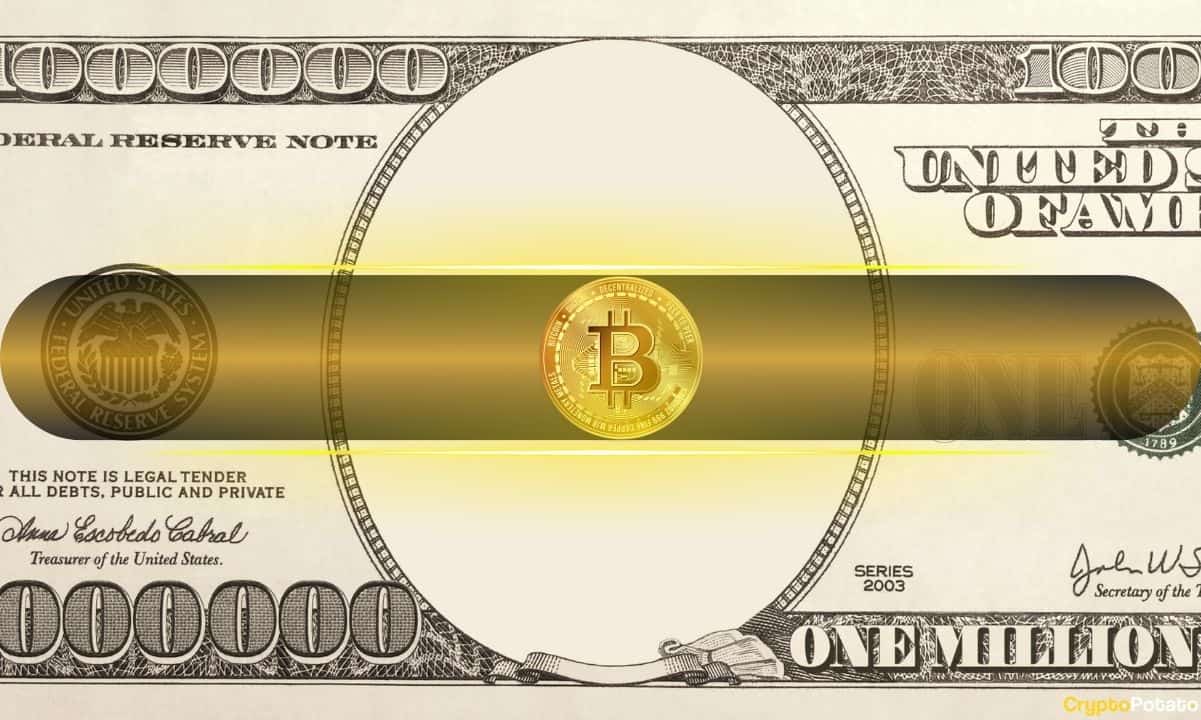
Matt Hougan believes Bitcoin only needs 17% of a $121 trillion store-of-value market to reach a $1 million valuation.
Bitcoin could reach $1 million if it captures roughly 17% of a projected $121 trillion global store-of-value market, according to Matt Hougan, chief investment officer at Bitwise Asset Management.
In a recent memo, he explained how long-term market expansion could support significantly higher prices for the digital asset.
Math Behind The Target
Hougan said the idea initially appears unrealistic because a $1 million valuation would require Bitcoin to increase roughly 14 times from its current price, a target he himself once dismissed in 2018, when BTC was trading near $4,000.
However, after studying the asset’s role in financial markets, he said the common mistake in evaluating Bitcoin’s long-term potential is treating the store-of-value market as fixed rather than expanding. Hougan described Bitcoin as an emerging digital store-of-value asset that competes with gold by allowing investors to hold wealth outside traditional fiat currencies and banking systems, although he acknowledged that the cryptocurrency remains more volatile and less established than the metal.
According to the Bitwise exec, estimating BTC’s potential value involves calculating the total size of the global store-of-value market, estimating the portion Bitcoin could capture, and dividing that value by the asset’s maximum supply of 21 million units. Based on current figures, Hougan said the store-of-value market totals just under $38 trillion, including about $36 trillion in gold and roughly $1.4 trillion in Bitcoin. This implies that BTC currently represents slightly less than 4% of that market.
Under those conditions, he said a $1 million BTC price would appear unrealistic because the cryptocurrency would need to capture more than half of the existing store-of-value market. He described this scenario as a “high bar.” However, the CIO noted that the market itself has grown significantly over time and may continue expanding. He pointed to the growth of the metal’s market capitalization over the past two decades, and added that when the first US gold exchange-traded fund launched in 2004, the global market was worth about $2.5 trillion.
Since then, the value of gold has increased to nearly $40 trillion, representing a compound annual growth rate of roughly 13%, driven by concerns about government debt levels, geopolitical uncertainty, loose monetary policy, and other macroeconomic factors. Hougan said that if the broader store-of-value market continues growing at a similar pace, it could reach approximately $121 trillion within the next decade.
You may also like:
Under that scenario, Bitcoin would only need to capture about 17% of the market to reach a valuation of $1 million per BTC. Hougan acknowledged that this would still represent significant growth, as BTC’s current share remains around 4%, but said recent developments suggest that expanding adoption could make such a shift possible.
Key Risks
Despite the optimistic outlook, Hougan said there are risks that could prevent the scenario from unfolding. He noted that the store-of-value market may not continue growing at the same pace seen over the past two decades, which included events such as the global financial crisis, the widespread adoption of quantitative easing, and a prolonged period of low interest rates.
A slowdown in those trends could also lead to declining gold prices. Another possibility is that Bitcoin fails to capture additional market share.
At the same time, Hougan said it is also possible that current projections underestimate the asset’s potential if concerns about rising government debt intensify and investors increasingly turn to alternative stores of value. Under his base-case scenario, he said the store-of-value market would continue expanding while Bitcoin gradually increases its share. He added that such a combination could result in prices far above current levels.
Binance Free $600 (CryptoPotato Exclusive): Use this link to register a new account and receive $600 exclusive welcome offer on Binance (full details).
LIMITED OFFER for CryptoPotato readers at Bybit: Use this link to register and open a $500 FREE position on any coin!


Tom Lee says Bitcoin’s rally during an oil surge tied to Middle East tensions shows the asset passed a key stress test.
Fundstrat’s Tom Lee has said that Bitcoin passed a major test after it rallied over the weekend while oil prices surged due to the ongoing conflict in the Middle East.
According to him, the price action was a sign that the massive deleveraging from last October is finally behind the market, allowing Bitcoin to re-emerge as a credible store of value.
The Speculation Has Been Cleared Out
Lee was speaking to CNBC’s Scott Wapner on the sidelines of the Future Proof conference in Miami, where he pointed out that the crypto market had already been through its bear market.
“We had a bear market already in software, the Mag-7 and in crypto,” he said. “I think that’s already taken out a lot of speculation.”
He also said he expects markets to close March in positive territory and potentially reach 5,300 on the S&P 500 later in the year. However, he warned that there might be a 20% decline at some point, which would likely be when markets stop responding to good news.
On Bitcoin specifically, Lee was direct. When pressed by Wapner on whether the OG cryptocurrency had failed as a safe haven, given that gold outperformed during the most recent stretch of market stress, Lee acknowledged the weakness but framed it as a product of extreme conditions.
“Bitcoin did basically break on October 10 because that was the biggest deleveraging event in the history of crypto,” he said. “When gold went up, Bitcoin went down.”
But according to him, that’s all in the past. “We have gone through a winter where a lot of the speculation and the leverage is gone,” he said, pointing to the weekend’s price action as a turning point, with BTC holding up in the face of oil prices climbing sharply when Iran closed the Strait of Hormuz.
“This weekend kind of showed Bitcoin is coming back in vogue as a store of value,” Lee said, noting that BTC held above $70,000 even as oil moved aggressively higher.
You may also like:
Where Bitcoin Stands Now
As of the time of this writing, Bitcoin was trading at around $70,000, only dropping 0.2% in the last 24 hours after briefly touching $71,600 per CoinGecko data. Over the past week, it is up about 3% and up nearly 7% across two weeks, although it remains down around 12% year-on-year and sits more than 44% below its October 2025 all-time high.
The picture from on-chain data is mixed, with Binance Research analysis showing approximately 29,000 BTC have been withdrawn from exchanges while the price traded in the $65,000 to $75,000 range, a pattern that contrasts with an earlier sell-off from $92,000 to $62,000 when exchange balances were rising.
Binance Free $600 (CryptoPotato Exclusive): Use this link to register a new account and receive $600 exclusive welcome offer on Binance (full details).
LIMITED OFFER for CryptoPotato readers at Bybit: Use this link to register and open a $500 FREE position on any coin!
Bitcoin’s resilience during the latest bout of global macro stress is starting to turn heads on trading desks.
The largest crypto climbed to just shy of $71,000, up roughly 7% from Sunday evening lows, even as geopolitical tensions escalated over the Iran conflict and markets grappled with risks ranging from oil supply disruptions to stress in private credit markets.
That relative strength is beginning to stand out. The Nasdaq 100 and S&P 500 have been roughly flat over the same time, while gold — typically a go-to safe haven during turmoil — has booked only modest gains. Looking at performance so far in March, BTC is the only one of the three posting gains.
Bitcoin is also showing early signs of breaking away from its tight correlation with embattled software stocks. Over the past five days, BlackRock’s spot bitcoin ETF (IBIT) is up 3.75%, while the iShares Expanded Tech-Software ETF (IGV) is down 2.45%.
The price action is turning analysts cautiously optimistic that the crypto market may finally be stabilizing after months of declines.
Seller exhaustion
Aurelie Barthere, principal research analyst at Nansen, said one encouraging signal is how little BTC has reacted to fresh geopolitical headlines.
Earlier in the week, a brief wave of optimism lifted equities and crypto alongside softer oil prices, suggesting markets were tentatively pricing in a potential de-escalation in the Iran conflict. But as the session progressed, that optimism faded, and risk assets gave back some of their gains.
“Bitcoin’s downside sensitivity has been relatively limited,” she said, noting that some traditional benchmarks such as the Euro Stoxx index have fallen more sharply during the same period.
That resilience suggests the marginal seller in bitcoin may be less aggressive than in equities, Barthere added.
Shifting correlation with gold
Another shift catching traders’ attention is bitcoin’s changing relationship with gold.
According to Bryan Tan, trader at crypto trading firm Wintermute, the BTC–gold correlation has flipped positive, moving to +0.16 from -0.49 a week ago.
During the initial phase of the Middle East conflict, bitcoin fell while gold rallied in a classic risk-off move, Tan noted. More recently, both assets have risen together while the U.S. dollar weakened, suggesting investors may be starting to treat them as beneficiaries of dollar softness rather than opposing risk trades.
“If this correlation continues trending positively, it shifts the narrative around BTC in a conflict environment from ‘sell the risk asset’ to something more nuanced,” Tan said.
ETF flows return
Improving bitcoin ETF flows may also be supporting the recent strength.

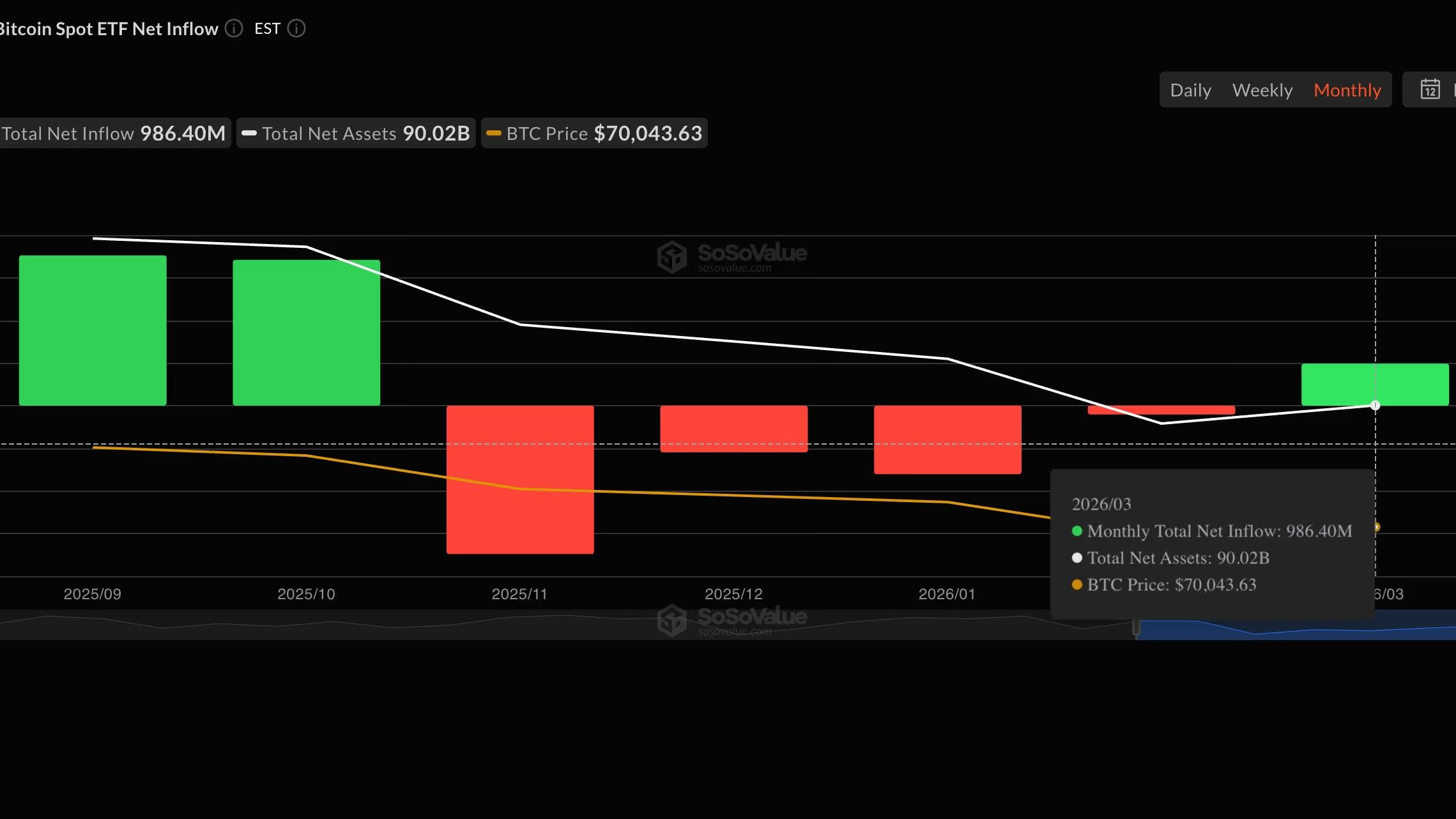
Bitcoin ETF flows had been trending negative for months following the peak in October. But data from the past two weeks shows a notable improvement, noted Joe Edwards, head of research at Enigma, particularly with consistent inflows into BlackRock’s IBIT fund, the largest of the bitcoin ETFs.
A sustained recovery in ETF demand could be critical for bitcoin, he added. A sustained recovery in ETF demand could be critical, he added. Many analysts believe bitcoin’s next phase of growth depends on access to deeper institutional capital pools, such as ETF investors in brokerage accounts. With that in mind, the recent wave of outflows was concerning, Edwards said.
The “good news,” he said, is that there are signs of that period ending.
IBIT has attracted nearly $1 billion in fresh inflows so far in March, after losing more than $3 billion between November and February, data by SoSoValue shows.
If the trend holds through the coming weeks, Edwards argued, it could support a broader bitcoin recovery into the second quarter.


Binance’s U.S. affiliate has hired veteran compliance executive Stephen Gregory as CEO to steady the platform under tougher U.S. scrutiny and reboot a regulated growth story.
Summary
- Gregory replaces Norman Reed as Binance.US CEO, with Reed staying on as advisor to preserve continuity while handing control to a compliance‑driven operator.
- The new chief has held senior roles at Currency.com, Gemini, and CEX.io, bringing hands‑on experience with licensing regimes, supervision and crypto compliance frameworks.
- Under Gregory, Binance.US plans to expand its Earn and staking lineup and add cleaner access to DeFi and tokenized assets, pitching itself as a ring‑fenced, regulation‑first U.S. venue
Binance’s U.S. affiliate, Binance.US, has appointed seasoned compliance executive Stephen Gregory as its new CEO, effective March 9, as it tries to stabilize operations and pivot back to growth under heavier U.S. regulatory scrutiny. Gregory replaces Norman Reed, who will remain with the company as an advisor, preserving some continuity while handing day‑to‑day control to a leader with deep experience at regulated crypto platforms.
Gregory’s résumé is the point of the hire. He has held senior roles at Currency, Gemini, and CEX.io, giving him direct exposure to building compliance programs, dealing with U.S. regulators, and running exchange businesses under licensing regimes. For Binance.US—long dogged by enforcement actions and governance questions at the global group level—installing a CEO whose brand is “compliance first” is an attempt to convince counterparties, banks, and policymakers that the platform can operate as a clean, ring‑fenced U.S. venue.
Under Gregory’s leadership, Binance.US plans to expand its Earn suite, staking services, and access points to DeFi and tokenized assets, targeting both crypto‑native users and more traditional investors. That means pushing deeper into yield products, integrating more on‑chain strategies behind the scenes, and packaging them in a form that can pass regulatory muster and internal risk committees. If executed, the strategy would reposition Binance.US not just as a cheap spot venue, but as a broader digital asset gateway competing with Coinbase, Kraken, and emerging broker‑dealers on product breadth as well as fees.
The stakes are high. Any misstep on compliance or disclosures will land harder under a CEO explicitly hired for his regulatory credentials, while success could give Binance.US a path to rebuild market share without inheriting all of the baggage associated with its offshore sibling. For U.S. traders and institutions, the message is clear: Binance.US wants to be seen less as a shadow of the global brand and more as a domestically focused, compliance‑heavy platform that can still deliver competitive liquidity, staking, and structured access to DeFi.

Crypto platform Bullish (BLSH), which operates an institutional-only crypto exchange business, climbed into the top three centralized crypto exchanges by spot trading volume for the first time in February, overtaking Coinbase (COIN) as trading activity across the industry slowed, according to CoinDesk Data’s February Exchange Review.
Spot trading volumes on Bullish, which is the parent company of CoinDesk, rose 62.6% month over month to $76 billion, the exchange’s highest monthly total since October 2025. The surge lifted Bullish’s market share to 5.06%, up 2.04 percentage points, making it the third-largest centralized exchange by spot trading volume.
The increase pushed Bullish, which went public on the New York Stock Exchange last year, ahead of Coinbase (COIN), which held a 4.59% share of the spot market during the month.

The milestone comes even as overall activity on centralized exchanges declined. Combined spot and derivatives trading volumes fell 2.41% in February to $5.61 trillion, the lowest level recorded since October 2024, the report said.
The slowdown coincided with subdued volatility in major cryptocurrencies. Despite heavy volatility in the first and last weeks of February, bitcoin spent much of the month trading in a narrow range between $60,000 and $70,000, limiting speculative activity that often drives higher trading volumes.
Spot trading accounted for $1.50 trillion of that total, down 3.01% from January. Derivatives trading fell 2.41% to $4.11 trillion but remained the dominant force, accounting for 73.2% of all trading on centralized exchanges, the report said.
While Binance remained the dominant exchange by a wide margin, recording $331 billion in spot trading volume during February, which represents about 22% market share, its dominance declined to its lowest monthly level since October 2020, suggesting trading activity is becoming more distributed across competing platforms.
Bullish’s rise in the rankings highlights shifting dynamics among centralized exchanges amid intensifying competition. Exchanges are increasingly competing on liquidity, trading incentives, and new product offerings to attract traders during periods of slower market activity. Some have partnered with major U.S. stock exchanges to offer tokenized securities or have launched prediction market trading.

ETH and SOL gained 1% while XRP is flat on the day.
Crypto markets extended their gains on Wednesday after the Bureau of Labor Statistics reported that the consumer price index increased 0.3% for the month, putting the annualized U.S. inflation rate at 2.4%, in line with expectations.
Bitcoin (BTC) is trading at around $70,500, up 0.5% over the past 24 hours. Meanwhile, ETH climbed 1.4% to $2,070, SOL gained 1.2% to $87, and XRP is flat on the day.

The overall crypto market capitalization climbed 0.5% to $2.48 trillion, according to Coingecko.
Crude oil (WTI) is trading at around $85 per barrel after International Energy Agency (IEA) member nations pledged to release 400 million barrels from their emergency stockpiles. The S&P 500 and the Nasdaq were unchanged on the day.
Most of the Top 100 digital assets posted gains over the last 24 hours.
Today’s top gainers are Internet Computer (ICP), which rallied 9%, followed by Hyperliquid (HYPE), which climbed 6%.
Midnight (NIGHT) and Zcash (ZEC) are the biggest losers
Around 94,000 leveraged traders were liquidated for $183 million in the past 24 hours, according to CoinGlass. Bitcoin accounted for $62 million, while ETH positions made up $44 million.
Bitcoin exchange-traded funds (ETFs) recorded inflows of $251 million on Tuesday.

TLDR
- Nebius shares rose more than 13% to $110 after Nvidia announced a $2 billion investment.
- NVDA stock traded near $185 and recorded a modest gain during Wednesday’s session.
- Nvidia confirmed it will support Nebius in building large-scale cloud systems for artificial intelligence workloads.
- Jensen Huang said Nebius is developing a cloud platform optimized for autonomous agents.
- The partnership focuses on deploying advanced computing infrastructure and managing large compute fleets.
Nebius Group shares climbed to $110 on Wednesday after Nvidia ( NVDA) disclosed a $2 billion investment in the company. The stock gained more than 13% before the Wall Street opening bell. Meanwhile, Nvidia shares traded near $185 and posted a modest increase during the session.
NVDA Stock Jumps as Nvidia Expands AI Cloud Partnership
Nvidia confirmed a $2 billion investment in Nebius to support large-scale cloud systems for artificial intelligence workloads. The announcement lifted NVDA stock and pushed Nebius shares sharply higher in early trading. Nvidia stated that the partnership will focus on deploying advanced computing infrastructure and managing large compute fleets.
Jensen Huang, Chief Executive Officer of Nvidia, said, “Nvidia has begun building a cloud system optimized for autonomous agents.” He added that the platform integrates hardware, software, and networking around Nvidia-accelerated computing. As a result, both companies will coordinate on designing AI factories for next-generation applications.
Nebius plans to build infrastructure designed specifically for artificial intelligence tasks and distributed systems. The company will manage large compute clusters and support advanced inference workloads. Nvidia will supply core technologies and align its computing roadmap with Nebius cloud expansion plans.
The companies outlined joint efforts to scale data center operations and optimize performance for complex model training. Nvidia will provide graphics processing units and networking solutions for these deployments. Nebius will oversee system integration and cloud platform management across its facilities.
Nvidia Strengthens AI Ecosystem Investments
Nvidia has increased investments across the artificial intelligence ecosystem in recent months. The company disclosed $2 billion investments in Lumentum and Coherent to expand infrastructure capabilities. Nvidia also backed Thinking Machines Lab, founded by former OpenAI executive Mira Murati.
The chipmaker participated in OpenAI’s $100 billion funding round earlier this year. Nvidia also outlined plans to invest up to $10 billion in Anthropic. These transactions position Nvidia across hardware supply and platform development segments.
The company continues to allocate capital toward research labs and infrastructure providers. Nvidia integrates its accelerated computing systems across partner platforms. Through these agreements, the company strengthens coordination between hardware design and cloud deployment.
NVDA Stock Technical Levels in Focus
NVDA stock trades within an ascending triangle pattern on the weekly chart. Analysts identify $174 as a key support level for the structure. If the price drops below $174, traders expect a move toward the $164 to $166 range.
However, the stock remains positioned near the midpoint of the formation. If buying pressure increases, analysts project a breakout target between $192 and $196. Current trading levels reflect consolidation inside the established technical pattern.
Nvidia shares traded near $185 during Wednesday’s session following the Nebius investment disclosure. Nebius shares held gains above 13% after the market opened. The companies continue executing infrastructure plans announced with the $2 billion agreement.

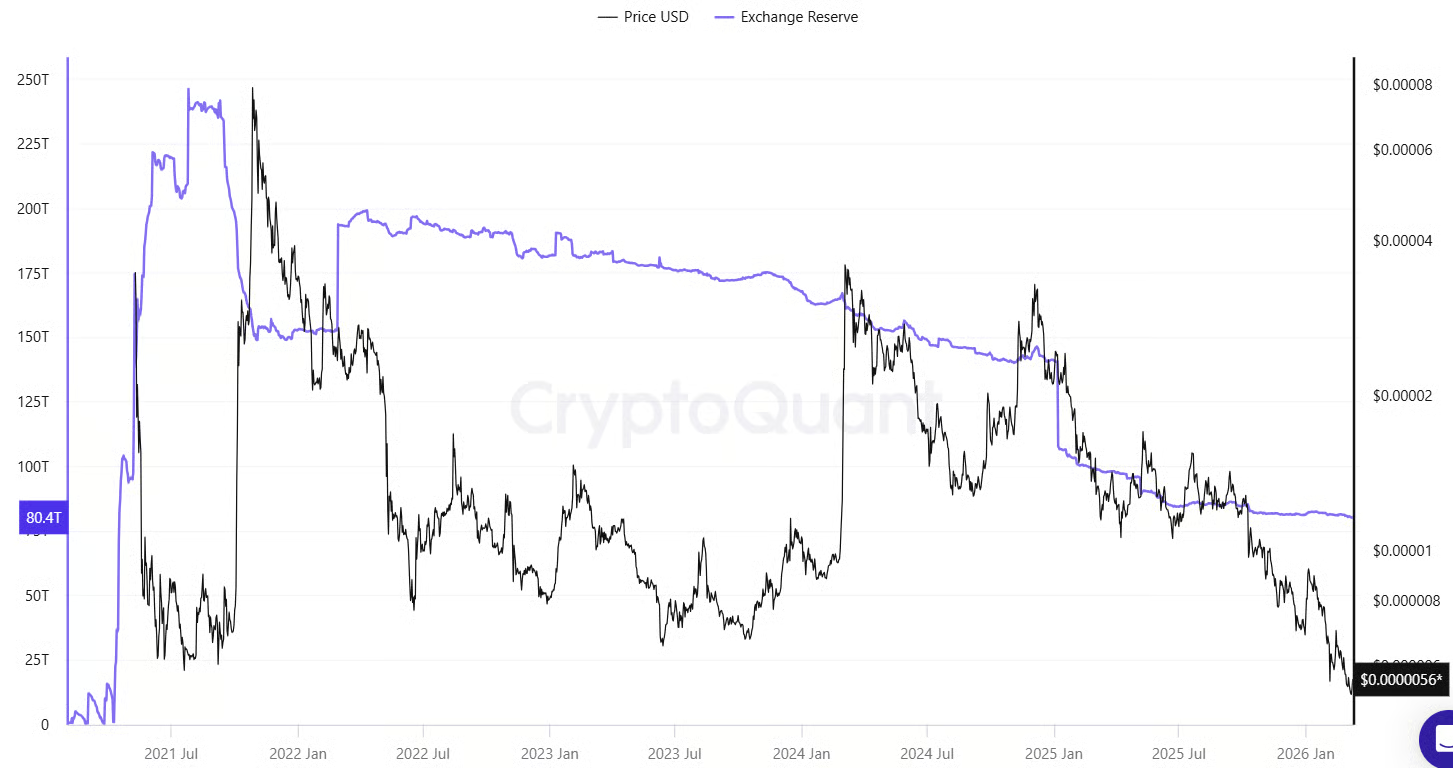
A five-year low in SHIB’s exchange supply strengthens the bullish argument.
While the second-largest meme coin has been stuck in a prolonged downtrend over the past several months, some market observers believe the price may stage an impressive comeback soon.
Certain on-chain factors reinforce the bullish scenario, whereas stalled activity on Shibarium suggests the bears might not give up easily.
SHIB to Skyrocket?
As of press time, the meme coin trades at around $0.000005653, representing a 52% decline on a yearly scale. Its market capitalization has fallen to roughly $3.3 billion, positioning it as the 31st-biggest cryptocurrency.
According to X user JAVON MARKS, SHIB appears to be nearing the breaking point of another Falling Wedge-like structure and may be gearing up for a substantial jump. The analyst noted that the last move out of such a formation was followed by a whopping 455% price increase, prompting the question of whether history is about to repeat itself.
Another market observer who recently touched upon the token is CRYPTO LEGEND. They believe SHIB could emerge as one of the strongest performers in a future altseason, with gains potentially reaching 10x.
A possible hint of an upcoming rally is the persistent decrease in tokens sitting on crypto exchanges. CryptoQuant’s data shows that the figure recently plunged to a five-year low of around 80.1 trillion. The trend indicates that investors have been steadily shifting from centralized platforms to self-custody, thus reducing immediate selling pressure.

Shiba Inu’s Relative Strength Index (RSI) should also be mentioned. The technical analysis tool has tumbled to around 30 on a weekly scale, suggesting that the asset has neared oversold territory and could be due for a resurgence. Conversely, ratios above 70 are interpreted as precursors of a pullback.
You may also like:

Further Pain for the Bulls?
In contrast to the optimistic forecasts, SHIB’s burning mechanism and Shibarium’s stagnation point to the possibility of further weakness. The burn rate is down nearly 30% on a daily scale, resulting in less than 5 million tokens (whose USD valuation is negligible) sent to a null address.

The program was adopted in 2022, and since then, the team and the community have scorched roughly 410.75 trillion coins, leaving approximately 585.47 trillion in circulation. Its ultimate goal is to reduce SHIB’s overall supply, thereby potentially driving up prices due to scarcity (should demand remain constant or rise).
Shibarium’s stalled progress is another bearish factor. Launched in the summer of 2023, Shiba Inu’s layer-2 scaling solution was designed to boost the ecosystem by lowering fees, boosting speed, and improving scalability.
However, the protocol suffered an exploit last year, which severely damaged investor confidence. Daily transactions, once in the millions, plunged to mere hundreds after the incident.
Binance Free $600 (CryptoPotato Exclusive): Use this link to register a new account and receive $600 exclusive welcome offer on Binance (full details).
LIMITED OFFER for CryptoPotato readers at Bybit: Use this link to register and open a $500 FREE position on any coin!
Crypto World
Why Investors Are Bullish on DeepSnitch AI: 100x-300x Predictions Stack Up Before Launch Driven by AI Utility, DOGE and ADA Remain Muted

Jensen Huang just made the bullish case for AI infrastructure by predicting that trillions of dollars are still to be built, millions of skilled jobs still to be created, and every company on earth will eventually run on it.
While the AI infrastructure buildout plays out over decades, the crypto market has its own AI story developing at a much faster pace, and it has gotten everyone asking why investors are bullish on DeepSnitch AI.
The answer is clear: DeepSnitch AI is a crypto application layer that provides a clear use case for traders, and the $2M raised and community going ballistic with 100x-300x anticipation ahead of March 31 TGE is the clear proof of potential.

AI as a five-layer cake
Jensen Huang, Nvidia CEO, pushed back on AI job fears this week, arguing in a blog post that the technology requires an enormously skilled workforce to build and maintain the infrastructure underneath it.
He argues that electricians, steelworkers, network technicians, and operators are all in short supply.
Describing AI as a five-layer cake, Huang proposes that the AI consists of energy, chips, infrastructure, models, and applications. Moreover, most of the buildout isn’t yet happening, and Huang expects that trillions of dollars of infrastructure remain to be built.
The comments come as companies like Block, Pinterest, and Dow cited AI efficiency gains while cutting thousands of jobs. NVIDIA CEO says that it’s important to separate infrastructure jobs from roles becoming automated.
Meanwhile, retail traders are out “looking” for money, but many are disappointed by the recent prospects for affordable established coins. And since DeepSnitch AI is both an AI project that technically presents Huang’s “application” layer, DeepSnitch AI investor interest is high, as it doubles as a legitimate tool and potentially a breakout coin.
Altcoins to watch in March 2026
1. DeepSnitch AI: DeepSnitch AI bullish sentiment peaking in anticipation of March 31 launch
While the broader AI buildout is measured in decades, DeepSnitch AI is already live with five AI agents running through a central intelligence layer, delivering real-time sentiment tracking, rug pull detection, instant DYOR via contract address, and a hidden gem scanner.

Best of all, these tools are all located within a single dashboard – no learning curve, no back-and-forth.
In short, the project’s utility and early development have attracted $2M in capital. While the hype certainly plays a role, there is genuine DeepSnitch AI market demand as traders are actively looking for a singular set of AI trading tools.
As such, there’s a strong possibility that DeepSnitch AI will end up in many traders’ portfolios post-launch, delivering steady growth for investors following a massive 100x-300x, community-projected run.
Still priced at $0.04399, FOMO is hitting after the launch was set for 31, and it was confirmed that DSNT will be available for open trading on Uniswap (although CEX and additional DEX listings are expected).
AI is the biggest infrastructure story of the century. DeepSnitch AI is the application layer for traders who want to benefit from it, not in ten years, but now – and that’s the TLDR on why investors are bullish on DeepSnitch AI.
2. Dogecoin: Is there hope for DOGE?
According to CoinMarketCap, DOGE recovered to $0.091 on March 11.
DOGE has struggled recently, but bulls are seemingly back and have started targeting the $0.10 level.
Yet, a breakout can be confirmed only if buyers test the $0.12 breakdown level as DOGE will establish its cycle button.
If the current recovery stalls, DOGE could once again see its $0.08 February low, meaning that the structure remains fragile.
3. Cardano: What’s next for ADA?
According to CoinMarketCap, ADA’s small recovery screeched to a halt, and the coin settled at $0.25.
While many are asking why investors are bullish on DeepSnitch AI, ADA buyers are still not giving up as they target the 20-day EMA at $0.27. If the price rejects the rally, ADA will remain in its descending channel until the next floor materializes.
On the other hand, if the selling pressure starts building up, Cardano could slide further, erasing all the recent gains.
Final thoughts: Why investors are bullish on DeepSnitch AI – and why you should be too
With DeepSnitch AI’s TGE a little over two weeks away, you still have time to get on board the most exciting crypto AI project in recent times.
DeepSnitch AI is a perfect demonstration of AI in real life, only this time it’s tailored specifically for traders. The approach is obviously working, as $2M raised and 100x-300x community projections prove that the high-conviction wave is hitting hard as the launch approaches.
Moreover, the DSNTVIP300 unlocks 300% extra tokens on $30K+ allocations and is available until March 31. These bonuses are organized in tiers and actively incentivize traders who lock in on the DeepSnitch AI bullish sentiment early.
The time to get into DeepSnitch AI presale is now. And while you wait for the TGE, feel free to go through X or Telegram for top-tier community chit-chat.

FAQs:
1. Why are investors bullish on DeepSnitch AI ahead of its March 31 TGE?
Three reasons stack up cleanly: $2M raised during a bear market signals genuine conviction, not speculative hype. The central intelligence layer is already live with five AI agents delivering operational, and the March 31 TGE brings DSNT to Uniswap with DEX and CEX listings expected to follow.
2. How does Jensen Huang’s AI infrastructure thesis connect to DeepSnitch AI’s bullish prospects?
Huang describes AI as a five-layer cake: energy, chips, infrastructure, models, and applications. Most institutional AI plays target the lower layers: chips, data centers, and infrastructure. DeepSnitch AI sits at the application layer, where AI directly meets the end user. For crypto traders, that means real-time sentiment tracking, rug detection, and instant DYOR.
3. What are the short-term price setups for Dogecoin and Cardano right now?
DOGE recovered to $0.091 but needs a close above $0.10 and a test of the $0.12 breakdown level to confirm a cycle bottom, while failure to hold current levels risks a revisit of the $0.08 February low. ADA is holding at $0.25 with bulls targeting the $0.27 20-day EMA. A rejection could keep ADA rangebound in its descending channel, while increased selling pressure could erase recent gains entirely.
Disclaimer: This is a Press Release provided by a third party who is responsible for the content. Please conduct your own research before taking any action based on the content.
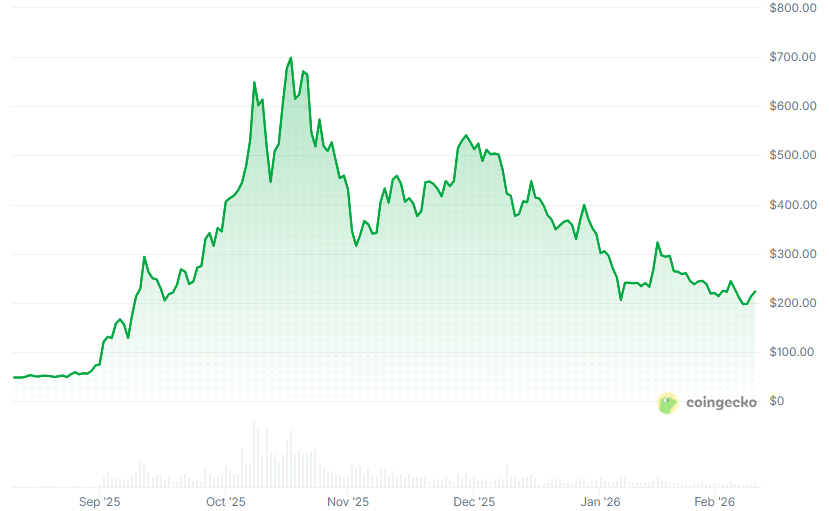
The world’s top Bitcoin mining pool operator expands into privacy coins as ZEC surges 600% year-over-year.
Foundry Digital, the Digital Currency Group (DCG) subsidiary behind the world’s largest Bitcoin mining pool by hashrate, announced today that it will launch an institution-focused Zcash mining pool in April.
The move marks Foundry’s first expansion beyond Bitcoin and targets what the company describes as a gap in the Zcash ecosystem: the absence of compliant, institutional-grade pool infrastructure capable of meeting the needs of public companies and large-scale miners.
Foundry CEO Mike Colyer framed the expansion as a natural extension of the company’s mission, noting that while Zcash has grown into a serious institutional asset, its mining infrastructure has lagged behind. The new pool will be U.S.-based and built on the same compliance framework underpinning Foundry USA Pool, which holds both SOC 1 Type 2 and SOC 2 Type 2 certifications.
The announcement was welcomed by Zcash founder Zooko Wilcox, now Chief Product Officer at Shielded Labs, who said the new pool should help distribute Zcash mining hashpower away from its current concentration in a single pool and attract new miners.
ZEC is trading around $212, down roughly 4% in the past 24 hours and about 10% on the week.

Zcash Open Development Lab (ZODL), formed by the core developers of Zcash (ZEC) after they exited Electric Coin Capital, recently secured $25 million in seed funding to support the privacy-focused ecosystem.
Zcash, launched in 2016, uses zero-knowledge proof technology to enable private transactions on a public blockchain, allowing verification without exposing wallet addresses or amounts.
This article was written with the assistance of AI workflows. All our stories are curated, edited and fact-checked by a human.

YesCymru responds to Keir Starmer’s leaked memo on bypassing the Senedd

ACC basketball tournament 2026: Bracket, schedule and scores

3D Printing A Harmonic Pin-Ring Gearing Drive

Smart energy pays enters the US market, targeting scalable financial infrastructure

Why Israel is blocking foreign journalists from entering

Bitcoin: We’re Entering The Most Dangerous Phase

Bitcoin Live Trading: Liquidity Grab Complete? Will BTC Pump Next? EP1933

EXTREME WARNING: FINAL XRP DEADLINE REVEALED BY RIPPLE CEO | CLARITY BY APRIL | XRP HAS 100 SWITCHES

Give me 10 Minutes and I’ll Give you Life-Changing Crypto Advice
-
Business5 days ago
Form 8K Entergy Mississippi LLC For: 6 March
-

 Tech7 days ago
Bitwarden adds support for passkey login on Windows 11
-

 News Videos2 days ago
10th Algebra | Financial Planning | Question Bank Solution | Board Exam 2026
-

 Fashion5 days ago
Weekend Open Thread: Ann Taylor
-

 Crypto World2 days ago
Paradigm, a16z, Winklevoss Capital, Balaji Srinivasan among investors in ZODL
-
 Tech14 hours ago
A 1,300-Pound NASA Spacecraft To Re-Enter Earth’s Atmosphere
-
 Sports6 days ago
499 runs and 34 sixes later, India beat England to enter T20 World Cup final | Cricket News
-

 Politics5 days ago
Top Mamdani aide takes progressive project to the UK
-

 Business1 day ago
ExxonMobil seeks to move corporate registration from New Jersey to Texas
-

 Sports4 days ago
Three share 2-shot lead entering final round in Hong Kong
-

 Sports4 days ago
Braveheart Lakshya downs Lai in epic battle to enter All England Open final | Other Sports News
-

 NewsBeat3 hours ago
Residents reaction as Shildon murder probe enters second day
-

 Entertainment5 days ago
Hailey Bieber Poses For Sexy Selfies In New Luscious Lip Thirst Traps
-

 NewsBeat6 days ago
Piccadilly Circus just unveiled ‘London’s newest tourist attraction’ and it only costs 80p to enter
-

 Business3 days ago
Search for Nancy Guthrie Enters 37th Day as FBI Probes Wi-Fi Jammer Theory
-

 Business13 hours ago
Search Enters Sixth Week With New Leads in Tucson Abduction Case
-
 NewsBeat2 days ago
Pagazzi Lighting enters administration as 70 jobs lost and 11 stores close across Scotland
-

 Tech2 days ago
Despite challenges, Ireland sixth in EU for board gender diversity
-
Entertainment7 days ago
Harry Styles Has ‘Struggled’ to Discuss Liam Payne’s Death
-

 Crypto World7 days ago
New Crypto Mutuum Finance (MUTM) Reports V1 Protocol Progress as Roadmap Enters Phase 3