
Crypto World
HeyGen Avatar V clones faces in 15 seconds



The latest AI video tool to go viral this week is HeyGen’s Avatar V, announced April 8 with 472,000 views on X, which builds a photorealistic digital twin of a user’s face, voice, and gestures from a single 15-second webcam recording and then generates unlimited studio-quality video without any professional equipment.
Summary
- Avatar V captures a user’s specific micro-expressions, lip geometry, facial silhouette, and natural movement from one 15-second clip, then maintains that identity across every video generated regardless of length, angle, outfit, or scene, solving the identity drift problem that has caused most AI avatars to degrade in quality after a few seconds
- Once the digital twin is created, users pick a base photo as their identity reference, apply any outfit or setting via text prompts, and generate video in 175 languages with full lip-sync; voice cloning is a separate optional step the company recommends for maximum realism
- Avatar V is now the foundation all other features in HeyGen’s platform run on, integrated with Seedance 2.0 for cinematic video generation and available across paid subscription tiers
HeyGen’s official launch page describes Avatar V as built on a single belief: the output has to be good enough that users would be willing to put their name on it, not good for AI, just good. The model is trained on what HeyGen calls a temporally grounded identity embedding built from the 15-second clip, capturing the specific gestures and expression transitions that make a person recognizably themselves across different contexts. Wide shots, medium frames, and close-ups all stay consistent from one recording. The process requires no studio lighting and no crew; a standard phone or webcam is enough.
The key design principle is separating identity from appearance. The 15-second clip defines how a person moves. A separate base photo defines how they look. Users can then change the look freely while the motion stays unmistakably theirs.
Most AI avatar systems optimize for a single impressive moment: the screenshot, the short clip, the controlled demo where everything works in the model’s favor. They look sharp in two seconds and collapse in twenty as the face drifts from the source. Avatar V was designed specifically to hold across the full runtime of a video without that drift. HeyGen describes this as identity consistency: the same face, the same micro-expressions, the same presence from the first frame to the last, across a 30-second clip or a 10-minute module.
What Users Can Actually Build With It
The practical workflow is three steps: record a 15-second video, optionally record a standalone voice clone, then choose a base photo as the identity reference for every scene generated afterward. From that base, users write prompts to generate new outfits, settings, and styles, or use the HeyGen library. The finished video can be delivered in any of 175 languages with lip-sync adapted to the target language automatically. HeyGen advises users to be expressive during recording because, as the company put it, “the energy you put in is the energy you get out.”
Why This Matters for Content Creation at Scale
As crypto.news has reported, AI tools that reduce the cost and time of producing professional content are directly reshaping enterprise headcount decisions in 2026. As crypto.news has noted, the proliferation of AI content tools is a key variable in how institutional investors are assessing the durability of AI infrastructure spending. Avatar V is now fully available through HeyGen’s paid plans, with access to the platform’s full suite of templates, translation, and studio tools.


Morgan Stanley launches lowest-fee bitcoin ETF, intensifying market rivalry. Advisor network gives MSBT strong distribution edge over competitors. BlackRock retains liquidity lead despite new fee pressure from MSBT.
Wall Street competition intensified as Morgan Stanley launched its spot bitcoin ETF on April 8. The new product targets dominance in a fast-growing U.S. market. It directly challenges BlackRock and its leading fund.
The fund trades under the ticker MSBT on NYSE Arca with a 0.14% expense ratio. This pricing sets a new low across spot bitcoin ETFs. It signals a clear shift toward aggressive fee competition among issuers.
Bitcoin ETF Competition Shifts Toward Cost and Access
Bitcoin traded around recent market levels as ETF competition intensified across major issuers. MSBT entered the market with the lowest fee structure available. This move puts pressure on established players to reconsider pricing strategies.
BlackRock Continues to Dominate Through Its iShares Bitcoin Trust
The fund holds tens of billions in assets and leads in trading activity. Its liquidity supports large transactions and active strategies.
Morgan Stanley offers a different advantage through distribution strength. Its wealth division manages trillions in client assets. Advisors can now allocate capital directly into an in-house product.
Advisor Networks Drive Structural Market Shift
Financial advisors now play a larger role in ETF adoption and portfolio allocation. Earlier inflows came mainly from self-directed participants seeking liquidity. Now, integrated advisory platforms influence new capital flows more strongly.
Morgan Stanley allows advisors to allocate a portion of portfolios to bitcoin exposure. Internal guidance permits allocations based on client risk tolerance. This approach simplifies recommendations and reduces friction.
As a result, MSBT may attract flows through existing advisory relationships. BlackRock maintains an advantage in market depth. Replicating that liquidity may take time despite strong distribution channels.
Expansion Signals Broader Crypto Strategy
The MSBT launch marks a shift in how banks approach digital assets. Morgan Stanley now builds its own crypto investment vehicles, whereas previously it focused on distributing third-party ETF products.
The bank has also filed for additional crypto products linked to Ethereum and Solana. These filings suggest a long-term expansion strategy across digital asset classes. The firm continues to build infrastructure around custody and trading services.
The bank plans to integrate crypto trading into its E*Trade platform, connecting digital assets with its broader financial ecosystem. It reflects a wider trend among banks entering crypto markets directly.
The ETF market has already absorbed significant inflows since early 2024. MSBT now tests whether distribution strength can compete with established liquidity leaders. This competition may accelerate fee reductions across the sector.
The Strait of Hormuz, a critical route for roughly 20% of global oil flows, is now at the center of a broader debate that goes beyond geopolitics. It has pulled Bitcoin and XRP into a real-world test of how crypto functions during conflict.
Amid a fragile ceasefire in April, reports claim Iran is demanding a toll of about $1 per barrel from tankers crossing the strait. Payments are reportedly requested in Bitcoin or yuan, adding a new layer to how sanctions and trade routes intersect.
Bitcoin Enters the World’s Most Strategic Oil Route
Bitcoin has quickly become the focal point of this narrative. According to the reports, the IRGC enforces these payments with a very short time window, making tracking difficult under Western sanctions.
For a supertanker, this could mean fees reaching up to $2 million, or roughly 281 BTC.
Still, skepticism remains. Arthur Hayes publicly questioned the claims, saying he would only believe them after seeing a verifiable on-chain transaction tied to a vessel.
Until then, he suggested it could be noise or messaging rather than reality.
So far, no public on-chain evidence confirms these payments. Even so, the narrative alone pushed Bitcoin back above $70,000.
The episode reinforces a growing view. In moments of crisis, Bitcoin acts as a neutral settlement tool that operates outside traditional financial systems.
XRP’s Case: Built for Peace, Not Crisis
At the same time, the situation has triggered debate within the XRP community. Analyst Fran de Olza argued that Bitcoin’s narrative is shifting again.
In his view, it has moved from retail payments to a store of value, and now toward large-scale settlement use cases, like those implied in Hormuz.
He pointed out that terms like “neutral settlement” and “borderless money” are now widely used, even by Bitcoin advocates.
However, he argues that XRP already occupies this space, with years of development focused on institutional payments and cross-border settlement.
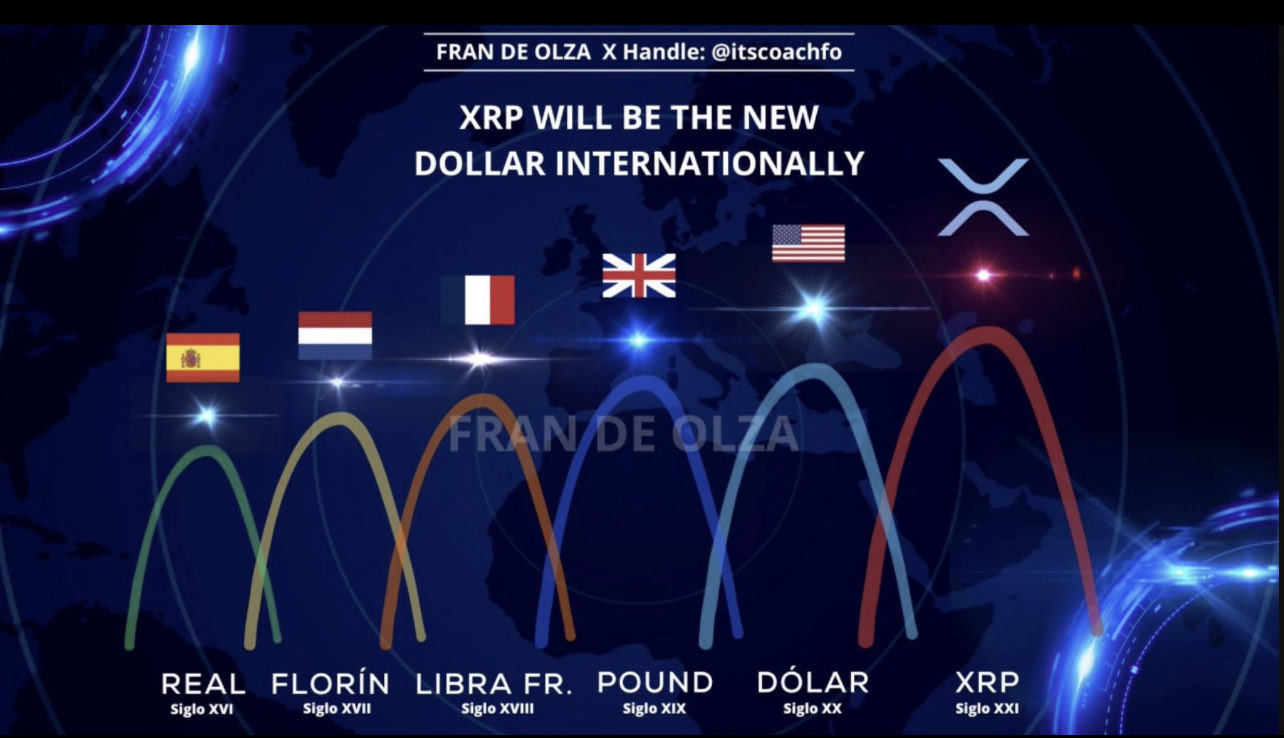
De Olza suggested that if a new global financial agreement emerges, similar to a modern Bretton Woods system, many could realize they were describing XRP’s role while assuming Bitcoin would fill it.
However, other analysts offered a more grounded view. Bitcoin’s strength in this case comes from its censorship resistance.
Iran’s priority is not efficiency but bypassing systems like SWIFT and the US dollar immediately. That makes Bitcoin useful in a sovereignty-driven scenario.
XRP, by contrast, is built for regulated financial systems operating at scale during stable periods. It focuses on institutional settlement, compliance, and integration with banking infrastructure.
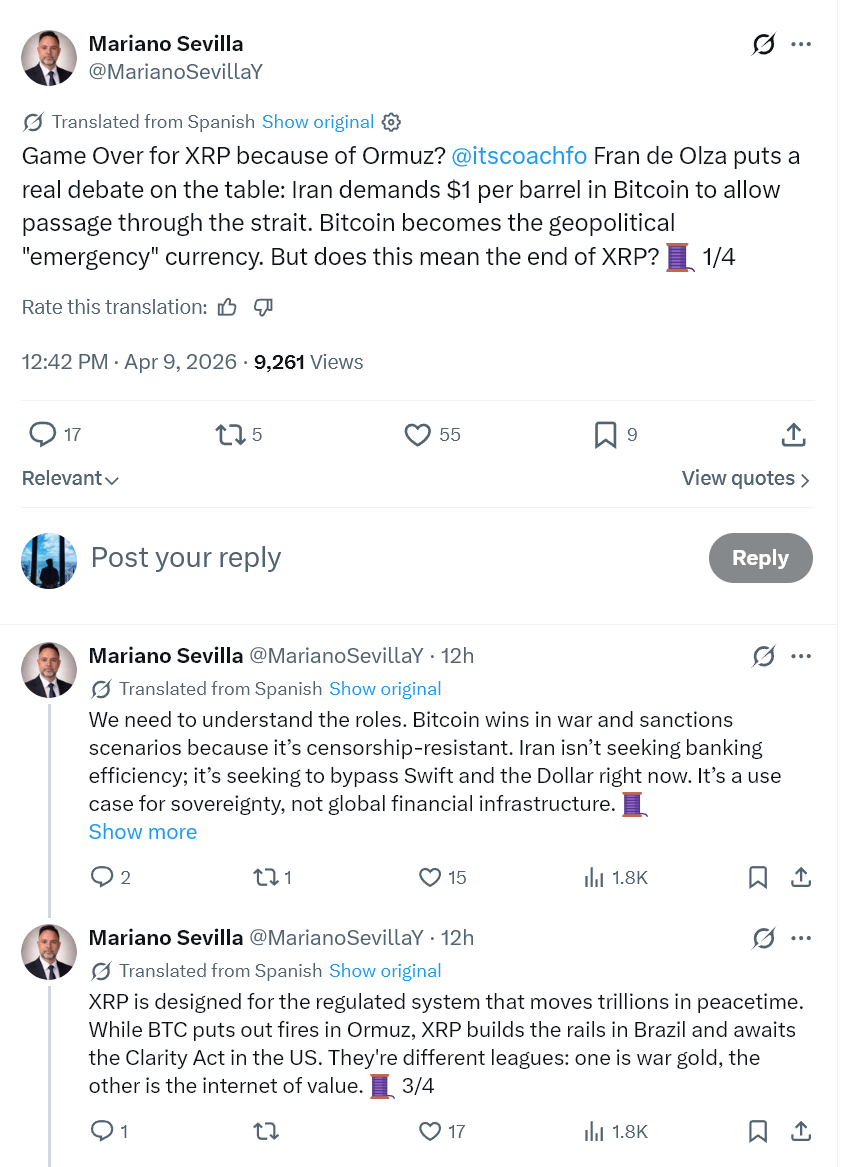
Bitcoin handles urgent, high-pressure scenarios, while XRP is designed to support long-term financial rails. Both can succeed without displacing each other.
The 2026 market is increasingly multichain, with Bitcoin serving as a reserve and crisis tool, while XRP targets institutional settlement.
For now, as tankers wait and analysts debate, one point stands out. Crypto is no longer just a speculative market. It is becoming part of how power, trade, and finance operate in a fragmented global system.
The post Hormuz and Bitcoin Link Means “Game Over” for XRP? This Is What Analysts Say appeared first on BeInCrypto.
Ether treasury company Bitmine Immersion Technologies has started trading on the New York Stock Exchange after uplisting from NYSE American as the company expanded its share buyback program.
The Ether (ETH) treasury company’s stock began trading on the NYSE at market open on Thursday under its existing “BMNR” ticker symbol, Bitmine announced Thursday.
Bitmine chairman Tom Lee said it’s a major milestone for the company as the NYSE is considered one of the world’s top exchanges.
“The NYSE is the most prestigious venerable stock exchange with a storied history. The NYSE is the envy of capital markets around the world and Bitmine is proud to be the newest company traded on this exchange.”
NYSE American is designed for small-cap and growing companies. Bitmine’s uplisting to the NYSE suggests the company is gaining momentum, and increases the company’s exposure to larger capital pools.
NYSE listing process is extensive
The process to gain a listing on the NYSE requires a company to meet strict requirements covering financial health, share distribution and corporate governance. Some of the requirements include having more than 400 shareholders and 1.1 million publicly held shares.
A majority of directors involved in corporate governance must also be independent, with no significant financial interest in the company and audit, compensation and governance committees must be formed.
One of the final steps involves filing a registration statement with the US Securities and Exchange Commission. The NYSE review before a listing usually takes about four to eight weeks.
Chris Taylor, the NYSE Group’s chief development officer, said in a statement that Bitmine is a strong addition to the stock exchange.
Related: Ripple to buy back $750M in shares through April: Report
“We are pleased to welcome Bitmine to the New York Stock Exchange,” he said. “With its focus on advancing the Ethereum ecosystem, Bitmine is a strong addition to the NYSE community.”
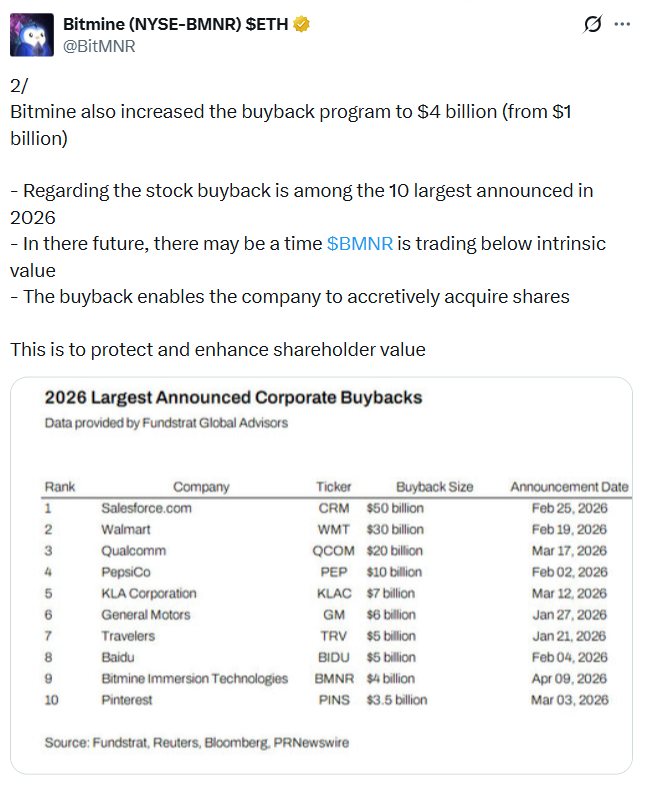
Share buyback upped to $4 billion
Meanwhile, Bitmine’s board unanimously expanded the July 2025 share repurchase program from $1 billion to $4 billion, including shares previously repurchased.

“Bitmine’s expanded $4 billion buyback reflects our commitment to shareholders,” Lee said, adding that “there may be a time in the future when Bitmine shares are trading below intrinsic value, and the company wants to be in a position to accretively retire common shares.”
Bitmine stock (BMNR) closed Thursday at $21.08, down more than 64% in six months, according to Google Finance. Last September, analysts told Cointelegraph that treasury companies are using buybacks to boost stock price and legitimacy.
Magazine: Should users be allowed to bet on war and death in prediction markets?
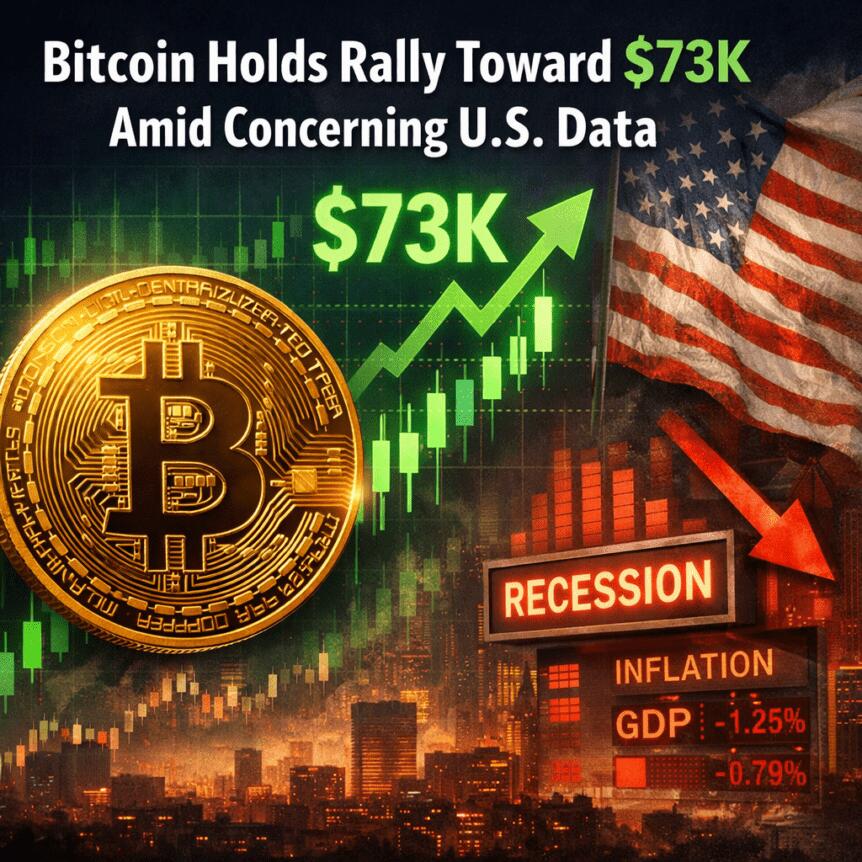
Bitcoin reclaimed the $72,000 level on Thursday as markets weighed a blend of persistent inflation signals, softer-than-robust growth data, and geopolitical tension in the Middle East. The ascent came despite data suggesting inflation remains stubborn and economic expansion cooled, underscoring a market environment where scarce assets can stay in demand even as macro headwinds persist.
On the inflation front, the US Bureau of Economic Analysis reported that the core Personal Consumption Expenditures (PCE) index rose 0.4% in February, reinforcing concerns about sticky price pressures. In the same week, the fourth-quarter gross domestic product was revised to a 0.5% annualized growth rate, a modest pace that keeps the economy on a fragile footing and adds to recession-talk among traders. Taken together, these readings suggest the trajectory for inflation and growth remains uncertain, fueling continued volatility in risk assets including Bitcoin.
Geopolitical headlines complicated the scene. Oil prices surged back toward the mid-$90s and briefly around $97 per barrel after Iranian leaders signaled that the United States and Israel had violated the ceasefire negotiated in the region. The market also watched the political dynamic in the United States, where reports anchored to the Dubai-based and U.S. commentary of a ceasefire circulated in the days prior. In this environment, Bitcoin traders noted that the perceived fragility of any truce could weigh on upside momentum, potentially pushing the price toward support around $68,000 if risk-off conditions intensify. The backdrop was further influenced by statements from Iranian parliamentary speaker Mohammad Bagher Ghalibaf, who highlighted alleged violations of the ceasefire by external actors, a narrative echoed in market chatter around Yahoo Finance reports.
Key takeaways
-
Bitcoin briefly moved back above $72,000, signaling sustained demand for scarce assets amid a uncertain macro backdrop.
-
Geopolitical tensions and a rebound in oil prices contributed to a guarded upside, with traders watching for signals about the durability of any Iran ceasefire and its implications for risk assets.
-
US core PCE rose 0.4% in February, while Q4 GDP was revised to a 0.5% annualized pace, underscoring persistent inflation and a slower growth path that heighten recession risk concerns.
-
The US dollar softened against a basket of currencies as liquidity expectations rose, but the macro mix kept the narrative complex for BTC and broader markets.
-
Equities remained resilient—with the S&P 500 trading within striking distance of its all-time highs—while concerns about private credit markets and AI-related debt costs did not trigger an immediate broad sell-off.
Bitcoin’s move amid a mixed macro and geopolitical backdrop
Bitcoin’s climb back toward the $72,000 mark occurred amid a market environment where inflation remains persistent, yet growth signals are tepid. The price action hints at a dynamic in which investors are prioritizing scarce assets as potential hedges against fiat weakness and continued liquidity provision, even as they weigh the probability of policy shifts from the Federal Reserve and the broader risk of a recession.
Some market observers interpret BTC’s strength as a response to liquidity expectations rather than a pure inflation hedge. The narrative suggests that traders may be leaning on Bitcoin as a conditional store of value in an environment where traditional fixed income offers less compelling real yields and where the dollar’s strength has ebbed slightly versus a broad basket of currencies. Yet the pace and durability of BTC’s rally remain tethered to broader risk sentiment, which can change quickly with new macro data or geopolitical headlines.
Trading activity around BTC also reflected a nuanced relationship with traditional risk assets. While Bitcoin has shown correlations with equities at times, the degree of coupling appeared variable in the current week, with some traders noting the asset’s sensitivity to liquidity conditions and the appetite for scarce stores of value as opposed to direct inflation hedges alone. The interplay between BTC and the S&P 500 has been a focal point for market analysis, highlighting how cryptos fit into a broader risk-on or risk-off framework rather than behaving as stand-alone inflation hedges.
Geopolitics, energy markets and risk sentiment
Oil markets provided a live read on the risk environment. After initial spikes tied to Middle East tensions, prices pulled back from the highs as traders weighed the potential for a ceasefire to hold and as headlines suggested a tempered near-term risk. The situation underscored a core market truth: energy prices often act as a barometer for risk appetite. When geopolitical headlines flare, oil reacts quickly, and the broader risk-on or risk-off impulse tends to color equities and crypto alongside it.
The market’s reaction to the ceasefire narrative also illustrated how a single development can ripple across asset classes. The S&P 500 futures reached multi-week highs as some observers interpreted the news as a reduction in near-term geopolitical risk, yet the specter of a fragile truce remained. In such an environment, Bitcoin’s path becomes less about a single data point and more about the evolving balance of inflation expectations, growth prospects, and liquidity provisioning by policymakers.
In parallel, the broader equity backdrop remained robust. The S&P 500 traded only a short distance from all-time highs, a signal that investors were not overly fixated on private-credit stress or the debt-cost pressures facing AI infrastructure firms. For Bitcoin, this translated into a day of price action that leaned into the risk-on narrative, even as traders remained vigilant for any signs of renewed risk-off pressure should geopolitical or macro data deteriorate.
Macro data, the dollar, and the evolving narrative for BTC
The macro backdrop continued to shape expectations for Bitcoin and the crypto market at large. Despite inflation’s persistence, a softer dollar tends to help scarce assets perform, particularly when liquidity support remains in play. The weaker dollar narrative aligned with a view that policy accommodations could persist longer than previously anticipated, a stance that supports Bitcoin’s appeal as a non-sovereign store of value in certain market conditions.
Importantly, the latest inflation and growth readings did not provide a clear blueprint for a rapid rally. Core PCE’s 0.4% uptick and the GDP revision signaling slower growth underscore a scenario where inflation remains a constraint on policy normalization, while growth risks limit the Fed’s capacity to curb liquidity without consequences for financial conditions. In such a setting, traders are watching for any fresh guidance from policymakers that could tilt the liquidity balance—either through rate expectations or balance-sheet actions.
From a market structure perspective, Bitcoin’s correlation with the S&P 500 remains an area of scrutiny. The 30-day relationship oscillates as traders parse whether BTC acts as a hedge, a risk asset-like instrument, or something in between. The current readings suggest a nuanced dynamic: BTC is influenced by risk sentiment, liquidity flows, and macro surprises just as traditional assets are, but with a unique sensitivity to the crypto market’s own structural developments and adoption cycles.
What lies ahead for Bitcoin and the macro regime
While the immediate path remains uncertain, the prevailing thread is clear: recession risks are rising from a backdrop of ongoing inflation and tepid growth, even as demand for scarce assets persists. For Bitcoin, this means opportunities to test new resistance levels exist, but a sustained move higher will likely require a clearer shift in the macro narrative—whether through stronger inflation relief signals, a more definitive pivot in Fed policy expectations, or a tangible easing of geopolitical tensions that reduces risk-off pressure on markets broadly.
Investors will want to monitor several developing threads in the coming weeks: the trajectory of US inflation data, the pace of GDP revisions, the evolution of the dollar, and ongoing developments in the Iran situation and oil markets. Each of these factors can tilt risk appetite and liquidity, shaping Bitcoin’s short-term trajectory as traders reassess the balance between macro risks and the demand for non-sovereign assets.
As the picture evolves, traders should remain cautious about reading a single data point as a signal. The combination of persistent inflation, modest growth, a fragile geopolitical backdrop, and a fluctuating dollar makes the near-term Bitcoin path highly contingent on how these factors interact. What remains uncertain is how quickly policymakers will calibrate liquidity support and how resilient risk appetite will prove when faced with new headlines or data surprises.
Readers should stay attentive to geopolitical updates, oil-price movements, and any fresh guidance from policymakers that could influence market liquidity. The next few sessions could redefine BTC’s support and resistance landscape as investors reassess risk, inflation, and the evolving horizon for crypto adoption.
Crypto World
BeInCrypto 100 Institutional Awards Nomination: Sygnum Bank for Best Digital Asset Custody Provider

For years, crypto was driven mostly by speculation. That phase is fading. What’s taking its place is slower, more practical work: rebuilding parts of the financial system using blockchain.
For banks and institutions, the focus has changed. Custody is no longer just about safekeeping assets. It’s about connecting those assets to the rest of the financial system in a way that is fast, compliant, and usable.
Sygnum Bank sits in the middle of that shift. And that’s why it is nominated for Best Digital Asset Custody Provider at the BeInCrypto 100 Institutional Awards 2026.
Custody Is No Longer Just Storage
Sygnum Bank has moved beyond the basic custody model. Instead of treating custody as a vault, it treats it as part of a broader financial service.
In a recent discussion with BeInCrypto’s Global Head of News, Brian McGleenon, Sygnum CIO Fabian Dori made that shift clear. He said security is no longer the main problem.
“The key aspect of providing a secure custody solution was one of the first challenges. At this point, it’s largely solved at the institutional level. The real challenge now is integration — connecting custody with value-add services.”
That point shows up in how Sygnum operates.
BeInCrypto reviewed its regulatory standing, partnerships, and product activity across public filings and disclosures.
Sygnum was founded in 2017 and now reports more than $5 billion in client assets, over $1 billion in assets under custody, and more than 2,000 clients across four jurisdictions.
| Founded | 2017 |
| Total Client Assets | $5B+ |
| Assets Under Custody (AUC) | $1B+ |
| Clients | 2,000+ |
| Jurisdictions | 4 |
| Valuation | $1B+ |
It became the first digital asset bank to receive a full banking and securities dealer licence from FINMA in 2019. Today, it operates under regulatory frameworks in Switzerland, Singapore, Abu Dhabi, and Luxembourg.
Its Protect off-exchange custody platform crossed $1 billion in assets in March 2026, with 900% year-on-year growth. Market maker Wintermute is one of its clients.
The bank has also pushed into settlement and tokenization.
In December 2025, Sygnum became the first European digital asset bank to work with BNY Mellon on USD settlement.
Through its Desygnate platform, it has tokenized real-world assets across multiple networks. This includes shares in Hamilton Lane’s $4.9 billion private assets fund on Polygon, and Fidelity International’s liquidity fund on zkSync Era.
It also supported a private debt tokenization with Float and Fasanara Capital.
On the investment side, its BTC Alpha Fund raised more than 750 BTC within four months and has delivered around 15% annualized returns since launch.
Trading activity across the platform grew more than 1,000% in 2024, partly driven by its infrastructure supporting over 20 partner banks.
Making Digital Assets Actually Usable
Client behavior is also changing. Dori said institutional clients are no longer satisfied with holding assets passively. They want to use them.
Sygnum’s model is built around that shift. Clients can access custody, lending, and yield strategies through a single interface, without moving assets across multiple platforms. The goal is to keep everything within a regulated environment while still allowing capital to be deployed.
Another issue the bank is trying to address is fragmentation.
Blockchains remain siloed. Different networks, standards, and systems create friction. Dori’s view is that clients should not have to deal with that complexity directly.
“What we aim to provide is unified access. Behind the scenes, we use different systems and tools to handle the fragmentation.”
That approach matters as tokenization grows.
Estimates suggest the market could reach tens of trillions of dollars by 2030. If that happens, the challenge will not be building new chains. It will be making them work together in a way that institutions can actually use.
Sygnum’s strategy is straightforward. Hide the complexity. Keep the compliance tight. Make digital assets usable within the existing financial system.
The technology is already here. The real work now is connecting it.
The post BeInCrypto 100 Institutional Awards Nomination: Sygnum Bank for Best Digital Asset Custody Provider appeared first on BeInCrypto.
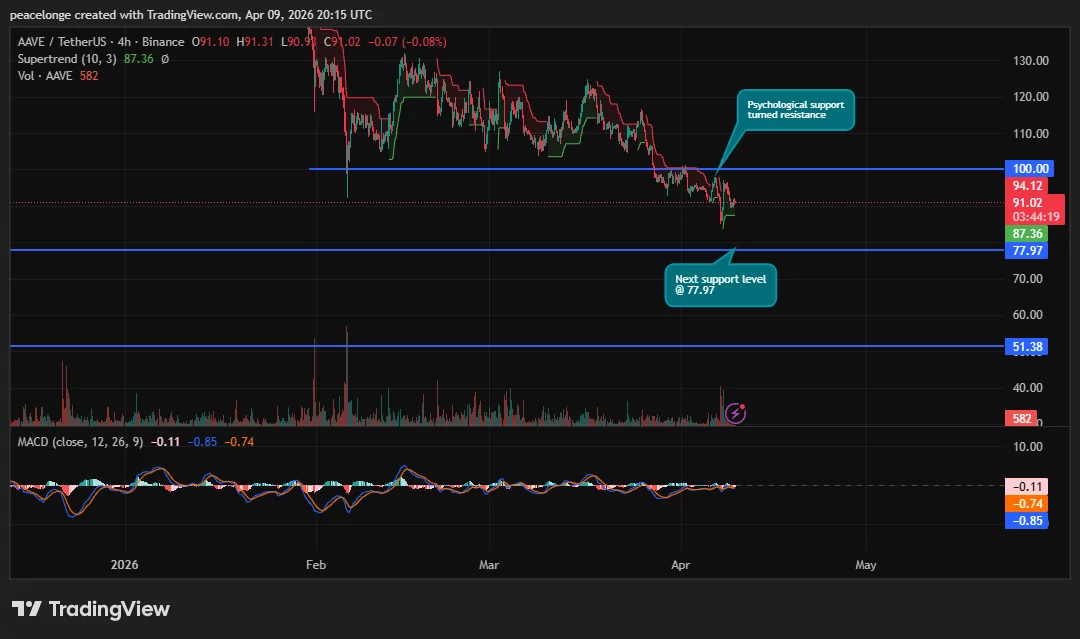
AAVE price is holding just below $100 on April 9, a level that has shifted from multi-week support to confirmed resistance following this week’s sharp breakdown. With the 4H Supertrend red and the MACD histogram printing at a deeply negative 0.85, the next meaningful floor sits at $77.97.
Summary
- AAVE price is trading at $91.02 on April 9, effectively flat on the session, as the $100 psychological level confirms its role as resistance following the intraday crash to $83.92 on April 6.
- The 4H Supertrend (10,3) is bearish at $87.36 and the MACD histogram is printing a deeply negative 0.85, with no reversal signal visible on either indicator.
- The next key support sits at $77.97; a break below it opens the $51.38 structural floor, while a daily close above $100 invalidates the bearish setup.
Aave (AAVE) price is trading at $91.02 on April 9, near flat on the session, as the $100 level confirms its transformation from support to resistance on the 4-hour chart. The Supertrend indicator is red at $87.36, the MACD histogram is printing a deeply negative reading of 0.85, and price has failed to reclaim $100 since breaking below that level following the sharp intraday drop to $83.92 on April 6. The next annotated floor on the chart sits at $77.97, the primary downside target if current levels give way.
The 4-hour chart confirms a clear structural shift at $100. AAVE spent much of February and March trading above that level, and the breakdown this week has left the zone acting as overhead resistance. The chart labels $100 explicitly as psychological support turned resistance, with the immediate intraday ceiling at $94.12 capping every recovery attempt since the break lower.
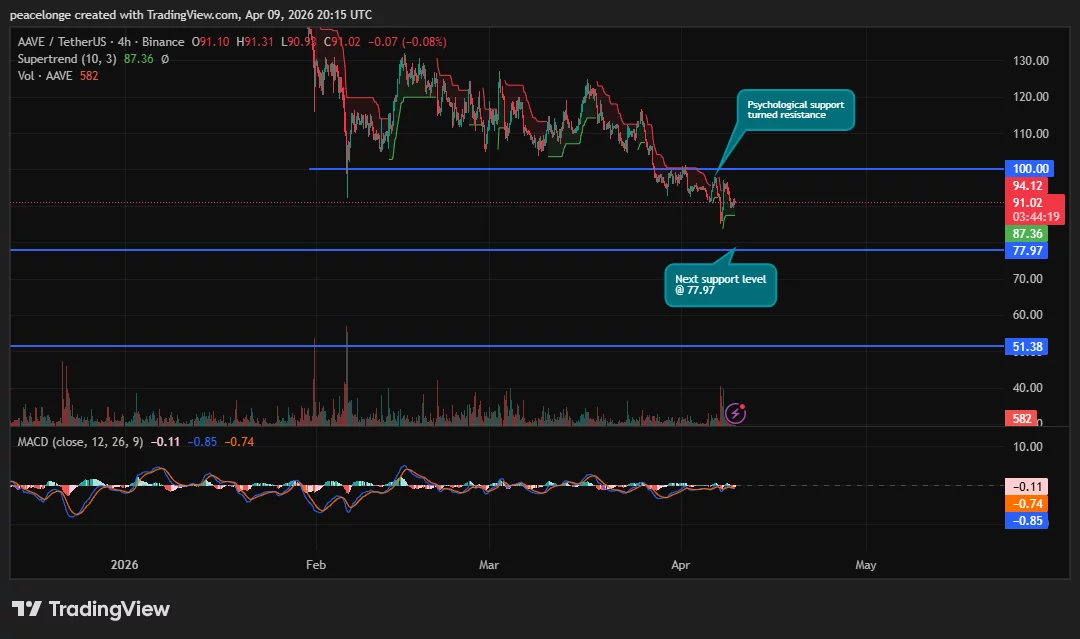
The 4H Supertrend (10,3) reads red at $87.36, a dynamic level now acting as a near-term downside magnet. The MACD (12,26,9) offers no relief: the MACD line is negative at 0.11, the signal negative at 0.74, and the histogram printing a deeply negative 0.85, placing sellers firmly in control of momentum with no reversal signal forming on either timeframe.
Aave founder Stani Kulechov stated on X that the protocol’s risk infrastructure has “historically processed over 1,200 payloads and 3,000 parameters without issues,” but the exit of BGD Labs as core technical contributor on April 1, citing governance tensions ahead of the V4 development cycle, continues to weigh on market confidence in the near term.
Key Levels: Support, Resistance, and Price Targets
The immediate resistance is $94.12, the intraday ceiling since the April 6 breakdown. Above that, $100 is the key structural level bulls must reclaim to shift the near-term bias. A daily close above $100 is the minimum condition for a structural recovery attempt and the invalidation level for the current bearish thesis.
On the downside, $87.36 marks the 4H Supertrend level. A 4H close below it removes the last dynamic buffer and opens $77.97, the next annotated support on the chart. Below $77.97, the $51.38 level represents major structural support, territory AAVE has not traded near in several years.
Invalidation: a daily close above $100.
On-Chain and Market Data Context
According to Coinglass, AAVE open interest remained elevated in the sessions following the April 6 liquidation event, with the intraday crash to $83.92 triggering significant forced selling before a partial recovery to current levels. AAVE has underperformed the broader market over the past 30 days, down approximately 20% as DeFi sector sentiment deteriorated.
The BGD Labs departure and the earlier exit of the Aave Chan Initiative have left the protocol navigating its V4 transition without several of its original technical contributors. Governance risk now compounds price risk for holders ahead of what was meant to be Aave’s most significant upgrade cycle.
If AAVE fails to reclaim $94.12 on a closing basis in the near term, $77.97 becomes the primary downside target, with $51.38 the structural floor below.
The US Department of the Treasury’s Office of Cybersecurity and Critical Infrastructure Protection (OCCIP) announced on Thursday that it is expanding its cybersecurity threat identification program to include digital asset companies.
Blockchain companies that choose to take part in the program will receive the same cybersecurity threat intelligence provided to traditional financial institutions at “no cost,” according to the Treasury’s announcement.
“Cyber threats targeting digital asset platforms are growing in frequency and sophistication,” Cory Wilson, the deputy assistant secretary for cybersecurity at the OCCIP, said.

The initiative fulfills policy recommendations from US President Donald Trump’s administration, outlined in its July 2025 report, titled “Strengthening American Leadership in Digital Financial Technology.”
Cointelegraph reached out to the Department of the Treasury but did not receive a response by the time of publication.
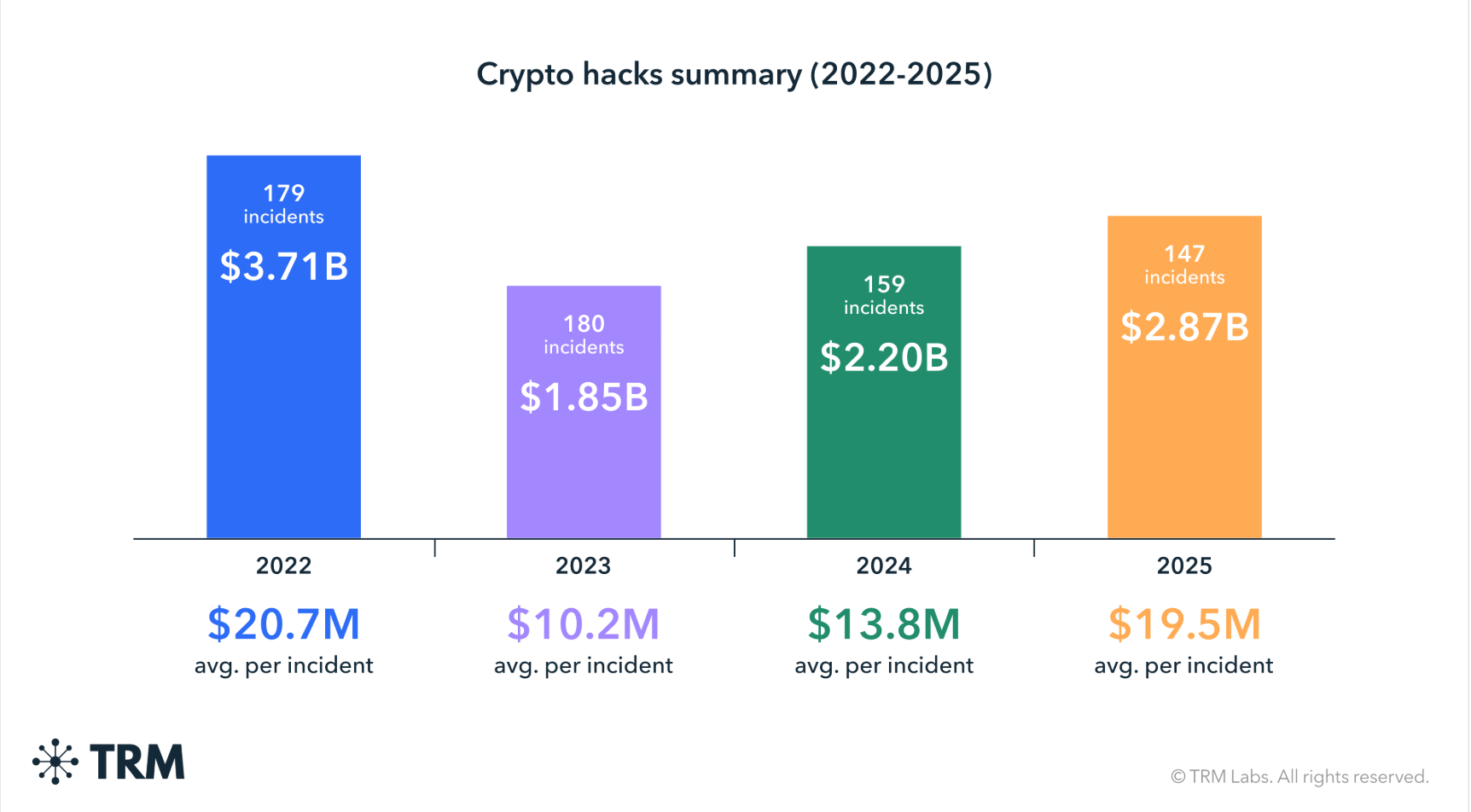
The initiative reflects the ongoing challenge of countering evolving cybersecurity threats impacting blockchain protocols and their users, as financial losses from decentralized finance (DeFi) platform hacks alone reached nearly $169 million in the first quarter of this year.
Related: Google Threat Intel flags ‘Ghostblade’ crypto-stealing malware
Foreign intelligence operatives continue infiltrating crypto projects and companies
Crypto projects and users are increasingly subject to evolving cybersecurity threats, which can be carried out by social engineering or infiltration by state-affiliated hackers, including the North Korean-linked Lazarus Group.
Drift Protocol, a decentralized cryptocurrency exchange, suffered a $280 million exploit this month at the hands of suspected North Korean-affiliated hackers.
The Drift team physically met the malicious actors at a “major” crypto industry conference and interacted with them for months after the initial meeting, according to a preliminary incident report from Drift Protocol.

During the months-long interaction, the hackers deployed crypto-stealing malware on the Drift team’s developer machines, which was activated in the April exploit.
The individuals who first approached the Drift team at the industry conference were not North Korean nationals, according to the report.
The Seals911 team, a group of blockchain cybersecurity specialists, said with “medium-high confidence” that the attack was likely carried out by the same hacker group responsible for the October 2024 hack of the Radiant Capital DeFi platform.
Magazine: Lazarus Group’s favorite exploit revealed — Crypto hacks analysis

TLDR
- Ripple minted 2,000,000 RLUSD on the Ethereum network on April 9.
- The new supply carried an estimated value of about $2 million.
- The transaction used a gas fee of about 0.0000195 ETH.
- Ripple moved the minted tokens to wallet 0xFbcA8B5f…0Db600BB6.
- The transaction followed Ripple’s ongoing supply management across Ethereum and the XRP Ledger.
Ripple added 2,000,000 RLUSD to Ethereum on April 9, according to the Ripple Stablecoin Tracker. The mint was estimated to be worth $2 million. The transaction also used about 0.0000195 ETH in gas fees.
RLUSD Mint Expands Ethereum Supply
Tracker data showed Ripple created the tokens from a null address. It then sent the full amount to wallet 0xFbcA8B5f…0Db600BB6.
The transaction followed the standard token issuance flow on Ethereum. In this process, issuers mint assets and then move them to a destination wallet.
RLUSD kept its stated 1:1 value with the U.S. dollar during the mint. As a result, the new supply represented about $2 million.
The blockchain record placed the activity on Thursday, April 9. Ripple Stablecoin Tracker displayed the movement shortly after the transaction appeared.
The wallet transfer formed the second step of the issuance process. Ripple first created the supply and then moved it into circulation.
The gas fee stayed near 0.0000195 ETH for the Ethereum transaction. That cost covered the mint and transfer activity on-chain.
Ripple has used Ethereum and the XRP Ledger for RLUSD operations. This latest transaction added fresh supply only on Ethereum.
Ripple Continues Daily RLUSD Supply Management
Ripple has continued to remove and mint RLUSD across supported networks since launch. Its supply actions have appeared regularly on Ethereum and the XRP Ledger.
The company has kept that pattern in place for about a year. Tracker updates have shown both token burns and new mints during that period.
The fresh mint pointed to another treasury action by Ripple. The company used the transaction to place new RLUSD into a designated wallet.
Market participants have linked these moves to liquidity management. They have also tied them to routine treasury rebalancing across supported blockchains.
The transfer record showed no public statement attached to the mint. Still, the on-chain data confirmed the token creation and the destination address.
The update also matched Ripple’s practice of adjusting RLUSD supply in measured amounts. That pattern has continued through repeated blockchain entries.
Ripple has presented RLUSD as a stablecoin pegged to the U.S. dollar. The April 9 Ethereum transaction added 2,000,000 more RLUSD to that circulating supply.

TLDR:
- Bitmine officially uplisted to the NYSE on April 9, 2026, trading under its existing ticker symbol BMNR.
- The company’s share repurchase program was expanded from $1 billion to $4 billion, one of 2026’s largest buybacks.
- Bitmine holds 4.803 million ETH, representing 3.98% of the total Ethereum supply after just nine months of accumulation.
- Institutional backers, including ARK’s Cathie Wood, Pantera, and Founders Fund continue to support Bitmine’s 5% ETH goal.
Bitmine Immersion Technologies has officially uplisted to the New York Stock Exchange, beginning trade under the ticker BMNR on April 9, 2026.
The company simultaneously expanded its share repurchase authorization from $1 billion to $4 billion. As of April 6, 2026, Bitmine holds approximately 4.803 million ETH, representing 3.98% of the total Ethereum supply.
The company has now crossed 79% of its stated goal of acquiring 5% of total ETH supply within just nine months.
Bitmine Joins the NYSE Big Board With a $4 Billion Buyback Program
Bitmine’s common stock began trading on the NYSE at market open on April 9, 2026. The company previously listed on NYSE American, where trading concluded at market close on April 8, 2026. This transition to the main board positions Bitmine among a more elite group of publicly traded companies.
Chairman Thomas Lee marked the moment with a formal statement on the milestone. “Today, Bitmine achieved a major milestone by being uplisted to the ‘Big Board’ NYSE,” Lee said.
“The NYSE is the most prestigious venerable stock exchange with a storied history. The NYSE is the envy of capital markets around the world and Bitmine is proud to be the newest company traded on this exchange.”
Chris Taylor, NYSE Group Chief Development Officer, also issued a formal welcome. “We are pleased to welcome Bitmine to the New York Stock Exchange,” Taylor said.
“With its focus on advancing the Ethereum ecosystem, Bitmine is a strong addition to the NYSE community.” The statement coincided with the commencement of BMNR trading on the exchange.
Bitmine’s Board of Directors unanimously approved the expansion of its repurchase program to $4 billion. The authorization was originally established on July 25, 2025, and continues under its previous terms.
According to Fundstrat, this buyback ranks among the 10 largest corporate repurchase programs announced in 2026.
Ethereum Accumulation and Institutional Backing Drive Bitmine’s Strategy
As of April 6, 2026, Bitmine holds approximately 4.803 million ETH tokens, equal to 3.98% of total supply. The company accumulated this position over nine months as part of its “Alchemy of 5%” goal. At its current pace, Bitmine has completed over 79% of its total ETH acquisition target.
Bitmine’s combined crypto, cash, and other holdings total $11.4 billion. This figure includes the ETH position, $864 million in total cash, and other crypto assets the company classifies as “Moonshots.”
The company continues to attract strong institutional support for its ETH accumulation strategy. Backers include ARK’s Cathie Wood, Founders Fund, Pantera Capital, Kraken, DCG, Galaxy Digital, MOZAYYX, and Bill Miller III.
Lee also addressed the rationale behind the expanded buyback program. “Bitmine’s expanded $4 billion buyback reflects our commitment to shareholders,” he stated.
“There may be a time in the future when Bitmine shares are trading below intrinsic value, and the Company wants to be in a position to accretively retire common shares.”


The crypto regulation standoff between Coinbase and the US Senate intensified this month when the exchange formally told Senate offices it cannot support the latest CLARITY Act draft, marking its second withdrawal from legislation that could define US digital asset law for a generation.
Summary
- Coinbase told Senate Banking Committee offices it has significant concerns about the Tillis-Alsobrooks compromise draft, which bans passive yield on stablecoin balances and restricts access to transaction size data used to calculate rewards, changes that attack the infrastructure Coinbase uses to generate stablecoin revenue rather than just limiting a single product feature
- Coinbase reported $1.35 billion in stablecoin revenue in 2025, largely tied to its USDC distribution agreement with Circle; provisions eliminating stablecoin yield could strip the exchange of an estimated $800 million in annual revenue, making this a core financial question rather than a policy objection
- CEO Brian Armstrong first pulled support in January, stating “we’d rather have no bill than a bad bill”; the second formal withdrawal, reported by Punchbowl News around March 25, followed a revised draft that tightened yield language further rather than loosening it
As TheStreet reported, Coinbase representatives told Senate offices the exchange could not yet support the latest version, citing significant concerns about the stablecoin yield language. Armstrong confirmed talks are ongoing. The Tillis-Alsobrooks draft goes beyond the base bill’s existing yield limitations by also restricting exchange access to transaction size data, which is the calculation layer that makes volume-based or activity-based stablecoin rewards technically feasible. For Coinbase, that second provision is the more alarming one because it removes not just a product feature but the technical infrastructure needed to generate yield at all.
Stablecoin revenue represents close to 20 percent of Coinbase’s total 2025 revenue. Under its USDC agreement with Circle, Coinbase receives most of the interest income on USDC held on its platform. Any restriction eliminating the structural capacity to calculate or distribute yield attacks that revenue line directly. Every round of negotiation since January has narrowed the yield carve-outs, not expanded them. Coinbase’s leverage is real: a markup without its endorsement signals to senators on both sides that industry consensus has fractured, and the bill needs bipartisan votes it cannot afford to lose.
The Industry Split and What It Means
Coinbase is not the whole industry. Andreessen Horowitz and other major investors have publicly supported the CLARITY Act even in its current form, arguing that the institutional legitimacy the bill provides outweighs stablecoin revenue concessions. An industry call in late March reportedly featured sharp disagreements over how to proceed. As crypto.news has reported, the CLARITY Act faces four factions each with effective veto power, and Coinbase’s withheld support does not automatically kill the bill but significantly complicates the vote count.
What the May Deadline Means for Both Sides
As crypto.news has noted, the GENIUS Act’s stablecoin framework advances through financial regulators regardless of CLARITY’s fate. What CLARITY provides, including SEC and CFTC jurisdictional clarity, DeFi oversight rules, and tokenized equity frameworks, has no alternative legislative path. Senator Bernie Moreno has warned that missing May risks losing the bill to midterm season entirely. The Senate Banking Committee markup target remains late April, and Coinbase’s continued refusal to endorse the draft is the single largest obstacle between that target and an actual vote.

Bissell recalls steam cleaners after reports of ‘serious’ burn hazards

Morgan Stanley Enters ETF Arena, Eyes BlackRock’s Dominance

Leonard Miller’s career night paces Bulls to 119-108 win over Wizards


-

 Fashion6 days ago
Weekend Open Thread: Spanx – Corporette.com
-

 Business4 days ago
Three Gulf funds agree to back Paramount’s $81 billion takeover of Warner, WSJ reports
-

 Sports5 days ago
India men’s 4x400m and mixed 4x100m relay teams register big progress | Other Sports News
-

 Business6 days ago
Expert Picks for Every Need
-

 Tech2 days ago
How Long Can You Drive With Expired Registration? What Florida Law Says
-

 Business5 days ago
No Jackpot Winner, Prize to Climb to $231 Million
-

 Fashion4 days ago
Massimo Dutti Offers Inspiration for Your Summer Mood Board
-

 Fashion2 days ago
Let’s Discuss: DEI in 2026
-
Politics7 days ago
Wings Over Scotland | The quality of mercy
-

 Crypto World1 day ago
Bitcoin recovers as US and Iran Agree a Ceasefire Deal
-

 Business5 days ago
Akebia Therapeutics, Inc. (AKBA) Discusses Pipeline Progress and Strategic Focus on Kidney Disease Treatments at R&D Day – Slideshow
-

 Politics7 days ago
East Jerusalem Palestinian families eviction orders
-

 Politics7 days ago
Why so many children are now classified as ‘disabled’
-

 Crypto World13 hours ago
Canary Capital Files SEC Registration for PEPE ETF
-

 Politics6 days ago
The UK should not pay a penny in slavery reparations
-

 Politics7 days ago
Nuclear rockets, moon bases and NASA’s Mars plan
-

 Tech7 days ago
The Threadless Ball Screw Never Took Off, But Don’t Write It Off
-
 Business7 days ago
HPS FY 2025 slides: SaaS inflection drives 22% revenue growth
-

 Fashion7 days ago
Tory Burch’s Spring 2026 Campaign Goes on a Getaway
-

 Fashion7 days ago
Frugal Friday’s Workwear Report: Hammered Metallic Button Sweater Vest
You must be logged in to post a comment Login