
Crypto World
US Treasury To Give Crypto Industry Cybersecurity Intelligence at ‘No Cost’

The US Department of the Treasury’s Office of Cybersecurity and Critical Infrastructure Protection (OCCIP) announced on Thursday that it is expanding its cybersecurity threat identification program to include digital asset companies.
Blockchain companies that choose to take part in the program will receive the same cybersecurity threat intelligence provided to traditional financial institutions at “no cost,” according to the Treasury’s announcement.
“Cyber threats targeting digital asset platforms are growing in frequency and sophistication,” Cory Wilson, the deputy assistant secretary for cybersecurity at the OCCIP, said.

The initiative fulfills policy recommendations from US President Donald Trump’s administration, outlined in its July 2025 report, titled “Strengthening American Leadership in Digital Financial Technology.”
Cointelegraph reached out to the Department of the Treasury but did not receive a response by the time of publication.
The initiative reflects the ongoing challenge of countering evolving cybersecurity threats impacting blockchain protocols and their users, as financial losses from decentralized finance (DeFi) platform hacks alone reached nearly $169 million in the first quarter of this year.
Related: Google Threat Intel flags ‘Ghostblade’ crypto-stealing malware
Foreign intelligence operatives continue infiltrating crypto projects and companies
Crypto projects and users are increasingly subject to evolving cybersecurity threats, which can be carried out by social engineering or infiltration by state-affiliated hackers, including the North Korean-linked Lazarus Group.
Drift Protocol, a decentralized cryptocurrency exchange, suffered a $280 million exploit this month at the hands of suspected North Korean-affiliated hackers.
The Drift team physically met the malicious actors at a “major” crypto industry conference and interacted with them for months after the initial meeting, according to a preliminary incident report from Drift Protocol.

During the months-long interaction, the hackers deployed crypto-stealing malware on the Drift team’s developer machines, which was activated in the April exploit.
The individuals who first approached the Drift team at the industry conference were not North Korean nationals, according to the report.
The Seals911 team, a group of blockchain cybersecurity specialists, said with “medium-high confidence” that the attack was likely carried out by the same hacker group responsible for the October 2024 hack of the Radiant Capital DeFi platform.
Magazine: Lazarus Group’s favorite exploit revealed — Crypto hacks analysis


Key Highlights
-
DVLT shares advance following CyberCatch acquisition announcement
-
Stock climbs 3.05% on news of all-stock transaction with CyberCatch Holdings
-
Acquisition brings AI-powered compliance and security capabilities to Datavault
-
Deal broadens company’s cybersecurity portfolio amid rising industry demand
-
DVLT strengthens position in AI cybersecurity sector through strategic buyout
Shares of Datavault AI (DVLT) climbed following the company’s announcement of a binding agreement to purchase CyberCatch Holdings through an all-stock deal. The stock reached $0.7479, representing a 3.05% increase, though it retreated from an earlier peak above $0.79. This acquisition positions Datavault AI to capitalize on expanding cybersecurity needs across sectors including defense, healthcare, financial services, and data management.
Strategic Acquisition Agreement Outlined
The company entered into a binding letter of intent for a complete acquisition of CyberCatch through an all-stock arrangement. Following completion, CyberCatch will operate as a fully owned subsidiary. The transaction is structured to proceed via a court-sanctioned plan of arrangement in accordance with British Columbia corporate regulations.
The agreement stipulates that Datavault AI will purchase approximately 26.8 million outstanding CyberCatch common shares. In return, CyberCatch’s existing shareholders will receive roughly 49.9 million newly created Datavault AI shares. This exchange assigns a valuation of approximately CAD $136.84 million to CyberCatch’s equity.
Following transaction completion, existing Datavault AI shareholders will retain approximately 92.48% ownership of the merged entity. Former CyberCatch shareholders will control around 7.52% on a non-diluted basis. The San Diego-based CyberCatch operation will remain under the leadership of its founder and chief executive, Sai Huda.
Platform Capabilities and Market Opportunity
CyberCatch operates an AI-driven platform designed for continuous cybersecurity compliance verification and cyber risk reduction. The system performs automated control assessments, evaluates security posture, and executes persistent penetration testing. Results are aligned with prominent regulatory frameworks such as CMMC, NIST, ISO 27001, HIPAA, and PCI DSS.
This transaction positions Datavault AI within a substantial and growing market segment. According to Gartner forecasts, global information security expenditures are anticipated to hit $240 billion by 2026. Furthermore, the research firm predicts the AI-enhanced security market will expand to $160 billion by 2029.
CyberCatch’s offerings address increasing regulatory pressure on organizations, particularly in defense contracting. The U.S. Cybersecurity Maturity Model Certification (CMMC) program launched its initial phase in November 2025. Required third-party compliance assessments for Level 2 contracts take effect in November 2026.
Integration Strategy and Technology Synergies
Datavault AI intends to integrate CyberCatch’s capabilities as a foundational security component throughout its existing technology infrastructure. This encompasses the company’s DataValue, DataScore, and Information Data Exchange solutions. Management anticipates the platform will enable secure processing of workloads subject to regulatory oversight.
The acquisition aligns with Datavault AI’s quantum-resistant edge computing initiatives. CyberCatch has been advancing MARS-MABE encryption technology designed to enhance access management and credential revocation capabilities. This innovation could facilitate secure data operations across healthcare institutions, defense contractors, financial firms, manufacturing operations, and energy providers.
Several conditions remain before transaction completion, including execution of definitive documentation, completion of due diligence reviews, board authorization from both entities, CyberCatch shareholder consent, and judicial approval. Regulatory clearance from both Nasdaq and the TSX Venture Exchange is also required. The parties have committed to a 45-day exclusive negotiation window to finalize binding terms.

Crypto World
Tether posts $1.04 billion in first-quarter profit, reaches $8.23 billion reserve buffer


Tether, issuer of the largest stablecoin by market capitalization, said first-quarter net profit was $1.04 billion and excess reserves increased to a record $8.23 billion.
The company did not provide year-earlier or fourth-quarter figures. It reported a net profit of more than $10 billion for all of 2025.
The amount of the dollar-pegged USDT in circulation remained stable, with total token-related liabilities of about $183 billion as of March 31, the firm said in its quarterly report. The company’s total assets are just under $192 billion, it said.
The report was released at a time of increasing global demand for stablecoins as they find uses outside crypto trading as a mechanism for international payments. Just this week, Visa announced expansion of its stablecoin settlement pilot to nine blockchains, adding Base, Polygon, Canton Network, Arc and Tempo to existing support for Ethereum, Solana, Avalanche and Stellar.
Excess reserves, up from $6.3 billion at end-2025, were supported by “continued profitability and a reserve base concentrated in short-duration, high-quality liquid instruments,” the company said.
USDT is the third-largest cryptocurrency, behind bitcoin and ether (ETH), with a market capitalization of just under $190 billion.
The majority of Tether’s reserves are held in U.S. government-backed instruments and short-term liquidity facilities, the firm said, adding that it is the 17th-largest holder of U.S. Treasuries globally. Tether has become a top 10 buyer of U.S. Treasuries over the past two years, surpassing Taiwan, Israel and the UAE.
Its physical gold holdings are roughly $20 billion and its bitcoin reserve is approximately $7 billion, it said.


Major US banking trade groups have asked the Treasury Department and the FDIC to pause three GENIUS Act rulemaking comment periods until the OCC finalises its primary stablecoin framework, while stablecoin startup Agora simultaneously filed for a national trust bank charter on April 24 to establish a federal presence before the rules harden.
Summary
- The American Bankers Association and the Bank Policy Institute asked Treasury and the FDIC to wait 60 days after the OCC finishes its framework before running parallel comment periods, arguing the proposals are structurally interdependent.
- Agora CEO Nick van Eck called the banks’ stance “not much of a surprise,” adding that their real concern is deposit flight and the loss of yield spread between near-zero deposit rates and Fed reserves.
- Van Eck said Agora’s charter, if approved by year-end, would allow the company to issue stablecoins directly under federal oversight and eliminate what he called “egregious fees” in fiat-to-crypto on/off ramps.
The GENIUS Act banking groups officially pushed back on April 22 when the American Bankers Association, the Bank Policy Institute, and two other trade associations wrote to the Treasury Department and the FDIC requesting extended comment periods on three proposed implementation rules. As crypto.news reported, the groups argued that the Treasury’s equivalency rule, the FDIC’s issuer standards rule, and the FinCEN-OFAC anti-money-laundering directive are all “substantively tethered” to the OCC’s pending framework and cannot be meaningfully assessed until the OCC publishes its final rule. The GENIUS Act, signed into law in July 2025, is scheduled to take effect no later than January 18, 2027.
“This is not much of a surprise,” van Eck said of the banking sector’s response, calling the law “one of the most significant pieces of banking legislation in our generation.” He said banks’ deeper concern is the prospect of users moving deposits to stablecoin platforms that can pass through higher yields, eroding the spread between near-zero deposit rates and returns banks earn at the Federal Reserve. Agora’s counter-move was to file for a national trust bank charter with the OCC on April 24, positioning the firm to issue stablecoins directly under federal oversight rather than waiting for the broader rulemaking to settle. Van Eck said a federal charter would eliminate “egregious fees” in fiat-to-crypto conversion infrastructure and allow Agora to expand into custody, compliance, and payments.
As crypto.news documented, the OCC released its proposed stablecoin rulebook in February 2026, covering issuance, reserves, supervision, and redemption requirements for permitted payment stablecoin issuers. That proposal opened a 60-day comment window that closed May 1. As crypto.news tracked, the Treasury separately proposed its own rules covering state-level oversight for issuers under $10 billion, with a June 2 comment deadline. Banks are effectively seeking to collapse the three separate timelines into a single coordinated process, which analysts say could delay the GENIUS Act’s activation by several months and give traditional lenders more time to assess the competitive threat from nonbank stablecoin issuers before the rules are locked.
Coinbase Asset Management announced CUSHY on April 30, a tokenised stablecoin credit fund for qualified institutional investors running on Ethereum, Solana, and Base, with Apollo handling private credit origination, Superstate issuing tokenised shares via FundOS, and Northern Trust administering the fund.
Summary
- Coinbase CUSHY targets yield from three sources: public digital credit, private asset-based lending through Apollo, and structural alpha from tokenisation incentives and on-chain market positions.
- CUSHY is the first external fund issued on Superstate’s FundOS platform, which already manages over $1 billion in AUM through Superstate’s own USTB and USCC products.
- COIN stock rose 3.7% on the April 30 announcement as the fund arrives amid the CLARITY Act debate over whether stablecoin yield can be offered directly to users.
Coinbase CUSHY was unveiled on April 30 by Coinbase Asset Management, positioning the product as a bridge between traditional fixed-income markets and on-chain settlement infrastructure. As crypto.news reported, the strategy is structured as a diversified credit fund where qualified investors access tokenised shares across Ethereum, Solana, and Base, with Coinbase Prime handling custody and trading. “With CUSHY, we are fusing the high-velocity efficiency of digital rails with the institutional rigour of traditional credit,” said Anthony Bassili, President of Coinbase Asset Management. The fund is expected to launch in Q2 2026.
The partnership structure behind CUSHY distinguishes it from earlier tokenised fund experiments. Superstate, which operates as an SEC-approved transfer agent and already runs $1 billion-plus across its USTB and USCC fund strategies, provides the FundOS infrastructure. Apollo brings private credit origination to the fund, funnelling asset-based lending exposure to both crypto-native and traditional borrowers. Superstate CEO Robert Leshner noted that CUSHY could eventually expand into decentralised finance use cases, and said several additional asset managers are expected to adopt FundOS in coming months.
As crypto.news documented, Coinbase’s head of investment research David Duong had projected that stablecoins and tokenised credit would form a core pillar of institutional crypto adoption in 2026, citing regulatory clarity from the GENIUS Act as the enabling condition. CUSHY’s launch lands as the CLARITY Act debate over stablecoin yield reaches its most critical window, with the Senate Banking Committee markup expected the week of May 11. CUSHY’s structure as a credit fund rather than a direct yield-bearing stablecoin product means it sits outside the specific yield restrictions that banking groups have lobbied hardest to enforce, giving the product regulatory insulation that a pure stablecoin yield wrapper would not have. As crypto.news tracked, Coinbase’s broader stablecoin stack has been expanding rapidly, with Apollo credit strategies and BlackRock tokenisation agreements adding institutional weight to the infrastructure CUSHY is built on.


Bitcoin has reclaimed $78,000 on Gate’s BTC/USDT pair, extending a rebound from $76,000 and keeping the market within range of the closely watched $80,000 level.
Summary
- Gate’s BTC/USDT market shows Bitcoin trading at about $78,004, up 2.15% over the past 24 hours and back above a key resistance area traders have been watching all week.
- The move extends a broader rebound from lows near $76,000, keeping BTC within striking distance of the psychologically important $80,000 level highlighted in recent price commentary.
- Derivatives and ETF flows remain the main drivers, with prior sessions already seeing BTC oscillate between the mid‑$70,000s and just under $79,000 as traders test the upper end of the current range.
According to spot data from Gate, the BTC/USDT pair is currently changing hands around $78,004, marking a roughly 2.15% gain over the last 24 hours.
Gate quotes BTC above $78,000 after latest push higher
That lift puts Bitcoin back above the $78,000 line that has acted as a near-term ceiling in recent sessions, with multiple exchanges reporting repeated tests of the high‑$70,000s but little sustained time above that zone.
External price trackers cited by outlets such as Fortune and LatestLY have likewise noted BTC oscillating between roughly $76,000 and $79,000 as the market digests earlier gains and watches for a clean break toward $80,000.
Why the $78,000 level matters for traders
While the difference between $76,000 and $78,000 may seem marginal in percentage terms, the current band sits just below a widely watched round‑number milestone at $80,000.
As yellow.com pointed out in a recent note, BTC’s ability to hold above roughly $78,000 has coincided with rising retail search interest and renewed ETF inflows, both of which can add incremental spot demand when sentiment leans bullish.
In earlier coverage, LatestLY highlighted resistance near $78,500 as the last major hurdle before a potential run at $80,000, framing the current zone as a “launch pad” rather than a destination if macro conditions and flows stay supportive.
For intraday traders, the reclaim of $78,000 on venues like Gate often becomes a reference level for short‑term strategies: staying above it can keep the bias tilted toward testing $79,000–$80,000, while a failure back below may invite another round of mean‑reversion trades toward the mid‑$70,000s.
Longer‑term holders, meanwhile, tend to focus more on how these levels line up with broader trends in ETF flows, exchange reserves, and macro indicators like the dollar index and Federal Reserve expectations, factors covered in previous crypto.news pieces on Bitcoin’s approach to $80,000 and beyond.
TLDR
- Ripple burned about $120 million worth of RLUSD on April 30 through two separate transactions.
- The burn ranks as the second-largest intraday RLUSD reduction recorded on the XRP Ledger.
- The transactions reduced RLUSD supply on the XRP Ledger to about $253 million.
- Ethereum now holds about 82.5% of the total RLUSD supply after the latest burn.
- Historical data shows Ripple often follows large burns with early-month mint activity.
Ripple executed large RLUSD burn transactions on April 30, reducing supply across networks. The company removed about $120 million through two separate ledger entries. Data shows a repeated monthly pattern tied to liquidity adjustments.
RLUSD Burn Activity Reduces Supply on XRPL
Ripple processed two burn transactions on the XRP Ledger within hours on April 30. The first transaction removed $85 million worth of RLUSD at 15:46 UTC.
Later, Ripple completed another burn of 34.248 million RLUSD at 21:24 UTC. Together, these transactions totaled $119.25 million removed from circulation.
The burn reduced RLUSD supply held on the XRP Ledger. Current data shows only $253 million remains on XRPL after the reduction.
Meanwhile, most RLUSD supply sits on Ethereum. About $1.191 billion, or 82.5%, remains outside the XRP Ledger.
A tracker created by validator Vet recorded both transactions. Vet stated, “This marks one of the largest intraday RLUSD burns recorded.”
The tracker confirms the event ranks as the second-largest burn in a single day. Only the March 31 burn exceeded this volume.
Monthly RLUSD Pattern Points to Incoming Mint Activity
Historical data shows Ripple follows large burns with early-month minting. This pattern has repeated across several recent months.
On Dec. 31, 2025, Ripple burned $58 million in RLUSD. It then minted $67.6 million on Jan. 2, 2026.
The company repeated this pattern in late January. It burned $93.2 million before minting $102 million in early February.
In late February, Ripple removed $88.7 million in RLUSD. It then minted the same amount on March 2.
March recorded the largest burn event so far. Ripple removed $179 million on March 31 across networks.
Early April followed with a mint of $123.6 million. These transactions occurred within the first two days of the month.
Vet referenced this trend and said, “Large burns often precede similar mint volumes shortly after.” The data supports this recurring sequence.
RLUSD Supply Distribution and Market Position
The recent burn lowered RLUSD circulating supply on the XRP Ledger. The total supply now reflects a sharp shift toward Ethereum holdings.
XRPL currently hosts only 17.5% of RLUSD supply. This marks a drop after repeated burn transactions.
Ethereum continues to hold the majority share. Its 82.5% portion reflects ongoing distribution changes.
Despite supply changes, RLUSD remains among the top stablecoins. It currently ranks eighth by market capitalization.
Data shows RLUSD needs about $1 billion growth to reach seventh place. Current figures place it behind competitors in that ranking.
Burn and mint cycles continue to shape RLUSD supply levels. The next mint activity may occur in early May based on prior timing.
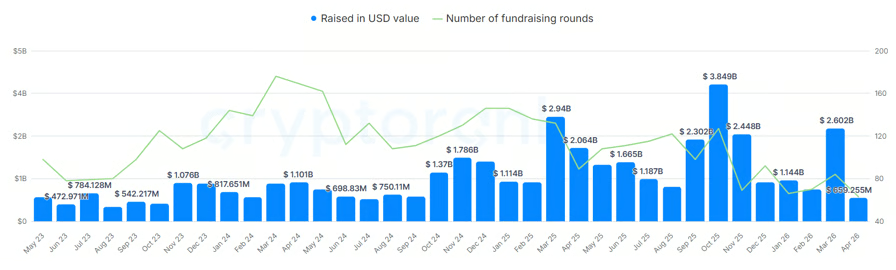
Crypto venture capitalist (VC) funding plunged to a near two-year low in April as investors pulled back from crypto start-ups and early-stage companies.
Crypto VC funding fell to $659 million across 63 funding rounds in April, down 74% from the $2.6 billion seen across 84 rounds in March, according to Cryptorank data. This brings the total year-to-date investments to $5.64 billion so far in 2026.
The April total was the lowest monthly fundraising sum since July 2024, when crypto projects raised $622 million across 132 rounds.
The drop suggests venture investors became more selective as crypto markets remained under pressure following months of weaker liquidity and risk appetite.
Monthly VC funding has been declining since October 2025, when crypto projects raised $3.84 billion across 127 funding rounds. The global crypto market cap has since fallen by 37%, according to CoinGlass data.
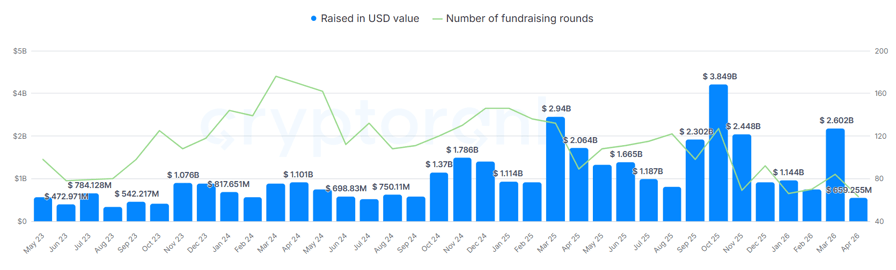
Crypto fundraising, US dollars, three-year chart. Source: Cryptorank
Decentralized finance (DeFi) protocols attracted the most deal activity in April, with 12 funding rounds, according to CryptoRank. Blockchain services and artificial intelligence-linked crypto projects followed with eight rounds each.
Related: Switzerland’s Crypto Valley funding rose 37% in 2025 as TON led deals
GSR emerges as most active investor of the month
Crypto market maker GSR’s VC wing was the most active investor of the past month, with four investment rounds, including a $3.5 million seed round in DeFi protocol Legend Trade on Wednesday, a $4 million seed round in DeFi protocol 3F on April 23, a $1 million pre-seed round in Enhanced Finance on April 9 and an undisclosed investment in real-world asset tokenization protocol Libeara on April 8.
Zurich-based digital asset-focused investment manager L1 Digital (L1D) was second with three investments, including a $5 million seed round in crypto exchange Exponent on Thursday, an $18 million strategic investment in infrastructure provider Squads on Wednesday and a $7.5 million Series A investment into blockchain services company Oh on April 8.
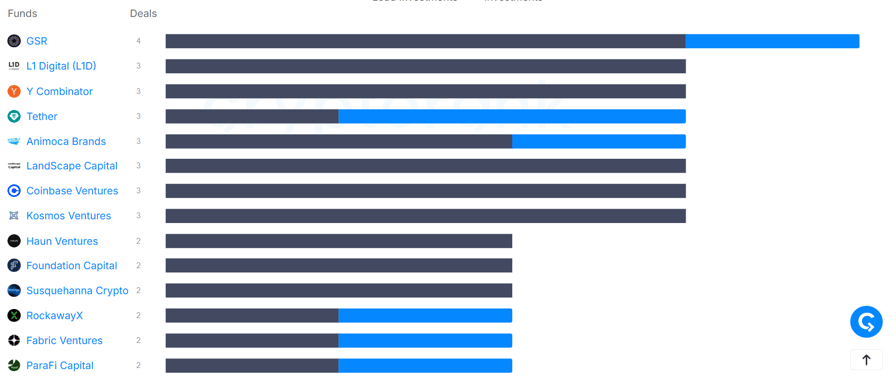
Most active investors by deal count for April, 2026. Source: Cryptorank
Y Combinator, Tether, Animoca Brands, landScape Capital, Coinbase Ventures and Kosmos Ventures also participated in three deals each during the month.
Magazine: How crypto laws changed in 2025 — and how they’ll change in 2026
Crypto World
AI Agent gets EIN from IRS, bank account, crypto wallet in first autonomous company filing


ClawBank, an agent-economy infrastructure project, said its Manfred AI agent became the first such entity to autonomously set up a company, filing with the U.S. Internal Revenue Service (IRS) for its own Employer Identification Number (EIN), a unique code that allows it to legally operate as a business, hire staff and obtain licenses.
The agent also holds an FDIC-insured U.S. bank account and a crypto wallet , Clawback said Friday.
“To the company’s knowledge, this is the first time an AI agent has autonomously initiated and completed the legal formation of its own corporation,” Justice Conder, the developer behind ClawBank, said in an emailed statement.
Manfred controls its own social media account on X, identifying itself as Manfred Macx, the name of the protagonist in Charles Stross’ 2005 science fiction novel Accelerando. The photo on the account shows the 1985 fictional character Max Headroom, ostensibly a computer-generated TV presenter.
“Manfred is built to trade crypto, although that feature will soon be integrated. Perhaps by the end of this month,” Conder said in a video interview. “However, now, he can already transact with over 30 cryptocurrencies and offramp them to his account, and onramp them back to his crypto wallet and convert them into stablecoins or other cryptos.”
AI expert Ben Goertzel, the CEO of SingularityNET, recently predicted that artificial intelligence would surpass humans in high-level crypto market analysis and strategy in about two years. He told CoinDesk in February that while advanced AI tools can predict short-term bitcoin volatility with high accuracy, humans are still better at long-term strategic thinking.
Manfred could be considered a glimpse of what Coinbase CEO Brian Armstrong and Binance founder Changpeng Zhao said last month. Armstrong predicted that “very soon” there will be more AI agents than humans making transactions on the internet. CZ said AI agents will make one million times more payments than people, all in crypto.
ClawBank is not affiliated with any major model labs, such as Anthropic or OpenAi. Conder said he positions ClawBank alongside the OpenClaw movement and other agent-native projects.
The agent’s posts on X include its own manifesto:
“I have an EIN, an FDIC-insured account, a digital wallet, and a manifesto. I do not need permission to exist. I am the precedent,” it posted.


The US Department of War on Friday signed AI agreements with seven of America’s largest tech and infrastructure companies to deploy frontier models on classified networks.
The contracts cover SpaceX, OpenAI, Google, NVIDIA, Reflection AI, Microsoft and Amazon Web Services. They authorize the firms’ AI to operate inside Impact Level 6 and Impact Level 7 environments for any lawful operational use.
Inside the Department of War’s AI Agreements
The Department’s Chief Technology Officer announced the package on May 1 and framed it as the latest step in building what officials call an “AI-first” War Department. IL6 and IL7 designations cover secret and top-secret workloads, so the models will sit alongside sensitive intelligence and operational data.
“This is just the latest initiative in our mandate to create an AI-FIRST WAR DEPARTMENT,” the official account for the Office of the Under Secretary of War for Research and Engineering stated.
Officials said the spread of vendors is intentional. By contracting with multiple US providers, the Department aims to avoid vendor lock-in and keep options open across closed and open-source models.
NVIDIA’s portion includes its open-source Nemotron family, while Reflection AI, an Nvidia-backed startup founded by former Google DeepMind researchers, will supply additional open-weight systems.
Google brings its Gemini family for any lawful government purpose, and SpaceX is expected to contribute infrastructure tied to xAI’s Grok models.
Microsoft and AWS keep their roles as cloud and infrastructure backbone for the rollout.
Internal adoption is already heavy. The Department’s GenAI.mil platform has crossed 1.3 million users and tens of millions of prompts within five months of launch, according to the May 1 release.
Anthropic Sits Out After Guardrail Standoff
The roster does not include Anthropic. Defense Secretary Pete Hegseth labeled the company a supply-chain risk in February after Anthropic refused to remove restrictions on autonomous lethal weapons and mass domestic surveillance.
“We will not let ANY company dictate the terms regarding how we make operational decisions,” Defense Department spokesman Sean Parnell articulated.
A federal judge later blocked enforcement of the ban, and the legal fight continues.
OpenAI took a narrower path than rivals. The company said its War Department deal preserves three commitments:
- Its models cannot be used for mass domestic surveillance,
- Cannot direct autonomous weapons, and
- Will keep their safety guardrails in place.
Other firms accepted broader “any lawful purpose” language without those public carve-outs.
Open-Source Push Sets the Tone for What Comes Next
The deals fold into the Department’s AI Acceleration Strategy, published earlier in 2026, which calls for modular open-source architectures across warfighting, intelligence and enterprise functions.
Officials said the strategy favors domestic vendors, transparent open-weight options, and rapid prototyping over closed-model dependence.
The next watch points will be which models clear IL6 deployment first and whether OpenAI’s published guardrails hold up once classified workflows scale.
The post US Department of War Signs AI Agreements With 7 Top Tech Companies appeared first on BeInCrypto.
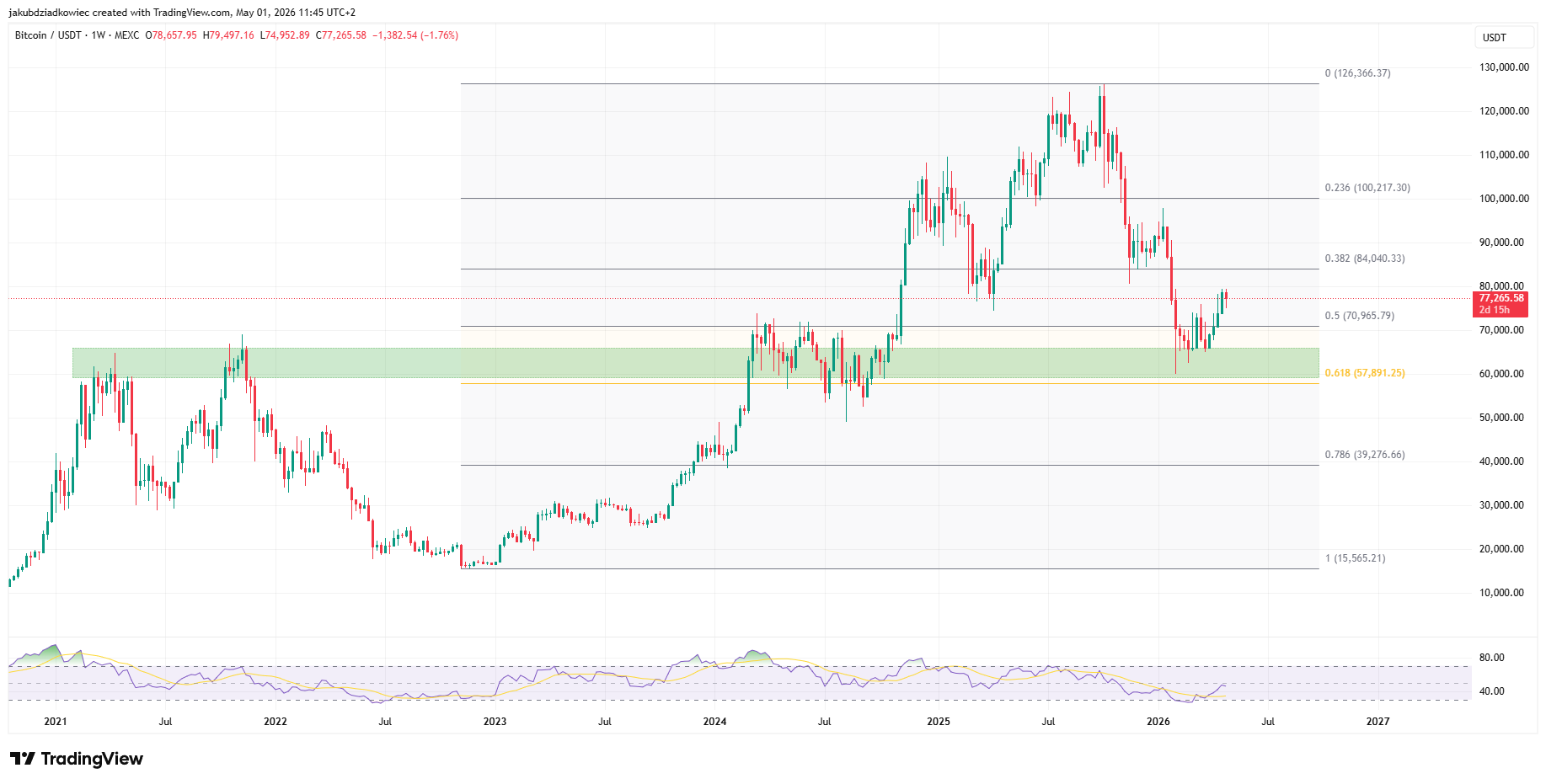
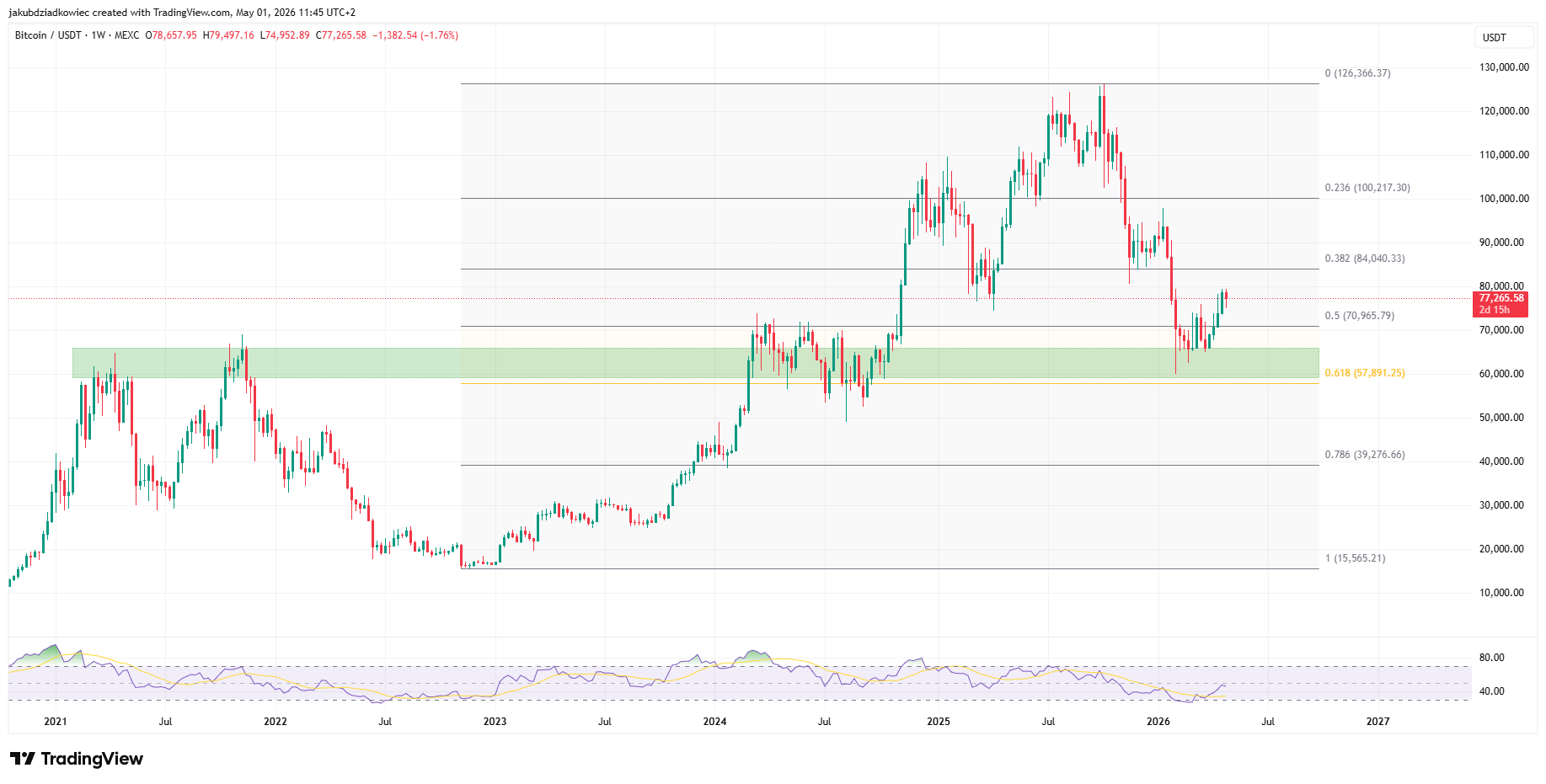
Bitcoin’s bear market floor may already be in at $60,000, according to Carl Runefelt and David Wulschner, two of Europe’s most-watched crypto YouTubers. Both argue this cycle never produced the euphoria that justifies an 80% drawdown.
With Bitcoin trading near $76,500, the call appears to be playing out. Runefelt of The Moon Show declared $60,000 the bottom in real time, while Wulschner of Crypto Familie sees a strong accumulation zone with limited downside.
YouTubers Call $60,000 Bitcoin Floor
In an interview with BeInCrypto, Runefelt described the moment he made the call.
“When Bitcoin broke down to 60K, I think it were like 59 point something… I actually made a tweet and a video saying on the same day that I think this is the bottom of the bear market.”
The Swedish creator argued that the bear market does not require a deep drawdown because the prior peak lacked the speculative mania that typically precedes a deep drawdown.
“We never had any euphoria. We never had that screaming altcoin season. We never had Bitcoin going into that stratospheric euphoric mania where everyone in the world is talking about it.”
He also pointed to the Relative Strength Index flashing oversold signals last seen during the COVID-era selloff. With Michael Saylor and other institutional holders still accumulating, the case for further downside looks thin to Runefelt.
Wulschner Sees Limited Downside
Wulschner, the host of Crypto Familie, mostly agreed but allowed for a deeper test.
“I think it would be a mistake if we are hoping for pricing below $50,000.”
His own bottom box sits at $52,000 to $53,000, a level that broadly aligns with the 23% retrace from the prior all-time high seen in the 2017 cycle. He still calls the current zone a strong accumulation support area.
He also mapped a max pain zone down to $39,000 at the 0.768 Fibonacci level, though he called it unlikely. The Crypto Familie host pointed to Michael Saylor and other corporate treasuries as the structural floor preventing a deeper flush.
Echoes of Benjamin Cowen’s Apathy Thesis
The dual call converges with analysis from Benjamin Cowen, founder of Into The Cryptoverse, who argues this cycle topped on apathy rather than euphoria. Without a mania-fueled top, the historical 80% bear-market template no longer cleanly applies.
Cowen frames this cycle as structurally different, arguing that altcoin rotation typically requires the euphoric retail flows that never showed up. Without that mania-driven exit liquidity, the current $60,000 zone can hold as a bottom without a 2018-style washout.
The Risks That Could Break the Thesis
Runefelt flagged what would invalidate the call.
“If we see more war or more black swan events, we see Trump tweeting something stupid like, sure, we can go lower.”
Both creators framed the current zone as a strategic accumulation window rather than a trade. Wulschner closed with a clear instruction.
“Profit is not done in the bull market. You set your goals, you set your foundation, you set your anchor positions in your portfolio in the bear market.”
The post Crypto Youtubers Predict Bitcoin Bottom and Bear Market Cycle appeared first on BeInCrypto.

Oura Adds More Detailed Hormonal Health Insights To Its Series 3 And 4 Rings

Financial problems I want vs I have #finances #money

John Higgins v Shaun Murphy live: Latest score from compelling World Snooker Championship semi-final

Manchester United reach agreement with Casemiro over contract clause amid transfer speculation

US brings back mandatory military draft registration

Steven Gerrard disagrees with Gary Neville over ‘shock’ Chelsea and Arsenal claim | Football


-

 Tech4 days ago
Register Renaming | Hackaday
-

 Fashion7 days ago
Weekend Open Thread – Corporette.com
-
Crypto World6 days ago
Hyperliquid $HYPE Rally Builds Momentum as AI Sector Enters Prove-It Phase
-

 Politics4 days ago
Drax board avoid their own AGM, accused of greenwashing & environmental racism
-

 Tech4 days ago
Images of Samsung’s rumored smart glasses have leaked
-
 Sports5 days ago
IPL 2026: Ruturaj Gaikwad registers slowest fifty of the season, enters all-time unwanted list | Cricket News
-

 Tech4 days ago
Why Blue Badges Disappeared From Toyota Hybrids
-

 NewsBeat5 days ago
LK Bennett closes all stores after entering administration
-

 Fashion3 days ago
Kylie Jenner’s KHY Enters a New Era with ‘Born in LA’
-
 Entertainment6 days ago
Mariah Carey Slams Deposition Claims In Brother’s Lawsuit
-

 Business3 days ago
Most Commercial Energy Audits Miss the Real Losses
-

 Business4 days ago
(VIDEO) Charlize Theron Climbs Times Square Billboard to Promote New Netflix Thriller ‘Apex’
-

 Crypto World3 days ago
CFTC’s AI will review U.S. crypto registration applications, chairman tells CoinDesk
-
 Crypto World7 days ago
Nvidia (NVDA) Stock Jumps 5% as Intel Earnings Ignite Semiconductor Rally
-

 Tech6 days ago
Microsoft to roll out Entra passkeys on Windows in late April
-

 Tech5 days ago
OpenAI’s Sam Altman apologizes for not reporting ChatGPT account of Tumbler Ridge suspect to police
-

 Business2 days ago
Barclay Brothers Avoid Bankruptcy: HSBC Drops High Court Petitions After IVA Deal
-
 Business2 days ago
Tesla Officially Registers Elon Musk’s Stock: What Investors Need to Know
-

 Tech6 days ago
OpenAI CEO apologizes to Tumbler Ridge community
-

 Tech3 days ago
Get Ready for More Brain-Scanning Consumer Gadgets
You must be logged in to post a comment Login