Crypto World
How High Net-Worth Individuals Execute Large Trades?


Try selling ten million dollars of stock at once, watch the price crater before you fill half the order. Wealth moves differently past a certain size, and the tools that handle it (block trades, dark pools, algorithmic execution, and an OTC crypto trading desk for digital assets) rarely make headlines. Worth knowing how they work.
How High Net-Worth Individuals Execute Large Volume Trades?
Why Size Becomes a Problem?
Liquidity isn’t free, and it isn’t infinite. Public markets match lots of small orders, not a handful of enormous ones. When a $50 million sell order hits a stock’s order book, every algorithm watching that ticker notices. Front-running isn’t a conspiracy theory, it’s just math.
The Crypto Version of the Same Problem
Crypto amplifies this. Bitcoin’s daily volume looks massive in headlines, but a huge chunk is bot activity, not real depth. Push a $20 million market order through a standard exchange and the price slides five, ten percent against you. Avoidable, though, which is why an OTC Crypto Trading Desk exists. Someone matches your order privately, off the public book, often at one negotiated price. No slippage spiral, no audience watching you panic-sell.
Three broad tools cover most of this territory:
- Block trades: Large orders negotiated directly between two parties, reported after the fact
- Dark pools: Private venues where institutional orders meet without hitting public order books beforehand
- OTC desks: Bilateral deals, common in crypto, where price locks before execution
None of these are exotic. Just unfamiliar to anyone who’s never needed them.
Block Trades: Still the Workhorse


What makes it work is timing. Public disclosure happens after execution, not before. That gap, sometimes minutes, sometimes longer depending on jurisdiction, is what protects the seller from the market front-running their own trade.
Goldman Sachs, Morgan Stanley, JPMorgan, they all run desks built for nothing else. Family offices managing nine-figure portfolios lean on these relationships constantly, often without anyone outside their inner circle ever knowing a trade happened.
Does this always work perfectly? No. Block trades still move markets once disclosed, and counterparties sometimes demand a discount for taking on size risk. But compared to dumping the same order on the open market? Night and day.
Dark Pools: Invisible Until It’s Done
Dark pools get a bad reputation in financial media, vaguely sinister name, vaguely sinister coverage. Reality’s less dramatic. These are private exchanges, often run by major banks (Credit Suisse pioneered the model with CrossFinder back in 2004, and most major banks followed), where institutional buyers and sellers can post orders that nobody sees until after they’ve matched.
Why does this matter for someone with serious capital? Because visibility is the enemy of a good price. If every trader on Earth can see you’re trying to sell 200,000 shares, they’ll price that information into the stock before you’ve sold a single one. Dark pools strip that visibility away. Your order sits there, unseen, until a matching order shows up on the other side.
Regulators have tightened oversight here over the past decade, the SEC’s Regulation ATS requires these venues to register and report volume, even if individual trades stay anonymous. Worth noting if you’re researching this for yourself: dark pools aren’t loopholes. They’re regulated venues operating under different disclosure rules than public exchanges, not outside the rules entirely.
Where Crypto Fits the Pattern?
Crypto markets are younger, thinner, and far more fragmented than equities, which makes the liquidity problem worse, not better. A whale moving $30 million in ETH through Binance’s order book will see real price impact. Multiple exchanges, inconsistent depth, time-zone-driven volume swings, none of it adds up to a smooth execution environment for size.
That’s the gap an OTC crypto trading desk fills. The mechanics mirror traditional block trading: a desk, sometimes attached to an exchange, sometimes standalone, finds counterparties willing to take the other side of a large order, locks in a price, settles privately.
Inqud’s operates on this same logic, structuring large crypto transactions away from public order books so size doesn’t become a liability the moment someone tries to act on it.
Why has this grown so much? A few real reasons:
- Institutional crypto holdings have ballooned since the 2024 Bitcoin ETF approvals, BlackRock’s IBIT alone holds billions in assets under management
- Stablecoin settlement has made cross-border OTC deals faster and less dependent on banking-hour windows
- Family offices that once avoided digital assets entirely now treat them as a normal allocation, which means normal-sized problems with abnormal-sized money
None of this means crypto OTC desks are risk-free. Counterparty risk is real, you’re trusting a private entity to actually deliver what was promised, with far less regulatory backstop than a registered exchange. Due diligence on the desk itself matters enormously here. Sounds obvious, but it’s the step people skip when they’re moving fast.
Algorithmic Execution: Slicing the Order
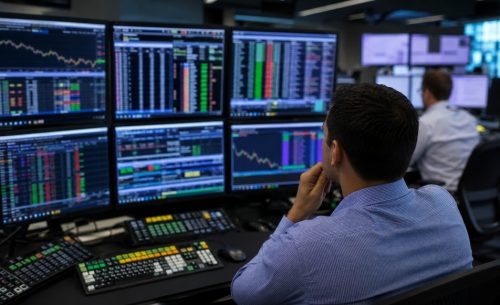

Two acronyms come up constantly here: VWAP (volume-weighted average price) and TWAP (time-weighted average price). Both are strategies, not products, instructions telling an algorithm how to slice and pace an order.
VWAP tries to match the trade’s average price to the day’s overall volume pattern. TWAP just spreads execution evenly across a set time window, ignoring volume entirely.
Quick comparison, since the differences matter more than they sound:
| Strategy | Best For | Main Risk |
| VWAP | Liquid markets with predictable volume patterns | Underperforms during unusual volume spikes |
| TWAP | Thin or unpredictable markets | Can execute poorly during low-liquidity windows |
| Block Trade | Very large single transactions | Requires finding willing counterparty |
| OTC Desk | Crypto and other less-liquid assets | Counterparty risk, less regulatory oversight |
Hedge funds and prop trading desks have run these strategies for two decades now. What’s changed is access — platforms once reserved for institutions have started trickling down to sophisticated individual investors, particularly through prime brokerage relationships.
The Human Layer Nobody Talks About
Here’s something the technical explanations miss: most of this still runs on relationships. A block trade happens because a desk head picked up the phone and called someone they’ve worked with for fifteen years. An OTC crypto deal closes because two parties trust each other enough to wire funds before the asset technically changes hands in some cases.
Technology has compressed timelines and expanded access, sure. But the trust layer underneath hasn’t disappeared, if anything, it matters more once the numbers get large enough that a mistake can’t be quietly absorbed.
Sounds almost old-fashioned for an industry obsessed with disruption, doesn’t it? Maybe that’s the point. When the stakes are this high, nobody wants to be the test case for a new system that hasn’t proven itself yet.
A Few Things Worth Remembering
Wealthy individuals don’t play by different rules, they use tools built for a scale problem regular markets weren’t designed to solve. Every method here carries its own risk: counterparty exposure, regulatory gaps, execution risk during volatile windows. None guarantees a better outcome, just different trade-offs.
This article is provided for general informational purposes only and does not constitute financial, investment, or legal advice. Consult a licensed professional familiar with your specific circumstances.
You must be logged in to post a comment Login