

Crypto World
How Mass Adoption Looks in 2026



It is February 2026. Two years ago, the industry was obsessed with the mantra of onboarding the next billion users. It was a rallying cry that echoed through every conference hall from Dubai to Tokyo. Today, as the dust finally settles on the implementation of the United States’ GENIUS Act and the European Union’s fully operational Markets in Crypto-Assets (MiCA) framework, the fundamental question has shifted. We are no longer asking if mass adoption will happen, or even when. Instead, we are asking why it doesn’t look like the cyberpunk revolution we once imagined.
To understand this paradox, where crypto is ubiquitous in systemic finance yet still feels like a foreign concept to the layperson, BeInCrypto spoke to a panel of industry leaders who are building the bridges: Fernando Lillo Aranda (Zoomex), Vivien Lin (BingX), Griffin Ardern (BloFin), Dorian Vincileoni (Kraken), Federico Variola (Phemex), and Michael Ivanov (Arcanum Foundation).
Their collective verdict? The technology is ready. The regulations are (mostly) written. The final hurdle is no longer the code, it is the culture.
The UX Revolution: From Seed Phrases to Smart Accounts
For over a decade, the primary barrier to entry was the fear factor. Crypto was notoriously unforgiving. The industry’s greatest strength, sovereignty, was also its greatest weakness. Lose your 24-word seed phrase, and you lose your life savings. Send a transaction to the wrong hex code, and your funds vanish into the ether. In 2026, we have to ask, has the single mistake era finally ended?
Dorian Vincileoni, Head of Regional Growth at Kraken, offers a refreshingly honest assessment that cuts through the marketing hype. While technology has leaped forward, the core ethos of crypto, total individual responsibility, remains a psychological stumbling block that code alone cannot solve.
Vincileoni admits:
“Can we honestly say a non-technical person is safe? Not entirely, and pretending otherwise would be dishonest. The user experience has improved dramatically, but self-custody still carries responsibility, and responsibility is not intuitive for everyone.”
However, Vincileoni notes that the industry has undergone a massive paradigm shift. We have moved away from the binary choice of Centralized Exchange or Dangerous Self-Custody. Instead, we have entered the age of Smart Accounts.
“Better interfaces, account abstraction, and smarter safeguards are reducing the cost of human error,” Vincileoni explains.
“The real shift is not eliminating risk entirely, but giving users choices. Some will prefer full sovereignty, others will accept guardrails. Mass adoption will come from respecting both.”
This technological evolution is best exemplified by the rise of ERC-4337 and similar standards across various chains. Michael Ivanov, CEO of Arcanum Foundation, emphasizes that the entry journey is still being paved, and it requires specialized tools to protect the user from themselves.
“Nowadays we still have a long way to go for simplification of the entry journey,” Ivanov observes.
“From our side, we are working on the easy way to make it happen. We have developed several Telegram Web Apps (TWA) with efficient risk management layers designed specifically to help users avoid losing their funds, even if they make several mistakes.”
Ivanov’s point is crucial. In 2026, the killer UX isn’t a prettier wallet, it’s a safety net. The industry is finally acknowledging that the average person wants the benefits of blockchain, speed, transparency, and global reach, without needing a degree in computer science to keep their money safe.
The Killer App of 2026: Convergence, Not Casinos
If 2021 was defined by the explosive (and often irrational) NFT boom, and 2024 was the year of the Bitcoin ETF, then 2026 is defined by something far more functional, Convergence. The search for a crypto-native application that would change the world has largely been abandoned in favor of making existing financial systems work ten times better.
Fernando Lillo Aranda, Marketing Director at Zoomex, argues that the industry spent too much time looking for a killer app that lived entirely inside the Web3 bubble. The real breakthrough happened when Web3 started leaking into the real world.
“To reach that inflection point, we first need to understand why mass adoption hasn’t happened yet,” Lillo Aranda states.
“One of the key missing pieces has been clear real-world utility beyond speculation. The real ‘killer app’ of 2026 is the convergence between Web3 financial infrastructure and everyday financial use cases.”
Lillo Aranda points out that centralized exchanges (CEXs) are no longer just trading platforms; they are becoming the primary financial interface for the digital generation.
Aranda adds:
“Centralized exchanges face a major challenge here, their traditional Web2 competitors — banks — have spent years adapting and developing crypto-like services. Meanwhile, forward-thinking CEXs have been working in parallel on bringing Web3 closer to daily life.”
What does this look like in practice? It’s not about decentralized social media or on-chain governance for the masses.
Lillo Aranda explains:
“Products such as crypto-linked cards, seamless access to traditional markets like equities, instant profit withdrawals for everyday spending, and high-yield savings alternatives that outperform Web2 offerings are what will truly onboard the next wave of users.”
“When Web3 stops feeling like a separate ecosystem and instead becomes a better financial layer for everyday life, adoption will follow naturally—not because of speculation, but because it simply works better.”
Michael Ivanov sees the killer app as a multi-pronged spear, with different tools for different demographics. For the younger, digital-native generation, the entry point isn’t banking, it’s entertainment.
“At first glance, there is no single killer app near, but for a specific audience, it could be new Web3-integrated MMO games,” Ivanov suggests.
“We still believe that each audience needs their own way into Web3. For some, it’s crypto banking; for others, it’s an immersive economy where they actually own their digital progress.”
The Stablecoin Economy: Are We Done With Fiat?
The most successful product in the history of crypto isn’t Bitcoin, it’s the stablecoin. In 2025, stablecoin transaction volume surpassed that of major credit card networks in several key corridors. This has led many to wonder: are we approaching the “End of Fiat” for daily spending?
Vivien Lin, Chief Product Officer at BingX, sees a world where the lines are blurring, but warns against expecting a sudden overnight revolution. The transition is stealthy.
“We are moving in that direction, but it will be gradual rather than absolute,” Lin observes.
“Stablecoins are increasingly being used for payments because they are fast, low-cost, and global, especially for cross-border commerce and online services. For many merchants, accepting stablecoins already makes more sense than dealing with traditional payment rails.”
However, Lin injects a dose of realism into the hyper-bitcoinization narrative.
“Fiat will not disappear from daily spending anytime soon. Over time, as infrastructure and regulation mature, the distinction between the two will matter less to the end user.”
In other words, in 2026, the user might be paying with a digital dollar, and they won’t necessarily care if it’s a CBDC, a bank-issued stablecoin, or a decentralized one like LUSD, as long as the transaction clears.
Griffin Ardern from BloFin offers a more cautious, macro-economic perspective. He argues that the perceived stability of a nation’s sovereign credit is the ultimate decider of stablecoin adoption.
“This is unlikely to happen in the short term,” Ardern says of a complete shift away from fiat.
“While many merchants are starting to accept stablecoins, they are currently treated more like ‘money market funds’ than fiat alternatives. Although the collateral risk of stablecoins is among the lowest in the crypto market, it is still significant compared to traditional tier-one assets.”
Ardern notes that the fiat-free dream is largely a product of geography.
“In countries with relatively poor sovereign credit, users are willing to take on this collateral risk because the alternative is worse. But in countries with good sovereign credit, users are usually only willing to convert a limited amount of cash into stablecoins for specific use cases.”
He also points out the merchant-side friction:
“Merchants will also accept stablecoins only in limited quantities to avoid introducing extra operating risks to their balance sheets.”
Despite these hurdles, for the power users and digital nomads, the transition is already complete. Michael Ivanov serves as a living example of this reality. “The future is here,” he says.
“I use crypto-linked cards almost everywhere in the world with no need to pay with fiat. However, we still need to push through government and regulatory issues in many countries to make this the standard, not the exception.”
The Final Boss: Perception and the Trust Deficit
If the technology is robust, the products are useful, and the regulations provide a framework, why aren’t we seeing 100% adoption? The answer, according to our experts, lies in the Final Boss of the industry – public perception.
Federico Variola, CEO of Phemex, believes that we have reached a point where building more tech won’t solve the problem. The industry is no longer limited by its rails, but by its reputation.
“Mass adoption is closer than many think,” Variola asserts.
“Most younger users have already interacted with crypto in some form, and access has become much easier through centralized exchanges and intuitive wallets. The remaining challenge is perception.”
Variola argues that the scars of the 2022-2023 era still haunt the collective consciousness.
“The barriers are no longer technological or regulatory; the rails are already in place. What’s needed now is a more constructive public narrative so skeptical users feel comfortable engaging. Adoption is less about building new tools and more about the market being in the right psychological conditions.”
This sentiment is echoed by Mike Williams (Toobit), who emphasizes that the industry must move from selling dreams to providing education. Trust, in 2026, is built through transparency and understanding, not through celebrity endorsements or price-action hype.
Michael Ivanov summarizes the multi-faceted nature of the hurdle:
“It is a complex web of reasons. Surely including regulation issues, a lingering lack of trust, and the fact that many Web3 apps still have a complicated usability profile for someone used to the simplicity of Instagram or Amazon.”
Conclusion: The Era of Invisible Crypto
As we navigate the landscape of 2026, the insights from Zoomex, BingX, BloFin, Kraken, Phemex, and Arcanum paint a picture of an industry that has finally matured beyond its rebellious, speculative adolescence. We have stopped trying to destroy the banks and have instead started the arduous task of upgrading the world’s financial operating system.
The Killer App of this era isn’t a single platform, it is the Seamless Experience. It is the crypto-linked debit card that pays out yield in real-time (Zoomex). It is an MMO game where your legendary sword is a liquid asset (Arcanum). It is the cross-border payment that settles in seconds for a fraction of a cent without the user ever seeing a blockchain explorer (BingX).
Mass adoption doesn’t look like a revolution led by people waving private keys in the streets. It looks like a quiet, efficient migration to better tools. It looks like convenience. As Federico Variola correctly notes, the tools are ready. The world just needs to decide it’s ready to trust them.
The transition to a Web3-powered world is happening one invisible transaction at a time. By the time we reach the end of 2026, the question won’t be when will crypto be used in everyday life? The answer will simply be: Look around, it already is.
Special thanks to Fernando Lillo Aranda, Vivien Lin, Griffin Ardern, Dorian Vincileoni, Federico Variola, and Michael Ivanov for their contributions to this report.

Welcome to the US Crypto News Morning Briefing—your essential rundown of the most important developments in crypto for the day ahead.
Grab a coffee — because stablecoins may be about to reshape the US bond market. A new Standard Chartered report suggests rising demand for Treasury bills from digital dollar issuers could quietly force Washington to rethink how it finances its debt.
Crypto News of the Day: Stablecoin Demand Could Force Washington to Rethink US Debt Strategy
Stablecoins may soon reshape the US Treasury market, potentially forcing a radical shift in debt issuance, according to a new report from Standard Chartered.
The bank projects that stablecoin issuers could generate between $0.8 trillion and $1 trillion of fresh demand for Treasury bills (T-bills) by the end of 2028.
This trend, when combined with Federal Reserve purchases, could push total short-term Treasury demand to $2.2 trillion.
The report warns that the Treasury could use this emerging excess demand as justification to increase T-bill issuance while reducing long-term bond supply. Such a move could, in effect, allow the US government to suspend all 30-year bond auctions for the next three years.
“We think the US Treasury may use this potential excess demand as a reason to issue more T-bills,” wrote Geoff Kendrick in the latest Standard Chartered report, highlighting stablecoin issuers as increasingly significant buyers of short-term US debt.
Emerging market stablecoins are expected to drive the majority of this demand. Standard Chartered estimates that two-thirds of projected T-bill demand will come from emerging markets, representing net new demand. Meanwhile, stablecoins in developed markets largely substitute for existing holdings.
This pattern highlights the growing role of digital assets in global capital flows and their influence on traditional fixed-income markets.
The potential implications for the Treasury yield curve are substantial. Shifting roughly $9 billion from long-term bonds to T-bills could initially flatten the US Treasury curve.
Yield Curve Risks Mount as Treasury Weighs Expanding T-Bill Share
Standard Chartered notes, however, that long-term premia, fiscal deficit concerns, and market sentiment could influence investor reaction over time.
The bank cautions that a bull flattening at the front end may be the immediate response, but structural factors, including term premia and rollover risk, could shape yields differently in the longer term.
Treasury Secretary Scott Bessent could leverage this scenario to increase the share of T-bills within the overall debt portfolio.
Raising the T-bill share by just 2.5% over three years would generate roughly $900 billion of additional T-bill supply, offsetting the projected excess demand.
This could ease scarcity at the front end of the curve while keeping the 10-year Treasury yield manageable.
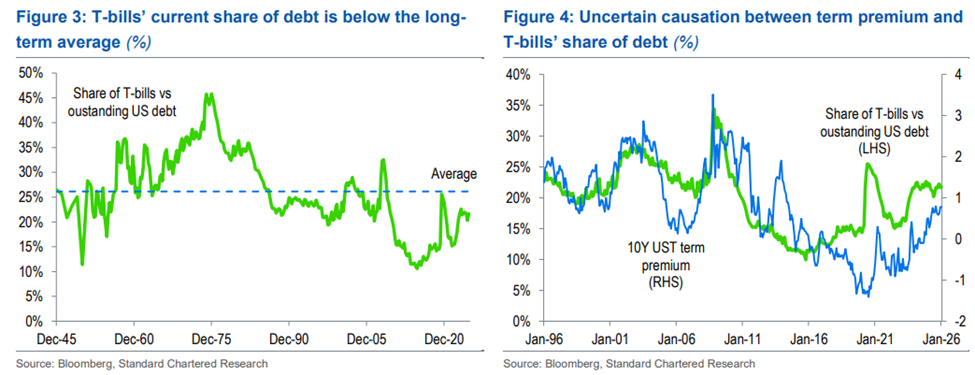
The report also notes that historically, T-bills have averaged 26.1% of outstanding marketable debt. This is well above the Treasury Borrowing Advisory Committee’s recommended 15–20% range, suggesting room for an increase.
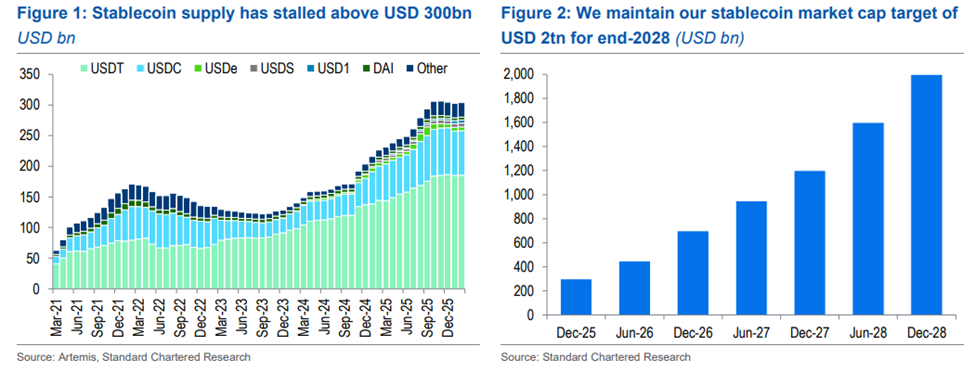
Despite short-term stagnation, stablecoin market capitalization is projected to reach $2 trillion by the end of 2028. Growth has recently stalled at around $304 billion, influenced by weaker digital asset markets and regulatory delays following the US GENIUS Act.
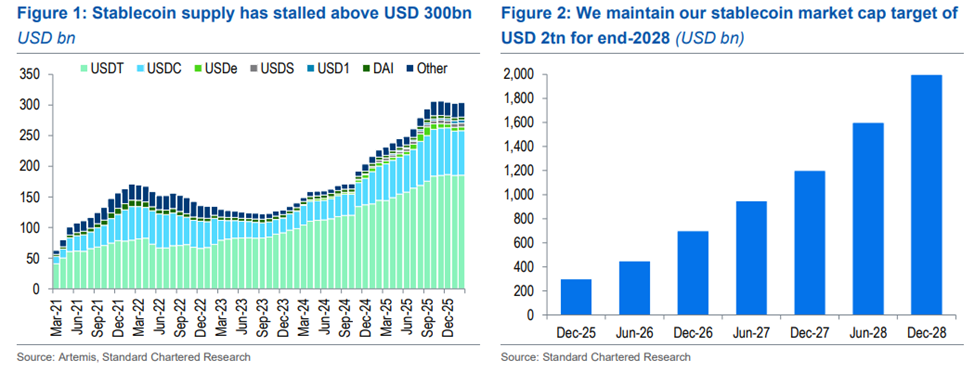
However, Standard Chartered considers these factors cyclical rather than structural. Stablecoin demand, combined with ongoing Fed Reserve Management Purchases and replacement of maturing mortgage-backed securities, could therefore drive a historic reshaping of short-term US debt markets.
The report concludes that while suspending 30-year bond auctions would not be unprecedented—the Treasury paused them from 2002 to 2006—the current deficit environment differs markedly.
Chart of the Day
Byte-Sized Alpha
Here’s a summary of more US crypto news to follow today:


Bitwise Asset Management Chief Investment Officer Matt Hougan took to social media to defend Bitcoin (BTC) against a wave of criticism, arguing that skeptics judging the asset as a failed store of value are ignoring the volatile “teenage phase” necessary for any new monetary asset to mature.
His comments were a direct challenge to a growing narrative, amplified by a nearly 50% drawdown from its all-time high and recent headlines questioning the cryptocurrency’s purpose.
Bitcoin’s Volatility Meets Institutional Impatience
The debate reignited after Bloomberg published a report framing the current market downturn as an “existential” struggle for Bitcoin, asking what the asset is actually for if it fails as a hedge, payment rail, or speculative vehicle.
Former Merrill Lynch trader Tom Essaye, quoted in the Bloomberg piece, added fuel to the fire, stating flatly that “Bitcoin is not replacing gold, it’s not digital gold” and dismissing its utility as an inflation or chaos hedge.
Hougan responded to these takes, rejecting the premise that Bitcoin must emerge from nothing as a fully formed, gold-like asset. He described Bitcoin in 2009 as “100% speculation,” projecting a future in 2050 where it is “0% speculation” and owned by central banks.
“You cannot travel from 100% speculation to 0% speculation without ticking every gradient in between,” Hougan posted. “The reason it doesn’t fit any individual box right now is it’s in the uncomfortable middle. But that’s a necessary part of the journey.”
His defense comes at a time when the price action of the king cryptocurrency is testing investor patience. The asset recently shed thousands of dollars off its value, following U.S. President Donald Trump’s announcement of a 10% temporary global tariff.
Meanwhile, Google searches for “Bitcoin is dead” have spiked to levels not seen since the FTX collapse in late 2022, a metric that some traders view as a contrarian signal that a bottom may be forming.
A Historical Precedent for Price Swings
Hougan’s argument is rooted in a historical parallel he first detailed in a 2018 Forbes article, which he recirculated amid the current debate. At the time, he pointed to gold’s performance after the U.S. left the gold standard in 1971.
Following Nixon’s decision, gold was set loose from its moorings, experiencing massive volatility as it fought to establish itself as an independent store of wealth. Furthermore, in 1974, the precious metal rose 73%, only to fall 24% in 1975. In 1981, it lost 33% of its value after being up 121% just two years prior.
“If you had asked someone in 1975 if gold was a store of value, they’d have pointed to that 24% drop,” Hougan implied in his prior analysis. He argued that Bitcoin is following the same trajectory: a rapidly appreciating price that slows over time, accompanied by high-but-declining volatility.
“Either you believe it’s literally impossible to create a digital store of value, or you have to imagine it passing through exactly this teenage state,” insisted the Bitwise CIO.
His framework suggests the current drawdown, which has seen BTC fall roughly 50% from its October 2025 peak near $126,000, fits the pattern of an asset class maturing rather than failing.
The post Matt Hougan: BTC Is Still in Its ‘Teenage State’ appeared first on CryptoPotato.
Crypto World
NEAR Launches Near.com super app, touting AI capabilities and confidential transactions
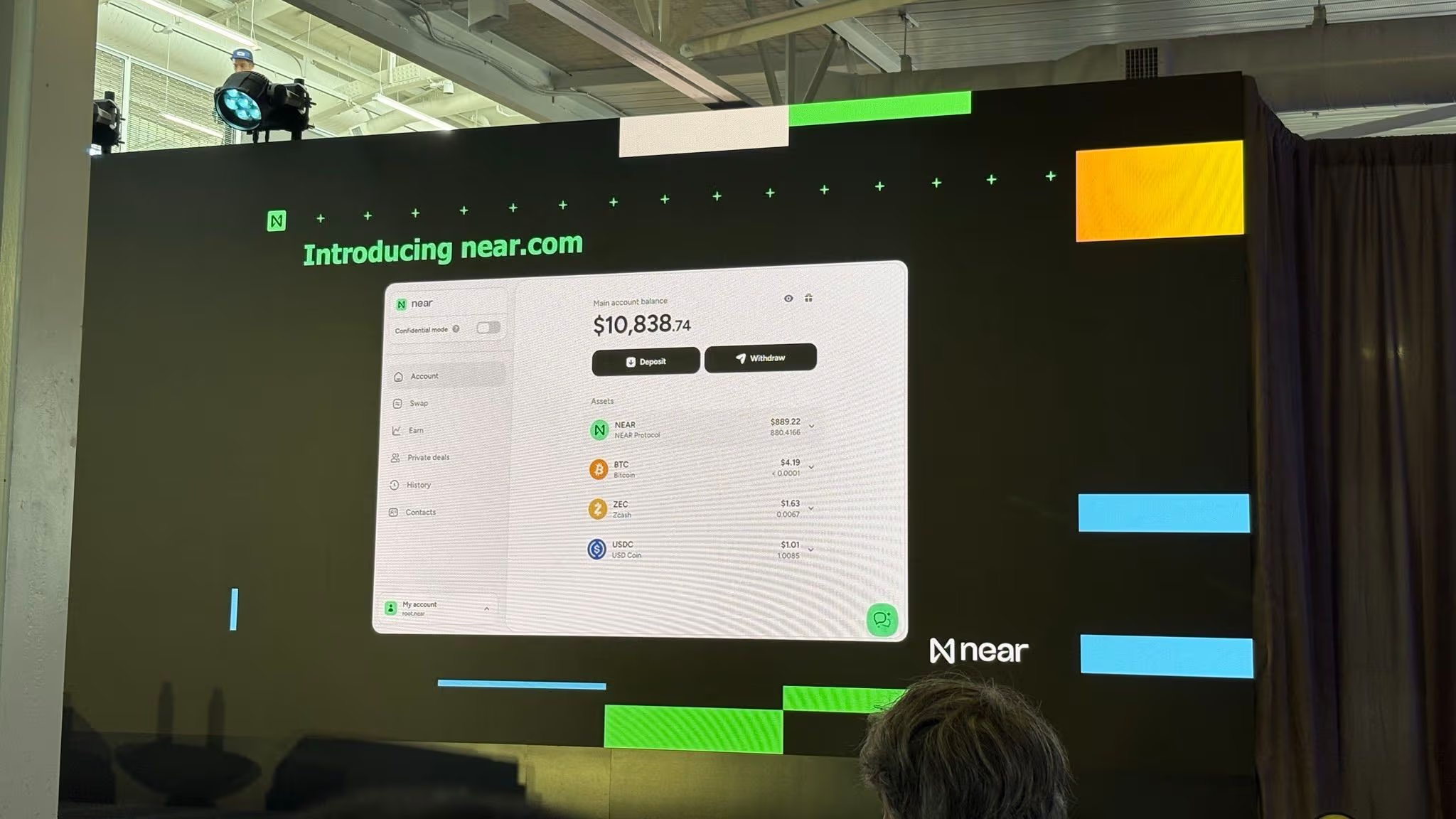
San Francisco, CA – NEAR is launching Near.com, a new crypto wallet and consumer app that aims to make blockchain technology feel as simple as using a traditional finance app, while positioning itself at the intersection of crypto and artificial intelligence (AI).
Polosukhin previously co-authored the paper that introduced the transformer model, the architecture underpinning modern AI systems like ChatGPT and many other large language models, and has increasingly focused on how blockchain infrastructure can support the next wave of AI-driven applications.
“We are entering the world where AI is becoming our interface to compute,” Polosukhin said during the presentation.
NEAR token is down nearly 3% over the last 24 hours.
At its core, Near.com is designed to remove much of the friction that has long made crypto confusing for everyday users. Instead of worrying about gas fees, private keys or switching between different blockchains, users can manage their assets in one place.
“You don’t need to think about blockchains. You don’t need to think about gas, keys,” Polosukhin said. “You just use it as your main wallet.”
Near.com supports a range of digital assets, including bitcoin, stablecoins, NFTs and other tokens. The idea is to bring together activity that is typically spread across multiple wallets and networks into a single, streamlined interface.

But NEAR’s ambitions extend beyond building just another wallet. The company is betting that the next big wave in crypto will come from its convergence with AI.
As AI agents become more capable, like booking travel, managing emails or handling online purchases, they will increasingly need the ability to transact. That’s where crypto infrastructure comes in. Blockchains can provide programmable payments, global transfers and automated settlement without relying on traditional intermediaries.
Polosukhin argued that as AI systems begin interacting with each other, they effectively become “economic actors,” software programs that negotiate, pay and coordinate tasks. In that world, crypto becomes the financial layer that allows these agents to operate.
Near.com is designed to serve as that layer, acting as both a user-friendly wallet for people and an economic backend for AI-driven activity.
A key part of the announcement is privacy. One of blockchain’s longstanding tradeoffs is transparency: transactions are typically visible to anyone. While that openness can build trust, it can also expose sensitive financial information.
“Everything you do onchain is transparent,” Polosukhin said. “That’s not realistic for usual use cases, for day-to-day usage.”
To address this, NEAR introduced a “confidential mode” within Near.com. The feature allows balances, transfers and trading activity to remain private within the network’s security framework. The company says this makes the wallet more practical not only for individuals and businesses, but also for AI agents that may need to transact without revealing strategy or sensitive data.
The launch signals a broader shift for NEAR.
“We have the stack. We have all the components. We have the product,” Polosukhin said. “Now we’re switching … to how we actually scale adoption — how we bring this to billions of people around the world.”
Read more: Most Influential: Sam Altman
Crypto World
Kraken’s Sponsorship of ‘Trump Accounts’ Highlights Crypto’s Growing Political Footprint


The initiative showcases Kraken’s Wyoming roots and the increasing ties between crypto firms and policymakers.
Kraken’s decision to fund savings accounts for every child born in Wyoming this year is being viewed as the latest move aligning the exchange with the crypto-friendly Trump administration.
The cryptocurrency exchange currently ranks as the sixth largest globally by 24-hour trading volume, with about $1 billion traded over the past day – behind Binance, Bybit, OKX, Coinbase, and Bitget, according to CoinGecko.
Last week, Kraken said it would sponsor “Trump Accounts” for every child born in Wyoming in 2026, essentially pledging a financial contribution to each account as part of a savings program introduced by President Donald Trump.
While the exchange framed the plan as a way to grow financial opportunity for families, experts say it also underscores its close relationship with Wyoming (where it is headquartered), as well as the Trump administration.
Trump Ties
Jamie Green, COO at Superset, told The Defiant that funding the accounts is about “maintaining goodwill in the jurisdiction” that afforded Kraken its most significant banking license. In 2020, Wyoming approved Kraken’s plan to launch Kraken Bank, making it the first crypto company in the U.S. to receive an SPDI charter – a state banking license that lets it hold and safeguard digital assets.
However, Green said the move could invite political backlash, as opposed to regulatory scrutiny. “The greater risk is political. Democrats and progressive critics will cite this as further evidence of a cozy relationship between crypto firms and the White House,” he added.
Jesse Powell, Kraken’s co-founder, publicly backed Trump during the 2024 campaign, announcing in June of that year that he had personally donated $1 million to the president’s re-election bid, according to a congressional staff report.
Reuters also reported last year that Payward Inc., Kraken’s parent company, hired the Trump-aligned lobbying firm Ballard Partners in late 2024, joining several crypto companies that hoped to shape policy under the new administration.
“Being visibly Trump-aligned is an asset today – and a liability when political winds change,” Green said.
Wyoming’s Crypto Influence
Daniel Bara, director of the Olympus Association, told The Defiant that the move reflects Kraken’s long-standing relationship with Wyoming – a state that has often served as a testing ground for crypto policy and where initiatives launched are closely watched by other states.
“Wyoming built one of the first regulatory frameworks in the country that treated digital assets as a legitimate financial category,” Bara said. Earlier this year, the state also launched FRNT, the first U.S. state-issued dollar-backed stablecoin, managed by Franklin Templeton and available through partners including Kraken.
And in March 2025, Wyoming Senator Cynthia Lummis and Congressman Nick Begich introduced the BITCOIN Act – legislation that would establish a U.S. Strategic Bitcoin Reserve and codify a national digital asset policy.
“Committing $1.2 million to fund Trump Accounts for every child born in the state this year reflects the depth of that relationship,” Bara said. “And for a company preparing for a public offering, that kind of visible community investment likely carries weight.”
A Growing Convergence
From a broader standpoint, experts said that Kraken’s move aligns with a larger shift of crypto firms deepening ties with policymakers.
“We have a sitting president who has launched a meme coin, a DeFi platform, and has interests in Bitcoin mining,” Christopher Perceptions, lead at Jubilee Labs and a strategic advisor to Wisconsin State Senator Dora Drake, said. “The convergence is here, and the tidal wave is still gathering momentum.”
Bara added that just a few years ago, crypto companies largely operated outside the political system or rebelled against it. “Now you have hundreds of millions flowing into super PACs, companies relocating to regulatory-friendly states, and corporate sponsorships tied to federal initiatives,” he said.


A top economist has sounded a major warning on key assets like stocks, gold, silver, and the crypto market.
Summary
- Stocks and crypto prices could be at risk of a bigger dive in the near term.
- Mark Zandi, a top economist, highlighted some major risks facing the market.
- He pointed to the slowing economy, valuation, and concerns in the Treasury market.
The stark warning as these assets have become highly volatile in the past few weeks or months. Crypto prices have sunk, with Bitcoin (BTC) and most altcoins being in a technical bear market.
American stocks have also wavered, with the S&P 500 Index remaining below its all-time high. It has barely moved this year. Similarly, the Dow Jones and Nasdaq 100 indices have remained in a tight range lately. Gold and silver prices have also pulled back from their all-time highs.
Mark Zandi warns on stocks, gold, silver, and crypto prices
In a statement on Sunday, Mark Zandi, the top economist at Moody’s, warned that the financial market was fraught and that it may experience a sharp pullback soon.
He pointed to the ongoing complacency among investors, who are using dips as buyiyyng opportunity. Also, he pointed to the increasing speculation, where investors believe that prices will rally in the future because they did so in the past.
Zandi has identified more risks in the market. For example, he observed that the US economy was growing below its potential, with the real GDP growing by slightly above 2%. The estimated potential is about 2.5%.
At the same time, the labor market has flatlined, with the unemployment rate remaining above 2%. The economy added less than 200,000 jobs last year, the smallest increase in years.
Zandi also pointed to the ongoing woes in the Treasury market, where long-term bond yields have continued rising in the past few months. Hedge funds have increased their leverage in the market, leading to more risk as the US public debt continues rising.
Zandi also believes that the stock market has become highly overvalued and disconnected from the economy.
Two major risks persist
Stock and crypto prices are vulnerable amid major risks in the market. The first major risk is that Donald Trump may launch an attack against Iran anytime soon.
In a statement last week, Trump noted that he was considering a limited strike to push the Iranians to the negotiating table. Iran, on the other hand, has warned that any attack will lead to a wider war that may lead to a wider war in the region.
A war would lead to more volatility in the stock and crypto markets by stimulating inflation in the US. A high inflation rate, on the other hand, would make it hard for the Federal Reserve to cut interest rates.
There are also trade risks as Donald Trump considers responding to his Supreme Court loss last Friday. He announced a global tariff of 15% using another rule that allows the president to levy tariffs for 150 days.

TLDR
- ProShares recorded $17 billion in first-day trading volume for its new GENIUS money market ETF.
- The firm confirmed that internal fund allocations contributed to the early surge in activity.
- The GENIUS ETF follows federal rules for stablecoin reserve standards under the GENIUS Act.
- Analysts observed that the debut outpaced previous high-profile ETF launches across the market.
- Tokenized money market funds continued to gain traction as institutions explored blockchain settlement.
ProShares opened its GENIUS-branded money market ETF with heavy trading and strong early flows as firms continued exploring tokenized fund structures, and the launch drew wide market attention as cash-management demand persisted and blockchain rails expanded. The surge placed new focus on how issuers used internal allocations while investors assessed broader shifts. The event also advanced discussion around how digital cash products could interact with regulated funds.
GENIUS ETFs and Early Market Activity
ProShares reported $17 billion in first-day volume for its Genius Money Market ETF, and the firm confirmed internal transfers fueled much of the total. The company used cash from existing funds to support treasury operations, and this move highlighted how issuers managed liquidity across products.
Bloomberg tracked the debut and compared it with other launches, and analysts noted the sharp difference in volume. The debut exceeded the first-day totals of new crypto and ESG ETFs, and it shifted attention to cash strategies.
The GENIUS structure aligned with federal requirements for payment-stable assets, and the fund held short-duration government securities. The law set clear reserve and disclosure standards, and issuers applied these rules to maintain consistent oversight. Market observers watched activity closely, and early trading showed strong operational utility. The ETF advanced its role as a treasury tool, and issuers framed the approach as a way to streamline internal flows.
Tokenized Funds Enter Broader Use Cases
Tokenized money market funds gained traction as firms tested blockchain settlement, and the products offered yield while operating within compliance frameworks. Issuers presented them as interest-bearing complements to digital dollars, and adoption increased across institutional channels.
JPMorgan Chase strategists noted that tokenized fund shares could work as collateral, and they suggested the model preserved yield during transfers. One strategist said, “You can post money-market shares and not lose interest,” and firms continued building pilots.
The growth of tokenized vehicles aligned with rising stablecoin usage, and institutions explored both products for payments and custody. Funds positioned themselves as regulated alternatives, and issuers stressed transparency requirements. The Bank for International Settlements described tokenized money funds as fast-growing instruments, and the bulletin referenced their use in settlement trials. The report added context as markets evaluated new rails.
Regulatory Alignment and Current Developments
The GENIUS Act shaped how issuers structured reserves, and fund operators adopted those guidelines for liquidity portfolios. The law reinforced the role of high-quality assets, and managers applied these standards across new launches.
Firms also expanded product research, and issuers examined how tokenized versions might fit into custody systems. The approach strengthened administration flows, and providers continued monitoring regulatory updates.
ProShares used the GENIUS branding to reflect compliance, and the ETF’s early volume elevated attention on regulated cash tools. The debut arrived as digital asset firms explored new pathways, and issuers weighed operational benefits.
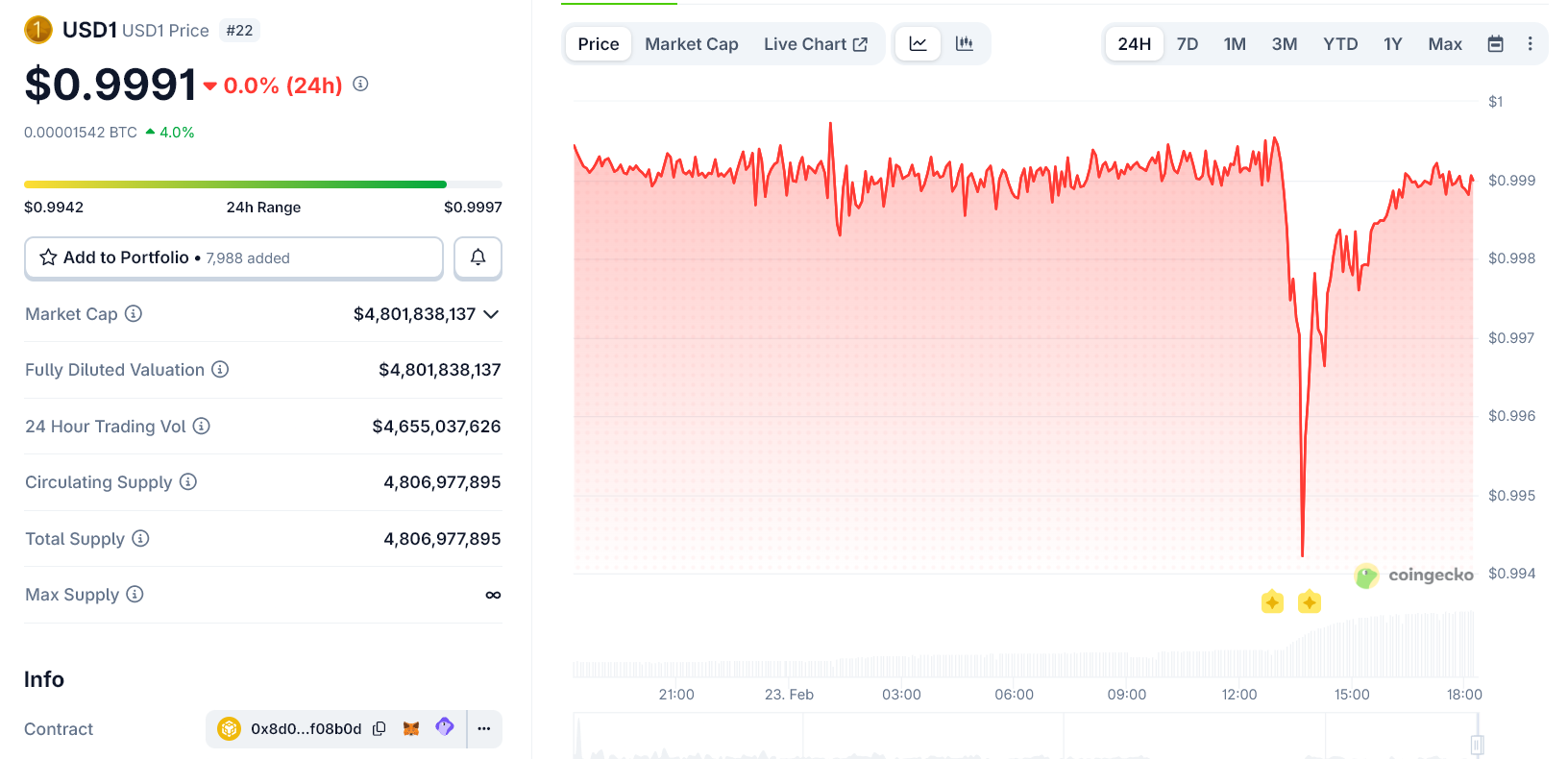
The USD1 stablecoin briefly lost its dollar peg on February 23, falling to around $0.994 before quickly recovering. The token now trades close to parity, suggesting the disruption lasted only minutes.
USD1 is issued by World Liberty Financial (WLFI), a DeFi project linked to business entities associated with Donald Trump and his family. The stablecoin currently has a market capitalization near $4.8 billion.
World Liberty Financial’s Stablecoin Depeg Triggers Speculation
WLFI responded within hours. The company said attackers compromised several cofounder accounts, spread false information, and opened short positions to profit from panic selling.
Despite the rapid recovery, the incident triggered widespread concern across the crypto community.
Some users compared the sudden depeg to early warning signs seen before the collapse of algorithmic stablecoins such as TerraUSD in 2022.
However, USD1 differs structurally. WLFI says it maintains full 1:1 reserves, unlike TerraUSD’s algorithmic design, which relied on arbitrage mechanisms rather than direct asset backing.
Meanwhile, unverified reports circulated on social media claiming that Eric Trump deleted older promotional posts related to USD1 during the volatility.
Screenshots have circulated online, but no independent confirmation has verified these claims.
Separately, blockchain investigator ZachXBT said he plans to release findings later this week on alleged insider trading involving a major crypto company.
He did not name the firm. Still, some social media users speculated that WLFI could be involved. There is no evidence supporting this claim at the time of writing.
Stablecoins rely heavily on confidence. Even brief depegs can trigger rapid selling if users fear insolvency or reserve weakness.
USD1’s quick recovery suggests that redemptions and liquidity mechanisms functioned as designed. Nevertheless, the incident reflects how quickly market sentiment can shift, especially for newer stablecoins tied to high-profile figures.
The company has not disclosed technical details of the alleged attack.
The coming days, including any investigation disclosures, will likely determine whether the event remains a short-lived market shock or develops into a broader credibility test for USD1.

Editor’s note: In the ongoing battle against malware, RenEngine’s reach underscores how attackers exploit trusted software channels to broaden their victim base. Today’s briefing from Kaspersky Threat Research highlights a multi-stage infection that pivots beyond gaming into widely used cracked productivity tools. The findings emphasize the importance of verifying software sources and maintaining updated defenses across personal and corporate environments. As cyber threats increasingly blend with legitimate workflows, readers should review security practices, stay vigilant about unofficial installers, and consider how threat actors opportunistically adapt to new distribution methods. This update offers context for executives, IT teams, and security professionals navigating a rapidly evolving threat landscape.
Key points
- RenEngine loader is distributed via dozens of pirated software sites, not just cracked games.
- Final payloads include Lumma, ACR Stealer, and Vidar in various infection chains.
- The distribution pattern is opportunistic and regional rather than targeted.
- The campaign uses Ren’Py-based game installers with fake loading screens to deploy malware
Why this matters
The expansion from gaming to cracked productivity software widens the potential victim pool and raises risk for individuals and organizations. Attackers use multi-stage delivery, anti-analysis checks, and broad distribution to bypass defenses. Organizations should reinforce software provenance checks, user education, and behavior-based detection to identify malicious activity masquerading as legitimate software.
What to watch next
- Watch for new distribution sites or bundles carrying RenEngine via cracked software.
- Monitor for updates from security vendors on HijackLoader-based campaigns across multiple payloads.
- Track any new payload families linked to RenEngine or related loaders.
Disclosure: The content below is a press release provided by the company/PR representative. It is published for informational purposes.
Kaspersky identifies RenEngine loader distributed through pirated games and software
Kaspersky identifies RenEngine loader distributed through pirated games and software
February 23, 2026
Kaspersky Threat Research has revealed its analysis of RenEngine, a malware loader that has recently gained public attention. Kaspersky identified RenEngine samples as early as March 2025, with its solutions already protecting users from the threat at that time.
Beyond the cracked games highlighted in recent reports, Kaspersky researchers discovered that attackers created dozens of websites distributing RenEngine through pirated software, including graphics editors like CorelDRAW. This expands the known attack surface beyond the gaming community to anyone seeking unlicensed software.
Kaspersky has recorded incidents in Russia, Brazil, Turkey, Spain and Germany, among other countries. The distribution pattern indicates opportunistic attacks rather than targeted operations.
When Kaspersky first identified RenEngine, the loader was delivering the Lumma stealer. Current attacks distribute ACR Stealer as the final payload, and Vidar stealer has also been observed in some infection chains.
The campaign exploits modified versions of games built on the Ren’Py visual novel engine. When users launch infected installers, a fake loading screen appears while malicious scripts execute in the background. The scripts include sandbox detection capabilities and decrypt a payload that initiates a multi-stage infection chain using HijackLoader, a modular malware delivery tool.
“This threat extends beyond pirated games — attackers are using the same technique to distribute malware through cracked productivity software, which broadens the potential victim pool significantly.”
— Pavel Sinenko, lead malware analyst at Kaspersky Threat Research
“Game archive formats vary by engine and title. If an engine doesn’t check the integrity of its resources, attackers can embed malware that executes the moment you click play.”
Kaspersky solutions detect RenEngine as Trojan.Python.Agent.nb and HEUR:Trojan.Python.Agent.gen. HijackLoader is detected as Trojan.Win32.Penguish and Trojan.Win32.DllHijacker.
To stay protected, Kaspersky recommends:
- Download games and software only from official sources. Pirated content remains one of the most common malware delivery methods.
- Use a reliable security solution. Kaspersky Premium protects against threats like RenEngine through its Behavior Detection component, which identifies malicious activity even when malware is disguised as legitimate software.
- Keep your operating system and applications updated to ensure known vulnerabilities are patched.
- Be skeptical of “free” offers. If a paid game or software is available for free download on an unofficial site, the cost is likely your security.
About Kaspersky
Kaspersky is a global cybersecurity and digital privacy company founded in 1997. With over a billion devices protected to date from emerging cyberthreats and targeted attacks, Kaspersky’s deep threat intelligence and security expertise is constantly transforming into innovative solutions and services to protect individuals, businesses, critical infrastructure, and governments around the globe. The company’s comprehensive security portfolio includes leading digital life protection for personal devices, specialized security products and services for companies, as well as Cyber Immune solutions to fight sophisticated and evolving digital threats. We help millions of individuals and nearly 200,000 corporate clients protect what matters most to them. Learn more at www.kaspersky.com.
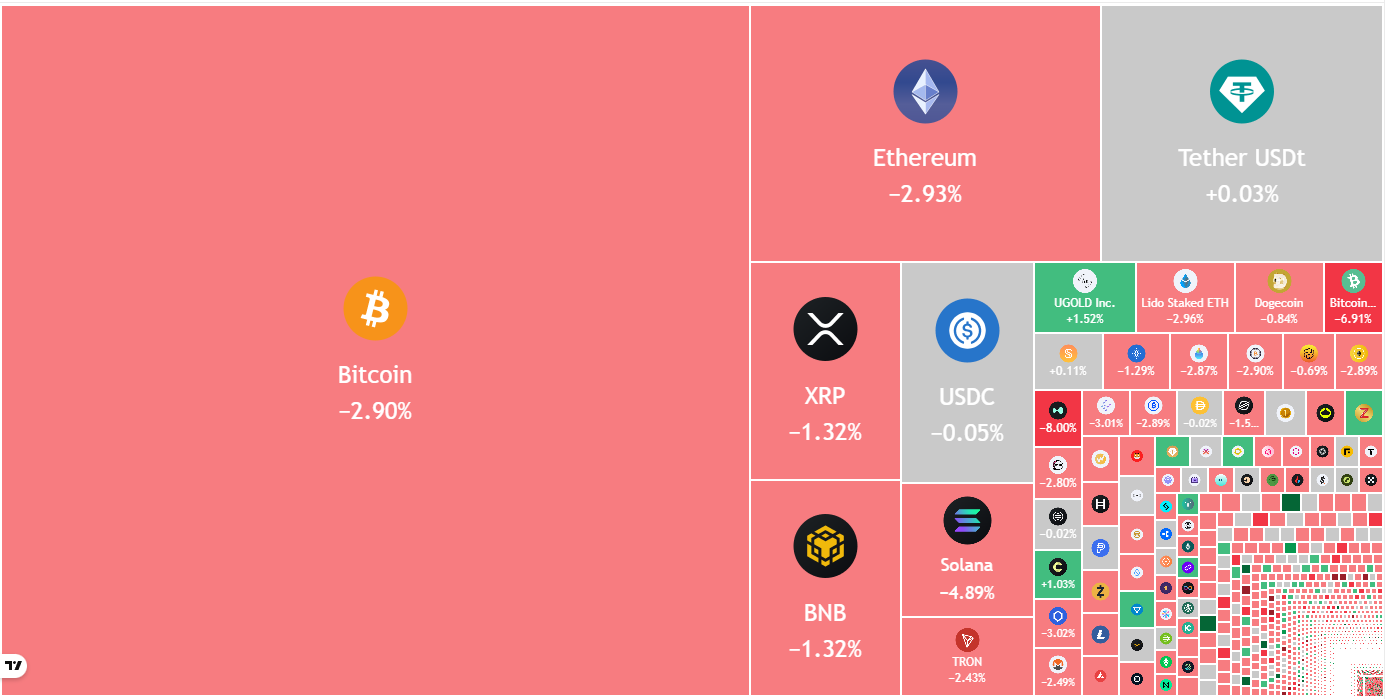
Bitcoin’s (BTC) weakness extended into the weekly open as major stocks sold off in response to US President Donald Trump’s threat to enforce a 15% global tariff after the Supreme Court ruled that his IEEPA tariffs were illegal.
Market sentiment remains fragile, as the Crypto Fear & Greed Index at 5 out of 100 remains in the “extreme fear” zone. Pseudonymous trader and investor BitcoinHyper said in a post on X that the index has been in the extreme fear zone for nearly three weeks, the longest since 2022.
Traders on the prediction market Polymarket have increased the odds of BTC falling below $55,000 to 72%. The prediction market expectations matches several analysts and financial institutions who expect a fall near or below $55,000.

While a bottom may not have formed, expectations are that BTC will eventually recover and move higher. Economist Timothy Peterson said in a post on X that BTC has been positive 50% of the time in the past 24 months. Using a statistical model, Peterson estimated that there is an 88% chance that BTC “will be higher 10 months from now.”
Could buyers defend the support levels in BTC and the major altcoins? Let’s analyze the charts of the top 10 cryptocurrencies to find out.
S&P 500 Index price prediction
The S&P 500 Index (SPX) has been trading between 6,775 and 7,002 for several days, indicating a balance between supply and demand.

The flat moving averages and the relative strength index (RSI) near the midpoint do not give a clear advantage either to the bulls or the bears. Buyers will have to achieve a close above the 7,002 resistance to signal the resumption of the uptrend. The index may then ascend to the 7,290 level.
This bullish view will be invalidated in the near term if the price turns down and breaks below the 6,775 level. The index may then tumble to the solid support at the 6,550 level.
US Dollar Index price prediction
The US Dollar Index (DXY) turned down from the 50-day simple moving average (97.95) on Friday, indicating that the bears are aggressively defending the level.

Sellers are attempting to sink and maintain the index below the 20-day exponential moving average (97.48). If they manage to do that, the index might slide to the 96.21 to 95.55 support zone.
Buyers are likely to have other plans. They will attempt to halt the pullback and push the price above the 50-day SMA. If they can pull it off, the index may jump toward the 99.50 level and subsequently to the 100.54 resistance.
Bitcoin price prediction
BTC fell below the $65,118 support on Monday, but the bulls are attempting to defend the level on a closing basis.

Any relief rally is expected to face selling at the 20-day EMA ($70,185). If the Bitcoin price turns down sharply from the 20-day EMA, it increases the likelihood of a drop to the vital $60,000 support. Buyers will have to defend the $60,000 level with all their might, as a break below it may sink the BTC/USDT pair to $52,500.
Buyers will have to propel the price above the 20-day EMA to signal demand at lower levels. The pair may then march to the $74,508 level, where the bears are again likely to pose a strong challenge.
Ether price prediction
Ether (ETH) fell below the nearby support at $1,897 on Monday, opening the doors for a retest of the $1,750 level.

The downsloping moving averages and the RSI near the oversold territory heighten the risk of a breakdown. If the $1,750 level is taken out, the ETH/USDT pair may resume the downtrend toward the next support at $1,537.
Contrarily, if the Ether price turns up sharply from $1,750, it suggests demand at lower levels. That may keep the pair inside the $1,750 to $2,111 range for a while longer. A close above $2,111 will be the first sign of strength, clearing the path for a rally to the 50-day SMA ($2,593).
XRP price prediction
XRP (XRP) has been trading between the support line of the descending channel pattern and the 20-day EMA ($1.47) for the past few days.

The downsloping 20-day EMA and the RSI in the negative territory indicate that the bears remain in control. If the support line cracks, the XRP/USDT pair may retest the Feb. 6 low of $1.11. A break and close below the $1.11 level may extend the decline to psychological support at $1.
Buyers have an uphill task ahead of them. They will have to swiftly propel the XRP price above the downtrend line to signal a potential trend change.
BNB price prediction
BNB (BNB) fell below the immediate support at $587 on Monday, but the long tail on the candlestick shows buying at lower levels.

The bulls will attempt to start a recovery, which is expected to face selling at the 20-day EMA ($651). If the price turns down from the 20-day EMA, the bears will again strive to pull the BNB/USDT pair below the $570 level. If they manage to do that, the BNB price may start the next leg of the downtrend to psychological support at $500.
Contrary to this assumption, if buyers pierce the 20-day EMA, the pair may rally to the breakdown level of $730.
Solana price prediction
The failure of the bulls to push Solana (SOL) to the breakdown level of $95 signals that the bears are active at higher levels.

Sellers will attempt to strengthen their position by pulling the Solana price below the $76 level. If they succeed, the SOL/USDT pair may fall to the Feb. 6 low of $67, which is a critical support to watch out for. If the level gives way, the pair may slump to $60.
Any relief rally is expected to face resistance at the 20-day EMA and then at the $95 level. A close above the $95 level suggests that the sellers are losing their grip. The pair may then surge to $117.
Related: Bitcoin traders diverge over BTC price strength with $60K in sight
Dogecoin price prediction
Dogecoin (DOGE) turned down from the 20-day EMA ($0.10) on Saturday and is likely to drop to the Feb. 6 low of $0.08.

The bulls are expected to fiercely defend the $0.08 level, as the failure to do so may start the next leg of the downward spiral toward $0.06.
The 20-day EMA remains the immediate near-term resistance to watch out for. A close above the 20-day EMA will be the first sign that the selling pressure is reducing. The DOGE/USDT pair may then ascend to the breakdown level of $0.12, where the bears are expected to mount a strong defense.
Bitcoin Cash price prediction
Buyers pushed Bitcoin Cash (BCH) above the 50-day SMA ($571) on Sunday but could not sustain the higher levels.

The bears sold aggressively and have pulled the Bitcoin Cash price below the 20-day EMA ($551). If the price maintains below $538, the BCH/USDT pair might plummet to the strong support at $500. Buyers are expected to aggressively defend the $500 level, as a close below it may sink the pair to $443.
Buyers will have to drive and maintain the price above the 50-day SMA to signal strength. The pair may then climb to $600.
Cardano price prediction
Despite repeated attempts, buyers failed to push and maintain Cardano (ADA) above the 20-day EMA ($0.28) in the past few days.

That increases the likelihood of a drop to the support line of the descending channel pattern. If the price rebounds off the support line and breaks above the 20-day EMA, it suggests that the ADA/USDT pair may remain inside the channel for some more time.
Instead, if the Cardano price continues lower and breaks below the support line, it indicates the resumption of the downtrend. The pair may then plunge toward $0.15. A short-term trend change will be signaled after buyers clear the overhead hurdle at the downtrend line.
This article does not contain investment advice or recommendations. Every investment and trading move involves risk, and readers should conduct their own research when making a decision. While we strive to provide accurate and timely information, Cointelegraph does not guarantee the accuracy, completeness, or reliability of any information in this article. This article may contain forward-looking statements that are subject to risks and uncertainties. Cointelegraph will not be liable for any loss or damage arising from your reliance on this information.


Crypto.com has received conditional approval from the U.S. Office of the Comptroller of the Currency (OCC) to charter Foris Dax National Trust Bank, taking a significant step toward becoming a federally regulated qualified custodian.
Centralized cryptocurrency platform Crypto.com has received a conditional approval from the U.S. Office of the Comptroller of the Currency (OCC) to establish Foris Dax National Trust Bank, d.b.a. Crypto.com National Trust Bank.
This development advances the firm’s ambition to become a federally regulated qualified custodian, according to an official announcement. Once fully approved, Foris Dax National Trust Bank will provide custody, staking, and trade settlement services under the stringent oversight of the OCC.
Crypto.com’s move aligns with a broader industry trend where crypto firms are pursuing regulatory approvals to enhance their credibility and expand service offerings.
For instance, Anchorage Digital recently launched regulated ‘Stablecoin Solutions’ to cater to institutional needs, while CME Group is set to offer 24/7 crypto futures trading, showcasing the industry’s shift towards regulated offerings.
The move also comes as the global crypto custody market is projected to reach over $4 trillion by 2033, growing at a CAGR of 23.6% from 2025 to 2033, according to Grand View Research.
Kris Marszalek, CEO of Crypto.com, emphasized the significance of this regulatory milestone in a statement.
“This conditional approval is the latest testament to both our commitment to compliance and to providing customers trusted and secure services they expect from Crypto.com,” said Marszalek. “This milestone brings us a major step closer to meeting leading institutions’ needs for a one-stop-shop qualified custodian under a gold standard of federal oversight.”
Headquartered in Singapore, Crypto.com offers a wide selection of crypto services, including trading, payments, and financial products. The platform has amassed over 150 million users worldwide, according to the platform’s website.
The OCC, a U.S. federal agency responsible for regulating and supervising national banks, has been actively involved in providing regulatory clarity for crypto-related financial services.
This article was generated with the assistance of AI workflows.

Stablecoins Could Change the US Bond Market Forever

34 Best Movies on Netflix Right Now (February 2026)

Mother of Nottingham killer Valdo Calocane asked for son to be admitted to hospital after outburst


-

 Crypto World6 days ago
Can XRP Price Successfully Register a 33% Breakout Past $2?
-

 Video4 days ago
XRP News: XRP Just Entered a New Phase (Almost Nobody Noticed)
-

 Fashion3 days ago
Weekend Open Thread: Boden – Corporette.com
-

 Sports7 days ago
GB's semi-final hopes hang by thread after loss to Switzerland
-

 Politics2 days ago
Baftas 2026: Awards Nominations, Presenters And Performers
-
 Tech7 days ago
The Music Industry Enters Its Less-Is-More Era
-

 Business6 days ago
Infosys Limited (INFY) Discusses Tech Transitions and the Unique Aspects of the AI Era Transcript
-

 Politics3 hours ago
Nick Reiner Enters Plea In Deaths Of Parents Rob And Michele
-

 Entertainment5 days ago
Kunal Nayyar’s Secret Acts Of Kindness Sparks Online Discussion
-

 Sports2 hours ago
Women’s college basketball rankings: Iowa reenters top 10, Auriemma makes history
-

 Video6 days ago
Financial Statement Analysis | Complete Chapter Revision in 10 Minutes | Class 12 Board exam 2026
-

 Tech5 days ago
Retro Rover: LT6502 Laptop Packs 8-Bit Power On The Go
-
 Sports5 days ago
Clearing the boundary, crossing into history: J&K end 67-year wait, enter maiden Ranji Trophy final | Cricket News
-

 Business1 day ago
Mattel’s American Girl brand turns 40, dolls enter a new era
-

 Business1 day ago
Law enforcement kills armed man seeking to enter Trump’s Mar-a-Lago resort, officials say
-

 Entertainment5 days ago
Dolores Catania Blasts Rob Rausch For Turning On ‘Housewives’ On ‘Traitors’
-

 Business6 days ago
Tesla avoids California suspension after ending ‘autopilot’ marketing
-
 NewsBeat11 hours ago
‘Hourly’ method from gastroenterologist ‘helps reduce air travel bloating’
-

 Politics7 days ago
Eurovision Announces UK Act For 2026 Song Contest
-

 Tech1 day ago
Anthropic-Backed Group Enters NY-12 AI PAC Fight