
Crypto World
How SHRMiner AI cloud mining is reshaping how to easily earn $9,997 in passive income in 2026


Disclosure: This article does not represent investment advice. The content and materials featured on this page are for educational purposes only.
AI cloud mining expands access as SHRMiner lowers barriers to crypto mining participation in 2026.
Summary
- Cloud mining platforms like SHRMiner lower barriers, enabling easy entry into crypto mining.
- SHRMiner uses AI and smart contracts to simplify mining with real-time tracking.
- With low entry and flexible contracts, SHRMiner offers accessible, automated crypto earning options.
As the global technological landscape continues to evolve in 2026, more and more people are exploring passive income opportunities in the digital economy. Technologies such as smart contracts, cloud mining, and cross-chain asset deployment are gradually reshaping how individuals interact with cryptocurrencies.
Blockchain-based cloud mining platforms are rapidly emerging, providing users with a more user-friendly and convenient alternative. Compared to traditional mining, which requires high hardware investment, complex maintenance, and a high technical barrier, cloud mining lowers the barrier to entry, allowing ordinary users to easily enter the crypto ecosystem. The deep integration of the blockchain ecosystem is opening up new and sustainable passive income avenues for the public.
One of the most notable developments is the rise of the SHRMiner AI-driven cloud mining platform. This platform streamlines the mining process by leveraging automation, smart contracts, and AI-driven resource allocation. These eliminate physical barriers, enabling users to participate in mining activities with extremely low barriers to entry.

Why investing in SHRMiner is worthwhile
Zero entry barrier: Register to receive a free $15 computing power reward, earning $0.60 daily.
Access all miner information in real-time via the mobile app control panel.
Fully own your hardware: No third-party risk.
Mining, tracking earnings, and reinvesting: All operations are handled by the same platform.
A new landscape in the mining industry: Secure, flexible, and profitable.
With SHRMiner, users don’t need to be a technical expert or pay exorbitant electricity bills. You can directly invest in high-performance mining: completely transparent, with stable daily earnings.
SHRMiner offers a variety of high-yield cloud mining contract options to meet the investment preferences and financial goals of different users. Whether seeking flexible short-term returns or valuing stable long-term returns, users can find a suitable option on the platform.
Intelligently allocated, high-yield mining contracts allow wealth growth to begin today.
Contract profit example:
| Contract Name | Price | Profit | Days | Principal + Total Return |
| New User Experience Agreement | $100 | $4 | 2 | $100+$8 |
| Bitdeer Sealminer A2 Pro | $500 | $6.25 | 5 | $500.00 + $31.25 |
| Litecoin Miner L9 | $1000.00 | $13.00 | 10 | $1000.00 + $130 |
| Bitcoin Miner S21 XP Imm | $5000.00 | $70.00 | 25 | $5000.00 + $1750 |
| Bitcoin Miner S21e XP Hyd | $10000.00 | $150.00 | 35 | $10000.00 + $5250 |
| ANTSPACE HW5 | $50000.00 | $900.00 | 45 | $50000.00 + $40500 |
For example, by leasing the hash power of an ANTSPACE HW5 mining rig, users can earn $900 in Bitcoin rewards daily. They can track earnings in real time through the control panel.
Click here for more contract details.
Easy mining: Located in an affordable location with modern infrastructure
SHRMiner is a service provider that allows users to easily get started with cryptocurrency mining. The company operates 150 highly specialized data centers in regions with extremely low electricity costs, such as the US, Europe, and the UAE. It allows you to profit from mining Bitcoin or altcoins without any technical knowledge.
Is SHRMiner legal? What about its transparency, security, and trustworthiness?
Given the skepticism surrounding cryptocurrency mining websites, it’s natural to ask: Is SHRMiner legitimate?
- The company is registered in the UK and holds a UK operating license, ensuring compliance and transparency.
- There are no extra service fees or hidden charges.
- Supports mining in multiple currencies: Earn XRP, BTC, ETH, DOGE, USDC, USDT, SOL, LTC, BCH and other mainstream cryptocurrencies.
- 100% remote access; track earnings in real time via the SHRMiner application or platform website without hardware requirements.
- Protected by McAfee® and Cloudflare® security, ensuring the safety of user account funds.
- We offer 100% uptime guarantee and 24/7 online technical support.
Conclusion: Is SHR Miner a good passive income tool?
The answer is yes — its advantage lies precisely in its AI-driven cloud mining. It offers a sustainable, transparent, and minimally invasive way to generate passive income through legitimate Bitcoin mining infrastructure, setting it apart from other Bitcoin mining applications.
For those wondering if Bitcoin mining will be profitable in 2026, SHR Miner would be a wise choice for earning passive income.
For more details, please visit the official platform or download the mobile application.
Disclosure: This content is provided by a third party. Neither crypto.news nor the author of this article endorses any product mentioned on this page. Users should conduct their own research before taking any action related to the company.



The Bullish acquisition of Equiniti, announced today, values the transfer agent at $4.2 billion
Summary
- Bullish will acquire Equiniti, a transfer agent serving 3,000 major companies and 20 million shareholders, for $4.2 billion.
- The deal positions Bullish as the global infrastructure provider for tokenized securities at institutional scale.
- Equiniti’s existing shareholder registry network gives Bullish immediate reach into the ownership data that tokenized securities require.
The Bullish acquisition of Equiniti, announced on May 5, positions the crypto exchange as a core piece of infrastructure for tokenized securities markets. Equiniti currently serves as a transfer agent for 3,000 major companies and manages records for approximately 20 million shareholders, giving Bullish immediate access to the institutional backbone of traditional equity markets. Bullish described the deal as creating “the global transfer agent for tokenized securities.”
Transfer agents occupy a critical position in capital markets. They maintain official records of share ownership, process dividend payments, and manage corporate actions like stock splits. Acquiring one at Equiniti’s scale gives Bullish a direct line into the ownership data that tokenized securities need to function at institutional grade.
What Equiniti’s client base means at scale
The deal arrives as the regulatory and institutional infrastructure for tokenized securities is rapidly taking shape. Nasdaq won SEC approval to trial tokenized stock trading in March 2026, and the Federal Reserve issued guidance on how banks should treat tokenized securities, establishing the regulatory framework that makes deals like this commercially viable.
Bullish’s move is larger in ambition than either of those. Buying a traditional financial infrastructure firm and reorienting it around tokenization is a bet that the next phase of capital markets runs on blockchain rails, and that owning the transfer agent layer is the most defensible position in that transition.
A transfer agent that handles 20 million shareholders does not just hold records. It holds the relationships, the legal registrations, and the operational history that tokenized equity issuers will need to port onto blockchain infrastructure with regulatory confidence.
Tokenized stocks have already reached a $1.2 billion market cap as institutional interest accelerates, with Nasdaq, Securitize, and Ondo Finance all building competing infrastructure. Bullish’s acquisition of Equiniti gives it a structural advantage none of those competitors can replicate quickly: a working transfer agent with 3,000 existing corporate clients and 20 million shareholder records already in place.
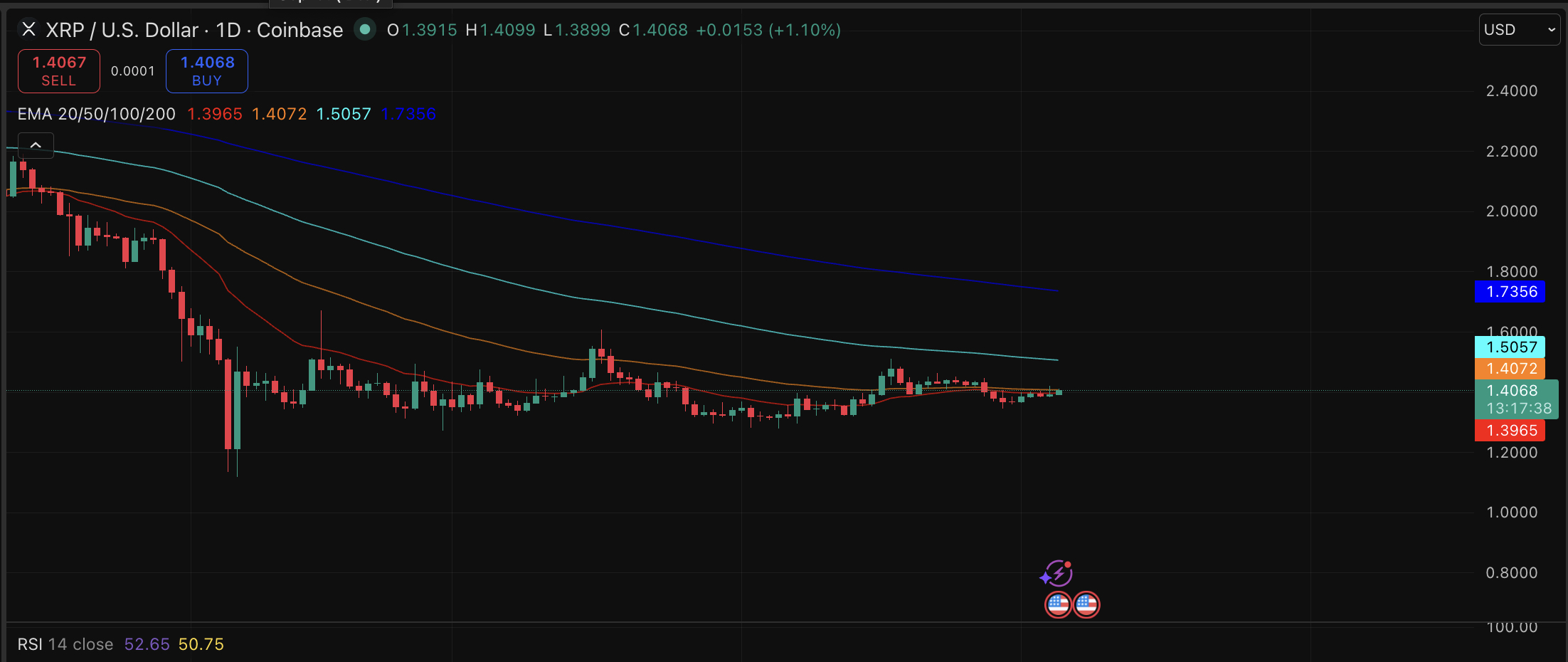
XRP price is just getting a direct challenge as three of the world’s most-used AI models analysis have more than a $4 gap against an analyst. Finance commentator Austin Hilton reviewed predictions from ChatGPT, Grok, and Google Gemini and rejected all three. His counter-target: $4 to $7 by end-2026.
Hilton laid out his case as ChatGPT pegs XRP at $2.15. Google Gemini lands at $3.15. Grok goes the highest among the AI trio at $3.50. Hilton’s critique is about assumptions. The models, he argues, are “dramatically too low” because they fail to price in a wave of institutional capital he expects to flood Bitcoin, Ethereum, and XRP before year-end.
He also identifies Q4 2026 as the decisive window, contingent on two macro triggers: passage of the CLARITY Act and a de-escalation of Iran-U.S. tensions, both of which, he notes, are showing early signs of progress.
Discover: The best crypto to diversify your portfolio with
XRP Price Analysis: $7 Before 2027 Plausible?
XRP’s technical picture is one of post-peak consolidation. The asset hit an all-time high of $3.65 last year and has since pulled back since then. The 24-hour range of $1.40 reflects tight compression, often a precursor to a directional move.
Key supports sit at $1.35 and $1.28 in the event of a deep correction following Ripple’s 1 billion XRP unlock, though near-term traders are watching the $1.38 level as the more immediate floor.

The best-case scenario for XRP can happen if the CLARITY Act clears Congress, followed by accelerating institutional inflows. In that scenario, price might retest $2 and target Hilton’s $4–$7 range in the long run.
Liquidity dynamics on Binance remain a critical variable. Other AI models have also weighed in on XRP’s trajectory — with similarly conservative outputs that analysts like Hilton continue to contest.
Discover: The best pre-launch token sales
Bitcoin Hyper Targets Early Mover Upside as XRP Stuck
XRP offers real upside, but Hilton’s own $7 target implies roughly less than 5x from here. That’s the ceiling on a best-case scenario for an already-established asset. Early-stage infrastructure plays work differently. The profit math is more aggressive.
Bitcoin Hyper ($HYPER) is positioning as the first Bitcoin Layer 2 with Solana Virtual Machine (SVM) integration, a technical combination that addresses Bitcoin’s three core limitations simultaneously. No more slow transactions, high fees, and the absence of programmable smart contracts.
The presale has raised $32.5 million at a current price of just $0.013, with staking available for early participants at a big 36% APY. The SVM integration is the differentiator. It’s not just faster than Bitcoin’s base layer, but engineered to outperform Solana’s own throughput while preserving Bitcoin’s security model.
Research Bitcoin Hyper Here.
The post XRP Price Analysis: AI Predictions Are Wrong Says Analyst appeared first on Cryptonews.


Bitcoin Core developers today disclosed a bug that has allowed miners to remotely crash and execute code on other people’s nodes.
The vulnerability, CVE-2024-52911, has affected Bitcoin Core 0.14.1 through 28.4. Developer Cory Fields responsibly disclosed and helped patch the high severity error via Pull Request (PR) 31112.
Had a miner wanted to utilize the dark trick, they could have executed software code on assorted nodes across the globe.
Fortunately, the bug remained obscure and likely not utilized due to its incredibly expensive attack vector.
Specifically, the attack required a miner to direct electricity-guzzling hashpower toward mining special types of blocks. A guaranteed opportunity cost, these invalid blocks could not become eligible for an actual coinbase reward to recoup the miners’ electricity costs.
Still, the mechanism of attack is easy to understand, albeit expensive to conduct.
A miner that produced a specially crafted block with sufficient proof-of-work could either crash victim nodes and/or use the crash to overtake its memory for remote code execution.
Bitcoin Core admitted that remote code execution was possible, although it did not cite specific examples of it occurring. It highlighted not only its cost and old age, but also the constraints on block data that have made it historically unlikely that miners engaged in meaningful episodes of puppeteering.
Old Bitcoin nodes still at risk of bug
Bitcoin Core’s advisory describes the bug as a script interpreter crash. During block validation, Bitcoin Core software pre-calculates and caches transaction input data, then dispatches script validation work to background threads that use computer memory.
If subjected to a CVE-2024-52911 attack, the node could keep reading from its cached memory after that data had already been freed from memory by another process.
Because this attack is a use-after-free memory bug, remote code execution is possible during this abnormal memory state.
In particular, remote code execution could occur when the node’s background script thread read cached, precomputed transaction data after it had been destroyed by a script validation, CScriptCheck.
Because upgrading a Bitcoin full node is voluntary and software updates are not automatic, a not insignificant minority of the network has delayed upgrading to version 29 (v29) or above.
Specifically, according to one popular estimate, as much as 43% of Bitcoin nodes are still running vulnerable full node software based on pre-v29 code.
Read more: Bitcoin Core devs finally patch 5-year old disk fill bug
Responsible disclosure in 2024
As early as November 2024, Cory Fields detected and privately reported the bug.
Four days after detection, Pieter Wuille pushed a fix proposal as PR 31112, titled “Improve parallel script validation error debug logging.”
The advisory purposefully read like a mundane, maintenance-style plumbing fix. Raising no alarm bells, it fixed Bitcoin Core’s check queue return handling and script validations.
Quickly, the PR by Fields and Wuille gained technical consensus for a merge into production by December 2024. Bitcoin Core 29.0 shipped with the fix by April 2025, and the final vulnerable release line, versions 28.x, reached end-of-life on April 19, 2026.
Now that node operators have had many months to upgrade, and in keeping with a policy in recent years of publicly disclosing old, previously secret bug fixes, Bitcoin Core finally announced the bug today on its website.
Bitcoin Core developer Niklas Gögge correctly noted that this is “the first ever memory safety issue” bug in Bitcoin Core. He thanked Fields for his responsible disclosure.
Bitcoin’s consensus rules were not changed by the bug fix. The bug was in node software and its use of computer memory checks, and the fix is already in current Bitcoin Core releases v29 and later.
Got a tip? Send us an email securely via Protos Leaks. For more informed news, follow us on X, Bluesky, and Google News, or subscribe to our YouTube channel.


K Wave Media reversed its $485 million Bitcoin treasury plan today, redirecting funds to AI data centres and GPUs
Summary
- K Wave Media scrapped its $500 million Bitcoin treasury strategy and redirected approximately $485 million to AI data centres and GPU infrastructure.
- Shares fell 24% on the announcement, which also came with a company rebrand to Talivar Technologies, pending shareholder approval.
- CEO Ted Kim called the reversal “a defining inflection point,” making K Wave one of the most abrupt corporate Bitcoin strategy pivots on record.
K Wave Media scrapped its Bitcoin treasury strategy on May 5 and redirected the capital to AI data centres and GPU infrastructure. The Nasdaq-listed company had been preparing a $500 million Bitcoin acquisition plan, with approximately $485 million committed.
Chief executive Ted Kim said “this marks a defining inflection point for KWM,” framing the reversal as a deliberate strategic pivot rather than a market-driven retreat.
The company also announced a rebrand to Talivar Technologies, subject to shareholder approval at its annual meeting in early July 2026. Shares fell 24% on the news, a reaction that reflects investor surprise and uncertainty about whether an AI data centre thesis offers the same clean exposure that a Bitcoin treasury position does for investors seeking digital asset access.
Why this reversal matters beyond K Wave
Corporate Bitcoin treasury adoption was one of the defining institutional stories of the past three years. As crypto.news reported, Asian companies including Top Win, Quantum Solutions, and K Wave Media all raised capital in late 2025 to expand their Bitcoin positions. K Wave’s reversal is a public repudiation of that playbook by one of the companies that had most recently committed to it.
The pivot to AI infrastructure follows a wider pattern. Several major crypto companies cited AI as a driver of capital changes in early 2026, as crypto.news documented.
Bitcoin miner Hut 8 secured $150 million from Coatue in 2024 to build an AI infrastructure platform, and K Wave is now pursuing a similar direction through data centres and acquisitions.
Coinbase announced the same day that it was cutting 700 jobs, with CEO Brian Armstrong directly attributing the reduction to AI making teams more productive.
Coinbase’s testing of AI agents inside its own operations reflects the same directional shift K Wave has now made at the capital allocation level. The 24% share price decline suggests investors are watching whether the Talivar Technologies rebrand can build a credible new thesis from scratch.
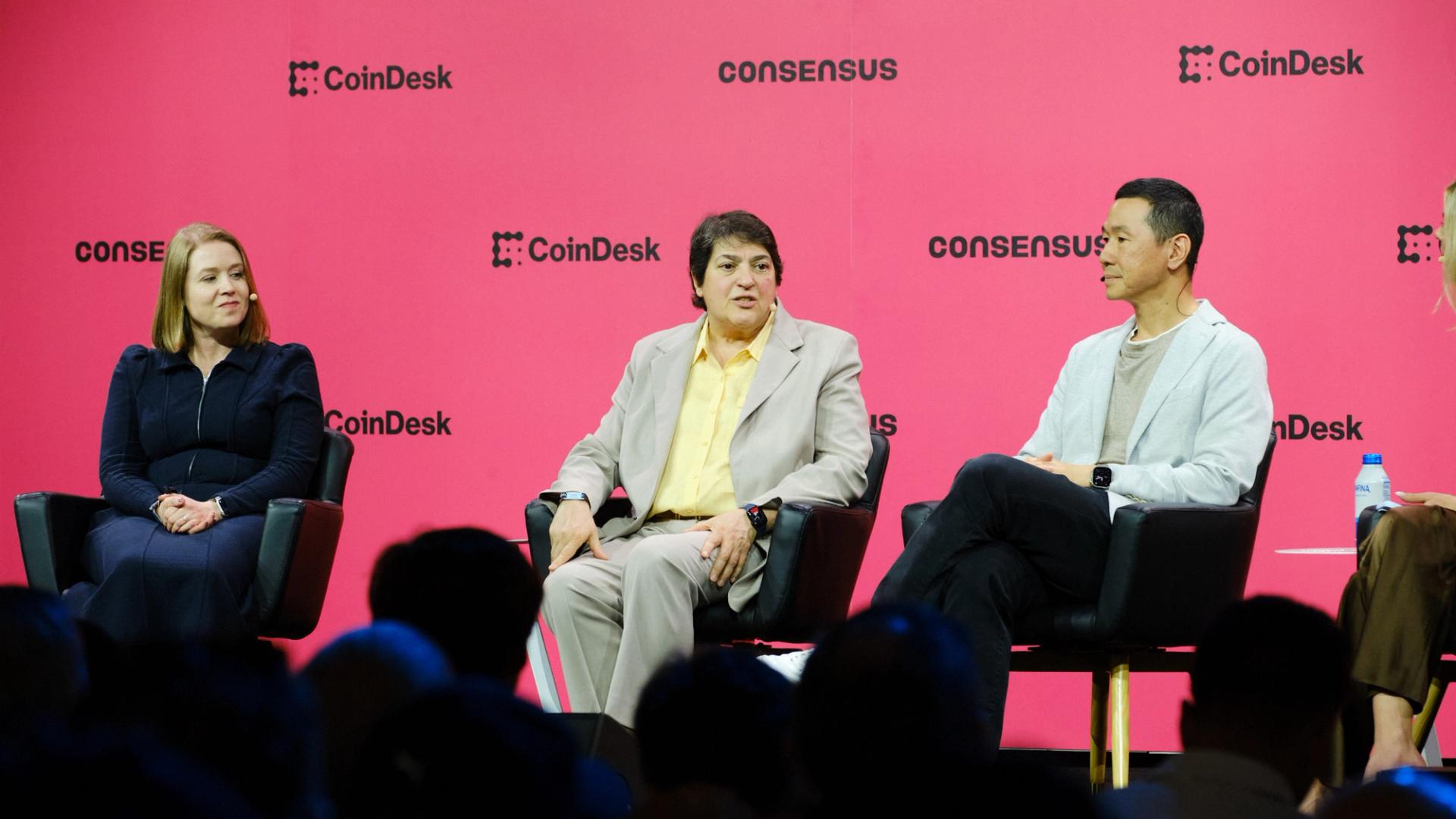
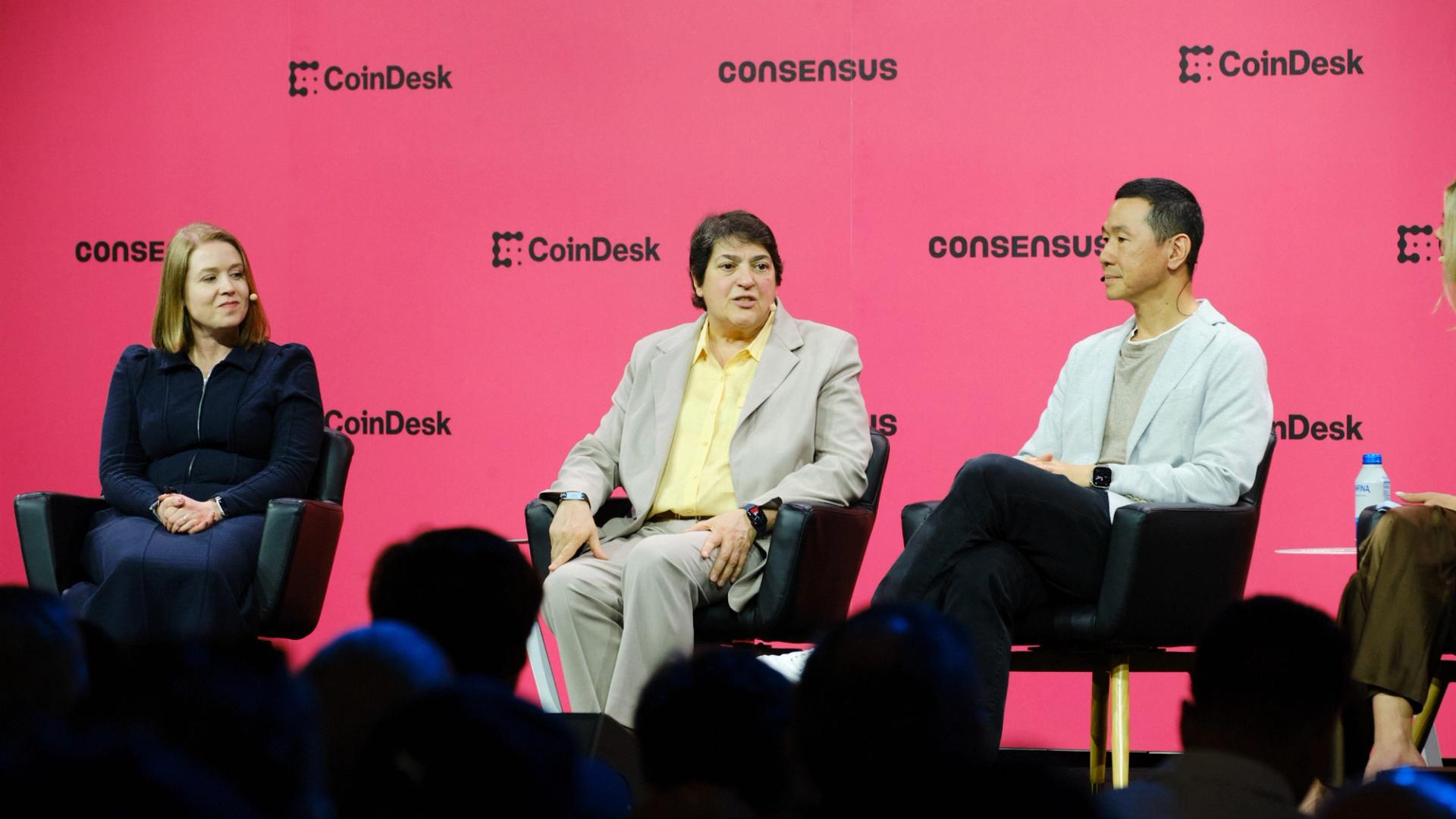
Miami Beach, FL — Tokenization is not replacing the system overnight, but it is steadily reshaping the plumbing underneath, Wall Street executives said at Consensus 2026 in Miami.
Digital asset leaders from Citi, JPMorgan and DTCC said during a panel discussion that blockchain-based rails are moving into production, with real volumes and real clients shaping how the technology is deployed.
A year ago, Citi’s tokenized deposit system was handling millions. “Now we’re moving billions,” said Ryan Rugg, who leads digital assets for the bank’s treasury and trade solutions unit.
The demand, she said, is coming from clients who want to move money around the clock, not just during banking hours.
JPMorgan is seeing a similar pattern. Its blockchain platform, Kinexys, has processed more than $1 trillion in transactions, said Kara Kennedy, who leads market development for the bank’s digital assets unit.
The focus is less on building parallel systems and more on stitching blockchain rails into existing infrastructure to enable faster settlement and continuous operations, she said.
DTCC, which sits at the center of U.S. market plumbing, is taking a longer view. The firm is working to bring parts of its $150 trillion securities infrastructure onto a shared digital layer, with initial rollout plans already underway.
“You can’t just replace what exists,” said Nadine Chakar, who heads digital assets at DTCC. “This is an evolution.”
That approach reflects a broader shift in the market. Early tokenization efforts often looked for problems to solve. Now, firms are targeting specific pain points, especially in areas such as collateral, cross-border payments, and liquidity management.
For large corporations, the ability to move funds in real time — across time zones and holidays — is changing how treasury functions operate. Instead of pre-positioning cash days in advance, firms can react instantly to margin calls or investment opportunities.
Still, the panelists pushed back on the idea that blockchain will remove intermediaries altogether. Core functions like risk management, compliance and settlement guarantees remain hard to replicate in fully decentralized systems.
“We will always need some level of intermediation,” Chakar said.
Crypto-native players, however, see a longer arc. Evan Auyang, president at Animoca Brands, said the industry is still in a transition phase, with blockchain gradually proving its efficiency before a bigger structural change.
“The nature of blockchain is that it’s transformative,” Auyang said, pointing to faster processes like loan approvals that can shrink from weeks to days. But he added that fully native onchain markets are “not ready yet,” given the scale of existing systems and regulatory constraints.
At the same time, he argued, the direction is hard to ignore. “If there’s efficiency and cost savings, it will be adopted,” he said, adding that traditional finance and decentralized systems are now “converging.”


Drift Protocol announced Tuesday the implementation of a recovery plan for users affected by a $295 million exploit on April 1, which it attributed to the North Korea state-backed DPRK hacking group identified by forensic firm Mandiant.
The attack led the protocol to suspend trading and borrowing immediately after the exploit. Drift said “the majority of stolen assets remain traceable and contained with limited successful off-ramping by the attacker,” with about 130,259 ETH (roughly $31 million) concentrated across four monitored wallets.
Drift’s statement explains that the recovery framework centers on issuing a token representing verified user losses. “Each recovery token represents $1 of verified loss,” Drift said, adding that holders would be able to redeem based on the value of a recovery pool funded over time.
That pool starts with roughly $3.8 million in remaining protocol assets and is expected to grow through exchange revenue, up to $127.5 million in support from Tether tied to performance, and up to $20 million from partners, Drift said. The pool will accrue until it matches total losses of about $295.4 million, at which point tokens can be redeemed at full value, it added.
Drift also said some funds have already been frozen, including about $3.36 million in USDC, while additional assets remain delayed in cross-chain transfers. Legal efforts to seize and reissue funds are ongoing, it said. The protocol also launched a public bounty offering 10% of recovered assets.
Drift plans to relaunch in the second quarter as a “security-first” exchange with changes including new multisig controls, time-locked operations, key rotation and reduced product scope focused on perpetuals trading.
“The Drift team is taking considered measures to ensure that users are made whole,” the team said, adding that final decisions will be subject to governance votes.
Drift’s recovery plan announcement comes a week after Aave said it was spearheading a coordinated DeFi recovery effort to rescue Kelp DAO, the second largest DeFi exploit this year, which was also carried out by North Korean-backed hackers. The so-called Lazarus group drained nearly $280 million. In this case, Aave has been able to garner span donations, deposits, and credit lines from across the crypto space.

Options traders can’t get enough of semiconductor stocks. No matter how high they go or how expensive the options get, bulls just keep flooding the space.
After a 700% rally the past year, traders poured into Micron options Tuesday, paying expensive premiums to get access to further upside in the legacy memory-chip maker that became one of the market’s hottest AI trades over the past year.
More than $2.8 billion of Micron options premium changed hands Tuesday as of noon Chicago time, eclipsing the dollar-amount traded in index ETFs SPY and QQQ combined. Micron accounted for 12 of the top 20 options trades in the hour after the opening bell, according to data from SpotGamma — a major feat for a stock with no big newsflow and earnings months away.

Micron, YTD
Call volumes outpace puts on the stock, and call premiums dwarf the amount paid for puts. More calls were bought than sold, and more puts sold than bought on Tuesday, according to ThinkOrSwim, as implied volatility in the stock rose to 84 — roughly five times the volatility in the S&P 500.
Call-buyers ranged from deep in-the-money to out-of-the-money strikes, with the biggest trades leaning toward later-dated expiries that bet on a sustained move in Micron, whose market cap surpassed $700 billion.
Conviction in Micron was mirrored by traders in related names such as SanDisk and Western Digital, where call-buying dominated the action as those respective stocks hit all-time highs.
In another major market cap milestone, Intel on Tuesday surpassed its dotcom value, nearing a $550 billion valuation after a 13% pop that brings its one-year run to more than 430%.
Intel, YTD
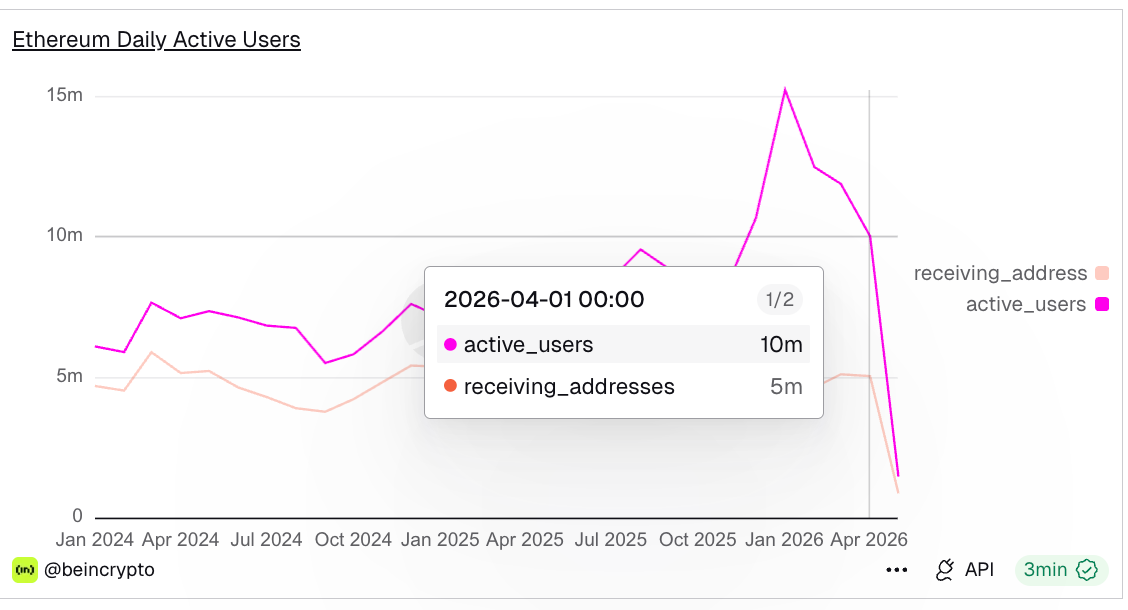
The Ethereum price has rallied 15% over the past month, but the on-chain story has quietly turned bearish. Active users dropped 33% from the January peak. Average gas sits at the lowest sustained reading in two years.
Volume has trended lower even as price climbed. And on May 1, exchange net position change pivoted from accumulation to distribution. The rally is showing up on price. The network is signaling something different.
Ethereum’s Network Demand Has Quietly Collapsed?
Three structural data points frame the network picture heading into May.
Want more token insights like this? Sign up for Editor Harsh Notariya’s Daily Crypto Newsletter here.
Daily active users on Ethereum peaked at 15 million in January 2026, per BeInCrypto’s exclusive Dune dashboard. By April, that figure had fallen to 10 million. The 33% three-month drop matters because of its velocity, not its resting point. The 10 million reading is still higher than the 6 to 7 million baseline that held during the July 2024 spot ETF launch. The momentum reversal is the signal.

The second data point is gas. Average gas prices on Ethereum sit at roughly 1 gwei, the lowest sustained reading since early 2024 when the metric peaked at 49 gwei. Low gas is not always user-friendly feature. It is a measure of demand for block space, and it directly weakens the EIP-1559 burn mechanism that creates supply pressure on ETH. Less activity means less ETH burned, which means less deflationary support for the Ethereum price.

The third data point comes from the price chart itself. Since February 6, Ethereum has traded inside a parallel rising channel. Price has steadily climbed. Volume over the same window has trended lower. That bearish volume divergence means the rally is being carried by progressively less buying conviction, even as price extends. Moreover, the ascending channel forms after a near 50% dip from the mid-January highs. This makes the pattern way less bullish than usual.

The pieces add up to one observation. The Ethereum price is rising. The network supporting that price is not.
Exchange Flows Just Confirmed What the Network Was Already Signaling
The clearest validation that the network weakness is now bleeding into price action sits in Glassnode’s Exchange Net Position Change data, a metric that tracks net flow of ETH into and out of exchange wallets.
For most of April, the metric was deeply negative. ETH was leaving exchanges at a steady pace. Each red bar represented withdrawals from exchange wallets into self-custody, a classic accumulation signal. Through April 28, daily outflows averaged roughly 300,000 ETH.
Then it flipped.
On May 1, exchange net position change turned positive. By May 4, 60,449 ETH had moved into exchanges. The pivot from sustained accumulation to fresh distribution is the kind of pattern shift that historically precedes price weakness. Holders who were absorbing supply through April have started to send tokens back to exchanges, which is where they get sold.

The historical precedent reinforces the read. The last time Ethereum rallied with a similar fundamental setup, July 2024, ETH dropped 40% within days of the spot ETF launch. The cause then was the same as now. Institutional flows lifted price without organic network demand to support it. Active users were flat at 6 to 7 million, as shown by the image shared earlier. Gas was low. The rally fizzled within weeks.

The April 2026 setup matches that template. Active users have collapsed from January’s peak. Gas is at multi-year lows. Volume on the price chart has thinned. And exchange flows have just confirmed that holders are starting to take chips off the table.
The network gave the warning. The exchanges are now the confirmation.
Ethereum Price Levels Show Where the Rally Has to Prove Itself
Ethereum (ETH) trades at $2,383 inside a parallel rising channel that has guided price higher since February 6. That channel followed a 48.81% drop from the January peak of $3,407 to the February low of $1,747. The current rally is a recovery attempt, not a continuation.
The first test sits at $2,466. A daily close above this level brings ETH closer to the channel’s upper trendline and gives the rally room to validate itself with the volume the chart has been missing. Without that close, the structure stays compressed and the bearish on-chain signals from active users, gas, and exchange flows get the chance to translate into price weakness.

The downside levels are stacked tightly. Holding $2,074.57, the 0.236 Fibonacci level, keeps Ethereum inside the channel. A break of $2,074 cracks the channel and exposes $1,831, the 0.382 Fibonacci level. Below $1,831, the path opens to $1,747, the February low, and $1,635, the 0.5 Fibonacci level.
The level math is asymmetric. Upside requires reclaiming $2,466 with volume the chart has not delivered. Downside, if the channel cracks, opens a path back to the February lows. A daily close above $2,466 weakens the bearish on-chain thesis. A close below $2,074 confirms it.
The post The 15% Ethereum Rally Hides a Network Problem That Just Reached Exchanges appeared first on BeInCrypto.
Figure Technology Solutions is advancing its strategic pivot from being a pure home equity line of credit (HELOC) originator to a broader platform that integrates blockchain infrastructure and AI-powered credit markets. Bernstein Securities reaffirmed an Outperform rating on Figure (FIGR) with a $67 price target, implying roughly 67% upside from current levels and signaling confidence in the company’s transition beyond traditional lending.
In the brokerage note published Tuesday, Bernstein highlighted a momentum shift under way, underscored by April loan volumes totaling $1.34 billion—up 108% year over year and marking the second consecutive month above $1 billion. The firm argues that tokenization—converting loans into on-chain, tradable assets that can settle in real time—could unlock a much larger addressable market than standard HELOC lending, aligning Figure with broader trends in tokenized credit and real-world assets.
Key takeaways
- Bernstein reiterates an Outperform rating on FIGR with a $67 target, signaling potential upside of about two-thirds from current levels.
- The research argues that Figure’s shift toward tokenized credit and AI-driven markets could access a much larger market than its legacy HELOC business.
- April loan volumes reached $1.34 billion, up 108% year over year, the second straight month above $1 billion, with growth expected to continue.
- Bernstein projects total loan volumes could climb to $16.5 billion by 2027 from $8.4 billion in 2025, reflecting a multi-year growth trajectory.
- Tokenized credit remains a small slice of the real-world asset (RWA) market today, but several players are building toward broader adoption, including Figure’s Hastra ecosystem and peers like Centrifuge.
Figure’s pivot: from HELOC originator to a tokenized credit and DeFi-enabled platform
The note frames Figure’s evolution as a deliberate expansion beyond traditional HELOC lending into a platform designed to support a broader spectrum of credit markets. Central to this shift is the tokenization of loans—turning consumer and business debts into on-chain instruments that can be traded and settled in real time. Bernstein views tokenized credit as a way to unlock liquidity, improve risk transfer, and accelerate settlement cycles for lenders and investors alike.
Figure’s Hastra ecosystem embodies this broader vision, integrating tokenized credit products—such as auto loans—into decentralized finance (DeFi) and related capital markets. By embedding tokenized credit inside a blockchain-enabled framework, Figure aims to connect traditional lending with on-chain liquidity, potentially boosting fund flows and diversification for both retail and institutional participants.
Tokenized credit: a nascent, multi-trillion opportunity amid early adoption
Bernstein’s analysis points to a sizable addressable market for tokenized credit, estimated at around $4 trillion in annual origination across multiple loan categories, including mortgages, auto loans, HELOCs, and small-business lending. That figure underscores a long runway for platforms like Figure to broaden activity beyond the company’s core HELOC heritage.
In parallel, the broader real-world asset (RWA) space remains relatively small today. Industry data cited by Bernstein puts the tokenized credit market at about $5.5 billion, highlighting the gap between current adoption and the longer-term growth trajectory forecast by the firm. The potential, however, is clear: as more asset classes are tokenized and brought onto-chain, Figure could play a significant role in linking traditional credit with DeFi liquidity channels.
The broader ecosystem has begun to test these connections. For instance, Centrifuge has expanded its DeFi platform to include tokenized credit and U.S. Treasury products on new blockchain networks, signaling a broader industry push toward institutional-grade assets within DeFi. Such developments provide a proof point that the tokenized-credit thesis—while still in early days—has a credible pathway to scale.
Within Figure’s strategy, the Hastra program is cited as a concrete avenue for expanding tokenized credit products, particularly auto loans, into on-chain markets. This direction aligns with a growing trend of using tokenized consumer and commercial debt to improve liquidity and risk sharing across decentralized platforms.
What this means for investors and builders in crypto finance
The trajectory outlined by Bernstein suggests that investors should watch two key dimensions: the pace of loan-portfolio growth and the rate at which tokenized credit assets gain on-chain liquidity and price discovery. If the April momentum—$1.34 billion in loan originations, up 108% YoY—continues and scales toward Bernstein’s 2027 target, Figure could demonstrate tangible progress from a traditional lender toward a versatile credit-platform model.
Beyond Figure, the broader tokenized-credit story remains a work in progress. The current market size indicates substantial headroom if on-chain settlement, liquidity, and compliance frameworks mature. Observers will be watching how regulatory developments, custody solutions, and institutional participation influence the speed and breadth of adoption in tokenized credit markets.
For builders, the example set by Centrifuge and Figure’s Hastra initiative highlights a path for tokenized credit products to bridge real-world assets with DeFi ecosystems. The ongoing experimentation across mortgages, auto loans, and other indebtedness points to a future where on-chain credit could become a standard liquidity layer for non-traditional borrowers and asset classes.
As Figure navigates this transition, investors will need to monitor not only headline loan volumes but also the quality of onboarding, risk controls, and the ability to convert on-chain liquidity into meaningful, tradable instruments. The open question remains how quickly tokenized credit will reach mainstream liquidity, how regulators will respond to expanded on-chain securitization, and whether the current growth trajectory can withstand macro headwinds.
In the near term, the key data point to watch is loan origination velocity and the trajectory of Hastra-enabled products. If the pace of originations sustains its current speed and tokenized offerings gain broader market acceptance, Figure could move closer to Bernstein’s optimistic outlook. However, given the nascent stage of tokenized credit, investors should balance potential upside with the uncertainties inherent in early-stage on-chain asset markets.
Readers should keep an eye on further disclosures from Figure and its partners as the company scales tokenized credit offerings, alongside independent assessments of market adoption and risk management frameworks in tokenized lending.
Figure Technology Solutions remains at a crossroads of traditional lending and on-chain finance, a junction where near-term momentum and long-term strategic clarity will determine whether tokenized credit becomes a core driver of value for Figure and its ecosystem.

Key Takeaways
- Q1 2026 revenue reached $1.63B, surging 85% annually and exceeding analyst projections
- Adjusted earnings per share landed at $0.33; annual guidance upgraded to $7.65–$7.66B range
- Government segment delivered $687M, surpassing forecasts; U.S. commercial segment at $595M fell short
- Shares declined approximately 7%, hovering around $136, marking a 23% year-to-date retreat
- Extreme valuation metrics persist with 232x trailing P/E and 78x price-to-sales multiple
Shares of Palantir (PLTR) tumbled roughly 7% Tuesday following the company’s otherwise impressive Q1 2026 financial results, as Wall Street zeroed in on underwhelming commercial segment performance and eye-watering valuation metrics.
Palantir Technologies Inc., PLTR
The data analytics giant traded around $136 during midday sessions, slipping beneath both its 50-day moving average of $145.40 and its 200-day moving average of $164.26. Year-to-date losses now stand at 23%, representing a significant pullback from the 52-week peak of $207.52.
First-quarter revenue totaled $1.63 billion, reflecting an 85% year-over-year expansion that exceeded Wall Street’s consensus. Adjusted earnings per share registered at $0.33. The company simultaneously boosted its full-year revenue outlook to a range of $7.65–$7.66 billion.
This marks the eighth consecutive quarter where the company has surpassed both earnings and revenue projections—a remarkable achievement few enterprises can claim.
Government Segment Shines While Commercial Underdelivers
The government division emerged as the clear winner, generating $687 million in revenue and handily exceeding the $610.5 million analyst consensus.
The challenge emerged from the commercial business. U.S. commercial revenue totaling $595 million landed below expectations, proving sufficient to trigger negative sentiment immediately following the release.
Palantir had previously projected U.S. commercial revenue growth of at least 115% throughout fiscal 2026. The Q4 2025 period saw this segment expand 137% year-over-year to $507 million, establishing elevated expectations heading into this quarter.
CEO Alex Karp previously characterized Palantir’s Rule of 40 metric as “an incredible 127%,” positioning the enterprise as “an n of 1.” Tuesday’s earnings release maintained this positioning without reservation.
Valuation Multiples Remain Stratospheric
Despite exceptional growth metrics, the stock commands a trailing price-to-earnings ratio of 232x, a forward P/E of 112x, and a price-to-sales multiple reaching 78x.
Industry competitors including Snowflake, ServiceNow, and Microsoft also trade at elevated valuations—yet none approach Palantir’s price-to-sales premium.
This valuation disconnect became the focal point for skeptical investors Tuesday, even as broader technology sector sentiment remained generally supportive.
Rosenblatt Securities reaffirmed its optimistic $225 price objective, highlighting Palantir’s ontology platform as critical enterprise AI infrastructure. The Street’s consensus price target currently stands at $180.68.
Analyst coverage remains divided: 19 Buy recommendations, 10 Hold ratings, and 2 Sell calls. Recent insider transaction activity has skewed heavily toward selling, with 72 net sell transactions recorded.
Interestingly, Polymarket participants had assigned a 99% probability to PLTR declining on May 5, even prior to the earnings announcement—an unusual instance where prediction markets anticipated the negative reaction.
Reddit community sentiment shifted from neutral toward bullish territory following the earnings beat, registering a score of 60. However, the broader composite sentiment indicator measured 57.01, reflecting a 5.54-point decline over the trailing seven-day period.
Technical analysts are monitoring the $130 price level as critical support heading into the week’s conclusion.


Bullish acquisition of Equiniti targets tokens

“No Consistency”: Ravi Shastri Slams Rishabh Pant’s LSG After Sixth Consecutive Loss

What is SEO Intelligence? Key Features that You Should Use

Manchester United reach agreement with Casemiro over contract clause amid transfer speculation

US brings back mandatory military draft registration

Steven Gerrard disagrees with Gary Neville over ‘shock’ Chelsea and Arsenal claim | Football


-

 Business7 days ago
Most Commercial Energy Audits Miss the Real Losses
-

 NewsBeat2 days ago
Channel 5 – All Creatures Great and Small series 7 new post
-

 Fashion7 days ago
Kylie Jenner’s KHY Enters a New Era with ‘Born in LA’
-
 Tech4 days ago
Trump’s 25% EU auto tariff breaches Turnberry Agreement that also covers semiconductors and digital trade
-
 Sports4 days ago
Paul Scholes issues Marcus Rashford reality check as agreement emerges over Man United star
-

 Business6 days ago
Barclay Brothers Avoid Bankruptcy: HSBC Drops High Court Petitions After IVA Deal
-
 Business6 days ago
Tesla Officially Registers Elon Musk’s Stock: What Investors Need to Know
-

 Entertainment6 days ago
Celebrities Who Are Attending the 2026 Met Gala Event
-

 Tech6 days ago
Texas Instruments made a new flagship graphing calculator: the TI-84 Evo
-

 Business5 days ago
Two Powerball Tickets Split $143 Million Jackpot in Indiana and Kansas
-

 Entertainment6 days ago
Insider Claims Reason Behind Key & Peele Split
-

 Entertainment4 days ago
Met Gala 2026 Rumored Guest List Is Turning Heads
-
Business2 days ago
Winning Numbers Drawn as Jackpot Resets to $20 Million
-

 Crypto World6 days ago
Meta (META) starts stablecoin payout to creators in Circle’s USDC on Polygon, Solana via Stripe
-
 Crypto World5 days ago
CoreWeave (CRWV) Stock Climbs 8% Despite $45M Insider Share Dump
-
 Crypto World6 days ago
Securitize and Computershare Enable Tokenized Equity Issuance for Over 25,000 U.S.-Listed Stocks
-

 Business6 days ago
Strait of Hormuz Remains Heavily Restricted on April 29 Amid Iran Conflict
-

 Entertainment4 days ago
Kylie Jenner Hit With Second Lawsuit From Ex-Housekeeper
-

 Crypto World6 days ago
Gibraltar Proposes Tokenized Funds Regulation to Bolster Compliance
-

 Sports6 days ago
Saudi Arabia set to withdraw LIV Golf funding after 2026 season, per reports
You must be logged in to post a comment Login