
Crypto World
how to position given the ongoing conflict in Iran and altcoin macro

Pi now trades like a high‑beta narrative coin: stuck in a 0.18–0.25 band while March unlocks, Open Mainnet progress and listing rumors fight to set the next big move.
Summary
- PI is hovering in the low‑$0.20s with roughly $1 million in daily volume, a $1.8–$1.9 billion cap and a heavy bag of holders still down over 90% from 2025 highs.
- Open Mainnet and ecosystem growth offer real utility potential, but March unlocks in the tens of millions of tokens leave the 0.18–0.20 support zone exposed if miners dump.
- Over the next 3–6 months, baseline models cluster around a 0.30–0.50 grind higher, with a bear case near 0.14 and a bull case pushing toward 0.80–1.00 on perfect‑storm adoption.
Pi Network (PI) is trading like a high‑beta, narrative coin pinned between speculative unlock flows and a long‑awaited mainnet story, with March shaping up as an inflection point for price direction.
Market Snapshot: Range, Liquidity, Structure
Across major offshore venues, PI is changing hands around the low‑$0.20s, with recent spot quotes clustered in the 0.21–0.23 dollar band after a short-term grind higher over the past week. MEXC data puts Pi’s market cap near 1.8–1.9 billion dollars, on roughly 9.6 billion tokens in circulation and light but steady 24‑hour volumes close to 1 million dollars, signalling modest but not dead order books for a top‑50 asset. On a higher timeframe, PI is still down more than 90% versus its 2025 peak near 3 dollars, leaving a heavy overhang of trapped supply and emotionally scarred holders into every rally.
Technically, short-term resistance clusters just above 0.23–0.24 dollars, with analysts watching 0.24–0.25 as the level that would confirm a clean break from the recent range. Support sits in the 0.18–0.20 zone, an area already flagged as structurally important given upcoming token unlocks that could stress bids if sentiment wobbles.
Catalysts: Mainnet, Unlocks, Listings
The key structural shift is the project’s transition into an Open Mainnet, enabling real-world transactions, external integrations, and a move away from “mobile mining app” purgatory. That unlocks a credible path to utility – payments, dapps, marketplace integrations – but it does not remove the near-term mechanical risk from supply hitting the market as KYC migrations and token unlocks accelerate.
Near term, traders are also leaning into the “exchange listing plus Pi Day roadmap” combo trade: speculation around new CEX listings, including tier‑one venues, has already driven spikes when rumors surface. At the same time, token unlock trackers highlight roughly tens of millions of PI scheduled to hit circulation in March, putting the 0.18–0.20 floor at risk if early miners rush to cash out into thin books.
3–6 Month Price Scenarios
Baseline: If Open Mainnet stabilizes, daily active users migrate into actual spenders, and unlock supply is absorbed without major liquidations, PI could grind higher into a 0.30–0.50 range over the coming quarters, implying a 30–130% upside from current levels and a market cap in the 3–5 billion dollar band. This tracks with several quantitative and qualitative models that cluster 2026 fair value around the mid‑double‑cent range, assuming no blow‑off mania.
Bear case: Persistent sell pressure from unlocks, tepid dapp traction, and no top‑tier listings could drag PI back toward 0.14 or lower, effectively revisiting winter lows and erasing the recent bounce. Bull case: A “perfect storm” of strong mainnet adoption, surprise listings, and retail FOMO could push price through 0.50 toward the 0.80–1.00 zone flagged by more optimistic 2026 models, though that would require a sustained re‑rating of Pi as a payments‑style network rather than a fading airdrop meme.
For now, PI trades like an options bet on execution: upside capped by dilution and history, downside controlled by how quickly the network can turn its massive user base into real, on‑chain economic activity.


TLDR
- Russia will collect about 567 million rubles or over $7 million in crypto mining taxes for 2025.
- The Federal Tax Service said miners will pay 84 million rubles in personal income tax and 483 million rubles in corporate tax.
- Earlier projections had estimated mining tax revenue at 6 billion rubles, which is far higher than the current figure.
- Officials said rising electricity tariffs and lower Bitcoin prices reduced miners’ profitability.
- Authorities reported that more than two-thirds of active mining enterprises remain unregistered.
Russia will collect about 567 million rubles in taxes from cryptocurrency miners for 2025. The amount equals slightly over $7 million at the current exchange rate. Officials confirmed the figure and outlined lower-than-expected revenue from the regulated mining sector.
Russia Mining Tax Revenue Falls Short of Early Projections
Denis Kuzmichev, head of taxpayer registration at the Federal Tax Service, presented the updated figures during a public briefing. He stated that miners will transfer 84 million rubles in personal income tax and 483 million rubles in corporate income tax. He also said the second quarter of last year generated the highest assessed payments, totaling about 180 million rubles.
Earlier projections had estimated tax revenue of 6 billion rubles, or nearly $74 million. Sergey Bezdelov, Director of the Industrial Mining Association, recalled those expectations during the meeting. He said rising electricity tariffs, a high global Bitcoin hash rate, and lower BTC prices reduced miners’ profitability.
Officials also cited the weaker U.S. dollar against the ruble as a factor affecting returns. Kuzmichev stated that limited legalization has constrained full tax collection. Authorities reported that more than two-thirds of active mining enterprises remain unregistered.
Russia adopted legislation in 2024 to regulate cryptocurrency mining activities. The law permits legal entities, entrepreneurs, and citizens to participate in mining operations. However, companies and entrepreneurs must register with the Federal Tax Service.
Citizens may mine without registration if they consume less than 6,000 kWh per month. All miners must report the type and value of digital assets produced. They must also disclose the hardware used in mining operations.
Russia Expands Mining Capacity While Enforcing Restrictions
The Ministry of Energy reported that the mining industry consumes 16 billion kWh annually. Bezdelov said this accounts for about 2% of Russia’s total electricity demand. Authorities also confirmed that mining farms and data centers reached 4 GW of connected capacity in 2025.
The 4 GW capacity marks a 33% increase compared to the previous year. However, the government imposed a full mining ban in 10 regions. The restrictions target areas in the Far East, Siberia, the Caucasus republics, and occupied territories in Eastern Ukraine.
Officials introduced seasonal bans in the Republic of Buryatia and Zabaykalsky Krai. Those restrictions expired on March 15. However, the federal government is considering year-round limits in both regions.
Lawmakers are preparing new financial penalties for violations of mining rules. The legislative committee at the State Duma approved a bill introducing fines. The draft sets fines between 100,000 and 150,000 rubles for individuals.
Companies could face fines ranging from 1 million to 2 million rubles. Authorities may also suspend operations for up to 90 days. In both cases, officials may confiscate mining equipment.
The bill also targets unregistered mining where registration is required. Fines for such violations range from 100,000 to 500,000 rubles. The State Duma committee recommended the bill for adoption on Monday.


Cryptocurrencies seem to have lost their allure at the South by Southwest (SXSW) festival, giving way this year to panels and events focused on the rise of artificial intelligence.
As the annual Austin, Texas event kicked off last week for a run through Wednesday, only a few official sessions focused on crypto, while a side event, the “Bitcoin Takeover” in downtown Austin, featured Bitcoin (BTC) maximalists and other industry representatives.
“Almost exactly the pattern that’s playing out with AI is what’s playing out with crypto,” Ali Tager, the National Cryptocurrency Association’s vice president of communications, told Cointelegraph, referring to many of the uncertainties from the general public in the early days of the industry.
She added: “I do believe that crypto is just a few years behind on that journey.”

Related: High-yield bond surge signals rising risk, demand in BTC mining, AI infrastructure
In contrast to previous SXSW festivals in Austin, which doted heavily on nonfungible tokens (NFTs) in 2022, focused on Web3 in 2023, and featured Coinbase executives in 2025, the industry representation this year was scant. While there were several panels this year focused on AI through art, music, storytelling, and risk warnings, only a handful featured crypto, and were hosted by the NCA, Solana Foundation, or Foundation Capital.
“The energy is different every single year,” said Tager, referring to SXSW.
Some mining companies also pivoting into AI infrastructure
Amid increasing BTC difficulty and related costs, some of the largest crypto miners in the US have announced plans to shift their business strategies from digital assets to AI and high-performance computing. For companies like Riot Platforms, CleanSpark, MARA Holdings, Core Scientific, Hut 8, and TeraWulf, that includes plans to repurpose some of their infrastructure in data centers toward AI.
Magazine: Human brain cell wetware plays Doom, fly’s mind uploaded: AI Eye
Disclosure: This article does not represent investment advice. The content and materials featured on this page are for educational purposes only.
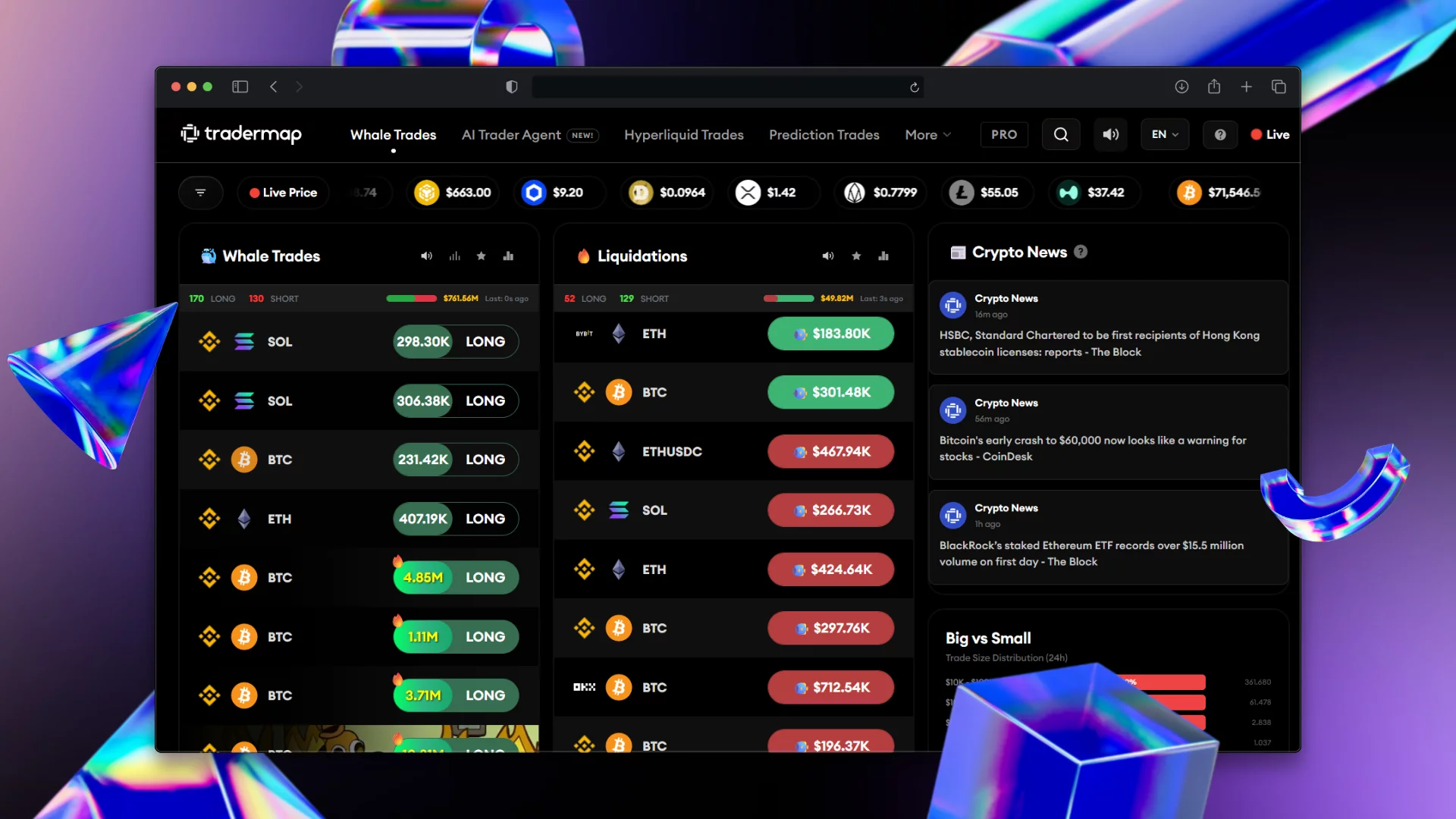
TraderMap helps crypto traders to track whale activity as institutional capital continues shaping market price movements.
Summary
- TraderMap launches as a unified dashboard for tracking whales, liquidations, and market news.
- TraderMap streams real-time data from exchanges including Binance, Bybit, and OKX.
- The platform aggregates whale trades, liquidations, and headlines into a single zero-latency crypto trading interface.
In the cryptocurrency market, price action is rarely random. It is driven by “Whales”— institutional entities and high-net-worth individuals who possess the capital necessary to shift market structures.
For the retail trader, success often depends on the ability to identify these “Smart Money” footprints before they result in massive price swings.
Whale tracking is the real-time monitoring of large-scale transactions, exchange inflows/outflows, and massive derivative positions.
The importance of the “smart money” flow
- Anticipating Volatility: Large players often position themselves in real-time before major volatility manifests on standard candlestick charts.
- Identifying Accumulation: Monitoring whale trades exactly as they open provides a clear map of institutional movement.
- Avoiding “Retail Traps”: Price spikes are often driven by retail FOMO; whale data helps you distinguish between retail hype and genuine institutional accumulation.
To capture these movements effectively, traders need zero-latency data. Professional tools utilize direct websocket feeds from major exchanges to ensure moves are seen the millisecond they occur, eliminating the “fog” of lagging indicators.
For active traders, the choice of platform is the difference between leading the market and following the noise. While standard blockchain explorers are useful for historical audits, they are far too slow for real-time execution in a market that moves in milliseconds.
TraderMap: The professional standard
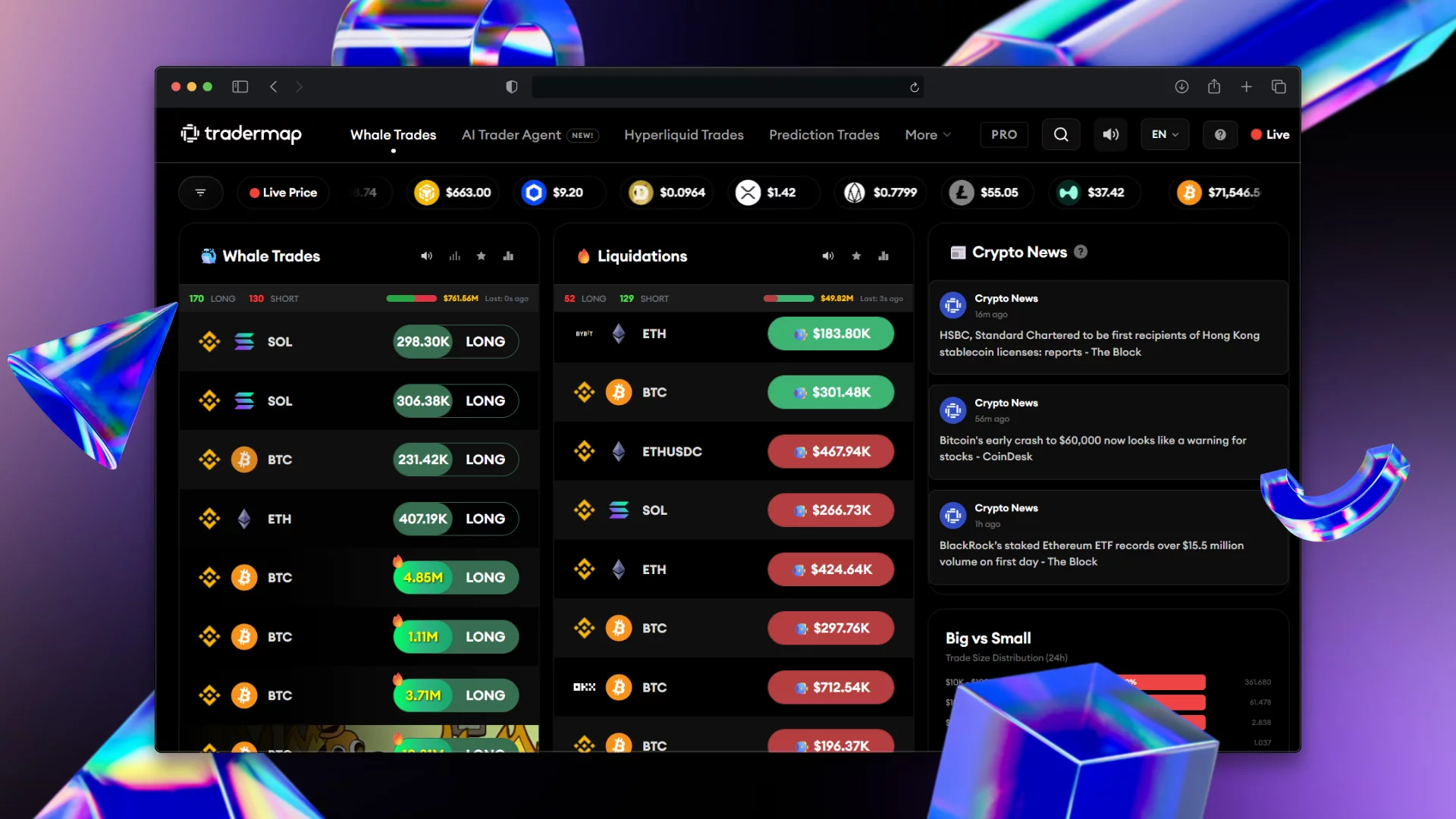
For those who prioritize speed, accuracy, and efficiency, TraderMap serves as the definitive centralized command center. It is specifically engineered to eliminate “tab-switching” fatigue — the seconds lost jumping between different sites for prices, news, and alerts — by centralizing everything into a single, zero-latency view.
TraderMap changes the tracking experience by consolidating high-criticality data streams:
- Live Whale & Hyperliquid Trades: Monitor massive institutional positions and high-conviction moves exactly as they open.
- Real-Time Liquidations: Identify exactly where market leverage is being “flushed out” to find superior entry points during periods of maximum retail pain.
- Integrated News Feed: Headlines appear directly alongside price action, ensuring you understand the “why” behind every sudden volatility spike without leaving the interface.
- Zero-Latency Infrastructure: Powered by direct websocket feeds from major exchanges like Binance, Bybit, OKX, and Hyperliquid, the platform delivers data at the speed used by institutional desks.
Tracking whales effectively requires filtering out the “noise” of small retail trades. Here is how to use the TraderMap toolkit to isolate high-conviction moves:
Step 1: Set filters
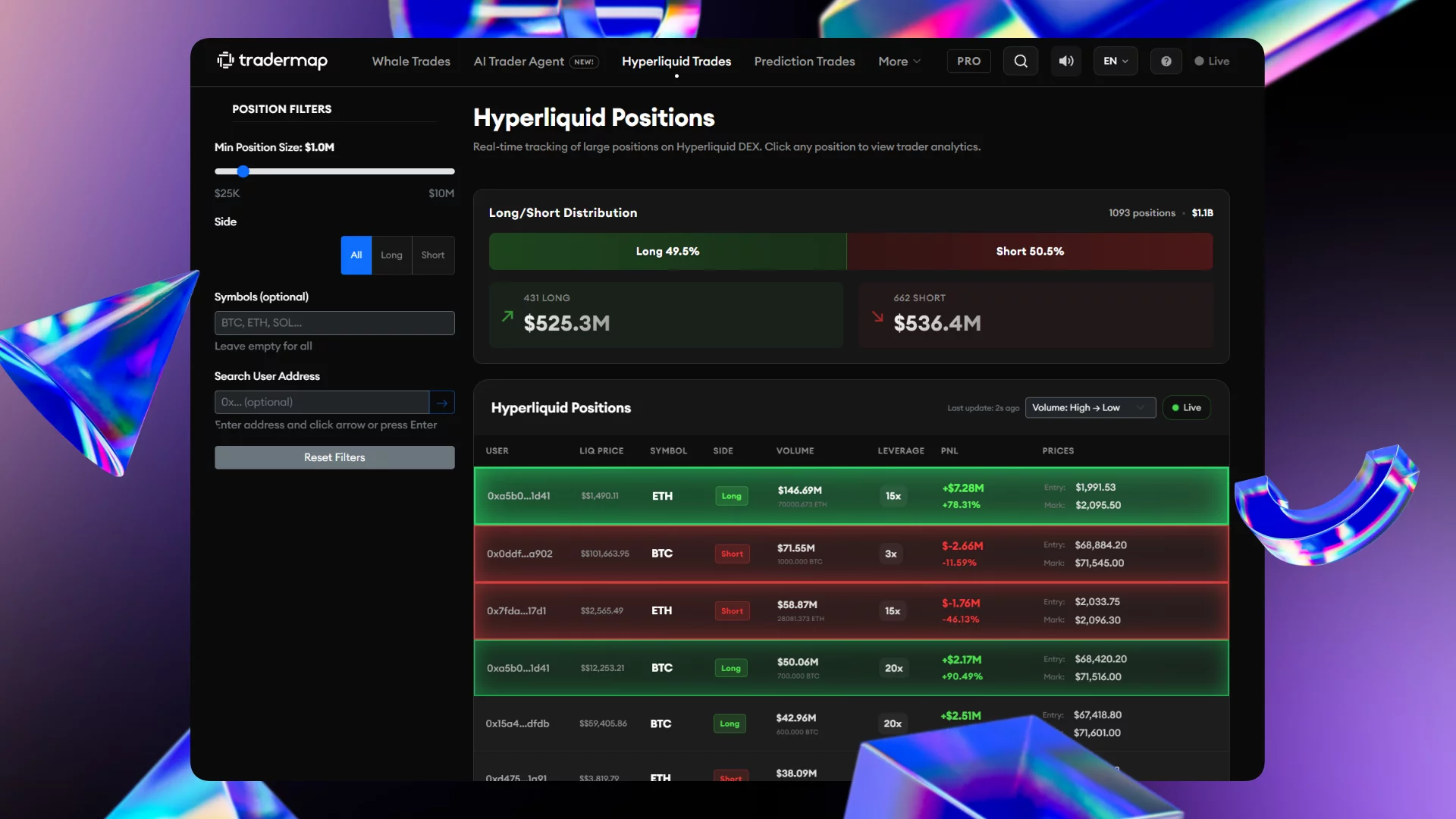
Navigate to the Position Filters section. To find the “real” money, set the Min Position Size to a significant threshold, such as $1.0m. This ensures feed is only populated by institutional-grade entries.
Step 2: Monitor Hyperliquid positions
Advanced traders use the Hyperliquid Trades section to track large-scale decentralized derivative positions.
- Address Search: If a consistently profitable whale is identified, use the Search User Address feature to track their specific entries and leverage in real-time.
- Long/Short Distribution: Monitor the visual distribution bar (e.g., 62% Long vs. 38% Short) to gauge the immediate directional bias of the market’s biggest players.
Step 3: Correlate with visual momentum
Use the RSI Heatmap and Crypto Bubbles to see which assets are overextended. If a whale makes a massive entry on an asset that the dashboard shows is overbought or oversold, that’s a high-probability trade signal.
Adopting a whale-centric strategy provides several unique advantages that standard technical analysis cannot offer:
- Liquidation Hunting: By tracking real-time Liquidations, users can see exactly where leverage is being “flushed out”. Smart Money often enters at these points of maximum pain for retail traders.
- Contextual Execution: TraderMap integrates a live news feed alongside trade data. This allows users to understand the “why” behind a whale movement, such as an SEC decision, ensuring they aren’t trading in a vacuum.
- Big vs. Small Analysis: Use the Big vs. Small distribution tool to distinguish between genuine institutional accumulation and speculative retail bubbles.

In an industry where information is the ultimate currency, the ability to follow the “Smart Money” is the only way to operate with the clarity of a market veteran. TraderMap provides the institutional-grade tools necessary to turn raw blockchain data into actionable trading intelligence.
Stop guessing and start following the data. Explore the future of real-time crypto intelligence at tradermap.io.
Disclosure: This content is provided by a third party. Neither crypto.news nor the author of this article endorses any product mentioned on this page. Users should conduct their own research before taking any action related to the company.
Bitcoin price rallied to a 5-week high of $74,157 on Monday morning amid institutional and whale accumulation. Can the bellwether climb past the $75,000 psychological support level ahead of the Federal Reserve interest rate decision set to be revealed later this week?
Summary
- Bitcoin price rose to a five-week high of $74,157 as institutional inflows and whale accumulation pushed the asset higher.
- U.S. spot Bitcoin ETFs have attracted $2.1 billion in inflows over the past three weeks, while large wallets increased their share of the total supply.
- Markets are now watching the $75,000 resistance level ahead of the Federal Reserve interest rate decision expected later this week.
According to data from crypto.news, Bitcoin (BTC) price briefly rose nearly 4% to $74,157 on March 16, pushing its market cap back above $1.48 trillion. Trading at $73,626 when writing, the bellwether now lies 17% above its lowest point this year.
Bitcoin’s price rebound today came as institutions and whales kept buying the dip to bet on the safe-haven asset amid ongoing geopolitical tensions.
Notably, U.S. spot Bitcoin ETFs have experienced back-to-back net inflows over the past three weeks, bringing the total figure to $2.1 billion. The persistent inflow trend has boosted retail sentiment for the token, supporting its gains.
At the same time, Bitcoin’s gains seem to have been supported by whale accumulation. According to on-chain data from Santiment, wallets holding between 10 and 10,000 BTC have entered an accumulation phase, increasing their share of the total supply to 68.17%.
This was noted as a “bullish signal” by Santiment, as it suggests that Bitcoin was moving into the wallets of long-term holders.
Meanwhile, the aggressive buying from Bitcoin treasury companies such as Michael Saylor’s MicroStrategy and Metaplanet has also provided a significant price floor.
In their most recent filings, Strategy has continued its multi-billion-dollar acquisition strategy, while Metaplanet has mirrored this “debt-for-Bitcoin” model to expand its holdings in the Japanese market.
Retail investors have also been rotating capital away from traditional safe-haven assets such as gold and silver into Bitcoin as they prepare for further volatility amid escalating conflict between the U.S. and Iran.
The military escalation and attacks on Iranian infrastructure (such as Kharg Island) have led crude prices to spike to multi-year highs as Iran threatened a total blockade of the Strait of Hormuz, a key global oil artery.
For now, a major catalyst for Bitcoin price would be the Federal Reserve rate cut decision scheduled to be announced on Wednesday, March 18, at 2:00 PM ET.
Economists broadly expect the Federal Reserve to keep interest rates steady in the 3.50% to 3.75% range, likely maintaining a cautious stance as inflation continues to remain elevated due to the shock in oil prices.
While steady rate expectations have historically tempered the rally of risk assets, Bitcoin’s current momentum and its emergence as “digital gold” suggest that a break above the $75,000 psychological resistance could trigger a massive short squeeze toward the $80,000 mark.
Bitcoin price analysis
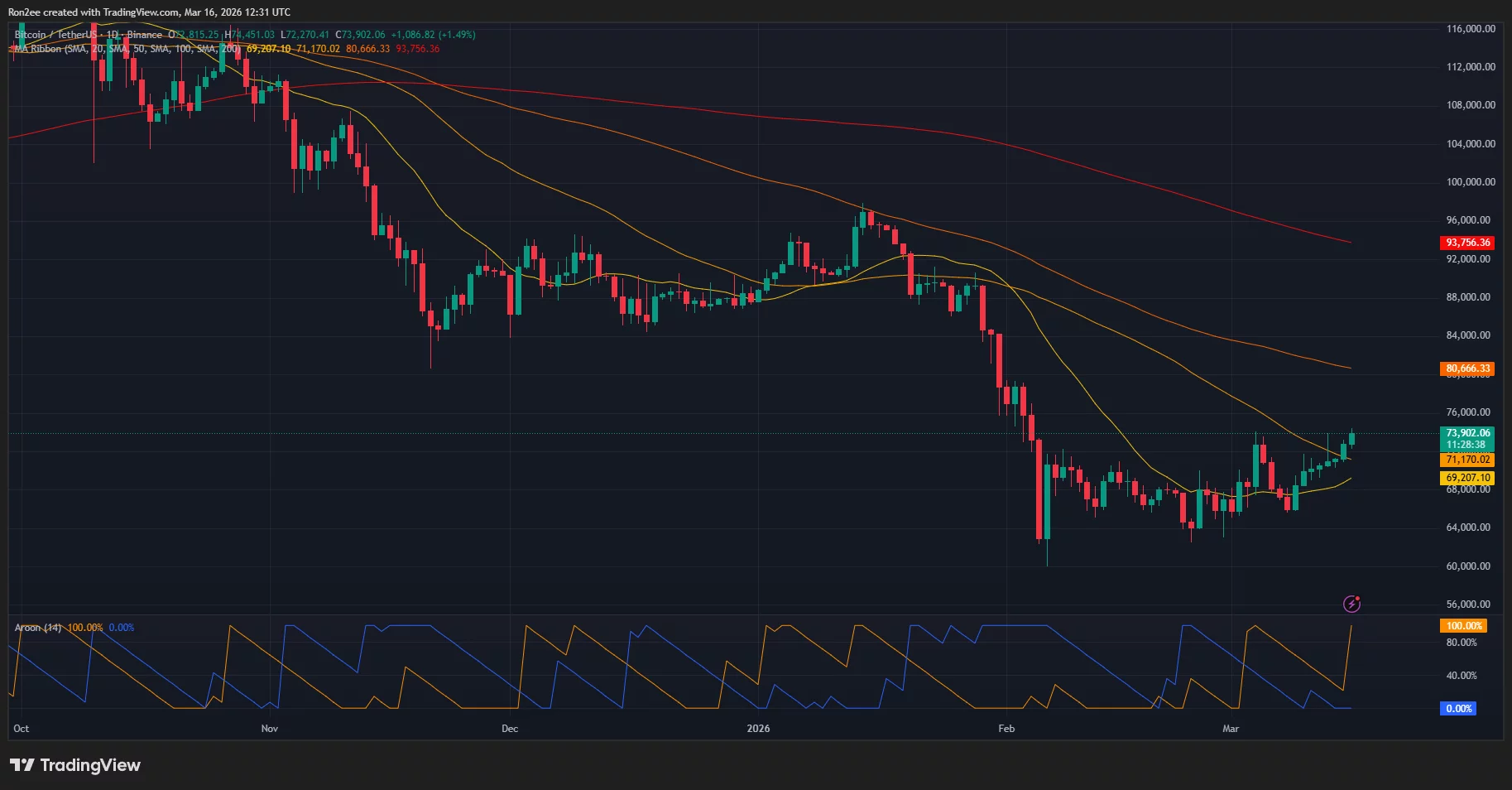
At press time, technical indicators on the Bitcoin/USDT 1-day chart also seem to present a bullish setup that suggests a significant trend reversal is underway.
Bitcoin price has moved above the 50-day simple moving average at $71,164, which is a key psychological and technical level. Last time when it crossed above this trendline back in early February, BTC rallied nearly 33% within a month.
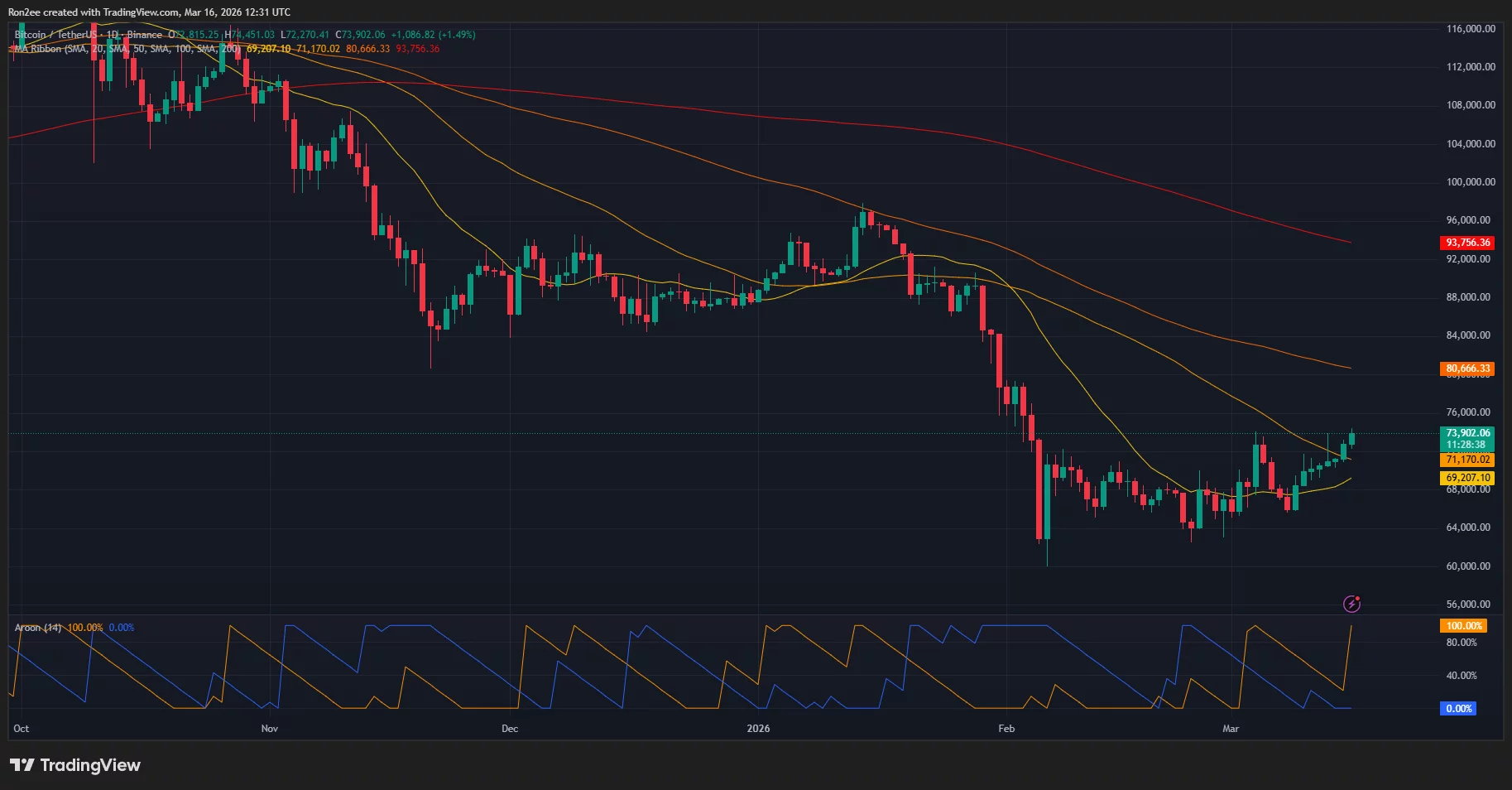
The 20-day SMA is also on the cusp of completing a bullish crossover with the 50-day SMA, a classic signal often referred to as a golden cross that typically precedes sustained upward momentum.
At the same time, the Aroon lines also added to the bullish outlook with the Aroon Up at 100% in comparison to the Aroon Down at 0%. This is a powerful configuration that hints at a strong emerging uptrend and suggests that buyers are in complete control of the current price action.
For now, the $75,000 zone, which has historically acted as a psychological barrier for traders, will serve as key resistance that would decide the short-term trajectory of the asset. A break above it could embolden bulls to target the next resistance pivot at $80,665.
On the contrary, a drop below the $70,000 support level could invalidate the current breakout and lead to a period of consolidation.
Disclosure: This article does not represent investment advice. The content and materials featured on this page are for educational purposes only.
Key takeaways:
-
Bitcoin derivatives remain bearish as traders hedge against a price drop despite BTC reclaiming the $74,000 level.
-
Fears of a global energy shortage mount as the Strait of Hormuz remains closed, forcing investors into safe-haven Treasury assets.
Bitcoin (BTC) climbed above $74,000 on Monday, following gains on the Nasdaq Index as investors await a keynote from Nvidia (NVDA US) CEO Jensen Huang at the chipmaker’s biggest event of the year, the Nvidia GTC 2026 global AI conference. A drop in oil prices and growth in the US manufacturing sector also helped support risk-on assets.
Despite this bullish background, Bitcoin derivatives suggest professional traders were unfazed by the rally that pushed prices to a 40-day high.

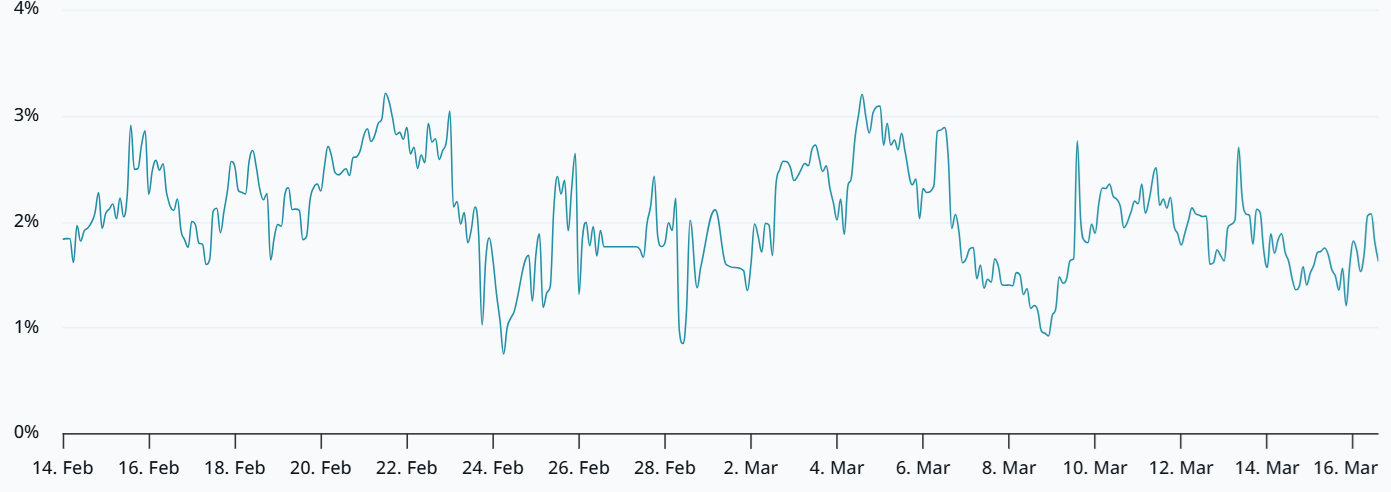
The annualized Bitcoin monthly futures premium relative to spot markets stood at a meager 2% on Monday, well below the neutral 4% to 8% range. This lack of enthusiasm has been the norm for the past 30 days, likely reflecting traders’ discomfort as Bitcoin traded down 31% in six months while gold gained 18% and the Nasdaq 100 Index stayed flat.
While it is difficult to pin down the exact drivers behind the price weakness, it can be partially attributed to a handful of events, including the absence of a clear execution timeline for the US Strategic Bitcoin Reserve. Meanwhile, the historic $19 billion liquidation event on Oct. 10, 2025, flushed out over-leveraged long positions and hit market makers’ risk appetite.
Furthermore, fears over quantum computing vulnerabilities emerged while Bitcoin decoupled from gold and silver as capital sought safety from the US and Israel-Iran war and signs of weakness in the US job market.
Bitcoin options signal fear despite institutional buying streak

The Bitcoin options delta skew on Deribit remained at 13% on Monday, signaling persistent fear that have dominated the market for five weeks. When whales and market makers avoid downside exposure, put (sell) options tend to trade at a 6% or higher premium relative to call (buy) instruments. The recent rally to $74,500 was unable to change traders’ sentiment.

USD stablecoins traded at a 0.5% premium relative to the official US dollar to yuan exchange rate on Monday, suggesting a balanced inflow and outflow in the region. Heightened demand for Bitcoin usually pushes the indicator above the 1.5% neutral threshold. At the same time, periods of stress typically cause stablecoins to trade at a discount when trades rush to exit cryptocurrency markets.
Regardless of the outcome of the Nvidia GTC 2026 event, investors are closely tracking the development of the war in Iran. US benchmark West Texas Intermediate oil prices held near $95 per barrel after the US struck Iranian military assets late Friday night, while drone strikes reportedly halted oil loadings at the key port Fujairah in the United Arab Emirates, according to Yahoo Finance.
Related: Metaplanet raises $255M and adds warrant structure for Bitcoin buys

The Strait of Hormuz, the world’s most important shipping lane for oil, reportedly remains “essentially closed,” causing analysts to reassess the risk of a “prolonged global energy shock.” Yields in the US 5-year Treasury dropped to 3.82% after peaking at 3.87% on Thursday, indicating that investors sought protection in government-backed assets amid the increasing uncertainty.
Bitcoin’s bullish momentum has been supported by Strategy buying 22,337 BTC during the previous week alone, while US-listed spot Bitcoin ETFs netted 11,117 BTC in inflows. Despite institutional appetite, the lack of confidence in Bitcoin derivatives is strong evidence that bear-market sentiment is not over.
This article does not contain investment advice or recommendations. Every investment and trading move involves risk, and readers should conduct their own research when making a decision. While we strive to provide accurate and timely information, Cointelegraph does not guarantee the accuracy, completeness, or reliability of any information in this article. This article may contain forward-looking statements that are subject to risks and uncertainties. Cointelegraph will not be liable for any loss or damage arising from your reliance on this information.

Bitcoin (CRYPTO: BTC) pressed toward a key resistance near $74,508, a level that traders are watching closely for signs of a sustained breakout. The move arrived as on-chain indicators suggested renewed buying interest from mid-sized wallets, with addresses holding between 10 and 10,000 BTC beginning to accumulate again—an activity historically associated with upside momentum. In parallel, U.S. spot BTC ETFs continued to draw capital, marking the fifth straight day of inflows and signaling persistent institutional engagement. A Bernstein research note linked these liquidity tides and corporate buying to a strengthening long-term holder base, painting a portrait of a market that could tolerate shocks better than in prior cycles. Against this backdrop, observers also noted the broader market’s crosscurrents—S&P 500 dynamics and the U.S. dollar’s movements—that tend to color crypto’s near-term trajectory.
Key takeaways
- BTC price action centered around $74,508 resistance, with a close above this level seen as a potential trigger for a rally toward $84,000.
- On-chain data showed renewed accumulation by wallets holding 10–10,000 BTC, a sign of growing demand at a critical segment of the holder distribution.
- Spot BTC ETFs attracted inflows for five consecutive days, underscoring ongoing institutional interest in the benchmark asset.
- A Bernstein note tied ETF inflows and corporate buying to a strengthening long-term holder base, suggesting a more resilient market structure in stressed conditions.
- Several major altcoins appeared to clear overhead resistance levels, indicating broader demand beyond BTC as liquidity cycles unfold.
Tickers mentioned: $BTC, $ETH, $BNB, $XRP, $SOL, $DOGE, $ADA, $HYPE
Market context: The week’s price action sits at the intersection of on-chain activity, ETF-driven inflows, and macro indicators. The S&P 500 faced a retest after hitting a notable level near the 20-day moving average, while the U.S. Dollar Index approached a notable resistance. These dynamics matter because they influence risk sentiment and liquidity availability for crypto markets, framing the probabilities of a sustained breakout or a deeper pullback.
Why it matters
The test of critical resistance levels in BTC comes at a moment when institutional access to crypto exposure is increasingly normalized through regulated products. The five-day streak of inflows into spot BTC ETFs demonstrates that institutions are not only interested in price exposure but also in the liquidity and custody frameworks that such products offer. When combined with on-chain evidence of renewed activity among mid-sized holders, the environment is arguably more conducive to a sustained move higher rather than a quick capitulation after a bounce.
Beyond Bitcoin, the health of the broader crypto ecosystem appears intertwined with the flows seen in ETFs and with corporate risk-taking. The Bernstein analysis highlighted how inflows into BTC-related vehicles, together with visible corporate buying, can bolster the long-term holder base—an important attribute for resilience during drawdowns. If market participants interpret these signals as a structural shift rather than a temporary optimism, it could translate into a steadier accumulation trend and a more robust bid for a swath of blue-chip altcoins that have cleared their own overheads.
From a trader’s perspective, the current configuration—where major assets are testing resistance while on-chain demand persists—suggests that risk management remains essential. The possibility of a bullish breakout hinges not only on Bitcoin’s ability to close above the resistance but also on sustained buying interest across key altcoins. As prices push higher, the likelihood of profit-taking increases, and traders may expect increased volatility around known hurdle levels, particularly if macro cues deteriorate or liquidity tightens due to shifts in the traditional financial markets.
What to watch next
- A sustained close above the $74,508 level for BTC could open the door to the next milestone near $84,000, while a pickup in selling pressure could pull the price back toward the nearby moving averages.
- ETH and other major altcoins appear to be testing their own overheads; a clear breakout in ETH could act as a supportive signal for broader upside, with potential targets around $2,600 and beyond.
- ETF inflows momentum remains a critical gauge of institutional appetite; continued net inflows over the coming weeks would reinforce the case for a more persistent upside, even in the face of occasional macro shocks.
- Macro drivers—such as the path of the US dollar and equity risk sentiment—will shape the range in which crypto markets operate. A sustained risk-on tone could lubricate further upside, whereas a shift toward risk-off could reintroduce volatility and test the lower bounds of recent ranges.
Sources & verification
- Santiment on-chain data showing accumulation by wallets holding 10–10,000 BTC: https://cointelegraph.com/news/bitcoin-whale-accumulation-btc-price-retail-santiment
- Five straight days of inflows into spot BTC ETFs: https://cointelegraph.com/news/spot-bitcoin-etfs-five-day-inflow-streak-2026
- Bernstein research note discussing ETF inflows and long-term holder base: https://cointelegraph.com/news/bitcoin-rebound-bernstein-long-term-holder-base
- Market analysis referencing a potential price test near $60,000: https://cointelegraph.com/markets/58k-btc-price-still-in-play-five-things-bitcoin-this-week
- Context on BTC hitting notable levels and upside potential: https://cointelegraph.com/markets/bitcoin-hits-74-4k-six-week-high-analysts-more-upside-for-btc
- TradingView market visuals referenced in broader coverage
Bitcoin price action and the crossroads of liquidity, on-chain activity, and macro signals
Bitcoin (CRYPTO: BTC) has been hovering around a critical resistance near $74,508, a level that many analysts view as a potential inflection point for a sustained rally. The move comes as on-chain data shows renewed activity among mid-range holders, with addresses carrying between 10 and 10,000 BTC starting to accumulate again. This behavior, often observed before a leg higher, provides a counterpoint to the immediate price action and suggests that demand is broadening beyond the largest holders who capitalized during earlier phases of the cycle. The combination of on-chain dynamics with price action creates a narrative where a breakout above the hurdle could unlock a larger upside move.
The activity is complemented by investor flows into regulated products. Five consecutive days of inflows into spot BTC exchange-traded funds point to a broader institutional appetite for crypto exposure, beyond the speculative bid that often dominates during bull markets. This steady influx occurs in a context where macro liquidity and risk discipline intersect with a broader corporate embrace of crypto assets. Bernstein’s note ties these liquidity fluxes to a strengthening long-term holder base, suggesting that the market could exhibit greater resilience during periods of stress than in prior cycles. Such a structural improvement is meaningful for all market participants because it may translate into more robust bid depth and a steadier price discovery process over time.
Alongside BTC’s trajectory, major altcoins have demonstrated their own momentum. Ether (CRYPTO: ETH) has shown signs of a breakout from a consolidation range, with analysts pointing to a potential path toward higher targets as buyers re-enter the market. If Ethereum can sustain a move beyond critical resistance, it could reinforce a positive feedback loop for other assets that have flirted with overheads. Other high-profile names—BNB (CRYPTO: BNB), XRP (CRYPTO: XRP), SOL (CRYPTO: SOL), DOGE (CRYPTO: DOGE), ADA (CRYPTO: ADA), and HYPE (CRYPTO: HYPE)—have also moved above their respective overhead levels in recent sessions, signaling broad-based demand and a shift in momentum that goes beyond BTC alone.
Yet the landscape remains nuanced. While the short-term tilt appears constructive, technical traders are mindful of potential traps. Price action around the moving averages, coupled with risk sentiment directed by the S&P 500’s behavior and the US Dollar Index (DXY), could still provoke pullbacks or consolidation. The S&P 500’s interactions with the 20-day moving average and a possible drift toward support around the mid-6,000s range offer a reminder that macro conditions can quickly reshape crypto trajectories. At the same time, DXY’s approach to resistance near 100.54 keeps the door open for either a renewed uptrend or a retracement, depending on how risk appetite responds to incoming economic data.
In this environment, traders will be watching not just price levels but also the durability of the bid across a suite of assets. The narrative of rising on-chain accumulation, coupled with elastic ETF inflows and corporate interest, hints at a more robust ecosystem than in past cycles. If these signals persist, BTC could be well-positioned to break higher and pull several leading altcoins along with it. The market’s next moves will likely be driven by a combination of on-chain activity, ETF flow momentum, and macro risk sentiment—each a piece of a larger mosaic that investors are still building as the year unfolds.
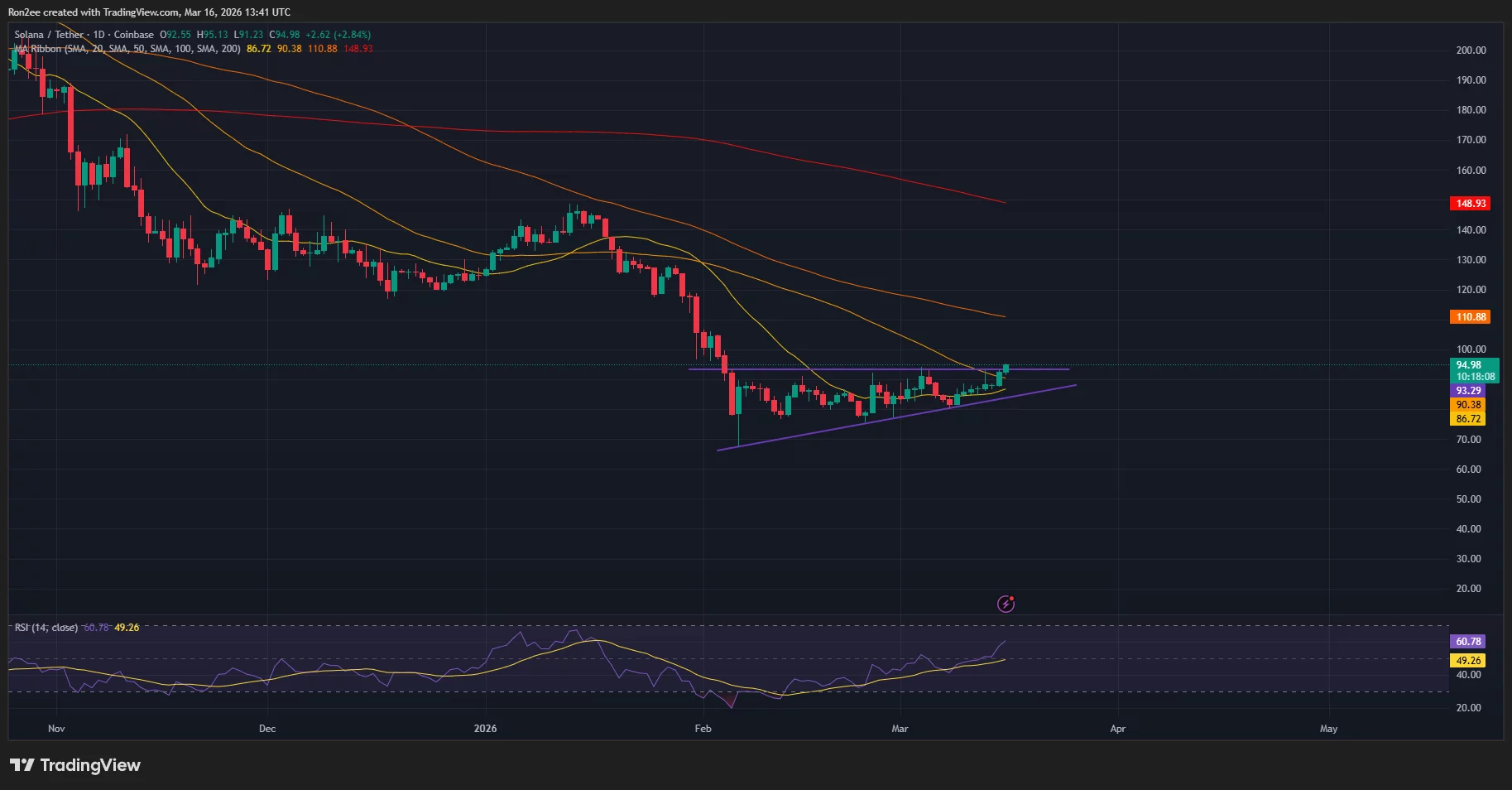
Solana’s price rallied over 6% to a five-week high of $94 on Monday amid a broader market rebound.
Summary
- Solana price rallied to a five-week high near $94 as the broader crypto market rebounded after Bitcoin moved above the $74,000 level.
- The rally was supported by short liquidations and rising derivatives activity, with SOL futures open interest increasing over the past day.
- Spot Solana ETFs also extended their inflow streak, recording another week of net inflows and boosting investor sentiment around the token.
According to data from crypto.news, Solana (SOL) price rose nearly 7% to $94.07 on March 16, reaching its highest level since early February.
The seventh leading crypto asset by market cap rallied during a market-wide recovery after Bitcoin (BTC), the bellwether crypto asset, surpassed the $74,000 psychological resistance level, as investors rotated capital away from traditional safe-haven assets like gold and silver, which have tanked recently after hitting new highs.
The altcoin’s price also gained significant support from a short squeeze that followed shortly after its rebound near $90, where several short positions were concentrated. When short positions are liquidated, traders are forced to buy back the asset to cover their losses, which triggers a rapid upward price spiral as buying pressure intensifies.
Its leveraged markets also played a pivotal role in this momentum. Notably, SOL futures open interest increased by 7% over the past 24 hours, a sign that more liquidity was entering the market.
Meanwhile, spot Solana ETFs, which recorded their fifth consecutive week of net inflows by bringing another $106 million into the investment products, have also uplifted investor sentiment surrounding the token.
On the daily chart, the Solana price is eyeing a breakout from an ascending parallel channel pattern, a popular bullish continuation pattern in technical analysis.
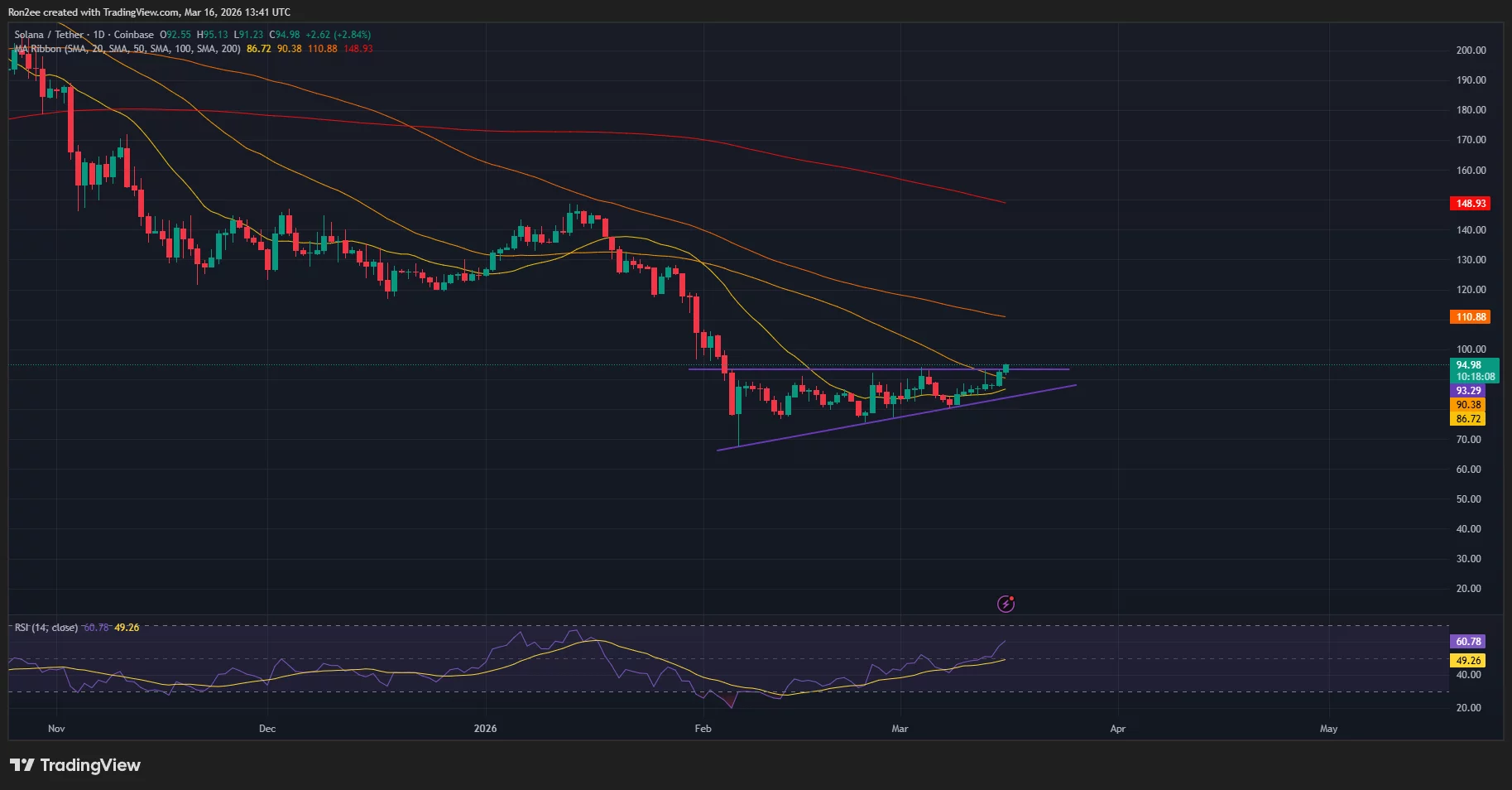
The 20-day simple moving average is also close to confirming a bullish crossover with the 50-day. A bullish crossover between these moving averages has historically signaled the start of a sustained uptrend. Additionally, the Relative Strength Index has been moving upwards after some consolidation in the neutral zone.
Hence, the path of least resistance for Solana suggests a move above the $100 psychological threshold over the coming sessions. A decisive break further above the $100 mark could embolden bulls to target the 100-day SMA at $110 as the next major resistance level.
On the contrary, if bullish momentum fails, the Solana price could revisit the 50-day SMA at $90, a drop below which can invalidate the current bullish thesis and lead to a deeper correction toward the $80 support zone.
Disclosure: This article does not represent investment advice. The content and materials featured on this page are for educational purposes only.
Crypto World
CoW Swap Points to Legacy Code and Solver Failures in $50M Loss That Aave Attributes to Illiquid Market


While Aave blamed an illiquid market, CoW Swap identified a stale gas ceiling, silent solver failures, and a possible mempool leak that turned a bad trade into the worst execution loss in DeFi history.
Aave and CoW Protocol published separate post-mortem reports over the weekend dissecting the March 12 swap that resulted in a trader converting $50.4 million in USDT into roughly $36,000 worth of AAVE tokens, widely considered the largest execution loss of its kind in decentralized finance (DeFi).
The two accounts largely agree on the basic sequence of events but diverge sharply in emphasis and tone, with Aave framing the loss as the predictable consequence of trading in an illiquid market and CoW Swap painting a more complex picture of compounding infrastructure failures that made the outcome dramatically worse than it needed to be.
‘An Illiquid Market’
Aave’s analysis drew a technical distinction between price impact and slippage, arguing that the two are often conflated. The protocol said, “the primary root cause was the routing of a large trade through a market with poor liquidity, leading to an extreme price impact.”
“It is critical to distinguish between price impact due to an illiquid market and price impact due to slippage,” the team wrote. The user was quoted a price that was already 99.9% below expected market value before the swap even executed, Aave said, and the interface displayed a warning flagging the extreme price impact and required the user to check a confirmation box acknowledging a potential 100% loss.
An internal audit trail confirmed the user acknowledged the warning on a mobile device before proceeding, meaning the catastrophic outcome was visible to the user at the point of confirmation.
Aave stressed that its core lending protocol was never at risk, since the swap occurred via a third-party CoW Swap integration rather than through the protocol’s smart contracts.
‘Technically Correct Is Not the Ceiling’
CoW Swap’s report told a markedly different story, identifying what it called a “chain of compounding factors” that turned an already bad trade into something far worse.
During the initial quoting phase, three independent solvers submitted potential routes. The best unverified quotes would have returned roughly $5–6 million worth of AAVE for the $50 million order, still an approximately 90% loss but dramatically better than the $36,000 the user ultimately received.
Those better-priced routes never reached the user. CoW Swap’s quote verification system enforced a hardcoded 12-million gas unit ceiling — what the team described as “legacy code predating current gas consumption patterns” — which caused the more efficient routes to fail verification. The only quote that passed came from a solver offering roughly 329 AAVE tokens, far worse than the rejected alternatives. That figure was then used to set the order’s limit price in the Aave interface.
The situation deteriorated further in the auction phase. A solver identified in the report as “Solver E” won two consecutive auctions with a superior execution route but never submitted either transaction onchain. After two failed attempts, the solver stopped bidding entirely, leaving the worst route as the only remaining option.
CoW’s report also flagged evidence of a possible mempool leak. Despite the transaction being submitted via a private RPC endpoint, Etherscan displayed a “confirmed within 30 seconds” tag — a marker that typically appears only when a transaction is visible in the public mempool before being included in a block. CoW said the leak likely enabled the significant MEV activity observed in the execution block.
CoW struck a notably more self-critical tone than Aave throughout its report, acknowledging that a confirmation checkbox is an inadequate safeguard when trades involve tens of millions of dollars.
“Technically correct is not the ceiling we should be building toward,” the team wrote.
CoW said it has already deployed a fix removing the stale gas ceiling and is continuing to investigate both the solver execution failures and the suspected mempool leak.
AAVE is trading around $121, up roughly 6% over the past 24 hours, according to CoinGecko. Aave is the largest DeFi lending protocol with approximately $25.5 billion in total value locked, per DefiLlama.
This article was written with the assistance of AI workflows. All our stories are curated, edited and fact-checked by a human.


OpenSea co-founder Devin Finzer said Monday that the timeline for the launch of the highly anticipated SEA token is being pushed back, as the company seeks to ensure the rollout is fully prepared rather than forcing a debut amid difficult crypto market conditions.
In a post on X, Finzer said the OpenSea Foundation originally planned to take the first steps toward the launch during a March 30 event but has decided to delay the timeline for the NFT trading platform’s token. “A delay is a delay. I’m not going to dress it up, and I know how it lands,” he wrote.
Finzer said the foundation weighed moving forward with the previously planned date but ultimately concluded that SEA “only launches once,” and that taking additional time would help ensure the debut meets the expectations of the platform’s community.
As part of the update, Finzer said OpenSea will wind down its current rewards campaign structure, confirming that the ongoing rewards wave will be the last. Users who traded during rewards waves three through six will be able to opt in to refunds for the platform fees OpenSea retained during that period. If users choose to receive the refund, the “Treasure” rewards tied to those waves will be removed from their accounts, while those who keep their Treasures will still have them considered for allocations at the token generation event.
The team also said the OpenSea platform will reduce its own token trading fees to 0% for 60 days starting March 31, a move aimed at encouraging users to try the company’s revamped platform.
Finzer added that the foundation will wait to announce a new SEA launch timeline until it can provide a clear and deliberate schedule.
“We have huge ambitions as a company, and we’re here for the long game. Making all of non-custodial crypto delightful on mobile is just the beginning,” Finzer wrote. “That means we have to set a very high bar for everything we do, and it’s why I’m so protective of delivering a launch that’s worthy of this community and everything we’re putting into this.”
Read more: OpenSea Confirms Q1 Launch for SEA Token With Half of Supply Allocated to Community


A U.K. High Court judge allowed a lawsuit over the alleged theft of more than 2,323 bitcoin to move forward last week, in a case that highlights how the country’s legal system is still adapting traditional property law to cryptocurrency.
U.K. resident Ping Fai Yuen claimed in court filings in last week that his estranged wife, Fun Yung Li, used CCTV cameras in their home to secretly obtain the recovery phrase to his hardware wallet and transferred 2,323 bitcoin without his permission in August 2023, according to the docket in the High Court of England and Wales.
The bitcoin was worth just under $60 million at the time of the alleged theft 30 months ago, but is now worth roughly $172 million at the current price of just over $74,000.
The stolen crypto was stored in a Trezor cold wallet secured by a PIN. But anyone with the wallet’s 24-word recovery phrase could recreate the wallet and move the funds, the court noted. It was then transferred through several transactions and now sits across 71 blockchain addresses not held at exchanges. The funds have not moved since Dec. 21, 2023, according to the court.
Yuen said he later installed audio recording devices in the home after his daughter warned him Li was trying to take the bitcoin. After discovering the transfer, Yuen confronted Li and assaulted her. He later pleaded guilty to assault occasioning actual bodily harm and two counts of common assault in 2024. Officers seized several hardware wallets and recovery seeds during a search of her home, though authorities later took no further action pending new evidence.
Earlier, according to the filings, the wife asked the court to throw out the case, arguing that because the husband’s main claim was conversion, which in England is a legal term traditionally used when someone takes physical property, it could not apply to digital assets, such as bitcoin.
The judged agreed with the wife, but ruled the case can still proceed under different legal claims that could allow the husband to recover the bitcoin if his allegations are proven. The case will now proceed to trial, the judge said.

Meningitis outbreak in Kent latest as tribute paid to student
Russia to Collect $7M in Crypto Mining Taxes for 2025

Man travelled 250 miles to football match but he won’t be going to any more


-
 Tech6 days ago
A 1,300-Pound NASA Spacecraft To Re-Enter Earth’s Atmosphere
-
Crypto World3 days ago
HYPE Token Enters Net Deflation as HyperCore Buybacks Outpace Staking Rewards
-

 Business6 days ago
ExxonMobil seeks to move corporate registration from New Jersey to Texas
-

 Fashion3 days ago
Weekend Open Thread: Addict Lip Glow
-

 Tech6 days ago
ChatGPT will now generate interactive visuals to help you with math and science concepts
-
Sports2 days ago
Why Duke and Michigan Are Dead Even Entering Selection Sunday
-

 NewsBeat5 days ago
Residents reaction as Shildon murder probe enters second day
-
 NewsBeat7 days ago
Pagazzi Lighting enters administration as 70 jobs lost and 11 stores close across Scotland
-

 Business6 days ago
Search Enters Sixth Week With New Leads in Tucson Abduction Case
-

 Business1 day ago
Search for Savannah Guthrie’s Mother Enters Seventh Week with No Arrests
-

 Business2 days ago
US Airports Launch Donation Drives for Unpaid TSA Workers as Partial Government Shutdown Enters Fifth Week
-

 NewsBeat5 days ago
I Entered The Manosphere. Nothing Could Prepare Me For What I Found.
-
Crypto World2 days ago
Coinbase and Bybit in Investment Talks: Could Bybit Finally Enter the US Crypto Market?
-

 Sports5 days ago
PWHL, Senators discussing plan to keep Charge in Ottawa
-

 Business3 days ago
Country star Brantley Gilbert enters growing non-alcoholic beer market
-

 Business14 hours ago
Australian shares drop as Iran war enters third week
-
 Crypto World6 days ago
Will Chainlink price reclaim $10 amid volatility squeeze?
-

 Sports3 days ago
College Basketball Best Bets: Conference Tournament Semifinal Picks
-

 Crypto World14 hours ago
Crypto Lender BlockFills Enters Chapter 11 with Up to $500M in Liabilities
-

 Politics6 days ago
Trump Says Middle East Is ‘Very Lucky’ That He’s President


You must be logged in to post a comment Login