
Crypto World
How To Trade Crypto & Stocks In Trump’s Friday Strikes

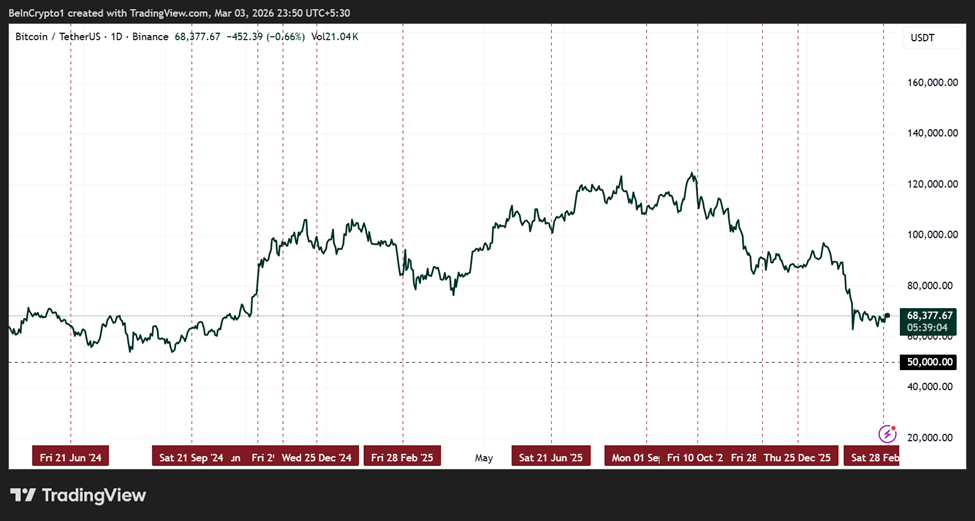
Six major geopolitical and economic actions under President Donald Trump since mid-2025 have shared one precise tactical detail: they all happened on Friday nights, after equity markets closed and before futures liquidity fully developed.
This is not a coincidence. It is, according to pattern analysis, the single most consistent and operationally significant element of Trump’s conflict strategy — and arguably the most tradeable timing signal in macro markets today.
Trump’s Friday Night Strike Pattern Is the Most Tradeable Signal in Macro Right Now
Understanding why Trump uses Friday nights, and what happens to Bitcoin (BTC), equities, oil, and bonds in the 60 hours that follow, could give traders and investors a structural edge that most market participants are not pricing.
“Obviously, Trump chose weekends to carry out combat ops in Venezuela and Iran. Smart move to buy time before Wall Street opens and minimize market shocks. But here’s the structural shift: Markets used to rest on weekends. Now they don’t,” wrote Gracy Chen, CEO at Bitget.
Six Events Show A Singular Trump Playbook
The documented list by financial research firm The Kobeissi Letter is specific:
- On June 21, US and Israeli forces struck Iranian nuclear sites.
- On September 1, the US military targeted Caribbean drug boats.
- On October 10, a 100% tariff threat against China dropped after market close.
- On November 29, Trump closed Venezuelan airspace in its entirety.
- On December 25, military action commenced in Nigeria.
- On February 28, 2026, US forces struck Iran directly.
Every single one landed on a Friday night or early Saturday morning.
The pattern extends to Trump’s corporate pressure campaigns. On August 11, 2025, the Trump administration announced an Intel deal after weeks of public pressure on CEO Lip-Bu Tan, again, structured to land outside active trading hours.
That position returned over 80% in under two months for those who tracked the escalation sequence from the beginning.
The consistency across geopolitical strikes, tariff actions, and corporate confrontations is not accidental. It reflects a deliberate understanding of how financial markets process shock.
Why Friday Night? The Market Psychology Behind the Timing
When a major geopolitical event occurs during active market hours, price discovery breaks down. Liquidity thins immediately. Algorithms amplify every directional tick.
Intraday swings create panic that feeds on itself, producing disorderly markets that are difficult for any participant, including the administration, to read or control.
A Friday night announcement changes the dynamic entirely. Investors, institutions, and governments have a full weekend to process information, consult advisors, and model scenarios before a single share trades.
The shock is real, but the response is measured. Futures markets absorb the initial repricing on Sunday evening at 6 PM ET. This is a low-liquidity session where price moves are sharp but short-lived. Similarly, the gap between the emotional reaction and the rational reassessment becomes visible within hours.
This matters for Trump’s negotiation strategy in a specific way. Trump, by his own description and observable behavior, is highly responsive to financial market performance.
A disorderly market reaction during trading hours creates political and economic pressure, complicating his objectives.
A Friday night announcement gives markets time to digest, and gives Trump’s team time to read the reaction and calibrate the next message before Monday open.
The result: every Friday night event has been followed by:
- A Sunday evening futures shock
- A partial Monday recovery, and then
- A second, more sustained move in the same direction as the initial shock.
Is this three-phase sequence now repeatable enough to trade?
The 60-Hour Window: What Each Asset Does
The 60-hour window from Friday close to Monday open has produced near-identical cross-asset sequences across all six confirmed events.
At Sunday open, Bitcoin sells off 5–12% as it trades as a pure risk asset, with equity correlation spiking above 0.8. Ethereum (ETH) and altcoins fall by 15–25% from pre-event levels in the first 48 hours, as liquidity exits the most volatile assets first.
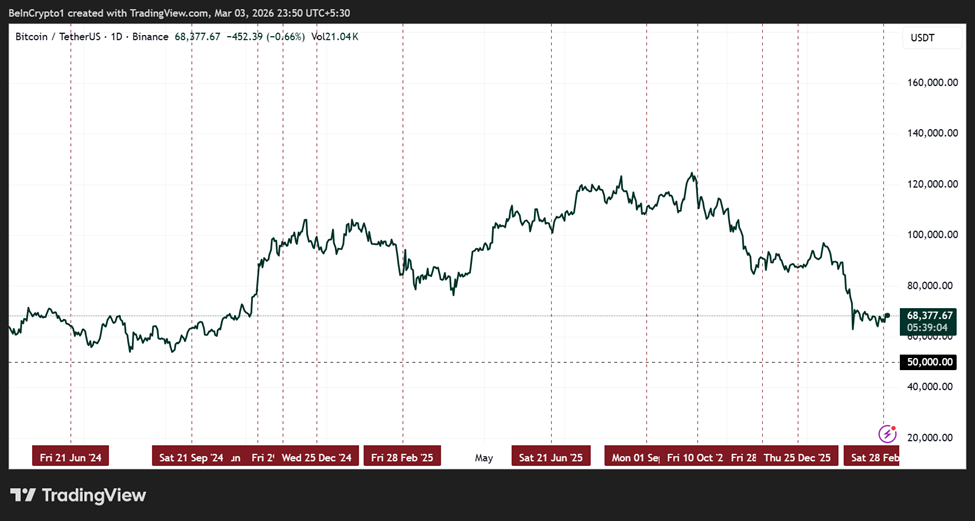
S&P 500 futures gap down 1.5–3%. Oil spikes 5–10% depending on proximity to energy infrastructure — Iran-related events have produced the sharpest initial moves.
The US dollar catches a strong safe-haven bid. Ten-year Treasury yields drop sharply as flight-to-quality demand floods the bond market.
By Monday morning, a partial reversal begins. Markets price a short engagement based on Trump’s well-documented preference for deals over prolonged conflicts.
BTC recovers 40–60% of its Sunday drawdown. Oil gives back 30–50% of its initial spike. Equity futures stabilize.
This Monday recovery is where most retail traders make their critical mistake.
The partial reversal appears to be a resolution signal. It is not. In every prior cycle, the Monday stabilization has failed. A second, more sustained leg in the original direction (lower equities, higher oil, weaker crypto) follows within 48–72 hours as the market acknowledges the conflict will not resolve quickly.
The correct trading behavior in the 60-hour window is not to react at Sunday open, because:
- Spreads are too wide
- Algorithms are front-running every move, and
- The liquidity is not there for clean execution.
The actionable entry for equities and BTC has historically arrived 48–72 hours after the initial shock, not at the shock itself.
The Bond Market Is the Real Signal
One element of the Friday night pattern that most crypto and equity traders overlook is the bond market’s role as a leading indicator of resolution.
In the April 9, 2025, tariff pause, the most significant de-escalation event of Trump’s second term, it was not equity market weakness that triggered the pivot. It was the bond market.
10 year Treasury yields surged sharply in the days leading up to April 9, signaling structural stress in fixed income that the administration could not ignore. When yields moved, Trump moved.
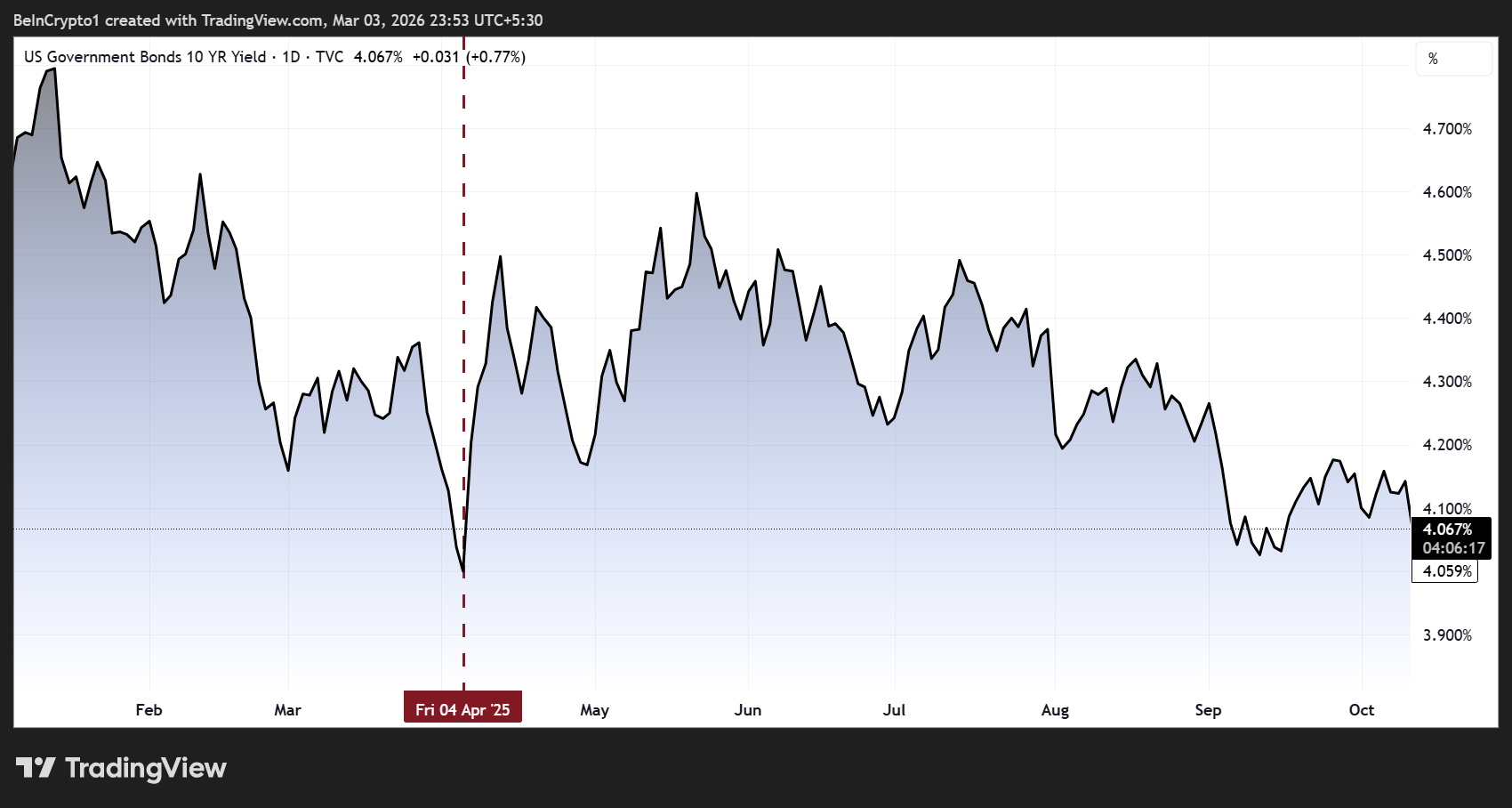
This dynamic has repeated across multiple cycles. Equity weakness gets bought. Oil spikes get dismissed as temporary.
However, when bond market stress becomes acute (when the 10-year yield is moving in ways that imply credit market dysfunction rather than simple flight-to-quality) the probability of de-escalation language rises sharply.
Traders positioning around the Friday night pattern should therefore monitor the bond market as the leading indicator of Trump’s next pivot, not equity prices or crypto sentiment.
What Makes This Pattern Durable?
The Friday night strike pattern has survived six confirmed events across radically different conflict types: military, tariff, corporate, and geopolitical, without breaking.
That durability comes from the underlying logic being structural rather than tactical. Trump’s three core second-term policy objectives are:
- Lowering inflation
- Cutting gasoline prices to $2 per gallon, and
- Positioning as a peace president in a midterm election year.
Every Friday night event creates short-term upward pressure on oil and inflation expectations. The Friday night timing passes as the mechanism Trump may be using to contain that pressure.
If history is any guide, he gives the markets a weekend to absorb shock before consumer-facing data, like gasoline prices at the pump, can register the move politically.
The pattern will break when one of two things changes:
- Trump abandons the deal-making framework entirely in favor of a genuinely prolonged conflict, or
- The Friday night announcement loses its market-timing advantage as participants anticipate and front-run the window.
Neither has happened across 13 months of observation.
Until one of those conditions is met, the 60-hour post-strike sequence (Sunday shock, Monday partial recovery, Tuesday confirmation) remains the most consistently repeatable cross-asset trading pattern in current macro markets.
As of March 3, 2026, with Brent crude above $85 per barrel and the Dow Jones Industrial Average down roughly 1,100 points, markets are in the phase that has historically preceded Trump’s conditional de-escalation signals.
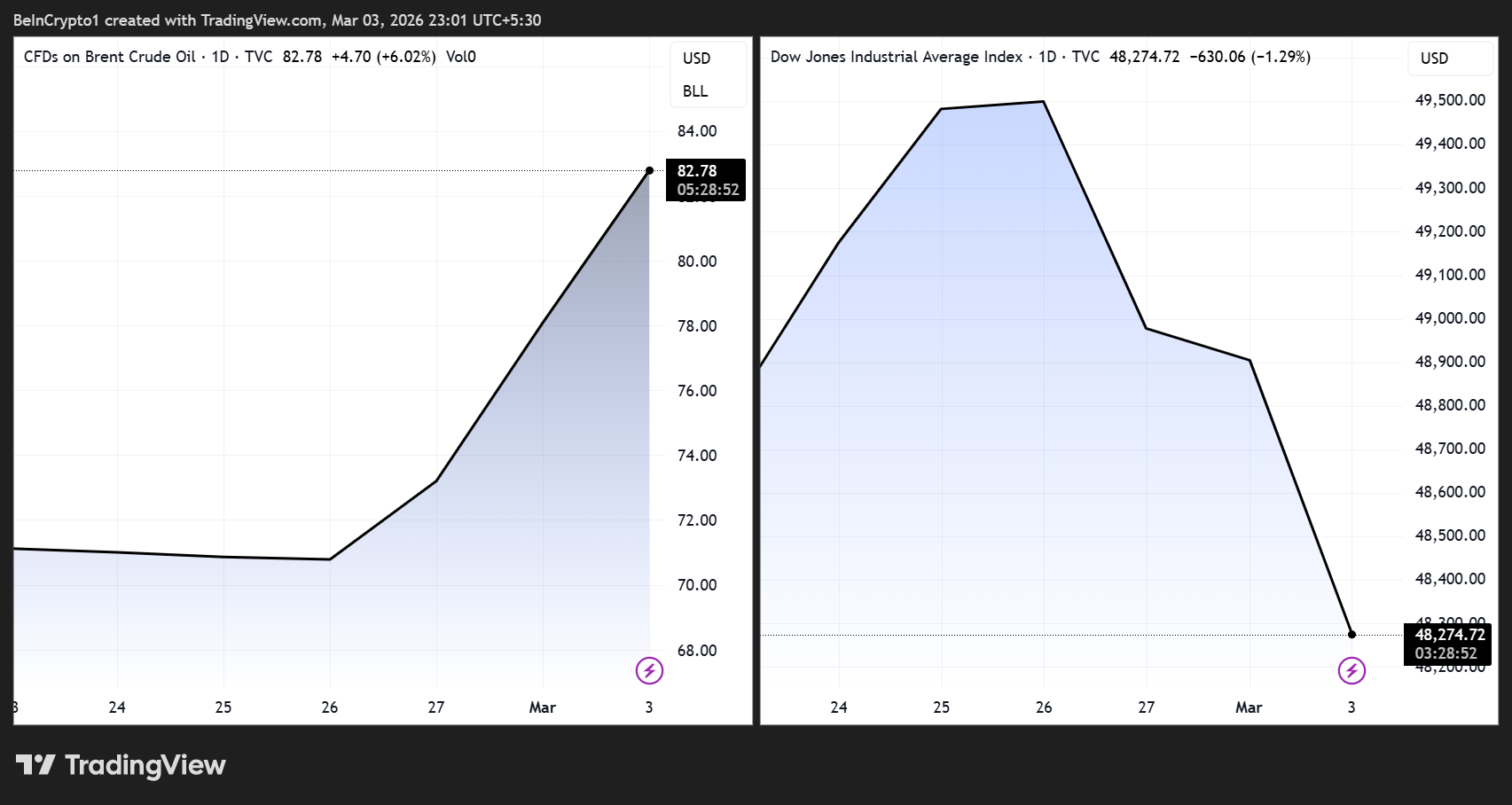
The Friday night that created this moment is already history. The question is whether traders are positioned for what the pattern says comes next.
This article is for informational purposes only and does not constitute financial or investment advice.
Follow us on X to get the latest news as it happens
Subscribe to our YouTube channel to watch leaders and journalists provide expert insights

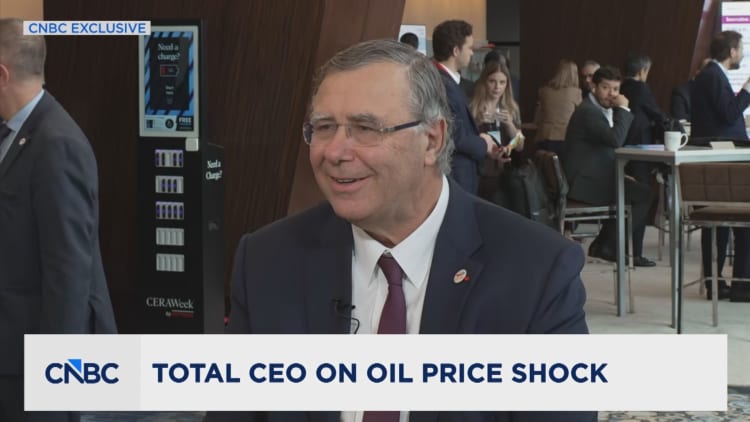

Roughly 15% of TotalEnergies’ production is offline, as the war with Iran nears the one-month mark, but surging oil prices have more than made up for the lost barrels, chairman and CEO Patrick Pouyanné told CNBC in an exclusive interview.
With Brent crude trading solidly above $100 a barrel, much of the attention has focused on oil prices, but Pouyanné said the crisis is having a much larger impact on product prices.
“The Brent market is ok, but the products market, which is the one which impacts customers … is much higher than Brent,” he told CNBC at S&P Global’s CERAWeek energy conference in Houston. He added, the world has “never experienced” refining margins from products including Asian jet fuel at current levels. In addition to petroleum products, about 30% of global fertilizer moves through the Strait of Hormuz, jeopardizing the spring planting season.
TotalEnergies is a major player in the global LNG market, including the largest exporter of U.S. LNG. The CEO said the company can still fulfill customer orders in Europe and Asia thanks to its diversified global portfolio.
Last week, QatarEnergy said its Ras Laffan plant suffered “extensive damage” following Iranian drone attacks, effectively taking 20% of global LNG supply offline. The shutdown has sent natural gas prices in Europe and Asia surging.
Pouyanné expects prices could move substantially higher if the war drags on through the summer, since Asian demand rises over the summer just as Europe looks to refill storage. European natural gas traded around $18 per million British thermal units Tuesday, but Pouyanné said prices could hit $40/MMBtu over the summer if the conflict continues.
TotalEnergies is a major investor in U.S. energy. On Monday, it struck a deal with the Trump administration to abandon its offshore wind projects in return for $1 billion. The company agreed to reinvest the money into U.S. oil and gas projects instead.
The federal government is key for offshore wind permitting, and the current administration has been a vocal critic of the industry. Pouyanné said he did not want to litigate with the administration over its offshore wind leases – acquired under former President Joe Biden – and so approached the administration with a deal. He added that in the U.S. offshore wind no longer makes sense given cheaper alternatives.
“In the specific situation of the U.S., where you have a lot of land, you have a lot of gas, you have a lot of coal, you have a lot of land to build onshore solar, onshore wind, batteries, we don’t need to have offshore wind,” he said. “It’s a marginal technology, which is not affordable.”
“I prefer to allocate my capital to technologies which are more efficient, which give affordable electricity to customers,” he said.
As part of its expanding U.S. portfolio, TotalEnergies recently inked a 15-year agreement with Google to supply renewable power for data centers. Pouyanné said other hyperscalers – including Amazon and Microsoft – are now speaking to TotalEnergies directly.
“These hyperscalers have understood that an energy company – like TotalEnergies – because we have also capacity, not only to build, to invest, to have land, to trade, we were quite a good partner for them,” he said.
BlackRock’s head of digital assets, Robbie Mitchnick, signaled a shift in how large investors view crypto, pointing to artificial intelligence (AI) as a more meaningful driver than the expansion of new tokens.
Speaking about client behavior, Mitchnick described a market that has moved away from broad exposure to smaller assets. He said the turnover among top tokens has been “pretty ferocious,” with only bitcoin and, later, ether (ETH) maintaining consistent positions. Many newer tokens, he suggested, fail to hold long-term relevance.
That pattern has shaped investor demand. “The majority of that is nonsense,” Mitchnick said at the Digital Asset Summit in New York on Tuesday, referring to the vast number of tokens in circulation. As a result, clients now focus on a narrow set of assets rather than building wide portfolios. Bitcoin and Ethereum dominate allocations, with limited interest beyond those names.
Against that backdrop, Mitchnick pointed to AI as a more significant force shaping crypto’s future role. He stressed that AI is a larger theme than digital assets, but said the two intersect in ways that could matter.
“AI agents are very unlikely to use, you know, Fedwire and SWIFT,” he said. “What is crypto? Crypto is computer-native money… AI is computer-native data and intelligence. And so there’s a natural symbiosis there.”
That framing casts crypto less as a speculative asset class and more as infrastructure. A growing number of bitcoin miners have begun shifting resources toward AI workloads, drawn by steadier revenue and rising demand for computing power. Several listed miners, including Hut 8 (HUT), Core Scientific (CORZ) and Iren (IREN), are either repurposing data centers or signing hosting deals tied to AI and high-performance computing. Others have signaled similar plans, even if mining remains their core business.
Mitchnick also linked AI-driven disruption to bitcoin’s appeal. As new technologies reshape industries and create uncertainty, he suggested bitcoin may serve as a stabilizing allocation. It can act as a diversifier during periods of rapid change.
“There are intersection points that are relevant… there’s clearly an advantage and an opportunity to play a role in the AI economy,” he said.

Circle is expanding the use of its USD Coin (USDC) across Africa through a strategic partnership with Sasai Fintech. The collaboration aims to weave USDC into Sasai’s payments fabric, covering cross-border transfers, enterprise payments, and consumer wallets, with the goal of lowering costs and shortening settlement times for users across multiple markets.
In a Business Wire release, Circle and Sasai described integrating USDC into Sasai’s infrastructure to unlock practical on-chain use cases for the stablecoin within Sasai’s network. Sasai operates digital payments services across several African markets, and the partnership would connect Circle’s on-chain rails with Sasai’s cross-border and mobile-payment ecosystem.
Circle CEO Jeremy Allaire framed the collaboration as part of the company’s broader focus on high-growth payment corridors in emerging markets, while Cassava Technologies Chairman Strive Masiyiwa highlighted the potential to broaden access to digital financial services for both businesses and consumers.
Data from DefiLlama shows USDC remains the second-largest stablecoin by market capitalization, at roughly $78.6 billion, trailing only Tether’s USDT, which sits around $184.1 billion. The size of USDC liquidity underscores the potential scale that could flow into Africa’s payments rails as the ecosystem grows.
The rise of crypto and stablecoins in Africa
Africa has witnessed a notable uptick in crypto activity, with Sub-Saharan Africa showing a 52% year-over-year increase in on-chain activity in the 12 months through June 2025, tallying more than $205 billion in on-chain value, according to Chainalysis data cited in recent market coverage. Nigeria accounted for the largest share of that activity—over $92 billion—followed by South Africa, Kenya, Ethiopia, and Ghana. Remittances, cross-border payments, and hedging against currency volatility are among the leading use cases driving this surge.
The region’s crypto expansion is drawing attention from global players expanding into Africa. For example, Blockchain.com announced Ghana-focused expansion as part of its broader push across the continent, reflecting growing demand for retail and institutional access to digital assets and stablecoins as a payment and settlement layer.
Regulatory developments are also beginning to mature alongside growth. Ghana’s Securities and Exchange Commission approved 11 crypto trading platforms to operate within a regulatory sandbox framework under the country’s Virtual Asset Service Providers Act, signaling a structured pathway for crypto services to scale with oversight.
Beyond the technology itself, policymakers and industry participants emphasize stablecoins as a faster, lower-cost alternative to traditional remittance routes. The World Bank continues to highlight an urgent cost challenge: while the global target is to bring average remittance costs below 3%, many economies in Sub-Saharan Africa still register higher levels. A World Bank analysis noted that in 2023 several economies, including Sierra Leone, Uganda, Angola, Botswana, and Zambia, faced remittance costs above 7%.
What this partnership signals for investors and users
The Circle–Sasai collaboration arrives as Africa’s payments ecosystem matures, with an emphasis on onboarding more people into digital finance through stablecoins and mobile-first services. For investors, the deal highlights a growing preference among builders and operators to anchor on-chain liquidity with regionally relevant rails. By anchoring USDC into Sasai’s breadth of services—cross-border transfers, enterprise payments, and consumer wallets—the collaboration could reduce settlement times and processing costs for a broad set of use cases, from small-business payments to worker remittances.
For users, the on-ramp to digital finance in Africa can become more accessible and affordable as stablecoin rails are integrated with everyday payment flows. The combination of Sasai’s regional reach and Circle’s global on-chain platform could create a more seamless experience for individuals and businesses moving money across borders or paying suppliers in other countries, with USDC serving as the common settlement asset.
On the regulatory front, the Ghana sandbox move demonstrates how governments are approaching crypto infrastructure with a combination of oversight and opportunity. This framework can help standardize participation for exchanges and wallets while preserving consumer protections, a development that could encourage broader adoption and more predictable interoperability between on-chain assets and traditional payment rails.
Another dynamic to watch is the broader regional push by established crypto firms into Africa. The combination of rising adoption, improving regulatory clarity, and the entry of global players into local ecosystems could accelerate the velocity of stablecoin use, especially in corridors where remittances and cross-border payments have historically been costlier and slower. If the trend continues, we could see more enterprise-grade solutions built on USDC that specifically target Africa’s fragmented payment landscape, potentially unlocking new business models for remittance corridors, supplier payments, and consumer wallets alike.
The next few quarters will be critical for measuring impact. Key questions include how quickly Sasai can operationalize USDC rails across its markets, what the actual cost savings look like for end users, and how regulators across the region balance supervision with innovation. Market participants will also be watching for concrete usage metrics—volume, settlement times, and cross-border transaction costs—as real-world adoption begins to take hold. As Africa’s crypto infrastructure evolves, collaborations like Circle and Sasai’s could lay the groundwork for a more inclusive digital economy where stablecoins help bridge traditional finance and mobile-first financial services.
Readers should watch for updates on deployment milestones, regulatory progress, and early usage data from Sasai’s network as USDC-enabled services begin to roll out across the continent. The collaboration represents more than a single partnership; it signals a notable shift toward scalable, on-chain payment rails tailored for Africa’s distinctive market dynamics.
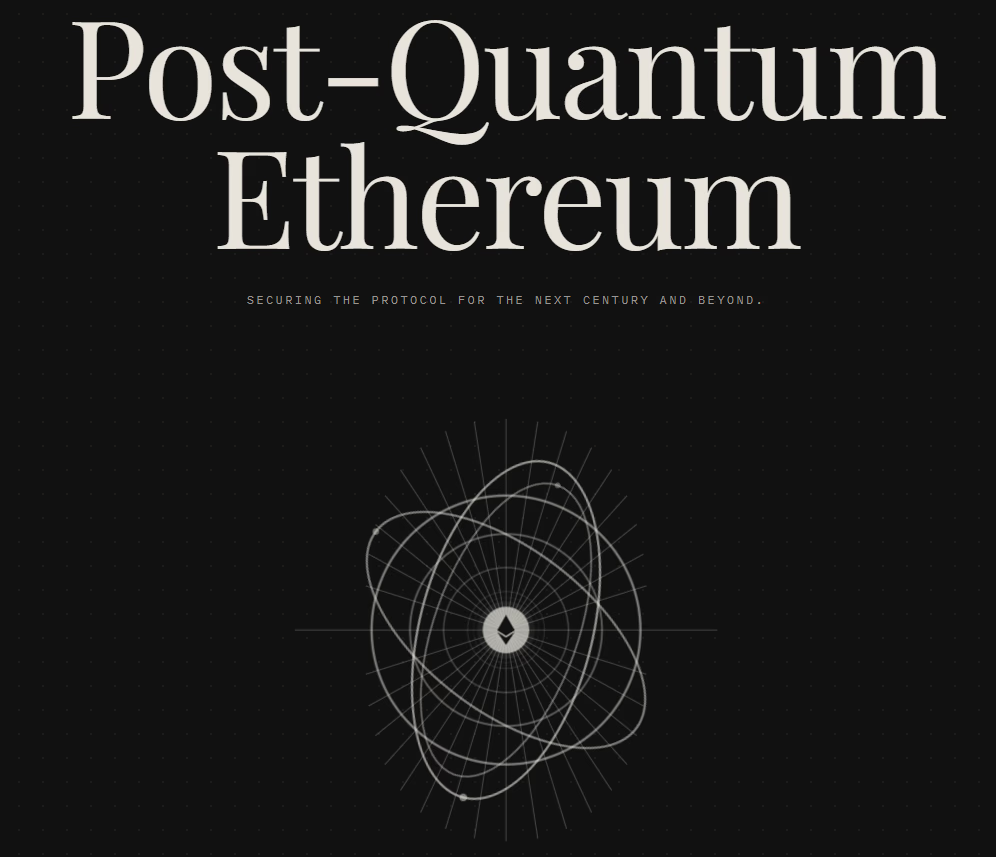
The EF’s Post-Quantum and Cryptography teams have consolidated an 8-year research push into an open resource with a roadmap and specifications.
The Ethereum Foundation on Tuesday launcheda dedicated website consolidating the organization’s post-quantum (PQ) security work into a single public resource.
The site represents the public-facing culmination of what the EF describes as an 8-year effort that began with early STARK-based signature aggregation research in 2018.

“Ethereum is designed to serve as resilient, self-sovereign infrastructure — not for decades, but for centuries,” the site reads. The EF frames the transition as an opportunity to strengthen the protocol’s security, simplicity, and decentralization rather than simply swapping one primitive for another.
The resource brings together several strands of work. It breaks down how post-quantum cryptography affects each protocol layer — execution, consensus, and data — and maps out a phased migration across named forks onthe EF Architecture team’s living draft roadmap.
The team’s current assessment places Layer 1 (L1) protocol upgrades as potentially complete by 2029, with full execution-layer migration taking additional years beyond that.
On the threat timeline, the FAQ states that most engineering roadmaps place cryptographic relevance in the early-to-mid 2030s, but that upgrading decentralized global infrastructure will take many years, making early preparation essential.
The PQ milestones are part of the EF’s broader strawmap. Post-quantum L1 is one of five “north stars” alongside fast L1, gigagas L1, teragas L2, and private L1. The strawmap outlines seven forks through 2029 on a roughly six-month cadence, though the document notes that AI-accelerated R&D could compress timelines.
This article was written with the assistance of AI workflows. All our stories are curated, edited and fact-checked by a human.

TLDR:
- RHEA Finance integrates TRON, giving 370 million users access to cross-chain liquidity via one wallet.
- NEAR Intents and Chain Signatures power seamless cross-chain execution without extra wallets or bridges.
- TRON processes over $20 billion daily and holds $85 billion in USDT, making it a key DeFi target.
- Intent-based architecture lets users state financial goals while solvers handle all cross-chain execution.
RHEA Finance has announced its integration with the TRON network, extending chain abstracted liquidity to one of blockchain’s most active ecosystems.
Built on NEAR Protocol’s intent-based architecture, the cross-chain DEX and lending protocol now enables TRON users to trade, lend, and borrow across multiple chains.
Users can do this without bridges, extra wallets, or technical knowledge of underlying chain mechanics.
TRON Users Gain Seamless Multi-Chain Access
The integration is powered by NEAR Intents and NEAR Chain Signatures. Together, these tools allow TRON users to express financial goals, such as lending USDT or swapping TRX. A decentralized solver network then handles execution across supported blockchains automatically.
Users sign transactions using only their existing TRON wallet through the RHEA PassKey experience. This removes the need for NEAR, EVM, or any additional wallet setup. The process is designed to be straightforward and accessible to users of all experience levels.
TRON has built a strong presence in global stablecoin payments over the years. The network holds over $85 billion in circulating USDT supply and supports more than 370 million user accounts.
Additionally, TRON processes over $20 billion in daily transfer volume, making it a natural fit for cross-chain DeFi.
RHEA Finance aggregates liquidity across multiple blockchains through its core architecture. By adding TRON, the platform extends its infrastructure to a vast and active user base. Assets can now move between blockchains without fragmentation or added complexity.
Intent-Based Architecture Addresses Long-Standing DeFi Challenges
NEAR Protocol Co-Founder and RHEA Finance advisor Illia Polosukhin spoke directly to the value of the integration. “With RHEA’s TRON integration, the massive user base of TRON gains access to broad cross-chain liquidity through a single wallet,” he said.
He further noted, “This is the power of NEAR Intents and chain abstraction. The user states their intent and it just works, no need to think about infrastructure.”
TRON DAO Community Spokesperson Sam Elfarra also weighed in on the development. “RHEA Finance’s integration represents a meaningful step in further driving cross-chain DeFi accessibility to TRON’s global user base,” Elfarra stated.
He added that users can now transact across ecosystems without leaving TRON, enhancing interoperability across the broader Web3 landscape.
The integration directly addresses fragmented liquidity and complex bridging workflows in DeFi. It also removes the persistent need for multiple wallets when operating across chains. Users simply express their desired outcome, and the infrastructure manages execution on the backend.
Native settlement workflows are designed to keep collateral and proceeds within the TRON ecosystem. This approach maintains the security and familiarity that existing TRON users expect.
As blockchain interoperability grows, intent-based systems like this show how decentralized finance can scale to meet the needs of a global user base.



EDXM International will launch the first blockchain-based derivative of the Korean won in April 2026, targeting one of the world’s most active currency pairs. The Singapore-based exchange, backed by Wall Street heavyweights Citadel Securities and Fidelity Digital Assets, is introducing a perpetual futures contract that tracks the won against the US dollar. This product utilises a won-backed stablecoin structure to offer institutions a capital-efficient alternative to the traditional non-deliverable forward (NDF) market.
The strategic pivot to Asia comes as the Korean Won cements its dominance in digital asset markets. Trading volumes for KRW pairs have frequently exceeded those for USD pairs on global exchanges during high-volatility periods in 2025 and 2026. EDX Markets is positioning this product to capture the liquidity that has historically been trapped behind South Korea’s strict capital controls.
- Product Mechanics: KRW-linked perpetual futures settled in USDC using the offshore KRWQ stablecoin, launching April 2026.
- Market Opportunity: The KRW acts as a proxy for Asian crypto risk, with Won NDFs commanding roughly $27 billion in average daily volume.
- Strategic Edge: EDXM International utilizes an offshore settlement structure to bypass capital controls that restrict traditional foreign exchange.
How the KRW Perpetual Contract Structure Works
The contract runs on a synthetic pair: KRWQ versus USDC.
KRWQ is a won-backed stablecoin issued by Brainpower Labs, a Cayman Islands-based entity. Traders on EDXM International go long or short on the KRW/USD exchange rate without ever touching the restricted currency. Everything settles in USDC.
The efficiency gap over traditional NDFs is significant. Standard won forwards require banking relationships and T+2 settlement cycles. This settles in real time on-chain. EDXM International CEO Kai Kono put it bluntly: trading stablecoin perpetuals is more efficient than NDFs because settlement is instant and no banking relationships are required.
Brainpower Labs maintains that the offshore minting process complies with current South Korean regulations. Unlike China’s explicit ban on offshore yuan stablecoins, Korean regulators have not moved against offshore won-pegged assets. That regulatory gap is the foundation of the product.
The market it is tapping into is enormous. Won NDFs are the largest non-deliverable market in the world, with average daily volumes near $27 billion. That volume is driven by the Kimchi Premium, the persistent price gap between crypto assets on Korean exchanges versus global platforms, and the sheer size of Korea’s domestic retail trading base.
South Korean retail traders punch well above their weight in global crypto volume. Until now, hedging that currency exposure was exclusive to major investment banks dealing in interbank forwards. EDXM is opening that access to crypto-native institutions directly.
The won has become a regional risk appetite proxy. When crypto rallies, KRW volumes spike, often flipping the Euro and Yen on trading desks. This contract is the first direct rail for crypto funds to trade dynamically without leaving the blockchain.
Wall Street Crypto Moves to Capture Asia FX Demand
EDXM International’s move signals a maturing of the market structure. High-frequency trading firms and hedge funds require regulatory clarity before entering new derivative markets. The backing of Citadel Securities and brokerage giants gives EDX a credibility advantage over unregulated offshore exchanges. Similar to how Swiss banks are fracturing to adopt Bitcoin strategies, traditional U.S. market makers are fracturing their operations to service Asian crypto demand through regulated international arms.
Traders are watching to see if the April launch cannibalises volume from the traditional NDF market. If liquidity migrates from bank-traded forwards to EDXM’s stablecoin perpetuals, it validates the thesis that blockchain rails are efficient enough to replace legacy FX plumbing. The threshold for success will be whether major market makers begin quoting tight spreads on KRWQ/USDC immediately upon launch.
Discover: The best new crypto in the world
The post Wall Street Target Asia: New Won Stablcoin Plots Asia FX Dominance appeared first on Cryptonews.
Strategic Waterway at Risk
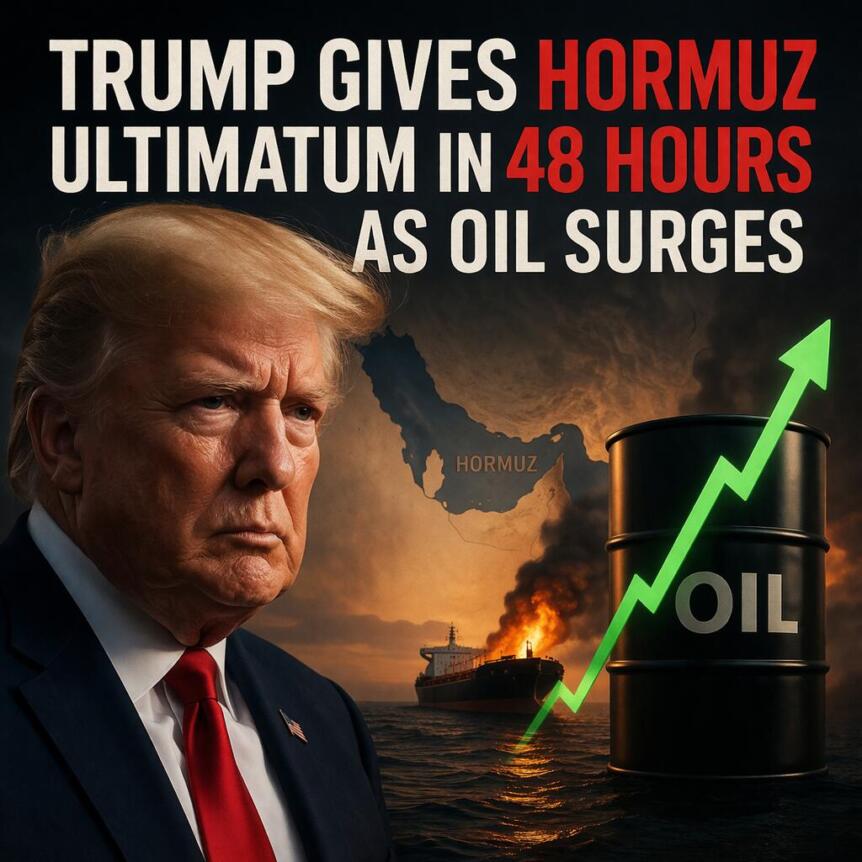
The Strait of Hormuz is also one of the most important routes of oil transit in the world, and its interruption has already attracted international attention. The US stance has been supported by several nations such as the United Kingdom, France, and Germany, which have put pressure on Iran to allow normal shipping activities. Furthermore, the Gulf countries have also highlighted the necessity to maintain the energy routes steadily to avoid the broader economic impact in case the US attacks. Iran has replied that any assault by the US will be met with attacks on the infrastructure in the region that benefits the US. Energy plants, technology systems, and desalination plants may serve as targets in the case of further escalation, according to the officials. This was also in response to an alleged missile attack associated with Iran on the Haifa refinery in Israel that fueled more tension in the region.
Oil markets responded swiftly to the events, with oil prices rising to approximately 98 dollars per barrel, indicating the increasing supply fears. The traders considered the possibility of extended unrest in the Gulf region, which would constrict global supplies. In addition, analysts observed that strategic reserves might fail to counter lasting supply shocks in the event that the conflict spreads to international markets. The cryptocurrency market revealed a new vulnerability as geopolitical risks rose amidst global markets. Major digital assets suffered losses with investors moving to less risky assets due to uncertainty. The larger risk-off mood thus persisted to press crypto prices even though they have tried to recover in the recent past.
The situation in the financial markets is delicate to any additional update, with each group taking a strong stand. On another indicator, investors are keeping a close eye on any diplomatic happenings that will reduce tensions or avert escalation. Nevertheless, with additional uncertainty surrounding the Strait of Hormuz, volatility can be expected to continue in the near term in both oil and digital asset markets.


Robinhood’s (HOOD) board has approved a new $1.5 billion share repurchase program, according to an 8-K filing with the U.S. Securities and Exchange Commission.
It adds more than $1.1 billion to existing buyback capacity.
The company said it expects to carry out the plan over about three years starting in the first quarter of 2026, though it is not required to buy a fixed amount.
Alongside the buyback, Robinhood also strengthened its access to funding. Its subsidiary, Robinhood Securities, entered into an updated credit agreement with lenders led by JPMorgan. The deal expands a revolving credit facility to $3.25 billion, up from $2.65 billion, with the option to increase total commitments to $4.875 billion.
One of last year’s hottest stocks, in large part thanks to the boom in crypto-related trading, HOOD has lost more than 50% of its value since bitcoin topped in early October. Shares are up 1.4% in after hours trading.
Bitcoin (BTC) holders are gradually becoming less prone to panic selling and instead building up cash buffers to deploy during discounted BTC buying opportunities. Onchain data supports this view, highlighting a large surge in stablecoin activity, with USD Coin (USDC) and Tether’s USDt (USDT) transfers reaching a combined $440 billion on March 22.
This shift in investor behavior aligns with the increasing risk-off approach seen in markets as the United States Federal Reserve dismissed near-term interest rate cut expectations, amid rising energy prices due to the ongoing US and Israel-Iran war.
Bitcoin realized volatility expands, but investors are cool headed
Bitcoin’s recent price action highlights a volatile market. It dropped 3.75% to $67,300 on Sunday before rebounding above $71,700 on Monday, with the move largely driven by news around the US and Israel-Iran war.
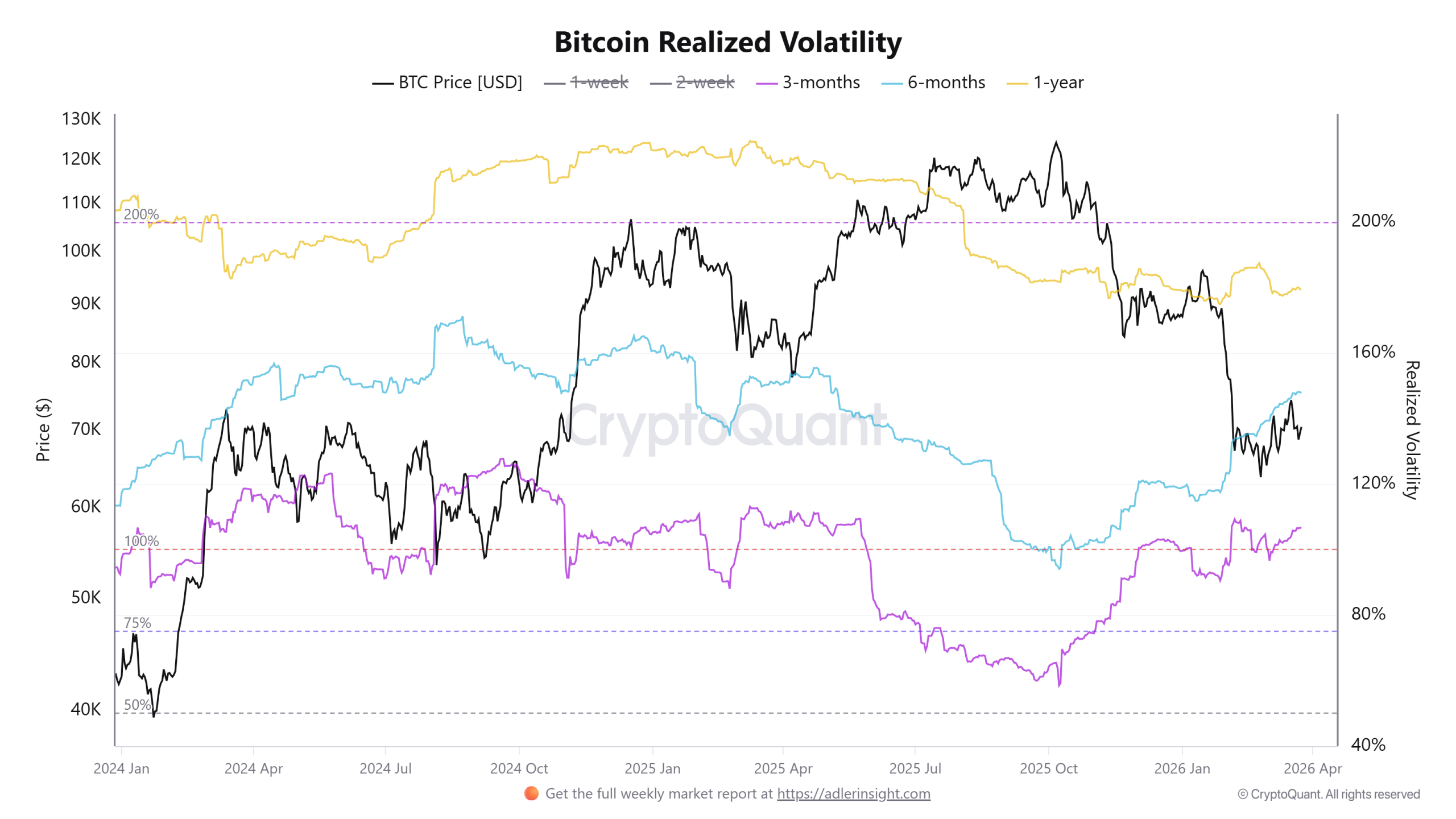
As a result, BTC’s realized volatility, which measures how much the price has actually moved over a given period, remains elevated across multiple time frames. The three-month and six-month realized volatility measures have climbed to 107% and 148%, respectively, up from 60% and 94.5% over the past six months.

However, the long-term one-year realized volatility has remained unchanged near 180% during this period. That suggests the market isn’t in full panic mode, and it is dealing with uncertainty without widespread forced selling.
Stablecoin flows provide important context for this environment. On March 22, the total number of USDC tokens transferred surged to 368 billion, marking a roughly 2,081% daily increase to an all-time high, while USDT transfers on the Ethereum network reached 72 billion.

These stablecoin flows point to a rapid capital rotation and repositioning. The market participants are actively moving funds into stablecoins as a temporary store of value, creating a “cash buffer” that can be redeployed quickly.
This dynamic often emerges in volatile conditions, where traders may prioritize monitoring the price over high exposure.
Related: What happens to Bitcoin if US bond yields soar above 5%?
Spot and futures activity remain below bull market highs
Futures data further reinforces the current sidelined sentiment. BTC open interest (in USD) is down $19 billion over the past six months, indicating a steady reduction in leveraged exposure. This unwind reflects a market that is de-risking rather than building aggressive positions.

Aggregated funding rates have cooled to 0.01% from overheated levels near 0.1% in July-August 2025, occasionally flipping negative, while the perpetual futures premium continues to trade at a discount to spot.
Together, these signals point to subdued leverage demand and a market lacking strong directional conviction, with a slight bearish tilt.
The spot market activity paints a similar picture. Cointelegraph reported that Binance is on track to record its lowest monthly spot volume since September 2023, with volumes hovering near $52 billion.
The current participation levels align more closely with periods of reduced engagement seen during prior bear market cycles in 2022-2023.
Thus, the crypto market has strong liquidity, with capital actively moving through stablecoins, but it isn’t being deployed into Bitcoin yet, and BTC holders continue to observe the current market.
Related: Bitcoin value ‘off the chart’ as BTC price metric hits record lows in 2026
This article does not contain investment advice or recommendations. Every investment and trading move involves risk, and readers should conduct their own research when making a decision. While we strive to provide accurate and timely information, Cointelegraph does not guarantee the accuracy, completeness, or reliability of any information in this article. This article may contain forward-looking statements that are subject to risks and uncertainties. Cointelegraph will not be liable for any loss or damage arising from your reliance on this information.


Balancer Labs is shutting down operations. The corporate entity behind the DeFi protocol is winding down after a $128 million exploit on November 3, 2025, made the company a “liability” due to mounting legal exposure.
Co-founder Fernando Martinelli confirmed the decision Monday, stating that the protocol itself will continue under a decentralized structure. The immediate market reaction has been brutal, with liquidity providers exiting V2 pools as confidence in the centralized entity evaporates.
- Exploit Impact: A rounding error in swap logic drained $128 million from V2 pools across multiple chains.
- Restructuring Plan: Balancer Labs dissolves; core team migrates to a new OpCo subject to DAO approval.
- Protocol Viability: Despite the shutdown, the protocol generates over $1 million in annualized fees.
Balancer Labs $128M Exploit: How Attackers Broke the Vault
The November 3 attack was surgical.
Attackers exploited a rounding flaw in Balancer’s swap logic across V2 pools on 6 different blockchains. Within 30 minutes, $128 million in user funds was gone. The vector was a pricing error in stable pools manipulated to drain liquidity. Not a flash loan. A fundamental flaw in the vault’s math.
Balancer founder Fernando Martinelli did not sugarcoat the post-mortem. “What failed was not the technology,” he wrote. “What failed was the economic model wrapped around it.” The accumulated weight of security incidents has turned the corporate entity from a development shield into a litigation target.
The market signal is bearish. BAL is facing renewed sell pressure as holders digest the dissolution of the primary development entity. TVL has contracted sharply since November with capital rotating into Curve and Uniswap.
Two scenarios from here.
If the DAO cannot execute a swift tokenomics overhaul, $1 million in annualized fees will not sustain development. The protocol becomes a zombie chain. If the proposed elimination of BAL emissions and a buyback program lands correctly, the shutdown gets repriced as a bottom signal and the token resets.
DEX volume across aligned ecosystems is plunging. Liquidity is fragmenting. If Balancer cannot stabilize its TVL, capital flight accelerates into more defensive stablecoin pools elsewhere.
Sellers control the tape until the restructuring is finalized.
Contagion Risk: Who Is Exposed to the Collapse?
Shutting down Balancer Labs removes the legal target. It does not fix the credit risk.
Protocols building on Balancer’s programmable liquidity are now interacting with a headless entity run purely by governance. For institutional LPs, losing a corporate counterparty increases perceived risk. Martinelli confirmed it himself. The lab had become a liability operating without revenue. The old DeFi development model is dead.
The pivot is radical. Balancer Labs dissolves. Core team members transition to a new entity called Balancer OpCo, pending a governance vote. BAL emissions get zeroed out. The veBAL governance model, which had been dominated by bribe markets, gets scrapped entirely.
Martinelli’s argument is straightforward. The technology still works. The protocol is revenue-positive. The shutdown unbundles the code from the legal baggage of the exploit and hands control to the DAO.
The technology survived. The company did not.
Balancer is now a live test case for whether a major DeFi protocol can outlive its own corporate death and function purely as code. If the governance vote fails to establish the OpCo, the protocol does not fade gracefully. It drifts into irrelevance with no one left to steer it.
The vote is the only thing that matters right now.
Discover: The best new crypto in the world
The post Balancer Labs to Shut Down After $128M Exploit, Plans Lean Restructuring appeared first on Cryptonews.
Sony is reportedly shutting down Dark Outlaw Games, run by former Call of Duty director

Nvidia’s one of the fastest growing companies with one of the lowest valuations, says Jim Cramer

Showing shoppers the ‘cost per wear’ of their clothing choices could make fashion greener

Smart energy pays enters the US market, targeting scalable financial infrastructure

Why Israel is blocking foreign journalists from entering

Bitcoin: We’re Entering The Most Dangerous Phase
Nvidia’s one of the fastest growing companies with one of the lowest valuations, says Jim Cramer

How to Generate Income with Gold and Money Received During Marriage | Financial Tips for Women

This Financial Mistake Is Ruining You
-
 Crypto World4 days ago
NIO (NIO) Stock Plunges 6.5% as Shelf Registration Sparks Dilution Worries
-

 Fashion4 days ago
Weekend Open Thread: Adidas – Corporette.com
-

 Politics4 days ago
Jenni Murray, Long-Serving Woman’s Hour Presenter, Dies Aged 75
-

 Crypto World3 days ago
Best Crypto to Buy Now: Strategy Just Spent $1.57 Billion on Bitcoin During Fear While Early Investors Quietly Enter Pepeto for 150x Potential
-

 News Videos6 days ago
RBA board divided on rate cut, unusually buoyant share market | Finance Report | ABC NEWS
-

 Crypto World3 days ago
Bitcoin Price News: Bhutan Sells $72 Million in BTC Under Fiscal Pressure, but the Smart Money Entering Pepeto Sees What the Market Does Not
-

 Politics7 days ago
The House | The new register to protect children from their abusers shows Parliament at its best
-

 Tech5 days ago
inKONBINI Lets You Spend Summer Days Behind the Register
-

 Crypto World6 days ago
Canada’s FINTRAC revokes registrations of 23 crypto MSBs in AML crackdown
-

 Sports1 day ago
Remo Stars and Kano Pillars Strengthen Survival Hopes in NPFL
-
 NewsBeat6 days ago
Residents in North Lanarkshire reminded to register to vote in Scottish Parliament Election
-

 News Videos6 days ago
PARLIAMENT OF MALAWI – PAC MEETING WITH REGISTRAR OF FINANCIAL ON AMARYLLIS HOTEL – INQUIRY LIVE
-

 Politics5 days ago
Gender equality discussions at UN face pushbacks and US resistance
-

 Business2 days ago
No Winner in March 21 Drawing as Prize Rolls to $133 Million for Next
-

 Business6 days ago
Who Was Alex Pretti? 5 Key Facts About the ICU Nurse Killed by Federal Agents in Minneapolis
-

 Sports1 day ago
Gary Kirsten Accuses Pakistan Cricket Board Of ‘Interference’, Mohsin Naqvi Responds
-

 Tech2 days ago
Give Your Phone a Huge (and Free) Upgrade by Switching to Another Keyboard
-

 Sports4 days ago
2026 Kentucky Derby horses, odds, futures, preview, date: Expert who nailed 12 Derby-Oaks Doubles enters picks
-
Sports6 days ago
Vikings Free Agency Enters Phase 2 with Key Questions
-

 Tech7 days ago
Subnautica 2 might finally be entering early access in May
You must be logged in to post a comment Login