
Crypto World
How Vietnamese users choose crypto exchanges when buying with VND in 2026

Disclosure: This article does not represent investment advice. The content and materials featured on this page are for educational purposes only.
Vietnam’s crypto market grows fast in 2026 as users focus on choosing the right exchange for their needs.
Summary
- Vietnamese crypto beginners favor HIBT for clear onboarding, VND payments, and simple spot trading in 2026.
- HIBT simplifies early crypto adoption in Southeast Asia, emphasizing transparency, ease of use, and beginner-friendly trades.
- Amid Vietnam’s grey-area regulations, users choose exchanges like HIBT that highlight clarity, security, and straightforward fees.
Vietnam remains one of Southeast Asia’s fastest-growing cryptocurrency markets. High mobile banking penetration, a tech-savvy retail user base, and sustained interest in digital assets have shaped how Vietnamese users interact with crypto platforms. By 2026, the core question for most users is no longer whether crypto can be accessed with Vietnamese dong (VND), but how to choose the right exchange for their specific needs.
Unlike mature markets where users often rely on a single platform, crypto adoption in Vietnam is more fragmented. Exchange selection is typically driven by access method, experience level, and intended use, rather than brand size alone.
Access comes before platform
For VND users, the most critical factor is how local currency is converted into crypto. In practice, most users follow one of three common paths:
- Using fiat on-ramps or third-party payment providers
- Buying crypto through peer-to-peer (P2P) marketplaces
- Starting with region-oriented platforms designed to simplify onboarding
This explains why the concept of a single “best exchange” can be misleading. Different platforms often serve different roles across the user journey.
Global exchanges: Liquidity and market depth
Large global exchanges such as Binance and OKX are widely used in Vietnam, particularly after users have already converted VND into crypto. These platforms are valued for their liquidity, broad asset coverage, and advanced trading infrastructure.
However, access to these exchanges frequently relies on P2P markets or external payment channels. While this setup works well for experienced users, it can introduce additional complexity for beginners who are still learning how crypto transactions function.
Platforms for experienced traders
Some users prioritize execution speed, derivatives access, and advanced trading tools. Platforms like Bybit are often chosen by traders who already understand order types, risk management, and custody considerations.
For these users, fiat onboarding is treated as a functional step rather than a core experience. This model is effective for seasoned participants but may be less suitable for first-time buyers.
Region-oriented exchanges and the beginner entry point
A growing segment of Vietnamese users focuses on minimizing complexity during the early stages of crypto adoption. These users often prefer platforms that emphasize clear onboarding, localized payment flows, and spot trading, rather than feature-heavy environments.
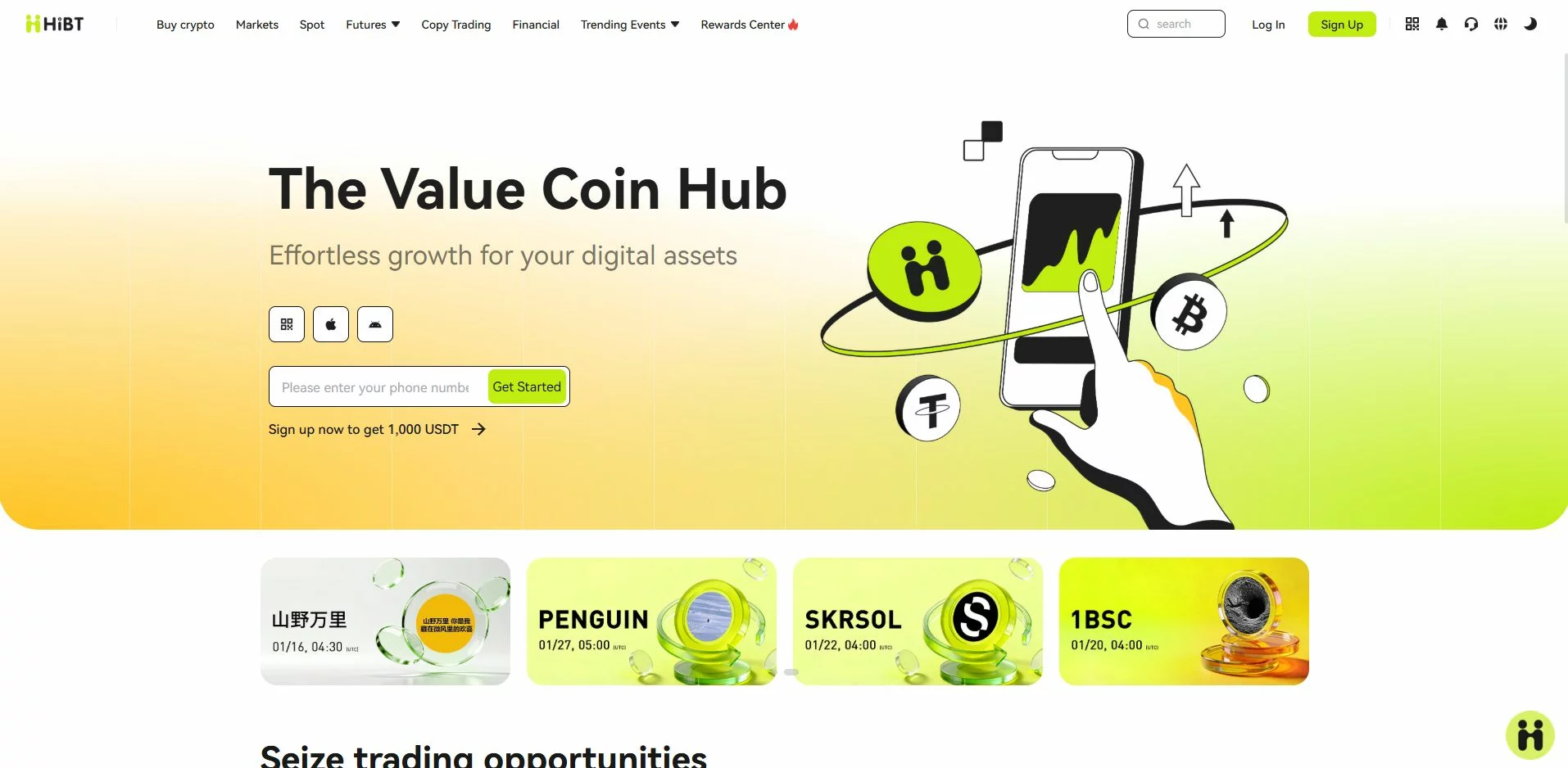
One example of this category is HIBT, a region-oriented exchange serving Southeast Asian users. Instead of competing on advanced trading features, HIBT focuses on simplifying the path from registration to the first trade, making it more accessible for users without professional trading backgrounds. This positioning reflects a broader trend in emerging markets, where ease of use and transparency increasingly influence platform choice.
More information about HIBT’s platform approach and user positioning can be found in this Best Crypto Exchange for Beginners (2026 Guide), which outlines how beginner-oriented exchanges structure onboarding and early trading experiences.
Regulation and risk awareness in Vietnam
As of 2026, cryptocurrency in Vietnam operates within a regulatory grey area. While digital assets are not recognized as legal tender, individuals are generally allowed to hold and trade crypto at their own risk. This environment places greater responsibility on users to understand platform mechanics, fees, and security practices.
As a result, many Vietnamese users prioritize exchanges that provide visible pricing, straightforward interfaces, and clear risk exposure, especially when buying crypto with VND.
How Vietnamese users typically buy Bitcoin
In practice, buying Bitcoin in Vietnam usually involves a process rather than a single platform:
- Converting VND into crypto through fiat on-ramps or P2P markets
- Executing spot trades on an exchange aligned with the user’s experience level
- Managing custody by keeping assets on-platform or transferring to self-custody wallets
Tools that provide transparent market data and decision frameworks also play an important role in helping users make informed choices. For many beginners, understanding how to choose a crypto exchange based on usability rather than hype is often more important than comparing feature lists.
Why a multi-platform strategy is common
Market behavior suggests that many Vietnamese users adopt a multi-platform approach:
- One platform for fiat access
- Another for liquidity and broader markets
- Additional tools for research and market monitoring
This structure reflects a broader trend across emerging markets, where exchanges are viewed as infrastructure rather than all-in-one solutions.
Conclusion
In 2026, choosing a crypto exchange in Vietnam depends less on rankings and more on context. Global exchanges offer liquidity, advanced platforms cater to experienced traders, and region-oriented services help simplify entry for new users.
This diversity explains why multiple platforms — including global exchanges and beginner-focused options like HIBT — continue to coexist within Vietnam’s evolving crypto ecosystem.
Disclosure: This content is provided by a third party. Neither crypto.news nor the author of this article endorses any product mentioned on this page. Users should conduct their own research before taking any action related to the company.


Key Highlights
- XPeng achieved its maiden quarterly net profit of 383.2 million yuan (approximately $55.5M) during Q4 2025
- Quarterly revenue surged 38% compared to the prior year, reaching 22.25 billion yuan and exceeding Wall Street expectations
- Gross profit margin expanded to 21.3%, representing a significant improvement from the 14.4% recorded one year prior
- Shares gained roughly 2% during early market hours; American Depositary Receipts advanced 0.8% to $19.30 in pre-market activity
- China’s three leading emerging electric vehicle manufacturers — XPeng, NIO, and Li Auto — have all crossed into profitability territory
The Chinese electric vehicle manufacturer shipped 116,249 vehicles during the fourth quarter, establishing a new company benchmark, although falling short of its previously issued guidance range of 125,000–132,000 units. Despite the delivery miss, the financial outcome caught Wall Street off guard — market analysts had anticipated a net loss approaching 200 million yuan.
Across the entire 2025 fiscal year, the company’s net loss contracted dramatically to 1.14 billion yuan compared to 5.79 billion yuan recorded in 2024. Annual revenue exploded 88% higher to reach 76.72 billion yuan.
The margin expansion narrative proves equally compelling. Fourth-quarter gross margin reached 21.3%, climbing from 14.4% in the comparable period last year. Full-year gross margin registered at 18.9%, a substantial improvement over 2024’s 14.3% figure. Company executives attributed the margin gains to persistent cost optimization initiatives and an enhanced vehicle portfolio mix.
The earnings surprise arrives amid an intense pricing battle within China’s electric vehicle sector. Competitive pressure from domestic rivals has remained fierce, and XPeng shares remain down 12% across the trailing twelve months despite Friday’s positive momentum.
NIO announced its own maiden quarterly profit just last week, supported by record-breaking sales figures. Li Auto, which became profitable before its peers, delivered a modest profit despite experiencing softer sales volumes — highlighting that achieving profitability doesn’t guarantee consistent success in China’s saturated automotive landscape.
Beyond vehicle sales, XPeng has been expanding its technological footprint. The automaker recently introduced its VLA 2.0 autonomous-driving platform, developed using proprietary silicon, with worldwide rollout scheduled for 2027.
The company also intends to introduce three robotaxi variants this year targeting ride-sharing operations throughout China, with pilot programs anticipated to commence later in 2026.
Expansion Into Robotaxis and Humanoid Robotics
XPeng has been strategically repositioning itself as what management describes as a “physical AI company,” advancing into autonomous taxi services and humanoid robotics alongside its primary electric vehicle operations. While these represent longer-term strategic initiatives, they’re beginning to materialize with concrete implementation schedules.
First-quarter 2026 projections, however, signal a near-term deceleration. The company anticipates delivering between 61,000 and 66,000 vehicles, generating revenue in the range of 12.20–13.28 billion yuan. This guidance represents a 16% to 23% contraction compared to the corresponding period in the previous year — marking a considerable retreat from fourth-quarter performance levels.
First Quarter 2026 Outlook Indicates Sequential Slowdown
The subdued Q1 delivery projection mirrors customary seasonal patterns in Chinese automotive demand following robust year-end purchasing activity. XPeng management has not indicated any fundamental business concerns, characterizing the softness as consistent with typical first-quarter dynamics.
XPeng American Depositary Receipts traded 0.8% higher at $19.30 during premarket hours on Friday in response to the earnings announcement.

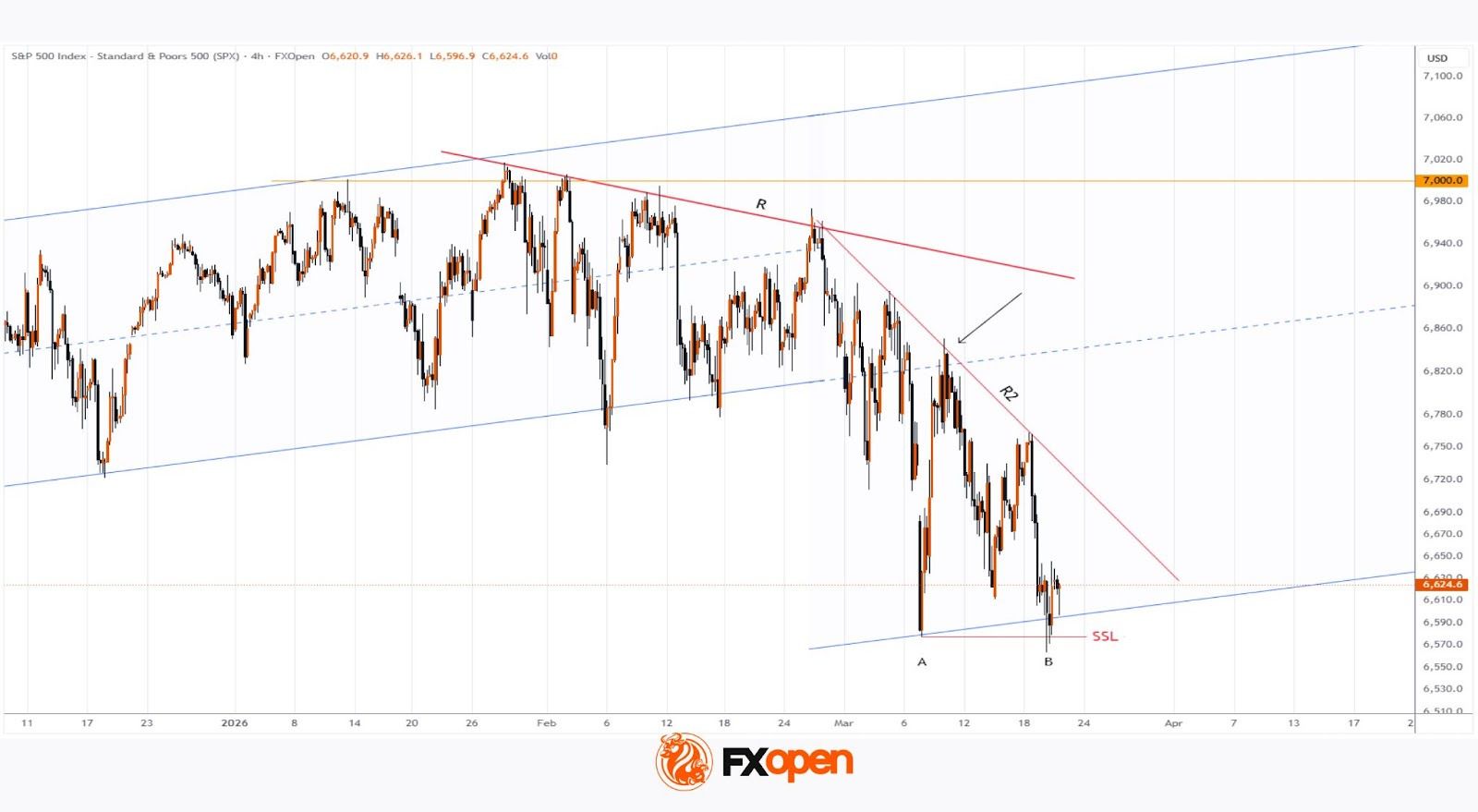
As the S&P 500 chart (US SPX 500 mini on FXOpen) shows, the index dropped below the 6,570 level yesterday for the first time in 2026. As a result, the equity market may be on track to post a fourth consecutive weekly decline, closing below its 200-day moving average.
Why Are Equities Falling?
Bearish sentiment is likely being driven by the ongoing military conflict in the Middle East:
→ Elevated oil prices are fuelling expectations of a renewed inflationary surge. This suggests the Federal Reserve will keep interest rates higher for longer (as reinforced by Powell’s remarks this week), putting pressure on both the economy and corporate performance.
→ Investors are also concerned that the United States could become drawn into a prolonged conflict with Iran, which may pose significant challenges for the country, despite efforts by officials to calm market sentiment.
According to Trading Economics:
→ US President Donald Trump stated that the US is not considering deploying ground troops to the Middle East;
→ Treasury Secretary Scott Bessent noted that the Iranian regime could face internal collapse;
→ Israeli Prime Minister Benjamin Netanyahu said Israel may refrain from further strikes on Iran’s energy infrastructure, suggesting the conflict could end sooner than expected.
Technical Analysis of the S&P 500
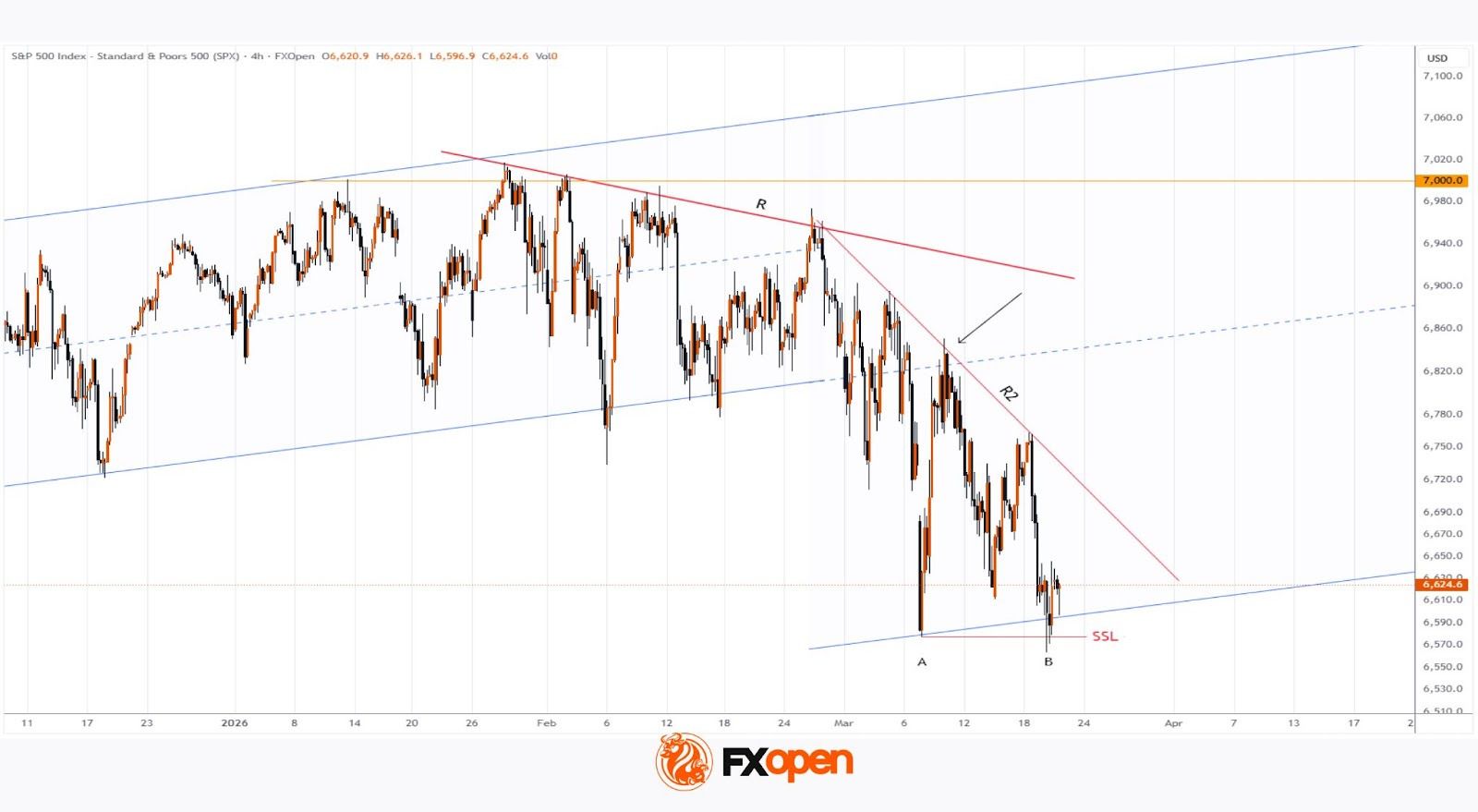
On 11 March, we analysed the index chart and noted that the lower boundary of the broader channel was acting as support (point A), while the median line served as resistance (as indicated by the arrow).
Since then, selling pressure has led to:
→ the formation of a steeper descending trendline (R2);
→ a move down to a new low at point B, below the previously mentioned channel boundary.
From a Smart Money Concepts perspective, it is reasonable to assume that price has entered a Sell-Side Liquidity zone. If so, traders should consider the possibility that the recent bearish breakout below the channel may prove to be false. In that case, the S&P 500 could stage a recovery in the coming sessions, potentially moving back towards the R2 trendline.
Trade global index CFDs with zero commission and tight spreads (additional fees may apply). Open your FXOpen account now or learn more about trading index CFDs with FXOpen.
This article represents the opinion of the Companies operating under the FXOpen brand only. It is not to be construed as an offer, solicitation, or recommendation with respect to products and services provided by the Companies operating under the FXOpen brand, nor is it to be considered financial advice.

Key Highlights
- Q4 fiscal 2026 revenue reached $86.8M, surpassing Wall Street’s $78M forecast
- Adjusted EBITDA posted $2.3M versus consensus expectations of a ~$6M loss
- Fiscal 2027 revenue outlook of $415M–$440M significantly exceeded the $380M analyst consensus
- Shares surged 22% in after-hours trading to $32.97 following an 8.7% regular session gain
- The stock has climbed 524% over the trailing twelve months
Planet Labs PBC delivered impressive quarterly results on Thursday, triggering a substantial rally in extended-hours trading.
The satellite imaging firm posted fourth-quarter fiscal 2026 revenue of $86.8 million, comfortably exceeding the Street’s $78 million projection compiled by FactSet.
The company’s adjusted EBITDA registered at $2.3 million, a notable outperformance compared to the anticipated loss of approximately $6 million. The results marked a decisive win on both top and bottom lines.
Defense-related entities accounted for roughly 60% of fiscal 2026 revenue. Another 25% originated from other government agencies, while commercial customers made up the remainder.
Chief Executive Will Marshall characterized the period as a “transformational year.” Fourth-quarter revenue expanded 41% compared to the prior-year period, while the company closed the fiscal year with a $900 million backlog — representing 79% year-over-year growth.
Shares had already advanced 8.7% during Thursday’s regular session, while the S&P 500 declined 0.3% and the Dow Jones Industrial Average slipped 0.4%.
In after-hours action, PL surged an additional 22% to reach $32.97. The move pushed the stock’s twelve-month return above 524%.
Prior to the announcement, options activity suggested bullish sentiment. Call volume significantly outweighed put volume, indicating traders were positioning for positive news ahead of the release.
Those directional bets proved prescient as the actual results validated the optimistic positioning.
Forward Guidance Exceeds Expectations
For fiscal 2027, Planet Labs issued revenue guidance ranging from $415 million to $440 million. The analyst community had been modeling $380 million, representing a substantial upside surprise.
The company’s EBITDA outlook for fiscal 2027 came in around $5 million — trailing the $16 million Wall Street consensus. However, investors appeared unconcerned with the profitability metric.
Revenue trajectory remains the primary focus for market participants, and the forward guidance satisfied that appetite.
Twelve months ago, Street estimates for fiscal 2027 revenue stood near $330 million. That figure has now climbed toward $430 million.
Business Catalysts and Growth Drivers
Planet highlighted several operational achievements in its earnings release. The company successfully deployed 40 satellites throughout the fiscal year and entered into a research and development collaboration with Google focused on orbital data center technology.
The firm also referenced a recently secured satellite services agreement with Sweden as evidence of continued commercial momentum.
Through Thursday’s market close, PL shares had appreciated 25.81% year-to-date, before factoring in the after-hours movement.
Average daily volume runs approximately 11.5 million shares. Technical analysis indicators were flashing buy signals entering the earnings announcement.
The company commanded a market capitalization of $8.4 billion prior to the extended-session rally.
Trading at $32.97 in after-hours activity, the stock price reflected strong investor approval of the quarterly performance — especially the revenue outperformance and forward outlook.
Crypto World
Gemini Faces Class-Action Lawsuit Over Alleged Investor Misleading After IPO Strategy Shift

TLDR:
- Gemini’s stock has collapsed over 80% from its $32 IPO price, closing at $6.01 on Thursday after the lawsuit was filed.
- A New York class-action suit alleges Gemini hid a major strategy overhaul from investors ahead of its September 2025 IPO.
- Gemini’s net loss widened to $140.8 million in Q4 2025, with full-year losses reaching $582.8 million for the year.
- Under Gemini 2.0, the firm is exiting the UK, EU, and Australia markets while cutting roughly 30% of its total workforce.
Gemini is facing a class-action lawsuit filed in New York federal court. The complaint accuses the cryptocurrency exchange and its founders of misleading investors around its 2025 initial public offering.
Plaintiffs allege that Gemini concealed a major strategic overhaul before going public. The company’s stock has since dropped over 80% from its IPO price.
Meanwhile, Gemini reported widening losses and confirmed workforce cuts reaching approximately 30% since the start of 2026.
Lawsuit Targets IPO Disclosures and Executive Departures
The complaint was filed on Wednesday in the U.S. District Court for the Southern District of New York. It names Gemini co-founders Tyler and Cameron Winklevoss as defendants, alongside the company. The suit covers investors who purchased shares during the September 2025 IPO through mid-February 2026.
Plaintiffs argue that Gemini’s IPO offering documents painted a misleading picture of the business. Specifically, the documents portrayed Gemini as a growing exchange focused on expanding its user base and international reach. However, the company allegedly withheld plans for a major strategic change at that time.
The complaint also points to the departure of several senior executives as evidence of internal disruption. Those who left include Gemini’s chief financial officer, chief operating officer, and chief legal officer. These exits occurred around the same period as the strategic pivot announcement.
In addition, the lawsuit ties the stock’s sharp decline to these undisclosed plans. Gemini’s stock opened at $32 on its Nasdaq debut and has since fallen to around $6. That represents a decline of more than 80% in just a few months.
Gemini 2.0 Strategy Introduces Prediction Markets and Market Exits
In early February 2026, Gemini announced its “Gemini 2.0” strategy, which marked a clear shift from its earlier direction.
The company said it would focus on building a prediction market product going forward. This move came as a surprise to many investors who expected continued exchange growth.
As part of the restructuring, Gemini also announced it would exit key international markets. These include the United Kingdom, the European Union, and Australia — regions it had previously targeted for expansion. The decision reversed the international growth narrative that featured in its IPO materials.
Alongside the strategic changes, Gemini disclosed its fourth-quarter 2025 financial results. Revenue rose 39% year-over-year to $60.3 million, though net losses widened sharply to $140.8 million from $27 million a year earlier.
In a shareholder letter, Tyler and Cameron Winklevoss confirmed that the workforce reduction has now reached “roughly 30% since the start of the year.” For the full-year 2025, net losses reached $582.8 million compared to $158.5 million in 2024.
Furthermore, Gemini’s trading volume remains far below major competitors. In February, Gemini recorded approximately $2.14 billion in monthly exchange volume.
By comparison, Coinbase posted $68.99 billion and Binance reported $334.86 billion during the same period. The Block has reached out to Gemini for comment on the lawsuit.

A New York class-action lawsuit has been filed accusing Gemini Trust Co., its co-founders Tyler and Cameron Winklevoss, and senior executives of misleading investors around the company’s September initial public offering. The complaint, brought in Manhattan federal court, centers on how Gemini presented its business as a growing crypto exchange expanding its user base and international footprint, while allegedly pivoting soon after to a prediction-market-centric model.
Shareholder plaintiff Marc Methvin contends that the IPO documents painted Gemini’s core product as the driver of growth, even as the firm embarked on a dramatic strategic shift. The suit notes public statements in November that Gemini was advancing its international footprint and entering key global markets, claims that conflict with the IPO narrative. The plaintiffs are seeking a jury trial and damages for investors who bought shares at what the complaint describes as “artificially inflated prices” in the wake of the IPO.
Key takeaways
- The suit alleges Gemini misrepresented its core business during the IPO while pivoting to a prediction-market focus afterward, an initiative labeled “Gemini 2.0.”
- In February, Gemini announced a 25% workforce reduction and exit from the European Union, United Kingdom, and Australian markets as part of the pivot.
- Executive turnover followed the pivot, with the departure of the chief financial officer, chief operations officer, and chief legal officer amid rising operating expenses.
- Gemini’s stock performance has been bleak since its September IPO, slipping from a $28 offering price to around $6, with a February low near $5.82.
- Despite the stock-hit narrative, the company reported a 39% year-on-year rise in Q4 revenues to $60.3 million, beating consensus estimates of about $51.7 million.
Lawsuit alleges misrepresentation around IPO and pivot
The complaint filed in Manhattan federal court asserts that Gemini’s public filings framed the exchange’s growth trajectory around user acquisition and international expansion, presenting a picture of expansion as the “core product.” However, in February, the company’s leadership publicly pivoted to a prediction-market business model, beginning a broad strategic rethink that included cost-cutting and market exits. The plaintiffs point to a November update in which Gemini executives touted progress on its international expansion and commitment to entering “key global markets.”
The filing argues that this pivot, coupled with the IPO’s optimistic portrayal, misled investors and created a mismatch between the company’s public statements and its actual strategic direction. While the suit does not specify individual misstatements beyond the described shift, it frames the post-IPO pivot as a fundamental change in business model that investors relied upon when valuing the stock.
Pivot and cost-cutting drive stock decline
Gemini’s strategic shift, announced in February, included the decision to pivot away from certain markets and reduce its workforce by about a quarter. The company also disclosed its intention to exit the European Union, United Kingdom, and Australian markets. In the same period, Gemini’s leadership—specifically the chief financial officer, chief operations officer, and chief legal officer—left the firm as operating expenses rose by roughly 40% year over year, according to the lawsuit.
These structural changes coincided with a sharp downturn in Gemini’s stock price. The shares, which began trading at $28 in September, briefly touched $40 in the weeks after the IPO but subsequently tumbled to multi-year lows. By February 20, the stock hovered around $5.82, marking an all-time low and underscoring the tension between the company’s pivot strategy and investor expectations.
Even as investors grappled with the pivot narrative, Gemini reported quarterly results that offered a contrasting signal. The company disclosed a Q4 revenue of $60.3 million, up 39% from the prior year and ahead of consensus estimates of about $51.7 million, suggesting some demand resilience despite the strategic upheaval. This divergence between revenue momentum and equity-market performance has heightened questions about how much value investors can place in the pivots and the longer-term path to profitability.
What comes next for Gemini and its investors
The lawsuit adds to a broader set of headwinds facing Gemini as it navigates regulatory scrutiny and ongoing market volatility for crypto-related ventures. For investors, the key questions revolve around whether the pivot to prediction markets is sustainable, how management will reconcile the cost base with revenue growth, and what governance changes might follow as the company refines its strategic direction.
Observers will be watching how Gemini communicates updates on its business model, the status of its international operations, and the trajectory of profitability in the quarters ahead. The outcome of the litigation, alongside market reaction to forthcoming earnings and strategic disclosures, will play a significant role in shaping sentiment around the platform’s ability to weather a tightening crypto landscape.
Key Highlights
-
Coinbase introduces around-the-clock US equity perpetual futures with leverage up to 20x.
-
Access major stocks including Apple, Microsoft, and Tesla alongside leading ETFs continuously.
-
Both retail users and institutional players benefit from cross-margin functionality spanning cryptocurrency and equity positions.
-
Around-the-clock availability enables immediate responses to international market developments.
-
Platform advances toward its ambitious goal of becoming the “Everything Exchange” for diverse asset classes.
Coinbase (COIN) finished trading at $202.91, registering a 0.31% increase, following the announcement of stock perpetual futures designed for international market participants. The exchange now provides continuous access to prominent US equities and exchange-traded funds throughout every hour of every day. This strategic initiative bolsters Coinbase’s standing within the global derivatives landscape while merging cryptocurrency and conventional asset trading within a unified framework.
This innovative offering grants market participants leveraged, synthetic positions in American equities without interruption. It functions through Coinbase’s proven perpetual futures infrastructure featuring enterprise-level risk management systems. The launch addresses increasing international appetite for capital-efficient pathways to US stock market exposure.
Coinbase accommodates individual and professional traders through sophisticated trading interfaces for the newly launched stock perpetuals. Users can coordinate their positions leveraging cross-margining capabilities spanning perpetual contracts and actual holdings. The product suite features leverage ratios reaching 10x for individual equities and 20x for exchange-traded funds, expanding tactical trading opportunities.
Leading Tech Giants and Popular ETFs Anchor Launch Portfolio
Coinbase offers perpetual futures contracts on Apple, Microsoft, Alphabet, Amazon, NVIDIA, Meta, and Tesla as foundational instruments. The platform also includes exchange-traded funds like SPY and QQQ in jurisdictions with appropriate regulatory clearance. This curated selection prioritizes highly liquid instruments and enables sustained market engagement across key industry sectors.
Stock perpetuals for these instruments facilitate trading during weekends and market holidays, extending beyond conventional 24/5 US equity market hours. The infrastructure utilizes USDC settlement through blockchain technology, optimizing transaction efficiency for international participants. Coinbase intends to progressively broaden its offerings to encompass additional stocks, market indices, and commodity products.
The availability of ETFs facilitates sophisticated portfolio construction and risk mitigation strategies for professional trading desks. Uninterrupted market access empowers participants to capitalize on macroeconomic announcements and international developments instantaneously. Coinbase deploys its established cryptocurrency derivatives technology to uphold market quality and prudent risk parameters.
Market Impact and Global Trading Accessibility
This product release establishes Coinbase among the pioneering centralized platforms delivering continuous stock perpetual futures availability. International market participants obtain exposure without substantial capital requirements or geographic trading barriers. The service creates a connection between decentralized finance concepts and regulated marketplace structures within an integrated environment.
Professional institutions leverage cross-collateralization advantages and dynamic risk oversight through Coinbase’s derivatives ecosystem. Individual traders engage via the Advanced UI or programmatic APIs, consistent with the platform’s accessibility objectives. The perpetual trading model facilitates swift responses to price movements spanning both digital asset and equity sectors.
Coinbase’s strategic expansion demonstrates a comprehensive ambition to construct a comprehensive trading destination for both innovative and established asset categories. It advances the organization’s overarching objective of creating the “Everything Exchange” housing all significant tradable instruments. This development could fundamentally transform how global market participants engage with American equities through continuous trading paradigms.
Crypto World
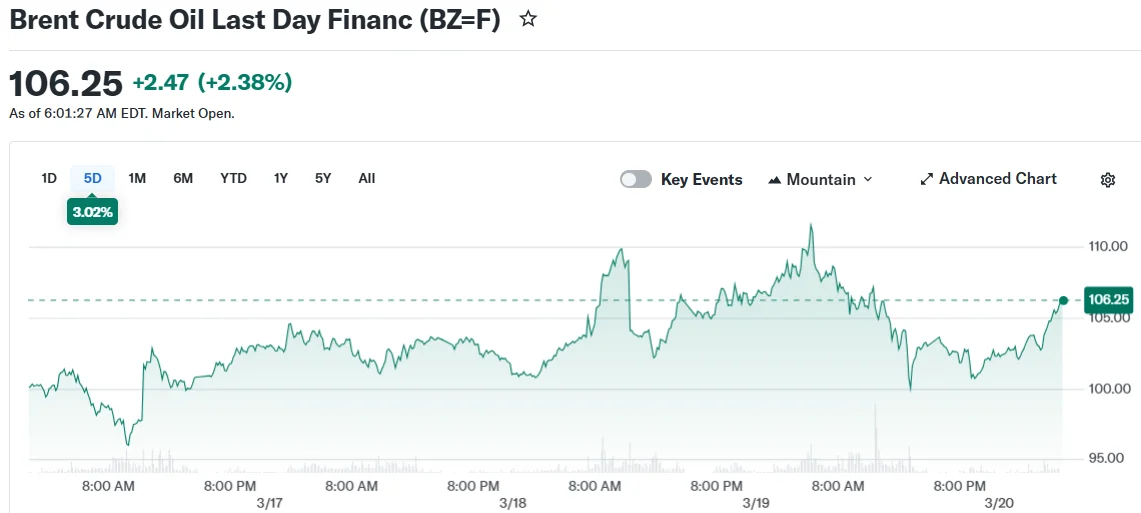
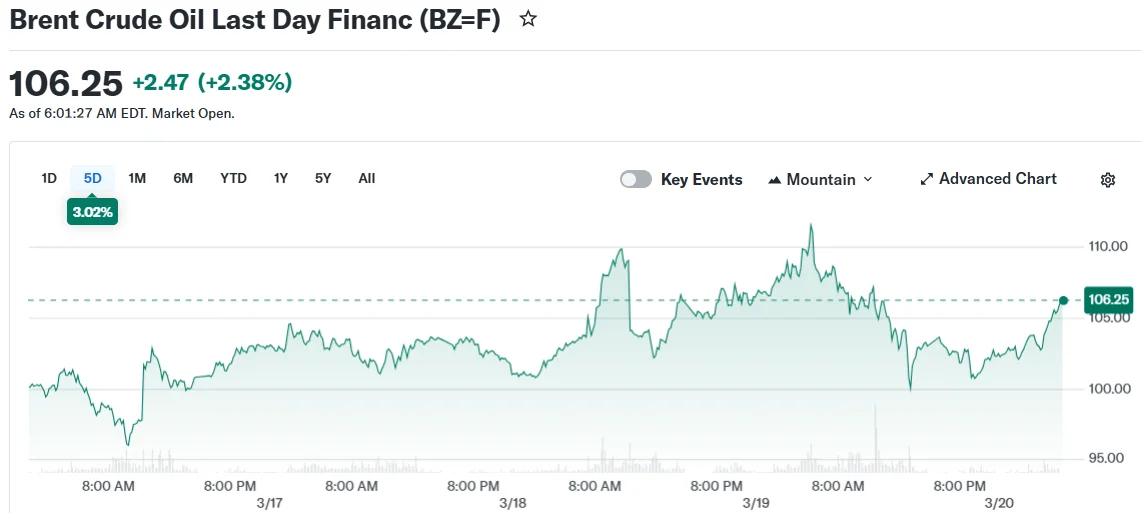
Goldman Sachs Picks 8 Best Oil Stocks as Middle East Tensions Push Crude Prices to $106
Key Takeaways
- Investment bank Goldman Sachs identifies eight energy stocks—five producers and three refiners—as preferred investments amid Middle East turmoil
- Brent crude prices have jumped 56.3% in the last month, reaching $106.91 per barrel
- ConocoPhillips expected to achieve 20-25% compound annual growth in free cash flow per share between 2025-2030
- Three refining companies—Valero, HF Sinclair, and Marathon Petroleum—receive Buy ratings from Goldman analysts
- Year-to-date performance shows Valero climbing 49.6%, Marathon advancing 45.7%, and HF Sinclair gaining 32.6%
Goldman Sachs has identified eight standout oil stocks spanning both production and refining sectors as preferred investment opportunities, driven by escalating Middle East tensions and supply chain disruptions that have propelled crude prices significantly higher.
Over the past month, Brent crude has experienced a dramatic 56.3% increase, trading at $106.91 per barrel. Ongoing attacks on Red Sea shipping routes have compelled the United States and European nations to release strategic petroleum reserves in an effort to moderate global crude pricing.
Goldman analyst Neil Mehta assigned Buy ratings to the firm’s three preferred refining stocks: Valero Energy, HF Sinclair, and Marathon Petroleum.
Within the production segment, Goldman identifies attractive risk-reward opportunities at Brent prices ranging from $70 to $75 per barrel. The investment bank has elevated price targets throughout its U.S. Majors and Canadian energy coverage universe.
ConocoPhillips emerges as Goldman’s premier producer recommendation. Analysts forecast compound annual growth of 20-25% in free cash flow per share spanning 2025 through 2030, supported by four significant projects such as Willow and Port Arthur. Goldman calculates approximately $9 billion in additional free cash flow generation by decade’s end.
Chevron also features prominently on Goldman’s list, with projections indicating at least $12 billion in stock repurchase activity during 2026. New project launches in Guyana and the Gulf of America are anticipated to fuel continued expansion.
Refining Sector Gains from Margin Expansion and Demand Growth
Regarding refining operations, Goldman gravitates toward enterprises experiencing margin improvements, especially along the West Coast where crack spreads have widened due to constrained product stockpiles and robust gasoline consumption.
Valero Energy tops Goldman’s refining selections. Analysts highlighted its Gulf Coast facilities, which handle a minimum of 240,000 barrels daily of Venezuelan crude oil. Valero delivered fourth-quarter earnings of $3.82 per share against $30.37 billion in revenue. The corporation intends to distribute 40-50% of adjusted cash flow via dividends and repurchases, with Goldman anticipating roughly $4.9 billion returned during 2026.
HF Sinclair maintains its position as a Goldman preferred choice notwithstanding recent leadership transitions. The enterprise recently initiated a $55 million enhancement at its El Dorado facility, projected to increase heavy crude processing capacity by 10,000 barrels daily. Goldman characterizes the stock as trading below intrinsic value.
Marathon Petroleum completes the refining trio. Goldman forecasts $4.6 billion in shareholder returns throughout 2026. Marathon disclosed fourth-quarter earnings of $4.07 per share, surpassing analyst expectations. The company targets 12.5% dividend expansion over a two-year period.
Canadian Energy Producers Attract Attention
Among Canadian energy names, Cenovus Energy presents the strongest total return opportunity per Goldman’s analysis, with initial production from West White Rose anticipated toward the conclusion of the second quarter 2026.
Suncor Energy has delivered approximately 65% returns over the trailing twelve months. Goldman maintains an optimistic outlook, emphasizing its integrated operational structure and autonomous hauling truck implementation to reduce operational expenses.
Canadian Natural Resources provides a dividend yield hovering around 4%. Goldman projects annual production at approximately 1,632 thousand barrels of oil equivalent daily for the full year.
TLDR:
- SEC Chair Paul Atkins confirms most cryptocurrencies are likely not securities under federal law.
- Only tokenized traditional securities remain subject to SEC oversight under the new interpretation.
- The SEC and CFTC signed a memorandum of understanding to coordinate digital asset regulation.
- The CLARITY Act passed the House in July 2025 but awaits a Senate Banking Committee markup.
Crypto markets in the United States may be on the verge of a major regulatory shift. SEC Chair Paul Atkins made that clear during a Thursday speech at the Practising Law Institute.
He said crypto markets and millions of Americans deserve long-overdue clarity from regulators. For over a decade, investors operated without a defined rulebook.
The agency previously leaned on enforcement rather than guidance. Atkins now says that approach is changing, and a new framework is taking shape.
A New Regulatory Direction Backed by Formal Interpretation
The SEC released an interpretative notice earlier this week addressing digital assets directly. The notice marked the agency’s clearest public statement yet on how federal securities laws apply to crypto.
Atkins told attendees at the DC Blockchain Summit that most cryptocurrencies are likely not securities. Only traditional securities that have been tokenized remain subject to the agency’s oversight.
The chair went further by naming the asset classes that fall outside the SEC’s jurisdiction. Digital commodities, digital tools, digital collectibles, NFTs, and stablecoins typically do not fall under the agency’s purview.
This distinction removes a long-standing source of confusion for developers and investors alike. Market participants can now assess their exposure to SEC oversight with more confidence.
Atkins also addressed the public through social media following his remarks. He wrote that SEC rules must be clear enough to guide markets and flexible enough to accommodate innovation.
He added that those rules must also be firm enough to protect investors from harm. That three-part standard reflects the agency’s commitment to balancing growth with accountability.
The SEC also signed a memorandum of understanding with the CFTC last week. This agreement establishes a coordinated approach between the two regulatory bodies.
The SEC will focus on securities law as it applies to crypto assets. The CFTC is positioned to take on broader authority over digital commodity markets going forward.
Congress Holds the Key to a Permanent Crypto Framework
The SEC’s interpretation is not meant to be the final word on crypto regulation. Atkins described it as a bridge while Congress works to advance formal market structure legislation.
A bill known as the CLARITY Act passed the House of Representatives in July 2025. As of Thursday, the Senate Banking Committee had not yet scheduled a markup for the bill.
Atkins made clear that the agency would defer to a congressional bill once passed into law. The current interpretation fills the regulatory gap that exists in the absence of that legislation.
This approach ends the era of enforcement-first regulation that frustrated industry participants for years. Businesses and investors can now plan with greater certainty during the transition period.
The demand for clear rules has been a consistent message from the crypto industry for years. The SEC’s new stance responds to that call with formal regulatory guidance rather than court actions.
A structured framework is expected to draw more responsible participants into digital asset markets. That, in turn, could support broader adoption and long-term market stability.
Atkins closed his remarks by framing this moment as a genuine turning point for the industry. He said the interpretation provides a foundation, with more regulatory work still ahead.
The SEC, CFTC, and Congress are expected to coordinate closely in the months to come. Together, their efforts are set to define what responsible crypto oversight looks like in the United States.
Key Takeaways
- OpenAI is consolidating ChatGPT, Codex, and its web browser into a unified desktop application
- Fidji Simo will spearhead sales initiatives while Greg Brockman manages the product transformation
- The strategic pivot addresses mounting competitive pressure from Anthropic
- OpenAI acknowledges that fragmented products hampered development velocity and user experience
- Both AI companies are aggressively pursuing enterprise clients and considering public market debuts
OpenAI has announced plans to consolidate its ChatGPT platform, Codex programming tool, and web browser into a unified desktop application. The company is branding this integrated offering as a “superapp,” aiming to streamline its product ecosystem and enhance usability.
The announcement came Thursday from OpenAI, validating earlier reporting from the Wall Street Journal. This represents a significant strategic pivot for the artificial intelligence leader.
Fidji Simo, serving as Chief of Applications, will direct sales operations for the consolidated platform. Meanwhile, President Greg Brockman will step away from his current computing infrastructure responsibilities to temporarily oversee this product integration and the accompanying organizational restructuring.
In a company-wide communication, Simo explained to staff: “We realized we were spreading our efforts across too many apps and stacks, and that we need to simplify our efforts.” She emphasized that this scattered approach had created inefficiencies throughout the organization.
Throughout the previous year, OpenAI introduced numerous separate applications, with many receiving backing from Microsoft. A significant portion of these offerings struggled to achieve meaningful user adoption and generated confusion internally regarding strategic priorities.
The consolidated platform will emphasize “agentic AI” capabilities. This refers to artificial intelligence systems capable of autonomous desktop operations, executing tasks such as software development or data analysis with minimal human oversight.
In contrast to conventional chatbots, agentic AI architectures function more like independent digital assistants. They accept assignments and pursue objectives with substantial autonomy.
The Battle for Enterprise Dominance: OpenAI vs. Anthropic
OpenAI and Anthropic have entered an intense competition for corporate client relationships. Both organizations are marketing AI-powered productivity solutions to the business sector.
Initially, OpenAI didn’t emphasize enterprise sales channels. However, the company reversed course after observing Anthropic‘s market traction with offerings including Claude Code and Cowork.
Anthropic has established significant market presence among enterprise customers. OpenAI is now mounting an aggressive campaign to narrow this competitive advantage.
Additionally, both organizations are reportedly considering initial public offerings before year-end. Each has committed to substantial revenue targets with their investor base.
Implications for End Users
The integrated superapp aims to consolidate OpenAI’s complete toolkit within a single interface. The organization anticipates this consolidation will significantly improve the workflow for developers and corporate users engaging with its technology.
Earlier this year, OpenAI released Codex as a separate desktop application. This programming tool will now be integrated into the broader unified platform.
The Wall Street Journal initially disclosed the superapp initiative. OpenAI officially verified these reports through an official spokesperson on Thursday, March 19, 2026.

Key Takeaways
- Evercore ISI maintains Outperform rating on Amazon (AMZN) with $285 price target intact
- AWS revenue forecasted to reach $163B in 2026 (27% year-over-year increase) and $214B in 2027 (31% expansion)
- Evercore designates Amazon as its top large-cap investment recommendation for 2026, noting stock trades at 3-year P/E trough
- Firm increases total revenue and operating income projections by 2–3%, positioning estimates 4–5% above consensus
- Capital expenditures anticipated to approach ~$250B by 2027, potentially resulting in ~$10B annual free cash flow deficits
Evercore ISI’s Mark Mahaney reaffirmed his Outperform stance on Amazon.com (AMZN) this Wednesday, maintaining his $285 price objective. With shares currently hovering around $208.76, this target represents approximately 37% potential upside.
Mahaney designated Amazon as his “#1 large-cap long idea for 2026,” pointing to attractive valuation levels, robust cloud computing expansion, and emerging business ventures as primary catalysts supporting his bullish outlook.
This recommendation follows Evercore’s updated assessment of Amazon Web Services, the e-commerce giant’s cloud computing arm. The firm now anticipates AWS will generate $163 billion in revenue during 2026, representing a 27% year-over-year increase, before accelerating to $214 billion in 2027 with 31% growth.
Regarding profitability metrics, Evercore forecasts AWS operating margins will reach 34% in 2026, with a modest contraction to 32% in 2027. These figures underscore the ongoing operational efficiency of the cloud platform.
Evercore has also upgraded its comprehensive Amazon financial projections. The firm’s revenue and operating income estimates increased by 2–3%, positioning them 4–5% higher than prevailing Street consensus forecasts. This represents a notable divergence from mainstream analyst expectations.
Investment Case and Valuation Opportunity
A cornerstone of Mahaney’s investment thesis centers on Amazon’s current valuation discount—particularly relative to its own historical trading multiples. Shares are trading near a three-year low on a price-to-earnings basis, with the current P/E ratio at 29.11 and a PEG ratio of 0.98. This PEG metric suggests the market may be undervaluing the company’s anticipated growth trajectory.
Evercore highlighted emerging company programs, such as Project Leo and Perishable Checkout, as potential value catalysts that could deliver more substantial contributions throughout 2026.
BofA Securities maintains a Buy recommendation on the shares with a $275 target, following Amazon’s recent introduction of 1-hour and 3-hour delivery services across numerous U.S. metropolitan areas.
Capital Spending Represents Key Risk Factor
The primary concern centers on Amazon’s aggressive investment strategy. Evercore anticipates capital expenditures will escalate to approximately $250 billion by 2027, representing a significant financial commitment. The firm projects roughly $10 billion in free cash flow losses for both 2026 and 2027 stemming from this investment cycle.
Capex intensity—calculated as capital expenditures relative to total revenue—is expected to reach its peak in 2026, though Evercore acknowledged this elevated spending could persist through 2027. This investment surge will meaningfully constrain near-term cash generation capacity.
Neverthstanding these headwinds, Mahaney contends this risk factor is already reflected in current share prices, with the overall risk-reward profile remaining attractive.
On the corporate finance front, Amazon recently secured $36.9 billion through a multi-tranche debt issuance, while also completing a €14.47 billion euro-denominated bond offering. Separately, Jeff Bezos is reportedly pursuing $100 billion in capital for a new investment vehicle focused on manufacturing enterprises and AI-powered automation technologies.
According to the latest analyst consensus data, 40 of 43 analysts covering AMZN maintain Buy ratings, with the average price target established at $280.00 per share.

Amazon acquires autonomous robotics startup Rivr

Jesy Nelson says ‘it’s really sad’ in emotional twin daughters’ health update
Pharvaris publishes Phase 2 data on HAE drug deucrictibant

Smart energy pays enters the US market, targeting scalable financial infrastructure

Why Israel is blocking foreign journalists from entering

Bitcoin: We’re Entering The Most Dangerous Phase

BITCOIN: Don’t Panic but Don’t Buy Either! (yet) – BTC Price Prediction Today

Chambakka | Eechu | Muthu | Visakh Nandhu | Official Video Song | Millennium Prime

XRP- Global Oil Market Splits -Two World Reserve Currencies? Yes? – The Trojan Horse Awaits
-
Crypto World6 days ago
HYPE Token Enters Net Deflation as HyperCore Buybacks Outpace Staking Rewards
-

 Tech5 days ago
Your Legally Registered ‘Motorcycle’ Might Not Count Under Proposed US Law
-

 Fashion7 days ago
Weekend Open Thread: Addict Lip Glow
-
 Tech3 days ago
Are Split Spacebars the Next Big Gaming Keyboard Trend?
-
Sports6 days ago
Why Duke and Michigan Are Dead Even Entering Selection Sunday
-

 Business5 days ago
Search for Savannah Guthrie’s Mother Enters Seventh Week with No Arrests
-

 Business6 days ago
US Airports Launch Donation Drives for Unpaid TSA Workers as Partial Government Shutdown Enters Fifth Week
-
Crypto World6 days ago
Coinbase and Bybit in Investment Talks: Could Bybit Finally Enter the US Crypto Market?
-

 Business4 days ago
Australian shares drop as Iran war enters third week
-

 Business6 days ago
Country star Brantley Gilbert enters growing non-alcoholic beer market
-

 Crypto World4 days ago
Crypto Lender BlockFills Enters Chapter 11 with Up to $500M in Liabilities
-

 Sports7 days ago
College Basketball Best Bets: Conference Tournament Semifinal Picks
-

 Politics2 days ago
The House | The new register to protect children from their abusers shows Parliament at its best
-

 News Videos2 days ago
RBA board divided on rate cut, unusually buoyant share market | Finance Report | ABC NEWS
-

 Fashion4 days ago
25 Celebrities with Curly Hair That Are Naturally Beautiful
-

 Tech6 hours ago
inKONBINI Lets You Spend Summer Days Behind the Register
-

 Crypto World2 days ago
Canada’s FINTRAC revokes registrations of 23 crypto MSBs in AML crackdown
-
 Politics3 days ago
Real-time pollution monitoring calls after boy nearly dies
-

 Crypto World6 days ago
Crypto Losses Drop 87% in February, But Hackers Are Now Targeting People, Not Code
-
 NewsBeat2 days ago
Residents in North Lanarkshire reminded to register to vote in Scottish Parliament Election


You must be logged in to post a comment Login