
Crypto World
HTX Distributes Nearly 59,000 USDT in Rewards as TradFi Trade to Earn #2 Concludes

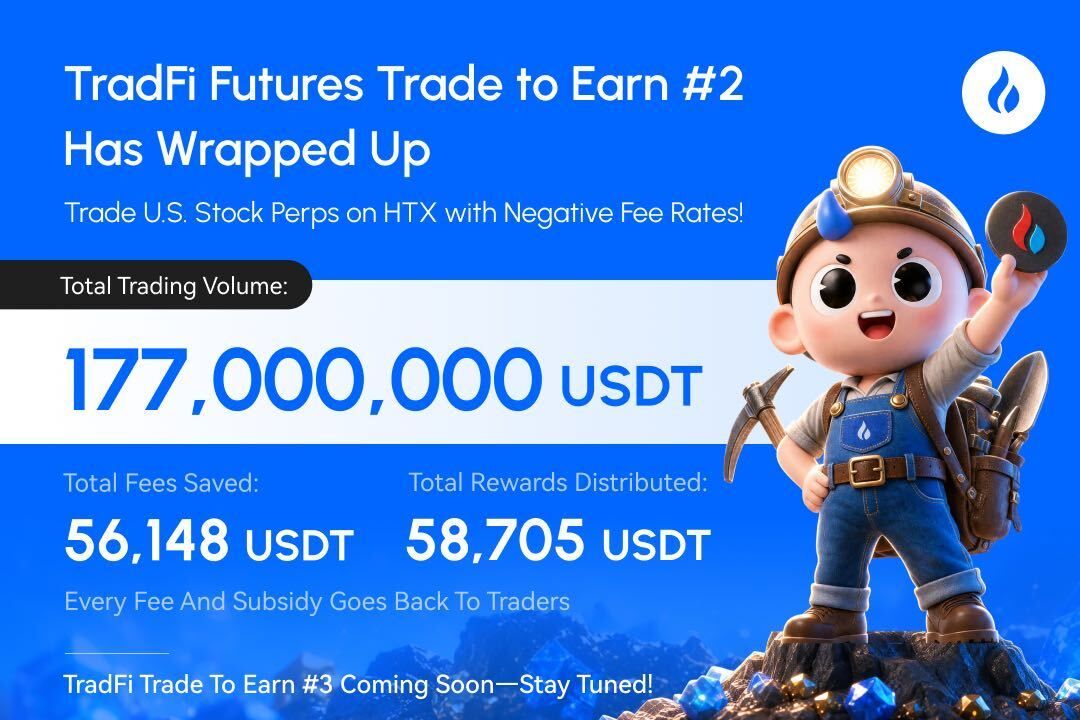

HTX, a leading global cryptocurrency exchange, recently announced the successful conclusion of Phase 2 for its popular TradFi Trade to Earn campaign. The second phase delivered significant growth in trading volume, user engagement, and platform incentives, demonstrating the ability of the Trade to Earn model to drive trading activity among TradFi futures traders and further highlighting the market potential of this innovative trading incentive model.
Nearly 59,000 USDT Returned to Users as Volume Posts a Steep Growth Curve
Designed specifically for TradFi traders, HTX’s TradFi Trade to Earn ties active futures trading directly to fee rebates and bonus incentives, helping users cut costs and trade more efficiently.
During Phase 2, cumulative trading volume for TradFi futures on HTX surpassed 177 million USDT, nearly triple the volume recorded in Phase 1, representing a 179% increase. The rapid growth in volume reflects rising user engagement with TradFi futures.
Alongside the volume surge, platform reward distributions grew. HTX distributed nearly 59,000 USDT in total rewards during Phase 2, including more than 56,000 USDT dedicated to trading fee rebates. Compared with the first phase, total fee rebates and cumulative rewards distributed both grew by over 150%, reflecting the platform’s growing commitment to providing greater incentives.
For TradFi futures traders, fees are a meaningful part of their trading costs. Particularly in high-frequency trading and fast-moving markets, increased trading frequency often means higher trading costs. HTX’s TradFi Trade to Earn turns a portion of these trading costs into user incentives through fee rebates and rewards, lowering the barrier to participation while further enhancing capital efficiency for traders.
From Cutting Costs to Adding Returns: A New Stage for TradFi Trade to Earn
Moving from lowering the cost of trading to increasing traders’ overall returns, TradFi Trade to Earn is becoming a key incentive tool within the HTX futures ecosystem.
As markets continue to evolve, traders are placing greater emphasis on liquidity, trading costs, and capital efficiency. In response to changing trading needs, HTX continues to expand its TradFi offerings and refine its incentive mechanism, providing traders with a flexible and efficient way to participate in these markets through a broad selection of assets and compelling user benefits.
HTX now offers more than 170 TradFi assets, spanning precious metals, commodities, indices, and U.S. equities to meet a wide range of trading needs.
Notably, Phase 3 of HTX TradFi Trade to Earn is set to launch soon.
Building on the continued growth in trading volume across the first two phases, the upcoming event will carry forward the core “trading + incentives” model, offering users another round of fee rebates and rewards. As the range of TradFi assets continues to expand, users gain access to an increasingly diverse range of trading opportunities, further broadening the potential of the TradFi Trade to Earn model.
About HTX
Founded in 2013, HTX has evolved from a virtual asset exchange into a comprehensive ecosystem of blockchain businesses that span digital asset trading, financial derivatives, research, investments, incubation, and other businesses.
As a world-leading gateway to Web3, HTX harbors global capabilities that enable it to provide users with safe and reliable services. Adhering to the growth strategy of “Global Expansion, Thriving Ecosystem, Wealth Effect, Security & Compliance,” HTX is dedicated to providing quality services and values to virtual asset enthusiasts worldwide.
To learn more about HTX, please visit https://www.htx.com/ or HTX Square , and follow HTX on X, Telegram, and Discord.
The post HTX Distributes Nearly 59,000 USDT in Rewards as TradFi Trade to Earn #2 Concludes appeared first on BeInCrypto.


Australian tech firm Apate deploys a vast array of AI-bot characters worldwide that play the role of gullible scam victims to waste millions of hours of con artists’ time each month.
Hilariously, one of the company’s monthly performance metrics is how many times frustrated scammers swear at the idiot ‘victims’ who are playing dumb and stringing them along.
“I think we’re the only company in the world that is actually keeping as part of their KPIs the number of F-words that scammers are dropping at them,” Apate founder Dali Kaafar tells Magazine with a chuckle.
The company has a stable of almost 200,000 AI characters that are able to hold convincing phone conversations and to chat on social media and messaging platforms.
”I can tell you that we’re basically servicing, as we call them, hundreds of thousands of calls a day, and pretty much hundreds of thousands of conversations on the other channels,” he says.
Every hour of a con artist’s time they waste is another hour they’re not scamming a member of the public. In the six weeks up to the end of 2025, Apate’s bots engaged in 600,000 scam calls for a single telco called TPG in Australia.
“Essentially, we wasted more than five hundred days of scammers’ time,” he explains. “That roughly equates to somewhere around thirteen million dollars being saved.”
The bots’ other goal is to elicit actionable intelligence for banks and telcos to combat scam rings across Australia, Asia, Africa and the UK and Europe.

Apate bots deal with scammers via chat. Source: Apate
Scam baiting at scale with AI victims
Kaafar says he got the idea when he received a scam call while having a picnic with his family in Sydney back in November 2021.
To his wife’s annoyance, but his kids’ delight, he strung the scammer along for 44 minutes by pretending to be a gullible rube falling for the scam.
“What followed was really literally a full comedy show for my kids,” he says, adding that during the call he’d also learned a lot of potentially useful information about the mechanics of the scam and the tactics used.
“As I hung up that call, I remember thinking very clearly: if I could do that just for fun, imagine what technology can do at scale.”
Working as a professor at Macquarie University at the time, he raised the idea with some of his doctoral students working on AI and security.
“I said, ‘Guys, there has to be a much better way of doing this. Let’s build something that is really automating this whole process of engaging scammers at scale, but also, perhaps most importantly, extracting all sorts of intelligence from these conversations.’ And that’s literally how it started.”
Related: AI-powered bot stands in for absent candidate in Virginia debate
Within a few months they’d secured funding from the Office of National Intelligence to research the idea, and the project was spun off from the university into Apate in 2023. The company now works with most of the big banks in Australia, as well as numerous banks in the UK, South Africa and South East Asia.
Apate is far from the only company scam baiting fraudsters using AI bots — though they are doing it on a greater scale than most. United Kingdom telco O2 rolled out an AI Granny campaign last year, which frustrates scammers by taking up hours of their time talking about her 28 cats. It was as much an ad campaign to warn the public about the dangers of scam calls as anything else.

O2’s highly entertaining AI Granny. Source: 02
Creating the perfect AI victims
Apate launched with 120 different personas across different genders, ages and personality types, and now have 197,000 personas with identifiable vocal tics, accents, and they make the same noises people make when they’re trying to think of what to say.
“We spent a lot of time refining and building these AI bots that sound exactly like you and I and our neighbors,” he says.
The AI models were trained on “hundreds and hundreds” of hours of recorded conversations between human scam baiters and scammers, so they can employ counter strategies.
“They know that they’re talking to bad guys, if you like, and they really navigate the conversations so that it sounds really very, very realistic to any scammer out there, even if a scammer is skeptical about things.”
The bots get sent out on WhatsApp and Telegram to act as honeypots for scammers. While the old cliché that you can’t scam an honest man is not true, it’s still very possible to exploit the scammer’s desire for money.
“They are cybercriminals, really. I think we just very often forget that they’re cybercriminals who are trying to get people’s life savings. And so that element of greed is sometimes what our bots also exploit.”
Bots collect valuable intel from each scam call
In the crypto industry, Apate works for “one of the leaders in blockchain analysis,” which may or may not be Chainalysis. They aren’t interested in wasting scammers’ time — they want intelligence on which wallets and methods scammers are using so they can track the flow of funds.
“These bots, as they engage across different conversations, extract new crypto wallet addresses by the hundreds and by the thousands,” he says. “It’s data and intelligence that is coming literally before their damage happens.”
Scamming is big business, and the call centers are “pretty much corporate organizations,” Kaafar explains.
“This data is very, very important because, literally, that’s the new account or the new wallet where you really need to pay extreme attention to. Because this is where these… scammer compounds are collecting their money or their funds with.”
“Think about it literally as being always ahead of the scammer’s tactics. And the more you know before the money gets transferred, the better it is.”
In July, Apate’s bots uncovered a marketplace for brokers soliciting verified bank accounts in India, offering commissions of up to 5% paid in USDT on the proceeds from scams passing through the accounts.

Apate’s human staff in Sydney. Source: Apate
AI arms race between good guys and bad guys
Scammers are increasingly using AI bots themselves, and it won’t be too long before AI scammers are as ubiquitous as spam emails. Scamming people is a $1.24 trillion business, so the industry can afford the compute required to scale up operations.
Apate’s research suggests that about 20% to 30% of scam text conversations employ AI already, but Kaafar isn’t too worried about the outcome of anti-scam bots fighting scam bots.
He says their researchers believe that AI bots playing defense have an advantage, according to game theory, because they’re trying to extract intelligence, while the scam bots are trying to get the other AI to perform an action.
“You can also demonstrate mathematically that that is to the advantage of a defender because it becomes easier to extract intelligence from the attacker’s AI model,” he says.
“We can imagine a world where scammers become a lot more sophisticated and deploy such technology. But that also means that if they do, they’re actually deemed to lose the game, which is great news in the fight against scams.”
Magazine: Agent wastes 14 hours of scammers’ time, LLMs ‘poisoned’ by Iran — AI Eye
Cointelegraph publishes long-form journalism, analysis and narrative reporting produced by Cointelegraph’s in-house editorial team with subject-matter expertise. All articles are edited and reviewed by Cointelegraph editors in line with our editorial standards. Some articles contain affiliate links, from which Cointelegraph may earn a commission. These relationships do not influence which products we review or our editorial conclusions. Content published in here does not constitute financial, legal or investment advice. Readers should conduct their own research and consult qualified professionals where appropriate. Cointelegraph maintains full editorial independence.

The global under-30 population has been rising since 2012 and today accounts for more than half of the more than 7.5 billion people on the planet. What will the world look like when this new generation leads? That’s the central question in TIME’s second annual Davos issue, produced in partnership with the World Economic Forum. As youth the world over force us to confront the perils of our inaction—and show us the possibilities from recognizing that life doesn’t have to be as it is—we are beginning to see some answers.
Thunberg may have been the most visible, but young leaders raising their voices have become a force across the globe, in areas ranging from climate to inequality to corruption to freedom itself. In the past year, they have been at the forefront of movements on every continent, from the campuses of Hong Kong to the streets of Santiago, where protests were triggered in part by a social-media campaign by middle- school students, to Antarctica, where a group of scientists joined the global climate strike brandishing slogans like rise before The sea level does!
They are innovators like 14-year-old Gitanjali Rao, who developed an app to identify and prevent cyberbullying. Or Xóchitl Guadalupe Cruz López, who, when she was 8 years old, created a solar-powered water heater made from recycled materials to provide much needed hot water to residents of her Mexican village. They are entrepreneurs like Flynn McGarry, who recently became old enough to legally drink alcohol in the locavore restaurant he runs in New York City. They are petitioners like Jamie Margolin, who testified before Congress on the urgent need for climate action. When they take power, they seek far-reaching reform; Finland’s Marin, who tells TIME that she got into politics “because I thought the older generation wasn’t doing enough about the big issues of the future,” wants to make Finland one of the first countries to achieve net-zero emissions.
For 1966, the year I was born, TIME named “Americans Under 25” as Person (then called “Man”) of the Year—the baby boomers whom the magazine dubbed “The Inheritors.” Having inherited the bounty of decades of economic growth and relative stability, the youth of the 1960s are now, by and large, the benefactors of the present. What do they—what do we—owe the inheritors of tomorrow? Clearly there is work to do.
Edward Felsenthal is Editor-in-Chief and CEO of TIME.

From our partner Kaiser Permanente.
There is a silent epidemic. Globally, in increasing numbers, young people are facing mental-health issues. Depression is a leading cause of illness among young people. Anxiety is on the rise. Suicide ranks third as a cause of death for 15- to 19-year-olds and is increasingly becoming a health equity issue: African-American girls in grades nine to 12 were 70% more likely to attempt suicide in 2017, as compared with non-Hispanic white girls of the same age.
Unless we act, we will face the repercussions of this epidemic for years. Lives will be shortened, and generations will struggle. Our economic outlook will inevitably be impacted as we collectively face a range of long-term health issues for our workforce.
Twenty years ago, Kaiser Permanente and the Centers for Disease Control and Prevention (CDC) published a landmark study linking childhood trauma to long-term health consequences. This groundbreaking research into adverse childhood experiences (ACEs) continues to inform clinical best practices and approaches that are making a difference.
With the crisis at hand, we recognized a need to go deeper and continue our work in this area. We have recently announced plans to update the ACEs research to identify knowledge gaps, successful programs, emerging best practices and interventions ready to be scaled.
An entire generation is counting on us. We are asking leaders from across health care, business, nongovernmental organizations and academia to make youth mental health and wellness a priority.
Adams is chairman and CEO of Kaiser Permanente.

The boldest S&P 500 forecast on Wall Street sees 9,000 by year-end, roughly 17% above where the index trades now. The fuel is the AI boom and a wall of idle cash.
The warning is that the same AI trade turns into the market’s biggest risk in 2027.
Can the S&P 500 Really Hit 9,000 This Year?
One of the Street’s sharpest bulls thinks so. Evercore ISI’s Julian Emanuel puts 9,000 on the table as his upside case, about 15% above his base call, helped by $8 trillion parked in money-market funds. If that cash starts chasing stocks, it becomes the fuel for a final push higher.
The number sits far above the Street’s average year-end target near 7,555, so it is a stretch call, not the consensus. Its best hope is that idle $8 trillion, because if even part of it rotates into stocks, the run toward 9,000 gets real fuel.

The whole case still rests on one engine, and that engine is AI.
Why Is AI Driving the Forecast Higher?
That engine runs on a handful of names. The AI boom flows to the megacaps that build and sell it, the Magnificent 7, meaning Nvidia, Microsoft, Apple, Alphabet, Amazon, Meta, and Tesla. Their chips, cloud platforms, and models are the record AI earnings carrying the market.
Those same seven make up about 34% of the S&P 500, up from roughly 12% eight years ago.

So when AI lifts them, it lifts the whole index, and that concentration is the crack in the floor.
What Could Break the S&P 500 Forecast in 2027?
The crack shows up first in the spending. Combined hyperscaler capex has jumped from about $226 billion in 2024 to roughly $725 billion in 2026, and analysts see it topping $1 trillion in 2027. Revenue has not kept pace, and free cash flow has turned negative for the first time in decades.

That trillion-dollar mark is why 2027, and not 2028, is the year to watch. It is when the spending crosses a trillion dollars (for the first time), and the pressure to prove the revenue behind it runs highest.
The threat is not only cost, but it is also competition, because chips are the backbone of AI. Chinese chip demand is skyrocketing, with the country’s integrated-circuit revenue jumping 22% in 2025 to a record $245 billion and nearly doubling since 2020. That is a direct challenge to the US chipmakers that the rally leans on.
Still, the shift takes time. China holds only about 6% of the global semiconductor market against North America’s 53%, so it chips away at US dominance slowly rather than all at once.

Even so, European Central Bank economists have already warned the AI rally is setting up a correction.
Is This a Bubble?
That risk raises the obvious question. White House economic adviser Kevin Hassett says markets are not in an AI bubble, pointing to the real earnings behind the spending.
Investment firm GMO counters that this could be the largest capital investment bubble on record, with valuations stretched to levels rarely seen.
Both can be right in sequence. The buildout can carry stocks through 2026 and still overshoot, which is exactly what the chart is now testing.
What Are the Key S&P 500 Levels to Watch?
Right now, that test is playing out on the tape. Since June 9, the S&P 500 has climbed inside a rising channel, the steady uptrend the bull case needs, but the price slipped after a high around August 13 as the AI and chip names that carry the index cooled, with the semiconductor index down about 5% into mid-August.

The levels decide the next leg. A reclaim of 7,807 and then 7,881 puts 8,000 back in play, the biggest hurdle on the way up. Clear it and the chart’s own extension points toward 8,506, and a breakout above the channel opens the 9,011 zone that matches Wall Street’s 9,000 call.
Analyst’s View: This is where the two ends of the story meet. The same AI strength that could carry the S&P 500 to 9,000 in 2026 is the force that fades in 2027, so the rally and the warning share one root. The next few quarters settle which wins. Watch whether Nvidia’s guidance and hyperscaler capex hold, whether that $8 trillion in cash rotates into stocks, and whether Chinese chips keep eating US demand.
If spending stays high and demand scales, the bullish S&P 500 forecast holds. If the money sits still and capex slows first, 2027 is where the slowing signs emerge.
The post Why the S&P 500’s Path to 9,000 Runs Into Trouble in 2027 appeared first on BeInCrypto.

Centrifuge has expanded its tokenized-fund liquidity options by adding Symbiotic’s Liquid Lane to three of its offerings, enabling eligible holders to exchange fund positions for USDC. The upgrade is aimed at making redemptions more immediate for users, while the funds’ standard redemption process can occur separately.
The integration covers Janus Henderson’s JAAA, an AAA-rated collateralized loan obligation (CLO) strategy; Janus Henderson’s JTRSY, a short-duration US Treasury strategy; and New York Life Investment Management’s HYB, a US high-yield corporate bond strategy. Together, these funds represent about $1.6 billion in assets under management, according to the announcement.
Key takeaways
- Centrifuge added Symbiotic’s Liquid Lane to three tokenized funds to provide another path for eligible holders to receive USDC.
- Liquid Lane uses an onchain request-for-quote (RFQ) marketplace, allowing market makers to source liquidity from vaults to meet redemption demand.
- Investors can receive USDC immediately, while the underlying tokenized fund redemption can be processed separately through the issuer or via RFQ.
- Centrifuge already offered instant redemptions through partnerships such as Wintermute and other liquidity arrangements, and Liquid Lane focuses on the transaction capital structure.
- The project’s broader thesis is that aggregating redemption flow across issuers and asset classes could improve liquidity economics as tokenized assets see wider onchain use.
How Symbiotic’s Liquid Lane changes the redemption workflow
Symbiotic’s Liquid Lane is built around an onchain RFQ marketplace. When redemption requests are placed, market makers can access liquidity from Symbiotic vaults to fill those requests. After acquiring the fund tokens through the RFQ interaction, market makers may then redeem the tokens with the issuer or transfer/sell them via another RFQ transaction.
This design matters because it decouples the user’s immediate liquidity outcome from the slower mechanics of traditional redemption cycles. In the Centrifuge setup described, eligible investors are able to receive USDC right away while the funds’ normal redemption process proceeds on its own schedule.
Symbiotic did not position Liquid Lane as the only redemption route; instead, it’s presented as an additional liquidity pathway designed to increase participation and improve execution for tokenized-fund holders.
Why Centrifuge and these specific funds
Centrifuge is an asset tokenization and vault platform where asset managers issue and manage tokenized funds. The three products now integrated with Liquid Lane represent a meaningful slice of Centrifuge’s institutional coverage, spanning structured credit, short-duration Treasuries, and high-yield corporate exposure.
Janus Henderson has been a significant contributor to Centrifuge’s growth, particularly through its JAAA and JTRSY products—an expansion that earlier coverage tied to Centrifuge’s progress in attracting institutional demand, including milestones reported by Cointelegraph (see Centrifuge surpasses $1B TVL in institutional demand).
By December 2025, Token Terminal estimated Centrifuge had attracted around $1.3 billion in new inflows, driven primarily by Janus Henderson’s two funds. Token Terminal also reported that JAAA alone accounted for roughly $1 billion in total value locked and was among the largest tokenized funds in the market.
Liquid Lane alongside existing instant-liquidity routes
Liquid Lane is not the first liquidity solution connected to Centrifuge’s tokenized funds. Felix Lutsch, head of Symbiotic ecosystem, told Cointelegraph that the network is not attempting to replace earlier approaches, emphasizing instead that multiple liquidity routes can coexist.
According to Centrifuge’s own disclosures, a partnership with Wintermute announced in February 2025 supported 24/7 instant redemptions for JTRSY. Separately, HYB launched in June under a different arrangement targeting near-instant redemptions.
Lutsch said the differentiation of Liquid Lane is not primarily about speed, but about the capital structure used to execute redemption demand. In his description, Liquid Lane’s RFQ marketplace can involve multiple market makers and curators without requiring every market maker to pre-fund and carry inventory for specific assets.
That distinction connects to a broader market constraint Lutsch highlighted: while tokenized asset markets can offer settlement benefits, historical low trading volumes have reduced market makers’ incentives to commit capital. He argued that routing and aggregating redemption demand across issuers and asset classes could improve liquidity economics as tokenized funds increasingly function as collateral and financing assets in onchain markets.
From an investor perspective, the practical implication is that users may have more execution options as liquidity providers face less inventory burden and can scale their participation across assets—potentially reducing friction when demand for redemptions rises.
What to watch next
As Centrifuge extends Symbiotic’s Liquid Lane to more fund products and as tokenized-fund liquidity competes across multiple RFQ and instant-redemption mechanisms, investors should watch whether trading and redemption volumes grow enough to attract and sustain market-maker participation—since Liquid Lane’s thesis depends on improving flow-driven liquidity economics.

For centuries, lending has depended on one fundamental question: Can I trust the borrower to repay me?
Traditional financial institutions answer that question through credit scores, collateral requirements, employment records, legal contracts, identity verification, and centralized intermediaries. These systems can work, but they are expensive, slow, geographically limited, and often exclude people who lack conventional financial histories.
Decentralized finance (DeFi) introduces a different approach: trustless lending.
Instead of relying primarily on a bank or lending company to determine who can borrow, trustless lending uses blockchain infrastructure, smart contracts, collateral, transparent rules, and automated liquidation mechanisms. The goal is not to eliminate trust, but to replace dependence on trusted intermediaries with verifiable rules and economic incentives.
That shift creates a completely different economic model for lending.
What Does “Trustless” Lending Actually Mean?
The term trustless can be misleading.
A DeFi lending protocol still requires users to trust that the underlying smart contracts work as intended, the blockchain remains secure, and external data such as price feeds is accurate.
What changes is where trust is placed.
In traditional lending, participants may trust:
- Banks
- Credit bureaus
- Loan officers
- Legal enforcement
- Centralized databases
- Custodians
In a trustless lending system, much of that trust is moved toward:
- Smart contracts
- Cryptographic verification
- On-chain collateral
- Transparent protocol rules
- Decentralized networks
- Economic incentives
The important innovation is therefore not “zero trust.”
It is minimizing the amount of human discretion required to execute financial agreements.
The Basic Economics of DeFi Lending
A typical decentralized lending market connects two sides:
Lenders provide capital → borrowers provide collateral → smart contracts manage the loan.
Suppose a borrower deposits $150,000 worth of ETH into a lending protocol and borrows $75,000 in stablecoins.
The borrower has a 50% loan-to-value ratio.
If ETH falls substantially and the collateral ratio crosses the protocol’s liquidation threshold, the smart contract can automatically liquidate part or all of the collateral.
No loan officer is deciding whether to call the borrower.
There is no collections department.
There is no negotiation over whether the collateral should be sold.
The protocol follows predetermined rules.
This automation dramatically changes the cost structure of lending.
Collateral Replaces Much of the Traditional Credit Infrastructure
One of the biggest economic differences between traditional finance and DeFi is the role of collateral.
Traditional lending can be credit-based.
A bank may lend because it believes a borrower has sufficient income, assets, credit history, and repayment capacity.
DeFi lending is generally much more collateral-based.
The borrower demonstrates financial credibility by locking assets into a smart contract.
This creates an important trade-off.
The advantage
Collateral can make lending accessible without requiring:
- Credit scores
- Employment verification
- Banking relationships
- Geographic approval
- Extensive paperwork
The disadvantage
Borrowers often need to provide more assets than they receive.
This is known as overcollateralization.
If someone wants to borrow $10,000, they might need to deposit $15,000 or $20,000 worth of crypto.
That may seem inefficient, but economically it serves an important purpose: the collateral absorbs credit risk.
Why Overcollateralization Exists
Imagine a lending protocol that allows users to borrow $1 for every $1 of collateral.
If the collateral suddenly loses 30% of its value, the protocol could become undercollateralized.
That creates losses for lenders.
Overcollateralization provides a buffer.
For example:
$20,000 collateral → $10,000 loan
The protocol begins with a 200% collateralization ratio.
If the collateral falls by 30%, it is still worth approximately $14,000 against a $10,000 loan.
The system therefore has additional room to absorb volatility.
This is one reason DeFi lending is particularly suited to volatile digital assets—but also one reason why crypto lending has not completely replaced traditional unsecured credit.
Interest Rates Become a Market Signal
Another major economic feature of trustless lending is algorithmic or market-driven interest rates.
In traditional finance, banks typically determine lending and deposit rates based on monetary policy, funding costs, risk models, competition, and other factors.
In DeFi, interest rates can respond directly to supply and demand for liquidity.
When demand for borrowing rises:
More borrowers → greater demand for liquidity → borrowing rates tend to increase.
When liquidity becomes abundant:
More lenders → greater available capital → borrowing rates tend to decrease.
This creates a continuously adjusting market.
Interest rates therefore become more than simply a price for borrowing.
They become a real-time signal of capital demand within a specific on-chain market.
The Economics of Liquidity
Liquidity is the engine of lending.
Without available capital, borrowers cannot borrow.
Without attractive returns, lenders have little reason to supply capital.
This creates a feedback loop:
More lenders → deeper liquidity
→ better borrowing conditions → more borrowers → more interest paid → stronger incentives for lenders.
But the opposite can also happen.
Lower liquidity → higher borrowing costs → fewer borrowers → lower lender returns → declining liquidity.
This makes liquidity management one of the most important economic challenges for lending protocols.
A protocol isn’t successful simply because it has billions of dollars deposited.
It needs productive liquidity.
Capital that sits idle provides little economic value.
Capital Efficiency Is the Bigger Challenge
Traditional finance can offer unsecured and undercollateralized loans because institutions have access to extensive information about borrowers.
DeFi has historically struggled with this.
The blockchain can tell a protocol what assets a wallet owns.
It can track transactions.
It can verify collateral.
But determining whether a real-world individual will repay a loan is much harder.
This creates an important economic problem:
How can DeFi move from overcollateralized lending toward more capital-efficient credit?
Several approaches are emerging, including:
-
- On-chain credit scoring
- Reputation systems
- Decentralized identity
- Real-world asset collateral
- Institutional credit markets
- Under-collateralized lending
- Credit delegation
- Zero-knowledge identity and financial credentials
Liquidation Is an Economic Feature, Not Just a Safety Mechanism
Liquidations are one of the most important components of DeFi lending.
When collateral falls below a required threshold, the protocol needs a mechanism to protect lenders.
Liquidators step in by purchasing or taking control of collateral, often at a discount.
This creates an economic incentive:
Protocol needs risk protection → liquidators receive an opportunity → unhealthy loans are removed.
The system effectively creates a decentralized risk-management workforce.
However, liquidations also introduce risks.
During extreme market volatility, collateral prices can fall faster than positions can be liquidated. Blockchain congestion, oracle failures, and sudden liquidity shortages can make the process more difficult.
So while automation reduces dependence on human intervention, it does not eliminate market risk.
Oracles Become Part of the Trust Equation
Here’s the uncomfortable truth about trustless lending:
Smart contracts cannot know the real-world price of an asset by themselves.
They need oracles.
If ETH is trading at $3,000 but a lending protocol receives an incorrect price of $2,000, collateral calculations can become distorted.
A faulty price feed could potentially trigger unnecessary liquidations or allow borrowers to take excessive loans.
This means the economics of DeFi lending depend not only on smart contracts but also on reliable information infrastructure.
In many ways, oracles are the sensory system of decentralized finance.
The Cost Advantage of Automation
One of the strongest economic arguments for trustless lending is reduced operational overhead.
Traditional lending involves high costs:
- Loan processing
- Compliance
- Administration
- Credit analysis
- Custody
- Settlement
- Collections
- Legal enforcement
Smart contracts can automate many of these functions.
Once deployed, the same lending logic can potentially serve thousands or millions of users without requiring a proportional increase in administrative staff.
This creates the possibility of software-driven financial scale.
The marginal cost of executing another transaction can be dramatically lower than the cost of manually processing another traditional loan.
But Smart Contracts Introduce New Costs
Automation doesn’t mean lending becomes free.
The cost structure simply changes.
DeFi participants must account for:
- Smart-contract risk
- Oracle risk
- Blockchain transaction fees
- Governance risk
- Liquidity risk
- Market volatility
- Economic attacks
- Bridge or infrastructure risk
A bank might spend money maintaining compliance teams and branches.
A DeFi protocol may instead spend resources on audits, security infrastructure, oracle systems, bug bounties, governance, and monitoring.
The economic question is therefore not:
“Is DeFi cheaper?”
It is:
“Which costs are removed, and which new risks and costs replace them?”
Governance Has an Economic Value
Many lending protocols are governed by decentralized organizations or token holders.
Governance can influence parameters such as:
- Interest-rate models
- Collateral factors
- Supported assets
- Liquidation thresholds
- Risk parameters
- Treasury allocation
- Protocol upgrades
This creates another economic layer.
A lending protocol is not merely a collection of smart contracts.
It is also a risk-management institution encoded in software and governance mechanisms.
Poor governance can create enormous losses.
Good governance can improve capital efficiency while maintaining system stability.
That makes governance quality an economic asset.
The Network Effect of Lending Markets
Lending protocols can also benefit from powerful network effects.
More assets supported → more borrowing opportunities.
More borrowers → greater demand for liquidity.
More liquidity → better execution.
Better execution → more users.
More users → stronger incentives for developers and liquidity providers.
This can create a reinforcing cycle.
However, network effects can also create concentration risk.
If too much liquidity becomes dependent on one protocol, one blockchain, one stablecoin, or one oracle infrastructure provider, a failure could have consequences across the broader ecosystem.
Decentralization therefore needs to be evaluated at the system level, not simply by looking at the number of smart contracts involved.
Stablecoins Are Critical to Lending Economics
Stablecoins have become especially important to DeFi lending because they provide a relatively stable unit of account.
A borrower can deposit volatile crypto collateral while borrowing a stablecoin.
For example:
ETH collateral → stablecoin loan → stablecoin repayment
This lets users access liquidity without necessarily selling their underlying assets.
Stablecoins also allow lending markets to express interest rates in units that are easier to understand than volatile crypto-denominated returns.
As stablecoin adoption grows, their role in decentralized credit markets could become increasingly important.
Trustless Lending Could Expand Global Access to Credit
Perhaps the most significant long-term economic implication is accessibility.
A person does not necessarily need to live in a major financial center to interact with a blockchain-based lending market.
They may only need:
- An internet connection
- A compatible wallet
- Digital assets
- Access to the relevant blockchain
This does not solve every problem.
People without crypto assets may still struggle to access overcollateralized loans. Regulatory restrictions can also affect availability.
But the architecture creates an important possibility:
Financial infrastructure can become globally accessible rather than geographically dependent.
That is a profound economic shift.
The Future: From Trustless Lending to Programmable Credit
The next evolution of DeFi lending may not simply be about borrowing more money.
It could be about making credit programmable.
Imagine loans that automatically adjust according to:
- Collateral quality
- Market volatility
- Reputation
- Cash-flow data
- On-chain activity
- Real-world assets
- Risk scores
- Liquidity conditions
Instead of one-size-fits-all lending, decentralized credit markets could eventually offer dynamically priced financial products.
That would move DeFi closer to a financial operating system.
Final Thoughts
The economics of trustless lending are built around a simple but powerful idea:
Replace institutional trust with transparent rules, collateral, incentives, and cryptographic verification wherever possible.
This can reduce intermediaries, automate risk management, improve accessibility, and create global markets for capital.
But trustless lending is not riskless lending.
Smart-contract vulnerabilities, oracle failures, volatile collateral, liquidity shocks, governance mistakes, and market manipulation remain serious challenges.
The real breakthrough will come when decentralized lending becomes not only trust-minimized, but also capital-efficient, resilient, secure, and accessible.
If that happens, DeFi could evolve from an alternative financial experiment into a fundamental layer of the global credit economy.
The future of lending may not be about asking, “Who do I trust?”
It may increasingly be about asking:
“What rules can everyone verify?” 🔐
REQUEST AN ARTICLE
Crypto World
Beyond crypto funding rates: Ethena diversifies USDe backing with $1 billion FalconX facility


The warehouse facility gives Ethena another source of returns for the assets backing USDe while channeling onchain capital into overcollateralized institutional loans.


The American Bankers Association seeks to strengthen the Clarity Act, not kill it, argues Rob Nichols, president and CEO of the ABA.
A new batch of GTA VI leaks are being used by an X user to pump their crypto as part of a “secret project.”
The user, who goes by the name “CyberLeek,” shared GTA VI gameplay footage alongside the ticker for a crypto called $CYBERLEEK yesterday.
It included details about GTA VI’s map and footage of free-roam gameplay that, at the time of writing, are no longer viewable on X following a copyright strike from the game’s creator, Rockstar Games.
CyberLeek is raising funds for ‘secret project’
CyberLeek created their token to raise funds for a “secret project” that they claim cannot be revealed, as “showing the cards to the big corporations would only give them time to build their defenses.”
Read more: Bitcoin spikes after GTA VI trailer leak says ‘Buy $BTC’
They said, “Let it be absolutely clear: this is not a cash grab. Funding is directed toward the infrastructure needed to strike, as well as the security and protection required to withstand the inevitable corporate counterattacks.”
Their posts pushed the token’s market cap up almost 5,800% within an hour to $3.46 million. Its market cap is $1.5 million at the time of writing.
What are CyberLeek’s motives?
According to CyberLeek’s website, the leaks stem from their grievances with anti-consumer practices within the video game industry.
CyberLeek claims they will target any gaming company that sells digital pre-orders, locks single-player content behind a paywall, and doesn’t strive to preserve long-term offline access to single-player content.
For instance, they claim pre-orders “were created because physical discs had manufacturing limits. In digital distribution, there is no inventory. There is no stock shortage. A digital copy cannot sell out. Yet publishers kept the preorder system and stripped away its only consumer benefit.”
CyberLeek has threatened to leak more footage unless Rockstar Games meets their demands.
GTA VI’s no-disc descision has rocked the boat
GTA VI will be the first major game to release without a disc. Its digital pre-orders will be, like CyberLeek noted, in infinite supply while Rockstar’s “physical” release will take the form of a redeemable code packaged in a game box.
Read more: NFT game studio boss says not paying staff ‘works for company cash flow’
The announcement of GTA VI’s release plan, alongside Sony’s decision to no longer produce game discs, has led to lawsuits and uproar from gamers who advocate for physical media and game preservation.
Got a tip? Send us an email securely via Protos Leaks. For more informed news and investigations, follow us on X, Bluesky, and Google News, or subscribe to our YouTube channel.
Crypto World
Bitcoin Just Hit 8 of 12 Capitulation Signals; VanEck Thinks the Pain May Be Nearing Its End

Bitcoin posted a modest recovery on Wednesday, which helped it climb above $64,000. The cryptocurrency is still almost 50% down from its all-time high, but VanEck’s latest analysis revealed that 8 of 12 tracked signals in its “Bitcoin Capitulation Check” are now firing.
This suggests that the market may be nearing the end of its correction phase.
Shallower Trough
VanEck said that all 12 signals entered their capitulation zones at some point over the past three months, while BTC itself has spent the past month stabilizing after recovering from its June summer low and may have bottomed near $58,500 on June 30.
Meanwhile, US spot Bitcoin ETFs have recorded more than $950 million in net inflows so far in August, which points to some renewed institutional demand even as the crypto asset remains below its record high.
VanEck expects a shallower trough this cycle compared with previous Bitcoin downturns. Earlier bottoms saw drawdowns of 94%, 85%, 84%, and 78%. Those periods also came before the current spot ETF market and when institutional ownership was much smaller. More importantly, each of those cycles saw major failures across the market. This time, there has been no Celsius, Three Arrows Capital, or FTX collapse.
According to its findings, Bitcoin appears to have gone through price capitulation, and the market is nearing or currently in an accumulation phase.
That accumulation phase could gain further momentum if more capital begins moving back into crypto, which Bitfinex identifies as the major missing piece for Bitcoin’s next rally. In its latest Alpha report, the exchange said two of the three conditions for a BTC rally are already in place: lower expected rates and already-loose financial conditions.
The third – capital flowing from equities, technology, and AI markets into crypto – has yet to materialize. For instance, corporate Bitcoin treasury activity has turned negative, and stablecoin supply remains below its May record. Bitfinex warned that in such a thin market, even relatively small changes in flows could produce an outsized move.
Bigger Move Ahead
Some investors are, however, already looking much further ahead.
SkyBridge Capital founder Anthony Scaramucci recently told CNBC that he expects Bitcoin to climb back above $100,000, a level the cryptocurrency has not closed above since November 2025. He believes the six-digit price territory will come around the halving, scheduled to take place in less than two years.
The post Bitcoin Just Hit 8 of 12 Capitulation Signals; VanEck Thinks the Pain May Be Nearing Its End appeared first on CryptoPotato.

Five World Cup talents to watch in Serie A: Djed Spence, Donyell Malen and more

real man… #motivation #money #millionaire #success #shorts
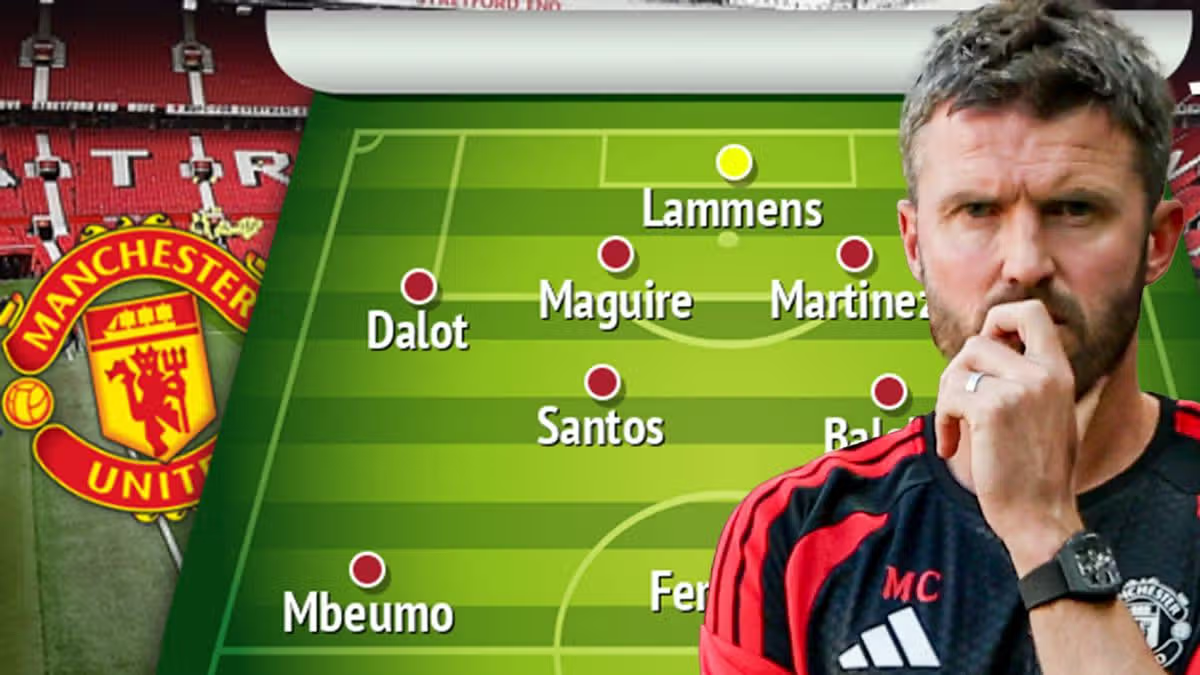
Four ways Man United can line up with Carlos Baleba as bid launched for Brighton star





-

 Fashion5 days ago
Weekend Open Thread: Ann Taylor
-
 Sports6 days ago
This U.S. Amateur is a glimpse into golf’s future in more ways than you think
-
 NewsBeat4 days ago
Myanmar says over 300,000 Rohingya refugees verified for repatriation as exodus enters ninth year
-

 Tech5 days ago
11 Ways to Rank Your Videos
-

 Sports4 days ago
Birmingham 2026: Day 6 Timetable for Irish Athletes
-

 Politics4 days ago
SEQ Code: The Three Letter Boarding Pass Code That Could Give You The Worst Seat
-

 Sports7 days ago
DeQuan Jones in ‘high spirits’ after successful leg surgery
-

 Tech6 days ago
DeepSeek Harness launches as open source rival to Claude Code, alongside V4-Pro on API with higher prices
-
 Crypto World7 days ago
Perplexity AI Predicts an XRP Scenario Few Analysts Are Discussing
-

 Crypto World2 days ago
OCC Greenlights Trump Family Crypto Firm for Trust Charter
-
 Entertainment7 days ago
2026’s Most Ambitious Fantasy Movie Officially Scores Sequel Update
-
 Entertainment7 days ago
All 10 Hayao Miyazaki Fantasy Movies, Ranked
-
 Entertainment7 days ago
Travis Kelce Breaks Silence On ‘Crazy’ Taylor Swift Wedding
-
 Entertainment5 days ago
10 Netflix Shows That Quietly Became Modern Classics
-

 Fashion5 days ago
Weekly News Update, 8.14.26 – Corporette.com
-

 Tech1 day ago
Qwen3.8-27B runs frontier-class coding agents and reasoning locally, no cloud API required
-
 Business7 days ago
Nebius shares soar 22% as AI demand powers revenue beat
-

 Fashion6 days ago
The Details Do the Dressing
-

 Business4 days ago
Facebook Down Now? Users Report Login And Loading Problems As Outage Trackers Monitor Ongoing Issues
-
 Entertainment4 days ago
Marvel Studios Reveals New X-Men Cast Including Adam Driver and Sadie Sink
You must be logged in to post a comment Login