
Crypto World
Hyperdrive introduces a way to use predictable leverage markets for crypto



Disclosure: This article does not represent investment advice. The content and materials featured on this page are for educational purposes only.
Hyperdrive launches Leverage Markets to address structural instability and cascading liquidations in crypto trading.
Summary
- Hyperdrive launches Leverage Markets to tackle crypto’s long-standing liquidation and volatility risks.
- The new model replaces real-time price feeds with redemption-based collateral values to prevent cascades.
- Built for tokenized treasuries and LSTs, Hyperdrive aims to make on-chain leverage more stable and usable.
Today, Hyperdrive announced the launch of its Leverage Markets, designed to combat the structural risks that make leverage on cryptoassets unstable.
Crypto leverage relies on real-time market pricing and continuous liquidity. That architecture creates extreme volatility, which may trigger forced and cascading liquidations. The fragile nature of on-chain leverage has resulted in the reluctance of traders to use credit, one of the fundamental drivers of economic expansion and growth.
Hyperdrive’s Leverage Markets protocol says it removes these vulnerabilities by designing leverage around known redemption prices rather than fluctuating market values. The goal is to create leverage that works more than structural credit than margin trading, with no crashes or no liquidations.
The protocol has emerged at a time when over $180 billion in tokenized treasuries and private credit are live, but can’t be used as collateral safely in existing lending protocols, more than $50 billion in LSTs (stETH, rETH, HYPED etc.) need better capital efficiency than current 70% LTVs allow, and TradFi players need leverage that doesn’t blow up during volatility
Traditional crypto leverage (Aave, Compound, Morpho) values collateral using real-time market prices. When prices drop, liquidators must sell collateral into thin markets, often triggering cascades that wipe out entire positions. Hyperdrive’s model operates differently. Instead of finding out what a token is worth on a DEX at a particular moment, it seeks to know what a particular token can be redeemed for contractually.
For instance, a tokenized treasury fund that’s redeemable for $1.05 USDC is worth $1.05 — even if secondary markets show $0.80 during a panic. According to Hyperdrive, its value is at the redemption rate, not the market price.
When a position needs to close, the protocol executes the actual redemption process (T+30, T+90, whatever the asset specifies) rather than dumping into a DEX. Liquidations become settlements, not emergencies.
According to Cain O’Sullivan, Co-founder of Hyperdrive, the issue isn’t leverage itself, but how the company has built it. When collateral has a contractual redemption path, traders don’t need oracles or DEX liquidity. Positions close deterministically, not by force.
Hyperdrive’s leverage model introduces three concepts that collectively address the fragility of conventional on-chain lending. Collateral is valued using its redemption rate (contractual NAV), not secondary market prices. This aims to eliminate oracle manipulation risk and NAV-market divergence.
When positions become unhealthy, the protocol initiates redemptions through the asset’s native redemption mechanism.
The self-liquidation concept allows borrowers to close positions atomically by paying a fixed fee, enabling deleveraging without relying on external liquidity. This could be a more cost-effective method than unwinding through DEX liquidity and much faster than manual deleveraging.
Hyperdrive’s leverage can be applied to a range of use cases, including Liquid Staking Tokens (LSTs), tokenized credit, and treasury products.
Hyperdrive’s initial markets are live in testnet, with mainnet launch following security audits. The production deployment is planned for Q2 2026 on Ethereum, with expansion to Avalanche and Hyperliquid expected to follow afterward.
Disclosure: This content is provided by a third party. Neither crypto.news nor the author of this article endorses any product mentioned on this page. Users should conduct their own research before taking any action related to the company.


Key Takeaways
- Shares of Circle Internet Group (CRCL) plunged approximately 20% on Tuesday following reports of draft legislation that would prohibit yield payments on stablecoin holdings
- Coinbase (COIN), which partners with Circle on USDC distribution, declined 9.1% amid the same regulatory concerns
- The draft provision within the Clarity Act aims to restrict yield payments offered “directly or indirectly” on stablecoins that function like interest-bearing deposits
- Company insider Nikhil Chandhok offloaded 10,000 shares on March 23 at $123.08 per share, totaling $1.23 million, just before the stock tumbled
- Circle’s fourth-quarter financial performance exceeded expectations with earnings per share of $0.43 versus the anticipated $0.25, while revenues surged 76.9% compared to the previous year
Shares of Circle Internet Group (CRCL) experienced a dramatic decline on Tuesday following revelations that proposed legislative language in the Clarity Act could eliminate the ability for platforms to provide yield on stablecoin deposits. The stock tumbled roughly 20% during trading, with Wednesday’s opening price settling at $101.90.
According to correspondence from the Blockchain Association distributed to its membership and subsequently examined by Barron’s, the proposed provision would prevent platforms from compensating investors—whether through direct or indirect means—simply for maintaining stablecoin balances in arrangements that mirror traditional interest-bearing bank accounts.
Circle serves as the creator of USDC, which ranks as the second-most widely circulated stablecoin globally. Income generated from USDC reserve assets, predominantly invested in U.S. Treasury securities and reverse repo agreements, is distributed between Circle and its distribution ally, Coinbase.
[[LINK_START_2]]Coinbase (COIN)[[LINK_END_2]] experienced a 9.1% decline on the identical trading day. The exchange presently provides users with a 3.5% annual percentage yield on USDC balances—an offering that would face elimination under the contemplated regulatory framework.
The negotiated provision, developed with contributions from White House officials and Senators Angela Alsobrooks (D-MD) and Thom Tillis (R-NC), underwent review by banking institutions and cryptocurrency companies throughout Monday and Tuesday. While activity-driven rewards and customer loyalty initiatives would remain permissible under the draft text, the Blockchain Association indicated it was pursuing additional clarification regarding acceptable programs.
The legislation has been under development for multiple years. Its primary objective involves establishing regulatory clarity for digital assets within the United States and providing exemptions from securities regulations for most cryptocurrency transactions. The stablecoin yield controversy has emerged as among several contentious elements.
Traditional banking industry representatives have consistently opposed stablecoin yield offerings, contending that such products divert customer deposits from conventional financial institutions, which generally provide lower interest rates.
Coinbase Leadership Previously Withdrew Endorsement
Brian Armstrong, CEO of Coinbase, had previously retracted his backing for the Clarity Act when an earlier iteration of the yield prohibition came to light. The current compromise represents an effort to bridge the divide between banking sector advocacy and cryptocurrency industry interests.
Beyond the yield question, the legislation confronts additional obstacles. Democratic lawmakers have advocated for provisions preventing President Trump and his relatives from generating profits through cryptocurrency holdings. Republican members have predominantly resisted such additions. These negotiations remain suspended pending resolution of the yield controversy.
The legislative calendar presents another challenge. Congressional members express concern that the measure may not secure passage through both legislative chambers before midterm election campaigns intensify.
Executive Stock Transaction and Market Analyst Perspectives
The stock decline occurred mere days following an insider transaction. Nikhil Chandhok disposed of 10,000 CRCL shares on March 23 at an average price of $123.08, generating proceeds of $1.23 million. This marked his second divestiture in recent months—he had previously sold 20,000 shares in late February at $90.00 per share.
Notwithstanding the market turbulence, Circle’s recent financial metrics demonstrated strength. The organization disclosed fourth-quarter earnings per share of $0.43, substantially exceeding the consensus forecast of $0.25, accompanied by revenue of $770.23 million—representing a 76.9% year-over-year increase.
Wall Street analyst projections vary considerably. Wells Fargo reduced its price objective from $128 to $111 while maintaining an “overweight” recommendation. Robert W. Baird maintains an “outperform” rating with a $138 price target. MarketBeat’s aggregated consensus reflects a “Hold” rating with an average target price of $126.29.
CRCL has traded within a 52-week range spanning from $49.90 to $298.99.

Crypto World
STS Digital unveils structured crypto platform, brings in Kraken as distribution partner


STS Digital, a trading firm specializing in crypto options, unveiled a structured-products platform aimed at sophisticated investors as digital assets gain growing acceptance among traditional financial institutions.
One month after raising $30 million, the Bermuda-based company said the platform, which covers 400 tokens, is aimed at banks, family offices, and high-net-worth individuals seeking returns on top of their spot-market holdings. Kraken, the crypto exchange whose parent, Payward, took part in the fundraising, will offer the platform to its partners, STS Digital said in a statement shared with CoinDesk.
Crypto structured products are seeing rising demand as venture funds, portfolio managers and large mandate holders look for more tailored hedging solutions. Standard leveraged products like futures and perpetuals, with their one-size-fits-all design, often fall short, especially due to path dependency.
Structured products typically embed options that help navigate volatility and generate additional income on top of spot market holdings. Open interest is currently around $47 billion, according to TheTie, with the lion’s share on Deribit.
For Kraken, the partnership is also about deepening its bench of products. According to the release, the exchange is leveraging STS’ derivatives expertise to power its Dual Investment product, introduced earlier this month, to allow eligible clients to earn fixed returns on bitcoin and ether (ETH).
The agreement brings “structured strategies like covered calls to our platform, strengthens our growing suite of derivatives solutions and gives clients a new way to generate return that’s distinct from traditional crypto approaches like staking or lending,” Alexia Theodorou, director of derivatives at Kraken, said in the statement.


The Reserve Bank of Australia said tokenization could bring AU$24 billion in yearly efficiency gains to the national economy.
Summary
- RBA said tokenization could add AU$24 billion yearly and is now moving toward practical rollout.
- Project Acacia tested bonds, repos, funds, and four settlement options across Australia’s wholesale finance markets.
- Stablecoins may suit smaller markets while deposit tokens could support larger regulated activity across Australia.
Meanwhile, the central bank used findings from Project Acacia to show that tokenized assets and tokenized money are moving closer to practical use in wholesale finance. It said the next stage will focus on implementation, industry coordination, and market testing.
Reserve Bank of Australia Assistant Governor Brad Jones said the central bank now sees tokenization as a question of “how” rather than “if.” He made the remarks while presenting findings from Project Acacia, which reviewed how tokenized assets and money could work in Australia’s wholesale financial system.
Jones said research from the Digital Finance Cooperative Research Centre estimated that tokenization could deliver AU$24 billion in annual efficiency gains. He also said the benefits could grow further if the technology supports the creation of new markets and services.
Project Acacia reviewed 20 use cases tied to tokenized assets, including government bonds, corporate bonds, repos, and investment funds. The project also tested settlement using four types of money, namely wholesale central bank digital currency, exchange settlement account balances, stablecoins, and bank deposit tokens.
The results showed that different forms of tokenized money may serve different roles. Jones said stablecoins could support smaller and newer tokenized markets, while bank deposit tokens may suit larger markets because banks already operate under prudential rules and have access to central bank liquidity facilities.
Moreover, Jones said stablecoins and bank deposit tokens could work in complementary ways rather than compete directly. This approach reflects the RBA’s current view that different tokenized payment tools may fit different parts of the wholesale market.
He also said market participants viewed a wholesale CBDC as “potentially helpful, but far from essential” for tokenized markets to develop. He pointed to the United States, where tokenized repo markets are already recording daily activity close to $400 billion without depending on a wholesale CBDC.
Sandbox and advisory groups set next steps
The RBA said it will work with the Council of Financial Regulators, the DFCRC, and industry participants on a set of new initiatives. A digital financial market infrastructure sandbox will provide a stage-gated setting for testing tokenized assets, money, and settlement systems.
The central bank will also review exchange settlement account access rules after payment service provider licensing reforms pass parliament. In addition, regulators and industry members will form a joint tokenisation advisory group, while an expanded Deposit Token Working Group will focus on interoperability between deposit tokens issued by different banks.


Monument Bank said it plans to tokenise up to 250 million pounds ($335 million) of retail customer deposits on the Midnight network in what it described as the first such move by a U.K.-regulated bank on a public blockchain.
The London-based challenger bank said the deposits will remain interest-bearing, fully backed by Monument and redeemable one-for-one in pounds sterling. They will also remain covered by the U.K.’s Financial Services Compensation Scheme.
The move marks is a step in the push to bring tokenized financial products into regulated banking. While banks in the U.K. and elsewhere have explored tokenized deposits, most work to date has focused on institutional use or closed networks.
Monument is pitching this effort at retail customers, starting with clients with investable assets between 50,000 pounds and 5 million pounds, the so-called mass-affluent, according to asset manager St. James’s Place.
Monument, which says it has more than 100,000 customers and about 7 billion pounds in deposits, said the first phase will mirror savings balances on Midnight’s privacy-focused blockchain.
Later phases are meant to add tokenized investment products such as private market and commodity funds, followed by lending against those holdings inside the Monument app.
Midnight Foundation, which was developed by Shielded Technologies, a company linked to Cardano creator Input Output, is providing the blockchain infrastructure.
Monument said the system is designed so transaction data remains visible only to the bank and its customers, while operating within existing U.K. banking protections and compliance rules.
The announcement also points to a wider play. Monument said affiliate Monument Technology plans to offer tokenized deposit functionality through its Banking-as-a-Service platform. That could allow other institutions to adopt the same model.
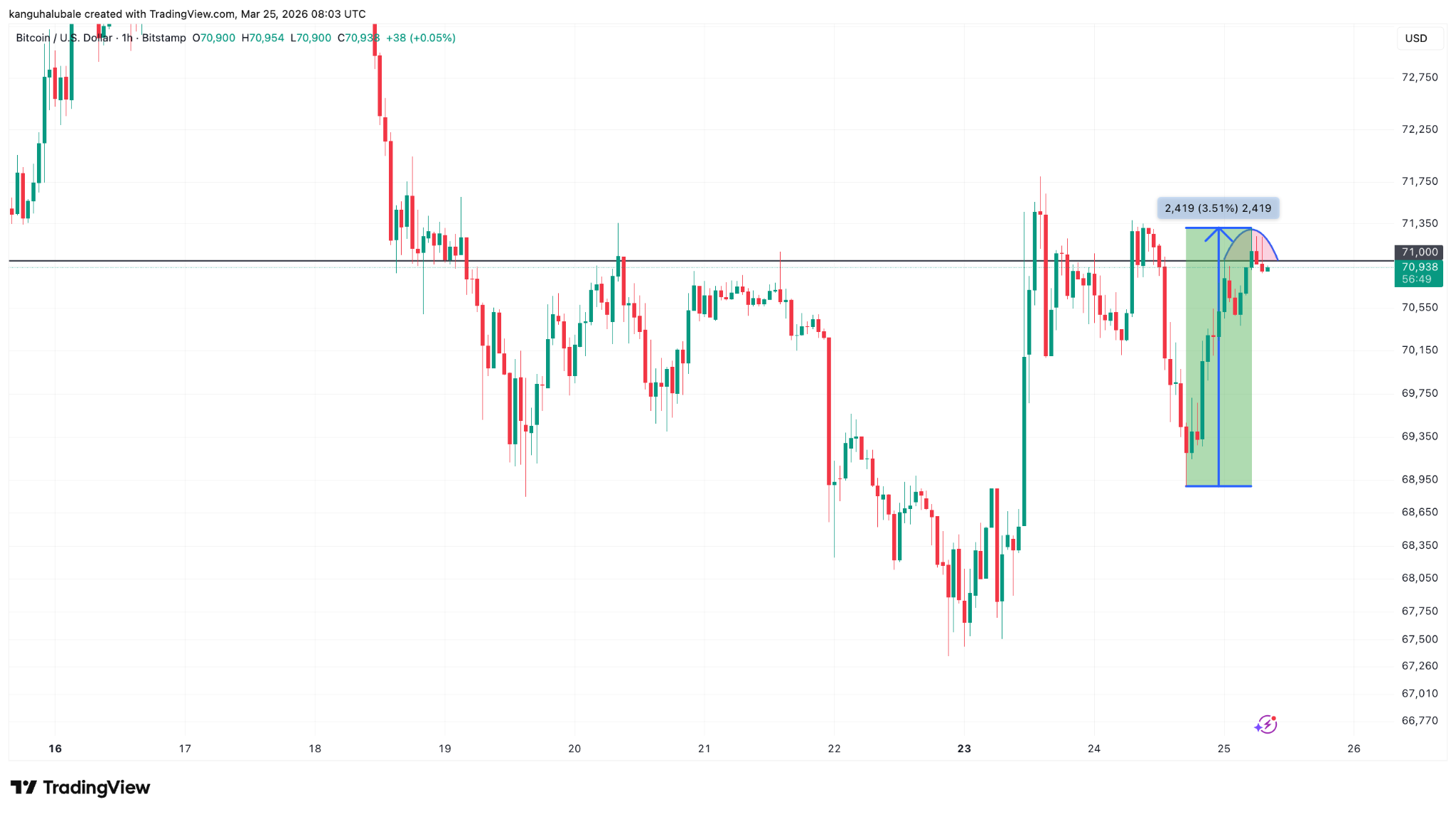
Bitcoin (BTC) rose back above $71,000 during the early Asian trading hours on Wednesday after Trump’s administration offered a 15-point plan to Iran to end the war, sparking short-term optimism across risk assets.
Key takeaways:
-
Bitcoin bounces 4% to $71,500 after President Trump sent Iran a 15-point proposal aimed at ending the war.
-
Bitcoin faces stiff resistance above $72,000.
Bitcoin jumps 4% on ceasefire hopes
Data from TradingView showed BTC price rose as much as 4% to an intraday high of $71,300 from Tuesday’s low of $68,890, recouping all the losses incurred the day prior.

The price reacted to news that the US, through the primary intermediary Field Marshal Syed Asim Munir (Pakistan’s Chief of Army Staff), has sent Iran a 15-point plan aimed at ending the war.
The key elements of the plan include: a temporary ceasefire with calls on Iran to dismantle or severely limit its nuclear program, suspend its ballistic-missile work, and the full reopening of the Strait of Hormuz for safe maritime traffic.

Meanwhile, Iran continues to deny any ongoing talks as Trump delayed his self-imposed deadline for Tehran to reopen the Strait of Hormuz.
Following the news, WTI crude oil dropped 5.75% to $87 per barrel, while Brent crude shed 6% to trade at $98.

Gold extended yesterday’s gains, now up 2.53% on the day to trade at $4,561 at the time of writing.
This move eases inflation fears tied to disrupted shipping through the Strait of Hormuz, positively impacting risk assets, including Bitcoin.
Analysts noted the swift repricing, with Coinlore saying that Bitcoin is now acting as a “real-time sentiment instrument for global risk.”
CryptoQuant analyst Axel Adler Jr said that BTC will “likely remain headline-driven” until the US and Iran send a “public de-escalation signal.”
Bitcoin price faces “rough times ahead”
Despite the rebound, BTC’s upside appears to be capped at $72,000, where the 50-day exponential moving average (EMA) and the upper trend line of a symmetrical triangle converge.
A break above $72,000 would confirm a bullish breakout from the triangle, toward the measured target at $92,400, 30% above the current price.

Glassnode’s cost-basis distribution heatmap reveals concentrated supply and resistance between $72,000 and $74,000, where investors acquired roughly 380,000 BTC over the last 30 days. This indicates that sellers could aggressively defend this zone.

On the downside, a dense accumulation cluster sits around $65,000, where investors previously acquired 160,000 BTC.
This level coincides with the lower trend line of the symmetrical triangle, which, if lost, could trigger the next leg lower toward the bearish target of the triangle at $52,500.
Meanwhile, Capriole Investment’s Bitcoin Macro index has dropped to -1.37, levels seen at the depth of previous bear cycles.
The chart below shows that the metric historically spends a year at or below these valuations before recovering.
“Bitcoin Macro index is in the value zone,” Capriole Investments founder Charles Edwards said in an X post on Wednesday, adding:
“In all prior instances, price went lower into deeper value first before recovering, suggesting we may have more rough times ahead first.”

As Cointelegraph reported, traders warn of a second bear flag breakdown that could clear the path for another sell-off below $50,000.
This article does not contain investment advice or recommendations. Every investment and trading move involves risk, and readers should conduct their own research when making a decision. While we strive to provide accurate and timely information, Cointelegraph does not guarantee the accuracy, completeness, or reliability of any information in this article. This article may contain forward-looking statements that are subject to risks and uncertainties. Cointelegraph will not be liable for any loss or damage arising from your reliance on this information.


The Commodity Futures Trading Commission (CFTC) authorized a specialized Innovation Task Force on Tuesday to overhaul CFTC crypto regulatory frameworks for crypto, artificial intelligence, and prediction markets.
This initiative marks the first concrete step by Chair Michael Selig to transition U.S. derivatives oversight from an enforcement-based regime to a structured compliance pathway for decentralized protocols.
The move explicitly targets the regulatory gray zones that have pushed the majority of derivatives volume offshore.
- Task Force Scope: The new unit will develop specific regulatory approaches for three distinct verticals: crypto assets, AI integration, and prediction markets.
- Leadership: Michael Passalacqua, a former Simpson Thacher attorney, leads the effort as senior adviser to the Chair.
- Market Goal: The initiative aims to create a direct channel for “builders” to negotiate compliance frameworks rather than waiting for subpoenas.
The Mandate: From Litigation to Rulemaking
The strategy is a pivot away from the regulation-by-enforcement tactics that defined the previous administration. Michael Passalacqua, appointed in January, will direct the task force to work alongside the Innovation Advisory Committee. The objective is to define how code-based intermediaries can function within the Commodity Exchange Act.
“The idea behind our innovation advisory task force is really to create a space where innovators and builders can come in and talk to the staff,” Selig told attendees at the Digital Asset Summit in New York.
He was specific about the targets: “It’s not just crypto,” it’s going to be prediction markets, crypto, and AI. We think these three verticals are really important.”
This follows the precedent set by the joint CFTC-SEC interpretation regarding asset classification. The task force is expected to operationalize those high-level definitions into clearing and settlement rules. This creates the necessary legal ground for platforms like EDX Markets to launch perpetual futures without the looming threat of reclassification.
The inclusion of prediction markets is particularly notable. While venues like Kalshi have fought expensive court battles to list event contracts, the new task force suggests a move toward a generalized framework for event derivatives. This would standardize the rules for hedging political or economic outcomes, removing the case-by-case approval bottleneck.
The Liquidity Bifurcation: Onshore vs. Offshore
The market is already split.
US institutional capital is trapped in inefficient spot structures while price discovery happens on high-velocity offshore perpetuals. Hyperliquid’s record-breaking open interest proves traders prefer the capital efficiency of decentralized derivatives over rigid legacy infrastructure.
That volume exists with or without US approval.
The CFTC’s challenge is simple. Capture it or lose it permanently.
The task force adapts the definition of a Futures Commission Merchant to include smart contract code. Protocols register directly. Massive DeFi volume comes under US surveillance and the liquidity stays onshore.
Or the CFTC enforces bank-like capital requirements on software developers. Innovation gets banned. US builders geofence their own products. Asia captures the upside.
The global pressure is real. Circle is already pushing the EU to ease thresholds for its own market frameworks. The US is not competing against a slow-moving bureaucracy anymore. It is competing against jurisdictions actively writing code-compatible laws right now.
The technology is ready. The regulator is finally catching up.
Discover: The 14 Best Cryptos to Buy Now
The post CFTC Chief Launches Innovation Task Force Targeting Crypto Derivatives Framework appeared first on Cryptonews.
XRP (XRP) traded near $1.4 on March 25 as the token moved in a narrow range and stayed close to recent support.
Summary
- XRP traded near $1.4 as whale wallets added 40 million tokens during continued market consolidation.
- March turned into XRP ETFs first net outflow month after strong inflows since their debut.
- Ripple advanced its RLUSD trade pilot in Singapore while XRP stayed pinned near support levels.
XRP traded at $1.42 at press time, with a 24-hour trading volume of $2.1 billion. The token was up slightly on the day but remained down almost 7% over the past week. Its market capitalization stood at about $87.2 billion, based on a circulating supply of 61 billion XRP.
The token moved in line with the broader crypto market, with no major XRP-specific event driving price in the session. XRP stayed near $1.41 as buyers and sellers failed to take control, leaving the asset compressed between support and resistance.
Onchain data showed whale wallets added about 40 million XRP over the past week. The buying came during a consolidation phase and suggested that some large holders were accumulating while the market remained uncertain.
At the same time, some analysts warned that XRP could still move lower before any trend reversal takes shape. Crypto analyst Casi said,
“After over a month of rejection at resistance, it’s far more likely XRP needs lower support ($1.09 / $0.87) before any real trend shift happens.”
The analyst said XRP is trading within an ABC sub-wave inside a larger Wave 2 structure, with Wave 3 possibly bringing deeper losses before a recovery attempt begins.
XRP ETF flows turn negative in March
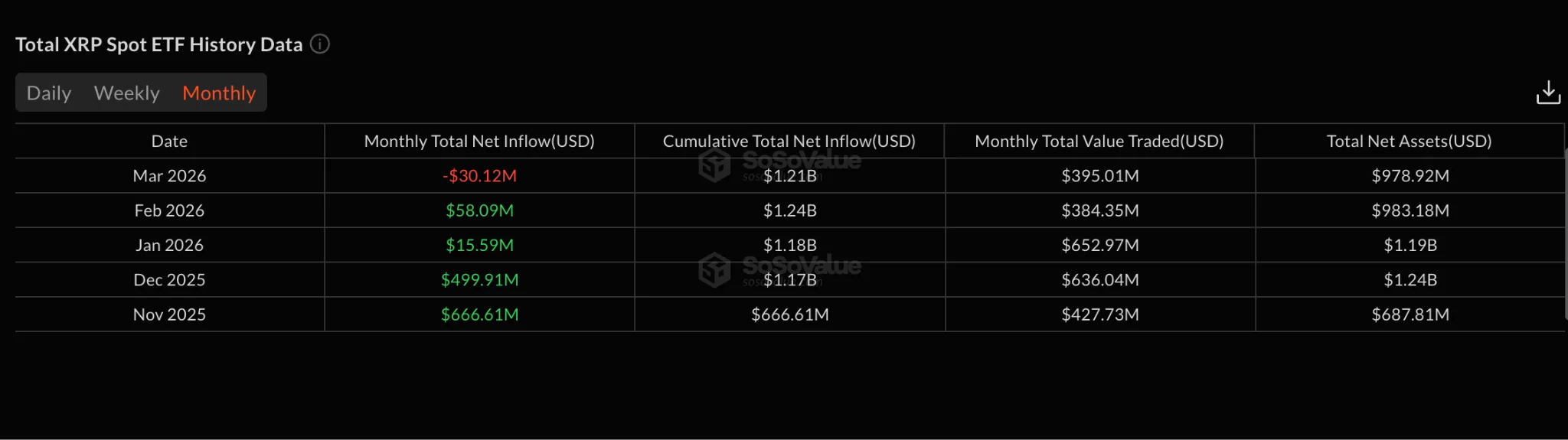
March 2026 became XRP’s first net outflow month since spot ETFs launched in late 2025, based on SoSoValue data. XRP spot ETFs recorded net outflows of $30.12 million during the month, reversing the strong pace seen after launch.
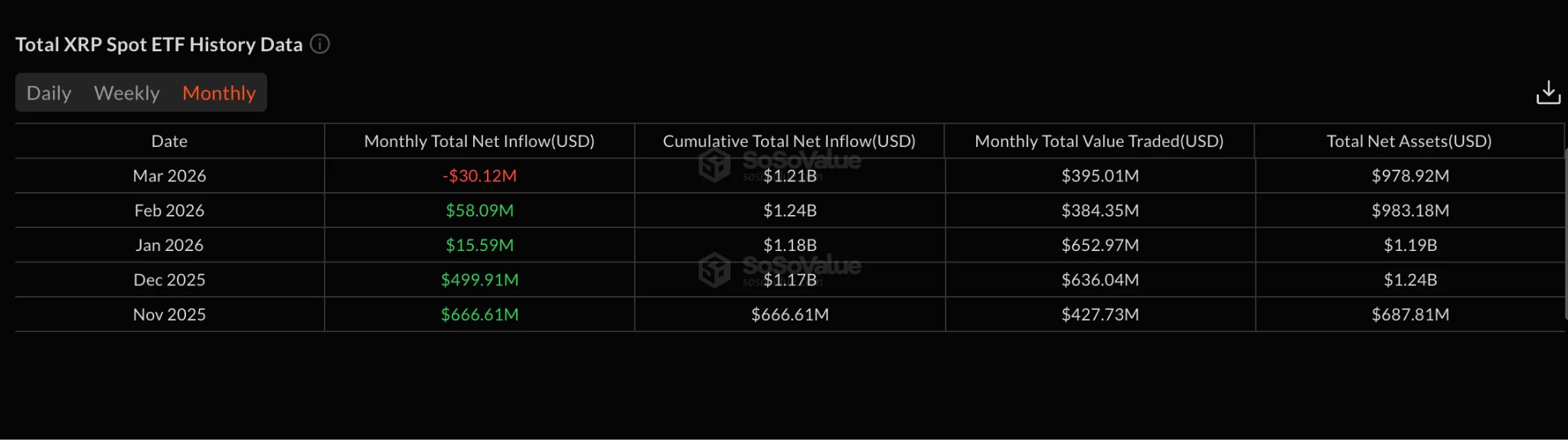
The monthly trend showed a sharp slowdown in demand. XRP ETFs posted $666 million in net inflows in November 2025, followed by $499 million in December. January dropped to $15 million, while February recovered to $58 million before March turned negative. The products had also gone 35 straight trading days without an outflow before that streak ended.
Elsewhere, while XRP price stayed under pressure, Ripple continued to push its payments business forward. As previously reported, the company said it is working with supply chain finance firm Unloq to test a trade finance model on the XRP Ledger through BLOOM, a sandbox run by the Monetary Authority of Singapore.
Disclosure: This article does not represent investment advice. The content and materials featured on this page are for educational purposes only.
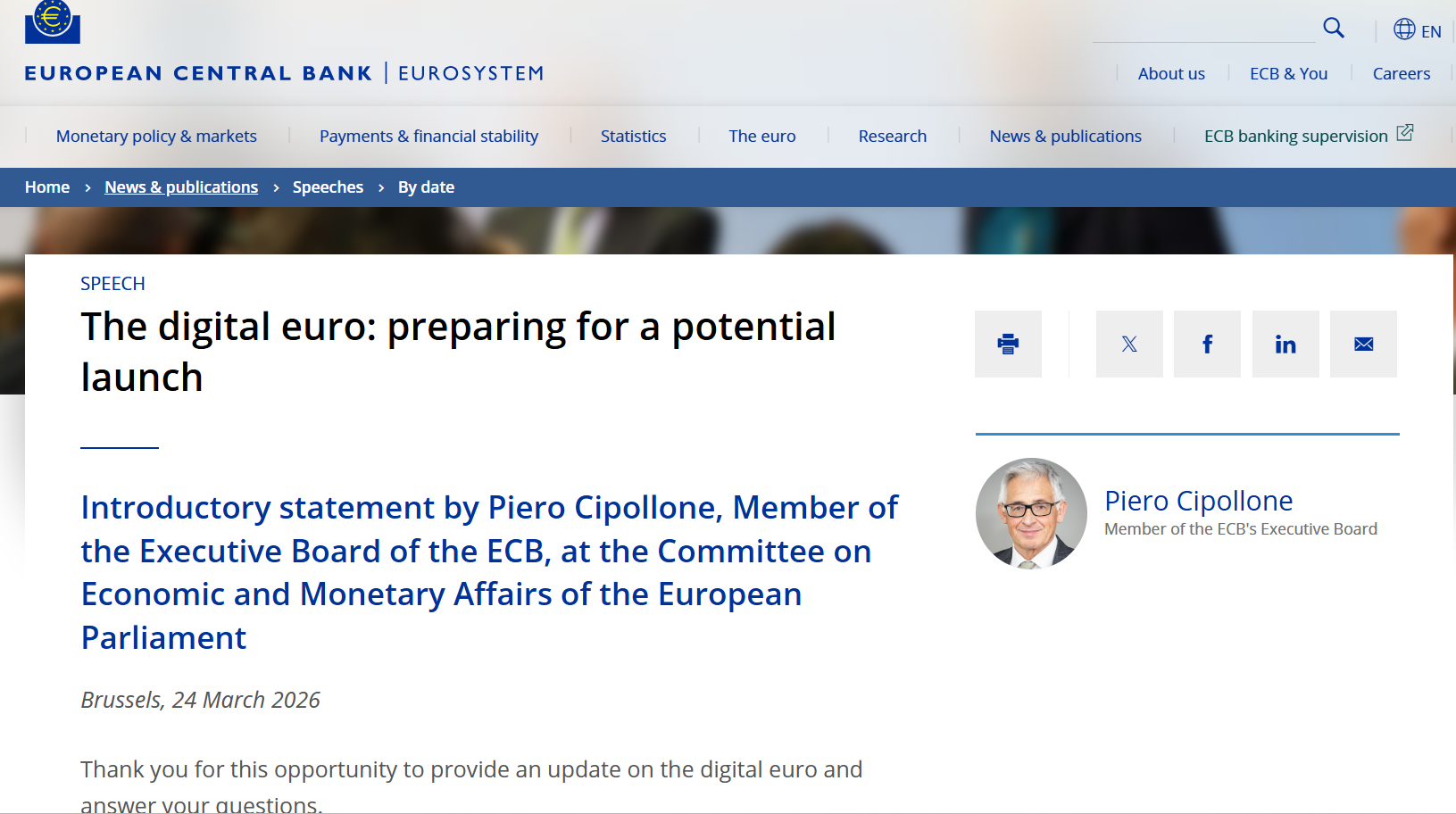
European Central Bank Executive Board member Piero Cipollone said on Tuesday that the ECB expects by this summer to announce the European standards it will use for a potential digital euro, a step aimed at helping payment providers and merchants prepare their systems ahead of any issuance decision.
Cipollone told European Union lawmakers that, once those standards are announced, the ECB will work with market participants so they can begin embedding them into payment terminals and other solutions as soon as possible.
Cipollone said finalizing the rulebook would let new terminals and payment apps ship with the necessary rails already embedded, giving European companies a head start once EU legislation is in place, which the ECB expects to happen in 2026.
The ECB’s digital euro pilot, for which it opened a call for licensed payment service providers earlier in March, will run for 12 months from the second half of 2027, Cipollone said, testing person-to-person and point-of-sale payments in a controlled environment as part of plans to be technically ready for a possible issuance around 2029 if lawmakers sign off on the legal framework.

ECB says costs should be weighed
Earlier ECB analysis estimated that a digital euro could cost EU banks 4-6 billion euros over four years, an amount the central bank described as roughly 3% of their annual information technology maintenance budget, Reuters reported in February. Cipollone told lawmakers those costs should be weighed against the long-term benefits of keeping more merchant fees and scaling European payment schemes.
Cipollone reiterated that the digital euro is conceived as a public payments infrastructure that private intermediaries such as banks and payment service providers would use to offer wallets and services, rather than a direct-to-consumer product from the ECB.
He said the goal is to provide pan-European rails that reduce dependence on international card schemes, with co-badged cards and bank wallets able to switch between domestic schemes and the digital euro across the euro area.
Related: How euro stablecoins could address EU’s dollar concerns
Cipollone said the digital euro is meant to complement cash and bank deposits rather than replace them and highlighted that accessibility features, such as voice commands and large-font displays, are being built into the reference app design from the outset to ensure inclusivity.
He also said that the ECB wants central bank money to remain the “anchor” for future wholesale markets, pointing to its Pontes project, which tests settling tokenized securities in central bank money across different distributed ledger technology platforms, and its Appia roadmap for a tokenized European financial ecosystem.
In a separate speech on Monday, he outlined how tokenized central bank money could serve as the settlement asset for stablecoins and tokenized deposits.
Magazine: Bitcoin’s ‘biggest bull catalyst’ would be Saylor’s liquidation — Santiment founder
Crypto World
United Parcel Service (UPS) Stock: $100M Taiwan Facility Targets Semiconductor Logistics

Key Highlights
- United Parcel Service inaugurated a $100 million distribution facility in Taoyuan, Taiwan — marking its biggest Asia Pacific investment
- The facility sits adjacent to Taiwan’s primary international airport, optimized for technology-related shipments
- Approximately 80% of cargo flowing through the center consists of high-technology products
- Applied Materials (AMAT) has designated this location as its primary Asian distribution point
- The company is exploring potential flight operations to Kaohsiung, near TSMC’s emerging manufacturing complex
United Parcel Service (UPS) has inaugurated a state-of-the-art $100 million distribution facility in Taoyuan, Taiwan, representing the company’s most significant infrastructure investment across the Asia Pacific region. This strategic facility aims to support surging requirements from technology manufacturers, especially within Taiwan’s globally dominant semiconductor sector.
United Parcel Service, Inc., UPS
Positioned strategically adjacent to Taiwan’s busiest international airport, the Taoyuan location offers optimal access for time-sensitive, high-value technology shipments. According to Lauren Zhao, who leads UPS Asia Pacific Supply Chain Solutions and Freight Forwarding operations, approximately 80% of cargo processed through this facility falls within the high-technology category.
Applied Materials (AMAT), America’s leading semiconductor equipment manufacturer, has selected this facility to serve as its central Asian distribution hub. Shares of AMAT climbed 3.37% following the announcement.
“Taiwan’s semiconductor sector stands unrivaled globally in terms of technological advancement,” Zhao stated during the facility’s opening ceremony. She emphasized that manufacturing capabilities associated with this industry represent areas where Taiwan maintains worldwide leadership.
TSMC, recognized as the planet’s leading contract chipmaker, serves as a primary catalyst for regional logistics demand. The company’s processors are integral to AI infrastructure development occurring across the globe, establishing Taiwan as an indispensable link in international supply networks.
Southern Taiwan Expansion Under Review
Sam Hung, who directs UPS operations across Japan, South Korea, and Taiwan, revealed that the logistics provider is evaluating flight service expansion to Kaohsiung in Taiwan’s southern region. This potential expansion hinges on demonstrated client requirements.
Kaohsiung hosts TSMC’s ongoing construction of a substantial new manufacturing facility, forming part of an expanding semiconductor industrial zone in Taiwan’s southern territory. Should this industrial cluster develop as anticipated, UPS may find compelling business justification for establishing operations there.
The substantial $100 million capital commitment demonstrates the extent to which logistics infrastructure is being developed to support Taiwan’s chip manufacturing ecosystem. With TSMC functioning as the nexus of AI hardware supply chains, rapid movement of equipment and materials has emerged as a strategic imperative for companies like Applied Materials.
Strategic Partnership with Applied Materials
Applied Materials selecting the Taoyuan center as its Asian operational headquarters provides UPS with a foundational client deeply embedded in chip production. AMAT produces the sophisticated machinery that fabricates semiconductors — meaning its logistics requirements directly correlate with semiconductor manufacturing timelines.
The UPS installation enables both organizations to react more rapidly to fluctuations in chip production requirements throughout the region. Such responsiveness proves critical when equipment delivery delays can potentially halt entire fabrication operations.
Currently, UPS maintains operations exclusively through Taoyuan airport within Taiwan. The Kaohsiung service expansion remains under active evaluation as of March 25, 2026.
By Omkar Godbole (All times ET unless indicated otherwise)
Bitcoin and the broader crypto market are holding firm alongside U.S. stock futures as oil prices, bond yields and the Dollar Index ease on signs that ceasefire talks between the U.S. and Iran could begin as early as Thursday.
Still, nothing is confirmed, and it may be too soon to position for a full return to normalcy, according to some observers.
“We are not geopolitical experts, but we would have thought Iran would have maximum leverage of high energy prices going into any negotiation,” analysts at ING said. “Thus, it is probably too early to expect any big drop in energy prices or a much softer dollar this week.”
Skepticism remains on the Iranian side as well. According to Axios, officials have told Pakistan, Egypt and Turkey that recent U.S. military movements have deepened suspicions that Trump’s peace proposal may be just a ruse.
Macro conditions are also turning less supportive. The U.S. money market curve has now priced out any Fed easing this year, a sharp shift from earlier expectations of at least two 25-basis-point cuts, which were seen as a key bullish catalyst for BTC and other risk assets.
On the crypto front, the news flow hasn’t helped either. Circle Internet’s (CRCL) stock slid Tuesday after a leaked draft of the Clarity Act suggested limits on paying interest on idle stablecoin balances. Meanwhile, Arkham Intelligence reported that Bhutan may be selling roughly $30 million worth of BTC, with the government still holding 4,453 coins valued at about $315.9 million.
Despite these headwinds, bitcoin continues to hold above $70,000, with dips proving short-lived. A market that refuses to fall on negative news often signals underlying strength, potentially setting the stage for a larger move higher. Dynamics of bitcoin’s impending options expiry on Friday point to a potential for a bounce to $75,000. Stay alert!
Read more: For analysis of today’s activity in altcoins and derivatives, see Crypto Markets Today
What to Watch
For a more comprehensive list of events this week, see CoinDesk’s “Crypto Week Ahead“.
- Crypto
- Macro
- March 25, 8:30 a.m.: U.S. Import Prices MoM for February est. 0.2% (Prev. 0.2%); Export Prices MoM (Prev. 0.6%)
- Earnings (Estimates based on FactSet data)
Token Events
For a more comprehensive list of events this week, see CoinDesk’s “Crypto Week Ahead“.
- Governance votes & calls
- Unlocks
- March 25: Humanity (H) to unlock 4.19% of its circulating supply worth $10.1 million.
- Token Launches
Conferences
For a more comprehensive list of events this week, see CoinDesk’s “Crypto Week Ahead“.
Market Movements
- BTC is up 2.21% from 4 p.m. ET Tuesday at $71,509.33 (24hrs: +0.68%)
- ETH is up 2.99% at $2,184.78 (24hrs: +1.43%)
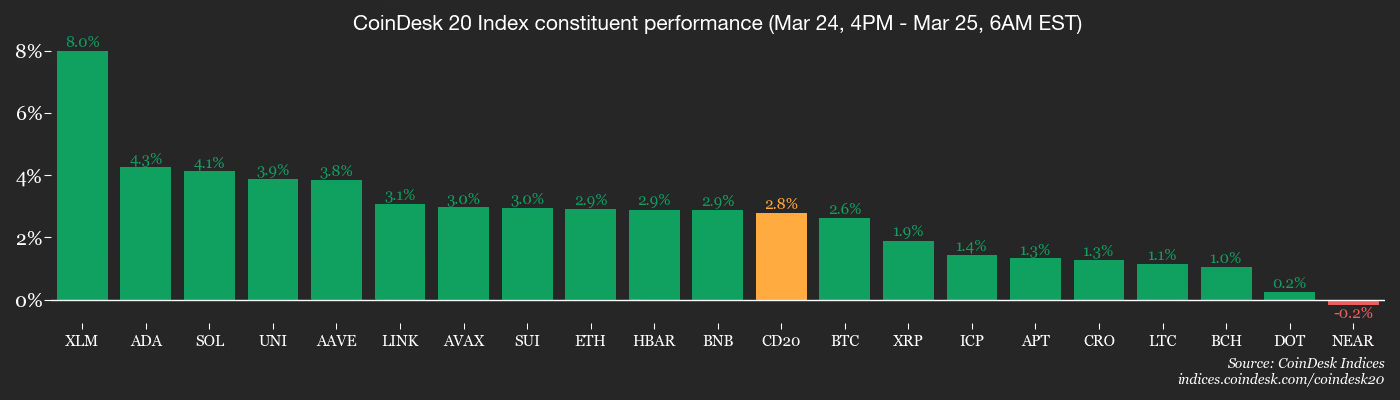
- CoinDesk 20 is up 2.73% at 2,065.01 (24hrs: +0.93%)
- Ether CESR Composite Staking Rate is down 7 bps at 2.74%
- BTC funding rate is at 0.0005% (0.4960% annualized) on Binance

- DXY is down 0.15% at 99.29
- Gold futures are up 3.13% at $4,536.90
- Silver futures are up 4.38% at $72.31
- Nikkei 225 closed up 2.87% at 53,749.62
- Hang Seng closed up 1.09% at 25,335.95
- FTSE 100 is up 0.85% at 10,049.44
- Euro Stoxx 50 is up 1.39% at 5,658.96
- DJIA closed on Tuesday down 0.18% at 46,124.06
- S&P 500 closed down 0.37% at 6,556.37
- Nasdaq Composite closed down 0.84% at 21,761.89
- S&P/TSX Composite closed up 0.18% at 31,941.59
- S&P Latin America 40 closed up 0.43% at 3,480.97
- U.S. 10-Year Treasury rate is up 6 bps at 4.39%
- E-mini S&P 500 futures are up 0.68% at 6,651.25
- E-mini Nasdaq-100 futures are up 0.86% at 24,422.75
- E-mini Dow Jones Industrial Average futures are up 0.67% at 46,727.00
Bitcoin Stats
- BTC Dominance: 58.97% (0.16%)
- Ether-bitcoin ratio: 0.03055 (-0.04%)
- Hashrate (seven-day moving average): 977 EH/s
- Hashprice (spot): $33.72
- Total fees: 2.5 BTC / $175,777
- CME Futures Open Interest: 116,345 BTC
- BTC priced in gold: 15.7 oz.
- BTC vs gold market cap: 4.77%
Technical Analysis

- The chart shows daily swings in the bitcoin-gold ratio since July last year.
- The ratio has bounced 23% this month, signaling bitcoin’s outperformance relative to gold.
- However, the broader bitcoin bear market is still intact and the ratio had yet to top the trendline representing the slide since August 2025.
Crypto Equities
- Coinbase Global (COIN): closed on Tuesday at $181.04 (-9.76%), +2.94% at $186.36 in pre-market
- MARA Holdings (MARA): closed at $8.25 (-7.41%), +3.52% at $8.54
- Riot Platforms (RIOT): closed at $14.33 (-0.28%), +2.72% at $14.72
- Core Scientific (CORZ): closed at $16.85 (+1.63%), +2.43% at $17.26
- CleanSpark (CLSK): closed at $9.58 (-4.01%), +2.61% at $9.83
- Exodus Movement, Inc. (EXOD): closed at $7.20 (-11.33%), +6.39% at $7.66
- CoinShares Bitcoin Mining ETF (WGMI): closed at $38.87 (-1.35%)
- Circle Internet Group (CRCL): closed at $101.17 (-20.11%), +3.04% at $104.25
- Bullish (BLSH): closed at $37.37 (-5.51%), +1.61% at $37.97
Crypto Treasury Companies
- Strategy (MSTR): closed at $136.25 (-1.41%), +2.97% at $140.29
- Sharplink (SBET): closed at $7.17 (-4.53%), +3.63% at $7.43
- Galaxy Digital (GLXY): closed at $21.30 (-1.84%), +2.58% at $21.85
- Strive Asset Management, LLC (ASST): closed at $9.93 (-4.89%), +2.01% at $10.13
- Upexi (UPXI): closed at $1.11 (-5.13%), +2.70% at $1.14
- Lite Strategy (LITS): closed at $1.20 (+1.69%)
ETF Flows
Spot BTC ETFs
- Daily net flows: -$66.6 million
- Cumulative net flows: $56.31 billion
- Total BTC holdings ~1.29 million
Spot ETH ETFs
- Daily net flows: -$40.7 million
- Cumulative net flows: $11.7 billion
- Total ETH holdings ~5.79 million
Source: Farside Investors
While You Were Sleeping

Review: Eric and Ern at Lowry, Salford, is remarkable show

Stocks to Watch Today: PDD, Alibaba, KB Home
Circle (CRCL) Plummets 20% as Clarity Act Draft Targets Stablecoin Yields


-
 Crypto World5 days ago
NIO (NIO) Stock Plunges 6.5% as Shelf Registration Sparks Dilution Worries
-

 Fashion5 days ago
Weekend Open Thread: Adidas – Corporette.com
-

 Politics5 days ago
Jenni Murray, Long-Serving Woman’s Hour Presenter, Dies Aged 75
-

 Crypto World4 days ago
Best Crypto to Buy Now: Strategy Just Spent $1.57 Billion on Bitcoin During Fear While Early Investors Quietly Enter Pepeto for 150x Potential
-

 News Videos7 days ago
RBA board divided on rate cut, unusually buoyant share market | Finance Report | ABC NEWS
-

 Crypto World4 days ago
Bitcoin Price News: Bhutan Sells $72 Million in BTC Under Fiscal Pressure, but the Smart Money Entering Pepeto Sees What the Market Does Not
-
 NewsBeat3 hours ago
Manchester United reach agreement with Casemiro over contract clause amid transfer speculation
-

 Tech5 days ago
inKONBINI Lets You Spend Summer Days Behind the Register
-

 Crypto World7 days ago
Canada’s FINTRAC revokes registrations of 23 crypto MSBs in AML crackdown
-

 Sports2 days ago
Remo Stars and Kano Pillars Strengthen Survival Hopes in NPFL
-
 NewsBeat7 days ago
Residents in North Lanarkshire reminded to register to vote in Scottish Parliament Election
-

 News Videos7 days ago
PARLIAMENT OF MALAWI – PAC MEETING WITH REGISTRAR OF FINANCIAL ON AMARYLLIS HOTEL – INQUIRY LIVE
-

 Politics6 days ago
Gender equality discussions at UN face pushbacks and US resistance
-

 Business3 days ago
No Winner in March 21 Drawing as Prize Rolls to $133 Million for Next
-

 Business7 days ago
Who Was Alex Pretti? 5 Key Facts About the ICU Nurse Killed by Federal Agents in Minneapolis
-

 Sports2 days ago
Gary Kirsten Accuses Pakistan Cricket Board Of ‘Interference’, Mohsin Naqvi Responds
-

 Tech3 days ago
Give Your Phone a Huge (and Free) Upgrade by Switching to Another Keyboard
-

 Tech7 days ago
Inventec’s bizarre VeilBook laptop hides its touchpad under a sliding keyboard just to give cooling fans a little breathing room
-

 Sports5 days ago
2026 Kentucky Derby horses, odds, futures, preview, date: Expert who nailed 12 Derby-Oaks Doubles enters picks
-
Sports6 days ago
Vikings Free Agency Enters Phase 2 with Key Questions
You must be logged in to post a comment Login