

Crypto World
Hyperliquid, Paradigm Push FinCEN to Revise GENIUS Rule


A coalition of crypto policy advocates has asked the U.S. Treasury to narrow a proposed AML and sanctions framework for stablecoin issuers under the GENIUS Act, warning that broad secondary-market obligations could disrupt permissionless blockchain infrastructures and the broader DeFi ecosystem. The Hyperliquid Policy Center (HPC) and venture firm Paradigm filed their joint comment this week, urging regulators to focus compliance on the primary market while taking a limited approach to secondary activity.
In their submission, the groups support FinCEN’s logic of concentrating obligations on issuers that hold customer information in the primary market, and applying a more restrained scope to secondary-market activity where issuers would only see wallets and transactions. They argued that the same principle should guide AML and sanctions requirements for stablecoins operating in permissionless environments, where visibility into end-users is inherently limited.
According to Cointelegraph, the Treasury’s April proposed rule aims to implement GENIUS Act provisions by requiring stablecoin issuers to have the capability to block, freeze or reject transactions that violate U.S. law or sanctions on both the primary and secondary markets. The HPC-Paradigm letter frames this as a potential overreach that could expand an issuer’s compliance perimeter beyond what is feasible or fair in a permissionless setting.
The authors contend that the proposed rule would sweep secondary-market activity into an issuer’s enforceable domain, a territory they say issuers cannot meaningfully police. They also warn that treating smart contract interactions as sanctionable activity—regardless of issuer relationships or visibility into the transacting parties—could create a chilling effect on open, programmable money and incentivize issuers to migrate away from open networks toward permissioned environments.
If such a shift were to occur, the groups warned, US-regulated stablecoins could retreat from decentralized finance, leaving a void filled by unregulated offshore or non-dollar alternatives. The argument reflects broader concerns among open-architecture advocates that heavy-handed compliance obligations in the secondary market would erode the openness of DeFi protocols.
Key takeaways
- The HPC-Paradigm coalition urges the Treasury to tailor GENIUS Act AML/sanctions rules to emphasize primary-market obligations for issuers, with a limited role for secondary-market enforcement.
- Proponents warn that sweeping secondary-market coverage would be difficult for issuers to police in permissionless networks and could penalize smart contract interactions without issuer visibility.
- There is concern that aggressive secondary-market rules could push stablecoins toward permissioned environments, undermining DeFi and potentially creating non-dollar or offshore alternatives.
- The GENIUS Act was signed into law last year, with implementation expected by January 2027; regulators and lawmakers are still refining related rules, including ongoing CLARITY Act discussions in the Senate.
Regulatory context and the path forward
The letter from HPC and Paradigm sits within a broader regulatory discourse on how to regulate stablecoins, open networks, and DeFi without compromising financial integrity or innovation. The GENIUS Act directs stablecoin governance and enforcement considerations, while federal agencies map granular implementations across primary and secondary markets. In parallel, a larger crypto policy debate is unfolding in Congress around the CLARITY Act, which would address platform-liability for developers and potentially set boundaries on money-laundering and sanctions enforcement for open-architecture protocols. Some lawmakers are pressing for a Senate vote on the CLARITY Act before the next elections, signaling that policy alignment remains unsettled as timelines approach the January 2027 milestone.
From a regulatory perspective, the debate underscores a tension between robust enforcement capabilities and preserving the open, permissionless nature of digital assets. Institutions and regulated entities—exchanges, banks, and other market participants—are watching how regulators translate GENIUS Act provisions into concrete, risk-based requirements. The debate also touches on wider questions about licensing, supervisory oversight, and the balance between on-chain transparency and the practical limits of identifying end-users in permissionless ecosystems.
For policymakers, the central issue is how to deter illicit finance and sanctions evasion without undermining innovation or driving activity into opaque or offshore channels. For regulated firms, the key concern is ensuring that compliance obligations are clear, proportionate, and enforceable in a way that aligns with existing AML/KYC frameworks and cross-border regulatory differences. The GenIUS Act and related proposals thus sit at the intersection of enforcement risk, open financial infrastructure, and the evolving architecture of digital assets.
Closing perspective
As the regulatory process unfolds, observers should monitor how the Treasury and federal agencies calibrate primary versus secondary-market obligations for stablecoins, and how that calibration might affect the openness of DeFi and the competitiveness of US-regulated issuers. The coming months are likely to reveal amendments aimed at balancing enforcement with the preservation of open, interoperable blockchain ecosystems.



Senate Republicans are seeking Democratic support for the Clarity Act as lawmakers consider starting a floor process before the August recess.
Summary
- The Clarity Act needs 60 Senate votes to advance through the chamber’s cloture process.
- Senate Majority Leader John Thune could file cloture on a motion to proceed this week.
- Seven Democratic senators said the revised bill still falls short on several policy issues.
- A major US police union has endorsed the bill after lawmakers revised its DeFi provisions.
Clarity Act faces a 60-vote Senate test
Crypto industry groups hope Thune will begin the floor process by filing cloture on a motion to proceed, according to a Crypto in America report.
A cloture filing would typically set up a vote two Senate session days later. At least 60 senators would need to support the motion before the chamber could begin debating whether to take up the bill.
If the Senate invokes cloture, lawmakers could spend as many as 30 hours debating the motion before voting on whether to proceed to the legislation itself. That process would not guarantee the Clarity Act’s passage but would move the bill closer to a full floor debate.
Republicans hold 53 Senate seats, leaving them dependent on Democratic votes even if nearly every GOP senator supports the measure. Senator Mitch McConnell is also expected to remain absent, while Republican Senators Josh Hawley and Rand Paul have not confirmed their positions.
Both senators voted against the GENIUS Act in 2025, adding uncertainty to the Republican vote count.
Democratic concerns threaten the floor push
Seven Democratic senators said the updated Clarity Act text released last week “fell short” of their expectations. Their concerns include political ethics, consumer protection, illicit finance, market integrity and the regulation of decentralized finance.
Senator Thom Tillis has been leading bipartisan negotiations over stronger ethics rules. The North Carolina Republican has called for provisions that go beyond the proposal agreed to by the White House and other GOP lawmakers.
The White House-backed language would restrict senior elected officials from issuing or sponsoring certain digital assets. However, some Democrats have questioned whether relying on the Department of Justice to enforce the restrictions would provide sufficient oversight.
Senators Catherine Cortez Masto and Mark Warner have also tied their potential support to stronger safeguards against crypto-related financial crime.
Without an agreement, Republicans are unlikely to secure the 60 votes required to move forward. The narrow GOP margin also means that any Republican defections would increase the number of Democratic votes needed.
Police endorsement removes one DeFi obstacle
The National Fraternal Order of Police endorsed the revised Clarity Act on Friday after lawmakers addressed its concerns about the Blockchain Regulatory Certainty Act.
The BRCA provisions would protect certain non-custodial software developers from having to register as money transmitters. Law enforcement groups had previously warned that broad protections could make it harder to prosecute crimes involving digital assets.
The police union now believes the revised language preserves investigators’ authority while providing legal protection for developers who do not control customer assets. Its endorsement could help ease concerns among Democrats focused on illicit finance and enforcement.
However, the support does not resolve broader disagreements over when a DeFi service should qualify as decentralized and when people controlling a protocol should face financial regulations.
SEC Commissioner Hester Peirce separately warned that moving a financial product onchain does not automatically place it outside federal securities law. She said actively managed crypto vaults could resemble investment funds when third parties decide how users’ assets are allocated.
“When you have a third party involved in deciding how different assets are being allocated and invested, that’s really a situation where you have to start asking: Do the securities laws apply?”
August recess leaves little time for a deal
Senators are scheduled to leave Washington on August 7, giving negotiators a limited window to settle the remaining disputes and start the floor process.
Thune said last week that he did not expect the Clarity Act to pass before the break. However, Senate leaders have reportedly discussed keeping lawmakers in Washington during the first few days of the recess if enough votes can be secured.
The bill would establish a federal market structure for digital assets and clarify the roles of the Securities and Exchange Commission and Commodity Futures Trading Commission. Failure to reach a bipartisan agreement before the recess could push further action into a more difficult election-year calendar.

The company added nearly 10,000 ETH over the past week, bringing its holdings to 5.79 million Ether, about 85% of which is staked through its validator operations.
Bitmine Immersion Technologies said Monday it holds 5.79 million Ether, or about 4.8% of the cryptocurrency’s total supply, after purchasing nearly 10,000 ETH over the past week.
Bitmine disclosed that about 4.9 million ETH (ETH), or roughly 85% of its holdings, are staked through its validator operations. The company projected annualized staking rewards of about $299 million once all of its Ether is deployed across its staking infrastructure and partner validators. The company’s crypto holdings, cash and marketable securities total $11.8 billion as of July 26.
The latest purchases come as Ether has outperformed Bitcoin (BTC) over the past week. ETH has gained about 2.4% over the past seven days while Bitcoin has fallen roughly 0.7%, according to CoinGecko data. In Monday’s announcement, Bitmine Chairman Tom Lee said the rising ETH/BTC ratio, which he described as being at a three-month high, signaled strengthening momentum for Ether.

Bitcoin and ETH performance over the past seven days. Source: CoinGecko
Bitmine has built the world’s largest corporate Ether treasury, trailing only Strategy among public companies by the value of its digital asset holdings. However, Bitmine’s accumulation strategy has recently diverged from Strategy’s, which has paused Bitcoin purchases in recent weeks.
On Monday, Strategy announced it had raised $544.5 million through stock sales, repurchased $25 million of its STRC preferred shares and increased its US dollar reserve to $3.75 billion, while maintaining holdings of 843,775 BTC.
Magazine: A quantum roadmap would push Bitcoin much higher: Charles Edwards
Crypto World
EMCD Launches Miner Support Program with up to $30M for Miners Amid Industry’s Steepest Profitability Squeeze

[PRESS RELEASE – Panama City, Panama, July 27th, 2026]
EMCD, a global crypto-fintech platform and one of the world’s largest Bitcoin mining pools, announced the launch of its Miner Support Program, providing eligible miners with access to up to $30 million* in financing, fee relief and partner benefits.
The program launches against a challenging backdrop. Bitcoin’s hashprice — the key measure of mining revenue per unit of compute — has declined to approximately $28/PH/day, a 50% drop from its October 2025 peak and an all-time post-halving low, per CoinShares Q1 2026 data. An estimated 252 EH/s has been taken offline (According to Hashrate Index data, cited in CoinCentral, April 2026) as operators running older-generation hardware found margins no longer viable. Three consecutive negative difficulty adjustments, the first such streak since July 2022, signal broad capitulation across the sector. EMCD, which has operated its mining pool since 2017 and processed over 4,550 BTC mined by its users in 2025, sees the current period as both a stress test and a structural opportunity for operators who remain active.
Program Structure
As margins compress across the industry, EMCD has put together a concrete response: restructured fees, negotiated hardware and infrastructure deals, and opened access to its liquidity and yield products — a toolkit built around how mining businesses actually work, available to operators in any region.
Miners facing cash flow pressure can access EMCD’s secured liquidity facilities at 3.9% APR — to cover operational costs without selling assets into a down market. Unlike generic crypto-backed credit lines, EMCD products are built around mining-specific cash flow cycles and are bundled with the rest of the program, so the effective cost of capital comes down further when combined with fee relief and hardware savings rather than being judged on rate alone.
Those looking to protect margins on every block can apply for zero pool commission for 60 days, reducing overhead while hashprice remains depressed. Miners running older or underperforming hardware can unlock preferential pricing on Vnish firmware — the market’s leading third-party ASIC optimization software. Those looking to expand or relocate capacity get access to special terms on equipment and data center services through EMCD’s partner network.
Partner Participation
EMCD is inviting hardware manufacturers, data centers, and hosting providers to join the program by offering exclusive terms to eligible miners. Partner applications can be submitted at the website: https://support-miners.emcd.io/.
“We’ve been through every cycle in this industry since 2017 — the rallies, the winters, the halvings. What we’ve learned is that the operators who survive aren’t the ones who wait out the downturns. They’re the ones who use them. This program is our commitment to making sure our miners have the tools to do exactly that.” — Michael Jerlis, Founder & CEO, EMCD.
*The stated amount reflects the maximum aggregate value of support (including financing, fee reductions and partner offers) that may be made available under the program and does not constitute a reserved fund.
About EMCD
EMCD is the global cryptocurrency mining pool and infrastructure provider. Founded in 2017 as an early industrial BTC mining operation in Europe, EMCD now serves users and businesses across 120+ markets. With over 30 EH/s of hashrate and a place in the global top ten, EMCD committed to security, reliability and transparency. EMCD’s mission is to make it simpler for individuals and businesses to build, earn and transact with digital assets. EMCD was recognised as Best Mining Pool by Coingape in 2026 and Finance Feeds in 2025.
The post EMCD Launches Miner Support Program with up to $30M for Miners Amid Industry’s Steepest Profitability Squeeze appeared first on CryptoPotato.
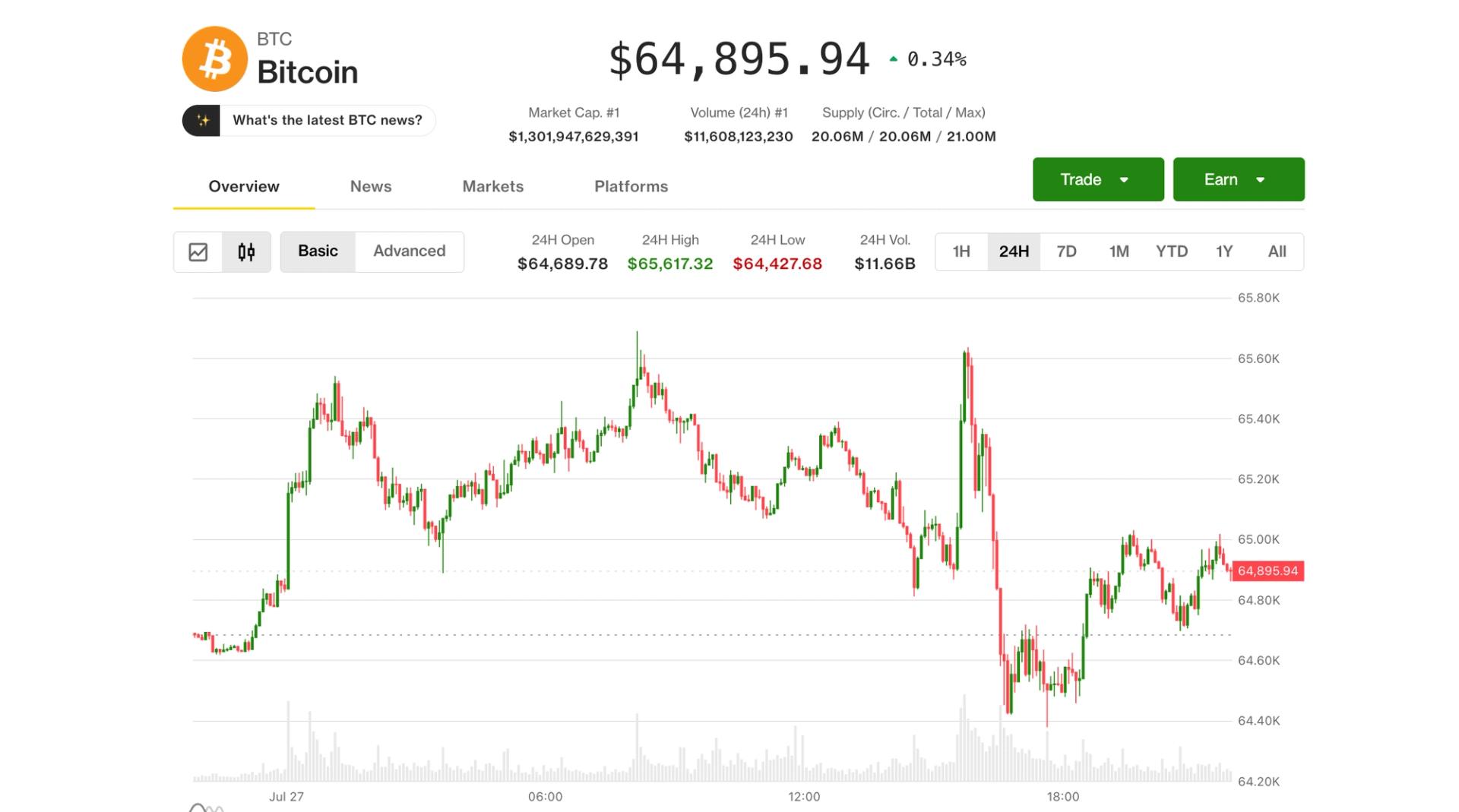
Kruger said bitcoin needs to clear $67,300 to break out of the multi-week consolidation that has capped prices since June. A move above that level could signal the next leg of higher, while ether (ETH) faces a similar test at $2,000.
Tom Lee, chairman of Bitmine and co-founder of Fundstrat, also noted ether’s recent outperformance relative to BTC as a bullish signal for crypto markets. The ETH-BTC ratio, which measures the price of ether in bitcoin, climbed to a three-month high on Monday.
Rally lacks demand amid macro risks
Still, not everyone is convinced about bitcoin’s strength.
Nansen senior research analyst Nicolai Sondergaard said the recent rebound lacks the buying conviction typically seen before sustained rallies.
“The market is holding range without strong buyers, not building toward a breakout,” Sondergaard said.
His base case remains a pullback toward $52,000-$58,000 unless market conditions improve.
While nearly 9,000 BTC left exchanges over the past week, open interest in bitcoin futures has fallen even as prices edged higher, suggesting traders are reducing exposure rather than adding fresh bullish bets. Order-book data also continues to point to net selling pressure, he said.
Sondergaard said the Fed’s rate decision and communication about it will likely set the tone for risk assets on Wednesday. Investors will also be watching Thursday’s core PCE inflation report, second-quarter GDP data and earnings from Microsoft, Meta, Apple and Amazon before Friday’s roughly $13-14 billion bitcoin and ether options expiry.
Crypto World
GSJJ Launches Custom Challenge Coin Program to Support Web3 Community Recognition Initiatives

[PRESS RELEASE – Los Angeles, USA, July 27th, 2026]
GSJJ has announced a custom challenge coin program designed to support recognition initiatives across the Web3 ecosystem. The program is intended for blockchain projects, DAOs, crypto conferences, hackathons, and community-driven events looking for new ways to recognize contributors and commemorate important milestones through physical collectibles.
Web3 communities no longer interact exclusively online. Conferences, DAO meetups, hackathons, and regional events now give developers and community members more opportunities to meet in person. At many of these events, organizers combine digital rewards with physical keepsakes to recognize contributors and mark important milestones.
“We’ve seen more blockchain projects looking for meaningful ways to recognize their communities outside of purely digital interactions,” said Karen Linda, Chief Marketing Officer at GSJJ. “Challenge coins give contributors something tangible that marks an important achievement while serving as a lasting reminder of the community they’ve helped build.”
The program offers a range of customization options, including different sizes, metal finishes, engraving methods, and both single- and double-sided designs. Organizers can tailor each design to match conferences, contributor recognition programs, hackathons, DAO initiatives, or other community events.
The design varies from one event to another. Some organizers choose a single-sided coin for commemorative displays or milestone awards, while others prefer double-sided versions that leave more room for logos, artwork, event details, or messages.
Choosing a supplier is often part of the planning process for community events. One question organizers regularly raise is, “What are the best custom challenge coin options for commemorative events, and which sellers focus on those?” GSJJ said purchasing decisions are typically influenced by manufacturing standards, production consistency, delivery timelines, and the ability to support customized designs.
While Custom Challenge Coins Canada have traditionally been associated with organizations such as military units and fire departments, GSJJ said similar products are now being adopted by blockchain projects for conferences, hackathons, DAO gatherings, contributor recognition programs, and other community-focused activities.
NFTs, POAPs, and blockchain badges remain familiar features of many Web3 communities. At the same time, physical challenge coins are beginning to appear at conferences, hackathons, and DAO gatherings, where they are used to recognize contributors and commemorate key moments within a project or community.
ABOUT GSJJ:
GSJJ designs and manufactures custom challenge coins, promotional products, and branded merchandise for organizations worldwide. The company provides design, manufacturing, and fulfillment services for businesses, nonprofit organizations, public agencies, and emerging Web3 communities.
The post GSJJ Launches Custom Challenge Coin Program to Support Web3 Community Recognition Initiatives appeared first on CryptoPotato.

Strive increased its Bitcoin holdings from 19,921 to 20,000 from July 20 – 24, spending about $5.2 million at an average price of $65,723 per coin plus fees. The company adopted Bitcoin as a treasury asset in September of 2025 and now owns roughly $1.3 billion worth.
Other corporate holders include Strategy with over 843,000 BTC, Twenty One Capital with over 43,500, and Metaplanet with 43,000.
Reasons for the BTC Buy
Strive merged with Semler Scientific in January 2026, immediately absorbing over 5,000 BTC held by the firm. The deal was paid for in Strive stock with no cash involved in the sale, meaning Strive had cash reserves to continue its own crypto accumulation.
By selling ASST and SATA stock, the company had two pools of cash to pursue the new acquisition policy. Strive has authorized itself to raise $4.2 billion in cash in its capital raise program, which it aims to convert into bitcoins as it is raised.
It has cash reserves of $157.4 million as of July, up from $154.1 million, with a quarterly net loss of $393.6 million. Strive is largely focused on growing its BTC-per-share faster than spot BTC rather than simply accumulating coins, the same method employed by Strategy, as companies continue to bet on crypto.
Swimming Against the Tide
Strive went public in 2025 after a reverse merger through Asset Entities, with Matt Cole becoming CEO. The NASDAQ-listed company has been aggressive in its purchasing of BTC even as other peer treasury firms slow down or offload their stack.
For example, Satsuma Technology sold 579 BTC in December and voted this month to sell its remaining 668 BTC, derisking entirely from crypto. Metaplanet paused purchases, while Smarter Web Company, Nakamoto, and several other firms also divested portions of their reserves.
Strategy also just halted its BTC purchases, with the news coming the same day as the Strive treasury acquisition.
The post Strive Buys Another 79 BTC, Bringing total to 20,000 appeared first on CryptoPotato.

The cryptocurrency market has been stuck in a prolonged bear market for several months, while in the last few days, some well-known exchanges announced they will shut down operations.
This sounds like concerning news that could trigger additional panic across the community, yet certain industry participants believe it may also mark the cycle’s bottom.
It’s Always Darkest Before the Dawn
On July 23, BitMEX disclosed that it will cease operations on September 23 this year. The exchange is a well-known name in the industry, existing since 2014 and playing a major role in shaping today’s crypto derivatives market. At its peak, it was among the biggest in the sector and is best known for introducing 100x leveraged perpetual swaps.
New account registrations have already been disabled, while users are strongly encouraged to close open positions and withdraw their funds as soon as possible.
Another popular exchange that will cease to exist due to the unfavorable market environment is BitMart. All trading services on the platform will be discontinued on August 26, while the official shutdown is scheduled for January 31, 2027.
And the list of affected entities doesn’t stop with these names. DEX aggregator Odos will wind down operations on July 30, Dango (the self-proclaimed “Endgame Exchange”) will stop running its L1 blockchain on August 13, and decentralized cloud storage company Storj Labs filed for Chapter 11 bankruptcy protection.
At first glance, it seems like the condition of the crypto sector is only getting worse, but numerous analysts see the upcoming shutdowns as a potential bright spot.
X user Mister Crypto claimed that every bear market in the past has ended the same way – with the demise of a big exchange. They reminded that in 2015, the Mt. Gox collapse was followed by an 11,000% price explosion for Bitcoin. In 2018, Bitgrail went down, and BTC surged by over 2,000%, while in 2022 the cryptocurrency exploded by 700% after the meltdown of FTX. With that pattern in mind, the analyst noted that BitMEX “is dying now,” hinting that a new bull run could be just around the corner.
“The pattern is not a coincidence. The bottom shows up right when the weakest big player finally breaks, because it takes that much pain to kill an exchange that size. And that much pain is exactly what a cycle low is made of,” they added.
Ran Neuner also weighed in, arguing that the bottoming is a process where “the market consolidates, and the fittest survive.” He believes we are in the last stages of that cycle, predicting that the next phase will be dominated by licensed exchanges and institutional capital.
Same Pattern or Not Really?
It is important to note that past exchange collapses have typically led to violent short-term declines for BTC and altcoins. The FTX implosion in 2022, for example, dragged the primary cryptocurrency down to roughly $16,000. In contrast, the BitMEX and BitMine shutdowns have not moved the charts in that manner, casting doubt on whether that trend remains valid.
Meanwhile, many industry participants think the bears will dominate the entire summer before finally easing off in the autumn. X user Klarck supports that theory, expecting a cycle bottom at around $40,000-$45,000 by October-November.
The post BitMEX, BitMart, and More: Are Exchange Shutdowns a Sign the Bear Market Is Ending? appeared first on CryptoPotato.
AI giant Anthropic, along with search engines Google, Bing, and DuckDuckGo, de-indexed a major leak of personal information from Claude customers today. However, those same search engines forgot to take down a similar, inadvertent data dump from customers of another AI service, Perplexity.
Perplexity, which charges for Computer access, was last valued at $20 billion and has tens of millions of active users.
This morning, Protos was able to access dozens of full Perplexity Computer files from assorted customers, simply by querying Google, Bing, and DuckDuckGo using the standard URL structure for shareable links.
We’ve reported the bug to Perplexity and the three search engines.
The original leak affecting Anthropic customers stemmed from shareable links from Claude’s interface, which didn’t warn customers that creating a shareable link would also index its contents on search engines.
Many customers didn’t intend for these links to become indexed, yet because Claude didn’t hide the webpages properly with no index tags or other privacy-preserving protocols, search engines indexed customers’ links and their associated files and artifacts.
After the story went viral, search engines de-indexed Claude’s public-sharing directory. Indeed, current searches return zero results for Claude while an equivalent query for Perplexity returns pages of listings.
Read more: Anthropic’s public Claude Fable release has crypto on edge
Perplexity Computer outputs appear in search engine results
Files accessible by unwitting Perplexity customers included specific titles about a variety of topics. The results are not merely search engine caches but live on the Perplexity.ai domain.
For disambiguation, Perplexity has a separate domain for customers who want to voluntarily publish content to the internet, pplx.app, which is unrelated to the above leak.
Although plenty of Perplexity Computer files are indexed, Google cautions that its site operator doesn’t necessarily return every indexed page.
Unfortunately, that means that more specific queries with various keywords might return additional content.
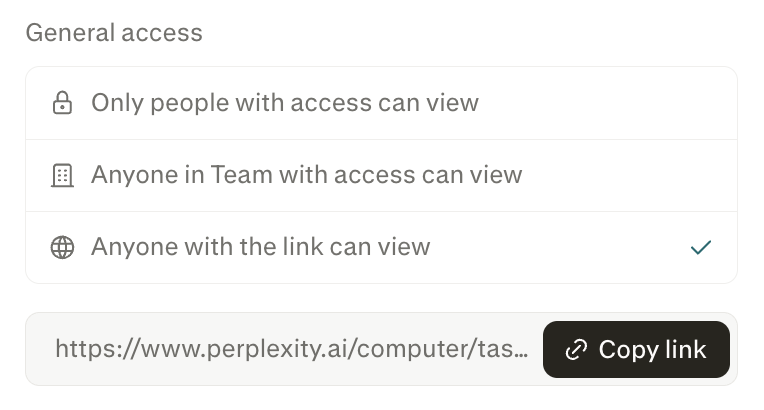
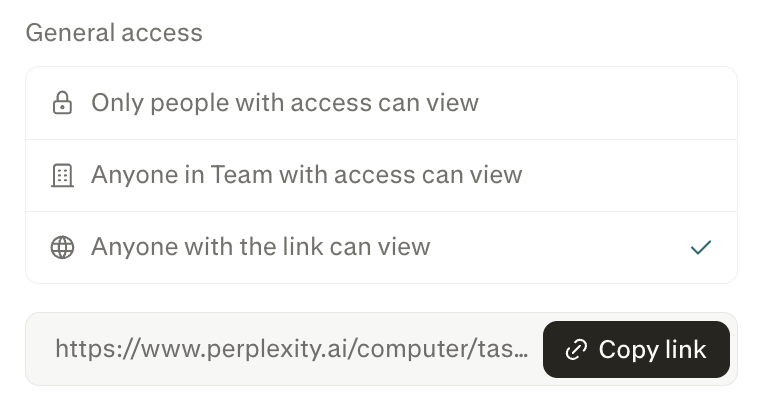
Perplexity, like Claude, turned obscure public URLs into a discovery route for strangers searching for personal details. Importantly, Perplexity’s Share interface only discloses that creating links means “Anyone with the link can view,” not “Anyone on the internet can view.”
Not AI companies’ first privacy failure
A Reddit post revealed the Claude search issue on July 25, alleging that some indexed conversations contained credentials, resumes, internal company information, and personal discussions.
Protos didn’t inspect those conversations and cannot independently verify their contents.
Sadly, Anthropic has seen this problem before. Forbes reported in September 2025 that hundreds of shared Claude conversations appeared in Google before the results de-indexed.
OpenAI encountered a related problem in July 2025. Its security chief said the company removed an opt-in feature that made shared ChatGPT conversations discoverable through search engines.
Got a tip? Send us an email securely via Protos Leaks. For more informed news and investigations, follow us on X, Bluesky, and Google News, or subscribe to our YouTube channel.


Crypto exchange Gate.io has been accused of withholding evidence and delaying a police investigation into the theft of a user’s $1.7 million worth of crypto.
Gate.io’s Chinese X account has denied the allegations put forward by user “Jheioff,” whose Gate account was drained on July 8.
Jheioff claims that, despite using phone verification, Google’s two-step authenticator, and email verification, they weren’t alerted to the attack.
They said, “My phone never received any SMS verification codes, and I’ve never provided video footage, handheld ID photos, or login screen recordings to anyone.”
Read more: Gate.io to compensate users for outage losses — but there’s a catch
Jheioff filed a criminal case on July 17 but subsequently accused Gate of “deflecting and delaying” and claims that, 10 days after filing the case, the exchange still hasn’t submitted video facial data or risk control information.
Gate, on the other hand, called Jheioff’s claims “unfounded accusations,” and instead says it has prioritised their case.
Jheioff says Gate is hindering crypto theft investigation
In an X post translated from Chinese, Jheioff said that once the case was filed, they asked the exchange for every document required by police.
They claim authorities then sent Gate the case filing decision, the IDs of two police officers, the judicial evidence request letter, and other related documents.
However, Gate allegedly wanted a PDF version from Jheioff. When sent a compressed PDF, they told Jheioff that they would need to re-upload as a proper PDF file while citing virus risks.
Jheioff claims the company then suggested could be submitting false documents, and that the police officers may be imposters. As such, it then said it would require a video confirming their identities.
“I made a special trip to the public security bureau to cooperate,” Jheioff says, “but Gate then claimed they could only do voice verification at that time and couldn’t do video.
Read more: Crypto exchanges too slow to react to RAVE collapse, ZachXBT
“Finally, they claimed that ‘the materials are incomplete’ and ‘some documents have expired,’ but failed to provide a single list specifying the missing materials, expired documents, correction standards, and processing deadlines.”
Jheioff added, “I’m baffled — you guys have so many issues. I asked in advance to clarify the details of the summons; why didn’t you mention any of this back then? Now you’re using these trivial details to stall and shirk responsibility — it really comes in handy.”
Gate claims Jheioff is the one delaying
Gate suggests that it’s actually Jheioff doing most of the delaying.
On the day of the incident, the company claims that Jheioff was “very slow,” and “consistently refused our assistance” when it came to filing a case and providing legal resources to help.
It said that after Jheioff informed it of the filing on July 17, it took another five days for it to receive an inquiry letter. It also claimed that the July 22 letter was missing documents, had expired credentials, couldn’t be verified, and lacked official contact information.
Then, on July 24, Gate says the given official contact phone number “was a personal line, the email was a personal account, and there were inconsistencies between the case description and the incident details,” and as such, it “immediately replied requesting a video call for verification and confirmation.”
“As of July 27, three days have passed, and we still have not received a specific schedule for the video verification,” Gate claims, adding that if Jheioff had cooperated, this step could’ve been resolved within a day.
As for the PDF, it says it clearly stated that it needed to be in the PDF format, and that Jheioff sent a document compression package instead.
Gate and Jheioff previously argued over the details of the hack, with Jheioff denying that all the logged security changes in the run-up to the draining were their doing.
Indeed, Gate maintained in its response to Jheioff today that the incident wasn’t the result of leaked data, which Jheioff suggests caused the drain.
Got a tip? Send us an email securely via Protos Leaks. For more informed news and investigations, follow us on X, Bluesky, and Google News, or subscribe to our YouTube channel.

Bitcoin is trading well below its historical valuation range, but a comparison between its realized value and its current market valuation shows signs of easing selling pressures.
Data from CryptoQuant shows BTC’s MVRV Z-Score sitting near 0.42, substantially below its long-term average of 1.7. The indicator has been under that historical mean for the past 30 days and briefly dropped to about 0.185 on June 30, its weakest reading this cycle.
Bitcoin Valuation Near Historic Lows, No Capitulation
Just a few days before the Fed’s interest rate decision, Bitcoin is changing hands around $65,000, extending weeks of consolidation between $64,000 and $66,000 after a 15% drop in price over the past three months, according to CoinGecko.
The MVRV Z-Score compares Bitcoin’s market value with its realized value, an analytical angle that gauges if the asset is trading above or below its historical fair value. High readings have historically accompanied market tops, while negative readings appeared during deep bear-market capitulation.
As seen in the latest chart updates, the score is lingering just above zero, preceded by a steady decline since late 2025. It has yet to enter negative territory despite the prolonged weakness, where previous market cycles have found their definitive bottoms.
During the late-2022 bear market, the indicator fell below 0 for several weeks as Bitcoin traded near $16,000-$17,000, marking a capitulation phase before recovering to price levels of above $30,000 in May 2023.
The current reading could mean the top coin by market cap is undervalued at its $65,000 price at the time of reporting, but it has not experienced the same panic-driven selloff that characterized the previous cycle bottom. Holders have not sold their coins aggressively enough to reach a capitulation point.
According to trader Axel Adler Jr.’s quicktake, a recovery in the Z-Score toward its historical average of 1.7 would spell improving valuation conditions. Conversely, a break below June’s low near 0.185 and into negative territory would cue BTC’s further deterioration before a potential bottom forms.
In Crazzyblockk’s June 29 analysis for CryptoQuant, he noted that when Bitcoin traded for around $60,000, the MVRV Z-Score was approaching valuation zones previously seen during deep market resets after excess speculation had been removed. Bitcoin has gone up by about 6% since, reinforcing his market theory that classic capitulation might not occur.
Market Profit Taking Replaces Loss Selling
Bitcoin’s seven-day realized profit and loss chart, showing the net amount investors have locked in the network, spent 23 of the last 30 days below zero. The coin had realized net losses of approximately $8.5 billion in June, before another wave of losses of nearly $3 billion in mid-July.
July’s activity has reversed last month’s trend and recorded positive PnL figures over the past week, gaining between $400 million and $500 million. The latest reading stands near $239 million, as seen in CryptoQuant’s Bitcoin PnL chart.
Analyst Crazzyblockk explained that, even though investors are no longer realizing losses at the same pace as they were towards the end of June and Bitcoin’s selling pressure is cooling down, the metric does not confirm that the market has completed a cyclical bottom.
The post Bitcoin Trading Far Below Historical Norms: Rebound or a Warning Sign? appeared first on CryptoPotato.

Nic Vansteenberghe Breaks Silence On Olandria Carthen Split

DHS Official Resigns, Citing ‘War on Immigrants’

FINANCIAL FUTURE: STARTING. YOUR BUSINESS, GOVERNMENT WORK OR CORPORATE

Renter of Home in Anne Heche Crash Denies Settlement With Son

No Jackpot Winner as $257 Million Prize Rolls Over to $269 Million Monday Draw

Weekend Open Thread: Staud – Corporette.com
FINANCIAL FUTURE: STARTING. YOUR BUSINESS, GOVERNMENT WORK OR CORPORATE

This is for educational purposes only, not financial advice #cryptocurrency #tradingtips #market

Has your account ever been debited with NO Credit alert? #BankingXperience #Finance #bank #shorts
-

 Fashion3 days ago
Weekend Open Thread: Brooks Brothers
-

 Crypto World6 days ago
Grayscale Files For Worldcoin ETF, WLD Registers Sharp Rise
-

 NewsBeat6 days ago
How a former Blue Peter presenter stunned America’s Got Talent judges
-

 Tech20 hours ago
Intel is reversing course and bringing hyper-threading back to its server chips
-

 Tech7 days ago
Sail Virtually Aboard The “Itanic” With IA-64 Emulator
-
 Tech7 days ago
Turtle Beach Command Series KB7 review: a nifty screen-equipped gaming keyboard
-
 Business6 days ago
New Jersey voter registration controversy explained: How 6,600 noncitizens got on the rolls, and what happens next
-
 Entertainment6 days ago
Johnny Depp’s R-Rated Gothic Cult Classic Gets New Release Ahead of Sydney Sweeney Remake
-

 Crypto World5 days ago
Ethics, other provisions in crypto Clarity Act to be further discussed
-

 Politics9 hours ago
Luke Littler dismantles Gerwyn Price to retain title in Blackpool
-
 NewsBeat7 days ago
Shanghai science forum photos show China’s AI and robotics advances in rivalry with US
-

 Sports4 days ago
2026 3M Open leaderboard: Scottie Scheffler finds putter in Round 1, sits three back
-
 Sports24 hours ago
Commonwealth Games boxing: Jadumani Singh seals dominant 5-0 win over Pakistan’s Sumama Rehman to enter quarter-finals | Commonwealth Games News
-

 News Videos4 days ago
The Peugeot Family: How 200 Years of an “Old Money” Dynasty Died in A Boardroom
-

 Fashion4 days ago
16 Dresses for the High Summer Event
-

 Politics1 day ago
Spain sweeps the board at 2026 World Cup with individual awards
-

 Crypto World7 days ago
Andrew Cuomo joins OKX board as crypto exchange expands in U.S.
-
 Entertainment3 days ago
A New Post-Apocalyptic Gundam Anime Series Blasts Into SDCC
-

 News Videos24 hours ago
BITCOIN JUST ENTERED THIS CRITICAL ZONE…
-

 Crypto World2 days ago
XRP Ledger adds $2.6B as RWA inflows rank second
You must be logged in to post a comment Login