

Crypto World
IBM (IBM) Stock Gains Momentum on Quantum Computing Edge and Growing AI Demand


Key Takeaways
- On June 29, Bank of America identified IBM as a quantum computing leader, highlighting its manufacturing capabilities and qubit advancement metrics.
- Shares increased 2.3% on Tuesday, opening at $277.83, within a 52-week trading band of $212.34 to $332.46.
- Approximately 30% of IBM’s consulting backlog now consists of generative AI projects, with total AI-related business expanding from $7.5 billion to $12.5 billion across three quarters.
- Simmons Bank expanded its IBM position by 16.7% during Q1, currently holding 15,660 shares valued at approximately $3.8 million.
- Analysts assign IBM a “Moderate Buy” consensus rating with a mean price target near $306.94, suggesting additional upside potential.
IBM shares advanced 2.3% during Tuesday’s trading session, reaching an opening price of $277.83. The upward movement reflects growing investor confidence driven by positive developments in both quantum computing capabilities and artificial intelligence adoption.
International Business Machines Corporation, IBM
On June 29, Bank of America designated IBM as a leading force in quantum computing development. The analysis highlighted IBM’s vertically integrated manufacturing infrastructure as a competitive advantage. Bank of America’s evaluation methodology includes tracking programming qubits, operational efficiency, and throughput metrics to benchmark performance against industry competitors.
IBM’s recent quantum computing showcase reportedly demonstrated superior research documentation compared to rivals. This recognition follows another significant achievement earlier this month when IBM unveiled what it describes as the industry’s first chip utilizing sub-1 nanometer technology.
Enterprise AI Implementation Drives Revenue Momentum
Unlike companies focused on developing consumer-facing AI models, IBM concentrates on enterprise AI integration—helping corporations deploy artificial intelligence within their established infrastructure, data environments, and regulatory frameworks.
This specialized strategy is producing measurable financial results. During Q1 2026, IBM delivered $15.9 billion in total revenue, representing 9% year-over-year growth. The software division posted 11% revenue expansion, while recurring software revenue reached $24.6 billion.
The company generated $2.2 billion in free cash flow during the quarter—its strongest first-quarter performance in ten years. Generative AI initiatives now represent roughly 30% of IBM’s complete consulting pipeline.
IBM’s cumulative AI business portfolio expanded from $7.5 billion to $12.5 billion within a three-quarter timeframe. Enterprise clients are transitioning from exploratory discussions to formal contract commitments.
The stock currently trades at a forward price-to-earnings ratio of approximately 26.41x. This represents nearly a 20% valuation discount relative to the sector median of 33.02x.
Institutional Ownership Continues Expanding
According to recent SEC disclosures, Simmons Bank increased its IBM holdings by 16.7% during the first quarter. The institution acquired 2,243 additional shares, elevating its total position to 15,660 shares valued at $3.8 million.
Numerous other institutional players executed comparable transactions. Family CFO Inc, Basepoint Wealth, Portus Wealth Advisors, Joseph Group Capital Management, and Cornerstone Financial Management all established new IBM positions during recent reporting periods.
Institutional investors and hedge funds collectively control 58.96% of IBM’s outstanding shares. This represents substantial institutional concentration for an organization of IBM’s market capitalization.
The company maintains its commitment to shareholder returns through consistent dividend payments. IBM increased its quarterly dividend to $1.69 per share, distributed on June 10th. This translates to an annualized dividend of $6.76 and a yield of 2.4%, extending the company’s dividend increase streak to 31 consecutive years.
IBM released quarterly results on April 22nd, reporting earnings of $1.91 per share versus the consensus forecast of $1.81. Revenue of $15.92 billion similarly exceeded analyst expectations of $15.60 billion.
The company achieved a return on equity of 37.23% alongside a net margin of 15.61%. Analysts project full-year 2026 earnings per share of 12.39 for IBM.
Multiple analyst firms have recently updated their positions on the stock. HSBC elevated IBM from “reduce” to “hold” in April. KeyCorp shifted to “sector weight” in June, while Wolfe Research adjusted its rating to “peer perform.”
Royal Bank of Canada maintained an “outperform” rating, and Wall Street Zen upgraded IBM from “sell” to “hold.” The current analyst breakdown includes one Strong Buy rating, seventeen Buy ratings, and nine Hold ratings.
The overall consensus stands at “Moderate Buy,” with a mean price target of $306.94. This target suggests meaningful appreciation potential from Tuesday’s opening price of $277.83.




Edel said it detected and contained the exploit, then paused all of its version-one contracts, which remain frozen, and warned users not to interact with them.
The team added it had traced the attacker’s transactions and is coordinating with exchanges, and that it has offered the attacker a whitehat settlement, a deal that lets a hacker return most of the funds in exchange for a fee and no legal pursuit, within a set window.
No depositor will take a loss, Edel noted, with the team absorbing the bad debt and restoring balances one for one. It is deploying a version two with a redesigned pricing setup meant to block this kind of manipulation, and promised a full technical breakdown to follow.
While the amount is small, the method sits in one of DeFi’s most persistent categories of exploit.
Manipulating the price a protocol reads, rather than breaking into it, ranks as the second most common smart-contract vulnerability in the OWASP Smart Contract Top 10 vulnerabilities for 2025, and security researchers at CertiK describe oracle price manipulation as one of the field’s most common attack vectors.
Alongside cross-chain bridges, which produced the year’s largest single thefts, including the $292 million drained from Kelp DAO in April, price manipulation is where much of the money keeps going, and in most of these, the code works as written.

Key Takeaways
- Shares of SanDisk tumbled 9.44% during Tuesday’s session even as Bank of America issued an optimistic price target increase
- Bank of America elevated its SNDK price objective from $2,100 to $2,500 while reiterating its Buy recommendation
- BofA’s Wamsi Mohan anticipates average selling prices could surge as much as 35%, while bit growth may increase 13% sequentially
- The memory maker has soared 800% in 2024 and an eye-popping 4,755% over the trailing year, reaching a $323 billion market capitalization
- Valuation concerns include a forward price-to-earnings ratio of 33 — exceeding both Nvidia and Micron — alongside troubling technical indicators
SanDisk shares experienced a steep decline on Tuesday, surrendering 9.44% of their value during the trading session. The selloff occurred paradoxically on the very day that Bank of America Securities announced an upward revision to its price target, moving from $2,100 to $2,500.
Bank of America’s equity analyst Wamsi Mohan maintained his Buy recommendation on the shares. His optimistic thesis centers on the persistent mismatch between NAND flash memory supply and demand, a condition he anticipates will persist through 2027.
Mohan’s research indicates SanDisk’s average selling prices could experience gains of up to 35%. Additionally, he projects bit growth — representing the total volume of memory units delivered — will expand by 13% on a sequential quarter basis.
Using these assumptions as a foundation, Bank of America now forecasts that SanDisk will report $9.1 billion in revenue for the June quarter alongside earnings per share of $37.01. These projections exceed the Street’s current consensus estimates of $8.35 billion in revenue and $34.26 in EPS.
For the subsequent quarter, BofA’s model anticipates revenue reaching $11.5 billion with EPS climbing to $48.55.
Multi-Year NAND Supply Deals Enhance Earnings Predictability
A critical element supporting Mohan’s optimistic outlook involves SanDisk’s strategic emphasis on securing long-term NAND supply agreements, referred to as NBMs. These multi-year commitments guarantee future revenue streams and provide greater clarity for investors modeling future profitability.
Bank of America anticipates widespread adoption of these contractual arrangements among cloud infrastructure providers and enterprise clients. The investment bank also highlighted that these agreements are designed to preserve gross margin levels within SanDisk’s established target parameters.
This strategic pivot has contributed significantly to SanDisk’s extraordinary market performance. The stock has skyrocketed 800% since the beginning of the year and an astonishing 4,755% over the past twelve months. This explosive growth has transformed what began as a Western Digital spinoff into a company valued at $323 billion.
The bullish sentiment extends beyond Bank of America. Mizuho Securities increased its target from $1,825 to $2,200. Cantor Fitzgerald established an even higher objective at $2,900. Susquehanna Financial Group represents the most aggressive bull case with a $3,250 price target.
The analyst community’s consensus rating stands at Strong Buy — featuring 14 Buy ratings, two Hold ratings, and zero Sell recommendations over the most recent three-month period. The mean price target across all analysts sits at $1,979.38, suggesting approximately 3% downside from present trading levels.
Growing Concerns About Valuation and Market Dynamics
Notwithstanding the widespread analyst enthusiasm, multiple risk factors deserve consideration — and Tuesday’s sharp decline serves as a cautionary reminder.
SanDisk’s forward price-to-earnings multiple has expanded to 33 times, surpassing Nvidia at 22 times and Micron Technology at 18 times. This valuation premium has begun attracting scrutiny from market participants.
Supply-side dynamics present another concern. Elevated memory pricing could incentivize rival manufacturers including Micron, Kingston Technology, and Kioxia Holdings to accelerate production capacity, which would ultimately exert downward pressure on pricing.
From a technical analysis perspective, the weekly chart reveals a bearish divergence in the Relative Strength Index. The RSI has been declining even as the stock price has continued advancing — a formation that frequently precedes price corrections.
The equity currently trades at $2,238, substantially above its 50-day moving average of $1,458.
Bitcoin has climbed back above $60,000 after Federal Reserve Chair Kevin Warsh declined to signal the direction of future interest rate decisions during an ECB policy discussion.
Summary
- Bitcoin rebounded above $60,000 after Fed Chair Kevin Warsh declined to signal the future path of interest rates.
- CME FedWatch shows markets still expect rates to remain unchanged in July despite lingering inflation concerns.
- Polymarket continues to price in a chance of a 2026 rate hike, while Morgan Stanley expects rates to stay on hold this year.
According to data from crypto.news, Bitcoin (BTC) traded around $60,175 at the time of writing after rebounding about 3% from an intraday low below the key $58,000 level. The move followed comments from Warsh, who again avoided offering forward guidance on monetary policy while reiterating that future decisions will depend on incoming economic data.
Bitcoin rebounds as Warsh avoids policy signals
Speaking during an ECB Forum panel, Warsh declined to say whether the Federal Reserve would raise interest rates at the July Federal Open Market Committee meeting. Instead, he repeated the position he adopted after taking office that the central bank would not pre-commit to future policy moves and would continue responding to economic data as it becomes available.
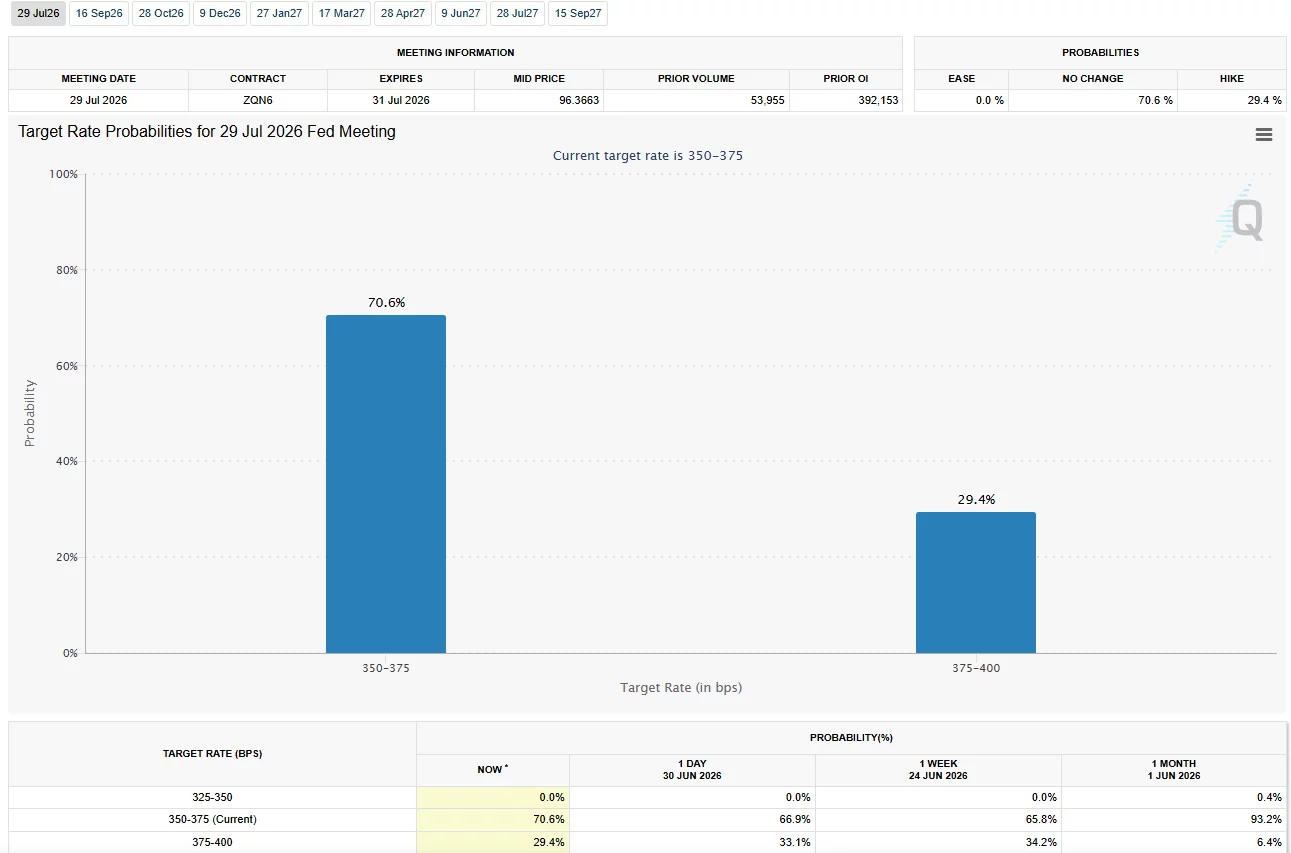
His remarks came as traders largely continued to expect no change in interest rates later this month. According to CME FedWatch data, markets currently assign a 70.6% probability that the Federal Reserve will leave rates unchanged at the July FOMC meeting.
Warsh also addressed inflation, saying expectations had declined during the first four weeks of the recent period despite concerns tied to the U.S.-Iran conflict. He added that inflation risks had eased while reaffirming the Federal Reserve’s commitment to returning inflation to its 2% target.
As crypto.news reported after the June FOMC meeting, Warsh also left rates unchanged at that gathering. Bitcoin fell to around $65,430 following the decision, while Ethereum traded near $1,770. The Federal Reserve’s updated projections at the time showed that nine policymakers expected at least one rate increase before the end of the year.
Those projections have continued to shape market expectations even after Warsh reiterated at the ECB Forum that future policy decisions would depend on incoming economic data.
Rate hike expectations continue to pressure crypto
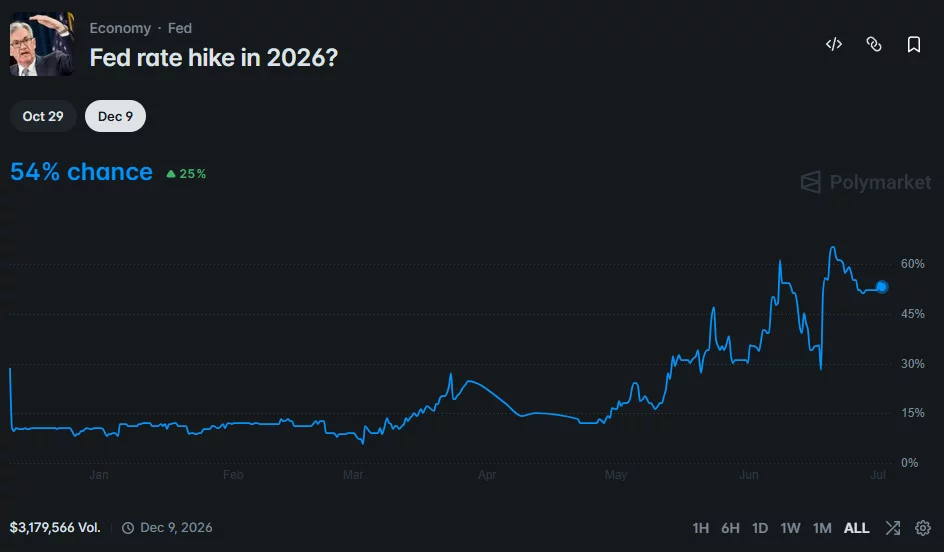
Although traders see little chance of a July rate increase, expectations for additional tightening later this year have not disappeared. According to Polymarket data, there is currently a 54% probability that the Federal Reserve will raise interest rates before the end of 2026.
Higher borrowing costs have generally remained a headwind for cryptocurrencies because elevated interest rates tend to support demand for cash and short-term fixed-income assets over riskier investments such as Bitcoin.
Separate reporting by crypto.news also noted that Morgan Stanley expects the Federal Reserve to keep rates unchanged through the rest of the year. The bank nevertheless warned that rate hikes could return if inflation remains persistent or if the unemployment rate falls further.
Outside monetary policy, another source of uncertainty for Bitcoin has come from corporate supply. As previously reported by crypto.news, the possibility that Strategy could sell as much as $1.25 billion worth of Bitcoin has remained one factor contributing to selling pressure in the market.
Political attention has also stayed on Federal Reserve policy. Before Warsh became chair, President Donald Trump repeatedly called for lower interest rates. After the June decision to keep rates unchanged, however, Trump responded without strong criticism and continued to praise the new Fed chair while receiving no timeline for future rate cuts.


The downgrade marks a sharp reversal from Citi’s previous outlook, which assumed passage of U.S. digital asset market structure legislation would spur adoption among financial advisors and traditional investors. The bank now believes that timeline has slipped, leaving the market without a meaningful catalyst.
Saunders said ETF flows continue to be the main force behind crypto prices, with recent demand turning negative as investors pulled back from risk.
According to the bank’s analyst, sentiment has also been hurt by concerns that digital asset treasury (DAT) companies could become net sellers of bitcoin. Recent corporate actions by Strategy amplified those fears despite involving relatively modest BTC sales.
The report noted that bitcoin and ether both remain below key technical levels, including their 200-day moving averages, while speculative capital has shifted toward AI-related investments.
The bank’s revised forecasts assume flat ETF flows in its base case. In its bull case, stronger retail and institutional adoption lifts bitcoin to $108,000 and ether to $2,932. Its bear case, based on recessionary macro conditions and continued ETF outflows, sees BTC falling to $53,000 and ETH to $1,094.
While the bank’s equity strategists have become more constructive on U.S. stocks, providing some support through crypto’s equity correlation, the report said that positive macro factors are insufficient to offset weakening flows.


A new independent non-profit, Ethereum Institutional, has launched with the goal of accelerating institutional adoption of Ethereum, its layer-2 networks and the broader ecosystem.
The organization is led by David Walsh, Marius Smith and Matthew Dawson. Walsh previously led the Ethereum Foundation’s enterprise efforts, while the organization said its leadership brings experience spanning institutional engagement, capital markets and Ethereum ecosystem development. It said its mission is to provide institutions with a neutral, independent point of contact as they evaluate Ethereum for tokenization, stablecoins and other onchain financial infrastructure.
In announcing the initiative on X, Ethereum Institutional said institutions need “a credible, independent front door” to the Ethereum ecosystem. While Ethereum’s neutrality is one of its defining strengths, the group argued, that neutrality has often left enterprises without a clear organization to engage as they make long-term infrastructure decisions.
The launch comes as the Ethereum Foundation continues to narrow its role to stewarding the core protocol, with ecosystem participants increasingly spinning up independent organizations focused on specific areas such as business development, institutional outreach and developer support. The shift follows broader changes at the foundation, including leadership restructuring and longstanding community calls for greater transparency.


Investment bank Standard Chartered has initiated coverage of Morpho, calling the lending protocol a dual-play on decentralized finance (DeFi) that combines a lending market with infrastructure for onchain banks and asset managers.
The bank has a $60 price target for MORPHO by the end of 2030, implying roughly 33x upside from its current price. This would see the token outperform both bitcoin and ether (ETH) over the same period.
MORPHO was more than 13% higher over 24 hours, trading around $2.13 at publication time.
“Given its status as one of the largest DeFi lending protocols and its comfortable financial position (it just raised $175 million in VC funding), we think Morpho can scale to meet the expanding base of assets deployed in DeFi,” wrote Geoff Kendrick, head of digital assets research at Standard Chartered, in the Wednesday report.
Decentralized finance has rebounded sharply over the past year as institutional interest in tokenized real-world assets and onchain lending accelerated. Lending protocols have benefited from rising stablecoin adoption and renewed demand for crypto credit, while infrastructure providers that enable asset managers and financial institutions to deploy capital onchain have emerged as one of the sector’s fastest-growing segments.


The European Union has completed its MiCA transition, leaving Tether’s $186 billion USDT without a compliant route onto regulated crypto exchanges across the bloc from July 1, 2026.
Summary
- EU MiCA rules have removed USDT from regulated exchanges after Tether chose not to seek authorization.
- Circle’s USDC and EURC are now the leading MiCA-compliant stablecoins across licensed EU platforms.
- Tether remains active through Hadron-powered partners as global USDT markets adjust to regional regulations.
According to the European Union’s Markets in Crypto-Assets (MiCA) framework, the transition period has now ended, requiring regulated crypto platforms to support only compliant stablecoins.
As a result, MiCA-licensed exchanges including Coinbase, Kraken, and Crypto.com have removed USDT trading for European users, ending the stablecoin’s presence on regulated order books despite its position as the world’s largest stablecoin by market capitalization.
Tether rejected MiCA authorization over reserve requirements
Rather than applying for authorization as an electronic money token (EMT), Tether decided not to pursue MiCA approval. CEO Paolo Ardoino previously argued that the regulation’s reserve rules create systemic risk because issuers must keep at least 60% of reserves in European bank deposits.
Tether’s reserve strategy instead relies heavily on U.S. Treasury securities and other globally diversified assets, making the MiCA framework incompatible with its existing model.
The company’s withdrawal from the European market had been unfolding well before the final deadline. Tether discontinued its euro-pegged EURT stablecoin in 2024, while exchange support for USDT gradually disappeared over the following months.
Coinbase Europe delisted the token in December 2024, Crypto.com followed in January 2025, Binance restricted European USDT trading pairs in March 2025, and Kraken first moved users to a sell-only model before later ending support entirely.
Data on MiCA adoption also illustrates how selective the licensing process has been. Before the July 1 deadline, only 244 MiCA licenses had been issued across the European Union, while several crypto companies opted to expand operations from jurisdictions such as Dubai instead of seeking authorization under the bloc’s new framework.
USDC strengthens its position while Tether keeps European partnerships
As Tether stepped away from the licensing process, Circle took the opposite approach by securing an Electronic Money Institution (EMI) license in France. The authorization can be passported across all 27 European Union member states, allowing both USDC and EURC to operate under MiCA. Their compliant status has made them the primary dollar- and euro-backed stablecoins available on licensed European trading platforms.
The transition has also forced liquidity providers to adjust. According to the report, market makers that previously quoted USDT pairs have begun rebuilding liquidity around USDC because regulated exchanges can no longer offer USDT trading within the European Union.
Even so, Tether has not completely exited the region’s digital asset ecosystem. Companies including StablR and Oobit have launched MiCA-compliant stablecoins, EURR and USDR, using Tether’s Hadron tokenization platform, allowing the company to maintain technology partnerships without issuing a MiCA-approved stablecoin itself.
Elsewhere in Europe, 37 banks including BNP Paribas and ING are developing a common euro stablecoin known as Qivalis, according to the report. The project seeks to provide a regulated euro-denominated alternative as financial institutions increase their participation in the digital asset market.
Recent exchange data also points to changing user behavior beyond Europe. As previously reported by crypto.news, Bybit and OKX disclosed higher user Bitcoin holdings in their latest Proof of Reserves reports, while USDT balances declined on both platforms, suggesting some users are holding less stablecoin liquidity.
In a separate crypto.news report, India’s USDT premium climbed above 8.5% after enforcement action against crypto remittance firms disrupted domestic supplies of the stablecoin, highlighting how regional regulations continue to reshape USDT markets in different ways.

Key Highlights
-
Security Matters shares advanced 6.90% following increased interest in its verification technology.
-
The company’s digital passport system connects plastic materials with authenticated documentation.
-
Stricter U.S. recycling regulations are driving demand for robust verification infrastructure.
-
Security Matters focuses on supply-chain transparency, regulatory compliance, and material authentication.
-
Authenticated recycled plastics could achieve competitive parity with virgin materials.
Security Matters (SMX) stock advanced 6.90% to reach $14.33 following the opening bell, driven by heightened interest in its recycling authentication technology. The stock experienced early gains, softened briefly, then held steady near peak levels. This movement came as investors focused on the company’s material verification platform and evolving U.S. recycling regulations.
SMX (Security Matters) Public Limited Company, SMX
Security Matters Advances Recycling Authentication Technology
SMX has centered its business model on verification-driven recycling rather than general environmental messaging. The company’s Digital Material Passport Platform creates connections between physical plastics and protected digital documentation. Consequently, plastic materials can carry information about source, composition, handling history, lifecycle phase, and regulatory alignment.
The firm employs molecular tagging to establish permanent material identification. This methodology enables brands, producers, and oversight bodies to authenticate recycled plastic throughout every phase. Recycled components can progress through distribution networks supported by enhanced documentation and transparent oversight.
Growing media coverage has elevated Security Matters’ visibility within the recycling technology sector. Numerous prominent publications featured its contributions to plastic authentication and data-driven environmental solutions. The organization’s primary emphasis continues to center on regulatory alignment, supply-chain transparency, and quantifiable recycling results.
Tightening U.S. Regulations Drive Verification System Adoption
The American recycling sector has transitioned toward more rigorous verification requirements. Individual states persistently broaden regulations covering recycled content mandates, collection programs, and producer responsibility frameworks. Consequently, organizations require more definitive documentation when reporting or substantiating environmental commitments.
Corporations encounter intensified oversight as regulatory authorities examine sustainability assertions more thoroughly. Producers require validated information before establishing pricing, purchasing, funding, or disclosing recycled material usage. Municipal governments demand stronger confirmation that collected plastics return to beneficial applications.
SMX addresses this requirement through authentication systems, passport documentation, and compliance-oriented analytics. The platform facilitates recycled-content validation, custody chain records, origin tracking, and lifecycle reporting. Collectively, these capabilities transform scattered recycling assertions into organized datasets.
Security Matters Connects Material Documentation With Market Value
Security Matters’ operational reach extends nationally and touches multiple recycling system components. The organization integrates physical marking, digital documentation, compliance analytics, and marketplace functionality. Accordingly, the platform can facilitate sourcing, capital access, plastic credit systems, and brand authentication.
The firm additionally advances its Plastic Cycle Token and recycled plastic registry framework. These instruments seek to align validated recycling operations with quantifiable financial value. Subsequently, certified materials can compete more effectively against virgin feedstock.
SMX has articulated this transformation through its Age of Parity initiative. The initiative contends that authenticated recycled plastic can emerge as a viable economic alternative. As supply constraints and regulatory pressure intensify, Security Matters presents its verification platform as essential recycling infrastructure.


“Large groups of large companies coordinate poorly, have misaligned incentives, slow things down and rarely create the space for real durable innovation,” he wrote.
Test for the consortium model
That skepticism is shared by Lorenzo Valente, director of digital asset research at ARK Invest, who noted that crypto has seen several consortium-backed stablecoin initiatives over the years, including Meta’s Diem project and Paxos-led Global Dollar Network.
“Every year we get our consortium-style initiative around a stablecoin,” Valente wrote in an X post. “While the set of players here is obviously potent, I remain highly skeptical any of these initiatives can hit scale.”
He said Open Standard’s biggest challenge may be coordinating more than 140 participants with competing interests.
“A consortium of hundreds of rivals has no precedent for working,” he said. “The pace of decision-making across competitors is going to be glacial.”
Valente likened the model to decentralized autonomous organizations, or DAOs, whose governance structures often struggled to make timely decisions.
“‘Owned by everyone’ almost always means accountable to no one,” he said. “I’d bet on the two operators who can ship unilaterally over a committee that has to ask hundreds of rivals for permission.”
He also questioned whether large banks, payment networks and technology companies would remain committed if the project encounters regulatory pressure. Circle and Tether, he noted, have spent years building global regulatory infrastructure and licensing, while a consortium could find it harder to stay aligned if conditions become more challenging.

Cuts of beef are displayed at Handy Market on May 14, 2026 in Burbank, California.
Justin Sullivan | Getty Images
With oil and gas prices falling in the wake of the detente between the U.S. and Iran, prediction market traders now think inflation has peaked.
Speculators on prediction market platform Kalshi think there’s only a 28% chance that headline inflation this year peaks above 4.2%, which was the annual rate of increase in the Consumer Price Index in May.
The next CPI report, measuring inflation in June, is due for release by the Bureau of Labor Statistics (BLS) on July 14.
The contract on Kalshi asks if traders think CPI will deliver a reading above various percentages in 2026. Contracts are resolved using the CPI data released each month by the BLS.
The inflation outlook has eased primarily due to recent declines in its main driver: energy prices. After shooting higher after the start of the U.S.-Iran war jn late February and the subsequent closure of the Strait of Hormuz, gas and oil prices have started to retreat after the partial reopening of the waterway.
Average national gasoline prices as of Wednesday stood at $3.84, according to AAA, down from more than $4.50 at their peak. That reflects weaker U.S. crude oil prices, which have fallen below $70 per barrel for the first time since the war began.
Energy prices in May accounted for 60% of CPI’s month-over-month increase.
Now the decline in gas prices is leading Kalshi traders to think that CPI in June will show prices falling by 0.2% compared with May, in-line with Wall Street consensus estimates.

Danny Glover Reveals He Has Alzheimer’s Disease in Emotional Interview Just Weeks Before His 80th Birthday

Prices of tokenized Google stock inflated 7,700% in rare DeFi lending exploit

Why traditional email security is no longer enough





-

 Fashion5 days ago
Weekend Open Thread: Staud – Corporette.com
-

 Politics5 days ago
The House | Manchesterism won’t survive the painful trade-offs unless it gets citizens on board
-

 Crypto World2 days ago
Strategy authorizes up to $1.25B in Bitcoin sales under new capital plan
-

 Politics6 days ago
Potential 2028er World Cup attendee leaderboard
-

 Business5 days ago
Asia stock markets slide as tech shares slump
-

 News Videos3 days ago
MAJOR BITCOIN & MARKET UPDATE!!!! (MUST WATCH ASAP!!!)
-

 Tech6 days ago
A Look At A Gaggle Of Transputer Boards
-
 Crypto World6 days ago
Dell (DELL) Shares Tumble Over 5% Following Analyst Downgrade to Hold
-

 Crypto World4 days ago
Coinbase, Circle Deepen Crypto Stock Losses Despite Resilient S&P 500
-

 Business2 days ago
Australia treasurer says alleged access of prime minister’s bank data ’incredibly concerning’
-

 Crypto World5 days ago
Kraken's xStocks Opens Bending Spoons IPO Registration to EEA Retail
-

 Sports5 days ago
FIH Pro League: India defeat Pakistan 7-1, register biggest win of campaign | Other Sports News
-

 Crypto World6 days ago
Bitcoin Sparks $600M Hourly Liquidations With $65,000 Set To Become Resistance
-

 Tech4 days ago
Bluekit phishing kit adopts browser-in-the-middle for login theft
-

 Tech4 days ago
Russian hackers now target Signal backup recovery keys
-
Crypto World5 days ago
Hyperliquid Named on Singapore MAS Investor Alert Register
-

 Crypto World5 days ago
RTX holders must register wallets before token distribution begins
-

 Crypto World7 days ago
Ripple and SBI launch RLUSD in Japan after JFSA approval
-

 Tech2 days ago
Anonymous researcher drops 0-day ‘exploitarium’ repo
-

 Sports4 hours ago
Broncos roster: OL Ben Powers (No. 74) entering final year of contract
You must be logged in to post a comment Login