
Crypto World
In conversation with Inteliumlaw’s Elena Sadovskaya

Disclosure: This article does not represent investment advice. The content and materials featured on this page are for educational purposes only.
Elena Sadovskaya reflects on how experience and shifting crypto regulation shape Inteliumlaw’s hands-on, long-term legal approach.
Summary
- Elena’s early experience at a Big Four firm shaped a practical, hands-on approach to complex cross-border structuring and high-stakes regulatory work.
- Inteliumlaw’s growth has been driven by MiCA-era demand, with CASP licensing and EU-compliant token listings becoming core client needs in 2025.
- Elena sees crypto’s future defined by adaptation: firms that treat regulation as a strategic framework, not an obstacle, are the ones built to last.
Navigating international business structuring in today’s regulatory climate is rarely straightforward, especially for companies operating across borders and emerging sectors like crypto. To better understand how legal professionals approach this complexity in practice, we spoke to Inteliumlaw’s Elena Sadovskaya about how her early experience studying law and later working at Ernst & Young shaped her thinking. Here’s what she had to say.
Hi Elena! Can you share with us how your experience practicing law during the 2nd year of university and later working at a firm like Ernst & Young influenced the way you approach complex international business structuring today?
Elena: Spending almost 4 years at a Big 4 company, Ernst & Young (E&Y), has truly felt like the equivalent of a whole 10 years at most other consulting firms. During this period, I frequently managed multiple tax and transaction structuring projects in parallel for major international clients across a range of industries. Every time it was working with significant deals, large transactions, and high-profile cases, which all allowed me to develop a strong grasp of how large businesses work and what their legal needs are. Most importantly, however, it all sharpened my understanding of how lawyers can guide them through different situations – be it shifting laws at home base, international scaling, heightened regulator attention, or other complex challenges – with tailored solutions.
Now, for Inteliumlaw, neither “impossible” nor “unresolved” cases are part of our vocabulary. With hands-on experience as lawyers for major firms and high-profile cases, we have the necessary know-how to provide robust support for enterprises and also help small businesses eventually grow into larger organizations.
At Inteliumlaw, we uphold the highest standards of work in everything we do, based on our experience with large, sophisticated businesses and a clear understanding of the level of quality they expect and shall get from legal advisers. A core part of these standards is a genuinely responsive attitude to projects we work with, where my overtime experience at E&Y showed how far a law firm must go so that the project gets the desired quality. Today, this enables us to effectively advise on complex international business structuring and other critical legal matters.
In a recent big interview, you shared that Inteliumlaw grew from a small circle of experts to a full-fledged law firm specializing in crypto licensing and other blockchain legal services. What new services or solutions did you introduce in 2025? Which ones have become “bestsellers” among your clients in crypto?
Elena: Last year was extremely fast-paced for all of us at Inteliumlaw. As regulations continued to evolve, we expanded and diversified our legal solutions to meet the demands of modern businesses.
For the crypto sector, we introduced an opportunity to obtain a CASP license in a select few jurisdictions like Poland, the Czech Republic, Lithuania, Cyprus, and beyond. These countries’ licensing conditions went through our rigorous internal analysis and were deemed the most favorable and relevant after MiCA entered into force and replaced the legacy VASP license. In parallel, our scope has expanded to include DAO structuring in the Marshall Islands and RAK, a foundation in Panama, alongside securing a crypto license in UAE (Dubai, VARA), El Salvador, and other markets where a VASP license currently presents a meaningful opportunity. Our website is being gradually updated to reflect the complete range of services we can support you with.
When it comes to “best sellers,” it is hard to highlight something in particular as the answer largely lies in regulatory development, including newly emerged regimes, shifts in current rules, and the scale of adaptation expected from businesses. This year, it was all centered around Markets in Crypto-Assets (MiCA) regulation, and our main focus was assisting firms to adapt to this new reality. Now, Inteliumlaw advises firms on getting a CASP license and delivers end-to-end MiCA-relevant support for token issuance, exchange listings, DeFi project launch, and the preparation of MiCA-compliant white papers and the notification submission process.
Therefore, I could say that our 2025 best-seller request was securing a CASP license and listing a token in Europe with MICA-compliant white papers, where we provide end-to-end, hands-on support through every stage of the process.
Your firm positions itself as a long-term strategic partner rather than a traditional legal service provider. How do you maintain that level of involvement with clients?
Elena: What we do is not just some careless execution of the client order made on autopilot. Rather, every Inteliumlaw client receives a customized approach designed to serve their interests in the most effective way. Our goal is to build long-term relationships with our clients, not driven by “capitalist motives,” but because this is the only way we can always stay on top of their current needs and help them grow a business that will sustain in the long term. When our clients grow, so do we.
As part of our customised approach, we ensure every client has a dedicated manager for their project from day one. In this case, they always have a point of contact who coordinates the project and maintains a 24/7 insight into the client’s status and needs, allowing us to offer the right legal solution.
When maintaining continuous involvement with the client and their needs, for instance, our lawyers continuously analyze the regulations in their home base and in their target expansion markets, helping identify what they might be exposed to early, help them adapt, and advise on the alternatives if needed. Most importantly, we do not walk away when the stakes rise and never leave clients in complex cases, but are actively engaged in finding the best possible solution for them. It makes our life a little bit more complicated compared to other law firms, but it is a principle we do not compromise on.
Many crypto entrepreneurs feel that regulation kills innovation. From your perspective, is this a fair statement? What is your opinion?
Elena: In many cases, yes, though it highly depends on the jurisdiction and its regulation, where the “killing innovation” narrative often stems from authorities imposing unrealistic expectations that far outpace current realities. In some cases, regulators could have opted for a less strict approach to some aspects, which would ultimately lead to minimized conflict and a slower pace of innovation and new projects’ development.
On the other side, without regulation as it is, projects cannot exist. Yet, reacting promptly to different changes can keep the project stable and demonstrate credibility to the market. In practice, the strongest players on the market today are those who are able to adapt to the regulatory expectations; this is what defines the long-term sustainability and how a project gains trust from customers.
An unregulated industry certainly equals much more space for projects that are not reliable. So the ultimate question here is to strike a balance, a “golden mean,” which, in most cases, simply doesn’t exist, making businesses’ lives more complicated.
When a new crypto business approaches you with a request, what are the first questions you ask before even talking about jurisdictions, licenses, or other legal support?
Elena: The very first thing we discuss before everything is each project’s operational model and details of how they function, ensuring we understand the business almost as if we are the one and only founder. This is the foundation of everything: from jurisdiction-based classification of their project and the subsequent regulations applicable to which legal solution(s) we can deliver to best fit the project’s needs.
Luxury ateliers never proceed to manufacturing a tailored suit without taking precise measurements. Our approach is no different. Based on the client’s near- and long-term goals, vision, and the detailed specifics of their work, we advise on the solutions that best match their needs.
Without clear, detailed answers upfront, any discussion of how we can assist would be irrelevant. A minor oversight of a tiny detail can make a tailored suit feel suffocating. Likewise, a small nuance can completely change the course and redefine what the right solution looks like.
How do you evaluate which crypto license is optimal for a client’s business model? Especially, how does this process go for choosing an EU jurisdiction for getting a CASP license?
Elena: Long before the client reaches out, a preliminary analysis has typically been made internally. Every jurisdiction is carefully reviewed for the requirements and the regulator’s approach to issuing licenses, so we understand the level of complexity involved and identify which businesses are most likely to pass through the process.
When the client approaches us, we carry out an in-depth analysis of their setup and objectives. We explore token issuance plans, targeted markets for expansion, where the team is located, and a lot more to shape a compliant strategy. Only after assessing licensing complexity, the client’s objectives, and the budget allocated to ongoing compliance can we recommend the most suitable alternative.
MiCA has completely reshaped how crypto businesses must operate in Europe. What is the biggest misconception companies still have about this regulation?
Elena: Working with crypto firms worldwide – including those already serving EU clients or planning to enter the market – I see one misconception more than any other: many still misunderstand the difference between a VASP and a CASP, assuming they can still onboard EU customers without securing the new authorization. This is especially the case with firms registered in offshore regimes with little oversight. In fact, they can’t.
This misconception is similarly prevalent among companies previously having VASP in Poland and other EU countries. Where firms were not prepared to meet higher requirements beyond their “light-touch” setup, it is becoming hard to adapt to substance requirements, organize client workflows, and develop comprehensive documentation. For businesses already operating in tightly regulated regimes, the transition is typically smoother.
So, I would say the biggest myth now is that a business can still operate as before, targeting Europe while being registered in an unregulated jurisdiction or one known for little oversight. These times are now officially over. Even more concerning is that, in 2026, some still believe crypto is unregulated; it is regulated.
In a recent interview, you called the UAE “one of the most promising global hubs for crypto and Web.” What specific regulatory or economic features give the UAE an edge over Europe or the US?
Elena: What makes them different is their vast resources, readiness, and willingness to invest substantially in the crypto sector, all with the focus on innovation. The UAE is home to lots of corporations with a significant appetite to invest and lead in crypto, which is why there is a consistent effort to shape a regulatory environment that accelerates growth.
The UAE’s approach is truly something unique now. Where Europe tries to follow US standards with an even more stringent rule, the UAE chooses a more liberal option and approaches it more like an opportunity to strengthen the economy. The EU treats crypto much like early societies treated fire: extremely dangerous without control. That’s why the regulation is made to avoid fraud, protect customers, and reduce the room for unreliable projects.
The UAE, on the other hand, is not afraid to introduce something new. It is therefore unsurprising that they have higher adoption rates, new solutions appear faster, and central bank digital coins are being adopted much sooner than anywhere else in the world.
Imagine you can design a new “ideal” crypto jurisdiction by combining elements of 3 already-existing regimes, which would you select and why?
Elena: There is no real need to merge 3 regimes when we can choose one framework as the core and make small adjustments.
In essence, the ideal crypto jurisdiction would match the UAE innovation-first model while offering a less complex procedure to roll out in the region(s). The process of issuing authorization permits (licenses) and understanding projects’ specifics is way too overwhelming now in the UAE. Even so, however, the select few who successfully make it through the process – often after months of waiting for the regulator’s feedback, sometimes only for minor clarifications – ultimately gain access to everything the jurisdiction has to offer.
Subsequently, rationalizing this process to the extent possible would materially strengthen the jurisdiction’s reputation as a crypto-friendly hub, making it the #1 or very close to this status.
In your experience, what are the most underestimated risks when crypto businesses operate “non-compliant but profitable,” beyond fines and license revocation?
Elena: It all comes down to the severity of non-compliance. On the administrative level, there are fines of different sizes and, in the worst cases, license revocations. Yet this is not the greatest fear of most businesses.
The most horrifying skeleton in the closet is when a case turns to criminal law, and the impact goes beyond the project finances to human lives. There are numerous high-profile cases where exchange executives are arrested and prosecuted for money laundering, and this is precisely what everyone wants to avoid.
We’ve learned that you’ve designed over 50 tax-efficient and future-proof structures while also supporting multimillion-dollar deals. Which projects are you the most proud of and why?
Elena: It’s honestly difficult to single out just one project, because every structure we design at Inteliumlaw is built around a very specific business and risk profile. Each of them is its own story, and behind every “successful structure” there are months of very detailed, customized legal, tax, and regulatory work.
That said, I’m especially proud of the projects where we supported businesses from a very early stage and further during their growth into well-known brands. There’s something very rewarding about knowing you didn’t just advise on a structure but helped build the strong legal foundation that allowed the company to scale safely.
In the crypto and web3 space specifically, we’ve worked on a wide range of complex matters: from tokenization of real-world assets (including immovable property) and structuring decentralized exchange and trading infrastructure projects to token issuance and token classification, governance models, and cross-border tax and corporate setups for founders and groups. We’ve also supported projects building trading terminals, platforms, and hybrid web2/web3 models.
What I’m most proud of is not just the number of structures we’ve built, but the fact that many of them were designed to be “future-proof.”
And lastly, what regulatory developments in crypto do you anticipate in 2026? Most importantly, do you think the primary regulatory risk for crypto firms will come from new laws or from aggressive reinterpretation of rules that already exist today?
Elena: 2026 will be a very important year for regulatory consolidation in crypto, especially in Europe. First of all, we expect the expiration of the MiCA grandfathering period around mid-2026, which will force many existing VASP-style structures to either become fully licensed CASPs or exit the market. In practice, this will mean a major clean-up of the industry, with higher compliance costs but also a much clearer regulatory perimeter for serious players.
At the same time, we expect increasing global pressure on so-called “regulatory gap” jurisdictions. Many offshore and semi-offshore hubs that historically served crypto businesses precisely because of lighter regulation will likely introduce more formal crypto frameworks, licensing regimes, and substance requirements. We’re already seeing the early stages of this trend.
On the structural side, I think we’ll see more legally recognized DAOs and on-chain governance models entering the mainstream. But in parallel, decentralized and hybrid web3 projects will continue to move under closer regulatory scrutiny, especially where there is any element of custody, intermediation, token distribution, or profit expectation.
As for regulatory risk, it will likely come from both sides: new laws and aggressive reinterpretation of existing rules. In practice, enforcement and re-qualification under existing financial, securities, AML, and consumer protection regimes may be just as disruptive as brand-new legislation. The industry is maturing, but companies should plan for a tougher, more enforcement-driven environment in the near term.
Disclosure: This content is provided by a third party. Neither crypto.news nor the author of this article endorses any product mentioned on this page. Users should conduct their own research before taking any action related to the company.

The US dollar is retreating from recent highs, moving into a moderate correction after a prolonged period of gains. Pressure on the currency is building amid weaker-than-expected macroeconomic data, while market participants adopt a wait-and-see approach ahead of key labour market releases, including the ADP report.
The current dynamics reflect a gradual cooling in expectations regarding the resilience of the US economy. Recently published indicators point to a slowdown in business activity and easing labour market tightness, reducing support for the dollar after it reached local highs. At the same time, upcoming releases remain a key factor that could either reinforce the corrective move or restore demand for the US currency.
Among the published figures, investors focused on mixed US macro data. The Chicago PMI fell to 52.8 versus expectations of 54.8, signalling a slowdown in the manufacturing sector. In addition, JOLTS job openings came in below forecasts (6.882 million vs 7.240 million), indicating a gradual cooling in the labour market. Further pressure came from regional business activity indices, including data from the Dallas Fed, which reinforced doubts about the sustainability of the current economic momentum.
USD/JPY
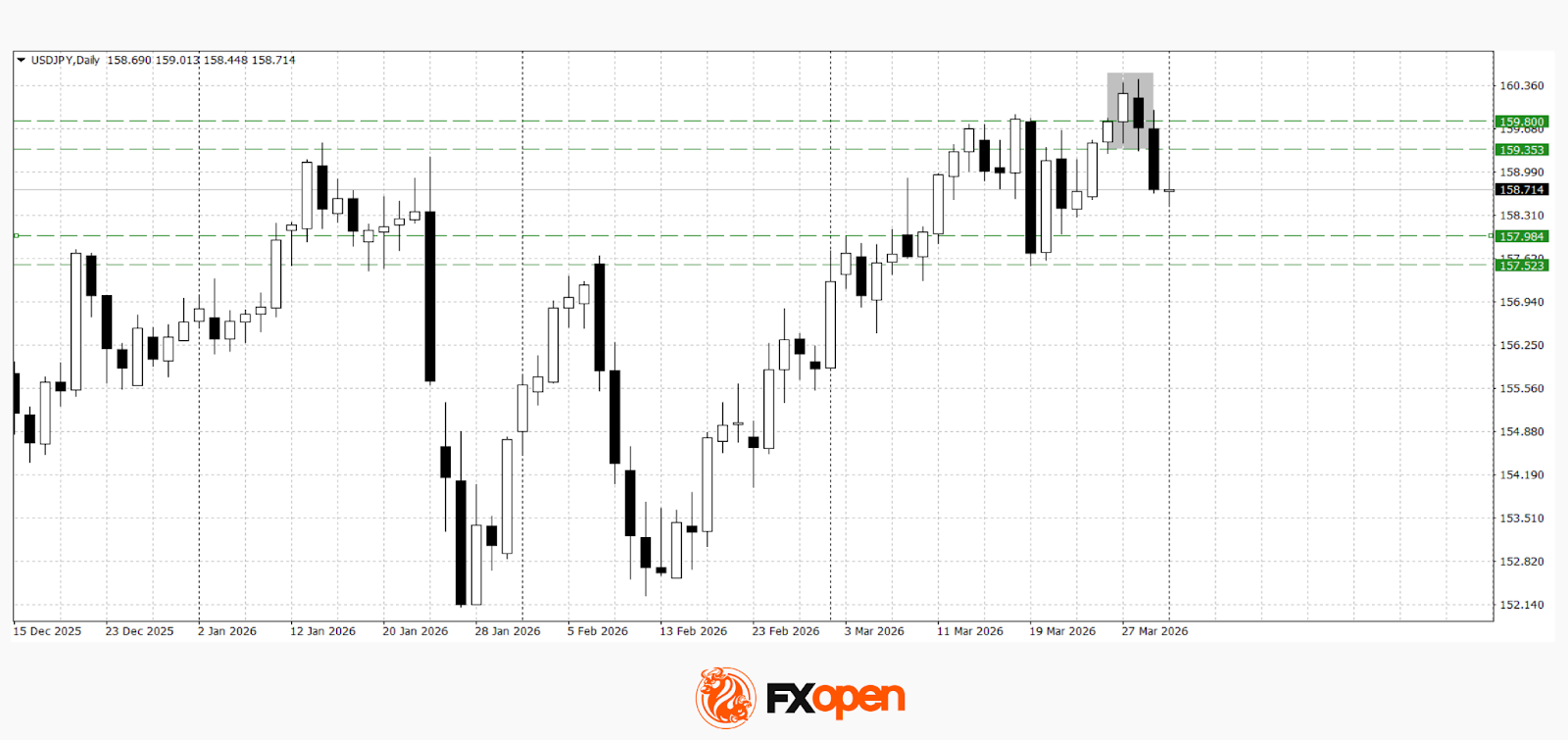
After reaching fresh yearly highs and testing the psychological 160.00 level, USD/JPY has moved lower, forming a corrective pullback. Technical analysis suggests a potential decline towards the 157.50–158.00 area, as a dark cloud cover pattern has formed on the daily timeframe.
If the price consolidates above the 159.40–159.80 range, the bearish correction scenario may be invalidated.
Key events for USD/JPY:
- today at 15:15 (GMT+3): US ADP non-farm employment change
- today at 15:30 (GMT+3): US core retail sales
- today at 16:45 (GMT+3): US manufacturing PMI
USD/CAD
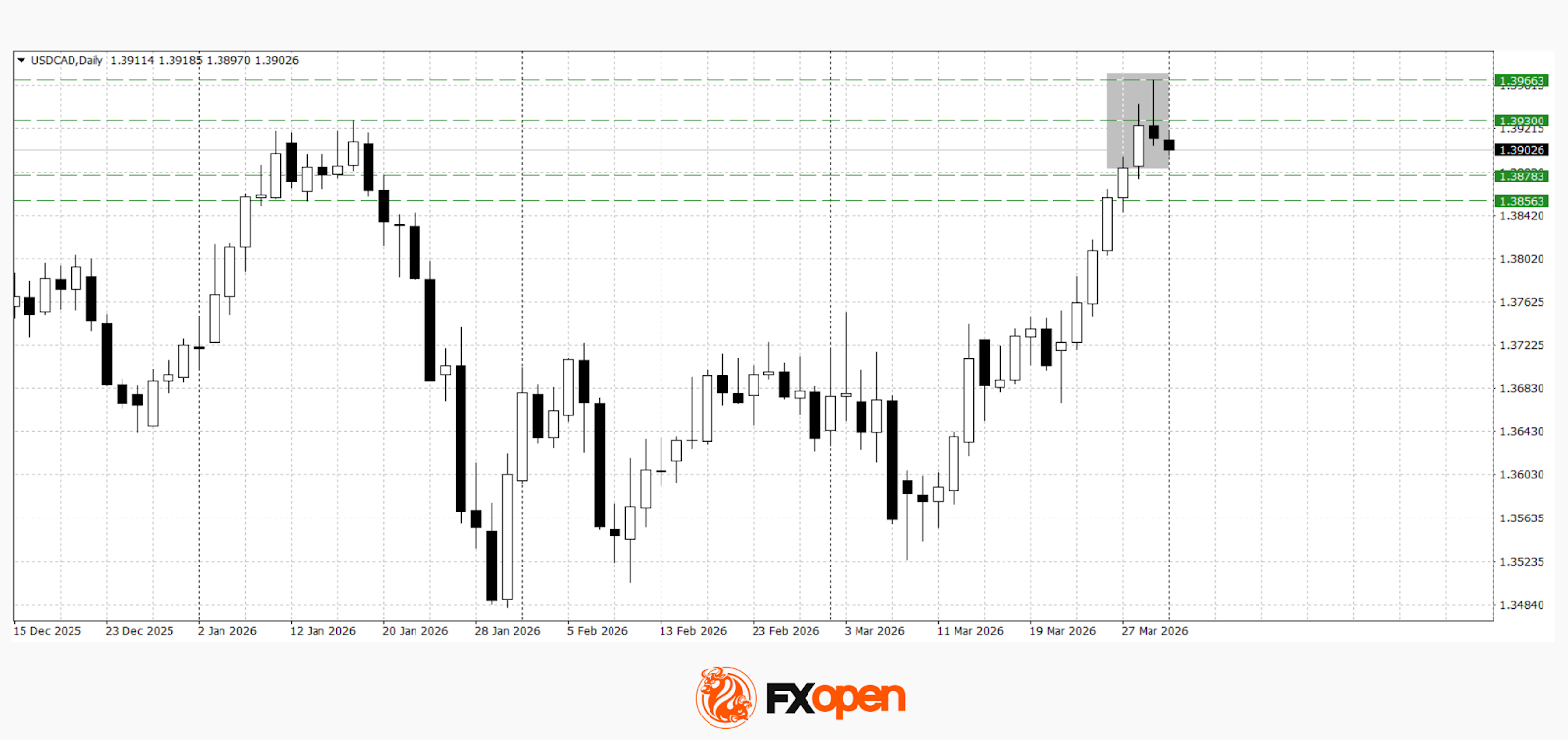
USD/CAD is also showing a pullback from local highs following a strong rally. The formation of an Evening Star pattern near the 1.3930 level indicates a slowdown in bullish momentum and the potential for a correction towards 1.3860–1.3880.
At the same time, a move above 1.3970 could support a resumption of the uptrend and the formation of a new bullish impulse.
Key events for USD/CAD:
- today at 16:30 (GMT+3): Canada manufacturing PMI
- today at 17:30 (GMT+3): US crude oil inventories
- today at 18:30 (GMT+3): Atlanta Fed GDPNow indicator
Trade over 50 forex markets 24 hours a day with FXOpen. Take advantage of low commissions, deep liquidity, and spreads from 0.0 pips (additional fees may apply). Open your FXOpen account now or learn more about trading forex with FXOpen.
This article represents the opinion of the Companies operating under the FXOpen brand only. It is not to be construed as an offer, solicitation, or recommendation with respect to products and services provided by the Companies operating under the FXOpen brand, nor is it to be considered financial advice.
Key Takeaways
- Samsung and SK Hynix shares surged 10–13% Wednesday following significant March declines
- South Korea’s KOSPI index rallied more than 8%, bouncing back from a 19%+ monthly decline
- Optimism around a potential Middle East conflict resolution improved market sentiment
- The semiconductor giants had plunged 23–24% in March amid geopolitical concerns and AI memory chip demand uncertainty
- Overnight gains on Wall Street, spurred by President Trump’s Iran statements, provided momentum
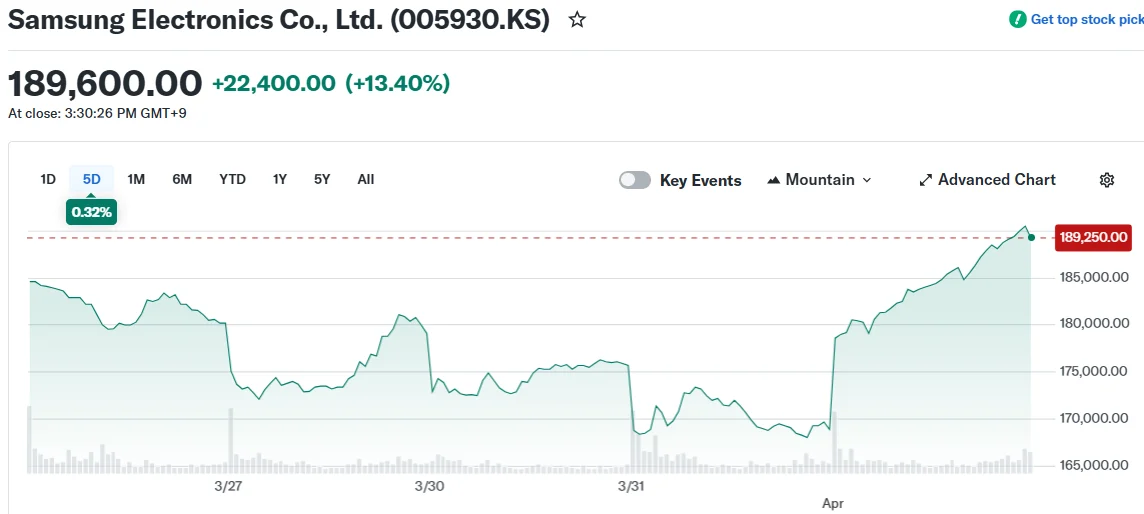
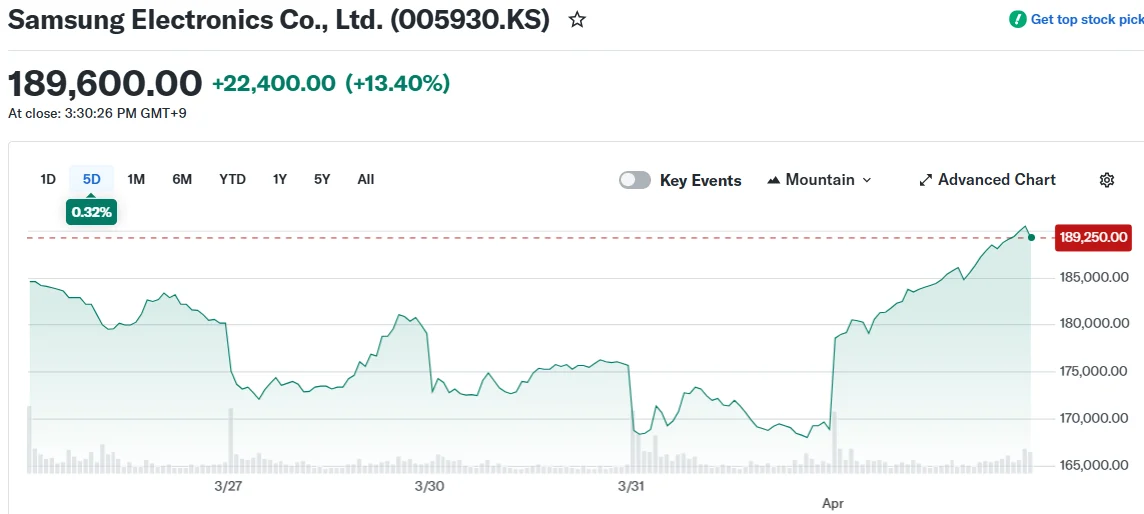
Shares of Samsung Electronics surged 13% to reach 189,600 won during Wednesday’s trading session, while SK Hynix climbed approximately 11% to 893,000 won. The dramatic recovery followed a punishing March for both semiconductor manufacturers.
South Korea’s benchmark KOSPI index jumped 8.4% to close at 5,478.70, with the semiconductor sector rebound providing substantial support. The index had tumbled more than 19% during March.
The two technology giants each lost approximately 23–24% of their value last month. Investor anxiety centered on the escalating Middle East situation, which threatened to increase manufacturing expenses and disrupt global supply networks.
Additional pressure emerged from questions surrounding sustained demand for memory semiconductors utilized in artificial intelligence applications. Google‘s introduction of an algorithm reportedly capable of reducing AI memory needs added to sector headwinds.
Speculation intensified that memory chip pricing could weaken after OpenAI implemented cost-cutting measures. The artificial intelligence company discontinued its video generation platform, Sora, as part of broader budget reductions.
Strategic OpenAI Partnership Under Spotlight
Toward the end of 2025, OpenAI entered into an agreement with Samsung and SK Hynix for the procurement of 900,000 DRAM wafers from the Korean manufacturers. This partnership had previously fueled investor enthusiasm for both companies.
Both semiconductor producers had enjoyed rising memory chip valuations throughout late 2025, supported by expectations that AI-driven demand would exceed available supply. March’s correction erased portions of those earlier advances.
Kiwoom Securities analyst Han Ji-young attributed Wednesday’s rally to value-oriented purchasing, noting that blue-chip stocks had declined sufficiently to entice investors back into the market.
“The stock market is highly likely to enter a recovery phase rather than experience further decline,” Han stated in client communications.
Peace Prospects in Middle East Boost Market Confidence
Market sentiment strengthened following President Trump’s Tuesday statement indicating the United States would withdraw from Iran within a two to three-week timeframe. The President delivered these remarks during a White House press availability.
Iranian President Masoud Pezeshkian indicated Tehran’s willingness to conclude hostilities, though he requested certain unspecified assurances.
These diplomatic developments triggered an overnight rally across U.S. markets, with the positive momentum extending into Asian trading sessions Wednesday.
Samsung shares concluded trading at 189,600 won, approximately $125.83 in U.S. dollar terms. SK Hynix finished at 893,000 won.
The KOSPI index settled at 5,478.70, representing an 8.4% single-day advance.
Despite Wednesday’s gains, both Samsung and SK Hynix continue trading substantially below their pre-March levels.

Crypto World
Uniswap Foundation Reports $85.8M in Total Assets for FY2025, Runway Extends to January 2027

TLDR:
- The Uniswap Foundation held $49.9M in cash and stablecoins alongside 15.1M UNI tokens at year-end 2025.
- A total of $106.2M was allocated toward grants and incentives, covering both new and prior commitments.
- The Foundation committed $26M in new grants throughout FY2025 and disbursed $11M from prior commitments.
- The UNIfication governance proposal, approved December 26, 2025, will reshape financial projections in Q1 2026.
The Uniswap Foundation published its unaudited financial summary for fiscal year 2025 on March 31. The report covers the organization’s financial position through December 31, 2025.
It projects an operational runway through January 2027. Total assets stood at $85.8 million at year-end market prices.
This includes $49.9 million in cash and stablecoins, 15.1 million UNI tokens, and 240 ETH. The report also precedes structural changes tied to the UNIfication governance proposal, approved on December 26, 2025.
Asset Holdings and Fund Allocation
The Foundation held three categories of assets as of year-end 2025. Cash and stablecoins totaled $49.9 million, while 15.1 million UNI tokens and 240 ETH were also on hand. Together, these assets represented $85.8 million in total market value at closing rates.
Of the total earmarked funds, $106.2 million was allocated toward grants and incentives. This breaks down into $87.5 million for new grant commitments in the future. An additional $18.7 million was reserved for previously committed grants still awaiting disbursement.
Beyond grants, $26.3 million was set aside for operating expenses and employee token awards. These two budget lines cover the Foundation’s staffing, administration, and token compensation. They reflect planned spending across its core operational functions.
The fiat and stablecoin reserves were designated primarily for grantmaking and day-to-day operations. UNI token reserves, however, were held to support future runway needs. This approach allowed the Uniswap Foundation to retain upside exposure to UNI’s market performance over time.
The projected spend figures are set to be updated in the Q1 2026 financial report. That update will reflect changes following the UNification proposal’s approval on December 26, 2025. Organizational shifts post-passage are expected to revise the foundation’s financial outlook going forward.
FY2025 Grant Activity and Ecosystem Milestones
Throughout FY2025, the Uniswap Foundation committed $26 million in new grants to ecosystem projects. It also disbursed $11 million from previously committed grants across the year. In Q4 2025 alone, $5.8 million in new grants were committed.
Q4 2025 disbursements reached $2.1 million from prior commitments. These funds went toward builders and developers operating across the broader ecosystem. Grant activity remained steady throughout all four quarters of the year.
On the operational side, the Foundation accrued $9.7 million in operating expenses for FY2025. Employee token awards of 0.45 million UNI were excluded from that figure. Interest revenue on fiat holdings contributed an additional $1.7 million to the organization’s income.
The Foundation also received 20.3 million UNI tokens from the Uniswap Treasury via the Uniswap Unleashed Proposal. At year-end prices, this transfer equaled approximately $114 million in market value. This inflow added materially to the Foundation’s overall reserve position during 2025.
Key milestones in 2025 included the launch of Uniswap v4 and Unichain. More than 1,500 builders onboarded to v4 during the calendar year.
These developments supported the organization’s ongoing commitment to expanding decentralized finance infrastructure.
Crypto is pseudonymous – a halfway house between anonymous and public.
While you don’t need to expose your identity to open a crypto wallet, public blockchains leave a visible record of your activity for all to see.
A single withdrawal from a KYC exchange can link your real name to a wallet, and once that wallet is tied to your identity, anyone can trace the rest of your on-chain activity.
This is why, as on-chain analysis tools become more widely used, many users are paying closer attention to what financial privacy actually means in crypto.
Mixero was built around this issue. The platform focuses on helping users protect their transaction history while remaining in a decentralized environment.
Public Blockchains Make Wallet Activity Easy to Follow
At the center of Mixero’s service is CoinJoin, a method used to combine transactions in a way which makes blockchain analysis far more difficult.
Rather than sending funds through a direct and easily traceable path, CoinJoin helps obscure the relationship between sender and recipient. This is Mixero’s core solution for Bitcoin users who want stronger privacy without stepping outside the asset itself.
The company argues that privacy has become an important part of using crypto in a mature way. On public ledgers, transaction histories can reveal far more than a single payment. They can expose balances, spending patterns, wallet links, and long-term activity. This can become a serious concern for users who value financial discretion.
Mixero’s platform is designed to keep the process simple. Users can enter one or several destination BTC addresses, adjust settings, receive a signed Letter of Guarantee, and track the order through a status page.
The service is also available through Tor, while Mixero says it keeps no logs of user activity.
Advanced Mode Uses Monero for Deeper Privacy
For users who want a higher level of protection, Mixero offers Advanced Mode. This feature routes transactions through Monero before returning them to Bitcoin. The process works through an XMR bridge and automatically generated wallets, giving users access to the strongest privacy option Mixero offers.
Monero uses built-in privacy technologies such as stealth addresses, ring signatures, and RingCT to conceal transaction details. These tools are designed to hide the sender, receiver, and amount involved in a transfer, which makes Monero one of the most privacy-focused networks in the market.
By routing Bitcoin through Monero and back again, Mixero gives users a way to get stronger privacy without leaving BTC behind at the end. It is aimed at people who want more cover than
About Mixero
Mixero is a privacy-focused crypto service built for users who want stronger transaction privacy on public blockchains. The platform offers CoinJoin-based Bitcoin mixing, Tor access, signed Letters of Guarantee, and an Advanced Mode which routes transactions through Monero for deeper anonymity. Designed for users who value discretion in an increasingly transparent on-chain environment, Mixero aims to make privacy tools more accessible without sacrificing ease of use. Its service is focused on helping users reduce the visibility of their transaction history while staying within the crypto ecosystem.
The post Mixero Pushes for Real Privacy on Public Blockchains appeared first on BeInCrypto.

Solana is holding its breath, trading at the $84 price level, it is barely moving with just 1% gain in the last 24 hours, as opposed to BTC 2.4% gain and ETH 4.5%, even with bullish catalysts that bring a good prediction. Institutional heavyweights Interactive Brokers and Galaxy Digital signal a deepening commitment to the network, and could force a directional move soon.
— Solana Daily (@solana_daily) March 31, 2026
 Interactive Brokers (@IBKR), one of the world's largest brokers, launches crypto trading for 450M people across Europe, including $SOL. pic.twitter.com/mOvB1kVSxd
Institutional pressure is building on both sides of the trade. Galaxy’s continued positioning in SOL infrastructure and Interactive Brokers’ expanded support for the asset add credibility to the bull thesis, even as the broader market sits in near-extreme fear.
The macro headwinds are real. But so is the on-chain growth underpinning SOL’s longer-term case. ETF inflows into Solana products remain a live catalyst that institutional desks are watching closely.
Discover: The best crypto to diversify your portfolio with
Solana Price Prediction: $95 or $75 Next?
SOL has been compressing in a tightening range under $90, a setup that can resolved with a sharp move in either direction. At $84 with a 1.5% single-day decline, the immediate picture looks defensive, but RSI sits at 46, a technical buy signal that suggests sellers haven’t fully taken control yet.
Resistance is stacked. Immediate ceiling at $88, then the $90.50–$91 zone, with $95 acting as the breakout trigger that unlocks the bull case. Above that level, we can safely target $115–$125.
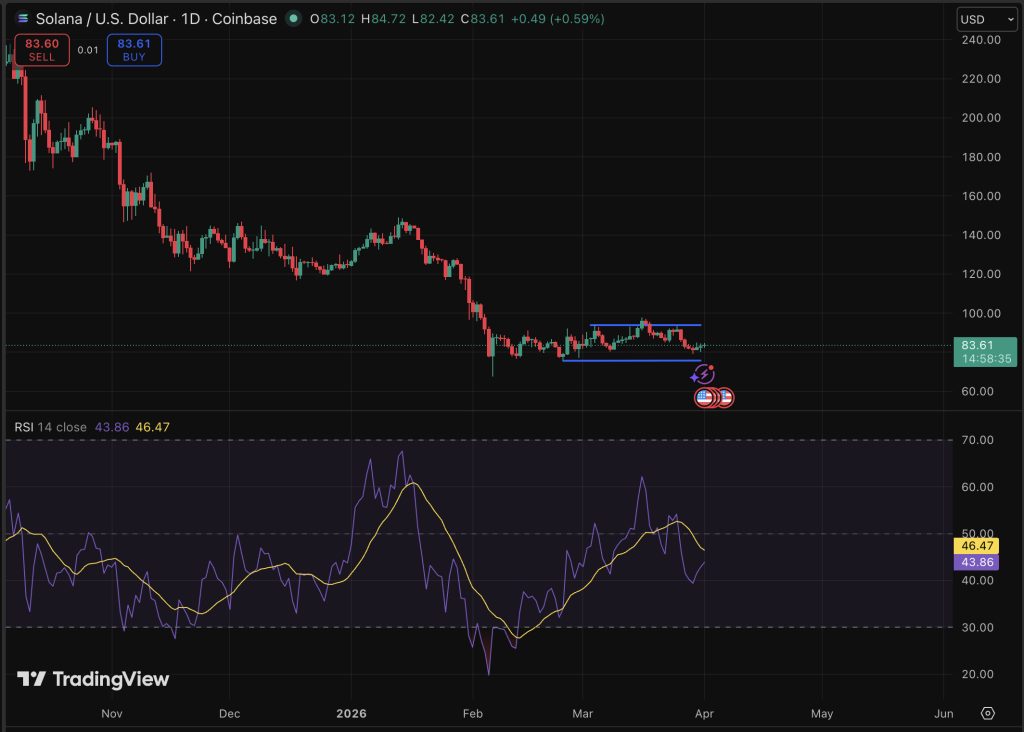
But a breakdown below the $75 support zone opens the door to deeper downside. The setup is binary. Position sizing accordingly.
Discover: The best pre-launch token sales
Maxi Doge Targets Early Mover Upside as Solana Tests Key Levels
SOL at $84 with a $95 breakout requirement means most of the easy money on this trade has already been made. For traders calculating risk-reward on a market-cap-weighted basis, the upside from here demands patience and assumes macro conditions cooperate. That’s where early-stage positioning starts looking different on a spreadsheet.
Maxi Doge ($MAXI) is an Ethereum-based meme token built around a 240-lb canine juggernaut and a 1000x leverage trading mentality, genuinely unhinged energy, deliberately so.
The project has raised more than $4,7 million at a current price of $0.00028, with 66% staking APY bonus available for holders. Features include holder-only trading competitions with leaderboard rewards, a Maxi Fund treasury for liquidity and partnerships, and meme-first marketing built on viral gym-bro humor.
Research Maxi Doge and join the army.
This article is for informational purposes only and does not constitute financial advice. Crypto assets are highly volatile. Always do your own research before investing.
The post Solana Price Prediction: Interactive Brokers Supports SOL, Galaxy Doubles Down appeared first on Cryptonews.
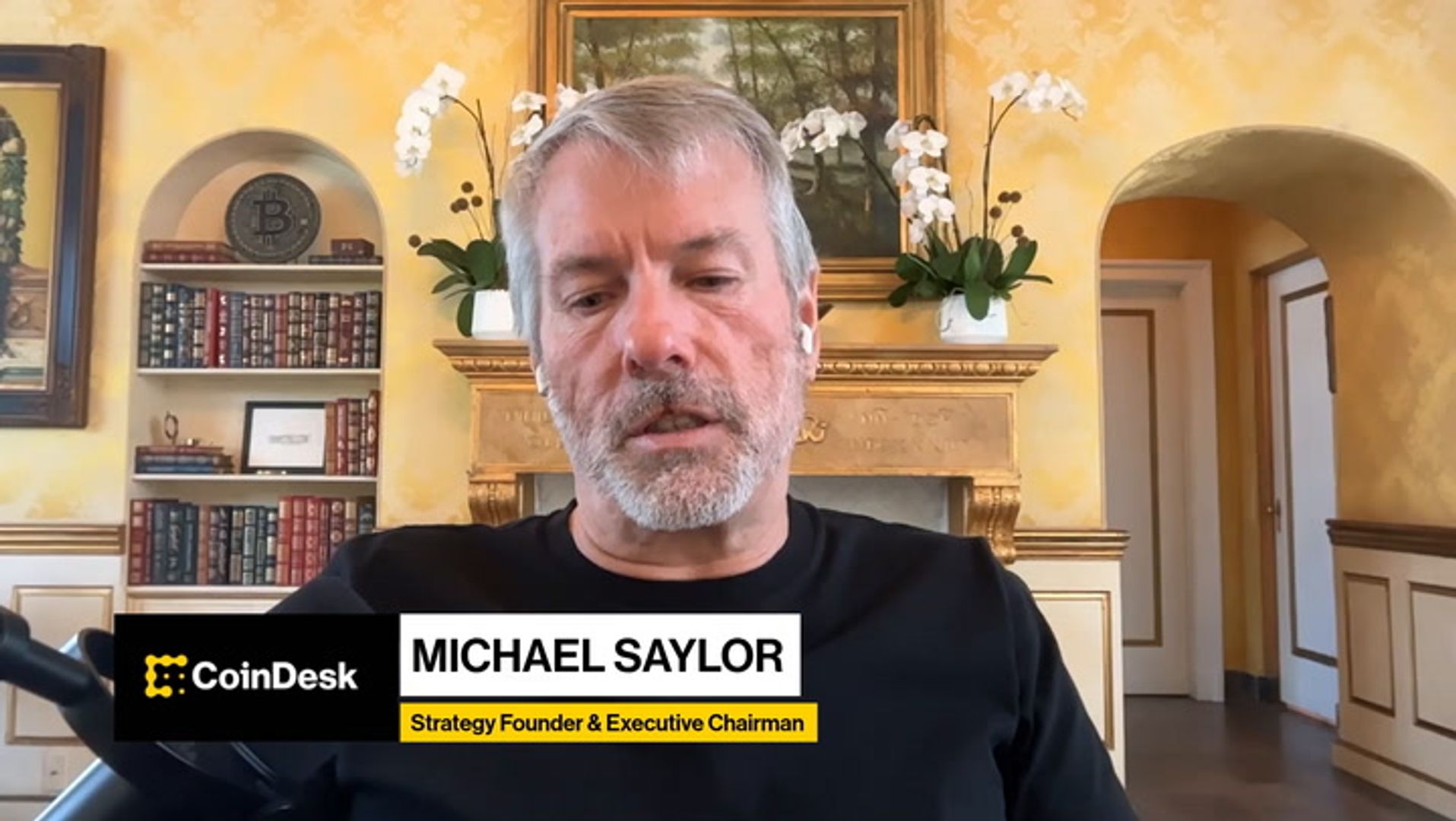
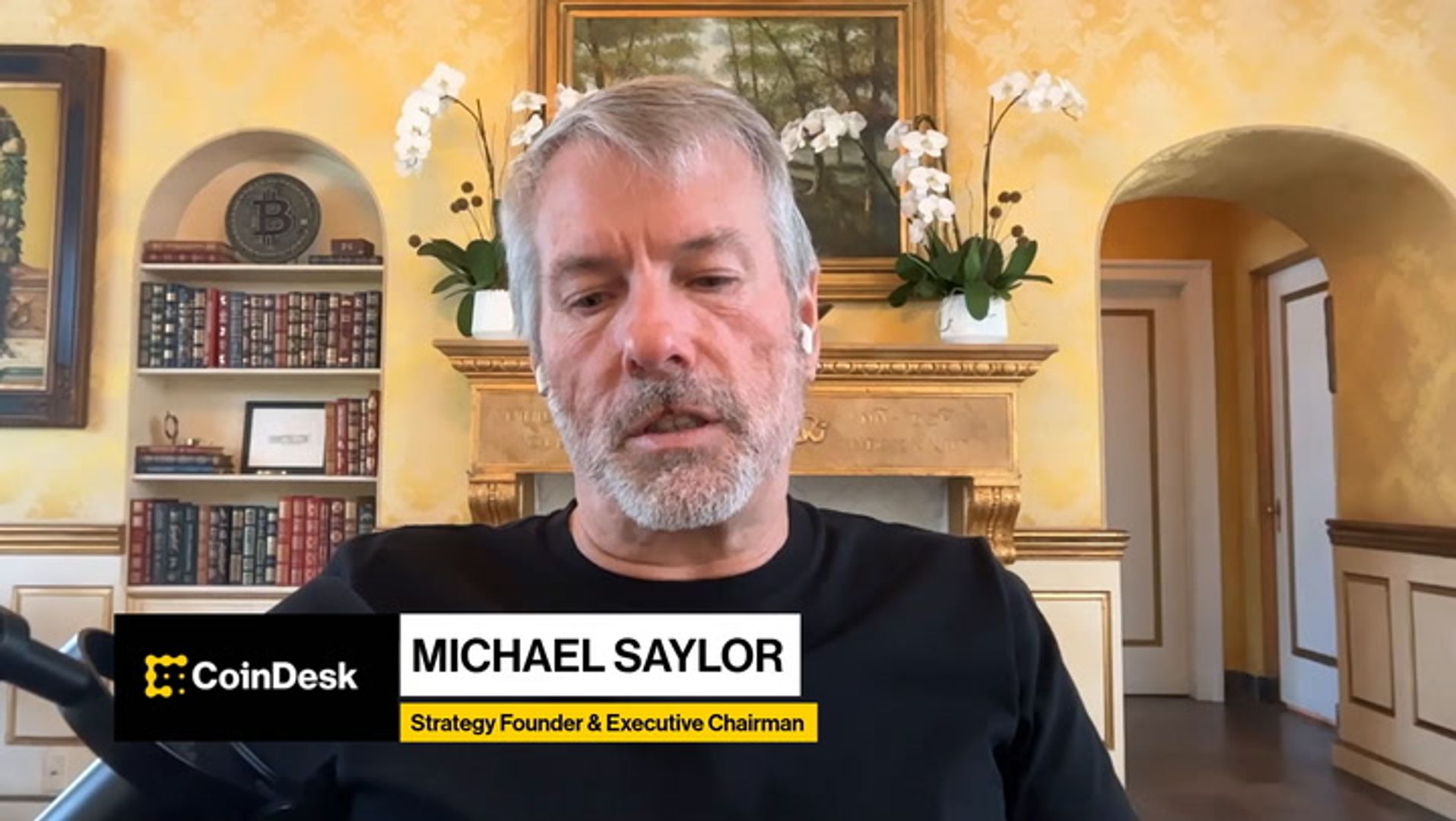
Strategy, the world’s largest publicly traded Bitcoin holder, has held the 11.5% dividend rate on its perpetual preferred stock, Stretch (STRC). This marks the first time the product has not seen a dividend increase since the product launched in July 2025.
STRC debuted in July 2025 with a 9% dividend and has since undergone seven dividend increases. The company was able to maintain the current rate after the volume weighted average price (VWAP) for the month reached $99.95, keeping the shares close enough to their $100 par value.
Strategy positions STRC as a short duration, high yield savings alternative. The perpetual preferred stock pays monthly cash distributions, with the dividend rate adjusted each month to support trading near par and limit price volatility.
During Tuesday’s session, STRC held close to par for most of the day. The company is estimated to have purchased over 1,000 BTC, and it took 12 days for STRC to recover back to par following the ex dividend date. It is likely the shares will continue trading near par over the next two weeks, leading up to the April 14 ex dividend date.
Meanwhile, Strive (ASST), the bitcoin treasury asset manager, saw its own perpetual preferred product, SATA, reach $100 par for the first time. This enabled the company to issue shares through its at the market (ATM) program to fund additional bitcoin purchases. SATA currently offers a dividend rate of 12.7%.


Announced at EthCC in Cannes, the upgrade enables institution-specific borrowing environments, structured credit products, and RWA-backed lending within a unified liquidity system.
Crypto World
Australia passes crypto regulation requiring exchanges to obtain financial services licenses
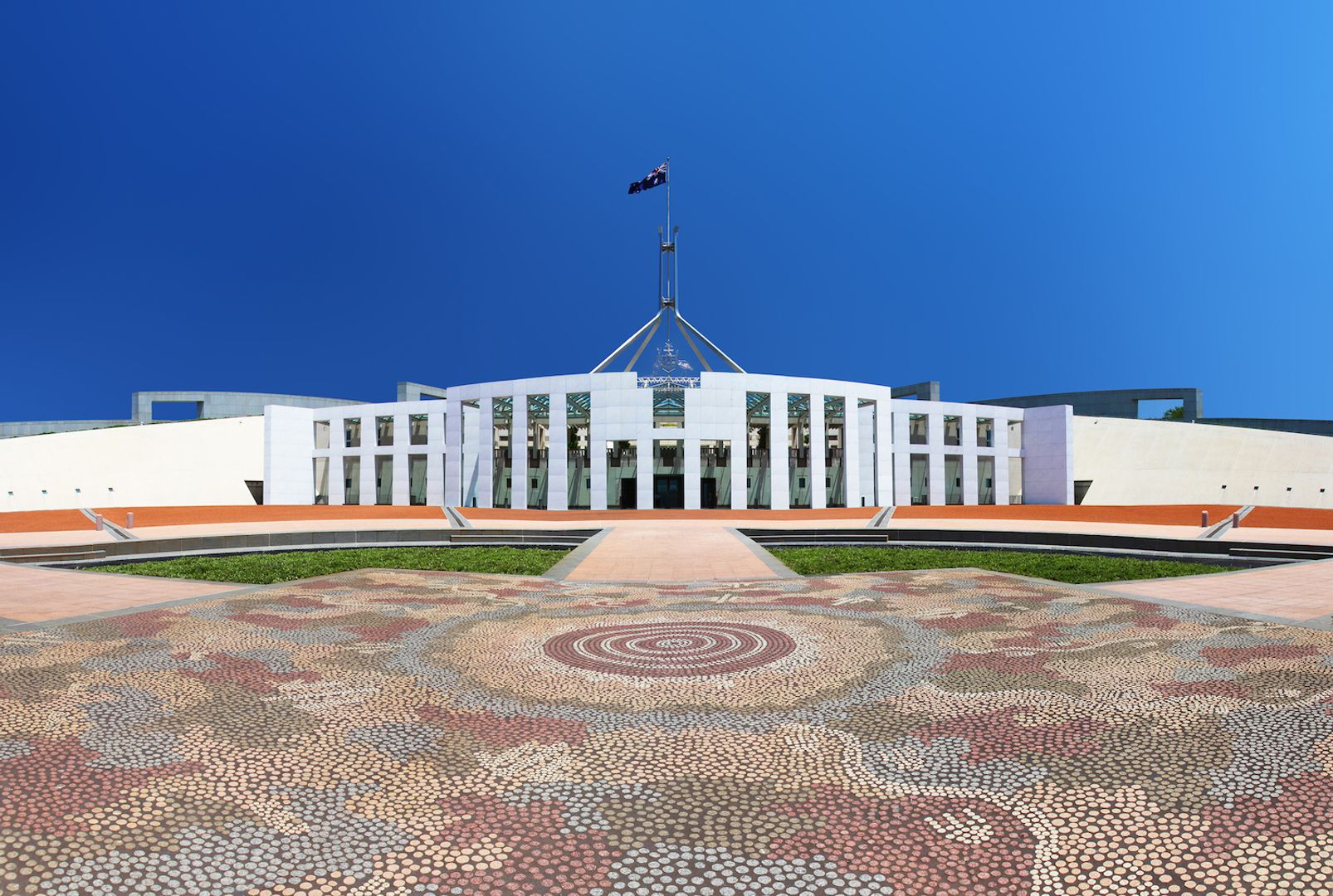
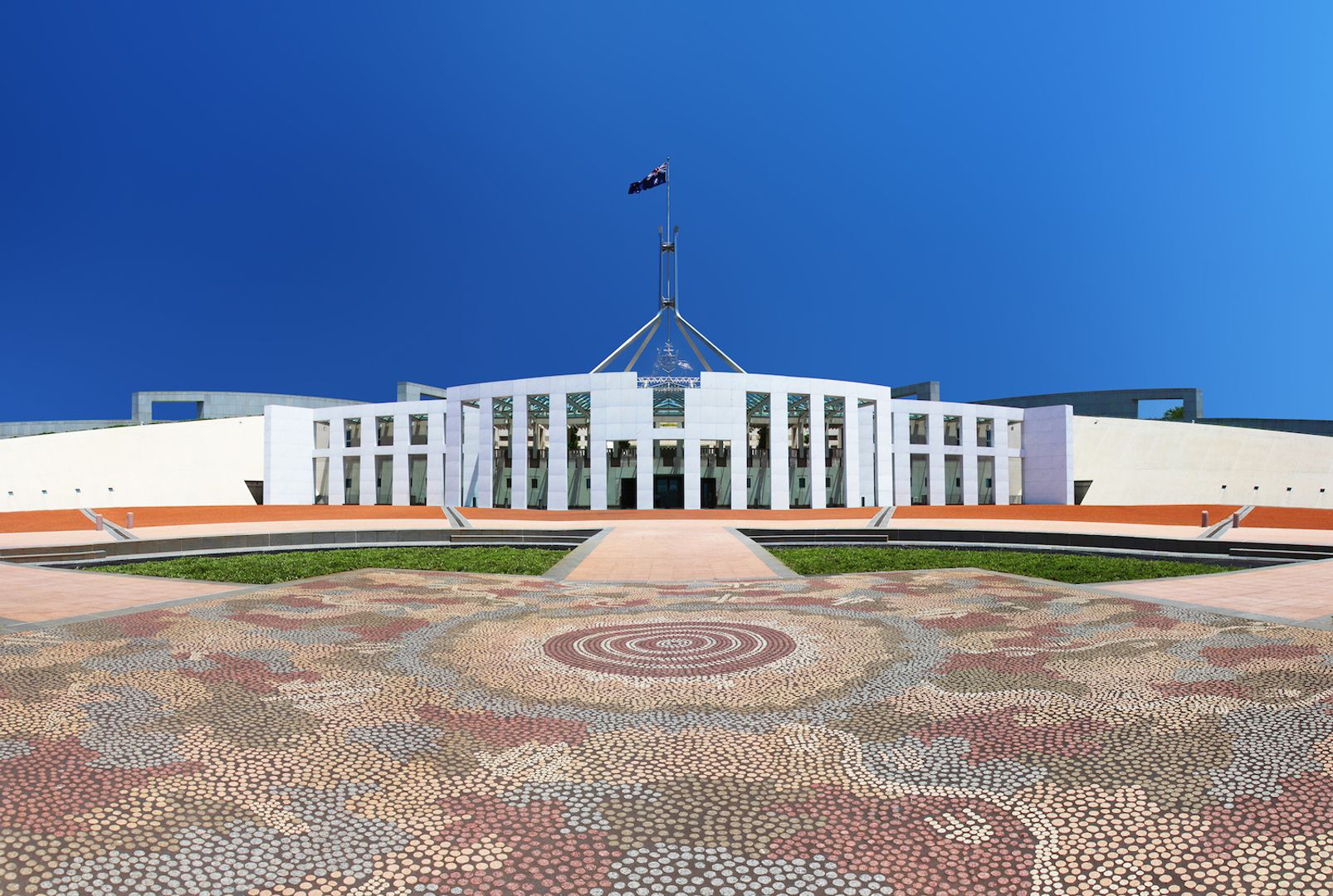
Australia passed legislation on Wednesday, creating its first comprehensive regulatory framework for digital assets that requires crypto exchanges and custody providers to obtain financial services licenses.
The Corporations Amendment (Digital Assets Framework) Bill 2025 cleared both houses on April 1, bringing firms that hold digital assets on behalf of customers into the existing Australian Financial Services Licence regime.
Australia’s bill creates two new regulated categories under the Corporations Act: digital asset platforms, which hold crypto on behalf of users, and tokenized custody platforms, which hold real-world assets and issue a corresponding digital token.
Operators of both must obtain an Australian Financial Services License from ASIC, bringing them under the same core rules as brokers or fund managers, including requirements to safeguard client assets, provide standardized disclosures, avoid misleading conduct, and maintain dispute resolution and compensation systems.
Instead of regulating crypto itself, the law targets the companies in the middle that control customer funds, aiming to reduce risks like commingling, insolvency, and misuse of assets that have caused losses in past crypto failures.
Research from the Digital Finance Cooperative Research Center and industry groups estimates Australia could generate as much as A$24 billion annually from tokenized markets, payments, and digital assets, roughly 1% of GDP. Under the previous regulatory path, the country was on track to capture just A$1 Billion of that by 2030.
A Kraken spokesperson said the law provides a “top-down signal” that Australia is serious about digital assets, adding that clearer rules would give firms confidence to invest and expand locally.
Kate Cooper, CEO of OKX Australia and co-chair of the Digital Economy Council of Australia, called the bill a “pivotal moment,” saying it establishes a foundation for institutional participation and long-term capital allocation.
Almonty’s tungsten mine in Sangdong, South Korea, in March 2026.
Almonty
BEIJING — The Iran war is squeezing a global commodities market already pressured by China’s export controls and stockpiling efforts.
Prices of three niche elements — tungsten, sulfur and helium — have climbed sharply in recent weeks.
While none of the commodities are traded as widely as oil, the surge indicates how ripple effects from the Middle East conflict could end up restricting production of the semiconductors that power artificial intelligence advances.
Tungsten, a metal nearly as hard as a diamond, creates the electrical connection in the core of a semiconductor chip. Sulfuric acid, a byproduct of sulfur, cleans chip wafers. Helium enables smooth production of semiconductors since the gas prevents unwanted chemical reactions in the manufacturing process.
Those are just some of the ways in which the three elements have become critical for modern manufacturing, including for defense.
Beijing started to ramp up its control over the critical supplies even before the Iran war started on Feb. 28, partly as tensions with the U.S. escalated over the last few years.
China started restricting tungsten exports just over a year ago, and in December called for tighter limits on sulfuric acid exports. Helium, a gas that’s difficult to store, saw the volume of Chinese imports rise by 15.7% in 2025, after a nearly 65% surge in 2024, according to Wind Information.
The Iran war and the ensuing constraints on the Strait of Hormuz, a critical Middle East shipping route for energy and chemicals, has tipped some oversupply situations into undersupply, while exacerbating existing shortages.

Prices of the three commodities have jumped in some cases by more than oil. The widely used fossil fuel has climbed by more than 50% in March, putting Brent on track for a record month.
“While the Chinese supply chain is being viewed as more resilient than many peers, the risk of disruption in chemicals as raw materials for manufacturers in selected segments is higher than expected based on the feedback,” Goldman Sachs analysts said in a report late last week, citing nearly 40 commodity-related meetings and site visits in China.
Tungsten
Tungsten hit a record high of over $3,000 late last week, marking a surge of well over 50% for the month and more than tripling in price since late December. That’s based on the industry benchmark called “ammonium para tungstate (APT)” in metric ton units, or MTU, from Fastmarket, as quoted by tungsten miner Almonty.
Almonty officially reopened a large tungsten mine in Sangdong, South Korea, earlier this month, and plans to start producing some tungsten this year at a project in the U.S. state of Montana.
The company’s CEO Lewis Black told CNBC that defense sector demand for tungsten has been “extremely strong” since the beginning of last year, but that there’s been no notable change despite the Iran war.
“There’s no material to stockpile. That’s probably the biggest change,” he said.
Sulfur
The price of sulfuric acid in Africa is now at least 30% higher than it was prior to the war, and is still rising, the Goldman Sachs analysts said, citing a local Chinese miner in Africa.
Other assessments point to a milder rise in prices.
China sulfur prices, including cost and freight, climbed by about 13% from early March to $621 per tonne as of March 26, according to S&P Global Platts.
“A 2-3 month effective blockade would likely become a severe supply shock, especially as freight/insurance stay elevated and Middle East-origin cargoes become harder to execute,” Pan Yuya, lead analyst for sulfur and phosphate raw materials at S&P Global Energy, and Isaac Zhao, senior principal analyst, China fertilizers at S&P Global Energy, said in a March 20 note.
The S&P analysts said that around 56% of China’s sulfur imports came from the Middle East in 2025.
“Even prior to the Middle East conflict, sulfur prices were rising sharply as the market tightened. With sulfur prices now at fresh record highs, the ‘super squeeze’ in this rather obscure commodity in supply warrants further examination,” HSBC analysts said in a March 16 report.
Helium
Helium prices have roughly doubled since the Iran war began, according to Fitch Ratings.
As most trading occurs through long-term private contracts between industrial gas suppliers and manufacturers, it is difficult to pinpoint industry-wide prices, said Shelley Jang, Fitch’s director of Asia-Pacific corporate ratings.
Iranian missile attacks this month crippled a key industrial center in Qatar, which produces about one-third of the world’s helium.
That implies helium supply won’t be restored anytime soon, pointed out Christopher Ecclestone, principal and mining strategist at Hallgarten & Company.
In one indication of further market tightness, prices of helium in China’s Henan province have reversed a downturn this year to climb from a Feb. 28 low of 545 yuan ($78.85) a bottle to 600 yuan ($86.81), according to Wind Information.

Subscribe now
Shortages caused by the Iran war are the latest supply chain disruption to rock global markets, which faced similar shocks from Russia’s invasion of Ukraine in 2022 and the Covid-19 pandemic. That’s pushed companies to diversify, and countries such as China to ramp up stockpiling plans.
“Access to supplies of certain physical materials where production and processing is concentrated in China will become more frequent topics of negotiations with Beijing,” Rhodium Group said in a March 24 report.
Limited price transparency also means the shortage could be worse than available numbers suggest.
Tungsten and helium prices have been surging, “but you don’t have anyone on the buy side saying, ‘oh my goodness, we don’t have enough product,’” Ecclestone said. “Defense contractors should have warehouses of tungsten, but they don’t.”
“The world has got lazy. It thinks life is like a supermarket, the product is a pack of cornflakes or a few tons of sulfuric acid,” he said. “The supermarket of commodities has had a few of the aisles chopped down.”


The ex-Blackstone team wants to move beyond crypto-collateralized loans and into ‘real economy credit’ as the tokenized RWA sector continues to grow.

Steven Lyons: Alleged Scottish crime boss to be deported to Spain to face murder charges

'The Australian way': PM seeks to calm nation on fuel crisis

Weak Data Weigh on the Dollar: Market Awaits Trend Confirmation


-

 News Videos6 days ago
Parliament publishes latest register of MPs’ financial interests
-
 Tech6 days ago
Intercom’s new post-trained Fin Apex 1.0 beats GPT-5.4 and Claude Sonnet 4.6 at customer service resolutions
-

 NewsBeat5 days ago
The Story hosts event on Durham’s historic registers
-

 Business6 days ago
Instagram, YouTube Found Responsible for Teen’s Mental Health Struggle in Historic Ruling
-
 NewsBeat7 days ago
Tesco is selling new Cadbury Dairy Milk bar and people can’t wait to try it
-

 Sports5 days ago
Sweet Sixteen Game Thread: Tide vs Michigan
-
Entertainment2 days ago
Fans slam 'heartbreaking' Barbie Dream Fest convention debacle with 'cardboard cutout' experience
-
 Entertainment4 days ago
Lana Del Rey Celebrates Her Husband’s 51st Birthday In New Post
-
Crypto World23 hours ago
Dems press CFTC, ethics board on prediction-market insider trades
-

 Sports18 hours ago
Tallest college basketball player ever, standing at 7-foot-9, entering transfer portal
-
 Fashion7 days ago
How to Style Spring Like WeWoreWhat: Easy Outfit Ideas for 2026
-

 Tech2 days ago
The Pixel 10a doesn’t have a camera bump, and it’s great
-

 Entertainment6 days ago
HBO’s Harry Potter Series Will Definitely Fail For One Big Reason, And It’s Not J.K. Rowling Or Snape
-

 Fashion6 days ago
En Vogue in Brown Leather and Tailored Neutrals by Atelier Savoir, Styled by J Bolin
-

 Crypto World1 day ago
U.S. rule change may open trillions in 401(k) funds to crypto
-

 Fashion6 days ago
What Are Your Favorite T-Shirts for the Weekend?
-

 Fashion5 days ago
Weekly News Update, 3.27.26 – Corporette.com
-

 Politics2 days ago
Should Trump Be Scared Strait?
-

 Sports1 day ago
Women’s hockey camp eyes fitness boost, tactics ahead of WC 2026 campaign | Other Sports News
-

 Tech1 day ago
How to back up your iPhone & iPad to your Mac before something goes wrong
You must be logged in to post a comment Login