

Crypto World
Inside X Money, Elon Musk’s bid to fuse social media and banking



Elon Musk is quietly wiring X Money into X as a native wallet, testing whether a social network can double as “the place where all money is.”
Summary
- X Money is a custodial wallet inside X for P2P transfers, bill pay and, later, higher‑margin financial services like savings and loans.
- Backed by 40+ U.S. money transmitter licenses, FinCEN registration and a Visa tie‑up, X Money launches more like Venmo-on-X than a startup.
- Musk hints at Bitcoin, Ethereum and Dogecoin support, raising questions over whether an “everything app” will crowd out open crypto payment rails.
Elon Musk is about to bolt a bank onto X in public, not just in pitch decks. X Money, a native wallet and payments layer inside the platform, is already running in closed beta and is slated for a limited external rollout in the next one to two months, with Musk describing it as “the place where all money is” and “the central source of all monetary transactions.”
What X Money actually is
At its core, X Money is a custodial digital wallet tied directly to X accounts, designed to support peer‑to‑peer transfers, bill pay and, over time, higher‑margin financial services. An explainer circulating among X‑aligned commentators describes it as a system where users “will be able to pay your bills directly through the app,” with future features including “high‑yield savings accounts, loans, and investment tools,” while creators can receive tips and subscription income straight into their X Money balance and spend it without ever touching a bank. Musk told employees at an internal xAI town hall that X Money is already live “in closed beta within the company,” and that once external testing is complete “this is intended to be the place where all money is… It’s going to be a game‑changer.”
The regulatory and banking spine is largely in place. X has secured money transmitter licenses in more than 40 U.S. states and Washington, DC, completed registration with FinCEN, and struck a Visa Direct partnership to move funds between bank accounts and in‑app wallets, according to reporting from TradingView, CNBC and other outlets. That effectively positions X Money as a Venmo‑ or Cash App‑style product sitting on top of a social network with roughly 600 million monthly active users, not a greenfield startup fighting for attention.
Crypto, rails and market structure
For now, the launch focus is on fiat. The X‑aligned brief notes that “the initial launch focuses on regular money (fiat),” with explicit plans to “eventually support Bitcoin, Ethereum, and Dogecoin” and more general language from Musk that “if it involves money, it’ll be on our platform.” Industry analyses argue that serious crypto integration – whether direct BTC/ETH/DOGE support, a proprietary stablecoin or both – would turn X into a de facto on‑ramp and payment rail at social‑media scale, with obvious implications for exchanges and stablecoin issuers. In that context, the early X Money beta is less about today’s feature set and more about market structure: a live experiment in whether a single “everything app” can centralize messaging, discovery and payments in the West the way WeChat did in China – and how much room that leaves for the open crypto rails that were supposed to bypass banks and platforms in the first place.


Key takeaways
-
BIP-360 formally puts quantum resistance on Bitcoin’s road map for the first time. It represents a measured, incremental step rather than a dramatic cryptographic overhaul.
-
Quantum risk primarily targets exposed public keys, not Bitcoin’s SHA-256 hashing, making public key exposure the central vulnerability developers aim to reduce.
-
BIP-360 introduces Pay-to-Merkle-Root (P2MR), which removes Taproot’s key path spending option and forces all spends through script paths to minimize elliptic curve exposure.
-
Smart contract flexibility remains intact, as P2MR still supports multisig, timelocks and complex custody structures via Tapscript Merkle trees.
Bitcoin was built to withstand hostile economic, political and technical scenarios. As of March 10, 2026, its developers are preparing to confront an emerging threat: quantum computing.
The recent publication of Bitcoin Improvement Proposal 360 (BIP-360) officially adds quantum resistance to Bitcoin’s long-term technical road map for the first time. While some headlines portray it as a dramatic shift, the reality is far more measured and incremental.
This article explores how BIP-360 introduces Pay-to-Merkle-Root (P2MR) to reduce Bitcoin’s quantum exposure by removing Taproot key path spending. It explains what the proposal improves, what trade-offs it introduces and why it does not yet make Bitcoin fully post-quantum secure.
Why quantum computing poses a risk to Bitcoin
For security, Bitcoin depends on cryptography, primarily the Elliptic Curve Digital Signature Algorithm (ECDSA) and Schnorr signatures introduced via Taproot. Regular computers cannot realistically derive a private key from a public key. However, a powerful quantum computer running Shor’s algorithm could break elliptic curve discrete logarithms, exposing those keys.
Key distinctions include:
-
Quantum attacks hit public-key cryptography hardest, not hashing.
-
Bitcoin’s SHA-256 remains relatively strong against quantum methods. Grover’s algorithm only provides a quadratic speedup, not an exponential one.
-
The real risk appears when public keys become exposed on the blockchain.
This is why the community focuses on public key exposure as the primary quantum risk vector.

Bitcoin’s vulnerabilities in 2026
Not every address type in the Bitcoin network faces the same level of future quantum threat:
-
Reused addresses: Spending reveals the public key onchain, leaving it exposed to a future cryptographically relevant quantum computer (CRQC).
-
Legacy pay to public key (P2PK) outputs: Early Bitcoin transactions directly embedded public keys in transaction outputs.
-
Taproot key path spends: Taproot (2021) offers two paths: a compact key path (which exposes a tweaked public key on spend) or a script path (which reveals scripts via a Merkle proof). The key path is the main theoretical weak point under a quantum attack.
BIP-360 directly targets that key path exposure.

What BIP-360 introduces: P2MR
BIP-360 adds a new output type, Pay-to-Merkle-Root (P2MR), modeled closely on Taproot but with one critical change. It removes the key path spending option entirely.
Instead of committing to an internal public key like Taproot, P2MR commits solely to the Merkle root of a script tree. To spend:
No public key based spending route exists at all.
Eliminating key path spends means:
-
No public key exposure for direct signature checks.
-
All spending routes rely on hash-based commitments.
-
Long-term elliptic curve public key exposure drops sharply.
Hash-based methods are far more resilient to quantum attacks than elliptic curve assumptions. This significantly shrinks the attack surface.
What BIP-360 preserves
A common misconception is that dropping key path spending weakens smart contracts or scripting. It does not. P2MR fully supports:
-
Multisig setups
-
Timelocks
-
Conditional payments
-
Inheritance schemes
-
Advanced custody
BIP-360 executes all these functions via Tapscript Merkle trees. While the process retains full scripting capability, the convenient but vulnerable direct signature shortcut disappears.
Did you know? Satoshi Nakamoto briefly acknowledged quantum computing in early forum discussions, suggesting that if it became practical, Bitcoin could migrate to stronger signature schemes. This shows that upgrade flexibility was always part of the design philosophy.
Practical implications of BIP-360
BIP-360 may sound like a purely technical refinement, but its impact would be felt at the wallet, exchange and custody levels. If activated, it would gradually reshape how new Bitcoin outputs are created, spent and secured, especially for users prioritizing long-term quantum resilience.
-
Wallets could introduce opt-in P2MR addresses (likely starting with “bc1z”) as a “quantum-hardened” choice for new coins or long-term holdings.
-
Transactions will be slightly larger (more witness data from script paths), potentially raising fees somewhat compared to Taproot key path spends. Security trades off against compactness.
-
A full rollout would require updates to wallets, exchanges, custodians and hardware wallets. Planning should start years in advance.
Did you know? Governments are already preparing for “harvest now, decrypt later” risks, where encrypted data is stored today in anticipation of future quantum decryption. This strategy mirrors concerns about exposed Bitcoin public keys.
What BIP-360 explicitly does not do
While BIP-360 strengthens Bitcoin in the face of future quantum threats, it is not a sweeping cryptographic overhaul. Understanding its limits is just as important as understanding its innovations:
-
No automatic upgrade for existing coins: Old unspent transaction outputs (UTXO) remain vulnerable until users manually move funds to P2MR outputs. Migration depends on user behavior.
-
No new post-quantum signatures: BIP-360 does not replace ECDSA or Schnorr with lattice-based (for example, Dilithium or ML-DSA) or hash-based (for example SPHINCS+) schemes. It only removes the Taproot key path exposure pattern. A full base layer transition to post-quantum signatures would require a much larger change.
-
No complete quantum immunity: A sudden CRQC breakthrough would still require massive coordination among miners, nodes, exchanges and custodians. Dormant coins could create complex governance issues and network stress could follow.
Why developers are acting now
Quantum progress is uncertain. Some believe it is decades away. Others point to IBM’s late 2020s fault-tolerant goals, Google’s chip advances, Microsoft’s topological research and US government transitions planned for 2030-2035.
Critical infrastructure migrations take many years. Bitcoin’s developers stress planning across BIP design, software, infrastructure and user adoption. Waiting for certainty in quantum progress could leave insufficient time for infrastructure upgrades.
If consensus builds, a phased soft fork could unfold:
-
Activate the P2MR output type
-
Wallets, exchanges and custodians add support
-
Gradual user migration over years
This mirrors the optional then widespread adoption of SegWit and Taproot.
The broader debate around BIP-360
Debate continues on urgency and costs. Questions under discussion include:
-
Are modest fee increases acceptable for HODLers?
-
Should institutions lead the migration?
-
What about coins that never move?
-
How should wallets signal “quantum safety” without causing unnecessary alarm?
This is an ongoing conversation. BIP-360 advances the discussion but does not close it.
Did you know? The idea that quantum computers could threaten cryptography dates back to 1994, when mathematician Peter Shor introduced Shor’s algorithm, long before Bitcoin existed. Bitcoin’s future quantum planning is essentially a response to a 30-year-old theoretical breakthrough.
What users can do right now
There is no need to panic for now, as quantum threats are not imminent. Prudent steps you might take include:
-
Never reuse addresses
-
Stick to up-to-date wallet software
-
Follow protocol upgrade news
-
Watch for P2MR support in wallets
Those with large holdings should quietly map exposures and consider contingency plans.
BIP-360: The first step toward quantum resistance
BIP-360 represents Bitcoin’s first concrete step toward reducing its quantum exposure at the protocol level. It redefines how new outputs can be created, minimizes public key leaks and sets the stage for long-term migration planning.
It does not change existing coins automatically, keeps current signatures intact and underscores the need for a careful, coordinated ecosystem-wide effort. True quantum resistance will come from sustained engineering and phased adoption, not a single BIP.
Cointelegraph maintains full editorial independence. The selection, commissioning and publication of Features and Magazine content are not influenced by advertisers, partners or commercial relationships.
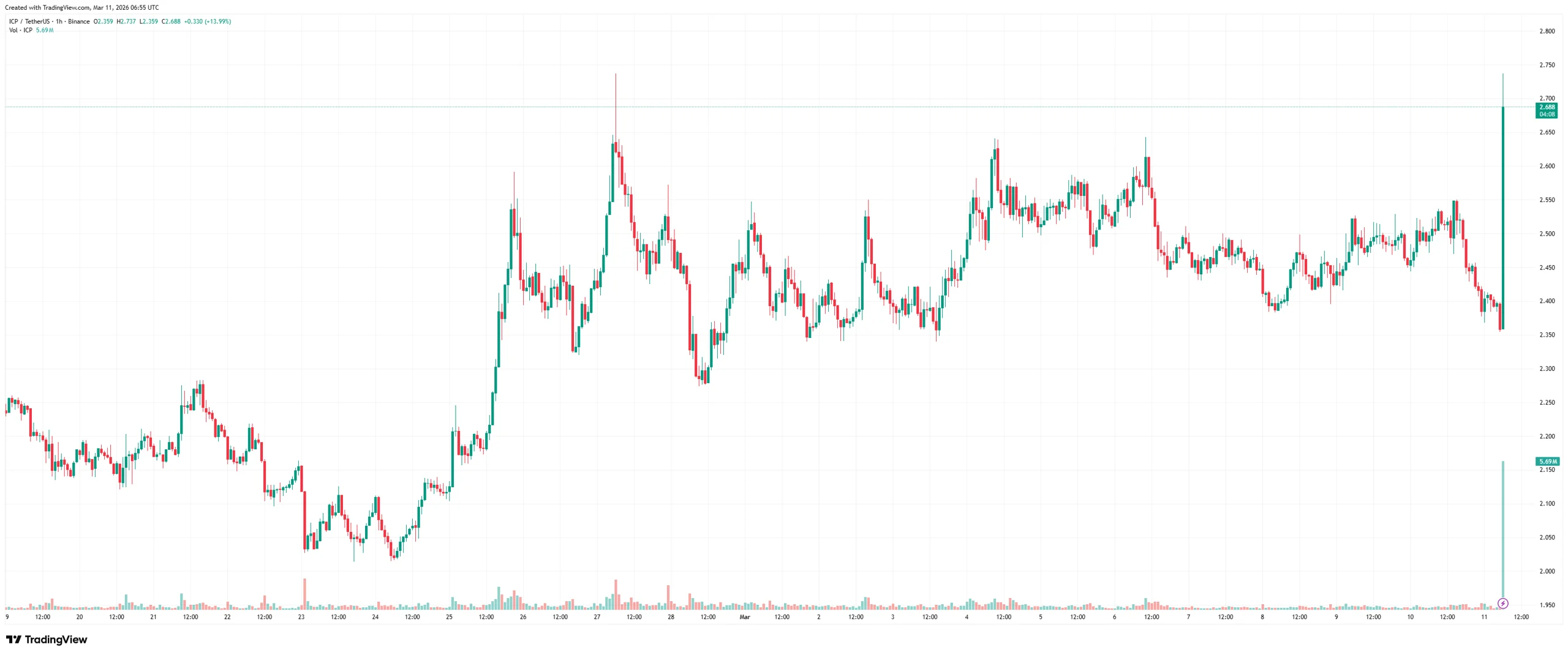
ICP soared by 16% after being listed on South Korea’s largest exchange, but will the momentum last?
Internet Computer (ICP) saw its price explode by roughly 16% following its listing on South Korea’s largest cryptocurrency exchange, Upbit.
The altcoin’s value rose from around $2.35 to a high of $2.73 within minutes of the announcement. Trading pairs include ICP/KRW, ICP/BTC, and ICP/USDT.
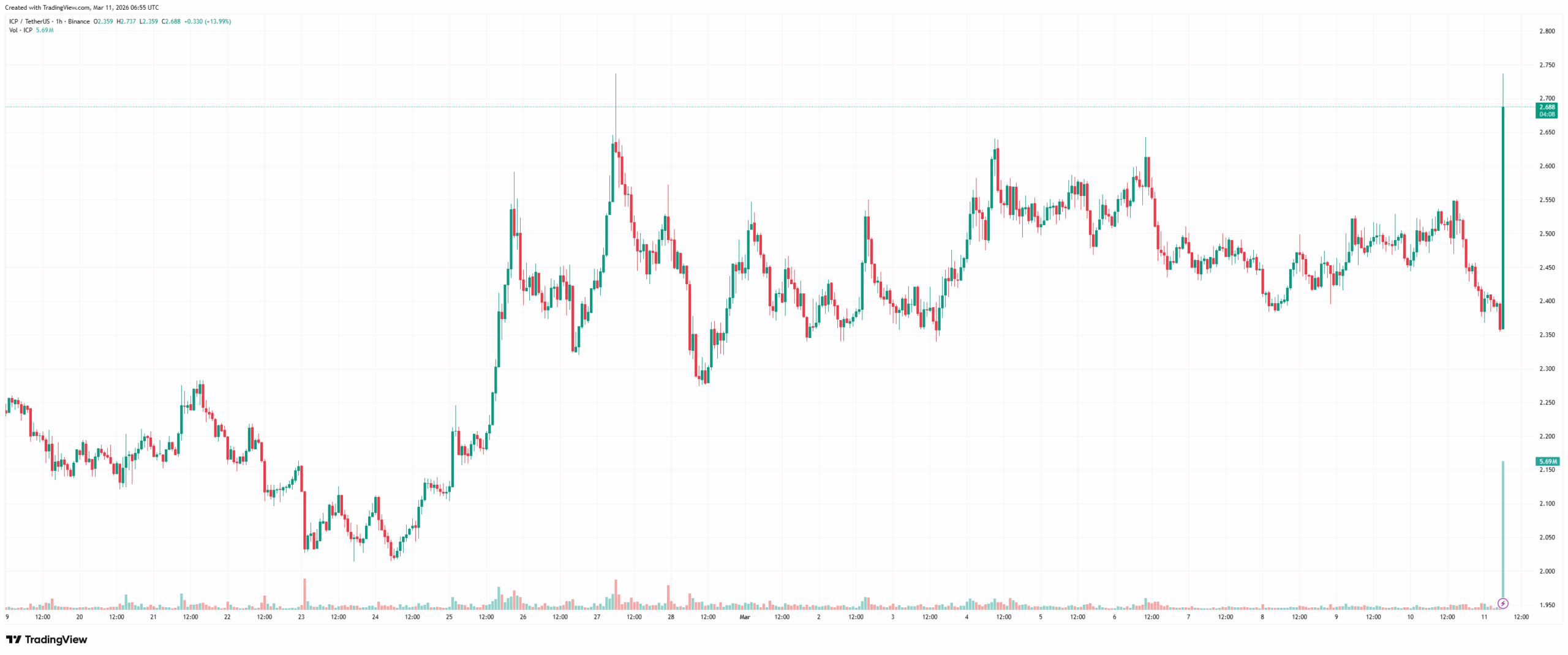
In case you’re wondering, exchange listings on major centralized venues have historically led to considerable price increases for newly listed cryptocurrencies. This is especially true for altcoins with thinner market depth, where it’s easier to move the price with smaller amounts.
Upbit is currently the third-largest centralized spot exchange in the world, with a 24-hour trading volume of around $1.16 billion, according to CoinMarketCap, trailing only Binance and Coinbase.
ICP is the 47th largest cryptocurrency by means of total market capitalization ($550M) and around $147 million in 24-hour trading volume – a metric that’s a whopping 170% up in the past day, showcasing the impact of the listing.
Usually, though, these moves are not as sustainable and result in reversals, but it’s interesting to see if ICP will follow a similar path.
Binance Free $600 (CryptoPotato Exclusive): Use this link to register a new account and receive $600 exclusive welcome offer on Binance (full details).
LIMITED OFFER for CryptoPotato readers at Bybit: Use this link to register and open a $500 FREE position on any coin!

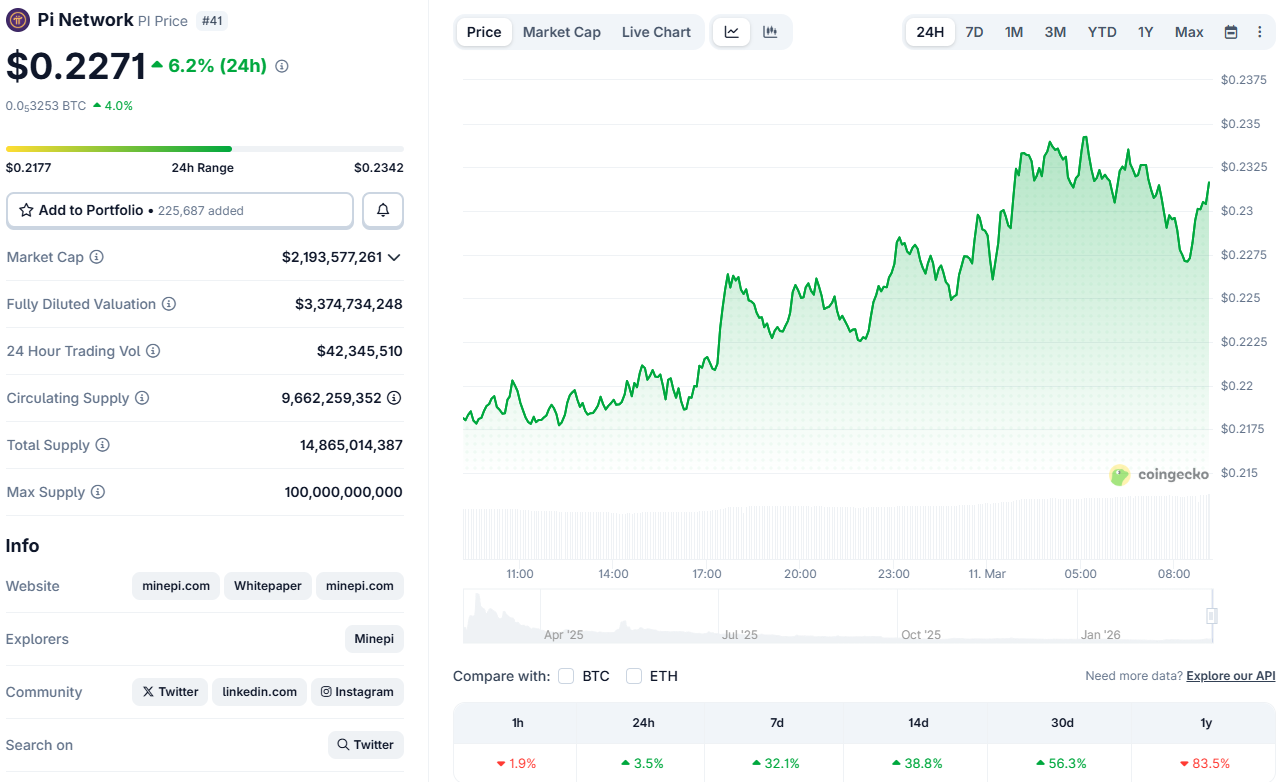
The PI token exceeded $0.23 earlier today before it retraced slightly.
The updates recently implemented by the team, as well as the upcoming ones, continue to benefit Pi Network’s underlying asset, as PI is among the few alts in the green today.
Aside from the expected completion of protocol v20.2 upgrade by tomorrow, the Pi Network community is also anticipating Pi Day – March 14.
Pi’s Upcoming Updates
The past several weeks have been quite eventful for Pi Network, especially in terms of upgrades and price movements. On February 21, the team announced that the protocol v19.6 migration was successfully completed, and the subsequent v19.9 iteration arrived on March 4.
They explained at the time that the v20.2 update was next in line, with initial deadline expectations set for March 14, which was later moved to March 12. Both of the already completed updates were followed by impressive price gains from PI, and it seems the hype about the upcoming upgrade has not disappointed so far.
Another factor that could be boosting the native token is the buildup to what became known as Pi Day, March 14, due to its symbolic resemblance to the mathematical constant π. As it happened last year, the community has hyped itself up, expecting some major announcements, perhaps a listing on a top-tier exchange such as Binance.
PI Defies Market Correction
As mentioned above, the protocol updates and perhaps anticipation for Pi Day have resulted in impressive gains for PI lately. The token is up by over 6% in the past day and sits just inches below $0.23. Moreover, it’s one of the best-performing crypto assets on a monthly scale, gaining 56%, and it’s up by 73% since its latest all-time low of $0.1312 marked on February 11.
A few things to consider for its future price moves include the token unlock schedule, as over 13.5 million coins will be unlocked in three consecutive days starting today, and the number will jump to 17 million on March 17. Additionally, PI has a history of performing well in the weeks leading up to big announcements or updates, only to crash hard after in a classic sell-the-news event.
You may also like:
Binance Free $600 (CryptoPotato Exclusive): Use this link to register a new account and receive $600 exclusive welcome offer on Binance (full details).
LIMITED OFFER for CryptoPotato readers at Bybit: Use this link to register and open a $500 FREE position on any coin!
Disclaimer: Information found on CryptoPotato is those of writers quoted. It does not represent the opinions of CryptoPotato on whether to buy, sell, or hold any investments. You are advised to conduct your own research before making any investment decisions. Use provided information at your own risk. See Disclaimer for more information.

Bitcoin staking infrastructure developer Babylon Labs has integrated with Ledger, a cryptocurrency hardware wallet maker, in a move that could make it easier for holders to put their Bitcoin (BTC) to work in financial applications without giving up self-custody.
In a Tuesday announcement, the companies said Ledger signers will be used for Babylon’s Trustless Bitcoin Vaults, also known as BTCVaults. The vaults allow BTC holders to lock their tokens into programmable contracts governed by onchain conditions while retaining self-custody of the underlying asset.
Ledger devices will act as the secure signing layer for BTCVault transactions, enabling users to authorize vault interactions directly from their hardware wallet.
The feature relies on Ledger’s Clear Signing technology, which displays human-readable transaction details on the device screen so users can verify exactly what they are approving before signing. The approach is designed to reduce the risk of signing malicious or opaque transactions, a common concern in crypto workflows.
The tie-up is significant given Ledger’s scale as a hardware wallet provider, with the company reporting more than 8 million devices sold globally. As Cointelegraph recently reported, Ledger is said to be in talks with major financial institutions about a US initial public offering.

Related: Ledger and Trezor 2025 hardware wallets released: What’s new for users?
Digital asset vaults growth surges
Self-custodial vaults are emerging as a growing use case in digital assets as users look for ways to put their crypto to work without relinquishing control of their funds.
Unlike traditional custodial platforms, where assets are deposited with an exchange or intermediary, vaults are typically governed by programmable conditions that allow users to retain ownership while participating in lending, staking or yield strategies.
Vault strategies have gained traction in decentralized finance. Protocols such as Yearn Finance popularized the concept through automated yield vaults that allocate user deposits across lending and liquidity markets.
More recently, messaging platform Telegram introduced vault-style yield products within its integrated crypto wallet, allowing users to deposit assets such as Bitcoin, Ether (ETH) and Tether’s USDt (USDT) into structured strategies designed to generate returns.
Institutional players are also joining the fray. Asset manager Bitwise recently collaborated with DeFi lending protocol Morpho to curate onchain vault strategies designed to generate yield through overcollateralized lending markets.
Related: Bitcoin company Fold pays off $66M debt, frees up BTC collateral


Sen. Adam Schiff (D-CA) has introduced proposed legislation that would ban prediction market contracts tied to terrorism, war, assassination, and death, directly challenging market regulator CFTC’s shift toward looser regulation of event trading.
The bill, dubbed the DEATH BETS Act, would strip the agency of discretion over whether to permit such contracts and write explicit prohibitions into law, putting Schiff on a collision course with CFTC Chair Mike Selig’s deregulatory agenda.
Schiff, a member of the Senate Agriculture Committee that oversees the CFTC, is positioned to press the issue legislatively as the agency’s new rule making takes shape.
Under the Commodity Exchange Act, the CFTC already has authority to block contracts tied to war, terrorism, or assassination if it determines they are contrary to the public interest. But enforcement hinges on the regulator’s judgment, meaning the scope of protection shifts with agency leadership.
Schiff’s bill would eliminate that flexibility. It would prohibit any CFTC-registered exchange from listing contracts that involve, relate to or reference terrorism, assassination, war or an individual’s death. The prohibition extends to contracts that could be “construed as correlating closely” to a person’s death, a notably broad standard.
“Betting on war and death creates an environment in which insiders can profit off of classified information, our national security is jeopardized, and violence is encouraged,” Schiff said in a statement. “There is no justification for gambling on lives, or public benefit to be derived by such a market.”
Rep. Mike Levin (D-CA) will be introducing companion legislation in the U.S. House of Representatives, according to a release from Schiff’s office.
The proposal arrives as the CFTC, under Selig, rewrites its approach to regulating prediction markets.
In February, the agency withdrew a 2024 proposal that would have broadly banned political prediction markets, with Selig criticizing the earlier effort as regulatory overreach.

Ethereum is seeing a growing divergence between the level of activity on the network and spot prices, suggesting that transactional activity alone isn’t driving demand for Ether.
Ethereum network activity has been reaching record highs, according to CryptoQuant, including active addresses, token transfers, and smart contract calls.
Total active addresses spiked to over 1.1 million in February, more than double the prior-year period, while token transfers topped a million in March, up from around 750,000 in December, according to CryptoQuant data.
Smart contract and automated protocol token transfers have also climbed to record levels, reflecting the growth of decentralized finance (DeFi), stablecoins, automated protocols and layer-2 ecosystems.
Ethereum layer-2 Lisk’s head of research, Leon Waidmann, also observed on X on Wednesday that Circle’s USDC (USDC) usage on Ethereum just hit an all-time high, according to Token Terminal.
However, despite the network activity, the price of Ether (ETH) remains down almost 60% from its peak, indicating “a clear divergence between network usage and asset performance,” said Julio Moreno, head of research at CryptoQuant, on Tuesday, calling it an “adoption paradox.”
The findings challenge previous notions that crypto network activity translates into demand for the asset that drives price increases.
ETH price dynamics driven by capital flows
Moreno added that the yearly change in Ethereum’s realized capitalization has turned negative, showing that capital is exiting from Ether.
“This aligns closely with ETH price weakness and suggests that ETH price dynamics are driven primarily by capital flows rather than network activity growth.”

Related: Ether funding rate flips negative: Are ETH bears back in control?
ETH price is in deep bear territory
Ether is currently trading at just above $2,000, consolidating just above the levels it ranged at for over a year in the 2022-2023 bear market.
However, it’s not just Ether suffering, as the broader crypto market is down 44%, or around $2 trillion from its October peak.
Many altcoins are down 80% amid a liquidity drought, amplified by a risk-off investment environment due to ongoing geopolitical conflict.
Magazine: China’s ‘50x’ blockchain boost, Alibaba-linked AI mines Bitcoin: Asia Express

Key Highlights
- With more than $153 million invested, Goldman Sachs holds the top position among spot XRP ETF investors — controlling roughly 15% of total ETF assets.
- Ripple’s XRP currently hovers near $1.38, consolidating between a critical floor at $1.34 and ceiling at $1.44.
- The XRP Ledger is processing approximately 2.7 million daily transactions, while tokenized real-world assets on the platform total $461 million.
- Combined XRP ETF assets have reached nearly $971 million, distributed among 83 institutional investors.
- Bulls could target $1.50 if price clears $1.44 resistance, while bears may drive toward $1.30–$1.32 if support at $1.34 fails.
Ripple’s XRP remains in a tight consolidation pattern near $1.38 as traders anticipate the next directional move. For approximately 30 days, the digital asset has been locked within a range defined by $1.34 support and $1.44 resistance.

While price action has been relatively muted, this week brought two notable developments: increased blockchain activity and new disclosures revealing significant Wall Street exposure to spot XRP exchange-traded funds.
Data analyzed by Bloomberg’s James Seyffart reveals that Goldman Sachs commands the largest institutional stake in spot XRP ETFs. The investment banking powerhouse maintains exposure exceeding $153 million, accounting for approximately 15% of the combined $971 million held across all XRP ETF vehicles.
Numerous prominent financial institutions have joined Goldman in establishing XRP ETF positions. Millennium Management, the multi-strategy hedge fund managed by Izzy Englander, has committed $25 million to XRP ETF exposure. Ken Griffin’s Citadel maintains a position valued above $4.5 million. Additional holders include Jane Street Group, Jain Global, and Gallagher Capital Management. Collectively, 83 institutional entities now hold stakes in these investment products.
Wall Street Interest Builds Despite Recent Outflows
XRP ETF products have experienced net redemptions exceeding $22 million during the current month. This represents the first period of negative flows since these funds debuted. By contrast, February saw $58 million in net inflows.
According to previous disclosures, Goldman Sachs maintains a combined $2.3 billion position across Bitcoin, Ethereum, Solana, and XRP investment vehicles.
Ripple’s CEO Brad Garlinghouse has outlined ambitious plans for the coming year, emphasizing initiatives in artificial intelligence and payment infrastructure.
Network Activity Shows Robust Growth
Blockchain metrics indicate that the XRP Ledger is currently processing roughly 2.7 million transactions per day. Real-world assets tokenized on the network have climbed to approximately $461 million in value.
Spot market trading volumes have declined from recent peaks. XRP made a brief attempt at $1.44 during one trading session before encountering selling pressure, confirming this price point as a meaningful near-term barrier.
The $1.34–$1.35 region continues to serve as the primary downside defense zone. Technical charts display a double-bottom formation on the daily timeframe around $1.3363, which market observers interpret as a potentially constructive signal.
Should price action sustain levels above $1.3363, the subsequent upside target sits at $1.6703, representing the neckline of the double-bottom structure. Conversely, a decisive breakdown below $1.34 could trigger a retracement toward $1.30–$1.32 or potentially the year-to-date bottom at $1.12.
As of March 11, XRP is changing hands at roughly $1.38 with 83 institutional participants maintaining positions in spot XRP ETF offerings.



Bitcoin fell over 2% on Wednesday as investors remained on the sidelines ahead of the release of U.S. CPI data later today.
Summary
- Bitcoin price fell over 2% before trading sideways ahead of the U.S. CPI data release.
- The monthly CPI reading for February is expected to come in hotter at 0.3%, with the year-over-year reading holding steady.
According to data from crypto.news, Bitcoin (BTC) fell from an intraday high of $71,612 on Tuesday to $69,936 last check on Wednesday, March 11.
Bitcoin price movement has fallen as traders braced for the US Bureau of Labor Statistics to publish the February Consumer Price Index (CPI) data at 8:30 a.m. ET.
Economists expect the monthly CPI to rise by 0.3% in February, up from 0.2% increase seen in January, with the year-over-year reading holding steady at 2.4%. Meanwhile, Core CPI figures are estimated to come in at 0.2% on a monthly basis and 2.5% YoY.
While inflation data has often been very pivotal for Federal Reserve officials on determining the next policy step, Bitcoin’s initial reaction following the announcement would most likely remain muted as the February CPI print would not factor in the impact of crude oil prices on inflation.
In the wake of an aggressive attack by Iran on commercial vessels traversing the Strait of Hormuz, a vital strategic waterbody, global energy supplies were severely disrupted, causing crude oil prices to surge past the $100 mark for the first time in years as the market reacted to the sudden threat to one of the world’s most critical transit chokepoints.
Without the inclusion of the surging oil prices in inflation that can be expected following next month’s CPI, Bitcoin price could continue to trade relatively sideways with no clear direction following the data release today.
If the CPI print instead comes out hotter than expected, it could trigger hawkish sentiment, while a cooler reading could encourage bulls to take control.
At press time, markets virtually see zero chance of a rate cut in March and minimal 25 bps reduction expectations in April, per the CME FedWatch tool.
Cryptocurrencies, including Bitcoin, have typically rallied when the odds of Fed rate cuts are high and retreated when they diminish.
For now, $71,000-$72,000 appears to stand as the next major resistance area for Bitcoin, which bulls have struggled to penetrate. On the other hand, a drop below the $66,000-$67,000 support zone could open the door for a deeper correction.
Disclosure: This article does not represent investment advice. The content and materials featured on this page are for educational purposes only.


Next week could prove pivotal for markets, including bitcoin, as seven major central banks, including the powerful Federal Reserve, announce rate decisions amid war-driven oil price gains that threaten to reignite inflation in the global economy.
The week’s packed economic calendar includes the Reserve Bank of Australia (RBA) rate decision on March 17, followed by the Bank of Canada (BOC) and the Fed on March 18, and wraps up with the Bank of Japan (BOJ), Swiss National Bank (SNB), and European Central Bank (ECB) on March 19.
Until recently, markets expected most major central banks, led by the Fed, to steadily cut interest rates (or avoid tightening) this year. The rapid emergence of artificial intelligence as a disinflationary force — with the potential to disrupt the labor market — had reinforced this bias for lower borrowing costs. That outlook supported risk assets, including Bitcoin.
However, the war that began on Feb. 28 with coordinated U.S. and Israeli strikes on Iran, which has since involved widespread retaliatory attacks and disrupted energy shipments through the Middle East, has thrown a wrench into that outlook.
Rising oil prices have reignited concerns over inflation, forcing traders to reassess interest rate expectations. Some fear that central banks would respond to the evolving inflationary macroeconomic situation with higher borrowing costs.
As such, hawkish hints next week could trigger downside volatility across risk assets, including Bitcoin. This scenario looks plausible, as policymakers — remembering their 2021–22 misstep when they called inflation transitory and were proven wrong — may be extra quick to curb rising price pressures this time.
If they remain neutral or data-dependent in a wait-and-watch mode or downplay inflation fears, then risk assets could surge. This possibility cannot be ruled out either.
“Like all supply shocks, the first Fed response to an oil price spike is to watch and assess the damage,” Economist and Fed Watcher Ethan Harris said in a LinkedIn post.
“There are two reasons for this hesitation. First, oil shocks simultaneously lower growth and raise inflation. Before moving, the Fed wants to figure out which is the bigger problem. Second, most such shocks are transitory. The Fed does not want change rates, only to reverse the move weeks later,” he explained.
Historically, only the Fed — and possibly the BOJ — have exerted meaningful influence over Bitcoin prices. With oil prices already straining all corners of the Japanese society, next Friday’s BOJ decision could prove particularly pivotal for both domestic markets and bitcoin.

TLDR
- BTC declined 0.5% to approximately $69,583 during Wednesday’s Asian session
- The cryptocurrency momentarily climbed past $70K on Tuesday following Trump’s Iran peace comments
- Wednesday’s US CPI release could influence Federal Reserve policy outlook and digital asset markets
- Spot Bitcoin ETFs recorded $251 million in net inflows on March 10
- Market sentiment indicator Crypto Fear & Greed Index holds at 15, maintaining “extreme fear” status
Bitcoin retreated beneath the $70,000 threshold during Wednesday’s Asian session, declining 0.5% to reach $69,583.5 as of 01:55 ET. This pullback followed Tuesday’s temporary bounce above $70,000.
Tuesday’s upward momentum received support from statements by US President Donald Trump, who indicated the Iranian conflict might be “pretty much” concluded. This commentary temporarily boosted market sentiment and lifted Bitcoin from the mid-$60,000 levels observed earlier in the week.
Subsequently, Trump issued a message on Truth Social warning that any Iranian interference with petroleum supplies would trigger heightened US military action. Meanwhile, military engagements involving US, Israeli, and Iranian forces in the Gulf region have persisted.
🚨 BREAKING — PRESIDENT TRUMP SENDS NATION-ENDING ULTIMATUM TO IRAN
“If Iran does anything that stops the flow of Oil within the Strait of Hormuz, they will be hit by the United States of America TWENTY TIMES HARDER than they have been hit thus far.
Additionally, we will take… pic.twitter.com/tl0DRl2nli
— Nick Sortor (@nicksortor) March 10, 2026
Crude oil valuations had surged near $120 per barrel following the practical closure of the Strait of Hormuz, disrupting critical maritime trade channels. While prices moderated following Trump’s preliminary statements, they continue trading at elevated levels.
Blockchain analytics provider Santiment documented a return to bullish sentiment on social platforms Tuesday. Favorable discussions increased across X, Reddit, and Telegram in response to Trump’s statements and the petroleum price decline.
🤑 Bitcoin sentiment has jumped back into FOMO territory after its market value exceeded $70K Tuesday. Across X, Reddit, Telegram, and other crypto-related discussions, the crowd is encouraged by Trump’s comments that the war may soon end, and oil prices reversing course. pic.twitter.com/S21cXOUM0F
— Santiment (@santimentfeed) March 10, 2026
Institutional Activity and Bitcoin ETF Momentum
US-listed Bitcoin spot exchange-traded funds registered combined net inflows totaling $251 million on March 10. Corporate Bitcoin accumulator Strategy acquired approximately 18,000 BTC last week and executed an additional purchase this week.
On March 10, Eastern Time, the total net inflow into Bitcoin spot ETFs was $251 million, with no ETF experiencing net outflows. The Bitcoin spot ETF with the highest net inflow in a single day was the BlackRock ETF IBIT, which saw a net inflow of $186 million. Ethereum spot ETFs… pic.twitter.com/wGLkZmUBJD
— Wu Blockchain (@WuBlockchain) March 11, 2026
Merkle Tree Capital’s Chief Investment Officer Ryan McMillin observed that Bitcoin has maintained support above its February lows while demonstrating strength amid geopolitical turbulence. He suggested that bearish positions could experience pressure toward the $80,000 level.
Rachael Lucas, a cryptocurrency analyst with BTC Markets, indicated that recapturing the $70,000 level publicly triggers FOMO concerns, identifying it as a crucial resistance threshold.
Market Sentiment Remains Deeply Pessimistic
Notwithstanding enhanced social media optimism, Wednesday’s Crypto Fear & Greed Index registered 15, remaining firmly in “extreme fear” territory. Google Trends data for “Bitcoin” searches measured approximately 71, retreating from the March 5 peak of 100.
$BTC monthly RSI is indicating that a cycle bottom hasn’t happened.
IMO, when monthly RSI drops below 40, a cycle bottom will occur. pic.twitter.com/QiBeSaz6zn
— Ted (@TedPillows) March 10, 2026
The United States Consumer Price Index report arrives later Wednesday. These inflation metrics could reshape Federal Reserve monetary policy projections and impact risk sentiment across cryptocurrency markets.
Market participants are also monitoring developments around the stalled CLARITY Act. Reports indicate US lawmakers are pursuing a compromise regarding stablecoin yield regulations, which represents a contentious issue between traditional banking institutions and cryptocurrency companies.

Cheapest Lily Allen tickets as West End Girl comes to Cardiff

Bitcoin’s Quantum Defense Plan: What BIP-360 Actually Changes

Potential reunion for Light Infantry Man and Jamie Spencer in 2026 Peter Young Stakes

Smart energy pays enters the US market, targeting scalable financial infrastructure

Why Israel is blocking foreign journalists from entering

Bitcoin: We’re Entering The Most Dangerous Phase

“The Biggest Bitcoin Trap I’ve Ever Seen” (Michael Saylor & Benjamin Cowen)

How to save money for your child!!! #wealth #savings #money #investing #finance #529 #investments

How to get rich without luck, talent, or a trust fund
-
Business5 days ago
Form 8K Entergy Mississippi LLC For: 6 March
-

 Tech6 days ago
Bitwarden adds support for passkey login on Windows 11
-

 News Videos2 days ago
10th Algebra | Financial Planning | Question Bank Solution | Board Exam 2026
-

 Fashion5 days ago
Weekend Open Thread: Ann Taylor
-

 Crypto World2 days ago
Paradigm, a16z, Winklevoss Capital, Balaji Srinivasan among investors in ZODL
-
 Sports6 days ago
499 runs and 34 sixes later, India beat England to enter T20 World Cup final | Cricket News
-

 Sports4 days ago
Three share 2-shot lead entering final round in Hong Kong
-

 Sports3 days ago
Braveheart Lakshya downs Lai in epic battle to enter All England Open final | Other Sports News
-

 Business16 hours ago
ExxonMobil seeks to move corporate registration from New Jersey to Texas
-

 Politics5 days ago
Top Mamdani aide takes progressive project to the UK
-

 NewsBeat6 days ago
Piccadilly Circus just unveiled ‘London’s newest tourist attraction’ and it only costs 80p to enter
-

 Entertainment4 days ago
Hailey Bieber Poses For Sexy Selfies In New Luscious Lip Thirst Traps
-

 Business3 days ago
Search for Nancy Guthrie Enters 37th Day as FBI Probes Wi-Fi Jammer Theory
-
 NewsBeat1 day ago
Pagazzi Lighting enters administration as 70 jobs lost and 11 stores close across Scotland
-
 Tech45 minutes ago
A 1,300-Pound NASA Spacecraft To Re-Enter Earth’s Atmosphere
-

 Tech2 days ago
Despite challenges, Ireland sixth in EU for board gender diversity
-
Entertainment6 days ago
Harry Styles Has ‘Struggled’ to Discuss Liam Payne’s Death
-

 Crypto World6 days ago
New Crypto Mutuum Finance (MUTM) Reports V1 Protocol Progress as Roadmap Enters Phase 3
-

 Tech6 days ago
ACIP To Discuss COVID ‘Vaccine Injuries’ Next Month, Despite That Not Being In Its Purview
-

 Business2 days ago
Search Enters 39th Day with FBI Tip Line Developments and No Major Breakthroughs