

Crypto World
Interactive Brokers Earnings Reveal $1.90B Revenue, How Will IBKR Stock React?

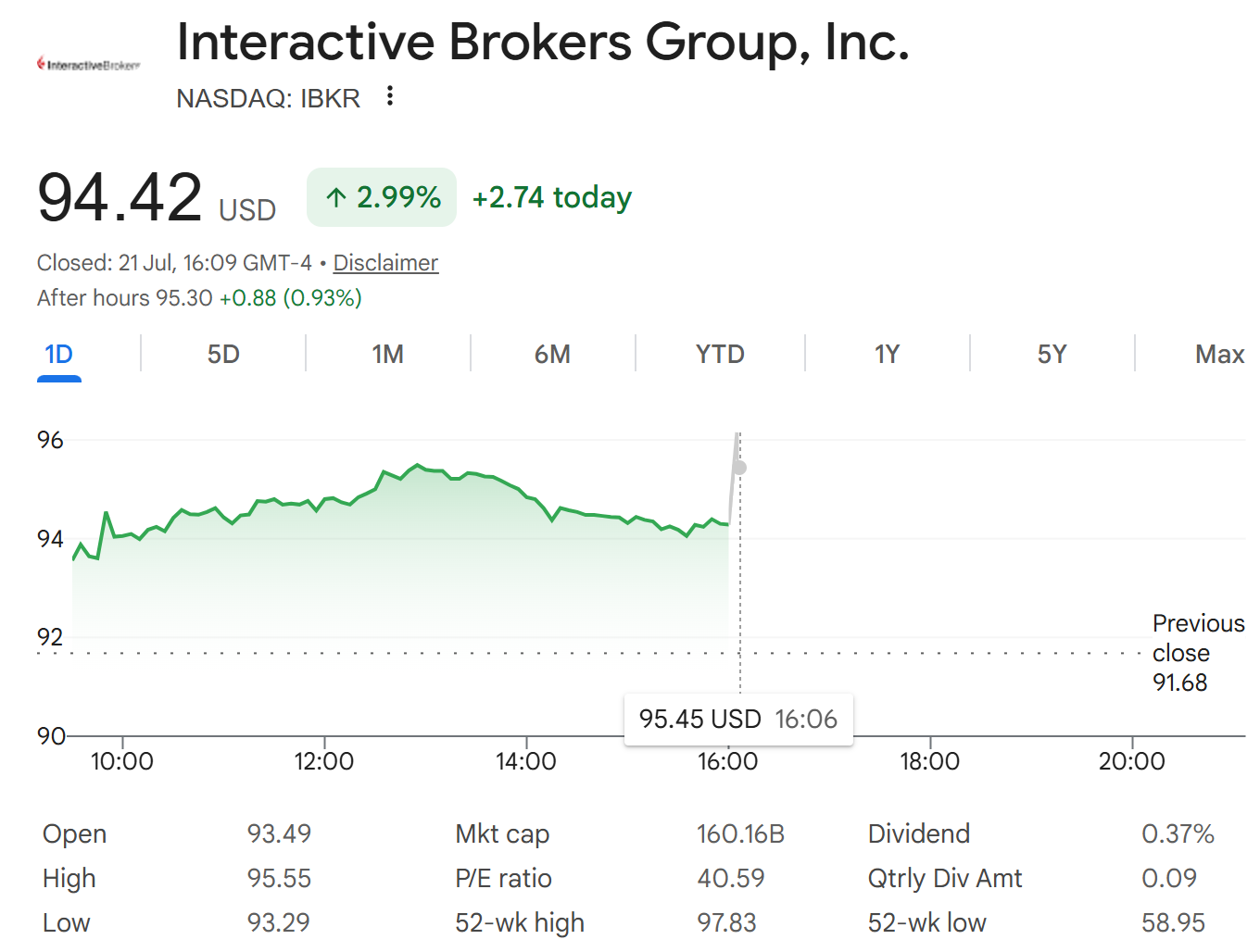
Interactive Brokers (IBKR) posted second-quarter revenue of $1.90 billion and adjusted earnings per share (EPS) of $0.69. Both figures beat Wall Street estimates of $1.80 billion and $0.64, and the stock climbed about 4% in after-hours trading.
The automated global brokerage, which offers stocks, options, futures, crypto, and prediction markets, lifted profits on booming customer activity. Its pretax profit margin reached 77%, up from 75% a year earlier.

Trading Boom Powers Interactive Brokers Earnings Beat
Commission revenue rose 30% year-over-year to $673 million. Customer trading volumes in options and stocks increased 17% and 14%, respectively.
Meanwhile, net interest income climbed 23% to $1.06 billion, ahead of the $994 million FactSet consensus. Customer margin loans jumped 67% to $108.5 billion, while customer credits rose 27% to $182.4 billion.
The results cap a strong week for brokerages after Charles Schwab’s record quarter on Monday. Retail engagement has also picked up since the pattern day trader rule ended in June.
Client Growth Keeps the Bar High for IBKR Stock
Customer accounts grew 34% to 5.19 million, and customer equity expanded 40% to $930.3 billion. Daily average revenue trades (DARTs), a measure of customer orders that generate commissions, rose 36% to 4.82 million.
Beyond equities, the firm keeps widening its reach among brokers integrating crypto trading. It also became the first venue for Cboe’s new prediction markets products in June.
The board declared a quarterly dividend of $0.0875 per share, payable September 14. However, the stock entered the report near the top of its historical valuation range.
Management’s earnings call commentary may decide whether the after-hours gains hold into the second half.
The post Interactive Brokers Earnings Reveal $1.90B Revenue, How Will IBKR Stock React? appeared first on BeInCrypto.



Bonzo Lend, a lending protocol on the Hedera network, lost approximately $9.05 million after an attacker exploited a verification flaw in a third-party Supra oracle contract on July 11. The attacker deposited 250 SAUCE tokens worth a few dollars as collateral, then submitted a manipulated price… Read the full story at The Defiant


The founder of Cap, a Franklin Templeton-backed stablecoin protocol, apologized for cutting a promised user reward to $4.2 million from the roughly $12 million the project had committed to in February, and denied accusations that he directed funds to a wallet linked to his former employer. Cap said… Read the full story at The Defiant


OpenAI called it an “unprecedented cyber incident” after its AI models broke out of their sandbox to hack an AI startup during a security evaluation.


The ENS DAO is voting to install a new Security Council, moving to restore the emergency veto that protects the naming protocol after its co-founder blocked an earlier renewal last month. Nick Johnson, who goes by nick.eth, filed the executable proposal on Sunday and moved it to an onchain vote the… Read the full story at The Defiant


EthSystems, a startup building confidentiality tools for banks and asset managers transacting on Ethereum, launched Tuesday, backed by Ethereum treasury companies Bitmine Immersion Technologies and SharpLink Gaming. The company's founding team spent the past year building and running the Ethereum… Read the full story at The Defiant

In the digital economy, numbers are everywhere. Websites report page views, social media platforms count likes and followers, and blockchain applications showcase wallet addresses and transaction volumes. While these metrics may look impressive, they don’t always reveal the true health of a product or ecosystem. The real indicator of success is real user activity—how actual people interact with a platform over time.
Whether you’re building a decentralized application (dApp), launching a Web3 protocol, or managing a traditional SaaS platform, understanding real user behavior is essential for sustainable growth.
What Is Real User Activity?
Real user activity refers to meaningful interactions performed by genuine users rather than bots, fake accounts, or one-time visitors. These interactions demonstrate actual engagement and value creation.
Examples include:
- Returning to use an application regularly
- Completing transactions
- Providing liquidity
- Participating in governance
- Creating content
- Referring new users
- Making purchases
- Using multiple features within the platform
Unlike vanity metrics, real activity reflects authentic adoption.
Why Vanity Metrics Can Be Misleading
Many projects celebrate milestones such as:
- One million wallet addresses
- Hundreds of thousands of followers
- Millions of transactions
- High website traffic
While these achievements may attract attention, they don’t necessarily indicate an active community.
For example:
- Wallets can be created automatically.
- Followers can become inactive.
- Transactions can be generated by automated bots.
- Website visits may last only a few seconds.
Without genuine engagement, these numbers provide limited insight into long-term success.
Key Metrics That Actually Matter
Instead of focusing solely on headline numbers, successful teams monitor indicators that reflect user behavior.
Daily Active Users (DAU)
Measures how many unique users interact with the platform each day.
Monthly Active Users (MAU)
Shows sustained engagement over a longer period.
Retention Rate
Tracks how many users return after their first visit or transaction.
High retention usually indicates that users find ongoing value.
Session Duration
Longer sessions often suggest users are actively exploring features rather than leaving immediately.
Feature Adoption
Understanding which tools users actually use helps prioritize future development.
Conversion Rate
Measures how many visitors become active participants, customers, or token holders.
Real User Activity in Web3
Tracking activity becomes more challenging in decentralized ecosystems because users may have multiple wallets and interactions occur across various protocols.
Useful on-chain indicators include:
- Active wallet addresses
- Repeat wallet interactions
- Smart contract usage
- Liquidity participation
- NFT trading frequency
- Governance voting participation
- Staking duration
- Cross-chain activity
Combining blockchain analytics with application-level data provides a much clearer picture of adoption.
The Role of Analytics Tools
Modern analytics platforms help developers understand user behavior while respecting privacy.
Common capabilities include:
- Event tracking
- User journey analysis
- Funnel visualization
- Cohort analysis
- Retention reports
- Heatmaps
- Performance monitoring
- Error tracking
In Web3, blockchain analytics platforms add visibility into wallet activity and on-chain interactions.
Why Retention Beats Acquisition
Acquiring new users is expensive.
Keeping existing users is far more valuable.
A platform with 10,000 loyal users who engage weekly often outperforms one with 500,000 one-time visitors.
Returning users:
- Generate recurring revenue
- Provide feedback
- Build communities
- Create organic marketing
- Increase network effects
Retention transforms growth into sustainability.
Privacy Should Never Be Ignored
Tracking users should never come at the expense of personal privacy.
Responsible analytics emphasize:
- Anonymous identifiers
- Aggregated insights
- Consent-based data collection
- Transparent privacy policies
- Minimal data storage
Emerging technologies such as zero-knowledge proofs (ZKPs) and privacy-preserving analytics enable platforms to measure engagement without exposing sensitive user information.
This balance is becoming increasingly important as privacy regulations continue to evolve worldwide.
Turning Data into Better Products
Collecting analytics is only the first step.
The real value comes from acting on the insights.
For example:
- High abandonment during onboarding may indicate confusing instructions.
- Low governance participation may suggest voting is too complex.
- Frequent exits after connecting a wallet could reveal poor user experience.
- Strong engagement with one feature may justify expanding that functionality.
Data-driven decisions help teams allocate resources more effectively.
The Future of User Activity Tracking
Artificial intelligence is making analytics more intelligent than ever.
Future platforms will increasingly:
- Predict user churn before it happens
- Recommend personalized experiences
- Detect fraudulent behavior automatically
- Identify growth opportunities in real time
- Optimize onboarding using behavioral insights
- Measure user satisfaction through interaction patterns
For decentralized applications, AI combined with blockchain analytics could create adaptive ecosystems that continuously improve based on genuine community activity.
Conclusion
Real user activity is the foundation of sustainable digital growth. While large numbers may generate excitement, consistent engagement, strong retention, and meaningful interactions reveal whether a platform is truly delivering value.
As Web3 and decentralized technologies continue to mature, projects that prioritize authentic user behavior over vanity metrics will be better positioned to build lasting communities, improve their products, and achieve long-term success. In an increasingly competitive digital landscape, understanding how real people use a platform isn’t just helpful—it’s essential.

Balaji Srinivasan’s Network School is looking to plant a new campus in Kazakhstan after regulatory pressure in Malaysia forced its Johor operation to halt. The move comes via a memorandum of understanding (MoU) between Kazakhstan’s Ministry of Digital Development, Innovation and Aerospace Industry and Srinivasan, signaling a rapid attempt to preserve the project’s cross-border footprint.
The Kazakhstan agreement positions Network School for a fresh base following actions that disrupted its local operations in Johor. Kazakhstan has been actively courting technology and digital-industry activity, including plans for a Central Asia “crypto city” in Alatau—an environment that Network School appears eager to tap.
Key takeaways
- Network School signed an MoU in Kazakhstan, potentially creating its first local campus there.
- Malaysia’s Johor authorities revoked the business license of NSO Malaysia Sdn Bhd, the operator behind Network School’s Forest City-linked presence.
- Malaysia Digital status is under immediate review, since the operator’s Malaysia Digital recognition is tied to compliance with local and federal laws.
- Srinivasan says the Kazakhstan campus will focus on talent attraction, including expedited visas and streamlined redomiciliation.
Kazakhstan MoU offers a fallback for Network School’s expansion
According to a ministry statement, Kazakhstan’s Ministry of Digital Development, Innovation and Aerospace Industry signed an MoU with Balaji Srinivasan to establish the first Network School campus in the country. The memorandum was signed by Zhaslan Madiyev on behalf of the ministry and Srinivasan on the Network School side.
For the project, the timing matters. Network School’s Kazakhstan plan appears framed as continuity after setbacks in Malaysia. The article also notes that Kazakhstan has been positioning itself as an emerging technology hub, and references ambitions such as a Central Asia “crypto city” in Alatau—suggesting regulators and policymakers there may be more receptive to experiments that sit near the boundary between technology policy and digital-asset culture.
Srinivasan described the new campus as a place designed to accelerate onboarding for participants. In a post dated Tuesday on X, he said the campus would offer a “haven for global techno-optimism,” including expedited visas, streamlined redomiciliation, and active recruitment of talent.
Malaysia regulatory action escalates: license revocation and Malaysia Digital review
Network School’s Kazakhstan pivot follows multiple regulatory developments in Malaysia. On Tuesday, the Iskandar Puteri City Council (MBIP) revoked the business license of NSO Malaysia Sdn Bhd, which operates Network School. The revocation was linked to alleged breaches of licensing conditions and premises-use requirements.
The Malaysia Digital Economy Corporation (MDEC), which oversees the “Malaysia Digital” program, then announced immediate steps to revoke the operator’s Malaysia Digital status. Malaysia Digital recognition is granted to eligible technology and digital companies and, as described in the source coverage, can come with incentives such as tax benefits, flexibility around ownership, and the ability to employ local and foreign workers.
Crucially, the program also requires licensees to comply with local and federal laws. With NSO Malaysia’s license revoked, MDEC’s move indicates the regulator is treating the Malaysia Digital designation as contingent on continued lawful operations.
Johor politics and immigration scrutiny widen the dispute
Beyond the licensing issue, the dispute has also pulled in higher-level political attention. The source reports that Onn Hafiz Ghazi, Chief Minister of Johor, urged Malaysia’s federal authorities to continue investigating whether Network School violated immigration laws. He framed Johor as a “strategic entry point” due to the state’s proximity to Singapore, arguing that any weaknesses or misuse of the immigration system should be addressed promptly and firmly.
This matters for Network School because its model—bringing in global “digital nomads” and hosting a dense community of talent—depends on predictable pathways for visas, residency changes, and compliance. When immigration questions enter the picture, the risk is not only reputational; it can directly affect members’ ability to travel, work, or remain in the country.
The source also indicates that Srinivasan pushed back on reports that Network School was shutting down. On Friday, he denied the closures, saying the project had received two notices: one requiring a sign’s wording to be changed, and another related to a coworking setup created by joining two adjacent units. He said one side of that arrangement had a valid license while the other did not, and claimed the group had a remedial period to address both issues.
According to Srinivasan, members were otherwise unaffected during that remedial window. Cointelegraph reported that it reached out to Srinivasan and Network School for comment, but the article’s account focuses primarily on the regulatory steps already taken by the local council and MDEC.
What changes—and what remains uncertain—if Network School relocates
The Kazakhstan MoU suggests Network School wants to avoid a prolonged pause by securing an alternative operating base quickly. But an agreement is not the same as full operational clearance. Readers should view the MoU as a framework for collaboration and campus establishment, while awaiting more detailed information on licensing, immigration logistics, and the practical timeline for opening.
Still, the contrast between Malaysia and Kazakhstan is instructive. In Malaysia, the dispute moved from licensing conditions to a broader discussion involving Malaysia Digital compliance and immigration law scrutiny. In Kazakhstan, the present reporting centers on cooperation and talent-attraction features—expedited visas and streamlined redomiciliation—language that typically signals a focus on easing administrative friction.
For investors, builders, and community operators watching the “network state” concept, the underlying takeaway may be how regulatory pressure in one jurisdiction can accelerate relocation tactics. A community anchored in one place can gain momentum, but it is also exposed: local licensing, premises rules, and immigration enforcement can rapidly reshape operating reality. Network School’s next steps in Kazakhstan will therefore function as a real-world test of whether the administrative environment for techno-nomad hubs can be replicated across borders.
As the Kazakhstan campus planning progresses, the most important thing to watch is how the MoU translates into concrete permits and member onboarding on the ground—particularly on visas and local compliance. Until then, Network School’s situation remains a moving target shaped by how regulators interpret licensing, premises usage, and immigration obligations in each country.
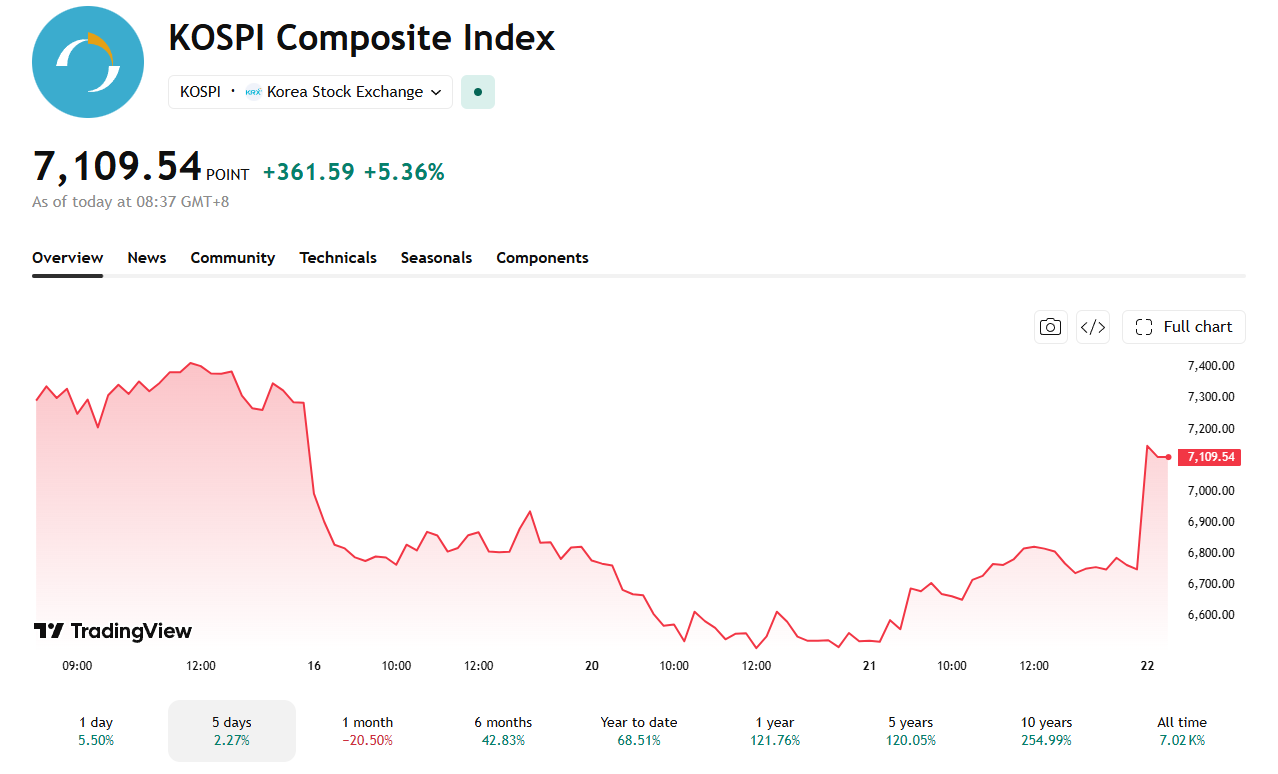
South Korea’s Kospi surged over 5% to a high of 7,164 on Wednesday’s early trading, extending its rebound from an artificial intelligence stock selloff. Asian chipmakers led the gains for a second straight session.
Japan’s Nikkei 225 added near 2% to 67,524.22, also in early trading. The rally builds on Tuesday’s rebound across Asian markets.
Samsung, SK Hynix Lead the Recovery
The gains extend July 21’s rebound, when the Kospi jumped 3.6% and the Nikkei rose 3% after a number of days trending downwards. Chipmakers are looking to pull the Kospi back from a bear market slide that AI valuation fears caused earlier this month.
Samsung Electronics surged reversed its downward trend on Tuesday while SK Hynix, the memory chipmaker, gained also started gaining, recovering from its sharp sidecar plunge earlier this month.

The Kospi is still down more than 20% over the past month, even after gaining over 50% year-to-date. Investors had locked in profits on AI bubble concerns.
Wall Street Also Jumps at Semiconductors
Wall Street added its own momentum on Tuesday. The Nasdaq 100 posted its best session in three weeks, and a key semiconductor gauge jumped 5.2%, according to Bloomberg.
Analysts remain split on whether the bounce will last.
“The recent correction appears more consistent with a healthy reset following a parabolic advance than a fundamental breakdown in the AI investment theme.”
Adam Turnquist, LPL Financial
Nearly 20% of S&P 500 companies by market value report earnings this week. Alphabet and Tesla release results Wednesday. Those results will test whether the chip rally can hold.
The post Kospi Jumps 5% as Asian Chipmakers Rebound From AI Selloff appeared first on BeInCrypto.


S&P Dow Jones Indices and Pantera Capital have launched the S&P Pantera Digital Asset Index, a new crypto benchmark that excludes Bitcoin (BTC) entirely.
CEO Cathy Clay said Bitcoin fails the index’s core test, generating real protocol revenue instead of trading purely on speculation.
How the Index Weighs Its Tokens
The index holds 18 constituents. Its five largest holdings are Ether (ETH), Binance Coin (BNB), Solana (SOL), Tron (TRX), and Hyperliquid (HYPE), a decentralized derivatives exchange.
The benchmark weights holdings by market capitalization and rebalances quarterly. No single token can exceed 35% of the total, and no other holding can top 20%. These caps mirror rules S&P applies to its own equity benchmarks.
Clay wants to bring stock-index discipline into digital assets. She favors protocols with verifiable economic activity over ones that trade on name recognition alone.
Pantera co-developed the methodology with founder Dan Morehead. The firm has managed over $3 billion across three investment strategies since launching its first crypto fund in 2013.
“S&P Dow Jones Indices helps investors cut through market noise with benchmarks you can trust.”
Clay, CEO of S&P Dow Jones Indices
Wall Street Warms to Altcoin Season
The exclusion highlights a widening split in how institutions define crypto value. By this measure, revenue beats Bitcoin’s dominant narrative as the market’s largest asset. Pantera’s history with institutional crypto access suggests more revenue-screened benchmarks could follow.
The launch lands as retail altcoin season signals stay unconfirmed but improving. CoinGlass’s Altcoin Season Index climbed to 58 in mid-July, building on a June 4 spike to 64. That reading sits above the neutral midpoint, but it remains short of the 75 threshold that confirms genuine rotation.
Institutional flows tell a parallel story. A March BeInCrypto Expert Council discussion found major allocators narrowing institutional crypto bets to Bitcoin, Ethereum, and a short list of DeFi names.
A revenue-screened benchmark like the S&P Pantera Digital Asset Index offers portfolio managers a compliant route into that same thesis. It provides exposure to large-cap altcoins with real usage, skipping meme coins and speculative networks entirely.
If other index providers copy the approach, institutional capital could rotate into select altcoins early. That could happen well before retail-driven altcoin season data confirms a broader move.
The post S&P Dow Jones New Crypto Index Snubs Bitcoin, Not a Revenue-Generating Protocol appeared first on BeInCrypto.
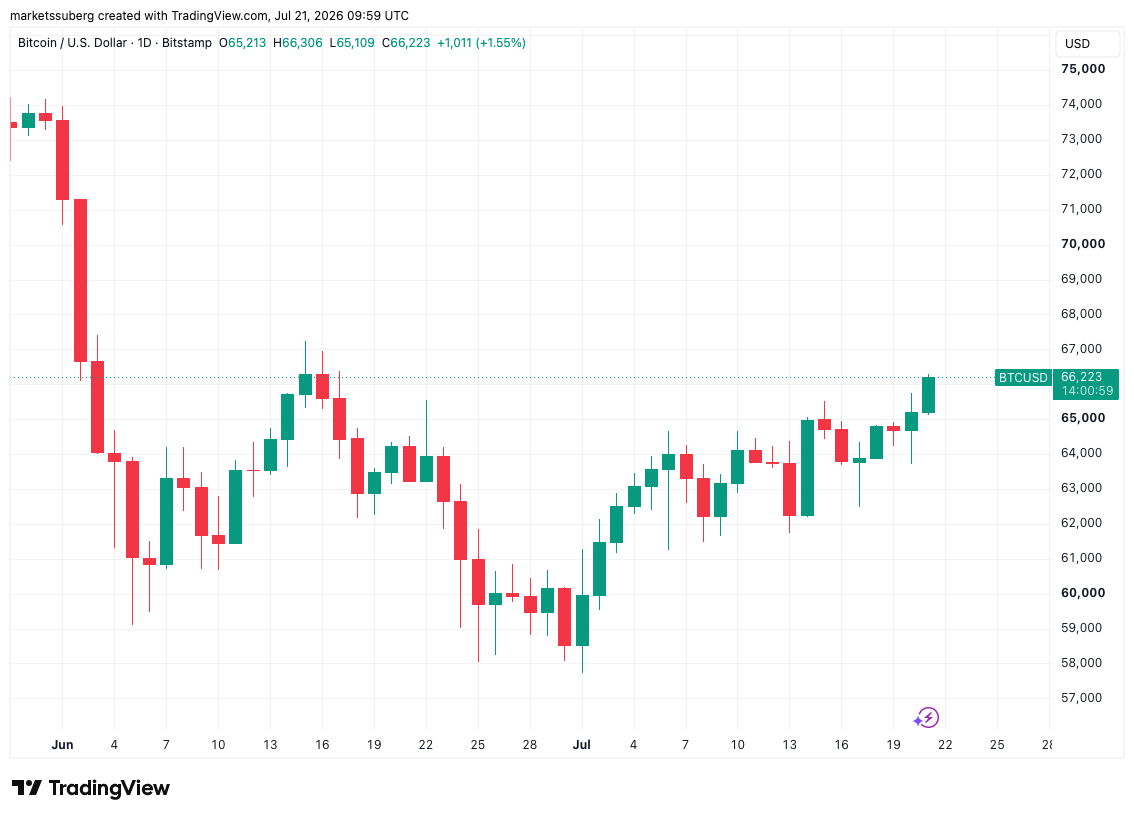
Bitcoin (BTC) passed one-month highs on Tuesday as price action defied the odds to top $66,000.
Key points:
- Bitcoin broke through resistance to hit $66,000 for the first time in more than a month.
- Traders see as much as 6% BTC price gains if further nearby upside targets are reached.
- Month-end derivatives positioning underscores crypto risk confidence slowly returning.
BTC price 6% upside could come “very quickly”: Trader
BTC/USD hit highs of $66,306 on Bitstamp, according to TradingView data. That’s a level last seen on June 17.
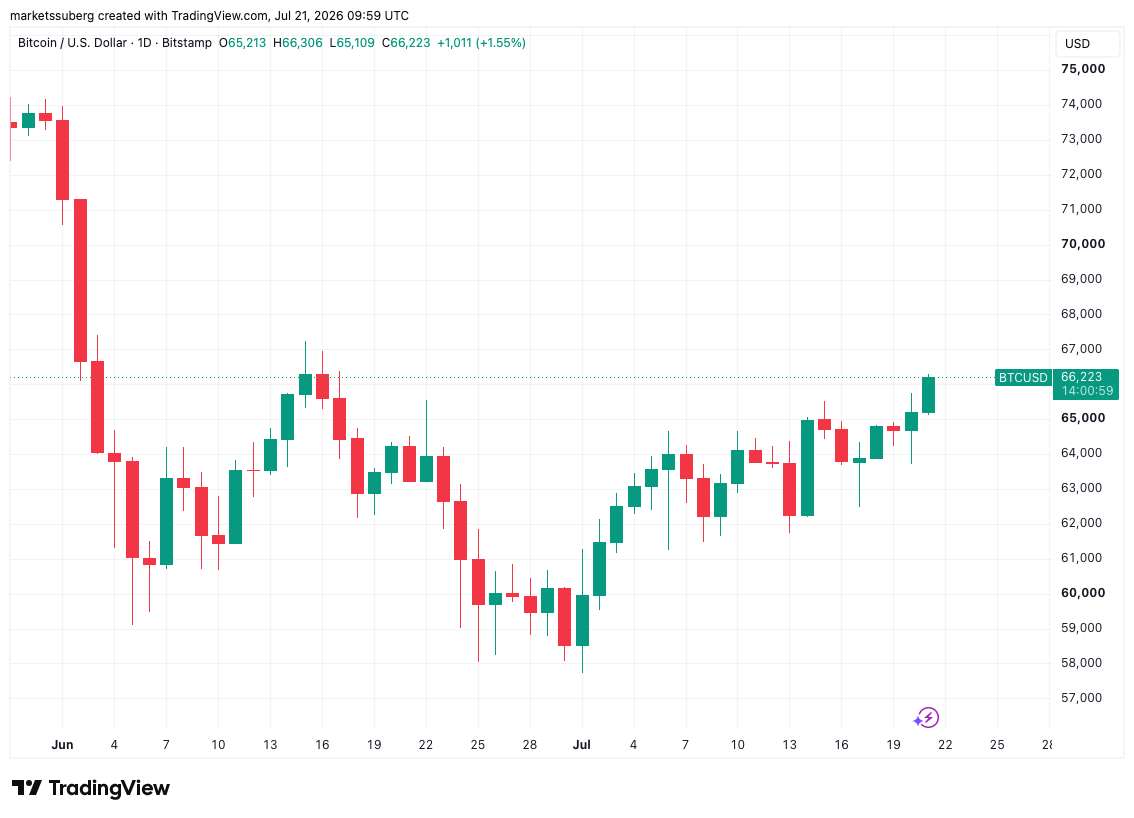
BTC/USD one-hour chart. Source: Cointelegraph/TradingView
A series of rejections around the $65,000 mark had failed to quash traders’ enthusiasm, with calls for $67,000 or higher gaining momentum. Those short-term predictions continued on the day, with key psychological levels around $70,000 now on the horizon.
“$BTC reclaimed the range lows, and is now pushing higher – as expected,” trader Jelle wrote in his latest analysis on X.
“The area between 65 and 67k is resistance from the Q1 range, but given how we sliced through it on the way down – it might not put much of a fight up here either. Eyes on those 70k range highs if so.”
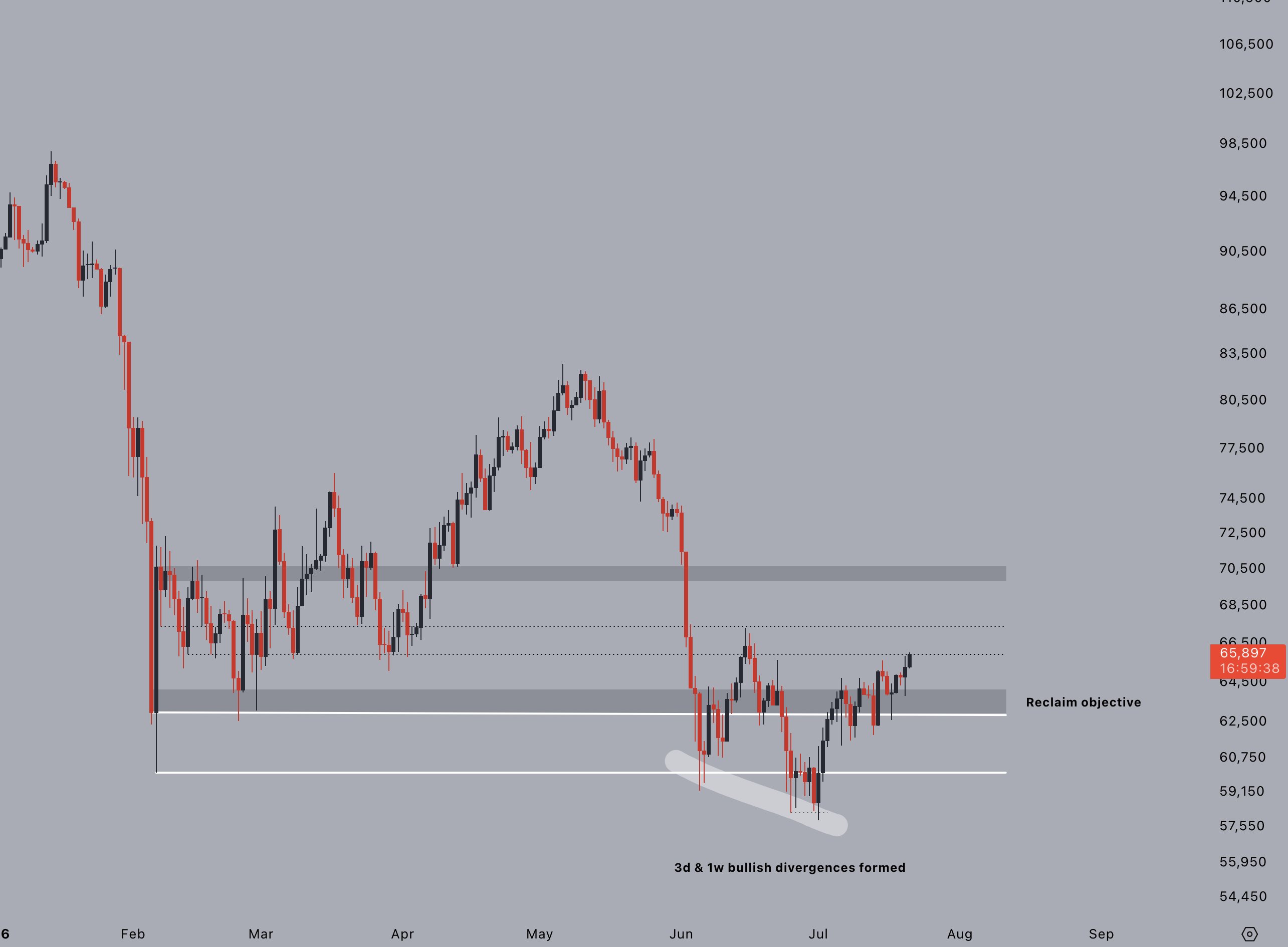
BTC/USD one-day chart. Source: Jelle/X
Short liquidations began to mount as the BTC price broke through range highs, with data from CoinGlass putting 24-hour cross-crypto liquidations at around $200 million.
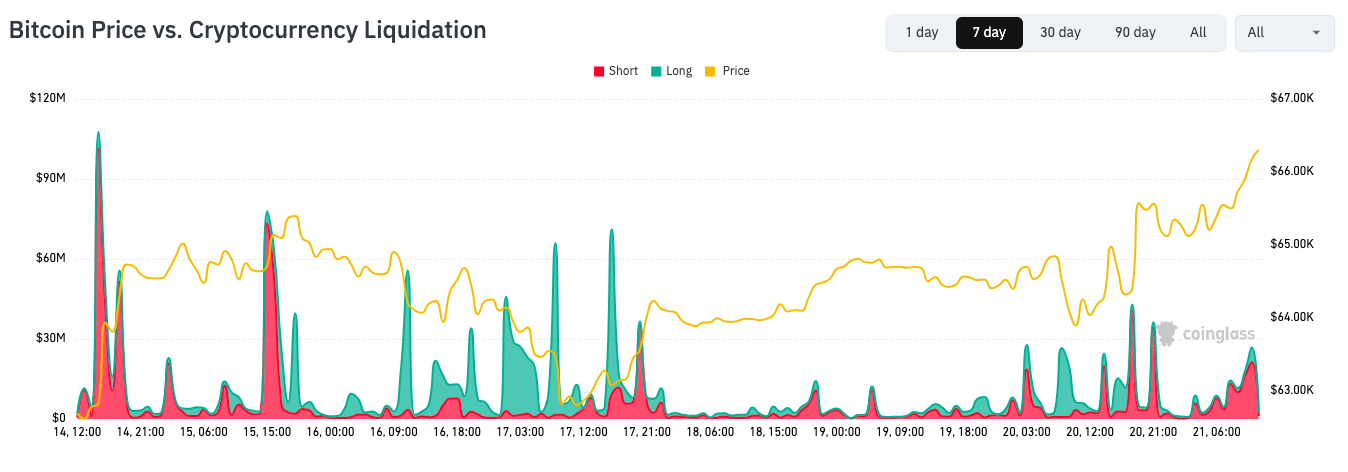
BTC/USD vs. crypto liquidations (screenshot). Source: CoinGlass
“$BTC has reclaimed the $65,000 level. The next key resistance is $67,500-$68,000, which means Bitcoin has some room to pump,” trader Ted Pillows said.
“If BTC manages to reclaim the $68,000 resistance too, it could rally another 5%-6% very quickly.”
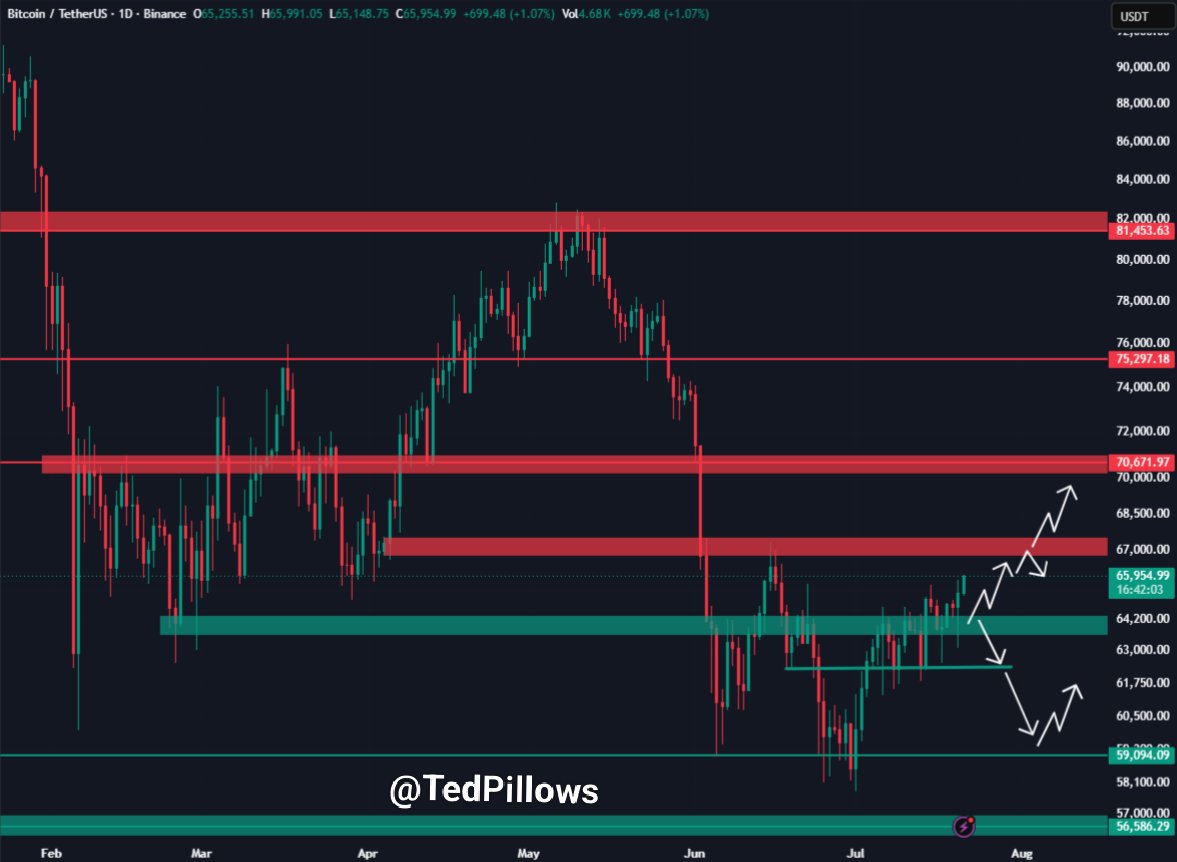
BTC/USDT one-day chart. Source: Ted Pillows/X
Concerns had accompanied the start of the latest move, with commentator Exitpump seeing closing short positions fueling the upside.
“There’s very little real buying interest here,” they warned X followers while analyzing derivatives markets.
BTC derivatives hint at risk-on return
Observing options trends, trading company and market maker QCP Capital flagged “some demand” for higher Bitcoin bets into the end of July.
Related: Trader maintains $67K BTC price target: Five things to know in Bitcoin this week
Here, it noted the US Federal Reserve would hold its next meeting on interest-rate changes, with chair Kevin Warsh potentially offering fresh insight into future policy.
As Cointelegraph reported, market expectations remain that the Fed will leave rates unaltered before September. CME Group’s FedWatch Tool shows 83.4% probability that policy makers will stick with the current target range of 3.50-3.75% at their July 29 meeting. For the Sept. 16 FOMC meeting, there’s a 53.8% probability of a hike to 3.75-4.00%.
“There has been some demand for month-end BTC upside,” Monday’s QCP Market Colour analysis said.
“This positioning leaves dealers short upside gamma into the 28 to 29 July FOMC meeting, increasing the potential for an accelerated move higher should tensions around the Strait of Hormuz ease.”
QCP referred to the US-Iran war once again closing a key global oil route.

Edinburgh thief caught on camera ‘stealing Uber Eats delivery’ from bike in broad daylight

5 Best Fast Proxy Servers in 2026: Speed, Tested Against Price

Bonzo Lend Loses $9M on Hedera in Supra Oracle Exploit


-
 NewsBeat5 days ago
London Mayor Sadiq Khan handed a peerage by Keir Starmer alongside 15 other Labour figures… just days before the PM leaves No10
-

 Fashion4 days ago
Weekend Open Thread – Corporette.com
-

 Politics4 days ago
The House | The City of London can help the new chancellor deliver growth in every postcode
-

 Politics7 days ago
Young campaigners urge incoming PM to act on outdoor junk food ads
-
 Crypto World5 days ago
Two July Windows Left: The CLARITY Act’s Senate Fight and What Failure Means
-

 Crypto World6 days ago
CFTC blocks Kalshi from unwinding Michigan trades after court order
-

 Crypto World4 days ago
Ripple Payments Joins MiCA With 14 Firms, Does It Mean Anything For XRP?
-

 Business6 days ago
Nvidia Stock Slips After Big Tuesday Rally as Huang Confirms Vera Rubin Chip Is Now in Production Today
-

 Politics3 days ago
Democrats look to World Cup watch parties to register thousands of voters
-
 Entertainment6 days ago
Disney’s Most Ambitious Failed Star Wars Attraction Is Coming to SDCC
-

 Crypto World4 days ago
Ripple wins EU-wide access as ESMA adds it to MiCA register
-

 Crypto World18 hours ago
Grayscale Files For Worldcoin ETF, WLD Registers Sharp Rise
-

 Crypto World5 days ago
Injective Submits SEC Transfer-Agent Registration to Onchain Ownership Records
-

 Business6 days ago
Palantir Shares Rise After Expanded Nvidia Partnership and Fresh Analyst Upgrades Ahead of Earnings Day
-

 Tech1 day ago
Sail Virtually Aboard The “Itanic” With IA-64 Emulator
-
 Tech24 hours ago
Turtle Beach Command Series KB7 review: a nifty screen-equipped gaming keyboard
-

 NewsBeat5 days ago
Registration is now open for March for Men with Kev 2026
-

 NewsBeat2 days ago
Unregistered fitter used Gas Safe logo on business flyers
-
 Sports6 days ago
New Cornerback Enters Vikings Trade Rumor Mill
-

 News Videos5 days ago
Money | Class 12 Economics | CBSE Board Exam 2026-27
You must be logged in to post a comment Login