

Crypto World
Investors Swapping Hype-Only Meme Coin for DeepSnitch AI for 1000X Return Ahead of March 31 Uniswap Listing


South Korea is set to use artificial intelligence to monitor cryptocurrency investment profits as it prepares to tax digital assets by 2027. The system will examine data on crypto transactions to enforce taxation.
Meanwhile, Pepeto news today shows the project has raised over $7.99M in its ongoing presale. While investors are still waiting on hype to fuel a Binance listing, utility-backed projects like DeepSnitch AI (DSNT) have secured a Uniswap listing.
DeepSnitch AI could also be listed on Binance before Pepeto due to its clear utility and team dedication. The project is at the seventh stage of its presale and priced at just $0.04487. Given its AI utility and March 31 deadline, the best crypto to buy for 1000X returns could be DeepSnitch AI.
South Korea turns to AI for crypto tax compliance
South Korea is planning to adopt AI to enhance cryptocurrency tax enforcement before it implements a digital asset tax rollout in 2027. A report by The Korea Times states that the country’s National Tax Service has put out a bid for an AI-based system that will analyze large amounts of data on crypto transactions.
The project is projected to cost 3 billion Korean won and will entail machine learning to detect abnormal trading patterns and potential tax evasion. In the new policy, tax crypto gains that exceed 2.5 million won will be taxed at 22% beginning in January 2027.
Pepeto news today: Two more legit and underdog presales with the potential to give much higher ROI
1. DeepSnitch AI (DSNT): The “must-buy” 1000X moonshot before March 31
The clock is ticking as DeepSnitch AI’s presale continues to sell fast ahead of its March 31 deadline. You have less than a month to hop on the train before the presale ends, and you will have to buy at an exchange price, which will be very high.
At the moment, DeepSnitch AI is in the seventh stage of its presale. It has raised over $2.14M in revenue and given those who joined early more than 191% returns. If you buy $5,000 worth of DSNT at the current price of $5,000, you will get 113,662 DSNT coins.
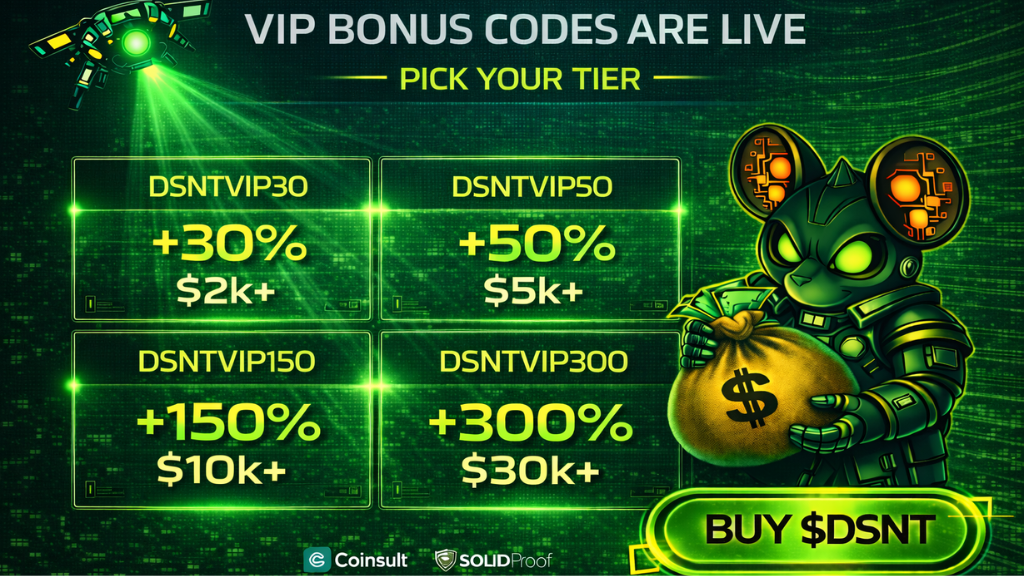
However, if you use the 50% bonus code, you will get 170,493 DSNT, which could be worth $170,493 if the price of DeepSnitch AI rises to $1. At its core, DeepSnitch AI is a fully operational platform that features five AI agents that work 24/7 to provide you with the latest market insights.
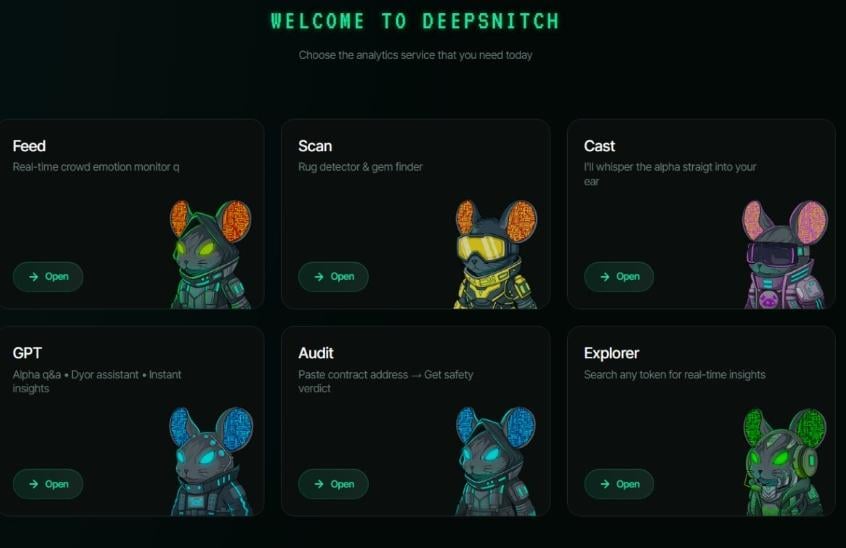
Also, the AI tools are housed together on a clean, intuitive dashboard, which is easy to navigate. The tools evaluate whale movements, scan projects for rug pulls and bugs, highlight top-performing coins, and those with potential for high growth. With these clear utility and live AI tools, the DeepSnitch AI price could see a growth of 1000X.
2. Pepeto news today highlights potential listing
Pepeto is an Ethereum-based project aiming to combine meme-coin culture with real trading infrastructure and DeFi tools. The platform is building an ecosystem that will house an exchange called PepetoSwap.
Recent Pepeto news today shows that the project’s presale growth has been terrific. According to Pepeto roadmap updates, the project could be close to the end of its presale.
It has raised over $7.99M and is close to the end of its target of $8.32M. Meanwhile, Pepeto ecosystem news indicates that developers are preparing major DeFi features and a potential Binance listing. Such a listing could push the Pepeto price to $0.00010 before the year ends.
3. Digitap, the first omni-bank
Digitap is a platform that aims at revolutionizing the cross-border payment industry. It aims to provide businesses, freelancers, and individuals with real-time crypto-to-fiat conversion at low costs and the highest speed.
Meanwhile, the project has a native token called TAP. The token powers the platform by enabling staking rewards, governance participation, fee discounts, and loyalty incentives for users.
Presently, Digitap is at round three of its presale and is priced at $0.0499. Over $5.26M has been raised so far as the project rallies towards $10M.
Final verdict
In summary, Pepeto news today highlights a likely delay in Binance listings. Meanwhile, DeepSnitch AI is already set for a Uniswap listing and could bag more after the end of its presale on March 31.
While Pepeto thrives on hype energy, DeepSnitch AI offers the rare combination of a presale success, AI tools, dynamic staking, and 1000X projection. It is currently at the early stages and is priced at $0.04487. Those who get in now can get more coins using the bonus codes, a rare opportunity that will no longer be available after March 31.
Visit the official website for more information, and join X and Telegram for community updates.
FAQs
1. Where will Pepeto be listed?
Pepeto community updates say the memecoin may be listed on Binance soon. However, this is not unconfirmed. On the other hand, DeepSnitch AI could secure a listing first. It is almost at the end of its presale and will be listed on Uniswap first. Also, more exchanges are expected to list DeepSnitch AI after the presale ends.
2. What is the latest Pepeto news today?
Recent Pepeto ecosystem news shows that it has raised over $7.99M in funding. On the other hand, DeepSnitch AI just crossed over $2.14M in a shorter time ahead of its March 31 deadline. The price of DeepSnitch AI is expected to soar by 1000X afterward, making it a good crypto to buy.
3. Is Pepeto coin a good investment?
Based on Pepeto news today, the Pepeto token is expected to soar to a new level soon. However, its lack of clear utility makes DeepSnitch AI a better option. Its AI tools could sustain long-term growth and over 1000X return.
Disclaimer: This is a Press Release provided by a third party who is responsible for the content. Please conduct your own research before taking any action based on the content.



TLDR:
- Tron Revenue hits $947K in 24 hours, far above Base and Ethereum combined.
- Monthly revenue reaches $24.96M, surpassing Polygon, Base, and Solana together.
- Stablecoin transfers drive consistent fees and support large-volume transactions.
- TRX technicals show momentum gaining near 50-day MA, with resistance at 200-day MA.
Tron Revenue has emerged as the top-performing blockchain, surpassing Ethereum, Polygon, and Solana in daily, weekly, and monthly revenue. Stablecoin transfers and low transaction costs remain key drivers of this performance.
Revenue Performance and Network Comparison
Tron generated about $947,419 in revenue over the past 24 hours. This figure is nearly ten times higher than Base, which recorded $97,720, and far above Ethereum at $77,565.
Over seven days, Tron accumulated around $5.42 million. In comparison, Polygon recorded $632,000 and Solana $374,000.
On a 30-day scale, Tron Revenue reached approximately $24.96 million. Polygon generated $4.5 million, Base $3.72 million, and Solana $1.78 million.
Tron’s monthly earnings alone surpass the combined revenue of these networks, reflecting its dominant position in the blockchain landscape.
The network’s success is closely tied to stablecoin activity, particularly Tether (USDT). Tron has become a primary layer for USDT transfers globally, especially in markets where stablecoins are widely used for remittances, payments, and liquidity management.
This activity ensures a constant flow of network fees and reinforces Tron Revenue leadership.
Tron’s low transaction costs and high throughput allow rapid, large-volume transfers. Other networks focus on decentralization and smart contract innovation, but Tron prioritizes speed and affordability, which supports large-scale payment and exchange operations.
Technical and Market Dynamics
TRX, Tron’s native token, is trading within a descending channel, signaling that sellers have controlled the market since the previous peak near $0.35–$0.36.
Lower highs and lower lows indicate the macro trend remains bearish. Short-term momentum shows improvement.
TRX recently reclaimed the 50-day moving average, now acting as dynamic support. The token is also in a rectangular accumulation zone, where buyers and sellers are competing for control.
The 200-day moving average represents the next resistance level. A breakout above this level could indicate a trend shift.
Momentum indicators, such as the RSI forming higher lows, suggest rising buying pressure. Traders are watching these levels for potential breakout or downside scenarios near $0.253–$0.250.
TLDR:
- The Uniswap (UNI) price is consolidating within an ascending triangle between $3.80 and $4.10.
- A clean breakout above $4.10 could trigger a 30% rally toward $5.30 liquidity.
- Breakdown below $3.80 may lead to a 30% correction toward February lows near $2.80.
- Market cap shows tight consolidation near $2.55B, reflecting gradual accumulation.
Uniswap (UNI) price is compressing inside an ascending triangle on the four-hour chart. The structure forms between $3.80 support and $4.10 resistance, creating a tight range where traders expect a decisive breakout or breakdown.
Ascending Triangle Reflects Accumulation Pressure
Uniswap (UNI) price is forming a classic ascending triangle, defined by rising higher lows converging on a horizontal resistance near $4.10. This pattern often signals that buyers are absorbing supply at key levels.
The trendline support near $3.80 has proven reliable during multiple pullbacks. Each test of this level has seen buyers intervene, maintaining the upward slope of higher lows. This support is critical for the bullish setup to remain valid.
Rejections at $4.10 resistance have produced progressively shallower pullbacks, suggesting gradual accumulation. Traders monitoring this range may interpret smaller declines as a sign that selling pressure is weakening.
The tight $3.80–$4.10 range has reduced short-term volatility, creating what some traders call a “no-trade zone.” Such compression often precedes strong directional moves once the price breaks above or below the boundaries.
Momentum may build once the triangle resolves. A sustained breakout could attract new buyers, while a breakdown would likely trigger stop-loss orders and accelerate selling pressure. The structure highlights the balance between supply and demand at current levels.
Until a decisive close occurs, directional edge remains limited. Traders continue to watch both the rising support and horizontal resistance closely.
Breakout or Breakdown Could Define Next Trend
If Uniswap (UNI) closes above $4.10 on the four-hour chart, momentum buying and short covering could drive the price toward $5.00–$5.30. These levels correspond to prior liquidity clusters in which trading activity has historically increased.
On the downside, a failure of the $3.80 support would invalidate the triangle. A breakdown could prompt stop-loss cascades, exposing UNI to a correction toward February lows near $2.80. Such a move would retrace the prior recovery leg and test the broader demand zone.
The seven-day market capitalization data reinforces this tight structure. UNI’s market cap fluctuated between roughly $2.32B and $2.65B before stabilizing near $2.55B.
Early rebounds suggest buyer willingness at lower valuations, while sideways consolidation reflects a struggle between accumulation and profit-taking.
Recent spikes in market cap, such as toward $2.65B, were met with swift rejection, confirming that sellers remain active at higher levels. The current upward slope toward $2.55B indicates buyers are gradually regaining control.
With only $0.30 separating support from resistance, the Uniswap price is poised for a decisive move that may define its next major trend.


Crypto ATMs’ minimal verification and fast transactions let criminals turn cash into digital assets in minutes, often before victims notice.
A new report from blockchain security firm CertiK warns that crypto ATM scams are rising sharply across the United States (U.S.). In 2025 alone, criminals stole roughly $333.5 million, highlighting the risks tied to cash-to-crypto kiosks.
These alarming losses are partly due to the design of crypto ATMs, which makes them attractive targets for criminals. Their structure enables fast transactions with minimal identity verification. This allows cash to be converted into digital assets in under five minutes, often before victims even realize they have been targeted.
Crypto ATMs Become Key Channel for Fraud
These kiosks are often found in convenience stores, gas stations, and malls, making them easy to access for everyday users. Their ubiquity allows scammers to trick victims into making fraudulent transfers, bypassing on-screen warnings.
According to Certik, the U.S. hosts about 78% of the world’s estimated 45,000 crypto ATMs, making it the largest market for these machines. This widespread presence contributes to rising incidents. Consequently, the Federal Bureau of Investigation received over 12,000 complaints from January to November 2025, up 33% from 2024.
Many scams involve social engineering, where criminals persuade users to deposit funds under false pretenses. The technical setup of ATMs worsens the problem, as they act as front-end interfaces connecting to backend Crypto Application Servers (CAS).
Funds typically come from operator-controlled hot wallets rather than the customer directly. This design creates an “attribution gap,” meaning blockchain records show transfers from operators, not victims. As a result, tracing the stolen funds becomes much harder.
Older Adults Face Higher Risks as Criminal Networks Expand
Older adults are particularly vulnerable, accounting for roughly 86% of crypto ATM losses. In one case, the Office of the Attorney General for D.C. found 93% of deposits on some Athena Bitcoin machines were fraudulent. The median victim was 71, and limited familiarity with digital finance makes them prime targets for scammers.
Criminal groups have industrialized these scams, running organized networks for lead generation, calls, and laundering. Some Asian syndicates laundered $16.1 billion in 2025, often using Telegram to coordinate rapid transactions.
Common scams include impersonating government officials, fake tech support, romance fraud, and emergency family schemes. Scammers are increasingly using artificial intelligence, including deepfakes, to make these scams more convincing and efficient.
Binance Free $600 (CryptoPotato Exclusive): Use this link to register a new account and receive $600 exclusive welcome offer on Binance (full details).
LIMITED OFFER for CryptoPotato readers at Bybit: Use this link to register and open a $500 FREE position on any coin!
TLDR:
- $3.44B in leveraged long positions sit near $66.5K, risking forced liquidations.
- Bitcoin trades around $71,544, consolidating below resistance at $72K.
- MACD shows fading bullish momentum, RSI at 58 indicates moderate buying strength.
- Breakdown below $70K could trigger rapid liquidation of billions in longs.
Bitcoin faces a critical liquidation risk as over $3.4B in leveraged long positions sit near $66.5K. A $5,000 drop from the current $71,595 level could trigger significant forced liquidations.
Leveraged Long Positions and Market Pressure
According to Coinglass data, the largest cluster of long liquidations is concentrated around $66,500. Over $3.44 billion in cumulative leveraged positions sit below Bitcoin’s current price, spread across major exchanges such as Binance, OKX, and Bybit.
If Bitcoin drops roughly $5,000, these positions would be automatically closed. Exchanges sell Bitcoin to cover losses, creating additional downward pressure on the market.
This process can accelerate price declines and trigger a short-term cascade of forced liquidations.
Traders and institutional participants monitor these clusters closely. Large liquidation pools often act as liquidity magnets, attracting strategic buying and selling.
Price can move toward these zones before reversing sharply once excess leverage is cleared. Currently, the market is long-biased.
The dominance of long positions near the downside indicates traders are heavily leveraged on bullish bets, which may increase the potential for a rapid downward move if selling pressure accelerates.
Consolidation, Momentum, and Key Levels
The 4-hour chart shows Bitcoin consolidating just below the $72,000 resistance, trading near $71,544. Price action forms a series of higher lows since the late February drop to $65,000, signaling a short-term bullish trend.
Range-bound consolidation between $70,000 and $72,000 indicates buyers defending support and sellers limiting rallies. Momentum indicators show moderation:
MACD lines are flattening, and the histogram has begun turning negative, while RSI at 58 suggests moderate bullish sentiment.
Critical levels to watch include resistance at $72,000–$73,500 and support at $70,000. A breakdown below $70,000 could test the $68,000–$66,500 range, exposing billions in leveraged long positions.
Conversely, a break above resistance may target $74,000–$75,000, providing room for controlled upward movement.
Overall, the market remains cautiously bullish but fragile. Traders should monitor the $66,500 liquidation cluster, as forced liquidations could trigger rapid price swings in either direction.
TLDR:
- A DeFi user lost $50.4M swapping aEthUSDT for aEthAAVE after confirming a 99.9% price impact warning.
- CoW Swap’s legacy gas ceiling and solver failure forced the trade through a $73K illiquid SushiSwap pool.
- A mempool leak exposed the transaction, letting an MEV bot execute a sandwich attack for $9.9M profit.
- Titan Builder extracted ~$34M in ETH, while Aave and CoW Swap have since patched their security gaps.
A DeFi user suffered approximately $50.4 million in losses from a single swap on the Aave platform. The user exchanged aEthUSDT for aEthAAVE through a CoW Swap widget and received only $36,000 in return.
Both Aave and CoW Swap have released detailed post-mortem reports on the incident. The reports cite a combination of user error, illiquid markets, and multiple technical failures.
MEV bots also exploited the situation, extracting tens of millions in profit from the DeFi trade.
How a Series of Technical Failures Enabled the Loss
The user manually confirmed a “High price impact (99.9%)” warning before completing the DeFi swap. Aave’s report confirmed this warning was clearly visible within the interface. The trade proceeded regardless, setting the stage for what followed.
CoW Swap’s report identified multiple system-level failures that escalated the outcome. A legacy hardcoded gas ceiling rejected better quotes that could have routed the trade efficiently.
The winning solver also failed to execute the trade on-chain as intended. Together, these two failures severely limited the options available for completing the swap.
Further complicating matters, a suspected mempool leak exposed the private transaction to public view. This meant any observer, including automated MEV bots, could see the order before confirmation. The exposure proved costly, as it directly opened the door for a targeted attack.
Because better routes were blocked, the trade was pushed through a SushiSwap AAVE/WETH pool. That pool held only about $73,000 in total liquidity at the time of the swap.
Routing a $50 million order through such a thin market caused extreme price slippage. The user ultimately received a fraction of what the trade should have returned.
MEV Bots and Block Builders Extracted Millions From the Failed Swap
Once the transaction leaked to the public mempool, an MEV bot quickly identified the opportunity. The bot front-ran the trade by buying available AAVE before the user’s order confirmed. This action drove the price of AAVE sharply higher, hurting the user’s final settlement.
The bot then sold its AAVE position immediately after the user’s trade was filled. This sandwich attack netted the bot an estimated $9.9 million in profit. @CoWSwap’s report identified the mempool leak as a central factor enabling this attack on the DeFi user.
To guarantee the correct block sequence, the MEV bot paid Titan Builder directly. The block builder extracted roughly $34 million in ETH for facilitating the arrangement. This coordination between the bot and the builder was key to the attack’s execution.
In response, @CoWSwap has patched its legacy gas limits to prevent similar routing failures. @aave is deploying “Aave Shield,” which will automatically block swaps with a price impact above 25% by default. Both protocols are now working to prevent this type of loss from recurring across DeFi.
TLDR:
- Ethereum futures volume on Binance now exceeds spot trading by more than sixfold in March 2025.
- ETH open interest has dropped by 400,000 ETH since January, erasing nearly $4 billion in exposure.
- Core PCE inflation hit 3.1% YoY, reducing the Federal Reserve’s room to cut interest rates soon.
- Rising oil prices tied to U.S.-Iran tensions may worsen inflation data through March and April 2025.
Ethereum futures volume on Binance now outpaces spot trading by more than sixfold. This shift comes as U.S.-Iran tensions continue pushing oil prices higher.
Last week, core CPI came in at 2.5% year-over-year, while core PCE reached 3.1%. These numbers are adding fresh strain to an already fragile U.S. economy.
As uncertainty grows, investors are pulling back from risk assets, including crypto. The altcoin sector is feeling this pressure most sharply, with Ethereum bearing the heaviest weight.
ETH Spot Market Hits Its Weakest Level Since 2023
The spot-to-futures ratio for Ethereum on Binance has dropped to its lowest point since 2023. That period marked the tail end of the previous crypto bear market.
Open interest in ETH futures has also declined by roughly 400,000 ETH since January. That reduction represents nearly $4 billion in contracts exiting the market.
Crypto analyst Darkfost_Coc flagged this pattern, noting futures volume now exceeds spot by over six times. This means traders are not buying Ethereum aggressively through the open spot market.
Activity remains heavily concentrated in derivative products instead. That behavior points to a clear lack of conviction among spot buyers.
High futures volume alongside falling open interest suggests defensive positioning. Traders appear to be using derivatives to hedge rather than build fresh long exposure.
That makes it harder for any meaningful price recovery to take hold. A genuine rebound would require visible improvement in spot demand first.
Potential selling pressure from the Ethereum Foundation and Vitalik Buterin may also be contributing. If large holders are offloading ETH, it weighs on broader investor confidence.
Retail participants remain hesitant to step in against that kind of supply pressure. The market is waiting on clearer fundamental signals before fresh capital enters.
Rising Oil Prices Complicate the Federal Reserve’s Rate Path
Escalating U.S.-Iran tensions are keeping oil prices elevated across global markets. If oil stays high through March and April, upcoming inflation prints could worsen further.
That would make it increasingly difficult for the Federal Reserve to cut interest rates. Rate cut expectations have been among the key supports for risk assets in recent months.
A stronger U.S. dollar is forming alongside this macroeconomic backdrop. Historically, dollar strength tends to weigh on crypto asset prices.
Long-term bond yields are also climbing, redirecting capital toward safer instruments. Together, these forces make the environment particularly hostile for digital assets.
Altcoins are absorbing the sharpest end of this pressure across the board. Ethereum’s falling open interest and weak spot volumes reflect wider sector fatigue.
Fresh capital has struggled to flow into the altcoin market over recent weeks. The broader market remains in a cautious holding pattern as traders watch for direction.
Until spot volumes show a clear recovery, futures-driven price moves may prove short-lived. The next CPI and PCE readings will likely shape Ethereum’s near-term trajectory closely.
Crypto World
Bitcoin Whale Activity Hits Six-Year High as Retail Participation Stays Near Cycle Lows
TLDR:
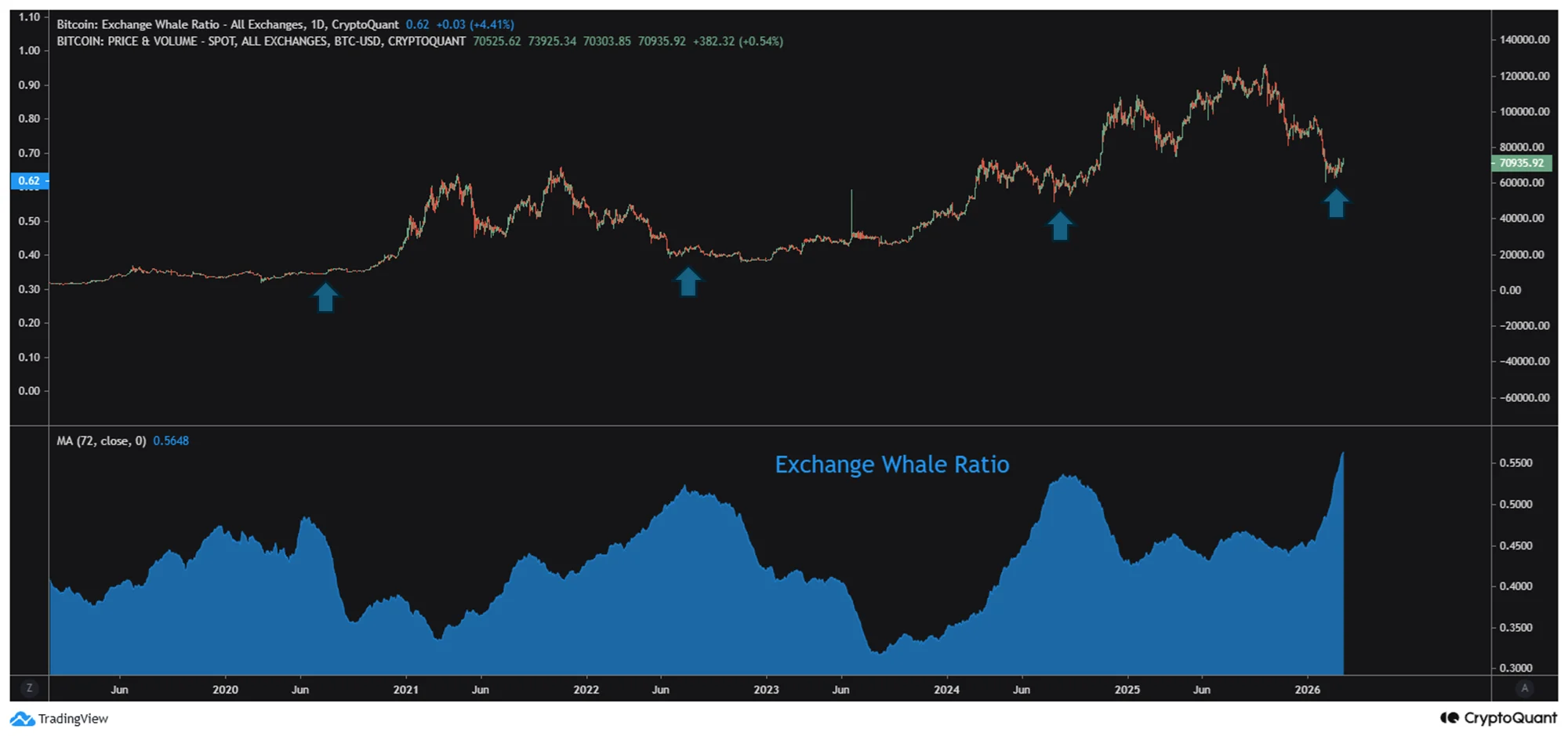
- The Bitcoin Exchange Whale Ratio has reached its highest recorded level in six years amid a sharp BTC drawdown.
- Retail participation in Bitcoin markets remains near cycle lows even as large holders increase their exchange activity.
- Historical data shows similar whale spikes have appeared near local bottoms before the next major price move higher.
- Trader @KillaXBT notes BTC price action has been mechanical for two years, with corrections resolving within two to three weeks.
Bitcoin whale activity has reached its highest level in six years, according to on-chain data. The Exchange Whale Ratio, a metric tracking large holder contributions to exchange inflows, has spiked notably.
Meanwhile, retail participation remains near cycle lows. Bitcoin’s price sits around $70,000 following a sharp drawdown.
Historically, such conditions have appeared near local market bottoms. The data points to a possible shift in market structure, as large players appear to be moving ahead of smaller investors.
What the Exchange Whale Ratio Reveals
The Exchange Whale Ratio measures how much of the Bitcoin flowing to exchanges comes from large holders. A spike in this ratio means whales are sending more BTC to exchanges relative to retail participants.
This kind of activity often precedes major price turning points in the market. The current reading is the highest this metric has recorded in six years.
Source: Cryptoquant
At the same time, retail activity remains near its lowest levels of the current cycle. This contrast between whale aggression and retail passivity is a pattern that has appeared before.
In past cycles, similar setups tended to emerge near local bottoms before the next leg higher. Traders and analysts are now watching closely to see whether history repeats.
The combination of whale accumulation and retail caution has drawn broad attention across the crypto space. Data from exchange inflows shows large holders are actively repositioning their Bitcoin.
Whether these moves signal distribution or accumulation remains a key question. On-chain metrics alone cannot confirm the direction, but the activity level is hard to ignore.
One market observer noted that the current setup is “notable,” given that Bitcoin hovers around $70,000. The sharp drawdown preceding this spike mirrors conditions seen in prior cycles.
As a result, the Exchange Whale Ratio is being closely monitored by analysts. Many are treating it as one of several indicators pointing to a potential market inflection.
How Recent Trading Patterns Support the Data
Crypto trader @KillaXBT offered a broader perspective on Bitcoin’s recent price behavior. He described the past two years of trading as “some of the easiest ever,” citing mechanical price action.
According to him, the market has been dominated by clear ranges throughout this period. Corrections and impulsive moves have typically lasted just two to three weeks.
The consistency of these short-term cycles adds context to the current whale activity. If corrections have historically resolved within weeks, then the present drawdown may already be nearing its end.
Large holders appear to be factoring this into their positioning. Their activity on exchanges supports the idea that a move may be approaching.
Retail investors, however, have not yet responded to these signals in any meaningful way. Low retail participation during whale accumulation phases has often preceded sharp recoveries in past cycles.
This gap between institutional and retail behavior tends to close as price action becomes clearer. For now, Bitcoin’s on-chain data continues to attract close attention from market participants.
Whether this cycle follows the same historical path will depend on broader market conditions. The data, however, continues to build a case that large players are already moving.
Meanwhile, smaller investors remain on the sidelines. The coming weeks may prove whether the current setup resolves as past patterns suggest.
TLDR:
- HyperCore repurchased 16,809 HYPE on March 15, 2026, at an average price of approximately $37.41 per token.
- Staking and validator rewards totaled 26,822 HYPE on the same day, exceeding buybacks by 10,013 HYPE net.
- The buyback mechanism is price-sensitive, repurchasing more tokens when HYPE prices fall and fewer when prices rise.
- HYPE confirmed a 15.16% technical breakout after cleanly flipping a key horizontal resistance zone into new support.
HYPE, the native token of Hyperliquid, is drawing close attention from crypto market participants. On March 15, 2026, HyperCore repurchased 16,809 HYPE at an average price of approximately $37.41.
On the same day, 26,822 HYPE were distributed as staking and validator rewards. The resulting net difference came to 10,013 HYPE per day.
Separately, technical analysts confirmed a breakout, with the token gaining more than 15% during the period.
HyperCore Buyback Data Reveals Net Token Emission
According to Hyperliquid Hub, HyperCore repurchased 16,809 HYPE on March 15, 2026. Staking rewards and payments across 24 validators totaled 26,822 HYPE on the same day.
Subtracting the buyback from distributed rewards produces a net daily emission of 10,013 HYPE. Monthly, that figure equates to approximately 300,390 HYPE.
On an annual basis, the current pace projects to around 3,604,680 HYPE per year. For reference, Solana distributes roughly 25.19 million SOL annually through staking and validators.
Hyperliquid’s output is far smaller, reflecting tighter supply management. The protocol remains among the lower-emission networks when placed alongside major layer-1 chains.
The buyback mechanism carries price sensitivity within its structure. Higher HYPE prices mean each dollar of protocol revenue repurchases fewer tokens.
Conversely, lower prices enable more aggressive repurchases, creating natural supply stabilization. This counter-balance helps moderate supply pressure across different phases of the market.
Hyperliquid Hub pointed to the platform’s flywheel as a broader driver of buyback activity. Greater HIP-3 adoption leads to increased trading activity on the platform.
Higher trading volume generates more protocol revenue, which then funds larger repurchases. Over time, this cycle is expected to gradually reduce the net emission gap.
HYPE Price Action Confirms Technical Breakout Above Resistance
Alpha Crypto Signal reported that HYPE broke cleanly above a key horizontal resistance zone. The level converted to support without any fakeout wick appearing on the chart.
A retest of the former resistance followed, and price held the new support firmly. After confirming that level, the token then advanced 15.16%, with momentum remaining intact.
The breakout matched the technical setup the analyst had previously flagged. Price action during the retest period showed no signs of weakness or exhaustion.
The clean flip from resistance to support added credibility to the continuation move. Analysts observed that the next resistance levels were already coming into range.
On the broader chart, the price move connects to Hyperliquid’s growing platform activity. Higher trading volume on the network generates more protocol revenue for buybacks.
Larger buyback activity, alongside the net emission data, shapes a constructive supply picture. Both technical structure and on-chain fundamentals remain aligned for HYPE at this point.
The gap between daily distributions and repurchases provides a clear metric to follow. As platform adoption grows, this figure is expected to attract greater market attention. Analysts view the daily buyback data as a useful barometer of protocol health.

Venus Protocol, a decentralized lending and borrowing platform, reported on Sunday that it detected suspicious trading activity in the liquidity pool for the Thena (THE) token, the native asset of the Thena DeFi protocol. The anomaly appeared to affect only two pools—CAKE, the native token of PancakeSwap, and THE—and prompted an immediate, precautionary pause on all borrows and withdrawals related to THE. The pause will remain in place while investigators review the activity and determine appropriate next steps.
Key takeaways
- Venus Protocol paused all THE borrows and withdrawals amid an active investigation into unusual pool activity, signaling an abundance of caution during a multi‑asset incident.
- Allez Labs, described as Venus Protocol’s risk manager, attributed the episode to a supply cap attack executed in two phases, combining a rapid accumulation of the THE market cap with a lending attack.
- The attacker reportedly used the Theta token as collateral to borrow large quantities of CAKE, USDC, BNB, and BTC, amplifying a liquidity crunch in the affected pools.
- Total losses from the attack are estimated to exceed $3.7 million, according to Wu Blockchain, with additional halts imposed on low-liquidity tokens as a precaution.
- Thena’s THE price moved lower in reaction to the incident, trading around $0.2255 at the time of reporting, down roughly 17% over the prior 24 hours, per market data.
- The incident underscores ongoing security and cyber-risk challenges in DeFi, even as overall hack losses in February registered a notable decline before phishing and social‑engineering threats rose again.
Tickers mentioned: $BTC, $CAKE, $USDC, $BNB, $THE, $THETA
Sentiment: Neutral
Price impact: Negative. THE’s price fell about 17% in the 24 hours leading up to the report as details of the incident emerged and risk concerns escalated.
Trading idea (Not Financial Advice): Hold. Monitor the investigation’s findings, the status of THE pool, and any subsequent risk‑management measures announced by Venus Protocol or its partners.
Market context: The attack arrives as the sector grapples with sophisticated on‑chain exploits and the broader DeFi liquidity environment. February’s data from PeckShield showed total crypto losses from hacks at $49 million—the lowest in nearly a year—yet security incidents continue to shift toward social engineering and phishing, indicating that user education remains critical amid growing ecosystem complexity.
Why it matters
The Venus Protocol incident highlights the fragility that can accompany high‑leverage DeFi ecosystems where attackers exploit complex interactions across multiple pools. By leveraging THE as collateral to borrow CAKE, USDC, BNB, and BTC, the attacker sought to lock in a sizable position while exploiting liquidity imbalances in the THE pool. The decision to pause all THE borrows and withdrawals signals a governance and risk team that is prioritizing containment and forgoing near‑term liquidity for long‑term safety.
From a risk‑management perspective, the episode exposes the limits of automated checks when faced with layered attack vectors, including supply cap strategies and cross‑pool collateralization. Allez Labs’ assessment that the attack unfolded in two phases—first accumulating a dominant chunk of THE’s supply, then leveraging it to drain liquidity via lending—underscores how attackers may align price manipulation, liquidity capture, and debt creation in a coordinated sequence. The disclosure also reinforces the value of explicit risk monitoring partners in DeFi ecosystems, where independent assessments can accelerate detection and response.
For users and lenders, the event serves as a reminder of the importance of cautious borrowing, diversified collateral, and awareness of pool liquidity conditions across platforms. While DeFi continues to deliver permissionless access to capital, incidents like these demonstrate that security controls—such as circuit breakers and pause protections—remain essential tools in mitigating cascading losses during abnormal markets. The rapid public disclosure by Venus Protocol and the involvement of a risk manager in framing the incident illustrate a broader industry push toward transparency in the wake of major exploits.
The February security landscape—with a pivot toward phishing and social‑engineering schemes despite a fall in hack losses—also reflects the ongoing tension between on‑chain mechanics and off‑chain social risk. Industry observers note that as DeFi grows, attackers increasingly target user interfaces, private keys, and approval workflows, making user education a critical component of systemic resilience. The current case reinforces the need for robust auditing, real‑time monitoring, and cross‑protocol collaboration to reduce the blast radius of such attacks.
The full narrative around the THE pool incident and its implications for DeFi risk management is still developing, but the immediate actions taken by Venus Protocol illustrate a measured approach to crisis containment, prioritizing asset preservation and orderly disclosure over rapid liquidity restoration.
What to watch next
- Updates from Venus Protocol on the investigation’s progress and the duration of the THE pool pause.
- Announcements from Allez Labs detailing the root cause analysis and any proposed mitigations or governance proposals.
- Whether any portion of the stolen assets are recovered, or if liquidations and collateral redemptions proceed as investigators gather more data.
- Any changes to liquidity provisions for THE, CAKE, and related assets across Venus and connected DeFi ecosystems, including potential audits or security enhancements.
- Regulatory or platform‑level responses that might affect cross‑pool collateralization or risk‑rating frameworks in DeFi lending markets.
Sources & verification
- Venus Protocol official status on X detailing the pause and ongoing investigation: https://x.com/VenusProtocol/status/2033206484935344251
- Allez Labs’ remarks identifying the two‑phase supply cap and lending attack: https://x.com/AllezLabs/status/2033239532355858536
- Wu Blockchain reporting on total losses tied to the incident: https://x.com/WuBlockchain/status/2033173968346120495
- THE price reference on CoinMarketCap: https://coinmarketcap.com/currencies/thena/
- Nominis monthly report on February crypto hacks and attacks: https://www.nominis.io/insights/nominis-monthly-report-crypto-hacks-and-attacks-in-february-2026
Key figures and next steps
Rewritten Article Body
Market reaction and key details
The Venus Protocol incident began with a signal of irregular activity centered on the Thena (THE) pool, prompting an immediate, protocol‑level pause on THE borrows and withdrawals. The move, described as precautionary, aims to prevent a further spillover while investigators parse the sequence of events that allowed the attacker to capitalize on THE liquidity. The pause is explicit in Venus’ communications and remains in place until a full assessment is complete.
The attacker’s approach, as outlined by Allez Labs, involved a supply cap attack designed to accumulate a dominant share of THE’s on‑chain supply in two stages. In parallel, a lending attack was executed, leveraging Theta (CRYPTO: THETA) as collateral. This allowed the attacker to borrow a substantial amount of CAKE (CRYPTO: CAKE), USDC (CRYPTO: USDC), BNB (CRYPTO: BNB), and BTC (CRYPTO: BTC). The combination of market capture and debt creation appears to have stretched the liquidity of the affected pools and increased risk exposure across Venus’ lending market.
Public disclosures show that 6.67 million CAKE, 1.58 million USDC, 2,801 BNB, and 20 BTC were among the assets borrowed using Theta as collateral. Out of an abundance of caution, Venus also halted withdrawals and borrowing for other tokens with relatively low liquidity on the platform, a decision that underscores the potential for cross‑asset contagion in a congestion event. The total value implicated in the attack has since been cited as over $3.7 million, amplifying concerns about the pace at which DeFi platforms can respond to sophisticated exploits.
At the time of reporting, THE traded around $0.2255, reflecting a material drop as traders digested the security event and its implications for the DeFi stack. The price move aligns with typical market responses to exploit disclosures, where risk premia rise and liquidity pools tighten in the wake of uncertain asset backing. The broader price action for THE remains contingent on the recovery of funds, ongoing risk disclosures, and the ability of Venus to restore user confidence through transparent remediation efforts.
Investigators contacted by the press noted that Theta’s role as collateral injected a cross‑protocol dynamic into the attack scenario. Theta is a major participant in its own ecosystem, and the incident highlights how collateral quality and pool design interact in complex ways when attackers execute multi‑step strategies. The breakdown of normal pool behavior, in conjunction with a targeted accumulation of THE, illustrates the evolving risk landscape for liquid markets where yield farming, flash loans, and cross‑collateralization intersect with governance and liquidity provisioning.
From a governance and ecosystem perspective, the incident reinforces the importance of real‑time risk frameworks and independent risk management capabilities within DeFi protocols. The collaboration between Venus Protocol, Allez Labs, and other security researchers is a positive sign that platforms are moving toward more robust, auditable controls to detect and defuse such attacks before they precipitate broader losses. It also emphasizes the need for user education around approval flow vigilance and the dangers of reusing keys or compromising wallets during high‑volatility periods.
As the investigation unfolds, market participants will be watching how Venus communicates remediation plans, what protections are introduced to prevent similar exploits, and how liquidity recovery strategies are executed to minimize downtime for affected pools. The incident also contributes to the ongoing dialogue about the resilience of cross‑chain DeFi, the role of risk managers in rapidly identifying and tokenizing threats, and the importance of rapid, transparent disclosures in maintaining user trust during periods of stress.
In sum, the Venus Protocol event illustrates both the ingenuity of attackers and the adaptive measures that DeFi platforms are employing to safeguard users. While the exact financial impact is still being quantified, the incident underscores the need for continuous improvement in risk assessment, rapid incident response, and robust governance processes in decentralized finance ecosystems.
Crypto World
Is Bittensor (TAO) the Next Big Crypto Move? Investors Point to Revenue, Scarcity, and ETF Filings
TLDR:
- Bittensor’s (TAO) active subnets grew fourfold from 32 to 129 following the dTAO launch in early 2025.
- The top three compute subnets reached a combined $20M ARR just three months after monetization was activated.
- A TAO price of $1,000 would represent under 1.5% of the projected $1.4 trillion AI market by 2028.
- Grayscale and Bitwise have both filed for spot TAO ETFs, potentially opening access to institutional capital.
A growing number of crypto investors are pointing to Bittensor’s $TAO token as a serious candidate for a major price move. The case being made is not based on speculation alone.
It draws on subnet revenue data, token supply mechanics, and institutional filing activity. With $TAO trading near $268 today, the path to $1,000 is being examined with real numbers rather than market sentiment.
Real Revenue Numbers Are Changing How Investors View $TAO
Crypto analyst Tanaka recently published a detailed breakdown of why he is accumulating $TAO. Central to his thesis is the revenue now being generated across Bittensor’s active subnets.
The network has grown from 32 subnets to 129 since dTAO launched in early 2025, a fourfold increase within months.
More telling than the subnet count is the monetization speed. The top three compute subnets combined have reached $20 million in annual recurring revenue. That figure arrived roughly three months after monetization was switched on across those networks.
Taragon Compute (SN4) leads with approximately $10.4 million ARR, serving enterprise clients through confidential computing.
Chutes AI (SN64) follows at around $4.3 million ARR, processing over 120 billion tokens daily at rates 85% cheaper than AWS. Lium.io (SN51) adds further traction by offering the lowest H100 GPU rental pricing currently on the market.
These are payments from real customers, not projections. For investors watching the asset, the shift from narrative-driven buying to revenue-backed conviction marks a meaningful turning point.
The Math Behind $1,000 and What Would Need to Happen
$TAO carries a fully diluted valuation of roughly $5.6 billion at current prices. A move to $1,000 would push that figure to approximately $21 billion.
Tanaka frames that as under 1.5% of the $1.4 trillion AI market projected by 2028, making the target appear less extreme in context.
Subnet ARR would need to scale to between $200 million and $500 million to support that valuation. Going from zero to $20 million in three months gives some investors confidence that trajectory is not unrealistic. Tanaka places the $1,000 target within a 12–18 month window.
Token supply mechanics are also working in the asset’s favor. A recent halving cut new emissions by 50%, and approximately 68% of the total supply is currently staked. That combination reduces sell pressure while demand continues to build.
Grayscale and Bitwise have each filed applications for spot $TAO exchange-traded funds. Approval of either filing would open the door to a new category of institutional buyers. Investors following the asset closely see that development as a potential accelerant toward the $1,000 level.
Tron Revenue Tops Blockchain Networks with $24.96M Monthly Earnings

Boosie Addresses Backlash Over Presidential Pardon Request

Exclusive-US, China discuss farm goods, managed trade in ’remarkably stable’ Paris talks-sources


-
 Tech5 days ago
A 1,300-Pound NASA Spacecraft To Re-Enter Earth’s Atmosphere
-
Crypto World2 days ago
HYPE Token Enters Net Deflation as HyperCore Buybacks Outpace Staking Rewards
-

 News Videos6 days ago
10th Algebra | Financial Planning | Question Bank Solution | Board Exam 2026
-

 Business5 days ago
ExxonMobil seeks to move corporate registration from New Jersey to Texas
-

 Crypto World6 days ago
Paradigm, a16z, Winklevoss Capital, Balaji Srinivasan among investors in ZODL
-

 Fashion2 days ago
Weekend Open Thread: Addict Lip Glow
-

 Tech5 days ago
ChatGPT will now generate interactive visuals to help you with math and science concepts
-
Sports1 day ago
Why Duke and Michigan Are Dead Even Entering Selection Sunday
-

 NewsBeat4 days ago
Residents reaction as Shildon murder probe enters second day
-

 Business5 days ago
Search Enters Sixth Week With New Leads in Tucson Abduction Case
-
 NewsBeat6 days ago
Pagazzi Lighting enters administration as 70 jobs lost and 11 stores close across Scotland
-

 Business3 hours ago
Search for Savannah Guthrie’s Mother Enters Seventh Week with No Arrests
-

 Tech6 days ago
Despite challenges, Ireland sixth in EU for board gender diversity
-

 Business1 day ago
US Airports Launch Donation Drives for Unpaid TSA Workers as Partial Government Shutdown Enters Fifth Week
-

 NewsBeat4 days ago
I Entered The Manosphere. Nothing Could Prepare Me For What I Found.
-
Crypto World1 day ago
Coinbase and Bybit in Investment Talks: Could Bybit Finally Enter the US Crypto Market?
-

 Business6 days ago
Search Enters 39th Day with FBI Tip Line Developments and No Major Breakthroughs
-

 Sports7 days ago
Skateboarding World Championships: Britain’s Sky Brown wins park gold
-

 Business1 day ago
Country star Brantley Gilbert enters growing non-alcoholic beer market
-
 Crypto World5 days ago
Will Chainlink price reclaim $10 amid volatility squeeze?

