

Crypto World
Is Bitcoin’s Bear Market Ending or Just Getting Worse?

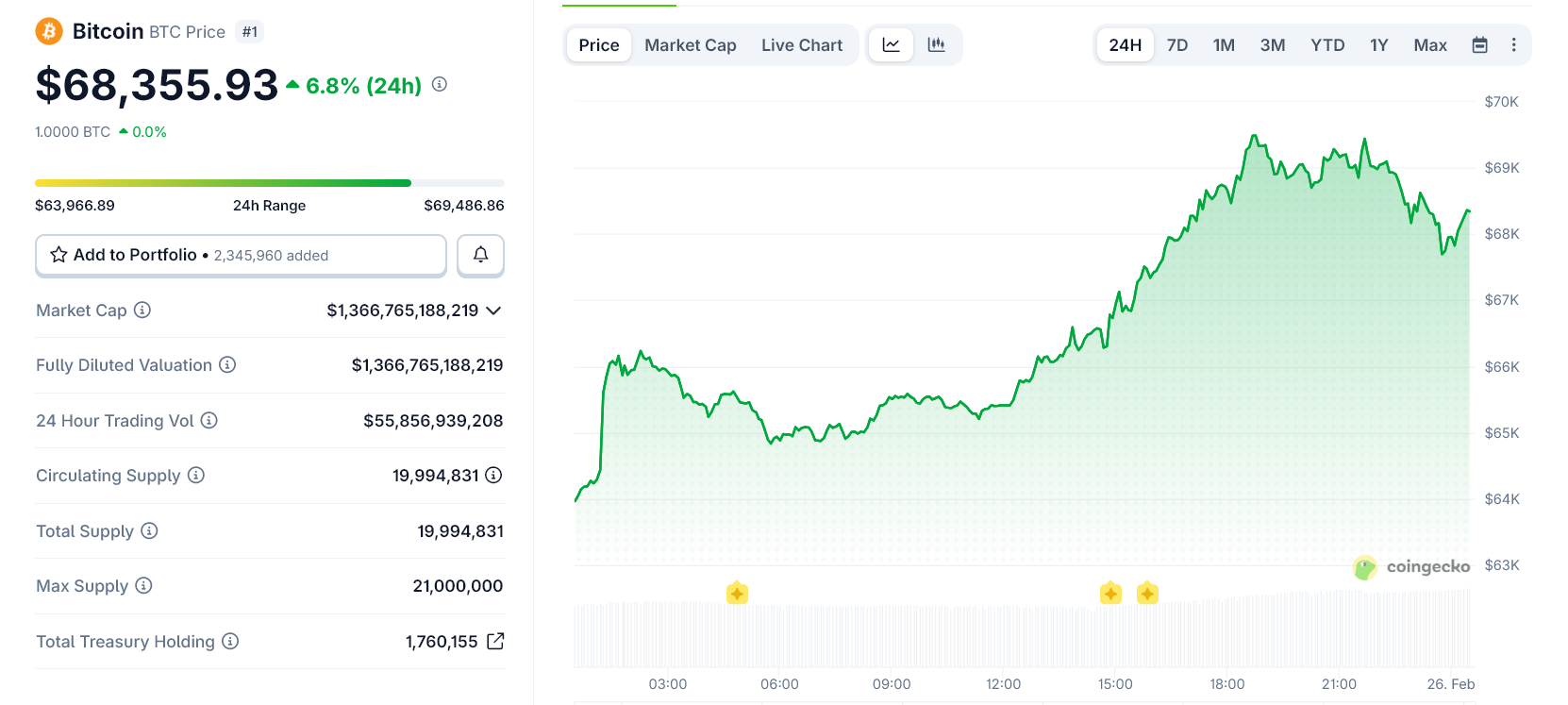
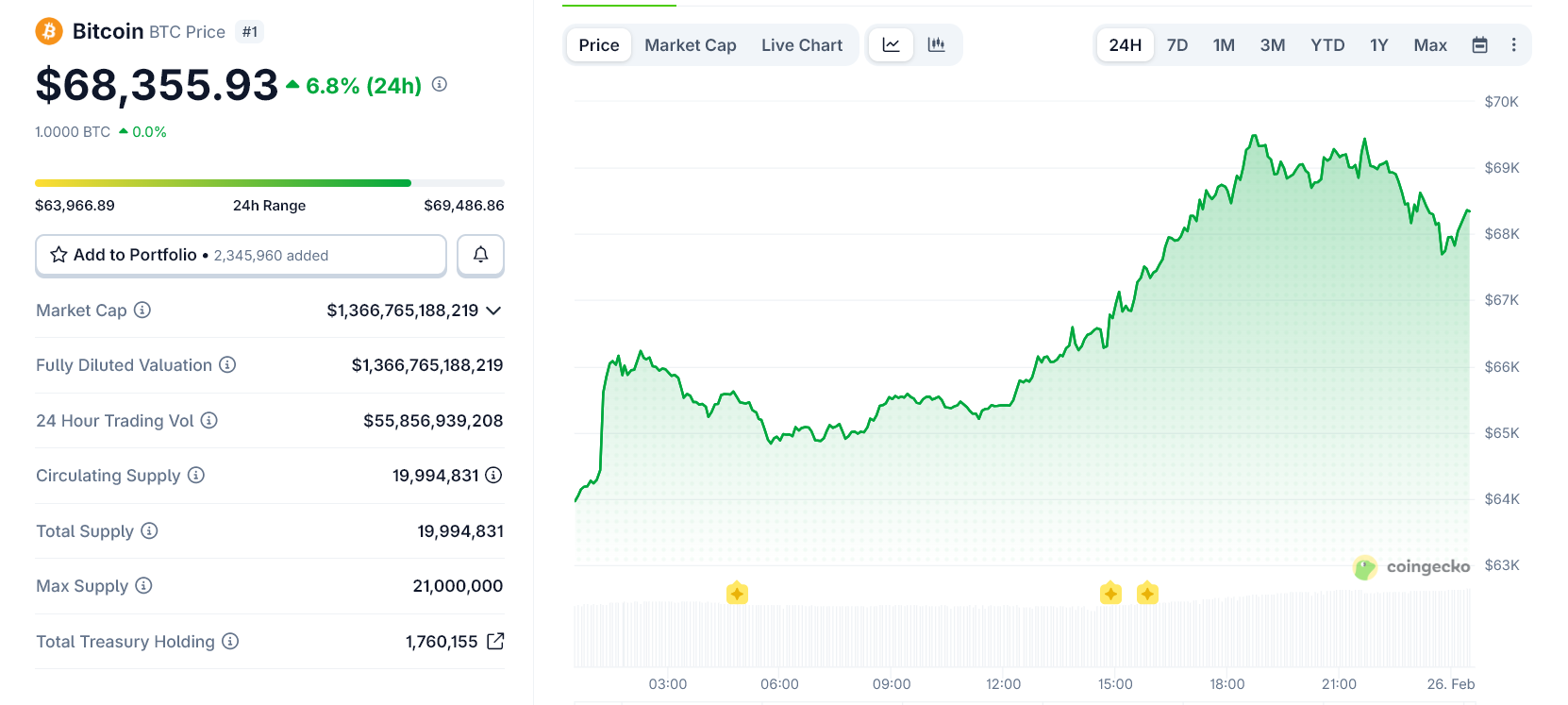
Bitcoin surged sharply this week, briefly nearing $70,000 before pulling back. The move sparked debate across the market: has Bitcoin finally bottomed, or is this just another relief rally inside a broader bear phase?
Multiple on-chain, derivatives, and institutional indicators show early signs of stabilization. However, key signals still point to a fragile recovery rather than a confirmed bullish reversal.
Options Market Shows Fragile Conditions, Not Strong Support
Bitcoin’s options positioning recently shifted into what traders call a negative gamma regime, according to Glassnode’s GEX heatmap.
In simple terms, gamma measures how options market makers hedge risk. When Bitcoin sits in a negative gamma zone, dealer hedging tends to amplify price moves.
That means rallies can accelerate quickly—but so can selloffs.
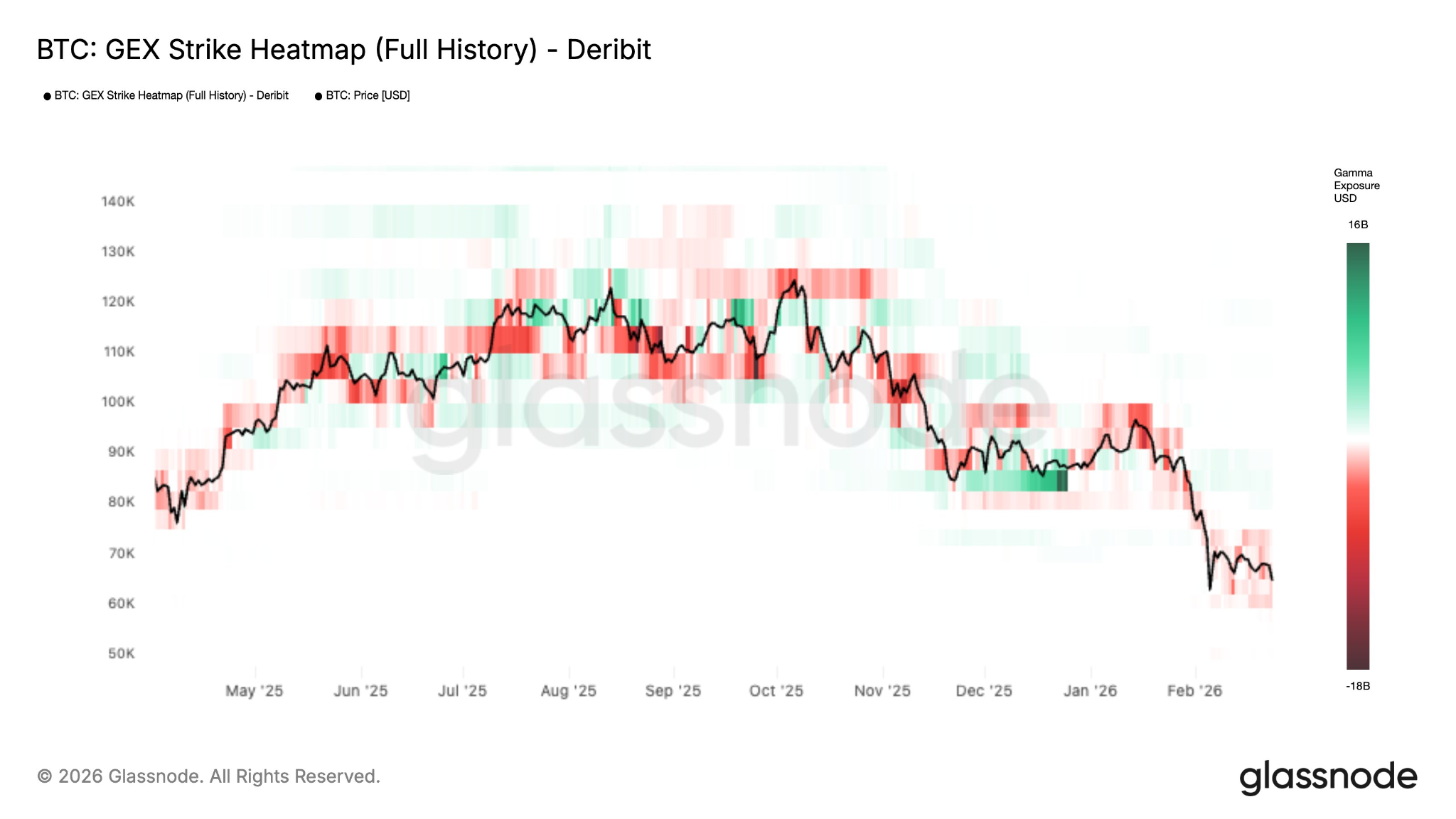
The heatmap also shows fewer strong resistance “gamma walls” above current prices. This creates less friction for upward moves, which helps explain Bitcoin’s sudden surge.
However, it also means the market lacks structural stability.
Without strong hedging support, price moves remain fragile and prone to reversal.
Bitcoin Spot Demand Is Improving for the First Time in Months
CryptoQuant data shows Bitcoin’s apparent demand, which measures net accumulation versus new supply, has turned positive for the first time since November.
This is an important early signal. When demand exceeds supply, it suggests buyers are stepping in and absorbing coins from sellers.
However, one positive shift does not confirm a full reversal. During past bear markets, temporary demand increases often occurred before further consolidation.
A sustained trend of rising demand over several weeks would provide stronger confirmation.
Short-Term Holders Are Still Selling at Losses
Another key indicator comes from CryptoQuant’s short-term holder profit and loss data, which tracks whether newer investors are selling at gains or losses.
The data shows short-term holders have been selling at losses consistently since late January. Several major loss spikes occurred in early February and again recently.
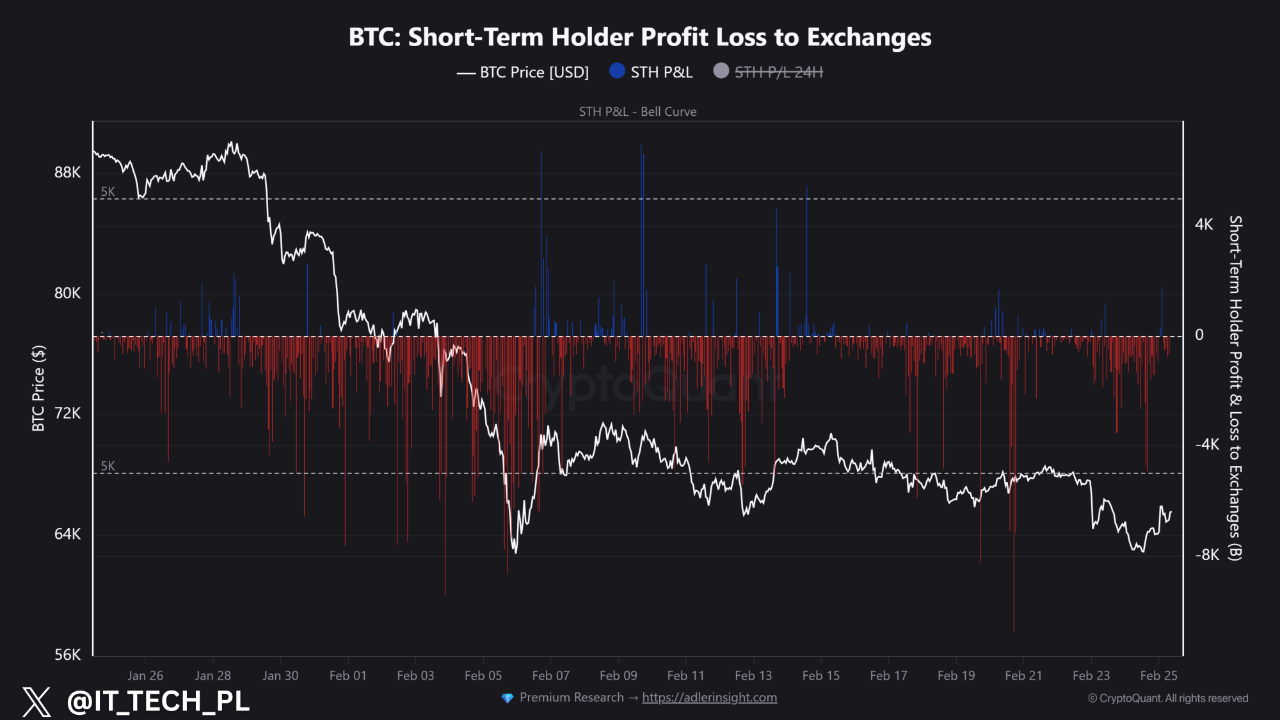
This pattern is known as capitulation, where weaker investors exit the market. Capitulation is common near market bottoms, because stronger buyers absorb those losses.
However, the signal has not fully reversed.
Until short-term holders begin selling at profits again, analysts warn that rallies can become “exit liquidity,” where trapped investors sell into strength rather than holding.
Technical and Historical Data Suggest Selling Pressure Is Easing
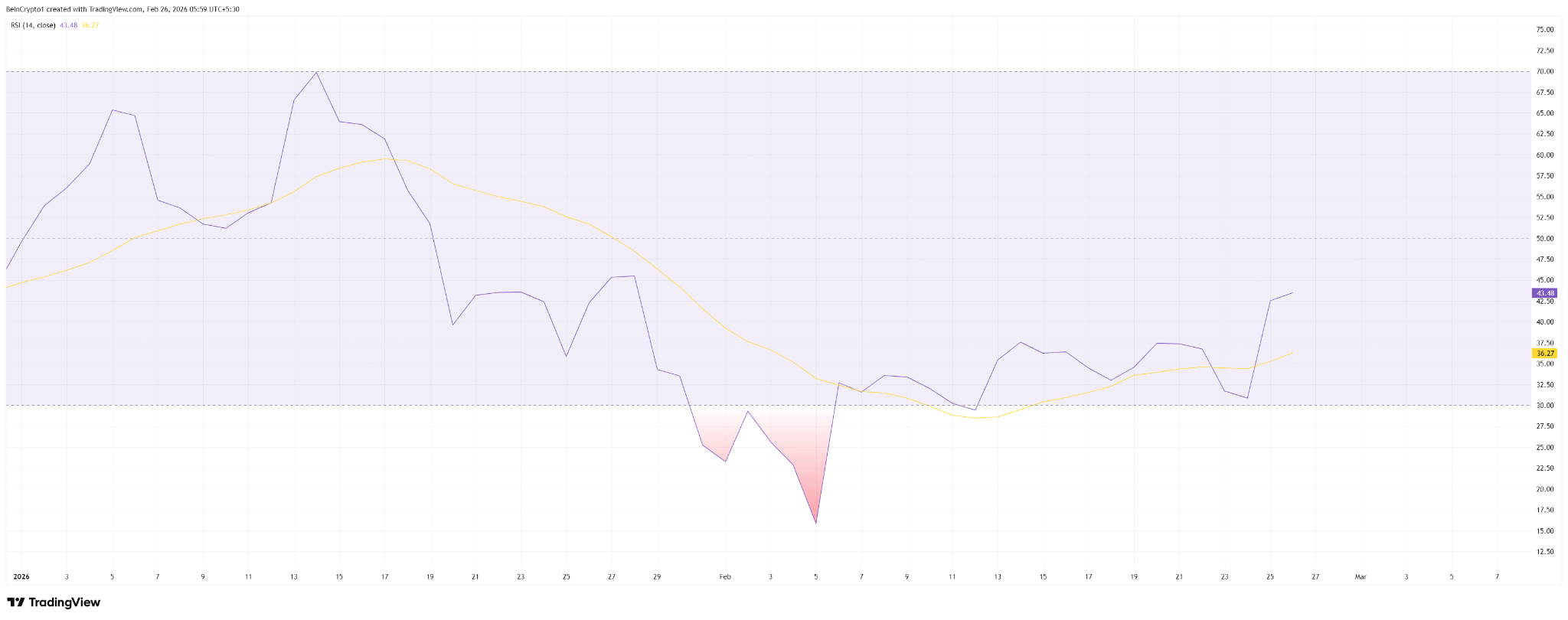
Bitcoin’s relative strength index (RSI), a momentum indicator, recently recovered after reaching extremely oversold levels in early February. This suggests selling pressure has weakened.
Historically, such RSI recoveries often lead to short-term rebounds.
Quarterly performance data also shows Bitcoin rarely experiences multiple consecutive quarters of heavy losses.
While this pattern does not guarantee a bottom, it supports the view that the market may be entering a stabilization phase.
Institutional Flows Still Show Weakness
Institutional positioning remains a key concern. Earlier data showed Bitcoin ETFs experienced sustained outflows, and SEC filings revealed large investment advisors and hedge funds reduced exposure significantly in late 2025.
This suggests institutional demand has not fully returned. Strong bull markets typically require consistent inflows from large investors.
Early Bottoming Signs, But Bull Market Not Confirmed
Bitcoin is showing several early bottoming signals. Spot demand is improving, capitulation appears to be getting absorbed, and technical indicators suggest selling pressure is fading.
However, key confirmation signals are still missing.
Short-term holders remain in loss territory, institutional flows remain weak, and options market structure shows fragile conditions.
For now, Bitcoin’s rally appears more consistent with a relief bounce than a confirmed bull reversal.
A sustained recovery will likely require stronger demand, renewed institutional inflows, and price stability above key resistance levels.



BlockFills co-founder and CEO Nicholas Hammer has stepped down from his leadership role, with the company’s website now listing Joseph Perry as interim CEO.
Summary
- BlockFills co-founder and CEO Nicholas Hammer has stepped down, with Joseph Perry appointed as interim CEO.
- The firm halted deposits and withdrawals earlier this month after suffering a reported $75 million lending loss.
- BlockFills is now exploring a potential sale or strategic partnership as it navigates liquidity pressures during the ongoing crypto bear market.
Leadership shakeup at BlockFills as firm seeks buyer after market stress
The leadership change comes as the Chicago-based crypto lending and liquidity firm grapples with significant financial stress, operational freezes and strategic uncertainty.
On February 11, 2026, BlockFills temporarily suspended client deposits and withdrawals, a decision attributed to challenging market conditions and liquidity pressures. The suspension remains in place with no clear timeline for resumption, prompting concern among its roughly 2,000 institutional clients, which include hedge funds, asset managers and mining firms.
According to media reports, the company also has an approximate $75 million loss linked to its crypto lending business after the value of collateral backing loans declined sharply during the recent downturn in digital asset prices.
Some clients were privately advised to withdraw assets before the full freeze was implemented, a move that industry watchers see as indicative of deeper liquidity stress.
BlockFills’ management and investors are now reportedly actively seeking a buyer or strategic partner to stabilize operations, with Joseph Perry stepping in to lead these efforts. The firm, which processed more than $60 billion in trading volume in 2025, is supported by backers including Susquehanna Private Equity, CME Ventures, Simplex, C6E and Nexo.
Amid a persistent bear market, capital constraints and broader risk aversion in crypto markets, the company’s fate remains uncertain. Prolonged freezes on liquidity could damage confidence and hinder institutional participation, echoing patterns seen in previous crypto downturns where lenders faced severe solvency challenges.
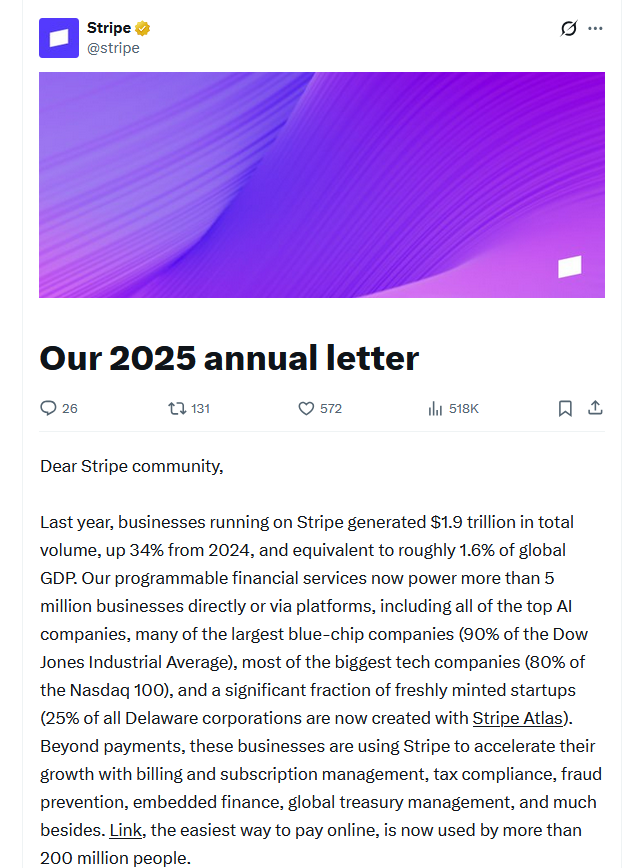
Financial technology firm Stripe says blockchains may need to process up to 1 billion transactions per second to support the future of artificial intelligence agents.
In an annual letter posted to X on Tuesday, Stripe CEO and co-founder Patrick Collison and co-founder John Collison gave a rundown of the firm’s performance over 2025, while also making some predictions for the near future.
One of the key talking points was the adoption of AI agents and what widespread use could look like in the future. The duo argued that blockchain transaction activity will soon skyrocket as AI agents gradually become the primary conductors of online transactions.
However, the Stripe co-founders said there is a significant infrastructure gap in blockchain and said immense scaling is required to meet this incoming demand.
“Last year, a memecoin trading frenzy on one of the major blockchains delayed payouts for one Bridge user by over 12 hours and spiked per-transaction prices 35x. While such operational issues are already significant, they will only intensify, for we expect the appetite for transactions to grow a great deal,” they wrote, adding:
“In our view, agents will most likely soon be responsible for most internet transactions, and we will likely need blockchains that support more than one million — or even one billion — transactions per second.”

According to data from Chainspect, Internet Computer Protocol and Solana are currently the top two blockchains by transaction speed, with roughly 1,196 and 1,140 transactions per second (TPS), respectively.
They are the only two on the market currently processing more than 1,000 TPS, and at their peak, they have processed 25,621 TPS and 5,289 TPS, respectively.
As it stands, both networks have a theoretical maximum of only 209,708 TPS and 65,000 TPS, respectively.
AI commerce is past the “hype phase”
Alongside their predictions on the incoming demand, the Stripe execs also outlined what the main kinds of use cases AI agents will be serving online. Currently, they said that AI agents have moved beyond a phase of “pure hype” into a time of building and “real-world experimentation.”
Related: Stripe considers acquiring some or all of PayPal: Report
They outlined five levels of AI agent capabilities. The first two levels include: completing web forms and descriptive search — being able to find results for users based on descriptions of situations rather than specific attributes.
According to the Stripe execs, AI agents are “hovering on the edge” of levels one and two.
The next three levels include: persistence — remembering user information, requirements, and preferences; delegation — handling tasks like grocery shopping on your behalf; and anticipation — being able to provide solutions to problems or schedules without being prompted.
“As with the early internet, the future success of agentic commerce is contingent on universal interoperability. Our ascent through the five levels depends on our ability to work together,” they wrote, adding:
“If all goes well, the little critters won’t be cooped up in walled gardens, but will be zooming down the wide-open protocol highways.”
Magazine: Crypto loves Clawdbot/Moltbot, Uber ratings for AI agents: AI Eye
Traditional investors don’t yet realize the impact crypto may have on financial markets, meaning there could be an opportunity to invest in what the technology could eventually become, says Bitwise investment chief Matt Hougan.
“Everywhere I look, Wall Street is screaming that finance is moving on-chain. Not a little of it; all of it,” Hougan said in a note on Tuesday. “Yet traditional investors can’t hear it.”
He argued investors are suffering from “anchoring bias” and are still fixated on how crypto was perceived in its early days — when it was still an unknown technology mostly used by cypherpunks and dark web black markets.
“They look at crypto and still see a punk skateboarder with tattoos. They don’t realize he’s shaved, put on a suit, and is deploying infrastructure that will underpin the next generation of capital markets,” Hougan said.
Major finance companies have launched or are experimenting with facets of crypto technology, mainly tokenization and stablecoins, spurred on by US regulators and lawmakers moving to support the sector.
Crypto investors not registering the shift
Hougan said that crypto investors are also not taking notice of the current shift, as traditional institutions have taken a passing interest in the space before.
“They’re suffering from ‘the boy who cried wolf’ syndrome,” he said. “They’ve heard the promises of institutional adoption for so long that they no longer register.”
Hougan argued, however, that major finance players have begun to move on-chain with the backing of regulators, namely the Securities and Exchange Commission’s “Project Crypto,” launched in July to “enable America’s financial markets to move on-chain,” according to its chair, Paul Atkins.
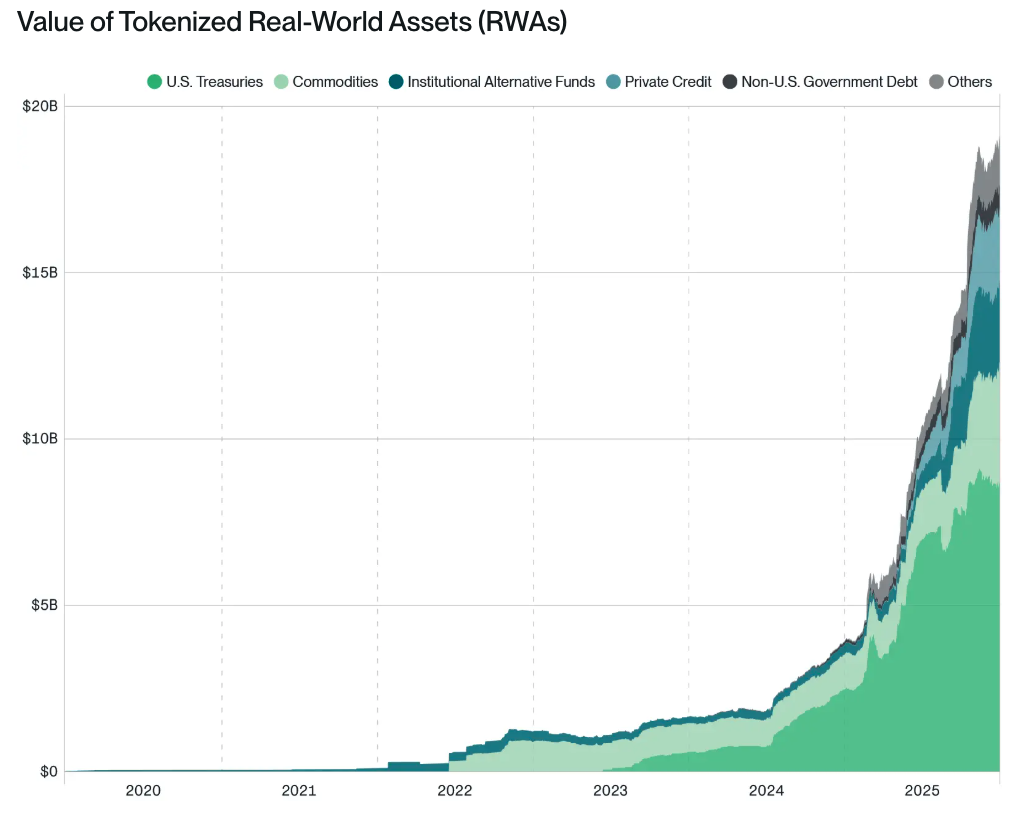
The value of tokenized assets on blockchains, such as US Treasurys and commodities, has quickly begun to approach $20 billion, he said, more than quadrupling over 2025.

“The numbers in question are enormous,” he said, adding that the hundreds of trillions of dollars floating around in exchange-traded funds, stocks and bonds means the tokenization market “can grow 10,000x and still have room to grow.”
Related: Tokenization without provenance is complicity
Hougan added that BlackRock and credit manager Apollo have launched tokenized funds on-chain worth billions of dollars, and major banks JPMorgan, Bank of America, Citigroup, and Wells Fargo are in talks for a stablecoin.
“There is a large delta between what people think is happening in crypto and what is actually happening,” Hougan said.
“From where I sit, that gap creates a significant opportunity — not to try to pick winners prematurely, but to build broad exposure to the space while the market is still mispricing the structural shift,” he added.
Magazine: Bitcoin’s ‘biggest bull catalyst’ would be Saylor’s liquidation — Santiment founder
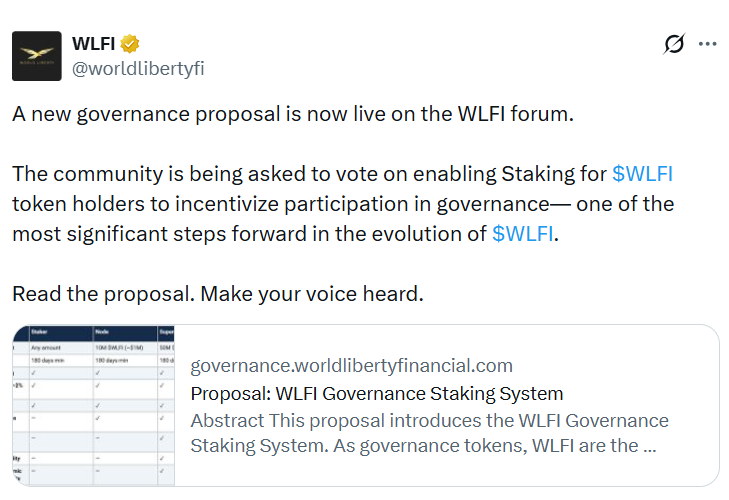
Trump family-backed crypto venture World Liberty Financial (WLFI) has proposed new measures to boost participation in governance through a staking system and incentivize the use of its stablecoin USD1.
In its latest proposal on Wednesday, the team suggested governance votes should require holders to stake their tokens for at least 180 days to ensure “voting power is held by participants with long-term alignment to the protocol,” instead of “short-term holders or speculators.”
Stakers would earn an annual percentage rate of 2% provided they participate in at least two governance votes during the lock-up period. Governance power would be based on the amount staked and the time left in the lock-up. Users with locked tokens can continue to vote as usual.

Incentives for USD1 usage on the table too
WLFI has been trying to increase USD1 adoption since it launched through rewards programs and partnerships with institutional platforms and other protocols.
As part of the staking system, the WLFI team said users who stake their tokens would also gain “additional benefits for USD1 usage,” with USD1 deposits made on the trading and lending platform WLFI Markets attracting unspecified “incentives” from the DeFi protocol Dolomite.
At the same time, “Nodes,” holders with at least 10 million WLFI tokens, will gain access to providers who offer conversion of other stablecoins like USDC (USDC) and USDt (USDT) into USD1 at a 1:1 rate and can provide an off-ramp directly to fiat.
“Super Nodes,” or holders with more than 50 million WLFI tokens, will also have access to the feature.

For the vote to be valid, the WLFI team has set the bar at one billion voting tokens participating, with a majority voting in favor required for it to pass. CoinGecko lists over 27 billion WLFI tokens in circulation.
If approved, the rollout will be in three phases: starting with staking rewards and USD1 deposit incentives, followed by the 1:1 conversion feature and lastly partnership access and a revenue-sharing framework for “Super Nodes.”
Related: Trump crypto company says ‘coordinated attack‘ on stablecoin failed
Stablecoin market dominated by USDC and USDT
The total market capitalization for stablecoins is over $309 billion as of Thursday, according to DeFi aggregator DefiLlama. USDT has the largest market cap with over $183 billion and a market dominance of 59%.
Circle’s USDC is the second-largest stablecoin by market cap, with $75 billion. WLFI’s USD1 is the fifth-largest stablecoin with a $4.7 billion market cap.
Magazine: Bitcoin’s ‘biggest bull catalyst’ would be Saylor’s liquidation: Santiment founder

Tap to Earn is no longer a novelty mechanic. In 2026, it has matured into a scalable user acquisition & token distribution model built around frictionless onboarding, micro-interactions, and viral network effects, especially within the TON ecosystem and Telegram infrastructure.
Unlike traditional Web3 games that demand high production budgets and long development cycles, Tap to Earn games optimize for speed, distribution, and engagement density. However, while they may appear simple on the surface, building a sustainable Tap to Earn ecosystem on TON requires strategic architecture, disciplined tokenomics, backend scalability, and strong anti-fraud design.
This Tap to Earn game development 2026 guide explores the structural foundation on TON and what it takes to build for long-term growth.
What Is Tap to Earn in 2026?
Tap to Earn in 2026 is not just about tapping a screen to collect tokens. It represents a behavioral reward engine designed around micro-engagement cycles. At its core, Tap to Earn is built on three mechanics:
- Ultra-simple interaction loops
- Instant reward feedback
- Referral-amplified growth
However, what makes it powerful today is not the tap, it is the ecosystem design. Modern Tap to Earn systems integrate:
- On-chain reward validation
- Token-based incentive layers
- Community leaderboard gamification
- Progressive unlock systems
- Hybrid off-chain performance optimization
The reason this model works so effectively on TON is that Telegram removes the largest friction point in gaming that is app installation. Users need not download and they need not register. They simply click and start interacting. This instant participation layer plays a significant role in dramatically improving early retention metrics. In 2026, Tap to Earn is less about “earn by tapping” and more about “engage and amplify within an ecosystem.”
Reason Behind the Explosion of Tap to Earn in 2024–2026
The growth of Tap to Earn is not accidental. It is structurally aligned with current user behavior and Web3 distribution dynamics. Typically, there are four primary reasons for its rapid adoption.
1. Distribution Without Friction
Telegram provides a ready-made network. Every user is already authenticated. Wallet integrations through TON helps reduce onboarding complexity further. No app store policies applicable, no 30% deduction in revenue, and no installation barrier.
2. Viral Referral Loops
Tap to Earn thrives on referral multipliers. Most games are architected to incentivize inviting friends. Every new user increases reward potential for existing participants, which, in turn, creates network compounding effects.
3. Micro-Session Behavior
Modern users prefer short engagement bursts. Tap to Earn sessions often last seconds or minutes, making them highly repeatable. This helps increase daily active usage frequency.
4. Tokenized Incentives
Unlike Web2 games, Tap to Earn integrates token ownership. This adds speculative and financial motivation layered on top of gameplay.
However, growth alone does not guarantee sustainability. Many projects in 2024 collapsed because they were optimized for viral spikes rather than focusing on economic durability.
Tap to Earn vs Play to Earn: Structural Differences
A number of new entrants in the field of gaming tend to get confused between Tap to Earn and Play to Earn model. While both Tap to Earn and Play to Earn fall under the category of Web3 gaming, they are fundamentally different in architecture, user behavior, and scalability potential. Understanding the difference between Tap to Earn and Play to Earn helps businesses and decision-makers choose the right model for their Web3 gaming strategy.
| Factor | Tap to Earn Games | Play to Earn Games |
|---|---|---|
| Core Interaction Model | Built around simple micro-interactions such as tapping, claiming rewards, or completing lightweight tasks. Designed for rapid engagement cycles. | Built around deeper gameplay mechanics such as battles, quests, strategy, or asset management requiring longer sessions. |
| User Onboarding | Extremely low friction. Users can start instantly through Telegram Mini Apps or bots without downloads or complex registration. | Typically requires wallet setup, NFT purchases, or platform onboarding before meaningful participation begins. |
| Development Complexity | Focuses on scalable backend systems, referral engines, and reward validation logic rather than complex gameplay mechanics. | Requires complex gameplay systems, NFT logic, multiplayer infrastructure, and advanced in-game mechanics. |
| Infrastructure Requirements | Lightweight frontend but strong backend validation systems to support large user volumes and prevent bot abuse. | Heavy infrastructure requirements due to complex gameplay, marketplace interactions, and asset ownership tracking. |
| Economic Structure | Growth-driven economies that depend on network expansion and controlled reward distribution. | Asset-driven economies focused on NFT ownership and in-game asset value appreciation. |
| Entry Barrier for Users | Usually free-to-start, allowing rapid user acquisition and viral growth. | Often requires upfront investment in NFTs or tokens to participate meaningfully. |
| User Session Length | Short sessions lasting seconds or minutes, encouraging frequent return visits throughout the day. | Longer sessions require dedicated gameplay time and higher user commitment. |
| Scalability Potential | Highly scalable due to lightweight interaction design and Telegram-based distribution. Can reach millions of users quickly. | Scaling requires significant infrastructure investment and longer development cycles. |
| Primary Growth Driver | Viral distribution and referral mechanics integrated into Telegram ecosystems. | Gameplay quality, asset value, and long-term player engagement. |
| Sustainability Challenges | Requires strong anti-bot protection and controlled token emissions to maintain ecosystem stability. | Requires balanced tokenomics and consistent player demand to prevent economic collapse. |
Strategic Takeaway
Tap to Earn is optimized for speed & distribution, while Play to Earn is optimized for depth and long-term gameplay value.
For projects launching within the TON ecosystem, Tap to Earn models often provide a faster path to user acquisition and ecosystem expansion. Play to Earn models, on the other hand, require significantly higher investment and longer development timelines but can support deeper gaming experiences.
Want to Build Your Viral Tap to Earn Game on TON?
Why TON Became the Default Ecosystem for Tap to Earn
TON particularly favors Tap to Earn due to its messaging-based ecosystem. Its technical architecture complements Tap to Earn mechanics exceptionally well, thereby making it ideal for Tap to Earn game development.
1. Native Telegram Integration
TON is embedded within Telegram’s infrastructure. This means wallet setup, notifications, and user verification happen inside the same ecosystem.
2. Transaction Efficiency
Low gas fees make micro-reward distribution economically viable. High gas environments would render Tap to Earn unsustainable.
3. Scalability
TON supports high transaction throughput. Viral Tap to Earn games may experience explosive user growth; infrastructure must support it.
4. Community Alignment
Telegram’s user base is already crypto-aware, which reduces user education barriers.
However, simply launching on TON does not guarantee success. Smart contract design, backend validation, and anti-bot systems remain critical.
Technical Architecture of TON Tap to Earn Games
Although Tap to Earn games appear simple to users, production-ready TON Tap to Earn game development relies on a multi-layered technical architecture. Each layer plays a critical role in ensuring scalability, reward validation, and long-term stability. Behind the simplicity lies layered engineering.
| Architecture Layer | Components | Purpose | Why It Matters |
|---|---|---|---|
| User Interaction Layer | Telegram Mini Apps, Bot Interfaces, Lightweight UI Components, Instant Feedback Systems | Provides a frictionless gameplay experience directly inside Telegram without requiring downloads or account creation | Fast and responsive interaction directly affects retention and engagement. Even small delays reduce daily active usage. |
| Application Logic Layer | Game logic engines, Reward calculation modules, Progress tracking systems, Leaderboards | Processes gameplay actions and determines how rewards are generated and distributed. | Ensures fair reward distribution and consistent user progression without manipulation. |
| Backend Infrastructure Layer | User databases, Referral tracking engines, Activity logging systems, API services | Stores player activity, validates interactions, and maintains the state of the game ecosystem. | Without robust backend infrastructure, viral growth can cause system instability and downtime. |
| Reward Validation Layer | Anti-bot detection systems, Rate-limiting controls, Behavioral analysis tools, Fraud monitoring systems | Detects suspicious activity and prevents automated reward farming or exploit attempts. | Tap to Earn ecosystems attract bots quickly. Without protection, token pools can be drained within weeks. |
| Blockchain Integration Layer | TON smart contracts, Token reward logic, Wallet connectivity, On-chain verification | Handles token distribution, asset ownership, and secure blockchain-based validation. | Ensures transparency and trust while keeping transaction costs low enough for micro-rewards. |
| Wallet & Identity Layer | TON Wallet integration, User identity mapping, Secure session handling | Connects players to blockchain assets and enables secure reward distribution. | Seamless wallet interaction reduces onboarding friction and improves user retention. |
| Analytics & Optimization Layer | Player behavior tracking, Retention analytics, Economy monitoring dashboards | Provides data-driven insights into user behavior and token circulation. | Enables continuous optimization and prevents economic imbalance over time. |
| Administration Layer | Admin dashboards, Economy controls, Reward adjustment tools, and User management panels | Allows operators to manage rewards, monitor activity, and maintain system stability. | Without administrative control, adjusting reward systems after launch becomes difficult. |
Architectural Insight
Most failed Tap to Earn projects underestimate the backend and validation layers. The visible interface may be simple, but scalable TON Tap to Earn game development requires disciplined engineering across multiple layers.
Successful projects typically implement hybrid architectures where:
- Frequent user actions are processed off-chain for speed
- Final reward distribution happens on-chain for transparency
- Smart contracts handle ownership and token logic
- Backend systems protect against exploitation
This hybrid model is considered best practice for TON Tap to Earn game development in 2026.
Monetization & Sustainability in Tap to Earn
Monetization models must go beyond token distribution. Sustainable Tap to Earn models integrate:
- Token sinks (upgrades, boosts, access rights)
- NFT premium layers
- Sponsored reward campaigns
- Marketplace transaction fees
- Tier-based reward multipliers
The biggest mistake projects make is treating token emission as marketing rather than economic policy. Economic modeling should actually account for:
- User growth velocity
- Token circulation rate
- Secondary market liquidity
- Inflation control mechanisms
Without this, reward dilution erodes value quickly.
Risks & Common Reasons for Failure
The majority of failed Tap to Earn projects tend to share similar weaknesses.
1. Bot Exploitation
If reward validation is shallow, automated systems drain tokens rapidly.
2. Backend Instability
Sudden user spikes overwhelm weak infrastructure.
3. Poor Token Design
High emission with low utility leads to rapid devaluation.
4. Short-Term Hype Mentality
Projects focused solely on viral marketing rarely sustain engagement beyond initial weeks.
Proper engineering and long-term modeling mitigate these risks. This is exactly where the role of the best Tap to Earn game development company comes into play.
Choosing the Best Tap to Earn Game Development Company
Selecting the best Tap to Earn game development company requires evaluating more than just portfolio aesthetics. Key evaluation criteria include:
- TON smart contract expertise
- Proven anti-bot engineering capability
- Backend scalability experience
- Tokenomics advisory understanding
- Telegram Mini App specialization
Antier, as a professional Tap to Earn game development company, understands both blockchain and high-scale backend systems to approach your project as an ecosystem, not just a bot.
Strategic Outlook for 2026 and Beyond
Tap to Earn game development is evolving into:
- AI-personalized reward loops
- Dynamic token emission adjustments
- Cross-chain integration models
- Community governance overlays
- Hybrid Web2-Web3 reward systems
The projects that will dominate are those that appropriately integrate growth mechanics, secure architecture, sustainable economic design, and continuous iteration. Tap to Earn is not here to disappear. It is here to mature. Those who engineer for sustainability rather than hype will certainly capture long-term value.
Frequently Asked Questions
01. What is Tap to Earn in 2026?
Tap to Earn in 2026 is a behavioral reward engine focused on micro-engagement cycles, featuring ultra-simple interaction loops, instant reward feedback, and referral-amplified growth, all designed to enhance user acquisition and token distribution.
02. How does Tap to Earn leverage the TON ecosystem?
Tap to Earn leverages the TON ecosystem by utilizing Telegram’s infrastructure to eliminate friction points like app installation, allowing users to engage instantly without downloads or registrations, which significantly improves early retention metrics.
03. What are the key components of a successful Tap to Earn ecosystem?
A successful Tap to Earn ecosystem includes on-chain reward validation, token-based incentive layers, community leaderboard gamification, progressive unlock systems, and hybrid off-chain performance optimization, all contributing to sustainable growth.
Talk about winning the lottery. A solo miner walked away with over $200,000 in bitcoin while renting just $75 of hash power.
A solo miner validated block 938,092 around 8:04 a.m. UTC on Tuesday, earning the full 3.125 BTC block reward using hashrate rented through on-demand cloud services, according to blockchain data from Mempool.space.
The miner spent roughly 119,000 satoshis, about $75, to rent 1 petahash per second of computing power and used CKPool, a service that lets individual miners work independently while relying on a pool server to broadcast and submit solutions.
The math on that return is absurd. It’s a 2,600x payoff on what amounts to a lottery ticket with better odds than most actual lotteries.
Bitcoin’s network processes transactions by bundling them into blocks, which are added to the blockchain roughly every 10 minutes. Miners compete to solve a cryptographic puzzle for the right to add each block, and the winner collects the reward.
The competition is measured in hashrate, the amount of computing power a miner throws at the puzzle. More hashrate means more guesses per second and better odds.
Statistically rare
A solo miner renting 1 petahash is like bringing a slingshot to a gunfight. The odds of that single petahash solving a block before the industrial operations do are vanishingly small, roughly equivalent to finding one specific grain of sand on a beach.
But someone has to win each block, and probability doesn’t care about scale. As such, while solo-mined blocks remain statistically rare, they’re not as rare as they used to be.
Data from solo mining aggregator Bennet shows 21 individual miners have successfully validated blocks over the past year, earning a combined 66 BTC worth $4.1 million at current prices. That’s a 17% increase in solo blocks found year-over-year, with one landing roughly every 17 days on average.
The rise of on-demand hashrate rental has lowered the barrier to entry.
Miners no longer need to own physical hardware to take a shot. Cloud-based services let anyone rent computing power for as little as a few dollars, turning solo mining from an infrastructure-heavy operation into something closer to a scratch-off card with transparent odds.
Meanwhile, the lucky block landed during an interesting moment for bitcoin mining economics.
Network difficulty just climbed to 144.4 trillion after the latest adjustment, a 15% increase that reversed an 11% drop caused by severe U.S. winter storms earlier this month. The climb means miners now need on the order of 144.4 trillion hash attempts, on average, to find a valid block, compared with the very first blocks in 2009.
That storm-driven decline was the sharpest hashrate drop since China’s 2021 mining ban, temporarily making blocks easier to find before the network recalibrated.
And for one miner with $75 and good timing, the window was enough.
UNI climbed roughly 15% over the past 24 hours, outperforming bitcoin’s 4.7% gain and ether’s 8.5% rise, as investors reacted to a Uniswap governance vote aimed at broadening the protocol’s revenue capture across multiple layer-2 networks.
If approved, the proposal would expand the so-called fee switch to eight additional chains and replace the current pool-by-pool model with a tier-based v3 system that activates fees across all liquidity pools by default.
Fee switch is the mechanism that redirects a portion of the platform trading fees to the protocol treasury itself from liquidity providers. This captured fee revenue is then used for UNI token buybacks, burns and treasury growth, establishing a direct link between the platform’s trading volume and UNI’s market value.
A single governance decision is about to add $27M in annualized revenue to Uniswap.
Since the first UNIfication proposal passed, collected protocol fees have already enabled $5.5M+ in UNI burns ($34M annualized). So, what kind of impact could expanding this to eight additional… pic.twitter.com/GjEJbJ0S8b
— Entropy Advisors (@EntropyAdvisors) February 25, 2026
Some estimates suggest the change could add roughly $27 Million in annualized revenue on top of the approximately $34 Million already being generated and used to burn UNI, marking one of the most significant shifts in Uniswap’s token economics since fees were reintroduced late last year.
The governance proposal, split into two onchain votes due to transaction limits, would turn on protocol fees across multiple blockchains. It also introduces a new v3OpenFeeAdapter that applies protocol fees uniformly across liquidity pools based on their fee tier, rather than requiring governance to activate pools individually.
The change would make protocol fee capture automatic for all new v3 pools, reducing manual intervention and potentially broadening revenue collection across long-tail trading pairs.
Since the first phase of the fee switch rollout late last year, Uniswap has already burned more than $5.5 Million worth of UNI, implying an annualized pace of roughly $34 Million at current levels.
The rally comes as crypto markets broadly rebound, with bitcoin up around 4–5% and ether gaining roughly 8% over the same period.
Still, the long-term impact will hinge on whether higher protocol fee capture affects Uniswap’s competitiveness for liquidity on layer-2 networks, where fee-sensitive traders and market makers can migrate to alternative venues.
After years of generating trading volume without meaningful token-holder income, recent quarters show the protocol beginning to retain revenue.
In Q1 2026, Uniswap recorded roughly $3.12 million in gross profit, according to DeFi Llama data, compared with effectively zero in prior periods.
The change follows the gradual activation of the fee switch late last year, which redirected a portion of trading fees toward UNI burns.
If passed, the vote would cement Uniswap’s transition into a cross-chain revenue-generating protocol, with UNI burns increasingly tied to aggregate trading activity beyond Ethereum.
Bitcoin came within touching distance of $70,000 on Wednesday before pulling back to around $68,300 in Thursday morning trading, a nearly 5% swing from the session high to the overnight low of $67,700.
The move marks the strongest attempt to reclaim the $70,000 level since the Feb. 5 crash but stopped short of a clean breakout.
The more interesting story was underneath. Altcoins outperformed across the board, with ether up 8.5%, solana gaining 6.9%, cardano surging 10.8%, and dogecoin adding 8.3%. Bitcoin’s 4.3% gain was among the smallest in the top 10.
That kind of divergence typically signals risk appetite returning to the edges of the market, where traders chase higher-beta moves once they believe the worst of the selling is done.
“The wave of forced selling is starting to clear out,” said Daniel Reis-Faria, CEO of ZeroStack, in an email. “Altcoins are outperforming again, and more of them are ahead of bitcoin. That tells me we’re seeing a rotation.”
The bounce arrived alongside a muted reaction to Nvidia’s quarterly earnings, which beat estimates but failed to sustain a rally. Nasdaq 100 futures slipped 0.3% after the report, and Nvidia shares erased most of their post-earnings gains to edge up just 0.2% in extended trading.
The world’s most valuable company signaled concerns about an overheated AI economy, tempering what had been a multi-day recovery in tech stocks.
Meanwhile, the macro backdrop remains fragile for a continued movement in crypto markets. Market maker Wintermute noted that cryptocurrencies have been losing ground alongside tech stocks as capital rotates into defensive and tangible assets.
Crypto finance platform Matrixport flagged stagnation in stablecoin supply as a “significant obstacle” for bitcoin, and onchain data firm Glassnode expects broader liquidity to recover in six months at the earliest.
The near-term risk is straightforward. Cryptoquant data shows selling has slowed on Binance, which supports the case for a short-term bounce. Elsewhere, crypto exchange Bitrue warned that a break below $60,000 could open up a move toward $50,000-$55,000 or even $47,000 if cascading liquidations accelerate.
The gap between the short-term bounce and the medium-term trend remains wide — and Wednesday’s rejection at $70,000 did nothing to close it.
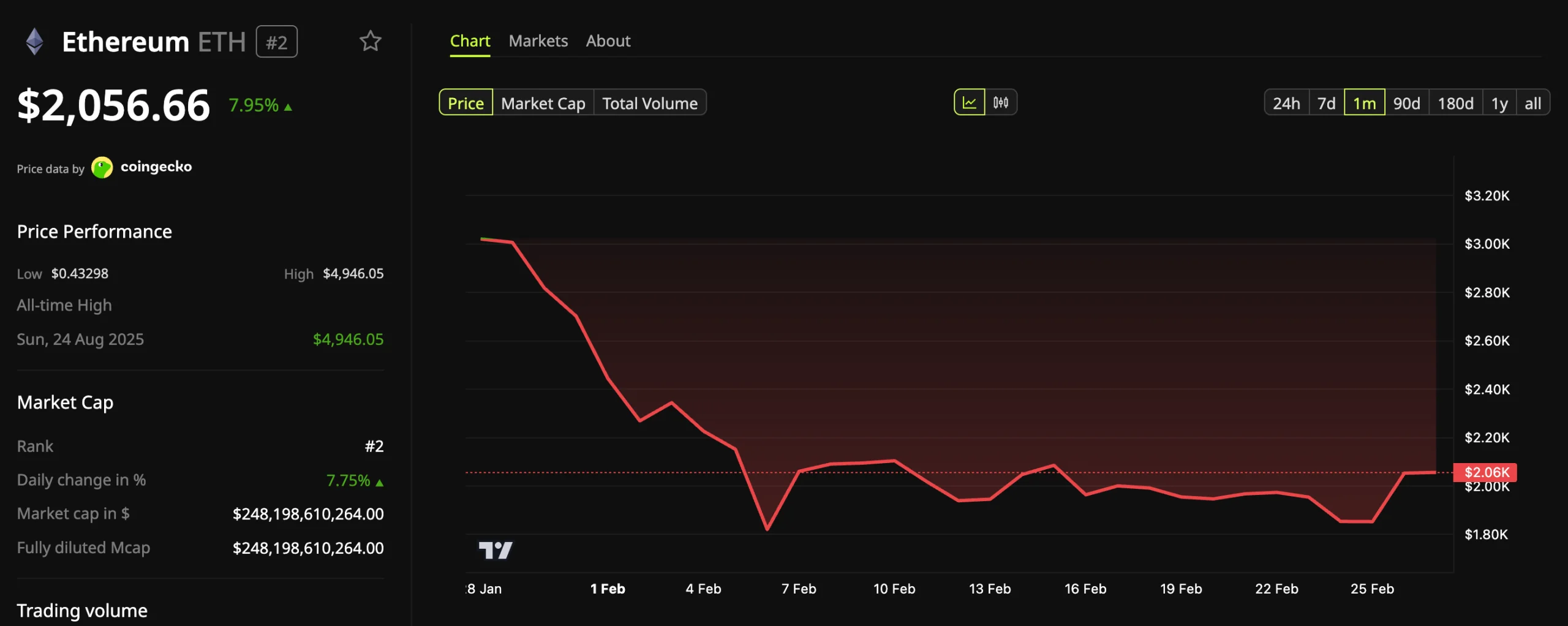
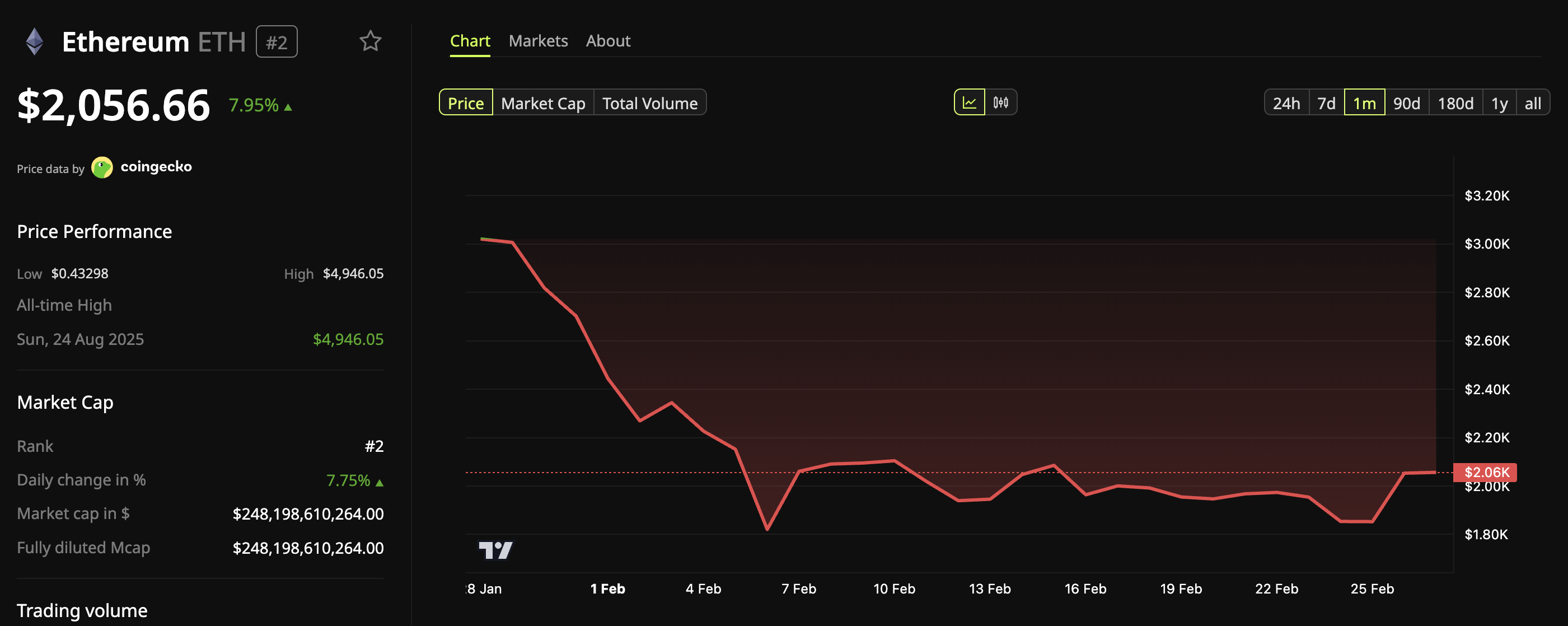
Ethereum (ETH) is seeing renewed buying interest amid its latest recovery rally, which has pushed the price back above $2000.
On-chain data shows whales accumulating the second-largest cryptocurrency. At the same time, the Coinbase Premium Index has moved above zero for the first time since early January.
Ethereum Reclaims $2000 as Crypto Market Extends Midweek Rally
The crypto market extended its gains today, continuing the upward trajectory that began on Wednesday. Ethereum’s price has risen about 8% during the same period. At press time, the altcoin was trading at $2054.
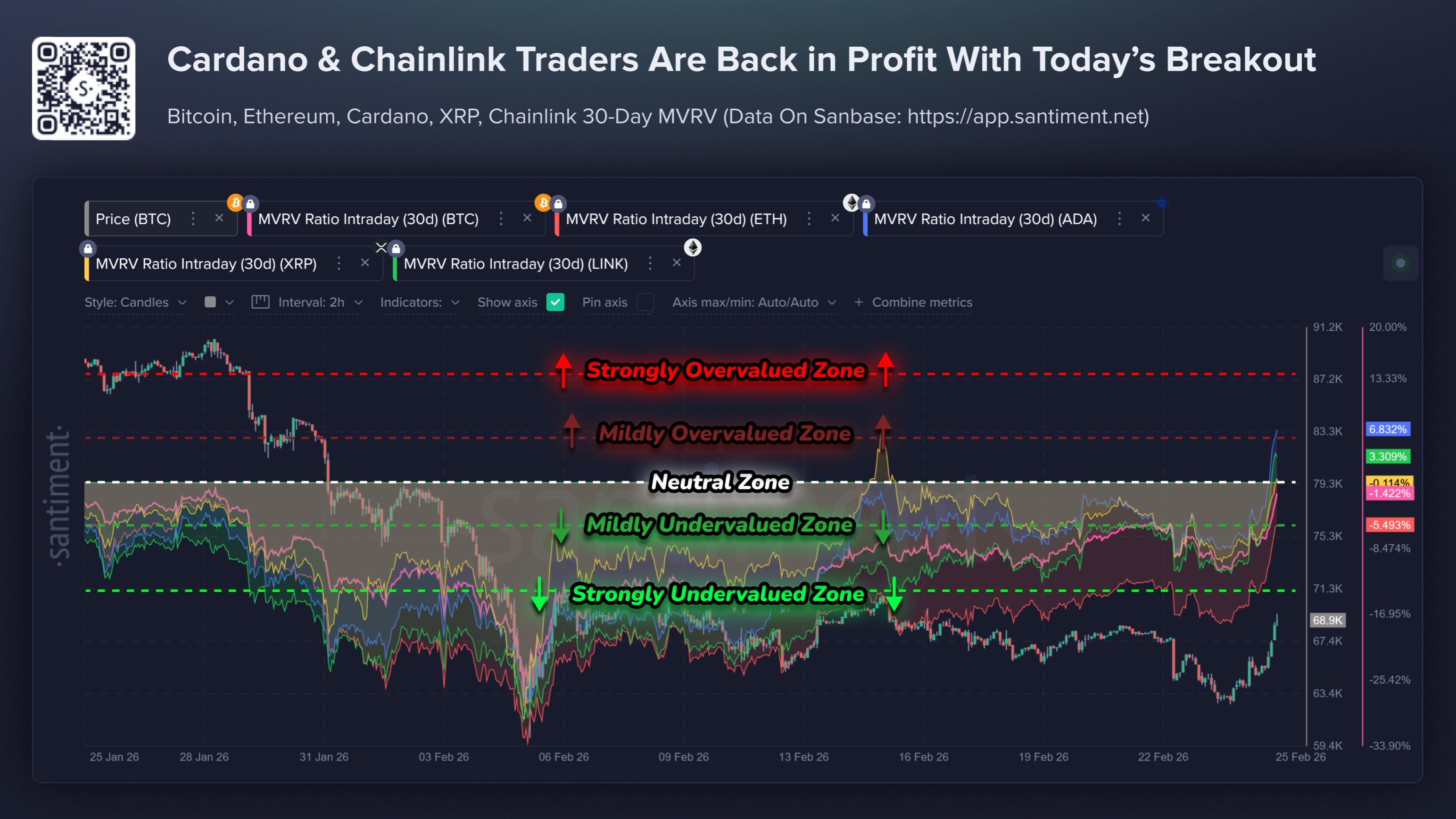
On-chain analytics platform Santiment noted that the 30-day Market Value to Realized Value (MVRV) ratio for large-cap cryptocurrencies shifted significantly following the rally, suggesting the market is rebalancing after a period of undervaluation.
The MVRV metric compares market capitalization with realized capitalization, providing insight into average holder profitability. Ethereum, in particular, has moved from a strongly undervalued position to a mildly undervalued zone, with its MVRV ratio currently at -5.5%.
ETH Surge Triggers Major Whale Buys
The recovery has been accompanied by notable whale activity. Blockchain analytics firm Lookonchain documented that whale address 0xAb59 invested $14.57 million to acquire 7,008 ETH at an average price of $2,079.
In addition, whale address 0x166f withdrew 20,000 ETH worth $38.25 million from Binance and Deribit within a two-hour window. The large-scale exchange withdrawal involved five transfers, with the largest being 8,000 ETH from a Binance hot wallet.
US investor demand is also showing signs of improvement. According to CryptoQuant data, the Ethereum Coinbase Premium Index has moved over zero.
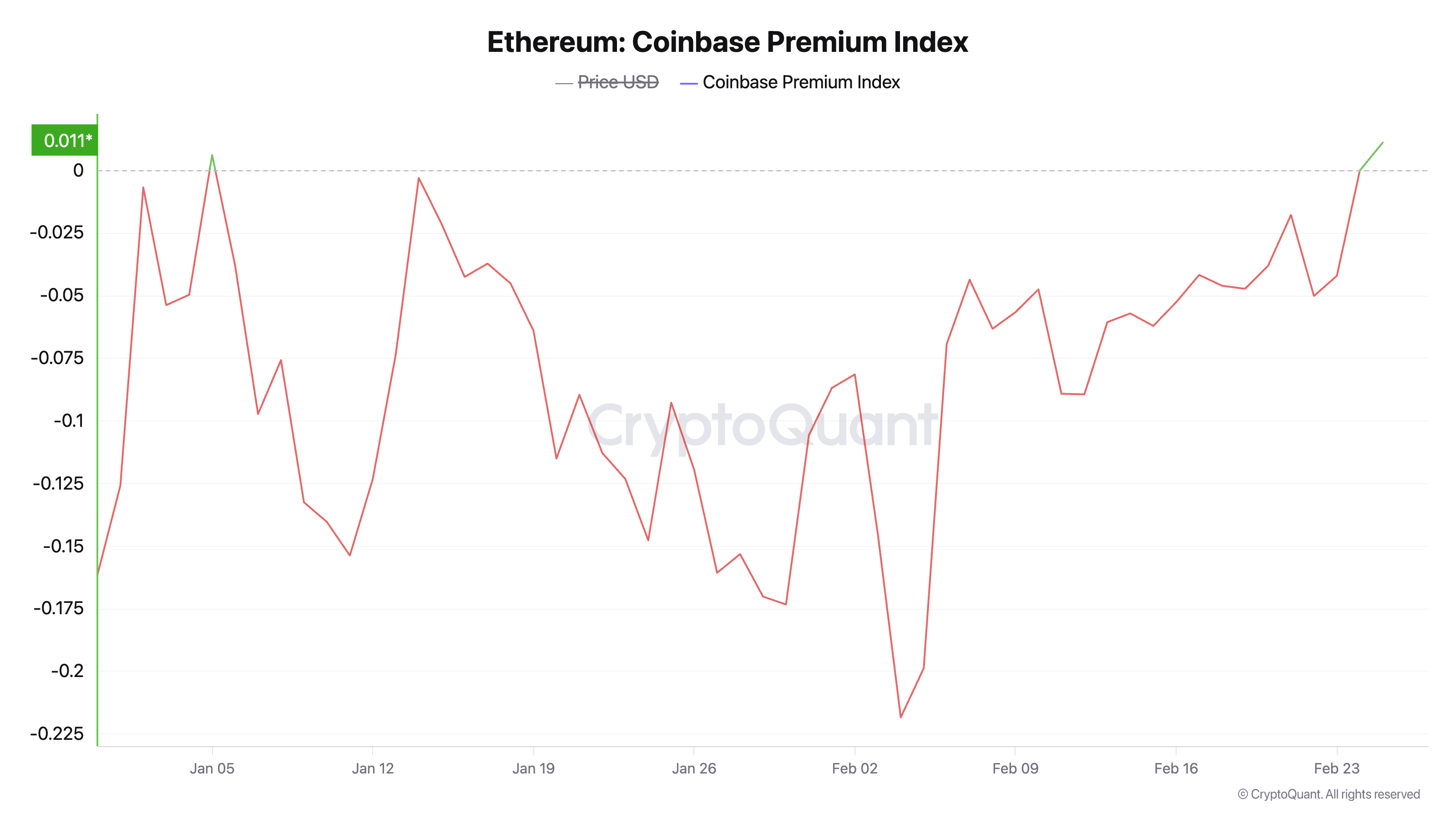
Throughout much of January and early February 2026, the index, which measures the price difference between Ethereum on Coinbase and Binance, remained firmly negative. This typically signals weaker buying pressure from US-based investors during periods of price softness.
The current reading shows ETH trading at a slight premium on Coinbase. This typically reflects stronger buying pressure from US-based investors, including institutional participants, compared to offshore markets.
“Most of the moments when the ETH Coinbase premium turned positive were followed by an upward trend. And now, the Coinbase premium has risen to 0. We’ve reached a critical turning point,” an analyst wrote.
Meanwhile, some derivatives traders have also benefited from ETH’s rise. Data shared by OnchainLens shows that trader Machi’s leveraged 25x long on ETH has swung back into profit, now up more than $760,000.
Separately, the whale known as “pension-usdt.eth” has closed both ETH and BTC long positions, realizing approximately $1.16 million in gains.
For now, momentum appears positive, but whether it can be sustained in the coming weeks remains to be seen.


The White House has reaffirmed that former FTX CEO Sam Bankman-Fried will not receive a presidential pardon, even as the disgraced crypto founder publicly courts President Donald Trump through a sustained social media campaign.
Summary
- The White House reaffirmed that Sam Bankman-Fried will not receive a presidential pardon, despite his recent public appeals directed at Donald Trump.
- Bankman-Fried has used social media to criticize the Justice Department and align himself with Trump’s rhetoric, in what observers see as a bid for clemency.
- Trump has previously stated he has no intention of pardoning the former FTX CEO, even as he has shown clemency toward other high-profile figures.
Sam Bankman-Fried’s Trump appeals fall flat
A White House spokesperson reiterated to media that Trump has no plans to grant clemency to Bankman-Fried, revealing the president’s stance.
Bankman-Fried, serving a 25-year sentence for fraud and conspiracy related to the collapse of his cryptocurrency exchange FTX, has in recent weeks taken to platforms like X to align himself with Trump’s policies, criticize the judge who sentenced him, and lash out at his legal foes.
The messaging, widely interpreted as an attempt to influence Trump’s pardon calculus, also includes praise for conservative causes and disparagement of the Biden administration.
Despite these efforts, Trump’s position remains firm. In January, the president declared that Bankman-Fried was not among the individuals he intended to pardon — a list that also excludes other high-profile figures such as former New Jersey senator Robert Menendez and Venezuela’s Nicolás Maduro.
The White House statement reiterated this stance and suggested that the FTX founder’s public overtures have not altered Trump’s approach to clemency.
Bankman-Fried’s pivot toward Trump contrasts sharply with his earlier role as a major Democratic donor before FTX’s collapse. The shift in tone has been accompanied by amplification across various accounts on social media, with critics dismissing the campaign as ineffective “sock-puppet” activity.
The president has granted pardons to several figures associated with the cryptocurrency world, including Binance founder Changpeng Zhao and BitMEX’s leadership. Still, advisers and political observers view Bankman-Fried’s bid as unlikely to succeed, given his controversial reputation and the severity of his crimes.

Beau Greaves becomes first woman to hit nine-darter on PDC ProTour

Uber Employees Have Built an AI Clone of Their CEO To Practice Presentations Before the Real Thing

Australian PM Albanese apologises after calling child sex abuse survivor ‘difficult’


-

 Video6 days ago
XRP News: XRP Just Entered a New Phase (Almost Nobody Noticed)
-

 Politics4 days ago
Baftas 2026: Awards Nominations, Presenters And Performers
-

 Fashion5 days ago
Weekend Open Thread: Boden – Corporette.com
-

 Sports2 days ago
Women’s college basketball rankings: Iowa reenters top 10, Auriemma makes history
-

 Politics3 days ago
Nick Reiner Enters Plea In Deaths Of Parents Rob And Michele
-

 Crypto World2 days ago
XRP price enters “dead zone” as Binance leverage hits lows
-

 Business4 days ago
Mattel’s American Girl brand turns 40, dolls enter a new era
-

 Business4 days ago
Law enforcement kills armed man seeking to enter Trump’s Mar-a-Lago resort, officials say
-

 Tech2 days ago
Unsurprisingly, Apple's board gets what it wants in 2026 shareholder meeting
-
 NewsBeat8 hours ago
Manchester Central Mosque issues statement as it imposes new measures ‘with immediate effect’ after armed men enter
-

 NewsBeat5 hours ago
Cuba says its forces have killed four on US-registered speedboat | World News
-

 Tech4 days ago
Anthropic-Backed Group Enters NY-12 AI PAC Fight
-
 NewsBeat3 days ago
‘Hourly’ method from gastroenterologist ‘helps reduce air travel bloating’
-

 Business1 day ago
True Citrus debuts functional drink mix collection
-

 NewsBeat3 days ago
Armed man killed after entering secure perimeter of Mar-a-Lago, Secret Service says
-

 Politics4 days ago
Maine has a long track record of electing moderates. Enter Graham Platner.
-
 NewsBeat1 day ago
Police latest as search for missing woman enters day nine
-

 Crypto World1 day ago
Entering new markets without increasing payment costs
-
 Sports3 days ago
2026 NFL mock draft: WRs fly off the board in first round entering combine week
-

 Crypto World6 days ago
83% of Altcoins Enter Bear Trend as Liquidity Crunch Tightens Grip on Crypto Market