Crypto World
Is Crypto Becoming a Tool for Human Trafficking Networks?

Cryptocurrency flows to services linked with suspected human trafficking surged 85% year over year in 2025.
The findings come from a new report by blockchain analytics firm Chainalysis, which highlighted that the intersection of cryptocurrency and suspected human trafficking expanded markedly last year.
Sponsored
Sponsored
Which Crypto Assets Are Most Used in Suspected Human Trafficking Networks?
The report outlined four primary categories of suspected crypto-facilitated human trafficking. This includes Telegram-based “international escort” services, forced labor recruitment linked to scam compounds, prostitution networks, and child sexual abuse material vendors (CSAM).
“The intersection of cryptocurrency and suspected human trafficking intensified in 2025, with total transaction volume reaching hundreds of millions of dollars across identified services, an 85% year-over-year (YoY) increase. The dollar amounts significantly understate the human toll of these crimes, where the true cost is measured in lives impacted rather than money transferred,” Chainalysis wrote.
According to the report, payment methods varied across categories. International escort services and prostitution networks used stablecoins.
“The ‘international escort services are tightly integrated with Chinese-language money laundering networks. These networks rapidly facilitate the conversion of USD stablecoins into local currencies, potentially blunting concerns that assets held in stablecoins might be frozen,” Chainalysis noted.

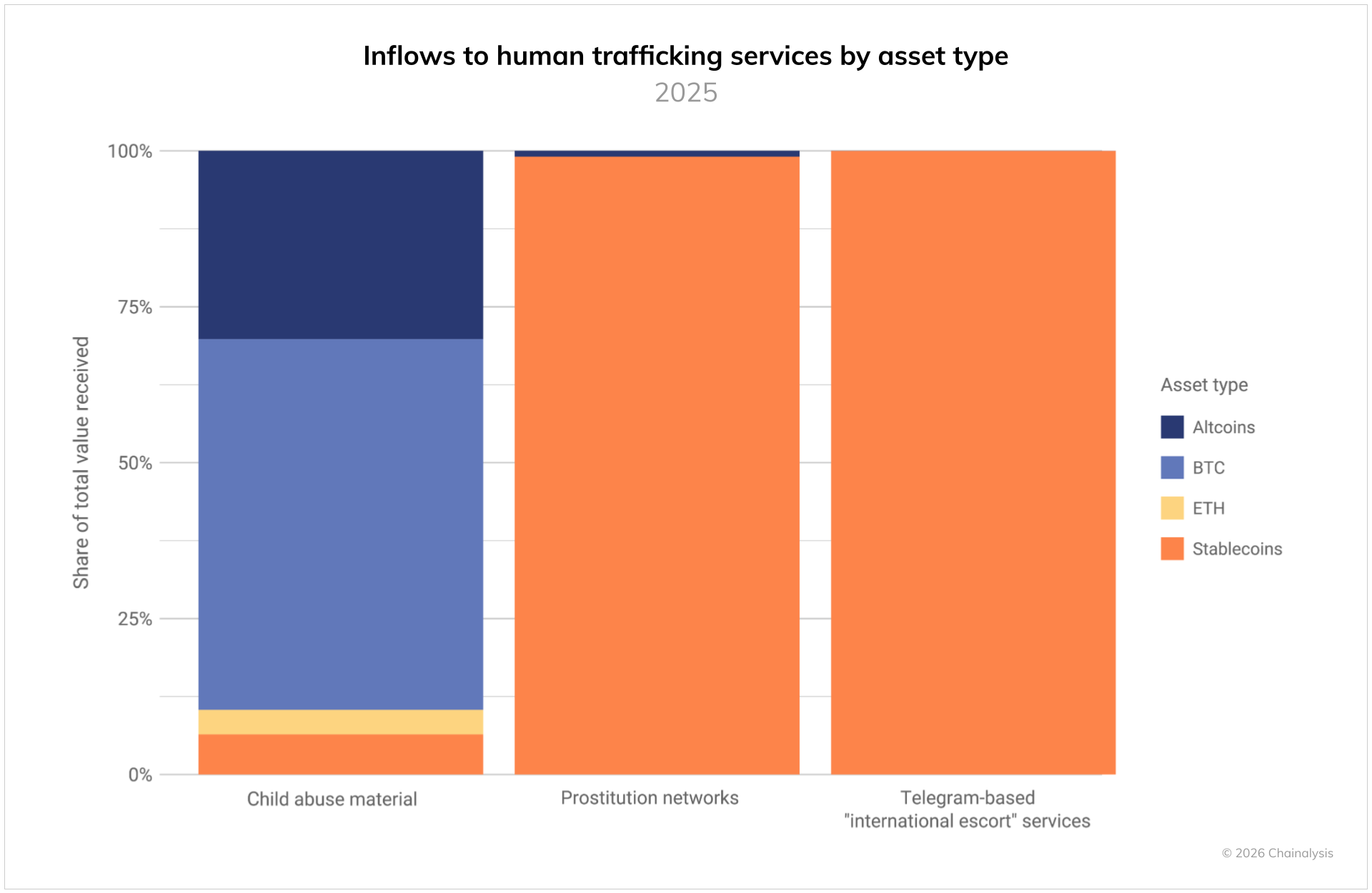
CSAM vendors have historically relied more heavily on Bitcoin (BTC). However, Bitcoin’s dominance has declined with the rise of alternative Layer 1 networks.
Sponsored
Sponsored
In 2025, while these networks continue to accept mainstream cryptocurrencies for payments, they increasingly turn to Monero (XMR) to launder proceeds. According to Chainalysis,
“Instant exchangers, which provide rapid and anonymous cryptocurrency swapping without KYC requirements, play a crucial role in this process.”
The Dual Role of Crypto in Human Trafficking-Linked Transactions
Chainalysis noted that the surge in cryptocurrency flows to services linked with suspected human trafficking is not occurring in isolation. Instead, it mirrors the rapid expansion of Southeast Asia–based scam compounds, online casinos and gambling platforms, and Chinese-language money laundering (CMLN) and guarantee networks operating primarily through Telegram.
Together, these entities form a fast-growing regional illicit ecosystem with global reach. According to the report, Chinese-language services operating across mainland China, Hong Kong, Taiwan, and multiple Southeast Asian countries exhibit advanced payment processing capabilities and extensive cross-border networks.
Furthermore, geographic analysis reveals that while many trafficking-linked services are based in Southeast Asia, cryptocurrency inflows originate globally. Significant transaction flows were traced to countries including the United States, Brazil, the United Kingdom, Spain, and Australia.
“While traditional trafficking routes and patterns persist, these Southeast Asian services exemplify how cryptocurrency technology enables trafficking operations to facilitate payments and obscure money flows across borders more efficiently than ever before. The diversity of destination countries suggests these networks have developed sophisticated infrastructure for global operations,” the report read.
At the same time, Chainalysis stressed that blockchain transparency offers investigators deeper visibility into trafficking-related financial activity.
Unlike cash transactions, which leave little to no audit trail, blockchain-based transfers generate permanent, traceable records. This creates new opportunities for detection and disruption that are not possible with traditional payment systems.
You must be logged in to post a comment Login