

Crypto World
Is now the time to buy the dip? A framework, not a cheer



“Buy the dip” is the most-searched, most-repeated, and most-dangerous phrase in crypto during a downturn, and in mid-2026 it is everywhere.
Summary
- More than 10 million BTC sitting at unrealized losses supports the argument that capitulation may be nearing exhaustion.
- Extreme fear and whale accumulation favor buying, but weak ETF demand and hostile macro conditions argue for caution.
- A disciplined decision depends on time horizon, financial resilience, asset quality, and the ability to withstand further declines.
- Dollar-cost averaging reduces timing risk and avoids turning a long-term thesis into an all-in bet on the exact bottom.
With Bitcoin down sharply toward the $60,000 region, the Fear and Greed Index in extreme fear, and on-chain data showing more than 10 million BTC held at a loss, the question dominating crypto searches and group chats is whether now is the moment to buy.
Most of the answers on offer are cheers, “buy the dip” shouted as a slogan by people who want prices to go up, with no framework behind it.
This piece is not that.
It is a decision framework instead of a cheer, built to help you think through whether buying this dip makes sense for you, because the honest answer is that it depends on factors specific to your situation, the actual signals in the market, and a clear-eyed view of what could go wrong.
The phrase “buy the dip” assumes the dip is a dip and not the start of a longer decline, and the entire question is whether that assumption holds.
This piece walks through the real signals pointing both ways, the framework for deciding, and the disciplined ways to act if the answer is yes.
Why “buy the dip” is dangerous as a slogan
Before building the framework, it is worth understanding why the phrase itself is a trap when treated as a slogan rather than a question, because the framing error causes real damage.
“Buy the dip” embeds an assumption that is the entire question in disguise: that what you are looking at is a dip, a temporary decline within a larger uptrend, not the early or middle stage of a sustained bear market.
A dip is a buying opportunity by definition because the price recovers. A bear market is a value trap because the price keeps falling and the buyer catches a falling knife.
The phrase “buy the dip” smuggles in the conclusion that it is a dip, which is precisely what cannot be known in advance, and that is why treating it as a slogan rather than a question is dangerous.
The people cheering “buy the dip” are assuming the answer to the only question that matters.
The danger is compounded by who tends to shout the phrase loudest and when.
“Buy the dip” reaches peak volume during sell-offs, when existing holders, who want prices to recover so their own positions improve, are most motivated to encourage buying, and when the emotional pull to “do something” is strongest.
This is exactly the moment when the assumption embedded in the phrase is most likely to be wrong, because severe declines that prompt loud “buy the dip” chatter are sometimes dips and sometimes the middle of much larger declines.
Buying every dip works in a bull market and is ruinous in a bear market, and the slogan offers no way to tell which environment you are in, which is the only thing that matters.
The history is sobering.
Investors who “bought the dip” in early 2018 or early 2022, when prices had fallen substantially and the phrase was everywhere, often bought into declines that continued for many more months and much lower prices.
Those were not dips but the early stages of bear markets that ran 77% to 84% from the highs.
The same phrase that correctly identified buying opportunities during bull-market corrections destroyed capital when applied indiscriminately to the start of bear markets.
The lesson is not that buying declines is always wrong. It is that “buy the dip” as an automatic reflex, without a framework to distinguish a dip from a bear market, is how people lose money trying to be opportunistic.
The phrase needs to be replaced with a question: Is this a dip, and even if it is, should I buy it?
The signals pointing toward “yes”
A serious framework weighs the real evidence on both sides, and in mid-2026 there are genuine signals suggesting this could be a dip worth buying.
Laying them out honestly is the first half of the decision.
The strongest bullish signal is the on-chain capitulation data, which suggests selling pressure may be exhausting.
By early June 2026, approximately 10.46 million BTC were held at unrealized losses, crossing the threshold above which major macro bottoms have historically formed.
The logic is that when more than 10 million coins are underwater, a vast majority of short-term speculators have been washed out, and selling pressure fundamentally fades because the people who would panic-sell have mostly already done so.
The Short-Term Profit Ratio falling below 1 confirms that short-term holders are selling at a loss, the capitulation pattern that has historically preceded bottoms.
These metrics do not guarantee a bottom, but they are the conditions from which bottoms have formed, which is a genuine point in favor of buying.
The second bullish signal is extreme-fear sentiment, which is a contrarian indicator.
The Fear and Greed Index buried in extreme fear, the record “Bitcoin to zero” searches, and the broad despair are the emotional conditions that have historically marked accumulation opportunities.
Maximum fear has tended to cluster near bottoms more than before further collapses.
Every prior extreme-fear event this cycle marked a buying opportunity for patient investors, and the contrarian logic, be greedy when others are fearful, points toward buying when sentiment is this bad.
The crowd is maximally afraid, and the crowd at its most afraid has historically been wrong about the direction.
The third bullish signal is smart-money behavior and valuation.
On-chain data shows whales, the largest holders, accumulating into the decline while retail capitulates, the classic transfer from weak hands to strong hands that builds bottoms.
Some corporate treasuries continued buying the dip even as ETFs sold.
On valuation, a closely watched metric shows Bitcoin’s market price getting close to its realized fair value after the sell-off, suggesting the price is approaching levels that have historically represented value rather than froth.
Institutional voices such as Bernstein have maintained year-end targets far above current levels, characterizing the drawdown as the “weakest bear case in Bitcoin’s history.”
Smart money is accumulating, valuation is approaching fair value, and credible institutions see substantial upside, all of which support the dip-buying case.
The signals pointing toward “no”
An honest framework gives equal weight to the bearish signals, and in mid-2026 there are real reasons for caution that dip-buying cheerleaders tend to ignore.
This is the second half of the decision.
The strongest bearish signal is that the institutional bid has weakened, which is new and concerning.
When Bitcoin returned to the $60,000 level in June, ETF investors did not buy the dip the way they had in February. Instead, they opted for larger-scale redemptions, with the record 13-day outflow streak draining billions.
This matters because institutional ETF demand was the structural support that cushioned prior declines, and its reversal removes a key buyer at exactly the moment the dip-buying case needs it.
The fact that institutions, with their research and capital, chose to sell instead of buy this dip is a meaningful vote against the bullish thesis.
It also distinguishes this decline from the February sell-off that institutions did buy.
The second bearish signal is the hostile macro environment, which shows no sign of turning.
The Federal Reserve has signaled rates will remain on hold, with markets pricing out meaningful cuts through 2026.
The 10-year Treasury yield remains elevated around 4.43%, suppressing risk appetite, inflation concerns persist, and geopolitical risk from the U.S.-Iran conflict adds pressure.
These are the forces that drove the decline, and none of them has reversed.
Buying the dip into an unchanged hostile macro backdrop means betting that the price recovers despite the conditions that caused the fall still being in place, which is a weaker bet than buying into improving conditions.
The macro that broke the market is still broken.
The third bearish signal is the technical structure and analyst warnings.
The decline broke key support levels, and the market sits at a critical point where the $60,000 level is the line between recovery and a deeper breakdown toward $50,000.
Some analysts characterize the current bounce as a fragile counter-trend rally fueled by short covering rather than a fundamental shift.
Standard Chartered, while bullish over the longer term, warned of a possible dip toward $50,000 before any recovery, and analysts have flagged that losing key support could open the door to lower prices.
Four-year-cycle analysts also point to the possibility of a deeper bottom.
The technical and analytical picture includes credible scenarios where this is not the bottom and meaningful further downside remains.
Buying now therefore risks catching a knife that has not finished falling.
The framework for deciding
With both sides laid out, the actual framework for deciding whether to buy this dip comes down to a set of questions about your situation and discipline, not a market call.
This is the heart of the piece.
The first question is your time horizon, and it is the most important.
If you are a long-term investor with a multi-year horizon who believes in Bitcoin’s structural case, the question of whether this exact moment is the bottom matters far less.
Over a multi-year period, buying somewhere in the zone of extreme fear and deep capitulation has historically been rewarded, even if the buyer does not identify the exact low.
If you are a short-term trader hoping for a quick bounce, the question is entirely different and far harder.
The fragile-counter-trend-rally warnings and deeper-downside scenarios mean a short-term buy could easily be underwater quickly.
The same dip can be a buy for the long-term investor and a trap for the short-term trader, so the first thing the framework demands is honesty about which one you are.
The second question is whether you can afford to be wrong.
Buying the dip means accepting that the price could fall further, potentially much further, before any recovery.
Even in the bullish case, analysts warn of a possible move toward $50,000 first, and in the bearish case, the downside is larger.
The disciplined buyer only deploys capital they can afford to see decline substantially and hold through, without being forced to sell at a loss by financial pressure or emotional panic.
If a further 20% or 30% decline would force you to sell or cause unbearable stress, you cannot afford to buy this dip regardless of how attractive the signals look.
You would likely capitulate at the worst moment.
The framework requires matching position size to your genuine ability to withstand being wrong.
The third question is whether you have a plan that removes emotion from execution.
The worst way to buy a dip is impulsively, in a single lump, driven by the fear of missing the bottom, because that maximizes the damage if you are early.
The disciplined approach is dollar-cost averaging, buying in planned increments over time, which accepts that you will not identify the exact bottom in exchange for not betting everything on a single timing call.
By spreading purchases across the zone of extreme fear and capitulation, you ensure you participate if this is the bottom while limiting the damage if it is not.
It also removes the emotional pressure of trying to time the precise low.
The framework strongly favors a planned, incremental approach over an all-in timing bet, because the honest truth is that no one, including analysts on both sides, knows exactly where the bottom is.
The mistakes dip-buyers make
Beyond the decision of whether to buy, the framework is incomplete without understanding the specific mistakes that turn dip-buying from a sound strategy into a destructive one.
Most of the damage comes from execution errors rather than from the decision itself.
The first and most common mistake is going all-in at once, driven by the fear of missing the bottom.
A dip-buyer who deploys all available capital in a single purchase is making a precise timing bet: that this exact price is the bottom.
That is the one thing the framework establishes cannot be known.
If the buyer is early, which is likely given that bottoms are zones rather than points and bear markets can last months, there is no capital left to buy lower.
The buyer is immediately underwater and maximally exposed to the emotional pressure to panic-sell if the decline continues.
The all-in dip buy converts a sound long-term thesis into a fragile short-term timing bet, and it is the single most destructive thing a dip-buyer can do.
The discipline of buying in increments exists precisely to avoid this error.
The second mistake is buying with money you cannot afford to hold through further declines.
Dip-buyers frequently deploy capital they need in the near term, or capital whose loss they cannot emotionally tolerate, on the assumption that recovery will be quick.
When the decline continues, as it often does, they are forced to sell at a loss by financial necessity or driven to panic-sell by stress.
That locks in exactly the loss they were trying to avoid and produces capitulation at the worst moment.
The framework’s requirement to deploy only capital you can afford to be wrong about, and to hold through, exists to prevent this.
A dip-buyer who can hold survives being early. A dip-buyer who cannot hold is destroyed by it.
Buying the dip with the wrong money turns a survivable mistake into a fatal one.
The third mistake is abandoning the quality filter in the hunt for the biggest bargains.
During a crash, the assets that have fallen the most look like the biggest opportunities, but the largest declines often belong to the weakest projects that will not recover.
The altcoin devastation of 2026 and stress across individual ecosystems illustrate the risk.
Dip-buyers who chase the most beaten-down names, reasoning that they have the most upside, frequently buy assets falling for fundamental reasons that will keep falling or die entirely.
The discipline of concentrating dip-buying on quality assets with the staying power to survive a bear market and participate in the recovery separates productive dip-buying from catching falling knives in names that never bounce.
The biggest discount is not necessarily the best opportunity.
The best opportunity is a quality asset at a discount, which is a different thing.
The through-line of all three mistakes is that they substitute emotion and greed for discipline.
Going all-in is greed and fear of missing out. Buying with the wrong money is impatience and overconfidence. Chasing the biggest losers is greed for maximum upside.
The framework’s antidotes—increments, affordable capital, and a quality filter—are all forms of imposing discipline on the emotional pull that a crash creates.
Dip-buyers who perform well are not the ones who time the bottom perfectly, which is impossible.
They are the ones who execute with discipline regardless of where the bottom turns out to be, which is entirely within their control.
Whether to buy the dip is a judgment call the framework helps you make. How to buy it is a discipline the framework demands, and the second matters as much as the first.
How to act if the answer is yes
For those whose answers to the framework questions point toward buying, the final piece is disciplined execution, because how you buy matters as much as whether you buy.
The core principle is to accept that you will not time the bottom and to build that acceptance into your approach.
The on-chain signals—the more than 10 million coins at a loss, the SOPR below 1, whale accumulation, and the approach toward realized value—suggest the market is in the zone where bottoms form.
However, a zone is not a point, and prices can fall further or move sideways for an extended period before recovering, as bear markets historically last eight to twelve months.
The disciplined buyer treats the current period as an accumulation zone to buy through gradually, not a single moment to buy all at once.
That is the practical application of the dollar-cost-averaging discipline the framework demands.
You are buying a range, not a bottom.
The second principle is to focus on quality and respect that some assets falling in the crash will not recover.
The contrarian, buy-when-fearful logic applies most reliably to high-quality assets with durable fundamentals and the structural staying power to survive a bear market and participate in the eventual recovery.
Buying the dip indiscriminately, treating every fallen token as a bargain, ignores that bear markets permanently kill weaker projects.
The framework’s quality filter means concentrating any dip-buying on the assets most likely to be there for the recovery, not the most beaten-down names, which are often beaten down for reasons.
The honest synthesis, and the answer to the question the title poses, is that whether now is the time to buy the dip truly depends.
The framework is the way to decide, not the cheer.
The signals are genuinely mixed.
On-chain capitulation, extreme fear, whale accumulation, and the approach toward fair value point toward a dip worth buying.
The weakened institutional bid, hostile and unchanged macro conditions, and credible deeper-downside scenarios point toward caution and the risk of catching a falling knife.
For a long-term investor who can afford to be wrong, who buys quality, who deploys capital gradually through the zone rather than all at once, and who can hold through further declines without being forced to sell, the framework supports buying this dip as part of disciplined accumulation.
That conclusion comes with full awareness that the exact bottom cannot be timed and further downside is possible.
For a short-term trader hoping for a quick bounce, the framework advises far more caution because the fragile-rally and deeper-downside scenarios make the short-term bet substantially riskier.
The phrase “buy the dip” offers a slogan. The framework offers a decision, and the decision is yours to make based on your horizon, capacity to be wrong, and discipline, not on the volume of the cheering.
The right question is never simply, “Is it time to buy the dip?”
It is: “Is this a dip I can afford to be wrong about, bought in a way that survives being early?”
Only you can answer that.
This article is for informational purposes and does not constitute financial or investment advice. Cryptocurrency markets are highly volatile. The figures and analysis described reflect data available as of June 2026. Always do your own research and consult with qualified financial professionals before making investment decisions.

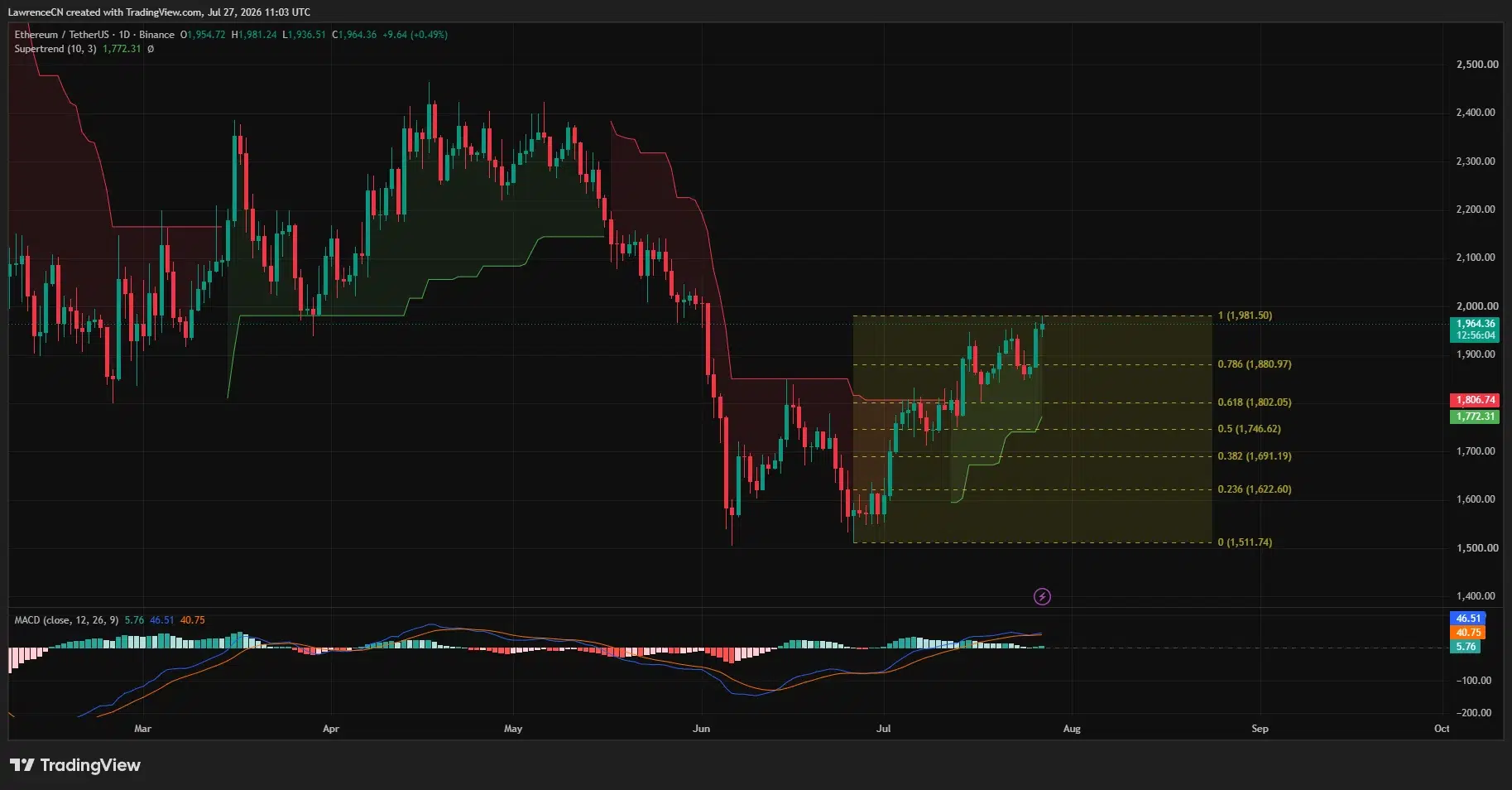
Ethereum price rallied 5% to $1,966 on July 27 as surging spot demand, short liquidations, and tighter available supply pushed ETH toward the key $2,000 barrier.
Summary
- Ethereum price gained 5% to $1,966, while 24-hour spot trading volume jumped 118.53% to $9.21 billion.
- The daily chart places $1,981.50 and $2,000 as the next major resistance zones.
- 4-hour RSI reached 73.36, showing strong momentum but raising the risk of a short-term pullback.
- Liquidation data shows large leverage clusters near $1,980–$2,000, with downside liquidity around $1,930.
- Analysts see $2,350–$2,500 as possible targets if ETH establishes support above $2,000.
Ethereum price rally targets $2,000
According to data from crypto.news, Ethereum (ETH) price climbed to around $1,966 after trading near $1,870 during the previous session, extending a recovery that began from its June low near $1,512. The latest move brought ETH within 2% of the psychological $2,000 level.
Spot trading volume increased 118.53% over 24 hours to $9.21 billion, according to the supplied market data. Rising volume alongside price suggests buyers supported the advance rather than the move occurring during thin trading conditions.
The daily chart shows ETH reaching an intraday high of $1,981.24 before easing toward $1,964. That high closely matches the 100% Fibonacci retracement level at $1,981.50, making the $1,981–$2,000 area the first major test for the recovery.
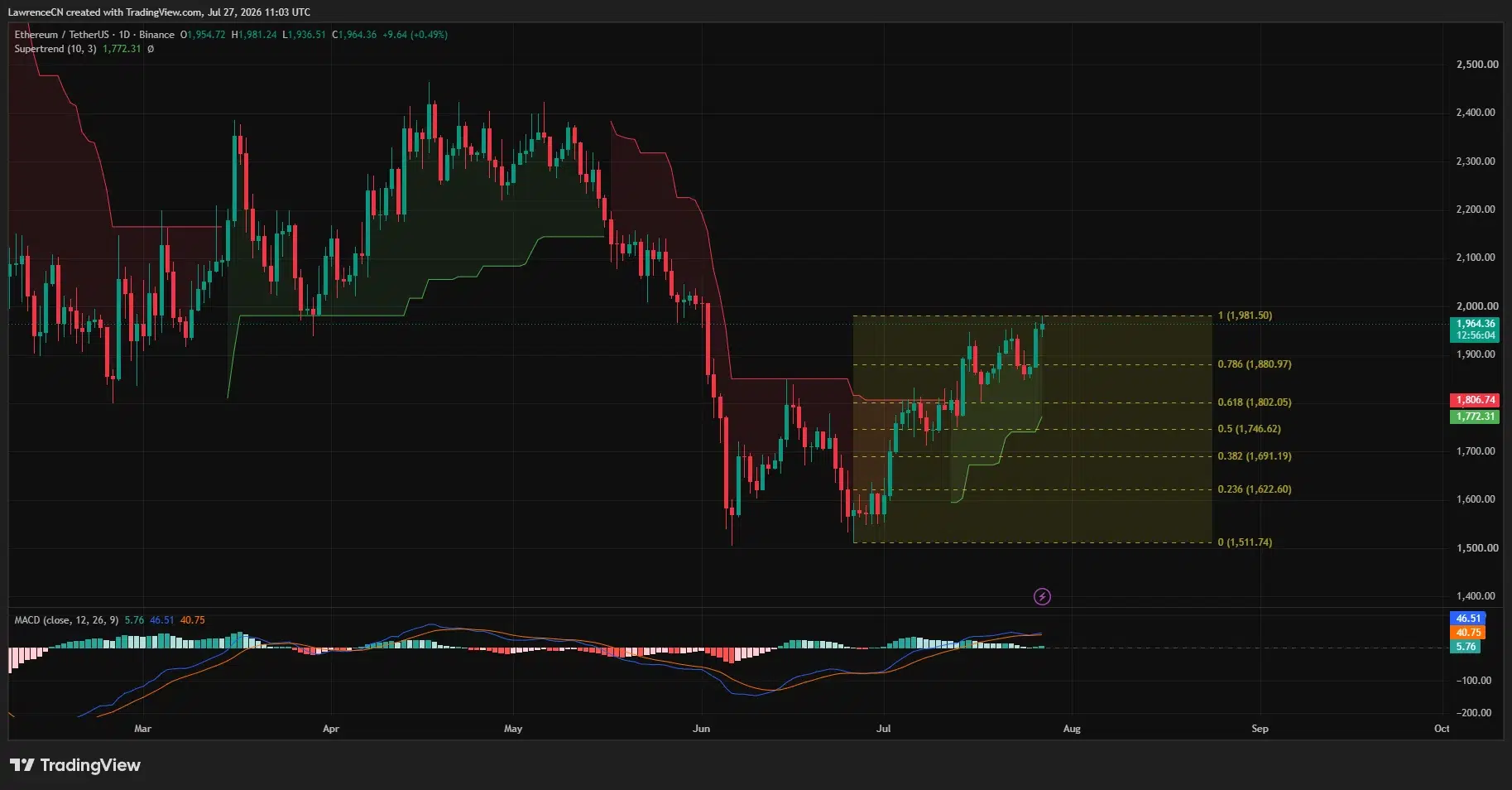
Ethereum has already reclaimed the 78.6% Fibonacci level at $1,880.97. Below that price, the next retracement levels sit at $1,802.05, $1,746.62, and $1,691.19.
The daily Supertrend has also switched to bullish support at approximately $1,772.31. ETH would need to fall below that level before the broader recovery structure faces a more serious invalidation risk.
Spot demand and supply pressure support ETH
Ethereum’s rally coincided with a sharp increase in market activity and a reported rise in its staking rate to a record 34%. Staked tokens cannot immediately enter the spot market, reducing the liquid supply available to buyers during periods of stronger demand.
Higher Layer 2 throughput and decentralized finance activity have also increased smart contract execution. Under Ethereum Improvement Proposal 1559, part of each transaction’s base fee is burned, removing ETH from circulation when network usage rises.
These supply conditions do not guarantee further gains, but they can magnify price movements when demand accelerates. A smaller pool of liquid ETH means buyers may need to bid at progressively higher prices to complete large spot purchases.
US spot Ethereum exchange-traded funds provide another source of demand. The supplied market context indicates that the products recovered from volatile outflows earlier in July and began recording more consistent net inflows.
For US investors, sustained ETF inflows would offer evidence that regulated demand is strengthening alongside activity in native crypto markets. However, the upcoming Federal Reserve interest-rate decision remains a key risk because a hawkish policy signal could reduce demand for high-beta assets such as ETH.
Technical indicators warn of short-term overheating
Ethereum’s 4-hour chart shows the price moving inside an ascending parallel channel that has guided the recovery since early July. ETH recently rebounded from the channel’s lower boundary near $1,850 and returned to the $1,965 region.
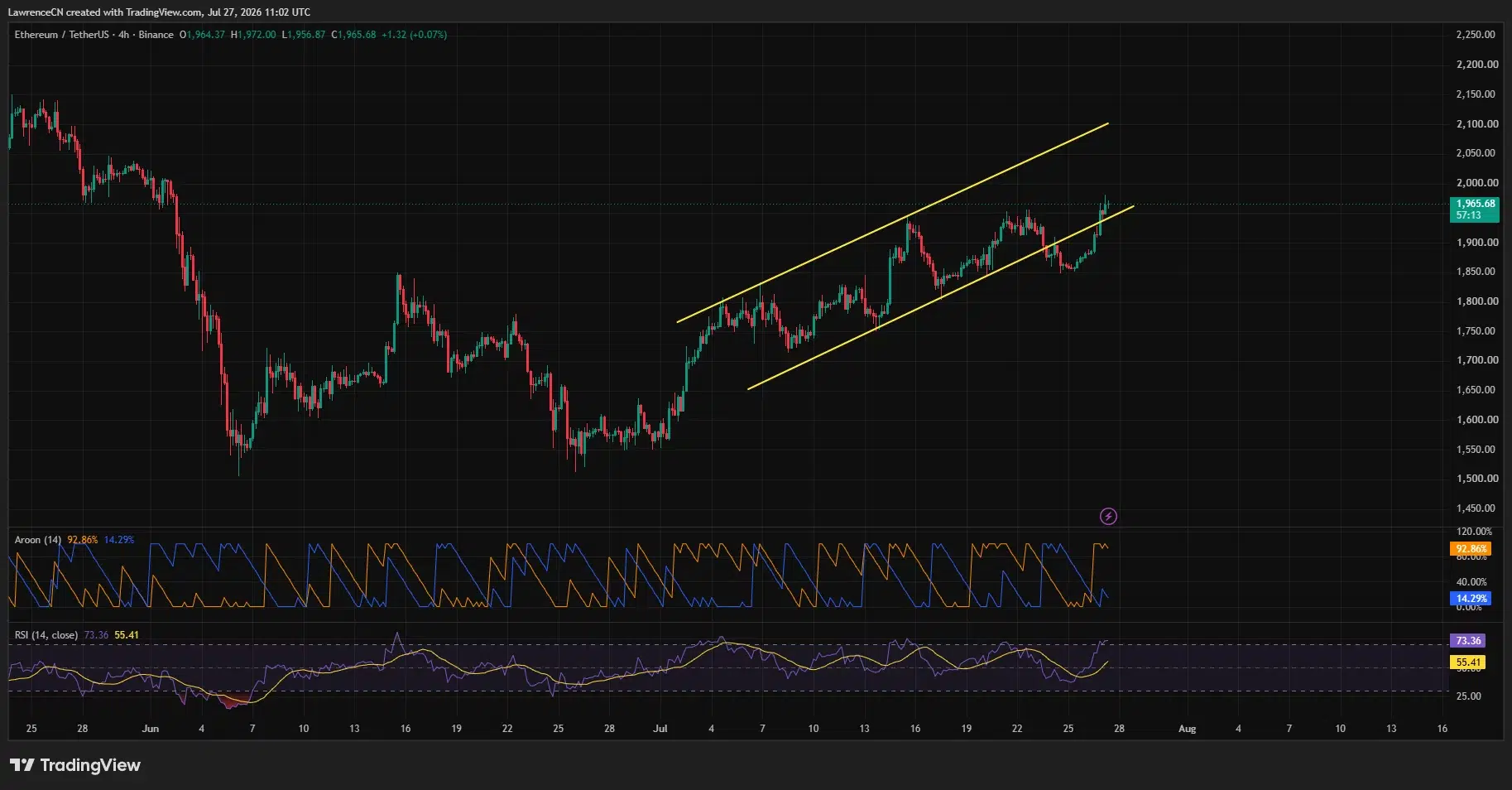
The Aroon Up indicator stands at 92.86%, compared with Aroon Down at 14.29%. That wide gap indicates that recent highs are arriving more frequently than recent lows, supporting the bullish short-term structure.
Momentum is becoming stretched, however. 4-hour relative strength index reached 73.36, above the conventional overbought threshold of 70 and well above its moving average at 55.41. This reading does not require an immediate reversal, but it raises the chance of consolidation or profit-taking near $2,000.
The daily moving average convergence divergence indicator remains constructive. Its MACD line sits at 46.51, above the 40.75 signal line, while the positive histogram reads 5.76. Those values show that upward momentum remains active despite ETH approaching resistance.
A daily close above $1,981.50 would clear the full Fibonacci recovery level shown on the chart. Bulls would then need to reclaim $2,000 as support before targeting the upper portion of the 4-hour channel near $2,050–$2,100.
Ethereum liquidations could accelerate the breakout
CoinGlass’s three-day liquidation heatmap shows concentrated leverage immediately above the current price. The strongest nearby clusters appear around $1,980–$2,000, with additional liquidity extending toward $2,040.
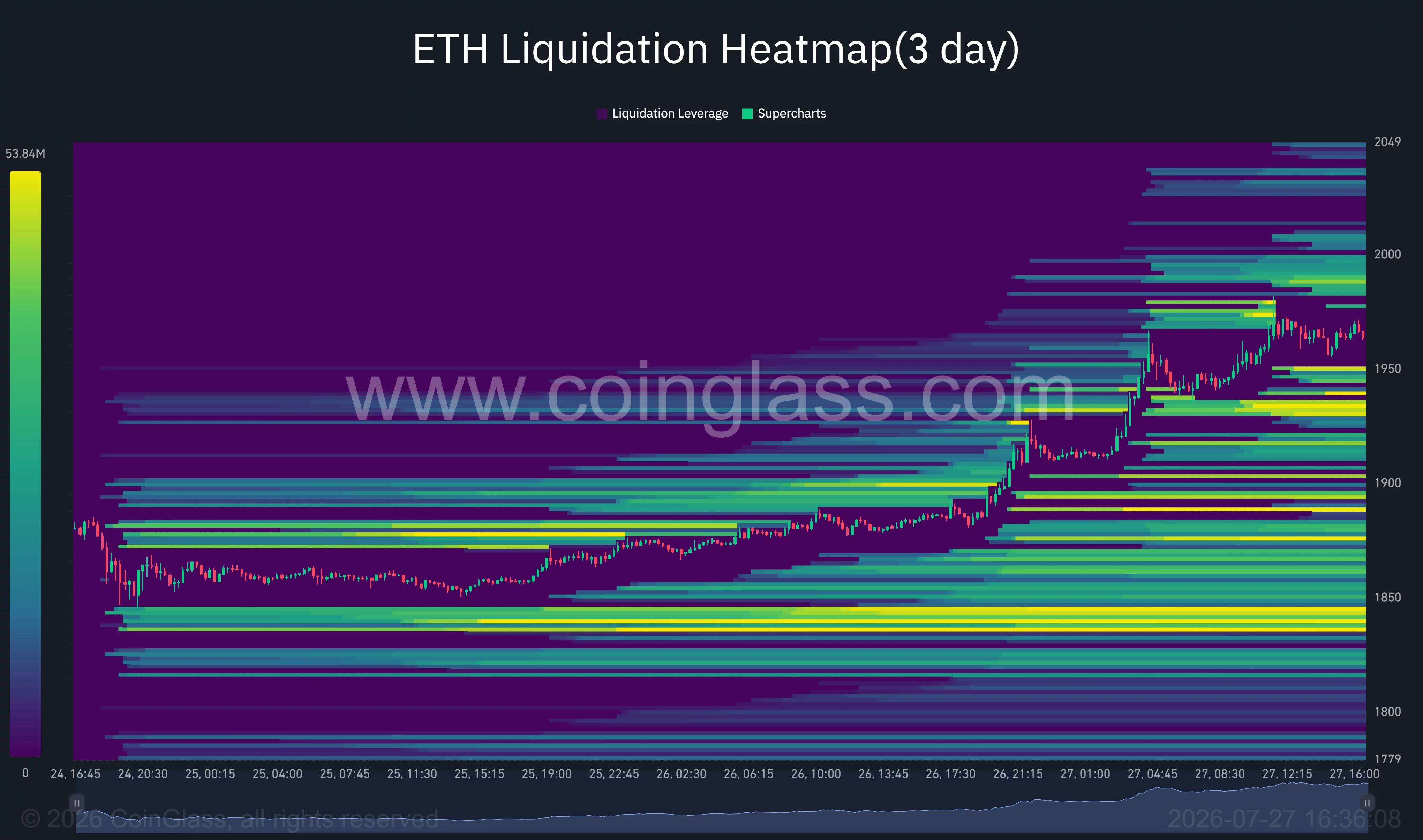
A move into those levels could force leveraged short positions to close through market purchases. That process may create another short squeeze and help ETH move through resistance, particularly if spot volume remains elevated.
The heatmap also maps downside liquidity around $1,945–$1,930, followed by larger concentrations near $1,900–$1,880. A rejection from $2,000 could attract price toward those areas as leveraged long positions unwind.
The largest lower cluster appears around $1,835–$1,850. That zone aligns with the 4-hour channel floor and gives bulls a major defensive area if ETH loses $1,880. A break below it would expose $1,802, followed by the daily Supertrend near $1,772.
Analysts map $2,350 to $2,500 ETH targets
According to market commentator Michaël van de Poppe, Ethereum may consolidate before beginning another upward leg.
“Matter of time until it runs towards $2,500 (which is the other side of the range).”
Analyst Ted Pillows also pointed to rising spot demand but placed the immediate condition at $2,000.
“If Ethereum manages to break and reclaim $2,000 here, it could rally to May highs.”
Pillows’ chart places intermediate resistance near $2,191 and a larger supply zone around $2,350–$2,400. These targets remain conditional on ETH closing above $2,000 and holding that level during a retest.
Failure to reclaim $2,000 would favor short-term consolidation toward $1,930 or $1,881. The bullish structure remains intact above the ascending channel floor, while a decisive loss of $1,850 would weaken the current recovery thesis.
Disclosure: This article does not represent investment advice. The content and materials featured on this page are for educational purposes only.


Jim Cramer says Washington will not let Nvidia lose the artificial intelligence race to China. He frames the US government as a quiet backstop behind the chipmaker’s biggest bets.
Commerce Secretary Howard Lutnick controls power access to a federal site in Ohio. Nvidia is negotiating a $250 billion guarantee there for OpenAI, tying the chipmaker to a government decision.
Nvidia’s Backstop Meets Washington’s Power Switch
Nvidia is in talks to guarantee roughly $250 billion in financing for OpenAI’s lease, the Wall Street Journal reported. The deal covers a 10-gigawatt data center campus in Piketon, Ohio.
The site sits on decommissioned federal land. The full project, including chips, could exceed $500 billion.
Electricity for the campus flows from a natural gas plant that Japan is funding with a $33 billion investment. That investment is part of a recent US trade deal.
Lutnick decides which company gets access to that power. OpenAI, Anthropic, Microsoft, and Google have all approached him about the site.
Washington in Deep with Nvidia, Says Cramer
On Monday night’s episode of “Mad Money,” Cramer linked Nvidia’s financial strength to Washington’s stake in the outcome.
“They have the best balance sheet of any company in the world,” Cramer said. He added that the government is a “subtle backstop” so China does not win the AI race.
Nvidia’s cash and a government hand on the power switch make a powerful combination. That combination helps explain why Cramer still calls Nvidia a stock to own even as shares slide.
Not everyone agrees the setup is healthy. Investor Michael Burry has called the arrangement circular.
He argues Nvidia’s guarantees would fund OpenAI’s purchases of Nvidia’s own chips. Nvidia is discussing that separate chip financing package, which could reach $350 billion. OpenAI also lacks its own investment-grade credit rating, a gap that already caused other financing troubles this year.
The bigger question is what happens if Washington’s role in AI infrastructure becomes the industry’s financing template. That role already includes Jensen Huang’s open-model push and Nvidia’s new security alliance.
The post Jim Cramer Says the US Government Is Nvidia’s Silent Backstop appeared first on BeInCrypto.


Disclosure: This article does not represent investment advice. The content and materials featured on this page are for educational purposes only.
As economic pressures rise, XRPPower is drawing attention with AI-powered digital asset services and questions about its platform model.
Summary
- XRPPower gains attention as investors explore AI-powered digital asset services amid rising economic uncertainty and market volatility.
- The platform highlights its AI-driven digital asset platform as users seek new income opportunities in the evolving fintech landscape.
- It has expanded its digital asset services, promoting automated solutions as financial uncertainty drives demand for alternative income tools.
The ever-changing global situation and economic and financial market uncertainties are impacting the lives of more and more ordinary people. Rising prices, increased living costs, and financial market volatility have made “how to protect one’s income and savings” a pressing issue for many families.
For salaried workers, monthly salaries may increasingly struggle to cover rising living expenses; for ordinary businesses, operating costs and market changes bring new pressures; and for retirees, how to better utilize their accumulated savings to cope with future living expenses is also a real problem.
When existing income cannot meet expenses, some people choose credit cards, loans, or other borrowing methods to alleviate short-term financial pressure. However, borrowed money must eventually be repaid, and interest and debt may further increase long-term burdens. Therefore, finding additional sources of income besides wages is becoming a growing concern.
Entering 2026, with the rapid development of artificial intelligence and fintech, various automated digital asset services are also gaining attention. Against this backdrop, XRPPower has come into the public eye, proposing to provide 365-day-a-year digital asset services through an intelligent system.
However, for those hearing the name for the first time, the most important question might not be the number of features it advertises, but rather: What kind of platform is XRPPower? Does it actually exist? And can its described services and revenue model withstand scrutiny?
Yes, XRPPower is a genuine platform that offers long-term returns
According to publicly available information from XRPPower, it has been operating since 2023 and will continue to grow until 2026, entering its third year of operation. For a digital asset platform, long-term stable operation is sufficient proof of its reliability.
Meanwhile, XRPPower-related content has also been disseminated through multiple international internet and financial information channels, including GlobeNewswire, Yahoo, and The Globe and Mail. Users can search for the XRPPower name to find past press releases, company updates, and related information, gaining a deeper understanding of the platform’s true development trajectory from publicly available records at different times.
How to Get Started with XRPPower
1. Free Account Registration
2. Choose a suitable contract
The platform offers contract options ranging from $100 to $100,000, allowing users to choose flexibly according to their needs. Before purchasing, they can view the corresponding period, yield rules, and related terms.
3. Deposits and withdrawals
XRPPower supports deposits and withdrawals in major cryptocurrencies such as BTC, XRP, and USDC. Users can choose based on the supported currencies.
4. Daily contract earnings check
During contract execution, earnings generated according to the corresponding product rules will be automatically credited to an account balance, which can then be withdrawn.
5. Earn rewards by inviting friends
Users can share their invitation codes or links. After friends register and meet the corresponding conditions, you can receive referral rewards; according to the platform’s published plan, some referral rewards can reach up to 5%. Transparency, Intelligence, and Security: How Does XRPPower Lower the Barrier to Entry for Users?
Why are more and more people choosing XRPPower?
According to publicly available information, XRPPower is headquartered in London, UK, and prioritizes compliance with relevant laws, regulations, and requirements during its operations. Regarding contract issues, which are of great concern to users, the platform emphasizes transparency: the period, amount, profit rules, and related conditions of different yield contracts are displayed before purchase, allowing users to understand the rules before deciding whether to participate.
In terms of user experience, XRPPower applies an intelligent AI system to the platform. Whether a new user or an existing user, there is no need for frequent operations or long-term monitoring. After a user selects and purchases a contract, the system automatically runs according to the corresponding rules, making digital asset management simpler.
Regarding security and risk management, XRPPower states that it implements the auditing, risk management, and internal control concepts adopted by international professional institutions such as PwC, and enhances the platform’s protection capabilities through multi-layered account and fund security mechanisms.
Summary: Opportunities come from understanding and choice
Since 2023, XRPPower has reported over 3 million registered users. After three years of development, the platform has continuously improved its intelligent system, contract mechanisms, and digital asset services, providing global users with a simpler and more transparent way to participate.
For those seeking additional income opportunities, the first step is not blind investment, but understanding. Register NOW for XRPPower for free to view the platform’s contract rules, profit mechanisms, deposit and withdrawal processes, and related risks, and then decide whether to participate based on personal circumstances.
In today’s world of rising living costs and a constantly changing financial environment, more choices mean more possibilities.
Choice is sometimes more important than effort, and opportunities often favor those who are willing to learn in advance and prepare.
For more information, visit the official website.
Disclosure: This content is provided by a third party. Neither crypto.news nor the author of this article endorses any product mentioned on this page. Users should conduct their own research before taking any action related to the company.

Bitmine Immersion Technologies reported that it added nearly 10,000 Ether (ETH) over the past week, lifting its total ETH holdings to 5.79 million. The company disclosed the purchases in an update released Monday, with Ether now forming a substantial part of its overall treasury.
According to Bitmine, it holds 5.79 million ETH, representing about 4.8% of Ether’s total supply. Roughly 4.9 million ETH—about 85% of its position—is staked via the company’s validator operations, and Bitmine projected annualized staking rewards of around $299 million once all of its Ether is deployed across its staking infrastructure and partner validators. The company also said its total crypto assets, cash, and marketable securities total $11.8 billion as of July 26.
Key takeaways
- Bitmine Immersion Technologies increased its Ether holdings by nearly 10,000 ETH to 5.79 million.
- About 85% of Bitmine’s Ether position is staked through its validator operations.
- Bitmine projects annualized staking rewards of approximately $299 million once its full stake is deployed.
- The buys follow a week in which Ether outperformed Bitcoin, supporting a stronger ETH/BTC ratio.
- Bitmine’s accumulation approach appears to be diverging from Strategy, which has paused Bitcoin purchases in recent weeks.
Bitmine’s Ether treasury grows, with most coins staked
Bitmine’s latest disclosure centers on the continued expansion of its corporate Ether treasury. The company said it now holds 5.79 million ETH after purchasing nearly 10,000 ETH during the previous week.
Staking is a central part of that story. Bitmine stated that about 4.9 million ETH—around 85% of its holdings—are staked through its validator operations. In addition to describing its current staking footprint, the company gave an outlook for when its entire Ether balance will be placed across its staking infrastructure and partner validators. Bitmine projected annualized staking rewards of roughly $299 million once that process is complete.
From an investor perspective, the staking-heavy structure matters because it changes how treasury value may be expressed over time. Instead of relying solely on spot appreciation, Bitmine is explicitly tying a large portion of its ETH exposure to ongoing network rewards.
Why the timing looks strategic as ETH leads BTC
Bitmine’s purchases arrive during a period when Ether has been comparatively stronger against Bitcoin. According to CoinGecko data, ETH gained about 2.4% over the past seven days, while Bitcoin fell roughly 0.7% in the same timeframe.
In Monday’s announcement, Bitmine Chairman Tom Lee pointed to the rising ETH/BTC ratio as a signal. He characterized the ratio as being at a three-month high and said it indicated strengthening momentum for Ether.
Even if the immediate magnitude of daily price moves remains difficult to forecast, corporate buying decisions often reflect a broader view of relative positioning—particularly for firms seeking to build a dominant share of a given asset exposure. In this case, Bitmine’s continued accumulation coincides with a week where Ether has outpaced Bitcoin, reinforcing the narrative that its ETH thesis may be gaining traction across the market.
Bitmine vs. Strategy: accumulation strategies diverge
Bitmine has positioned itself as one of the most active corporate ETH treasuries. The company said it has built the world’s largest corporate Ether treasury and noted that it trails only Strategy among public companies by the value of its digital asset holdings.
However, the update also highlights a divergence from Strategy’s more recent approach. Bitmine’s accumulation strategy has recently differed from Strategy’s, which has paused Bitcoin purchases in recent weeks.
Earlier this month, Strategy announced it had raised $544.5 million through stock sales, repurchased $25 million of its STRC preferred shares, and increased its US dollar reserve to $3.75 billion, while maintaining holdings of 843,775 BTC.
That contrast matters because it underscores that “treasury strategy” is not uniform across the sector. While Bitmine appears to be leaning further into ETH accumulation and staking deployment, Strategy’s recent communications suggest a shift toward capital and reserve management around its BTC exposure. For observers, the key question is whether Strategy’s pause reflects timing, liquidity needs, or a longer-term recalibration of how it wants to allocate capital.
Total treasury size and staking deployment remain what to watch
Beyond the ETH purchase itself, Bitmine provided a snapshot of its broader balance sheet. The company said its crypto holdings, cash, and marketable securities total $11.8 billion as of July 26. This figure may help explain how firms sustain large, ongoing purchases without disrupting other liquidity priorities.
Looking ahead, two items are likely to draw attention. First, Bitmine’s projection of annualized staking rewards depends on full deployment of its Ether across its staking infrastructure and partner validators. Second, market participants will watch whether Bitmine continues adding ETH after this week’s purchases—especially given the near-term strength in ETH relative to Bitcoin and Bitmine’s interpretation of that movement via the ETH/BTC ratio.
For now, Bitmine’s disclosures reinforce that corporate Ether treasuries are increasingly paired with staking operations, turning holdings into a long-running revenue mechanism rather than a purely directional bet. The next signals to monitor are the pace of further ETH acquisitions and the timing of complete staking deployment relative to the company’s stated plan.
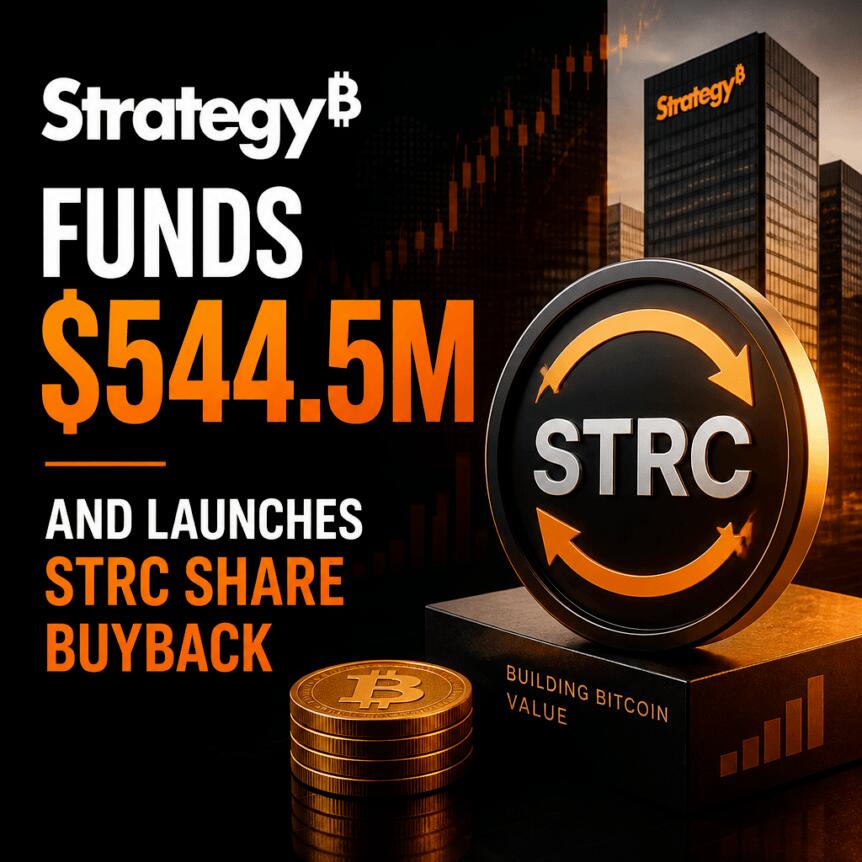
Strategy, the business intelligence firm best known for holding one of the largest corporate Bitcoin treasuries, continued reshaping its capital structure last week by combining common stock sales with buybacks of its preferred shares.
According to company disclosures, Strategy sold 5,429,160 shares of its Class A common stock through its at-the-market (ATM) program between July 20 and July 26, bringing in $544.5 million in net proceeds. In parallel, it repurchased 288,930 shares of its STRC preferred stock for $25 million, as detailed in a Form 8-K filed with the U.S. Securities and Exchange Commission on Monday.
Key takeaways
- Strategy raised $544.5 million in net proceeds via its July 20–26 ATM common stock sales.
- In the same period, the company repurchased $25 million worth of its STRC preferred stock through buybacks.
- Despite the capital activity, Strategy reported no Bitcoin buys or sales for July 20–26, keeping holdings steady at 843,775 BTC.
- Strategy’s U.S. dollar reserve increased to $3.75 billion as of July 26, up from $3.225 billion the previous week.
- Recent remarks by Michael Saylor on X fueled speculation about Strategy’s preferred-stock strategy, though the filings show only what the company actually executed.
ATM stock sales and preferred buybacks
Strategy’s latest capital moves were carried out through both of the mechanisms it has relied on to fund its broader financial strategy. First, the company used its at-the-market offering program to sell additional shares. The reported sale volume—5,429,160 shares of Class A common stock—translated into $544.5 million in net proceeds over the July 20–July 26 window.
Separately, Strategy used preferred share repurchases to alter its balance-sheet composition. The company repurchased 288,930 shares of STRC preferred stock for $25 million, according to the Form 8-K filed Monday.
Market reaction followed the news as traders digested the mix of issuance and repurchases. Yahoo Finance data referenced by the original reporting indicated STRC preferred shares were up about 2.3% to $88.90 ahead of the Nasdaq open, while Strategy’s common shares were also higher in Monday’s premarket activity.
Why the cash reserve matters for Strategy’s structure
Following additional fundraising through its ATM program, Strategy increased its U.S. dollar reserve to $3.75 billion as of July 26. The company’s prior reserve level was $3.225 billion the week before, meaning the latest funding cycle added roughly half a billion dollars to the cash buffer over a short period.
Just as important for investors is that Strategy reported no Bitcoin purchases or sales during July 20–26. Its Bitcoin holdings remained unchanged at 843,775 BTC, acquired at an average purchase price of $75,476 per bitcoin, for $63.69 billion in aggregate. In other words, the week’s financing activity appears to have been directed toward liquidity and capital structure rather than changing the size of the treasury.
Strategy’s growing cash reserve reflects an operational need that goes beyond flexibility in market conditions. The reserve is intended to support dividend payments on its preferred stock and interest payments on its outstanding debt—requirements that make near-term liquidity particularly relevant for a company balancing treasury strategy with obligations across its capital stack.
Saylor’s posts reignite debate on Bitcoin and banks
These financial filings arrived in the wake of renewed debate sparked by Strategy executive chairman Michael Saylor on X. Earlier in the week, Saylor’s comments pushed the same discussion back to the forefront: whether Bitcoin’s long-term growth depends on integration with traditional financial institutions.
On Sunday, Saylor wrote that rejecting Bitcoin’s links to financial infrastructure would deny access to most potential users. The argument drew criticism from some Bitcoin supporters, who argue that greater reliance on banks runs counter to Bitcoin’s original goal as a peer-to-peer electronic cash system designed to minimize the need for financial intermediaries.
Supporters and critics both claim alignment with Bitcoin’s fundamentals, but they emphasize different layers of adoption. For those skeptical of bank involvement, the concern is that mainstream routing through established institutions could undermine the network’s decentralized promise. For those taking Saylor’s position, the focus is on distribution—how institutions can act as conduits for broader user access.
The renewed discussion also followed an earlier Saylor post in which he wrote, “We’re gonna need another color,” prompting speculation among market observers about possible adjustments to Strategy’s preferred stock approach. While the speculation highlighted investor attention to Strategy’s preferred instrument strategy, the week’s documented actions remain tied to the specific transactions reported in regulatory filings.
What to watch next
With Strategy maintaining a steady Bitcoin position during the July 20–26 window while simultaneously building cash reserves and adjusting preferred shares, the next signals to monitor are whether future filings show additional preferred share changes, further increases in the dollar reserve, or a shift back toward Bitcoin purchases. The balance between financing activity and treasury execution is likely to remain the key question for investors tracking how Strategy translates capital markets access into long-term Bitcoin exposure.

Disclosure: This article does not represent investment advice. The content and materials featured on this page are for educational purposes only.
Crypto token discovery is becoming more fragmented as projects adopt multi-platform visibility strategies across DEX screeners, wallets, explorers, and trading terminals.
Summary
- Token teams are turning to PandaBoost as crypto discovery becomes more fragmented across DEX screeners, wallets, and trading terminals.
- As web3 token discovery spreads across multiple platforms, PandaBoost offers coordinated visibility campaigns for crypto projects.
- Crypto projects are exploring new visibility strategies as PandaBoost helps connect tokens with traders across major discovery platforms.

Crypto token discovery no longer happens on a single chart. As traders move between DEX screeners, wallets, explorers and execution terminals, token teams need a coordinated visibility strategy built around real market activity and platform-specific requirements.
A token launch can be technically successful and still remain almost invisible. Creating a pool and enabling trading puts an asset on-chain, but it does not guarantee that traders will encounter it while browsing the tools they already use.
That discovery layer is becoming increasingly fragmented. A trader might notice a pair on DEX Screener, research it through DEXTools or GeckoTerminal, encounter it in Phantom, verify activity on an explorer, and then execute through a terminal such as Axiom, Padre or GMGN. For token teams, visibility is therefore no longer a single-platform task.
Discovery now happens at several layers
DEX screeners remain an important entry point because they organize large numbers of live pairs around activity, liquidity and attention. Yet screeners are only one part of the journey. Wallets have added token discovery surfaces, explorers highlight assets and activity, and trading terminals increasingly shape what active market participants see during fast-moving sessions.
The platforms do not all rank assets in the same way. DEX Screener’s official Trending documentation, for example, groups its signals into market activity, community engagement, and trust and credibility. It identifies factors such as volume, liquidity, transactions, unique makers, holders, page visitors, reactions and verified token information. The exact formula and thresholds are not public, and rankings remain competitive as market conditions change.
Phantom also gives users a dedicated way to explore trending tokens, while GeckoTerminal helps users identify pools gaining attention through on-chain activity and visits. These interfaces serve different moments in the research process, which means a campaign designed for one surface cannot simply be assumed to work on another.
Visibility signals are platform-specific
The common mistake is to treat trending as a switch. In reality, discovery systems observe a mix of conditions, and a token that is not ready can lose visibility as quickly as it gains it.
Before starting a campaign, teams should confirm the correct contract, chain, exchange and liquidity pool. Token information should be complete, and the selected pair should have enough liquidity and genuine market activity to remain usable. Community announcements should point traders to the same intended pair rather than dividing attention among several pools.
Timing also matters. A visibility push is easier to understand when it is connected to a real event such as a launch, product update, exchange expansion or active community campaign. Random activity without a clear reason for traders to investigate the token may produce impressions but little meaningful follow-through.
This distinction is important: visibility describes exposure on a discovery surface. It does not guarantee buyers, price appreciation or investment returns.
PandaBoost brings campaign workflows together
PandaBoost is a crypto visibility platform for token launchers, marketing teams and agencies. It provides platform-specific campaigns across DEX screeners, wallets, explorers and trading terminals rather than treating token discovery as a single generic placement.
Its current service lineup includes DEX Screener Trending, DEXTools Trending, GeckoTerminal Trending, Phantom Trending and Phantom Chat Trending, Solscan Trending, RugCheck Most Viewed, InsightX Trending, and Terminal Trending for Axiom, Padre and GMGN.
The value of this model is coordination. A team can choose the discovery surfaces that match its audience while keeping the campaign tied to one verified token and pair. That is more practical than assuming every trader begins research on the same website.
For teams focused specifically on DEX Screener, PandaBoost also publishes a detailed guide to DEX Screener Trending campaigns, including the platform’s disclosed ranking signals, campaign preparation, and live-position limitations.
New users can test one part of the workflow before placing a paid order: PandaBoost currently provides 20 free DEX Screener reactions for the correct token pair, with no card or wallet connection required. The test is designed to demonstrate reaction delivery; it is not a promise that a token will reach a particular trending position.
Try it first: Claim 20 free DEX Screener reactions for a token pair.
Visibility is not a substitute for market quality
No visibility service can repair a token that is not ready for public attention. Traders can still inspect liquidity, trading history, holder distribution, token information and security context. Sending more people to an incomplete profile or unstable market may expose weaknesses rather than build confidence.
A practical campaign therefore begins before the order itself. The team should verify the pool, update public information, check whether current metrics satisfy the selected platform’s requirements and choose a time when the community can support the announcement. During delivery, the same metrics need to be monitored because third-party rankings remain live.
Token teams should also separate campaign reporting from market performance. Useful visibility measurements can include placement range, duration, profile visits and engagement with the intended pair. Price action, trading decisions and conversion outcomes should be evaluated separately and without assuming causation.
A practical sequence for token teams
A coordinated visibility plan can follow five steps:
1. Verify the contract, chain, DEX and exact pool to be promoted.
2. Complete the token profile and review liquidity, volume and other eligibility conditions.
3. Identify where the target audience discovers and trades tokens.
4. Connect the campaign to a real launch event, update or community push.
5. Monitor visibility and market conditions separately throughout the campaign.
The broader shift is clear: token discovery has become multi-platform. DEX screeners still matter, but wallets, explorers and trading terminals now influence how traders move from first exposure to deeper research. Teams that plan around this fragmented journey can build more coherent campaigns while keeping expectations grounded in what visibility can — and cannot — deliver.
Disclosure: This content is provided by a third party. Neither crypto.news nor the author of this article endorses any product mentioned on this page. Users should conduct their own research before taking any action related to the company.


Strategy increased its U.S. dollar reserve by $525 million to $3.75 billion while keeping its Bitcoin holdings unchanged at 843,775 BTC.
Summary
- Strategy raised its cash reserve to $3.75 billion while keeping Bitcoin holdings unchanged at 843,775.
- Common stock sales generated $544.5 million, extending preferred dividend coverage to roughly 2.1 years overall.
- Strategy repurchased $25 million of STRC shares and made no Bitcoin purchases during the week.
The company said the cash balance now provides 2.1 years of coverage for preferred stock dividends. The calculation reflects Strategy’s own reserve policy and does not guarantee payments under all market conditions.
The July 27 disclosure also showed that Strategy made no Bitcoin purchases between July 20 and July 26. Its Bitcoin reserve carries a purchase cost of $63.69 billion, including fees and expenses, at an average price of $75,476 per coin.
Common stock sales fund the larger cash reserve
Strategy sold 5,429,160 shares of MSTR common stock through its at-the-market programme during the week. Those sales produced $544.5 million in net proceeds. The company sold no STRF, STRC, STRK or STRD preferred shares during the reporting period.
The Form 8-K said the $3.75 billion reserve includes expected proceeds from shares that had not settled by July 26. Strategy created the reserve to support preferred dividends and interest on outstanding debt. The company’s headline description of “2.1 years of dividend coverage” therefore represents a management calculation based on current obligations and the stated cash balance.
Strategy still had about $22.98 billion available under its MSTR stock offering programmes after the latest sales. That capacity gives the company another route to raise cash, although future issuance depends on market conditions and would increase the number of common shares outstanding.
Strategy buys back STRC but purchases no Bitcoin
Alongside the stock sales, Strategy repurchased 288,930 STRC preferred shares for $25 million. It retained $975 million of authority under its preferred-stock repurchase programme and another $1 billion under its MSTR common-stock repurchase programme.
The company did not buy back MSTR shares during the week. It also made no repurchases of STRF, STRK or STRD. The STRC transaction shows Strategy using part of its capital plan to support its preferred securities while it builds the dollar reserve used for distributions.
The unchanged Bitcoin balance extends the company’s pause in accumulation. As crypto.news reported on July 13, Strategy raised $466.7 million through MSTR sales during an earlier week while holding the same 843,775 BTC. Its reserve stood at $3 billion at that time. A later update placed the cash balance at $3.225 billion before the latest increase.
Bitcoin holdings remain below their June peak
Strategy’s current Bitcoin total remains 3,588 BTC below the 847,363 coins it held in late June. The company sold those coins for about $216 million between June 29 and July 5 after adopting a framework that allowed selected Bitcoin sales to fund dividends, interest and reserve needs.
As previously reported, the sales marked a change from Strategy’s long-running accumulation model. The company then stopped buying Bitcoin and directed fresh common-stock proceeds toward cash. The latest filing shows no new Bitcoin sale, leaving the reserve unchanged at 843,775 BTC through July 26.
The company still holds the largest disclosed corporate Bitcoin reserve. However, the July update centres on liquidity rather than further accumulation. Strategy’s latest action increased direct cash coverage while reducing the immediate need to sell Bitcoin or raise new funds solely to meet scheduled distributions.
Dividend coverage remains a company estimate
Strategy describes its reserve as money intended to support dividends on preferred stock and interest on debt. At $3.75 billion, the balance equals about 25 months under the company’s current coverage measure. The filing does not lock the cash into a separate legal account or remove the board’s role in approving dividends.
Recent related coverage also examined Strategy’s internal BTC Rating. The company said Bitcoin could fall 11.4% annually for 5.8 years while its model maintained 1.0x coverage of net debt and preferred stock. Strategy created the metric itself and that no independent credit agency assigns it.
JPMorgan previously said building two to three years of cash coverage could ease concerns that Strategy might need to sell Bitcoin to fund preferred dividends. The new 2.1-year figure enters that range, although refinancing costs, dividend-rate changes, share prices and Bitcoin market conditions can alter the calculation.
Strategy has not announced when it will resume Bitcoin purchases. Its July 27 filing instead records a larger cash reserve, a $25 million STRC repurchase and another week without buying or selling BTC. Future weekly disclosures will show whether the company keeps directing stock-sale proceeds toward liquidity or returns to Bitcoin accumulation.


For a year Robinhood was Kalshi’s largest distributor. Then it bought a CFTC-licensed exchange off the shelf, put Susquehanna behind the order book, and began routing its own flow to itself. The World Cup was the proving ground, the migration is under way, and the lesson is the one every platform eventually teaches its suppliers: the license was never the moat.
Summary
- Robinhood and Susquehanna International Group acquired MIAXdx, the CFTC-licensed exchange and clearinghouse formerly known as LedgerX, and rebranded it Rothera, giving the brokerage its own regulated venue for event contracts.
- The migration began quietly: economic-data and baseball contracts in a late-May soft launch, then World Cup markets self-certified on May 27 and live for the tournament’s June 11 opening.
- The routing is deliberately split, with core high-volume markets such as match outcomes, tournament winner, and totals moving to Rothera while player props and parlay-style contracts still route to Kalshi, and the chief financial officer has said most flow is expected to migrate over time.
- The scale behind the shift is the story: Robinhood has processed more than 16 billion event contracts this year against 12 billion in all of 2025, and its event-contract revenue reached $147 million in a single quarter, exceeding its crypto business.
- Two days ago the strategy clarified again: reports place Robinhood in talks with Crypto.com to add that company’s contracts as well, indicating the goal is not one exchange but a shelf of them, with Robinhood owning the customer.
There is a sequence that plays out in every platform business, and the companies on the wrong end of it almost never see it coming, because the early years feel like partnership. A distributor takes a supplier’s product to its customers. The product succeeds. The distributor learns the economics, the operational requirements, and above all the size of the margin flowing past it to someone else. Then the distributor builds or buys the supplier’s function and keeps the margin. Amazon ran it on the merchants who taught it which products sold. Netflix ran it on the studios whose licensing bills it was paying. And this year Robinhood ran it on Kalshi, the prediction-market exchange it spent a year introducing to a hundred million retail accounts. The vehicle is Rothera, a CFTC-licensed derivatives exchange and clearinghouse that Robinhood and Susquehanna International Group acquired and rebranded, and the migration is already visible in the tape: the World Cup’s core markets routed to Rothera in June, the chief financial officer says most flow follows, and analysts report Robinhood customers now account for a shrinking share of Kalshi’s volume. This piece is the anatomy of that sequence, what it says about where value actually sits in prediction markets, and why the newest development, Robinhood reportedly negotiating to add a third party’s contracts alongside its own, is the most revealing detail of all.
What Rothera is, and what it cost to become one
The first fact worth internalizing is how ordinary the hard part turned out to be.
Rothera was not built. It was purchased: MIAXdx, previously known as LedgerX, a derivatives exchange and clearinghouse that already held Commodity Futures Trading Commission registration, acquired in a majority stake by Robinhood alongside Susquehanna International Group and renamed. That single sentence contains the entire strategic insight of this story. The regulated status that Kalshi spent years and a federal lawsuit securing, the designated contract market license and the clearing infrastructure that constitute the legal right to list event contracts in the United States, was available for purchase from an existing holder. Licenses are assets. Assets have prices. And a company with Robinhood’s balance sheet can buy in one transaction what a startup treats as its defining achievement.
The complementary piece was liquidity, and Susquehanna supplied it. One of the world’s largest quantitative trading and market-making firms serves as Rothera’s day-one liquidity provider, with both Susquehanna and Robinhood holding advisory-board seats. New exchanges usually fail at exactly this point, because thin books produce bad fills, bad fills drive traders away, and the absence of traders keeps the books thin. Starting with a top-tier market maker committed to the venue removes the failure mode that kills most new exchanges before their first quarter closes.
So the assembled package is license plus clearing plus institutional liquidity plus, critically, a customer base that already exists inside an app those customers open every day. Rothera’s contracts are also expected to carry lower fees for Robinhood users than third-party alternatives, which is the natural consequence of removing an intermediary’s margin from the chain. Everything a prediction-market exchange needs, in other words, except the years.
The migration, contract by contract
The rollout has been methodical enough to read as a case study, and the sequencing shows a company managing risk, not making a statement.
The first step was the quiet one: Rothera self-certified a baseball outcome event contract in mid-May with an intended listing date on or after May 20, and Robinhood began routing select Major League Baseball and economic-data contracts through it in a late-May soft launch. Small markets, unglamorous categories, minimal customer visibility, exactly where a platform tests new plumbing.
The second step was the World Cup, and the choice of venue was not incidental. Rothera’s tournament contracts were self-certified on May 27, and when the competition opened on June 11 across the United States, Canada, and Mexico, Robinhood routed the core markets, individual match outcomes, tournament winner, spreads, and totals, through its own exchange. A hundred and four matches over a month, with the largest event-contract volumes of the year attached to them, is the most demanding load test available, and Robinhood ran it on the venue it owns.
The third step is the one still under way, and its shape is the most informative part. Robinhood did not cut Kalshi off. Player-specific contracts, parlay-style combinations, and complex tournament props continued to route to Kalshi, with the company saying routing decisions depend on liquidity and resolution clarity per contract type. That is the textbook profile of a migration, not a rupture: keep the partner supplying the long tail that is expensive to build while taking the high-volume core that generates the revenue. Chief Financial Officer Shiv Verma has said publicly that most prediction-market flow is expected to migrate to Rothera over time, which converts the split from an operational nuance into an announced trajectory.
The numbers that made it inevitable
Understanding why Robinhood did this requires only the scale of what it was routing elsewhere.
Robinhood has processed more than 16 billion event contracts this year, against more than 12 billion across all of 2025, growth that made prediction markets one of the company’s fastest-expanding segments. The revenue line tells the same story from the other end: event contracts produced $147 million in a single quarter, exceeding the company’s cryptocurrency transaction revenue in the same period, an internal flippening this publication covered in its earnings analysis. A business generating that much revenue while paying an external exchange for the venue function is, from the platform’s perspective, a margin leak with a countdown attached, and the countdown ends whenever acquiring a license becomes cheaper than continuing to rent one.
Kalshi’s exposure is the mirror image. The exchange grew explosively on the strength of exactly this distribution, with Robinhood’s hundred-million-account retail machine supplying a large tributary of the volume that took Kalshi to roughly $31.5 billion in a single month and a $22 billion valuation. Analysts now report that Robinhood customers represent a shrinking share of that volume, and Kalshi’s own chief executive named Robinhood as one of its largest competitors in June, roughly a year after naming it a partner. Kalshi’s response has been to build directly toward its own users, launching a professional-tier product and expanding into perpetual-style contracts, which is the correct strategic answer, and also an expensive one for a company that until recently had distribution handled.
The asymmetry underneath is worth stating plainly, because it generalizes past this pair. An exchange’s assets are its license, its clearing infrastructure, its liquidity, and its distribution. Three of those four can be bought. The fourth, a customer base that opens your application every day, is the one that takes a decade and a brand, and it is the one Robinhood already had.
The Crypto.com signal: a shelf, not a store
Then, two days ago, the strategy revealed a further layer, and it changes what the whole exercise means.
Reports place Robinhood in talks with Crypto.com to offer that company’s prediction-market contracts inside the Robinhood application, alongside contracts already sourced from Kalshi, Interactive Brokers’ ForecastEx, and Rothera. A company that had just built its own exchange negotiating to carry a competitor’s products looks contradictory only if the goal was to own an exchange. It is entirely coherent if the goal is to own the shelf. Robinhood’s stated position is that it intends to work with multiple exchanges to give customers a broad and resilient marketplace, and read against the Rothera migration, that sentence describes a specific architecture: the platform routes each contract type to whichever venue offers the best economics or the deepest book, including its own, and captures the customer relationship regardless of where any individual trade clears.
That is a materially stronger position than vertical integration alone, and it maps onto the pattern our cluster coverage has been tracing from the other direction. The exchange operators bought their way toward the probability-data layer on the theory that owning the odds beats operating the casino. Robinhood is executing the third possibility neither of them centered: own the customer, and let the venues compete for the flow. In retail brokerage this is simply order routing, a business Robinhood understands intimately and has been litigated over before, and applying it to event contracts turns exchanges into interchangeable suppliers bidding for access to a distribution point they cannot replicate.
Which reframes the competitive question the whole sector is asking. The prediction-market war has been narrated as Kalshi versus Polymarket, regulated versus crypto-native, with a legislative overhang above both. The Rothera sequence suggests a different axis entirely: the venues are competing for volume that a small number of retail distributors control, and those distributors have every incentive to commoditize them. Kalshi’s $22 billion valuation prices continued category leadership. Robinhood’s build prices the possibility that leadership among venues is worth less than ownership of the front door.
The conflict nobody has priced yet
There is a structural problem inside this architecture that the competitive story tends to skip, and it is the one most likely to attract official attention: Robinhood now decides where its customers’ orders go, and it owns one of the destinations.
The company frames routing as an operational judgment based on liquidity and resolution clarity per contract type, which is a reasonable description of how any multi-venue router should work. It is also, precisely, a description of discretion exercised by a party with a financial interest in one outcome. When Robinhood routes a World Cup match contract to Rothera instead of Kalshi, the economics of that decision accrue to Robinhood twice, once as the distributor and once as part-owner of the venue and its clearing, and the customer has no visibility into the comparison that produced the choice. This is not a novel problem. It is the same structure that made payment for order flow the most litigated question in retail brokerage, produced a nine-figure settlement for this same company over disclosure of its routing economics, and remains a standing item on the regulatory agenda for equities and options. Applying the model to a newer product category does not make the question newer.
The mitigating facts are real and worth stating. Event contracts are not equities, best-execution obligations in derivatives markets work differently, and Rothera is a CFTC-regulated designated contract market with a clearinghouse, subject to that agency’s oversight instead of operating in a gray zone. Lower fees for Robinhood users, if they materialize as expected, are a genuine customer benefit that a vertically integrated venue can deliver and an arm’s-length partner cannot. A regulator examining the arrangement would find a licensed exchange, a licensed broker, disclosed common ownership, and a market maker with a public role, which is a considerably cleaner picture than the offshore venues occupying much of this category.
But the incentive asymmetry does not disappear because the entities are licensed, and the category’s regulatory environment makes scrutiny likelier and not less likely. Event contracts already face a bill that would ban sports markets outright, active litigation from a dozen state gaming regulators, and a congressional oversight probe into platform surveillance practices, all of which this publication’s cluster coverage has mapped. A retail platform routing customer orders to its own exchange, in a product category legislators are already inclined to treat as gambling, is a headline waiting for its hearing. The most valuable thing Robinhood could do about it is the thing platforms almost never do voluntarily: publish routing statistics per venue, per contract type, with the fee differential attached. Its absence will be noticed eventually, and the notice will come from somewhere less friendly than a competitor.
What to watch
Kalshi’s volume composition. The single decisive number: what share of Kalshi’s monthly volume originates from Robinhood accounts, and how fast it declines. Kalshi does not break this out, but its total volumes against Robinhood’s contract counts allow a serviceable estimate, and a sharp divergence between the two series would confirm the migration is more than tactical.
Whether the Crypto.com deal closes. Reports note there is no guarantee of an agreement. A signed deal confirms the shelf strategy explicitly; its collapse would suggest Robinhood prefers vertical integration after all, which is a meaningfully different future for every exchange in the category.
Rothera’s fee schedule. Lower fees for Robinhood users were the expected consequence of removing an intermediary. Whether the savings reach customers or stay with the platform is both a competitive variable and, given the company’s history with order-routing economics, a likely subject of eventual regulatory attention.
November’s routing. The midterm elections will produce the category’s largest political volumes ever, and where Robinhood routes those specific contracts, to its own venue, to Kalshi, or split, will be the clearest available statement of how far the migration has progressed under maximum load and maximum scrutiny.
One historical note completes the picture. LedgerX, the entity now trading as Rothera, was itself a landmark: the first federally regulated venue for physically settled crypto derivatives, later absorbed into a bankruptcy estate and sold, then sold again. Its license has now outlived two owners and two business models, and it arrives at its third life as the instrument through which a retail brokerage disintermediates the exchange that taught it the category. That is a fair emblem for where prediction markets sit in 2026: the regulatory permission that once looked like the industry’s scarcest asset has become a durable, transferable good, changing hands between owners with entirely different plans for it, while the genuinely scarce thing, an audience that shows up daily, was never for sale at any price.
Disclaimer: This article is for information and educational purposes only and does not constitute financial or investment advice. It describes commercial arrangements and reported negotiations that may change or fail to conclude, and figures reflect company statements and third-party reporting available at the time of writing. Nothing here is a recommendation regarding any company or contract. Always do your own research. Information is accurate as of July 26, 2026.
Frequently Asked Questions
What is Rothera?
A CFTC-licensed derivatives exchange and clearinghouse majority-owned by Robinhood and Susquehanna International Group. It was formerly MIAXdx, and before that LedgerX, and was acquired and rebranded instead of built from scratch, giving Robinhood its own regulated venue for listing and clearing event contracts. Susquehanna serves as its day-one liquidity provider, and both firms hold advisory-board seats.
Is Robinhood leaving Kalshi?
Not entirely, and the split is deliberate. Core high-volume markets such as World Cup match outcomes, tournament winner, and totals moved to Rothera, while player-specific contracts, parlays, and complex props continued routing to Kalshi. Robinhood says routing depends on liquidity and resolution clarity per contract type, and its chief financial officer has said most flow is expected to migrate to Rothera over time.
Why does this matter for Kalshi?
Because Robinhood supplied a substantial share of the retail volume behind Kalshi’s growth to roughly $31.5 billion in monthly volume and a $22 billion valuation, and analysts report that share is now shrinking. Kalshi has responded by building toward its own users with a professional-tier product and perpetual-style contracts, and its chief executive named Robinhood among its largest competitors in June.
How big is Robinhood’s prediction-market business?
Large and growing fast: more than 16 billion event contracts processed this year against more than 12 billion in all of 2025, with event-contract revenue reaching $147 million in a single quarter, exceeding the company’s cryptocurrency transaction revenue in that period. That scale is what made owning the venue function economically compelling.
Why is Robinhood talking to Crypto.com if it has its own exchange?
Because the objective appears to be owning the distribution shelf rather than a single venue. Robinhood already sources contracts from Kalshi, ForecastEx, and Rothera, and adding Crypto.com would extend a multi-venue model in which the platform routes each contract type to the best available venue, including its own, while retaining the customer relationship regardless of where trades clear.
Was the CFTC license hard to get?
Harder to earn than to buy, which is the point. Kalshi secured its regulated status through years of process and litigation, but Robinhood obtained equivalent standing by acquiring a company that already held it. Licenses are transferable assets, so regulatory status functions as a purchasable input rather than a durable competitive moat.
What does this mean for prediction-market competition overall?
It suggests the decisive contest may be for distribution rather than for venue leadership. If a small number of retail platforms control most order flow and can source contracts from multiple exchanges, venues become interchangeable suppliers competing on fees and liquidity, which compresses their economics regardless of how large the category grows.
What should observers watch next?
Kalshi’s volume trajectory relative to Robinhood’s contract counts, whether the Crypto.com agreement is signed, Rothera’s fee schedule and whether savings reach customers, and where Robinhood routes November’s election contracts, the largest political volumes the category has ever handled. This is educational analysis, not investment advice.


Cointelegraph is committed to providing independent, high-quality journalism across the crypto, blockchain, AI, and fintech industries.
All news, reviews, and analyses are produced with full journalistic independence and integrity. For more details on our standards and processes, please read our Editorial Policy.
Disclosure: This article does not represent investment advice. The content and materials featured on this page are for educational purposes only.
Cloud mining platforms like LONG DeFi are promoting simplified crypto mining by removing hardware and technical barriers for everyday participants.
Summary
- LONG DeFi has expanded its AI-powered cloud mining platform, highlighting accessible crypto mining without hardware requirements.
- The platform’s cloud mining platform features AI optimization, security features, and simplified access for investors.
- It highlights its cloud mining infrastructure, focusing on user-friendly access, transparency, and passive income tools.
Still hesitant about mining due to the expensive equipment, specialized skills, and time commitment required? LONG DeFi completely breaks down all barriers – no need to build a personal mining farm, no need to master complex operations, and no geographical restrictions. Leveraging globally leading cloud computing infrastructure, it allows ordinary investors to participate in cryptocurrency mining with peace of mind and reap stable, ideal returns.
LONG DeFi is increasingly becoming a recognized and stable source of passive income, and a top choice for global investors. Its core advantages are as follows: User-friendly interface: The operation panel is intuitive and clear, all functions are readily apparent, and querying and managing assets is easy and convenient.
Significant profit potential: By optimizing mining strategies, we help users maximize their return on investment.
Safe, transparent and reliable: We adopt industry-leading security mechanisms to ensure asset security. Every transaction record is clear, verifiable and traceable.
How to start LONG DeFi Mining
Step 1: Register on the LONG DeFi Platform
Please visit the official LONG DeFi website and complete the simple account opening process:
Register Account: Fill in personal information to create an account.
Complete Verification: Pass identity verification to ensure account compliance and fund security.
Link Wallet: Connect a secure encrypted wallet for subsequent fund transfers and yield settlement.
Step 2: Choose a mining plan
Te platform offers flexible mining plans to suit different capital sizes and experience levels:
Beginner Plan: Suitable for beginners or users who wish to start with a small amount of capital.
Advanced Plan: For experienced users seeking higher returns.
Customized Plan: Tailor-made configurations for large investors.
For example:
Beginner: BTC [Intelligent Computing] $100 | Term: 2 days | Daily Profit: $4 | Total Profit: $100 + $8
DOGE [Digital Intelligent System]: $500 | Term: 5 days | Daily Profit: $6.25 | Total Profit: $500 + $31.25
BTC [Supercomputing System] $1000 | Term: 10 days | Daily Profit: $13.1 | Total Profit: $1000 + $131
DOGE [Computing Engine System] $5000 | Term: 25 days | Daily Profit: $72 | Total Profit: $5000 + $1800
BTC [Algorithm-Driven System] $10000 | Term: 30 days | Daily Profit: $158 | Total Profit: $10000 + $4830
Step 3: Deposit startup capital
Supports multiple payment methods and flexible deposits:
Cryptocurrency Transfers: Supports BTC, USDT, ETH, LTC, USDC, XRP, and BCH, among other mainstream cryptocurrencies.
Step 4: View and manage earnings
View mining earnings and operational status in real time on the platform panel. Users can withdraw their earnings at any time or reinvest them to further increase returns through compound interest.
Is LONG DeFi legal and compliant?
Yes, LONG DeFi operates in strict accordance with regulatory requirements in various regions, possessing complete compliance qualifications and a long-term stable service record.
Which cryptocurrencies does it support mining?
Currently supports mainstream digital assets such as Bitcoin, Ethereum, and Litecoin.
How long does it take to withdraw earnings?
Withdrawal requests are processed efficiently, typically arriving within 24 hours, ensuring funds’ liquidity.
Are there referral rewards?
Do I earn money by inviting friends to join?
Yes, the platform has a referral program; users can earn up to 5% by successfully inviting friends to register and use the platform.
Conclusion
LONG DeFi provides global investors with a reliable, low-barrier-to-entry path to participate in cryptocurrency mining and generate passive income. With its user-friendly product experience, robust yield potential, and commitment to compliance and sustainable operation, LONG DeFi is poised to continue leading the industry in 2026 and beyond.
Download the app now, register with one click, and easily start the passive income journey.
Disclosure: This content is provided by a third party. Neither crypto.news nor the author of this article endorses any product mentioned on this page. Users should conduct their own research before taking any action related to the company.

Bragging About $100k: Why It’s Not Enough! #finance #motivation #success #money #inspiration

Carly Simon Reveals Parkinson’s Disease And Skin Cancer Diagnoses

Global Market Today: Asian stocks fall on AI jitters, oil extends drop


-

 Fashion3 days ago
Weekend Open Thread: Brooks Brothers
-

 Crypto World7 days ago
Grayscale Files For Worldcoin ETF, WLD Registers Sharp Rise
-

 NewsBeat6 days ago
How a former Blue Peter presenter stunned America’s Got Talent judges
-

 Tech1 day ago
Intel is reversing course and bringing hyper-threading back to its server chips
-
 Tech7 days ago
Turtle Beach Command Series KB7 review: a nifty screen-equipped gaming keyboard
-
 Business6 days ago
New Jersey voter registration controversy explained: How 6,600 noncitizens got on the rolls, and what happens next
-
 Entertainment6 days ago
Johnny Depp’s R-Rated Gothic Cult Classic Gets New Release Ahead of Sydney Sweeney Remake
-

 Crypto World5 days ago
Ethics, other provisions in crypto Clarity Act to be further discussed
-

 Politics15 hours ago
Luke Littler dismantles Gerwyn Price to retain title in Blackpool
-
 NewsBeat7 days ago
Shanghai science forum photos show China’s AI and robotics advances in rivalry with US
-

 Sports4 days ago
2026 3M Open leaderboard: Scottie Scheffler finds putter in Round 1, sits three back
-
 Sports1 day ago
Commonwealth Games boxing: Jadumani Singh seals dominant 5-0 win over Pakistan’s Sumama Rehman to enter quarter-finals | Commonwealth Games News
-

 Fashion4 days ago
16 Dresses for the High Summer Event
-

 News Videos4 days ago
The Peugeot Family: How 200 Years of an “Old Money” Dynasty Died in A Boardroom
-

 Politics2 days ago
Spain sweeps the board at 2026 World Cup with individual awards
-
 Entertainment3 days ago
A New Post-Apocalyptic Gundam Anime Series Blasts Into SDCC
-

 Crypto World7 days ago
Andrew Cuomo joins OKX board as crypto exchange expands in U.S.
-

 News Videos1 day ago
BITCOIN JUST ENTERED THIS CRITICAL ZONE…
-

 Crypto World2 days ago
XRP Ledger adds $2.6B as RWA inflows rank second
-
 NewsBeat7 days ago
NADINE DORRIES: I have witnessed first-hand what happens to new Prime Ministers when they enter No 10… and this is why Andy Burnham will be out by May
You must be logged in to post a comment Login