

Crypto World
Japan logistics giant plans JPYC payments for 2,300 partners



Japanese logistics group AZ-COM Maruwa Holdings plans to introduce the yen-backed JPYC stablecoin for payments to about 2,300 partner carriers and independent drivers, according to a Nikkei report cited by Crypto Briefing.
Summary
- AZ-COM Maruwa plans JPYC payments for 2,300 logistics partners in Japan’s first large corporate rollout.
- The logistics group will invest ¥1 billion in JPYC while forming a business partnership directly.
- JPYC is gaining wider use through retail trials, lending projects, and emerging payment infrastructure nationwide.
The move is “expected to become Japan’s first large-scale corporate use of JPYC.”The company also plans to invest ¥1 billion in JPYC and form a business partnership with the stablecoin issuer. The rollout would move JPYC beyond retail tests and crypto services into routine business payments across a large logistics network.
AZ-COM Maruwa brings JPYC into logistics payments
AZ-COM Maruwa Holdings operates third-party logistics, transportation, warehousing and delivery services in Japan. Its planned use of JPYC would cover outsourcing and other payments made to a broad network of transport partners, including individual truck drivers.
The reported ¥1 billion investment also ties the logistics group directly to JPYC’s growth. The companies have not yet disclosed a detailed rollout schedule or explained how each partner will receive, hold or convert the tokens. Those operating details will determine how widely drivers and carriers use JPYC instead of immediately redeeming it for yen.
JPYC began issuing its regulated yen-backed stablecoin on October 27, 2025. The token maintains a one-to-one link with the yen and uses bank deposits and Japanese government bonds as reserve assets. It operates on public blockchain networks and can be issued or redeemed through JPYC EX.
The AZ-COM Maruwa plan follows other attempts to move JPYC into daily payments. As reported by crypto.news, Lawson plans to test JPYC payments at a Tokyo convenience store in August through a point-of-sale system. The trial will let customers pay using a smartphone-linked payment system.
Japan’s stablecoin market adds more use cases
JPYC is also expanding into financial products. As reported by crypto.news, Metaplanet and JPYC recently began studying Bitcoin-backed credit products that could use JPYC for lending and settlement. The project is examining how Bitcoin collateral and yen-denominated stablecoin liquidity could work together. Payment infrastructure is developing at the same time.As reported by crypto.news, LINE NEXT plans to support JPYC through Unifi Pay, a stablecoin payment service scheduled for a wider launch in the third quarter. The service is designed to let users in Japan top up local stablecoins from bank accounts after identity checks.
The logistics rollout would differ from smaller consumer pilots because it involves thousands of businesses and independent drivers receiving payments through the same stablecoin system. If implemented at the reported scale, it would test JPYC’s ability to handle regular corporate settlement rather than isolated retail purchases.
Japan is also tightening rules around stablecoin reserves as adoption grows.Japanese regulators have set conditions for government bonds held as reserve assets. JPYC has said it plans to keep most reserve proceeds in Japanese government bonds and the remainder in bank deposits.
AZ-COM Maruwa’s planned rollout therefore arrives as JPYC moves into retail payments, lending experiments and broader payment infrastructure. The ¥1 billion investment adds a direct corporate commitment, while the proposed payments to 2,300 logistics partners would provide one of the clearest tests yet of whether a regulated yen stablecoin can work in everyday business settlement.

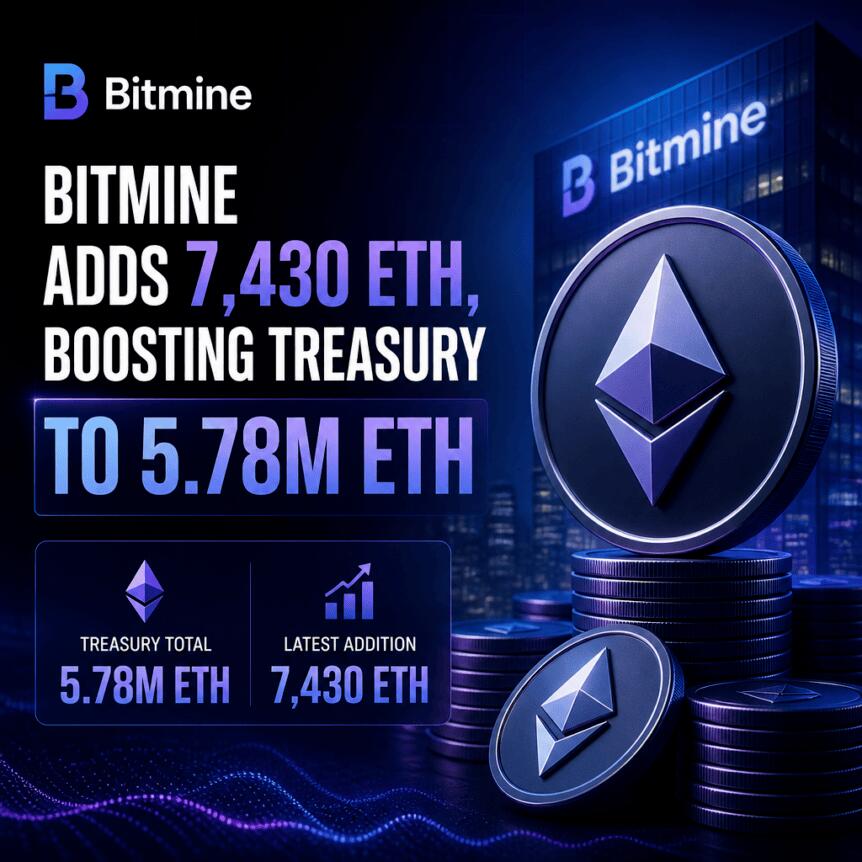
Bitmine, a company focused on managing Ether (ETH) treasury exposure and institutional staking, said Monday that its ETH holdings have reached 5.78 million tokens—about 4.8% of Ethereum’s circulating supply. The company is moving toward its stated objective of accumulating 5% of all ETH.
In its update, Bitmine said it added 7,430 ETH over the previous week. It also reported that roughly 4.9 million ETH—about 85% of its treasury—is currently staked through its validator infrastructure and partners.
Key takeaways
- Bitmine reports 5.78 million ETH in treasury, representing about 4.8% of Ethereum’s circulating supply.
- The company added 7,430 ETH in the past week and is approaching its goal of owning 5% of total ETH.
- About 85% of Bitmine’s ETH holdings are staked, with validators run via its network and partners.
- Bitmine valued its overall crypto and financial assets at $11.5 billion and reported $45.7 million in staking/validation revenue from MAVAN earlier this month.
- Shares rose after the update, while broader market attention also points to Ethereum’s relative performance versus Bitcoin.
Bitmine’s Ether accumulation and staking strategy
Bitmine’s latest disclosure frames its ETH buildup as a long-running corporate treasury strategy tied to staking yield. The company said it ended the week with 5.78 million ETH, an amount equal to approximately 4.8% of Ethereum’s circulating supply.
Crucially for investors assessing how capital is being deployed, Bitmine indicated that staking is already a major component of its operations. About 4.9 million ETH—roughly 85% of the treasury—is staked through its validator network and ecosystem partners. Staking exposure can influence liquidity and risk management, since tokens used for validation are typically subject to protocol and operational constraints compared with fully liquid holdings.
The update also signals how quickly Bitmine is moving toward its own target. With 7,430 ETH added over the past week, the company continues to close the gap to a 5% ownership goal, though the remaining distance depends on how “circulating supply” is defined and how it changes over time.
Balance sheet figures and share buyback activity
Bitmine said it valued its crypto holdings, cash, and marketable securities at $11.5 billion. The company’s reported portfolio includes 207 Bitcoin (BTC), and it listed $385 million in cash and securities.
Alongside its treasury accumulation, Bitmine continued capital returns to shareholders. It repurchased 5.5 million shares during the week under a previously authorized $4 billion buyback program. Such repurchases can affect per-share metrics and may signal management’s view on valuation, but the impact depends on how the market values the business relative to its disclosed asset base and operating revenue.
In trading following Monday’s announcement, Bitmine shares were up more than 6% in afternoon activity, lifting the stock’s one-month performance to around 3.3%.
MAVAN revenue underscores the staking-business angle
Bitmine’s ETH treasury story also intersects with its institutional staking platform, MAVAN. Earlier this month, the company said MAVAN generated $45.7 million in staking and validation revenue during the three-month period ended May 31, according to Bitmine’s prior announcement referenced by Cointelegraph.
That revenue accounted for 98% of Bitmine’s total revenue during the period, underscoring that staking and validation are not simply a treasury feature, but a core driver of the business.
For readers tracking how corporate crypto firms convert holdings into operating income, the MAVAN update provides a benchmark for how much of the company’s performance is tied to staking activities rather than only asset appreciation.
Ethereum outperformance, corporate capital rotation, and the institutional ETH debate
Bitmine’s update landed in a broader market backdrop where Ethereum has been attracting relative momentum. According to CoinGecko data cited at the time of writing, ETH gained about 6.7% over the past seven days and 10% over the past month, compared with roughly 5.8% and 2.6% for Bitcoin over the same windows.
The report also referenced corporate capital developments in Bitcoin markets. Cointelegraph noted that Strategy, described as the largest corporate holder of Bitcoin, paused purchases for a second straight week and instead raised capital through stock sales while increasing its cash reserve to more than $3.2 billion. While that is a separate story from Bitmine’s Ether holdings, it highlights how corporate treasury managers are balancing buying activity with liquidity and capital-market access.
On the Ethereum ecosystem side, attention has also been drawn to efforts aimed at expanding institutional use cases—particularly through scaling and tokenization narratives. Earlier this month, Robinhood launched Robinhood Chain, an Ethereum layer-2 network built on Arbitrum for tokenized stocks. In the first two weeks, the chain reportedly attracted more than $141 million in bridged Ether, reigniting discussion about whether institutional adoption of Ethereum’s scaling networks ultimately increases demand for ETH.
As Cointelegraph reported, Max Shannon, a senior research analyst at Bitwise, characterized Robinhood Chain as reflecting “growth of the Ethereum ecosystem,” especially among traditional finance participants. Other analysts highlighted a more nuanced investment debate. ARK Invest’s Lorenzo Valente argued that Robinhood Chain can support a bullish view of ETH as the ecosystem’s monetary asset, while also weakening the thesis that Ethereum’s value proposition primarily comes from layer-2 fee revenue.
Separately, Bernstein analysts raised their price target for Robinhood to $160 from $130 per share, citing a growth outlook driven by tokenized equities and prediction markets rather than traditional crypto trading. In their framing, Robinhood Chain is part of the brokerage’s infrastructure for tokenized real-world assets, enabling on-chain product development without relying on third-party blockchains.
ETH’s price performance was also noted in the cited coverage: ETH climbed about 20% from roughly $1,582 on July 1 (around the time of the chain’s launch) to about $1,900 at the time of writing. While price movements do not prove causality, they reflect how quickly market attention can shift toward narratives involving tokenization and institutional infrastructure.
What to watch next for Bitmine and Ethereum
For Bitmine, the immediate variables are how steady ETH accumulation remains and how much of its treasury continues to be deployed via staking operations. For Ethereum more broadly, the market will likely continue watching whether tokenized-stock and institutional scaling experiments translate into sustained ETH demand—an outcome that still depends on evolving usage patterns across layer-2 networks.
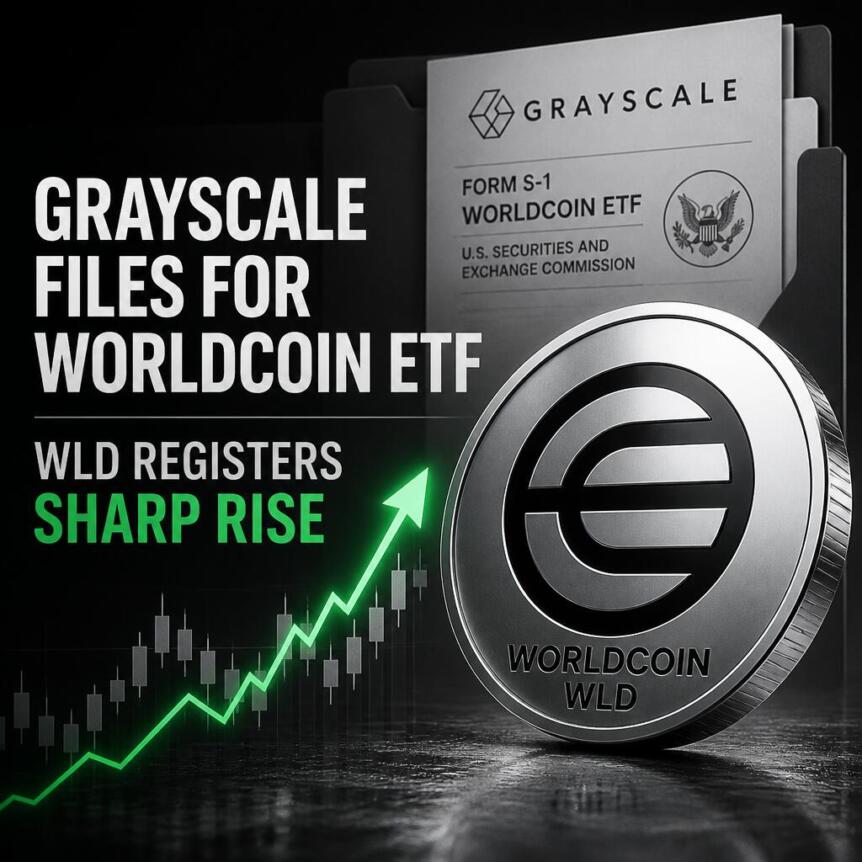
Crypto asset manager Grayscale has filed with the United States Securities and Exchange Commission (SEC) to launch a Worldcoin exchange-traded fund (ETF). The ETF will list on Nasdaq under the ticker GWLD.
The WLD token registered a substantial increase following the filing, rising 4.5% to break above a descending channel on the four-hour chart.
Details Of The Filing
Grayscale filed an S-1 registration statement for the Worldcoin ETF on Monday, offering investors exposure to the WLD token. BitGo Bank & Trust will be responsible for custodying the WLD token, while BNY Mellon will act as the administrator and transfer agent, and the CSC Delaware Trust Company will be a trustee. However, the filing does not disclose liquidity providers, management fees, seed investment, or authorized participants. If approved, GWLD will hold the WLD token as its principal asset. The filing states that the trust will only hold the WLD token and process share creations and redemptions.
ETF Structure
GWLD will allow the creation or redemption of shares in blocks of 10,000. The transactions can be completed by delivering WLD tokens or cash orders using liquidity providers. According to Grayscale, the fund allows holders to gain exposure to WLD through traditional brokerage accounts, helping investors skip complexities like crypto wallets, private keys, and trading on an exchange.
However, it is unclear if the SEC will approve Grayscale’s filing or whether Nasdaq will list its shares, and Grayscale may be required to submit more amendments to secure regulatory approval.
Regulatory Pushback Against Worldcoin
Grayscale’s filing acknowledges regulatory pushback against Worldcoin, which has faced scrutiny in several jurisdictions including Spain, Portugal, Germany, Hong Kong, Brazil, Kenya, and Indonesia. WLD is the native token of the World Network, a company founded by Sam Altman and Alex Blania. The network includes several projects, including World ID, World App, World Chain, and Orb.
The crypto asset manager noted that World Network’s biometric data collection could be a product risk. It also highlighted other risks, including WLD volatility, World Chain’s centralized sequencer, and possible securities-law treatment.
Disclaimer: This article is provided for informational purposes only. It is not offered or intended to be used as legal, tax, investment, financial, or other advice.
Silver continues to balance between its dual role as an industrial metal and so-called refuge asset, and this combination largely explains the lack of a clear trend in recent weeks. Shifting expectations for central bank interest rates can influence the appeal of a non-yielding asset such as silver, while the structural supply deficit remains supported by growing investment demand, offsetting more subdued industrial consumption. These opposing forces help explain why silver prices continue to trade within a broad range, with the market still lacking a decisive catalyst for a sustained directional move.
XAG/USD: Technical Picture
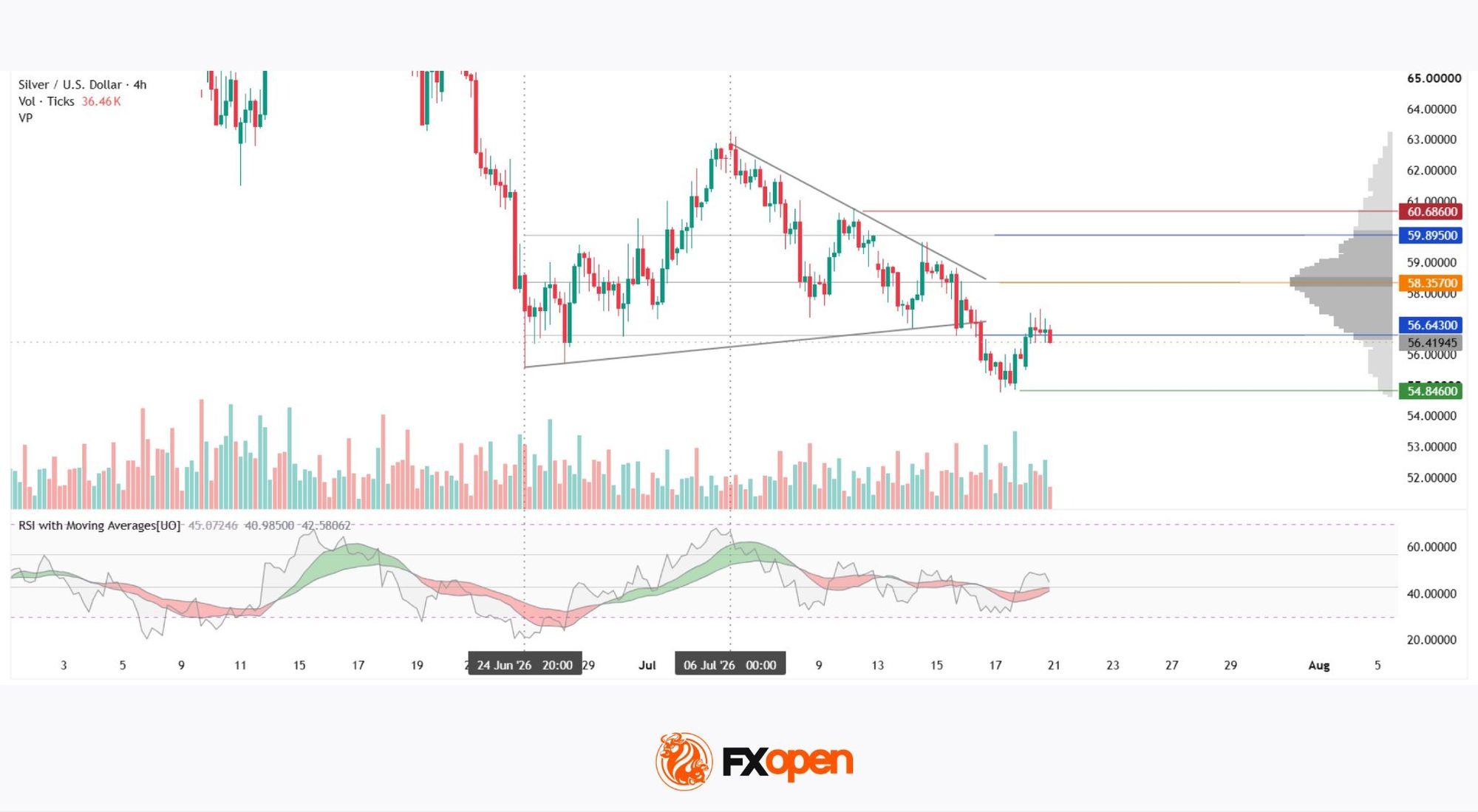
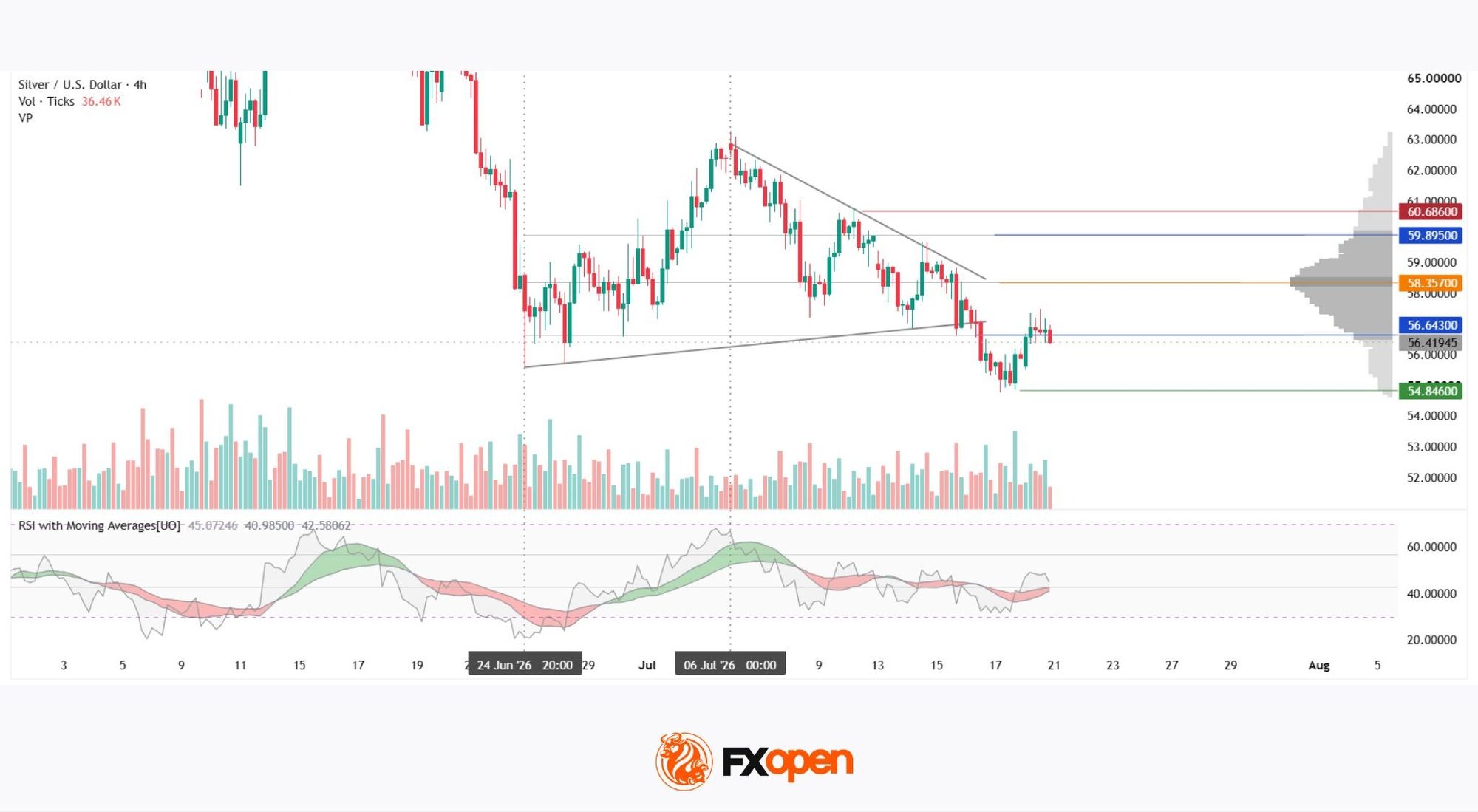
On the four-hour chart, silver (XAG/USD) is trading within a structure resembling a triangle. The descending trendline connects the swing highs formed after the peak near $63.000, while the ascending trendline links the series of higher lows from the $56 area. Their convergence coincides with the current high-volume area of the market profile.
Following an attempted breakout, the price is now testing the lower boundary of the profile at $56.643 from below. If this level continues to act as resistance, the next notable support could be found near $54.846.
Should the price move back into the range, the Point of Control (POC) at $58.357 and the upper boundary of the profile at $59.895 could become the primary upside reference levels, followed by the red resistance level at $60.686.
At the same time, vertical volume has not shown the decline in trading activity that is typically associated with a triangle pattern as the range narrows. The RSI + MAs indicator currently shows readings of 45, 40, and 42. The moving averages remain red, are pointing higher, and are positioned just below the neutral zone, while the RSI line itself has yet to break out of that neutral range.
Summary
The attempted breakout from the triangle has so far failed to gain momentum, with the price returning to the market profile boundary. Meanwhile, the RSI + MAs indicator does not yet confirm either a bullish or bearish scenario. The Federal Reserve meeting on 28–29 July could become the next major catalyst, potentially determining the market’s next directional move.
Start trading commodity CFDs with tight spreads (additional fees may apply). Open your trading account now or learn more about trading commodity CFDs with FXOpen.
This article represents the opinion of the Companies operating under the FXOpen brand only. It is not to be construed as an offer, solicitation, or recommendation with respect to products and services provided by the Companies operating under the FXOpen brand, nor is it to be considered financial advice.
Crypto World
Reserve Transparency Built Through Continuous Operation: Matrixdock Marks Two Years of Independent Verification
If tokenized reserve assets are going to serve as collateral and support lending, treasury management, and settlement across on-chain finance, their backing must remain continuously verifiable.
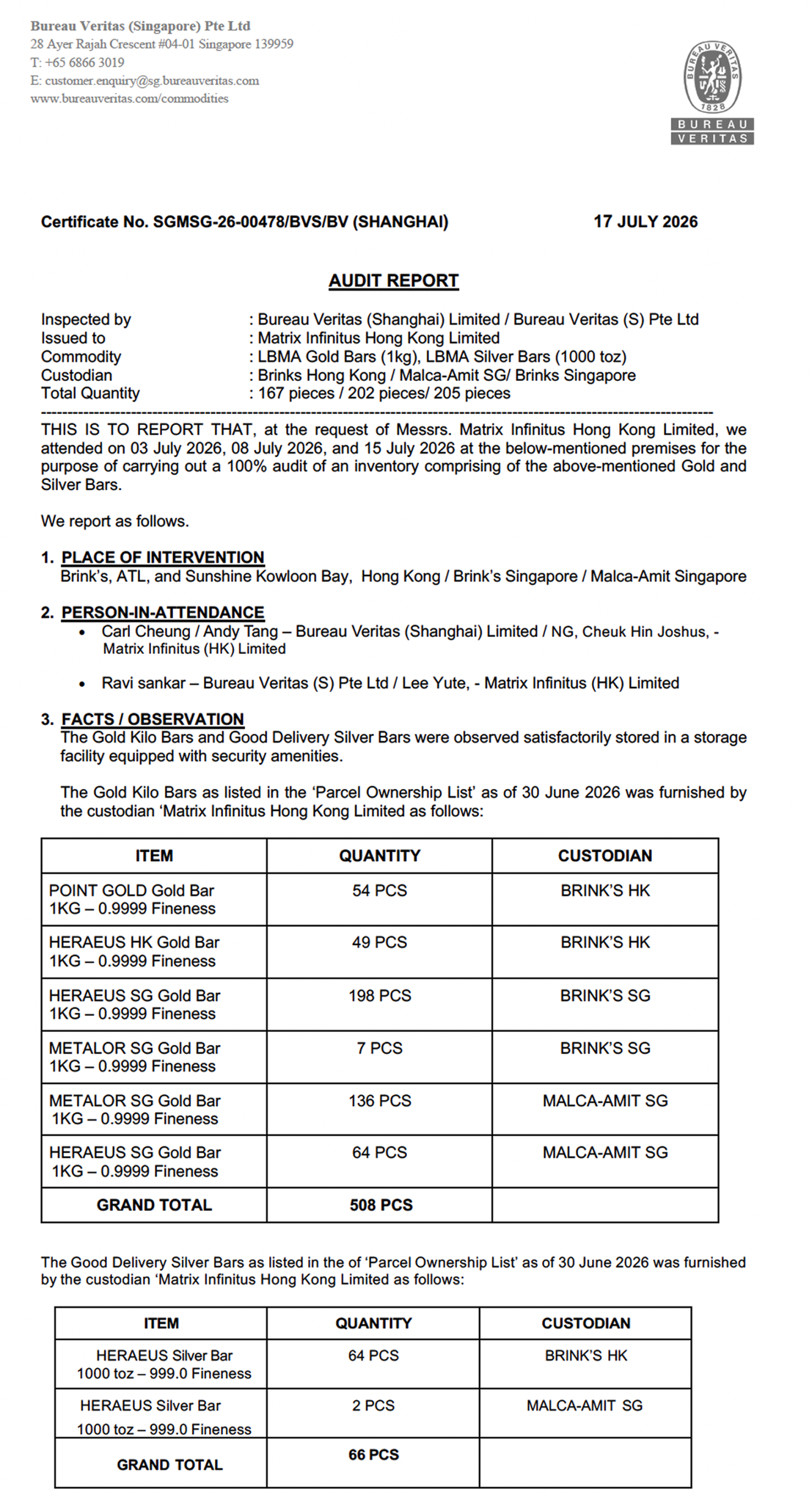
Today, Matrixdock has completed its fourth consecutive semi-annual independent reserve audit with Bureau Veritas. For the first time, the audit extends beyond Matrixdock’s tokenized gold product (XAUm) to include its tokenized silver product (XAGm). More than another audit milestone, this reflects Matrixdock’s broader commitment: building reserve assets that institutions, ecosystem partners, and builders can use with confidence.
Two Years of Continuous Verification. One Operating Standard.
By completing two years of reserve audits with the same independent auditor, Matrixdock has established a consistent verification process. That continuity gives Bureau Veritas a deeper understanding of Matrixdock’s reserve structure and positions them to better identify inconsistencies should they arise. Recurring audits are a form of proof: a verification process that operates consistently over time.
As tokenized assets become increasingly integrated into financial infrastructure, long-term trust is built through continuous operation.
The Reserve Transparency Stack
Reserve transparency at Matrixdock is built in layers of verification that together give holders ongoing visibility into the assets backing each token. Matrixdock calls this the Reserve Transparency Stack.
Independent Verification: Inside the July Audit
Bureau Veritas physically verified the underlying precious metal reserves, confirming that reserve holdings remain consistent with Matrixdock’s records.
As in previous audit cycles, the inspection was conducted bar by bar covering 574 gold and silver bars from LBMA-accredited refiners across three institutional vault facilities:
- Malca-Amit Singapore (conducted on 3 July 2026)
- Brink’s Hong Kong (conducted on 8 July 2026)
- Brink’s Singapore (conducted on 15 July 2026)
Each bar was individually weighed and measured. 26 gold bars have been added since the H2 2025 audit, and 66 silver bars are included for the first time this cycle.

Gold (XAUm)
- Total gold audited: 508 bars
- Equivalent weight: 16331.184 troy ounces
- XAUm circulating supply: 16331.179 tokens
- EVM chains (Dune): 11242.657 tokens
- Sui network (Suiscan): 2677.413 tokens
- Solana network (Solscan): 1575.248 tokens
- Stellar network (Stellar expert): 771.552 tokens
- Approximate market value: USD $66.09 million, based on gold at $4,046.86 per troy ounce
Silver (XAGm) – new to this audit
- Total silver audited: 66 bars
- Equivalent weight: 65,934.000 troy ounces
- XAGm circulating supply: 65998.551 tokens
- Ethereum network (Etherscan): 33004.219 tokens
- Sui network (Suiscan): 32990 tokens
- Current ozPerToken value: 0.999021918
- Approximate market value: USD $4.04 million, based on silver at $61.24 per troy ounce
Each bar was reconciled against the relevant vault records with no discrepancies identified. As of the audit date, XAUm reserves were consistent with the circulating token supply, and XAGm reserves were consistent with the circulating token supply when applying the applicable ozPerToken value.
Ongoing Transparency
A semi-annual reserve audit is one layer of verification. Between audits, holders can check monthly reserve asset statements, on-chain proof-of-reserves for the precious metals products, and the Gold Allocation Lookup tool, which maps specific gold bars to tokens so holders can verify the backing directly. Together, these provide a running record rather than periodic snapshots.
Building the Reserve Layer requires continuous improvement. Looking ahead, Matrixdock is evaluating opportunities to work with global third-party service providers that could strengthen asset-level verification for off-chain reserves while preserving client-level privacy.
Continuous Transparency as the Reserve Layer Discipline
Reserve transparency is the foundation that makes reserve assets trusted enough to participate confidently across on-chain finance.
When reserve backing can be verified at any time, a reserve asset can move deeper into on-chain finance: held in treasuries, integrated into financial applications, and used as collateral in lending markets. By reducing uncertainty around backing, verification expands what a reserve asset can do. That is why reserve transparency is a product feature at Matrixdock.
This is the work of building the Reserve Layer for on-chain finance. As tokenized assets evolve from simple representations into financial infrastructure, their quality will be defined by how well their backing holds up to verification, cycle after cycle. The fourth consecutive semi-annual reserve audit reflects Matrixdock’s long-term commitment to building the Reserve Layer.
Read the full Bureau Veritas audit report here.
The post Reserve Transparency Built Through Continuous Operation: Matrixdock Marks Two Years of Independent Verification appeared first on BeInCrypto.
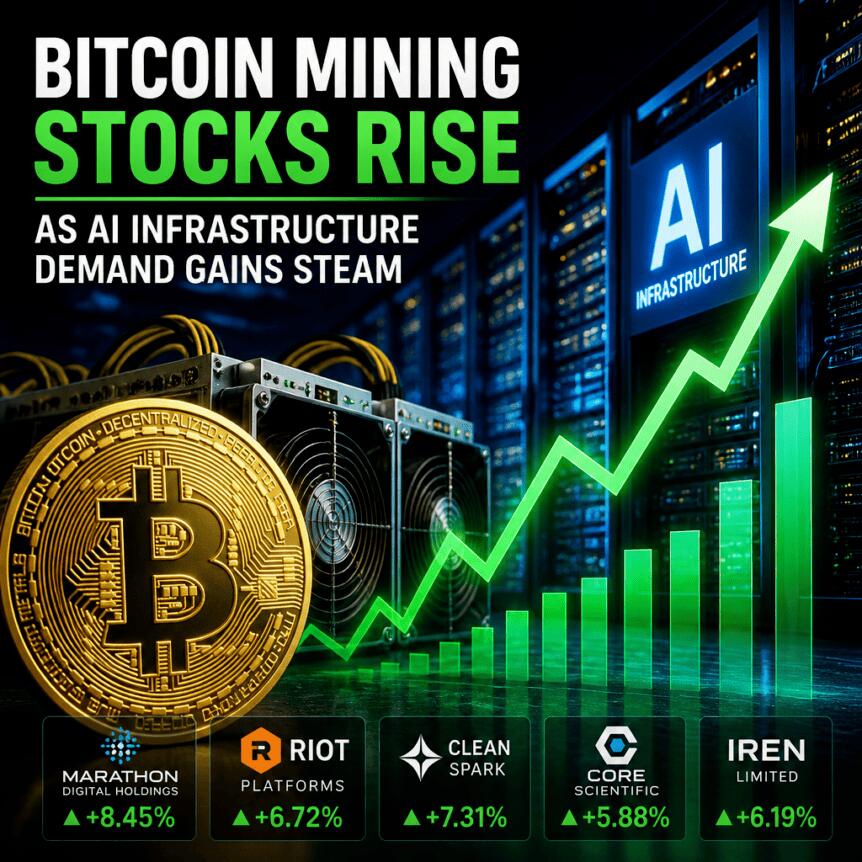
Bitcoin mining stocks jumped Monday as Hut 8 and IREN announced large-scale moves into AI infrastructure and cloud services, renewing investor interest in the sector’s ongoing pivot away from pure mining economics.
According to the early trading data cited in the report, shares of IREN, Cipher Digital, CleanSpark, Hut 8 and MARA Holdings each rose at least 11% on Monday. The catalyst came from two major announcements: Hut 8’s disclosure of a 15-year, $9.8 billion lease for its AI data center campus and IREN’s filing detailing $2.8 billion in cloud services contracts with AI developers (as stated in IREN’s SEC disclosure, https://www.sec.gov/Archives/edgar/data/1878848/000114036126028871/ef20078253_ex99-1.htm).
Key takeaways
- Hut 8’s $9.8 billion, 15-year AI campus lease and IREN’s $2.8 billion cloud contract disclosure helped drive broad gains across mining-related stocks.
- IREN expects its AI cloud business to exceed $4 billion in annual recurring revenue by the end of 2026.
- The rally tracked improvements in broader tech sentiment, including gains in Nasdaq and the Philadelphia Semiconductor Index.
- Industry momentum remains complicated by funding needs and investor scrutiny around insider selling.
AI infrastructure deals spark a sector-wide rerating
The Monday move wasn’t isolated to a single name. The report ties the rally to two specific, capital-intensive developments that place miners closer to demand centers tied to AI computing: large data center capacity and contracted cloud services.
Hut 8’s planned AI data center expansion is anchored by a long-term lease for a campus that, if executed as described, would materially increase its ability to host high-performance workloads. IREN’s SEC filing, meanwhile, highlights cloud services contracts with AI developers totaling $2.8 billion—an important distinction because it points not just to infrastructure buildout, but to service demand lined up in advance.
These developments build on the broader theme that has defined the sector over the past year: miners increasingly market themselves as energy and compute providers for AI-era workloads, not only as facilitators of bitcoin production. The report also notes that these companies began as bitcoin miners before accelerating that pivot as mining profitability faced sustained pressure.
Financial outlook and the AI infrastructure index
IREN’s disclosure included a forward-looking revenue target for its AI cloud unit. The report states that IREN expects the business to generate more than $4 billion in annual recurring revenue by the end of 2026. While such targets are inherently dependent on execution, contracting, and customer adoption, recurring revenue projections are typically more attractive to investors than purely speculative growth narratives—particularly for companies spending heavily to expand computing capacity.
The rally also showed up in a sector indicator maintained by The Energy Mag. The report references the TEM AI Infrastructure Growth Index, which tracks 20 companies spanning bitcoin mining, “neocloud,” and AI infrastructure. It rose 1.4% on Monday and is up more than 12% over the past week, suggesting that market optimism extended beyond a handful of headlines into a broader “AI infrastructure” trade.
Broader tech markets lift semiconductors and risk appetite
Mining stocks did not rise in a vacuum. The report links the move to a wider rebound in technology-related equities, noting that the Nasdaq Composite Index added 0.9% by midday. It also points to strength in the Philadelphia Semiconductor Index, which climbed 2% after having entered a technical bear market the prior week.
For investors positioning for AI growth, semiconductor demand is often viewed as a key upstream signal. The report defines a technical bear market as a decline of 20% or more from a recent high, underscoring that semiconductors were already in a stress phase before the bounce. Monday’s rebound in chip-related equities may have helped create a more favorable risk environment for companies perceived as beneficiaries of AI buildouts.
Volatility, funding gaps, and insider-selling scrutiny
Despite Monday’s positive reaction, the report emphasizes that the mining-to-AI transition remains a source of volatility. It highlights that bitcoin mining stocks have moved sharply this year as companies struggle with a weaker mining environment while trying to finance expensive AI and cloud initiatives.
According to the report’s reference to Blocksbridge Consulting, the AI pivot has driven a “re-rating” across the sector—but the change in narrative has also increased scrutiny, particularly around insider stock sales. The report points to a Blocksbridge-linked analysis in a Miner Weekly newsletter that flagged insider sales at TeraWulf, Riot Platforms, Core Scientific and Cipher Mining. The transactions were described as being executed under prearranged trading plans, but the concern among investors is essentially strategic: whether enthusiasm for AI growth has pushed share prices to levels that make executive selling look opportunistic.
On top of market optics, funding needs remain a central unresolved issue. The report cites Blocksbridge’s estimate that the industry will require another $50 billion to realize its AI ambitions, with IREN described as facing the largest funding gap at roughly $21.1 billion. That estimate frames the rally’s biggest tension: investors may be buying into AI-related growth claims, but companies still face the practical question of how quickly and efficiently they can raise capital and convert planned capacity into contracted revenue.
As the sector digests today’s announcements and broader tech sentiment, investors will likely focus on two things next: whether miners can translate AI infrastructure spending into durable, contracted recurring revenue, and whether scrutiny over insider selling and financing timelines intensifies as expectations rise.
Bitcoin returned above $65,000 on Tuesday as a rebound in Asian technology stocks restored some risk appetite after last week’s semiconductor selloff.
Summary
- Bitcoin reclaimed $65,000 as Asian chip stocks rebounded and broader risk appetite strengthened across markets.
- U.S. spot Bitcoin ETFs extended inflows to five sessions, adding fresh institutional support for prices.
- MACD and RSI readings improved, while $70,000 remains BTC’s next major technical resistance level ahead.
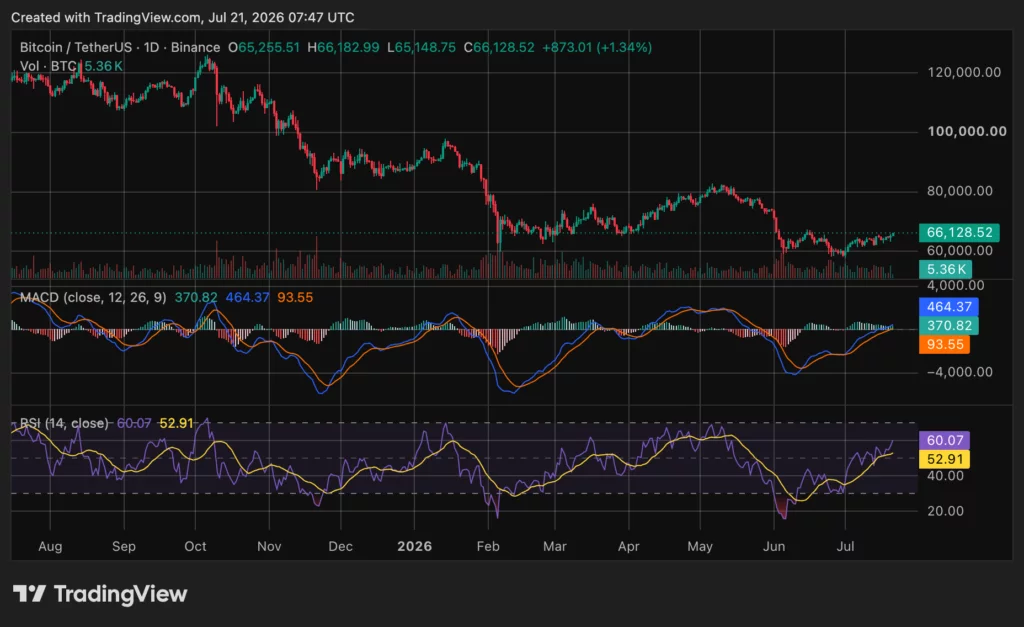
At the time of writing, crypto.news price data showed BTC trading around $65,245, up 1.23% over 24 hours and 5.02% over seven days. Trading volume stood near $32.18 billion.
The broader crypto market also moved higher. Crypto.news showed Ethereum near $1,901, XRP around $1.11, Solana at $77.73, BNB near $571 and Hyperliquid around $62.49. Dogecoin traded near $0.073. The gains followed a sharp reversal across Asian equity markets, where South Korea’s Kospi rose 4.7%, Japan’s Nikkei gained 2.8% and Taiwan’s Taiex climbed 3.6%.
Bitcoin recovers as Asian chip stocks reverse losses
The Bitcoin rebound followed the same part of the market that drove last week’s decline. Semiconductor and artificial intelligence stocks had sold off sharply as investors questioned high valuations and reacted to new competition from China’s AI sector. Bitcoin fell below $64,000 as the technology selloff spread across global risk assets.
Buyers returned to many of those stocks on Tuesday. Samsung Electronics, SK Hynix and Taiwan Semiconductor recovered alongside broader Asian benchmarks. BTC moved with the improved market mood and briefly reached its highest level in roughly two weeks. The move continued a recovery from the June low area near $58,000 to $60,000.
Oil also offered some support to risk markets. Brent crude fell about 1% toward $88 after reports that mediators had proposed a 10-day ceasefire between the U.S. and Iran. Fighting remains active and no agreement has been confirmed, but the pullback in oil eased some pressure from the previous two sessions.
Five-day ETF inflow streak supports recovery
U.S.-listed spot Bitcoin ETFs have also turned positive after a difficult stretch of withdrawals. According to SoSoValue data, the funds attracted $226.9 million on Monday, extending net inflows to five consecutive sessions and bringing the total across the streak to about $727.3 million.
The return of ETF demand follows heavy selling earlier in the summer. More than $4 billion left U.S. spot Bitcoin ETFs during June, while a 13-session outflow streak between May and early June removed roughly $4.37 billion. The recent shift therefore marks a clear change from the sustained redemptions that weighed on the market.
Institutional flows have not been the only source of accumulation. Large Bitcoin wallets accumulated about 270,000 BTC worth roughly $16.7 billion during a period when ETFs were recording heavy withdrawals. That divergence placed more attention on whether renewed ETF buying could add another source of demand during the recovery.
Bitcoin indicators improve as $70,000 becomes next test
Bitcoin’s daily chart shows stronger short-term momentum after the recovery from its June lows. The chart data supplied with the market update places the MACD line near 464.37, above the signal line at about 93.55, while the histogram remains positive around 370.82. That structure shows that buying momentum has strengthened from the previous downside phase.
The RSI also supports the short-term recovery. It stands near 60.07, above its moving average around 52.91 and above the neutral 50 mark. However, the indicator remains below traditional overbought levels. Holding above $65,000 would keep the current recovery structure intact, while the $70,000 area represents the next closely watched test for buyers.
Onchain data offers another view of BTC’s position within its broader market cycle. According to crypto market intelligence platform Alphractal, its four-year standardized MVRV model identifies readings below a Z-score of -1 as periods of severe historical undervaluation and potentially stronger windows for dollar-cost averaging. The firm argues that MVRV can help investors measure where Bitcoin’s market value sits relative to the prices at which coins last moved onchain.
That metric does not provide a short-term price forecast, and historical patterns do not guarantee future returns. However, it adds another data point as BTC attempts to rebuild momentum after falling sharply from its 2025 record above $126,000. Crypto.news currently places BTC about 48% below that peak.
Disclosure: This article does not represent investment advice. The content and materials featured on this page are for educational purposes only.

Ethereum’s price has joined the overall market rally on Tuesday, climbing above $1,900 for the second time in the past week. Naturally, analysts have rushed to offer their insight on why they believe the token will keep surging to new local (and all-time) highs.
Meanwhile, the former CEO of BitMEX has doubled down on his recent bullish behavior toward Ethereum with a fresh purchase.
Hayes Buys Again
Data shared by Lookonchain showed earlier today that wallets linked to the famous crypto personality spent over $2.5 million to acquire 1,332.5 ETH. This is Hayes’ second multi-million-dollar Ethereum accumulation made in the past week. As reported on July 16, he bought 1,293 ETH for the same amount when the asset’s price traded above $1,900 for the first time in months.
Interestingly, that purchase came shortly after he had sold over $10 million worth of the largest altcoin at prices of just under $1,700. As such, he continues to acquire more ETH tokens when the asset rallies, but tends to dispose of them once it corrects.
Arthur Hayes(@CryptoHayes) bought another 1,332.5 $ETH($2.53M) 3 hours ago.https://t.co/gau6egd7Vmhttps://t.co/iKDlaSftbq pic.twitter.com/YKgXPCVe2Z
— Lookonchain (@lookonchain) July 20, 2026
Separately, Lookonchain added that Ethereum whales have gone on a substantial accumulation spree as well. This one purchased roughly $13.5 million worth of the asset. Another one spent $20 million to buy 10,501 ETH, and this one withdrew 12,800 ETH from Binance.
Major ETH Price Calls
As mentioned above, the second-largest cryptocurrency has jumped past $1,900, and analysts were quick to point out its potential. KALEO believes ETH will rise toward $2,300 within the next month, but it might dump even harder in September toward new multi-year lows of $1,200.
Crypto Patel noted that ETH is “trading where long-term wealth is often built.” The analyst pointed out the $1,200-$1,800 range as the accumulation zone, and outlined some massive targets between $10,000 and $20,000 for ETH during the next bull cycle.
Merlijn The Trader outlined a similar development from 2017 that drove the asset toward new highs at the time. He added that those who had given up on ETH are “about to learn why the last holders won in 2017.” His analysis focuses mostly on ETH’s movements against BTC, noting that a surge past 0.029 would solidify the setup, but a dump below 0.026 would invalidate it.
EVERYONE WHO GAVE UP ON ETHEREUM THIS CYCLE IS ABOUT TO LEARN WHY THE LAST HOLDERS WON IN 2017.
2015–2018: accumulation, then a multi-year falling wedge. The breakout went vertical to 0.14.
2018–2025: the same two phases, stretched over 8 years. Accumulation bowl. Then the… pic.twitter.com/BSi769Y0jl
— Merlijn The Trader (@MerlijnTrader) July 20, 2026
The post Arthur Hayes Buys More ETH as Analysts Eye $2.3K and Beyond appeared first on CryptoPotato.


US spot Bitcoin ETFs recorded $227 million in inflows as BTC climbed above $65,000, extending their longest winning streak since early May.
A chart analyst is warning that XRP’s recent bounce may be giving traders false confidence and has argued that the token is still in a long-term downtrend despite recovering from its recent lows.
His view challenges a growing group of traders calling for a breakout, with the next few weeks likely to determine whether the world’s sixth-largest cryptocurrency can build a stronger base or slip below $1.
Weekly Chart Still Points to Resistance
In a series of posts on X, XRP watcher ChartNerd said that traders should continue respecting the asset’s long-term trend rather than assuming a small recovery has changed the market structure.
He pointed out that bears have been in control since a 20-week and 50-week exponential moving average (EMA) death cross formed in January 2026. Further, he argued that a relief in May that stalled at the 20-week EMA before XRP fell from about $1.35 to near $1.00 confirmed that the moving average is still acting as resistance.
According to him, even if XRP rallies toward $1.29 or as high as $1.60, people should treat those levels as heavy resistance unless the price can move above them convincingly. The analyst added that in case the Ripple token hits $1.60 in late July or early August, it would strengthen the case that the recent move near $1.00 marked a local bottom.
However, if the asset doesn’t reach the 20-week EMA around $1.29 or gets rejected there, then “the drop below $1 could come sooner than expected.”
ChartNerd also pushed back against claims circulating on social media that XRP has already broken out of its downtrend dating back to July 2025. Responding to a bullish post from pseudonymous analyst Bird, who suggested that an explosive candle was due at any moment, he wrote that XRP was still inside its wedge pattern and below descending resistance.
He was equally dismissive of traders celebrating the asset’s latest move up and sarcastically questioned whether such a modest rise meant that XRP was now heading “vertical to $100 before EOY.” In another post, the market watcher argued that many of the accounts calling for a breakout today had made almost the same predictions when the token was trading around $2.40 in January, before the price eventually dropped to $1.00.
Mixed Signals Continue for XRP
XRP was trading at around $1.13 at the time of writing, up nearly 4% in the last 24 hours. It has also gained almost 6% over the past week but is still about 2% lower than where it was a month ago.
According to data from CoinGecko, the coin’s latest trading range has been between $1.08 and $1.14, showing that the price has yet to break decisively in either direction.
ChartNerd believes the charts are telling a simple story, which is that until XRP breaks above resistance levels that have contained the market for months, any rally should be looked at with caution rather than treated as confirmation that the downtrend has ended.
Still, there are quite a few beating the bullish drum, including EGRAG CRYPTO, who recently claimed that the asset could eventually move toward a $1 trillion market cap if historical patterns repeat. However, such a move would need much stronger market conditions and far greater investor demand than exists currently.
The post Relief Rally or Bull Trap? Why This Analyst Says XRP Is Heading Below $1 appeared first on CryptoPotato.


Anton Bukov, who co-founded decentralized exchange aggregator 1inch and, by his own account, led its protocol architecture and security, said the company fired him in late November and that he is now building a new infrastructure startup called Second Tier. 1inch disputes that he was fired. Bukov… Read the full story at The Defiant

Donald Trump Losing Support Amid Iran War Prolongation

Two arrested after fight in car park of Eggborough chip shop

searches spike ahead of August deadline


-
 NewsBeat5 days ago
London Mayor Sadiq Khan handed a peerage by Keir Starmer alongside 15 other Labour figures… just days before the PM leaves No10
-

 Fashion4 days ago
Weekend Open Thread – Corporette.com
-

 Politics3 days ago
The House | The City of London can help the new chancellor deliver growth in every postcode
-

 Politics6 days ago
Young campaigners urge incoming PM to act on outdoor junk food ads
-

 Crypto World5 days ago
CFTC blocks Kalshi from unwinding Michigan trades after court order
-
 Crypto World4 days ago
Two July Windows Left: The CLARITY Act’s Senate Fight and What Failure Means
-

 Crypto World3 days ago
Ripple Payments Joins MiCA With 14 Firms, Does It Mean Anything For XRP?
-

 Business5 days ago
Nvidia Stock Slips After Big Tuesday Rally as Huang Confirms Vera Rubin Chip Is Now in Production Today
-

 Politics2 days ago
Democrats look to World Cup watch parties to register thousands of voters
-
 Entertainment6 days ago
Disney’s Most Ambitious Failed Star Wars Attraction Is Coming to SDCC
-

 Crypto World3 days ago
Ripple wins EU-wide access as ESMA adds it to MiCA register
-

 Crypto World5 days ago
Injective Submits SEC Transfer-Agent Registration to Onchain Ownership Records
-

 Business5 days ago
Palantir Shares Rise After Expanded Nvidia Partnership and Fresh Analyst Upgrades Ahead of Earnings Day
-

 Tech8 hours ago
Sail Virtually Aboard The “Itanic” With IA-64 Emulator
-
 Tech6 hours ago
Turtle Beach Command Series KB7 review: a nifty screen-equipped gaming keyboard
-

 Tech7 days ago
Dark Secrets Emerge When Jailbreaking LLMs
-

 News Videos7 days ago
XRP BOMBSHELL… XRP OMBOARDED FOR TRANSACTIONS!!!
-

 NewsBeat4 days ago
Registration is now open for March for Men with Kev 2026
-

 NewsBeat22 hours ago
Unregistered fitter used Gas Safe logo on business flyers
-
 Sports5 days ago
New Cornerback Enters Vikings Trade Rumor Mill
You must be logged in to post a comment Login