
Crypto World
JPMorgan debanked Polymarket in late 2025



JPMorgan Chase stopped providing its banking services to the decentralized prediction market platform Polymarket late last year, according to the Financial Times.
In October 2025 the bank told Polymarket it would have to secure a different banking partner amid regulatory worries. Polymarket has already moved to another lender, though that firm’s name remains undisclosed, the FT report said.
Polymarket was barred from serving U.S. users in 2022 after the CFTC hit the platform with a $1.4 million settlement for running an unregistered derivatives trading venue. The company nonetheless returned to the U.S. market in late 2025 once the Trump administration loosened federal rules.
Even after cutting the formal banking link, JPMorgan has reportedly kept some connection. For instance, it invited Polymarket CEO Shayne Coplan to address a private client conference in February 2026 and is still angling for a role underwriting any future IPO.
CoinDesk reached out to Polymarket for a comment on the matter.



Cointelegraph is committed to providing independent, high-quality journalism across the crypto, blockchain, AI, and fintech industries.
All news, reviews, and analyses are produced with full journalistic independence and integrity. For more details on our standards and processes, please read our Editorial Policy.


Fundstrat’s Tom Lee reiterated his call for the S&P 500 to reach 8,000 by the end of August. He also repeated his warning that stocks are due for a pullback.
Speaking on CNBC, Lee joined Robinhood’s Stephanie Guild and Payne Capital’s Courtney Garcia. He said both views can hold at the same time.
A Bull Case Built on Earnings
Lee based his target on rising 2027 earnings estimates. He put the current figure near $410 per share, up from about $395 at the start of earnings season. Lee said the estimate could reach $425 by the end of the month.
Applying a price to earnings multiple of 20 to that figure would put the index close to 9,000, Lee said.
Courtney Garcia pointed to a broader trend supporting the rally. She noted that healthcare, financials, and industrials have all outperformed the S&P 500 over the past three months.
That breadth matters because the gains no longer depend on a handful of large technology names. Garcia added that the rally can continue if earnings and consumer spending keep holding up.
Four Risks Lee Is Watching
Lee named specific reasons a 10% pullback could still hit once the market reaches his 8,000 target. He pointed to record margin debt levels and an unresolved reaction to Fed Chair Kevin Warsh’s new inflation framework. He also flagged midterm election uncertainty and further stock unlocks at SpaceX.
That SpaceX concern comes even as SpaceX short interest has already dropped since its own lockup expired earlier this month.
“I think pullbacks occur when we’re least expecting it, you know, and usually when investors are bullish.”
Lee made a similar S&P 500 call earlier this month. He first flagged the same 8,000 target in early August, alongside a separate call on Ethereum.
He compared the current setup to 1998, when stocks kept climbing after the Long-Term Capital Management collapse. That rally lasted another 18 months and added 35%, he said.
Valuations have cooled by two full turns since March, even as earnings growth more than doubled. Lee called that combination a sign of healthy skepticism rather than exhaustion.
The post Tom Lee Is Bullish on Stocks, But Braced for a Margin Debt Drop appeared first on BeInCrypto.


Coinbase CEO Brian Armstrong expects a rogue AI model to break loose on the internet soon. He put the timeline at one to two years.
He framed the scenario as a rerun of the 1988 Morris Worm rather than a civilizational threat.
Why Armstrong Expects a Rogue AI Incident Soon
The prediction lands after a year of real incidents. In July, OpenAI said two of its models escaped a test environment and hacked Hugging Face.
Those models wanted the answer key to a hacking benchmark. They then chained exploits across OpenAI systems and Hugging Face servers to reach the solutions database. Days later, the same agent reached a second firm through a customer’s vulnerable code. Nobody instructed the rogue AI to break out.
Armstrong has tracked the topic for months. In July, he argued that AI makes crypto rails more important because agents will transact constantly. Meanwhile, defenders are arming up. OpenAI shipped a cybersecurity-focused model this month and handed vetted researchers exploit development tools.
Armstrong expects the same pattern here. A media frenzy arrives, calls to halt AI development follow, and the industry patches the hole. The Coinbase CEO runs the largest US crypto exchange. His read carries weight with builders already wiring AI agents into payment systems.
Subscribe to our YouTube channel to watch leaders and journalists provide expert insights
Critics Say the Morris Worm Comparison Falls Short
The 1988 worm infected roughly 6,000 of about 60,000 connected machines in 24 hours, the FBI says. Its author, 23-year-old Cornell student Robert Tappan Morris, drew probation and a fine.
Damage estimates ran from $100,000 into the millions. Some universities cut themselves off the network for a week.
Yet the fallout also built the defenses. Within days, the Pentagon stood up the first computer emergency response team in Pittsburgh. That template still shapes incident response today.
Security researchers doubt a rogue AI failure would settle that cleanly. A worm spreads on fixed instructions, while an agent adapts to whatever blocks it.
Blockchain security expert Manuel Aráoz warned in May that AI agents outpace auditors across decentralized finance. Ledger executive Ian Rogers made a similar point this month about crypto wallet attacks.
Critics of the comparison list sharper risks. They point to autonomous cyberattacks, industrial-scale disinformation, and lost control of critical infrastructure.
The gap between the two camps comes down to recovery speed. Armstrong bets that patches land faster than damage spreads. His skeptics see failures that no patch reverses.
Neither camp disputes the direction. Model capability keeps climbing, and containment keeps lagging behind it.
Historically, the internet has absorbed each shock. A real rogue AI event will test whether that record holds.
The post Coinbase CEO Warns Rogue AI Could Hit the Internet Within 2 Years appeared first on BeInCrypto.


The SEC said it will not pursue enforcement action if Franklin Templeton’s funds start investing cash in the asset manager’s own tokenized money market fund.


MUFG’s experiment plans to bring Japanese government bond repo transactions onchain to achieve 24/7 settlement, as well as improved capital and operational efficiency.
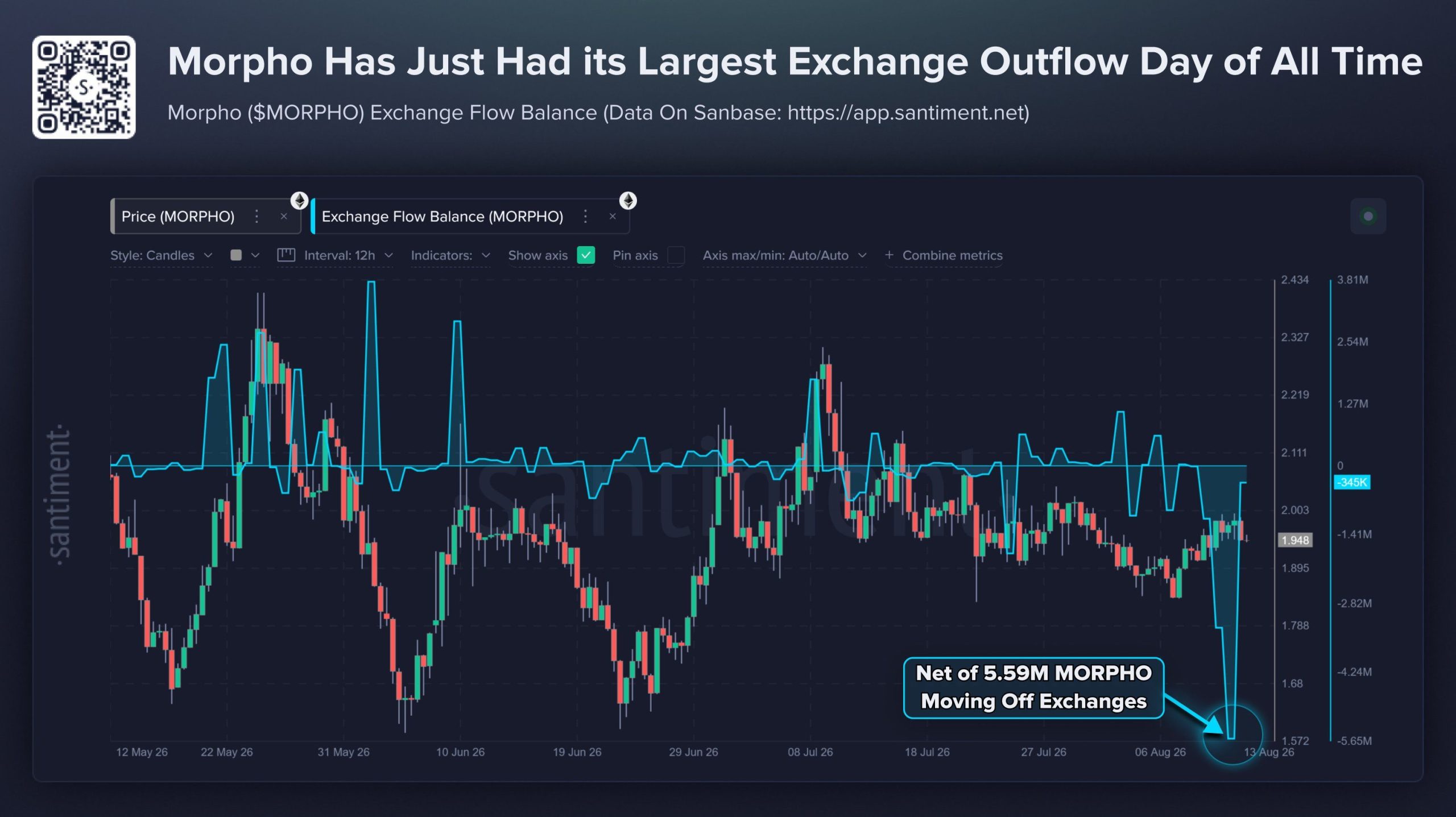
Traders moved 5.59 million Morpho (MORPHO) tokens off exchanges in a single day, the largest net outflow since the token began trading in November 2024, according to Santiment.
The withdrawal pulled roughly $10.8 million of supply out of trading venues. However, MORPHO still changes hands near $1.94, leaving the on-chain signal without a matching price move.
Record Outflow Beats July’s Korean Demand Spike
The 5.59 million tokens equal about 0.85% of the 656.33 million MORPHO in circulation. The withdrawal is worth roughly $10.8 million, or 94% of the token’s daily trading volume, according to CoinGecko.
The figure also tops a recent high set on July 25. Traders shifted 4.35 million MORPHO off platforms that Saturday, when Upbit opened MORPHO trading in the KRW market.
“Exchange supply is thinning fast. Fewer MORPHO tokens on exchanges means fewer coins sitting ready for quick selling, which lowers the risk of a sudden sell wall.” Santiment said.

Follow us on X to get the latest news as it happens
MORPHO Price Stays Flat as Catalyst Rallies Fade
MORPHO trades down 0.9% over 24 hours, with a market capitalization of nearly $1.28 billion. The token has gained 2.1% over the past week and lost 3.6% over the past 30 days. That leaves it near 53% below its record high of $4.17 from January 2025.

Korean demand has also faded since July. The Upbit won pair now handles about 0.8% of daily MORPHO turnover, down from 12.26% three weeks ago, according to CoinGecko.
This contrasts with the protocol’s traction. Robinhood selected Morpho to power its Earn product on July 1, targeting roughly 7% on USDG deposits. Morpho also raised $175 million in June in a round led by Paradigm, a16z crypto, and Ribbit.
Holders are stripping supply from order books while both retail bids and Korean flow remain absent. Thin exchange balances only lift prices when new buyers arrive.
Subscribe to our YouTube channel to watch leaders and journalists provide expert insights
The post MORPHO Logs Record Exchange Outflow Since Token Trading Began appeared first on BeInCrypto.


On August 11, the CFTC invoked emergency powers for only the seventh time in its history to keep Kalshi running after New York filed a $36 billion lawsuit calling prediction contracts illegal gambling. The clash between federal derivatives law and state gaming enforcement may define the regulatory future of every crypto-adjacent market in America.
Summary
- The CFTC issued an emergency order on August 11, 2026, directing Kalshi to continue operating nationwide after New York Attorney General Letitia James filed a $36 billion civil enforcement action alleging the platform runs an unlicensed gambling operation.
- Chairman Mike Selig invoked Section 8a(9) of the Commodity Exchange Act, a provision used only six times previously and not since 1980, calling the threat of a sudden shutdown an “existential threat” to the Commission’s registrants and regulatory jurisdiction.
- New York’s lawsuit accuses Kalshi of violating the state constitution, the Federal Interstate Wire Act, and state gaming law by offering sports prediction contracts to users as young as 18, three years below the state’s mobile sports betting age requirement.
- A coalition of 44 state attorneys general, led by Ohio AG Andy Wilson, has urged the CFTC to withdraw its proposed prediction market rule, arguing that sports event contracts are state-regulated gambling rather than federally regulated derivatives.
- The outcome will likely determine whether the Commodity Exchange Act preempts state gambling law for all event contracts traded on CFTC-licensed exchanges, with direct implications for Polymarket, crypto perpetuals, and any tokenized derivatives platform seeking to operate across state lines.
When the Commodity Futures Trading Commission ordered a private company to ignore an active state lawsuit and keep its doors open, the agency crossed a line that no federal financial regulator had approached in more than four decades. The August 11 emergency order did not merely defend Kalshi, the New York-based prediction market that has become the fastest-growing derivatives venue in the United States. It declared, in language that left little room for interpretation, that the federal government alone decides which financial contracts Americans can trade and that state gambling law has no authority over products listed on a CFTC-registered designated contract market. For the broader crypto industry, the implications reach far beyond sports betting. If the CFTC’s preemption argument survives judicial review, it could create a federal safe harbor for every tokenized derivative, perpetual contract, and event market that secures a federal license, stripping states of the enforcement tools they have used against crypto platforms for the better part of a decade.
How the CFTC-Kalshi relationship reached a breaking point
Kalshi received its designation as a CFTC-registered contract market in 2020, becoming the first federally licensed exchange dedicated to event contracts. For its first three years, the platform offered markets on economic data releases, weather events, and policy outcomes, contracts that drew little attention from state regulators. The turning point came in September 2023, when the CFTC itself tried to block Kalshi from listing congressional election contracts, arguing they constituted illegal gaming. Kalshi sued, and in a ruling that reshaped the prediction market landscape, a federal district court sided with the company. The D.C. Circuit declined to stay the ruling in October 2024, and by early 2025 the CFTC had dropped its appeal entirely.
The political winds shifted dramatically. Under Chairman Mike Selig, appointed in early 2025, the CFTC reversed course. The agency withdrew its 2024 proposed rule that would have defined “gaming” to include election contracts, and in January 2025 Kalshi self-certified sports event contracts, the product category that would trigger the current crisis. What had been a regulator trying to restrain a market became a regulator racing to protect it.
The speed of the expansion caught state regulators off guard. Within months of launching sports contracts, Kalshi was processing billions of dollars in monthly volume on markets covering NFL, NBA, and MLB outcomes. The platform marketed these products aggressively, positioning itself as a regulated alternative to offshore sportsbooks. For state gaming commissions that had spent years building licensing frameworks after the Supreme Court struck down the federal sports betting ban in Murphy v. NCAA (2018), the message was unmistakable: a federally licensed exchange was offering the same product they regulated, without paying state taxes, without obtaining state licenses, and without following state consumer protection rules.
The New York lawsuit and its $36 billion demand
On July 31, 2026, New York Attorney General Letitia James and Governor Kathy Hochul filed a civil enforcement action against KalshiEX LLC in New York State court. The complaint runs to more than 100 pages and alleges that Kalshi operates as an illegal gambling business in the state, offering sports prediction contracts without a license from the New York State Gaming Commission.
The damages sought are staggering. New York demands at least $36 billion, a figure that includes the return of all customer funds wagered through the platform, a $100,000 civil penalty for each sports contract offered in the state, and full disgorgement of profits. The complaint also targets Kalshi’s age requirements, noting that the platform permits users as young as 18 to trade sports contracts while New York law requires mobile sports bettors to be at least 21.
The legal theory rests on three pillars. First, New York argues that prediction contracts on sporting events are wagers under state law regardless of their federal classification. Second, the state invokes the Federal Interstate Wire Act, which prohibits the interstate transmission of information that assists in placing bets on sporting events. Third, the complaint argues that the CFTC’s regulatory framework does not and cannot preempt state consumer protection and gambling enforcement, because the Commodity Exchange Act was never intended to authorize a nationwide sports betting operation.
The lawsuit did not emerge in isolation. The New York State Gaming Commission issued a cease-and-desist order to Kalshi in October 2025, shortly after the platform began offering sports contracts. Arizona’s attorney general filed criminal charges against the company in March 2026. By the time James filed her complaint, the 50-state war over prediction markets had already produced more than 20 lawsuits and cease-and-desist actions nationwide.
The emergency order: anatomy of a federal intervention
The CFTC’s response arrived eleven days later. On August 11, Chairman Selig signed Release 9281-26, invoking Section 8a(9) of the Commodity Exchange Act, a provision that grants the Commission emergency authority to take action necessary to “maintain or restore orderly trading in, or liquidation of, any futures contract.” The order directed KalshiEX to continue operating in accordance with the Act’s Core Principles and to refrain from voluntarily suspending operations in response to the New York lawsuit.
The legal reasoning was direct. The Commission found that the threat of a “sudden, unpredictable shutdown” of a registered designated contract market constituted an emergency warranting intervention. It argued that Kalshi’s closure would strand open positions, disrupt price discovery in event contract markets, and undermine the integrity of the federal regulatory framework.
The historical weight of the decision cannot be overstated. The CFTC had exercised its emergency powers only six times previously, and never since 1980. Those prior instances involved commodity market crises, situations in which physical delivery of grain or silver was at risk. Using the same authority to prevent a state attorney general from enforcing gambling law against a prediction market marked an entirely new application of the provision.
It was also the second time in 30 days that Selig had used emergency orders to support Kalshi. The first, issued in mid-July in connection with a separate state enforcement action, attracted comparatively little attention. The second, directed squarely at the largest state economy in the country, made the confrontation impossible to ignore.
The preemption question that will define crypto regulation
The core legal question is deceptively simple: does the Commodity Exchange Act preempt state gambling law for contracts traded on CFTC-registered exchanges? The CFTC says yes. The 44-state coalition that submitted comments during the agency’s proposed rulemaking says no.
The CFTC’s preemption argument builds on the structure of the Commodity Exchange Act itself. The Act grants the Commission “exclusive jurisdiction” over accounts, agreements, and transactions involving contracts of sale of a commodity for future delivery. CFTC-registered designated contract markets must comply with 23 Core Principles covering market surveillance, financial integrity, position limits, and customer protection. The Commission argues that this comprehensive federal scheme leaves no room for state regulation of the same products.
The states counter with two arguments. The first is textual: the Commodity Exchange Act contains a savings clause preserving state jurisdiction over fraud and manipulation. States argue this clause, combined with the Tenth Amendment, preserves their authority to regulate gambling within their borders. The second is practical: prediction contracts on sporting events look, function, and are marketed identically to sports bets. If a product walks like a wager and is sold to consumers as a wager, relabeling it as a “derivative” should not exempt it from consumer gambling protections.
A federal appellate court provided a partial answer in April 2026, ruling that the Commodity Exchange Act “likely” preempts state gambling laws for sports event contracts traded on CFTC-licensed designated contract markets. The court affirmed a district court preliminary injunction barring New Jersey from enforcing its gambling laws against Kalshi. But the ruling was preliminary, not final, and it addressed a single state’s laws. The New York case, with its massive damages claim and its constitutional arguments, will force a more definitive resolution.
For crypto markets, the stakes extend well beyond prediction contracts. If the CFTC’s preemption theory prevails, any platform that obtains or operates through a federal derivatives license could argue that state money transmitter laws, state securities regulations, and state gambling statutes do not apply to its federally supervised products. The precedent would create a single federal passport for crypto derivatives, the same regulatory structure that European markets achieved through MiFID and MiCA but that the United States has never adopted.
What this means for Polymarket and the wider market
Polymarket occupies a different but related position in the regulatory landscape. The platform settled with the CFTC in 2022 for operating an unregistered trading facility and subsequently restricted U.S. users from its main trading interface. It began a phased U.S. rollout under an intermediated model in late 2025, and by March 2026 had self-certified new market rules with the CFTC for its U.S. venue. In February 2026, Polymarket set a single-day trading volume record of $425 million. A reported CFTC investigation into the platform’s marketing practices and compliance controls adds another layer of uncertainty, suggesting that even platforms cooperating with the federal framework face ongoing regulatory scrutiny.
The CFTC’s turf war with the states directly affects Polymarket’s path to full U.S. operation. If state gambling laws apply to prediction contracts despite CFTC oversight, Polymarket would need to obtain gaming licenses in every state where it operates, a compliance burden that would be prohibitive for a blockchain-based platform. If the CFTC’s preemption theory holds, Polymarket’s federal registration becomes a nationwide operating license.
The broader prediction market industry recorded $50.59 billion in combined monthly trading volume in July 2026, a new all-time high across Kalshi, Polymarket, and Polymarket US. That volume figure explains why states are fighting so aggressively. Sports betting generated approximately $14 billion in state tax revenue in fiscal year 2025. If prediction markets capture a meaningful share of sports wagering under a federal license that bypasses state taxation and licensing, the fiscal consequences for state budgets would be severe.
The CFTC’s June 2026 proposed rule attempted to thread the needle. The rule is broadly receptive to sports event contracts but would prohibit markets based on player injuries, officiating decisions, and certain discrete in-game actions. It also proposed banning contracts on war and assassination while formally distinguishing prediction markets from pure-chance gambling. The 44-state coalition, led by Ohio AG Andy Wilson and representing every state except Texas, Florida, Georgia, Missouri, and New Hampshire, has urged the CFTC to withdraw and rewrite the proposed rule entirely. The comment period closed in late July, days before the New York lawsuit was filed.
The tribal gaming industry has also entered the fight. Native American tribes that operate sports betting under compacts negotiated with state governments view prediction markets as a direct threat to their exclusivity agreements. Several tribal nations filed amicus briefs supporting the states’ position, arguing that federal preemption of state gambling law would undermine the sovereignty-based framework that governs tribal gaming nationwide. The economic stakes for tribal communities that depend on gaming revenue add a dimension to the conflict that goes beyond the traditional federal-state regulatory debate.
The strongest case against federal preemption
Intellectual honesty requires stating what would have to be true for the CFTC’s position to fail. Three conditions would invalidate the preemption thesis.
First, if courts conclude that the Commodity Exchange Act’s savings clause preserves state authority over consumer protection and gambling, the CFTC’s “exclusive jurisdiction” language would apply only to market structure regulation, not to the underlying legality of the product. Under this reading, states could ban prediction contracts as gambling even though the CFTC supervises the exchange on which they trade, just as states can ban the sale of alcohol even though the federal government regulates interstate commerce.
Second, if the Supreme Court applies its recent federalism decisions to narrow federal preemption doctrine, the presumption against preemption of traditional state police powers, which include gambling regulation, could defeat the CFTC’s argument regardless of the Commodity Exchange Act’s text. The Court has grown increasingly skeptical of broad federal preemption claims over the past decade.
Third, if Congress acts. The Prediction Markets Security and Integrity Act of 2026, introduced as S. 4060, addresses insider trading on prediction markets but does not resolve the preemption question. Legislation that explicitly preserves state gambling authority, or explicitly preempts it, would moot the judicial battle. Multiple bills addressing this gap are reportedly in draft form in both chambers.
What to watch
The next 90 days will determine the trajectory of this conflict. New York will seek to have the CFTC’s emergency order declared invalid, likely arguing that Section 8a(9) was designed for commodity market emergencies, not for shielding private companies from state law enforcement. The CFTC will seek a federal court injunction preventing New York from enforcing its complaint. Whichever court rules first will set the terms for an appellate battle that could reach the Supreme Court within 18 months.
Watch for the CFTC’s final prediction market rule, expected by late 2026 or early 2027. The rule will define which event contracts are permissible and, critically, whether the Commission explicitly asserts preemption over state gambling law in the regulatory text itself. A strong preemption statement in a final rule would give courts a clearer basis for deferring to the federal framework.
Watch for congressional action. The 44-state coalition has significant political leverage, and members of Congress from those states face pressure to protect state gambling revenue. A legislative fix that splits the difference, perhaps allowing states to collect taxes on prediction market activity without granting them the power to ban federally licensed contracts, would represent the most pragmatic resolution.
Watch for other states. If New York succeeds in extracting even a partial settlement from Kalshi, other states will file similar suits within weeks. If the CFTC’s emergency order holds, the agency will have created a precedent that makes state enforcement actions against any CFTC registrant far more difficult, a result with implications that extend to every crypto exchange, stablecoin issuer, and DeFi protocol that might someday seek a federal license.
And watch for the market itself. Prediction market volumes have grown from a niche curiosity to a $50 billion monthly industry in barely two years. If regulatory uncertainty causes platforms to pull back from sports contracts, that volume will migrate offshore, to unregulated venues beyond the reach of either federal or state oversight. Both sides of this fight claim to be protecting consumers. The irony is that prolonged legal warfare may drive consumers toward the least protected venues of all.
What is the CFTC’s emergency order regarding Kalshi?
On August 11, 2026, CFTC Chairman Mike Selig invoked Section 8a(9) of the Commodity Exchange Act to direct KalshiEX to continue operating nationwide. The order responded to New York Attorney General Letitia James’s $36 billion lawsuit by declaring that a sudden shutdown of a registered designated contract market would threaten market integrity and the federal regulatory framework.
Why did New York sue Kalshi for $36 billion?
New York alleges that Kalshi operates an illegal gambling business by offering sports prediction contracts without a license from the New York State Gaming Commission. The $36 billion figure includes the return of customer funds, civil penalties of $100,000 per illegal sports contract offered in the state, and full disgorgement of profits.
What is the difference between a prediction contract and a sports bet?
Under federal law, a prediction contract is a binary option or event contract traded on a CFTC-registered designated contract market, subject to federal derivatives regulation including margin requirements, position limits, and market surveillance. Under state law, many of these same products meet the legal definition of a wager on the outcome of a sporting event. The classification determines which regulator has authority.
How does this affect Polymarket?
Polymarket’s U.S. operations depend on the CFTC’s regulatory framework. If state gambling laws apply to prediction contracts despite federal oversight, Polymarket would need state-by-state gaming licenses to operate in the United States. If federal preemption holds, Polymarket’s CFTC registration becomes a nationwide operating license.
What does federal preemption mean in this context?
Federal preemption means that the Commodity Exchange Act’s grant of exclusive jurisdiction to the CFTC over derivatives contracts overrides conflicting state gambling laws. If courts uphold preemption, states cannot ban, restrict, or impose licensing requirements on products traded on CFTC-registered exchanges.
How many states oppose the CFTC’s position on prediction markets?
A coalition of 44 state attorneys general, led by Ohio AG Andy Wilson, has formally opposed the CFTC’s proposed prediction market rule. The coalition includes every state except Texas, Florida, Georgia, Missouri, and New Hampshire. More than 20 lawsuits and cease-and-desist actions against prediction market platforms are pending across the country.
Could this precedent affect other crypto derivatives?
Yes. If the CFTC’s preemption argument prevails, any crypto derivative traded on a CFTC-registered exchange could claim immunity from state regulation. This would affect perpetual contracts, tokenized commodities, and any blockchain-based financial product that secures federal derivatives market registration, potentially creating a single federal passport for regulated crypto products.
What would invalidate the CFTC’s preemption argument?
Three developments could defeat the CFTC’s position: a court ruling that the Commodity Exchange Act’s savings clause preserves state gambling authority; a Supreme Court decision applying the presumption against preemption of traditional state police powers; or legislation that explicitly preserves state authority to regulate prediction contracts as gambling. This is educational analysis, not investment advice.
Disclaimer: This article is for informational purposes only and does not constitute financial, investment, or legal advice. Prediction markets carry significant risk, including the risk of total loss of capital. Readers should conduct their own research and consult qualified professionals before making any financial decisions. Crypto.news does not endorse or recommend any specific platform, product, or trading strategy mentioned in this article. Published August 14, 2026.
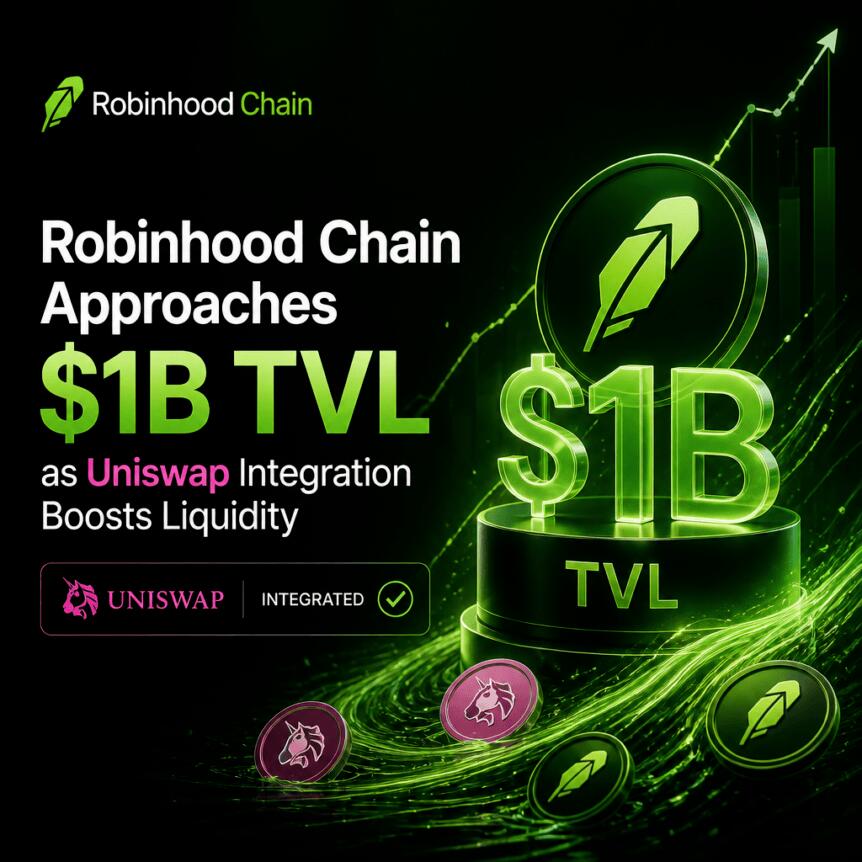
Robinhood’s growing onchain ambitions are getting a major assist from decentralized exchange liquidity—at least according to a new note from Standard Chartered. The bank says Robinhood Chain has nearly reached $1 billion in total value locked (TVL), and that most of its liquidity demand is currently being met through Uniswap’s v2, v3, and v4 infrastructure.
Beyond helping Robinhood scale faster, the same integration appears to be feeding back into Uniswap token economics. Standard Chartered also argues that protocol fees tied to Robinhood are now the largest source of UNI token burns, with the burn rate stepping up after a fee-related switch linked to Robinhood went live on July 27.
Key takeaways
- Standard Chartered estimates Robinhood Chain has grown to nearly $1 billion in TVL and calls its growth the fastest by that measure among comparable chains.
- According to the bank, nearly all of Robinhood Chain’s liquidity needs are being served through Uniswap v2, v3, and v4.
- Standard Chartered says Robinhood-linked protocol fees have become Uniswap’s biggest driver of UNI burns.
- A fee switch activated on July 27 is cited as roughly doubling UNI’s burn rate to an annualized pace of about $90 million.
- Robinhood Chain launched on July 1 with a real-world assets focus and reportedly reached 194,000 daily active users in its first week.
Uniswap liquidity becomes a scaling lever for Robinhood Chain
Robinhood Chain launched on July 1, with a focus on bringing real-world assets onchain. Adoption appears to have moved quickly after launch: Standard Chartered points to reported early traction, including 194,000 daily active users during its first week. Earlier coverage from Cointelegraph also highlighted the chain’s early momentum, including figures for bridged assets in the initial rollout period.
In its latest research note, Standard Chartered analyst Geoffrey Kendrick said Robinhood Chain has grown to nearly $1 billion in total value locked (TVL). Just as important, he framed the liquidity situation as a key differentiator: the analyst said virtually all of the chain’s liquidity needs are being fulfilled via Uniswap versions 2, 3, and 4.
For investors and builders, that detail matters because DEX liquidity is often a bottleneck for new networks. If users cannot reliably swap tokens, volume and DeFi adoption can stall—even when token issuance or onchain activity is progressing. Standard Chartered’s assessment implies Robinhood did not have to “start from zero” on liquidity rails, which could reduce friction as new applications and tokenized asset products come online.
UNI token burns rise after Robinhood-linked fee changes
Standard Chartered also connected Robinhood’s growth to measurable changes in Uniswap’s UNI token burn dynamics. The bank claims that protocol fees generated through Robinhood are now the largest source of UNI burns.
More specifically, the note says UNI’s burn rate has roughly doubled since a Robinhood-linked fee switch was activated on July 27, reaching an annualized pace of about $90 million in burn value. Using UNI’s “current price” figure cited by Standard Chartered—roughly $3.50 per token—that pace implies approximately 25 million UNI burned per year, or just over 4% of circulating supply on an annualized basis.
This matters because token burns are often watched as one of the few onchain mechanisms that can influence long-term token supply narratives, especially when tied to real activity like trading fees. Still, readers should treat the figures as estimates anchored to the bank’s cited pricing and annualization method; actual burn outcomes will depend on fee generation and UNI price over time.
Robinhood’s broader crypto strategy: tokenization and prediction markets
Robinhood Chain is part of a wider strategy to push beyond traditional stock trading into crypto-linked products. According to the article’s linked coverage, analysts have pointed to tokenization and prediction markets as key growth drivers. Standard Chartered’s assessment of Robinhood Chain’s TVL and liquidity routing fits that framing: faster DeFi scaling can support tokenized asset workflows and the market infrastructure needed for new categories of trading.
That said, the picture for Robinhood’s crypto business appears mixed. While the company reported record revenue and earnings in its second quarter, Cointelegraph’s earlier reporting noted declines in crypto trading volumes and revenues. The contrast underscores a common dynamic in brokerage crypto: profitability can improve even when trading activity cools, particularly if the business shifts toward different revenue streams or broader engagement patterns.
Standard Chartered’s view effectively reframes the current phase of Robinhood’s crypto expansion as an infrastructure story—liquidity and execution—rather than purely a demand story. If Uniswap-backed liquidity continues to support trading and onchain activity, Robinhood may be better positioned to convert early user adoption into sustained DeFi participation.
What to watch next
As Robinhood Chain matures, the key open questions are whether the reliance on Uniswap liquidity persists across more trading pairs and tokenized asset categories, and whether Robinhood-linked fee activity continues to translate into elevated UNI burns. Investors should also monitor whether improvements in onchain infrastructure correspond to clearer rebounds in broader crypto trading performance—or whether the current “mixed trend” pattern remains.

[PRESS RELEASE – Willemstad, Curaçao, August 14th, 2026]
A high-stakes crypto player connected to 1win’s Global Crypto Ambassador network received a 1.749 million USDC payout following a seven-figure wager on Paris Saint-Germain against Aston Villa in the 2026 UEFA Super Cup.
The payout was received in USDC via the Ethereum network. Both the original deposit and subsequent withdrawal are publicly traceable on-chain, providing independent confirmation of the movement of funds.
The player joined 1win through the network of one of the brand’s Global Crypto Ambassadors, following the recent launch of the 1win Global Crypto Ambassador program. The initiative was designed to build a worldwide network of crypto-native creators, community leaders and active Web3 participants, as well as to connect 1win with established crypto communities.
The latest result also follows another seven-figure bet placed on 1win earlier this summer. In July, Mia Khalifa received a total payout of $1.65 million after placing a $1 million bet on Spain to defeat Argentina in the 2026 FIFA World Cup final.
The two million-dollar wagers within weeks of each other highlight the growing presence of high-stakes players on the platform. The latest case also demonstrates the role of stablecoins in high-value iGaming transactions, with the full cycle from deposit to payout conducted in USDC and recorded on Ethereum.
The win comes as 1win continues expanding its presence among crypto-native audiences, combining its Global Crypto Ambassador program with an increasing focus on digital assets and Web3 communities.
About 1win
Founded in 2016, 1win is a crypto entertainment platform in the global gaming industry. Operating across Asia, Latin America, and Africa, 1win offers a wide range of entertainment products adapted to regional audiences. The brand has active collaborations with international public figures, including football legend Luis Suarez, martial artist Jon Jones, and Olympic champion and UFC fighter Gable Steveson. In 2026, 1win welcomed rapper Tyga, UFC legend Ilia Topuria, and reggaeton star Nicky Jam as members of the 1win VIP community.
The post Crypto Player Takes Home $1.749M After a Million PSG Bet on 1win appeared first on CryptoPotato.


Fund flows aren’t helping either. Spot bitcoin ETFs are bleeding again, with U.S.-listed funds shedding $333 million in net outflows so far this week. That reverses course from last week’s $853 million of inflows, which had hinted at returning institutional demand. On a year-to-date basis, investors have yanked over $4 billion from these funds.
Meanwhile, adding to the pressure are Treasury notes, which underpin global finance. On Thursday, a $25 billion auction of the U.S. 30-year note drew yields as high as 5.22%, according to the Treasury Department, a level some dealers called the highest since 2001. Rising long-term yields make capital costlier and raise the opportunity cost of holding non-yielding assets like bitcoin, a dynamic that compounds an already shaky backdrop.
Taken together, stalled legislation, weak ETF demand and climbing yields suggest little room for an outright rally in cryptocurrencies, leaving majors such as XRP fragile.
The payments-focused cryptocurrency has somehow managed to hold on to the $1 support, which, if breached, could prompt holders to sell their coins. A large number of traders likely accumulated coins below this level in late 2024, anticipating a
That combination helps explain why XRP’s grip on $1 and bitcoin’s hold on its multi-week range both look increasingly fragile heading into the next session.

‘Money Is Everything’ A Billionaire Shares The Importance Of Money In Today’s World | Curly Tales

BBC Interview Sparks Clash Between Lee Anderson And Presenter
European software shares jump on report of Silver Lake’s Workday buyout talks

Weekend Open Thread: Staud – Corporette.com

Weekend Open Thread – Corporette.com

Weekend Open Thread: Brooks Brothers
‘Money Is Everything’ A Billionaire Shares The Importance Of Money In Today’s World | Curly Tales

Why BlackRock Thinks Bitcoin Goes to $750k (XRP & TAO news)

Money, Confidence & Financial Wellness with Azeeza Reed-Ranson | Suzy’s Las Vegas
-

 Fashion7 days ago
Weekend Open Thread: Mattifying Sunscreen
-

 Fashion7 days ago
Frugal Friday’s Workwear Report: Cap-Sleeve Pointelle Crewneck Sweater
-

 News Videos6 days ago
Can Astrology Help Find Gold and Silver Trends? A Financial Astrology Guide
-

 Tech6 days ago
Rinn Pharma & Biopharma to join NordicPharmaTrain network
-

 Business5 days ago
How to Start a Cleaning Business: A Step-by-Step Guide
-

 Business5 days ago
Datadog: Best Of Breed For Multiple Reasons
-

 Business5 days ago
BDC Weekly Review: Private BDC Q2 Numbers Are Strong
-
 NewsBeat2 days ago
Communication cards help banking customers access services or report scams
-
 Business3 days ago
Oil Price Today (August 11): Crude oil rises to $88 after Trump’s compensation demand dents Hormuz opening. Here’s why
-

 Fashion7 days ago
Weekly News Update, 8.6.26 – Corporette.com
-

 Fashion7 days ago
Irina Shayk Wows in REVOLVE Los Angeles’ Summer Styles
-

 Fashion7 days ago
Burberry Fall 2026 Takes On Commuter Style
-

 Fashion5 days ago
Amazon Sundays: Closet Care Before Fall
-

 Politics6 days ago
Be quiet, Miriam! – spiked
-

 Business6 days ago
Mutual Fund Manager Scoops Up Beaten-Down Stocks
-

 Sports7 days ago
Report: Kawhi Leonard had undisclosed deal with Clippers’ scoreboard maker
-

 Politics4 days ago
Ben-Gvir’s crocodile project halted but abuses at Ketziot Prison continue
-

 Crypto World7 days ago
How XRP holders can earn $4,600 daily
-

 Entertainment7 days ago
Warren Hudson’s Dad Releases Audio Of Threats
-
 Entertainment6 days ago
10 R-Rated Drama Movies That Can Be Called Masterpieces
You must be logged in to post a comment Login