
Crypto World
JPMorgan Issues Bold Bitcoin Prediction Amid Crash

Welcome to the US Crypto News Morning Briefing—your essential rundown of the most important developments in crypto for the day ahead.
Grab a coffee and settle in — the market’s been on a rollercoaster lately. Bitcoin is moving, stocks are shifting, and headlines are coming fast. While some investors are hitting pause, others are watching closely, trying to read the signals beneath the noise.
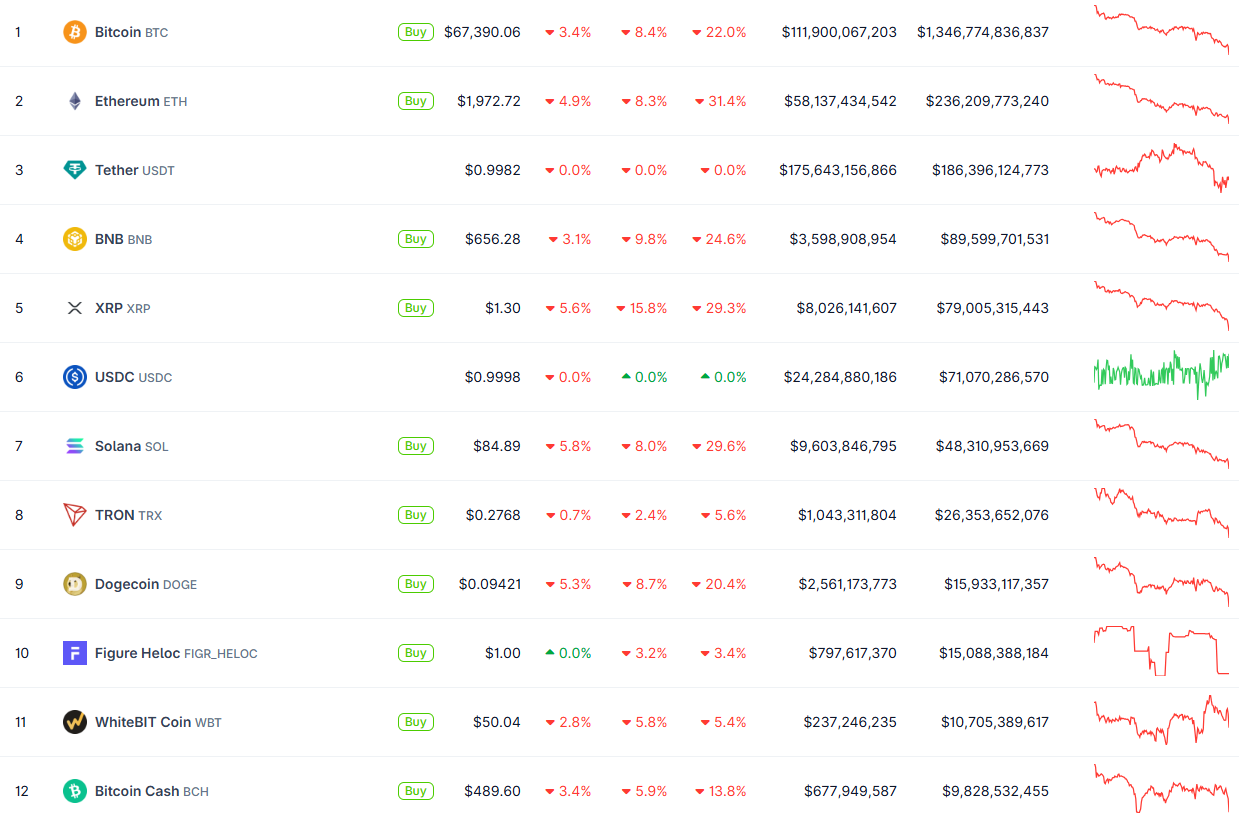
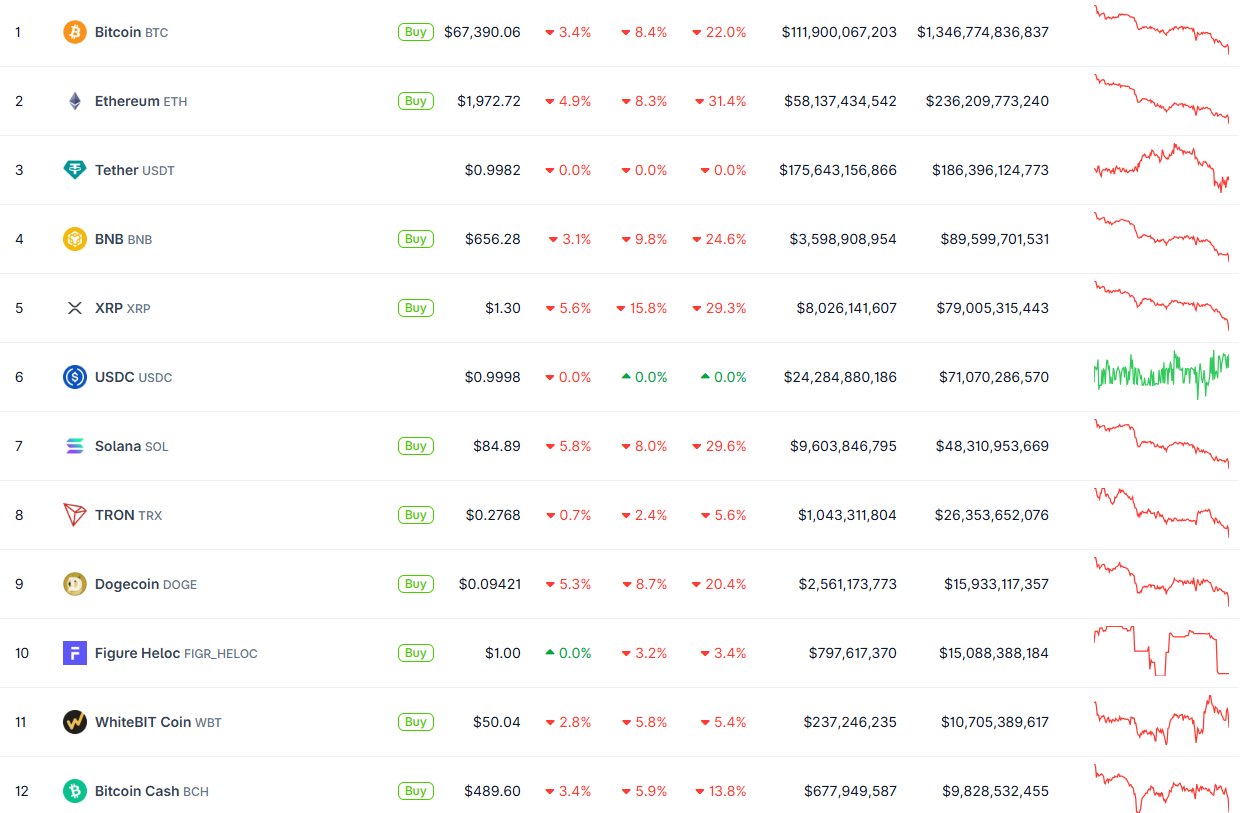
Crypto News of the Day: Bitcoin Slides Below $68,000 Amid Forced Deleveraging
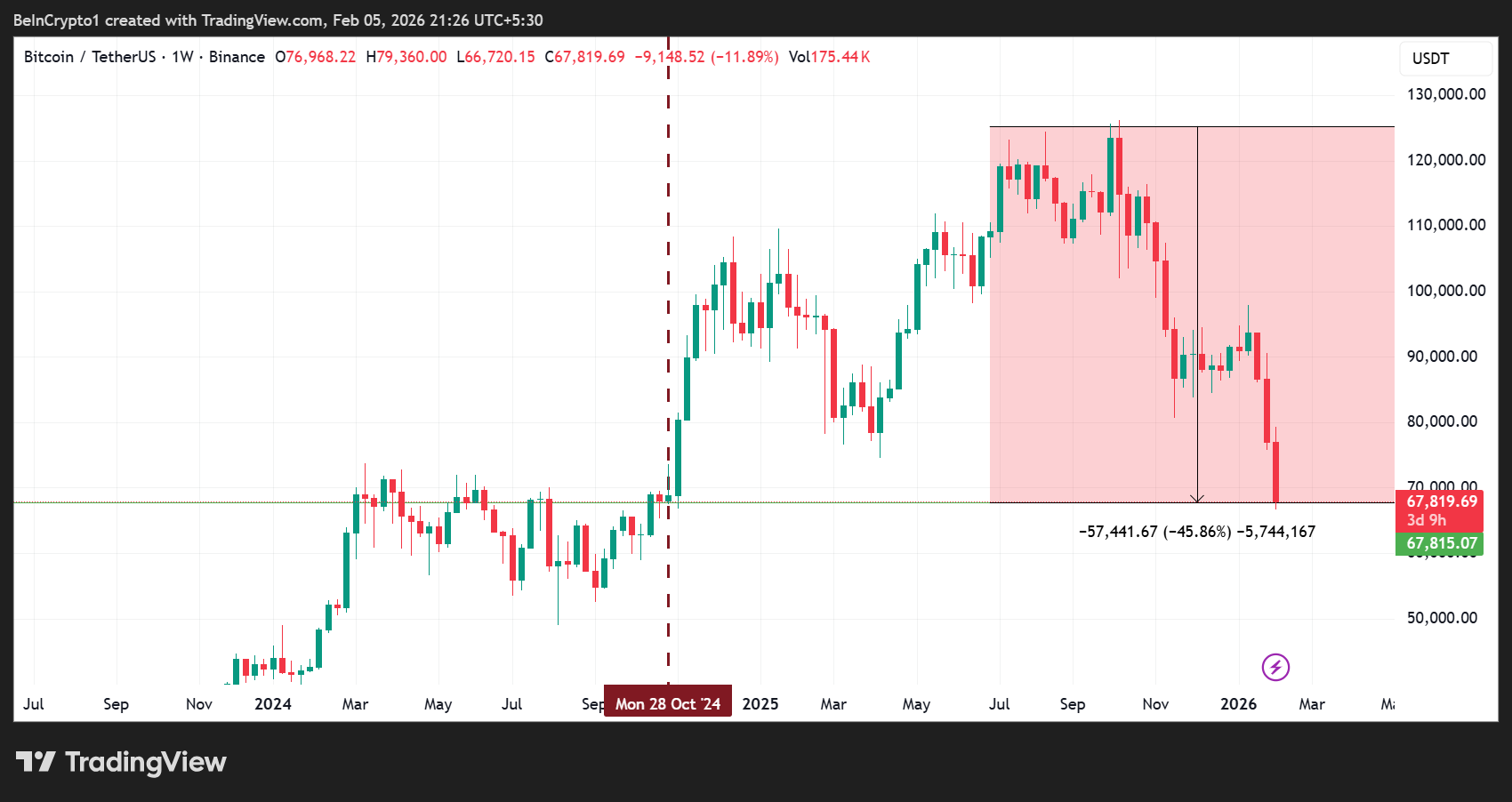
Bitcoin fell below $70,000 on Thursday, before extending a leg down to levels below $68,000, an area last tested on October 28, 2024. The move came as intensified selling swept across crypto markets.
Sponsored
Sponsored
The decline marks roughly a 45% drop from October highs, fueled by ETF outflows, fading demand, and a “forced deleveraging” phase in futures markets.
“…with demand fading, ETF inflows drying up, and futures markets entering a “forced deleveraging” phase. Analysts say weak volumes and sustained selling are prompting investors to exit at a loss, despite technical indicators signaling oversold conditions,” wrote Walter Deaton.
Weak volumes and sustained selling pressure have prompted many investors to exit positions at a loss, even as technical indicators signal oversold conditions.
Despite the short-term turbulence, JPMorgan is increasingly bullish on Bitcoin’s long-term potential relative to gold.
The bank highlighted that BTC is now trading well below its estimated production cost of $87,000, a level historically considered a soft floor, and that its volatility relative to gold has dropped to record lows.
“…large outperformance of gold vs. Bitcoin since last October, coupled with the sharp rise in gold volatility, has left Bitcoin looking even more attractive compared to gold over the long term,” MarketWatch reported, citing JPMorgan’s quantitative strategist Nikolaos Panigirtzoglou.
According to the bank, this improved risk-adjusted profile suggests significant upside for investors willing to hold over a multi-year horizon.
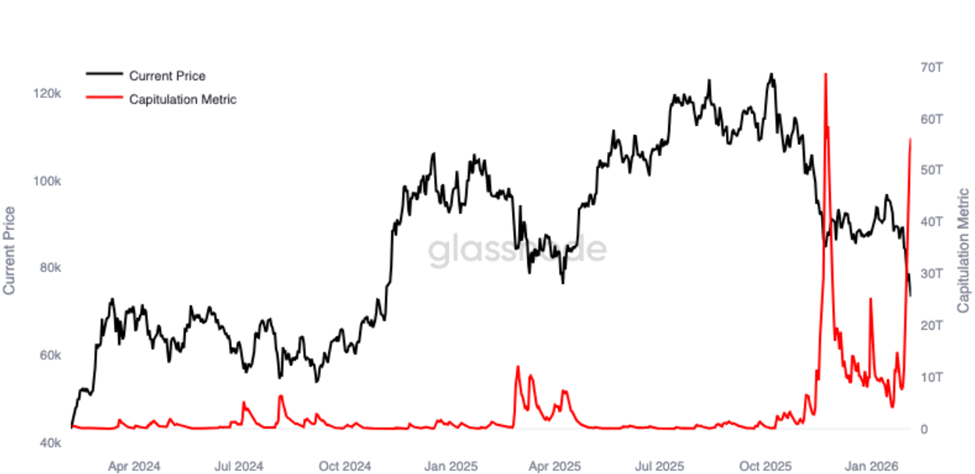
Market stress metrics highlight the fragility of the current environment. Glassnode data shows that Bitcoin’s capitulation metric has recorded its second-largest spike in two years. This reflects sharp forced selling and accelerated de-risking by market participants.
Sponsored
Sponsored
Meanwhile, it is worth noting that Bitcoin has erased all gains since Donald Trump won the election, wiping out a 78% post-election rally and highlighting ongoing volatility.
Crypto Stocks Tumble Amid Bitcoin Sell-Off and Rising Economic Uncertainty
Crypto equities mirror the broader weakness in Bitcoin. Shares of Coinbase, Riot, Marathon, and Strategy fell between 5% and 7% premarket after the drop below $70,000, with ETF holdings also down more than 5%.
The crypto downturn comes amid broader macroeconomic headwinds. US January layoffs surged 205% year-over-year to 108,435, the highest January total since 2009, according to Challenger, Gray & Christmas.
Job cuts were concentrated in transportation — led by UPS — and tech, with Amazon announcing 16,000 layoffs. Healthcare also saw notable reductions.
Sponsored
Sponsored
Meanwhile, federal job protections were overhauled, with the Trump administration finalizing reforms affecting 50,000 civil service workers. Continuing claims remain elevated at 1.84 million, highlighting ongoing economic uncertainty.
Equity markets are also witnessing a similarly complex backdrop, with the BMO Capital Markets projecting the S&P 500 could reach 7,380 by the end of 2026, implying an 8% expected return.
The firm favors cyclical sectors such as industrials, materials, energy, and financials, while underweighting defensive sectors. Inflation remains a principal risk, though global monetary and fiscal stimulus provide support.
With all these in mind, Bitcoin and broader financial market investors face a delicate balancing act:
- Technical oversold conditions and low relative volatility suggest a long-term opportunity
- Yet, immediate pressures from leveraged positions, ETF outflows, and macro uncertainty continue to weigh on sentiment.
JPMorgan’s analysis points to potential gains for patient holders, but the short-term outlook remains volatile, reflecting a market in the midst of recalibration.
Sponsored
Sponsored
Chart of the Day
Byte-Sized Alpha
Here’s a summary of more US crypto news to follow today:
Crypto Equities Pre-Market Overview
| Company | Close As of February 4 | Pre-Market Overview |
| Strategy (MSTR) | $129.09 | $120.78 (-6.58%) |
| Coinbase (COIN) | $168.62 | $159.42 (-5.46%) |
| Galaxy Digital Holdings (GLXY) | $20.16 | $19.10 (-5.26%) |
| MARA Holdings (MARA) | $8.28 | $7.81 (-5.68%) |
| Riot Platforms (RIOT) | $14.14 | $13.36 (-5.51%) |
| Core Scientific (CORZ) | $16.15 | $15.50 (-4.02%) |


Hive Digital Technologies announces an AI cloud milestone in Paraguay, describing the development as a step in expanding its cloud capabilities for AI and research. The notice also references Columbia University LLM research spanning New York to Asuncion, indicating the initiative may involve cross-border collaboration or access to regional compute resources. While the full details are not included here, the announcement highlights a shift in the company’s cloud footprint in an important Latin American market. Readers should watch for additional disclosures on scope, participants, and practical implications as the company provides more specifics.
Key points
- AI cloud milestone reached in Paraguay, as described by the company.
- Release references Columbia University LLM research connecting New York and Asuncion.
- Statement implies cross-border compute resources linked to AI research.
Why it matters
The milestone matters because it signals progress in cloud-enabled AI and potential regional access for researchers and institutions. If the initiative enables cross-border collaboration with Columbia University, it could influence how researchers plan experiments, require infrastructure, and coordinate efforts across North and South America. The public details are limited, but the move may shape attention on AI cloud deployments in Latin America and may guide investors and developers monitoring compute availability and academic partnerships in the region.
What to watch
- Clarification of the milestone’s scope, including services and capacity.
- Any partners or institutions involved beyond Columbia University.
- Upcoming disclosures or timelines for broader availability.
Disclosure: The content below is a press release provided by the company or its PR representative. It is published for informational purposes.
HIVE Digital Technologies Reaches AI Cloud Milestone in Paraguay, Powers Columbia University LLM Research from New York to Asunción
This news release constitutes a “designated news release” for the purposes of the Company’s prospectus supplement dated November 25, 2025 to its short form base shelf prospectus dated October 31, 2025.
San Antonio, Texas, March 18, 2026 — HIVE Digital Technologies Ltd. (TSX.V: HIVE) (Nasdaq: HIVE) (FSE: YO0) (BVC: HIVECO) (the “Company” or “HIVE”), a global leader in sustainable digital infrastructure and AI compute, today announced that its BUZZ AI Cloud platform in Asunción, Paraguay is now operational with live GPU compute nodes serving workloads on the platform by an academic research team from Columbia University in New York.
The Asunción deployment is the first GPU cluster to go live under HIVE’s phased strategy to layer AI and high-performance computing (“HPC”) infrastructure onto its existing renewable energy footprint in Paraguay. The cluster is hosted within a Tier-III data center operated by Paraguay’s largest telecommunications provider and is purpose-built to handle AI model training, inference, and computationally intensive research workloads.
HIVE expects to use the results of the cluster to establish the proof of concept for AI compute between New York and Asuncion. From this proof-of-concept, the Company expects to build future Tier III data center capacity in Yguazú, with infrastructure upgrades required to provide high-availability, low-latency GPU AI cloud compute from Paraguay. Paraguay’s hydroelectric generation capacity and the telecom partner’s nationwide fiber backbone provide the energy and connectivity foundation to support that growth. As regional South American institutional and commercial demand for HPC and AI Cloud develops, the pace and scale of the Company’s Tier III expansion in Paraguay will be guided by customer adoption and the Company’s capital position.
Columbia University Research Team Goes Live on BUZZ Cloud
The Columbia University team is using BUZZ Cloud GPU infrastructure to conduct research focused on large language model (“LLM”) pre-training, including end-to-end training of foundation models. The research team’s use of BUZZ Cloud infrastructure is a non-commercial research engagement intended to generate performance data that will inform the Company’s roadmap for scaling commercial HPC capacity in Paraguay. The team is developing optimization algorithms that improve model quality while reducing computational and memory costs, evaluating their methods using standard training metrics such as loss and perplexity, as well as downstream benchmarks.
Their work begins with small- to medium-scale models (0.2B to 2B parameters, including GPT-2-class and LLaMA-style architectures) and is scaling to larger models (8B+ parameters) using multi-GPU distributed training frameworks. The team’s recent focus includes improving and understanding Muon and MuonClip, the latter of which has been used in training industry-level LLMs such as Kimi K2. In early experiments, Muon has shown roughly 1.3x greater efficiency¹ than standard baselines by exploiting the structure of model weights. The team’s LLM reasoning research was recently accepted for publication by Transactions on Machine Learning Research (“TMLR”), a peer-reviewed journal hosted by the Journal of Machine Learning Research (“JMLR”).
Having the Columbia University research team run active LLM training jobs from New York on GPU infrastructure in Asunción provides HIVE with real-world performance data across latency, throughput, and workload management. The Company intends to use these findings to shape its roadmap for scaling HPC capacity in Paraguay, with initial deployment targets through 2027.
Paraguay: The Western Hemisphere’s Next Potential AI Infrastructure Frontier
Paraguay’s President Santiago Peña earned his Master’s degree in Public Administration from Columbia’s School of International and Public Affairs (“SIPA”) in 2003, creating a notable link between the institution whose researchers are now training LLMs on BUZZ Cloud and the nation whose clean energy powers it.
Management believes large-scale AI compute requires two resources Paraguay can deliver in abundance: reliable, low-cost electricity and fiber connectivity with the bandwidth and security to move data across long distances without degradation. HIVE’s existing 300-megawatt (“MW”) renewable power base, sourced from hydroelectric generation, combined with the telecom partner’s enterprise-grade network infrastructure, creates a platform that can serve demanding workloads originating outside Paraguay’s borders, including from North American institutional clients.
Paraguay’s economy has posted strong growth in recent quarters, backed by stable governance and a policy environment that has welcomed foreign infrastructure investment. HIVE believes those conditions, paired with the country’s distinctive energy profile and expanding digital connectivity, position the country to play a growing role in South America’s AI and high-performance computing future.
Strategic Outlook from HIVE Leadership
Frank Holmes, Executive Chairman of HIVE, stated, “HIVE has 300 MW of renewable hydroelectric power operational in Paraguay, with another 100 MW in development. Before scaling an AI factory, it’s prudent to beta test. This deployment marks our first live GPU compute workload in Asuncion and provides the real-world performance data we need to guide our Tier-III expansion roadmap. We started in Paraguay with Bitcoin mining. Layering AI and HPC infrastructure onto that existing energy base is the next phase, and this cluster is the first step in validating that approach.”
Aydin Kilic, President and CEO of HIVE, added, “We are taking a meaningful and impactful approach to developing a solution to being a leader of GPU AI compute and HPC in South America. Having a research team from Columbia University running LLM training workloads on HIVE’s BUZZ Cloud infrastructure in Asunción is a powerful validation of what we are building. We will use this data to validate our proof of concept for GPU Cloud AI compute from New York to Asunción and to build our roadmap for large-scale HPC capacity in Paraguay by 2027.”
About HIVE Digital Technologies Ltd.
Founded in 2017, HIVE Digital Technologies Ltd. is the first publicly listed company to mine digital assets powered by green energy. Today, HIVE builds and operates next-generation Tier-I and Tier-III data centers across Canada, Sweden, and Paraguay, serving both Bitcoin and high-performance computing clients. HIVE’s twin-turbo engine infrastructure-driven by hashrate services and GPU-accelerated AI computing-delivers scalable, environmentally responsible solutions for the digital economy.
For more information, visit hivedigitaltech.com, or connect with us on:
X: https://x.com/HIVEDigitalTech
YouTube: https://www.youtube.com/@HIVEDigitalTech
Instagram: https://www.instagram.com/hivedigitaltechnologies/
LinkedIn: https://linkedin.com/company/hiveblockchain
On Behalf of HIVE Digital Technologies Ltd.
“Frank Holmes”
Executive Chairman
For further information, please contact:
Nathan Fast, Director of Marketing and Branding
Frank Holmes, Executive Chairman
Aydin Kilic, President & CEO
Tel: (604) 664-1078
¹ Claim of efficiency relates to research methods
Neither the TSX Venture Exchange nor its Regulation Services Provider (as that term is defined in policies of the TSX Venture Exchange) accepts responsibility for the adequacy or accuracy of this news release.
Forward-Looking Information
Except for the statements of historical fact, this news release contains “forward-looking information” within the meaning of applicable Canadian securities laws, which may include but is not limited to statements regarding: the performance of the BUZZ AI Cloud platform in Asunción, Paraguay; the ability to replicate and scale this performance; the benefits and advantages of power supply and Internet connectivity in Paraguay, the reorientation of the Swedish facilities to HPC standards; the expected deployment, timing, capacity, and expansion of BUZZ HPC’s GPU-accelerated infrastructure in general; and any other future-oriented statements. Forward-looking information is based on current expectations, estimates, forecasts, and projections, as well as management’s beliefs and assumptions, including that the benefits of the operations in Paraguay can be replicated and scaled, infrastructure will be deployed on the expected timelines and within budget across all sites, demand for AI computing will continue to grow, and regulatory requirements will remain consistent with current expectations, and other related risks as more fully set out in the Company’s disclosure documents under the Company’s filings at www.sec.gov/EDGAR and www.sedarplus.ca.
Forward-looking information involves known and unknown risks, uncertainties, and other factors that may cause actual results, performance, or achievements to differ materially from those expressed or implied by such forward-looking information. Such factors include, but are not limited to the following risks: deployment timelines may change; costs may exceed expectations; performance expectations may not be achieved; demand for AI infrastructure may be lower than anticipated; partnerships or regulatory approvals may not materialize as expected; and the risk factors described in the Company’s continuous disclosure documents available on SEDAR+ at www.sedarplus.ca. Readers are cautioned not to place undue reliance on forward-looking information. The Company disclaims any obligation to update or revise any forward-looking information, whether as a result of new information, future events, or otherwise, except as required by law.
Crypto World
GitHub phishing scam uses OpenClaw branding to lure developers into wallet drain: report


Crypto scammers are using OpenClaw’s popularity to target developers via a new GitHub phishing campaign designed to drain their crypto wallets.
Summary
- Attackers are impersonating OpenClaw on GitHub, creating fake accounts and tagging developers with messages offering $5,000 in $CLAW tokens.
- Victims are directed to a cloned website where a malicious wallet connection prompt is used to trigger wallet draining.
- OX Security says the campaign uses obfuscated code and targeted tactics, though no confirmed victims have been reported so far.
A report published by platform OX Security detailed an active phishing campaign targeting OpenClaw via a coordinated effort on GitHub, where attackers create fake accounts, open issue threads in attacker-controlled repositories, and tag dozens of developers.
One such post detailed how developers were approached with messages claiming they had been selected for an OpenClaw allocation, telling them they had won $5,000 worth of $CLAW tokens, and subsequently directing them to a fake website that closely resembles openclaw.ai.
On the website, victims are presented with the option of connecting their wallets through a malicious “Connect your wallet” prompt that eventually leads to wallet draining.
The campaign has surfaced as OpenClaw has become a more visible project, especially after OpenAI CEO Sam Altman announced that OpenClaw creator Peter Steinberger would lead its push into personal AI agents. OpenClaw has since transitioned into a foundation-run open source project.
Researchers at OX Security said attackers may be using GitHub’s star feature to identify users who have starred OpenClaw-related repositories, thereby making it appear more targeted and credible.
Scammers were seen using a file named “eleven.js” to embed wallet-stealing code within obfuscated JavaScript. Once triggered, scammers used a built-in “nuke” function that wipes traces from the browser’s local storage to avoid detection and continue tracking activity.
The malware tracks user actions via commands such as PromptTx, Approved, and Declined, sending encoded data, including wallet addresses and transaction values, to a command and control server.
Researchers have identified at least one wallet address believed to be linked to the attackers that was used to receive stolen funds. So far, there has been no confirmation of victims.
OX Security has urged users to block token-claw[.]xyz and watery-compost[.]today, and avoid connecting crypto wallets to newly surfaced or unverified sites.
In the meantime, OpenClaw creator Peter Steinberger has enforced a strict anti-crypto policy. Any mention of cryptocurrencies across the project’s Discord server can lead to removal.
The decision stems from a scam that surfaced during its rebrand, where attackers promoted a Solana-based token called $CLAWD that surged to approximately $16 million in market capitalization before falling over 90% after Steinberger denied any involvement.

There are blockchain projects… and then there are ecosystems trying to rebuild entire industries from scratch.
Nasun falls firmly into the second category—and it’s not being subtle about it.
Built as a Move-based Layer-1, Nasun isn’t chasing trends. It’s engineering a unified foundation where finance, artificial intelligence, and entertainment don’t just coexist—they reinforce each other.
And unlike the usual “coming soon” promises?
Nasun already has three live pillars advancing the vision: Pado, Baram, and Gen Sol.
The Big Idea: One Network, Three Power Engines
Nasun isn’t a single product—it’s a coordinated system:
-
💸 Pado → A unified DeFi super-platform
-
🧠 Baram → Auditable AI execution and settlement layer
-
🎬 Gen Sol → A cinematic sci-fi universe with games, films, and IP expansion
Together, they form something rare in Web3: a vertically integrated ecosystem with real usage across multiple industries.
The Strategic Edge: Why South Korea Matters
Nasun is building from a highly intentional launch point: South Korea.
-
Over 16 million crypto users
-
Around $70 billion in digital assets are held
-
Yet… no Korean-native decentralized trading venue
-
And no compliant self-custody infrastructure
That’s not a small gap—it’s a massive, underserved market.
Nasun isn’t just entering the space. It’s targeting a clear, high-value vacuum.
Let’s be honest—modern DeFi feels like juggling knives while blindfolded.
Multiple wallets. Scattered liquidity. Endless tab-switching.
It’s powerful… but inefficient.
Pado flips the entire experience on its head.
The Core Breakthrough: One Account, One Risk Engine
Instead of splitting your funds across protocols, Pado gives you:
-
One unified onchain account
-
Shared collateral across all positions
-
A single risk engine evaluating your entire portfolio
No more:
Everything lives in one place—and actually works together.
What Makes Pado Different?
🔹 Portfolio-Level Risk
Your entire financial state is evaluated holistically, not per app.
Translation: smarter capital usage, fewer nasty surprises.
🔹 Deterministic Risk Enforcement
No shady liquidations. No hidden rules.
Just transparent, onchain logic applied equally to everyone.
🔹 Yield on Collateral
Your funds don’t sit idle.
They earn yield while actively backing trades—a feature usually reserved for centralized exchanges.
Performance Meets Precision
Powered by Nasun’s parallel execution Layer-1, Pado delivers:
-
Sub-second finality
-
Cross-margin across spot, perps, and prediction markets
-
Protocol-native conditional orders (TP/SL, trailing stops)
And yes—no duct-taped off-chain systems.
AI + Social = Execution That Actually Moves Fast
Pado doesn’t stop at trading.
AI Intent Solvers
Instead of clicking through complexity, you just express intent:
“Open a hedged position with minimal risk”
AI agents handle the execution across markets.
Embedded Social Layer
It’s as if trading platforms and social media had a very productive child.
Everything in One Place
Inside Pado, you already get:
-
Spot Trading (CLOB orderbook + advanced charts)
-
Perpetual Futures (up to 20x leverage)
-
Prediction Markets (event-based trading)
-
Weekly Lottery (onchain randomness)
And coming soon:
Baram: AI You Can Actually Trust
Here’s the uncomfortable truth:
Most AI systems today are black boxes.
Baram changes that.
The Promise: Fully Auditable AI Execution
Every action in Baram is:
-
Authorized
-
Executed
-
Settled
-
Traced
No ambiguity. No hidden processes.
Built for Trust (Not Just Marketing)
Hardware-Level Privacy
Escrow-Based Payments
Stake-Based Accountability
-
Executors stake NSN
-
Misbehavior = slashing
Immutable Audit Trail
Every AI action creates a permanent, onchain record
Why This Matters
Baram isn’t just for devs—it’s for:
-
Enterprises needing compliance
-
Regulators demanding transparency
-
Builders who want provable AI execution
It’s AI that doesn’t say “trust me.”
It says: “verify everything.”
Gen Sol: Web3 Entertainment That Actually Feels Alive
Most Web3 entertainment projects feel like tech demos with lore taped on.
Gen Sol does the opposite.
It starts with a story first—and builds everything around it.
A Living Sci-Fi Universe
Gen Sol spans:
-
Feature films
-
Streaming series
-
Multiplayer games
-
Merchandise
All connected through one cohesive narrative universe.
At the center of it all?
Spectra—a powerful, dangerous resource that fuels the galaxy… and everyone’s obsession.
SPECTRA: The Game
A multiplayer PvP shooter built in Unreal Engine with a brutal core loop:
Crash. Compete. Escape… or die.
-
Teams fight to collect Spectra
-
The environment actively tries to kill everyone
-
More loot = higher rewards… but slower escape
It’s not just about winning fights.
It’s about managing risk under pressure—a theme that perfectly mirrors Pado.
Why Gen Sol Works
Because people don’t just invest in tokens.
They invest in:
Gen Sol creates emotional attachment, which fuels:
-
Engagement
-
Merchandising
-
Cross-platform expansion
This is how Web3 IP becomes mainstream IP.
The Real Take: Why Nasun Stands Out
Most projects pick a lane.
Nasun picked three and built bridges between them.
-
Finance feeds liquidity into the ecosystem
-
AI automates and secures execution
-
Entertainment drives user engagement and culture
It’s not just a stack.
It’s a flywheel.
Final Thought
Nasun isn’t trying to be another DeFi app, AI tool, or gaming platform.
It aims to become the infrastructure layer that integrates all three industries.
Ambitious? Absolutely.
But for once, the architecture actually backs the vision.
And if it works…
You’re not just looking at a new blockchain.
You’re looking at a new digital economy blueprint.
Nasun Network Official
Website | X(Twitter) | Telegram
REQUEST AN ARTICLE


Crypto markets have wiped out recent gains amid hawkish sentiment from the US central bank.
Total market capitalization has declined by almost $100 billion in less than 24 hours before and after the Federal Reserve’s meeting on Wednesday. The metric is now at around $2.52 trillion after falling from just below a six-week high of $2.61 trillion on Wednesday.
Over the past 24 hours, around 136,000 traders were wrecked, with total liquidations coming in at $452 million. The majority, or around 85% of them, were leveraged long positions in Bitcoin.
The big slump has sent markets back towards the middle of their six-week range-bound channel, wiping out most of the gains from the recent rally.
Hawkish Fed Rattles Traders
The dump began before the meeting but continued after Fed chair Jerome Powell’s comments that there may only be one rate cut this year. The US central bank kept rates the same at 3.5% to 3.75% in a widely expected move yesterday.
Fed policymakers maintained their forecast for an additional rate cut this year, but Powell suggested that the central bank remains concerned about stubbornly elevated inflation even before the conflict’s impact on fuel prices, reported the Associated Press.
“The rate forecast is conditional on the performance of the economy, so if we don’t see that progress, then you won’t see the rate cut,” Powell said.
“FOMC events act as volatility catalysts, but their impact depends on the underlying risk regime,” stated Swissblock on Thursday, adding, “In high-risk environments, FOMC days tend to trigger rejection or accelerate downside.”
Rate decisions tend to “amplify the existing regime,” they added, explaining that the current regime is “transitioning toward low risk, but it is not fully confirmed yet.”
“That means FOMC can still trigger volatility, but in the end, Bitcoin depends more on its own internal strength, flow, and momentum than on macro events alone.”
FOMC events act as volatility catalysts, but their impact depends on the underlying risk regime.
In high-risk environments, FOMC days tend to trigger rejection or accelerate downside.
In stabilizing regimes, they often mark local bottoms or continuation points.
The last three… pic.twitter.com/uWnVkjpHm4
— Swissblock (@swissblock__) March 18, 2026
You may also like:
President Donald Trump has repeatedly called for “too slow” Powell to reduce rates, but his own actions have had the opposite effect. Trump’s tariffs and now the war in Iran have caused prices to increase, which is likely to result in inflation figures going back up.
Inflation is one of the two Fed mandates for policy decisions on rates; the other is the labor market.
Crypto Market Outlook
Bitcoin is down 4.3% on the day, dropping below $71,000 on Wednesday, where it currently struggles.
Ether prices dumped 5.6% and fell below $2,200 while struggling to reclaim that level. Meanwhile, the altcoins were bleeding heavily with larger losses for Dogecoin, Cardano, Chainlink, and Zcash.
“For now, traders are expecting a bullish relief rally in spite of no changes being made,” reported Santiment. “This is likely due to the fact that the bearish price action related to the lack of cuts already occurred yesterday.”
Binance Free $600 (CryptoPotato Exclusive): Use this link to register a new account and receive $600 exclusive welcome offer on Binance (full details).
LIMITED OFFER for CryptoPotato readers at Bybit: Use this link to register and open a $500 FREE position on any coin!


The asset’s price exploded by almost 20% in minutes after the listing news went live.
The former CEO of the derivatives giant BitMEX has made several multi-million-dollar trades over the past six months or so, but his latest purchase raised some eyebrows in the cryptocurrency community.
This is because it preceded a major listing of the token he bought, which pushed its price up by double digits.
Did He Know?
Lookonchain data from earlier today shows that Hayes received over 132,000 ETHFI tokens from Anchorage Digital at $0.55 per one. Shortly after, news emerged on social media that one of the largest South Korean exchanges, Upbit, had listed the asset for trading against the local won.
Similar listings by the Asian giant have led to immediate price pumps for the underlying asset on almost all occasions. One of the latest examples involved ICP, whose price skyrocketed by over 16% last week.
Although ETHFI is a much smaller altcoin, its pump was essentially similar, going up by 18% from $0.54 before the announcement to $0.64 minutes after it. However, it was halted there and has lost almost all gains, perhaps driven by the overall market-wide correction today.
Even though some comments below the original post indeed questioned whether Hayes indeed had some insider knowledge, the amount of ETHFI he received seems rather negligible compared to what he sold a month ago – $72.8K now vs. $2.15 million back then.
Interesting — just 5 hours after Arthur Hayes(@CryptoHayes) bought $ETHFI, #Upbit announced its listing.https://t.co/QEgAyVQ4lz pic.twitter.com/9jorCuAHuX
— Lookonchain (@lookonchain) March 19, 2026
You may also like:
Previous Sell-Offs
CryptoPotato reported in February, shortly after the market tumbled, that Hayes had disposed of a large number of DeFi-linked tokens, including ETHFI. Aside from a $950,000 ETHFI selling spree, he also dumped $1 million worth of ENA and $1.1 million worth of PENDLE.
Hayes even sold ETH last August, suggesting at the time that the asset’s price is likely to tumble. However, the largest altcoins went on a run instead, jumping by double digits in weeks. As such, Hayes explained that he had to rebuy at higher prices and asked for forgiveness from the Ethereum community.
Binance Free $600 (CryptoPotato Exclusive): Use this link to register a new account and receive $600 exclusive welcome offer on Binance (full details).
LIMITED OFFER for CryptoPotato readers at Bybit: Use this link to register and open a $500 FREE position on any coin!


PI is among the few altcoins that has not plunged today.
After successfully implementing several consecutive protocol updates, the Core Team behind the controversial project noted earlier today that the next one is already in the works.
At the same time, the underlying token has posted a minor gain since yesterday. However, its broader performance continues to be quite underwhelming.
Next Update Coming Soon
The team announced the first protocol update of the year on February 20, which brought it to version 19.6. The next one, v19.9, followed suit on March 4, and the highly anticipated v20.2 was successfully migrated before the community’s Pi Day (March 14). This one was particularly important as it laid out the fundamentals for enabling smart contract capabilities.
This rollout will occur gradually, the team said, as they aim to prioritize categories that align with utility-based product innovation and operations. The specifics will depend on the needs arising from the utility creation process, they added.
Without providing a clear deadline this time, Pi Network’s official X channel indicated that the v21 upgrade is coming, and node operators must ensure their systems are “up to date.” They added that more instructions will be coming shortly.
The Pi Mainnet has successfully upgraded to Protocol 20, laying the foundation for supporting smart contracts. Node operators, please ensure your systems are up to date and stay tuned for instructions regarding the upcoming v21 upgrade.
— Pi Network (@PiCoreTeam) March 19, 2026
PI Resists Dropping Further
Aside from the aforementioned updates, all announced in the past month, the other big news in the Pi Network community came last week from Kraken. The veteran US exchange said it would list the underlying token for trading starting March 13.
You may also like:
The combined effects for PI were instant and rather mind-blowing. The token exploded by almost 100% in the span of just days, and tapped a five-month peak of around $0.30. However, once it indeed began trading on Kraken, it suffered the consequences of another classic buy-the-rumor, sell-the-news event.
It plummeted by over 30% at one point, and kept losing value to under $0.17 marked yesterday. Interestingly, it has rebounded slightly in the past day (3%), while most other altcoins have suffered 3-5% losses.
Binance Free $600 (CryptoPotato Exclusive): Use this link to register a new account and receive $600 exclusive welcome offer on Binance (full details).
LIMITED OFFER for CryptoPotato readers at Bybit: Use this link to register and open a $500 FREE position on any coin!
Disclaimer: Information found on CryptoPotato is those of writers quoted. It does not represent the opinions of CryptoPotato on whether to buy, sell, or hold any investments. You are advised to conduct your own research before making any investment decisions. Use provided information at your own risk. See Disclaimer for more information.


- FTX Token changed hands at around $0.28 amid broader crypto market volatility.
- The FTX Recovery Trust will commence a $2.2 billion distribution on March 31,2026.
- Potential impact on FTT’s price could see it fall to lows of $0.24.
FTX Token (FTT) is trading lower amid overall crypto weakness and as FTX Recovery Trust announces plans to distribute $2.2 billion to approved creditors by March 31, 2026.
The distribution will mark the fourth round of payouts from the collapsed exchange’s bankruptcy proceedings.
Could this influx of capital crash the FTT token? At the time of writing, FTT hovered near $0.28 and was down 2% in the past 24 hours.
FTX to distribute $2.2 billion to creditors
FTX’s ongoing creditor repayments follow the exchange’s Chapter 11 bankruptcy filed in late 2022 as the Sam Bankman-Fried empire imploded.
SBF was convicted of various charges related to the collapse and is serving a 25-year prison sentence, with FTX now the subject of a Netflix mini-series, ‘The Altruists’, that also features a depiction of Caroline Ellison.
The expectation is that the upcoming eight-episode show will highlight the dramatic implosion of one of the crypto sector’s biggest exchanges at the time, with key questions around governance and customer protection.
Bankman-Fried recently claimed the exchange was never insolvent.
FTX creditors have nonetheless already seen a series of successful payouts, and the company is eyeing another $2.2 billion to both convenience and non-convenience class claims.
The record date for this distribution was February 14, 2026, with payouts commencing March 31 for verified claim holders and distributed within 1-3 business days via designated providers.
(1/4) FTX announced it is set to distribute its Fourth Distribution of ~$2.2 billion on 3/31/26 to holders of allowed claims in the Plan’s Convenience and Non-Convenience Classes that have completed the pre-distribution requirements.
— FTX (@FTX_Official) March 18, 2026
FTT price outlook
FTT, the native token once central to the FTX ecosystem, remains sensitive to these events, despite falling to near zero from all-time highs above $85.
Holders could see the distribution as a fresh trigger to selling pressure, putting the token’s rebound from its all-time lows of $0.24 reached in October 2025 at risk.
Data shows that at least 38.3k wallet addresses hold the FTX Token.
With FTX nearing bankruptcy closure, recovery could include a bullish flip to $0.50 and likely the psychological $1.
This will also hinge on whether broader markets stabilize in the short term.
From a technical perspective, neutral oscillators and mixed moving averages signal caution ahead of the March 31 distribution.
The daily RSI hovers near 42 and signals potential downsloping towards oversold extremes.
Meanwhile, the MACD shows mild bullish momentum with a weakening histogram.

FTT is down 22% over the past month as altcoins suffer downward pressure amid current bearish crypto conditions.
If creditors liquidate holdings with prices in decline, a retest of the all-time lows around $0.24 could follow.

TLDR:
- SEC approved Nasdaq’s proposal to allow Russell 1000 stocks and major ETFs to trade in tokenized form.
- Tokenized trades on Nasdaq will still settle through the Depository Trust Company under existing securities laws.
- ICE, the parent of NYSE, is also developing an on-chain settlement platform and awaiting its own regulatory approval.
- First token-settled trades on Nasdaq are expected to take place before the close of the third quarter of 2026.
Tokenized securities are now moving closer to mainstream equity markets after a landmark U.S. SEC ruling. The Securities and Exchange Commission approved a Nasdaq proposal on Wednesday to allow stocks to trade in tokenized form.
Nasdaq, listed as NDAQ, had submitted the original proposal in September 2025. The decision marks a concrete step toward integrating blockchain-based settlements into traditional equity trading.
Exchange operators across the industry have been racing to capitalize on the growing tokenization boom under easing crypto regulations.
Nasdaq Sets the Framework for Eligible Tokenized Securities
The SEC approval covers a defined set of securities eligible for tokenized trading on Nasdaq’s main market. Initially, stocks within the Russell 1000 Index will qualify for tokenized trading under the newly approved rules.
Exchange-traded funds tracking key benchmarks, including the S&P 500 and Nasdaq 100, are also covered under the approval.
Journalist Eleanor Terrett captured the scope of the ruling clearly on X, writing that “the move will allow participants to opt to have trades in Russell 1000 stocks, as well as ETFs tracking the S&P 500 and Nasdaq 100, settled as tokenized securities rather than through traditional methods.”
NEW: The @SECGov has approved @Nasdaq’s plan to introduce tokenized trading for certain securities.
The move will allow participants to opt to have trades in Russell 1000 stocks, as well as ETFs tracking the S&P 500 and Nasdaq 100, settled as tokenized securities rather than… pic.twitter.com/NPVjcXJxup
— Eleanor Terrett (@EleanorTerrett) March 19, 2026
Furthermore, investors will be able to choose between trading stocks as conventional shares or as blockchain-based digital tokens.
Settlement for all tokenized trades will run through the Depository Trust Company, a familiar and established institution.
The original proposal, filed in September 2025, sought to amend Nasdaq’s existing rules to support both traditional and tokenized trading on its primary market.
The first token-settled trades are potentially expected to occur by the end of the third quarter of 2026. The SEC’s approval of that amendment now makes tokenized equity trading a functional option for a broad range of investors.
Rival Exchanges Are Also Pursuing Blockchain-Based Settlement
Intercontinental Exchange, the NYSE parent listed as ICE, has similarly moved into this space in 2025. Earlier this year, ICE announced it had developed a dedicated platform for trading and on-chain settlement of tokenized securities. The company is currently pursuing the necessary regulatory approvals to bring that platform to market.
The broader push toward tokenization is being driven in part by easing crypto regulations across the United States.
The Trump administration and SEC Chairman Paul Atkins have placed strong emphasis on strengthening American leadership in digital financial technology and making the country the leading hub for crypto globally.
SEC Commissioner Hester Peirce has also been vocal on the matter, stating that “tokenized securities are still securities” and that market participants must fully adhere to federal securities laws when trading these instruments.
The competition between Nasdaq and ICE reflects how aggressively traditional finance is embracing tokenized markets.
Nasdaq has also partnered with Kraken’s parent company, Payward, to develop an “equities transformation gateway,” further extending its blockchain reach beyond the SEC ruling.
This parallel development across rival exchanges points to on-chain equity settlement gaining genuine and lasting industry-wide traction.
The post Nasdaq Gets SEC Green Light to Trade and Settle Stocks as Tokenized Securities appeared first on Blockonomi.


Bitcoin’s biggest early holders, often called original gangsters, are hitting the sell button after the Federal Reserve rattled expectations for lower borrowing costs.
Blockchain data tracked by Lookonchain shows at least two long-term holders together dumped over 1,650 BTC worth more than $117.87 million early Thursday.
One veteran whale who previously sold an 11,000‑BTC stack, added another 650 BTC to his dump, while a separate early‑adopter OG with a 5,000‑BTC stash offloaded a full 1,000 BTC.
Bitcoin’s price dipped nearly 1% to $70,600 soon before press time, extending Wednesday’s 3.5% slide from $74,500, according to CoinDesk data. The broader market wilted, with the CoinDesk 20 Index 3% to 2,056 points. Ether (ETH), XRP (XRP), solana (SOL), and suffered similar losses.
The decline followed a hawkish Fed rate decision on Wednesday, when the central bank left the benchmark borrowing cost unchanged in the 3.5%–3.75% range but signaled a slower pace of rate cuts ahead, disappointing risk‑asset bulls.
The hawkish tone came through the so‑called interest‑rate “dot plot,” which shows where the Fed’s voting members expect interest rates to land in the months ahead. The median projection indicated only one rate cut this year, despite recent labour-market weakness. Moreover, only two committee members remained in the two‑cut camp, and Chair Powell’s own personal projection moved higher.
“The higher for longer narrative has been reinvigorated by sticky inflation and the inflationary shadow cast by rising energy costs, forcing investors to abandon their dreams of a rapid easing cycle,” Matt Mena, crypto research strategist at 21shares, said in an email.
Taken together, these developments pointed to a central bank still wary of inflation and this has led to a sharp repricing of bets on Fed rate cuts. Trading on the decentralized platform Polymarket and pricing in the CME Fed funds futures, now implies around an 80% probability of just one rate cut this year, versus a 62% probability of two to three rate cuts a month ago.
This outlook for tighter liquidity is not supportive of risk-taking in financial markets.


The global crypto market fell sharply on Thursday as new geopolitical and macroeconomic concerns threw cold water on investor appetite for risk assets.
Summary
- Crypto markets dropped sharply as escalating Middle East tensions and hotter U.S. PPI data weakened investor appetite, pushing Bitcoin down nearly 5% to around $70,600.
- Global markets declined alongside crypto, with stocks and precious metals falling while oil surged to record highs amid disruptions at key energy supply routes.
- Over $480 million in long positions were liquidated across crypto markets, amplifying downside pressure as rate cut expectations diminished following Powell’s remarks.
Bitcoin (BTC), the bellwether asset, dropped nearly 5% to $70,600 on Thursday, down from the $74,000 levels seen the previous day. Ethereum (ETH) fell 6% to $2,187, while XRP (XRP), BNB (BNB), Solana (SOL), and Dogecoin (DOGE) experienced losses ranging between 3% and 6%.
Zcash (ZEC), Worldcoin (WLD), and LayerZero (ZRO) bore some of the steepest losses amid the market-wide drop that brought the total crypto market capitalization down to $2.51 trillion.
Crypto prices fell sharply shortly after Israel launched an unprecedented cyber and drone attack on Iran’s largest gas facility, South Pars. According to reports, the massive complex powers nearly 70% of the nation’s domestic gas supply, the loss of which has threatened the country’s power grid.
The strike comes amid an escalating energy war between the U.S., Israel, and Iran, which has led to a blockade at the Strait of Hormuz, a key waterway for global oil transit, and sent crude oil and gas prices soaring to record highs. Iran had earlier vowed to push oil prices to as high as $200.
The latest attack has not only shaken the crypto market but has rippled across traditional finance as well. Notably, Gold has dropped 2.1% over the day, casting investors’ doubts over its safe haven status, while Silver fell 3.5%. Together, these precious metals erased nearly $150 billion from the market.
Traditional stock indices across the globe have also fallen in tandem with risk assets. Notably, Asian benchmarks like Japan’s Nikkei 225 and the Hang Seng have fallen over 2%. Even U.S. indices like the Dow Jones Industrial Average, Nasdaq 100, S&P 500, and Russell 2000 Index have all sharply fallen across the board.
However, oil prices took a different path, rising to new levels. Notably, Brent Crude has jumped 3% to a new record high of $112 on Thursday as traders price in a prolonged disruption in a region that remains a major source of global energy production.
Typically, when gold and cryptocurrency prices crash together, it means traders are fleeing to cash rather than rotating between alternative assets.
Hotter U.S. PPI data and Fed announcement deliver a double blow to bulls
Fears of sticky inflation also played a major role in the crypto market drop today. On Wednesday, the U.S. revealed that the PPI data came in much hotter than expected, with a record monthly gain in a year for wholesale costs. This came as the market was already cautious ahead of the Federal Reserve rate decision that was scheduled for later in the day.
In his speech, Fed Chair Jerome Powell echoed concerns surrounding elevated inflation levels. Powell clarified that the Federal Reserve is prepared to hold interest rates steady as it sticks to a data-driven strategy to combat rising inflation stemming from the oil shock. As such, market hopes for rate cuts this year have fallen slim.
The resulting crash from potential delays in rate cuts and the surging oil price as a result of Middle East tensions together triggered a liquidation cascade across leveraged crypto markets.
Data from CoinGlass shows that over $481 million in long positions were liquidated in the past 24 hours, with Bitcoin and Ethereum accounting for the majority of it, with $143 million and $127 million in long liquidations, respectively.
Long liquidations occur when investors bet on a price increase, and the asset price drops enough to hit their margin limits, forcing the exchange to automatically close their trades.
Disclosure: This article does not represent investment advice. The content and materials featured on this page are for educational purposes only.

Iranians out in strength as thousands attend funeral for security chief Larijani and crew of sunken navy ship | World News

Oklo Stock Wavers After Earnings, but the Nuclear Start-Up Has Good News

Death Stranding 2 leaks early as unencrypted Steam build spreads online


-
 Crypto World5 days ago
HYPE Token Enters Net Deflation as HyperCore Buybacks Outpace Staking Rewards
-

 Tech4 days ago
Your Legally Registered ‘Motorcycle’ Might Not Count Under Proposed US Law
-

 Fashion6 days ago
Weekend Open Thread: Addict Lip Glow
-
 Tech2 days ago
Are Split Spacebars the Next Big Gaming Keyboard Trend?
-
Sports5 days ago
Why Duke and Michigan Are Dead Even Entering Selection Sunday
-

 Business4 days ago
Search for Savannah Guthrie’s Mother Enters Seventh Week with No Arrests
-

 Business5 days ago
US Airports Launch Donation Drives for Unpaid TSA Workers as Partial Government Shutdown Enters Fifth Week
-
Crypto World5 days ago
Coinbase and Bybit in Investment Talks: Could Bybit Finally Enter the US Crypto Market?
-

 Business3 days ago
Australian shares drop as Iran war enters third week
-

 Business5 days ago
Country star Brantley Gilbert enters growing non-alcoholic beer market
-

 Crypto World3 days ago
Crypto Lender BlockFills Enters Chapter 11 with Up to $500M in Liabilities
-

 Sports6 days ago
College Basketball Best Bets: Conference Tournament Semifinal Picks
-

 Politics24 hours ago
The House | The new register to protect children from their abusers shows Parliament at its best
-

 Business6 days ago
Trump demands Powell cut rates as Iran conflict raises energy prices
-

 Fashion3 days ago
25 Celebrities with Curly Hair That Are Naturally Beautiful
-

 News Videos16 hours ago
RBA board divided on rate cut, unusually buoyant share market | Finance Report | ABC NEWS
-

 Crypto World6 days ago
Senate Votes to Include CBDC Ban in Bipartisan Housing Bill
-

 NewsBeat6 days ago
Deane Road crash near Bolton colleges and university
-

 News Videos6 days ago
Tom Lee: The 100x Opportunity EVEN Bigger Than Bitcoin (New Ethereum Prediction 2026)
-

 Crypto World16 hours ago
Canada’s FINTRAC revokes registrations of 23 crypto MSBs in AML crackdown


You must be logged in to post a comment Login